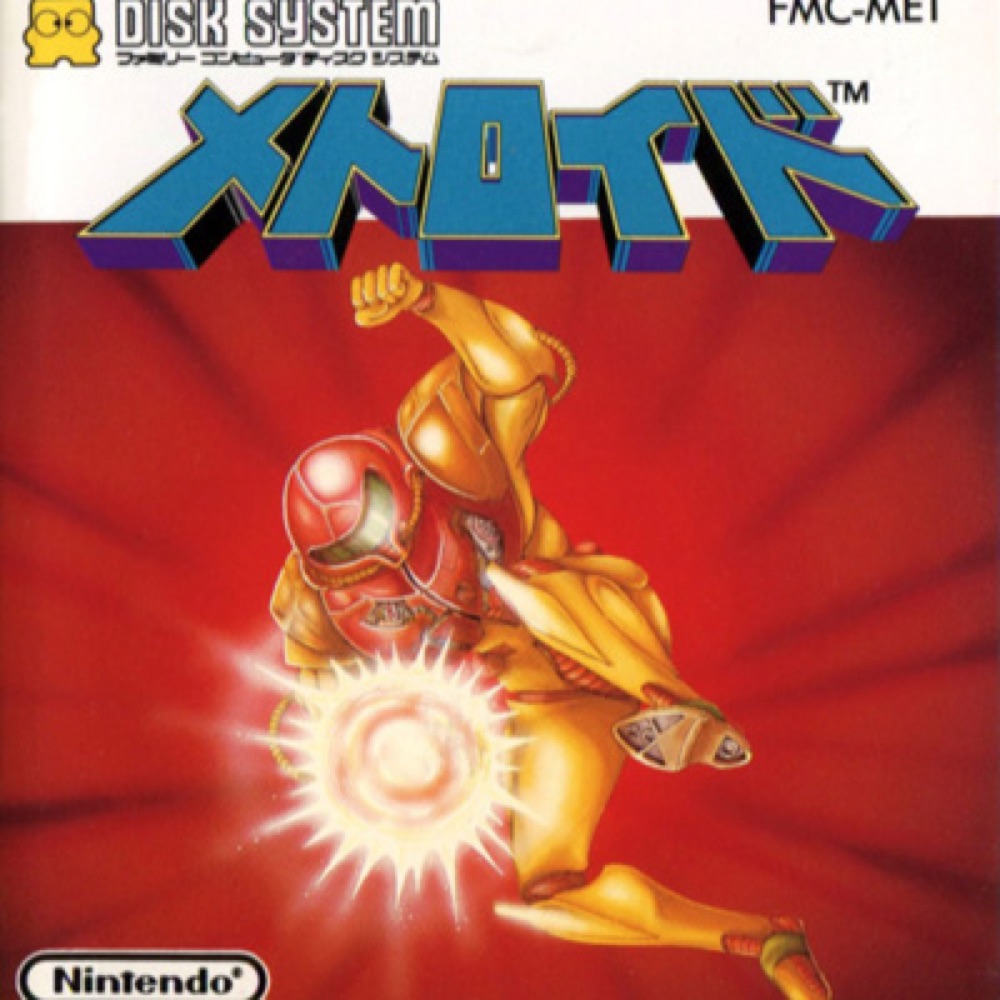
057 · METROID
Ranked #5 in our Top 10 NES Games of 1987 →
The Galactic Federation Police are running scared. A strange life form, held in suspended animation and suspected of causing the destruction of an entire planet, has been stolen by space pirates. The pirates have hidden this "Metroid" deep within the fortress Planet Zebes where they plan to make it multiply, and use it to destroy galactic civilization. For more NEStalgia as well as show notes for this episode visit www.NEStalgiacast.com
Tales from the Manual 2:53.907
Making Of 5:25.665
Gameplay 10:39.927
Power Up and Progression 19:19.947
Map Layout 27:03.093
38:29.827
Boss Battles 51:22.379
What is Satisfying about Metroid? 54:20.935
Development 57:36.370
Female Protagonist 1:06:28.833
Sequels and Spinoffs 1:12:11.462
Essential Games List 1:15:33.878
Metroid is the first of two big Nintendo franchise starters back to back, with The Legend of Zelda next week. We called it the most polished action platformer we'd played so far, and it was Joe's first time ever playing it. It also split the vote, with a game we all admired but Mike was unwilling to recommend today.
What makes it essential
- A tutorial that teaches by blocking you. You can walk right for a while, then hit a gap you are too big to fit through. The game sends you left, where the morph ball is waiting, and the lesson is that power-ups solve problems. If you feel stuck, try everything in the room first.
- You actually get stronger. Energy tanks, missiles and the wave beam make the suit feel like a suit, and starting a fresh file with 35 energy shows how far you came. Lava hurts instead of killing you outright, and there are no pits, which sells the power fantasy. Our Rygar complaint, upgrades that only matter in one spot, does not apply.
- Real non-linearity. Unlike Rygar, you can do areas in a different order than a friend and have a different game. Only a few items are mandatory, such as the morph ball, bombs and missiles, while you can pick between the high jump boots and the ice beam.
- Movement. The floaty, satisfying jump got special praise, and the polish reminded us of Gradius.
- The reward moment. Picking up an upgrade and realizing what it unlocks, with that item sound, was the most satisfying thing we named. Finding the Metroids late, with sprites more detailed than anything we'd seen, is a great reveal.
- A home console game. Like Kid Icarus and Rygar, it justifies owning the NES. The password system is there for a reason, and rushing it in one sitting misses the point.
Where it's rough
- Energy. Enemies cost more than they give, and every restart drops you back to 35 even with hundreds banked. Refilling from the air-vent bugs takes forever.
- No map. Landmarks are scarce, and the tall empty shafts are a slog to climb back up. We split on how to cope, with graph paper for some and a looked-up map for others.
- Hidden rules. Missile doors need five missiles, which nothing explains, and plenty of secrets need random bombing or shooting. In 1987 you needed friends to compare notes.
- Backtracking. The barriers are too far apart, so a wrong guess can cost a few minutes.
- Bosses. They feel like big enemies you shoot a lot, and Ridley seemed unaware of us. You also cannot shoot low, and plenty of enemies are down there.
Beyond the game
The manual runs 48 pages and refers to Samus as "he." Per the interviews we read, a two-person team spent nearly ten months on it, and Sakamoto joined only for the last three. Samus's name came from a mix-up over Pele's real name, and the decision to reveal her as a woman was made "in a flash" to reward fast clears. The credits thank restaurants that fed the team during crunch.
The bottom line
Essential, though not unanimously. Sean, Sam and Joe voted it in, with Sam saying it just barely made the list and Joe weighing pros against cons. Mike voted no. He called it a great 1987 release alongside Castlevania, Gradius and Super Mario Bros., but a starting point rather than an entry point now, with the energy reset and backtracking aging poorly next to later Metroid games. The three yes votes carry it. Play it for how the genre started, and keep a map handy.
Written from our conversation in this episode.
- --?VPm 000000
- 01u000 00000Y
- PLOT
- The Space Pirates plan to replicate Metroids by exposing them to beta rays and then using them as biological weapons to destroy all living beings that oppose them. While searching for the stolen Metroids, the Galactic Federation locates the Space Pirates' base of operations on the planet Zebes. The Federation assaults the planet, but the Pirates resist, forcing the Federation to retreat.
- As a last resort, the Federation decides to send a lone bounty hunter to penetrate the Pirates' base and destroy Mother Brain, the biomechanical life-form that controls the Space Pirates' fortress and its defenses.
- MAKING OF
- Famicom Disk System First with the ability to save and extra sounds. We get the password.
- Originally known as Space Hunter (a Game that would be similar to Metroid but only come to the Famicom)
- The team was Sakamoto (Artist and somewhat Producer -Wrecking Crew, Kid Icarus), Yokoi (Producer - Game&Watch, Game Boy, Donkey Kong), Hiroji Kiyotake (Character Desginer - Kid Icarus), Hirofumi Matsuoka (Background Designer), and Satoru Okada (Director - Kid Icarus)
- Hirokazu Tanaka did the music (Donkey Kong Squeaky SFX and many NES Launch Games)
- GAMEPLAY
- Brinstar
- Norfair
- Kraid's Lair
- Ridley's Lair
- Tourian
- Items
- Missle
- Energy Tank
- Bombs
- Varia Suit
- Long Beam
- Ice Beam
- Wave Beam
- High Jump
- Screw Attack
- Questions
- What did you think of the Map Layout? Those long vertical corridors
- How was Non-linear gameplay? Like Rygar but to the MAX
- Does this feel like an adventure?
- What does progression feel like in this game?
- Was Samus frustrating to control? Can’t shoot low
- Did the boss battles feel like boss battles?
- What is satisfying about this game?
- What to make of the weird Justin Bailey Code?
- Development
- Sakamoto inspired by ALIEN
- How Development Starts
- When making a game, we’d start out by having all the developers gather together to contribute their ideas, with Gunpei Yokoi at the head of the group. Then, using everything we came up with as a base, we work on filling in the blanks. - Sakamoto
- How long did it take for the two of you new employees to develop the game?
- Kiyotake: Not quite ten months.
- Sakamoto: I didn't join development of Metroid until about the last three months. (laughs)
- Sakamoto: I wasn't the only one to join. Everyone in Research & Development Department 1 joined at the end.
- Sakamoto: To be honest, it was hardly done at all! (laughs)
- Sakamoto: Everywhere had the same backgrounds and you could only do the same things. The characters were moving, but the rest of the game design was mere bare bones.
- How Sakamoto got into Video Games at Nintendo
- One day, however, Shigeru Miyamoto wandered over to our room and asked "Is there anyone here willing to lend us a hand?" That’s how I ended up doing sprite art for Donkey Kong Jr., which turned out to be my first real experience with video games. After that, I worked on the arcade version of Wrecking Crew. At the time, game development was done on a very small scale, so we had a team of five or six people working on everything from the programming to the music. Our development period was about half a year. - Sakamoto
- Trying to make what Super Mario Bros Didn’t Have
- What Super Mario Bros. didn't have? Like what?
- Kiyotake: As a simple example, you know how Mario slides a little before stopping?
- Uh-huh…
- Kiyotake: So we tried to make a dead halt.
- On Samus Name
- Kiyotake was the one to name Samus. Which comes from a miscponunciation of Pele, football legend
- Apparently, you thought Pelé's real name is Samus Arantes Nascimentos.
- But if you look it up, it's Edson Arantes do Nascimento.
- How did you decide to make Samus Aran a woman?
- The instruction manual specifically stated that Samus's identity was "shrouded in mystery". However, the booklet did at some points use masculine pronouns ('He', 'Him', and 'His') in reference to Samus, six times on page 7 alone.
- Sakamoto: Once we entered the final stage of development, we started talking about having different endings depending on how long it took players to clear the game. We wanted to prepare a reward for people who cleared it more quickly.
- Kiyotake: We wondered what would surprise everyone and talked about removing Samus's helmet.
- Sakamoto: Then someone said, "It would be a shocker if Samus turned out to be a woman!" And everyone thought that would be interesting and wanted to do it, so we decided it right away.
- Kiyotake: Yeah, we decided that in a flash. Back then, people played games over and over, so we wanted to give a reward for playing through quickly. Then we decided to put in four endings, with Samus removing her helmet or her suit and so forth.
- And to first-time players?
- Kiyotake: I'd like to say, "This is how hard games used to be!" (laughs)
- Special Shout out to a Restaurant
- Sakamoto: We were working late every night those last three months, so we ordered from restaurants near the company. Benkei Dining, the Chinese restaurants Tohryu, and another called Sometime Mako, were especially helpful, so we decided to put those three into the credits.
- Sequels and Spinoffs
- Metroid II: Return of Samus for Gameboy in 1991
- Metroid Manga
- Super Metroid - Super Nintendo Entry
- Playable in Metroid Prime
- Metroid Zero Mission (Streamlined version for GBA w/ added story). Also has Metroid in it.
- Original Metroid on GBA NES Classics
- On the NES Classics
- On the Nintendo Switch Online Service
- Metroid Metal - Which I love
- 
- 
- 
- 
- 
- 
Found automatically from the transcript and checked, but it can miss things or pick the wrong page. Spot a mistake? Tell us.
Games
- Metroid mentioned at
The episode's game: Nintendo's 1986 sci-fi exploration game starring bounty hunter Samus Aran.
- The Legend of Zelda mentioned at
Next episode's game, released right after Metroid as a one-two punch from Nintendo.
- Castlevania mentioned at
An earlier big 1987 release the show covered and voted onto the Essential Games List.
- Kid Icarus mentioned at
Another recent Nintendo game, also on the Famicom Disk System, with a map item and timed endings.
- Rygar mentioned at
An earlier NES game with open-ended exploration, compared with Metroid's non-linearity.
- Metroid Prime mentioned at
The 3D GameCube Metroid, which sold well and unlocks the original Metroid as a bonus.
- Metroid Prime 2: Echoes mentioned at
The sequel that sold about two million copies.
- Wrecking Crew mentioned at
An earlier Nintendo game that Sakamoto worked on.
- Kung Fu mentioned at
An earlier NES game whose go-left-instead-of-right start is compared with Metroid's opening.
- Section Z mentioned at
An earlier NES shooter with an energy meter instead of one-hit deaths.
- Super Mario Bros. mentioned at
The comparison point for movement, sliding and 'what Mario didn't have'.
- Super Metroid mentioned at
The Super Nintendo sequel and the next console Metroid entry.
- Metroid: Samus Returns mentioned at
The 3DS remake of Metroid II, which adds an optional map scan.
- Metroid II: Return of Samus mentioned at
The Game Boy sequel, due in 1991, Samus's next game.
- Metroid: Zero Mission mentioned at
The Game Boy Advance retelling of the original, with Metroid unlockable inside.
- Solomon's Key mentioned at
An earlier NES puzzle game in the hosts' debate about looking up solutions.
- Dark Souls mentioned at
Mentioned for its messages left by other players.
- The Legend of Zelda: Breath of the Wild mentioned at
Used to compare long modern development with the six-month original Zelda.
- Super Smash Bros. Melee mentioned at
Where Samus and a giant Kraid appear in Smash.
- Slalom mentioned at
An earlier NES game that was voted onto the Essential Games List.
- Athena mentioned at
An earlier NES game compared on how it presents its female lead.
- Ghosts 'n Goblins mentioned at
An earlier, harder NES game compared with Metroid's difficulty.
Hardware
- Famicom Disk System mentioned at
Nintendo's Japanese disk add-on where Metroid launched with saving and extra sound channels.
- Game & Watch mentioned at
Nintendo's LCD handhelds, the only prior work of Metroid's two young developers.
- Virtual Console mentioned at
Nintendo's download service, another place to play Metroid.
- NES Classic Edition mentioned at
The mini console whose 30th anniversary interview with the developers is quoted.
Companies
- Retro Studios mentioned at
The developer of Metroid Prime, whose offices Miyamoto visited.
People
- Shigeru Miyamoto mentioned at
Nintendo designer said to be puzzled by Metroid's popularity and not part of its making.
- Yoshio Sakamoto mentioned at
Artist and director who joined Metroid's development in its last three months.
- Hiroji Kiyotake mentioned at
Character designer on Metroid, who named Samus Aran after a mispronunciation.
- Gunpei Yokoi mentioned at
Producer of Metroid and head of Nintendo's R&D1 team.
- Satoru Okada mentioned at
Director of Kid Icarus who also directed Metroid.
- Hirokazu Tanaka mentioned at
Composer of Metroid's music and sound on Nintendo games of the era.
- Pelé mentioned at
The footballer whose name Kiyotake mistakenly thought was Samus Arantes, inspiring Samus Aran.
Film, TV and music
- Alien mentioned at
The 1979 film cited as an inspiration for Metroid's look and story.
- Citizen Kane mentioned at
The classic film some fans compare Metroid's reputation to.
Articles, videos and sites
- Game Maker's Toolkit mentioned at
Mark Brown's YouTube series, including a video breaking down Metroid's opening tutorial.
- Nintendo Switch Online mentioned at
Nintendo's subscription service, where Metroid is playable.
- NEStalgia Essential Games List mentioned at
The show's running list of games still worth playing, voted on at the end of each episode.
Other
- Mother Brain mentioned at
The final boss of Metroid, who controls the space pirates.
- Samus Aran mentioned at
The bounty hunter hero, whose gender is a manual mystery and a reveal in the endings.
- Ridley mentioned at
One of Metroid's space pirate bosses, named after a film director.
- Gradius mentioned at
Konami's earlier shooter, used to describe Metroid's level of polish.
Auto-generated transcript. Each paragraph starts with its timestamp. Speakers are not identified.
It's you against the evil Mother Brain in the thrilling battle of Metroid.
And welcome to NEStalgia, a chronological exploration of every NES game released in North America. I'm Mike. And I'm Sean. I'm Joe. And I'm Sam. Guys, we got a big one today.
How big? This is pretty big. This is like the first for this year of a series that we're going to continue to see again, you know, for a long time. Yeah, no, I've heard of it. Yeah, Super Mario Brothers last year was like that game that like, of course, everybody would look forward to. And I think, you know, there's a lot to look forward to this year. And we already had some big ones like Castlevania, Kid Icarus. Some people might say Rygar, but some people will say that, Sean. I think it's a big one. All right. The interesting thing here, of course, is that Metroid and then next week Legend of Zelda, those two games kind of come back to back and...
One-two punch. Yeah, the one-two punch of two of Nintendo's biggest franchises that have seen different forms of love from Nintendo throughout the years. Obviously, Legend of Zelda does really well for Nintendo. To the favorite child. Yeah, they sell it like hotcakes, but it does not sell like hotcakes in Japan, I found out. Yeah, it's a big North American one.
Yeah. Whereas Metroid is also really just a big North American thing, but even more so. Like, we just really love sci-fi around here because the Japanese apparently aren't having it because Metroid Prime, which is considered like a big game, sold well. They made Metroid Prime 2 and I think it only sold like two million copies, which I mean, like only two million. So it's like not weeb enough then. Yeah, it's really not. Yeah, it's not doing it. I can't believe you went there.
And Miyamoto himself is just very confused about Metroid. Metroid, he doesn't really like understand why it's so popular. I read this whole thing about Metroid Prime's development with Retro Studios and he came into the offices and kind of like talked to them and was just like, yeah, I don't really get the deal with Metroid.
I love the comments from these developers. It really is. And also like, he wasn't like on board with making this game, like he had no part in it. So maybe it's just like, well, that's the one good NES game I didn't make. Oh, so he's probably a little jealous. You should read the manual. It really goes into detail about what the deal is. Yeah. Okay. Uh, yeah, no, not that. Miyamoto definitely not jealous. He's got plenty to be proud of. I just think it's funny that like some people in Nintendo just can't even understand this game. So let's, uh, let's get into it. I'll talk a little bit about the plot of Metroid unless anybody else wants to give it a go first and then I can correct you.
Um, oh, confident. I mean, I can give you a, I mean, I'm not going to read the manual, but maybe that's a job for Sam, the manual Smith. Yeah. What do you got, Sam? So this is the most ridiculous manual I've ever seen of, I think any game. This is a 40, what is it? 46, 48, 48 page manual with backstory, with character art, with tons of stuff in it. Uh, not going to read the whole thing. Please don't. Do, all right, here we go. It sounded like I said please at first and I was like, someone's skipping the chapter right now. All right, so the premise of it is that there is a galactic federation that is just helping, you know, future citizens of space live in peace.
Space pirates exist in this universe and they have taken over this. I like how you didn't specify that a galactic federation exists in this universe, but you felt the need to be like, but space pirates do. Well, it's a given that a federation would form. Yeah, yeah, yeah. Of course a galactic federation would form. You're going to have a federation. Eventually we will have a galactic federation. Yeah, but then there's also, of course, going to be piracy. It's not like, it's not a utopia here. Yeah. Okay. It's not a utopian federation. Uh, there are outliers.
Um. So yeah, you're going to keep going? Yeah. You're taking a little bit of time here. Uh, basically, space pirates found this thing that they, that the federation called Metroid, which can wipe out civilizations and it's like a parasite thing that can be harnessed and they believe that's what happened to this one planet. And so they send bounty hunters. That's how they deal with the space, with the space pirates. They send bounty hunters. That's just like a thing. Um, they send the best bounty hunter in the world, Samus Aran, to this planet to get him and find out what the deal is. But I think the interesting thing is in the whole manual, they call Samus a he.
Yes. Yeah. Really? They are very particular about, uh, not, not specifying anything. In fact, uh, I think I have something yet. It, it doesn't say, uh, when it comes to the identity, it says that Samus's identity was shrouded in mystery, but the booklet also says he, in fact, uh, on page seven alone, it says he six times. Yeah. Wow. You count. So Sam, we're doing, uh, Sean, we're doing good research here. Okay. It's great. Very important that we give the full story. So speaking of the, the full story, Sam covered the story part of it, but I'll give you a little bit of the making of here.
So of course, Metroid is one of the very first, uh, Famicom disc system games. And it comes with the ability to save and has extra sounds, which I hate. I, I've listened to the extra sounds and they don't sound anything familiar to me at all. Like the things I love it when you get an item in this game, you know, because the sound is like, so, you know, like you feel like you've been rewarded. And then when I hear this version that adds like just a couple of extra tunes here and there to my favorite track, I'm like, that's weird.
Yeah. So just, it's just interfering with the nostalgia for it. And you know, the weirdest thing I thought about this, the weirdest thing about it is that Nintendo since then has gone with the American version. If you think about it, like that, that track has always sounded the same. It never had the, the Japanese elements added to it again.
I guess. I mean, if it's, if it's so much more popular in America, why, what, you know, why go for the less popular? It's just an interesting design choice. I noticed because there's a couple of extra like bars to the item pickups that just don't exist. Was the disc system more gimmicky than not? No, the disc system just had the ability to have like, it basically had an extra layer. Right. But do you think it was more like, oh, well we have, we have this extra thing, so we have to use it for something. Right. Oh yeah. Totally. I feel like it's as if in an alternate timeline, if, um, if Disney decided to re-release the original trilogy of Star Wars without all of George Lucas's goofball shit, in the background. Yeah.
And Sam, for the record, uh, all the Famicom disc system games kind of had, had that extra flair to them. Uh, we talked about Kid Icarus having those extra channels and Legend of Zelda has it too. Uh, and we'll talk about that next week, but Legend of Zelda is, I think actually work in their favor, the extra channels. It's almost like you're playing like a, a 16 bit game when you hear those, uh, extra sound effects. Yeah. So made on the Famicom disc system. Of course, we only get the password, uh, system for hours. We don't get, uh, this is the ability to save.
And it was originally known as space Hunter and, uh, that game would be, would eventually be made. And it kind of is similar to Metroid, but not entirely, but it only comes to the Famicom. So we probably won't be talking about it here. So they just took like the name and all of the, so they took the name and made a new game out of it. Yeah. They took the name, made a new game out of it. And it's kind of similar to Metroid. So I imagine maybe when it was being called space Hunter, they were working on that idea and then decided to scrap it. Interesting. Along with some of the ideas. But I will tell you that having seen footage of space Hunter, it's nowhere on that level of Metroid. It's not, they're not similar games.
Uh, so the team was Sakamoto, who of course we all remember he, on this, he was the artist and, uh, kind of like a producer. He was also from wrecking crew and kid Icarus.
Uh, and you bring in any bells Sakamoto? Yeah. Ring in some bells. Okay. Uh, Gunpei Yokoi, he was the producer and that's the guy who made the Game and Watch and the Game Boy and Donkey Kong. And he was basically like all their bosses. Like he was just like the head of that whole division. Uh, we have Hiroji Kiyotake, who, uh, was the character designer. Uh, and he was also the character designer for Kid Icarus.
Hirofumi Matsu, Matsuka? Hirofumi Matsuka, the background designer, which is like, I had to point that out because it's like, what backgrounds really? That's true. You know, the black darkness. Yeah, there's a lot of black darkness. There's like terrain and everything. But I guess, yeah, I guess like everything that isn't the character models themselves, he probably took care of. I like the bubble, the bubbles, like in that certain area. But they're kind of interactable, right? Yeah. Not really background, but I guess it's nice.
Not all the bubbles are interactive. One specific job. You can't just assume all bubbles are interactive. That's true. Interactive bubbles are the best kind, though. Uh, and, uh, Satoru Okada, who was the director for Kid Icarus, he comes back and directs Metroid as well. Oh, okay. So that's the team. And, um, Tanaka did the music and he was also the Donkey Kong squeaky guy.
He's the voice actor that provided the squeaky sounds that Sean hates. And also like many other NES launch games that we're not going to talk about here. So it's a pretty stacked team if you think about it. They really put a lot of their best on it. Uh, Nintendo R&D won. It's strange that they have such a mixed relationship with it then if they have all of their like all-stars on this, on this team.
Yeah, well, we'll get into that later. I don't want to talk too much about development at the beginning of the show, but you'll kind of see that it does become a little bit of a shit show, uh, down the line. That's the industry term for... Nowhere near Kid Icarus levels. I highly recommend you go back to that level and check out that development chapter because Kid Icarus just became... Like, do you guys remember? Like, they took away that guy's honeymoon.
That's right. They spelled his name wrong in the credits. Like, things got crazy. Meanwhile, they still participate in the uppercüğing uppercüğing uppercüğing uppercüğing So let's talk gameplay, guys. At its core, Metroid is just a game where you play as Samus Aran in a side-scroller where you can choose to go anywhere, do anything as long as you have access to it, and collect items along the way to find the space pirates, being Ridley, Kraid, and Mother Brain. The order kind of gets however you'd like to do it. I think Mother Brain always comes last, but Ridley and Kraid you can kind of interchange. If you're really good at the game, you'll go to Ridley first. Otherwise, I highly recommend having a ton of missiles stacked up.
But yeah, that's the goal is you've got to collect the power-ups. Not all of them. You don't have to collect all of them even. But you want to collect as many power-ups as you can to fight these villains, to take down the Mother Brain, and stop the Metroid invasion. Yes. So how does the game play? Don't give me how it plays. I meant what was your impression of it? I think that it's the most polished game to date. I think in terms of the action platformer,
we've sort of watched it try and find itself for a while, and finally there's this sort of baseline prototype that seems to work good. And it also, I think I've noticed the most nuanced tutorial, or at least baked-in tutorial in this game than any game I've played so far. Yeah, let's talk about the tutorial real fast. And I want to talk to Joe about this one, because you had an interesting experience. Yeah, yeah. But I'll talk to you about that after.
First, let's explain what this tutorial is. So essentially, every game you go in has so far taught us that you must go right, unless you're playing in Kung Fu, which for some reason says go left. And there is... Yeah, exactly. I would like to point out that, I don't know if we've all watched this, but Mark Brown on YouTube has a great video about this. I hope we put that in the show notes. We will put that in the show notes. It's a great breakdown. He did a whole series on Legend of Zelda, and now he's doing a second season of Boss Keys on the Metroid series.
And basically, at the very start of the game, you can go right for quite a while, explore all you want, learn how to use your gun, jump, all that stuff. But sooner or later, you're going to come to a point where you are just blocked. You see this little hole opening. You try to go through it, and you realize you can't. Because you're a large human. The game forces you to go left. And that isn't the brilliant part of this tutorial by any means, because that would be weird. Like, oh, in this game, you must go left. But it teaches you how to go left. When you go to the left, you'll find the morph ball, and the morph ball allows you to slip through in between those little cracks.
And thus, the greatest part of the tutorial is that it teaches you that this game is about collecting power-ups to solve the problems that are presented before you. If you can't get through a door, or you can't get through a space, or you think you're stuck, you have to try everything in the room and everything that's available to you before you consider yourself stuck. Yeah. And I think, like, we laughed about it, and I know that it's been done in other games, like Kung Fu and even Rygar, which had that open-world-ish setting as well. But, like, just the idea of, oh, I can proceed to the left, or the right, or down, or up, and still be making progress in some way is still sort of new.
Right. So, Joe, talk to me about how you played that opening. Yeah, so I started, I think I went right for, like, a minute, and you come to a door pretty quickly, and you can just shoot through the door. I just didn't try that. I didn't think of that. I was like, oh, maybe I'll go back. Maybe I missed something. And I went back and went to the left.
Jumped over. Classic Joe move. Maybe I missed something. Like, I shouldn't be progressing. I shouldn't see a door. I jumped over the thing and got the morph ball, but I didn't know that I got the morph ball. So I was like, what was that? Was that health, or was that? I was like, I didn't know what that was. Then I went over, and I was like, oh, a spot. Let me duck. And I'm like, oh, cool. You can morph into a ball in this game. I didn't know that what I had just collected had given me that ability. So I didn't really know that you were collecting things until I got the rockets, which was later on. And then I started to realize, like, oh. God damn it, Joe.
Hey, I think I beat the game. I think I broke the game. What a pure commentary from Joe, though. Like, fans of Metroid and fans of the show, because most of the fans of the show have played Metroid, will know that this is Joe's honest-to-God first time playing this game. Never before. Because he's said things like rockets.
What are they called? Missiles. What is that? I know. There's no difference, but they've always been called missiles in the 14 Metroid games that exist. You know? It's just like a staple of the series. I like it. No, I'm saying this is proof that you were- I feel like there's a status I haven't reached of a Metroid fan that I gotta get into. You didn't really grow up with Nintendo, right? I had an NES growing up. And then at that point, moved on to PlayStation. Gotcha. But yeah, I will be calling a lot of things the wrong things throughout the episode. And Sam, what is your experience with Metroid?
Metroid. I played Metroid Prime. Okay. And that's it. Wow, okay. So you come from a totally different background of Metroid, where you're only used to the 3D version. Yeah. How did this very first entry-level 2D thing handle for you? I had seen people play Metroid before. Sure, it's hard to escape. Super Metroid. And so I know what it is. But I thought that it felt cool. It feels cool before it gets frustrating. But I think that one thing that they really nailed this time, which they did with Super Mario Bros., is the jump. I think the jump, again, is really satisfying.
And you can tap it lightly for a small jump. And your character is really floaty, which gives you that outer space feel. Yeah, there is kind of like a zero gravity. If you think about how many flips she's doing in the air, it's like there must be some kind of zero. You get like a moon gravity. That's got a hurt after a while. You're doing like eight front flips every single time you jump. Yeah. So I think that the jump really helps make the game. And you think Samus, you think about the weapons. But I think that the jump was really, it couldn't be a good game without a satisfying jump. For you, is this game more about action, exploration, or platforming?
For me, it's about not getting hit. Okay. Because you can't really do any of it without that. But I guess that's more because I'm new and bad. But I would say more exploration. Because, you know, you just get lost. But a lot of it's just you've managed to barely get to the end of a corridor. And then you can't progress anymore. And so you got to go back.
Sean and Joe, any additional thoughts on action, exploration, or platforming? Obviously, it is all three of those. But which one were you kind of feeling as you were playing through the game? Well, I'm going to go more on exploration as well. Simply because, like, this is a very different feel for me in terms of any game I've played with Samus in it. Because up until this, I hadn't really given more than five minutes to a Metroid game other than, like, Smash.
Like, I played with her as Smash. And that was all I really knew of Samus until I popped this in. And it's just a, it's sort of like a mood whiplash. You're going from this really quick, like, Twitch environment to, oh, now I'm, like, walking down a dark hallway and falling down this crevasse. And I have to, like, I have to take my time and, like, try to explore. Yeah. So I'd say exploration.
I think I kind of live somewhere between exploration and platforming. Because my initial thought about the game was that the movement was so good. And, like Sam was saying, the jumping was so good. I feel like the platforming really kind of, like, shone. Shined? Shined. I think shined is the right word. But, you see, I won't even get real words right. Not even just Metroid words.
But then. And I also kind of, like, my first thing that I was thinking about this game in general was, it might be a little silly to compare, but it was giving me a little bit of a Gradius feel as far as, like, the level of polish. I want to hear more. Like, just as far as, like, Gradius was our first, what is it, a shmup? Yeah. That kind of had that level of polish and that level of, like, the look of it and also just, like, the motion of it. And I feel like this is not the first, but the first in a while platformer that we've had with that same level. It feels like that level of care and that level of thought was put into it. Right. The power-ups and the movement and everything.
Yeah, I think, I mean, we should talk about the power-ups and just the progression in general, guys. Because if there's one thing this game does, you know, like, probably really well is the ability to make you feel like you're actually getting stronger throughout.
We had a big complaint about this with Rygar, if you guys remember, where it was like, okay, I'm getting these power-ups, but they're only useful in, like, one situation. Right. After, like, getting strong for a while and, like, you know, having more energy tanks and more missiles and I think, like, the wave beam is one that, like, really helps you feel powerful. Once you, like, go back and start with a new file, you realize, like, wow, this is a tough place for one person to be, you know? Like, you only have, like, 35 energy.
Everything's coming out to get you. It's like, how did I survive at first without all this gear? It nails the feel of having a super suit. Like, it nails the feel of having, like, a robotic super suit and still, like, feels challenging and still feels like you're, you still feel like you're the underdog in the situation.
Well, that's what I like about it, too, is that because the progression is kind of locked behind, like, hey, you got to make sure you get this thing, but still allowing you to explore, like, other worlds or other areas within that world. You know, you can go to Norfair or Brinstar, well, Brinstar's where you start, but you can go to Norfair or Torian, like, those places are available to you, but a lot of things that happen there are just, like, really hard. Like, enemies take forever to die.
If you, you know, if you just go in down to Norfair, that's the purple one. If you just go in there, you could get killed easily. Yeah, like, I got, well, not one-shotted, but it was quick when I ducked in there, like, oh, well, I guess I'm not going there anytime soon. Right, and then fast forward and you get all your power-ups and you're like, hey, I'm ready to deal with this place.
Yeah, and I think another thing that makes you feel more powerful in this game is all of the, like, you don't just fall into pits and die in this one. Like, if you fall into... There's actually no pits, right? Yeah, yeah. That's what I mean. Like, if you fall into lava, you would think, like, oh, you're, like, the entire game is going to, like, pause and then your character is going to do a silly face and fall off the screen.
No, you just sort of, like, take damage for a while, but then you can get back up. Like, that sells the power suit. It's not even that much damage also. No, it doesn't. It's, like, one damage per, not a set, like, half second that you're in there, which is less than enemies do. And I think that's one of the parts of this game that is a lot more forgiving than a lot of, like, the Nintendo games we've played so far. Yeah, I think it does. While there are a lot of parts of this game that are not so forgiving.
I have to interrupt for a second, because you couldn't be more spot on with what you're talking about, because Sakamoto and Kiyotake gave an interview for Nintendo when they were releasing the NES Classic for Metroid with the 30th anniversary and everything.
And they said that they were trying to make what Super Mario Bros. didn't have. So, the Nintendo employee asked... Bottoms of pits. Yeah, like, what Super Mario Bros. didn't have, like, what? And Kiyotake answers, as a simple example, you know how Mario slides a little bit before stopping? So, we tried to make a dead halt.
Right? And it's like, and I thought, like, wow, that is a very obscure answer, but not unlike Nintendo employees. It doesn't explain why they're doing that. It's a much more vertical game. So, that makes sense. Yeah, and then goes into... But the real point, you know, trying to make what Super Mario Bros. didn't have was they were like, well, Mario's trying to avoid the enemies. Why do I have to avoid the enemies?
You know, like, the idea, you know, and it could have been a one hit or two hit kind of thing where, like, Samus, you know, the first time you get hit, you lose your armor. And then the second time you get hit, you die. You know, it's like, that could have been a thing. But they chose to make it a health-based system because they didn't want to have, you know, you locked around the idea of, like, everything is dangerous and I need to get out of here. They wanted you to give some power, some feel to, like, I'm going to explore the nooks and crannies and not be so afraid of taking a hit because I got to get close to my enemy.
Is this the first game where we've had, like, an actual large value as our health instead of, like, not just, like, a one, two, three, like, one hit, two hit, three hit, but, like, actually, like, a large value that's good at training? Yeah. Between, like, Castlevania, which had at least, like, 20 bars. That's true. But it's still a health, I mean, just, like, it's a health bar and now we just have, like, a number. Well, yeah, we recently played the other shmup.
There's another shmup? Oh, yeah, Section Z? Section Z had, like, energy in the, I mean, you could, when you got hit by things, you still died, but you could take a bunch of bullets. That's right. That's the first example of a numbered thing. I'm surprised you actually remembered that. That was good for you to remember. But I think one thing that Joe mentioned, one thing that Joe mentioned is the large number. Like, that's something that we haven't seen before because you could be in any of those games and, like, yeah, like, some of them are, like, 16 hits and that feels great.
But towards the end of this game, you could have 500 energy or more even, 500 energy, and that takes a while to deplete. The problem is that once it depletes that first time, good luck ever getting it back. I hope you have five hours to grind and get your energy back up. Energy is a huge problem in this game. It's my first official problem with Metroid. You know, I will have some more, but since we've been so nice to the game, I'm going to get a little critical for a second and talk about how I don't really like the energy system. If only because enemies take more damage than they give.
A lot of enemies that you get hit by will then, if you, like, receive energy from them, you won't get back enough energy. So they deal more damage to you than they give out. Right, exactly. And on top of that, not everyone is guaranteed to give you energy, which is fine. Not, you know, it shouldn't just be a free health game. You know, this isn't free health care. But, whoa. But hot take, you know, the Galactic Federation should give us all health care.
But the, what I was talking about is the idea that once you have 500 energy, like five energy tanks and 500 health, and then you go down to like, or even just restart your game, put it in, put in the password and spawn back at the beginning. You spawn with only 35 health. With the, oh, yeah. With the energy bars don't stay filled. You will never fill those things back up. I don't care. Like, you need so much time to fill up 500 energy in this game. And I know about those bugs that come out of the very similar looking warp pipes.
Yeah. They do kind of look like warp pipes. I think they're air vents. I know about those bugs that come out of that and you shoot them and they're most likely going to give you health. Like, one in three times they're going to give you health. But, Joe, how much is it? Like, four? Yeah, I found that very helpful at the beginning when I had 99 health. And I could sit there four. It still took me like six minutes. So, yeah. So, amplify that by times five.
I do not have the time for that. No. You don't have 30 minutes to get back to 500 health because that's how I'm going to take down Ridley. And also in those little areas, there's usually more stuff going on than just those little air vents. Right. There's usually stuff flying at you that's taking away health as you're trying to gain it. That was the thing that happened to me a couple times where I said, oh, okay, I'll just post up in front of this little air vent thing. Shoot these bugs and get health.
And meanwhile, I'm getting attacked by a bunch of other stuff. But, and also, when you want to go get the health, you have to stand on the air vent, but they don't stop coming. You know? You have to jump and grab it. So, I was getting hit as I was trying to get the health from the guys. You've got to plan it. Yeah, I was leading them to wait until they got close to me and then hit them. So, then the health dropped in front of me. But that's just too long. So, Sam, you talked about the verticality of this game. Yeah. There's a lot of vertical scrolling instead of horizontal. But, I mean, both of them are there.
I just want to talk about map layout in general. You know, we don't have to get specific about, like, the map layout of Brinestar versus the map layout of Norfair. But, like, what did you guys think of the map? Well, one, the fact that there is no, like, visual map is something that, as a player in this day and age, I find very frustrating. I'm not really a mental map kind of guy. You didn't try graph paper? No. That is a valid thing to do, but I'm not expecting anybody to bust out the graph paper and map it out. And I guess, like, I could have just pulled up, like, a PDF of the map on my computer. But is that fun? It's not.
And I know that, like, I know that, oh, but what, okay, so you've got it in the game. Is that fun either? But, like, at least show me what I've explored yet. I know that they did fix that or at least add that in the remake for the GBA. Yeah, and even Super Metroid, which will be the next console game for Metroid. Even Super Metroid does have it where, exactly as you're describing, where you don't get to see the rest of the map, only the areas that you've actually touched.
Yeah. And not saying that this is necessarily a good thing, but I think that what, to me, it felt like what they're trying to go for is, like, yeah, you're lost in this place. Like, I feel like it was going for the feel of, like, you're lost. And I did start to feel like after a while I was starting to get, like, oh, okay, I know where I am. Because basically, like, that was kind of a cool feeling to, like, be familiar with an area. But, yeah, and, like, at a certain point, a map would definitely be helpful. Or even if there was, like, a map pickup that you can find. Yeah, because there's only a couple places in this game that have truly memorable landmarks.
Like, the, I guess, I want to call it, like, the throne, the statue room. Yeah, yeah. Or the, like, the big face or the places where you get the power-ups from. All the elevator rooms.
Like, there aren't enough of them. Like, you will recognize certain, like, platform arrangements. But, like, you've got to have really good memories. Yeah, it's more the color. Some of the vertical rooms wind up being the big problem. Because, you know, you have a lot of those. And, yes, there's, like, a little bit of color coding to them. But you also have to kind of remember, like, how high up you are. Like, you know, like, oh, should it? Because if you drop down, that's not a big problem. Dropping down isn't a big problem. Coming back up takes forever. That's my problem with the verticality of the game. Is that it's a lot of nothing going on. They didn't populate that area with anything too interesting.
It's just those little sea urgins things that fly back and forth. And the sea urgins who kind of crawl around it. I'm talking about also the guys who are impervious and block your way as they scroll through one side. I, one time, was, like, very high up and dropped and just kept dropping. And my will to play dropped a little. I was like, maybe I should just die right here and start back at the beginning. Because I'll get closer to the part of the map I want to be to. Yeah. Makes sense. So that's critical number two for me. That's point number two.
Okay. So nobody tried to map this thing out. Is that what I'm understanding? I didn't. I looked up a map. I was that guy. I did try with some graph paper. And I liked it. I liked the feeling. I feel like that's not cheating because, you know, what's stopping Samus from doing that in the game, right? Like, graph paper. I don't know why you even had that thought. No, you know what I'm saying? No, it's like, you know, that doesn't ruin any imagination. Like, she would have had that too. I think you're role playing now. Right. I don't think it's cheating, but I do think it's not something. It's just something that now Nintendo can't claim as part of, like, a good part of their game. Because, like, no, you had to go do that yourself.
It wasn't in the game. And there are some ROM hacks that do fix that, by the way, that add, like, a map to it. And I think that's really neat that they managed it. Like, even within the same, like, Fatic and everything. Yeah, even within that, yeah. There's a bunch of Metroid ROM hacks, too, which I'm not going to get into here. But they're all very interesting. And I'd at least suggest Googling them and seeing what they do. Because some people have gotten very creative with the ideas.
Interesting. I think it's interesting, though, this, like, idea of drawing a map out. Because I've heard about that for this game and for Zelda, also. Yes. Which we're going to see next week. And, I don't know, I feel like you always hear stories of people talking about the maps. Or they'll find their old map or something.
And, I don't know, it's just, like, it's kind of refreshing, in a way. Yeah, you as an artist, I would have expressed something. Yeah, but. Yeah, I would have thought, you know, because you could go to town on this. You could even, like, label. Yeah, but then you're not playing the game.
You're just developing a game at that point. And not to go in about another game here, too. So, I don't think it's necessarily cheating in this game. But my mind kept going to, like, why have I thought about this before as cheating? I think it was in a game like Kid Icarus, where you find tools that give you the map. I think somebody said, like, oh, you could just draw the map yourself. And that's when I think it's cheating. Because there's an item in the game? Because there's an item in the game, and you're sidestepping it by doing it in real life. But you don't need that item.
Like, you can find your way without it. Yeah, I feel like, Joe, if you were walking through the woods, right, and you were genuinely lost, sooner or later, you're going to start building a map in your...
I'm saying in Metroid, it's not cheating. But in Kid Icarus, because the game... If you want to have a physical map in front of you, the game gives you those tools, but they make it a challenge. So, if you are, like, going off and, like, just making your own map, you're skipping the challenge that they built in. We're going to have to talk next week when another game gives you a map. I don't know. Like, if that's a part of the game, it's like, oh, you want the map? You have to find the map.
I was like, no, I'll just make my own map. So, yeah, then why even program it into the game? Well, I mean, I think it was used as, like, I mean, it's a helper. It's for people that don't want to write a map. It's not like I'm drawing my own ending. I don't know. They have an ending in the game? I thought it was like, it's like a power-up.
It's a power-up. I don't feel like you're wrong. I'm saying, like, I'm playing, like, devil's advocate against you. Because I think it's such a fun idea that you've brought to the table here, that collecting the map would be wrong. And I would love the idea that the space pirates just, like, left a map. They're like, you know, like, here's where Mother Brain is. Like, I think, yeah, I think if there was a map option in Metroid, and then you went and just draw your own map, you're kind of sidestepping what they put in the game to help you get there.
But since there's no map option. You're giving yourself extra work. I think that's the opposite. But is it work or is it just gameplay? That's part of the game. I don't know, man. Like, at that point, you're just questioning whether or not that game mechanic is fun. I mean, this game is basically just going through a maze. You know? That is the game when it comes down to it. So, I don't know. I think you can kind of treat it however you want. If you want to be the guy that, you know, if you guys have gone to a corn maze, there's, like, you can carry a flag with you in case you need help.
You know? You can, like, raise the flag up. They have that. This sounds like something they would put in, like, a modern day to the Metroid game. Yeah. That would be fun. They did do in Metroid 2 Return of Samus for the 3DS what they did do, or Samus Returns. That was, they changed the name. It bothers me because the Game Boy game is called Metroid 2 Return of Samus and then it becomes Samus Returns in the 3DS version. But in that game, what they do is they have, like, a power-up where you can just, like, as long as you have enough meter charged up, you can just scan the area nearby you for the rest of the map in that portion.
Yeah. And then, like, now you know everything within, like, a, you know, let's say a 30-block radius, right? And then you get to the next part where it's, like, all of a sudden it's, like, oh, no, I don't have any part of the map. Better explode my body and scan everything again. And it's, like, I don't know if the scan, like, you can turn it off for the record. They're totally aware that nobody would want that and they made it optional. You don't have to do anything that involves, like, progression. Like, EXP sharing Pokemon. Yeah, exactly. They're aware that some people just don't want to do that. But it's, like, once you make it an option in your game.
Yeah, that's how I am. It's hard to not use a tool. Yeah, that's how I am with EXP sharing Pokemon. I hate that it's there, but I'm like, oh. And so I think, like, what this comes down to, to bring it back to Metroid on the NES. Yeah, we've gotten to New Kid Icarus, to Pokemon, or just all over the place. What this comes down to is it's half the memory limitations of this game did not allow them to put in a map. And the other half, they didn't want you to put in a map because they actually wanted you to, like, explore and feel lost in this world. Right. This was not supposed to be a game, and I didn't do it this way, and I hope none of you guys did, and I'm sure a lot of our viewers at home didn't play it this way,
is it's not a game that you sit down and say, tonight I will beat Metroid. You know, like, I'm going to start a file, and I'm just going to go and beat it. You can do that with Super Mario Brothers. You can do that with almost any NES game we really talk about. Great ES, you could do that in a sit-down. You should do that in a sit-down. When we're talking about Metroid, all of a sudden it's like, no, there's a password system for a reason. Like, this is going to take some time.
If you rush through this game, you're really not going to enjoy it. I can spoiler alert that for you, right? And right off the bat, that's a flag for me. If you're trying to beat this game in one sitting and you're not a speedrunner, you're going to wind up being like, well, this mechanic's dumb, this mechanic's dumb. No, it's just... You're meant to learn and explore and kind of grow with it. Right, yeah. So that's critical in favor, point number one. I think it's cool also that you brought that up because I feel like a lot of, at least earlier NES games, had kind of fake longevity to them.
Where it would just be like the arcade longevity where it just kind of gets harder until you give up. Just do the same four levels and then faster. Yeah. To be fair, a lot of those games were just also arcade ports. Yeah. Yeah, but I don't know. I think this is one that kind of is able to do that. Like, you know, Super Mario Brothers did that by having lots of levels. This has just one level, but it's still able to give you that sense.
Yeah, no, I agree completely. And I think that this is one of the first times since a game like Kid Icarus, you know, which just came out recently for us. But like, that's another game that like feels home console even today. I wouldn't expect to play that in the arcade. Super Mario Brothers, I could expect that now in the arcade. You know, like it's not that hard to play 32 levels that are relatively short.
You know, but a game like Kid Icarus or Metroid and to some extent Rygar, though there was a arcade version of Rygar, but it was nothing like that. Those three games, it's like, I don't, those are home console experiences and I'm really happy to have them on my NES.
Good. You know, like I think that they're the first kind of like major justifications for like why you need this in your living room. Besides the Zapper or Rob, you know, like those other outside accessories. Because when we think about like modern games too, we think about long experiences that you're, that you're going to come back to a few times at least. Yeah. Before you beat it. And like, it's not, so now this is starting to feel more like games that I think at least more that I'm used to.
And like. Yeah. Because now if you think about, oh, it's a short game, you're still talking like four or five hours. Yeah. So let's talk non-linear gameplay. Because, you know, I think the only other time we've been given this option, we can no longer talk about Kid Icarus because that was linear. Now, the only other time we've been given that option with the NES has been Rygar. But was it really non-linear?
I think this is like Rygar to the max, you know, like that's what Metroid is for me. Well, the big difference, the big difference between Metroid and Rygar is there is actually different sequences, different order of operations that you can do. Like, I think Rygar, like, yeah, you're going to backtrack a lot. But if you needed to go somewhere else, like you needed to do it one, two, three, four, five. Like in Metroid, you could do like one, four, two, three, five.
And like still have a different experience than one of your friends that played. You can go to different places and get different power-ups in different orders. And the idea that you can skip power-ups too. You can skip those as well, yeah. You just don't even need some of those power-ups. If you choose not to find them or just choose to like make it harder for yourself. In Rygar, like you needed all of the weapons or items. You needed all the items to get to the end. There was no other way to do it. And in Metroid, it's like, nah, you don't want that ice beam? Like, whatever. Yeah, there's only a few that were. It's going to help you a lot if you get it. There were only a few that actually you needed to move forward.
Specifically, like. The Morph Ball. Yeah, you definitely need the Morph Ball. The High Jump Boots or. The Missiles. You don't need those. No, yeah, yeah. Sorry, they're just for that area. They seem very necessary because it's one of the first areas that you kind of get blocked off from that you won't solve for a while. So you always think you have to go back to that area once you're able to jump higher.
Don't you need the ice boots or the ice boots, the ice beam at some point to jump on the fly animals? Well, no, you can either get that. Can you skip that? You can either do the boots or the beam. Yeah, yeah, yeah. And it, yeah, that's the thing. It's like, you know, it's one or the other, but like, you don't need those. You do need the missiles. You won't get very far without the missiles.
And I'm pretty sure you would need. The bomb. Yeah, the bombs. Yeah, because there are certain areas that you're. The bomb. Yeah, the bomb. The bomb. And specifically, like, I don't think you can get to North Air without the bomb. The bomb. Very cool.
So what did we think of backtracking? I'm, I'm fine with backtracking. I mean, it would have helped to have a more like landmark laden area like we've talked about. But when it comes to a thing that I didn't like was the fact that, okay, so we've got this cool way to teach you how to get to things like, oh, if you try to jump, like you kind of see a ledge you can't quite reach or, oh, you can't quite fit into that hole yet.
But then you got shit like just random bombings of walls and random shooting up at bricks. Like, and I, I, I'm sort of trying to shoehorn this into the talk of, uh, um. The backtracking? The backtracking. But in order to eventually discover those things, you have to backtrack for a while. Just like, where the hell do I go next? Yeah, I think it's very frustrating when you get to a certain part that you've just been
climbing for a while and then you go through a door and then it leads you through a hallway and then you go through another door and you go up vertically and you get to another door and then finally there's a red door in your way and you're like, oh, I don't have super missiles yet. Better go find those and then go through the whole thing again. I felt like if you're going to do backtracking, like it's one thing to have already like solved all those other portions and then get like hit a wall. But if you're going to have backtracking in a game like this, the barriers should have been closer together. They shouldn't have been so open.
See, maybe I didn't have like, I just didn't get to get into a situation where it, it hurt me that much. But I always felt like when I had to backtrack it, it never ended up being too far. I was like, I was pleased. I was like, oh, okay. At least it's not that big of a space. It ends up being like three to four minutes of backtracking, I think sometimes. But like, that doesn't sound like a lot, but it is a lot. When you're playing. It's a lot. You're playing. Yeah. And then you have to like also, you know, you have to be on your guard when it comes to enemies because your energy is mostly going down, not really counting up.
For me, that was the biggest thing. Like if you get to the end of a really hard corridor and you barely escape, you know, and then it's a dead end and you've got to turn back around and go back through it. Right. It's just about like the biggest sigh. Yeah. And you're like, all right, I guess I'm going to do this. Or if you're like me and you don't realize that the missile doors take five missiles, because what is that? You shoot it three times with a missile and nothing happens. So you don't want to waste the rest of your missiles. Yeah. So I figured, oh, okay, this is, this must be for something else. That is an odd thing. Yeah. And so that happened to me where I would go through, I went through a really hard corridor,
got through a missile door that I was there specifically to get, because I remembered it was in a certain spot, shot it with the missile and it didn't open. And I said, all right, I guess I have to find a different kind of door. Yeah. And it went back through the same corridor. I've been playing. Had to go back through again. It was just. Yeah. I've been playing Metroid for many years. The other, you know, like all the games, including this one. And I didn't just know about the five missile thing. Like, it's just a rule, but I'm curious, like how, you know, like Sam has explained it. He thought it was just one and you'd be done and assumed he did wrong. You guys clearly found out eventually. How did you find out that it was five?
Well, I found out it was five just because I knew that, like, I knew from osmosis, like, because I never played these games before, but I knew that the missiles open these doors. So I'm like, okay, some number has to open this. But if I was a kid that just got this game and had didn't have friends that had already played it and told me this or didn't look it up, like I would think the same thing. I would move on to the next thing.
Yeah. So I had, you know, I ran into the door first, couldn't, couldn't, couldn't get through it. So I was kind of thinking, oh, there must be something I have to get. And I went out searching and I found the missiles next, came back to the door and shot it. And I kind of just had like a no, like this does have to be with it. And I just kind of like, I was like, just kept shooting out of like desperation.
Well, that must be how people find out though, too, if I think about it, you know, it's like eventually you're going to realize like, you know, you might go back and try and find like the morph ball bomb. And then when that doesn't work, you're finally just going to be like, you know what? I'm just going to shoot this thing with missiles, you know, like with everything I've got until something works. And I think that winds up being a part of the game. It's like there just comes a time where like you hit a room and you're like, have no idea what to do. You just shoot everything. You morph ball hoping that like a passage is open somewhere. You bomb the floors hoping that one of them has like a little thing.
And sometimes they have like an energy tank or something, you know, so many PS1 games where that's just how I played the game. It's so strange. And then but then like once you find the thing like that's been blocking it, you know, like the whatever the puzzle was, it just becomes so obvious. And then you get mad at yourself. I don't know if it was obvious because no, there are parts that are not obvious. Like my reaction was more like, are you kidding me? Like I was supposed to know that or I know that they don't expect you to know that, but it should be more obvious. I do think that the five missile thing, like I think I lucked into finding that out, but I think the puzzle was getting the missiles.
So to make it so then you have to use five of them when it's not really like explained, it is a little is a little like I could see why they'll confuse people and not feel like the best designed mechanic. Yeah. Let's be honest.
In 1987, this game sucks if you don't have friends, you know, like this is a game where I don't care if you're a kid or an adult, you better have other people to talk to about this game because you're going to figure things out that they haven't and they're going to figure out things that you haven't. And this is one of those communication based games where, you know, you don't have the internet. The meta game. Yeah, exactly. You need to kind of like get together and think of those people as your galactic federation phoning into your Samus to tell her the information on how to get through the next door or something.
But yeah, if you don't have those resources available to you, I don't think that getting stuck in these kind of games and going to the internet is cheating. No. Okay. This is different than the Solomon's key dilemma that we talked about in that episode where like when you're actually solving a puzzle. Yeah. That's when things get cheating when you go to online because it's not satisfying. This is a literal puzzle. Yeah. Right. I think there's kind of like levels of like how you want to face it. I guess I wouldn't say it's like, yeah, you're cheating. It's just like, do you want to beat it exactly the way that it was intended where you have to figure it all out yourself? It's going to be a real challenge and it might not be fun.
So it's like, or do you want to like, yeah, you get some help on, you know, it's fine either way. I think the, the attitude has evolved over time because maybe in 86, 87, that would be like, oh, you spoiled it for me. Or like, oh, you, you want me to tell you the, the, the answer you loser. And I think now it's actually become like, it is just a part of games now. Like if you look at Dark Souls, there'll be writing on the floor that other players have left for you. Or, um, let's go back to PT where, um, the, the actual, like obscure puzzle that they put into that teaser could not be solved unless the internet got involved. Like it, it's a, it's a whole new attitude.
Yeah. And you put in like Metal Gear Solid five where they're like, there's still a community of people trying to disarm nukes for no apparent reason whatsoever. And it's like, that's just really cool. But I think your Dark Souls example is the best one because when, when I first played that game and I'm not good at those games, I barely got far at all, but I thought like,
wow, what a neat feature that like, there's just randomly chosen community points that will like warn you about things. Like watch out for the guy with the bow and arrow on the top of the castle. It can also troll you really hard though. Yeah. That's true too. But like, I just think like, wow, it's really interesting idea. And like, imagine if that had like, you know, a Metroid feature on Nintendo switch online, which won't happen. No.
But imagine if it was like on the Nintendo switch online, you can enable a mode where the community can kind of give you tips and be like, Hey, check around this area, you know, for bomb, for bombing things, you know, or like use your suit, use your missile, but doesn't tell you where, like, I think that would have been a cool thing.
Yeah. Even, even kind of Mario maker sort of does with the, like telling you where other people died. Yeah. It's not like a community of people. It's not, those people aren't telling you, but you're seeing like, Oh, 800 people died in that spot. Like something going to happen when I go to another, there's another thing that dark souls did really well. Mario maker did have hints too, as well though. Like, that would, that would tell you like, you know, make sure you do this or, or troll you. Yes. There will always be trolls. And in fact, I'm quite confident that the equivalent of trolling back then in like 1987 was like just giving a bogus password. Yeah. You know what I mean?
Oh, this password makes it so this way you are win the game. Like it just doesn't happen. Yeah. Or even just like playground talk. Like, do you know, if you jump on this 600 times, like you get an extra gun and you're like trying to do it over and over again. Or I remember, uh, uh, we'll, I'll do this and we can stop talking about this. I know that, uh, one of the magazines, the gaming magazines would have an April fool's joke. Oh, game and farcer. That was the one I remember. Game informer would become on April on their April issue. They would become game and farcer. Were they? Yeah.
And just for like, it was four pages. Okay. Uh, and it would have some of the funniest things that I've ever read. There were some more devious ones though that actually looked like tips. Yeah. These ones were very clearly jokes, but, um, I do remember I got pranked so hard a year after the issue had come out. So I, I collected Nintendo power and I was just like reading them. I would bring them to school for our reading time. Cause my teachers would allow that. They'd be like, yeah, Nintendo power, whatever. It's a magazine read. And I would read it. And I didn't realize I was reading the April issue of last year. And they were talking about warp pipe technology coming to like, you know, like to Japan.
Like that they were actually just going to do it. And I remember like showing everybody in my class and people being like, their minds were blown. Like we were all going to be like super Mario. And I was like, in my head, I'm like, yeah, why wouldn't this happen? It's in the game. We should be able to extract that. Oh my God. So that's enough about April fools and saw, but I think that was like, that was a great conversation though. Because that's a lot of what this game comes down to.
Real fast. The boss battles, because I'm not, I'm not so sold that they feel like boss battles. It just feels like giant enemy encounters. Like, you know, just a larger enemy that you must deal with now. And they take a lot more hits, but a lot of hits, take a lot of hits, but the missiles are there for a reason. I mean, if there's one reason why you should have 250 missiles, it's strictly for the bosses. You know, it's like, I don't think you need 250 missiles throughout the regular part of this game. There's no door that takes 250 million missiles to open. There's a secret door. 250 million missiles.
Sean, you had a thought. I just think that we aren't at the point yet where good boss design has really flourished yet. I think that, like, I think Castlevania did it pretty well, at least like to an extent. I really enjoyed Castlevania's boss battles, actually. Like, those are the only ones that, like, Kung Fu did not bring boss battles to me.
Super Mario Brothers definitely does not. But at least Kung Fu had, like, they were events. Like, they're not great bosses, but they, you had to prepare for their patterns and their techniques. Whereas in this, it's just like, okay, there's, just shoot a bunch of times. Shoot the big thing a bunch of times. They're here. It's like a thing. You know, it's like, it's like Ridley isn't, I don't know, he just didn't seem like aware of my presence.
Like, he just seemed like he was moving around the room. He's just always doing that. Whether you're there or not, that's just what he's doing. I wouldn't be surprised to find that out, that he's just always doing that because I was more or less, like, it was a pain in the neck to target him a lot. Like, I was shooting missiles and it just wasn't connecting because he'd be moving around. And I was like, are you avoiding me or am I avoiding you? Like, who is afraid of who here? So, yeah, I think another place where this game falls short is in its boss design.
But it doesn't really feel like it's building up to those boss designs anyway, right? Like, I mean, yes, that's the statue room and you have to, like, have them to get through. But, like, I don't know. I just never really thought, like, when I got to Kraid, I was like, oh, wow, like, things are about to go down. Nah, I didn't even know he was coming before that room. Like, really, if we're being honest. I was used to Kraid from Melee.
Oh, yeah. Where Kraid is just this gigantic thing. And then when you get there, it's like, where's the real Kraid? You're just a little taller than me. Like, you're 6'4". Yeah, they would eventually retcon that, of course. But, like, not really retcon it, I guess. Like, obviously the real Metroid fans will give me the scoop on what really happens because Metroid is part of the timeline. But I just mean, like, when we see Kraid next in Super Metroid, he's gigantic. So, explain that one, Metroid fans. Seriously, at me on Twitter. At him. Okay. Now I have, like, an army coming after me.
I guess, let me ask an interesting question for my last question of the game. What is satisfying about this game? What is, like, or the most satisfying thing about this game for each of you? I got one. Sure. Sam. It's, you'd mentioned this before, I think, but I think getting an item, getting an upgrade is the most satisfying thing because it just unlocks everything in your head automatically. You think, oh, every time that there was that thing that I passed, now I can do that. You know? And it's that moment of realization without having to actually slog through all the annoying parts yet that I think is the best. Hard agree, Sam. Just for the sound effect alone, I would be like, that's the most satisfying part.
But it's definitely just satisfying in general to have that eureka moment of, like, you didn't even know, like, the ice beam, right? You didn't know you were even going to get that if you didn't really, like, search through the manual. Yeah. If you just find the ice beam, all of a sudden you're like, oh yeah, and I can freeze those guys and use them as platforms. Like, you know, it's just one of those things that, like, you can do. Or the high jump moment where you're like, oh, that's why I can finally jump to that area. Yes, exactly. A whole new way of exploring that world, too.
Yeah. I agree with that one. The only thing I would add to it, too, is the actual, like, exploration beforehand, like, finding the items. So it's like, finding your way to the items, I think, also is very satisfying. But to add on to what Sam said, too, is that the, I know we kind of mentioned it before, but, like, once you have a lot of these power-ups, like, you feel significantly more powerful than you started. You feel like you have upgrades. Like, they don't feel like weak upgrades. Yeah, the game definitely gets progression right, if nothing else.
Sean? I mean, I would agree with you guys, but just for the sake of changing it up a little, I will talk about something a little different. I'd say that one of the most satisfying feelings is more just, like, satisfying, like, scratching an itch. Like, oh, you're in a weird position. You can't quite get to that part of your body. So it itches. And then finally, you find some way to get to it. And it's when... Yeah, it itches. Yeah. And it's when you you're so low on life that you just get that godforsaken, godforsaken beeping noise, and it's just going and going and going, and you finally get enough energy to make it stop.
Because that is... That's true. Because that is the worst sound effect that I've had to, like, listen to for over a minute. You think that that's the suit making that noise? Like, panic? I would hope it's the suit. Yeah, like, and not just, like, but I meant, like, it's more for us. Yeah. But, like, do you think Samus... I think it's a diegetic noise. I think it's the cyber suit. Yeah. It's also funny, though, that, like, all the enemies are hearing it. Yeah, that's what I was going to say. It's like, all the enemies are alerted. Do you know? I want that.
So, yeah, they did... Actually, yeah, the enemies don't become any more aggressive. That would be an interesting feature to add. Like, become more aggressive when you're low on health. But you become stronger. That'd be cool. That's a normal RPG trope.
Okay, let's talk about development. The section where I give you guys a bunch of facts and you react. Let's do it. This is not as usually works. It's no secret that usually we don't have a lot to talk about when it comes to development because I'm scraping the bottom of the barrel for things about Athena.
But for Metroid, we have a good trove here of information. So it's no surprise here, Sakamoto was inspired by Alien. But, like, not really because the development of this game was, like, going on for 10 months before he joined the project. So he's like, yeah, I was inspired by Alien, the movie, you know. Oh, the movie. Yeah, the movie. I know. First, I'm like, Alien. Everybody knows it.
Well, yeah. Okay, I was being sarcastic. Yeah, yeah, yeah. I feel like if I say Alien, you know, if I said he's inspired by Aliens, that's up for debate, right? It's like all of a sudden it's like, oh, by Tim Allen. Tim Allen. It's a buzz light year, which didn't happen until nine years later. That's a pretty good connection, though. Man, he was space. Really was ahead of his time. Wow, okay. And that's the development. Yeah. That's the development in a nutshell.
No. Basically, the only thing that I think about with the alien influence is like a person alone with a bunch of aliens. Okay, no, no, no. There's a lot of visual elements as well. Okay, so you got the space jockeys, or whatever the hell they're called. The jockeys. Space pirates? No, no, no, no. Metroid.
So every little altar that you get an upgrade at. Oh, yeah, yeah, yeah. Oh, the Chozo statues. Yeah. You call those space jockeys? Well, there's something jockeys. I forgot. Oh, and those are the guys from Prometheus, right? Let me, uh... Yeah, but in Alien, you see one. Yeah, okay. And it looks very similar to the Chozo statue thing. Huh. And you also have just the idea of a bio-engineered weapon that could end all life in the universe if it so wanted to, and all that kind of good stuff. And a female main star. And Ripley.
Yeah. And Ridley. Ripley. I call her, I call it Ripley. Oh, I call it Ridley because Ridley Scott. It is Ridley Scott. Okay, yeah. I thought, like, the Ripley thing was like, well, close, but no cigar. And then one day I was like, wait a minute, Ridley Scott directed a movie.
Ripley is what I used to troll Mike with when we would talk about this game, and I've just accidentally made it my lexicon. I love it. It's like Binding of Isaac. Binding of Isaac. Isaac, yeah. Or Maria. I forgot which way I say it because now I know the correct way. But it is Isaac, right? It's Isaac. I'm actually hearing you guys talk about it so often, I actually don't know. We need to get back on track. So let's talk about how development started, okay?
When making a game, we'd start out by having all the developers gather together to contribute their ideas with Gunpei Yokoi at the head of the group. Then, using everything we came up with as a base, we work on filling in the blanks. Because that's Sakamoto talking, but that would not be the case for this game because instead they gave this game to two brand new employees, Kiyotake and I think it was Hirofumi Matsuka.
Those two were given the game. The only thing they had worked on before this was Game & Watch, okay? Whoa. The LCD games. So now it's like, hey, just go ahead and can you just make a major video game for us? Just you two. We'll join in later, but just go to town on it. Okay. So they did. And it's like, that's pretty inspiring, right? Yeah. Like these two dudes just wound up like making Metroid, right? Wrong. Okay.
How long did it take for the two of you new employees to develop the game? Kiyotake says, not quite 10 months. Okay. Which is a weird answer to begin with, okay? Not quite 10 months. So nine months and 20 days. Nine months and 30 days, yeah. That's 10 months. Well, 31 days, right? I always think of the longest months when I think of months. Okay. Sakamoto says, I didn't join development of Metroid until about the last three months. And he laughs. Sakamoto then adds, I wasn't the only one to join. Everyone in R&D 1 joined at the end. To be honest, it was hardly done at all.
He jokes that like by the time that the rest of R&D 1 had joined, those two had done nothing in the first 10 months of it. That's really messed up. Figured out like, oh, we have to make a video game and try to like, imagine like just trying to learn. Like imagine you don't know. Right. C, you know, C plus or C sharp, right? What is it? What's the programming language?
You mean like, imagine you're me. Yeah. Imagine you're me, not knowing what the programming language that you're supposed to learn is. I do appreciate how blunt these interviews are. Like, not like the interviews now where it's like, oh, it was just such a great experience. Even if it's just for like NAC 2. Right. Like it wasn't a great experience. Are you kidding? They wrote the games in assembly, by the way. I do know that. Okay. Anyway.
So Sakamoto says that it was hardly done at all. Well, everywhere had the same backgrounds and you could only do the same things. The characters were moving, but the rest of the game design was mere bare bones. So then they talk about how Sakamoto got into video games in general. And I'm like, okay, I'm on board for that. Like, how does one get into video games in the early 1980s? Because you got to remember Sakamoto was there in like 84. I think he joined into the maybe 83, 84. He says, one day, however, Shigeru Miyamoto wandered over to our room and asked, is anyone here willing to lend us a hand? That's how I ended up doing sprite work on Donkey Kong Jr.
So you can see that like those two working on that video game is not a rare situation at all. You know, it's like maybe now they're like half presidents of Nintendo at this point. You know, it's like you just get assigned to something, you wing it, and then somehow like you succeed.
So he became the, he did the sprite art for Donkey Kong Jr., which turned out to be my first real experience with video games. After that, I worked on the arcade version of Wrecking Crew. At the time, game development was done on a very small scale. So we had a team of five or six people working on everything from the programming to the music. Our development period was about half a year. That sounds surprising.
Like from what we've heard so far. Yeah. Six months to make a game sounds about right for, for what they're asking for. You know, you hear so often now, I mean, we, you know, Telltale Games just had that whole like breakdown where they're no longer a company and they had to, now they're pretty much bankrupt that to sell their assets and they're being sued.
But it's like, the story there is like, there's so many employees, there's so many deadlines, there's so many games to make, and they take so long to make, you know? It just turns into some like, uh, ah shit, nevermind. What if like, just to continue that thought, like what if the Legend of Zelda, like the original Legend of Zelda team got like the people, you know, the people who made Breath of the Wild, like transport to the past and go talk to them and be like, oh, you guys are making a Zelda game? We're making one too. We, we've been working on it for seven years. You know, like that's, that was the development cycle for Breath of the Wild was seven years. And it's like the Legend of Zelda team probably got like six months.
Okay. It's not that long. What? Six months. Six months? No, I don't think it's that long at all. No. And I appreciate that they could make a game like this in that kind of time. Yeah. So, uh, on Samus's name. Okay. Everybody knows Samus Aran. Uh, Kiyotake was the one to name Samus, but it comes from a mispronunciation of the football legend Pele. What? Yeah. Right? That's exactly what I'm talking about. Right? How could there be a mispronunciation? Right? Oh my God. Like that drastic. So, apparently, Pele thought that, uh, Pele.
Kiyotake. Kiyotake is now in this game development cycle, yeah. Kiyotake thought that Pele's real name was Samus Aranadas Nashimantels or something like How do you re-wet? Fucking with him. Name was super long. Name was Pele. And, um, and if you look it up, it's actually Edson, uh, Edson Arantes. So, he, he thought that it was Samus Arantes and named it Samus Aran, but Pele's real name is Edson Arantes.
So, imagine if they just named it Pele. Yeah. Like, we just played as Pele. Pele Aran. Man. Um. Well, why name, why, why was Pele? Well, he just liked Pele. The inspiration. Yeah. That's cool. Yeah. You would think, like, where's the, where's the alien inspiration, right? Where's the Ridley Scott inspiration? Yeah. We also like soccer. Yeah, so, yeah, they like soccer. It does not take much for Nintendo to name a character after you. That's true. I mean, Mario is based after their landlord. Well, that's like in Metroid Prime 4, I hear that a character leaked, that's, uh, Cristiano Ronaldo. He's coming.
Uh, by now, Smash is out, probably, right? Yeah. So, I hope you're enjoying it, future us. Uh, next, okay, so obviously, if we're gonna talk about Samus' name, we have to talk about how they decided to make Samus a woman.
The instruction manual, of course, states that Samus is shrouded in mystery, but the team decided fairly early on whether it was gonna be a man or a woman, Sakamoto says. Once we entered the final stages of development, we started talking about having different endings depending on how long it took players to clear the game. Now, you can remember that kind of from Kid Icarus. Mm-hmm. There's different endings based on, uh, how well you... Or poorly. Oh, yeah, how well or poorly you did. This time, they decided to decide how well or poorly you do by how fast you can clear the game. So, they wanted a reward for people who cleared it more quickly. Kiyotake then adds, We wondered what would surprise everyone, and we talked about removing Samus' helmet.
Then someone said, this is Sakamoto, It would be a shocker if Samus turned out to be a woman, and everyone thought that would be interesting and wanted to do it, so we decided it right away. Kiyotake then adds, Yeah, we decided that in a flash. Back then, people played games over and over, so we wanted to give a reward for playing through quickly. Then we decided to put it in four endings, with Samus removing her helmet, her suit, and so forth.
Jeez. Yeah. Good thing it ended in five endings. And, yeah. And, you know, it's interesting. It's like, I think about it, and it's like, maybe it could have been, like, an Athena situation. Remember, we're talking about, like, the red bikini that's all she's wearing.
But it's like, at the same time, it's like, I think this is a powerful moment for, you know, like, the female gamer, right? Like, I don't think it's like, it's like, powerful until you get to the last one, but like, under 30 minutes, and it's like, just her in her underwear or bikini or something. Well, yeah, it's her in her bikini, and she's got, like, that green hair. Not on purpose, by the way, Samus doesn't actually have green hair, it's just that that's how they had to design it. With the palette. Yeah, with the palette.
But, but I don't know, I'm not saying, I'm not saying that, like, you go girl, okay? I'm not saying it's that kind of empowerment, but I'm saying, like, it's definitely not, like, trying to be, like, look at this naked woman who you control.
Right. I think there's more positives in this game than there are in Athena, but there's still definitely negatives. Right. Yeah. I think, like, having the helmet off and revealing that it's a woman, that would probably be the best scenario, you know, like, to end it there, but, like, you know, it became a big thing of, like, that time, like, oh, put in the Justin Bailey coat and play her, you know, without her clothes, you know, without her suit on. That was, like, a thing people wanted to do, and it made the game. But at least in that coat, she's, like, closed, right? Well, she's closed in the, no, in the bikini.
Oh, really? Oh, okay. She just looks, yeah, she looks closed because it's, like, again, she's not that, she's not as scantily clad as, like. Also not very high resolution. Yeah, yeah, that's true, too. But I'm sure that somebody was happy they reached that end screen and saw that. I know, I mean, because I think it does come from, like, even, like, the fact that there are four levels of, like, of revealing, like, that, whether it's, like, cool that it's a powerful female character or not, that comes from, like, this really creepy, like, part of these developers, I think. But, like, you know, it is what it is.
And, uh, so, in the credits, uh, they did do, like, some mispronunciations again of the people's names, like, mispronunciations, misspellings of the people's names. They actually say them. Yeah. Sakamoto came out as something like Sakowow or something like that. Like, it's like, Sakowow. They just turned the M upside down. I like to think that he just asked for that. He was like, you know, I don't, you don't have, like, we don't have the space to fit my full ass names. That's what my friends are calling me these days.
So they did that instead. But they did give a shout out to their favorite restaurant in the credits as well. Sakamoto writes, we were working late every night those last three months, so we ordered from restaurants near the company. Ben K Dining, the Chinese restaurants Choryu, and another called Sometime, oh, Sometime Mako or Mako, I don't know how to say that. Anyway, those three were especially helpful, so we decided to put those three into the credits. It really was the Wild West spec. You just threw whatever you wanted in and included your favorite. It's like, hey, thanks, Applebee's.
Put my first grade teacher in there. That would actually be really funny if, like, you know, some indie dev put in, like, shout out to Domino's, you know, like, you guys are the realists.
And lastly, this is for Joe. Yes. Yes, this is just specifically for you. He says, they asked him in the interview, they asked Kiyotake, because they were talking about, you know, 30 years. How would you like to see this game played today? And he goes, Sakamoto's answer was, I prefer, you know, the three generations play this game. Like, imagine grandpa, father, and now little kid, all three of them play this game. And Kiyotake adds, well, for the first time player, I'd like to say, this is how hard games used to be. Ha ha ha.
So, as your first time playing Metroid, did you feel like this was a hard game? I did feel like this was a hard game, although I'm coming from the context that we're playing every NES game in order. We just played Ghosts and Goblins. So it didn't feel like, oh my God, this is what NES games are like? Because Ghosts and Goblins was still harder than this for me. But it's more punishing. I wonder if, like, the guys at Nintendo were, like, aware of Ghosts and Goblins. Like, was that on their radar?
You know, like, obviously it was on some of their radars, but, like, was a guy like Sakamoto playing all the NES games? Probably not. But I definitely think it still fits in that category of, like, yeah, this is, like, more, much more challenging just in the way they expect you to play the game than most games today. Mm-hmm.
So we'll meet Samus again. We will, in Metroid 2 Return of Samus. Returns of Samus. Returns. That will be Samus' next game, and that doesn't come out until 1991. So it will take quite some time. That's four years from Metroid. Metroid. And then there's also a Metroid manga, which came out around 2002, 2003, tied into Zero Mission, which is basically, like, a retelling of Metroid in manga form. And it's pretty nice art. I'd highly recommend it if you can. Obviously, very easy to find scans of manga online. I'm not going to point you to those resources, but, hey, knock yourselves out.
Then the next console entry would become Super Metroid, my personal favorite Metroid game, one of my top games of all time, and that's not a surprise. Super Metroid is awesome. Go Bills. Has anybody else played Super Metroid here? I've played a little bit.
Great. Okay. No, no, no. It's just... It's interesting. I have nothing else to add. It's very rare when you hear someone say, like, oh, that's one of my favorite games, and then all of their friends haven't even touched it. Like, I shouldn't be friends with you guys. This is my first Metroid game ever. I should be forcing you guys to go home tonight and play Super Metroid, because it might change... We won't even watch the TV shows I recommend, all right? That's true. So why would I do that? I know. I'm sorry. Okay. This is not a time to call me out. He never watched The Wire. This is not a time to call me out. I'm watching The Sopranos right now. Give me a break. I'm catching up.
Okay. And so Super Metroid is the next console entry. Metroid is available in many different ways. You can play it in Metroid Prime on the GameCube. It actually just comes as an unlockable bonus.
Then there's Metroid Zero Mission, which is a retelling of Metroid, the original story, but done in the Game Boy Advance visuals. And it's changed a lot. It made it a lot more streamlined. Over-corrects a lot of our problems with it. Yeah, for sure. And also, Metroid Zero Mission has Metroid in it. Oh. So you can play the original Metroid after you play Metroid Zero Mission just inside the cartridge. But if you didn't want to buy Metroid Zero Mission, you can just buy the original Metroid on a GBA cartridge as well because it came out on the NES Classic series for GBA. It also came out on the NES Classic.
Guys, can you tell? They really like releasing this game. Right. Because it's also available on Virtual Console and Nintendo Switch Online Service. It's free money. It's just everywhere, guys. So I have to mention Metroid Metal, which is a- Oh, hardcore. It's a band I love. Oh, it's real. Yeah, it's real. And they do renditions of all different tracks from many different Metroid games. And I just, like, I discovered it when I was, like, in ninth grade. And I still listen to it pretty often. Like, it's so heavy. The Space Pirates theme is, like, the best.
It's so atmospheric at first. And then just, like, if you're working out, you're going to love it. Damn. That's my Metroid Metal plug. I think the band is actually Stemmage. And then they go under the name Metroid Metal for when they play the Metroid songs. Maybe that was just the album title. No, no, no, no. Like, it's a set. Like, they don't- They're not- Their band name isn't Stemmage when they do the- I think, like, maybe some band members leave and stuff like that. There's a lot of video game music that I'm ready to recommend to you guys. Kirby's Dream Band.
You know? Like, definitely check out Kirby's Dream Band. They're really good. Anyway, I've exhausted everything we can talk about when it comes to development, sequels and spinoffs, gameplay, plot, objective, what the podcast is about, who's on the show. Those are all things that we've talked about so far, but what we haven't talked about is the Essential Games List.
What a doozy we have today, guys. We're talking about Metroid. Metroid, just for a refresher, so far, in 1986, we have voted for- 1987. We have voted for- It's like, what year is it, right?
We have voted for Slalom. We have voted for Kid Icarus. And we have voted for Castlevania. Wait, hold on. We put Slalom in the Essential Games List? Some of us voted for Slalom. I like Slalom. It's a great game. Sean, you may remember. I don't know why Slalom's so much worse than Slothrider.
Oh, okay. Slalom's on there. Yep. And, you know, just for the record, there's a lot more games on the Essential Games List, too, that you can check out on the website, www.nostologycast.com. For those of you that aren't aware of what an Essential Game is, because you're listening to Metroid as your very first episode, and you're like, well, this will definitely be the last episode I listen to. These guys can't stay on topic. They made it pretty far, though. You know, to be fair. Yeah, they made it pretty far if they got to this point. Or they skipped to this point and be like, oh, well, maybe the Essential Games section gets better. Even they know I'm not going to listen to this again.
Anyway, the Essential Games List is where we decide if these games are worth playing today. We're not talking about Essential NES games just in the NES category. We're talking about all of the games.
That's, you know, Xbox. All the games ever, yeah. Xbox One, or if in the future they're calling it Xbox Five now. Like, whatever you're listening to, like, we're talking about is it still worth playing? Is it going to still be a good game to check out? Sean? See, I think that for Metroid, this is a great learning experience. Like, to look at, because I really don't think that this is the best version of Metroid that, like, you can play. I think that that comes in the next decade.
But I do think that this is still a really great game. Like, that it finally got that semi-free world, that open world maze down, right? Especially in the 2D environment.
It, again, it makes you feel powerful as you get farther in the game. It's got some really good tutorial methods of introducing you to aspects of the game. It has a lot of problems as well. But I don't think that those are quite as, on the same magnitude as what it gets right. Again, I don't think this is the best Metroid game. But I think that just sort of speaks to the quality of these games in general. So I will say this is an essential game.
Wow. That is one vote for you keeping score at home. You need, what is it? It would be three. Well, we need two today. Oh, two. Two. Okay. You always need 50%? I always thought it was a majority. Mike, have you been, are you on drugs? This was your plan. So just two. Okay. All right. Sorry. All right. Joe? All right. I don't know. Yeah, yeah. Sorry if I'm breaking character there. I'm not on drugs. But for some reason, all of a sudden, I'm having this epiphany. I'm like, that seems flawed. Very much is. You only need two people to do it. That's how we've been doing it for 60 weeks. Yeah, yeah. We'll re-look at it.
We'll have to revisit this in the best of 87 episodes. Having epiphanies is like a sign of being on drugs. Okay, yeah, yeah. So I'm having a DMT experience right now in the back of my brain. Yeah. Okay, Joe. Tell me your essential vote, but give me the story, too. Right. There are a lot of games for me that I'll just know. Like, yeah, this is definitely going essential. This is definitely not.
This was not one of those games. I actually kind of struggled for a while thinking about this. I actually wrote myself a list of pros and cons, which I've not really done before. Like, this was the deciding factor with these pros and cons. Will you read off this list? I would love it. It's a very short. It's not everything. It's very generalized. No, I know. I'm not looking for an essay. But pros... Read it verbatim. I mean, they're just one word. Oh, okay. So I just have... I'm going to elaborate on them. But pros, movement, which I thought felt very good.
The power-ups, like we've said a few times, it makes you feel like you actually have a super suit. The progression, as in... I think this is the first game where we can really understand the Metroidvania style.
Correct me if I'm wrong, but that's what it's talking about. It is a Metroidvania. Yeah. So this is where... I like that idea that you're locked out, but not because there's a wall, because there's a tool you need. I thought aesthetically, it's very pleasing. It's well designed. And granted, this one is a little weird because it's not necessarily perfectly in the game, but the story, which is in the manual, which I consider part of the game, is pretty in-depth. Yeah, those are a lot of pros. Right. And you know what's something I don't have written here that I kind of, I think maybe is included in all that I'm adding right now, is that it really gives you the feel of being
lost in a really hostile environment. Like it kind of gives you a feel that you should always be on your toes and always be a little nervous. But does it give you the feel of a bounty hunter? I don't think so. But I don't think that... You don't feel like you're hunting for Craid, Ridley, and Mother Brain? I guess it does, like in that sense that I'm hunting, but it doesn't feel, I don't know, it doesn't feel like I'm like... I don't think so either. Yeah, I'm necessarily... I feel like I'm more of an explorer that's got to deal with stuff. I feel like I'm more trying to not die. Yeah. Let's hear some cons. Some cons. One thing we didn't talk about, and this sounds nitpicky, but it's not if you've played this game, you can't shoot low.
And like half the enemies are low, but your gun will only shoot at arms. Because... I know, but even before that, before you get the bombs, bombs are slower. And like, it's just weird to me that you can't duck and shoot. Bombs are also like a precision thing too, and they're like, it's just ineffective. I don't think that that's a good excuse. Right. You can't... Just the fact that you can't shoot low, and that a ton of the enemies are too short for you to shoot, because you just can't point the gun down. Yeah, you're right. So that was... Yeah, where are the Samus-sized enemies, really? Right. None of them. Well, the bosses, but...
So this, like... It sounds like a pro, that there are a lot of secrets, which I always love in games. But a lot of these secrets are not something that you would find organically. Exactly. Like you just bust through a wall anywhere, and you know... Because, you know, eventually I started watching a video of like someone who's really good at the game, and I was like, how would I ever know to do any of this stuff? So that's a con, that the secrets aren't quite like perfect, that aren't great in their design. Con number three, the bosses. They're just not well-designed boss battles, there's not really much more to say about it than what we've already talked about.
And con number four is kind of another one, this one's like, almost like towards the middle of pro and con, but the backtracking, I think they did a good job of making backtracking not so bad, but sometimes there can be a little too much of it. But if you're counting, that's four cons to my five and the six that I added of pros, and I do think that I have a hard time imagining someone picking up this game and not having a pretty good time with it. So I think that I will go essential. All right, and going by my own logic from the show, that would mean that this game is now an essential game. However, the votes don't stop there. I feel like Mike is in a fugue state right now.
Sam and I must continue to vote, just for the record, so we know how many people voted yay and nay. Sam? I also had a really hard time deciding where this game stacks, like how this game stacks up, because I know that this is a genre that has really good games in the future, so it's not the best version of this kind of game, I'm assuming. I don't really play a lot of Metroidvanias, and there were parts of it that were just really frustrating, but at the same time, I haven't played an NES game that really gave me the same experience, that felt like this tight, that was like this cool, you know, that also we didn't talk about the music in this game, but the music I thought was great.
I think it's on the list. It's on the list. It just barely made it on the list, and if there was like a slightly better version that we played next, I don't know what I'm saying, but it's on the list. You had like a nice pause in between each of those words. Yeah. No, very interesting, so that's three votes for yes, and now we will pass the baton over to me. You know, what's interesting is I've seen a lot of talk about Metroid throughout the years. There's been some people that refer to it as like a Citizen Kane, and I don't see it.
I played this game having already played some other Metroid entries. I think my first Metroid game was probably Metroid Fusion, then Metroid Prime, Super Metroid, Metroid Prime 2 and 3, Zero Mission. So Metroid kind of came in late for me, so I already experienced a lot of Metroid.
Metroid, what's really cool about Metroid is when you start up that title screen, and this is something I talked about in Kid Icarus 2, like I started up that title screen, and I want to just like let that thing like play out and breathe, you know? Live there. Yeah, it's just, it's haunting, you know, in a way, and that music, and then you get like, yeah, a pretty poorly worded story. Like it's not, it's trying to give you like the abbreviated thing, right? It's trying to give you like the abbreviated Sparknotes version, but it's still like cool to have like all this set up.
And then you hit, you know, you hit start, and you enter like this middle of the way, like you don't know where you are, you can go left, you can go right, and you're just like, you're just kind of like spawning into existence. And then it's up to you to like explore everything that there is on Planet Zeebus, and you have to try to track down the three bosses and defeat the space pirates. And by the time you get to the end of the game, you thought you've seen it all, and you finally see the Metroids. And they're like these giant enemies, like, like they're huge. Their sprite work looks kind of like more detailed than anything we've really seen before.
I mean, Mother Brain looks great too, don't get me wrong. But the Metroids especially, just like, they look really cool. It's funny, I didn't even think of that. But that's so, that's completely true, the Metroids look like they don't belong on the system compared to everything else in this game. And they look, you can tell too, like, the way that they were communicated to us now, we know that they have like this spongy, like, jellyfish, I think, but you can tell that in the game too, just the way that they did like that trace outline, and then like the, you know, the jellyfish, shading and stuff like that.
Like, I just think it's really cool that they save something like that till the very end. Metroid could have been something that you discover like, in the next area after you get the morphs. Yeah, exactly. Everything's a Metroid. Yeah, everything's Metroid. And like, who knows what a Metroid, you know, but they like, just like in Alien, where it's like the third act, and you finally like realize, oh, this wasn't a movie about like, you know, take, you know, taking, this is a movie about being hunted by the alien, you know? And like, it's like, it becomes a totally different movie in the third act.
That's what the game kind of becomes like. I feel like the real experience of this game, yes, you should go through the start sequence and have all that, but then like, also like, look up a password to just start you in Turian, and just like, be like, blown away by like, how out of your element you are when you're trying to like, get through all these Metroids, and then wind up in Mother Brain, who's shooting everything and anything at you, is you have to try and like, lock down like, a hundred missiles. You know, so much at her.
I'm assuming it's a she. Mother. Mother Brain. And you know, I think there's, there's so much going on here atmospherically, yet at the same time, there's just not enough going on gameplay wise that I like. There's so much here that's been done better in future Metroid games, in the Metroidvania genre altogether. Metroid is like, yes, it's the starting point, but I don't necessarily think it's a great entry point anymore. The problem that I have with Metroid is twofold, I think.
Yes, it's a very hard game, but it only gets hard, like, artificially, I guess. Like, once you run low on energy, it's very hard to stay, like, to stay energized, I guess is, like, the right way to, to phrase it, and once you have, like, those energy tanks and missiles that you had, that progression's kind of lost, and you have to build it back up each time, and I would have liked to have seen an option where, like, maybe, you know, the reward for collecting those energy tanks is that if you die, you start back up with those energy tanks.
Backtracking is something in this game where I think it would have been great to have a way to, like, spawn in different areas of each place. Like, if you have Brine Star, it's, like, you can always spawn back at that beginning part, or if you have the elevator that takes you down to Norfair, you could spawn there. It's just where you don't have to go all the way back through the beginning of things. I get that it's a game based on exploration.
I think that those two things were neat at the time, and have now aged the game a little bit. I think that the limited amount of what's accessible to you is the same kind of thing, the same kind of things that, like, a game like Rygar made me think, like, oh, that's really neat, but it's just not enough. That's how I still feel about Metroid right now. I feel like, wow, all these things are really cool, and don't get me wrong, like, I had fun playing this, but I don't think I'm about to go ahead and recommend this game just because there's so many other things that are doing it better today. I don't think it's essential anymore.
If you're talking about 1987, I give it a two thumbs up. Like, this is probably one of the most competent releases we've seen on the system. I think it's right up there with what I would consider the greats, Castlevania, Gradius, and Super Mario Brothers, but I'm not going to put it on my essential games list. All right. Well, fuck you, Mike. Wow. You waited that whole time to say that. You were like, right next to the mic. You were like, I'm going to tell Mike to go.
I hear your points, and that's why I sort of, like, was going back and forth as I was speaking for my vote because this really is just a learning experience. Like, it's more of an educational purpose to play this game, like, to see, like, how this Metroidvania thing started and how it sort of found its footing. But I still think that while being the first isn't 100% of what makes a game essential or, like, part of, like, canon, like, the cult canon of, like, of retro video games, but I still think it plays a pretty significant chunk of what makes a game, like, worthy of being played. And that's ultimately what's weighed my decision, I think. Yeah, I just think when it comes down to it, it's, like, some of these older games, like,
fare better when they are arcade ports because they are meant to be played, like, arcade-style games where they're just short bursts, you know? If you think about, like, the games I'm really digging on the NES, a lot of them are, like, meant to be played for, like, 20 minutes, 30 minutes, you know, 30 minutes. They're not meant for these, like, sit-down and, you know, like, slog experiences. I think that, like, when we vote for the Essential Games list, and I'm not saying that we always vote in unison, I think that, um, uh, not Chubby Cherub. What's it called? Kid Ninja. Kid Icarus.
I think that's where we, that's our biggest divergence, but I like the same kind of games that you like on this. Like, we usually vote for very similar games on the Essential Games list. Agreed. Um, but yeah, I guess, like, this is just one of those things that we have to be. You will not forgive me for. No, I'll forgive you. It means you're growing apart slowly.
Yeah. All right. Well, it stays on the Essential Games list, so everybody should be happy. Metroid fans should be happy, uh, and everybody can tell me why I'm so wrong, uh, you know, for the rest of my life, because I don't think I'm gonna change my opinion, uh, on Metroid. Uh, that said, I probably won't try to take it off the list on the Best of 87 episode, but I am coming for a few others. Uh, you've been, you've been put on notice.
Next week, we've got a great episode for you. If you enjoyed this one, which was really long, uh, enjoy next week's, because it's The Legend of Zelda, and you know that one's gonna be long, too. Uh, you might think that you've seen it all, right? Uh, Mike... Immediately in the pitch voice. Yeah, you might think you've seen it all. Mike has now voted for Metroid to be, uh, unessential, and surely in The Legend of Zelda episode, everybody's just gonna unanimously vote it essential, and I'm gonna hear things I've read on the internet thousands of times. You're wrong, because I have never read anything to you on the internet. What? You will get to hear them in our voices!
Uh, you'll get to hear our unique spin on things, essentially, especially because I'm pretty sure that some of you have never played Legend of Zelda before. I've never played Legend of Zelda. I'm giving you this look. I'm thinking, and I'm thinking there are probably, actually, a lot of times that our listeners have heard you read something to them on the internet. Sometimes you'll be like, oh, I found it right here, and you read something to them on the internet.
Okay, so, yeah. They're already suspicious of next week's episode. Well, if you're not suspicious of next week's episode, and you definitely want to hear it, be sure to hit that subscribe button wherever you're listening on this podcast, whether it's on our website, www.nostalgiacast.com. That, you just hit the download button in the right corner, or if you're listening directly from the website, you hit that play button, which is on the left side of the play button bar.
And then, if you're listening... If you're trying to type in our URL, that's in the top of the... Yeah, that's in the top of the internet. If you're on Chrome, Safari, they'll all be at the top still. Yeah. Unless you're in Australia. Yeah, then they'll be on the bottom. In which case, everything is up. Yeah, the URLs are on the bottom in Australia. Yeah. And that's not a dig at Australia. You guys rock. You guys are sick.
Please mail me something. Mail us some sand. People have been very good at writing to us lately, so I'm going to encourage that, too. You can write to us at contact.nostalgiacast.com or just on Twitter at atnostalgiacast.com... at Nostalgiacast. Yeah, thanks, Ethan. I love what people are writing to us now. They're saying very interesting things and calling us out and saying get good, and I love it because I probably never will get good, guys. I'm sorry, but... That's not something we're going to do. Yeah, I grew up playing video games for the story, and it's only now that I'm starting to realize that NES games don't have story.
So I have to learn to be good at them, too. You've got to read the manual. It's a work in progress. Hopefully, by game 700, I'll be pretty good at video games. No, you'll be okay at 700 video games. There we go. That's pretty much my story on life. Yeah. I'm pretty much okay. Just okay. I'm okay, but at most things. Yeah. And if you feel like you're okay at most things, write us in and say, I'm okay. Please. Just say, I'm okay. We care. We'll give a list. Ten episodes from now, we will list off everybody who's been okay.
Thank you so much for listening. I'm Michael Esposito. You can find me at Esposito Film on Twitter. You're a bounty hunter, but maybe not a female. Well, statistically, probably not, because this podcast is used for men, but if you are a female, write into us and say, I'm a female. And in 20 episodes, we'll tell us how many people were females. Okay. Well, this podcast is for gamer boys and gamer girls. I love it. The gamer boys and the gamer girls. And the non-binary gamers. This has been Metroid, and the non-binary gamers are welcome, too. Especially in Metroid. Go Bills. Yep. Go Bills. Bye.