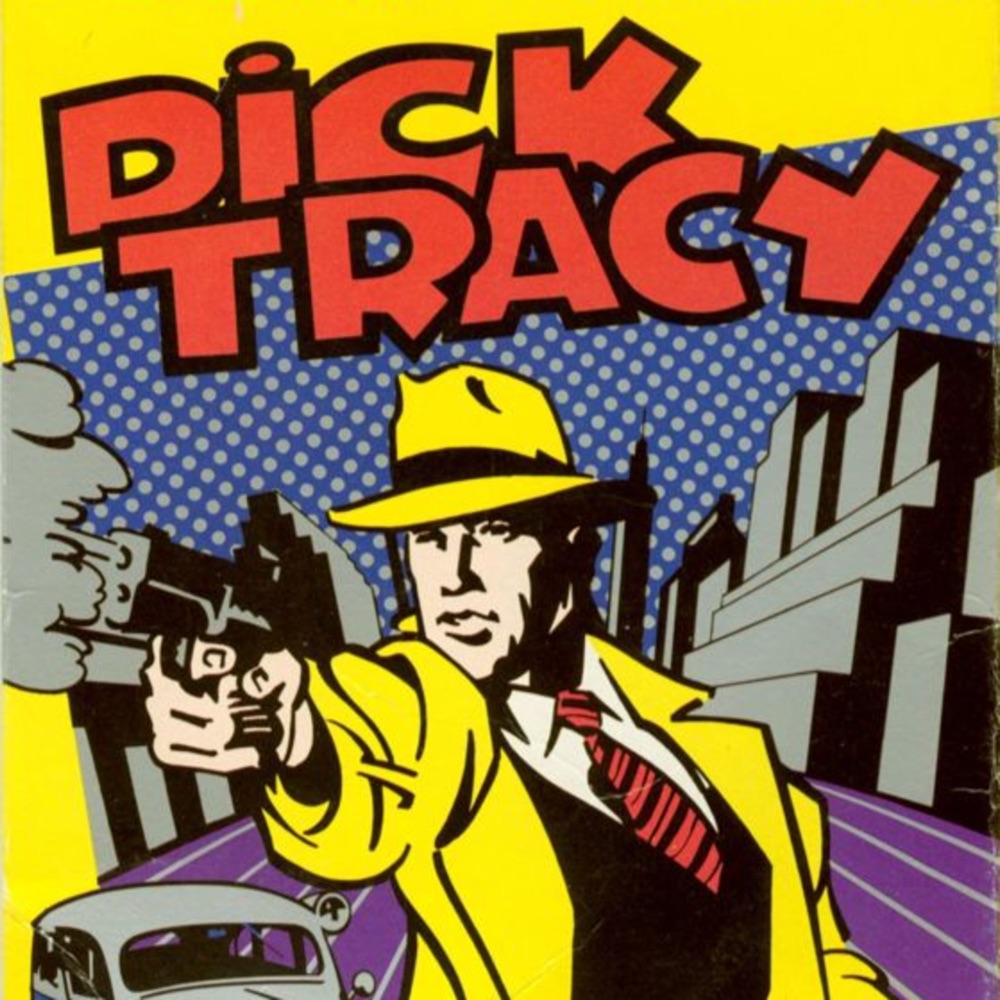
349 · Dick Tracy
You play as square-jawed detective Dick Tracy as he tries to solve five different crimes that vary in difficulty. This game is mostly a platform game with some overhead driving to get to the different buildings in search of clues.
Joe was billed as our resident Dick Tracy expert, and his research turned out to be watching the 1990 movie about two and a half hours before we recorded. He liked it: Danny Elfman score, bright noir, villains in heavy makeup like Lips and Little Face. The game is a looser tie-in with a more ambitious structure than we expected, and not much to hold it together. We all agreed the coat is very yellow.
What it tries
- A detective wrapper. You get a clue, find the right building on an overhead city map, fight through a side-scrolling stage, arrest the crook and collect the next lead. It is not L.A. Noire and not Phoenix Wright, and there are no Roger Rabbit drawers to search.
- A punch like a comic book. Enemies spin across the screen and knock others down. Joe said the movie has a shot where one punch topples about ten crooks like bowling pins.
- A code of conduct. You are penalized for shooting unarmed people, and we liked that the hero has rules.
- Arrest anyone. You can try to arrest without evidence, and your boss berates you. That made us laugh.
Where it falls down
- Snipers on every rooftop. The overhead city is empty, so the game fills it with gunmen who whittle down the same health you need for the stages. Juking them works a few times. Getting out to fight them is never worth it.
- A car on rails. You are locked to the right lane, like a piece on a game board, and on foot the screen stays locked around your car.
- Fist or gun, via Select. Punch someone armed at range and you get shot. Switch to the gun and an unarmed guy walks up. We wanted punch on one button and shoot on another.
- A stale loop. Tracy never gets stronger or finds new gear, and we missed his two-way watch. The clues ("you need to go to nine and J") barely count as detective work, though we doubted any NES game could pull off cryptic ones.
- Continue that isn't. Joe was confused by the menu option, since dying just sends you back. A code after a finished case turned out to be the answer.
Beyond the game
The first case starts over a fake $20 bill, about $381 today. The first thing you see is Tracy at a desk, even though the movie's running point is that he never takes a desk job. A Game Boy version simplifies things, and the same year's Sega Genesis version lets you shoot into the background and has enemies who reload. We agreed we would want a Genesis the next day.
The bottom line
Skip it. We all voted no. Mike lost interest when it became clear the building stages were the whole game and nobody would be interrogating people. Joe said none of the styles are particularly fun and the side-scrolling is more frustrating than anything. Sean landed on frustration over fun, and admired the attempt more than the decisions. It is a notable NES experience, which is not the same as a good one.
Written from our conversation in this episode.
- What is the Gameplay Loop?
- Exploration and investigation: Players control Dick Tracy, navigating both overhead city maps and side-scrolling action sequences, switching between driving in the city and on-foot missions.
- Clue gathering: The core of the game is investigating crime scenes and gathering clues to track down criminals. You need to visit various locations to interview suspects and find evidence.
- Combat: While exploring, players engage in combat with enemies using a variety of weapons (e.g., a pistol or fists), but must be careful not to shoot innocent civilians—there’s a penalty for that.
- Mission-based structure: Each case you investigate follows a structured path where players solve a mystery by piecing together clues to arrest the right suspect.
- Trial and error: The game often forces players to remember locations and suspect patterns, requiring careful note-taking and revisiting places for further investigation.
- Key Features of the Game
- City driving segments: These overhead driving sections allow Dick Tracy to travel between destinations, offering a mix of navigation and occasional shootouts with enemy cars.
- Clue-based progression: Solving cases is less about direct combat and more about finding the right clues. This gives the game a detective mystery feel, standing out from typical NES action games.
- Puzzle Solving in Dick Tracy (NES)
- Clue Gathering: The core puzzle mechanic revolves around gathering clues from various locations around the city. You need to visit crime scenes, interrogate suspects, and find evidence. This process is more like piecing together information than solving traditional puzzles.
- Clue-based Progression: Each case in the game has you track down criminals by collecting clues scattered across different areas. Clues can be found in rooms, interrogated from witnesses, or left by suspects. Once enough clues are collected, you can piece together the identity of the criminal.
- Decoding Messages: Some puzzles involve decoding hidden messages or finding key pieces of evidence in documents. These clues might reveal where to go next or who to arrest.
- Interpreting Clues: Players need to match clues to suspects in order to identify the right criminal. This involves reading descriptions, analyzing evidence (like a weapon found at a crime scene), and matching them to what’s known about the suspects.
- Multiple Suspects: Part of the puzzle-solving involves identifying the correct suspect from a list of potential criminals. If you gather enough clues, you can make an informed decision on who to arrest. If you make the wrong choice, you might have to backtrack and gather more evidence.
- Backtracking: Often, players need to revisit locations to find missed clues or to question someone again. This adds a layer of puzzle-solving in terms of figuring out where to go next or who to talk to again based on new evidence.
- Challenges in Puzzle Solving
- Lack of guidance: The game doesn’t provide much help when it comes to interpreting clues or determining where to go next. Players often have to rely on trial and error, which can be frustrating.
- Time-sensitive: Some cases require you to solve them within a certain amount of in-game time, adding a layer of pressure to puzzle-solving. If you don’t solve the puzzle quickly enough, you may lose the case or have to start over.
- Note-taking: Players are often encouraged to take notes on the clues and locations they’ve visited, as there’s no in-game journal to track everything. This makes puzzle-solving more involved but also more difficult for casual players.
- How Puzzles Could Be Improved
- In-game tracking system: The game could benefit from an in-game journal or clue tracker to make it easier for players to review the evidence they've gathered.
- Hints system: Adding a hint system could help players who are stuck, making the puzzles feel less opaque and reducing the need for trial and error.
- Clearer objectives: The game could improve its puzzle-solving experience by giving players clearer objectives or guidance when they’re struggling to figure out the next step.
- Multiple suspects: Players need to use detective work, arresting the correct suspect based on the clues they gather.
- Limited ammunition: Players must be mindful of their ammo supply, adding a layer of resource management.
- Multiple environments: From the streets to warehouses, rooftops, and crime hideouts, the game switches between different styles of play.
- Other Games Like Dick Tracy on NES
- The Untouchables (1990): Like Dick Tracy, this game has a mix of shooting and side-scrolling action based on 1930s crime noir. It shares a similar tone but is more focused on action than detective work.
- Who Framed Roger Rabbit (1989): This game also mixes detective elements and clue-gathering, with city exploration and side-scrolling action. Both games involve solving mysteries, but Roger Rabbit has a more playful tone.
- Batman: The Video Game (1989): While more combat-heavy, this game shares the dark, comic-book atmosphere and action-oriented gameplay with Dick Tracy.
- Deja Vu (1990): Another detective-style game, but this one is more of a point-and-click adventure. It focuses heavily on clue gathering and puzzle-solving.
- What Makes it Unique/Different from Other NES Games?
- Blends action with detective work: Unlike many NES games, Dick Tracy requires players to think like a detective, piecing together clues and avoiding unnecessary violence, adding a unique investigation layer to the action genre.
- Penalties for harming civilians: The game punishes players for shooting innocent people, an unusual mechanic for NES action games, making players more cautious in combat.
- Non-linear exploration: The game allows for more freedom to explore the city and solve the case in a semi-open-world manner, unlike most linear action games on the NES.
- Mixed gameplay modes: It combines top-down driving, side-scrolling action, and puzzle-solving, giving a wider variety of play than many other games of the era.
- Quality of Life Improvements Dick Tracy Could Have Added
- Better map system: The driving segments are often confusing due to a lack of clear navigation. A more user-friendly map with clearer location markers could have streamlined the exploration.
- Faster character movement: Both in driving and walking segments, the pace of the game feels slow. Speeding up movement or allowing for running would improve the flow of the game.
- More save points/checkpoints: Dying can set you back significantly in the game. Adding more save points or checkpoints could have reduced frustration.
- Improved clue management: Keeping track of clues can be cumbersome. A dedicated in-game journal or log to automatically record clues would be a helpful feature.
- Clearer objectives: At times, it’s unclear where to go or what to do next. A hint system or clearer objectives would enhance the player experience.
- Hidden Secrets in Dick Tracy (NES)
- Unlimited Health in Car Chases: During the driving segments of the game, enemies will shoot at Dick Tracy’s car. However, if you drive off-road (on the sidewalks), enemy cars can no longer damage you. This can make the driving sections significantly easier.
- Skip Buildings by Using the Map: If you’re stuck in a specific building or don’t want to fight through a long section, you can use the map screen to fast travel out of the building. This helps avoid tricky enemy encounters.
- Hidden Rooms and Extra Lives: Some buildings have hidden rooms or extra paths that contain health replenishments or even extra lives. These are often found by searching for subtle environmental clues, such as slightly different colored walls that might indicate a hidden door.
- Unlimited Ammo Glitch: There’s a glitch in the game that can give you unlimited ammo for your pistol. If you time your shots just right while pausing and unpausing the game, you can trick the system into resetting your ammo count, allowing you to fire without running out.
- Penalties for Shooting Civilians: While not a secret in the traditional sense, many players didn’t realize that shooting civilians (even accidentally) leads to a major penalty. It’s not well-explained in the game, so players might lose health or get set back in their progress without knowing why.
- Tips and Tricks
- Save Ammo: Be very careful with your limited ammunition. Only use your pistol when absolutely necessary, as fistfights can often suffice in smaller encounters.
- Take Notes on Clues: The game doesn’t offer an in-game notebook or log for clues, so many players keep a real-life notebook to track where they’ve been, who they’ve spoken to, and which clues they’ve gathered.
- Interrogate Suspects Repeatedly: Sometimes suspects give you more information if you visit them again after gathering more clues. Always consider revisiting key suspects to get additional info.
- Easter Eggs in Dick Tracy (NES)
- References to the Comic Strip Characters: Throughout the game, many of the criminals you track down and fight are directly pulled from the original Dick Tracy comic strip. Some of the more famous ones include Big Boy Caprice, Flattop, Itchy, and Pruneface. These characters are portrayed with distinctive looks and behaviors, which fans of the comics or the 1990 movie would recognize.
- The Iconic Watch Radio: Dick Tracy’s famous two-way wristwatch, an iconic gadget from the comics, is featured in the game. While it’s not an interactive part of the gameplay, seeing it in cutscenes is a subtle nod to long-time fans of the detective.
- Movie References: Since the game was released around the same time as the Dick Tracy movie (1990) starring Warren Beatty, some of the game's visual style and character designs are influenced by the film’s aesthetic, even though the game isn’t a direct adaptation. Fans who saw the movie will notice these influences, particularly in the design of characters like Big Boy Caprice.
- Minor Secrets and Unusual Details
- Civilian Shootout Penalty as a Comic Reference: In the comics, Dick Tracy was always depicted as a detective who abided by the law and used force only when necessary. The game’s mechanic that punishes you for shooting innocent civilians seems like an Easter egg nod to the moral compass of the character from the comic strip.
- Exploration of Real-Life Locations: Some of the locations in the game are loosely based on real-world Chicago-like settings, much like in the comic strip where Dick Tracy operated. This is a subtle nod to the roots of the detective’s crime-fighting days.
- Other Dick Tracy Games
- Dick Tracy (1990, Sega Genesis): Released the same year as the NES game but on the Sega Genesis. This version had similar crime-fighting elements, including side-scrolling action and shootouts, but was visually more advanced with smoother animations and gameplay that leaned more into action than investigation.
- Dick Tracy (1991, Game Boy): A simplified version designed for the Game Boy. Like its NES counterpart, this game featured side-scrolling action but focused more on platforming and combat rather than clue gathering.
- Dick Tracy (1991, Amiga/PC): Another adaptation released for home computers, offering a blend of shooting and side-scrolling action, but it was not as well received as the NES or Sega versions.
- None of these games served as a narrative sequel to the NES version, but they were released around the same time to capitalize on the popularity of the Dick Tracy film in 1990.
- There hasn't been a modern sequel or reboot of the Dick Tracy games, though the character continues to have a presence in comic strips and occasional media adaptations.
Auto-generated transcript. Each paragraph starts with its timestamp. Speakers are not identified.
Dick Tracy. Okay boys, let's go. This could be our big break.
And welcome to NEStalgia, a chronological exploration of every NES game released in North America. I'm Mike. I'm Sean. And I'm Joe. And Joe, you are our resident Dick Tracy expert. We've been hyping this up for a long time. We know that you went into the archives and read every newspaper comic strip and just are just completely one with the canon of Dick Tracy. So you want to just talk a little bit about, you know, your fandom? Sure. Dick Tracy began in sometime in the 1930s. I don't remember the exact date. No, no, no. Not the Wikipedia article.
Your relationship. That's not the... The Wikipedia article, I'm assuming, has the exact date. Not sometime in the 1930s. I don't remember the exact date. That would be funny if they just like got away with that on Wikipedia. You know? Eh, sometime in the 1930s.
We'll fill it in. My fandom... Okay. The first time I saw the movie, the 90s movie, if we're not talking about the history that I did look up on Wikipedia. The first time I saw the, what is it, 80s, 90s movie? 90s. 1990. Same year. 1990 movie was roughly two and a half hours ago in preparation for this episode. You just watched it. But I did watch the whole movie. So it's fresh. Um, I know I wasn't on the episode when you guys apparently nominated me to watch it to consume all Dick Tracy media. So this felt like a good compromise. I'll consume one piece of Dick Tracy media. Yeah. And, uh, it's a pretty good movie. You know? I actually kind of liked it.
I mean, it is the biggest one. What'd you think of the score? Danny Elfman. Gotta love Danny Elfman. Yeah, right? And you know what? It's funny. Danny Elfman and also, um, Touchstone Pictures, which, um... You know, they have that logo and everything and that sound design. I feel like Danny Elfman does a lot of Touchstone Pictures stuff. It's funny. Like, I didn't know that Danny Elfman did the score, but I just figured that he did. But you knew. I didn't even see the movie. I didn't either. But, like, when I first started and I was just like... I mean, I also went as far as, like, this is Danny Elfman and Tim Burton. I mean, I made that part up, but it felt like it should have been both of them.
Um, but yeah, it was, uh, definitely, like, a style that I wasn't expecting. It's very, like... I don't even know if I can compare it to anything. It's like... Is it like Sin City, but goofy? I guess that would be... Having not seen Sin City, I think that would be a good comparison. It's very bright, but, like, dark. It's, like, noir, but, like, with... You know, he does wear that iconic yellow, uh, overcoat. And, like, the bad guys all have, like, very, like, colorful bow ties and things like that. But it's not, like... It's not, like, completely silly either.
Which is just a cool, like, stylistic choice. And all the bad guys have really heavy, like, makeup effects to look like, I'm assuming, some cartoonish way that they looked in the comics. Maybe, maybe not, but, like, that was my guess. Yeah, I would know, after the Wikipedia article. But, you know, like, there's a character in the very beginning named Lips. And they just, like, his... He's just got, like, a really big mouth. Clearly, makeup, and it's obviously makeup. It doesn't look real, but it... But it's... It fits the style. There's a guy named, like, Little Face, who just has, like, a regular-sized head with a tiny face in the middle. Like, some goofy stuff.
But, uh, even the look of the city is, like, this weird... It looks like, I mean, it looks like they're in a cartoon, but it's all real. It's all just, like, sets that are, like, really colorful and dialyzed. That's fun. Yeah. And the movie came out in 1990, so the game is, uh, actually, uh, appropriate for once to use, like, a really old franchise and, uh, make a video game about it. It's like, oh, it's a movie tie-in. Uh, how much of a movie tie-in it is, we'll get into. How much of a fun game it is, of course, we'll get into. Uh, Dick Tracy, of course. Joe, you mentioned the yellow coat, uh, and, uh, and hat. Uh, they nailed it in the movie, stylistically. They nail it in the game, too.
Uh, the yellow coat, for what it's worth. It is yellow. It's very yellow. That's what we'll be judging, yeah. You got the right color. Yep, it's faithful. So, like, Dick Tracy, uh, as a detective, right, this game could have been a lot of different things. It could have just been also a game where you're just Dick Tracy with a Tommy gun and you just, like, you know, action stages breaking up the mafia or whatever, right? Like, that could have been a thing.
But instead, it's, it's a little bit interesting. So, the, the player, you, you control Dick Tracy and you have this overhead city map and these side-scrolling action sequences, but also this, like, detective-y, uh, gameplay element to it, too, where you kind of have to, like, track down, uh, and, uh, and get enough information to have the book.
Yeah, you gotta, you gotta, like, you gotta do some deductions stuff. You got some, you got some mug shots. Right. But it's not L.A. Noire, okay? You're not, you're not, like, investigating a, a crime that you have to, like, actually visit the crime scene and interview people and keep track of what they said and try to catch people in a lie. It's not Phoenix Wright, either. You can't press X to doubt. It's correct. Right, and it's not Phoenix Wright, either, where it's like, oh, it's just a visual novel thing and you're just kind of, uh, pointing, clicking on the screen of, like, uh, oh, that was a lie because I have this piece of evidence or this, you know?
It's actually really just about figuring out where these criminals are, uh, in the overhead city, tracking them down, breaking up their gangs, and then arresting them to get one new clue that leads you to the next, uh, gangster. And so, in a way, it is, it is open world, right, with this overhead city, but it is much more mission-based, and, uh, and, you know, I just, I feel like there's a lot of, there's a lot of different things to pull.
So, like, there's the who-framed-Roger-Rabbit element of it, too, because that was another, like, movie tie-in game, and you were on an overhead map, and you went into buildings and stuff. You're not checking all of the drawers, though, in this one. Right, right, but this is, again, not necessarily an investigative detective story.
So, before we get into what you do in each segment and break it down, I just wanted to get your, uh, your take there on, like, were you surprised that this was the gameplay loop? Are you asking the resident expert, or just is that an open question? That's an open question. Sean, you're allowed to talk on this episode. Oh, good. Okay, cool. Um, I was surprised that this is how we were going about it. I also just didn't know much about Dick Tracy. I didn't watch the movie. I watched the trailer.
I was surprised by the cast and how I had never heard of it. Um, so I wasn't really sure what it was gonna be. Um, so I was surprised to see it was like, oh, this is like a, this is a detective game. But that is kind of surface level, as we've been kind of alluding to. The whole detective element is kind of a, uh, more a framing for all the levels that you go through. And, and sort of a menu that you can die on a lot. Um, and so yeah, I was, I was pleasantly surprised that it, that there was more depth to the game than just like scroll to the right and shoot stuff and then get like maybe a couple screenshots of a cut scene. Um, at least in the concept, the concept was very impressive.
Yeah, I will, I'll second that about the concept only. But, but I, uh, I also, you know, went into this with no expectations because I did play this game before having watched the movie. So, or really consumed any Dick Tracy media. So it was my, this was my, my, this is my entry point to my intro point to, uh, Dick Tracy. And then I was like, oh, check out that movie because this game is so good.
But, um, I, I guess the only thing I knew about it was just through like the cultural zeitgeist is that Dick Tracy is a detective. So I wasn't like surprised to see that, you know, you've got clues, you got to follow leads and everything. But I do think that, yeah, the, the leads and the clues and the notebook really are all just like interesting, but like very minor ways to get from level to level.
Yeah. And so I think let's start at the very beginning of the game. Uh, it just kind of, it leaves you with the idea that you can go anywhere and do anything, but you really can't do that. You have to, uh, you have one lead and you need to find that specific person. You can enter any building, which you've, you've got to applaud them for that, that they, uh, that they give you that kind of freedom. But because nothing will happen, uh, other than some side scrolling action, nothing will happen.
It does kind of become like a, you, you do wish a little bit for the who framed Roger Rabbit, open up all the drawers, not to search for absolutely nothing. But so that you have like a, a living world here where maybe you could go to a, you know, to a bar and try to gain some more intel.
If that one clue that they gave you wasn't enough, uh, ultimately you are just trying to look for the right building, uh, get past all of the mobsters in the, uh, side scrolling part. And then, uh, arrest the, uh, the criminal at hand. But to get there is a mission all on its own because once you enter that overworld surprise, this is not, uh, our reality. This is a reality where, um, I mean, this is a reality that every American fears, right? The mafia has taken over America and they are on the rooftops of every building. And Joe, tell me if this is true in the movie, were there snipers on every rooftop?
Uh, I don't think there was a sniper in the movie at all. So as far as I can remember, but there was a long time ago that I saw it. They do exist in Manhattan though. That's, that's what all the traffic's about. Right. That is happening. Uh, but the, the thing about the snipers on the roof is like, it's like not much you can do about them. I mean, you can get out of your car and shoot at them, but at that point you might as well just drive away. So like that, it felt, it felt unfair to me to have these snipers on the roof. Yeah. That, that's sort of what I was alluding to about like the menu that you can die on because,
uh, you, you get information. Like basically most of the game is just getting information like, oh, you got to go here now. And it's just like kind of a coordinate system that isn't perfect because it physically doesn't really work out, but you'll, you'll get there eventually. And it would be, I guess it's just because people would just see it as like a glorified menu if you could very easily traverse this city. So they just littered it with, with these snipers that whittle down your very limited health.
Uh, each hit that you, that you get on the overworld takes away from the health that you have to then go through in each of the like on foot missions. Um, and then that's kind of like where I died most of the time. You can try and juke them. Like I, I was able at times to like just sort of drive and then slow down and then drive faster, uh, and not get hit. But that only works so many times and you have to do a lot of driving.
So it's, it's very difficult. I just thought the mafia's whole thing was that like they had the police in their pocket, but they're just like actively trying to kill an officer in the line of duty. And like none of the other police care about it. Dick Tracy is a cop. You're right. He, he is. Well, maybe it's like a, yeah, he, I think he is a police detective. I was gonna say private investigator, but I'm pretty sure he is actually like a member of the police. Yeah, he actually works for the police. Yeah. I mean, they don't even say this though. Right. But like, I get the idea that this is all happening in like Chicago.
Right. Like is, they don't say Chicago ever. Right. It's like, he probably has like some made up like metropolis, like place. Yeah. I don't think they, I don't think they mentioned the name of the city. If the streets are just numbers and letters, like I would have thought maybe alphabet city, but I, Chicago works. Yeah. I don't know. Something about like, you know, uh, Al Capone and all that, you know, that's what, that's what happened in Chicago. It doesn't matter. I guess what I'm saying. Well, Dick Tracy is who caught Al Capone, right? Absolutely. Yeah. Via the newspaper strip. That's how they, he wasn't paying the taxes for the newspaper. That's true. Yeah.
Uh, don't ever submit that on a history paper. Uh, for those of you still in school, not true. Uh, next up is, you know, just to go back to the snipers real fast. It just wasn't necessary. Like I get that the world would have been empty, which is a mistake in itself. Cause it shouldn't have been, it shouldn't be like, Hey, this world's going to be pretty empty. So why don't we put snipers on all the rooftops? Like that seems like a really extreme decision.
Yeah. It could, it could have just been like, you know, uh, the Metroidvania style approach of just like gates and stuff that keep you out of the way until you make certain progress or, uh, I don't know, other forms of enemies other than guys on the roof. Like that could have happened. Or maybe just put, put guys on. You've got this gun.
You've got this gun mounted to your vehicle, but you can't shoot the guys on the roofs with them. And I don't like, it's like you should, maybe there should just be more car combat then. Like not even that you can really control the vehicle because the game is enforcing you drive on the right side of the road at all times. So it's actually more of like, you're, you're, you're stuck to this grid. You're not really moving or it's so weird.
I need you to talk more about that, Sean, because I feel like that's something we, we have a little, not even just glossed over, but we haven't mentioned that. Like, so you're, you're in overhead driving, uh, think like Grand Theft Auto one and two, like the originals. It's like that. That's the vibe. But like, okay, what it does do, and I, and I kind of have to, I have to give him a lot of credit for this.
The whole idea of, uh, ludonarrative dissonance. I don't think we've talked about it too often on this podcast. It's a, it's a big $5 word for no reason, but it's what's kind of brought up when you do all this crazy video game shit. And then the story is like, Oh, I don't want to kill people. I don't want to hurt people. Uh, sorry, I'm, I'm doing a lot of red dead stuff cause I'm playing through that again,
but the game has kind of removed that entirely from the possibility of how you would play this game of like this crazy Dick Tracy that just drives all over the place and shoots everyone and just like has no respect for traffic laws because it, it ties you to the right lane. And it's almost as if like, you're not actually controlling the car. You're kind of moving the car as like a piece on a game board.
I mean, that, that's not a perfect analogy, but it's the ease, it's the best way that I can describe it. It's bizarre. Yeah. And I mean, not to go off the topic of the car, but this isn't the only instance where them trying to, I don't remember your $5 word, but them trying to incorporate that, uh, hurts the gameplay because you also are not supposed to shoot unarmed enemies. You can just punch them, but you can shoot them and you'll just get punished for it. And, uh, that, that also, uh, like I get that they're trying to be like, yeah, he's our hero and he shouldn't shoot unarmed people. But also like they didn't make it easy to do that in this video. No, no. You gotta do some hot swapping. We'll get into it. Yeah. I got ahead of ourselves.
When you get out of the car too, you're still like, yeah, he's a good one. Like able to free roam now as Dick Tracy. Again, they nailed the yellow coat, uh, totally. So yellow. On that little dot that you are on. Yeah. But the screen like locks, you can't, you can't, you can walk around the, the area that you have, that you have created for yourself when you get out of the car, but you can't like just walk around on foot, uh, and explore the city. You are locked to wherever the car is. Uh, so you can really only just get out of it for, uh, I don't know, like I guess, uh,
a break in the gameplay loop, but it's really just to park the car, get out of it and walk into the building. You might as well just people on the roof. Yeah, that's true. I guess I was just thinking like, don't mess with the people on the roof and just leave. Yeah. That's the thing. If you're going to take the time to get out and fight back against the people on the roof, you're just putting yourself in more danger when you could have just driven away and like been in probably less danger. It's never worth it, Sean. Sometimes you just have to walk away from the snipers.
And then when you enter these buildings, uh, it, again, this is where it loses all detective elements and, uh, kind of becomes like another, uh, detective, uh, a caped crusader, uh, the Batman, uh, NES game. It follows that style of side scrolling action now. And, uh, everybody knows that Dick Tracy is the strongest man alive because when he punches, when he punches anybody, he sends them flying. It's, it literally should have a comic book, like wallop, uh, you know, like a pow kapow something every time he punches one of these guys. Cause they go spinning across the screen and they even, they don't deliver. Yeah. They deliver damage to other guys.
Well, I will, as the resident Dick Tracy expert, I will vouch for him and his, his strength. Because in the film, there is a, there's a great montage, uh, in the, there's two, but there's one of him arresting a bunch of people. And the, in this montage, there is one shot that stood out to me where there's like, I mean, there's like 10 bad guys in all different color suits, all standing like all near each other. And Dick Tracy with one punch knocks them all down like bowling pins.
So, uh, yeah, that was a, he's a strong guy. That's pretty cool. And if you don't feel like punching, you can just shoot them from a distance too. That's an option. As long as they are armed. Yes. Cause again, there's this, there's this funny like code to Dick Tracy, you know, he, uh, there, there's a, there's a penalty for, um, shooting civilians or, um, or rather like causing damage that you don't need to. And so I kind of liked that. They, uh, yeah, it makes sense.
But like, this is what Joe was getting at that, that like in order to play the game the most efficiently. And this kind of gets into the controls. Like you have the, you, you select to change the thing that you're using. Um, one of which is your fist, the other of which is your gun. And sometimes you've got like first aid kits or whatever. But like, if you wanted to do that, you kind of, it's kind of janky the way that you, that you go about like, Oh, now I got to punch people. Now I'm in punch mode. Like, okay, now I got to shoot people. Now I'm in shoot mode. But like the, the, the, the speed at which you're going through this level, it doesn't really lend itself to that kind of like very slow decision making.
Um, and sometimes it's better to just go around and just punch everybody, but sometimes you can't. It it's, it's not a perfect system. Yeah. It's actually incredibly frustrating because yeah, if you're just punching people, cause you don't want to accidentally shoot someone who's unarmed, anyone with a gun will hit you from a distance and there's nothing you can do about it. The only way to switch to the gun is by hitting select, which is not like conducive to very quick, like rapid cycling or anything. And then you're holding the gun, you shoot one person. Another one would come like come up behind you or in front of you that just is unarmed.
Then you got to switch back to the fist. And by that time you're getting hit again. So it's like, it doesn't, it really, really breaks up the action. And I don't see why they couldn't have done like a being punch and B being shoot and just like reassigned some things. All you gotta do, all you gotta do. And maybe Mike won't like this.
Maybe there are points. Maybe there's times when up should be jump. Yeah. I mean, I don't think this is like, well, there are some platforming levels, so that would be kind of annoying, but I think that it would be less annoying than what we have. Yeah. That's a good point, Joe, about the platforming. Cause even though there, you're always like entering buildings or warehouses or docks or whatever, it does kind of eventually just switch off from being like a, what's the word I'm looking for here? But like, rather than just like tiers of different platforms, there, there does become pitfalls.
And like, you have to take down enemies before you can move to the next platforms. It does become a little bit more of a platformer action style game as you continue to move throughout where that, that part tries to spice things up a little bit. But ultimately the loop of finding out the next place you need to go doesn't become any more of a puzzle. You're not really given any kinds of cryptic clues. So it's really just about like driving around the city and finding the next spot that you kind of like were told to go to.
Should there have been more of a detective element there where instead of just like, okay, you went to the correct location, arrested the correct guy, found out now where you need to go next, should it have been a little more like open ended about what particular order you visit these places? And if you, um, you know, if you visit the wrong one, that it's not necessarily like, oh, we'll change the whole story for you, but that it might leave you a different clue or something rather than just say like, Hey, you need to go to nine and J, you know, I feel like it's a little too on the nose there. I like that idea in theory, but I, I have no confidence in like, really any NES game pulling that off in a way that would be fun.
So I'm okay with, I'm okay with them doing it. Like the, the, the detective thing is just sort of like dressing up the gameplay where it's like, yeah, it just, it just story beats really.
And like, that's fine because I, I wouldn't want, I wouldn't want what I expect I would get if that's what they made. You know, I just don't think they would do a good job. And we're also talking about the game that in addition to like, oh, this is where the next guy is and you could just, and it doesn't change. It's not like this is a, this is like procedurally generated. Like every time you play the game, the cross streets that you go to are the same cross streets. Um, you, so you could know where to go, but you just don't, you have to still get the evidence. So you still have to go to the other places.
Yeah. This is the game where once you're also doing all that, like you're going and you're finding all those clues that you need before you can go to where, you know, you need to go. If you played this before, like it says on the screen clue, it's screaming clue at you. If this was trying to be anything like that, like, like trying to get any kind of deductive reasoning out of you, trying to be a detective game, it just wouldn't do that.
So, uh, I, I don't think that we're really at the hardware level where, where a game like that could work. Maybe like the, when you were talking, the idea in my head was like something, something that clues about fish and maybe there's a dock that you could go to. Maybe there's like a fish market that you can go to. And depending on where you went, you'd get a different clue. But I think even that's too complex for what they're able to do here. I, I don't know.
I'm no, I think, I think it would require like a, a total overhaul of the game. You'd need like a different overworld that has like landmarks that could be cryptic or that you can answer to puzzles or something. And so, yeah, I just don't see it being anything but like a totally different game that way. Right. But, but then the problem becomes that really this game lives or dies based on these side scrolling action, uh, segments then where, you know, you, you have your incredibly powerful punch and your gun.
Those don't really evolve. Like Dick Tracy doesn't need to be stronger or use other weapons or, you know, I, I, I know preliminary knowledge here, but like, doesn't he have a really cool watch that like in the, in the, in the, in the comics, at least he has like a two way watch or something that he uses a lot. Like it counts time backwards and forwards. I'm trying to think of. He's got like, he's got like a two way radio watch, which I think was like a thing before.
Right. And like, anyone had phones, obviously, like cell phones. So that could have been something, but even that's not a thing. So ultimately like, I don't know, it's just, it, it becomes a, it becomes a, a stale loop kind of fast where it really needs to evolve. And I feel like that clue thing, you know, not, not, not a full blown detective game, but just something about making it also about navigating this city.
Instead, it's really just like a chore to navigate around this city with all these snipers on the roofs, which is just a crazy choice. Yeah. It really does come down to that. Like, I don't think that this is that terrible of a game if, and I can just live with the fact that the clues and the notebook are all just a different way to select a, to select a different level. It's just the fact that it's so impossible to get around the city that like it, it makes it really difficult to even try to enjoy the game.
Yeah. But I do think that there's also major flaws in the, uh, in the side scrolling main meat of the game too, which is basically, I mean, maybe it's because I was trying so hard to like not shoot the unarmed people and shoot the people that are armed that made it like kind of that, that gave me similar frustrations as the overworld did. So, so I do think that like it, even if they fixed the overworld, like they'd have to still fix the side scrolling thing, but not essential. Oh, whoa, whoa, whoa. No, sorry, sorry, sorry.
And Joe, you know, forgive me. Didn't watch the movie, but thank you for watching it. Uh, my understanding is that this is like no tie in necessarily with the movie other than maybe some characters also appearing in the movie, but it's not like, it's not like Dick Tracy, 1990 film, the game. Yeah. It doesn't even seem like, and I didn't beat the game, but it doesn't seem like even like the same bad guys are the bad, you know, these bad guys are from the movie, but it doesn't seem like the same plot of like, who's the bad guy and what are they trying to do? Well, um, this is something that I can say that I didn't do, uh, which was play beyond. Okay. We didn't even talk about this. I think it needs to be like addressed.
The whole concept of the first mission, not the first level, not the first screen. Sorry. I'm going a little off topic, off topic, off topic is, is you are being called in as like the big guns because somebody found a fake $20 bill. And yeah, that's true. Like, is that, is that really that important? That's where it starts, Sean. It starts with the fake $20 bill. They must have more fake. Sure, sure. It's a whole, like, it's a whole racket for making counterfeit currency.
But like, I guess what I, what I started this off with is like, isn't that just the first mission? Aren't there more missions? Did anybody play the other missions? Yeah. I mean, like it becomes, it evolves into something much larger where you're potentially going to take down this entire gang. Oh, okay. Yeah. See, I, I played the first, like the first $20 bill thing. Now it's worth mentioning though, $20 is $381 today.
That's true. That's $20 in 2024 is $381 as well. So, I mean, that is a big deal. If, if, if there was $381 of counterfeit money out there, you better believe that top detectives and, and crime, uh, law enforcement agents would come in and they'd be all over it. But. If something costs $381 today, it's basically free. It's eggs. It's true. It's eggs. Yeah. But, yeah. It's like, it's like, be lucky that it's only $381.
Um, but going back to what you were saying about like, what, you know, how much does this like follow the film one? Like, like almost like a, a major theme of Dick Tracy's character in the movie is that he will never have a desk job. Like he just, like they talk about it a lot. It's like a big thing with his love interest where he's not going to settle down. He's not going to have a desk job.
He wouldn't have a desk job. People always say that he says he doesn't want a desk job over and over again. What's the first thing you see in this game is Dick Tracy sitting at a desk, sitting at a desk, like a, like a, the desk desk that you've ever seen. It's got like a lawyer lamp on it. It's like a boring old desk job desk. Lawyer lamp. So already I'm like, wow, this is not following the, uh, the lore. That's really funny because maybe this is the, this is like a sequel. Yeah. It could be. It does settle down. Dick Tracy settles down.
Uh, Sean, your tagline there, Dick Tracy settles down. Uh, I just wanted to talk about the movie poster for Dick Tracy, the 1990 film, the movie poster, uh, just says Dick Tracy now playing everywhere. Like where a tagline would be. That's not what you put on a movie poster. I mean now playing everywhere. Yeah. If I read that movie poster now in 2024, is that still true? Can I like that movie poster doesn't make sense to me anymore. That's true. I don't, I mean, it definitely one of those situations. Like, I don't know why posters are legal because like they, they say that like, you know, a show is happening soon. But like, if you see the poster too late, the show isn't happening anymore.
So yeah, I get that. If we're going to like, if we're using that logic crossover that everybody wants to see Dick Tracy and curious George solving a case together in their yellow yellow. Yeah. They wear the yellow jumpsuits, uh, jumpsuits, uh, coats, yellow rain jacket. I'd like to see Dick Tracy in like a yellow jumper, like a, a yellow, uh, not a jumper. What's the word that, um, it's like a dude wears a onesie, a romper. A romper. Yeah. Dick Tracy in a romper. I'm going to try and pitch that. Curious George meets Dick Tracy in a romper. They take down Al Capone and Dwayne Johnson.
Dwayne Johnson, like the actor, like he's not like playing anyone. He's not playing anybody. Yeah. It's finally catching up to him. I'd be into it. There are some other Dick Tracy games. Uh, they're kind of unnotable though. Uh, there's a game boy game. Uh, it's like a simplified version of this game. Um, I don't even know if it has the city part. I feel like you're just doing the side scrolling action part. Um, and no, no sense of like a desk job in that one either. So maybe it's, maybe that's a plus. Maybe it's more real for Dick Tracy. Uh, there's also, um, this is weird, but in 1990, same year, Dick Tracy got a Sega Genesis game, 16 bits, way better than eight. That's a lot of bits. Twice as good. Yep.
Um, I can't tell if it leveraged the detective thing more or not though. Uh, not from this, not from this little glimpse. What I saw of it, cause I did research it cause it is one piece of Dick Tracy media, which I researched all of. Yes. Uh, if this is the one I'm thinking of, you can like, you know, it's side scrolling, you're shooting, you're shooting, you know, left to right, like normal, but you can also shoot into the background. You can like turn towards the background and shoot like into quote unquote Z space. Yes. But you look, you look like a mobster when you do that. I know, but it's, it's a cool piece of like tech advancement that you could do that. Dick Tracy vibes. Yeah.
I'll just say that if I was, if I, if I was the owner of an NES and I was playing Dick Tracy and then I went over to my friend's house and they were playing Dick Tracy on Sega Genesis, I would want a Sega Genesis the next day. Like it's crazy. We don't talk about it enough that like Nintendo is just doing their eight bit thing and Sega's over here releasing 16 bit games every week as well. And we're just not even paying attention to them. Should we just switch? Yeah, we should start another podcast. I mean, not, no, no, not another.
Just stop doing this one and start doing that one. You want to know what's next gen about Dick Tracy on the Sega Genesis, the kind of stuff that makes you say like, this is the future of video games. They shoot at you, the enemies, and then they reload. They have like a reload animation where they put bullets in the gun. It's like, it's like that, that would never happen on an NES. But we're going to do something that happens every episode on Nostalgia and that's the essential games list.
Look, you can say that they nailed the yellow coat and the yellow hat and they did. They nailed it. It's pretty freaking impressive. I know that I'm playing as Dick Tracy, whereas that's not always true in these franchise games. I don't know what my biggest gripe is here, but I have a lot of gripes and I feel like we talked about them throughout the show. So it's not necessarily that they failed Dick Tracy, the 1990 movie or the brand or whatever. No, I think they gave us a notable NES experience.
It just didn't wind up becoming anything other than another Dick Tracy media point for Joe to study for his midterms. So for that reason, I feel like once I realized that the whole game really was the parts where you're in the building, that's where I kind of like noped out of it. Like I thought this was going to be something where I kind of had to like check back with my notes and find secret rooms and, you know, interrogate people. When that became clear that that wasn't happening, my opinion of this game shifted very fast. So for that reason, it's a no. What about you, Joe? Yeah, there's they tried to do like one of those things where there's like multiple styles of game in this.
And I do think that none of them really are particularly fun because because of the way they're designed. I think there's possibly, you know, there's potential that they could have been fun or at least the side scrolling stuff could have been. But but even that it's just more frustrating to me than it is fun.
I'm definitely voting not essential, which I already spoiled earlier. But I also just just dawned on me, too, that I meant to mention that. There is the word continue is on the menu screen, but you don't get any continues. I don't understand. There's you die and you go back. Unless I missed it or didn't understand. There's codes. There are codes. But does it give you a code when you die? When you finish a when you fish it. Like if you were to finish the $20 bill caper. Yeah. You get a code. Oh, yeah. No, I totally did that. Yeah. I remember now. There you go. Sean. Hello. What's your vote? Oh, hi. Yeah. It's. Yeah. That's that's the theme.
We've been using the theme of frustration over fun. This is mostly frustration. I do think that there's a I have to admire what they tried to do, at least with the whole again, I don't see this as like multiple types of gameplay because the only one that's fleshed out in any way is the side scrolling. So I just see everything else is framing for getting from one level to another. I like that you can try to arrest the enemies, try to arrest the other people, like no matter if you have evidence or not. I think that's like that's very realistic. But then your boss is just like, damn it, dick, we can't do this. Like those are always funny.
But that's not what I'm going to vote anything essential for. I just it just makes me laugh a little bit. But this game has a lot of inexplicable decisions that I don't know. I don't know what they're trying to do here, but it didn't work. So it's not essential. Yeah. You should have been able to just arrest anybody. Yeah. You're you're you're the law. You should just be able to like rather than have to punch those guys, you should just be able to like, you know, again, Phoenix, right? Objection. You should just be like, you're under arrest. There should be you're under arrest. But exclaim I am the law. And there you go. Could have been a cop simulator. Could have been GTA for cops.
But it wasn't. Is there like a GTA for cops? Probably not. Right. I think there is a simulator. But it's like some Eastern European developer. Not very good. Well, while we're on the subject, since Joe mentioned it, did all three of us play L.A. Noire? Yeah, I did in its day. So it's been a very long time. It's been a long time. It's been a long time for me as well.
But I will say favorable, favorable view. I view it. Me too. I view it in a favorable light. I remember it fondly. Yes. Which is why I don't want to replay it. And I do remember half the cast of Mad Men being in it. That's true. It did happen. I have no idea why they were there. But that's cool. They were going for that time period. So they said, let's just grab them all. Not even the right time period.
Oh, really? Wait, when did L.A. Noire take place? It's like the 40s. Like the 20s, right? Okay, so it's further back. I feel like that's actually acceptable. If you would have told me it was the 70s, I would have been like, yeah, that's weird. Oh, yeah, no, that wouldn't have worked. But further back, 47, I mean, 47, 60. Okay, we're not talking about the flashback sequences, Mike. We're talking about the show. Oh, right, right, right. MLB, the show. Which also scanned in Don Draper's face. Very weird. No, they didn't. They didn't. Okay. All right. All right, we're out.
All right.