422 · Fun House
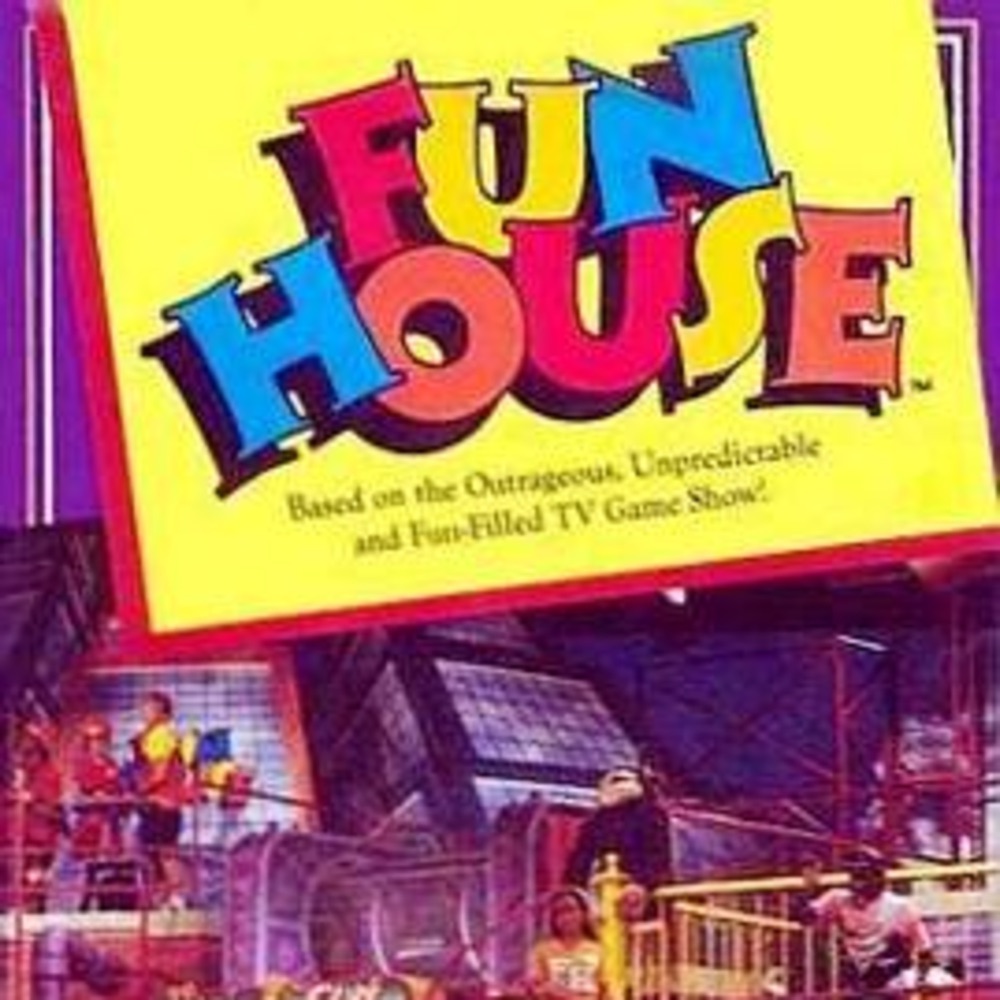
Fun House is a 1991 action video game based on the US version of the television show Fun House. It was released in North America for the Nintendo Entertainment System and MS-DOS with significant differences between the two.
We expected a game set inside a carnival fun house. Fun House is actually a Fox kids' game show hosted by J.D. Roth, a cheaper cousin of Double Dare with a Legends of the Hidden Temple-style finale, and its NES game ignores the show almost entirely. Sean, Joe and Mike spent a lot of this episode on the show (Sarah Gilbert turns up as a child contestant) before getting to the actual cartridge, which is a top-down maze game starring a kid on skates throwing tomatoes at targets.
Why it was briefly fun
- Tank controls that grow on you. One button accelerates, the D-pad turns, and everything slides. We were put off at first, then couldn't picture it working with a normal D-pad.
- Hunting blind. You only see a few tiles at a time, so each room is a search. Targets are numbered and must be hit in order, so stumbling on seven, eight and nine before one is a real setback. A room starts with 30 seconds, and extra clocks and hits add more.
- Good early pacing. Level titles hint at the layout, and the first floors add numbered targets, tomato turrets (which knock you off course instead of killing you) and momentum pads at a nice clip.
- The stage-clear music. We threw Real Time Associates a bone: it sounds like a game show.
Where it ran out
- The ideas stop. The evolution tapered off after the second floor, and by the third we were waiting for a different mini-game that never came. There are 72 rooms, though the fastest route needs only 32, and there are no passwords.
- Eight angles. You can only fire in eight directions, so distant targets are routinely just off your line.
- No show left in it. No trivia, no slime or glop, no messy obstacle course. Only J.D. Roth congratulating you after each room.
- The back rooms. The empty space beyond the maze is filled with ball-pit shapes and the letters F and H. It gave us creepypasta vibes, and Mike claimed he was absolutely spooked.
Beyond the game
The manual opens with "You're trapped in the Fun House," warns you to avoid exposure to water, and tells you to switch the console off before inserting the cartridge. We also all admitted we had never done that, which turned into a shared moment of dread. Real Time Associates is, in Joe's words, the most corporate-sounding developer name, and the show was only about two months from cancellation. Sean wondered if it began as a game looking for a license.
The bottom line
Skip it. Joe voted first, thanks to a deal in which Sean handed over his turn in exchange for $200,000, and said he didn't regret trying it but wouldn't play it again. Sean said it might have been a decent Flash game in 2006, but wouldn't last 32 levels, let alone 72. Mike made a roundabout case: a strange maze game wearing a game show costume. All three said no, so it stays off the Essential Games List.
Written from our conversation in this episode.
- Only those who think fast and move quickly will survive this sticky mess
- 1. What Is Fun House?
- Series Identity: Fun House was an American children’s game show that aired from September 5, 1988 to April 13, 1991.
- Host: The show was hosted throughout its run by J. D. Roth.
- Moolah Beach, Endurance, Disney World Inside and Out
- Basic Format: Two teams of kids competed in messy stunts, trivia, and a final obstacle-course run through the Fun House itself for cash and prizes.
- Closest Comparison: The show was commonly compared to Double Dare, though Fun House centered even more around the large final maze and prize run.
- Is this what you think of with a fun house?
- Do NOT let these kids improv.
- There was also a british show with a host with insane hair and even worse kid contestants
- 2. What Made the Show Memorable?
- Stunt Rounds: Each episode featured physical stunts and trivia, often involving slime, garbage, or goofy race-against-the-clock challenges.
- Grand Prix Race: The fourth round was a studio-circling race with themed vehicles or foot-race segments and small obstacle tasks along the way.
- Final Round Structure: In the Fun House itself, only one teammate could enter at a time, and they alternated after collecting three tags.
- Prize Appeal: The final round was known for unusually large prize totals for a children’s game show, often with total offerings around or above $10,000.
- 3. What Is Fun House on NES?
- Release Information: Fun House on NES released in North America in January 1991.
- Developer and Publisher: It was developed by Realtime Associates and published by Hi Tech Expressions.
- Genre: The NES version is an action/shooter game, though in practice it plays more like a top-down maze and target-clearing game than a traditional shooter.
- 4. How Closely Does the Game Match the Show?
- Main Similarity: The game keeps the basic idea of navigating a “Fun House” full of rooms under time pressure.
- Main Difference: Instead of stunts, trivia, and a prize-collection obstacle course, the NES game turns the concept into a top-down maze game where a kid on skates throws tomatoes at targets.
- Show Connection: J. D. Roth is still present in the game, congratulating the player on success and mocking failure.
- Podcast Angle: This is less “play the TV show” and more “use the TV show as a wrapper for an arcade-style maze challenge.”
- And that’s strange right? Its like they did their best to avoid making a sidescrolling platformer where you explore a fun house
- 5. What Is the Core Gameplay?
- Main Objective: In each room, the player must hit every target and then collect the key that appears after the final target is cleared.
- Time Limit: Each stage starts with 30 seconds, and the player gains time by hitting targets and collecting clocks while losing time when hit by hazards.
- Player Character: The player controls a child on inline skates and attacks with an unlimited supply of tomatoes.
- Fail State: If the player does not finish the room before time runs out, they lose a chance and must retry.
- 6. How Do the Controls Work?
- Movement System: d-pad turns the player, while the A button moves forward.
- Attack Button: The B button throws tomatoes, and rapid presses let the player fire quickly.
- Podcast Angle: A big early discussion point is whether the controls feel clever and distinctive or simply awkward.
- 7. How Is the Game Structured?
- Overall Size: The game contains 72 stages, organized as 12 floors with 6 rooms each.
- Room Identity: Each room has its own name, often based on puns or clues about the room’s layout.
- Progression Style: This is not a game built around bosses or narrative escalation. Its structure is instead based on increasingly complex room layouts and harsher obstacles.
- Podcast Angle: The game is really about endurance and route-reading more than spectacle.
- 8. What Items and Rewards Matter?
- Clocks: Clocks are among the most important pickups because they extend the timer.
- Coins: Collecting 25 coins grants an extra life.
- Lives and Continues: The player can have up to six lives, and even after losing them, the game allows infinite continues at the cost of points.
- Scoring Value: The points themselves are not useful, which makes survival and time management far more important than score-chasing.
- 9. What Obstacles and Hazards Define the Game?
- Target Hunting: Some rooms use numbered targets, and simply finding the “1” target can be one of the hardest parts of the level.
- Enemy Pressure: Hazards such as guns and stronger banana shooters can knock the player back and remove time
- Hidden Items: Some items are hidden inside walls, rewarding experimentation and bumping into suspicious spaces.
- Target Order: Because the key appears where the last target was hit, the player has to think strategically about which target to leave for last.
- 10. What Role Do Warps Play?
- Warp Rooms: The game includes warp zones that can send the player to much later areas.
- Intended Use: These let players skip ahead to harder content earlier
- Shortest Route: There is a route that lets players beat the game in 32 rooms instead of all 72 by using specific warps.
- Stage and Progression Discussion
- 11. What Is the Early Game Like?
- Teaching Function: The first floor is essentially a tutorial for the strange movement and shooting system.
- Low-Level Challenge: Early rooms are simpler, but they already establish the game’s key loop of target-clearing, route planning, and timer tension.
- 12. What Is the Midgame Like?
- Room Complexity: As the floors progress, layouts become more maze-like and more demanding to read quickly.
- Hazard Density: Midgame rooms feature more punishing placement of enemies and movement-disrupting elements.
- Strategy Shift: At this point, the game becomes less about basic execution and more about memorization, routing, and preserving time.
- 13. What Is the Late Game Like?
- Difficulty Escalation: The later floors are where the game’s room design and strict time pressure become most severe.
- Player Demands: The game increasingly asks for precise movement, fast target prioritization, and very little hesitation.
- Podcast Angle: The late game is a good place to ask whether Fun House is “secretly good” difficult or simply exhausting difficult.
- 18. What Is the Final Verdict?
- As a Fun House Adaptation: It only loosely captures the TV show’s spirit.
- As an NES Game: It is distinctive, demanding, and more memorable than its reputation might suggest.
- Main Strength: Its room-based maze design and odd steering controls make it stand out.
- Main Weakness: Its timer pressure and repetitive structure can make it feel punishing or monotonous.
- Closing Thesis: Fun House is not a faithful game-show simulator. It is a strange, high-pressure maze game wearing a game-show costume.
Auto-generated transcript. Each paragraph starts with its timestamp. Speakers are not identified.
Fun House, only those who think fast and move quickly will survive this sticky mess.
And welcome to NEStalgia, a chronological exploration of every NES game released in North America. North America. You loser. It's about time we changed the name of that country, the continent. All right, keep that in mind for the next Who Said It quiz. I'm Sean. And I'm Joe. All right. North America, welcome. I wonder if I could do more replacing N's with M's throughout the episode. Maybe it's just because we're in a fun house. Ooh, that's why I made the mistake. I'm usually perfect.
No. Fun House is actually, it's not what you think it would be, or at least not what I thought it was. I just thought it was like going to be a game that takes place inside of like a carnival fun house. I was very surprised to find out that this was a children's game show that ran like in the late 80s, early 90s for, had a, you know, not a great run by any means, but like more than like a couple episodes and canceled. It was on the air for quite some time. Were you guys aware of this game shows existence?
No, I had the like, to me, this game show is like one of those early AI photos where everything seems kind of recognizable, but you can't put your finger on it where I'm like, yeah, like I feel like I have memories of this game show, but I don't think I do. I think I just have memories of like a dozen other game shows that are like pieces of this game show. I think you were just thinking of Double Dare and Double Dare, but also like Legends of the Hidden Temple kind of vibe in there. And without any, without any actual seeming. Yeah. I think that the show is most commonly compared to Double Dare.
Um, and, and maybe the, the differences is that like, you know, they both had trivia and everything, but Double Dare was definitely more on like the, the silliness of the in between of the rounds and fun house focuses very much on like the very large final maze. It's almost like Double Dare meets Legends of the Hidden Temple, but nowhere near as intricate as Legends of the Hidden Temple's, uh, finale either. Uh, it was hosted by, uh, this guy, JD Roth.
I tried to look at him a little bit, see like if he was more popular beyond this. He had some things like Moolah Beach Endurance and hosted Disney World Inside and Out on ABC. None of these things sound big enough to me. Is he, is he like a face you recognize? Oh, he's my cousin. Yeah, I know him through Sean.
Okay, good. Um, I'm just remembering right now that when, you know, when I was younger, like flipping through the, channels at a friend's house, we came across Endurance and I don't know if it was actually bad or if we were just in that phase where we like, like make fun of everything, but we were making fun of it because it was a survivor ripoff. And like, then we always joked about it forever. I did not know it was this guy. So like, I do have this weird connection where I know him from Endurance. Never heard of any of those shows. You never heard of Moolah Beach? No. No, I'm teasing. Why, why should you? Yeah, it's, it's Moolah. Like, I feel like that's out of favor by 1990. Moolah? Yeah. Like, like calling cash Moolah.
Yeah. Who says that? Right. Who says that? Uh, J.D. Roth, did you watch the show at all? Did you see his hosting capabilities? He's in the game too. So I think it's worth finding out if he's like, you know, if Alex Trebek's in the Jeopardy! games, you're like excited. It's like, hey, that's Alex Trebek. Like, he's awesome. If, um, if J.D. Roth is in the Funhouse game, does it matter? I think so. Because I, he is the only thing that like actually shares anything that has to do with the show with this video game.
Uh, it, I remember the, the, the show, the one episode that I watched that their whole theme was like, we're going to go to states and we're going to talk about what makes states unique. And then they did a bunch of things that really didn't have anything to do with states.
Um, and there's a, there's a slime alternative. There's glop. Um. Oh my God. And, uh, yeah, they do. Why didn't glop catch on? I know, right? Yeah. Uh, they do the, the trivia. Um, they do the physical challenges and at no point do they run around shooting spheres.
But, uh, yeah, I watched some. It was fine. I watched some too. And my biggest problem with the show is that they should never have let the contestants, these, these young kids do any kind of, I mean, they're not even really improv-ing. They're just answering questions, but it's almost like they're not prepared for them ever. And these kids are like, they pick the most socially awkward people to be contestants on the show. And for that reason alone, I'm giving J.D. Roth the benefit of the doubt here as a host, because he manages to like get through the segments while the kids are like shell-shocked to be on TV.
I mean, I think that's just all kids on TV shows. I am just watching the first episode that came up on YouTube, and I'm pretty sure this is Sarah Gilbert as a child. Who's that? Sarah Gilbert was from Roseanne, and then she was like on The View or something. She was the daughter from Roseanne. Oh, yeah, I know who you're talking about. Yeah, this is definitely her. That's awesome. Hmm. Big pull.
Yeah. I feel like that's also why I always wanted to be a kid growing up in the outskirts of LA, because it means you could have been on this shit. Or Universal. Universal Studios lot. Yeah. In Orlando. Sure. And it's like they would never, I would never get to go on Figure It Out or anything, because I didn't live in the TMZ or outside of Orlando. So, of course, you're going to see actors before their prime.
Yeah, I think there's actually quite a few good examples of that. Of like, wasn't Aaron Paul on The Price is Right? Yeah. Before he was ever an actor? Yeah, I think it was definitely before Breaking Bad. Yeah. And he was really, really excited when he got called down. Yeah, he was going to win money. He's like, shit, I've been waiting tables forever trying to be an actor. That'd be really funny if he was super excited to be on The Price is Right, but he was already
famous from Breaking Bad. And it was just luck of the draw. Yeah, like Breaking Bad was a stepping stone. It was a stepping stone to get to The Price is Right. Having grown up with The Price is Right, it's like a rite of passage for every kid to once they get called out sick and leave school early, their mom just puts on The Price is Right and they eat soup or whatever. At least that was my experience around my neighborhoods.
Having done that, I am not famous. Maybe I am famous enough through this podcast. But if I got famous, I would still be excited to be on The Price is Right because it's something that is like, that big wheel, I just want to spin it once in my life. Yeah. Also, I feel like in your family, you got to at least act excited or else people are going to be like, wow, what a pretentious, you know, successful actor. I've never seen anybody not be excited when they call your name, so they must be coaching these people. Like, okay, we're going to call your name and when you do, you better jump up and down like 35 times. Well, they would just cut you out of the show if you weren't excited. Well, Price is Right, that would be a little harder to do.
Oh, was it live? It's not that it was live, but like then you join the show and then you're stuck in like the part where you have to guess the money and there are so many people that don't understand that game, but we're not here to talk about The Price is Right, actually. So maybe we should talk about Funhouse. Oh, yeah. And Sean, I know you were trying to talk about the game and say that the game has nothing in relation to the show, but even for the show, is this what you think of with a Funhouse?
No. No, no. The show was weird with the name. Um, the game is weird with the property and the name. Uh, so it's just, Funhouse was just a catch-all for anything, really. Yeah, at least the show had like that whole sort of building looking thing behind them and it was like, oh, anything can happen in the Funhouse. And the game is like, one thing will happen and this is the only thing that will happen. Right, right. That's a big promise. One thing will happen.
Um, and Funhouses, for me at least, like, you know, that's like sketchy carnival rides would show up near your church sometime in the summer or maybe at the end of the, uh, before the school year starts. Uh, and, and it's like, there's wacky mirrors and there's, uh, like a dark room where there's a bunch of like inflatable stuff that you have to work your way through. There's a little bit of that in the, in the final challenge when you like, quote unquote,
go through the Funhouse. But otherwise, it, it really is just like a, another Double Dare style obstacle course and not quite, like, I feel like they should have embraced a, uh, a confined loop of the Funhouse that is very challenging and like, even though it's the same every time, like kids struggle to get through it and that would have been more enticing than just like some obstacle course. It does at least share the, like, wow, this is a cheap and probably dangerous contraption that like you would have that feeling at a real Funhouse at, at that carnival.
Um, because like some of the obstacles in this Funhouse that they run through on the show are just like adults with, with like spray, like with like water bottle spray. And it just looks very cheap. It's all very cheap. Like it's the, it's the cheapest kids show I've seen, which is weird because I feel like it was a major network that aired this. What, what, what aired it? I think it was like Fox. It was Fox. And we're not going to call them a major network.
We're not going to allow, we're not going to stand for that. Um, there was also a British version of this show, which went, which lasted way longer. Um, but the host of that, who I don't have his name, he has an insane hairdo, like just like a, a, a, a main that you could not believe. And the contestants on that show, those kids are even worse. They are like, they're not even talking half the time. It's super weird. There's an uncomfortable like silence to a lot of British humor. Yeah. Those kids are being trained for it. And maybe they're not smiling because of their teeth, but this is like the British versus American office. Like it, it, yeah, it's, it's kind of like a mullet, but it's like a thick mullet.
Yeah. I see a guy with a really weird, like updo comb over and then a guy with a mullet. So I'm going to assume it's the guy with the mullet for sure. Yeah. All right. So I think, you know, that's, that's enough about the show. Now let's talk about Funhouse on the NES.
Uh, as you all know, it's January of 1991. We're getting a lot of the big hits. We got advanced Dungeons and Dragons and now we've got Funhouse based on the hit children's game show. Uh, instead of stunts, instead of trivia, instead of a prize filled obstacle course, the NES game turns the entire concept of Funhouse into a top down maze game where a kid on skates, which I don't think I saw anybody wear skates in the episodes I skimmed through. A kid on skates throws tomatoes at targets in order to, yeah, those are tomatoes. What'd you think they were?
Bullets. A kid shoots bullets at targets. It's like on skates too. Like, damn, that was the show we should have been watching. That was the show that they put the pilot on and the kid died during it. So they're like, oh, shoot. Like, I think we have to test this thing out. Maybe we should create a Funhouse.
Right, right. Yeah, or do that. But yes, yeah, I know in the manual it states that they're tomatoes. So you're throwing tomatoes at targets. And once you hit all the targets, you collect, there's a key at the end and then it goes like, congrats, the stage is over. You don't have to like rush to an exit or anything. It's just automatically over. And then you see J.D. Ross welcoming face as he tells you some great job or whatever. And you move on to the next stage. And you do this 72 times. If you're not, if you don't have the path, you can do it a maximum, I guess, of 72 times.
You can do it faster with shortcuts, but you do that over and over and over again. And that is the video game. So what happened here? What is going on? Did somebody make this game? And then like they had connections over at Fox and they were like, we can license this to you guys under the Funhouse name?
I have to wonder how big of a pull getting Funhouse as like your IP would have been. Because on paper, you know, regardless of how it was executed or whatever on paper, this kind of rollerblading around physics based thing, there's a little bit of puzzle element to it. Like it's got enough of a hook to just stand on its own as a concept for a video game. So adding Funhouse, which doesn't have anything to do with it and also isn't like you're adding like Rambo or something that like is everybody loves and everybody knows.
I mean, I wonder how popular this was. Was that going to boost sales for this or something? The only reason I even think that it might be something that was like created and then shopped around was because the developer is a company I have not heard of before called Real Time Associates Incorporated. And there's just never been a more corporate sounding, right? There's just never real time associates like that. That's your fun name. We have Konami. We have Capcom. We have Rare. And we have Real Time Associates. It's like they mean business. And so maybe they just had a product and they were looking for a buyer.
Yeah. This is also like I imagine like the last season of the show is going. So I don't they probably didn't have a lot of money to throw around. So the show is the show has about two more months before it's off the air.
So it's just the last gasp. Maybe they thought people were going to be itching for more Funhouse content once it went off the air. Like this is the consolation. Like it's canceled. But what was the host name? J.D. Roth. J.D. Roth will live forever. The kind of name where you have to say the full name. I'm not trying to make him sound important, by the way. It's just like you can't just say J.D. Like that could be anybody. Or J.Roth. Yeah. You can't say J.Roth because it's not his name. Wow. Yeah. It's a catch 22 over here.
So all the evidence and we can talk about the actual gameplay, but all the evidence to me looks like the company did their best to avoid making the obvious side scrolling platformer where you just like explore a Funhouse in a limited amount of time and answer some trivia questions between stages to add time to the timer on the on the platforming stages. Because that seems like the obvious like home run from my POV. And then to go ahead and make this skatey top down puzzle puzzles. Let's not let's not go there.
Target game. It's a little it's a little unexpected and not unwelcomed. Right. Like the game can still be good, even if it's not related to Funhouse. We don't have to judge it based on a game show we never heard of before today. We should judge the game by its actual merits. So how is the core gameplay? Yeah, it's fine.
You like the it's very strange like to start because I guess the whole roller skate thing, which I didn't fully comprehend until I saw like that they kind of put a sprite of like a more like zoomed in sprite of a guy on roller skates that like, oh, OK, I'm on roller skates. That must have happened in one episode of the show or something.
So that like sort of explains the sort of slippy sliding nature of the game. And then the top down, then you start to get introduced to like moving platforms. And there's like, I guess maybe that these things are shooting tomatoes, too. You've got turrets to avoid.
So, I mean, like it feels smooth and it's kind of intuitive how you interact with everything. But I think that like it felt fine. Yeah. I think at the very beginning, I was a little turned off by the way that the way that it plays, which is like you have a as basically your accelerate button and you just use the D pad to you got tank controls pivot.
Yeah. And that bothered me at first. But then as I got used to it, I was like, you know, this actually makes a lot of sense. And it does, you know, feel pretty good as a like intentionally difficult motion based game. You know, it's like it's trying to be slidey and, you know, it's not easy, but it does feel it feels polished. So I started to appreciate it once I kind of got used to it. And actually now I can't really imagine it being it working as well if it just had like traditional D pad controls.
What does feel weird is like when so while you're also using these tank controls to turn and sort of move somewhat fluidly, it also obviously will control your what direction you're going to fire your tomatoes at. And I was expecting there to be more angles at which you could fire your tomatoes. It seems like there'd be there'd be moments where I would be in a spot where like if I tapped a little to the left, I'd be shooting too far to the left. And if I tapped a little to the right, I'd be shooting too far to the right.
It's just not very precise. So, yeah, you got to get tricky with that, especially because like a big part of this is shooting things that are kind of further away from you. And if you only have eight points on your, you know, on your dais, then you, yeah, the further away something gets, the more space you're going to be missing as those angles open up. So, yeah, it is kind of, it's like nice that you can, you can get some distance from your shot, but it is sort of undermined by the fact that the angles do not line up with like the vast majority of your targets. Yeah, you got to get some trigonometry in there. No, thanks.
And as the game goes on, there are plenty of obstacles that are added. Not necessarily enemies, but things that bounce you around or fire back at you. And there are momentum pushes. So things that make you go faster in a certain direction or push you in the opposite direction. All of those things are welcome to continue to add to the challenge. But the, what makes the game remain somewhat unique throughout is that the way that the stage is laid out is always completely different. And when you enter it for the very first time, you don't, you don't have enough of a view, a point of view to see more than a few tiles on the screen at a time. So you have to kind of hunt for these targets.
So you don't know if like the room is a giant square or a bunch of corridors or a series of columns, but you have to try and go through the entire maze and hunt down these numbered targets. They, they have like the number one and then the number four in front of them. So you can't shoot the number four before you shoot one, two, and three. So then it also becomes about finding them in order.
I think this description is making the game sound maybe more clever than it is. But ultimately that is the hook of just exploring these rooms kind of rapidly, frenetically, like you would if you were in the funhouse on the game show. Like you, you know, it's all, it looks easy on TV. But then when you're actually, but no, but think about it. Like it looks easy when you're watching someone do it, but when it's finally like your turn to go and then all of a sudden nothing's easy.
Like that's kind of how it feels like at times in this, in these rooms, when you're looking for some of those targets that you just can't like, oh, I accidentally found seven, eight, nine grouped together before I ever found one, two, three. Like, shoot, now I have to go through the rest of the room and each room only, you know, it starts with 30 seconds on the clock. And then you get more time if you can find additional clocks or hit the targets. So the system ultimately can feel as the game goes on a little bit like a rush if you're enjoying the gameplay experience.
Yeah, I did like the, they're all kind of like bite-sized, like almost themed levels where they'll give you the title of the board that you're on. And it always has some kind of like, maybe it won't even be a play on words. It'll just be a very descriptive title. And that'll give you a hint sort of like how the, uh, how the level is going to be laid out. And you can use that information and, uh, maybe you'll get a little, uh, you'll get a little bit better at exploring that way. Sometimes it makes no sense.
Um, but usually they're pretty good about like the, the title giving a hint as to how the level is going to be laid out. Yeah. And in each, each, there's like several floors, I guess, of the fun house. And each one has, I think each one has six stages.
And I'll say the first few floors did like, I was kind of appreciating the, uh, evolution each time where it felt like, yeah, the first you're just hitting all the targets. Then they introduced those numbered ones. They started to introduce turrets. Like, I'm sure there's no turrets on the game. Tomato turrets. Yeah. Tomato turrets that like, don't kill you, but they, they slow you down or they knock you off course.
And, or like a couple of times there was like, oh, they put this in a, you know, in an order where like, oh, I can optimize the way I'm going. But like, I've got to watch out for dead ends. It's just like a little bit of clever design. And I felt like that was evolving nicely. And that evolution, I felt really tapered off pretty quickly after like the second floor. And then I was kind of hoping, oh, this whole game is going to be like this.
Every, every floor is going to be like new puzzles and new interesting ways to go about it. And from what I experienced, it did kind of start to slow down where it's like, okay, now it's just a lot of reusing of the same things.
So like, I, I think I lost a little bit of my excitement there. Yeah. I think that my, uh, I was holding out hope that maybe there'd be a different like game style. Like I was hoping that this was just, oh, we're going to do like six of this mini game. And then the next floor, it's going to be a different game that has like a completely different hook.
And then I was like, all right, I'll give it one more, uh, one more world basically before I come to the conclusion that this is just the entire game. And then, yeah, once I hit the third floor, I was like, okay, yeah, this is just roller skating with platforms and that, that roll under you and yada, yada, yada.
The game didn't really think this through, but since we're finding things to talk about on this podcast, there is some weird stuff going on in the like outside of the maze area of this game where like the, the, the patterns and stuff that they put on the like empty space between, uh, the areas that you, basically the areas of the parts of the room that you can explore. First, it looks like it's like ball pits and then it has like the letters F and H for fun house filled everywhere.
And then it's like a bunch of different shapes and everything, but there is just something a little like off putting about that negative space filling this area of, it's almost like looking into the back rooms a little bit.
Like it's not possible to be there. There's gotta be a creepy pasta about this game now. We'll have to find it. Yeah. You boundary break through the maze and then you're just like going through corrupt shapes. So Mike, was this sort of like a horror game for you? It was not a horror game for me. I just did. I just don't like the, I don't like that. They put these kid contestants on rollerblades, have them throw tomatoes at things. And then there's like impossible structures behind them. Yeah. That's the combination you don't want. Right. It sounds like you're terrified. I'm absolutely spooked.
All right. We kept saying there were 72 rooms, but actually it seems like the fastest route can only, you only have to do 32 of those rooms. Does that matter at all? Is there like a, is there a mapping strategy here? It doesn't really matter when you're not like skipping potentially like dangerous levels or harder, harder things to do. Or like, you're not really jumping around. You're basically just skipping content in a game that's already robbing you of anything else. I guess that's maybe, no, no, there aren't, there's no passwords.
So this is just like, you know, you got to turn, you got to turn the console off. So you just, I'm going to skip ahead to where I left off or close enough. Yeah. It's, it's, it's a convenience thing or, or they were thinking of speed running in 1990. Could they have added trivia in between the floors? Maybe not each stage, but some of the floors, just, just trivia that you have to get right. You have to. Yeah. It's like you lose lives if you get it wrong and then that's the game over. It's reminding me more and more of the Godzilla creepypasta now.
Yeah. I feel like there should, like it's, it's beyond me that they didn't have any of the actual game show stuff on here. Um, so I feel like it should have had some kind of, uh, trivia element, but I can't say that I particularly find any of those, uh, NES games where there is trivia all that fun. So it's more so, it's like, like I'm saying that it should, not so much that I want it. The soundtrack for this game is pretty good though. Okay. I like that stage clear music. Yeah. Thank you for the okay. The acknowledgement, the acknowledgement means everything. That follows. Yeah.
No, I mean, you know, I, I, I feel like it's a weird one to bring up because it's not like it's a, it's not exceptional. It's not something I'm going to play back, uh, uh, you know, on my own free will, but I'm trying to, I'm just trying to be a, I'm trying to throw a bone to real time associates. I think that the, what I remember is that the, uh, like stage complete music does a good job of sounding game showy. So like, yeah, I wouldn't listen to it, but it does sound like it's maybe the most game showy thing of this game about a game show. So I've got a question, um, that I think we'll add some minutes to our clock here. Um, what kind of reskin of this game do you think would improve it the most?
Like what, what, if it was the same, uh, mechanics and even the same like level layouts and all that, but it was like, you mentioned Rambo before, like, but it was all Rambo themed. Not that, but like, what, what do you think would, would be the best? I think you need to make it the Disney channel original movie brink theme.
And then you get all the, the, the skaters involved. Okay. I like that. Or Tony Hawk. This is just Tony Hawk. Yeah. What was that other roller blade, uh, game on the NES that was based on like a fake sport? Uh, was there sports entertainment? Remember Sean? Oh God. Yeah. Roller games. Yeah. Just make it, just make it another, it's another roller games game. You know, this time it's, uh, this time it's just more of a game. It's more of an arcade style thing. Whereas roller games was more of like a, uh, what was that platformer?
Yeah. It was, it was kind of, it also had a platformer beat them up. Yeah. It also had like weird, like floating mechanics because of the skates, but it was, it was definitely more like that. Um, this is what it reminds me of. Like just, just the feel of it. So you could skin this as like a spinoff of marble madness, not a sequel. Cause you're not controlling the stage. Like, like a marble madness where the marble has an engine in it.
Okay. I like that. Yeah. I also like the idea of the marble having like multiple objectives rather than just getting to the end of the stage. It has to roll into other marbles.
Yeah. Shoot other marbles, please. Okay. The tomatoes are calling the manual and looking at the manual, the, just the first line in the manual is you're trapped in the fun house. That sounds like a threat. I think it's more, it would be more of a threat if it says, uh, uh, we're going to trap you in the fun house. Right. You're trapped in the fun house. And they put fun house in all capitals to let us know that it's a licensed property. So that's great. Um, some precautions for the game, avoid exposure to water. It's a, it's a good tip. Is that on the back of the box? It's not, it's on the, it's in the manual. There's the manual.
Yeah, of course. Avoid exposure to water. Do not touch the terminals. That sounds, again, that sounds vague enough. That's kind of scary. Maybe we should move on. Well, hold on a minute. Listen to this. Getting started. Make sure your Nintendo entertainment system is turned off before inserting the fun house game pack. Has anybody ever tried the cartridge thing to like put?
If you ask me, it should have been, you're a computer virus and you're going around causing havoc in somebody's computer. I forgot we didn't ask you. Yeah, you didn't ask me. He said, if you asked him, this is what he would have said. Right. This is what I would have said if he asked me. It's a great answer. Instead of moving to the FCC fucking regulations. Right. You came up with that on the fly. That's pretty amazing. Thanks. Yeah. But no, seriously, just real fast. Because I don't think I, I just think this is like a revelation for me. I've never had the console on and then put the cartridge in. I did always feel like that was kind of dangerous.
I would, I would say I've never done that either. Right? Like, like power buttons on, power buttons in the on position. The red light is on. You could short circuit. And you're just sticking cartridge. Yeah. You're sticking cartridges in there. Get out of here. You could blow up. So at the very least, the manual for this game can teach you how to protect your other games. And we can teach you how to protect your time on the essential games list.
Sean? What's up? Sean, hold on. Before you go, I have a question for Mike. Sure. I cede, I cede my time. I yield the floor. Who do you think you are? I am. Well, what a, what a reference. I'm asking only because, uh, who do you think you are to skip over the year of Joe? The year of Joe? The year of Joe. We had the year of Sean and we had the year of Mike. And then the best of 90, you insisted that I was the 1989 year of Joe. When really I looked back, it is the year of Sean. This is my year to go first on the essential games list. Now, are you sure that you just like maybe listened to an episode that you didn't make it to from 1989?
You know what? I haven't confirmed that, but let's assume that it listens. Let's assume that it's true. And I will, I'll follow up next week and make sure that it's true. Before you make your, before you make your accusations. That's okay. You know what? I will continue to yield to the, yield the floor to you, Joe. I'm looking at the nostalgia rule book that we all made together in 2018. And it, it does say that if the person whose turn it is to do the essential games list for an entire year does allow another, uh, contestant on the show because it's a game show now. It does allow another contestant to vote in, at any point in the year, they cede their, uh, their priorities. Well, hold on, hold on. If I knew that, I wouldn't have yielded the floor.
Hmm. Well, you should know the rules before you, uh, you know, ignorance to the law does not exempt you from it. That's true. So I'm going to do a rare thing here and I am going to put the power in Sean's hands for once. Okay. He has very little power on the show. So we will allow him this moment to decide that Sean, since I did give it to you and make it the year of Sean, would you like to continue it to be the year of Sean or should we move it over to Joe? I will allow it to go over to Joe under one condition. What is the one condition?
That condition is, uh, to be determined at a later date. I knew you didn't have the condition, right? Well, do I have to agree? And it was, it was, you have to already agree. I was on the episode Willow and that was the last episode of 1989. Willow was one of my favorite games. No, no, no. You have to, you have to agree right now.
Hmm. It's going to be something like Zelda two can never be on. No, no, no. It's not going to be anything like that. I promise. What is, what is a promise? I think I should have to agree with this. I am, I am owed this.
No, no, no. You sounded like you were in deal making mode or at least Mike gave me the power to enter deal making mode. That brings me back to my question to Mike. Who do you think you are? I know, right? I'm feeling really guilty now. I want $200,000 and you can do it. All right. $200,000. That's a deal. All right. That sounds like a fair price. It was the unknown that was scaring me. Right. Considering what we make in advertisers alone per episode, $200,000 does seem fair. Exactly. Okay. So Joe, you can vote first.
I have to say I had a little bit of a hope for this game when I booted it up, but it was very, very quickly diminished. Uh, as I realized how kind of repetitive this is, it didn't really, didn't really do too much for me over time. Yeah. At the beginning, I was like, this has some promise.
Um, I don't know if I would even call it a play it though. After, after really giving it some time, like I'm, I don't regret having tried it, but I don't think I need to play it again. I kind of want another game to come in and use the same physics and just kind of do a little bit of a better job keeping it interesting. So overall, not essential.
Sean. That, I gotta say that like, that was one of the best opening reviews, uh, in the history of the podcast. Uh, thank you. I, that's why I was just like, that's why I was so upset. I couldn't do this opening review is, uh, you know, I'm, I'm rusty doing, you're doing great so far. But, um, yeah, I, uh, I, I don't, I didn't have any hope for this. Like as soon as I found out that it was based on a kid's show, I was like, oh, well, this is just going to be another terrible game.
Um, and then I watched the show and I was like, okay, maybe I could, I could like watch this with a bowl of cereal someday. And then I played the game and I'm like, wow, this is nothing like this, but it's still, it's still kind of got it. It's look kind of got something. Uh, I think if this were like a flash game from 2006, I'd probably play this a lot in my computer lab at school or, uh, something along those lines. Like it's a cool, it's a cool, fun little thing. It feels kind of cool. Uh, but I don't think that this really, it doesn't really last for 32 levels, let alone 72 levels or whatever Mike said.
Uh, this is not enough here. Uh, but Hey, at least you get to see, uh, JD, JD Roth that the one, the only, so yeah, not essential. Yeah. As a fun house adaptation, it does not capture the TV show spirit. And as a, uh, game show, the TV show has no spirit. So, uh, it didn't have, it didn't have high standing for me going into it cause I knew it was the game show first. Cause I looked up, uh, information about the game before playing it. But as an NES game, I mean, it does have a distinctive control to it. Uh, it's, it's maybe more memorable than its reputation might suggest. And the way we were talking about in the game, I think I'll remember this oddity because of everything surrounding it.
It that's, that's certainly not enough. I mean, its main strength is that the, the maze of the rooms is, is uniquely laid out each time so that the, um, the steering controls can become a little more fun to navigate through. But the repetitive structure makes this, it just makes it feel punishing and a little bit monotonous after a while. I agree with Sean that like, I don't think I could, even if I could be capable of doing all 72 levels, uh, I don't know how hard they get. I don't want to play through all 72 levels of this game and any game where you don't want to continue on with it has to be something that, um, we need to vote, uh, to keep off the essential games list.
That was a very roundabout way of saying no, but, uh, it's weird because Funhouse is not a faithful game show, uh, adaptation. It's a, uh, it's a strange maze game wearing a game show costume and those back rooms, uh, game show skin, game show skin. Right. And those back rooms scare the hell out of me. So yeah, this is a horror game. Mm-hmm. And, uh, next week we're going to play another horror game, G.I. Joe, Real American Hero.
And, uh. They're all horror games going forward. Yeah, they're all horror games. The Hunt for Red October. I don't know anything about the movie, but that sounds scary. Halloween's in October. Right. Jeez. Red October? October regular is bad enough. Hahaha. Hahaha.!!!!!!!!!!!