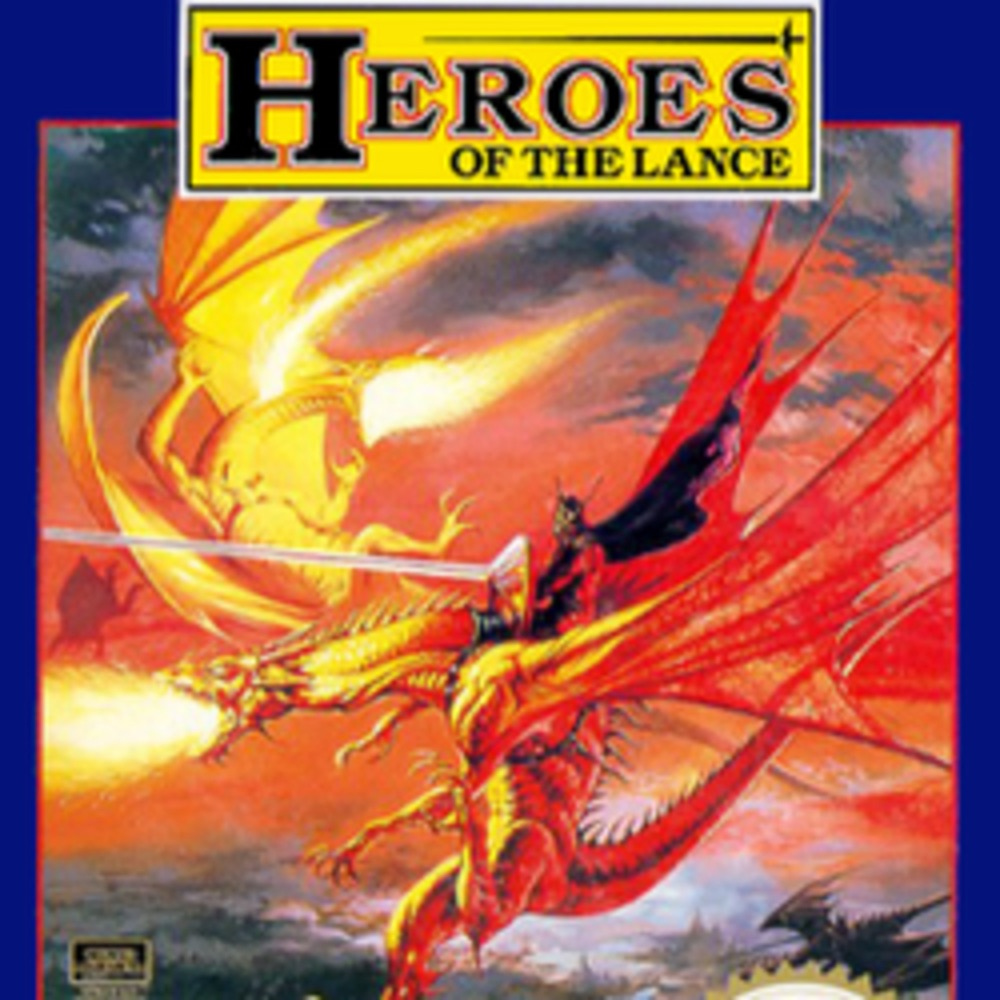
421 · Advanced Dungeons and Dragons: Heroes of the Lance
Advanced Dungeons & Dragons: Heroes of the Lance is a video game released in 1988 for various home computer systems and consoles. The game is based on the first Dragonlance campaign module for the Dungeons & Dragons fantasy role-playing game, Dragons of Despair, and the first Dragonlance novel Dragons of Autumn Twilight.
From Wikipedia: Advanced Dungeons & Dragons: Heroes of the Lance (CC BY-SA 4.0)
Our first game of 1991 is a Dragonlance tie-in, and Mike, Sean and Joe came to it hoping for the Dungeons & Dragons the NES had never delivered. What we got was a side-scrolling action game with eight premade heroes, a ruined sunken city to cross, and a black dragon named Khisanth at the end. It frustrated us from the first minute to the last.
Where it went wrong
- No character creation. The best part of D&D, the part people finish before they ever skip a second session, is missing. You get eight heroes and you are expected to know them.
- Controls that hide the rules. Attacks only seemed to work with some combination of direction and button, and getting through a door means holding the button for about three seconds. Hits miss constantly, which looked to us like hidden armor-class rolls, the way Morrowind does it, with no log to show it. Two characters just bop each other on screen.
- A menu simulator. Picking up a dropped item means standing on the right pixel, choosing who grabs it, backing out, and then digging through the inventory to use it. The buttons for confirm, back and exit seemed to change at every layer, and it is one of the ugliest menus we have seen.
- The manual. The first-five-minutes walkthrough is two pages of plain text, and it tells you to equip each hero with a weapon each already carries. The staff spell page reads like a first draft: the crystal staff holds 200 charges.
- Nothing to discover. The dungeon is mostly empty rooms and passive traps. Our wanderings turned up a crane that killed a character, a goddess statue that vanished after the staff was used on it, and a fork where north and south lead to the same fight. No feedback told us what any of it meant.
What it half-gets right
- Death matters. A fallen hero is gone for good, and losing Goldmoon means losing every spell. Row order also decides who takes the punishment. On paper, we liked that.
- A dragon at the end. At least the box promise is kept.
Beyond the game
A full run by someone who knows the game takes only 23 minutes, and they lean on one or two characters while spells fire from the menu. We tipped our hats to whoever had to learn that. We also previewed what's coming: Dragons of Flame, the sequel (55,711 copies sold, we heard), Dragon Strike, a dragon flight sim, and Pool of Radiance.
The bottom line
Skip it. Sean went first, as he will for 1991, and said no: not Essential, with no feedback and no flavor. Joe called it a skip it and theorized the developer, US Gold, made a game to hate the player. We agreed too, since it weakened our view of D&D video games, so nobody voted it onto the list. It did not stop us being curious about Dragon Strike.
Written from our conversation in this episode.
- Vanquish the ancient black dragon Khisanth (Kye-santh) or you are doomed to failure!
- 0) Cold Open (30 to 60 seconds)
- Hook: “This is an AD&D game on NES where the most important move is… switching characters.”
- Context for listeners: Most people expect turn-based rules or a deep RPG. This game is an action dungeon crawl that uses the party as its system.
- Thesis: Heroes of the Lance is ambitious, messy, and fascinating because it tries to turn a famous D&D story party into a side-scrolling survival game.
- Why you say this up front: It frames the whole episode so every later detail feels like proof, not random trivia.
- Follow-up questions
- If you saw “Advanced Dungeons and Dragons” on a NES shelf, what genre would you assume before you ever pressed Start?
- Is “ambitious but messy” your favorite kind of retro episode, or your nightmare?
- 1) General Overview (what it is, why it is unique)
- 1A) The simple pitch (one sentence)
- A party-based side-scrolling dungeon crawl set in Dragonlance, where you guide eight heroes through a ruined city to retrieve a sacred relic and beat a dragon.
- Context: This gives listeners a mental box. Everything else is detail inside that box.
- 1B) The three things that make it unique
- You do not create characters. You control a famous cast.
- Context: This is Dragonlance’s big identity. You are playing “the Companions,” not “your guy.”
- The game’s RPG decisions are not leveling and gear. They are formation and swapping.
- Context: The “RPG brain” of this game is: who is in front, who is safe, who can solve the current problem.
- The dungeon is basically the whole game.
- Context: This is not “world map, towns, quests.” It is one place, explored room-by-room.
- Follow-up questions
- Does a fixed cast feel more like you are inside a novel, or more like you lost the best part of D&D, making your own hero?
- When a game is “one giant dungeon,” does that sound focused and cool, or repetitive and exhausting?
- 2) Core Concepts Primer (teach the listener the nouns before using them)
- This section is intentionally short and friendly. You are making sure everyone is on the same page.
- 2A) What is Dragonlance, in plain terms
- Dragonlance is a D&D setting that leans hard into story and an ensemble of heroes.
- Context: Think of it as “D&D as an ongoing fantasy saga,” not a random adventuring sandbox.
- 2B) What is Xak Tsaroth
- Xak Tsaroth is a ruined, half-sunken city that functions as the dungeon.
- Context: When you say “Xak Tsaroth” later, it simply means “the giant dungeon place we are exploring.”
- 2C) What are the Disks of Mishakal
- The Disks are the sacred relic you are trying to recover.
- Context: This is the plot engine. You go down, grab them, escape.
- 2D) Who is Khisanth
- Khisanth is the black dragon guarding the relic and your end goal fight.
- Context: This is the boss you are building toward.
- Follow-up questions
- Does that premise feel like classic fantasy comfort food, or does it already feel too “lore heavy” for an NES action game?
- Would you rather the game explain this inside play, or is reading the manual part of the period charm?
- 3) Recap of the Franchise (up to release, but framed for why this game exists)
- 3A) D&D games in this era were genre roulette
- In the late 80s and early 90s, “AD&D” on the box did not guarantee a specific gameplay style.
- Context: Some were deep computer RPGs, some were action experiments. This is one of the experiments.
- 3B) Why Dragonlance was an attractive license
- Dragonlance comes with a built-in cast and set-piece story beats.
- Context: That makes it easy to adapt into a game where you control named heroes without needing character creation.
- 3C) Why the NES version feels a little odd historically
- The NES port arrives after the concept already existed elsewhere, so it can feel like an older design landing late on the system.
- Context: This helps explain why it may feel out of step next to smoother later-era NES action games.
- Follow-up questions
- Do you judge this as “an NES game,” or as “a port of an older design that happened to land on NES”?
- Is the Dragonlance name helping the game, or setting expectations it cannot meet?
- 4) Story and Objective (now that listeners know the nouns)
- 4A) The story, told like a campfire summary
- A party of heroes descends into a ruined city to recover a sacred relic tied to the return of divine power.
- Context: Even if you do not know the setting, it is basically “quest for holy artifact.”
- A black dragon stands between them and the relic.
- Context: Classic dungeon structure. Everything funnels toward the dragon.
- 4B) The objective, stated as “what you are trying to do in play”
- Explore deeper, survive long enough, keep the party functional, reach the dragon, claim the relic.
- Context: This is the gameplay version of the plot.
- Follow-up questions
- Does the game feel like it is telling this story as you play, or does it feel like the story is something you bring with you?
- In a game like this, do you care more about narrative clarity or mechanical clarity?
- 5) Core Gameplay Loop (simple, then “what that really means”)
- 5A) The simple loop
- Enter rooms, move through hazards, fight monsters, choose the right hero for the situation, repeat deeper into the dungeon.
- Context: Keep it high-level first so listeners can follow.
- 5B) What makes that loop different from a normal action game
- You are not just controlling one character. You are managing a party’s health and roles in real time.
- Context: The loop includes logistics. That is the identity.
- The game asks you to pause and make decisions through menus.
- Context: This is where some players feel “strategy,” and others feel “friction.”
- Follow-up questions
- Does pausing to manage the party make you feel like a commander, or does it break the flow?
- When you swap heroes, do you feel smart, or do you feel like the game made you do it?
- 6) Gameplay Elements (only the notable, game-specific stuff, introduced in a teachable order)
- 6A) Party formation and the “front row” concept
- Not everyone is equally safe. Who is in front matters.
- Context: Think of the party like a moving formation. You can rotate who takes the punishment.
- This creates a mini-game of triage.
- Context: You are constantly deciding whether to protect fragile utility characters or expose them to use their abilities.
- Follow-up questions
- Did you naturally learn to rotate the front line, or did the game punish you into learning it?
- Is “escort eight people through a dungeon” a cool idea, or inherently frustrating?
- 6B) Swapping heroes is the real “combat system”
- Instead of deep movesets, the depth is “who should be leading right now.”
- Context: The correct answer changes room to room: melee safety, ranged control, magic utility, healing.
- This is why the game feels tactical even when the action is simple.
- Context: The tactics live in selection, not execution.
- Follow-up questions
- Which situations made you swap most often: flying enemies, cramped corridors, boss moments, or pure desperation?
- Would fewer characters with deeper mechanics have been better, or would that ruin the “party” premise?
- 6C) Resources are limited, and that changes your personality as a player
- Magic and special tools feel scarce, so you start thinking in terms of conservation.
- Context: The game quietly trains you to hoard, then tests you to spend.
- That tension is a big part of the difficulty reputation.
- Context: You can lose because you spent too much early or because you refused to spend at all.
- Follow-up questions
- Are you a hoarder or a spender in retro games, and did this game punish your default style?
- Did the game ever communicate “this is the moment to use the good stuff,” or did you guess?
- 6D) Navigation and hazards are not side issues, they are the main conflict
- Pits and awkward rooms can be deadlier than enemies.
- Context: This is a dungeon survival game wearing action clothes.
- The dungeon layout becomes something you learn like a language.
- Context: Once you understand how it connects, it feels less like chaos and more like a place.
- Follow-up questions
- Did you ever hit the point where the dungeon felt legible, or did it stay confusing?
- What is the game’s real villain: monsters, geometry, or the interface?
- 6E) The “story artifact as victory condition” moment
- The Blue Crystal Staff is not just lore. It is central to the ending.
- Context: This is the most Dragonlance-flavored design choice in the whole game: the holy object matters mechanically.
- Follow-up questions
- Do you like when a story item becomes a hard mechanical requirement?
- Is it satisfying because it is faithful, or annoying because it narrows your options?
- 7) Extra Layer 1: Companion Mechanics (introduced as “roles,” not a character dump)
- Instead of listing eight bios, frame it as “how the game wants you to think about your party.”
- 7A) The party as four functional buckets
- Frontline anchors: characters you trust to lead through danger
- Context: These are your “I do not want to die to random hits” picks.
- Ranged stabilizers: characters who keep fights safer by controlling distance
- Context: On NES, range often equals safety, especially in cramped rooms.
- Utility casters: characters who solve problems rather than trade hits
- Context: Their value is not raw damage. It is the right tool at the right time.
- The linchpin: the character tied to the game’s most important story mechanic
- Context: This is the “if this goes wrong, the endgame gets weird” character.
- 7B) Quick “why you swap to them” spotlights (one line each, in listener-friendly terms)
- Use this as a rapid segment, almost like a sports roster.
- Goldmoon: your healer and story key. When things fall apart, she is how you get another chance.
- Raistlin: your problem-solver. When brute force stops working, he is the pivot.
- Caramon / Sturm types: your “walk into danger” leaders. They keep the party alive by being reliable.
- Tanis / Riverwind types: your “safe damage” switch. They smooth out messy rooms.
- Flint: the practical brawler with a bit of ranged flexibility.
- Tasslehoff: the weird utility pick, the one you use when you want coverage at multiple distances.
- Follow-up questions
- Did you end up playing this as “a party game,” or did you basically main one or two characters and treat the rest as extra lives?
- Which Companion felt surprisingly useful, and which felt like dead weight?
- 8) Extra Layer 2: Xak Tsaroth Beat Map (how the dungeon “story” escalates)
- This is a pacing tool for your episode, so you can describe progression without doing a walkthrough.
- 8A) Beat 1: Orientation (learning the game’s language)
- Early Xak Tsaroth is about comprehension, not mastery.
- Context: You are learning what matters: exits, hazards, swapping, formation.
- Follow-up questions
- At what point did you realize this was not a normal action game?
- 8B) Beat 2: Attrition (the game’s real difficulty shows up)
- Midgame is where resource drain and navigation mistakes compound.
- Context: This is where the “party management” idea becomes stressful rather than cool.
- Follow-up questions
- Does the midgame feel like fair pressure, or like it snowballs in a way that feels doomed?
- 8C) Beat 3: Requirement (the game reveals what it truly cares about)
- Late game is where the story artifact becomes the mechanical centerpiece.
- Context: This is the “Dragonlance module” moment. The plot object is the solution.
- Follow-up questions
- Does the ending feel like payoff, or like a rule check you were not properly prepared for?
- 9) Sequels and Spinoffs (quick list, each with a clean hook)
- Frame this as “Dragonlance is a setting, not a genre.”
- Dragons of Flame: more of the Silver Box approach, continuing the storyline with similar DNA.
- Shadow Sorcerer: still in that lineage, but it shifts the feel and priorities.
- War of the Lance: the zoomed-out war strategy take, for people who want the setting’s conflict at scale.
- DragonStrike (NES): dragon-riding action fantasy, closer to the box-art promise some people expected from Heroes.
- Champions of Krynn (Gold Box): the rules-driven party CRPG version, for those who want “AD&D as a campaign.”
- Follow-up questions
- After playing this, what would you want next: more action weirdness, or the “real RPG” version?
- If NEStalgia covered only one other Dragonlance game, which genre would make the best contrast episode?
Auto-generated transcript. Each paragraph starts with its timestamp. Speakers are not identified.
Advance Dungeons and Dragons, Heroes of the Lance. Vanquish the ancient black dragon, Kysanth, or you are doomed to failure.
And welcome to NEStalgia, a chronological exploration of every NES game released in North America. I'm Mike. I'm Sean. And I'm Joe. Guys, welcome to 1991. We made it. It's so nice to be here. So much has changed and so little at the same time.
When are you born? Not this year. 92? Yeah, you're going to have to wait a whole other year for me. Little baby Mike. We're only like a month or so away from the Bills losing their first Super Bowl. Of how many? Of four. Oh, I didn't know that. In a row. Yeah, yeah. Just so you all know. And then we're only, you know, I've been really hyping this up. We're only like 11 months away from the fall of the Soviet Union. Oh, that's huge. It better be good. You've been hyping it up so much. Yeah, it's pretty big. This year. Well, yeah. Well, no, not this year, but like that year. Well, yeah. Yeah. Okay. Do we have to be worried about them coming back? I mean, I wouldn't say never. Okay. We're playing Switch 2 Stalgia. Maybe we'll talk about that.
And as far as video games go, Dungeons and Dragons is one of those, I don't want to say like holy grails or whatever, but there are a lot of people who yearn for Dungeons and Dragons to be like the experience to be captured in video game form. It's something that if you ask certain people, they would tell you it's never been done.
And then there are other people who would refer you to some CRPGs that are, you know, basically as close to having a game master as you possibly can. But then there are people who will reference Dungeons and Dragons video games like this advanced Dungeons and Dragons NES game. First off the title, Advanced Dungeons and Dragons. Now, is that a good way to start to get people who maybe are don't know what Dungeons and Dragons is in? Should it have advanced in there?
No. And I also, for that reason, it shouldn't have advanced in there. And also like, I don't know if this is like more advanced than base Dungeons and Dragons. Well, I think it's more so, and I don't know the whole like history of D&D, but I think it was just like the whole IP was just called Advanced Dungeons and Dragons at this point. Oh. Or like this is second edition or something.
Yeah. And isn't this based on, this is based on a book, right? Like this is not based on like Dungeons and Dragons, the game. It's based on like a book about these characters. It's based on a book that takes place within a game space in Dungeons and Dragons that is still active and includes characters that you would interact with in those campaigns. So it may as well be canon.
Hmm. And that world is the world of Dragonlance and we're playing as the heroes of the lands, these eight characters. Another friction point, I guess, for the entry to Dungeons and Dragons here is arguably the most fun part of Dungeons and Dragons, the part that most people can accomplish before they play one session and then never show up to that group again, is the part where they create their character. Right? Like that is the, you know, you're doing the most role playing there of I'm going to be this person and I have these attributes and these stats. And this game has none of that. This game is like you will be these eight heroes. Hopefully, you know them. If not, learn to know them. Yeah. It's like they made a ready made like module.
And they like, you know, in most of these like early RPGs, I would at least expect you to be able to create a character. Or at least create your party. Yeah. Have 15 characters. You have to pick eight of them or something and they can all be like tiny bit different or something. I don't even know if there's leveling in this game. But like, regardless, this is some like a DM would like, okay, here, here's your character sheet. This is what you can do. And you just get all the character sheets.
And I just think, you know, maybe at the time, this was a way to distance from the tabletop game, right? Like they didn't want to eat the tabletop games lunch and try to recreate that in video game form. They were just like, here's something in the Dungeons and Dragons world that we can slice off, put on the NES and satisfy like a different type of gamer or meet the video gamer where they are and introduce them to the world of Dungeons and Dragons. However, you know, I think most people would expect, especially at this point, we've had a few of them now, you know, something with turn based rules or, you know, a deep RPG.
This game is an action dungeon crawler that, you know, is basically the most important move in terms of turn based movement is switching characters. It's something you'll be doing a lot of as you play this game. Yeah. And like, it's, it's, it's a weird choice for something that doesn't have a face or faces of the, uh, what do you call it?
Of the property or of the IP to, to kind of change it into this like platformer thing. Like, I feel like that's, what's done as like an easy way to get like any character into a video game. Like, yeah, it's just an action platformer because the character is the draw or like the, the character and like the, the way that they maybe fight or them going through the world as a draw. This is like the draw of Dungeons and Dragons.
Like you guys said was, is creating your characters, having some like choices, like kind of meticulously thinking about your strategy and things like that. And to just be like, yeah, we'll also paste that onto a action platformer feels really like they, they're not, they're not going to get their audience and they're not going to get a new audience. Yeah, I actually, uh, my, my instinct tells me that this wasn't trying to like be something different, um, and was very much trying to capture the same audience that enjoys D and D. Um, but they just really didn't know how to do that.
I mean, why else would you have a 2d side scrolling party management, uh, uh, labyrinth sim? Uh, it's just, it just seems like they're really trying to like fit into a sweater that just there, they were way too big for. Um, and so I, I don't know what the, the timeline is for this game is released and where that lines up with something like wizardry. Um, because that was something that was more so what I would have expected out of this. Like when I saw this, this title on the release list, I just thought it was going to be another, like first person dungeon crawler with D and D ornamentation. I feel like we might be up to like wizardry five by the time this game comes out.
But like, is that, is that the case? Like on the, like, cause this was also for regular piece, not regular PCs, but like computers too, right? Like this wasn't released for any, yes, specifically. That's a great question. Okay. Uh, for two reasons. Even, I, I feel like it is, no, it, it, it has computer, uh, programs as well, but it's all the same release, right? Yeah. I think it's okay. What I'm seeing is the NES version 91, the PC version, maybe as early as 88. Can't tell if it's the same exact game, but, uh, seems like there was a heroes of the Lance game in 1988. So, all right. Three years difference. Let's see. Correspond us back to the wizardry chart that puts us at right where I guess wizardry five. Wow. Is out in 1988.
Okay. A point and click adventure game. Like it's a, it'd be like if you want to, if you're playing super Mario and you want to collect a coin, you have to jump towards the coin and then go into a pause menu and go like three menus deep and find the word pickup coin.
Like it's just like, there's like, it sounds like I'm being ridiculous, but it's almost pretty literally that like an enemy drops a power up or gold or something. You have to, in the middle of the action, you have to, in the middle of the action, go into your menu and like find the hidden pickup command.
Yeah. It's at once both too simple and too convoluted for either like way to make sense. Uh, I, I, I would bring it back to when like dragon quest, uh, would have like go upstairs as like a selection, but that that's even, that's still like within its own thing. And they're still trying to figure it out. Whereas here they're obviously sort of riffing on two different established genres. And it's like, they just decided that if it's going to be D and D, it has to have complexity, but they just had to like manufacture complexity. Exactly. They were like, Oh, there's not enough complexity in it. Let's make it really hard to do simple shit.
Like arguably the easiest to translate part of dungeon and dragons is the part that could be captured in this game too. There isn't a, uh, a world to explore towns to visit NPCs to interact with. There isn't that open ended part of this. It's just, you're in a dungeon and you have to go through combat. So there is already like a way to do, do that with, you know, with dice rolls and, uh, you know, movement perks, you know, per space based on your character and everything. So it is weird that they chose this, uh, action RPG real time thing, because again, it's also, it, it goes against some other RPG decisions. It's, it's not leveling and gear.
It's the, you know, the formation, the character that you're choosing to solve the problem, uh, that the game is putting in front of you and using them in that regard. Not, you know, I guess like in a, in a regular D and D game, all these characters would be moving, you know, at the same time. So that's the trade off here, but that could still be done in a turn-based nature. The point being that the dungeon is basically the whole game and it still doesn't control anything like you would have in a, in a dungeon and dragons tabletop dungeon element. Yeah.
And I know that the, what, when you started the episode with of like, oh, we just need to find a way to make the D and D experience translate to a video game. What that usually entails is all of that other fun stuff that we sort of associate with like the improv element of it. But I feel like that wasn't really a thing until later. Like I think in the eighties, uh, it was more of like just a, like a, a, a, a smaller scale war game. And there wasn't a lot of actual, like, like role playing as a character. I'm sure I'm going to get called out, but I, I just feel like that was, that this was more of what it was back then. It was just like the dungeon.
Dungeon. So Dragonlance, uh, that, that series of dungeon dragon games where it's not, uh, open-ended, but it's a ongoing fantasy saga that is written and that you, you know, you follow along. There's established lore. It's basically like a, um, it's its own extended universe part of Dungeons and Dragons. Like you don't have to participate in it, but you can, uh, that is what this game is set in. And then the, the area it's in is Zach Sarath. I'm not sure if I'm even saying that right. It's like, do they just try to throw in random like X's and stuff like that just to make things sound more complicated?
Zach Sarath is a ruined half sunken city that functions as the dungeon. So it's like, technically, you know, you, you're in a, you're in a town, but it's really just a dungeon that you're exploring for a lot longer than maybe like a, a cave size dungeon would have you for. The, uh, Kaizenth was the thing I mentioned in the back of the box. That is the, uh, other component of this game. If there are, if there are dungeons, then there must be dragons and Kaizenth is the black dragon guarding, uh, what you're basically looking for, uh, to finish the game. So it's the, everything you're building towards, you're in a dungeon looking for a dragon. So they at least check the, the mandatory box.
Well, you're looking for the Macarena discs, uh, which will bring back the, uh, belief in the gods that we've lost, um, in this, uh, setting. Why don't they just... It'll bring back the belief in the gods? Yeah, right, right. I was gonna say, why don't they just teach it? Yeah. But you need the Macarena discs. Right, yeah, yeah. Well, they should just... The Macarena is the ritual you do. Everybody knows how to do that dance and then that's how you pray to the gods in this, uh, Dragonlance world. And while there probably are other Dungeons and Dragons games to cover around this time and everything, I think it's just worth getting right into, like, how it feels to start this game.
And, like, just to, you know, not even... Forget about mechanics and stuff. Like, almost like bringing back first impressions here for a minute. Like, did you guys have any idea how to play this game when you first started playing it? Does that make sense? Yeah, it makes sense. And, and no, I, I didn't. I mean, like, you know, there's, like, the obvious thing, what it looks like is, it's a side-scroller and you press A to attack or something. But, like, even that, it, like, doesn't seem to work. Like, whichever button you're pressing to attack, you have to press, like, down and, and A and, like, so I, I'm, like, pressing A while I'm walking. Like, sometimes it's working and sometimes it's not.
Or, I don't even remember. You have to press the direction that you want to shoot or attack and then A and B or something. So I'm just, like, pressing what I would normally and, like, once in a while I happen upon this crazy combination of buttons and it works. Which then tricks me into thinking, okay, so I'm right, which I wasn't, you know, and, like, it's, it's very unintuitive unnecessarily, I think. I think you could just, I don't see what would be wrong with just having a button for an attack. Yeah, so, um, I read the manual front to back before booting the game, as I've learned I need to do for these kinds of games.
And I, I was pretty sure I had a good idea of how this game would play and then I got into it and I was wrong. I couldn't even go through the first door without going to the manual again to make sure I was pressing the right input. Because you have to, you have to hold the button down for, like, three seconds to go through a door. It's crazy. It is crazy that there is no kind of confirmation that that is what you're going to do. But also, like, this is happening in real time. So, like, what am I doing? Am I, like, telling, am I signaling from the brain to the feet? Like, start walking in this direction?
Um, but then there's, yeah, that whole, like, how the combat actually feels. And it, what I think is happening is, I think it's also rolling, like, to hit against AC like you would in D&D. And that's why it's not actually hitting every time. Do you think it actually is doing that? I think it's doing that. Because this is giving me vibes of Morrowind. And if you ever played Morrowind, you'll know that combat in that is so frustrating. Because it's a first-person, like, melee, mostly, like, fighting system.
But it's also still rolling to hit chance every time you swing a sword. Unlike pretty much any other game that you could think of. Where it's just, like, if your sword crosses into the hitbox of an enemy, it's going to make contact. Like, no. So, that's not what's happening. So, this just feels like Morrowind to me here. And that's what I have to assume it's doing.
That would make sense. I was going to say before that, like, that's, like, the one thing that they, that, when, Mike, you mentioned that the one thing they could incorporate from D&D is, like, kind of the exploring in the vast world. I also thought rolling dice or having, like, RNG like that. Which, I guess it did. So, I'm somewhat impressed that they included that. Not that I think they did a good job of it. But, like, I still think if you want it to feel like D&D, you kind of need to see those values. Yeah. If it's happening secretly in the background, what's the point? Yeah. That's why usually in CRPGs you'll have, like, the, you'll have, like, the event viewer where it'll show every miss.
And, again, it might not even be doing that. And it could just be really bad at actually registering shit. And maybe AC didn't exist at this point in Dungeons & Dragons. And there's some other mode of calculation that I'm missing here. But it's got to be that. It has to be something like that. If there's one thing I can really appreciate about the beginning of the game, it is that it gives you the chance to kill yourself right at the beginning. Yes. You know, like, why even bother playing? Like, just fall down this pit and kill yourself one at a time until all eight characters are gone. And then that's, like, maybe that is, like, a speed run any percent. You know, like, just off the cast, dragon wins, something happened.
But, you know, and what we're talking about is still, like, the first second of the game. Yes. But I want to get into the second second of the game. Please. When you open the menu for the first time. And you think that that's got to be intuitive, right? But, like, I still, I'm not even going to be able to describe this properly because I still don't fully understand it. But it's, like, it's, like, you press one button to go into something and then that, if you press it again, it's, like, it's become the back button.
But then, like, if you want to go back, like, you press the back button. But now, if you want to go back a further time, it's, like, the start button. And I'm, like, why is the back button and the forward button and the confirm button? Like, it's, it just feels like it's changing. Like, the whole map of the controls feel like they're changing every time I, like, enter a different layer of the menu. Where, like, I, so many times I would just go back and forth between the same two menus. The buttons kept changing. And I was, like, what is happening? Why can't I just, like, learn two buttons that are, like, confirm and go back? It's also, like, one of the ugliest menus I've ever seen.
Oh, yeah. The, um, just getting into trying to pick up an object. Like, like, like Joe already explained, like, you have to, uh, you have to make sure you're standing on the right pixel. Because if you're standing in front of an object, that's not actually in, in grasp. So you have to then, uh, adjust to be standing on top of it, probably. And then you have to choose who picks up the item. And then you have to, then, I guess, like, then it just goes back to the view of the, uh, the view of, like, your inventory again. And then you have to press select to get out of there.
Because all it's just gonna say is that, is just that you picked up an item. And you can't use it immediately, obviously. Because you have to go back into the menu and then go into your inventory and then use it. So, yeah. Everything's just too complex. Or it's not even complex. It's just, it's just not ergonomic.
Yeah, I get that we're dealing with two buttons. But there's just way too many decisions being made through the menus. And so you're basically playing a menu simulator with some real-time elements happening on screen when you occasionally get out of the menu. And even then, like, what could be described as, I'm not even gonna say strategy, but just, like, using the systems.
It just, it's constant points of friction as well. Because this is a, this is the gameplay loop. Is, like, move a little bit, right? Find the next point of interest in the dungeon. And then go into the menu, figure out who the right character to use is. Figure out what the right thing to do with them is. Try and hope that it, either, if it's an enemy, that the hits land. Because I guess, like, the same could be said about the enemies. But I know we were describing that they might be rolling dice. But it is funny visually.
Whether they're doing that or not, just imagining, like, you and a grumpy dwarf fighting each other. But, like, neither, you know, you're hitting them with a sword. They're kicking you with their feet. And nothing's happening. So on screen, you just get this visual of two people, like, bopping each other. And no visual communication other than the occasional, like, death animation when it finally connects. Yeah, and this is, on this same note, I think the manual kind of illustrates perfectly how unwieldy this game can be. And it has to be just emulating the complexity of Dungeons & Dragons on purpose.
Because it gives you a sort of like a strategy guide for the first things you're going to do. And it tells you, go into the menu and equip a weapon to each character. Now, each character already has a weapon on them. Each character already is specialized in the weapon that they have. You're going to find weapons in, like, on the map. But in the first couple rooms, you're not. But you're going to find enemies. So why is the game not already have them pre-equipped? Like, is it just so that you have to go and menu dive to do that? Because you would have to, on your character sheet, say that you have this weapon equipped? You might as well learn how to use those menus eventually.
It's just crazy that, like, in order for the game to function at all, you have to menu dive. Like, in Final Fantasy VII, Cloud already has a buster sword. You don't have to go into the thing and then say, I have the sword in my hands now. It's impossible for him to not hold a weapon. So it's just weird that it just gives you that shit to do. It does remind me, though, in Final Fantasy I on the NES that, like, the first time I ever played that, I assumed that they would have weapons on them and just started going into the field. But, like, you have to buy the weapons first, like, at the town.
Yeah. So, like, no, that's, like, good. Oh, you have to go, yeah, seek out the weapon. Right. I still don't think it's my favorite. But here it's like, okay, I have the weapon. He just, like, wasn't holding it already. And if you're not all holding a weapon and maybe you only think to equip a weapon to the guy that you are, like, your avatar and not all of them, like, nothing's really going to work right because you're supposed to also be able to fire, like, ranged weapons out of your first row characters and all of the weird shit we're not getting into right now because it's just too much.
And it's just the game's just not going to work. And, Sean, I'm glad you brought up the manual because I also caught that section of your first five minutes with Advanced Dungeons and Dragons or your first five minutes with Heroes of the Lance, if we're going to follow the Bible here of the manual. And you know you're in for a good time when your first five minutes is explained across two pages of a manual with just text, no pictures, no funny diagrams or anything like that. It's just a wall of text literally telling you step by step what you should do in order to learn how to play this game
without any, like, flavor of storytelling or anything. It's literally just from the main menu, choose Hero Select, choose Goldmoon, and then choose Karamon. This puts two powerful fighters as the first and second characters and keeps Goldmoon and Rasslin in the front rank where they can use their spells. Save the game after all the characters are prepared so from now on you can quickly get started.
Press Select to get back to the comp. It's like, get the hell out of here. Like, come on. And the rest of the manual, too, is no, like, you know, Sean, we were talking about Ultima IV's manual and how beautiful that was with the 64 pages and that it built the story for you and everything. This is like a manual's manual. Like, this thing really is a little bit of story, but for the most part, like, you're reading schematics.
Uh-huh. Yeah, the part that you're talking about the first five minutes, I'm looking at the, like, a PDF with the overview of all the pages. It looks, from a distance, indecipherable from the compliance with FCC regulations and 90-day limited warranty. Same thought. Just imagine, like, you know, okay, so you got the guy with the sword, let's say, and you're stabbing people away and you finally want to use spells and you think, oh, I'll just equip the staff and I'll do the same thing and spells will just happen. It's like, no, go to page 15 of the manual. Clerical staff spells are used to choose a spell to be cast from Gold Moon's blue crystal staff.
Mishakal has filled the crystal staff with a limited number of magical charges. Yeah, Macarena, sorry. Sorry, that's the canonical change. And each spell uses the number of charges listed in each chart each time it is cast. The staff holds 200 charges. Now, I don't know about you, but I'm sure all of that tracks. I wouldn't know. I haven't been able to successfully cast enough spells in this game to tell you. But there's got to be a better way to word this. It feels like something that, like, they got all the information on paper and didn't take a second pass. Can we look through this again?
Mishakal has filled the crystal staff with a limited number of magical charges and each spell uses the number of charges listed in chart each time it is cast. The staff holds 200 charges. Parentheses. See chart on page 16. I think this is basically saying you have this much MP and these spells cost this much MP. You could write the manual. You could have taken the second pass.
And I don't even know how, like, because at first I was like, okay, it's too much because this is one of the areas in which they're trying to be close to how magic in D&D works. And I can't even tell you if that's right or if this is just them making something up to make it a video game.
I don't know. So, arguably, one of the more interesting parts of the game, though, is, and it will happen, when your character dies and you move on to the next character, that character is now gone. And so, yeah, there's some that are, you know, maybe a little inconsequential. But if you lose Goldmoon, you're losing the one character who has access to all the spells. So, try not to lose any other characters who can cast spells or else you're not going to be able to press on. And that's true of the attackers, too, is, like, there are just certain situations that you're not going to be able to get through if you don't have the party member at hand.
And that's, I can accept that because that's just the kind of game this is and the kind of game that D&D is. Like, you would then just be, like, if this were actual D&D, they're like, okay, roll a new character. We'll find you in the next room or something. Right. But, of course, there's no new characters that you happen upon as your friends filter into the room to play D&D.
But they do die just as easily as, like, level one characters would. So, yeah. And who you put, like, in front, like, who you control isn't the only people that, like, matter. There is some rhyme and reason to, like, the order you put your party in, too. And so that first row is kind of like the front row of defense. And so they'll all take punishment before the back row does. Yeah, I was sort of touching on that with, like, why it's important to make sure every character has a weapon equipped. But I did read the pages of the manual that, like, explained why, like, how everything worked. But, again, just gets too in the weeds for me to understand any of it.
I know that if you have guys with ranged weapons in, like, the secondary spots in the first row, they will also attack. And then you can select, like, if a magical character is in the back row, you can't use their spells at all. And yada, yada, yada. And it's just a lot. I mean. Yeah. And to be honest, all of that, like, it sounds really, it sounds interesting. It sounds like it could work in an interesting way. It's just that, like, in a game like this, where, like, the gameplay loop, it's just so, it's all, it's happening so fast. It's so, like, unclear what's going on. It's not very good to control.
Like, it ends up, like, being kind of trivial that, like, oh, yeah, the third guy in there, like, there's actually some effect on it. It's like, I'm not interpreting that while I'm watching this. Like, I'm not going to be able to see what's going on. I like that on paper. But, like, you'd have to have a whole different game designed around it where, like, there's some feedback. Or, like, maybe it's a little slower or maybe it just makes a little more sense than this game where I can be like, oh, yeah, I can read what's going on. Yeah, like a lot of games of this kind, even though this is sort of one of one right now of what they're doing, feedback is really what's missing.
With a lot of these NES RPGs that are not just JRPGs, they're pretty straightforward. There's just no feedback, so it's hard for me to even really care what's happening.
sometimes the dungeon is actually more of the enemy than the actual enemies in the game. Like, it's harder for me to figure out where I should be going and what I should be doing that when I finally see an enemy, I'm like, oh, good, I found something.
That's like your point of interest in the game. Otherwise, you're just kind of walking around these empty spaces hoping you'll run into something. And so when you see an enemy, it's like, okay, cool. I might be on the right track. At least they've got something to do now. Yeah, there's nothing really pulling you in. There's nothing that, like, you're discovering that makes you want to go deeper. It's just the game told you that there's this thing you have to do, so now you just have to go through this maze and find it. You do find points of interest. It's just none of them are all that interesting.
And when you do find something interesting, like, what is something interesting in this game? Like, what are the elements outside of fighting the enemies? Where you finally experience some actual, like, dungeon logic? Or, like, you know, are there keys? Are there levers you have to pull? Like, what is the dungeon exploration like rather than just jumping over pitfalls and going into doors? Well, I found a big... Basically, it's if the tile set looks at all different than what you've been just sort of running through recently, then, oh, hey, there's at least something new to look at. And pretty early on, I ran into a room in which there was, like, I don't know, like a crane of some sort. So I tried to jump to it and killed a character.
And then I tried to use a bunch of other commands to try and interact with it at all, and none of those worked. So then I just sort of gave up and turned around. But it at least looked like something that you could do something with.
Yeah, there were a lot of moments where, like, maybe not a lot of moments, but there were some moments where it felt like there should be some sort of, uh... What do you call it? Interaction? Interaction games. Oh. Well, yeah, yeah. But I mean, like, a game like, uh... Oh, my God, I'm blanking. This is embarrassing. It's the point-and-click adventure game we love. Oh, Maniac Mansion? No, no. Even more famous. Shadowgate. I'm like, how am I not remembering this? Like, we just had our best of episodes, one of my favorite games.
But, yeah, like, there were a few times where I was like, oh, like, there might be some, like, Shadowgate logic here. Do I have to go into the menu? Do I have to, like, use an item? And, like, I could never really figure it out. You know, like, there was just... Or even if I could, it's, like, really kind of lame. It's not like a puzzle or anything. You know, it feels like they're missing the mark on, like, putting something like that in there. Maybe it's just because the name D&D evokes that for me.
But, you know, other than that, like, the only, like, castle-y, dungeon-y things, I guess I should say, like, you'd maybe run into, like, some traps sometimes or, like, some, you know, dead ends or, like, weird directions to go. But, like, I know there were a few times where there'd be, like, fire traps or there'd be, like, a booby trap where, like, darts are coming out at you and stuff like that. Like, I guess that's dungeon-y. Yeah, there was also some points where, like, there would be an entrance to the north and the south.
And regardless of whether you went north or south, you had the same enemy encounter on both sides. And, like, that just, like, am I in some kind of Mobius strip? Like, what is actually happening here? And so that, by virtue of at least being something notable, I guess, is something like that. There was also a point where I found a statue of what looked like a goddess. And that kind of called me back to the story in the manual where you, like, use the staff on it. And so I went in there and I took Moonglow or Moongirl's staff and used it on her. And then when I got back to the actual, like,
screen of where things are happening, there was just no statue there anymore. So I don't know if I triggered something, if I got teleported somewhere, if I destroyed the statue. Again, no feedback. So who knows what I did. That might be the first interesting thing described, though, because the booby traps and the darts and the falling blocks,
like, that all feels very passive stuff for me. Like, I guess my point is, is that Dungeons & Dragons isn't just a game of brute force warriors where you just, like, run into a room and it's like, the GM's like, ha, more skeletons. And you go fight them. Yeah, it's not Gauntlet. Right. You're supposed, yeah, exactly. You're supposed to, like, actually explore and find, like, hidden parts of the dungeon that unlock other additional content and stuff.
All that to say that this game doesn't do that. And these eight warriors who could, you know, they are different classes and everything. They have different skill sets. They're basically just being used for combat. And so this whole game just becomes a fight your way through a dungeon until you find a dragon simulator, which is not a simulator I expected to play in 2026, but here we are. And I question that part of the goal because I understand they wanted to make an action game first and foremost. But even just, like, with these characters, whether you know them or not, I have no idea who any of these people are.
But that aside, you would think that, like, they would each have more of their strong suits or whatever. But when you watch a complete playthrough of this game, which is only 23 minutes, by the way, for someone who knows what they're doing, they're not, like, constantly switching characters like I was doing to try to figure out what the hell to do. When you know what you're doing, you really are just one, maybe two characters
the entire run, and everybody else is just happening through menus because you can cast spells that way. And so the game actually winds up becoming, and I get that, like, that's a perfect player or whatever, but it winds up becoming a game with very little of the mechanics that were actually laid down in the game and mostly just a how hard, how fast and how hard can you beat up enemies and can you do it, you know, better than they can do it to you. Yeah, it also kind of makes it feel like a puzzle with a solution, which I never really, you don't really feel good when an RPG feels like that.
No, I don't know. A quick aside, but, Mike, you mentioned the YouTube, you know, speedruns and stuff. I just want to give a quick shout-out to, like, the absolute hero that learned to play this game inside and out so they could play it on YouTube because I know that that was probably, like, a very horrible experience. And, like, honestly, when I was, like, playing it, I, like, looked for this YouTube video and I was like, I cannot believe someone actually is, had played this enough to be good enough at this game to kind of give me a quick, like, 25-minute, like, full experience of this and just be done with it because I feel like that sounds like a nightmare to me. If we're going mask off, Joe, I would just say that, like,
after 15 minutes with this game, I think I put down the controller in defeat and just was kind of like, I don't want to do this anymore. I don't want to learn how to play this game in particular. There was something about it and I think it was what we were describing with the menus and just the points of friction and everything, but especially when you don't actually know how to play the game yet. Like, you don't know what could happen
in the context of the game. Like, I always think about when I was young, first playing video games, you don't even understand necessarily that there is, like, a finite experience. You think, like, especially in 64 games for me when I was exploring, you think, like, things might change or different things might happen. Like, anything can happen in these worlds and then you eventually figure out, like, okay, no, this is all it is and then you master those skills or whatever and that takes time. That's why when you're a kid, you can spend, you know, two to three years playing Super Mario 64.
I can't do that here with Advanced Dungeons & Dragons because thankfully, I was able to recognize early that it wasn't worth the time it was putting in. Like, it's not a good enough game to want to put in the time to learn its systems and I feel like they knew that. They had to know that. But then they laid it upon us anyway
and so much is tarnished here. The Dungeons & Dragons name, the Dragonlance name, because I didn't even know what that was and now I have zero interest in, like, exploring that world because of this game and just the idea of, like, Dungeons & Dragons video games. It's like, I feel like my perception of Dungeons & Dragons and the title of video games means the game's not good and it might be because of this game because I owned this, I still own this game. This came with the NES that I bought off eBay, like, 20 years ago. Wow. And it came with it and, yeah, what a, no wonder the guy was getting rid of it.
He was like, you can have the NES but you must play Advanced Dungeons & Dragons Heroes of the Lands. And you've been trying to get rid of it ever since. Like, whoever has it has to try and get rid of it. It's a curse. Now, I don't know if that's true, though, about the other Dungeons & Dragons games. There's a ton more and there's a few more, I think, on the NES that we will play.
But do you guys have any experience with Dungeons & Dragons video games outside of this NES entry? Does Baldur's Gate 3 count? It does. I don't know. Yes. But Baldur's Gate is just, instead of Dragonlance, it's for Forgotten Realms and between Baldur's Gate 1 through 3, Neverwinter Nights, Icewind Dale, like, these are all competent, if not great CRPGs
that very much capture the idea of D&D, at least more so than anything on the NES. And some would say get pretty close to that idea of what D&D on a video game should be, especially with, like, the modding on Neverwinter Nights and yada, yada, yada. So, yeah, I have enough to compare to that, like, this is purely disappointment.
Right. And I think that, like, I never really seek out a D&D-style game, although I did, you know, like I said, loved Baldur's Gate 3, but, like, the reason I never really seek it out is because I have a hard time imagining, it just seems like something that's so hard to translate
to a video game. I mean, you're literally just purely have open imagination, like, where you can, you can do and say anything and there has to be another person there that can decide what will happen based on your actions. So it's, like, way more fluid than I can imagine video game code being. And maybe we're getting closer and closer to that point where that's not true anymore, but it's just hard.
Even, like, I mean, you know, I know, like, I believe Elder Scrolls was kind of taking a lot of cues from Dungeons & Dragons. Was it even maybe originally supposed to be tied in somehow or something? I don't know, something like that. But it's, I think, like, the Elder Scrolls game would get as close as you can to being like, wow, you can be whatever you want in these games, but it's still not like,
it'll never be like, oh, I'm sitting down, you know, with a DM and a group of friends and, like, we can do anything. You know what I mean? Like, anything we can think of can be done because the game is played on, the console is, like, your brain as opposed to, like, there has to be some sort of limitation in any video game. So it's like, I don't seek out games that are trying to do that because it seems like that's beyond a video game. Yeah, I think in a,
with a good DM that isn't just trying to create a, like, improv space for people, I think that what ends up happening in a D&D session ends up getting to, like, the choices that a D&D game of the scope and polish of Baldur's Gate 3 would give you. Like, there's still a lot of choice and consequence in a game like that. Yes, you can't say literally anything, but there'd probably be enough, like, shepherding to get you to a point where the end states of a Baldur's Gate quest would occur.
Sure, yeah. So I agree that it's never going to feel as dynamic and real, but I think that that's still pretty damn close. Right. And I'm recognizing that, yeah, like, in a D&D session there's usually probably all kinds of, like, internal cheating happening by the DM where it's like, well, this is where the story's gonna go eventually. Or, you know, or in some way. But it's still, like, yeah, the dynamics
of your decisions is more what I mean where it's like, it's, if it's done well, you can't really see behind the curtain. It should feel like, oh, you're actually just making any choice you want. Mm-hmm. And I'm sure in the current landscape somebody's gotta be looking into how do we capitalize on AI. Yeah, I knew you were gonna say it. To become the dungeon man. No, I'm not sure I'm looking for it because anything I've ever done, even forget about, like, with gameplay elements, just story-based has been nothing but recycled material because that's how AI models are trained in the first place. And so you're not getting anything new or interesting. You're getting, like, okay, I kind of see what you're,
you know, like, even if you feel like you're being taken on a journey, it's just a journey that somebody else has made up already. So we're not there, but I do wonder how they solved that and somebody must be looking at using that because, you know, there's always, like, the friction of Dungeons & Dragons is the time commitment and the meet-up, right, and the, like, the group nature, like, you need a party. It's not the solo experience or on your time
that it could be potentially with AI. So it's worth mentioning, of course, but we have, I was just looking into it, we have quite a few Dungeons & Dragons video games to play on the NES. They came a little late, but do you guys want to hear about them? I suppose. All right. So we have Dragons of Flame, which is the sequel to this game, Heroes of the Land, so it will play the exact same way and we will review it, but one thing that's interesting to note is that Dragons of Flame is the second campaign module in the Dragonlance series, so it's actually based on a real campaign in that world, not just, like, a here's these characters go defeat a dragon, so maybe it improves, at least on the story front.
I just gotta interrupt here, did this game find, like, a level of success that invoked a sequel? It's a great question. You have to imagine the answer is yes, Joe, right? I mean, it has Dungeons & Dragons on the name. Yeah. It's going to sell product. I guess success means a sale and not how the people felt about it after it was sold, and you can't go on the internet and see how other people are feeling about it, so. Yeah. Yeah, I didn't. I'm going to try and look for that, but I do just see quickly here on the Dragons of Flame page that it did sell 55,711 copies. It's like, who came up with that number?
When have we ever gotten that specific about video games? I'm not saying that this is the case because it sounds like it, since it's, it sounds like it's actually a direct sequel, it's probably the same dev. It is. But, okay. But, there's a lot of terrible Warhammer games from what I've been told. And, they just keep making them because literally anyone can license the property from Games Workshop. So, you'll get games of any quality with that IP attached. So, I imagine even if these games weren't very well received, some other company will come along and take the property and do whatever they want with it. So, we'll see how that goes.
Now, this next one, I'm very intrigued by. It's Advanced Dungeons and Dragons Dragon Strike. All one word, Dragon Strike. And, it is a dragon combat flight simulator. Let's go. I love that. I'm sure that's awful on the NES. That's getting far enough away that I'm back in. I'm like, okay, you took one thing from Dungeons and Dragons and made a game out of it. It's still menu diving.
Sure. It probably is. But, it looks like it's actually like cockpit view. Like, you on the dragon. Like, you're seeing the dragon's head. I was just going to say you have to land it. Right. You probably do. And then, Pool of Radiance, which is part of the, the Boulder's Gate world, right? The Forgotten Realms. Pool of Radiance might be the first one in that series. So, that is not,
there's no guarantee that it's going to, I don't think it plays like Heroes of the Lance here. I think it plays more like a traditional RPG. Okay. We'll see. And Dungeons, Advanced Dungeons and Dragons. Sorry, it always has to be Advanced. Advanced Dungeons and Dragons. Hills Far is another one of those also taking place in the Forgotten Realms series. And just looking at the Forgotten Realms series now, I can confirm that Pool of Radiance seems to be the first game that was made for that, for that setting. And now, you know, all those Boulder's Gate games have taken over.
And Neverwinter Nights is in that too? I didn't know that. Yeah. All right. So we've done all the coverage on the game that we possibly could, but we have left out probably the most important segment, the one we debated all last episode, the Essential Games List.
For all of 1990, which consisted of many years in real time, I went first and gave my vote for the Essential Games List. But every year, calendar, this gets so confusing we keep talking about years. But for 1991, we're going to change it and Sean is going to go first for the foreseeable future. So Sean, your vote. I go first. Wow. I set the tone here. Okay. Well, it's no surprise based on everything we've been saying and kind of the spite that we've had in our voices this entire 50-something minutes.
I will not be voting this onto the Essential Games List. Boulder's Gate, this is not. I think they have some kinks to work out. Maybe try not to make it a side-scroller. Maybe give the player a bit more feedback in what's going on. Maybe have any kind of character or any kind of just like color or or like flavor.
that might have kept my interest a bit more but yeah, not Essential. I don't know who's next. It'll be Joe. Yeah, I mean, I think I figured it out and this is going to be a little tinfoil hat like shadow organization conspiracy here but I think the reason that they made this game was because video games were eating their lunch. People were like, why would I play Dungeons and Dragons where there are video games and they're like, oh, we'll make the Dungeons and Dragons video game and everyone will play it and be like, oh my god, you can't do this in a video game. This is terrible. I want to go back to tabletop games because this is so bad.
So I think that that was like, they wanted to like really frustrate the audience and I think they succeeded. So I think while they succeeded, this is not Essential or a play it. This is definitely a skip it. And what I believe is that we finally found someone who listened to every episode of Nostalgia.
Their name was US Gold. They are the developer of Heroes of the Lance and they decided to make a game that we would absolutely hate. Everything that we've talked about in all these episodes about what we don't like in video games, they managed to capture in this game. And I'm not even saying it's the worst game that we've played on this podcast, but it is a game made to hate the player. It is a game made to make sure that you have as little fun as possible. And Joe,
I subscribe to your theory for sure that they would do this because the real Dungeons & Dragons can be so much more fun. But let's not forget that whether they want you to feel like this is a action RPG instead of a turn-based RPG like Dungeons & Dragons usually is, Dungeons & Dragons is at some point a role-playing game, an RPG, and they've managed to take the role-playing part out of this completely because just being characters on a screen doesn't make Mega Man a role-playing game, right? Like, I'm not role-playing as Mega Man anymore than I'm role-playing as Gold Moon here, you know? So this really frustrates me because if anything, and I think I said this earlier, it just weakens my perception of Dungeons & Dragons
as a video game. And I hate to hear it, but I have very little faith whether they change the genre to a more traditional RPG or make us ride a dragon and do flight sim stuff, I have very little faith in these games as a result of this first entry. I gotta say, I did pop over to a Dragon Strike YouTube video and it looks kind of cool to me. Oh, holy shit! Maybe we're in for a treat in the future. Let's go!
All right, that's all the time we have for this episode of Nostalgia. Next week, we've got Fun House. That sounds fun. Everybody just, I guess like, we're gonna set up an inflatable bouncy house in the backyard. Mm-hmm. We'll just get more record in there. That sounds nice. I don't know about the acoustics, but... Yeah, I don't think it matters. Well, also, I've never been to a bouncy house where the way you entered like, remained the same.
You enter and then all of a sudden it's like, how do I get out of here? You know? It's like, where am I? And maybe that's what this video game is. Maybe, unlike Advanced Dungeons & Dragons, they'll be able to take the concept of a dungeon and iterate on it.
coup coup coup coup coup coup coup coup coup coup