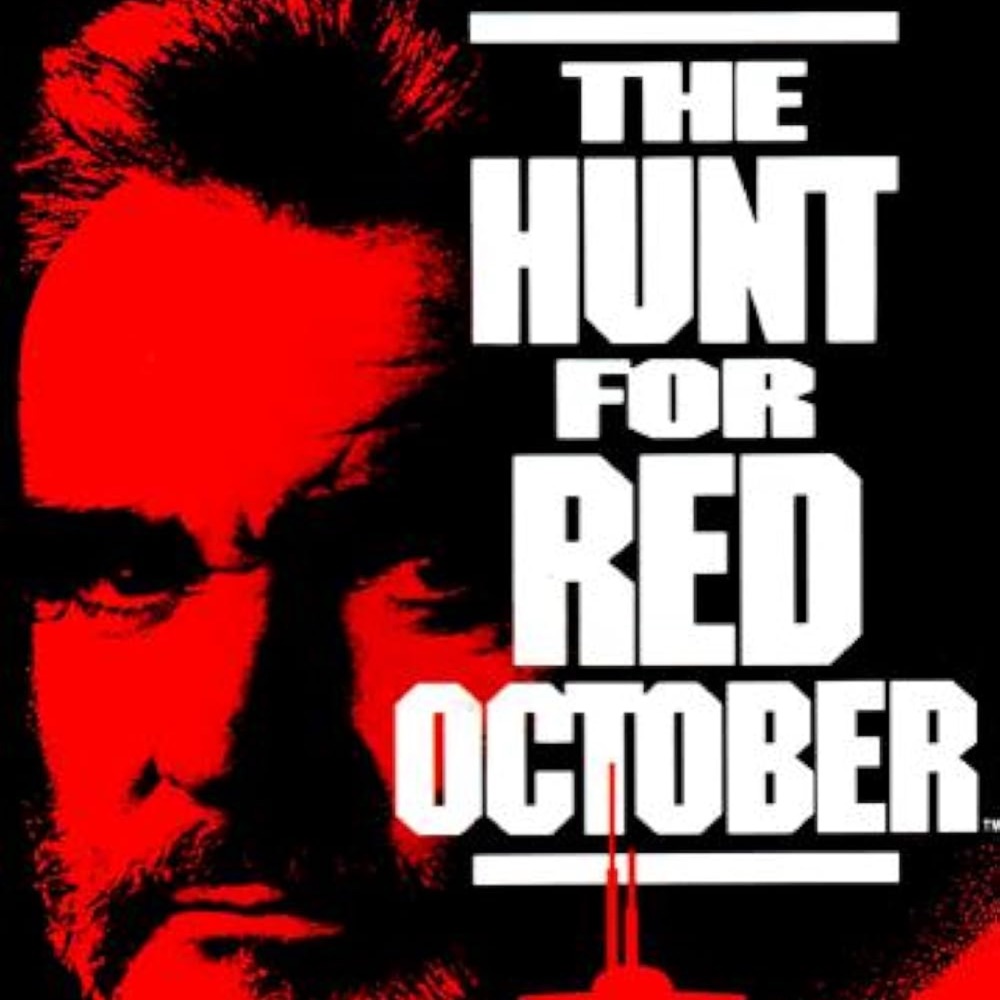
424 · The Hunt for Red October
The Hunt for Red October is a video game based on the 1990 film The Hunt for Red October. It was first released in 1991 for the Nintendo Entertainment System. Versions for the Game Boy and Super NES were subsequently released.
From Wikipedia: The Hunt for Red October (console game) (CC BY-SA 4.0)
We opened 1991 with a very serious movie and a game that starts with a wall of text on a red background, which is what we signed up for. Mike, Sean and Joe spent a good chunk of the episode arguing over whether a mostly left-to-right submarine game is a shmup. Sean says yes and will keep saying it.
What works
- The sub feels good. Movement is slow and fluid enough to read as underwater, not space. Tilting up or down changes your hitbox, which is how you thread the caves, and since a submarine has no independent turret, aiming means tilting the whole boat.
- More buttons than a shmup needs. A fires torpedoes forward, B fires missiles upward, Select triggers the caterpillar drive, and A plus B drops decoys. Torpedoes never run out but get weaker as your ammo drops. We mostly forgot the countermeasures.
- Armor and power. Run out of power and you only lose abilities, and you can surface and recharge if you survive the bombing runs. We learned that late.
- It looks great. The title sequence turns a sonar sweep into the hammer and sickle, and the Paramount logo is lovingly done. The crystal caverns and stalactites look close to Super Nintendo.
What doesn't
- It isn't fun to play. Joe said so plainly: death after death from needle-threading that is touchy on purpose and a little unbalanced. The coral reef level, with enemies on boats, planes and parachutes and no room to move, was a pain.
- The third act. After the whole game in the sub, the last stage is a platformer where you play Marco Ramius, the Sean Connery role, disarming bombs aboard the Red October. Sean says it ruins the game, and we called the game a reverse Kid Icarus. We couldn't recall anything like it in the movie.
- The movie barely fits. The cutscenes are long and dialogue-heavy, then you go back to fighting an armada the film never had. Who you're even playing is unclear, since Connery isn't driving.
Beyond the game
It is not the worst movie game we've played, and it didn't just borrow the title for an unrelated game. The escape-and-pursuit premise survives in dodging environmental and military threats at once. It's also our first Tom Clancy game, with Ghost Recon coming up.
The bottom line
Skip it. We all voted no on the Essential Games List: Joe because it isn't fun, Sean because the third act sinks it, and Mike because it is a good movie game but not a great video game. Sean would still recommend it if you like shmups or want to be the hunted sub. If you try it, stick to the submarine part and enjoy the title screen.
Written from our conversation in this episode.
- JOIN THE HUNT
- 1. What Is The Hunt for Red October?
- Original Source Material: The Hunt for Red October began as Tom Clancy’s 1984 debut novel and was later adapted into a 1990 film.
- Core Premise: The story follows Soviet submarine commander Marko Ramius, who attempts to defect to the United States with the advanced ballistic missile submarine Red October.
- Key Technology: The submarine’s experimental “caterpillar drive” is central to the plot, since it allows the Red October to move with extraordinary stealth.
- Genre Identity: This is a Cold War thriller about stealth, pursuit, military pressure, and the tension of whether Ramius can escape before the Soviet fleet destroys him.
- 2. What Is The Hunt for Red October on NES?
- Release Information: The NES version was released in January 1991.
- Developer and Publisher: It was developed by Beam Software and published by Hi-Tech Expressions.
- Genre: The game is a single-player side-scrolling action shooter.
- Adaptation Basis: The game is based specifically on the 1990 film, rather than the original novel.
- STARTS WITH A HEAVY WALL OF TEXT
- But a nice red background, this is the kind of shit I signed up for with Red October. There better be RED
- Beautiful job of the Paramount Pictures logo
- The sonar turning into the hammer and sickle? Chef’s kiss
- 3. How Closely Does the Game Follow the Movie?
- Story Similarity: The game keeps the basic premise of Ramius trying to defect with the Red October while Soviet forces attempt to stop him.
- Gameplay Difference: Instead of recreating submarine command in a simulation-heavy way, the NES version turns the material into a horizontal action game with combat, pickups, and cinematic interludes.
- Most Notable Change: The NES game ends with a final stage where the player leaves the usual submarine gameplay and controls Ramius on foot, disabling bombs in the Red October’s weapons bay.
- 4. What Is the Story in the NES Game?
- Opening Setup: The manual frames the Red October as a terrifying weapon identical to the movie
- Primary Story Goal: The game’s version of the story is simple and direct: survive the pursuit, navigate hostile waters, and bring the sub to freedom.
- 5. What Is the Core Gameplay?
- Main Structure: Most of the game plays as a side-scrolling submarine action game with deep-sea combat and evasive movement.
- Main Objective: The game’s stated objective is to evade destruction and eliminate threats, including enemy craft and saboteurs.
- Strategic Layer: The manual emphasizes balancing fuel, stealth, weapons, and defenses while dealing with both enemy attacks and difficult underwater terrain.
- Gameplay Identity: This makes the game feel less like a realistic sub sim and more like a military-themed action game with resource pressure.
- 6. How Do the Controls Work?
- Movement: I don’t pretend to know much about submarines, but I did play a lot of Silent Service. Is it that easy to reverse in a sub?
- Primary Weapons: The A button fires torpedoes horizontally, while the B button fires missiles vertically.
- Stealth Function: Select activates the caterpillar drive, which helps the Red October evade enemy sonar and pass enemies without drawing fire.
- Emergency Defense: Pressing A and B together launches electronic counter-measures, or decoys, that attract and destroy nearby incoming enemy fire.
- 7. How Do Weapons and Upgrades Work?
- Upgrade Path: Both weapon types can be upgraded from short-range, to long-range, to long-range homing capability.
- Downgrade Pressure: If ammunition levels fall too low, weapons downgrade automatically, although the manual notes that torpedoes never disappear entirely; they simply become much weaker and slower.
- 8. What Defensive Systems Matter?
- Armor: Armor pickups repair the submarine and effectively buy the player more survival time.
- Power Management: The Red October requires fuel, represented by power pickups, and the manual warns that running low can end a mission.
- 9. How Is the Journey Structured?
- Environmental Progression: The manual describes the Red October’s route as a journey through various oceans and their unique terrain.
- Early-Game Setting: The escape begins in a high-security Soviet harbor, where the player must slip past defenses including giant underseat gates and walls and avoid sonar buoys.
- Midgame Terrain: The game then moves into more dangerous natural environments, including coral reef areas, narrow caverns, and deep-sea trenches.
- Endgame Twist: The final NES-exclusive level breaks from the submarine format and becomes an on-foot mission inside the Red October itself.
- 10. What Makes This Game Distinctive?
- Stealth Theme: Even though this is an action game, the caterpillar drive gives it a mechanical link to the stealth premise of the movie.
- Stage and Progression Discussion
- 13. What Is the Final Stage Like?
- Gameplay Shift: The final stage abandons submarine combat and becomes a platform-style bomb-disposal mission.
- Character Focus: This is the one point where the game most directly foregrounds Ramius as a person, rather than just as the submarine’s commander.
- Specific Discussion Topics
- 14. What Makes This Game Interesting?
- Source Material Contrast: The game adapts a tense espionage thriller into a side-scrolling shooter,
- Adaptation Curiosity: It is a good example of how NES-era movie games often translated tone and premise loosely rather than literally.
- 15. What Makes This Game Frustrating?
- Difficulty Reputation: GameFAQs users broadly rate the game as “Tough/Unforgiving.”
- Resource Pressure: Running low on power, armor, or weapon strength can quickly spiral into failure.
- Control Rigidity: Because the submarine has specialized movement and directional weapon restrictions, the game can feel less fluid than a standard action title.
- Late-Game Surprise: The abrupt shift to an on-foot ending may feel memorable to some players and disorienting to others.
- 16. What Do the Graphics and Presentation Contribute?
- Cinematic Intent: Wikipedia notes that the game uses cinematic sequences in addition to combat stages, showing that it at least attempts a movie-like presentation.
- Atmosphere Goal: The game’s underwater settings, military framing, and stealth premise all push toward a more serious tone than many other licensed NES games.
- Presentation Hook: Even if the gameplay is blunt, the material itself gives the game a more adult and high-stakes flavor than many NES action titles.
- 18. What Is the Final Verdict?
- As a Film Adaptation: It preserves the escape-and-pursuit premise, but transforms it into a much more direct action game.
- As an NES Action Game: It has enough system ideas to stand out, especially with its stealth mechanic and unusual ending.
- Main Strength: Its strongest asset is that it tries to build mechanics around the Red October itself rather than simply using the movie title as decoration.
- Main Weakness: Its difficulty and stiffness may keep it from feeling as elegant as its premise sounds.
- Closing Thesis: The Hunt for Red October on NES is less a faithful simulation of the story and more a stern, system-heavy submarine action game built from its most recognizable ideas.
Auto-generated transcript. Each paragraph starts with its timestamp. Speakers are not identified.
The Hunt for Red October. Join the Hunt.
And welcome to NEStalgia, a chronological exploration of every NES game released in North America. I'm Mike. I'm Sean. And I'm Joe. The Hunt for Red October, a very serious film, maybe one of the most serious films we've covered in video game 8-bit form since Platoon.
Yeah, you know, like, I feel like some of these are weird when they get video games and The Hunt for Red October is no exception. It starts very serious even on the video game with a wall of text and I just know every kid in America hits start as soon as that stuff started coming up on screen. Especially because it's like, it's all like American history and I feel like, you know, if you're like eight years old, you're like, okay, I'm not reading that.
It very much is not American history. It's just the plot of the movie. Yeah, but I mean, November 12th, 1984, approximately four months before, you know, the Soviet Union and... Come on. No, it's like serious. It's serious. It means video games are serious. It means that you're important for playing it. Come on. Look, I'm not saying I don't like it now. I'm just saying that I feel like a lot of kids, they're skipping through that. I think you're thinking of the current generation.
I'm thinking of me when I was eight. Oh, okay. Yeah, 1984 to me would have sounded forever ago, even in 1991. Probably. Now, Sean, you are repeating some government lies there about this just being part of the movie. I want to remind you that it's repeated statements by both the Soviet and American governments is that nothing that we are about to see in this video game ever happened, all caps. So are you just perpetuating that myth here on the podcast as well? Because I'm inclined to believe that at least some of this happened.
Well, if we pull up Jack Ryan on the phone, maybe he could give us a bit more info. Yeah, so is this our first Tom Clancy game? Like, is this like the beginning of the Tom Clancy games? And it makes sense because this is also his first novel.
See, because the... We're getting Ghost Recon soon. The back of the box makes me feel like it's going to be... Join the hunt makes me feel like it's going to be like a Pokemon Go, like, ARG style. Like, everyone is out there hunting for the Red October on their phone. In submarines, do you have to be in water for this? Yes. It's like the Pokemon Go won't be in the water instead of land. But you can still give it a shot. True. Now, Tom Clancy, notable for the video game section, sure, but probably more prolific as a writer.
I'm interested in both sides because I never really played... There are tons of Tom Clancy's Splinter Cell, Tom Clancy's Ghost Recon. There's plenty of those games. I never really played most of any of that. So I'd be interested both from like a video game and literature perspective. What's your exposure to the Tom Clancy-verse? Almost nothing other than like knowing what these video games are and knowing they're based on books. Like, that's it. Okay, so Sean's going to have to carry this segment. Please, this episode.
Well, just this segment, just about Tom Clancy. You played the game, right? No. You didn't play this game? I haven't played one of these games in months. You guys just haven't noticed.
You're doing a great job or we're doing a really bad job. Yeah. Well, yeah, I've played some Tom Clancy stuff. I've seen some Tom Clancy movies. I haven't read a Tom Clancy book, but I'd never say never. But yeah, Splinter Cell was great. I played some Rainbow Six Siege for a little bit when that was new. I played some Rainbow Six when it wasn't a games-of-service thing. Yeah, I've done some Tom Clancy's. But it's not always, is the focus on stealth? No, the focus is on military. Right, so Splinter Cell is like the stealth adjacent but still military category?
I actually don't know if it's based on anything or if he just sort of workshopped the idea with them and then allowed them. Or if he just let them put his name on it. Right, which could very well happen. Yeah, but no, he's not a stealth writer. He's a military writer. Right. Yeah, I guess I always assumed that Splinter Cell was the answer to Metal Gear. I guess in a way, yeah. And in terms of the books, not really. But I mean, Tom Clancy's had many things adapted into movies as well. He's kind of like the spy military thriller version of Stephen King.
Yeah, or the non-horror Dean Koontz is actually, I think, a better thing there for me. I think it talks more about the quality. The quality. And then how about the actual movie, The Hunt for Red October, with Sean Connery and Alec Baldwin? Any watchers of that? I read the back flap. I watched the trailer. I watched the movie clips, selection of nine scenes. I probably saw the movie when I was much younger, but I don't remember much of it now. I feel like I have a vague memory of maybe having watched it with my dad or something, but I don't remember it at all, if I did. The Hunt for Red October. Yes. I know that you got the classic Sean Connery voice in there, but that's all I know about it.
And he's doing a good job of what the character is. The character, it's unknown his motives, right? Is he going to attack the U.S. or is he defecting to the U.S.? And I think Sean Connery plays the character in a way where you could rag on him for just being Sean Connery, but you could also say that he's doing this really good, riding the cusp of absurdity on his character as well. And I enjoyed his performance in this film. I also enjoyed Alec Baldwin in this film, and it kind of made me wonder what happened to Alec Baldwin a little bit. Because at this time in his life, he's doing so many big, big movies.
Blockbusters is questionable on some of these things, but just prolific films. And I feel like we just, ever since he shot that person, we don't hear from him anymore. Well, I guess that makes sense.
Yeah, well, you got to go there, huh? Yeah, well, it happened to him, but I'd say even before that he dropped off. Maybe he dropped off when Cat in the Hat came out, but I would argue that was his peak. I mean, I know him most as, like, a comedic actor with 30 Rock, but I'm probably in the minority there. Well, I feel like that became such a part of his brand, is that, like, so serious it's not serious kind of humor. Yeah. That's a great description of that.
And I guess, you know, submarines are pretty cool themselves, right? I think we covered that in our silent service episode, that submarine simulators, or just the idea of controlling a submarine as a unique vehicle, is pretty cool. And the Hunt for Red October submarine has an experimental caterpillar drive feature, which, pretty central to the plot, makes it so that it can basically become invisible underwater and not be detected. And that's something that's obviously going to fit into the game, too.
But since you were talking about, Joe, watching it with your dad, maybe, perhaps. It's like, I do think that that's also, like, kind of how this audience fits in, too, though, is that, like, if you were a kid, the movie was probably, like, cool, like, to look at, but you didn't understand really, like, what was going on, or you were, like, maybe a little bored by, like, the dialogue stuff, and you were like, ah, can't they just get back to the submarine footage? So the game, rightfully, gives you, it's all submarine. It's, like, the idea is just... Well, not the cutscenes. It's got those cutscenes that you feel like they're lifted right out of the movie. I think they might be ported from the movie.
Like FMVs, but for NES. Yeah, yeah. But the submarine is basically the maker break of the game, and the gameplay, it's very interesting. Obviously, on the NES, they're not going to try to, like, faithfully recreate the movie. How could they? I'm not even sure what that would look like. But instead of recreating a submarine simulator, even, the NES version turns into kind of a... Oops, all shmup. Well, is it a shmup, though? It's a shmup. I don't know. I don't know either, because, like, on paper, really, the only thing that differentiates it from a shmup is that, like, you kind of control the camera.
Even that's not fully true. Yeah. But that, like, small difference, you sort of do. It just moves really slow if you're not moving it, but you decide to speed it up. Like, you're moving it forward faster than it's, like, than it's regular, like, automatic movement. But, like, that little tiny difference does make it feel very different than a shmup to me. It makes the movement feel different to me. I feel like it's ignoring a lot of the rules of shmups, too. Like, it's very...
Even with the other enemies, like, it's not some... Not that it has to be a bullet hell or whatever, but there's not really, like, a screen littered with enemies where you're constantly clearing stuff. It is more like action navigation, getting through these obstacles and the ability to fire both head-on and above you. So there's definitely some things going on here that could bring it up to discussion. But I wouldn't say calling it a shmup is unfair, Sean, because at the end of the day, all you're doing is controlling this vehicle like you would any other vehicle in these horizontal games
across from a beginning to end to get to a destination. And even, like, the places you play in the game, it's just kind of like, where is this on Earth? It's in the ocean.
Yeah, but where do they have, like, giant walls and retractable pipes and, like, where does that all exist? I assume those were, like... In the ocean. Yeah, that's just, like, on the beach that you already see that stuff. You're not going to be, like, waist deep and you're already seeing that stuff. And I don't know or pretend to know anything about submarines. Most of my submarine knowledge comes from the aforementioned silent service. But is it really that easy to move a submarine in reverse? Is it really that easy to just, like, back up a submarine like it is in this game? It's almost as if, like, they're calling it... It's almost as if, like, the control scheme, for the most part, is sort of ported from shmups.
See, all right, here's the thing, though. I guess, for me, just being able to come to a complete stop feels not super shmup-like to me. That's a very... I think you guys have a very narrow description of what shmups are. Well, all right, that's one of the elements. But also, like, a shmup, like Mike was saying, too, I feel like a shmup has, like, tons of targets on screen where I'm, like, shooting them up. It feels like I need to be shooting a lot at a lot of enemies. And there are portions of this game that are like that. But there are large portions of this game where it's, like, you're quietly navigating through, like, little rocks and everything.
Yeah, you don't usually have a health bar in shmups, either. And I'm not saying that this definitely isn't a shmup. I'm just saying this does not feel like other shmups to me.
It's a very polished and with a few extra bells and whistles shmup. But we could have this conversation the whole episode if we want. Yeah, I think we should. I think we should continue to.
In the favor of shmups, as I mentioned, with your primary weapons, the A button firing torpedoes horizontally and the B button firing missiles vertically because you have enemies both above and to the side of you. So you have to deal with them. There are making a lot of good use of the NES controller, though, because the select button is also what you use to activate the Caterpillar drive we were talking about, which helps the Red October, which is— I feel like we didn't mention this. The Red October is the name of the submarine. It's not what they're hunting for. Everybody else is hunting the Red October.
And so you press the select button to kind of evade enemies. And then if you press A and B together, you get basically your emergency defense system, your decoys, electronic countermeasures, I think they're called in the manual, that attract and destroy nearby income enemy fire, too. So those are all neat features that I think would actually welcome in a shmup, right? A select button that kind of turns your vehicle temporarily invisible, pressing the two buttons together to temporarily send a decoy out that could take hits for you. Those all sound like great ideas. Do they work in the game?
It's hard to say, because I feel like some of them work in like— you know, you need decent power-ups. I'm trying to be careful of not further— making it sound like a shmup. —too much by making it be like, wow, these are really shmup elements I'm talking about here.
But, like, yeah, there's— I didn't find myself using them very often. Granted, I didn't get super far in this game. It's very, very difficult for me just to navigate through these waters. So, like, you know, maybe later in the game, I would have used them a lot more. But for me, I think I just didn't— I didn't end up using them. Like, I used them to, like, test them out and see what they are, and then I kind of forgot about them a lot. Yeah, I think they mostly work. I did forget about countermeasures pretty often, but the—
basically, it's like a— it's a force field. It's not really anything about, like, running silent or anything. But that I would use, because there's a lot of situations where you just sort of get pelted, and your armor will melt if too much stuff happens to you at once. I did like the— I did like the way that you move in this game, where, like, you kind of do have to get real—
real precise with it, because you're— depending on if you go up or down, you kind of— I don't know. What is that? That's not— is it roll? That's not roll. Is it yaw? Is it— you kind of tilt up. You tilt forward and backward, and that changes your hitbox, and you can do that to avoid torpedoes. You can do that to sort of thread the needle through very narrow sections of the game, because you do go into a lot of caves for a massive Soviet submarine, more than I would think for something like that. Armed caves, too. There's a lot of, like, attached turrets and everything in those caves. And I guess also, like,
flamethrowers at certain points. I don't know what those are supposed to be. But, yeah, I liked how the game felt, for sure. Yeah, I think that that's, like— that was the shining star of this game was the feel of the motion. The tilt part you're talking about, I also used a lot for just shooting at a slight tilt upwards. And, you know, if you're just talking about it, the gameplay, you might be like, well, that's annoying. Like, why can't I shoot at an angle without tilting the whole ship up or whatever?
But, like, we gotta remember, we're talking about a submarine, and, like, I did appreciate that that was, like, a way that they translated, like, the way a submarine might work, where, like, there's not, like, a turret that you're able to tilt up and down independently of the sub itself.
But then also, like, something about the floatiness of, like— or, like, the flow of the way you move. It's, like, a little bit slower, but it's really fluid, and it makes it feel, like,
underwater and not in space. And I think that that, you know, that, like, helped sell it a little bit for me. Yeah, and the movement on the sub is very important to those claustrophobic sections because, specifically, once you get out of the Soviet harbor, which is that one with the ridiculous giant gates and pressure systems and stuff that you have to, like, time to get through, once you're, like, actually just, like, in the Arctic or the coral reefs or whatever. Or the crystal caverns in the Atlantic. Yeah, yeah, of course, the famous crystal caverns. Like, those sections,
you know, may not be— may not have a lot of enemies, but you will just take a lot of damage if you don't know how to steer this thing properly. So a lot of it is also just, like, an impressive feat of knowing how to maneuver the Red October.
Along the way, though, there are, like, you know, with your weapons, like, you can pick up upgrades for them, and both your horizontal and vertical weapon can be upgraded from short-range to long-range to even homing capabilities, but they also downgrade as your ammunition level falls. The only thing that can never disappear is torpedoes. You do have unlimited torpedoes. They just become weaker and slower, so you have to fire more of them.
I think the game is, though, trying to balance, like, not even just the difference between navigation and enemy encounters, but also the different stages and, like, the feel of the game. Like, when you're in those coral reefs, you have a lot of enemies that are not necessarily in the water. They're above you parachuting in, or they're on boats, or they're on planes, and you don't have a lot of space because the reefs are, you know, like, you're very close to the water, so it's claustrophobic in a completely different way than the narrow cave segments because now you have, like,
technically you're free to get around, but you have to kind of move through it quickly and dodge all this enemy fire. That particular stage... Yeah, that level was a pain in the ass. Yeah, so as I was going to say, particular stage, while it's early on, you know, you take a lot of damage early, and you have both, like, an armor to you, like an HP system that way, and a fuel system as well, and the fuel system is way more forgiving than the armor system, but if either one goes, it's game over. Well, you can run out of power. You just lose all of your... Oh, I didn't know that. You just lose, like, sonar.
I think all of your abilities are weakened, but if you run out of power, you just get this thing that says out of power, but you can surface, and if you can dodge the, you know, bombing runs of these jets or whatever
and not get hit by torpedoes from below, you just sort of hang there and recharge for a bit. Yeah, I kind of wish I knew that because I would have been more... I would have used my power more often. Yeah. Yeah, it's fun. It also just sort of drains on its own while you're below sea level. Yeah, but there's pickups for that, right? Yes. Yeah. Joe, you mentioned those cut scenes, and while they're definitely not FMVs, they are pretty long, dialogue-heavy, story-driven things. It's like, you could argue that it's necessary for a game based on a movie that is mostly just, you know, character-driven,
you know, on the edge of your seat, what are they going to do next, decision-making style stuff, but it doesn't really translate to this game because then you just go back to, like, silly submarine-fighting. Yeah, I mean, yeah, it seems like it wasn't the most, like, smoothly implemented way to integrate the movie into the game, but you got to appreciate the very detailed talking heads of these characters, like, from the movie. I mean, like, particularly...
I can't remember if it was the FBI agent or if it was Sean Connery. I think Sean Connery has, like, very distinct lighting on his face and he's, like... Well, he particularly is definitely, like... He, like, starts sweating when he says certain things and dabs the sweat off his forehead and, like, I feel the emotion in it. Is Sean Connery in these?
Is that not Sean Connery? Well, the... The idea of Sean Connery. I'm pretty sure that this is, like, a... All this stuff is happening, like, not anywhere near the sub. Like, this is the, like, Soviet ambassador... Well, so remember, I don't... I haven't seen the movie. I don't know which character Sean Connery. Well, I just mean that none of them look like Sean Connery. I know, but aren't you... The guy in the tie, to me, looked like Sean Connery. No. The guy wiping the sweat off his forehead, I thought that that was Sean Connery. No, that's just, like, some Soviet ambassador dude.
Right, but you are definitely playing as, you know, James Bond, if you will, in this game, because maybe the biggest reason why this isn't a shmup is because at the final stage, you finally take control of just Sean Connery, which we should... Marco Ramius, I believe, is his name. And you do a platforming stage, where it's, like, you know, you have a gun and you're fighting off other enemies on land, and you have to... You have to disarm the bombs
that I think they're hooked up to the Red October itself. Yes, this is in the submarine. Right, so now you're in the submarine, so I guess that's what I was saying, is, like, you are playing as Sean Connery. Now you are, yeah. I felt this was very confusing. Well, hold on a minute. What are you saying? You're saying you're playing as the Red October before that? You're not Sean Connery steering the Red October? Okay, are you playing as some guy in Gradius, or are you playing as the ship? You're not... Okay, that's a great question. You are controlling the Vic Viper in Gradius, but I hear you on that. I guess what I'm saying is that if Sean Connery... I was just drawing attention to the fact that now we're in some really weird, like,
side-scrolling, like, platformer that makes no sense with what they've built with the rest of this game here. Did this kind of thing happen in the movie? Did Sean Connery, you know, start running around shooting people in a platforming setting? Actually, yes. Okay. Not at all.
Again, you're looking at somebody that read the back flap, but, Mike, you said that you watched the movie, so I feel like you should know better. No, I don't think that there is... I mean, there's action in the movie, but nothing like what's happening in this level. Yeah, but there is, like, a... There is sabotaging. They don't have the circular bombs with a, like, a clock face, like, detonator, but there's, like, a saboteur and a face-off with guns and stuff, but I think this is just that them, like, oh, we have to make it... The movie was mostly in a submarine, so I guess we have to go into a submarine, even though we've built a complete, like, game and, like, way to play the game that this doesn't really, like, fit with at all.
So it's a strange decision to do this. And yet, I don't really hate it. Like, it's a good... It's just good variety for the game. It's kind of weird that it didn't alternate between these and that it just introduces itself at the end here. I don't know. I think there's a huge quality drop when we get to this point. I feel like I'm playing... I'll be honest, I didn't get to that point, so I can't speak to the way it plays, but the way it looks, I think it is, like... I don't know. Part of me, like, I do want to appreciate, like, changing things up or having that, like, sort of...
What's it called? Well, the spy manga game that we played. And we played it at the Long Island Retro Games Fest with a sniper rifle. Oh. It's also an NES. Golgo 13. Like, that Golgo 13-esque, like, oh, there's all these different ways of playing and everything. But, like, I feel like this game just, like, didn't... If it's just set up where 90% of the game is in the submarine, it's like, okay, now do this whole different thing that you're, like, not ready for. It's a little weird. I think that throws me off a little bit. Yeah, it's because you hated the opposite in Kid Icarus, where the whole game was a platformer and then turned into a shmup on the final level. Well, anything that turns into a shmup
is not going to get my vote. No, but it was basically... The Hunt for Red October is a reverse Kid Icarus. Yeah. And, like, I'm not against that, though. Like, we've had other games that do that, and I'm like, oh, that's pretty cool. It's just, like... I guess having not gotten to it, I can only imagine that, like, it's so far into the game that I'm just, like, a little thrown off by it. It just feels like having to learn a new game. But, like, I don't know. I'm not fully opposed. I just... I guess I gotta get there. I guess I'll be right back.
We were talking so much here about the end of the game that I feel like, you know, we only quickly glossed over that the beginning of the game starts with a heavy wall of text, but it's got a nice red background. And that's the kind of shit that I signed up for with Red October. There better be Red in the game. I think that they probably set aside, like, half of the memory in this game for just, like, the...
for, like, the title sequence, which is very impressive, and I think, like, actually from the movie. Like, they have separate sprites. Yeah, yeah, the sonar turning into the hammer and sickle. Like, yeah, that came out really well. And then they move that into the corner and make it smaller, and it's like, oh, that's, like, three or four sprites right there that they keep cycling through. And then you go down, and then the whole title goes into the water and starts moving. Like, they didn't have that kind of technology. This is all, like, hand-keyed here. This is crazy. And then I thought they wouldn't have room for the game after that. Right, right. Or I thought the game was going to be way more impressive. Yeah, you have to insert cartridge two after that. Yeah. And, Joe, you mentioned that Paramount Pictures logo,
but it's amazing. Like, they did a beautiful job on that. So it's not... I'm not just fanboying here that it's included in the game. I think they did it really nicely. And now I kind of want to see, like, all of the studio's logos on the NES. Yeah. Show me what the Warner Brothers logo... I can't say anything negative about the Paramount logo. But I don't work there anymore. I can say whatever I want. I never really liked that mountain. The Paramount logo is peak. Aha. Thank you. I'll be here all week. It's a pretty shit mountain, actually.
Oh, interesting. Why? Just look at it. Oh, yeah. I do see it now. When you look at it. When you actually take one second and look at it. Right. They did get the proportions a little off. Like, Paramount is very clearly red and everything, but, like, the mountain isn't proportionally red. Yeah, it's, like, half of it's missing. No, I mean, even, like, in the movies. The real mountain, yeah.
It's kind of shit. Was it... This is just me being stupid for a second. Like, the original Paramount Pictures logo, like, did they actually film a real mountain, or is that, like, a drawer? Is that, like, an art painting? They didn't teach you that in Paramount school? They didn't teach me that in Paramount school, but I know that that was a real lion for MGM. Really? Yes. That was... Wait, are you being serious? I thought it was a painting.
The Damian Roar. It was a flip book. Yeah. Well, okay. Well, I got news for both of you. The Columbia Lady is a painting, so this isn't a crazy question to ask about the mountain. I don't think it's crazy. I just assume it's a painting, but... Yeah, it probably is. But I wonder if it's based on a real mountain. It's based... Yeah, it's based on Paramount Mountain.
This is good shit, guys. This is really good stuff. All right, so let's see. Cinematic intent? Cinematic intent. The game is going for it. Does it land it? I described it when we first started. This is a very polished game, and I think while it's not cinematic insofar as it feels like a movie, or even is trying to follow what happens in this movie very much, I think at least the first 70% of this game, when you're controlling the submarine, I think it can lean sort of cinematic. Like, the explosions are cool.
There's high tension. And then it kind of throws it all out the window when you play regular Mario Brothers at the end. But yeah, I think some of it is cinematic. I don't know if this is what would translate it to cinematic, but it is like... Visually, it does look very nice. Like, the color palettes all feel really good, but also the texture of everything. I mean, I think it's in the second level where everything looks like crystal-y, we were talking about. And then later levels, there's really interesting shadows and the stalactites and stalagmites. It looks like one of those games that looks a little closer to...
I don't want to say it's like a next-gen, like it's not Super Nintendo levels, but it's like that in-between, where there's a lot of good shading and just art in it that looks nice. Yeah, this looks pretty close to Sniss. Right, we wouldn't have saw this in 1986. Right. And so far, the game has been compared to Gradius, but in a submarine, and Mario, but with a gun. And so, by all means, this game sounds amazing. Yeah, like, anything else you guys want to say about... compare this game to some other games? Because we're doing a great job. I will say that you are mischaracterizing how I said Gradius. You were talking about being Sean Connery.
And that's why I... Okay, so I got a question for you. In 007 Agent Under Fire on the PlayStation 2, when you get into the Aston Martin, but you've been playing as James Bond, are you now the Aston Martin, or are you still just James Bond driving the Aston Martin? That is an example. I want you to point, Mr. Person that's seen the movie,
to any moment in which Sean Connery touches a piece of equipment on the submarine. He's not driving the submarine. It's true, it's true. Actually, yeah, there's an entire fleet in there. So, yeah, that's a good... It's a great point. We can't figure out who is currently piloting this. Is he commanding the people piloting the submarine? Yes. In which case, I think you're playing as the neurons in his brain that are going through his mouth, telling him to speak to those people.
Perfect. Perfect conversation. Feels like one we've had many times before. Just like how at the end of every episode, we have the same conversation, which is the essential games list.
Joe? Well, I think this game does a few things right, like the way it feels to control the submarine, the look of the game. I think overall, I don't know if it's just that this game is too hard, but navigating in this game is very frustrating to me. And not because... I don't think it's because it controls poorly. I think it's just because
sometimes you have to really thread the needle. And I get that that's where the challenge comes from in this, but for me, this was just death after death after death to the point where it's like... It's touchy. And I know it's touchy on purpose. I know that's what it's trying to do. But I think that they accidentally made it feel a little unbalanced. And as much as there's some cool things in this game,
it's not very fun, I guess is what I should say. I didn't have a good time playing it. I have a good time watching videos about it and thinking about it afterwards, but I'm not like... Oh, yeah. In the moment, it's not fun. It's a frustrating experience for me. So I'm going to say not essential. Sean? Yeah, I enjoyed most of this game. I did like the shmup parts. I think this is actually one of the better shmups that we've ever played. And I'm going to continue to call it a shmup.
But I'm not going to say that it's essential. The whole third act kind of ruins it for me. And even if it was just the submarine parts, I don't think it was essential worthy.
But it looks cool. It plays nice. I'd recommend playing it if you're into that sort of thing. Or if you just want to... If you want to hunt the Red October or be hunted as the Red October that sort of does it for you, then I'd play it. But not essential. The Hunt for Red October is a less than faithful recreation of the story of the movie and probably the book. I don't even know how much the movie differentiates from the book. But one thing that maybe we should have talked about instead of rambling through the episode is that it does, in a video game-y way, it preserves that escape and pursuit premise from the game pretty well.
Yes, they've added in a comical amount, like an armada against you. And that's not what the movie is like at all. But there still is this, not thriller, but tense throughout the game of being the sub and having to dodge a barrage of both environmental and military conflict. And so I think it does that really well. It is fun to be the Red October, but not something I would have had on my wish list at any point. Like, I guess that makes me think about, like, what other movies that shouldn't really be video games would I actually be, like, interested in playing after the fact? I don't know. But this one definitely,
while it doesn't stand out for any particular reason, they actually did do a good job of not just, like, using the title to hunt for Red October and making a completely different game. I don't think the Switch at the end
is either weird or unfair. I think it's just something else to throw into a game that's trying a lot of things. It's difficulty and barrage of enemies is, like, maybe a little too much for me.
But I do like that it actually does build the Red October itself into, as I mentioned, with all those different controls, into something that is cool to control and interesting to navigate around with. You can't just spam torpedoes and make it, like, another one of those shmups where you're just holding down the turbo button. You also have to be aware of things coming at you from above and when to use your caterpillar drive and when to use your decoys. So I do think that the game overall does a great job of making a movie video game. I just don't think it's actually that great of a video game. So no for me either. That's three no's.
But not the, like, not the worst movie entry we've had and allegedly a lot of people from the movie are in this unlike Back to the Future where we couldn't even get Doc. Yeah, even Sean Connery was in it. And as the... But now, looking back at it, now I'm realizing that Sean Connery would have been a lot younger than I'm imagining he would be in this movie because it was, you know, what, 1990. But, uh... Oh, no, he's old. Yeah, he's still pretty old. Yeah, he would have a full beard. I'm picturing... Okay, so, like, is he bald? No. Okay, yeah. See, I'm picturing, like, I'll put it in the chat. I'm picturing, like, very late in his life Sean Connery
as, like, this older guy. I mean, you know... You're gonna put it in the chat and then we're gonna describe it to everybody. Yes, that's the only way that this works. I mean, he still looks exactly like that but not like the, uh, the thumb on the right, uh, which is... Right, right, yeah. That guy, that guy also, yeah, way too Russian to be Sean Connery. Gotcha. Uh, but, but, you know, you have posted a great, um, uh, he's wearing a... I was gonna say a tuxedo but that's, like, a nice, like, green Ralph Lauren suit or something going on there.
Um, this is around the same time, though, as the release of, um, Indiana Jones and the Last Crusade. Yeah. With Sean Connery. So, I think, I don't know, was Hunt for Red October? Maybe it was, maybe it was before that. Nope, it was the year later, the Hunt for Red October. So, we get, uh, Last Crusade in 89, Hunt for Red October in 90, and this game in 91. That's right, folks, we're in 1991 now. Anything can happen because Sean and Joe are loose on society. We'll be right back.