429 · The Untouchables
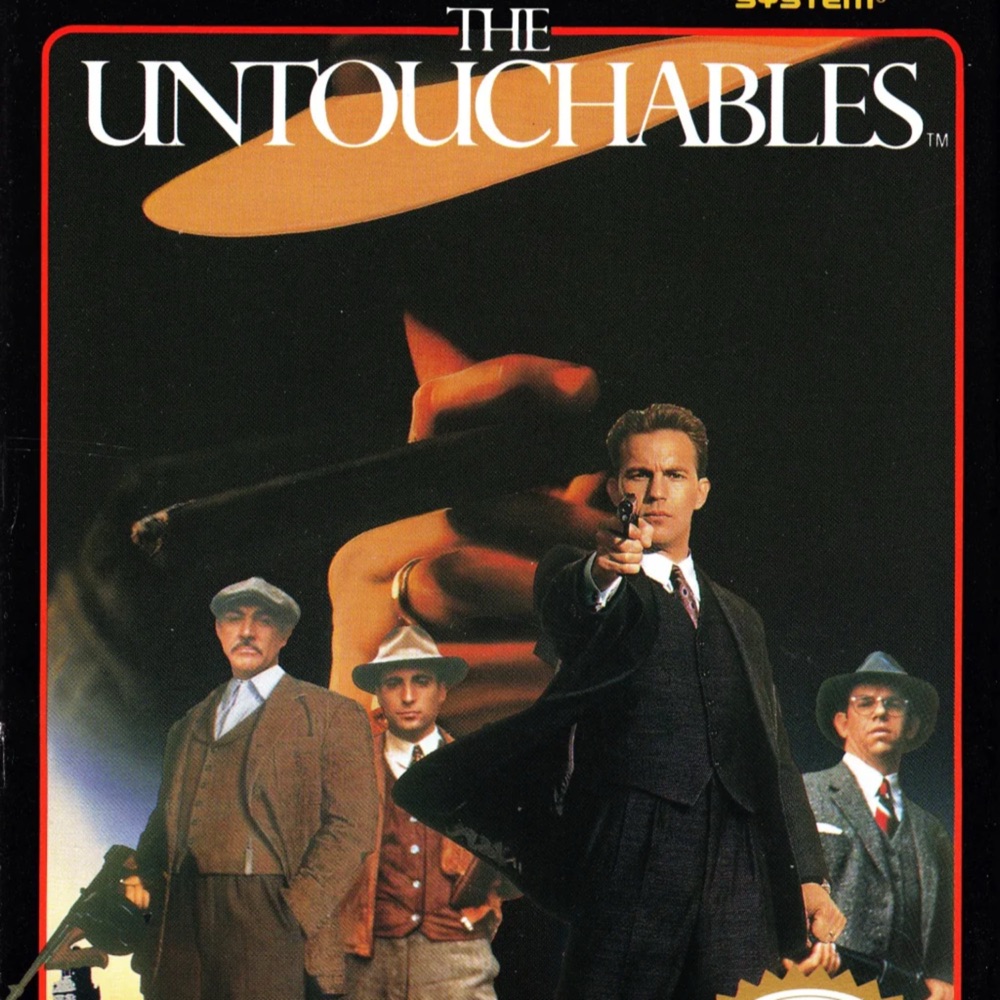
The Untouchables is an action video game released by Ocean Software in 1989 on ZX Spectrum, Amstrad CPC, Commodore 64, MSX, Atari ST, Amiga, MS-DOS, Nintendo Entertainment System, and Super NES. It is based on the 1987 film The Untouchables.
From Wikipedia: The Untouchables (video game) (CC BY-SA 4.0)
The Untouchables reached the NES in January 1991, four years after the De Palma film, which was itself based on a 1959 TV show and a 1957 memoir. A Super Nintendo version followed in 1993. Joe was out, so this was Mike and Sean. The game swaps genres almost every scene, and the film's big moments become levels whether or not they should.
What it attempts
- A different game per scene. Alley shootouts, a bridge raid, a warehouse side scroller, a train station escort, a hostage shot, a rooftop duel. Seven levels, at least four play styles, stitched together the Ghostbusters and Back to the Future way.
- The newspaper screens. "Elliot Ness wins fight with the mob" or "Elliot Ness dies in warehouse bust." They work as win and lose screens, but they were the one place the story moved and the period showed up, so they did more work than most of the game.
- All four Untouchables. Select swaps the character. Only the mugshot and health bar change, and Connery stays the back of a nondescript head, but the health of whoever is off screen slowly refills, so you will want it.
Where it misfires
- Two bullets and a slow cursor. Gangsters pop out, fire at your chest and vanish before the cursor arrives. We kept wanting a light gun.
- The bridge raid. You roll across a sand pit to shoot beer bottles, each worth 5 percent of the evidence, so you do it about 20 times, losing cursor control through every roll. We looked like we were destroying evidence. The Punisher mixed moving and aiming on one D-pad far better.
- The warehouse. The most conventional stage felt worse than the rolling. Jump and shoot seem swapped from what we expected, and the manual lists only the technical names of the buttons.
- The baby carriage. The train station is a nine-minute slow-motion shootout in the film and an escort mission here. You can only nudge the carriage, and it fails if it hits a wall or takes too much damage. We kept asking why the wheels roll on their own.
- The hostage. One shot, and a miss is game over. The game never says who the gunman or hostage is, so it assumes you have seen the movie.
- A 100-second timer in a game that rewrites its rules every stage.
Beyond the game
The ZX Spectrum and Commodore 64 versions scored 96 percent from UK magazines. The rooftop boss is Frank Nitty, a real person the movie kills off in a way real life did not. We argued about how far a true story can bend.
The bottom line
Skip it. With Joe out, we counted him as the one yes, since he would have loved it. Sean voted no: mostly a shooting gallery, a below-replacement side scroller, and one of the worst escort missions in video game history. Mike's closing summary landed the same way, and one yes out of three was not enough. It looks nice and suits fans of the movie, but it is not a good game.
Written from our conversation in this episode.
- LIVE AN AMERICAN LEGEND
I. Setup & Premise
- The pitch: You're Eliot Ness. Al Capone runs Chicago. You have a gun that holds two bullets at a time. Good luck
- Based on Brian De Palma's 1987 film. Kevin Costner as Elliot Ness which is funny cause some people pronounce the NES that way.
- itself based on the 1959 TV show
- itself based on the 1957 memoir
- itself based on the actual Prohibition-era federal investigation.
- By the time this game reached the NES in January 1991, the source material had been adapted, re-adapted, mythologized, and filtered through so many layers that the question wasn't whether the game would be faithful to the "real" Untouchables — it was which version of the legend it was even trying to be
- Developed by Special FX Software, published by Ocean Software. Special FX was formed by ex-Ocean employees who wanted to become independent contractors, but Ocean offered a deal that gave them publishing rights to anything Special FX developed.
- The central thing worth dwelling on: this is a game that changes what kind of game it is at almost every level. Shooting gallery, side-scroller, top-down action, escort mission, boss duel. It's an anthology of gameplay styles stitched together by newspaper headlines and a Prohibition-era veneer. Whether that ambition works or collapses under its own weight is the entire conversation
II. What Makes It Notable
- The genre-hopping structure mixed
- Here's the breakdown, scene by scene:
- Scenes 1 and 4 — Alley Shootouts:
- Third-person shooting galleries. Gangsters pop out of windows and doorways; you move a crosshair and fire.
- Ness brings a gun that can only hold two rounds at a time. The premise is to peek out of cover, shoot your two shots, go back into cover to reload — similar to Time Crisis.
- Except Time Crisis had a light gun and this has a D-pad.
- The cursor moves fairly slowly and the enemies appear and disappear quickly.
- While one would think this part of the game would include light gun compatibility, only the NES controller works
- Scene 2 — Warehouse Raid:
- Side-scrolling action. You're finding and shooting men with gray hats who are carrying evidence through Capone's bootlegging warehouse.
- Closer to a conventional NES action game, and probably the most mechanically straightforward stage
- Scene 3 — Border Raid:
- Rolling around on the ground, shooting at whiskey bottles. 1 More Castle Yes, really.
- This is the game's interpretation of the Canadian border liquor interception from the film.
- You're prone, dodging and shooting, destroying Capone's supply.
- Similar to The Punisher
- Scene 5 — The Train Station / Baby Carriage:
- The film: De Palma's 1987 Untouchables is one of the great crime films of the decade — Costner as Ness, Connery in his Oscar-winning role as Malone, De Niro as Capone, Garcia as Stone, David Mamet on the screenplay, Morricone on the score.
- The Union Station baby carriage scene is the movie's signature setpiece — a direct ode to the Odessa Steps sequence from Sergei Eisenstein's 1925 film Battleship Potemkin, one of the most referenced sequences in cinema history.
- The game turns that sequence — nine minutes of De Palma at his most operatic, slow-motion gunfire intercut with a baby carriage bouncing down marble steps while Morricone's score swells — into an escort mission where you push a carriage and try not to hit walls.
- The objective is to protect a baby carriage as it travels through a train station.
- If it takes too much damage, you fail. If you push it into a wall, you fail. If you let it run into a wall, you fail.
- Scene 6 — Hostage Shot:
- A gunman is holding someone hostage. You have to shoot the gunman in the head to pass the level; you have one chance, and if you fail game over
- This is either the most intense moment in the game or the most unfair, depending on how you feel about a game taking away thirty minutes of your time over a single pixel
- Scene 7 — Rooftop Duel:
- A shootout between one of Capone's goons and Ness on a roof, similar to the shooting gallery stages except there's only one enemy who must be shot multiple times.
- The ending is a bit weird; even though the last stage is a gunfight between Ness and one of Capone's guards, Capone ends up in jail
- Which is actually how the movie works too. Capone goes down for tax evasion, not a gunfight. The game just doesn't have the narrative space to make that feel earned
- The two-bullet gun feels dated
- In the shooting gallery stages, Ness fires twice and then has to duck behind cover to automatically reload. Two shots. That's it. The pacing this creates — pop out, fire, fire, duck, wait, repeat — is interesting conceptually. It forces patience in a genre that usually rewards aggression. But in practice, with a slow-moving crosshair and fast-appearing enemies, it mostly creates frustration. You will get tired after three stages of "shoot the guys in the windows" when there's less and less time during each stage.
- Worth raising: the two-shot limit is probably an intentional reference to the film's period-appropriate weaponry. Ness isn't carrying a machine gun. He's a federal agent with a revolver. The game is trying to make you feel outgunned, which is thematically correct and mechanically irritating in roughly equal measure
- The time limits
- In a game where the rules change every stage, being given barely enough time to figure out what you're supposed to do — let alone do it well.
- The newspaper headlines
- Between scenes, the game delivers results via newspaper front pages. Win Scene One and it's "Elliot Ness Wins Fight With the Mob." Die in Scene Two and it's "Elliot Ness Dies in Warehouse Bust."
- They're functionally just win/lose screens, but the framing is smart. It grounds the game in its period, gives weight to your success/failures, and is one of the few places where the story progresses
III. Pop Culture, Legacy & Connections
- The Untouchables was a hit on European home computers — the ZX Spectrum and C64 versions pulled 94-96% review scores from UK magazines. The NES version arrived two years later, developed by a different studio (Special FX vs. Ocean's in-house team).
- The R-rated-to-NES pipeline:
- The Untouchables sits in the same uncomfortable lane as RoboCop, Predator, Total Recall, Rambo, and every other hard-R property that got sanitized for a console marketed at children. Capone's baseball bat scene? Gone. Malone's death scene? Gone. The blood, the moral complexity, All gone.
- What's left is a guy with a crosshair shooting at windows.
- Thematic relatives:
- Dick Tracy (NES, 1990) — another Prohibition-era crime film turned NES game with shooting gallery mechanics.
- Hogan's Alley (NES, 1984) — the game The Untouchables' shooting gallery stages clearly resemble, except Hogan's Alley had Zapper support. The lack of light gun compatibility in a game built around crosshair shooting is a baffling omission
IV. Closing Bits
- The Untouchables tries to make every major scene from the film into a different type of game. Seven levels, at least four distinct gameplay styles. In 1991, was that ambition admirable or misguided? Is a game that does five things at a C+ more interesting than a game that does one thing at an A? And in the broader context of movie-to-NES adaptations — a genre defined almost entirely by disappointment — does The Untouchables deserve credit for at least trying to match the film's scope, even if it couldn't match its quality? NO
- Tease next episode
Auto-generated transcript. Each paragraph starts with its timestamp. Speakers are not identified.
The Untouchables, live an American legend.
And welcome to NEStalgia, a chronological exploration of every NES game released in North America. I'm Mike. And I'm Sean. Sean, without Joe here, I'm going to be expecting to see some enthusiasms from you today. Enthusiasm. Are you implying that I don't usually have enthusiasm?
Uh, it's just a line from the movie of which the game is based on, and I couldn't help but work it in because I have to reward myself for watching the movie, something I probably should have done a long time ago. But, um, I did watch this movie in advance this episode, mostly because I saw it was a De Palma film and I haven't seen one of those. I haven't liked. So I was like, sure. Yeah. Give me more. Yeah. I definitely had the thought cross my mind to watch it. And I'll definitely do that someday.
I would say it was. Okay. So I'm not putting it up there in like the pantheon of great movies or anything, but like it was one of those ones where like 40 minutes into the movie was, you know, like I'm still not looking at the watch. Like I'm just, I'm enjoying everything has it. There's set pieces. There's a lot of like homages to like classic film stuff. A lot of, a lot of, you remember in film school, we would always have to watch Battleship Podikin. Potemkin.
Yeah. I can never say it right. Uh, we had to watch a lot of that. There's actually like an entire scene that's just like an homage to that. It's the baby in the thing, right? Yeah. In the, his stroller. Yeah. Because we'll get to it. Yeah. Sure. Of course we'll get to it. Um, but whether we're talking about the game or we're talking about the movie, uh, in the untouchables, uh, video game, you are Elliot Ness in the, um, film. It's Kevin Costner and, uh, Al Capone, who in the film is played by Robert De Niro run Chicago. Uh, you have a gun that holds two bullets at a time and, uh, good luck.
I mean, that's, that's part of it. Yeah. That's most of it. Um, now the, the film, the film was made in 87, the, the game in 91, but the film is based on a 1959 TV show itself based on the 1957 memoir itself based on, of course, the actual prohibition era federal investigation.
So by the time this game reached the NES in January of 1991, the source material has been adapted, readapted, uh, you know, loosely of course too. Like none of this shit actually happened. Uh, so it's been filtered through so many layers that the question really isn't whether the game would be faithful to the real untouchables. It's just which version of the legend it was even trying to be. Like why, why make a game based on a movie that happened four years ago?
I mean, we, we've had this several times already. Like, uh, we didn't, we have jaws like 13, maybe not. But I think jaws is like iconic enough, right? Like jaws warrants it. Indiana Jones franchise play. It warrants it. You know, I'm not sure that like we're ever going to get the untouchables too. Do you think maybe we just, they just thought maybe it was going to be that like it just had enough staying power that it was still like a must see. Whereas today it's just like you, you've probably seen.
Well, you know, I usually save this for like sequels and spinoffs, but it's worth mentioning because we're talking about it right now, but the delayedness of it all it, this game then also gets a super Nintendo version in 1993. That that's insane. Right. Like, like, like, I just felt the need. Like where was, I bet, I'm sure people were waiting for the PlayStation version. Yeah. The N64 version of untouchables. Like it's just supposed to come with every console generation. You're supposed to get an untouchables game. That's pretty wild.
And it was developed by special FX software and published by ocean software. Now special FX was formed by X ocean employees. So they, I guess, wanted to become independent and ocean knowing the talent that was there. They basically offered them a deal that gave them the publishing rights to anything special effects developed in exchange, I guess, for their like licenses. So that's how they wound up making a lot of these movie games like the untouchables. So you say like just knowing the talent that was there as if like this is it should, should I know ocean is this, is this like kind of like knowing.
Oh, no, I guess I'm saying like, it's just, it's just an inside thing, you know, like they know what they're losing. So rather than lose the employees are like, yeah, you can still make the games and we'll publish them. I see. Okay. Yeah. So there was like a deal between them. Uh, and no, the, the game itself. I mean, this is a game that changes what kind of game it is almost every level. It's a shooting gallery. It's a side scroller. It's a top down action.
The, uh, Ghostbusters slash back to the future philosophy of movie games. Yeah. I mean, it's really like, it's just an anthology of gameplay styles stitched together around these newspaper headlines, uh, that, you know, call back to the prohibition era. And I think the, the, that's what we have to talk about first is just that, that genre hopping structure is what makes it so notable. So if we want, we can just kind of go through each game and talk about it a little bit.
Yeah, sure. All right. So we start on, uh, they're, they're called scenes and, uh, it's scene one, but also scene four are both, uh, alley shootouts. And these are third person shooting galleries. Gangsters pop out of windows and doorways. You are hiding behind, uh, a brick wall and then come out and you move across hair to fire. Sounds great. But, uh, one, as I mentioned early on, Ness brings a gun that can only hold two rounds at a time, which in real life, you know, sure. That totally makes sense. But, but like in a video game, that's not going to be very fun.
Um. The premise is you peek out, peek out of cover, shoot your two shots, go back into cover to reload. But I guess what I'm saying is like the, the cursor moves so slowly. Yes. And the enemies appear and disappear so quickly that when you're, when you're doing all of this, this is the one where it's like, oh, this would have been so much better if it had light gun compatibility. Yeah. I mean, I wouldn't say that the whole premise of having two shots per, like, I don't know,
pop out isn't itself bad. I think that if you found a way to use the, uh, the light gun in a better way, or no, sorry, just like use a control, uh, control scheme in a better way, uh, then that could be pretty cool. Namely, in this case would be using a light gun, but no, we get another, we get another sort of cursor, cursor shooter, which. Yeah. And the cursor shooters are, yeah, it's just so tough. Cause like I, I even find for FPSs in general, which I am ready to completely admit that I am bad at them. Like laughably bad.
If, if I'm in, uh, if I'm playing doom or unreal with somebody, uh, they're always going to get to me first. Like I just, I don't have the reflexes for it. Even with a mouse and keyboard. I, yeah, I don't have it, but especially with a D pad, I definitely don't have it. And these guys are not like peeking their head out and being like, Hey, what's going on out here? And looking around and then going back inside. They're like peeking out, shooting at you and then they're right back in there. Like every time you see a gunshot is hitting you in the chest. Um, if, if your health bar is to be believed and I'm not sure why you're wearing a really good bulletproof vest because you have, you can take a crazy amount of shots.
Um, now when you, did you read the manual first? I did not read the manual first. Why? Because you don't realize you can do this if, or it wouldn't just be intuitive to do this unless you read the manual. Um, but not only do you have a good amount of health, but you can also like, you know, hot swap your character, which doesn't really change anything aside from your health bar and a sort of mugshot next to the health bar. But it's a way in which you can sort of spread the pain or spread the love of like just getting shot at point blank rage in a, in a, in an alleyway.
Um, and it doesn't really, in this first level, it's not that big of a deal, but when they, they like recycle the whole concept in scene four, it's like, I think it's kind of impossible to do this without doing that. Right. It was, it wasn't something I realized the, the character swapping until, um, until the third stage on the, uh, the bridge where you're just like rolling around on the ground.
And I was like, they changed the, I felt like they changed a little bit of the controls or maybe I took too long of a break between the first stage and the third stage to realize, but like, I felt like something about the controls was different than the alley shooting. Yeah. So I was hitting, I was just like hitting buttons to see what they did and I hit select. And that was how I like noticed that my character changed, which is great. Cause it is the untouchables is not just Ness. It's a group of guys. So it's great that you get all four of them as well. Yeah. Did, did, are they all great characters in the movie? You have to tell me about them. Yeah. My favorite's Wallace. Cause he just looks like a very old guy.
I would say that, um, Sean Connery's character who, uh, what is his name? It's, is he supposed to be British? Cause I did watch the trailer and he still sounds very British. He's not, he's supposed to be Irish. Uh, got it. Yeah. Uh, yeah. I believe it's Maloney.
Uh, and, um, yeah, he, well, you gotta keep in mind too. This is like Sean Connery, uh, embracing his like old age for the first time. Like he was still doing James Bond stuff pretty like deep into the eighties. So it's like pretty good that like, you know, this is like a role for him where he can be the old man without the toupee and, uh, and, you know, kind of mentor Kevin Costner into this like leadership role. So I really liked Connery in the film. Uh, the other guys are just fine, but really it's like Connery's film to win because, uh, Costner is, he's just not, I don't know. Some of the, some of his deliveries. Kevin Costner. Yeah. He doesn't have quite the charisma that Sean Connery has. Even if you know that Sean Connery is a charisma guy.
Right. Even if you know, he's like barely getting the words out correctly and it sounds like he's slurring his speech. It's like, you're still just like, he's got so much charisma that you have to love it. Yeah. Oh, so we were talking about, um, the alley shootouts and then that led to the, uh, the bridge raid thing with the bridge raid. No, you know, okay. Yeah. Which shares most of its, uh, components of like how you actually control the thing with the alley shootouts, except you don't get cover, but what you do get to do, and I'm going to ask you another like movie question here.
Um, what you do get to do is flop like a fish. Uh, just across sort of a grass field in front of a bunch of people, uh, that are shooting at you. Um, is that sort of how the, the, is that how the, the scene goes in the movie? Okay. So are you not allowed to stand? Yeah. That's what I'm saying. That's the confusing part is like, I totally get it because they did have to essentially, um, the trucks are halted on the bridge and then they have to like take cover over behind the hill and shoot at them to make sure that they don't take off in the trucks.
But sure. They do that part on the ground, but like, why are they, it was kind of funny in the game that like they ground you to the floor and you just literally have to roll around the entire time. You look ridiculous. You get nowhere. You have to roll from end to end. Right. And, and you're looking for the evidence, which is just the beer bottles. And the only way to collect them is to shoot them. So you actually look like you're destroying evidence, uh, in the process, but it's like, when did, I just don't know.
I appreciate the game as a whole for trying to, to basically like take moments from the movie and recreate them as different video game segments. Like that, that idea tracks for me, except for the fact that like, they, they then like built themselves into very strict rules. Like, like this flopping on the ground thing. Like you have to roll the whole time. It's like, is he on fire? Is he trying to put himself out of fire? What is going on here?
Uh, and it's such a long screen and the bottles seem to spawn randomly that, uh, you, you know, like if you, if you find one piece of evidence, you now have to like flop around the whole screen again, just to look for the next bottle, which may very well spawn right next to you, but could also be in the entire opposite side. And that counts as like 5% of evidence. So you have to do this like 20 times. It takes a very long time.
And I think I would forgive a lot of it. I'm just how silly it is. If it weren't also a massive pain in the ass to control, because you are moving. And this also wasn't the first time that you have moved and aimed with the same, with, with the D pad at the same time, but it was done much better in that other game that we played that I kind of liked. Uh, the Punisher, the Punisher. Yeah. It was done much better in the Punisher. Uh, whereas in this, uh, you can just sort of try and flick a little bit to the right. And instead of aiming that little flick to the right, you then wrote a roll, which maybe means you can't shoot, which means you're just taking damage without any kind of, uh,
like offensive output. And it's just not great. And who taught these guys how to be in the police? Because they have no cover whatsoever. Like they are just out there on the floor. Yeah. Uh, in the field or sorry, in, in a sand pit really. Uh, and, and everybody else, all the enemies have cover and like, you just, you're just out there in the open. And when you roll, you can't do anything about like, you don't, you just lose control of the cursor obviously, cause you're now spinning over, but it's like this whole animation that you have to watch each time before you gain control again.
And the game isn't, this part of the game at least, isn't about killing all these guys. It's just about finding the evidence. So you're really not incentivized at all to, uh, to fire back at anyone. Like just find the bottles as quickly as you can and get out of there.
Yeah. I think that I started trying to shoot people thinking that I would need to just to reduce the amount of shots coming my way because it was like just taking like my, your health just melts in this scene. So you end up having to change characters. Thankfully you still have the ability to change characters so that your health pool, uh, can refill slowly while that character is not, uh, on the screen, but it was still, uh, it was, I was still cutting it pretty close there. It's just kind of conflicted. It's just kind of conflicted. It's just kind of conflicted. It's just conflicted. It's conflicted.
conflicted conflicted. so
in between these shooting stages there is a warehouse raid which is a side scrolling action level where you're finding and shooting men with gray hats who are carrying evidence through Capone's bootlegging warehouse it's probably the closest to the conventional NES action game that we've seen definitely like mechanically the most straightforward stage you're just kind of running through the side scrolling level shooting at the enemies and i don't know it's like you're you're not like it's not like last week's game which uh you didn't you weren't here for sean but oh yeah no joe joe and i aren't on speaking terms right now in peter pan and the pirates you had to kill every single pirate before you could leave the stage they didn't do
that here at least and they made it just about again collecting evidence yeah totally know what you mean um i do i have i did play that game um i just you know for my own reasons couldn't record but anyway yeah um i this was also i think this is this felt worse to me than even uh rolling around on the ground um and i think is it because they switched like what is supposed to be the jump button and the shoot button did they do that i did i i feel like we've had we've had this complaint in the past but i i just it i was able to intuit myself into the opposite like control scheme whereas in this i just could not get it the entire time i was just jumping at guys and shooting at
crates that i meant to jump on it this was this was me i was really struggling with this it's also funny because like the the game changes the control layout on you so much that in the manual where there's usually like a picture of the nes controller and it tells you like what the buttons do it's just telling you actually like the technical name of each button like this is the control pad this is the b button right right this is the start button it's like what do these things do it's like oh well then you got to go into the individual page for each one and learn it's like why like just keep it consistent have some rhyme or reason to this shit uh i also like just because it's what we're used to
it's it's not maybe that's more boring right like maybe it was more interesting to have like these third person uh duck and cover sequence shootout sequences i think you're right one and three than it was to like be like yeah and we also know how to just do the bare minimum guys we know how to phone it in like you know what it is i think you're absolutely right with that because at least it's a different art style the different perspective it's just something new to look at aside from that size sprite on that kind of screen and i was just like okay at least at least the like characters like the the at least the art is higher resolution than normal scene five now we're at the train station
which is uh listen in the movie it totally works like it's not it's it's the signature set piece of the film uh it's a like nine minute long slow motion uh shootout that involves a baby carriage falling down some steps and like you know is somebody gonna accidentally shoot the baby is kevin costner accidentally gonna shoot the baby is the baby going to be saved does the baby have a gun right maybe the baby that would have been like something for like a good parody film to do like just all of a sudden the baby shoots everybody uh but the game turning that into
like a level is kind of hilarious yeah like it's just kind of hilarious because if i i think like why stop there in the beginning of this film a uh like i'm gonna assume her age is like five years old this little girl uh is in a bar uh for reasons i can't remember right now at this moment but she's at a bar and somebody leaves their briefcase there and she's like mr mr you forgot this and she's holding the briefcase and of course it's got a fucking bomb in it because the guy who runs the bar wouldn't buy their uh illegal alcohol so uh so she blows up and it's like why wasn't that
turned into a level why wasn't it a level where like you play as a little girl and you got to get rid of the bomb damn i yeah so in this in this level uh which which they you know what give them credit where it's due it's ambitious uh on a totally different front than mechanically it's pretty straightforward but like it's just fun to be like yeah how do we take that slow motion shootout scene and turn it into a level and uh essentially it sean's right it's in the objective is to protect a baby carriage so it is an escort mission and it's just kind of rolling down through
a train station for not just one staircase but the entirety of the train station and at multiple times like you you should have the ability to just grab like if we're to believe you should be able to stop it yeah for to believe the space that the game the game space that the game gives you you would think that a person would stop the baby carriage and tuck it into a corner but no you apparently are also playing edward 40 hands and cannot grab anything all you can do is nudge the carriage while also shooting guns at the people shooting the baby and you um and if it touches any
surface the baby carriage falls over which immediately gives the baby uh exploding brain damage i guess yes yeah i mean no matter what happens uh if if the baby take if the baby carriage takes too much damage you fail if you accidentally push it into a wall you fail if you let it run into a wall you fail like there are the same problems that we always have with escort missions in games i don't know too many people that like them uh they're all present here and then it's also the absurdness of
it all because you could just grab the baby carriage right and like why are the wheels so uh loose why are they able to like just roll on their own like that the staircase made sense you know in the staircase it was like okay it's falling downstairs like momentum's on its side here it's like did they build this thing on a giant slant like is the whole thing just like uh or maybe a degree angle arc i would imagine at this point uh they had just they just invented the uh horseless baby carriage that was a joke well done you
can you can laugh at that you're allowed to laugh at that and then the very next stage we have the hostage uh shootout and this is one of those weird ones where like it is a scene in the movie but like the game hasn't given us enough context for anything like it it is basically assuming that you have seen the movie the events of the game because it doesn't tell you like who the gunman like you don't have any reason to like to know who the gunman is or who the hostage is like what are
the stakes and if in the game it kind of just looks like this bad dude that you've been shooting at this whole time since stage one is just holding some random person hostage but actually that person is the bookkeeper who is able to prove that al capone is uh you know evading his taxes and is actually receiving all this money and because he hasn't filed an income tax in a while like yeah
really interesting stuff i forgot this was the this is the treasury department yeah right right yeah another really interesting you know like everybody every kid says all right if i can't be in the marines put me in the treasury yeah everybody wants to root for the irs right so well you know now that you mention it if i could talk about the movie for one second that it is kind of funny and like in 2026 to be watching a movie like this and being like man so many people like died in chicago over something that should obviously be legal
like just because we decided that we weren't going to drink alcohol for like you know a few years like so many people died over this i think it's that's also i mean it's funny because in this movie you're supposed to root for um supposed to root for the guys that work for the treasury department um but and that's why it's so much easier to watch boardwalk empire and root for
nucky thompson or nucky i don't know uh steve buscemi because the guy that like you the the enemy is uh is the marshal that wants you to pay taxes on your illegal booze and so it's just you know what it is you know what it is it's just don't make me don't make me not drink that's all we're asking that's all we're asking society we're just asking for a little booze every now and every now and then
and steve buscemi the problem the problem with this hostage level is that uh it's barely it's not even a level you just shoot them the one time right yeah you just shoot them the one time you have one chance if you fail it's game over if you hit them you go to the final stage i had to ask because i did give up uh in the in the baby carriage level because there's too many things to to die on so from now on you're the only uh authority figure here well i don't even know what to really what else to say about this either that depending on which way you look at it like if your goal is
to to beat this game this this stage has a lot on the line here right because it could either be the most intense moment in the game or the most unfair depending on how you feel about a game taking away that much time over you know a few pixels like basically saying like hey you shot the guy uh it's game over go back to the beginning like that sucks the whole big like you can't just continue i thought there are no continues in this game oh maybe i was only yeah you're right you're right i know it sucks so after you shoot the right guy right right if you do succeed you get to the
rooftop duel and uh it's still the same guy believe it or not so that's uh oh no wait it looks like michael jackson actually right it's not the same guy yes it's uh capone's uh what a goon yeah he's a goon okay uh he's gang goons frank frank nitty uh and uh frank nitty's a real person if he's not michael jackson why does he strike michael jackson poses that's a good question but maybe that's why they waited to they were like we don't have the tech yet so we'll make it in 1991 when we have the tech to make him do michael jackson's that's true yeah and it's just the shootout on the roof um
kind of similar to the shooting gallery stages except there's only one enemy uh and you have to shoot him multiple times i i guess like so here's the here's the interesting thing is like the movie is the movie and the story in general of the untouchables is weird because this is a real person who uh they have written this ending for him where essentially he gets uh thrown off the roof and falls through uh a ford model t and dies and that's just not what happened to him in real life so it feels like it feels like you can't do that i feel like if i haven't heard of him um
it's okay to make up how he died me specifically not having knowledge of him i feel like it's okay in like inglorious bastards to do that because that's like wish fulfillment i don't know if like frank nitty was one of those guys that we were like yeah we're gonna fucking torture him because he's such a bad dude in real life it's like i i just don't know where the line ends right like can we really just be changing how people died in in movies that we're calling true stories
is it but it's based on a true story mike yeah that's true right right ah it's based on a true story uh and you know the ending it's the same as the movie though too where like you know you're not fighting capone capone's not gonna get involved but he does end up in jail it's how the movie works too capone goes down for tax evasion not a gunfight and uh you just see him behind uh behind bars and he's looking kind of creepy yeah he does look very creepy like a skin disorder he doesn't look like uh
robert de niro at all no not at all uh i i guess what i suppose though is that the game just doesn't have the narrative space to make this capone jail scene thing feel earned because it was you barely interacted with him at all like why wasn't there why wasn't there the big like round table uh fancy restaurant scene from the trail oh yeah right and you should be able to play as capone in that scene
beating uh whoever you choose like duck duck go style with a baseball bat is that what happens i can't believe i said duck duck go i wasn't gonna say anything yeah duck duck goose but you know you really like i don't know my preferred browser of choice right yeah oh yeah that's actually what happens yeah he's talking about how much he loves baseball and why and you know beautiful scene can all relate to it we all know why we how can you not get romantic about baseball exactly and he does and he gets so
romantic that it makes him pound the shit out of one guy's head like 14 times with a baseball bat that that that sounds pretty romantic to me every uh in a game where the rules change every stage it's weird to have a timer like you're being given barely enough time to figure out what you're supposed to do let alone do it well now they're like you know hey you're in a totally new environment but uh don't forget you only have 100 seconds to figure it all out well at least in this one it
it like mattered like i was timing out a lot um i'm not saying that i liked it but it was sort of in an opposition of the kind of just there to be there mario timer which sure you kind of ignore um but i guess like it is simple enough that you know i still quit because i found it frustrating but it's not it's not super difficult so i guess having one other uh constraint isn't isn't the worst
in the world and then as we mentioned with the newspapers between uh scenes the game delivers like the results via newspaper front pages if you win scene one it's elliot ness wins fight with the mob if you die in scene two it's elliot ness dies in warehouse bust uh they kind of function just as win lose screens but i think the framing is maybe the only thing that helps ground the game in its
period piece besides the um you know besides like the fashion uh of the time the movie goes you know like really really really well done with the uh with the set design and uh yeah what happens the new game over in the movie you know i don't know what happens because i i won on my first try watching the movie but uh i was gonna say that the wardrobes were even done by uh giorgio armani so
like they you know they really took great care here yeah he shows up uh not in the movie himself but he showed up to work which is enough that's all we can ask for uh but i just feel like it's it's the the newspaper thing here is it's like it's one of the few places where the story progresses it gives weight to your successes and failures and it grounds the game in its period so it's like
no it's doing a lot more work than most of the game yeah yeah yeah i mean that's the kind of stuff that i would uh i'd really be into if i were super young and didn't know bad side scrolling gameplay a little closer to the release of the actual movie uh the untouchables was a hit on european home computers first the zx spectrum and the commodore 64 versions oh pulling in a 96 positive review score
from uk magazines uh that's is it basically the same game it's it's basically the same game but it is developed it's um that that other version was developed by ocean's in-house team and it's unclear to me if that was also just special effects before they had turned into that you know like before they left i feel like it's gotta be like yeah that's what i'm saying so it's functionally the same game which is true of the super nintendo version too the super nintendo version is still the same idea of
like switching you know to these various different uh uh mini game stuff in the game and mini games in it but it's also like it's way higher fidelity like it they have changed a bit about the games as well and so it's like it's not just like a lazy port where they just were like hey we can put this on the super nintendo in 16 bit like they did change enough that it was kind of like huh this is a weird one
because i get it like the super nintendo is um is coming out in 91 so like they're we're gonna start seeing that where there are nes games and there are super nintendo games and i thought even like wow is this the first example but it's not because this one comes out in 93 so that's like kind of weird that's a weird lag yeah we're not ready for the games that come out like dual release though on nes and super nintendo at the same time because we have to review the nes one
oh no any other like um thinking about uh dick tracy which was a totally different kind of game but it was another prohibition error crime film turned nes game uh so like is this is there anything like this like is there any like that was a pretty niche genre and yet i managed to think of two entries i suppose you could even include hogan's alley into this depending on if you wanted to put
a time period to that uh and um that that cartoon live action movie that happened who framed roger rabbit of course i that's like i was about to say that yeah that's true but how is that similar to this uh they got like a guy with uh there's a little bit of like a vaguely vaguely noir influences uh okay cool cool the most vaguest of vagues yep all right so i agree and you know what uh can you
also explain to me how this is like the hunt for red october uh it's got sean connery in it that also doesn't really have sean connery in it because it and the only time that you can play as sean connery is in a really bad side scrolling section yeah that's worth mentioning you swap through the characters in this game but you don't swap sprites yeah swap face plates yeah you're just sort of nondescript back of dude's head number one the whole time right it's like well or maybe that's like
some kind of like robot or um or power ranger he's the avatar put their right and then they put their ids into into the driver's seat and then they control that that cop yeah this is actually a pretty cyberpunk adjacent thing yeah uh cyberpunk or um steampunk or magipunk all the punks just punk it up um and you know what we're gonna finish this episode punk with the essential games list
now sean you gave joe the right to go first in all future episodes in 1991 the essential games list but he's not here today so i will allow you to once again go first well i think that we should still hold a moment of silence just uh for the uh the rating that joe would give joe would have loved this game can we we're gonna count joe as one essential vote so that so that that yeah so now it's out of three and he gives one yes so sean your vote please um i'm gonna give it a no uh simply because uh
most of it is just a shooting gallery some of it is a less than a replacement level side scroller um and it has one of the worst escort missions in video game history so i i still think you know it looks nice and if you really love untouchables like it sounds like mike mike does uh it's a cool companion piece um but not not a good game yeah the untouchables tries to make every uh major scene
at least from the film into a different type of game seven levels at least four distinct gameplay styles in 1991 is that kind of ambition admirable or is it just misguided we've talked about this before if a game does five things at a c plus does that make it more interesting than a game that does one thing at an a and i guess in the broader context of movie to nes adaptations uh which is a genre currently that's filled almost entirely by disappointment does the untouchables deserve
credit for at least trying to match the film's scope and including uh almost all the major characters uh even if it couldn't match the film's quality no none of those things are gonna put it on the essential games list there are good questions to ask yourself as you're playing the game but they i think you will come to the same conclusion we are in that this is not an essential game but we have a chance next week for an essential game with the great one wayne gretzky and his hockey
okay you