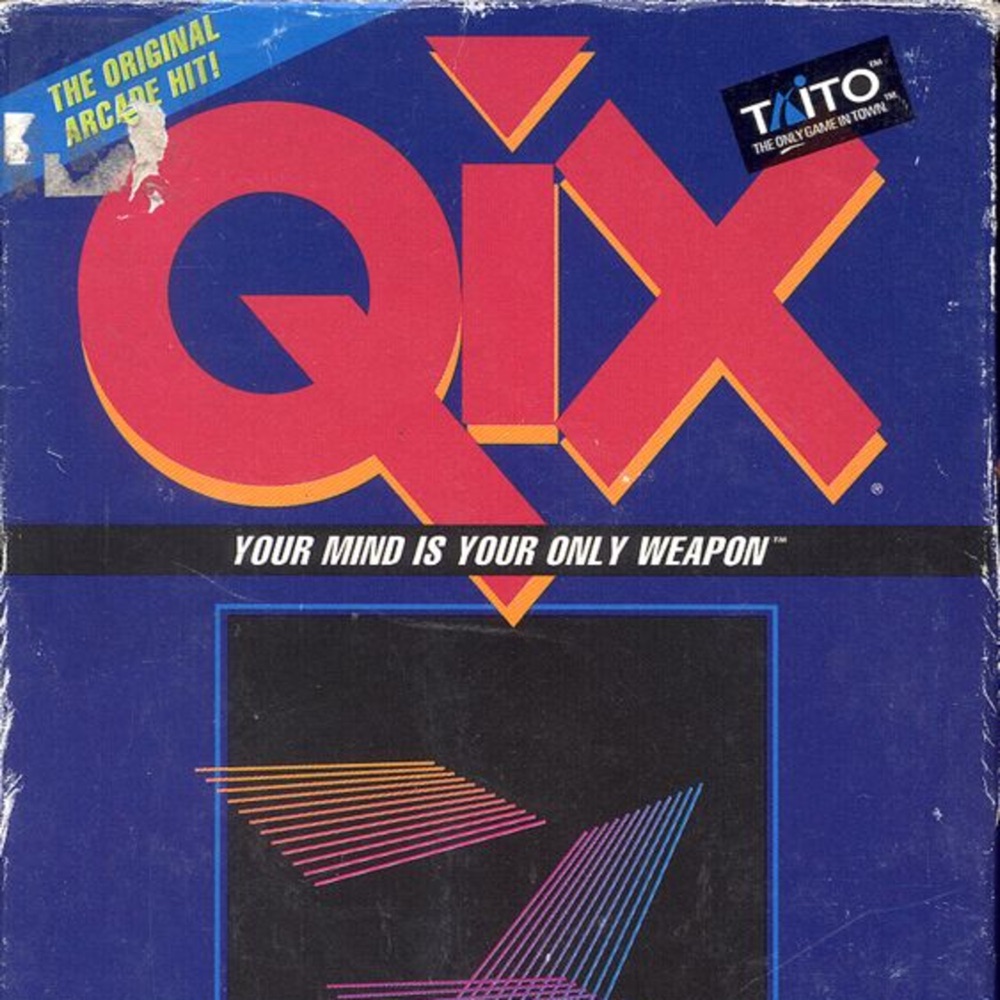
428 · Qix
Qix is a 1981 puzzle video game developed and published by Taito for arcades. Designed by husband and wife team Randy and Sandy Pfeiffer, Qix is one of a handful of games made by Taito's American division. At the start of each level, the playing field is a large, empty rectangle, containing the Qix, an abstract stick-like entity that performs graceful but unpredictable motions within the confines of the rectangle. The objective is to draw lines that close off parts of the rectangle to fill in a set amount of the playfield.
From Wikipedia: Qix (CC BY-SA 4.0)
We had never heard of Qix a week before we recorded, which is a little embarrassing for a 1981 Taito arcade game with a long list of sequels and clones. Mike and Joe were on this one. The pitch is nearly nothing: you are a marker on the edge of an empty box, drawing lines to claim territory while a mass of chaotic lines tries to touch you. Our best description was an Etch A Sketch that fights back.
Why we kept playing
- A threshold to beat. Each level asks for a percentage, 75 for example. Hug the border and you're safe but slow. Strike out into the void and you can grab 50 percent in one go, until the Qix shows up. A line you haven't closed is a target, which is why greed gets punished.
- The Qix itself. About five lines in two colors, moving in a way that feels truly random, so you can't memorize it like a Pac-Man ghost. Joe compared it to the monster in the movie Life: something that isn't thinking the way you are and can get you at any second.
- Scoring that argues with you. Slow drawing pays more than fast. From level three there are two Qix, and splitting them multiplies your points and ends the level. Your bonus depends on how far over the threshold you finish: exactly 75 percent earns nothing, 5 over earns 5,000 extra on a 1,000-point level. We care about scores rarely, and this is an exception.
- Strategies. Mike started greedy, then drew big frames along the perimeter and worked inward. Joe built little skyscrapers off whatever he'd claimed. Videos showed the better way, a string of 2 to 5 percent boxes that wall the Qix into a smaller space before one huge grab. By level nine they're just faster, and we died around level five or six.
Worth knowing
- Looks and sound. The one-pixel lines look like Microsoft Paint, and the wallpaper fills look like Mega Man backgrounds. The arcade version used solid colors, so the NES one is an upgrade. The menu music is phenomenal, and then the game is silent once you press start (the arcade is too).
- Game Boy. That version was published by Nintendo, with link-cable co-op as Mario and Luigi. In one cutscene Mario wears a sombrero and plays a guitar, the same outfit he gets in Super Mario Odyssey.
- The family. Randy and Sandy made it and named it from their license plate. Offspring include Volfied, Gals Panic and Qix++, which we want to track down. There is no ending: you play until you run out of lives.
The bottom line
Play it. On the Essential Games List the vote split, with only Mike and Joe voting: the first answer stopped at a definite Play it, saying the game scratches a particular itch and may not be widely beloved enough, and the second voted it on, praising a pure game with little to critique. One yes is not more than half of two voters, so it stayed off. We'd like to know where Sean would land before the Best of 91, which we noted is not until March 2028.
Written from our conversation in this episode.
- YOUR BEST DEFENSE IS A MENTAL OFFENSE
I. Setup & Premise
- The pitch: You control a diamond-shaped marker on the edge of an empty rectangle. Your job is to draw lines into the void, carve out territory, and claim at least 75% of the screen. The only thing stopping you is the Qix — a writhing, colorful geometric figure drifting randomly through the open space — along with Sparx patrolling the borders and a fuse that lights up your unfinished line if you stop moving
- Originally released in arcades in October 1981 by Taito America. Designed by husband-and-wife team Randy and Sandy Pfeiffer. The NES port was developed by Novotrade (Ecco the dolphin) and published by Taito in January 1991 — a full decade after the arcade original
- The origin story: Randy created the Qix's movement as a simple programming demo. Sandy suggested making a game out of it — "sort of like video-game Etch A Sketch." Their eureka moment came in a jacuzzi with a bottle of vintage champagne. Ginger Beard Man The game was named after Randy's license plate at the time: JUS4QIX, pronounced "Just For Kicks"
- The central thing worth dwelling on: this is a game with no characters, no narrative, no world. Just geometry, tension, and greed. Every single decision is a risk-reward calculation expressed as a line on a screen. Nothing else on the NES plays like this, and almost nothing in the arcade did either
II. What Makes It Stand Out
- The slow draw / fast draw system holds up
- Two buttons, one decision. Slow draw fills your claimed territory in red/orange and scores double points. Fast draw fills in blue, scores less, but gets you back to the safety of a border faster. Every line you draw is a bet — how long can you stay exposed in the open field before the Qix drifts into your path or a Sparx catches up?
- This is the entire game. One binary input that creates infinite gradients of risk. It's elegant in a way that most NES games never even attempt. The scoring system isn't decoration — it's the reason to play. Safe players will clear stages but never post meaningful scores. Greedy players will post huge numbers but die constantly. The game lives in the space between those two impulses
- The slow draw as a design concept is essentially "the game pays you to be afraid longer." That's a remarkable piece of psychology for 1981
- The Qix itself holds up
- The Qix doesn't chase you. It doesn't know you exist. It's just a cluster of lines performing random, graceful, unpredictable motion inside the rectangle. You can't kill it, can't predict it, can't negotiate with it. You can only watch it and hope
- The Qix is not a villain. It's weather. And that distinction is what makes the game feel different from everything else on the console. There's no pattern to memorize, no AI to exploit. Just chaos that you have to draw around
- The design implication: because the Qix is random, no two games play the same way. Every session is a new negotiation with entropy. That's a quality most NES games — built on memorization and pattern recognition — never offer
- The Sparx and the fuse holds up
- Sparx travel along every completed border — your claimed edges, the outer walls, everything. They're the ticking clock that prevents you from sitting safely on the perimeter forever. A meter at the top counts down to the release of additional Sparx and eventually Super Sparx, which can chase you along your unfinished line
- The fuse is the cruelest mechanic: if you stop drawing mid-line, a fuse lights and burns toward your marker. Hesitation is death. The game literally punishes you for freezing
- And then there's the Spiral Death Trap — draw yourself into a corner where you can't proceed in any direction and you're dead. The attract mode actually names it. The game warns you about a way to die that most players will discover on their own, usually once, usually memorably
- The two-Qix split holds up
- Starting at level three, the screen contains two Qixes. If you draw a line that divides the playfield so each Qix is trapped in a separate region, the level ends immediately — and a score multiplier is permanently applied to every subsequent level
- This is the high-level play that separates tourists from lifers. Splitting the Qixes is enormously risky — you're drawing a line across the entire screen with two random entities drifting around — but the compounding multiplier makes it the only strategy that matters for serious score runs. It's the kind of mechanic that reveals itself slowly and then redefines the game once you understand it
- The NES port specifically mixed
- The port is faithful to the arcade — the core mechanics are intact and play correctly. Electronic Gaming Monthly listed the NES version at #100 on their "100 Best Games of All Time" list in 1997, specifically for its risk-versus-reward system Wikipedia
- The honest trade-off: the visuals are spartan even by NES standards. The playfield is mostly empty rectangles and solid color fills. There's essentially no music during gameplay — just sound effects and silence. By 1991, NES players were used to Mega Man 3 and Castlevania III. Qix looks and sounds like it arrived from another era, because it did
- But the argument for the port: nothing about Qix needs audiovisual polish. The tension comes entirely from the mechanics. A prettier version wouldn't be a better version. The emptiness is the point — it keeps your attention on the line, the Qix, and the shrinking margin between safety and disaster
III. Pop Culture, Legacy & Connections
- The creators vanished: Randy Pfeiffer moved on from the video game industry to run his own business creating CAD software for model railway enthusiasts. When a fan tracked him down in 2003, he was the first person outside of Taito to contact Pfeiffer about the game — the first in over twenty years. Ginger Beard Man A husband-and-wife team invented one of the most influential puzzle games ever made, and then walked away entirely. The game became more famous than its creators, a parallel the interviewer explicitly drew to Tetris
- Kaneko released Gals Panic in 1990, an adult-oriented Qix variant where completing stages progressively revealed images of Japanese models in various states of undress. Giant Bomb It spawned numerous sequels and clones, and is considered the originator of the "reveal-a-picture" eroge subgenre. Wikipedia Qix's core mechanic — "claim territory to reveal what's underneath" — turned out to be a perfect engine for a type of game its creators never imagined. Den of Geek included Qix on a list of the top 10 most cloned video games. Wikipedia A significant percentage of those clones are explicitly pornographic. That's a legacy worth talking about honestly
- The Game Boy port, developed by Minakuchi Engineering and published by Nintendo, featured intermission scenes with Mario, Luigi, and Princess Peach cameos Wikipedia — including one where Mario appears in a desert wearing Mexican clothing and playing a guitar with a vulture looking on. That outfit later appeared as a wearable costume in Super Mario Odyssey. Wikipedia A Qix port on Game Boy may have quietly contributed to Mario's wardrobe decades later
- Taito's own Director of Creativity, Keith Egging, admitted that after an initial commercial hit, the game faded because it was "conceptually too mystifying for gamers" and "impossible to master." Wikipedia That's the developer's own postmortem — the game was too abstract, too open, too weird to sustain mainstream interest in 1981. The question is whether that's a failure of the game or a failure of the audience. By modern indie standards, Qix's minimalism and mechanical purity would be celebrated. It was ahead of its time in a way that actively hurt it
- Thematic relatives:
- Tetris — the closest spiritual comparison. Both are abstract puzzle games with no narrative, infinite play, and a core loop built on managing increasing pressure. Tetris won the culture war; Qix didn't.
- Worth asking why Tempest (1981, Atari) — another abstract arcade game from the same year that turned geometry into anxiety. Both prove that visual abstraction and mechanical depth aren't in tension Snake — the "draw a line, don't hit anything" concept reduced to its most primitive form. Qix is the sophisticated version of an impulse that's been in games forever
- Baba Is You, HyperRogue, and the modern abstract puzzle lineage — games that prove the audience Qix needed eventually showed up, just thirty years late
IV. Closing Bits
- The question to leave listeners with: Qix has no ending. There's no final boss, no credit roll, no conclusion. You play until you die and the only record is a high score. In a medium that now treats narrative completion as table stakes, is there still room for a game that offers nothing but a score and the knowledge of how you got it? Is the absence of an ending a design flaw or the most honest statement a game can make?
- Tease next episode
Auto-generated transcript. Each paragraph starts with its timestamp. Speakers are not identified.
Kicks, your best defense is a mental offense.
And welcome to NEStalgia, a chronological exploration of every NES game released in North America. I'm Mike. And I'm Joe.
This is an interesting one, Kicks, here, because I feel like I know a lot about early arcade games. Usually you go to an arcade enough, you'll see all the classics. You'll see Frogger, you'll see Q-Bird, obviously Pac-Man and Space Invaders.
Kicks is early. It's 1981. And it seems like it was rather popular, but I'm being completely serious when I say I had never even heard of Kicks one week before we recorded this episode. Oh, same. This was popular? Either way, when I was playing this, I was thinking like, oh, we're gonna like, we're gonna open some, we're gonna blow some people's minds that this game exists. We're gonna be like, yeah, check out this game you've never heard of.
It's funny that you say that because I, that was my, like before doing any research, that was my thinking as well. Was like, oh, this is kind of an obscure arcade game. It is not. It has many sequels. It has a long legacy. It was, again, an early arcade game published or rather released by Taito. So it's definitely well known by at least our audience, right? Our audience tends to know way more than us.
Yeah, 100%. And so rather than, you know, be funny or anything about Kicks and the name there, I think it's just worth mentioning that it was called Kicks because the husband-wife duo that made the game, it was named after their license plate, which was Just for Kicks, spelled J-U-S for the number four, Kicks, pronounced Just for Kicks, obviously. So there's no like deeper meaning to the word there or anything.
It was just kind of like, hey, like remember that thing from my license plate that was an abbreviation? Like what if we made that the name of the game? Well, they sure did expound on that with like more lore than like some like full adventure games have as to like what Kicks is and what each, like names of different things and stuff. So like it's funny that this came from just like their license plate.
Right, right. Because the game is very abstract and has nothing to do with driving. Although I guess you could say if you know, if you wanted to make it like a Tron thing that you are driving some kind of thing across a infinite space. But the pitch is essentially you control this diamond shaped marker on the edge of a empty rectangle or square. Is it square or rectangle? It's a little longer, right? And I guess it's both a square and rectangle because it does look square to me, but... Okay. Yeah, it looks like a square to me now, but I wrote rectangle. So dealer's choice. Anyway, your job is to draw lines into the void of this parallelogram.
And is that right? Is that the right term? I think so. Cool. I don't know. And you carve out your territory and that gets filled in with this cool design. And now you have to, you know, you get like essentially a claim percentage. So like out of that square, you just filled 5%. And there's a claim percentage, there's a threshold percentage and the level you're on. And so the threshold is what you have to at least meet. So if it says threshold 75%, you have to claim at least 75% of the screen. Sounds easy. Sounds like I'm just drawn around an empty square. What's the big deal? Well, there's a couple of things stopping you. And the biggest thing is kicks.
This very, very abstract, kind of scary concept if it was to be visualized by man, but it is a colorful geometric figure that essentially is a bunch of lines moving very randomly throughout the open space. And I emphasize the randomness because it truly feels random as opposed to the Pac-Man ghosts, which as most people know, like there, it is possible to play a perfect game of Pac-Man. That's because the ghosts move very predictably, even though it seems random, as long as you move in the same exact movements, kicks this thing. It moves in a way that is truly unpredictable and makes it scary to be near it because at any moment, any one of its lines could go towards your line.
Yeah. And that is the problem is that the kicks, if it touches your line before you complete the space, you are dead. And it's hard to explain what kicks looks like exactly. But if you're listening, I do recommend that you just look it up real quick, like a video of it just to see what this thing is. Like, I have to give them praise that just by like, this is this whole game is one of the like, there's one of the more simple designed like art elements like involved in this game are they're very basic.
But like, kicks being literally just what, like five lines moving around like two different colors is does such a good job of being like chaotic and very scary. Like, it just feels like we might have mentioned this on the podcast before, but Mike, Sean and I actually went and saw the movie.
Is it called Life? Yeah. Okay. The movie Life with, I believe, Jake Gyllenhaal. It is. Jake Gyllenhaal. And yep. But this, the monster in life reminds me of kicks or vice versa, where it's just this like chaotic, so alien thing that it's just, it's funny that I'm describing this and it's just like lines on a screen. But like, yeah, it does feel like this scary thing where it's like, ah, this thing can get me at any second. And like, it's not thinking the way I'm thinking. It's just fucking moving around.
Yeah. And eventually there's two of them. And so like, you know, they find ways to up the stakes here. And in addition to the kicks, there is also the sparks, which are like, they patrol the border of first the square, but then eventually you're, you know, filled in areas too. So that you have to also not just be like hugging the walls while you anticipate the kicks moving away. You have to kind of continuously dodge both, you know, your, your created space and the, the void space that you're trying to fill.
All the while you have two options of speed to fill in. And at first I just couldn't figure out a reason for why you would ever use the slow one. There's a slow speed and a faster speed. The slower speed rewards more points. So if you don't care about points, then have I got great news for you. There's an easier version of this game, but if you do care about the points, you know, you'll, you'll use the slower one in order to accumulate more points. Granted, you'll be filling in the screen a little slower.
I think the game itself, even though kicks feels like it moves randomly, does have kicks be way more forgiving at the beginning of the game in the way that like when you're playing it, you feel like you can start by just filling in like at least 40%, if not more of the screen on the first stage. Yeah. That is a behavior that is bad to take with you throughout the game because you will be punished for trying to make giant spaces.
And it looks like really good players just focus on making like very small, like two to 5% clears at a time before they go back to their larger area. Because you want to just continue to confine the space that kicks is in rather than try to make one big pull. You're not rewarded necessarily for your speed. Yeah. And I, and I, I do think that in the first, at least the first level, I think the kicks AI is actually designed to avoid contact with you.
Maybe just to teach you. So it's a sentient being. It's, it's learning. Yeah. Yeah, exactly. Even scarier. Yeah. It gets scarier by the moment. I was, I am surprised. Well, also, I'm also watching a playthrough right now, which I'm sure you are. I didn't know this strategy of making these tiny little, little boxes of the, like 2%, 2%, 2%, 2% until you're able to suddenly block off kicks and then like fill off like, but, you know, suddenly another 80% of the screen at once. Until I'm watching this guy. This is, this is definitely the way to do it. I was, I was, I was, I was taking all kinds of risks that were sometimes paying off and sometimes getting me killed.
And I, I, I worry that this episode is going to be very hard to follow if you don't see what we're talking about. But like, it's, it, it. I think it makes sense where if you're filling a space, you know, and it's like your space is, the space is, the void at first is large. And as you fill it in, it gets smaller, but so is the, you know, you're now confining the kicks to a smaller area too. So as it's moving around, you have more chance to make contact with it. Because the kicks can't pass by anything you've drawn.
So like, yeah, you're, you're kind of walling it in. But like, I also like, I had a hard time. I like understanding, I could intuit it, but understanding like which section will be filled in when I make a box. Because like, sometimes you're not just making a little box. Sometimes you're dividing the whole screen or you're making this crazy geometric shape that goes from like the top left corner to like halfway down the bottom right area.
And sometimes the bigger space gets filled in. Sometimes the smaller space gets filled in. And I'm thinking it just fills in the space that kicks is not in. Yes, that's what I was gonna say. I feel like that's the rule because you can't crush kicks. Right. But then eventually when there's two or three kicks, I, kickses. The plural of kicks is kicks. Okay. Good to know.
Then does it just choose the biggest or the smallest area? Well, you've just, no, you've just introduced an amazing additional mechanic that they did think of. And that is that when there are two kicks, if you are able to split them up, all your points are worth double going forward. And then triple and so on. So does it not fill in one of those spaces when you split them up? It does. Okay. So do you know how it picks which space? No, that is sorry. Yes. I now get what you're saying too. I was getting excited to introduce the next mechanic. No, I mean, that is a cool mechanic. Yeah. But you're right. That like, theoretically, the game does have some rules beyond just don't crush kicks.
Yeah. But yeah, I mean, it's like, I mean, we haven't even talked about the look of this game and the vibe of this game and everything. But like, it's just, there's a, as we're talking about it now, I'm realizing there's, there is a lot to this very simple game that like when on the surface looks like it's just, yeah, just draw these lines and split it up. You know what's the easiest way to describe this game to somebody who's not looking at it and maybe is learning about it for the first time? It's, it's like an etch-a-sketch.
It's, that's a good, that's a very good call. That's what your drawings look like exactly. Right. Even to the point of like the, the point that is drawing it, you can always see that little like tip of the needle in the etch-a-sketch. Like, that's kind of what your cursor looks like.
Yeah. Um, and I, I just, the way that your lines look, you can make such thin one pixel wide boxes that the, the line is one pixel wide. It fills in with this like pattern. It looks like things that in like the least impressive looking way seemed impossible on the NES. Like, I just like, I didn't know I could draw such a thin line and it could fill in this like pattern behind it where it like, it just looks like a Microsoft paint painting. But like, I don't know, it just doesn't look like pixel art to me. It looks too, too fine. Like fine as in like small.
I, I, I know what you're saying with, with the line itself. Like the line itself is too thin. Yeah. And, and, and it should be like a, a one inch thicker or something like that just because you didn't know pixels could get that thin. So presumably it's just drawing a bunch of like black pixels as well that because the void is black, you're just not seeing them.
Um, but that's me making up how video games work. So don't take that. Yeah, yeah. It sounds right. But like, but the actual backgrounds that it generates when it fills in, you know, that, that looks like NES art. To me, it looks like wallpaper.
Like some of them, some of them just like, I don't know how to describe it. Cause yeah, like when I look at it, like, yeah, that could definitely be NES art. But some of it, it's just like, well, that's, I think what it is, is because the way you contain it in these boxes, it just looks like you're somehow like breaking it through the NES to like this background. That's behind it, which is just like, I know what you mean. Cause the walls stay there that you drew. Yes. And every level, it just picks a different random pattern to be filled in by like the boxes you make. Like, I was just like, wow, they didn't have to do that.
Yeah. And a lot of the backgrounds, not all of them, but a lot of them did remind me of like backgrounds you would see in like Mega Man or something like that. So that's what I'm saying. Like, it doesn't, it doesn't look like impossible on the NES or anything. Whereas like kicks kind of does feel impossible, like just too chaotic. Yeah. Like, you're like no sprite behaves like that. And that's kind of like, you know, the interesting thing worth, worth resurfacing here is that the game, it's a game with no characters, no narrative, no world.
It's just geometry, but somehow like the, the tension of kicks, kicks, the sparks and whatever those, what are those like, what are those like little star things too that like also dance around in the void with kicks? Yeah. There are those, oh, I forget what they're called. There was a name for them. It was like snowflake or something, but like, it, they, those are the ones that only appear when your time runs out. Right. Yeah. Or, or just over time they appear. Yeah. But you have the timer at the top, the red bar.
Oh, is that? Yeah. When that, that red bar is shrinking. I think if you are still on the level and that red bar disappears, I believe that's when it starts like shooting projectiles at you. Although I'm looking at it right now and maybe that's wrong, but there, there was definitely a consequence like that when your red bar appears. And I thought it was like, then those snowflakes or whatever they're called. Okay. But, but you have all of that stuff, you know, that, that's the, that's the tension, right? That stuff chasing you. And then you have your own greed to balance of like, you know, like how risky do I play it?
Do like the game is not going to be fun if you just keep making little one inch lines. Like you do have to kind of go for it too, especially because the sparks like, you know, can get close to you if you can find the space enough. And if you touch them, you're just as out as you were, if you were in the void. So there is this just like risk and reward system that's very satisfying because it's all defined by the player. The game never forces you to like, you must make squares bigger than 30%, you know, like, you know, like there's no extra rules. It's just fill the space however you choose to do it.
Yeah. And, you know, I, I, I, I'm interested to hear like what your strategy was. Cause I, I'm, again, I'm surprised by this strategy I'm seeing on this playthrough, but it, it looks like the AB optimal strategy where they're making these tiny little boxes. My strategy eventually became like, at first I was trying to like, yeah, take big swings and see like what I could get away with. But my strategy eventually became taking big swings that were like kind of hugging close to the perimeter of the square.
So then like if kicks ever ended up kind of near me, I could always cut to the edge of the perimeter and close up that box. And it's still making a pretty big box because it's like, you know, imagine I'm just like filling in like the, I'm turning the, the box into like a picture frame slowly and like filling things in that way. And then like kind of working my way inward became my strategy, but I'm curious what you were, what you were up to.
No, I think definitely in the beginning I was just being greedy and covering like 50% at a time. And I was just like, wow, this is, this is gonna be an easy, fun game. Like the kicks is just, just avoided and everything will be good. And then eventually it's like, oh wait, this thing's kind of aggressive. Like I need to figure out what my move is here. And so I wasn't making, you know, like what you're seeing in, in the long play you're watching.
I wasn't making like micro movements, but basically you're kind of forced to like make smaller squares as you go. And I was kind of just building on where I was and just continuously building out. So I wasn't really like going back to the larger square. I was hanging out in like whatever I had made and kind of building like little skyscrapers, if that may, like tiers off of that. Gotcha, yeah. Yeah, that makes sense. How, how far did that take you, you think?
I think I was able to get to level eight. Maybe, maybe I was, or maybe I died in level nine. Yeah. Cause I, I want to say I got maybe to level five. Oh, okay. And I played like over and over again, like trying to see like how well I could do. I would always end up out of lives by like, by the latest level six. So I think like five was maybe the, the last one that I beat.
I feel like nine is when you still have two kicks, but like they also just start to get like so much faster. It's not even like they're more aggressive. They're just faster. So it's really hard to, to be greedy at all. Because if you just put yourself out there, they're more than likely going to touch your line.
Yeah. And that's, is that something we even mentioned? Like you are this little point and yeah, if one of those, uh, whatever things roaming the perimeter, touch that point, you die. But kicks only has to touch the, the line that you're drawing if you haven't filled it in yet. So like if you draw a big line, you're a huge target. I'm not sure if we even mentioned that. They're like, it's not just you that kicks can touch. It's the line that you're drawing before you've completed it, that it can touch. And that's what makes it so dangerous. It's a good point. Yeah. I thought we did, but I agree that it's worth restating because that's what makes it so much harder to be greedy.
Yeah. Uh, and you know, kicks is definitely the star of the show and everything, but it's not like, I don't think it has like programmable AI where it actually knows where you are and comes for you. It is, it is still like, it's weather, you know, it's like, it's just like a, it has no recognizable path. It's just like a pattern or anything. No AI to exploit. It's just this chaos around you. And so because the kicks is what I believe to be random, you know, no, no level plays the same way. It's not like, oh, just fill in like from the bottom left. Right. And you know, he sticks around this pattern here. It's like, you have to, you know, you're built on not pattern recognition, not memorization, but just on, uh, you know, how, how you want to tackle.
Yeah, exactly. Um, yeah. And that, that, that does make it like interesting where it's like, you have to always be able to, you can't just take someone through step by step. You have to always be able to adapt to like what's happening to you. And now, I mean, I think that's just like any good arcade game. I mean, that's what makes this like a skill based game rather than like just memorize.
And the two kicks is when they come out at the level three. You told me that the plural of kicks was kicks. Oh, right, right. Sorry. Yeah. And when the two kicks, uh, are on screen, if you draw a line that divides them, we mentioned that now you have a score multiplier, but it also ends the level immediately. It's not like you killed one kicks and now you get to move on. It's just, uh, or sorry, you killed one kicks and I have to fill the other space. It does, um, it does end the level, which is important to mention from a score perspective, which is probably one of the reasons that you would be playing kicks is for high score.
Uh, the way that it works is not based on time. Uh, although it seems like there is a time, uh, repercussion in, in the, in the design of the enemies. It works based on how over the threshold you go. So if the threshold is 75% and you claim 75%, the level ends and you get a zero bonus because you cleared exactly 75. If you, uh, got 76, you would get, uh, the multiplier for one of, so if it's a thousand points, it would be 1000 points. But if it was, uh, 1000 points and you went 5% over, now you get 5,000 extra points. So it is worth for high level play, not just meeting the threshold either, but going like as close to above it as you can.
Yeah. And that's, we always talk about how like we don't generally care about, um, high scores and stuff. I mean, this is a game you almost have to care about it. I mean, I guess you could just see like how many levels you can get through, but like some of the satisfaction comes from like getting those points by taking those risks and everything. So like I, I, uh, like this is one of the rare exceptions where I'm like at least moderately interested in the score. It's still not my, my primary focus.
And now kicks came out in 1981. And so the NES version of the game basically looks like kicks, you know, uh, in the arcade version. It is one of those where it now, like it, it, it doesn't, it doesn't need a audio visual polish, right? Like as long as it has the design, uh, the game like remains the same. I think, I think this version of it holds up just as well as it's arcade counterpart because it plays the same way. They didn't have to make a compromise on gameplay. And so even if maybe kicks, you know, like the backgrounds, the wallpapers, as Joe was saying, like look better in the arcade. It's like, it's not a noticeable downgrade in this NES version.
Yeah. I mean, I, I haven't seen the arcade version, but I just, I, I can imagine it looking cooler, but otherwise like, I, I'll tell you what I can imagine being a, a, an improvement. And this is, this is both a compliment and a complaint about the game.
The menu screen or the menu screen music. Phenomenal. Like I would just download this. I mean, this is, it's really gets me pumped and it like feels like the vibe of what this game is. Like you're a computer, you're trying to fight a rogue computer virus, but it's like fun. And it's, you know, and then the game silent. Give me this music. I want to hear this music the whole game. I want to hear it the whole time I'm playing. There's no, it's not going to be distracting. It's very like rhythmic. And like, it feels, it feels like some kind of like weird, like techno. And there's like this percussion in there that, that just like, it gets you grooving, but like, it's just, it's just until you press start.
Oh, oh, oh.
So I was able to check out the arcade version while you were talking about that. And two things. One, the arcade version is also silent during gameplay. So that stays. But even more interestingly, this might be one of those rare ones where the NES version might be preferred because the arcade game came out so early. I'm looking at it and it looks like with the exception of kicks being bigger itself, like, which is kind of scary that it's even bigger than it was in the NES game. There is no wallpaper fill. It is a solid color fill. Yeah, that's interesting. I'm seeing that now too for the first time. Yeah, I mean, the wall, the graphics. Phenomenal wallpaper color fill instead of solid color. It got the upgrade. Yeah, it's next gen. Yes, exactly.
Now, is there more that you want from kicks, though? Like, is there anything that a kicks two could have delivered on? Yes. Like, that kicks? Okay, go for it. There's more than I want. And, you know, secretly, you and I actually talked about this shortly before we started recording. I should have saved it for the podcast. But just like last week's game, I played this game with friend of the show, Mark Pascolato. We played two-player.
And, you know, it's like that classic arcade two-player where it's like I play, then he plays, then I play, then he plays. We see each other score. And then for some reason, when I die, he can keep going and I can sit there for no reason. But there's, I think there was potential to turn kicks into an actual two-player experience where you are both fighting for real estate on the screen.
Maybe there's still a kicks flying around and maybe each of you have like one shot of one of those snowflakes to shoot at the other person or something. I think that that would have been a very cool, this is me asking for like a different game. But I'm just like, if you're going to put a two-player in there, it would have been cool to have that as a mode as well. So that's what I want out of Kix 2. Now, Joe, are you ready for this? That's what Kix 2 is.
No, that is what the Game Boy version, which was released a year earlier. That's so funny because it's like the worst way to play two-player of any. So you need a link cable. You need the link cable. Yep, you need the link cable, but you can play. It's not necessarily competing against each other. It's co-op and you can complete together to fill in the void to take on Kix and fill it in together. So you have your area and they have their area.
It's kind of crazy, but there is one crazier thing in the Game Boy version of Kix, which was published by Nintendo. So it's not like somebody went rogue here. Kix clearly, at least on the Game Boy, was seen as a main attraction for Nintendo and for this link cable, but also for the inclusion of Mario, Luigi, and Princess Peach are all in the version of this game. What do they do? Wait, what do they do?
You have Mario and Luigi are the teams when you do the co-op. So one person's Mario and one person's Luigi. So there's that. But more interestingly, in between levels, there are little cut scenes to just break up the gameplay. Not story-wise or anything, just like here's Nintendo visuals to help break up the gameplay. And one of them has Mario in a desert, wearing a sombrero and some Mexican clothing, playing a guitar.
And that wouldn't be something that would be worth commenting on if we didn't have Super Mario Odyssey. Was that whole world like a reference to Kix too? Now saying the whole world is kind of crazy, but the outfit is the same. Really? The costume he gets in that stage in Super Mario Odyssey is the outfit that he was wearing in that one inconsequential cut scene on Kix on Game Boy.
Do you think they just have like a library of everything that like Mario has ever worn or like done? And they're just like, what can we reference that like nobody has thought about in 25 years whenever they make a new game? One of my favorite sites growing up was a website called the Mushroom Kingdom. And they had just a section of like all with screenshots to accompany it, like all cameo appearances of Mario in anything. Whether it was arcade, Game & Watch, like you name it.
And I don't know if that site's still up, but like they definitely have things to tap into that they still have not. So I think that that's just, it's just silly. It's like a neat piece of trivia. And it also just kind of shows that like this game that we didn't know about, even like Nintendo was taking it seriously enough to be like, yeah, we'll publish that on the Game Boy. Like we'll, we'll make sure that comes to our system. It must have been big in Japan. Yeah. Or maybe it was just big before we were big enough. Right, right. To know better. We didn't even grow up. Yeah. Like Peter Pan.
Yes, exactly. Great, great callback to last week's episode. Please go listen to it if you haven't. We talked about the husband and wife thing because of their license plate, but they, they made this game.
Sorry, Randy and Sandy. That's interesting. Wow. That's like a bit. Yeah. Randy and Sandy. And they said that their eureka moment for the game came in a jacuzzi with a bottle of vintage champagne. What does that mean?
Like why did they, why is that like, why is that solidified now in history? Yeah. Like the eureka moment where they were like, let's make this game or like the eureka moment of like, oh, this is what we call it. Or like, this is how it plays. Right. Or like, what was the eureka moment? Was there something they were trying to solve before they could finish this game? I think, I think, I think kicks came first. Like the idea of the entity through a programming demo that Randy was, that Randy made. And then Sandy suggested the etch-a-sketch portion of it, like the filling in and stuff.
And she must have done that in the jacuzzi because that's got to be the eureka moment. Right. It's like, there's no other, there's no other moment other than like, how do we turn it into the game? Yeah. But it's just kind of like, did they say that in an interview? Like, is this verified information? Like. I like the idea that like, Randy just had like a program that would just display kicks just like flipping around the screen and there was nothing else to it. And he was like, ah, I just don't know how to play it. Yeah. Right. But they didn't go on to like become prolific game designers. They pretty much vanished from the scene after that. But, well, I mean, you can only go down from kicks.
Yeah, that's true, I guess. But Joe, this is the part where I now have to do like sequels and spinoffs and tell you that there are many kicks spinoff games. Spinoffs? Not even just sequels? Not even just sequels. Because there is the sequel, Kicks 2 Tournament. Should be like Kicks 2 The Tournament. But just Kicks 2 Tournament. And it's just got a new color scheme and has some different bonuses. But for the most part, it's the same exact game. So it's just like more stages. Then Super Kicks was released in 1987.
But still just kind of like kicks again. The real change came with this game, which is I'm calling it a spinoff. But it basically is the embodiment of Kicks. It's like a successor to Kicks called Volfied. And Volfied is, it was known as Ultimate Kicks on Genesis and Kicks Neo on PlayStation.
And those games, they added the idea now that you could also capture blocks. And by capturing these blocks, they have power-ups inside them that can like stop time or shoot sparks, you know, and stuff like that. So the idea of like kicks style games is not just limited to Volfied. Like there are other games that I don't have the titles for here, but like are just essentially reskins of Kicks with like, you know, this one's got anime characters. This one's got like, you know, shmup things. It's all just that kind of approach to it, but it's basically just kicks. But the only like major change to kicks that's notable is the capturing of other boxes that contain power-ups that like help enhance the game.
Some of those clones being Gals Panic, which is a, apparently it started the sub-genre of adult-themed uncover the image games, if you know what I'm talking about, Joe. Yeah, wasn't there a... We did on our Bites episode, we did Bubble Bath Babes. Yeah. So yeah, you're basically playing kicks, but then the wallpaper is revealing a naked Japanese woman or at the very least in her bikini.
And there are some friendly ones as well. There was Dancing Eyes, which now that I'm looking at the box art, I'm not sure I want to say that that's friendly. Okay, here's one. This is the one I was thinking of. Kakoma Night in Busyland. And this came out on the Super Nintendo.
Was not developed by that husband and wife duo, nor was it published by Nintendo or Taito or anybody else. So it's just basically a clone. And it's the same idea, but with pretty cool visuals. But then the visuals wind up becoming too much. There's no black void. There's this area that you're in, and then there's this area you're filling, and that creates another wallpaper. So there's something to be said, too, about just the minimalist nature of kicks being in its favor. It didn't need extra things being in. I think that gives it that vibe of like, oh yeah, you're really inside the computer right now.
Now, there is one other version of kicks that I, after playing this version of kicks, I said, I have to get my hands on this. And it is called Kicks++. Like, literally the symbol, the plus sign symbol.
Kicks++. And it came out on Xbox Live Arcade. So I have no idea how I'm going to get a hold of it. And PlayStation Portable. But it is basically part of that line of like, Pac-Man Championship Edition and Space Invaders Extreme, where it's like, how do we take these old arcade games and plus them up in a way that like, is going to excite that old fan base? Not like, not like, oh, it's Pac-Man for, like Pac-Man World was trying to do. Like, Pac-Man's now a platformer. And he goes to different places. It's like, that's not what these games are doing.
And Kicks++ is just such a stylish, oh, it says the PSP version is exclusively in Japan. So this is going to be really hard to get a hold of. Oh, geez, yeah. But it's just, it's just such a, it's such a cool thing. And also like, the kicks themselves aren't like, they become different types of monsters too. I'm watching footage of it right now. And it's like, yeah, it's interesting. Like, they do evolve it enough, but they keep the, the vibe, they keep the, the core there. Yeah. So I definitely want to check this out after checking all this out. Oh, and it's interesting too, because of watching it. Like, they really make, the animation makes it look like you're cutting something away.
Yeah, so maybe we're the antagonist. Yeah, yeah. Maybe Kicks is just trying to live its life. Oh, I thought maybe we're cutting away like a virus or something. Oh, okay. Something bad. Yeah, so Kicks again is the antagonist. Thank goodness. I couldn't, I couldn't live with myself if it was me. Right. But I also couldn't live with myself if we didn't do the Essential Games List.
Joe. You know what? I'm tempted to throw this a vote. But what stops me is actually a conversation we had on our Best of 90 episode when I brought up To the Earth. And you guys kind of mentioned to me, like, I think To the Earth for you, Joe, is just kind of like scratching an itch for you that you really, really like. And I think that's true.
And I think it's true for Kicks, too. Where I'm like, I think it's just like, it scratches my brain in a way where I'm like, oh, this is like, I really like this. And I think people who like this kind of game definitely give it a try. I don't know if I could say it's essential. Like, I don't know if it's, if it's, if it's going to be widespread beloved enough to be essential. I'm not even sure I'm going to love it as much as I do right now with the recency bias I have. But I was just like, oh, this is really cool. And I kind of got a little addicted to it for a little bit while I was playing it.
But I think it's a definite play, especially if you're like this kind of game. But I don't know if I can go as far as to say it's an essential game. Yeah. It's a really smart game. It's, it's a, it's a, it's somehow an early arcade game that, while it did obviously get clones, we talked about quite a few of them. It didn't go into anybody else's lane at the time. And, and not too many things like iterate on this idea of like filling the void in a satisfying way while also having a terrifying enemy.
You know, there's, there is no ending in Kicks. There's no final boss. There's no credit roll. There's no conclusion. You, you just play until you die. And the whole point is for a high score. And video games today, most, I would say like 95% of video games today, narrative completion is table stakes. Like most people play a game and they want to just see the credits roll. And that's how they define beating a video game. Is there, is there still room for a game like Kicks that presumably, you know, nobody will, nobody will be able to claim that they perfected it, but also nobody will, not too many people will be able to even just clear the levels that are within the game itself. Is there still room for something like that?
I think so. And I think it's the same reason why I like, why I like all these arcade games that, that didn't have things that iterated on them or like that started something. It was like, the, the fun is just that it's a pure video game. You know, you're just like, all I'm doing is just filling in lines and there's no like, there's no special trick moves. There's no like, uh, you know, street fighter two quarter circle this and input these options. There's, it's always just like, do the, do the two instructions and you can pick up and play this game whenever you want. It reminds me of how I feel about Jairus in that way. And Jairus, I try to get on the essential games list several times.
Uh, and I think like that it's for the same reason that when we talked about Shadowgate and stuff like that, like it's okay that they're not necessarily the best version, but that they should still be on the essential games list. It does make me want to put kicks on the essential games list. Cause I think if it isn't just open up to like the NES version, which to me, by all means seems superior than the arcade version I, I haven't played. I do think that this is great. Is there room for improvement?
Like multiplayer having co-op and the power up stuff? Sure. But like the game they put here has very little to actually critique. It just makes you want more of it. And so I think that's a pretty good sign. So I am going to vote it on the essential games list. But unfortunately, since there's only two of us, that means that it will not get on because we always, you always need more than half. And so 50% of the vote. We need, we need Sean now in the best of 91 in like two and a half years to break the tie. But see now it's a bummer that it has to be a unanimous vote in the best of 91.
Right. Not that I will, like I'm so opposed to ever changing my vote on this one, but it's like, I would like to know where Sean would have voted to see if it would have gotten on or not before the best of. Oh, and you know, we don't have that long till the best of 91. We just have to wait until March of 2028. So plenty of time. Yeah. We'll be able to figure it all out by then. I'm sure you and Sean will be playing it every week until then to make sure that your taste is at the same time. Stay fresh on it. Yeah. Yep. Now next week we will be playing The Untouchables.
Can you, can you touch this? The only one way to find out. The Untouchables.