155 · BOMBERMAN
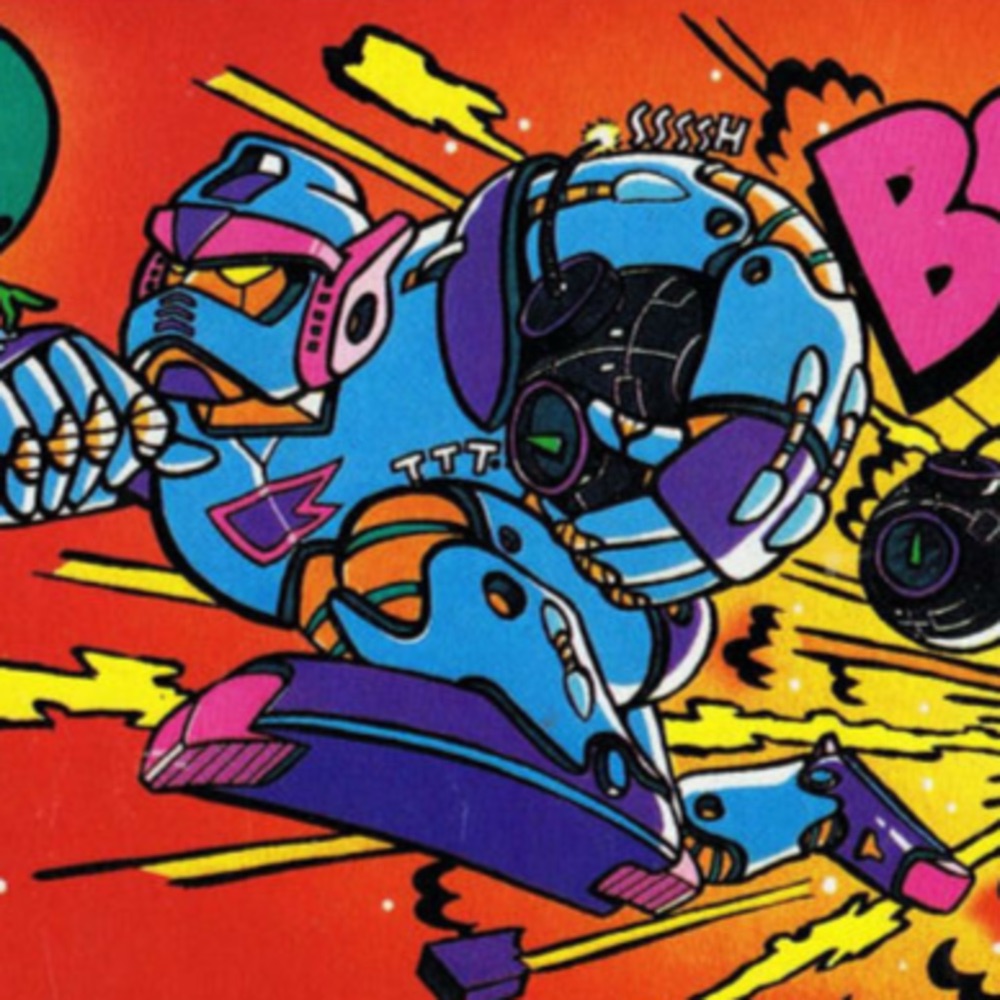
Bomberman was a robot in a bomb making factory who longed for his freedom. Rumors circulated that escaping to the surface would allow the robot to become human. Getting out would be the trick. Each room is inhabited by monsters that must be neutralized and the exit itself hidden underneath bricks.
SHOW NOTES
Bomberman Longplay
Bomberman Manual
Shinichi Nakamoto and his 72 hour port
List of Bomberman games
Super Bomberman 2 (The one Mike recommends)
Bomberman Act Zero Trailer (THE EDGE!!!)
- Bomberman is a robot engaged in the production of bombs. Like his fellow robots, he had been put to work in an underground compound at the center of the Earth.
- Introductions
- Is Bomberman an IP you associate with the upper levels of gaming? Is he as familiar as Mario/Pikachu/Sonic/Crash/Spyro/Master Chief/Lara Croft
- Overview/Plot
- Bomberman, is a robot that must find his way through a maze while avoiding enemies. Doors leading to further maze rooms are found under rocks, which Bomberman must destroy with bombs.
- The game is played top down and bombs explode in a 4 way cross direction at all times
- Development
- Bomberman was written in 1980 to serve as a tech demo for Hudson Soft's BASIC compiler.[4]
- This very basic version of the game was given a small-scale release for Japanese PCs in 1983 and the European PCs the following year.[4]
- The Famicom version was developed (ported) by Shinichi Nakamoto,[5] who reputedly completed the task alone over a 72 hour period.[6]
- Gameplay
- Your strategy for beating a level?
- Power-ups that really make you POWERED UP
- Controlling the bombs
- This and puzzles would’ve made a more interesting game
- Controlling the bombs
- What could’ve made the game more complex
- Spamming bombs
- Enemies appear BIG TIME if you break too many blocks
- BOMBER GOD
- Flamepass + Bombpass makes you near indestructible
- Sequels and Spinoffs
- Bomberman is a huge franchise so we’re not gonna cover it all until we get to BOMBERMAN II on the NES in 1993! Who is excited?
- I’d like to talk about some of the games I played as well
- Bomberman Special - MSX - it’s top down but there is this weird rounding corners when walking like you’re not in a grid you are kinda floating along a tight space. Bombs drop slow and take forever to explode
- Bomberman ‘93 - TG16
- Starting to feel more fun and colorful like I expect my bomberman
- Bomberman ‘94 - TG16
- Just as good...actually better than 93, now you can ride around in animals and destroy more than blocks
- Super Bomberman 2
- I did play 1, but 2 is the one worth talking about. Finally you’re feeling good. Tons of power ups and often with neat new designs and layouts and bombable items and patterns
- EGL
- Next week - Sesame Street 1-2-3
Auto-generated transcript. Each paragraph starts with its timestamp. Speakers are not identified.
Bomberman is a robot engaged in the production of bombs. Like his fellow robots, he had been put to work in an underground compound at the center of the earth.
And welcome to NEStalgia, a chronological exploration of every NES game released in North America. I'm Mike. I'm Sean. I'm Joe. And I'm Sam. Full House for the very first episode of 1989, which I believe was also the first year that the show Full House came out. Oh wow. It was 1989. So we have a Full House, there's a Full House sitcom, we're doing great. I've got a Full House as a hand of cards. Does that mean we'll get a licensed NES Full House game? You have to wait for Full House Tournament Fighter on Super Nintendo.
He had that all set up. Yeah, Joe and I worked that through. Yeah, yeah, yeah. No, actually, believe it or not, YouTube, yeah, like YouTube for Full House Tournament Fighter, and you can watch like Uncle Jesse actually lay out some good moves on Uncle Joey. Nice. He's not Uncle Joey, Mike. He's just Joey. Oh, that's right. Yeah, yeah. I knew something was weird about that. I was like, they never, you know, they also called him that woodchuck, right? Isn't he like, um... Oh yeah. Yeah, wood. Wood. Yeah, you know what I'm talking about.
Couple people watched Full House, heard it was a pretty successful show, but we're not talking about Full House or Full House Tournament Fighter. We're talking about Bomberman. Guys, is Bomberman an IP? Forget about the games for a second. Is Bomberman an IP you associate with the upper echelons of gaming? Is he as familiar as Mario, Pikachu, Sonic, Crash Bandicoot, Spyro, Master Chief, Lara Croft? Like, is he up there with these people? All right, so I think with who you just listed, that's a combination of A-list and B-list icons.
Like, Bomberman is definitely like on that cusp between like B-minus, C-plus. It's definitely more of a C-list gaming icon. I put Bomberman in the same tier as Tails from Sonic. Okay, I get that. I get that. I could see that. I would think though that if like, like Tails is up there with Sonic, right? Like, if Sonic's up there, then Tails is too. Yeah, but if Sonic wasn't part of it, if it was just Tails, I think that's where Bomberman would be. Okay, gotcha. If we set them all out on a line, I think that Bomberman would be below Crash Bandicoot, but above Knack.
Okay? And Joe, is Crash Bandicoot an A-list or a B-list character? It's a B-list. Well, let me tell you, you're talking to a very biased Crash Bandicoot, giant Crash Bandicoot fan, so I'm gonna say A-list, but I'm sure not everyone will agree with me, judging by Sean's whisper a second ago.
I would say Lara Croft being listed was also a little strange, right? Like, that's C-plus as well. That's where I associate Bomberman. That's B-minus. Here's the thing, though, is everyone that you mentioned, if we're just talking, like, our own personal experience, everyone that you mentioned, I knew something about. Bomberman, I just knew the name Bomberman. I didn't really know anything about it. That's true. I knew that he had bombs.
So, that puts him a little lower. Yeah. I think my only experience with Bomberman before this is from Smash Bros. as an assist trophy. Okay. Just for the most recent game, though, right? Just for any kind of Bomberman experience, I think. No, no, I'm saying, like, I only think Bomberman was recently an assist trophy. Oh, yeah. He wasn't on the Wii U one. No, I don't think so. Okay, that's interesting. Guys, I grew up on Bomberman, so I'm a little surprised to hear this, but I could understand why, you know, I asked this as, like, a trick question,
because I think Bomberman is, like, a big deal in Japan and not a big deal out here in the West, and I'm not quite sure why that is, but you'll see later on when we get into the sequels and spinoff section, I think it's gonna have to be its own show. Like, technically, Bomberman is probably, like, Hudson's biggest, Hudson Softs, their biggest character by far, just by looking at, like, the list of games that this guy has and, like, the amount of media support and all these other offshoots of it. It's like, this is, this is like a big franchise for them. I'm very surprised.
Oh, for sure. I'm also just gonna say that I've never played a Bomberman game in my life either, but I had always heard of him, and I, it looked interesting enough, so, cool.
So, Bomberman is a robot, might be a man, unlike decided on that. The manual kind of tells us that, like, he was a boy or he's trying to become a boy. It's like a Pinocchio story there. But he's a robot who, as we mentioned on the back of the box, is stuck in the underground compound of the center of the Earth, and he needs to find his way through a maze while avoiding different enemies and ultimately killing those enemies
as he uses his bombs in a top-down fashion to destroy bricks and enemies and bust down doors and find power-ups to continue to advance on from stage 1 all the way to, I believe it goes to stage 50. As I mentioned, the game is played top-down, and bombs explode in a four-way cross-direction at all times. Anybody think that I didn't do the whole video game justice there?
Those are definitely the way that you play the game, yeah. Well, did you mention that you evolve from level to level, and by the end of the game, you're a very different move set than the beginning of the game?
Move set, ability set, than the beginning. Because of the power-ups? Because of the power-ups, which, yeah, are game-changing. I guess technically you don't need to get the power-ups, but if you do, it evolves the gameplay over time. No, I think that's a good point, because we should probably start talking about this game at the most basic form. Like, forget the power-ups. When you first start this game, you're this little guy in a maze that looks not like a maze at all.
It's just a green background with a bunch of tiles placed around and some balloon enemies floating. And you have to lay out one bomb at a time. You don't have any more supply than that. And your explosion of your bomb is only the adjacent four tiles in a cross direction. So as you collect power-ups, obviously that expands. But how did you guys feel about the initial power of Bomberman and also just the feel of the game?
Yeah. My specific non-experience with this game in the past made me think that, oh, this must be what old Bomberman feels like. Because I've seen footage of the more modern games, and it's kind of chaotic, and it looks a lot more fun than this was. This was kind of like pulling teeth.
And just because you don't get to choose when they explode. You can only blow up one at a time, as you said. And it's so weak. But I did not realize that it was just sort of like setting the foundation to make you feel a bit more powerful down the line. But I'm sure we'll get into that. No, I have these images of what Bomberman is in my head. Of these giant explosions that travel really long distances in four directions. And I feel like when it just kind of popped on screen instead of exploding, it was very underwhelming. But that the sound of the explosion was really sick. Oh, yeah. I definitely felt that, too. Like, this is the best explosion sound of the NES so far. The best of 89.
Similar experience, too. But I thought, just based on the look of the game, I kind of unfairly was like, well... Based on the look and the first level, I was kind of unfairly like, well, this feels like a lot of the other arcade-style games that we've had. It's probably going to be very shallow and not get much more complicated than this. And it did, to an extent, prove me wrong. But, you know, at the beginning, it kind of made me think I wasn't going to be that into it in the future levels.
It's surprising how slow the game starts off because I would argue that that's fine if this is your first ever time playing Bomberman. But even you guys have, like, an idea of chaos in Bomberman games where there's usually, like, a bunch of different players. Enemies are all over the place. And they do fun things, too. It's a little strange when the enemies that you're fighting just kind of move in, like, random directions, could care less about where you necessarily are in the stage.
And when you have to kind of wait for all progress to happen based on, like, this five-second delay between when you place a bomb and when it explodes. Keep in mind, of course, that since we're describing these top-down levels as mazes, it's not so much a maze because you can always destroy the blocks in your path. But there are a lot of blocks in your path. So if we're talking lay down a bomb, five seconds to explode, open up, you know, a new direction, you have to do that a lot in a particular level.
And it's not that they don't give you enough time to do that or anything or that the levels themselves are too large. It's a very tedious task to ask of a player who's just starting out in the game. It's not very rewarding at first. Would you disagree? Yeah, I would. Because I was going to say, because I fully agree with you, that this was super risky. If they knew what this game was going to be, like, in the late game or after you've sort of learned the ropes and you pick up some power-ups, but you choose to show this as, like, how you're going to play the game, and, like, as a person that may not have been exposed to Bomberman before,
like, thinking that this might be how the game is played the entire time, it's just super risky to sort of, like, put your most boring foot forward. I don't know, though. I feel like it might just feel more risky to us from the lens of today.
But if you think about, like, back then, it wasn't like today where it's like, you pick up a game or you, I don't know, you try a game, you demo a game, or just you have access to all these games, and then you're like, oh, I don't like it, I'm going to try something else. Back then it was just like, well, you play this game at first levels, but you gave it a lot more of a chance, I feel like, in the 80s, because it was the only game you had, or you only had a few games. So, like, I feel like even the first level being boring, I feel like it was less of a risk that, like, they're going to lose their, people are going to just immediately put the game down over, like, the reward of, like, having that boredom turn into, like,
people noticing, like, how different. Sure. You know, like, say those first two to three levels where you're collecting, I think, because I really think you can only get one power up a stage. Am I right? Like, it sounds about right. I feel like maybe you could get two, but, you know, pretend that those first three stages where you're just kind of slowly gaining power ups, think of those as the tutorial stages, right? I think that maybe is what Joe is getting at. I would argue that those stages then don't need to be so large, though, and so empty in their design.
They could have been smaller things that teach you about, like, like, okay, well, remember, if you plant a bomb, like, you got to have another corner or out point to go to, otherwise you've kind of trapped yourself in your explosions.
Or, you know, these enemies go in a particular direction, so make sure you don't explode every brick around them, because then they'll just be free to roam, and it's going to be a lot harder to destroy them. Like, that's the kind of tutorial I would have liked to have seen. Instead, you get the full game with not a lot happening. Well, for the record, yeah. Does that make sense, Joe? Well, yeah, I agree with what both of you are saying about this level. Like, this level could be a lot better, and it could be more exciting and more interesting. I just don't think that it was necessarily much of a risk to them in the perspective of 1989,
because it's not like, I don't feel like a lot of people would play the first level and be like, okay, I'm out back then, like they would today. Absolutely. Sure, sure. Because you just bought the game. You just paid full price for it. Exactly, yeah, yeah. I get that, but I get what you're saying, but even something that has a more standard, like, not difficulty curve, but a curve of how complex the game can be. Like, if we're talking about Mario, if we're talking about Contra, like, well, you're going to be doing the same things,
across the entire course of you playing those games. Like, jumping in Mario is fun, regardless of when you're jumping, what level you're jumping in. Shooting in Contra is fun, regardless of what level you're in. Whereas, planting bombs and waiting for them to explode, and then once you somehow kill all the guys in the map, then, like, just sort of combing through every other little pixel to see which one has the hidden door is not all that fun. So I think it's a little different. Like, it is kind of riskier. And it may have, like, it definitely would have been helped by a more modern take and tutorialization that just hadn't been invented yet, really.
So I still think that it was a... This was an interesting way to go. Yeah, I mean, I see that, too. But I do also think that some of the things that you're saying are not fun in this first level are also not particularly fun in later levels, like combing through. No matter what your power-ups are, once you've killed all the enemies on the screen, combing through every brick, I think, is maybe, at least in my opinion, just a flaw in the game overall. Sure. I'll grant you that.
So let's talk about the main power-ups here. For the most part, you're collecting additional bombs that you can drop so that you can drop multiple bombs at a time. And there's, like, a fire power-up, too, that just increases the range of your explosion so that instead of one tile in each direction, it can go two, three, even four tiles in a particular direction. And that really helps speed up the gameplay and add a lot of strategy to it, too, because now you have to be aware of where your bombs are, where you are, and where the, like,
points of exits and enemies are. Because I would argue that when you have a one-by-one tile, you know, cross-directional explosion, that it's really easy to dodge that. And most of the time, you're just going to get either, like,
you're going to put yourself in a bad planting position where you accidentally planted it and trapped yourself in a place, or you trapped yourself with an enemy on the other side so you can't escape either the explosion or the enemy. Later on, all of a sudden, you're actually your own worst enemy in this game. I would argue that you're way too powerful for the enemies in the game, but you're now the threat. Yeah, it kind of becomes a puzzle game a little bit, as the more you play.
Oh, it's definitely a puzzle game throughout. It's just so that the puzzles kind of change. Yeah. Yeah, I'd even say that, like, at some point, the way that you become stronger did this weird thing where, for a little while, it made, oh, the puzzles are a little more interesting now, because now I have to think about it this way. And then after a while, it was like, okay, well, now the puzzles are a lot easier. Like, it made the difficulty curve, like, not, like, continually increase. I feel like there's a period of time, you know, there's one point where you eventually just have the ability to detonate the bombs whenever you want. Whenever you want, rather.
So you place it, and you don't have to really worry about where you placed it, because you can almost always find somewhere that's safe. You have all the time in the world to get there, because you detonated it at your own time. So I feel like, not that it was necessarily made it, like, pointless. It was actually kind of cool to suddenly, at first, to suddenly have a, an advantage where you didn't before. But it did mess a little bit with the difficulty curve of the puzzles. Yeah, it's sort of like, there's, there's like a tediousness meter and a difficulty meter. And whenever, like, as the difficulty goes up, the tediousness goes down, because you're sort of giving more and more,
you're getting into more and more chaotic situations. So, like, I still, but, like, the fun continues to go up in, in that situation. I don't know if I'm making any sense there. Yeah. No, I, I get it. I see what you're saying. I think there's just something to the satisfaction of seeing your growth in this game, which is, like, very clear. Yeah. And it's also interesting, because, so, did you get,
uh, the power-up to make the explosions bigger before you got the power-up to time your explosions yourself? I got one of the, yeah, one of the power-ups to make your explosions bigger first, and then I think I got the time one before I got the next bigger power-up. I don't remember exactly the word. That's interesting, because I, I didn't find, uh, my first, like, make it bigger power-up until, like, I was able to plant, like, five bombs at a time, and I could set it off at my own pace, and I was, like, a little bit faster,
um, so I also think that, like, the fact that the order in which you get the power-ups can make your experience that much more different as well. Yeah, that's, I had no idea that that was the case, that it, that would actually totally change the game in some instances.
Mm-hmm. Well, Sean, it sounds like your strategy wasn't necessarily to bomb every single block before you, uh, entered the door to go to the next stage. Would I, would I be correct in that assessment? You'd be correct. I did not think I was supposed to. I don't think you should have to, but theoretically,
that is the best way to get all the power-ups, is by bombing every single block, and granted, you're gonna blow up probably 50-plus blocks and get two power-ups in exchange, but your, uh, scenario, where you have the control of five different bombs that you can detonate whenever you want, but they only do one-by-one tile, uh, cross-directions, sounds like a nightmare to me. like, yeah, it's not, it didn't seem, uh, the, the most optimal way to do it because I,
like, at that point, I did go back and play it and I did eventually, uh, get the ones that made them bigger, uh, but when I watched the video of somebody that was on the same level as me, I think I was on, like, level 15 at the time, uh, and how they were playing, it was just like, this is insane, uh, and so when I, as I played a little bit longer, I was finally able to find those power-ups and, uh, kind of get to that level,
um, but yeah, no, I mean, because there are other things going against you, like the timer that will make it, make the, um, make a bunch of extra enemies spawn, like, I'm not gonna clear an entire level if I have that risk, so, uh, yeah, it's, it's entirely possible that a lot of people wouldn't have found all those power-ups to begin with anyway. So can you guys confirm something for me then? Is there, I just assumed, based on my experience, that there's only one power-up per level, so I played it like, I would bomb every single block until I found the power-up and the door, and then I would think, okay, that's everything I need to find, and I would move on, so I kind of found, like, a little happy medium with having to bomb every block,
and hopefully not missing power-ups, unless there are times where there's more than one power-up in a level. I'm only going off of what I remember, and I feel like I would have, I feel like I remember getting possibly two at max per stage, but it's very possible that, you know, it's just being a blur to me now, and that I'm thinking of later Bomberman games, which just give out power-ups like crazy, because it's to add to the chaos, so I can't say for certain that this game gives you two per stage or something like that, but it's definitely not more than two, so it's either one or two. Gotcha. You know, what's funny is
controlling the bombs, right, that's like a different kind of power-up, though, right? Like, the rollerblades let you move a little faster, the explosions can become bigger, the amount of bombs you can drop, you can have more of those, but being able to control them is like an actual new element to the gameplay, and what's surprising there is in a game like this, it's actually like a little too overpowered, but still really fun, and can cause you to put yourself in a hole where you can't escape and you have to detonate on yourself, so there is a balance to it, but I think
like the fact that like the bombs are on their own timer that doesn't necessarily like count down on screen, there was something more exciting about that when you have more of them because you kind of have to think about your placement rather than knowing that you're safe with your controlled detonations, that I wish the controlled detonations were actually more puzzle-based
and just part of the game if they wanted to go that route. I would have appreciated if you had to detonate things in a certain order to release a certain enemy in a specific direction, or the way that enemies go, you need to trap them in using your controlled explosions, like it feels like that was a missed element here, and instead the controlled explosions are just a really powerful
different way to play this game that could be fun for any kind of player, but kind of brings down the challenge of the overall game. Yeah, I mean, I'd actually say that I think that applies to all the power-ups. I feel like the game design could have benefited from being modeled around the power-ups. Once you get, like you said, you get the detonation, there should be a puzzle element that requires you to use that in some way you couldn't before, or even the blast radius when you're making those crosses, or how you can
put two bombs that will detonate each other, like there should be reasons to use that stuff other than feeling badass and feeling cool. There should be like, I don't know, I wanted there to be something a little more cognitive that you have to think about your placement as the levels went on, but it never really evolved in that direction. Yeah, my earlier levels sort of ended up kind of being like that because I didn't have the luxury of having
more than one box per explosion, so it ended up kind of being like, okay, now I've got this power-up that allows me to pull the trigger myself, so I see that this enemy is sort of trapped right now, so I'm going to set two bombs, one is going to open up the wall that's keeping that enemy boxed in, and then the second one I will trigger later so that it gets blown up by that as it starts to come out, so I ended up kind of using that as a puzzle-solving thing, but it only really mattered because I didn't have that other power-up, so it's kind of sandbox-y in that way, you're not going to get anything that's designed to be this puzzle-solving tool, but you can still get creative with these things, which I think is more important than sort of
a hand-crafted puzzle. What it came down to for me too, is this doesn't have to be a puzzle game in that respect where you're actually having to think about where you place your bombs in order to trap enemies, it didn't have to be that kind of level of game, like it is just supposed to be a game where you blow stuff up and have fun doing that, so I respect that they didn't go puzzle route,
but I think the worst game design decision they had was that enemies don't necessarily have patterns, and I understand that certain enemies are a little tougher than others, and certain enemies behave differently than others, but there needed to be something where like, for instance, those balloon enemies, right, I think they're the first ones you see in the whole game, they needed to just be an enemy that goes side to side,
you know, left to right, and you learn based off of that, that like, okay, I don't want to go in their hole because then I'll just get caught in their corner, but I can bomb them, and I can time my bomb based on like, them coming in this particular direction,
instead, the game handles everybody as a free-thinking, but without thought really, roaming character that doesn't, like, sometimes it feels like they know about your bombs, sometimes it feels like they know where you are, but as far as I'm concerned, the whole thing in terms of enemies is just completely random, and more often than not, they can just run into your explosions by accident, they are actually always walking in the direction of your bombs if you're placing them smart, they don't know where these bombs are in relation to you,
and I think patterns would have helped something like that if you had guys who went in circles and got, and like, later on with the ghosts, like, if they had like, you know, because they can go through the different blocks, if they had a recognizable pattern so that you could think about where you're going to place your bombs, rather than just
being in this awkward situation later on, when there's only like a few enemies left, where you're kind of like chasing them around the screen, and only ever like, getting kind of like, okay, well I'm going to place one here, and I have another one, so I'll place this here, and then I trap them, and that's great, but there's also times where trapping them isn't an option because you've destroyed every single block, and now they're just roaming around this stage randomly, and you just kind of have to hope that one of your explosions is lucky enough to hit them. They introduce such a wide variety of enemies aesthetically,
but for the most part, like most of them all do the same thing, so it tricks you into thinking like, oh, there's an enemy variety, but they're all kind of the same. Well, I'd say that, yeah, they definitely don't have patterns, but I think that they do have tendencies. Like, I remember the barrels, they move a little bit faster, but they stick to a left-right thing, or an up-down thing, depending on where,
like, whatever their initial state was. Like, they are much less likely to veer off of a one-axis path, but I think that's okay. I mean, I think that if you just have this grid, and all the enemies have very predictable behaviors, you're just sort of optimizing, like, your playthrough will be, like, how optimally can I do this, instead of, like, how can I, like, sort of crowd control this, which is also a valid way to play the game, or to design the game. So I don't think it needed to be this cut-and-dry pattern thing. Yeah, I guess now that I'm looking at it, I'm actually watching right now, yeah, there are some that go left and right,
yeah, that just wasn't as noticeable to me. I still agree with Mike, though. I feel like having a lot more specific patterns would have helped this game just help the levels feel, I don't know, like, a little bit more, it would help the levels. They would have been tighter because you would have had, you would have had a path in mind. Yeah, that's it, you have a plan of action. Right, I'm not arguing that they should all act like Koopa Troopas, right? That would be a really boring Super Mario Bros. game if you ever only went up against Koopa Troopas, but every enemy in a Mario Bros. game is
somewhat designed to do a particular pattern. I think the Hammer Bros. are a good example of something where it feels really random and you kind of have to think about when are they going to jump, when are they going to throw hammers, when are they going to do these things? I guess I'm showing how bad of a game designer I would be if the only thing I can think about is
movement patterns, but I'm sure there's other things they could have done, too, for these enemies to differentiate them on a level that would make them more interesting than just these guys float around the screen and you just have to make sure you bomb them. Well, so for example, when I first saw the barrel enemies, my first thought was, oh, that must be like a barrel of gunpowder or something, and when I place a bomb, they're going to blow up my bomb immediately or something. This is something else I would have to think about, like, okay, don't place a bomb too close to the barrel guy because he'll blow up all my bombs or something. I don't know, it doesn't really make sense when I think about it, but that kind of thing that I would have to think about would make the game feel take longer to get stale. Yeah, I get what you're saying, like, that is another element
that, like, if maybe it just, like, actually just made your explosion bigger and then that way it could reach you accidentally. I get that. Right. I sort of had that intuition as well. Yeah, rather than, like, right now, it's still just, granted, there might be, like, little different ways of figuring out how to get people, like, how to get each enemy depending on which direction they're moving, but it's still always just bomb all the enemies. Like, I know that's the name of the game, but, like, I feel like, I don't know, there could be another level. I've got one more,
one more example of something I was thinking of. It might kind of go back to what we were talking about before with the power-ups, but, Sean, you mentioned you were doing something that was, you were almost like creating a little bit of a puzzle for yourself that wasn't, like, in the game design, and I was kind of doing something similar where when I had a very large blast radius,
I would try and put bombs at the edge of another bomb's blast radius in a way where I could fill the whole board as much as I can, get as many enemies across the whole board with one explosion without having to detonate more than once. It didn't really make a difference, because if I didn't have them like that, I could have just detonated them all one after another and still gotten that same range, but it was just fun to me to do it that way,
and I kind of wished that the game would have rewarded me for some way in doing that. points stack on each other, or just some incentive to do something different than just place bombs and blow them up until you kill everything. I guess. I mean, also, if you frame it not so much as solving a puzzle or solving something that the game is laying out in front of you, but a more proactive way of thinking of like, oh, I'm laying a trap,
that's sort of how I was looking at it, and I think that was sort of my reward was knowing that I laid this successful trap. I know that that's like a very wishy-washy way to argue your point, but I really don't know what else could have been more of an incentive.
Yeah, I mean, look, I see what you're saying too, and I think that we're both, I mean, I agree with both of us, if that makes sense. I do think there's definitely something to that validation you have just from the satisfaction of
figuring out a cool way of doing it. I think one way of incentivizing you, which maybe wouldn't really work for the people on this podcast, I think we've all gone on record saying we don't care about points in games like this, but if you just made it so, okay, this is worth a thousand points, but if you stack it with another one, now it multiplies by three or something. Every time you kill multiple enemies at once, the points you get increase exponentially are just something to see a visual. That would also help a bad cause.
I do think that when Sean, when you said crowd control, that was like an eye-opening thing for me though, of like what is actually the most fun part of this game, which we were kind of talking about earlier and we lost track of when we started getting pretty negative about the game, but it is fun when you have like a lot of power and a lot of chaos on the screen in terms of like all these different enemies, placing your bombs, keeping track of where they are.
You know, I think like if the enemies were really difficult, we might have argued that this game was like an NES hard game where it's like all these enemies are like unfair now or something like that. So I could see that there's a line. I do think at the end of the day though, there is a point in this game where you just become like bomber god, instead of bomber man. And when you have the flame pass and the bomb pass, which are two not even late game power ups, they're just two power ups you can stumble across that allow you to walk over your own bombs, but then also like dodge the explosions of those bombs regardless of where you are. All of a sudden,
the whole game just becomes like dodge the enemies. And when you can just lay out, you know, I don't know what the limit is actually, but let's say like you can lay out five bombs and they can have huge explosions and you don't have to worry about where they are. You just have to make sure that they're hitting enemies. It's very hard to lose in that particular scenario.
And that's where actually the game becomes too extreme in this, you know, like it becomes, it becomes a sense where it's like, okay, I don't feel the challenge anymore. The challenge would be me just like taking off these power-ups. One note that I wanted to make, and it's sort of, I guess it's a little offbeat, the experience that I likened this to the most of like a game I played recently would be like Saints Row 4 where you're kind of, you kind of exist in this simulated version of the previous Saints Row games. so you can like hack, hack a simulation like you're in the Matrix and you basically become like a superhero playing a GTA game and it's so hard to die and everything dies so easily.
And you're just a superhero. So, but like that sort of, that change from the beginning of the game where you're just sort of walking around playing as like this very pedestrian version of a GTA clone to the end of the game where you're this invincible god that just flicks at enemies and they explode. That was sort of the experience I got, but I had a lot of fun when I was playing that game in a very similar way that I was having a lot of fun as I played through Bomberman. So like, yeah, you're overpowered,
but it's such a goofy way to do it. I just found it entertaining. Yeah. Your description reminds me of playing Crackdown if you guys had played that. Crackdown as well. It's very similar. Where in the beginning you're just like a guy and then by the end of it you can jump 50 feet in the air and survive huge explosions. So Bomberman's like that, but he can't jump. But he can roller skate, which is pretty cool.
He can roller skate. Speaking of Bomberman's movement for a quick second, this was a weird experience I had playing the game and it's going to be hard for me to explain this because I've tried thinking about it several times now before we recorded the episode. Did you notice something about the size of Bomberman's sprite on the maze itself, right? The maze itself seems like it should just be tile, if you press the down button, you'll move to the next tile, and so on and so forth, like a grid.
But it doesn't really work like that and there's actually like some, some looseness between the hallways of Bomberman where like he can kind of round the corners of these squares, which is weird because technically they shouldn't have circular edges on these squares, but they do. It was very uncomfortable and there was just something about like, it caught me off guard a lot when I was placing bombs because I think that I'm placing them on a particular tile, but I'm not quite there. I'm actually like a little off and maybe this carries all the way back from Legend of Zelda where that is actually
a game where you're very much on like a particular grid that you can move across. This game has like a looseness to it that felt very weird the whole time I was playing. I think it would have felt more weird if you were on a grid. Yeah, because there's sort of like a timing effect that comes with that and in a timing based game like this, I think that that would have made the game feel a lot more like while you're calling looseness kind of weird, I think that if you're stuck to this grid, it would feel even worse. Interesting,
because I guess I'm actually not saying that it's bad, you know, I'm saying it actually made me uneasy. Like there was a weird, there was a mental break for me while playing this game because of it feeling like my movement was like slightly adrift or something, you know, like I wasn't exactly in control of the character, I was ever so slightly off and it's not true, you are in control of the character at all times, it just, you know, it was like a visual psych out for me. Maybe it's to help round corners, like if you put a bomb down and then need to quickly escape so you don't get stuck on a corner, maybe that was part of the intention. If I think about like how I've played, like how you play Zelda or like a
classic RPG, like you don't really have much of a, like you can, can you kind of imagine having that control scheme and playing a Bomberman like game where it's just like one block, one block, like there really isn't that much of a, like you can't time that, like it's just this tempo. Exactly, I hear you, no, you're playing a math game all of a sudden, you know, you're trying to just like calculate, calculate the,
it might as well have counted down your spaces then, like okay, you are five spaces away from explosion, four spaces away, like I get that. It could be like a Crypt of the Necromancer kind of thing where it's a rhythm game. Oh, that's cool. Necrodancer. Necrodancer, yeah, right, Necrodancer. Slightly different game. I've only ever played the Zelda one, so I just call it Cadence of Hyrule, mostly. Which is rad as well.
Yeah. So I probably should have done the development section first because this probably would have set the stage better for the kind of game that, not only that we played, but that others can expect and maybe why it is the way it is. This is a, even though it's the first game of 1989 on the NES, this is a 1983
Japanese computer game that was written in, in basic for, as like a tech demo for Hudson Soft back in like 1980 and then finally published in 83. It never really like went anywhere for a while and then it all of a sudden like exploded on personal computers and then they were like, oh, well the Famicom just came out, so let's release it there and it did come out there. Eventually that Famicom port gets to the NES here in 1989, but the Famicom version was developed by the head of R&D, Shinichi Nakamoto, and he says, he claims to at least, have completed the task of porting it to the Famicom all by himself in 72 hours.
I mean, I'm not a programmer programmer, and I definitely wasn't a programmer in the 80s, but that still, it still sounds kind of outlandish to me. It's either like, Basic was very easy to translate to Assembly and this was a super simple game, or, Nakamoto's just a liar. I think he might be a liar. I'm gonna go with the, he was able to do it.
Nakamoto also added in a 1995 interview that he personally believes that the Famicom version of which he is solely responsible for, apparently, is the one and only version of the game. I would also find that hard to believe, that this is the definitive version of the original Bomberman, considering that, like, it ran on personal computers, it ran on the MSX, like, surely there's gotta be a better version. I did read that on the Wikipedia page, that the NES version was the version, but I get, I mean, maybe it's one of those things where you don't realize how good the arcade version is until you finally see it, but I can't really see too many, like,
presentational improvements that this game can, could do. I'm sorry, I feel like the only improvements that this game could have on other systems is presentational, because, like, the core gameplay, like, it, it performs pretty well, so, I don't know. And that's ultimately what I'm gonna get to here for a second, a bigger picture thing, if you will. This was a tech demo for Hudson Saw. Guy is named Bomberman, he bombs, uh, bricks, and destroys funny enemies.
Why is this about to explode into, like, like, a, you know, gigantic franchise with many, many games, like, would this first game, would you really imagine this, like, taking off and being like, well, we've gotta do more of just this, though. Like, we're not gonna add too many more improvements. It reminds me a lot of, like, Lode Runner. Remember when we covered the Lode Runner episode and it was, like, a bunch of sequels came out, but they were just, like, additional level packs
for Lode Runner. And it's, like, was that really necessary? Like, didn't you get enough from, like, the 50 levels that that game had? Now you needed, like, another 99 level pack where you don't add any new mechanics, really, you're just making more levels. That's ultimately what the first couple of Bomberman spinoffs are gonna be, sequels are gonna be. So it's, like, it's really strange that, I don't know, this is, like, such a weird character and game to get, like, a huge franchise. Imagine if, um,
you know, Mylon's Secret Castle became, like, a big thing where, like, oh, we gotta make another Mylon's Secret Castle game, like, let's just make that a whole franchise and Mylon will get a puzzle game and he'll get a platformer game and he'll get a 3D game and it's, like, my assumption there, though, is, and I don't have a precise idea of, like, an answer to that, but, but I will say that I, I think maybe,
I mean, we've been, I guess, moderately neutral on this game, but I think we've maybe leaned a little negative for what I thought I was gonna talk about on this episode. I did think this was a pretty good game for, for how simple it is, um, and it was satisfying and I did have fun, like, I did have fun with it, and I think it's at least enough that I, that I can see it warranting one sequel and then if that sequel suddenly does some things a lot better, like, I feel like that there's room for a, for a much improved sequel
and I feel like people would want that and then it's not like they were like, oh, Bomberman did great, let's make a hundred other games, they were probably like, Bomberman did great, let's make one other game and then that game does really well and then the next game does even better and like, I assume that like one of its sequels is even better, like, is even better in a way that they were like, oh my god, people are loving this now.
I guess in, to respond to what you said, Mike, about like, okay, Mylon Secret Castle gets this and whatever the hell else, I don't remember, those, I didn't really, I don't think I enjoyed those games, I barely remember what Mylon Secret Castle even was and the thing about Bomberman is that it is such a simple concept, but it is a systems-based game and this is like a term I throw around whenever I see one because it's such a, like, that is the philosophy of game design that I think I subscribe most to, that like, it evolves over time, like, one experience is going to be a little different than the next,
I think that's what people liked, I mean, and it's got just like sort of that it, like, that you can't really describe that Mylon Secret Castle most definitely does not have. I don't, I guess I really don't know,
how else to, I guess, defend this, defend this game, I don't know. I guess I'm not asking for defense, I'm just asking if anybody else is as surprised as I am that a character that just plants bombs and they, again, a top-down game and they just explode in directions and any Bomberman in the mainline games, which is a lot of them, any game that you play is going to start off with the same limitations of, like, your bomb can only be destroyed in a one-by-one cross-tile fashion and you can only drop one at a time, like, the fact that every single game starts like that,
maybe I have a little bit of a bias here because, and I am not saying this as a joke, I've been playing Bomberman games all day in preparation for this episode. I decided, it's 1989, we got sequels and spinoffs, let me try and actually tackle some of these other games so that I'm not just talking about them based on what I read, let me play some of these games. And there came a point where I realized that this would be
a six-to-eight-hour podcast if I talked about every Bomberman game. Yeah, don't do that, Mike. I had no idea. I had no idea that there was over 20 main Bomberman games, that there are over 10 portable Bomberman games, that there is a Bomberman arcade world also that, like, is sometimes known as Atomic Punk in the West and not Bomberman. That sounds pretty It is pretty cool. I had no idea that there were a whole line of Bomberman mobile games, like Bomberman Play IQ, which I can only imagine is like an IQ test with Bomberman, like that's how we probably have a Bomberman love tester game in here somewhere. One of those things where you, it's like an arm wrestling machine.
Yes, and it tells you if you're in love or not. Yeah, I see. There's Bomberman Wars, which was a Japanese-only tactical role-playing game featuring the Bomberman cast. There's, don't forget Robo Warrior, that game we played just a while ago, like that's a Bomberman game.
Bomberman Panic Bomber, which is like Puyo Puyo meets Tetris. Then there's the Bomberman LAN games, which are like this kind of like regular Bomberman games, so I don't know why they get their own section on the wiki. And then there's also like Bomberman Act Zero, which was like a reboot, a gritty reboot of Bomberman in like 2012. 2012. Yeah.
It's crazy, it's crazy. And then there's a whole clone section too, of just cloned Bomberman games that were made by other companies, mostly Chinese, but like that are just taking the same Bomberman thing and just removing him, but the idea of explosions and grids still being like the main thing you play as. I can't believe so many people find this kind of game so satisfying that they would go on to make 200 versions of it.
Yeah, when you put it that way, I mean, it is, yeah, like I would not have expected that level of a future for Bomberman from this game, but I don't know. I mean, I guess it was just, it just was like the perfect job interview where it was like, okay, you've shown us that you're okay, you're good, you know, you're kind of fun. And then it's like, all right, let's see what you can do now, really. Because what was the game, I'm already forgetting, what was the game we just played a few weeks ago that was the same Robo Warrior. That wasn't fun. No, was it Robo Warrior? Is that what I'm thinking of? Oh, I thought you were talking about with Bomberman in the... No, no, there's another warrior placing bombs through
a bunch of solid objects. Yeah, Robo Warrior. Wow, I, okay, I didn't even think I was on the Robo Warrior episode. You probably weren't. Yeah, you probably weren't. I wasn't. There was another game that we played that I was on. It wasn't fun. Okay, well, either way, there's another game that we played recently that I was on. I'll look it up in a minute when I'm done talking and I'll chime back in. But, that was not fun.
And, it was doing like the same things. It just, I don't know, it just didn't, it just didn't hit the elements right. And, and it, I didn't enjoy it at all. And this game I did enjoy. So, maybe, like I said, they just were able to keep building on that. It's not really an answer to your question. I just don't know, but, it's Pac-Man. Pac-Man does the same goddamn thing every time. But, Pac-Man is an icon. Everyone doesn't get sick of Pac-Man. They, they will go and play Pac-Man.
Uh, it's, it's a, I think that's sort of a, a good analogy for that. I think that, going along with Pac-Man, this game is very approachable. It's really easy to, not have any idea what you're doing and then start playing it and then understand what the point is. And I think that maybe that's where it gets so much, like, that's why it gets so many spin-offs because so many people can immediately understand how to play.
There's not, like, a whole lot of skill in the very beginning that you need. That's fair. That's definitely true. And, to be honest, I think, you know, anybody in today's gaming sphere that knows Bomberman knows that what actually made these games really successful is the multiplayer component, which is not present in this game, but became a huge thing of, like, four-player, five-player, seven-player, eight-player, ten-player Bomberman. Like, there is on the Sega Saturn, Saturn Bomberman, which is a ten-player Bomberman game. And another game that's just crazy, Bomberman, uh, had the first-ever HD video game in 1993.
Uh, it came out only in, like, on a special computer in Japan that they brought to, like, special events, but it was played on, um, on a 16x9, uh, TV and had, like, a huge, um, like, a huge scope to it. Everything was very tiny on screen, and you were just only Bomberman versus other Bomberman. Like, there were no enemies on the screen, and you were just, like, kind of, like, it looked like Minesweeper. You're just blowing away blocks, trying to ultimately, like, create holes for other players, uh, to be, like, trapped into your, uh, your plots or whatever. So it's, like, really funny
that the game would start off as a single-player game, but then explode into this multiplayer madness that I think most people are familiar with Bomberman for now. I think you play any of the Bomberman games after the first maybe two or three, and they all have this multiplayer component, which it's become famous for. I could see how that would be really fun, too, because you're actually going up against somebody who has,
you know, like, a brain, but also, yeah, brain is actually what I wanted to say, so thanks for saying that. You're welcome. But, like, you know, just, like, even some kind of attack against you, you know? A lot of the enemies in the screen, it's like, just don't walk into them. Just walk away when you see them and you'll be fine. It's really strange. Bomberman's a huge franchise, so we're not going to cover all these games and sequels and spinoffs, but we will try to cover a lot of it in Bomberman 2 on the NES in 1993. Who was excited for Bomberman 2? Probably. I am now. 35? Your enthusiasm has convinced me.
Might be 40. Yeah, it'll be a long time. Yeah. I did want to talk about three Bomberman games that I played, and that is Bomberman 93 for the TurboGrafx-16. It was, that was the first one in the line that I was playing where it actually started to feel more fun. There was a lot of, it was a lot of colors to it. Uh, the game moved a lot faster. Uh, the actual, like, layouts of the levels changed, which was nice.
And, that's how I expected my Bomberman to be, so this is, Bomberman 93 is where I would suggest is, like, the entry point. But then I played Bomberman 94, and Bomberman 94 is just as good, actually, better, than Bomberman 93. And now, you can ride around on animals, like kangaroos and stuff like that, while you're Bomberman, and destroy more than just, like, blocks. You destroy, um,
flowers are the, are the blocks in certain levels. Um, fire, like, cans on fire are another one. Like, it's just interesting that they finally, like, said, well, what if he did other things other than bricks? And when did this come out? Yeah, it's funny that, that, Bomberman 94, so 1984. That sounds like the 90s. It's funny it took him that long to get to, to get the idea that, like, there are other things other than bricks that can be blown up. What about the roller skates? So was it? You're hopping in a kangaroo pouch, I assume, that's how you travel. Well, you just go faster, that's all. But, do you,
like, if I'm in a kangaroo pouch and it's hopping me along while I'm tossing bombs out of it, like, do I keep my roller skates on? That seems like it'd be painful. I don't think you're ever actually wearing roller skates. Are you riding the kangaroo pouch or are you riding the kangaroo? You're riding the kangaroo, you're not in the pouch. So, I guess one question I'd mention, is this like a, is this like a Madden thing? Like, you got Bomberman 94, is there always, like, a Bomberman date? No. Bomberman 2K11?
Yeah. That's just for those two Bomberman games, actually, believe it or not. And then it gets into the Super Bomberman series, which was, uh, all on the Super Nintendo or the Super Famicom. Uh, some of them didn't come to the Super Nintendo, but Super Bomberman 1, uh, has four-player multi-tap support and, um, not really an improvement over Bomberman 94, so I didn't feel like mentioning it, but Super Bomberman 2, now that is my jam, okay? This is the one I played the most of by far.
Um, 2 is the one that's really worth talking about because it's like, there's tons of power-ups now. It's, it is just pure chaos. There are boss fights and interesting boss fights at that too, not just like, bomb the other enemy, uh, in a grid-like fashion. Like, they get into mechs and then you have to, like, dodge their patterns and lay out bombs, but then, like, watch out because they have bombs too. Very, very cool. Uh, and there's also, like, uh, steps and stairs and different, like,
layers to the, uh, to the levels, so you actually have to think about, like, where you are. There's TNT that, like, blows up different puzzle aspects of it, so you have to, like, think about, like, all right, if I blow up the TNT here, I'm gonna destroy a bunch of, um, a bunch of land or a bunch of, um, my power-ups and stuff like that, so it's a lot more thoughtful. I thought that was really cool. So I had to play Super Bomberman 2, I was like, all right, I'll try 3, 4, and 5,
and it was just shocking how bad 5 was. 5 was actually, like, Super Bomberman 1, again. I was like, why? Why did they go back like that? But I guess they ran out of time to develop those games and just said, eh, whatever. We could release this. That's more than likely how it went down.
So that's my experience playing Bomberman all day. Uh, I highly recommend everybody at least check out a few Bomberman games because there's a lot of them. You can't go wrong, right? Don't play Bomberman Act Zero, though, because there was no reason for a gritty reboot of Bomberman. And I mean gritty, like the edge is unreal. Yeah, it's pretty bad. Anyway, we've talked a lot about Bomberman. Now we have to decide if it will be our very first game of 1989 on the Essential Games list. I want to tell you that I looked up that game I was talking about.
And it was? It was, uh, it was Robo Warrior. Yeah, we thought so. Uh-oh. I don't know why I thought I wasn't on that episode. I looked back, though, the one before that was Rampage, which I wasn't on. But, so that was what I was thinking of. But Robo Warrior was so unmemorable that I didn't even remember the name of it. Yeah, so let's roll that music again.
New year, same list, but not really because we did remove some last episode. So if you want to know what the latest Essential Games list is, it'd be great if we had a website, but we don't. So instead, listen to every single episode and make like a, I don't know, have a notebook where you write down the games that become Essential, and that's the best way to keep track. It's almost as if, like, all these social media outlets that we have, we should probably, like, write it down somewhere.
That's a great idea, Sean. So just for this week only, I will post an image of every Essential game. Nice. Anyway, it's time to talk about if Bomberman's gonna be on that image. So, Sam, give me your thoughts. I think this is a fun game. It's certainly a classic game. We've heard a lot about it.
It's, you know, we've talked about it. It's a good time, but it's fairly simple also. And I think that this is a definite play it, but for me, it's just not quite essential. Fair enough. Joe, your thoughts? Yeah, I'm kind of in, like, the exact same place. I did think it was fun. I did have a good time, but it's really not something that I think, if I'm being honest with myself, I don't think I would seek it out ever to play. So I feel like it's like a play it. If you have access to it, yes, play it. It's great. But, like, I'm not even sure I'd say go out of your way to play it. I think it was, you won't regret it, but definitely not essential.
Sean? That's really disappointing because I was going all out. I was gonna, I was gonna hit the ground running and vote this game essential. I'm still gonna do that, at least, you know, for posterity's sake because I, I really, even, because since I haven't been exposed to any future Bombermans, I can't use the excuse of, like, play this one instead and, like, it's already been done and, you know, there are better versions. Like, I don't really have that in my back pocket. So, I just had a, it was a joy to play this game. I really appreciated the very quickly escalating intensity of the game and that, like, you know, that ever
elusive feeling of power that you, you get over the course of the game sort of in a, like, gradious on, on speed. Um, so, yeah, I mean, I, my vote would have, it is essential.
It just won't, it just won't matter. Because you've been, yes, you've already been outvoted. And I will say, in, in defense of Bomberman, in defense of Joe and Sam, and in defense of Sean, that, this is a, this is a game that I think made sense as the very first Bomberman entry. So, maybe it made even more sense when it first came out in 83 or whatever. I was hard on this game for, like, launching a franchise.
But I was only saying that because of, like, the ridiculous nature of the game. Like, just the design ideas of, like, this guy plants bombs and destroys things. Like, I just think that's crazy. But video games often are, are crazy. Uh, maybe they're a little less, uh, maybe they're more grounded now. But, I think Bomberman has all the makings of a good video game. I just can't,
like, I can't put this on the essential games list because now I have gone and explored. And I will say that multiplayer Bomberman is the future of Bomberman. And that I think this is a nice start.
But this is, uh, this is, this is almost like, you know, we get into this a lot with franchises where it's like, yeah, this is Bomberman. Like, ultimately, every game just iterates on the ideas that were laid out here. And that's true. Like, even the Super Bomberman 2 that I was talking about that I fell in love with today, like, that is really just Bomberman again. But they thought of, like, some new power-ups and they had better graphics. Like, you know, so they were able to make a more fun game.
However, every Super Mario Bros. game after Super Mario Bros. 1 is still just kind of basing itself around the design philosophies of Super Mario Bros. 1. but that first game feels really good. I can't say that Bomberman feels really good after going to these future games. And for that reason, I can't put it on the Essential Games list because for me, the thing that represents more than just NES games. But there's only NES games on it. Correct. Because when we get to all the other consoles,
we'll start adding those consoles games as well. We'll start doing, like, 10 games a week okay? We'll post Monday, 8 a.m., Tuesday, 6 p.m., Wednesday. Yeah, we'll do it because you know why? Because we have a great set of listeners who have listened to 150-something episodes now. Maybe almost 160. We're not going to do anything special for that but maybe, maybe we will. I just got the official tally. It's 155 episodes plus four specials and a bunch of unreleased Gaten episodes
for Japanese games that we once recorded and haven't released. So if you want to hear some of that stuff, let us know on Twitter. Be like, hey, I want unreleased Japanese episodes
on my podcast feed. I'm going to leak them. Yeah, well, you could try to leak them but ultimately they're going to come out. It's kind of like, think about it like Pokemon cards, right? Everybody had at least one Japanese Pokemon card but you don't remember how you got it. Like, how did you get that Japanese Pokemon card? You didn't import it. You didn't order it online. Like, it just kind of, all of a sudden you checked your binder one day and you're like, oh, this back looks different.
And that's what, you're actually freaking me out right now. That's, that's actually very accurate. It happens all the time and that's ultimately what's going to happen with these episodes. One day you're going to check your feed and be like, wait a minute, I didn't change my region to Japan
and they're just going to be there. So, we're all going to be speaking Japanese inexplicably. Yeah. Please let us know on Twitter at NostalgiaCast if you want to hear those episodes or if you listen to this episode and have thoughts about Bomberman because often enough people have thoughts about these games and they usually tell us we're wrong. So, we want to hear how wrong we were. But not Sean. Don't tell him how wrong he was because he thinks he's right. I'm always right.
Anyway, next week we got a special Sesame Street 123 episode for you. If there's not enough proof that we are going to play every single NES game look no further than Sesame Street 123 developed by Rare. So, I'm expecting Big Bird meets Donkey Kong Country style game. I don't know about the rest of you guys. I can't wait. These are the games I live for. I'm Michael Esposito. You can find me at Esposito Film on Twitter and I'll talk to you soon. I'll talk to you soon.