157 · STAR SOLDIER
New to SHMUPs? Read our guide: How To Enjoy SHMUPs →
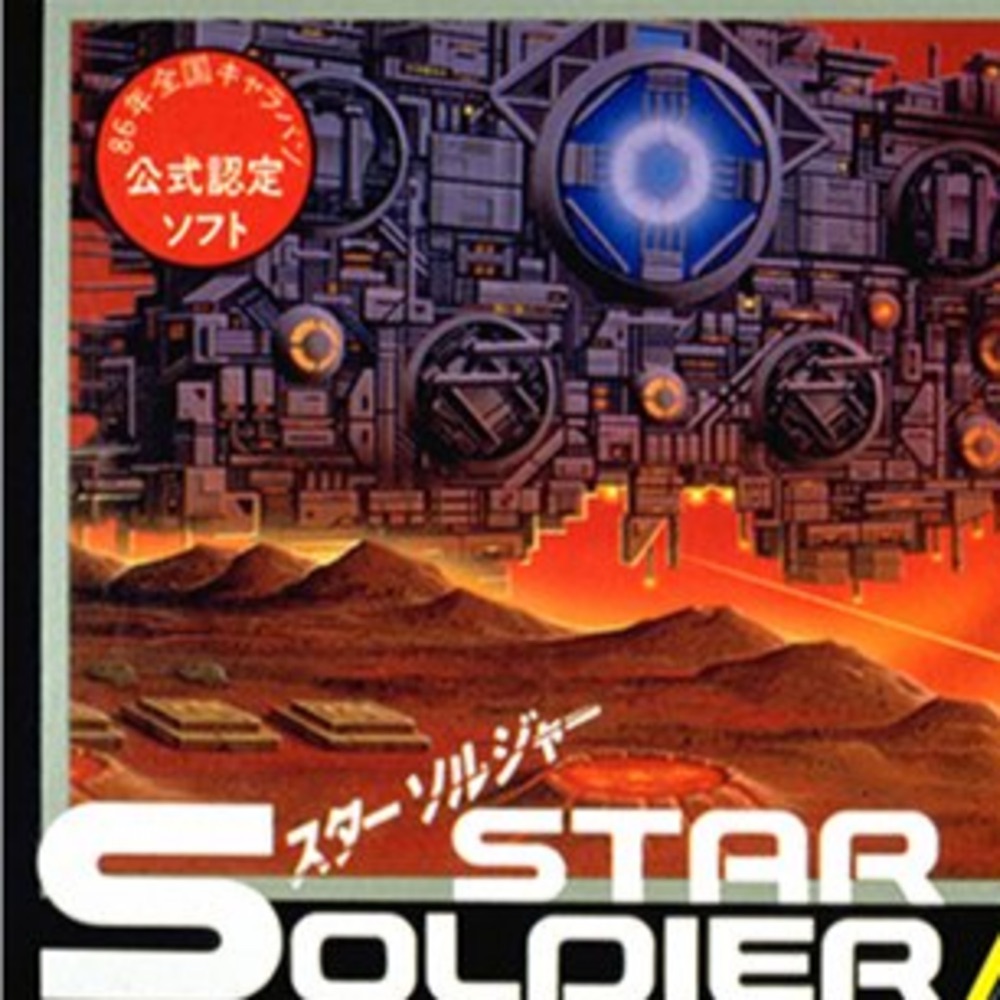
A strange and evil presence is lurking in space. Crushing everything in its path, destroying spaceships full of innocent people, the brutal Starbrain is threatening the entire Galactic Empire.
SHOW NOTES
Star Soldier Longplay
Star Soldier Manual
Star Force Gameplay
Star Force Episode
Takahashi Meijin Interview
Super Star Soldier
Final Soldier
Soldier Blade
Star Parodia
Star Soldier: Vanishing Earth
Star Solider (2003)
Star Soldier R
- A strange and evil presence is lurking in space. Crushing everything in its path, destroying spaceships full of innocent people, the brutal Starbrain is threatening the entire Galactic Empire.
- Introductions
- RETURN OF THE SHMUP
- Overview
- The player pilots the starship "Caesar", travelling through space stations occupied by powerful supercomputers known as "Starbrains" who threaten the galactic empire.
- Vic Viper Gradius
- Remember Star Force...this is like Star Force...with Power Ups
- The player pilots the starship "Caesar", travelling through space stations occupied by powerful supercomputers known as "Starbrains" who threaten the galactic empire.
- Gameplay
- Power-Ups
- Different colors different powers, but they reset if you accidentally collect a different color
- Dodging enemies is one thing, dodging powerups
- Different colors different powers, but they reset if you accidentally collect a different color
- Unique mechanic where you can fly underneath certain parts of the scenery. You can't be killed, but you can't attack either.
- There are only two boss types - a ship called a Star Brain, and an even bigger ship called the Super Star Brain. You need to kill them within a time limit, or you need to restart the level.
- How fair should a shmup be?
- Improvement or not from Star Force
- Power-Ups
- Development
- Insight from Takahashi Meijin a former Hudson Exectuive
- On calling SHMUPS, Dodging Games
- Takahashi: Yeah, it seems strange to just call them all shooting games. They probably want to say that, “oh, its easy to dodge since the hitbox is so small”, but I think that to the average person it looks impossible. And that has led to a great decline in the number of STG players, I think.
- On Scoring
- To make Lazaro appear in Star Soldier you had to be able to tap 16 times in one second. So we had scoring tricks too, but they weren’t essential to the game… it was just “if you want to score high, you’ll need to do this.” You shouldn’t have to pay attention to scoring to enjoy a game. Just surviving and progressing through the stage, enjoying that feeling of “ah, I’m doing good, I’m shooting them all down.” STG doesn’t have to mean aiming for a high score.
- On Players
- That was because the basics were still all there. STGs are the simplest kind of game to make, so its not as if they’ll ever completely vanish, but unfortunately its no longer a genre that the masses care much about. The impression most people have is that this is a genre of games only people with skill can play.
- Sequels and Spinoffs
- Apparently there is one more NES entry in the loosely connected series. Starship Hector in 1990
- Super Star Soldier - TurboGrafx 16 (1990)
- The first official sequel to Star Soldier
- Final Soldier - PC-Engine (1991)
- There are still the usual four weapon capsules, but you can designate different attacks to each of them, creating a total of twelve different weapons.
- Soldier Blade - TurboGrafx 16 (1992)
- You get a little robot buddy that always hangs around to help you out
- Star Parodier - PC Engine Super CD (1992)
- There are three playable ships - the silly version of the usual star fighter, Bomberman, and a gigantic PC Engine (with a copy of Super Star Soldier in the card slot.)
- Star Soldier: Vanishing Earth - N64 (1998)
- Star Soldier goes 3D. The view has changed to an overhead angled perspective
- Star Solider GC, PS2, PSP (2003)
- Hudson developed 3D remakes of its old games on the PlayStation 2 and Gamecube
- Star Soldier R
- Hudson and Konami merge together to make an homage to the beginning of Star Soldier
- EGL
- Next week - Tecmo Baseball
Auto-generated transcript. Each paragraph starts with its timestamp. Speakers are not identified.
Star Soldier, a strange and evil presence is lurking in space, crushing everything in its path, destroying spaceships full of innocent people. The brutal Star Brain is threatening the entire galactic empire. Star Trek, Nostalgia, a chronological exploration of every NES game released in North America. I'm Mike. I'm Sean. I'm Joe. And I'm Sam.
And guys, I need to say that I was listening to a past episode and one time I didn't say chronological, I said chronological or probological. I didn't say it and nobody called me out on it and it's in the episode. I'm not gonna say which one, but I'm a little upset with you guys because I've been saying this for 150 plus episodes and you guys didn't notice? We have a private group chat where we talk about the shit. You say the wrong word all the time. Like you want us to call you out every time you do that? I say the wrong word like every five minutes on this show. You're right. I'm really bad at that. You almost did it right there. You almost started that wrong with us a second ago.
But it also means that I'm not gonna pound you on it. Well, it's 1989 for those of you that are keeping score. We're on episode three of 1989 and when it's that early in the game, you're like, hey, another year. Maybe this one won't be filled with shmups. Nope. Wrong. You are. Star Soldier. Here we are. Guys, Star Soldier is a game that is apparently based off of Star Force, a game that we reviewed a long time ago in 1987,
which Joe gave the opinion that it was so simple, but that was a good thing. Joe, do you think you still stand by that? You know, I was thinking about that earlier when I revisited Star Force. Star Force. I guess I more meant that it was simple enough that it's just like the essence of shmups. So I get shmups in general aren't my thing, but I get why people might just want to play something that's like, oh, here's the base of all shmups.
So, I mean, I think I made sort of I think I made the joke that it was like on the the factory shmup floor. This was the one that didn't get any of the bells and whistles to make them any different. This was just the this was the template shmup. Yeah, the economy model. Yeah, that's I guess that's sort of how I still feel about that game. You know, I went back and revisited it just just for a minute or two. So it is not exciting. It's true that there really is as bare bones as we're describing it here. Yet I this time around, I did find that somewhat satisfying in the sense that it's really fun if you're just trying to play it for like mindless shmup practice of being able to dodge enemies and shoot enemies down and stuff like that.
It it didn't necessarily like change my opinion about the game at all. I just noticed what Joe was talking about this time where it's like, yeah, I mean, it's really simple and it's missing anything that would make it unique. But in a certain way, like it's kind of interesting to have something that just is like this is the genre of the game. You know, like imagine if Super Mario Brothers didn't have anything other than just jumping and platforms to land on. But you'd be like, yeah, you know what? I'm still OK with that. Like it still is in the Super Mario Brothers engine. You know, it's just missing a lot of the interesting stuff.
OK. And in the context of a shmup, I guess the other thing I was thinking was that it's because because there were no power ups, which I do think for me personally is a negative. If you're really good at shmups, you could see it as like a way to just the only way you can get further in this game is purely on skill. So, I mean, I guess that can be seen as a plus depending on what you're looking for. I think that's I think that's I think that's a little too I think it's giving it too much credit. I'm not but we're not here to talk about Star Force.
I don't think that removing features is is how to make a better game by by default. I mean, that's not what what I'm saying. I'm just I don't think you're saying that. But I mean, it sounds like you're describing a utility application instead of a video game.
I would say, though, that to Joe's point there, like it is kind of interesting as a as a skill thing. It's something you would see as a difficulty mode on a better game, you know, like something that just removes all the things that might help a player. Right. You can kind of go into the the debug mode, if you will, and say, like, OK, turn off all power ups, turn up, turn off all lives and stuff like that. Like, I'm just going to go into this and see how long I can survive. Star Force definitely offered that to the player.
That's not very interesting for us. And it's not very interesting, like in modern gaming. But it's kind of neat to see to think of like an arcade game that said, you know, the only thing you have to do is dodge and shoot like that's the whole entire game.
As Sean mentioned, though, we are here to talk about Star Soldier, a game only loosely based on Star Force. I don't want you guys to think that it's like this is a sequel. It's not. It's just this Star Star Force must have sold well. And they were like, how can we get this to be a better, more interesting shmup? And they came up with Star Soldier in this one. The player pilots the starship Caesar traveling through space stations occupied by powerful supercomputers known as Star Brains who threaten the Galactic Empire. A couple of questions here.
First off, does every starship need a name like the Vic Viper in Gradius? And then like here we have Caesar. Would you would you think that like, you know, like, oh, this game has no personality if the ship doesn't have a name? I think we're in like an age of like iconic, iconic spaceships. The Millennium Falcon, you know, I think they want to give it a recognizable name for that reason. Yeah, the Enterprise. And if we're just going to go by like, do do ships have names? I mean, like, I think every boat has a name unless it's like a canoe or something. So it all kind of makes sense. Yeah. Every spaceship has a name, too.
Yeah. But you were never you were never calling yourself Caesar or having any kind of identification with Caesar, right? Like that that's that's just a thing in the manual. And then you completely disregard that information, right? You don't. Oh, yeah. You don't think of Caesar like you think of Mega Man. No, for sure. But it's also like I think that this is another one of the situations where it may as well be a direct sequel. Like there's nothing. It's not like there's a completely different plot line going on here. You're still shooting things in front of you.
So to me, this is a direct sequel. The powerful supercomputers known as Star Brains who threaded in the Galactic Empire. That's straight from the manual there. I thought the Galactic Empire would be considered something that's bad to begin with, like they're evil. And then you have the Star Brains also being evil, taking down another evil. Or is this like a friendly Galactic Empire? Can a Galactic Empire post Star Wars episodes four through six be considered good? I see like you're in the Caesarship and it's the Empire. So I kind of see like Roman Empire connotations in that.
I love that. Yeah. It really just depends on your personal view on whether imperialism is a good or bad thing. Yeah. And the game makes no political comment towards that. It doesn't say whether the Empire is good or bad. It challenges the player to make that distinction. Yeah. Read into our apolitical work here. This is a think piece. I think we can all agree that what they're trying to say is regardless, humans can be good and bad, but computers can only be bad. So supercomputers called Star Brains must be really bad. Most likely. Because they're like trying to be humans. And that's our thing.
Yeah. You can't have a brain. Yeah. Yeah, it was bad enough in Planet of the Apes. I can't imagine it here with supercomputers. So let's get into the meat and potatoes of the game. And that is the whole idea of what a shoot them up is. In my opinion, it's all about, you know, dodging and shooting and how that controls and stuff like that. So just gut reaction. Did you have a good time playing this just in the sense of how it controls and how you feel as Caesar? I mean, the controls are tight. It's pretty fluid. You know, the better you do, the faster you are. So that feeling gets better, the better you play.
Other than that, there really isn't too much more regarding the controls that I can say about it. Yeah. I'll say I had more fun with this than I did with Star Force, where I think they both controlled pretty well. Where Star Force didn't have really any bells and whistles, this added maybe like a bell and a whistle. So that was nice.
Yeah, I think that the movement and the control is pretty good. One thing, I guess I can elaborate a little bit, that I thought was interesting. I don't really know if I like it or not, but it was interesting. Is that there's 3D space in this, in that you can go underneath certain parts of terrain and then resurface above certain parts of terrain. Which I think is cool. It's a cool way to escape enemies for a second.
Yeah, so go further into that, Sam. Because it is a pretty unique mechanic where, you know, if you're on the above part of the terrain, you can attack everything and you can be killed by anything. But if you manage to glide under this surface, your ship will not be visible, but you also can't attack anything and can't be attacked by anything. So it's kind of like this stealth part of a shmup where you have an infinite dodge, but it's not necessarily useful because enemies continue to surround them. What did you think about that in terms of actual gameplay?
Like on paper, it sounds great, but how did it work in the game? Like, I didn't, I wasn't a huge fan of it for the most part. There were some parts that got a little crazy, so it was nice to duck underneath. But I also noticed that during those crazy parts, there's usually one of those power-ups on, or one of those items that clears all the enemies on the screen anyway. Somewhere on the screen that you can't shoot if you're underneath the, you know, the main stage of the game. So it's, I think it's an interesting option that you can, if you know that it only works when you approach things from the bottom.
Like, I don't think you can go to the side underneath something. I think whatever the trigger is. That was going to be my point because I would just randomly do this and I had no idea how I was triggering this event. Like, I totally understand that this is like a risk-reward sort of thing in that if you don't want to take the risk, you're going to give up the reward of those power-ups on the top.
And to use it as like a quick escape, I'm totally for that. I think that's a cool twist to shmups. But I don't know how I was doing it. I don't know if there was like a specific direction that I was going. Because I'm pretty sure that I did go in from the side a couple times. And I don't know if it's like because I wasn't holding a directional button down or if I, or because I was holding a directional button down.
Yeah, I just couldn't get a handle on how it worked. See, it's funny because I felt like it was forced for me. Like, I felt like no matter what, if I went into these little holes that they put on the, you know, what would you even call what you're fighting through, right? Terrain. If you imagine them as terrain, right? There's holes in them. I felt like once I enter that hole, even if I didn't mean to, I was now forced to the, either the bottom or top part of the level.
Which is, which kind of kills the risk reward section of it. Because it'd be really cool if this was actually mapped to an input like, say, the B button. Yeah, because they're already duplicating the shoot button. So they kind of just bend something like, like if you hold this down, you will go under. And then you get to choose actually. Like, okay, I want to be away from all of this. Knowing that when I come back up, there will be possibly more enemies or I won't be able to come out of a good spot. Like, I'll come out and I'll be right in the middle of all the action. But being able to choose that, I think, would have been more meaningful.
Because by the fact that it's forced, there's a lot of times where I actually didn't want to be underground. And it left me worse off. Not underground, but like on the lower half of the stage. It left me worse off because when I come back up, you know. You're surrounded. There's a lot more happening on screen. Yeah. You're surrounded and you're more likely to die. Which in a game like this, with not that many power-ups, but you know, there's power-ups, is kind of devastating because you might have a great thing going and then you don't.
Yeah. So I did try and test what the trigger was just by like playing the same part of the first level over and over again. And I'm still not certain, but it seems to me like there's literally just certain points of these surfaces that you go under and certain points that you go over every time that you hit those points. Like almost as if the surfaces are slanted or like some parts of the surfaces are higher, but they're designed in a way that when looking at them from the angle that we were looking at them, you can't tell. So I thought that was kind of weird because there's no indication as to what parts you're behind and which parts you're in front of until you fly into them.
I don't know. It was a little strange. But also to the point that you were making, Mike, about coming out from underneath and being surrounded, I agree that that was not ideal. But I noticed that when I had the full power up where you're firing in all directions, rapid fire in all directions, it was a little satisfying of like hiding underneath and coming out and be like, aha! And all of a sudden you're an explosion of firepower in all directions. But if you don't have all those, then it's definitely troublesome. And I think we've talked about in a previous Shmup episode thinking like, you know, it is kind of weird that you're on the same exact plane level as every single enemy. Like we were joking about that, that obviously it's a 2D game.
And, you know, well, if there was some depth to it, that would be kind of cool because it's weird. Oh, it was 1943 we were talking about how like it's so strange that you're all the planes are exactly where you need to line up with. But now seeing it in practice, I don't know if I'd want like five different levels of Z-axis on a two-dimensional game where I have to like constantly shift up and down between these different platforms of the terrain to take down all the enemies. Especially one that auto-scrolls. I think that even when we were talking about it then, like I think in a 2D game like this, that would never have worked. What was the name of the space sim that we played? Star Voyager.
I guess that would be answering the question of what would that look like on the NES. Yeah. And it looked chaotic. I just played that accidentally because I thought that, Mike, you told us that this one is going to be related to Star Force and I misremembered what you told us as Star Voyager. So I played Star Voyager and then realized I was supposed to be playing Star Force. This is not like Star Voyager. I don't know why I'm going on this weird aside.
Star approach.
Star approach. shot, which is like kind of funny because it reminds me how often I just hang in the back of the screen, which is not like a good thing for a shmup. Like you shouldn't really hang out in the back of the screen, especially if you have a shot that fires from behind because then you're not using your full power.
But we'll get into that in a second. I think that's a different question there. To continue on with the power-ups, then there's the ultimate weapon that Joe was talking about where you shoot in like all, what is it, eight directions or six? Okay, it's eight. You shoot in all those directions and that feels really good and really powerful.
I just can't help but feel like the fact that the power-up is just like that S bar that just kind of floats around and you collect it and then it just continues to advance up as you advance up. I couldn't help but feel like that wasn't really that exciting and removed the choice aspect of power-ups that we liked so much about Gradius and Lifeforce. I'm not saying they had to make it a choice selection thing where you actually have to go into a menu or hit the select button to choose the current power-up, but it did feel
less exciting that it was all just so linear and you just have to collect these power-ups and they just gradually make you the next natural stage of stronger. What did you think, Sean? Sean? Because it's just like more guns, like the only direction you can go in terms of how powerful you get. I know you can also be a little faster, but that comes with more guns.
If you have a turbo button, that makes this entire game trivial. It just, because it's just like always spewing out bullets. There's no, there's no cool down. Uh, it doesn't, uh, there's no, there's no reason not to. And if there was a power-up that maybe changed the, changed in a more, uh, in a more meaningful way, the, the way that you are offensively playing the game, it would make it so that like, oh, just because I have turbo that makes, that makes this game so much easier. Uh, I, I think that that was sort of a problem for it. I think it's just lame also. What makes it lame, Sam?
Well, it's just, we've seen other games that show really interesting kinds of power-ups like, um, shoot, what's the one that's not Gradius that we just, that we liked more than Gradius? Lifeforce. Lifeforce that we just played, yes. Thank you. Um, they have the laser beam, they have like the wave beam, they have all these different interesting ways of making thoughtful gameplay, which I think is what's missing from this, where it's just, all right, now it's just easier instead of, like, which, which one do you think is best for this situation right now? You don't get that at all.
Exactly. And I think that goes in line with also the fact that most enemies are one hit kills, and then there's like, you know, the cliche, like couple of, uh, bigger enemies that need a couple more hits, but there's also only one boss in the game too, so there's never any thought about, um, you know, which power-up you need, you just hope you have the most advanced set at all times, because it's always going to help you to, to have more coverage when you're shooting. So, I think like, it was nice to have power-ups compared to Starforce, but we're not comparing this game to just Starforce, we're comparing it to all the NES shmups we've played, and by now we've gotten pretty used to some pretty like interesting, uh, unique, uh, shmup power-ups
that it feels like this one is actually, uh, like two steps backwards because, you know, that whole like one step forward, two steps back, because yes, it's better than Starforce, but it's not doing a lot in terms of power-ups on NES games. You know, the, the funny thing I just kind of realized is, is that like the biggest criticism of Starforce is that it's just sort of like a, a basic, uh, like template of a shmup, and it's almost like they said, oh, you want like a progressive, uh, you want like a progression of power-ups? Well, here's the most basic progression of power-ups we can possibly think of. And it's like they, they made almost a similar mistake again.
No, it's the same thing. They're definitely like two or three years behind everybody else making shmups right now. And the, I never thought that we would become authorities on shmups, uh, but now we are the connoisseurs and, uh, whether or not, uh, whether we not, we, we enjoy playing them or not, uh, we, we can, we can taste the difference between whether this shmup has an, has an oaky flavor to it or not. And these are just, you know, they would, they would be very badly gridded wines. It's certainly no scoon. It's no scoon.
Which again, like is, it is an interesting point because scoon actually took you to an interesting location of a shmup, right? Like it actually made a submarine style shmup. I'm down with that. I'm, I'm not so on board with seeing space again. Only nothing is that interesting. Yeah. Also, can we talk about the bosses?
Yeah. Let's talk about those supercomputer bosses, uh, star brain and superstar brain. Uh, they have, uh, one of them looks like an Nvidia GPU card. Uh, did anybody get that feel? Yeah, I guess so. Super star brain looked like that to me. And the only thing I want to, yeah, the only thing I want to mention is with the, with the star brain characters is that they only pop up at the end of the levels. They hype it up as like a big boss, like prepare for star brain or whatever.
And then there's like a time limit to the boss where it's like, oh, if you don't beat this thing in time, you get warped back like slowly to the beginning of the level. And I wish it was actually cool. And you saw all the damage you had done, but clearly no NES game is going to show you that. So instead they just warp you back to the beginning and you have to do the whole stage all over again, just for another shot at taking down star brain. It's not like you took a, you know, like you took one third of his health bar. Now you got to go back for the other two thirds. It's like, no, you just have to restart the level because you didn't do it in time. Sam, what did you think of the, the supercomputer star brain? I thought it was lame.
I thought that it was just, I mean, what, he had one little bubble gun that kind of wobbles a little bit and then a just single bullet that comes out and it's the same fight every time. And all you have to do is just shoot it in the middle and then that's how you beat it. And with superstar brain, it has cannons that you can take out, but it's the same thing. You just have to shoot it in the middle and there's not really. Wait, I didn't have to take out those little, like the, the, the fans on the graphics card before I took out the big fan. I wasn't sure. I, I, you do have to do that. You do. Okay. Yeah.
Um, but it doesn't matter. Like I hear what you're saying. It's, they missed the moment. They missed the memo because Gradius has that whole like shoot the core thing, which has become a synonymous with a lot of these, uh, shoot them ups, but they also gave you a real boss before that happens. You know, like the shoot the core thing is just like a funny, fun thing at the end where you have to like be precision and, and dodge at the same time.
This isn't so much about precision and dodging, because if I remember correctly, star brain will actually like lock you out of the center if you're not going for the center. So you kind of have to be chilling where his hip box is if you want to do any kind of damage on him. So you have to kind of play ball. There is, there, there is no dodging. There's just like being conservative. Yeah. Which is so much fun.
Um, it's not, it's not what I look forward to in a game. I, especially with these shmups, you know, like half the skill is dodging, but for the boss fights, right? For them to just be a larger, uh, sandbag like enemy where it's just, okay, more shots to the center, but it pretty much, uh, you know, only shoots straight on and only has two, uh, attacks.
That's no different from like a real and a normal enemy in this game. I saw a real enemy. No different from a normal enemy in this game. So I'm not quite sure what made star brain, the, uh, the threatening force that they expected him to be based on the manual in the back of the box. Like I didn't get that impression when I saw him on the screen. Yeah. I actually felt like when he got to the boss, it was a little bit of a break from the level. I mean, not that the levels were ridiculously hard either, but, but the, the brain felt easier than the level for like at least the, uh, yeah, that's the breather. The boss is the breather.
But I, but I hated that it didn't even, maybe it was in the manual, but you had no indication that there was a time limit. So I'm the first one. I'm just like taking my time, you know, trying to get the target, but trying to dodge and everything, not knowing that I'm being timed. And then I just get meticulously sent back to the beginning of the level. They make me watch myself get sent all the way back to the beginning of the level.
It does mention it in the manual, but does not tell you like how much time you have. There's no indication that you're running out of time. So, yeah. And then once you know, I mean, granted, I only, I only played like, I think like 10 stages, uh, or maybe set it, maybe eight stages. But, um, once you know the time limit, I never had any problem with the time limit. It's usually pretty easy to defeat these things, uh, and under whatever the limit is.
Well, we're talking about like advancements from Starforce. And I don't know if when you guys were replaying this, you got to the boss battles in Starforce, but they're hilarious. Like I, I actually completely wiped this from my brain, but they're like three second boss fights where if, as long as you have your, your dual weapon, uh, if you shoot on that thing and, and, uh, you know, there's like turret shooting at you, but the actual boss does not shoot at you, you can take that thing down in two to three seconds. And I thought that was really funny because I had just finished my Star Soldier playthrough
and was like, oh, let me see what Starforce is all about. And I was like, wow, it was even easier then. So I don't know if like, I don't know if the complaint with Star Soldiers is that it's too easy. I think the, the complaint is that there's just not really a lot going on in this game. Is that, is that what you guys are saying? It's simple. That's pretty much it. It's too simple. Not necessarily too easy.
Yeah. In fact, I thought that the, the, it was, it was a nice level of manageable in, in, during the levels itself of like when projectiles are coming at you, at least for me, maybe it's just because I'm not good at these games, but I mean, I know a lot of shmups, sometimes I'm just overwhelmed. There's too many things. I can't keep my eye on everything here. It felt like not super easy, but not like, not impossible at any points.
So that was the one thing like difficulty I thought was fine. It was the simplicity that got boring and repetitive. I completely agree with that because I think this is some of the best sets of like enemy patterns we've seen in terms of fairness where nope, there's not like this random smorgasbord of many different characters on the screen, many different enemies on the screen that will just go zigzagging every which way and you'll be in like a bullet hell.
That doesn't really exist in this game, but there are some interesting patterns where they come in from the sides and then they zigzag across or they make a circle. Yeah, I'll grant them that. Yeah. You know, I think, yeah, but, but again, like in a way, because it's so controlled, right? And because it's so like, it's almost like Galaga, you know, where like they all come out as a fleet. Because it's like that, it actually does make the game a fair bit easier than the shmups were used to on the system. Yeah, I will say that the, the enemy, I did feel like there was a, there was a good, I'm not sure if this is what you were saying.
Maybe I, maybe I missed it, but the, I did think that there was a good amount of enemy variety, like, like that smorgasbord. I feel like it existed, but it sounds like you were saying they didn't, they didn't come out all at once, but there was a lot. Like there, there are enough like different patterns. I mean, like the enemies themselves, like the designs are just kind of different oblong shapes. So I don't quite care for those designs, but I, like the patterns that they come out in, and I think a couple of them, they take more than one hit. So like, yeah, there, there is some variety there. I think, so I think you guys are saying the same thing.
Yeah. Because I specifically remember one that, that stood out to me where they, I'm trying to remember, it's like they come at you in like a, and they follow you, they track you, but then once you shoot them, they become like static obstacles that just move back and forth horizontally. So it's like, you can't kill them. There'll be obstacles, but you want to shoot them into this easier state to avoid. I thought that was just an interesting, unique thing. I had a question about one of the enemies, not enemies, but one of the destructible scenery, I guess. Sure. There's two eyes at the end of every level.
What's up with them? Does anything happen if you get both of them or? Apparently, if you kill them both at the same time, you get 80,000 points. That's the only thing about them. Wow. It's a point thing, you know, and that's like how most of these games were built anyway. Yeah. Believe it or not, like the arcade versions of these games were something that was designed for like the Japanese arcades where kids would go after school and there'd be like a whole selection of these different shmups, you know, in cabinets and stuff like that. And your whole goal for that, you know, until cram school essentially was just to beat the new high score and make your claim.
So I think like this kind of repetitiveness in a way is really exciting for that group of people. But we're not like, even if we were the biggest shmup fans, we still have to review these games based on like their actual gameplay value to the NES, not just to like this one particular genre and this like high score mechanic of it. So I could understand why sometimes these things take off in the sense of, oh, well, this one actually has great patterns or this one has really cool power ups that help you get through things. It's like, I can see how that's big for that scene, but it's not like necessarily a big revelation for the actual game in the scope of people who are buying this for the NES as like just to play alongside their other games.
Which will bring me to my final question for you guys based on this game. And it's actually just for all shmups in general. How fair does this genre need to be for you personally? Like, is it okay that these games are hard? Or do you think that there should be a balance in the sense that the games should be beatable at all times? Like they should play test it so that everybody could theoretically make it to the end of a shmup. Joe, what do you think?
Well, if we're talking just for me personally, I mean, I guess it depends on what you mean by fair. But I think pretty darn fair is what I require. I mean, the kind of thing where too many projectiles are coming at you that like you get very easily trapped into situations where you just can't get out because there's no spot and you have to like luck your way through things like that.
I don't find, you know, acceptable. But, and you know, part of this is also like just for me, I want a shmup to be a little easier than I'm sure someone who's a seasoned shmup vet would disagree and would want something that's like a high challenge. But as far as like fairness, I do, I do like always want them to have paid really close attention to enemy placement or just patterns to make sure that it's always like doable.
I guess just to rephrase my question for you, Joe, which I think you gave a fine answer to should this genre, not what it currently is, but should this genre be strictly a contest of skill or should they be designed like how most video games are designed in the sense of like there's a, there's a set amount of stages and there's a, there's a, there's a logical path to beating them as long as you play appropriately. Uh, appropriately, you know, like I would say that Super Mario Brothers is not a game that everybody gets to world eight for and beats Bowser. Right. But it's totally possible. And I would say that a good amount of NES gamers have done that, but Nintendo didn't make that an easy game per se. So I guess that's what I mean by like fairness.
Okay. Well, are you looking for that when you, when you play these games or is it, or do you recognize it as just a contest of skill? With that context to the question, I, I, I do think that maybe, I do think that the essence of a shmup is supposed to be like to test your skill. I think that that's what they want. It's again, it's not for me, but like, I think that that's what, that's what makes a shmup a shmup most of the time. Uh, so I, I do think that that's like, that's kind of an important element of shmups.
Yeah. I, I think that, um, I think it's sort of asking the same question, like with this either or thing, I mean, it's, if you need to, you need to display your skill in order to do this. But if you, if you try and like learn the game, you, you will eventually do that. Like anybody can beat this game. And I, I guess like what, uh, a part of your question that I can answer is, uh, whether I prefer like brute force memorization and, and Twitch reflexes or whether I, I prefer like systems mastery.
And if, if I, if I phrase your question in that way, I would prefer systems mastery where like you need to practice the game and understand like how you play the game with the most base level, but I don't think that, uh, it would be best for it to just keep exponentially,
uh, getting like faster and busier. Uh, because I just think that that's kind of a lazy way to do difficulty. Is that sort of in the same realm of what? I think that's a very thoughtful response. Yeah. I like that. Sam, any, any other things to add? I'm kind of in the same position as Joe, where this isn't really my genre of choice for games. So I would like it.
I would like them in general just to be a little bit more beginner friendly just for my own sake. But I also understand that these games specifically are those kinds of games where you need to get used to how it plays and you need to get the reflexes and having all that is part of the game. And I agree with what Sean said that it should be systems based where once you really know the game inside and out, not just where enemies are going to be, but how to interact with the, the game itself, like the world in the game. Yeah. I think that is a good place for shmups to be.
Yeah. That's awesome. I agree. I agree with that as well. I think you guys had some great answers for a very vague question. And to be fair, there was no right answer. I think some people would tell you that, you know, video games peaked in the early 80s with these arcade formats and it was all about high scores and that skill is really like the most fun part. I mean, you see that even in speed running today, right? That is all about skill.
Like there's no, there's no room for mistakes or errors and stuff like that. And I do think, Sam, you were talking about Cadence of Hyrule last week, I think. Right. And that's like, that's another game where, you know, you can't really make a ton of mistakes and it is, it punishes you immediately for, for making mistakes, but you get tries over and over again in the same sense. Like shmups are like that, you know, they, they are not necessarily going to be a designed to be beaten. They're designed to see how far you can go.
Yeah. So I'm going to add some development insight from Takahashi Majin, a former Hudson Soft executive and Hudson Software, the makers of this game. He actually has some pretty interesting quotes here, Sean. So not the, yeah, not the normal stuff. He doesn't shy away from it because this is a guy who pretty much always was around the shmup scene, which in Japan, they call them STGs. I'm not quite sure what that stands for. Hmm. Um, but shooting themed games, who knows? Uh, that sounds about as good as it can be. So, right. So they, they call it STGs over there, but he's been around that his whole life. And when he retired, he was kind of like, yeah, these STGs nowadays suck. It's all about the older stuff.
And an interviewer pressed him about some of these questions. So here's what he had to say. On calling shmups dodging games, he says, yeah, it seems strange to just call them all shooting games. They probably want to say that, oh, it's easy to dodge since the hitbox is so small. But I think that to the average person, it looks impossible. And that has led to a great decline in the number of STG players.
Would you agree with that sentiment that, uh, you know, like if you look at modern shmups, I don't know if any of you guys have seen like Ikaruga or stuff like that. Would you, would you like not even try those games because they are just bullet hells that look ridiculous and, and yes, you have tons of power ups and ammunition and, uh, barriers at your fingertips, but so do the enemies. No, I prefer to play those games because they seem to have more going on than what, what, what Hudson Soft has showed us these, in these couple entries.
And here's his thought on scoring. Uh, he says, to make Lazaro, who's in Star Soldier, appear, you had to be able to tap 16 times in one second. So we had scoring tricks too, but they weren't essential to the game. It was just, if you want to score high, you'll need to do this. But you shouldn't have to pay attention to scoring to enjoy a game. Just surviving and progressing through the stage, enjoying that feeling of, ah, I'm doing good. I'm shooting them all down. STG doesn't have to mean aiming for a high score. Kind of goes against what I was talking about just a few minutes ago, right? No, I mean, I, I agree with, with that assessment, uh, because we're, we're a very anti-scoring,
uh, crowd here. Um, so no, I mean, so I, I, I very much disagree with his first point, but I agree with that one. Yeah, it makes sense, actually. I mean, I never really thought about it from like the perspective of the developer because it does seem like most of these developers focus, put so much emphasis on scoring, including, you know, in this game. But, uh, but not, yeah, when I think about it, you're right.
You can, you can do, you can totally just do what we are doing. And I'm sure they had that in mind of just ignoring the score, but then, you know, certain things like Sam, there's something you were talking about earlier. Oh, the eyes like won't mean anything to us because it doesn't matter if you shoot them because he cares about the points. And then one more from, uh, Takahashi, he says on players here, that was because the basics were all still there.
STGs are the simplest kind of games to make. So it's not as if they'll ever completely vanish, but unfortunately it's not as if they'll it's no longer a genre that the masses care much about. The impression most people have is that this is a genre of games only people with skills can play. I, that, that, that's, I don't think he's wrong in that assessment. Well, I mean, I guess the, the, the similarities between his opinion on this, uh, on this comment as opposed to his first one.
Um, he's saying that like, you know, the whole genre is sort of fallen by the wayside here. And, uh, he is right in that assessment. It's, it's a very, uh, niche thing. Um, but I, I, I think he's, he's sort of acting like one of those guys that like, oh, if they just, if they were all just purists, uh, everything would, would still be in the heyday.
And I don't think that just because a genre has fallen into, uh, kind of the, uh, into, into more of like a niche market like that doesn't mean that there are any worse. I mean, just because they got more, the people that are interested in them are really interested in them now. Um, I, I guess I've sort of lost my point, but. Well, no, I hear what you're saying though.
To, to, to maybe pick up at least where I think, uh, you were, you might've been going with that. I feel like if anything, that could make these games better because it allows the developers to focus on what those people want. So, you know, instead of focusing on what's everybody going to love, what's going to be appealed to a broad audience, like they can get very specific about the things that people who play shmups like, and they can continue to build on those things.
That's what Pokemon fans have been wanting for a long time is like, stop appealing to the broad player base. And just like, I play this Pokemon game for 20 years. Give me some respect.
But yeah, that's, that's, I think what you were getting at as well, Sean. Um, I don't know if you quite finished the thought there, but like, it's strange that he's asking for games to go back to like star soldier levels of shoot them up where it's like, you know, things used to be a little more simple. It used to be more just about shooting the enemies and, and dodging. And now they've added all this flashiness and it's become really hardcore. And there's too many power ups and too many different types of enemies and, and too many stages. It sounds very crotchety to me. Right. It's like, I don't know if I'd want to go back to this. Yeah. As I don't know, the games are too fun now.
Yeah. We got all this cool, interesting stuff in them. It'd be like if people told, uh, Naughty Dog, like stay away from the last of us and go back to Crash Bandicoot. Right? Yeah. Like. Mm-hmm.
All right. Sequels and spinoffs time for star soldier. You know, apparently there is like an additional NES game in this loosely connected now trilogy of games where we had star force. Then we have star soldier right now. Now, apparently in 1990, we're going to get Starship Hector, which sounds ridiculous as a title, but is going to be part of the star trilogy of NES games. So as long as it has star in the title, it's technically part of this, I suppose. Yeah. We'll get Star Wars eventually.
Dan? Yeah. It's just weird, right? Starship Hector is like, it's just not really like a climactic name or exciting name. Like, I feel like only people named Hector would buy that. I'm looking at the like title screen of it right now and it's just a giant like epic like block text of just says Hector. Starship Travis. Which is great. Yeah. Starship Raul.
Everybody got a personalized copy. It's like when Coke did that, like share a Coke with Sean, right? It's like Starship Sean coming to you if you buy it. I'd love that. Yeah. You go into like the gift shop and you see like that shelf full of like all the most common names that all Starship so-and-so. Yeah. Well, and yeah, gift shop for Busch Gardens and Disneyland and all that shit. Keep an eye out for Starship Bort.
Bort? Bort. Yeah. Bort. Bort's like a very popular name. I love Bort. Yeah. All right. So you guys know my whole process of like this year, 1989 is different. I'm actually going to play all the sequels and spinoffs whenever possible for these games. So I went through the Star Soldier line and also played a few other ones, mostly on the TurboGrafx-16. But this was actually a really exciting series that got better with almost every single entry. So I'd love to talk about it if you'll humor me. Please. All right.
After Star Soldier, we got Super Star Soldier on the TurboGrafx-16 in 1990, the first official sequel to Star Soldier. This one has a weird mechanic where the power-ups still just kind of float on screen and you can collect them and they just progress the same linear fashion. But now there's different colors. So there's red power-ups, green power-ups, and blue power-ups. And if you're on the red chain, right, like let's say you've collected three reds, if you collect a blue even by accident, now you get reset all the way back to the beginning of blue's line of power-ups. So you also have to, besides dodging enemies, you have to dodge power-ups in Super Star Soldier.
Okay. I like that. That sounds cool. Then Final Soldier, which only came out in Japan, but it's a shmup, so I didn't need to know any Japanese to play the game. Uh, this one I really liked a lot and there's still the usual like four weapons, uh, four power-ups from Super Star Soldier. But this time you can actually designate which attacks you want to use in the menus section before you start the game. So you actually choose your loadout to be like, okay, well blue power-ups are this type of power-up. Green power-ups are this type of power-up. And so there's actually 12 different weapons that you can choose to your disposal for almost like an infinite amount of combos.
And I really enjoyed this one. It's very flashy. It's probably stuff that Takahashi either did work on so he's proud of it or was against it. Yeah. You know? Like, yeah, it's like who can tell based on this interview. It sounds like they kind of found their way. But I really liked, uh, Final Soldier. So if anybody's into the PC engine scene and is looking for a great shmup, Final Soldier is going to get my recommendation.
And then Soldier Blade, uh, came out for, back to US in 1992 for the TurboGrafx-16. And in this one, it's pretty much similar to Super Star Soldier, except for now you get a little robot buddy who's always there. He just hangs out with you. He helps take care of business. He, he can, he can unleash some power-ups. Pretty cool. Pretty cool guy. Okay. I don't really know what that means, but, uh, I'll, I'll play it myself, I guess. Imagine an indestructible, imagine an indestructible ship, right? He takes care of business. That also just hangs out with you. Yeah. Like, you shoot, but he also does stuff. Okay. All right. Now I get that.
I think that one also had a, uh, a thing where, like, that chain of colored power-ups changes. So now, like, as you collect them, the, the three most recent ones that you've collected are hanging out at, like, the bottom of the screen. Think of that as, like, part of your UI. Yeah. And you can actually press, um, the, let's say, like, the B button, whatever that is on a TurboGrafx-16.
You can press that and it releases, like, an ultimate attack, but you now give up that power-up in exchange. Okay. So I thought that was, like, a neat balance of, like, you might have, like, a level three power-up, but you have, like, a really tough enemy in front of you, so you have to sacrifice your level three power-up for a stronger one-shot attack. That's cool. Yeah. These sound, uh, these sound good on paper, Mike.
Thank you. Star Parodier, uh, for the PC Engine Super CD. I was not able to play because this is a Japanese-only hardware thing where it's disc-based. Think, like, Sega CD, but for the TurboGrafx, but only in Japan. And this is where our boy Bomberman comes back into play. You can play as Bomberman as a ship in a, in a star Parodier, uh, hilarious, like, style shmup. Like, it's really funny. It reminds me of Stinger with its graphics, uh, Crazy Enemies, and Bomberman's in it, so why not? Bomberman is the ship?
Bomberman is one of the ships, the other one is Caesar, and the third one is just a gigantic version of the PC Engine CD. Wow. Okay. With a copy of Superstar Soldier in the card slot. I can't visualize this at all, but it sounds like fun. We already have the graphics card in this one, so. Yeah. Right. I think it's nice that they included, like, a copy of Superstar Soldier, though, in their, in their ship version of their gigantic PC Engine.
Somehow, it got onto the N64 and became, like, maybe the only shmup on that system, if you don't think, like, I don't think of Star Fox 64 as a shmup for some reason. I think of that as just, like, a great game. That's just, like, exists in its own, like. Yeah. It needs to be two-dimensional. Yeah, it needs to be two-dimensional. Yeah, but it, what do they call it? Rail shooters, right? That's what they are. Yeah. What about Star Wars Rogue Squadron? That's. It's gotta be a rail shooter, right? It's not on rails. Oh, shoot. Then it's not a shmup. Nope. It's not a shmup then either, though. It's a 3D adventure game.
No, that's not true, because 3D adventure games would be like. It's an arcade flight sim. There you go. I like that. Yeah. Anyway, Star Soldier Vanishing Earth came to the N64. Star Soldier finally goes 3D. The view has changed to an overhead angle perspective, and I'm not a fan of it at all. I thought it was kind of weird. You know, like most N64 games. Look at those things now. They're pretty weird looking. Same thing with PlayStation 1 games. We're not getting into this conversation again.
Star Soldier then got named Star Soldier again. They went back to basics, and it came out on GameCube, PS2, and PSP in 2003. They developed a 3D remake of the original Star Soldier for GameCube and all that jazz. So it's just that in 2.5D, if you will, or 3D, however you want to imagine it. Star Soldier R, Hudson and Konami. Finally, the two shmup giants merged together to make an homage to the beginning of Star Soldier, what Star Soldier R. I don't even know when this came out, but it did, and nobody cared.
No fanfare whatsoever for this one. So this must be after Konami started making pachinko machines. Makes sense. So would you try Star Soldier now, knowing that it evolves into this big, grand series? But we already tried it. No, no, no. Would you try the rest of it? I might pick one of them. Dabble? Yeah, dabble. I'm not going to play all of them.
Unless I need to because of the podcast. No, no, no. It's fine. Actually, it's a good point that you mentioned that because we don't care at all about these other games, actually. We only care about one game, and it's the game that's the name of the episode, and that's Star Soldier. And we care about it so much that we're actually going to review it right now on a little thing we call the Essential Games List.
And it's time for the Essential Games List. As I just mentioned five seconds ago, it's just a short little jingle. Who knows? Maybe Sam will give us like a new version of the Essential Games List sometime. You know, he makes all the music that you hear on this show, except for the ones that are from the video game. But like, come on, you know the difference. Like, you can tell the difference from which ones because Sam's are just higher fidelity.
So, Sam, since we're putting you on the spotlight here, why don't you also tell us your thoughts on Star Soldier? And maybe, I don't even remember, was there music in this game? Did it suck? Did that thing? I don't remember any music. There is music. There is music, and it doesn't suck, but it's also not, you know, memorable. And I think that that is a great analogy for the rest of the game. I think that this game is a shmup on the NES.
And that's about it. It's really bare bones. It is successful in being a very bare bones shmup, I guess. Like, it's not like it's difficult to control or unfair in any kind of way. But, I mean, I guess the brain stuff at the end of each level, sending you back to the beginning is kind of unfair. But that's, I guess, an opinion.
But it doesn't really bring anything interesting to the table. It's just a very, very standard shmup. And so, I would say not essential. Not essential. You heard it here first. Sam, I do like the idea, though, that we have to also figure out if these games belong in their own genres. Like, you said it's a shmup, so it does make that category.
But, like, imagine if next week with Tecmo Baseball, we have to be like... Not a shmup. Yeah, not a baseball game. Like, you have to actually be like, turns out, not a baseball game. It's more of a shmup. That'd be interesting. Yeah, more of a shmup. That would be interesting, a shmup baseball game. We're not talking about that, though. Joe, please tell me your thoughts on whether Star Soldier is an essential game or not.
I'm not going to say much because I really don't think that there is a better description of this game than... I forgot the description. Oh, my God. Than... What did you say?
It's a shmup on the NES. It's a shmup. It's not... No, it doesn't suck, but it's not memorable. Sorry, I don't know why I forgot that. I was thinking about it ever since it was said. Yes, that is what I said about the music. I think that is the perfect... That is the perfect explanation, though. I mean, I don't think it gets any better than that. It's just... It's a middle-of-the-road, at best, shmup. So, no, not essential. Shmup on the NES, by the way. If we're talking shmups altogether, I'm sure it's much lower than middle-of-the-road.
Sean, go ahead. Yeah, I'm just going to continue to rephrase the basic conceit of what we've been saying. It is completely serviceable. It is functional. But it is so goddamn boring. I could have kept playing this game, but I didn't. It is not essential. What a beautiful phrase there at the end. I could have kept playing this game, but I didn't. I think we've only run into that kind of scenario a few times on this show. Oftentimes, we aren't interested enough to continue playing. But never have we said, like, I could keep going, but nothing... I'm guaranteeing that nothing else is going to happen. Kind of like the Lunar Pool. Right. Nothing's stopping me from playing more Lunar Pool except for myself.
And I think that's where I kind of land on my vote for Star Soldier here is that I'm pretty sure when I told you guys, like, hey, this is loosely connected to Star Force, no one knew what I was talking about. Yeah, I completely forgot about that. You had to go back and play Star Force to remember it. You might have remembered that it's a shmup because you knew that this one was a shmup, but I doubt that you remembered, like, the ins and outs of Star Force. And that's how it's going to wind up for Star Soldier here. This is a game that in 30 to 40 episodes, we will have a tough time name dropping this one on the show.
Which is scary because Sam had a tough time name dropping Life Force, the best shmup on the system so far in this very episode. Life Force, Star Force, you know, it's tricky.
All I'll say is it's no scoon. It's no scoon. That's the best scoop. That will be in the Sunday paper. Sam Smith, no scoon. Read it big. Anyway, as I mentioned earlier in the Essential Games list, next week is Tecmo Baseball. Guys, did you even know they made more than Tecmo Bowl? I mean, I knew they made more than Tecmo Bowl, but not baseball. Well, we'll be looking forward to playing it, and maybe, who knows, this will be the fifth baseball game we play on this system. Let's fucking go. And Sean's just really like, where's the football at? Yeah, where's the football? We've only had one. I know, I want more. But I heard a rumor that Tecmo's going to make a football game for you, maybe even two.
So that could be good or bad. I don't know. We'll see. Joe, thoughts on baseball? I like baseball. Baseball is a good sport. But is it haunted? I can neither confirm nor deny. Sam? Baseball? Haunted? Angels in the outfield? Yeah, it's a given. It's haunted on more than one occasion. Great. I mean, if you build it, they will come. That's like a ghost line, if I've ever heard one. Anyway, the show is Nostalgia. You can talk to us at NostalgiaCast on Twitter. I'm Michael Esposito. You can find me at EspositoFilm on Twitter. And we'll be talking to you next week all about Tecmo Baseball, maybe just in time for spring training if they haven't moved it or canceled it. But who knows? We'll see. That's for sure.