431 · Zombie Nation
New to SHMUPs? Read our guide: How To Enjoy SHMUPs →
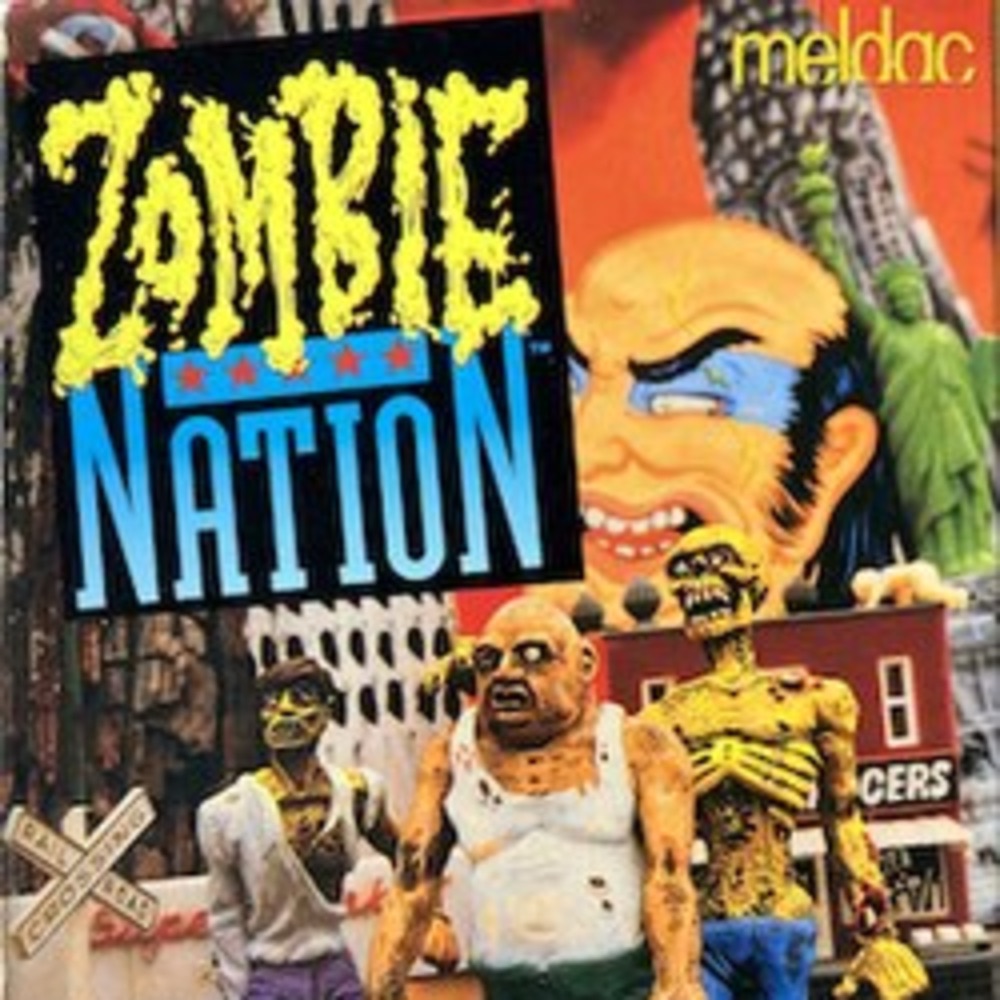
Zombie Nation is a 1990 shoot 'em up game developed by KAZe and published by Meldac.
A meteorite lands in the Nevada desert, turns out to be an alien called Darkseed, and zombifies the entire United States with magnetic rays. The only hope is a giant, floating, disembodied samurai head named Namakubi. We expected a beat-em-up, or something like Zombies Ate My Neighbors. We got a shmup, and the weirdest one we have played. Mike, Sean and Joe were all here.
What stands out
- The head. You fire from your eyes across the screen and flame from your mouth downward, so you can hit what is level with you and what is below. Namakubi looks angry, freshly ripped off, with a neck and stubble. The Japanese original used a floating Tengu mask, so the head was a deliberate choice for the American release.
- Nine heads for a life bar. Each one chomps, then turns to a skull when hit. We liked the personality, though we could not tell what takes one away, and some things drain several at once. Because you are a giant head, the hitbox is the other problem.
- The bosses. The Statue of Liberty is first, with snake hair and a torch that fires a beam. The second boss may be Paul Bunyan, according to people online, since the manual only says "legendary figure." Then a battleship, then Darkseed himself, a gray alien lying in a black void that does not react while you shoot him. It was genuinely unsettling.
- Falling people. Destroy buildings and screaming humans flip out and slowly drift down. Collect them to power up. We wondered who is a zombie and who is not.
What drags it down
- Hard to read. Your shots, the enemies and the burning buildings are all the same orange and red, and everything keeps animating. It looks metal, but it is hard to play.
- Straightforward underneath. The setting is odd but the game is not. We kept coming back to Katamari Damacy, where the play is as strange as the look. This is a shmup with new set dressing, and not an especially competent one.
- A stage-select quirk. Pick any of the four stages and the rest play in order, looping back, and the manual implies you must beat all four before Darkseed appears.
Worth knowing
The developer, Kaze, was formed a month before the Japanese release, led by a former Namco composer, and later moved into pinball and pachinko. The Konami code refills your life bar even though this is not a Konami game. Loose carts run about $150, though the game came to Switch and PC in October 2021 with both the Japanese and American versions. We put it near Parodius and Choaniki as spiritual cousins.
The bottom line
Skip it. Joe said not essential first: not a shmup fan, too chaotic and messy, and without the floating head and the lore it would blend into the background. The next voice agreed it was the right call and said no as well, and nobody argued for it. It is unforgettable and still not good enough for the list.
Written from our conversation in this episode.
- 1999. What appeared to be a harmless meteorite crashing in the Nevada desert had turned out to be Darc Seed, an evil alien creature with horrible powers.
I. Setup & Premise
- The pitch: A meteorite crashes in the Nevada desert. It's not a meteorite — it's an alien called Darc Seed. Using "magnetic rays," Darc Seed zombifies the entire United States, brings the Statue of Liberty to life (there’s now a collection of NES games where the statue of liberty comes to life), and seizes a legendary samurai sword called Shura.
- The only force capable of stopping this is a giant, levitating, disembodied samurai head named Namakubi — which translates literally to "severed head" — who crosses the Pacific to save America by shooting eyeballs and vomit at buildings
- That is the actual plot. That is the game you are playing
- Developed by KAZe
- headed by Junichiro Kawazoe, a former company director at record firm and game publisher Meldac.
- The head of development was Norio Nakagata, previously a composer at Namco.
- The studio was literally founded the month before the Japanese release.
- The premise is absurd, the execution commits fully to the absurdity.
II. What Makes It Stand Out
- The protagonist holds up
- You are a head. Not a character with a head. Not a character who lost their head. A head. A giant, floating, orange samurai head drifting through the skies above American cities, firing eyeballs from its eyes and vomiting projectiles from its mouth.
- Your health bar is displayed as a row of eight miniature Namakubi heads at the bottom of the screen.
- When Namakubi gets hit, one head turns into a skull. If all heads become skulls, you're dead
- There is a lore justification: Namakubi is the great head of a samurai warrior whose spirit crossed the ocean to reclaim the sword Shura from Darc Seed.
- This is apparently a connection to the historical figure Taira no Masakado, a real samurai whose decapitated head is said to have become a vengeful spirit, searching for its body after it was buried separately.
- The Japanese version: Abarenbō Tengu context
- The Japanese version replaces the samurai head with a giant floating tengu mask from Japanese folklore.
- Tengu are long-nosed supernatural beings from Japanese mythology — mountain spirits associated with martial arts, mischief, and divine retribution.
- In Japan, the game reads as a cheeky yokai action game. For the American release, the tengu mask was swapped for a samurai head, the backstory was rewritten around zombies and aliens, and the title became Zombie Nation
- The localization team correctly identified that an American audience would have no frame of reference for a tengu and went with the next-closest thing. Whether "giant severed samurai head" is actually more accessible than "giant demon mask" is debatable, but the intent was a cultural one.
- The localization didn't stop at the protagonist; they also overhauled The Statue of Liberty's crown. It was transformed into a writhing tangle of snakes, evoking a Medusa aesthetic, while her palette was adjusted to more closely mirror her real-world appearance.
- The shoot-'em-up mechanics mixed
- It's a side-scrolling shmup with a twist: If you rescue a falling zombie hostage it slowly powers up your attacks. You blast buildings apart — everything is destructible, skyscrapers crumble, smoke stacks collapse — and zombified civilians leap from the wreckage.
- You can fly around somewhat lazily and take a substantial amount of punishment. The player can regenerate some of their life by defeating enemies and structures. Which creates a loop where aggression is the best path forward. The more you destroy, the more health you recover. The game wants you to blow everything up, and it rewards you for doing so
- Your hitbox is enormous — you ARE a giant head — and in crowded sections, threading through projectile patterns with a sprite that large becomes genuinely demanding. It's the one place where the absurd premise creates real mechanical consequences
- The stage select holds up
- The game allows the player, like in the Mega Man series, to select any stage at will. Once a stage is selected, the following stages play sequentially, cycling from stage 4 back to 1.
- The bosses holds up
- The Statue of Liberty is Stage 1 — snake-haired, torch-wielding, spitting bullets at you while you shoot eyeballs at her face.
- Zombified Paul Bunyan and his axes
- A battleship called Atlas.
- The final boss, Darc Seed himself, is anticlimactic
- The Konami Code fun fact
- Inputting the Konami Code during gameplay refills your life bar. A Konami cheat code in a non-Konami game. Nobody knows why it's there. It just is
III. Pop Culture, Legacy & Connections
- The collector's market:
- Current loose cartridge prices sit around $150, complete in box around $335. It's not Stadium Events money.
- Meldac and KAZe's trajectory: KAZe went on to become pinball and pachinko game specialists (maybe that’s why the Konami code is in the game),
- The 2021 re-release: City Connection released Abarenbō Tengu & Zombie Nation for Nintendo Switch and PC on October 28, 2021 bundling both the Japanese and American versions together for the first time.
- The "Destructive Savior" problem:
- Namakubi saves the U.S. by shooting his own eyeballs and vomit at zombified American citizens, eating their corpses, and destroying random buildings along the way.
- This is like a reverse Godzilla situation where a Japanese entity saves America from itself by obliterating its infrastructure and eating its citizens.
- Thematic relatives:
- Parodius (Konami, 1988+) — the closest spiritual cousin. Both take the shmup framework and inject it with aggressive absurdity, though Parodius does it through Konami self-parody
- Cho Aniki (1992, TurboGrafx) — both games share a commitment to the grotesque that most Japanese developers wouldn't touch. Zombie Nation got there first
IV. Closing Bits
- In a medium that now celebrates indie weirdness — Katamari Damacy and Undertale to name two — was Zombie Nation thirty years ahead of its audience?
- Tease next episode
Auto-generated transcript. Each paragraph starts with its timestamp. Speakers are not identified.
Zombie Nation! I don't know why I said it like that. I'm gonna try that again. I was like being shaken. Zombie! Zombie Nation! 1999! What appeared to be a harmless meteorite crashing in the Nevada desert has turned out to be Darkseed, an evil alien creature with horrible powers. And welcome to NEStalgia, a chronological exploration of every NES game released in North America. I'm Mike. I'm Sean. And I'm Joe.
I don't know if that counts. We still haven't had the two of you together. Even if you insist on it. People aren't gonna know the difference. As far as they know, they don't know which one of us is talking right now. That's true, actually. Because nobody's ever taken the time in 400 plus episodes to differentiate our voices. Well, I'll leave it to them to figure out who I really am. And we can go on with the episode. What are you expecting out of a game that calls itself Zombie Nation? You know, I'm glad you asked that.
Because I'll say like, you know, I may be expecting like a side scrolling beat-em-up sort of thing. But when I read the opening passage of this game, I was like, okay, there's like a story there told the story. I absorbed it pretty well. I think I have a pretty good idea of what's good to come in this game. And boy, did the first frame of this game prove me wrong. I had no clue what I was in for. Yeah, I think I was expecting something more like Zombies Ate My Neighbors on the Super Nintendo that game. Like, I just think like, this game, barely about zombies.
Yeah, I mean, I guess maybe everything you are fighting is a zombie. Because they're kind of like people. So like, are they just like zombified? Every enemy is zombified and like wouldn't be attacking you otherwise.
Well, yeah, the whole nation is zombies. Right. So like, so they're not like, it's like, yeah, there's nothing that like looks like, oh, that's a zombie. It's a depiction of a zombie. It's just like, the word zombie is just a justification of like why you're killing everybody. And from a plot perspective, that was a pretty long back of the box. But just to recap what happened there, a meteorite has crashed into the Nevada desert. Only it's not a meteorite. It's an alien called Darkseed, which is a pretty cool name, except for the it's dark with a C instead of a K. Like, oh, yeah, yeah. Why? Why do that?
It's a player? Yeah. Anyway, so using magnetic rays, Darkseed has zombified the entire United States. And apparently one of the powers of zombifying things is that you can also bring inanimate objects to life because now the Statue of Liberty is a zombie as well. And I guess that also means that there's now a collection of NES games where the Statue of Liberty comes to life and you fight her. So that's interesting.
And then the last thing Darkseed does is seizes a legendary samurai sword called Shura. And sounds like all hope's lost. I mean, the entire United States is zombies. Usually it's like in these zombie things, the outbreak happens. And then we watch like the few people who, you know, Walking Dead style, like set up camps or whatever and try to fend themselves with the zombies. This time it's already too late. Everyone is zombies. So the only force capable of stopping this is a giant, levitating, disembodied samurai head named Namakubi, which translates literally to severed head in Japanese.
And I guess, yeah, go for it, was this made clear in the story and I missed it that you were going to be playing as severed floating head because I was just like, what the heck is this? And I thought at first like, oh, like this is really interesting. They just gave us this whole story about Darkseed taking over everything and I'm playing as the bad guy and I'm the one taking over because that's what it looks like at first until you realize that like, okay, I guess this is the hero that's coming to save us all. Yeah. Namakubi looks evil even as he's doing it.
Cause like, think about it. Your task is essentially you came from Japan as a giant severed head, cross the Pacific ocean and start like shooting fireballs at all buildings across various cities in the United States. It's like, that's like, that's like, that's Japan doing that is like a reverse Godzilla, right? Cause like technically the atom bomb created Godzilla and then like wrecked havoc on Japan a second time. It's like now the severed head is coming over to America and destroying it, but it's actually helping us.
Yeah. I, I, this was, this was definitely like threw me for a loop and, and, and definitely gave my, um, it helped delay my rage when I found out this game is a shmup. Cause I was so surprised that like my rage didn't kick in for a few minutes.
Yeah. I feel like we didn't even talk about that, but you're, you're absolutely right. The, this game is a shmup and I'm not sure that like anything from the plot gave that away other than the fact that you're a floating head, but you could be a floating head in an action style game. But yeah, this is a, this is a very traditional, um, shmup, but it's also, it's also like the weirdest shmup we've ever played. And we played some weird ones. Yeah. Yeah. It feels different. It feels very different than the way other shmups control.
Yeah. And it's like very chaotic to look at because again, the destruction of the buildings is, I mean, like, look in, in some respects, the game is pretty metal too. Like this is a pretty sick game. And, uh, I could definitely see, you know, you blast some, uh, some Metallica behind this and, uh, you know, with the, with like a bag of Doritos, this could be a pretty good time. But, um, but like it, it makes it all like harder to read and harder to actually play, but maybe that's not even the goal here. Is this just like, is this just supposed to be like a, a visually intense game with a ridiculous plot and everything is just so absurd that like, this is the natural conclusion for video games?
Yeah. I mean, I think, I don't know. I, I, I, I don't know. I cannot get into the heads of these developers, but I mean, yeah, I, I do agree with you. I mean, just looking at this, some, some very beautiful like design work with like, I am looking at right now, the second, the second stage where you got like the dark clouds up above and you've got this, like, what looks like some kind of military facility below mountains in the background. And like, kind of like the, the, the remnants of a sunset course sort of on the horizon. Like it's very, it looks very intense. Yeah. And, uh, the game itself developed by, uh, I think it's pronounced Kaze, uh, which was headed up by a, uh, a former record firm turned game publisher.
And, uh, the head of development was previously a composer at Namco. So I guess that's how the record firm works in, but it's basically like a bunch of music people who I guess have the ability to program wind up making, uh, this game. And I don't know if this is just like a clerical error or whatever, but the studio was founded one month before the Japanese release of this game. So I don't know if that means that they like were working on it for a little bit and then incorporated the company, but it, it, it'd be, it, I don't think it's out of line to say that this game could be made in a month.
Yeah. I don't know. I don't know how these timelines, uh, worked, but yeah, it seems like this is like, there's, there's some weirdness in this game for sure. Some jank for sure. But all that aside, like this is, it's a pretty robust, at least design.
And like, there's enough in it where like, yeah, I don't think this was like, oh yeah, we just pumped this out like real quick. And, uh, once again, you are just a head, not a character with a head, not a character who lost their head, a giant floating orange samurai head drifting through the skies above American cities, firing like those eyeballs. Like what is it? Fireballs or eyeballs? Cause they're coming out of his eyes.
Oh, I saw, I thought that they were fireballs, but you have two projectiles. There's, yeah, there's like one coming out of your eyes and they kind of look to me like the, uh, fire flower fireballs, but like they don't bounce. They just like go up and then you're like vomiting flames out of your mouth that go down. Um, well, the, yeah, and that's helpful, right? Like the ones that, the ones coming out of your eyes, like shoot across. And then you have the ones shooting out of your mouth, which, um, drop down to the ground. So this way you can attack both like things below you and on the same plane as you. So I, I think that that is a good call to have.
It is a messy call though, because it's all like the same color sprite. And so like, yeah, there is some like subtle differences, but it is just, it's just like a mess to read this game. And I, I know I've said that, but the reason why I brought up the head again is because apparently there is a connection to a historical, um, real samurai who's, uh, and I don't, I don't know how to pronounce the name. It looks like it's Taira no Masakado, who's a real samurai whose decapitated head is said to have become a vengeful spirit searching for its body after it was buried separately from its head.
And that is like what this character is based after all, all this stuff is lost on the American audience though. Right? Yeah. That's why like when I booted this up, I was like, Oh, I definitely am missing some context. It feels like they just expected to me to know that this was going to be happening.
Um, so I just was like, you know, I'm along for the ride. Let's, let's do it. We're floating head. We shoot flare out of our eyes and mouth. And here's what, here's where it gets weirder. The Japanese version of the game, the original version didn't have the samurai head. Instead, it was a giant floating Tengu mask from like Japanese folklore. And so you don't even have that samurai connection, you know, to the original game or whatever. It's not like, Oh, it's just poorly translated. Like they had the opportunity to change this to anything else. And they chose floating head.
Do you think that they'd like picked this head because it, because like you said, it looks so metal and they were just like, yeah, American audiences. They want like, they want grunge. They want look something that looks like, you know, mean. Yeah. Cause it does look like his head's been like freshly ripped off too. Like you still see the, uh, the neck and like he's unshaven and stuff. Like, but like, he's not hurt. He's pissed.
Yeah. And he's scary. Right. You'd be pissed too. If you were a giant head disturbed from your slumber. Sure. Um, but I, yeah, I do want to just touch on what you said about the, uh, about the projectiles looking messy. I thought that was one of the many things that made, I think like the best way I can describe the feeling of actually playing this game with the way you're shooting things and the way enemies are coming out of you is chaos.
Because like I, it is hard to know what's going on. I mean, even the enemies are kind of like the same color as your projectile. It's just like this spew of orange and red across the cityscape. Yeah. And, and everything is always animating too. So it's even like if you destroyed the building and then the building like fell or something, so it was out of the way, that would probably be better here. But instead, awesomely so it just stays on fire. And now you just have to like, like, you don't get a, you don't get hurt by it, but you have to like, just deal with the consequences of like more animation on your screen and trying to like read through it.
Yeah. Yeah. I mean, it's, it's, it's, it's a mess. I just don't see how this is helping the zombie, uh, problem. Like I don't see how destroying all this, all these cities helps us in the, you know, like in the canon of the universe. That's why I thought that like the, the word zombie was just in there to justify like we're killing. Cause like right now it's like, okay, it's like we're fighting the military.
We're attacking the city and fighting all the people in the city. It seems like we're the bad guy, unless all the people in the world or in the United States are the bad guys because they're zombies. zombies. So it's, yeah, I don't know what you do once you've killed all the zombies and there's just nobody left, but maybe you just need to kill all the zombies in order to get to the, to the final threat. And as you're destroying all these buildings, occasionally a person will like fall out of them and start screaming for help. And I don't know zombies to have ever used the English language. So we can presume that your destruction has turned these zombies back to humans, or maybe these were the ones that didn't get turned yet, uh, which I thought.
Didn't happen, but either way you, you can collect those guys and those power up your attacks as you collect, uh, more of the, um, the falling humans who are screaming for help. And they fall kind of funny. Like they first, they're always like doing flips, but then they like launch up in the air really high and then like kind of slowly descend against the laws of physics back down. Like you have plenty of time to collect them. And it's kind of like they're jumping, like they're not falling. Like they're jumping off. Yeah, exactly. Right, right. Like they saw the explosion and they were like, I gotta get out of here.
The life bar, this is a pretty good use of a life bar. You have, uh, what is it? You have like nine, nine heads. And I guess those are like your nine lives. And anytime you take damage, the head turns into a skull, but it still does like this chomping animation that the heads are doing. Yeah. So you can keep track of like how many you've lost. It's, it's so much better than just like a bar, you know, this is, there's some good personality here. I think I like, yeah, this is where I might disagree a little bit where at the sense that it's better because it is like unique and interesting.
They're all, like you said, they're all moving. They're all doing this chomping animation. I have no idea what causes one to go away. I feel like sometimes I'm hitting things and they're not going away. And other times I hit things and like five of them go away. Unless there's some kind of hidden value in there of like, oh, once you lose this much health, you lose one head. In which case it's, it almost seems arbitrary because I can't read how much health I'm actually losing.
But then also I think that just this style, these moving heads, there's, they're looping animation. They're all looping at the same time. So it's just, you know, it's nine heads doing exactly the same thing at the exact same time. And that coupled with the fact that you're this weird severed head that doesn't look like it should be flying. There's all this chaos going on on the screen. A lot of it's coming from the same color sprites. It gives me the vibe that this is a ROM hack.
This whole game feels very ROM hacky. Like there's another game and somebody hacked it to be like, look how funny this is. Like I made it look like this guy's head is like the main focal point of the game. Not just the, what you're controlling, but like literally your health bar is a bunch of this guy's heads. And it just like, it looks janky to me. And Joe, you know, you're probably experiencing so much damage because you might have forgotten you are a giant head. So you have a giant hit box. Like it is really hard to not take damage in this game. Right. But sometimes I'm getting hit by things in my health part doesn't go down.
And then other times like six of them will go down in like, and I think I did kind of figure this out eventually where it felt like six, six heads would go down and like one hit. But I think what's happening is there's certain things that like they don't have, they don't have a, um, like a grace period after you get hit. It's just like, if you're touching it, every instant that you're touching it counts as like one lost piece of life. So if I touching it for like a full second, it's like, Oh, how many frames did you touch it for? Yeah. 24, you know, bars of health or whatever. Um, but like, it just was hard to read for me. Thank you.
Thank you Well, if you are taking too much damage, interestingly the uh konami code if you put that in during gameplay refills your life bar but this isn't a konami game so why is this in the game is this the beginning of like everybody just using the konami code because i guess so the first i learned the konami code on playstation 1 on crash bandicoot oh and i was like oh and when i would see it another time i was like wow they're
using the crash bandicoot code it wasn't until i was older that i realized like oh that like crash bandicoot didn't invent that code i think it was maybe a ctr i can't remember but it was one of the crash games it is obviously like the most famous uh sequence of of arbitrary inputs to put in any game like you should always try it yeah it's the most famous combination of directions and letters
right yeah in human history yeah now we talked about the statue of liberty coming to life and that is the um the boss fight of of the first very first stage uh they didn't just like bring her to life though and and she's just a giant statue she did like as part of the zombification she became a little bit like medusa she has like snake hair now uh and her torch is she's able to like move it around
and fire like a beam that i mean it all is it's all great that stuff is is so much like the boss fights in general are so much more interesting than the actual game because of just how like larger than life the sprites are and finally the head feels like it's met a like a fair battle uh yeah you know what i mean like you you now feel smaller than your enemies but i have a question about the second stage
joe who do you think is the boss at the end of the second stage throwing those axes at you and leaping all over the screen yeah i didn't think about it at all so i'm gonna just take like a wild random guess that like i'm gonna go a little off base i'm gonna say it's zeus of greek myth okay i i appreciate your guess uh for zeus for zeus and i guess you're doing that because of the statue of liberty turning into medusa a little bit yeah so it says for in the manual uh darkseed has brought this legendary figure to life to carry out his wicked plans this legendary figure is all we get but people online seem to believe that this is none other than paul bunyan paul bunyan
zombified paul bunyan of course but he he has turned he has came to life and he is the second boss so between fighting the statue of liberty and then paul bunyan fighting darkseed at the end is gonna it's not gonna feel as epic by that point but i guess like paul bunyan makes sense because it's like this this whole thing kind of feels like it's it's fantasizing nor you know the united states yeah where it's like yeah you know you're a japanese hero and you have to travel to this distant land the united states and fight this statue of liberty and then like our lumberjack i don't even know what paul bunyan lumberjack like folk paul bunyan yeah the lumberjack yep like um but like that he's like a
specifically american thing right he's like an american folklore i canadian but like so it's like yeah it's like i guess trying to like i guess mystify if that's the right word well it kind of like almost like what star tropics claim to be doing as well where it's like oh we're like making an american version of of uh of an rpg this is like oh america the shmup joe do you know who the boss of
the third stages i don't it's a battleship so that's just like another thing that the japanese have to try to overcome a battleship oh wow see that's that got like a lot more real yeah that got very dark all of a sudden right glory yeah it's like oh man uh yeah we they were well think about it so statue of liberty is like you know early 1800s paul bunyan late 1800s battleship is like 1941
and then and then uh darkseed yeah darkseed is that's yeah the future darkseed hasn't happened yet yeah and i will say this they had no idea what to make of darkseed i don't know if you even watched a video of this final boss fight but like i don't know if i could tell you other than that darkseed's an alien i'm not sure i could tell you what the final boss fight is i am uh looking at it for the first time right now and i'll tell you it's terrifying way scarier than it could be if they had like an animated thing attacking you yeah and like the way that they're the way you're in like
a black void and then there's all these like faces that some of the moves after you kill them they stop moving but then the other ones like they move like how snake moves in the um in the mobile game where you eat the food not not solid steak uh and then like you think that's the boss fight and then all of a sudden you're fighting the who came up with this design i i should have looked that up but like the the stereotypical idea of an alien yeah like a gray is the right but he he's unable to attack you yeah is he like controlling these things around him psychically or something i would hope so because
otherwise he's just trying to defend himself and you're just angry and you're just shooting at him but like the imagery of it though is that like he is yeah he's laying completely on his back completely horizontally surrounded by what looks like i mean orbs or planets or moons or something but they're like half or you know they're like quarter moons or crescent moons if they're moons but like surrounded by them like a dense layer of them so it's not like oh look it's space there's a few planets in the background it's like almost like he's like just like recharging or something or
powering up or or something like him laying down and his eyes just slowly blinking and he's like not reacting to you shooting at him and other things are attacking around him is like really unsettling to me right but maybe it's not even that we are you know going further out into space maybe those are like molecules and we are like deep in the atomic level now like yeah we have to get rid of the virus which is alien and he's just sitting there like breathing in it just like live it like uh living off our not symbiotic uh what do you call it the parasitic relationship yep we talked so much about
the weirdness of the game and the stages and everything that i just wanted to talk about one weird game design decision and that was that the game allows you to you know kind of like just in the mega man series to select any stage it will at the beginning of the game but once a stage is selected the following stages play sequentially so you you could play stage two and then you'll go to stage three and then you'll go to stage four and then you'll go to stage one oh but you like why wouldn't you be able to like finish stage two and then go back to the menu and choose from the other three i mean yeah i could see it going that way or just being you started stage two and you played a stage four
and you beat the game but like so this do you not does it not consider you having beaten the game until you've looped back to the ones you missed now that's an interesting question i don't know the answer unfortunately because i didn't beat the game and i didn't test like you know going from stage two so i don't know if your theory is correct that if you start at stage four you just play stage four and then that counts as you beating the game um but that would suck well i mean i think that's like it's like a chapter select and you know even like a modern game where i feel like you're like oh yeah if it's like a game i am thinking of like a game i mean maybe it's not as modern anymore but like
i'm thinking of a game like uncharted where it's like a linear experience i can select the chapter and then i believe i can just like continue playing the game from that chapter it doesn't take me back out of it it's just like yeah beat the game from here if i want to like skip over earlier chapters that i've already beaten or something so the manual seems to imply that you do have to beat all four
rounds to uh to face that final what we were talking about with the stereotypical alien still won't the final alien will appear after you've beaten all four in them i thought it was gonna you beat the final area alien and you still got to do stage one right right right right no you have to you have to beat them in in any order so you could end on the medusa fight and then go to dark seed currently loose cartridge prices sit at around 150 so i mean it's not stadium events but that's that's a pretty penny
yeah that's surprising i mean maybe it was my only guess here is that it was not particularly popular when it came out and then it become like this it became like this niche thing later so there's maybe not as many copies i don't know why would this be so uh so expensive i can't imagine it had sold well so like maybe that's what happens it's like it's just it's harder to find yeah the
developer case went on to become a pinball and pachinko game specialist so maybe that's why the konami code is in the game uh why that's a joke because konami uh left the video game industry for a while to just make pachinko machines yeah it was like metal gear solid pachinko and people just wanted a new metal gear solid game period in uh october of 2021 this game uh was released on nintendo switch
and pc uh and it released uh both the japanese and american versions together for the first time i don't know who the audience was for this hopefully it was just an easy port but pretty amazing that uh this nes game could sit around 150 when you can get it on switch pretty readily yeah and i yeah like you said like were people calling for the and this is almost like the uh konami making pachinko
machines like maybe people wanted i feel like there's like so many other things that people would want on switch than this you know it's just maybe maybe not maybe there's you know enough of an appetite for people who just want to explore retro games but i mean i'd never heard of this game before um i don't know if there's a if there's a big uh desire for it out there or not well i'm just
thinking about like we did parodius on um on our nostalgia bites uh show which um just a reminder patreon.com slash nostalgia five dollars a month to get access to the bites uh podcast which is basically uh at this point 50 episodes so that's pretty cool 50 free episodes except for they're not free they're five dollars not each but uh a lump sum is this a good pitch joe yeah this is i'm i'm signing up right now right the math is checking out the math is mathing yeah and uh when we played parodius like that was like a very silly shmup and was leaning into maybe some more absurd stuff i feel like i'm not saying that they that they were purposely doing that but i think fans of parodius and
then there uh there's another series uh choaniki uh which i hope i'm saying that right i've never said that out loud before but um between parodius's absurdism and choaniki uh which i guess shares a commitment to the a little bit more of the grotesque nature uh that zombie nation has there's like there are spiritual cousins to this game uh even if they came out like before or after the game like
there is this line of just like absurd shmups not just world war ii as a shmup i mean to to to find a way to connect that to the essential games list would have been my hardest transition yet right like i you could have done it you're not giving yourself enough credit yeah and we're gonna world war this game credit oh okay good yeah we're gonna give this game its credit on the essential games list
joe yeah i don't think uh i don't think that i'm gonna be able to like keep anyone on the edge of their seat of whether or not i'm about this essential it's not essential uh definitely an interesting game uh i'm already not a shmup fan um and this didn't really do it for me it was a little too chaotic and a little messy also it's as cool and like and like uh metal as we keep putting
it as this game was even like if this were like a good game that like metal like grungy like hardcore style game it's really just like not my like it doesn't hold my interest like it does a lot of other people so that wasn't even like too much of a point in its favor for me um and then overall it was just it was just a messy shmup that like if it wasn't for the fact that it was a floating head with like this this crazy lore would completely blend into the background for me uh so i'm gonna say not essential
yeah i think that's the right call joe it's interesting that we talked about how weird the game is from like the sprite work and the uh and the story but it's actually not a weird game it's a very like straightforward game and i think that they missed an opportunity to lean into like more weird things happening in the game and i get it destroying buildings and having people fly out of them and having that be what you collect is pretty absurd but when i think of like weird games i think of like
katamari damasi right like that is a game that also looks very strange and has a crazy plot but also just plays in a way that is so weird that it winds up being complimentary and like it because it's all it's weird on all fronts it's more like cohesive than what's going on here where it's like yeah this is just a shmup uh with some new set dressing right and and it's not that competent of a shmup it has some
has some like things to remember sure like i don't think i'll forget this one soon but in a medium that now celebrates the indie weirdness you know uh i'd reference katamari damasi but even more indie like think undertale uh if just to name those two it's zombie nation wasn't necessarily like 30 years ahead of the curve on those games with this it was just doing something at the time that was just so radically different than what we were being exposed to so it's cool to see that even back then you could make uh weird looking stuff like just kind of follow your design document and be like yep we're gonna ship it no matter what this is what we want but it doesn't mean that people want it and i think
it's a no for me next week we have uh what do we have let me scroll down this chart you know it takes like 25 seconds now to scroll down the chart because we've recorded so many episodes that's fun yeah i mean it's pretty soon it's gonna take you know it's gonna take the length of an episode just to get down to the bottom so the episodes are gonna get shorter or the list is gonna get yeah pretty soon
where our episodes are going to be 25 seconds right and adventure island 2 beat you to it yes adventure island 2 now the scary thing is that the last time we recorded an adventure island episode covet happened so it's been that long but maybe we should try to like you know just keep an eye out on the news make sure yeah i hope there's not a correlation there yeah before we record this the sequel time
time