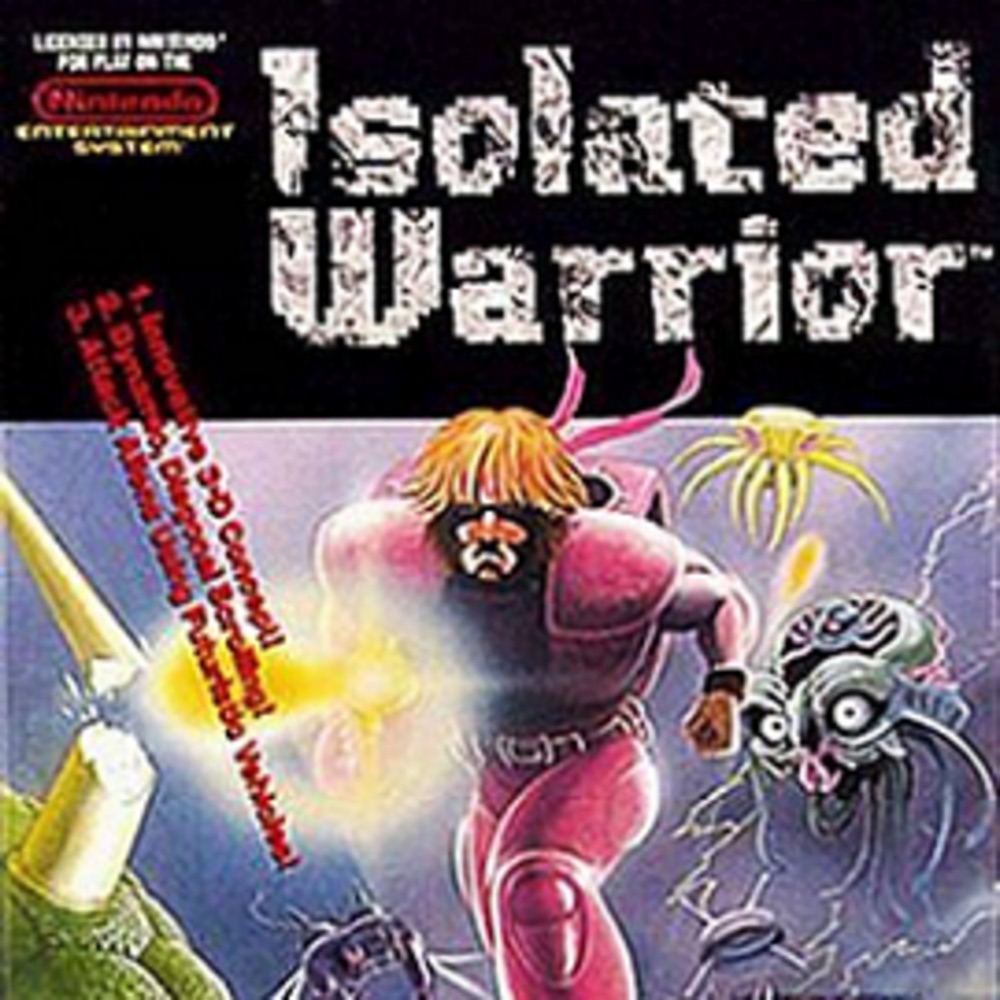
438 · Isolated Warrior
New to SHMUPs? Read our guide: How To Enjoy SHMUPs →
Isolated Warrior is a 1991 video game developed by KID and published in Japan by VAP, in North America by NTVIC, and Europe by Nintendo.
A title like Isolated Warrior sounded to us like a pandemic diary, and we preferred "Lone Warrior." Luckily the hero is Max Maverick, who marches forward the whole game on a hovercraft and a motorcycle, shooting aliens on the planet Pan. It is an isometric shmup from KID, the Burai Fighter developers, and we could not remember playing an isometric shmup before. Mike, Sean and Joe were on this one.
Why it looks so good
- One of the best-looking NES games. We kept coming back to that. A first mini boss looks like it could have been designed ten years ago, not thirty-five.
- Nightmare bosses. A boss has a brain that bursts into mini brains that shoot at you, and another stretches and repeats its sprite horribly when it dies before breaking apart. It felt like a bad trip turned into a video game.
- Readable chaos. Despite the aliens and trippy colors, we could always tell platforms, enemies and projectiles apart. One stage waves left and right like a Mode 7 effect on the Super Nintendo, though things slow down.
- A smart jump. Jumping dodges enemy fire without changing your own shot plane, and spamming it stretched our health far. Your life bar is a break from shmups where one hit kills you.
Why it plays rougher than it looks
- You can't turn. Max always faces forward but still walks, with diagonal sprites to match. Joe could not shake the feeling that he should be able to turn toward enemies at his side.
- Hit detection and a cramped screen. Some enemies only get hit while you're airborne, and bosses move between ground and air. There is almost no time when the whole screen is yours, and an invisible wall can drop you into a pit mid-jump.- Pitfalls and speed. Platforming over pits against a slow scroll feels bad, and the speed ramps up on the hovercraft, the motorcycle and the collection bonus stages, leaving you jumping pits that are off screen.
- Plain power-ups. A laser and a spread, leveled by W and L pickups. We thought it a spectacle first and game design second.
- Odd details. Max shouts "intermission" between levels, the final boss looks like a Gundam villain of the week, and the game ends by revealing it was a book.
The bottom line
Skip it. On the Essential Games List, Joe said no: he appreciated the look, but the gameplay never got fun and the game needed more. Sean enjoyed it more and agreed it is not quite essential, a game for shmup fans that is better than a lot of the shmups already on the list. A joke about feeling isolated led to the admission that a yes vote was sitting on our Google sheet, with an offer to take it back. By our count we have played 32 shmups, with 24 Skip it, five Play it and three Essential. Sean's own call in the room was Play it.
Written from our conversation in this episode.
- THEY’RE COMING TO YOUR TOWN
I. Setup & Premise
- The pitch: one soldier refuses to evacuate an alien-infested planet
- The game takes place on the planet Pan
- An unknown alien force attacks and starts consuming living things, machines, and buildings.
- The people and soldiers of Pan are told to evacuate, but army captain Max Maverick refuses to leave.
- He goes in alone, using a motorcycle and hovercraft as his only means of transportation.
- Developed by KID, published in North America by NTVIC
- The simplest way to frame it for listeners
- This is a diagonal/isometric scrolling shooter with light platforming.
- It looks vaguely like Zaxxon, plays more like an autoscrolling run-and-gun, and occasionally asks you to jump over pits, walls, bullets, and environmental hazards.
- The result is a game that feels technically impressive, slightly awkward, and genuinely distinctive.
II. What Makes It Stand Out
- The isometric perspective is the whole identity
- Most NES shooters scroll vertically, horizontally, or from a straight overhead view.
- Isolated Warrior scrolls diagonally, giving the action a pseudo-3D look.
- That makes it visually memorable right away, but it also changes how aiming, dodging, and jumping feel.
- It mixes shooter design with platforming
- Max can jump, hold the jump button for a somersault, and fire bombs while flipping.
- The game is not just asking you to shoot enemies. It wants you to read terrain, avoid damage zones, clear gaps, and survive forced-scrolling hazards. (World of Nintendo)
- KID also developed Burai Fighter, another NES shooter that tries to do more with movement and screen direction.
III. Gameplay Structure
- Controls
- D-pad moves Max in eight directions.
- B fires a laser beam.
- A jumps.
- Holding A performs a jump and somersault.
- Select changes shooting mode.
- On the motorcycle, pressing down performs a wheelie, which can help avoid some collisions but still leaves Max vulnerable to bullets. (World of Nintendo)
- Weapon modes
- Max has two laser styles:
- Spreading beam: better for wide enemy groups.
- Focusing beam: better for tougher enemies and enemies behind you.
- Both can be upgraded across five levels.
- The spreading beam expands into wider shot patterns, while the focusing beam eventually fires forward and backward. (World of Nintendo)
- Max has two laser styles:
- Bomb system
- Bombs also have power levels.
- Level 1 fires in one direction.
- Level 2 fires in three directions.
- Level 3 fires in five directions.
- Level 4 fires in eight directions.
- Level 5 is a one-use boosted state that drops back to Level 4 afterward. (World of Nintendo)
- Stage progression
- The game has six regular stages.
- After finishing each stage, the game gives you a password.
- If you finish all six stages before the game is over, the manual says you can enter a special Stage 7 for highly skilled players. (World of Nintendo)
IV. Unique Gameplay Elements
- Jumping in a shooter
- This is the mechanical twist that makes Isolated Warrior more than just “Zaxxon on foot.”
- You jump over bullets, terrain hazards, pits, walls, and sometimes enemies.
- In theory, this gives the game more depth. In practice, it also creates a lot of the game’s frustration because the perspective makes depth hard to judge.
- The motorcycle stage
- Stage 4
- It moves fast, throws in gaps, and gives Max a wheelie command that can accidentally interfere with jumping.
- holding down can trigger a wheelie when you really need to jump over a gap.
- The hovercraft stage
- The hovercraft section increases the speed and gives the game a different feel without totally changing the controls.
- It is a smart way to make the same basic mechanics feel more dangerous.
- The downside is that faster scrolling makes power-up collection and hazard reading harder. (Hardcore Gaming 101)
- Power-up economy
- The game has upgrades for spreading shots, focusing shots, bombs, bomb count, speed, health recovery, bonus points, and barriers.
- The barrier protects Max for five hits, then starts blinking before disappearing.
VI. Sequels and Spinoffs
- No direct sequel
- Isolated Warrior appears to be a one-off NES release rather than the start of a franchise.
- That is a little surprising because the concept feels sequel-ready: cleaner diagonal movement, better depth readability, bigger bosses, and more vehicle stages could have made a follow-up really interesting.
- Closest comparison points
- Contra / Super C: not the same perspective, but relevant when talking about action-shooter pacing and power-up pressure.
- Snake Rattle ’n’ Roll: useful only as an NES comparison for “isometric perspective that looks cool but can make movement weird.”
VII. Essential Games List Vote
- Case for Essential
- It is one of the most visually distinct shooters on the NES.
- It mixes shooting, jumping, vehicles, power-ups, passwords, and a hidden final challenge.
- Case against Essential
- The isometric angle can make basic actions feel less precise than they should.
- Hit detection and boss aiming can feel fiddly.
Auto-generated transcript. Each paragraph starts with its timestamp. Speakers are not identified.
Isolated Warrior, they're coming to your town.
And welcome to NEStalgia, a chronological exploration of every NES game released in North America. I'm Mike. And I'm Sean. An isolated warrior, hot isolated warriors in your neighborhood.
Now, we're all isolated warriors in our own way. Was it saying isolated warriors, like they, as in the isolated warriors come to your town? Or is it like a new thought? No, more like all the aliens. The aliens are coming to your town. Right. All the enemies, and you're the isolated warrior. You're, uh, technically the isolated warrior is every hero in most NES video games, right? You always do these things solo. True. Well, I thought maybe it was like, you know, like an actual warrior, but maybe, maybe during the COVID pandemic and he wasn't really, uh, getting out into third spaces very often. So it was just like a sad story. Something about the word isolated is just really boring to put before warrior.
Like lone warrior. That sounds, that's, that's awesome. Let me see that guy. Isolated warrior. It's just a boring, it's a boring phrase to me. Lone warrior. Awesome. Lonely warrior. Not so awesome. Yeah. Sad. Yeah. Right. Isolated warrior. Same thing. Thankfully, he's not just known as the isolated warrior. They had to give him a very cool nineties name and that name would be max maverick. He's taking, he's taking maverick to the max. It's a lot less emo. Well, yeah. The isolated warriors is banned.
It's like tame impala situation. He's just the whole band. Yeah. I can see him rocking like a guitar. Uh, yeah. Rocking a guitar on his hovercraft. Um, and, and I don't know about you guys, but when I heard isolated warrior, I was expecting action game.
We got a shmup. They, they like to sneak those in any way they can, but they did something different here. I don't, I can't recall the last, uh, if we ever played an isometric shmup before. No, this is new. Um, and you know, at least if they're going to give a shmup, they do do something new with it. So, yeah. But what is the, what do you get out of like the isometric thing?
If you, if you can't like go in different directions, like I guess you kind of do. It does turn from one direction to the other, but your, your character doesn't turn or anything like this could easily just be a top down thing and it wouldn't really like the isometric thing. I feel like makes things feel 3d, but this doesn't really capitalize on that. Yeah. I think, I think it's mostly for the design, but Joe, if your character turned in this
scrolling shmup, that would make this game infinitely harder, right? Like if, if this guy was walking around and facing different directions in the 3d space, like it's a good thing he stays facing. To be honest, I hadn't like really put enough thought into it and it might make it harder, but the whole time I was playing it, I was like, why can't I turn? Like if I'm just a guy and these people coming from to the left of me, I can't shoot them. I can only shoot forward.
They even have like a sprite animation for him walking, because he's always walking. You don't control like his walk. He's always marching forward. So when you do turn, they have these like different sprites for him, like walking diagonally. So this way he's still picking up his feet, but explaining why he's still moving forward and not just to the side. Yeah, I see it definitely as just matching the, uh, the visual aesthetic they were going for. And I think, you know, I think it works.
Um, it, it, this game does look hella cool at times. Um, and I'm willing to pay for, uh, some shoddy hit detection for that. I think a little bit, um, which I think is pretty apparent. Yeah, that is a great flag, Sean, because as you know, uh, with shmups, the key is to, you know, keep the battlefield clear in order to, uh, not take damage because, uh, well, in this shmup, there is a life bar. So it has that going forward. A lot of other shmups are just, if you get hit, your ship blows up.
So we don't have that situation going on here, but shmups are very much about precision. And when you take it to the isometric, uh, style, it could be hard to line up shots, especially because more so than just having the isometric point of view, the, um, what is usually the X and Y. Now we have the Z axis with, uh, with jumping. So now there's a, there's some enemies that can only be hit when they are, when you're in the air and some enemies that move, especially the bosses between being on the ground and in the air. And that makes hitting them a lot harder and thus clearing these levels a lot harder.
Now, did you guys notice that like when you jump, I feel like the game works in your favor and it doesn't. Yeah. Like when you're jumping, it doesn't change the plane that you're, that you're,
projectile is, but it does like affect the plane that you're on for enemy projectile. So it's like being a little, um, forgiving there. I think it's a little tricky when it comes to what you're shooting. I think it's not like perfectly, um, the same and you're still going to miss stuff that you think you're going to hit, but you are much harder to hit. And you might even have like, you might even have like eye frames or something when that's going on because I could really stretch my health pool just by spamming jump. Um, so yeah, I think it's a good, uh, it's a good trade there. And because there's jumping, should there have been more platforming than just pitfalls? No. Great. It's not that good.
Yeah. You mean like climbing up on things? It's better as, yeah, I'd say it's better just as a way to avoid, uh, avoid projectiles than actually when you do platform and jump over pitfalls, it feels terrible because you are capped by the slow scroll of the screen. Yeah. And like, I think that there's like in any game like this, that's got this isometric view, sometimes jumping up onto things. I'm trying to think of, uh, oh, what is it? It's, um, the game where you're like a wizard and you're running through all the different rooms and finding solstice.
Yeah. Solstice. Yeah. Um, like even in that, like, I love that game, but like sometimes the like jumping onto different platforms can be a little like not intuitive and they're a little, I don't want to say frustrating, but a little hard to kind of get the hang of add the infinite scrolling
element to this. And like all these projectiles coming at you, I think that might be one layer too much for me, you know, not saying that it like wouldn't be good if you're really good at this game. But yeah, I think for me, I'm like, I'm glad to just try and deal with the pitfalls and I really don't even love dealing with those. So, and, uh, the developer of this game kid also, uh, and kid, that's just like capital K capital I capital D. Um, they were also the developers of another NES game. We played, uh, Burai fighter, which I'm not going to be upset if you guys don't remember, but it was a side scrolling, uh, shoot them up. But it was the same idea of like, you were a, um, you were a robot character, not like a vehicle.
And, um, it, it very much felt like what isolated warrior could have been in, in 2d instead of isometric. I think I liked Burai fighter looking at these things here. Was there, was there any, uh, movement decisions? Like, could you choose to go in one direction or another? Uh, yeah, that was, that was one of the things too, is like you, you had to like quickly make decisions about going on different paths. Yeah. Nice. Okay. Wow. Give it up for Sean, everybody.
Thanks. That's the first game I've remembered in like 20 years. And you've only been playing video games, uh, for, uh, 19. That's true. Now, I feel like even though we decided that the visuals were good, we kind of blew past that and it is obviously like what the cell was at the time was just by, by making it isometric.
The cell was, you haven't seen a game like this. And obviously we have seen a lot of other isometric games, but not, not in the shmup format. And I do think like the game, while it does have a lot of similar tropes to other, uh, NES games recently with like aliens and trippy visuals and everything. There is something about whether it's the, uh, the color scheme of the levels or the enemy designs. It is a pretty readable game. It's not the kind of thing where it's like, well, I can't tell if that was a platform or not, or I can't see the, uh, the projectiles coming at me cause there's too much on screen. Like they did a good job of making everything distinguishable.
Yeah. I think that, uh, that is true. I wasn't even really thinking about legibility, even though I do, uh, totally agree with you now, but I think that this is one of the best looking NES games I've ever seen. Um, and especially with the enemy designs like that first, like mini boss that you run into that looks like something out of, that could have been designed like 10 years ago instead of like 25 years ago.
Um, uh, I guess 35, I don't know. Um, so between that and some of the things that they do with just like all the sprites to make things look even more 3d, like the snake head boss, even though that kills your frame rate, uh, it looks fucking bad-ass. So I'm a big fan of what they did here visually. And as you guys are saying this stuff, like I don't disagree with any of it. I do think this looks really, really good for some reason. I just like, didn't really notice while I played this game. Like now that I'm looking at it, this looks great. But like, yeah, while I was playing it, that was like not even, that was not even a thought that crossed my mind. Like, wow, this one looks so good.
I don't know why. Maybe I just, it really came to me when I got to like the first boss like that, like the bosses in this game are truly awesome designs and, and like the kinds of things that aren't just like, okay, here's a dragon, you know, it's like, okay, here's a guy's face on a tank. Right. And there's a lot of like creative, like the way the animations are. And I think it was maybe the third or fourth boss where like when you beat it, it like stretches in this kind of horrific way. And like, it starts, the sprite starts kind of repeating, but it looks intentional.
Yeah. And then like breaks apart. And I'm like, oh, it didn't just explode. It was like, they had like a horror vision for what was going to happen to this thing. It even does like some beyond just the isometric stuff. There's, um, I don't know what level it is. Um, but it's, it's kind of early on in the game. There's this like fake 3d thing. It does with the actual like stage that you're on where it keeps like, uh, shifting left and right, like very wavy. And it was like, it looks like a, right. It looks like a mode seven where you're having a, yeah, it looks like a mode seven thing on super Nintendo. And they're doing it pretty effortlessly here on the NES.
You feel like there was another moment where things got really slow because it's, because it's doing that, but it's still like, this is definitely a lot of things. Definitely a spectacle game first and like, uh, a like actual piece of game design second. So I, I'm, again, I'm, I'm okay with that trade. And at times the scrolling can be really slow also just from, uh, not from the frame rate issues, but just from, um, the, the, the, the set speed that the game has.
But once you get to like, uh, when you're on the hovercraft or the motorcycle and, uh, especially if you get to some of those bonus stages, uh, where there aren't enemies, but you just have to collect things, uh, the speed can ramp up like pretty dramatically. And that makes the game also like pretty damn hard. Yeah. Especially when you have pitfalls to jump over that are off screen when you're supposed to jump. It's not, not the best situation to be in. And I think that I ran into that, like even in the regular levels.
Um, but you know, that's, that's definitely a fault. And the motorcycle thing kind of came out of nowhere because everything else was so like alien, like, and like bubbly and, uh, not bubbly in like the cute sense, but like actual bubbles and like, uh, volcanic shit and stuff like that. But then like all of a sudden it's just like, okay, now you're out on the streets and it's like, I didn't realize that this place had roads.
You know what I mean? Well, it was, it's, it's coming to a town near you, which like, I had no idea that that was on the back of the box because they make it pretty clear in the manual that this is happening like in a different galaxy. Galaxy. So I just, I don't really get the, what they were doing with that. Um, is this, maybe this is star Wars. Yeah, it is a different, it's a galaxy far away from earth on the planet pan. What a, what a weird name that they got.
What about planet walk? Nice. Now, right before that motorcycle stage, I think you guys were talking about this one, the boss who like, as you kill him, his face stretches apart, but like, man, this is, this is like some bloodborne, uh, design stuff. Like this is, this stuff is really, uh, abstract horror here. Cause like, I, what are you doing? You're shooting like it has a brain and then it breaks out into like mini brains that then fire at you. Like what is happening? Yeah. I mean, I think that's exactly what's happening. And it's like, it's like they, yeah, they, they didn't just go with video game tropes. Like someone had a nightmare and made it into a video game.
I think it's all a bad trip. Somebody had a bad trip. And of course with the, um, as the, as it goes on, more enemies appear on the screen and you have to figure out how to deal with them. And like any good shmup, it has power ups. And there are, uh, two different types of beams that Max Maverick, if you forgot his name, yes, his name is Max Maverick. Uh, he has two different types of beams.
One that is a, uh, laser beam. And then the other one that's more of like a spread and, uh, you can collect, uh, either W or L, uh, on the power ups to level up these, um, these beams so that you can shoot more of them. First you can shoot from like the front and the back. And with the spread, you can shoot, uh, further with the spread and then eventually like all around you. But is this like compelling enough compared to like with other shmups, we see like completely new types of attacks. Like, is this too basic for this kind of game? Well, I think that like, I guess I was, had a hard time like understanding the actual progression
of some of these power ups, but I know that like some of the times I would have this spread shot that was like, there was no shot right down the middle, you know, where it was like, again, I feel like it was like a little more form over function. Like it looked cool, but like, well, what can I do with this? Like, I'd rather just have the regular shot.
And that's not true for all of the power ups, but I feel like I kind of felt that some of the time where I was like some of these power ups, like I'd rather just kind of stay simple at this point because some of these power ups are like, take too much of like me re maneuvering the way I'm playing the game entirely to use them where it's like, oh yeah, everyone that I want to shoot just has to be like at a, at a 103 degree angle from where I'm going here. It just like doesn't really make sense with where the game is.
Yeah. And that's more a problem when you're early in that power up progression and then it becomes a lot more usable as you get other angles to shoot from. And then you do get that center shot again, but you can always just go to the, uh, like the focus, uh, version where you're just shooting right straight down. Um, though they are different power ups. You can be very weak at one and powerful at the other. I think that's sort of like them being a little nice compared to like a Gradius, which just like kicks you down to zero.
Um, but then at least they have like the bombs, which aren't some like, like they, they kind of are a screen clear, but they actually are projectiles that have to hit things. So it's not just a, uh, a get out of jail free card. Um, and I think that like, you know, they were also pretty generous with how many of those you get. Um, and it's not completely impossible to, uh, you don't have to save them all, uh, for bosses. You can, you can sprinkle them in. And that bomb can only be done when you're in the air, right? You have to jump in order to use the bomb.
Yeah. You jump and you press jump again. And there's also a barrier, which is pretty standard for shmup. So basically all pretty standard shmup power ups. And it's more about just like the visual treat of playing through these levels. One thing I didn't understand about, uh, you know, there's not much of a story being told in this game, but between levels, uh, Max will come on screen and just shout intermission. Who's that for?
Like what purpose is that serving? Like we have already finished the level. Is he like telling us like to take a break? Is this like the Wii, you know, like the Wii says you've been playing for a little bit. It's time to take a break. I think that this is, uh, I think that the guys that did Max's design were like, well,
we're just, we're just seeing the back of his head this whole time. Um, they're running into that, you know, the, the third person shooter, uh, problem like 20, 20 years early. So they're, they just want you to get to see his cool face. Yeah. And just have him say intermission. Yeah. They also have little, uh, little cut scenes. Yeah. Those ones don't do much either, but we get the idea. He's the, he's an isolated warrior. He's all alone.
Is, is Max Maverick also like, is he more Mad Max or is he more Maverick from Top Gun? He obviously more. You think that was the, that was the inspiration though? The two of them has to be right. Yeah. Especially with the motorcycle. I don't think Mad Max ever. Oh really? I could, I'm probably wrong, but I just, maybe it's Maverick who rides a motorcycle. One of them. Yeah. I mean, he probably, I think he does actually, but only in the new movie. Which they knew about. They had the script ahead of time. Actually, I think they based the new movie. We're talking about Tom Cruise. Oh, okay. I didn't see that one. Which one? Tom Cruise. Yeah. I didn't see that one. That Tom. I think, I thought you were talking about John Cena for a second.
And so, yeah, there's a, there's a little, there's a little bit of a story. It's probably cooler to make your own story up, especially with a guy who's, uh, going through a very trippy, surreal experience and fighting. Right. Yeah, yeah, exactly. This is all just to get his girlfriend back.
Um, and I thought it was weird that like at the end, the boss that you like face off against just winds up being like somebody who could have been in like Gundam. Like not, not some crazy alien abstract horror thing, but just like, uh, a villain of the week. Did you guys see this? He's got some big powers. I mean, it's amazing. He's got some huge laser beams coming at you and you have to dodge them or jump over them. You can do some well time jumps over those lasers, which is kind of a funny visual, but sure. Uh, and then like, I'm not saying he's underpowered or anything. He just doesn't look nearly like he doesn't feel like he's fitting the theme at all. Like it was, it really all building up to this robot cyborg thing.
Yeah. You're, it is an underwhelming design. See, I agree that he doesn't fit the theme, but I think he looks really cool. I'm looking for the first time right now. Okay. Yeah. I mean, I didn't get to the end of the game either. This game's hard. At least I think it's hard.
Yeah. It is hard. Thank you. I think it's hard too, because there are, because they're trying to like make use of the jump and there's so many pitfalls. It's hard because then you wind up like by trying to avoid those, you have now less space on the board. And so like, if you're not clearing the enemies, now you have even like significantly less room to dodge around them. Whereas like in most shmups, yes, there are, there's always like some kind of cave segment
or narrow hallway corridor thing that you go through. But for the, but for the most part, you can use the entire entirety of the screen. That's like less true in this game. There's very little times where like the entirety of the screen is available for you to move around in. Yeah. And that's just a fact. Yeah. The, the, when you're moving forward and you can't go all the way to the front of the screen, like, like not during boss battles, but during actual scrolling, that actually drives me crazy because sometimes I'm trying to jump over a pitfall. And it's just like, I hit this invisible wall halfway over and I just fall.
That definitely interferes with any kind of, uh, actual movement. Um, and then you, you do have a big, like the top left of the screen, like there will be enemies up there. And even when there's like, even when you have the spread shot, you're probably not going to hit like in like level three or, or something. There's these enemies that are hanging on a wall, like above you. So you, you, you, you think to jump to hit them, you're probably not going to hit them. Then they jump down at you, like onto you. Like they just like magnetized to you. So I, I had a lot of trouble with that too.
You would think that that corner of the screen, um, with the spread shot would be just easier to hit. But since it, you can't hit it at all with the, the focus shot, it's just sort of your, it's your Achilles heel. This is something interesting about the manual for the game. Uh, most video game manuals will just like have the same art as the cover or something similar to it. And the name of the game and, and it might say manual. It might not, but like it's a booklet. So then you just read the thing.
This one has like how to play over it, like how to play isolated warrior as if it is like a book in a series of things. And I just feel like, I don't know why, but I've never seen that before. I've never seen it as like anything other than like the manual or a set of instructions, but this one makes it more like it brands it around something. I don't quite remember that part of the cover is what I'm saying. So it's like the title of the book would be how to play isolated warrior.
Got it. So it's just the, how to play that's different. Like, like just calling it that instead of, instead of referring to it as a manual or just having the title and knowing that it's part of the product, you know, it's like you're getting like this little book now on how to play. And in fact, the game ends with a book. It's, it's revealed that like it just shows you the book isolated warrior. And it's like, this whole thing was a book.
Instead of it all being a dream. It should almost be the beginning. Yeah. Right. Like give me this info when I start. So I know who this guy is. I just want to know where I could buy the book. I just want to know whether isolated warrior is going to wind up on the essential games list. Joe.
All right. I mean, I don't want it to seem like, okay, this was a shmup and I immediately eliminated it from my, uh, from the running. But, uh, you know, I, I, I appreciate the design. I appreciate the like aesthetic of this game.
Uh, yeah, the gameplay just wasn't that fun for me. I really didn't, I really didn't particularly enjoy it. I got frustrated with the, what we just talked about with like, you can't go across the whole screen. I mean, something about it felt weird to me that I couldn't turn. I know in most shmups you can't turn, but this just felt like a guy walking. So like, and it was isometric. So I felt like I should be able to, and I'm not saying that would have made it a better game, but it did stick with me while I was playing it. Like, like it was a frustration where I wanted to be able to turn these enemies that are coming up to the side of me. Um, and I can only shoot in one direction.
Um, and I think just in general, like I, I think it needed more. So I, I'm going to say, no, this is not an essential game. Sean. Yeah. I enjoyed it more than Joe did. Um, and I, I, I'm a sucker for stuff that, that looks nice. So, uh, that's part of it too. But I also, I do agree that this probably isn't an essential game, but this is also making me think of how many shmups we have on there, uh, on the essential games list that I think this game is better than.
Um, and so I think maybe we just got to do another, like, we just got a clean house, get rid of, get rid of like most of the shmups, um, to, to, to make it, to make it make sense, you know, because this is, I think it's a pretty good game, but yeah, I agree that it's not quite essential. I think it's a game for shmup fans. Like, I think you have to be pretty good at shmups to enjoy this one because, uh, while it is one of the most, not even just for shooters, but just most visually distinct NES games that we've played. And it does a good job of, you know, doing it in the isometric viewpoint. The isometric angle can make even the basic actions of, of, in other shmups feel less precise than they should in isolated warrior.
And, uh, I'm not just talking about like with the hit detection, uh, or what I mentioned with the bosses, but just in general, if the name of the game is to, uh, you know, blow up your enemies and stuff and it's proving a little difficult to do that, that's probably a skill issue, but it will translate to most, you know, gamers who aren't fans of shmups. And so I think in general, this one is really like one of those top tier things for, uh, for fans of shmups. And I wouldn't be surprised to find out that they enjoy it, but to go back to what Sean said, you know, I'm looking at what's on here in shmups and, you know, I, I, I automatically know Gradius and a life force around here.
And I think while those are, you know, challenging games, they are kind of beginner friendly, especially with the kinds of power-ups that you can gain like very early on to have additional shooters and barriers and, uh, multiple directions firing. Like you become a pretty brute force in that game, in those games early. And the same isn't true about isolated warrior, because even when you are like maxed out, you still are just like, you're still just ready to take punishment at any time because of how small your actual like area is to, to take on attacks. So I, I found the game.
Yeah. But doesn't that make you feel more isolated? Yes. I'm, I'm so immersed. You're right. I didn't notice how immersed I was. I realized I am the isolated warrior and that's why I am putting this game on the essential games list because I can make a joke like that because, because you two voted it. No. So, uh, unfortunately I think that means I have to say that I voted for it on the, uh, on the Google sheet, but you can take it back. Um, maybe I will. Uh, what other shmups do we have on there? I thought we did clean house. Yeah. Well, I, I'm just assuming. Yeah. Well, you know what they say about people who make assumptions.
Uh, I'm looking and, um, gun dot smoke is the other shmup. Oh yeah. You know what? I really like gun dot smoke, but this, that, that's like the closest one to this where you're, you're, it's a walking shmup. And I'm like, yeah, I really liked that game, but I think, I feel like this one, this one looks cooler. How many shmups do you think we've played? Probably 10. Too many. Right.
10? Okay. So keep in mind. I wish we really played 10. Right. We're on like what? Episode 430 something? Yeah. 60 is my four. Okay. Yeah. So I would say that like out of 430, it would be kind of surprising if we played, uh, 60 shmups, but, uh, it seems like the answer is 37, 37 shmups. It's honestly not as many as I thought. Up, it's actually less. 32. Exactly. That's way more than I thought. 30. Yeah. But what's that? What are those five? What are those five that you just took off the, took off the board there? Five that I, cause I couldn't read a bar graph.
Um, 32. Every time you can't read a bar graph, he takes five off the chart. Yeah. 24 skip it's for shmups, five play it's and three essentials. Okay. Well, yeah, we did a good job. That's a good, yeah. 24 skip it's is pretty, you know, like, but I would say this is a play it.
I think like, you know, for people who disagree with our essential votes, you should at least check out our play it votes. Cause we probably have all your favorite games on there. I'd be impressed to hear what we put as skip it's that people are like, no, that is a, an essential game. Like I want to see how badly we went in the opposite direction. I probably like young junior math.
Oh, fantastic game. I know we want to end there, but can I say something else? Please. I would like to talk about, uh, the last two weeks I missed, I missed the podcast, but I did play the games the last two weeks. So I just want to give like very quick thoughts about, uh, the last two weeks. So what, what, two weeks ago was, uh, galaxy 5,000 racing in the 51st century, which was too long of a name rolls right off the tongue. Um, but I enjoyed this. It reminded me of, uh, like our, uh, was it RC pro am that had that? We brought it up.
Um, but something about it. I don't know if you guys felt the same way on the episode. Something about it. It didn't, I, maybe it was just, I hadn't wired my brain enough to it. I had such a harder time with these controls than I remember having for, uh, for RC pro am. And I tried both versions. Well, were you playing with alpha or beta controls? I tried both versions.
Um, and I think, I don't remember which one's which, but I think I liked the, uh, the version where it's just, where it's not the half turn and then you got to switch, you know, where it's like up just turns clockwise and down turns counterclockwise or whatever. Right, right. I prefer that. Okay. So you were, that's B. Okay. That's B. But even that, I was just having, I, for some reason, I, my brain couldn't, I couldn't wrap my brain around it.
Um, but, uh, but otherwise I thought it was a cool game. I would not have voted essential. I, I wanted more ways to like fire weapons or things like that. At least as far as I got, but, uh, but yeah, a little fun experience. Um, you guys didn't have voted essential, right? I assume. No. Okay. We did not. Just making sure. Uh, I did like the game. It was fun. The following week was, uh, Ikari three. Yes. I'm a little baffled by Ikari three.
Okay. So were we. What the heck? I remember loving the first two Ikari warriors. I mean, one, this one just felt clunkier. And why don't you have a gun? I don't understand. Like, why are you like. You get a gun sometimes. You have a gun like what? During the boss battles? You get, during some of the, some of the boss battles. Yeah. Right. Some. So you just had to go. Joe, Joe, Joe, here's my question. Cause I asked Sean this too. And I posed it out there to listeners.
Why did everybody else agree not to bring guns? Like, why are your enemies like going bare? You know, like why, why can't they bring guns to this fist fight? Yeah. Maybe there's just not that many guns left. It's reserved for bosses. Yeah. After they went to the future in the second game. No. Yeah. It's like, it's like a Dune because everybody's got gun proof, uh, energy armor or some shit. Maybe. Yeah. I, I, I do like that explanation for why you would want to like use swords and shit again. But, um, but I, I just, the hit boxes in this game too, which is, I felt very, very jink.
Yeah. Pretty jink. Jink. Going into the jink folder as Sam, the manual Smith would say. Wonder what Sam's up to. Praise be. There's no way to know. We spoke to Sam one minute before this episode recorded. Peek behind the curtain for you. Yeah. All right.
All right.