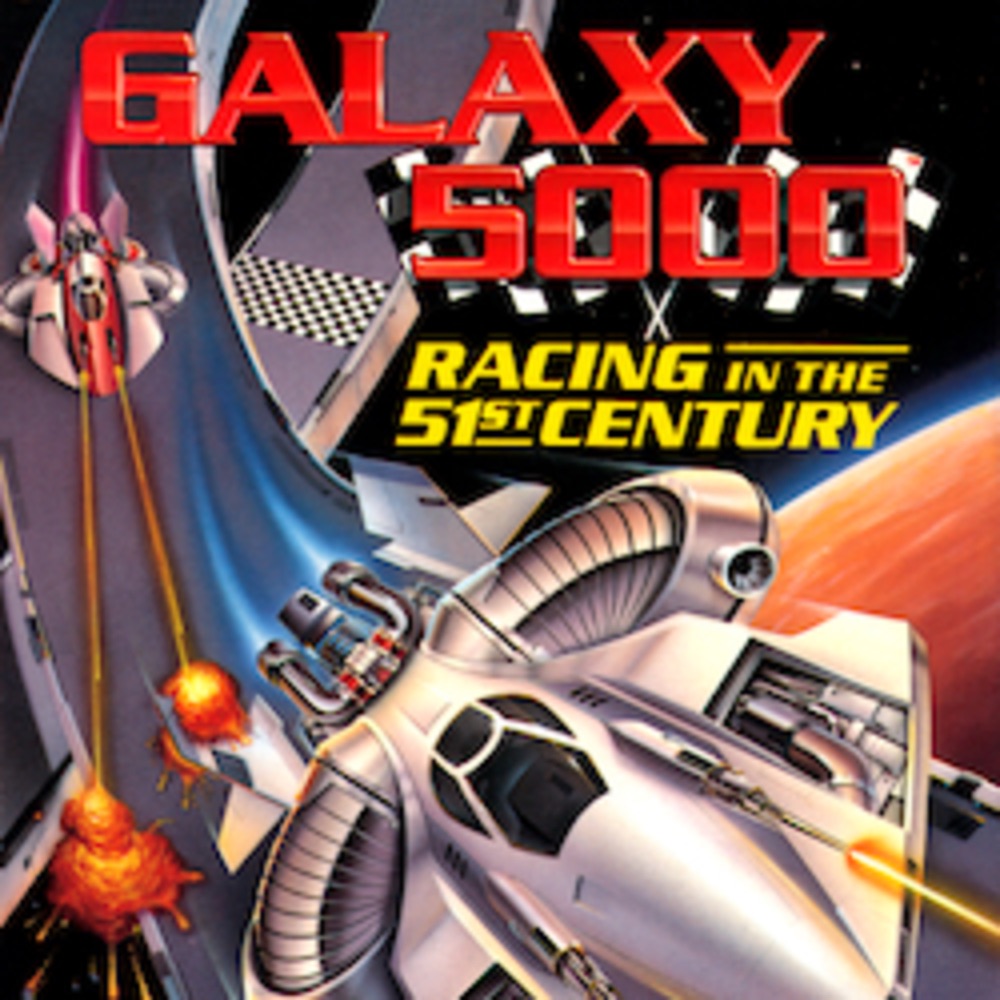
436 · Galaxy 5000: Racing in the 51st Century
Galaxy 5000 sets itself in the 51st century, a safe way to avoid being proven wrong. You start in the minor leagues on Mercury and work through the solar system in armored turbo craft. The story is a vibe: space racing, prize money, blowing up rivals. Mike and Sean were on this one, with Joe out. Our shorthand was RC Pro-Am in outer space, meant as praise and complaint both.
On the track
- It drives well. There is no accelerate button, you push where you want to go, and the ships carry momentum, so you nudge more than steer. The isometric view stays readable even when gaps and obstacles show up.
- Racing with teeth. Four ships race at once, you can shoot rivals and obstacles, and you jump pits. You only have to finish, not win, because prize money pays for repairs and for the five ships (Tomahawk, Crusher, Phantom, Scorpion, Stiletto), names a middle schooler would pick.
- Shortcuts. A jump can skip a whole bend. The computer drivers know some shortcuts but not all, so you may find one first.
- Odds and ends. Damage shows up as cosmetic wear until you repair it, blue stars give a special weapon, there is a digitized voice, and the course fades out as the roughly two-and-a-half-minute clock runs down.
- Two-player. No split screen. If one player pulls too far ahead, the other is warped to the front, and the winner is decided on total points, not races won, so the leader can keep swinging ahead.
What keeps it from going further
- Controls and walls. The Beta scheme uses up and down for speed, and the manual says it pays off later. We stayed with Alpha. Clip a wall and you come to a full stop while second and third go past.
- Missed jumps. Brushing the edge counts as landing, so we got greedy until one failed.
- Weak combat. Fire is unlimited and scattershot. We wanted limited ammo and enough punch to take out a rival. There is no engine sound either.
- Same again. Nine planets, four races each, four laps per race. New obstacles and bigger shortcuts arrive, but 36 races feel alike.
The bottom line
Skip it, with a caveat. Neither present host put it on the Essential Games List, and we joked that Joe, who was absent, was not going to change that. Sean called it a very solid play it but not quite essential: fun, with a good sense of speed, yet just RC Pro-Am in space. Mike agreed that it is one of the more distinctive NES racers, but said it does nothing wrong and nothing more than serviceable. Bought in 1991, it would have been a happy purchase for a night of multiplayer. Next to Mode 7 racers on the Super Nintendo, it is not a game we would keep coming back to.
Written from our conversation in this episode.
- THE BEST RACING IN THE UNIVERSE
I. Setup & Premise
- The pitch: futuristic combat racing on floating space tracks
- It’s the 51st century, and “armored turbocraft racing” is basically the dangerous sport of choice for thrill-seeking kids with a mean streak.
- You start in the minor leagues on Mercury and try to work your way through the solar system, eventually racing near Pluto.
- The game is not really selling a deep story. It is selling a vibe: space racing, danger, prize money, and blowing up your competitors.
- Developed and published by Activision
- The simplest way to frame it for listeners
- This is like if R.C. Pro-Am got thrown into outer space, added jumps, destructible track obstacles, digitized voices, money management, and more of a survival-racing edge.
- It is not a pure racing game. It is a racing/combat/upgrade game where finishing fast matters, but so does earning cash, managing damage, and learning how to abuse the tracks.
II. What Makes It Stand Out
- It’s an NES isometric battle racer with real mechanical ambition
- Four ships race at once, with one or two human players and the rest controlled by the computer.
- You can shoot rival ships, destroy track obstacles, jump over danger, and even fall off the course into space. (MobyGames)
- The track itself becomes part of the pressure
- You are racing the other ships, but also the clock.
- If you are close to running out of time, the track starts disintegrating underneath you, which turns a bad race into a panic sequence.
- Makes the game feel less like “just place first” and more like “survive the event.”
- It has two different control schemes
- Alpha controls: the D-pad moves the craft in screen directions.
- Beta controls: the D-pad works more like steering, with up accelerating, down slowing, and left/right turning the ship.
- The manual even admits Beta is harder at first but easier once mastered, which is a pretty honest design note for an NES racing game.
- The digitized voice clips give it personality
- MobyGames specifically calls out the squeaky digitized collision voices, including things like “Hey,” “Excuse me,” and “Watch it.”
- For an NES racer, that kind of sound gimmick helps the game feel more alive and arcade-like. (MobyGames)
- It has a surprisingly involved economy
- You earn cash from racing, destroying objects, collecting stars, and performing well.
- Between races, you decide how much money to spend repairing your current craft.
- If you have enough money, you can buy better turbocraft, but old damaged craft stay damaged if you do not repair them.
III. Gameplay Structure
- Single-player mode
- You race against three computer-controlled craft.
- There are nine planets, with four races per planet, and four laps per race.
- Each planet has different gravity, and each race adds more hazards and better rewards.
- Two-player mode
- Two players race against two computer-controlled craft.
- The manual frames the two-player mode around the four Mercury races.
- If one player gets a screen-length lead, that player earns a point bonus and the trailing racer is pulled forward so the race can continue.
- The winner is determined by who earns the most money over the four races, not simply who wins the most races.
- Race goals are layered
- Cross the finish line to count a lap.
- Beat the clock or the track starts falling apart.
- Finish high enough to earn prize money.
- Destroy objects and enemies for more cash.
- Collect stars for money, weapons, or repairs.
- Preserve your craft enough that you do not go broke fixing it afterward.
- Post-race loop
- After each race, the game gives a summary of your finish position, seconds left, bonus stars, destroyed objects, and total cash.
- Then you can repair damage before moving on.
- Progression and continues
- Completing all four races on a planet earns you a continue.
- If you use a continue, you restart on the first race of the planet where you died, with the craft you had at the start of that planet’s races.
IV. Unique Gameplay Elements
- Jumping is central
- The A button makes your turbocraft jump.
- This is not just a novelty. You use it to escape tight spots, cut corners, clear hazards, and make risky shortcuts.
- Weapons are both offensive and practical
- Each turbocraft has a built-in weapon, and later races can give you an extra weapon.
- Once you have both, Start switches between them.
- You can fire forward, and under certain control conditions you can also fire backward, which makes defense and positioning more important than in a normal racer.
- Five turbocraft models
- Tomahawk: starter craft with rapid-burst machine gun and batter bombs.
- Crusher: heavier bruiser with fireballs and bolo bombs.
- Phantom: fast stalker-style craft with laser and mortar bomb.
- Scorpion: predator-themed craft with guided missiles and terminators.
- Stiletto: ultimate speed machine with plasma bomb and sidewinders.
- The hazard variety is a big part of the identity
- Early hazards include turrets, zippers, and ramps.
- Later hazards include laser gates, black holes, stalagmites, spikes, bazooka bombers, lightning rods, and laser cannons.
- The game is asking you to race, fight, dodge, jump, and route-find all at once.
- Bonus stars give the tracks a risk/reward layer
- Green stars add money.
- Blue stars give you special weapons, and a second blue star gives rapid fire until you are severely damaged.
- Red stars repair your turbocraft.
- This gives you reasons to leave the clean racing line and take dangerous paths.
- Invisible roads and hidden fun
- The manual says some invisible roads only appear when you risk driving out into space.
- The game rewards reckless curiosity, but also punishes you if you guess wrong.
VI. Sequels and Spinoffs
- No direct sequel or franchise follow-up
- This appears to be a one-off Activision NES release rather than the beginning of a series.
- That is kind of surprising because the core idea feels very sequel-ready: more planets, more vehicles, better track design, more personality, and cleaner controls.
- Spiritual comparison games
- R.C. Pro-Am: the obvious NES comparison because of the isometric racing and combat-adjacent design.
- Cobra Triangle: another Rare-style comparison point because it mixes racing/action with hazards and vehicle combat.
- Rock n’ Roll Racing: the later 16-bit game that makes this formula feel more polished, louder, and more iconic.
- F-Zero: not mechanically the same, but useful as a contrast. F-Zero is pure futuristic speed. Galaxy 5000 is messier, meaner, and more combat-driven.
- Good discussion angle
- “Was Galaxy 5000 ahead of its time, or is it a cool idea trapped in a control scheme and presentation the NES could not fully support?”
VII. Essential Games List Vote
- Case for Essential
- It is one of the more distinctive racing games on the NES.
- The combination gives it a lot more identity than the average licensed racer.
- It is exactly the kind of game that makes the NES library feel stranger and broader than people remember.
- Case against Essential
- The controls can be a barrier
- The isometric perspective plus slippery space physics can make mistakes feel chaotic.
- Thirty-six races is a lot if the core action does not fully click.
- It is more interesting than polished, which makes it a better podcast game than a must-play game.
- Not Essential
Auto-generated transcript. Each paragraph starts with its timestamp. Speakers are not identified.
Galaxy 5000, racing in the 51st century, the best racing in the universe.
And welcome to NEStalgia, a chronological exploration of every NES game released in North America. I'm Mike. And I'm Sean. Is this like a method of future proofing your game so that we can't prove that this doesn't happen?
Yeah, I'd say like, you know, giving yourself a good 4000 years, you know, maybe 3000 and change is a pretty good way to make sure no one can say you were wrong. Right. I mean, we've seen with Back to the Future that like, you know, even in 1985, it's not a good idea to say what happens in 2015. Like that's gonna happen soon. We're gonna, you know, like we're not that far away. And then it did pass and those things didn't happen. Not unless you knew that something pretty bad was gonna happen in 2012, which I think we all know came true.
Right, right, right, right. So the Mayans tried this long shot thing. And even they, you know, had to experience that, you know, time will pass. And so theoretically, there is a world where people are listening to this very episode, Sean, in the year 5000. Is there something you want to say to them? Um, I'm gonna say I'm gonna have a few questions. My first question is, did we ever get Half Life 3?
And the second would be, can I come? That's amazing. The first question is kind of funny, though, because you have to imagine that if at any point, we got Half Life 3 before the year 5000, that like they also just went on a rip after that. And it was like, yeah, four, five, six, and seven are all coming out like within years of each other after Half Life 3. It's like, just took a really long time to figure out that third one. But now we are just busting through them. And so that's like a bizarre question to someone. Yeah. In the year 5000.
Or if I were to ask, did the Bills ever win the Super Bowl? And then they just say, like, actually, there was a civilization ending asteroid impact. So American football hasn't been played in 3000 years. And the Bills didn't win one before that. And that's just what I think is going to happen. I think that that's a full possibility. And unfortunately, they probably can't even understand our language in the year 5000. So we should really be saying, gleek gloop glabagoober.
Oh, I like that better. Right. It is in the year 5000. They're not even like talking in the same kinds of ways. No, no, no. Consonants, vowels. That's not a thing anymore. Right. Exactly. The, you know, those noises when you go between worlds in this video game, Galaxy 5000. Yeah, that's the, that's their actual language. They're predicting that. Yeah. Right. They predicted that. That's their first prediction that they're the Nostradamus of video games.
If you haven't picked up yet, Galaxy 5000 is, uh, it, not only does it take place in the future, it takes place in the 51st century, uh, where armored turbo craft racing is the, uh, sport of choice for thrill seeking individuals. And, uh, you start in the minor leagues on Mercury and try to work your way through the solar system. Uh, I guess that means that Pluto is the big leagues, but, uh, I guess this is their first mistake unless Pluto continues to be become a planet once again, but Pluto is not a planet anymore. So shouldn't it be ended at Neptune?
Uh, I mean, I guess you can just have these things happen on any kind of like planet toyd. Um, maybe, maybe they have a Grand Prix on series that we're not aware of that just isn't in this game, you know?
And, you know, the game isn't selling a deep story. Uh, you know, I was joking about like the minor leagues and stuff like that. It's just selling a vibe, you know, space racing prize money to fix your ship and blowing up your competitors. So it is kind of like combat vehicle racing in a way that we haven't, I mean, we've had it, but like not in the, not in the way that this game is doing it, where it kind of, this is like if RC Pro-Am was like thrown into outer space, added some jumps and, uh, did a, maybe RC Pro-Am had digitized voices, but there is a digitized voice in this game, which is pretty cool.
It's like, get out of here. Right. The most important thing that's going to make or break any racing game, but specifically one that takes the RC Pro-Am isometric approach and puts it in space is how it feels to drive one of these bad boys. Sean, is it fun to drive one of these spacecrafts? I'm going to go out on a limb and say yes. Uh, I think that that basic vibe, that, that basic feel from RC Pro-Am is there. Uh, I just have a soft spot for isometric games in the first place.
And even though this game doesn't have like a, like a, the typical feel of a racer, like there's no accelerate button. It's just the direction you push is the direction you go. Yeah. But it also like, you have to take into account that the direction you push is also going to feel an amount of, uh, momentum. So it's also sort of like you're nudging it in that direction instead of actually going in that direction. It's kind of complex when you think about it, but when you actually push the buttons, it's very intuitive.
Uh, it's just a little, you gotta get the hang of it is all. Yeah. And it's not like this hard to read, uh, 3D depth that we've seen with other games that try to do 3D because it's the isometric and we're kind of used to it at this point.
Uh, it is, it is kind of like easy to tell when they're going to be turns. Uh, they're not just like sudden, uh, you know, all of a sudden a blinker on your left saying, okay, you're going to start turning left now. And then it's like a hard turn. Like we've seen in mock rider and games like that.
I feel like visually the course, even when they do get more complicated with actual like gaps and obstacles in the course themselves, it's still a readable thing that makes it easy to, uh, understand how to, how to drive these things. You know, if you do have to take it slow or, or bank a turn or something like that. The interesting part of course comes not just from the racing, but the combat aspect because it's four ships racing at once and you can shoot your rival ships. You can destroy track obstacles. You have to jump over certain obstacles or pits.
Um, otherwise you might fall off the course or take too much damage, taking damage during the races. Even if you successfully finish the race means that, uh, you will have to use some of your winning money, uh, your prize money to heal your ship or else you run the risk of permanently damaging your ship. That, that combat aspect is something that we haven't seen mixed with, um, these other like RC pro am style racing games. Um, or, you know, we've seen on some of the ones that are trying to do like a simulation, we've seen some sort of, uh, buying parts and stuff like that. But this game takes it to, um, uh, maybe a more arcadey level.
Yeah. Like you're not really upgrading anything. You're, you're more so getting pretty impressive, like cosmetic damage onto your rig that you see between each race. And then you can choose to repair yourself and it kind of just like, it kind of wipes over the damage and you just, you get a clean new ride. Um, I'm not really sure how it affects like your stats or speed or whatever, because I always just completely repaired whatever vehicle I had between races. I don't really know what happens if you've kind of let it pile up.
Yeah. I got to imagine that, uh, not only will you eventually just get a game over if you, if your money can't repair your ship, uh, because it is the kind of thing where like your money is based on your placing. So you don't have to finish in first to move on. You just have to finish at all because the actual, um, the actual track itself is a part of the, of the pressure of the game. Um, there's a clock that is counting down from, I don't know if it's always the same, but it's like, you got like basically two and a half minutes.
Um, and when that timer runs out, especially like at the last three seconds, like the course just kind of fades out. Like the space obviously remains now you're going to dark. It's just the whole course disappears. Yeah. Raises some questions about the designs of these courses in general. Like, are these just projections with some kind of solid state to them so that they could hard light that they could handle?
Yeah. Right. Uh, but, but once that time is up, like that's it. So if you didn't cross the finish line, you can cross the finish line, like red at the end and still count it as a, as moving on. But if you don't, it's, it's, you know, that's the end of, uh, the race. So you have to complete these, not only, uh, in a good time to get, uh, the completion of the course, but in a good place to get enough money to repair, uh, your ship as well. Yeah. And it is an interesting moment. Like when you get to that point where it just starts to fade away, cause it is gradual.
It happens over, uh, like the last five, six seconds. So it, I think it's more so they turn the lights off. I think the, I think the track is still there. Um, but yeah, you'd have to, it gets a little bit harder to actually finish, but I'm sure it's for some people created some pretty dramatic finishes.
Um, how, how did you perform in the game? Um, you know, at first I was performing pretty great. Uh, I didn't have that much trouble learning, um, the driving, uh, aspect. And especially, uh, because the game lets you, uh, you can take jumps in a way where like, if there is a, a curve, but the curve meets back up in a specific way, you could take a long enough jump that you just skipped the whole bend and go to the next part of the track.
And at first the computers won't think to do stuff like that. And so it's very easy to kind of just like, uh, skip parts of the track shortcuts, if you will, but intentional, the game wants you to do that kind of stuff to, to place first, uh, early on. Once the, like amount of obstacles and the amount of turns, uh, in the game increased, which happens, uh, pretty early on when even, even as soon as you get to like, uh, Venus or Mars, uh, then it got a little trickier to finish in first, but not to like complete the course.
Yeah. Yeah. So I do think the game is forgiving in, in that front. Yeah. I also think that I appreciate that. Not every, not every, uh, NPC knows all of the shortcuts. Like they definitely do have them programmed in. So they're just going to do them and you might learn of them by watching them do it, but you also might be the first to find them, uh, in your race. And sometimes they'll go the long way around. So it's not like you're facing off against optimization opponents here.
And you don't want the money just to repair your current ship. You want the money. So this way you can buy, uh, the other ships in the game and, uh, upgrade, uh, the ships appropriately. There are five different models. There's the Tomahawk, the Crusher, the Phantom, the Scorpion, and the Stiletto. Uh, so naturally you don't want to just be using all your money to repair damage from the ship, which I guess if you played recklessly enough, you could just have like a lot of damage at the end of each one.
Again, I don't think, especially in the earlier stages, that that would be something that would happen to you unless you were truly just careless. Yeah. Uh, but you know, as you want to progress and continue to get these better ships, uh, you'll, you'll need to do so. And they got pretty cool designs too. I mean, the naming convention is pretty, you know, there's a lot to be desired there. I feel like you don't want to fly in the crusher. I feel like crusher is, is something that you come up with when you're eight and then you just don't really think about it again.
And you have to say it like crusher that, that and Scorpion, which I think like, you know, Scorpion is cool. Scorpion was moral combat. Yeah. You know what I'm going to say. But like, these are default cool middle school boy names.
Right. Right. But the designs of the ships themselves are, uh, are pretty cool in terms of like what, uh, I mean, they're not like aerodynamic because you're, you know, you're in space and that doesn't matter. Do you think that's also why there aren't like cool noises for accelerating? Like. Like there's no sound in space. I know there's no sound in space. I know. I know. I'm, I'm just coming up with probably the answer they came with when they were about to ship the game.
And, uh, I think Activision was the publisher. Oh, they were also the developers. So it was like, they're talking to each other and they're like, shouldn't there be some more sounds? No, it's fine. We're being scientifically accurate here. Uh, but that's like the only thing that I found very like weird about the, like the, the, the feel of the races. Like when I was thinking of, does this have a sense of speed?
I felt like, yes, it does. But the sound design is not doing anything for that. It's just in the handling and visually moving the screen fast. There are two, uh, control schemes too, which I thought was a little strange. And did you try the, the alpha controls are the ones that first off alpha controls, of course, I'm not a beta. I'm not gonna, I'm not gonna deal with that, but like the alpha controls, it's like pretty normal stuff. You know, you use the D pad to steer in the directions that the, that you need to steer the whole game in. And functionality. Yeah.
Right. And the beta controls, all of a sudden I was like, what does it want me to do here? Like I'm using up to accelerate and down to slow down the vehicle. Like that's how I'm, I'm dealing my speed. But then I have to use this. It's a D pad people. It's not an analog stick. It's not too analog. Yeah, but it's like, it's tank controls. That's how we played RC Pro-Am.
That's how, really? I'm almost positive. No, I know. I'm saying like, I didn't go back and revisit it. So it just felt strange after coming, because I started with the alpha controls to then go to the beta controls. I was like, eh, I don't know about this. I wasn't a fan of it. Yeah. I mean, I preferred, uh, the, I think that if it didn't have the kind of like the weight, if, if the characters of the characters, if the vehicles didn't have the kind of weight that they do, I would have preferred tank controls, but they are kind of weighty. So you're always, you're always kind of like trying to micro, micro steer. So I didn't really think the tank controls were necessary, but maybe some people, that's the only way that they can think.
Well, the manual goes as far as to say that the beta controls are harder to get the hang of, but once you master them, they'll help you place better in the later runs. Yeah. That tracks. That makes sense. I mean, I would imagine you have a lot more, uh, you have a lot more like acute control over the angle at which you are driving as compared to the isometric viewpoint.
Um, it reminds me of like any game, like any Gran Turismo where like when you finally go to manual mode instead of automatic transmission and it's like, Oh, like I, I can do a lot better. Like even, even the licenses in Gran Turismo are like designed to be really hard if you're using automatic transmission. Cause I don't think you can get gold on some of them. Is it even driving if you're using automatic?
That's so European of you. Yeah. I've never learned how to drive stick. So. Yeah. It's funny because I, I did learn how to drive manual for Gran Turismo games, but I still would never want to put myself in a car with like, I feel like something you need to learn inside and outside of a video game. It's not, it doesn't apply. It doesn't move over. What? I could definitely command a, like an army in, in the middle ages because I played, I've played Crusader Kings. So come on. Right. And we both tried a little bit of steel battalion. So we're totally ready to control a futuristic tank. That's true. That's true.
Okay. the single player mode with you know nine planets four races per planet four laps per race like it's a long game yeah i didn't finish it it's not asking you to do anything different each time though like they the the stages do become more complex for the people for the people who want to complete it right it's not just okay here's the next crazy design we came up with it's like they do add different kinds of obstacles they do have uh larger and longer tracks with bigger shortcuts that you kind of need to discover through uh through trial and error
it's a bad feeling to miss a jump in this game by the way uh and it can happen you could just like misread the line because the even if the tiniest part of your ship like touches any part of the course it like counts it as like you landing so it is like sometimes kind of forgiving so you think you're gonna make these jumps and you start to get like riskier and riskier and then one time you just
don't make it yeah um and i also felt like just in in terms of like the physics of the game that in certain levels in which there's like walls like later there aren't as many walls and you're just more free to fall into i guess miles to the whatever planet you're uh racing above but when there are walls there's like a lot of friction like it's if you hit it at like a weird angle you'd think like
oh you're just gonna kind of scratch off of it you're gonna lose some you're gonna lose some velocity but you're still going mostly in the same direction but if you run into those walls in the game you will kind of go to a full stop and you'll watch as second and third place whiz right by you and uh yeah sometimes it can feel a little a little off the rails there now here's the crazy question
should the uh should ammo have ammunition that you need to acquire on the track or should it have is the unlimited the way to go i think that it it's so like scattershot it's kind of hard to aim especially when you get into like arced projectiles that you don't really have any fine control over uh i think it's fine that that is just unlimited ammo like you're not really doing you're not doing
massive damage unless later there's a weapon that actually blows up cars but is that the case no no i i guess i'm just thinking that even even if your opponents had it too it is something that adds like a little bit more of a calculation to the races of just like up i i i can't just like fire at every single uh obstacle in my way every turret every uh you know laser gate i can't shoot those things just because they're in my way i need to make sure i have the proper ammunition for them i i would think then if they were gonna go that route you would have to have them actually
like they should be able to take out an enemy if you're gonna have limited ammo um so then you also have to like balance it on do i want to take out one of my competitors or do i want to take out this turret that always seems to get me on this corner uh you it would have to be like either you get four shots in the entire race or you can just spam it and doesn't really do much and there are a few
bonuses on on the stage there i guess where i would have put the ammunition uh collectibles uh different stars and uh the green star just adds money to your account the red star uh gives a little repair to the damage on your aircraft but the blue star gives you a special weapon and a second blue star gives you rapid fire so it's really that blue star that you want but any of these are good things to pick up and at first they just kind of seem like okay yeah that's just something i could handle with
money but it does give you a reason to just maybe like go off the line yeah yeah like leave the clean racing line because it's like all right well at the very least if i collect this i might um you know like i might i might get the bonus uh or or offset the damage that i might have taken there they needed maybe more purposeful placement of these stars like to teach you shortcuts or something like oh if i if i like if they were in the pits where technically if you had the right momentum or swing to it you could reach the next thing it's like the game needed to teach these shortcuts to the novice player in some
way and i think that could have been one way they handled it but then doesn't that also it's just sort of like a positive reinforcement like let's say you are playing against another person uh the person that knows the shortcut also gets the power up and yeah kind of throwing out balance there i don't know right no it's true in this game these kinds of games are gonna last based on their uh multiplayer so you do yeah you do need to to account for that and this game does have multiplayer which is great um it is weird though yep yeah it is weird because there's
you know well it's a hard thing and always right to think about like okay how are these eight-bit racing games going to handle uh two racers at once because when i grew up playing racing games on the n64 you know it was uh split screen was just like the the most obvious thing
doesn't happen here uh yeah they basically and you know it makes sense in like in a beat-em-up or shoot-em-up or something like you die no no no actually no it's the opposite you just get teleported from the back if you're about to get if you're about to get uh sort of not lapped but if the other player is about to go a full screen length ahead of you you're going to get
warped to the front and it does sort of disallow any kind of like real skill difference um it's kind of a handicap that's always going to be there but i guess like you can kind of counter that by just counting how many times you get teleported i don't know you gotta do that by hand and it's not like the two things aren't related to each other but the the solve that the game has is is that the winner
isn't determined by who wins the most amount of races over the over the four right so it's not like oh if you won three there's no chance it's about the total points that you get and so you get points by especially on these uh when you when you're when you're passing the screens that the second player has to basically be uh pulled forward so that the race can continue the the person in the lead is gaining points that entire time so that helps like oh further strengthen their lead over over the opponent so there there can be swings there in a way that just like winning races can't i see interesting so that helps even like you know yeah with combat and things that you blow up and everything
so there's more to it than just like finishing in first because you're both getting a time bonus for completing you're both getting bonuses for destroying things like i do appreciate that they didn't just make it uh a best of four yeah or what is that called because the best of seven requires you to win four so what is it what is a in four races is that a best of three no because best of three is five you can't have a series with an even amount of maximum games yes that's true right because definitely you could just tie unless you wanted ties to be a thing yeah yeah nobody wants ties it's a very european thing i know i don't i don't even how do you feel about that in like hockey ties uh i prefer a tie than a
shootout win but okay i uh i don't think that i like playoffs because they they force actual drama um if you're gonna win a whole series i'm sorry if you're gonna win a whole league i don't think that um uh any kind of trophy should be given because some other team lost to somebody that wasn't competing like what happens in like premier league football sometimes so there you go it's weird yeah it's
true it depends on i guess what you grew up with right because baseball you can't tie there's no such thing as a tie in baseball i i really like that you can't even tie you can't tie at all even during like the regular season i'll just make those yeah yeah exactly yeah we'll just we'll play i mean i've some of the longest games ever are are like two and a half regular baseball games
there was no direct sequel or even a franchise follow-up to this game this is just a one-off from activision which is interesting because like activision's a big name they could have looked for galaxy 5000 to be like i could see that this translating well from like nes to super nintendo to n64 right like this could have been a franchisable thing i mean yeah they they did the prequel the prequel band what's the prequel yeah galaxy 4000 no no galaxy 500 was the prequel oh the band yeah
you have to imagine that there's gotta be some connection there like yeah who came first yeah is it the chicken which is galaxy 5000 or the egg obviously the galaxy 500 band is based off of the video game where do you stand on that whole chicken or egg thing are you an egg guy you an egg man i'm gonna say that you know something that wasn't a chicken laid an egg that became a chicken damn you
just upset so many people all you have to do is just say nothing you just you you're such you're not even a politician uh here's the thing even though there is no uh direct sequel or anything and i'm sure activision has other racing games i could look for i just want to talk about some of the nes ones because like you know rc program is the obvious thing but i also got like some cobra
triangle vibes oh yeah especially with the combat stuff yeah that was a good game that was a that was sort of like a like a tasting menu of vehicles right wasn't that like a bunch of vehicles yeah yeah exactly you were in a boat i mostly remember the boat yeah uh and then you know when you think about racing in the future i guess there's like there's two different paths to go on i mean there's
plenty of other futuristic racing games but usually it's wipeout and f-zero uh and those are like the the the the futuristic racing games that come to my mind uh anything i missed that's obvious sean uh there's the original xbox launch title quantum redshift i i do know quantum redshift actually uh it's funny i must have owned that at one point because why else would i know it was on like a demo demo oh okay maybe i did have the demo disc from like xbox magazine or something
uh but you know since i mentioned f-zero i've been on a bit of an f-zero kick lately i started with the super nintendo game uh and that was fun for a little bit but uh leave something to be desired and so it was recommended for me next to go to play f-zero x on the n64 i'm a big n64 guy man was i just like completely surprised by this game i can't believe something like this works on n64 hardware there's 30 racers on the track there's no like i mean there is some slowdown but there's barely any
to like impact the gameplay it feels awesome it's got this awesome rock and roll music the whole time it's way more exciting than the like the sense of speed is there compared to the super nintendo game but also like there is combat in that game in fact one of the ways to even attempt winning in f-zero games is to just destroy your opponent so that they finish in dead last in the race
because like there is kind of that mario kart rubber banding going on where like the guy like they kind of have their winners set up for each grand prix yeah but the guy in like second you know he's if you don't kill him he's just going to continuously finish in the second if you keep finishing in first but the one time you take him out that's like it now there's like a new guy who's gonna be like all right now this is the guy this is your new rival and they mark them on the screen
as like rival kind of cool interesting and and exciting uh unfortunately i hit a wall in f-zero x and i um i can't beat the expert mode but i did do everything that you can do in novice and standard so i'm pretty happy so i'm just surprised that you a uh a big nintendo guy hasn't really played f-zero on the n64 until now like that i believe for me but not you didn't even didn't even know what it might look like sean and i'm just so blown away by the presentation that i think it is easily now like definitely top 10 might even be top 5 n64 games well there aren't many of those so i get it
yeah that is true that is true and i i heard good things about uh the gamecube uh version of f-zero f-zero gx so uh maybe someday i'll get around to that as well so here's the question because i was talking about f-zero wipeout you mentioned quantum redshift is galaxy 5000 ahead of its time at all like is it a cool idea trapped in the in in the nes and like that they could have continued to follow up on or was this like exactly what it needed to be yeah i don't think this is ahead of its time at all because i think it's very derivative of rc pro-am already so i it's just got a different
coat of paint they got rid of the engine sound so you could hear the music better um that's what i'm gonna go for go with now um i think they had they added a lot of cool like touches uh to make it like sell better not like actually just to sell the space thing better like all the close-ups of the vehicles of the ships uh those are cool but i wouldn't say that any part of it was ahead of its time right and now that you've answered that sean i just have one more question for you but it's kind of an important one it's the essential games list
that's not a that's not a question well now the question's gonna start okay okay big guy the question is galaxy 5000 is it essential yeah just going off of what i just said i mean i guess that was a poorly timed answer to a question um i i think that this is fun uh i really like the i think it's got a good sense of speed i i think that the car combat or vehicle vehicular combat is a cool part of it i don't think it's as as like it's not as sort of part of the game as i would like in a car
combat game um but it is cool that's there i'd say that this is a very solid play it not quite essential just because of how kind of it's just rc pro am in space so not essential but great and yeah i think i'm gonna echo that i mean it is one of the more distinctive racing games on the nes i think the con the the combination of the combat with the racing i i felt like i was doing like even though it was just uh sean you mentioned this one point in the episode just like you can just fire
whenever you want and it it doesn't have like great accuracy so you're just kind of firing all the time but it did make the con it did make me think of this more of a combat racer than just something especially because like you don't have to come in first yeah i like that about this game too so i think it's not the controls or the isometric perspective that become the barrier for the game and it's 36 races of basically the same kind of thing over and over again so i think it's not
it's not necessarily doing anything wrong it's just not taking it to that next level on anything it's a serviceable game and it gets done what it wanted to do so i think this is like a if i bought this in 1991 it'd be a happy purchase i'd be happy to have like friends over and do some multiplayer but it's not one like i would personally keep going back to or think about as i got like my super nintendo
racing games in this you know in the same way like it's like okay cool now i got 16 bet technology and all this stuff is better than it was on the nes version yeah you're gonna be way too busy with off-road the baja that i mean like i know you grew up with that but like when i played that at the long island retro gaming convention i was that's another one i was like blown away i was like we can do this on the super nintendo like it's just mode seven but it like works it like it totally gets the idea in the way that like some of these like what isometric is trying to do for like 3d on an 8-bit platform like yeah it is it probably did blow the minds of kids but it doesn't like it doesn't hold
up to the same like tech feat that the uh that the mode seven stuff does that's true and i do want to just give this game one last credit on the uh the amount i'm not not so much the animation itself but just how many like different sprites your the vehicles have like not just turning but also like how how tight the turn is like it looks really great when you're when you're moving this vehicle around um but it's not enough for me to change the vote it's just i just wanted to give it that last shout out there you're giving galaxy 5000 her flowers that's right i have to give her lots of flowers because we're putting her in the grave
it's over uh i mean like let's be real we're never going to reconsider this so this is it for galaxy 5000 we're not going to let joe get in the way of this he can still vote all right galaxy 5000 go to the polls it's jover you