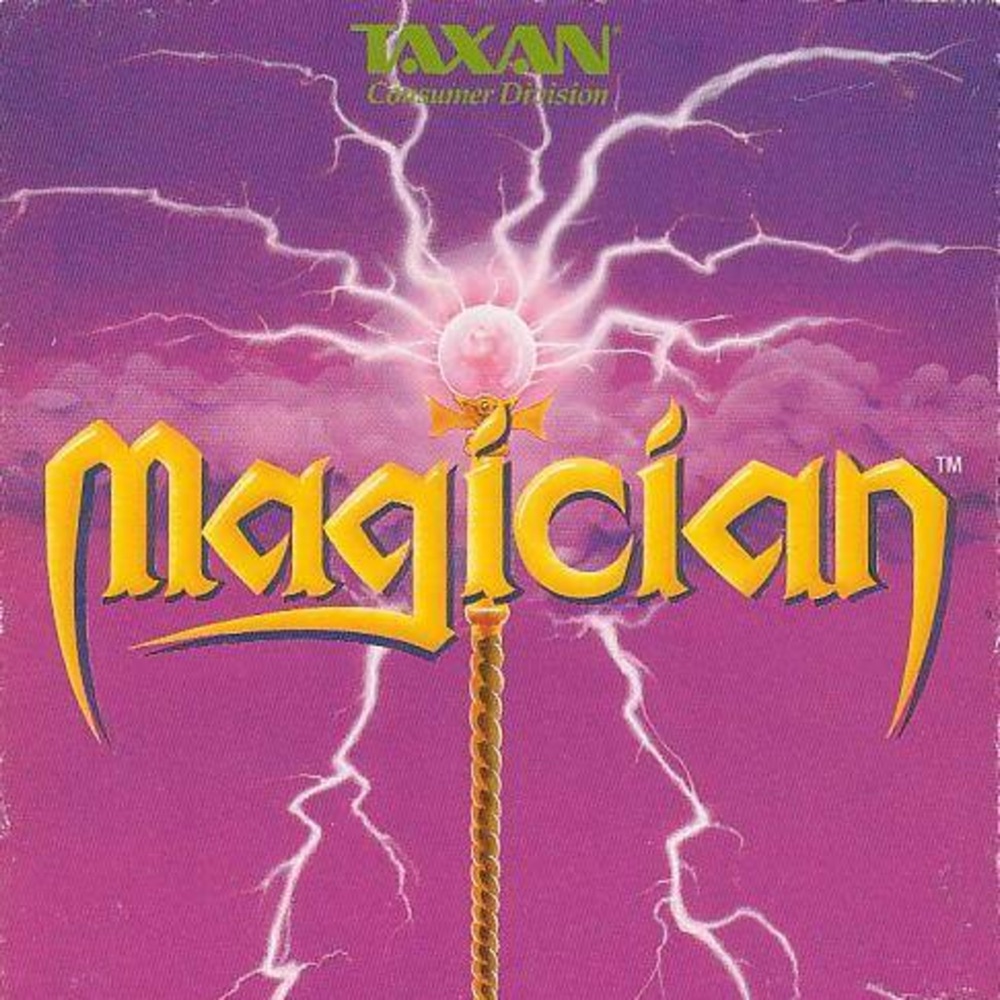
440 · Magician
Magician is a side-scrolling action role-playing game released for the Nintendo Entertainment System. It was designed by Eurocom Entertainment Software and published by Taxan.
Just Mike and Joe this time, since Sean was, as we decided, kidnapped by a magician. You play Paul, the last magician left in the land of Merlewood, hunting down Abaddon, who is also a magician, so the title stays a mystery. The manual reads like a sweeping RPG. In practice it is a Faxanadu-style side scroller buried under menus, and we spent almost an hour on it.
What's clever
- Spelling your own spells. You build words from runes, each with its own sound, and every attempt costs 50 mana. An unofficial combination still casts something, so guessing is Russian roulette with your own health. Nothing stops you from typing in a spell you already know, which is how a guide hands you level four fire in the opening minutes. We agreed that is where to put the guide down. Every spell comes in levels one to four, and a flight spell cast too low drops you in a pit.
- Needs, not a clock. Food, water, mana, venom and health all drain, so leaving a town carries a real "I'd better find shelter soon" feeling. That beat a countdown timer. Vegetables, the cheapest food, were the right buy every time.
- The music. We rarely talk soundtracks, but this might be our favorite NES music so far, full and with real bass. Joe knew the songs from an emulator tech demo he downloaded after high school, and was stunned to learn they came from this.
What gets in the way
- Menus, all the time. Changing spells, levels and items stops the action, so fights, which are projectile spam with no feedback, get chopped up further. We wanted icons in the text box that cycle with Select.
- A town full of nothing. Locked doors, silent NPCs, and a hero who walks slower than everyone around him. Talking means lining up exactly and pressing up.
- Hidden requirements. Nothing is optional, and experience arrives randomly: "you feel more experienced" after delivering a letter, or after talking to a tree twice. Skip the reveal scroll and dragon egg in a tree trunk and you can get stuck. Miss max stats and you get the lesser ending, then replay on a harder setting, then once more, only to be thanked "for playing."
- Limited saves. The battery allows 15 saves in each of four slots, 60 in all. A save that cost mana would at least have made sense.
- Under-used spells. Iron boots serve one puzzle, and jump matters in one zone.
Odd corners
The story goes that Eurocom's first game was made by three people in a barn. In 2012 Chris Shrigley released the source code for educational use.
The bottom line
Skip it. We both voted no. Joe admitted he loves it anyway, with the nostalgic music doing a lot of the lifting, but the menus, chores and cheap deaths were too much. Mike said a hardcore NES fan calling it underrated wouldn't shock him, since the big swings land maybe 60 percent of the time, but almost nothing about it works in 2026. Play it with a guide only as far as you must.
Written from our conversation in this episode.
Outline
- form the Ultimate Potion, and confront Abadon!
I. Setup & Premise
- The pitch: an apprentice wizard against an evil magician
- You play as Paul, the last apprentice magician left standing in the land of Merlwood.
- A powerful magician named Abadon got tired of helping people, built himself a castle, conjured up an army of beasts, and wiped out the wizards who kept order.
- The premise hides what kind of game this actually is. On paper it sounds like a sweeping fantasy RPG. The manual reads like a long quest. In practice it is a side-scrolling action-adventure with a survival layer bolted on.
- The simplest way to frame it for listeners: This is not Faxanadu and it is definitely not a fast action game. It is a slow, obtuse, menu-heavy action-adventure where you manage meters, write your own spells, and can quietly ruin your whole playthrough without knowing it.
- The closer comparison is early Sierra adventure games: clever, atmospheric, and very willing to soft-lock you with no warning.
II. What Makes It Stand Out
- You literally write your own spells. The magic system has you build spell words out of phonemes. Each spell is a specific word you assemble and save into your magic book. You can sit down at the very start and write out every spell in the game if you want, though each one you transcribe costs 50 mana. This is a genuinely unusual mechanic for a 1991 NES game and it is the thing the game is remembered for.
- It is part survival sim
- Paul does not just have a health bar. He has food, water, health, mana, and a venom meter, and the food and water tick down constantly.
- It was made by three guys in a barn
- Magician was Eurocom's very first game. According to Taxan's product manager Ken Lobb, when they hired the British studio there were three founders working out of a barn, and Taxan signed them specifically because of this game.
- It was also one of the last games Taxan published before the company folded. First game for one studio, near-last for the other.
- It has multiple endings, and one of them is dark
- Finish clean and you watch Abadon slump to his death.
- Kill enough non-hostile people and the ending plays with no music, the village sits deserted, and the game tells you your efforts were wasted.
- There are also small ending variations tied to your max mana and to how many loops of the game you have completed.
- "You feel more experienced!" Magician hands out experience for the strangest things. Talking to a certain tree does nothing. Talking to that tree a second time makes you more experienced.
- Later, simply walking into an anti-gravity room lined with ceiling spikes earns you the message, before you have done anything clever to survive it. Just entering counts.
III. Gameplay Structure
- Eight linear levels
- Serenna town, the Wilderness, the Lake, the Forest, the Mount Vunar caverns, the Dungeon, Abadon's Castle, and his Tower.
- Levels are linear and gated. You have to do specific things in order to move on.
- Controls are assignable and menu-heavy D-pad moves Paul.
- A and B are not fixed. You assign them on a setup screen to things like cast spell, jump, speak, or use item. Want to talk to a villager? Set B to Speak first, then walk up and press B.
- Start opens the command assignment screen. Select brings up your status. Because so much lives in menus, a huge part of play is pausing to reassign buttons, swap spells, and manage items.
- Combat loop
- You fight with attack spells and defend with up to four types of magical shields you build up.
- Mana is the whole economy. Spells cost mana, shields cost mana, even writing a spell costs mana.
- Enemies regenerate over time, so slow, inefficient fights can spiral. The guides online tell you to fire fast or watch a weak enemy heal faster than you can hurt it.
- Item and puzzle loop
- You collect keys, scrolls, charms, the elemental vials, food, water, and one-shot potions and rings. Treasure chests dropped by monsters vanish after a few seconds, so you grab a key and crack them fast. (GameFAQs, FatRatKnight)
- Talking to NPCs matters. Some are useless, some hand you crucial information or spells, and some will not talk to you at all. (American Lucha Libre)
IV. Unique Gameplay Elements
- The phoneme spell-building system, up close Spells are words. You assemble them from sound pieces and store them. Utility spells let you reveal hidden areas, light dark rooms, leap around, and even fly.
- How the phoneme spell system actually works Spells are words you build out of a small set of sound runes (MI, NA, RA, ST, OL, FI, HU, and so on) in a SpellBuild menu.
- Hit on a valid combination and the spell is saved into your spellbook, so you can recast it later without re-entering the runes.
- Writing a brand-new spell from scratch costs 50 mana, so you cannot just sit there spamming guesses.
- You can also buy spell scrolls in shops or get them from NPCs, but if you already know the runes you can simply type the spell in yourself.
- Casting a combination that is not a real spell is a gamble: it usually fizzles, sometimes restores you to full health, and quite often just kills you on the spot. (CRPG Addict / Speed Demos Archive)
- The attack spells:
- four schools, four power levels each: physical, venom, fire, and power
- Spear (Pholmira) throws a diagonal spear, Ven (Venahunara) fires a poison ball straight ahead
- Fireball (Fistmira) and Fire Ring (Fiolnarast) are your workhorses, and Fire Spray (Fiolhunara) erupts a fountain of flame out of Paul himself.
- The four shields, one per school
- Phys Shield (Phranarahu), Ven Shield (Veranamist), Fire Shield (Firanahura), and Pow Shield (Poranastra).
- You match the shield to whatever is hurting you.
- The utility spells, which are where the puzzles live
- Reveal (Minara, entered as MI-NA-RA): makes hidden objects and doors appear. Some rooms are impassable until you reveal what is really there.
- Wakey Wakey (Minastol, MI-NA-ST-OL): wakes sleeping or petrified things, including a stone-cursed wizard.
- Light (Miolst, MI-OL-ST): lights up pitch-black caves.
- Fly (Miranarast) and Jump (Mirahufina): vertical lift and gap crossing.
- Fleetfoot (Mimifinast): speed up. Iron Boots (Mistnast): the opposite, slow and heavy, which sounds pointless until a puzzle needs your weight.
- Meditate (Mifisthura): recover mana faster, at the price of burning through food and water faster.
- Three puzzles to walk through on the show
- The petrified wizard, invisible until you Reveal In the Wilderness
- First you have to find the Reveal scroll, hidden by searching a hole in a tree trunk, which also hands you the Dragon Egg and a boost to your max mana.
- Cast Reveal and the invisible objects pop into view, one of them a wizard statue.
- Cast Wakey Wakey on the statue and you revive Belseth, a wizard Abadon had turned to stone. He thanks you with a scroll, some experience, and the Vial of Earth, one of the four elements you need for the Ultimate Potion.
- The talking point: the puzzle is literally invisible unless you happen to be carrying the right spell, and the game never spells that out.
- Iron Boots makes Paul slow and heavy. On its face it is a downgrade you would never cast on purpose.
- But in the Forest there is a rickety bridge with a decayed plank, and the only way through is to cast Iron Boots and let your own weight crash you through it.
- The talking point: the game quietly teaches you that even the spells that look like dead weight are really lockpicks for one specific door.
- The weighted door in the Dungeons, solved with a clone of yourself Deep in Abadon's dungeon is a door release that only stays open while something heavy holds the switch down.
- The intended answer is the Twin spell, found nearby, which produces a second Paul. You park the twin on the switch and walk through the door yourself.
- There is at least one spell, Exorcise, whose formula the game never tells you anywhere. Players apparently had to brute-force it or dig it out of the ROM.
- The save system is stingy
- It uses battery-backed save, which sounds generous for 1991. The catch: you only get 15 saves for the entire game, spread across four slots.
- Knowing where to spend a save is its own skill, and a blind player will waste them. (Wikipedia / Questicle)
- Soft-locks with no warning
- Miss a single item and you can be stuck multiple levels later with no idea why. Skip the dragon egg early and you cannot get a charm in the caverns, which means you cannot reach the dungeon at all.
V. Reception & Legacy
- A surprising second life as open source. In December 2012, Chris Shrigley released the game's full source code to the public for educational use.
- That makes Magician an unusually well-documented NES obscurity. You can literally read how it was built.
VI. Sequels and Spinoffs
- No sequel, and a clean bookend There was never a Magician 2. The game stands alone.
- Faxanadu: the obvious NES shelf-mate, another side-scrolling action game with towns, shops, and magic, but far more forgiving and better paced.
- The Magic of Scheherazade: another NES take on a wandering magician with spells and helpful NPCs, if the hosts want a same-era contrast.
VII. Essential Games List Vote
- Case for Essential
- The spell-writing system is genuinely original. Building words out of phonemes is the kind of ambitious idea the NES library rarely attempted. The survival-meter layer and multiple endings, including the dark "you murdered the village" finale, give it real depth and personality.
- Case against Essential
- The difficulty and obscurity are punishing.
- You can soft-lock yourself for hours with no warning, and a coin-flip spell can end a run outright.
- It is menu-heavy and slow, and it basically demands a guide to finish.
- The stingy 15-save limit punishes exactly the experimentation the game otherwise invites.
Show notes
- This is the fastest paced video game anywhere
- NES Longplay
- Manual
- There's a discrepancy of when the game was actually released. Eurocom's own website lists the release date as March 1990, but popular magazines of the era such as Nintendo Power, EGM and GamePro lists the game as being released around February-March 1991.
- Was I the only one disappointed that this wasn’t a game about card tricks and rabbits?
- Cool intro music and tutorial that shows what can occur during the game
- First thing you learn in this game is don’t experiment with the buttons. You immediately use one of your 5 flasks of water if you hit the B button
- Limited SAVES - start with 15
- There's 9 areas. Even with 1 save per area, you still have 6 saves left.
- Resource Management and Health Management
- Food
- Water
- Make your own magic
- Learn em, New Game Plus next time, or cheat from the beginning
- writing a spell costs 50 mana each
- Learn em, New Game Plus next time, or cheat from the beginning
- The pain in the ass of the menu navigation
- Select vs start, vs up and down, vs selecting something (no confirmation)
- Many ways to softlock or miss hidden bullshit
- I got softlocked at the lake. Couldn’t get on the boat. Saving and dying literally restores you exactly where you were
- The Faxanadu approach to side scrolling ARPGs
- When fighting EVERYONE, you and the enemies all look like you’re on a leisurely stroll while also throwing pocket sand at one another
- In December 2012 programmer Chris Shrigley released the source code for educational purposes to the public
- Guess he was preparing for the next civilization after the mayan apocalypse to find and rebuild the game in the future
- Sequels and Spinoffs
- EGL
- Next week -
- NEStalgia Byte -
Auto-generated transcript. Each paragraph starts with its timestamp. Speakers are not identified.
Magician, form the ultimate potion and confront Abaddon.
And welcome to NEStalgia, a chronological exploration of every NES game released in North America. I'm Mike. And I'm Joe. And that's it. No Sean today. A magician kidnapped him.
That's the story we're going to run with. Yeah, we made him disappear. But apparently it's, is that how it works? Like the magician in this game is the bad guy? Or is it the wizard? I see. I assumed you were like on a path to becoming a magician. Right. But wasn't Abaddon, who's the villain of the game, isn't he also a magician? Yeah. So who is the titular magician? Right. Like maybe it's just the concept of magicians. It's like a, it's an essay. The whole game is just an essay on the thought of magicians. I buy it. Yeah. Wrap it up. We're done here, folks.
Uh, no, this is, this is actually a really interesting game. Uh, this is unlike, I feel like a lot of things that we've played on the NES, which has become a recurring theme in 1991. I, I'm kind of surprised that we are on, uh, what season seven of the podcast and, uh, we're still finding new ways to have interesting games on the NES. This one required a lot of reading the manual, a lot of learning because it, it lays down some systems that are, uh, you know, close to RPGs, close to action games, but have their own, has its own like sets of rules and, and combat and such.
And I, I just have to say like right off the bat, I don't usually do this, but like, this is the kind of game that, uh, once I started playing it, I was almost like immediately dreading it because it is so set in the, uh, in the system it created. And if you don't like that or can't understand that or can't like play the way that the game wants you to play, you're just in for like a tough gameplay experience. What do you think about that statement, Joe?
Yeah. I, I think that I feel that way about a lot of games that are like this too. And I did have that same thought when I, when I started this game, but something about this, I found, I, I don't want to say I found much more palatable cause it, cause it is very, there is like a very high barrier to entry on this game with all its systems and everything. But I guess I just found it a lot more interesting than a lot of those other games.
And that pulled me along and like made me really, really intrigued the whole time I was playing it. So you play as Paul, who, uh, is the last magician left standing in the land of Merlewood. And is that supposed to be like, like Hollywood and Merlin mixed together? Yeah. Like Merlewood. I didn't take, I didn't take the Hollywood part of it, but I assumed it was, you know, it was, uh, Merlin based.
But yeah, I think wood is often used as like a, you know, the name of a fantastical land is like that, you know, I'm trying to think of one, but, um, but I'll, I'll come up with one. Okay. And, uh, as we mentioned, Abaddon is the evil, uh, powerful magician and he has wiped out all of the other magicians. So, um, he, uh, he's the big bad that you have to try and track down. And it would be, uh, really silly to boil the game down to something like that because your adventure, uh, your quest is so much larger than just find Abaddon and, uh, kill him.
The, the premise on paper sounds like some kind of sweeping fantasy RPG, maybe turn-based, maybe an overworld and stuff like that has all those elements. The manual has this very, you know, long, uh, story and, uh, you know, Bible like, uh, instructions on how to play the game.
But in practice, it is a side scrolling action adventure game, uh, to close, you know, like, it's not Fizanadu, but it also kind of is. It's, it's Fizanadu with extra RPG layers and entirely, uh, new magic system. Uh, those RPG elements are still bolted on as well. So it's not Fizanadu in the sense that it's not a fast action game, uh, like Fizanadu in Zelda 2, but it, it is like a, it plays just like that, but with menu heavy, uh, you know, uh, quest solving, puzzle solving, uh, exploration and a lot of talking to NPCs to figure out where to go next. So I think it's Fizanadu in the sense that it's a sprawling con like a sprawling continuous
world that is a side scroller, you know, and, and in some of the other gameplay elements, but comparatively it is much more like it's much more meticulous and you have to, you have to really take your time and, and, and do a lot more menuing to do everything kind of like, because you're a magician, like you're not the, you're not the athlete class. You're not the warrior class. You're like the, you're like the nerd class. Seriously. You've got the, you gotta be a magician. You gotta remember your spells.
You gotta go into your menu and you gotta like build your spells and you gotta make sure you set yourself up before every battle with like the types of things you want to do. It's a lot slower pace of a game. And it's, it's like a weird marriage of, of like a, of like a board game and a side scroller almost. And, and heavy evidence on the, uh, slower pace thing, because I was just thinking about how the game drops you, uh, in a, um, in a town proper where there's all sorts of different shops and NPCs to talk to.
And it, it doesn't, it doesn't necessarily like spell out where you should go first or give you like a, you know, Hey, when, when you start, like, make sure you go talk to this guy cause he has a letter that he wants you to mail, you know, like it never explicitly tells you anything you have to do and encourages you to just knock on every door and talk to every NPC. And I think that that's, you know, great in an RPG, right?
You don't want to be told, uh, via like a, um, uh, a navigation companion, what you should be doing every 10 seconds. Right. Uh, that that's, that's like the opposite of, of, of a fantasy, uh, exploration game. So that works, but I hate these, and this, this still happens even today, but I hate these like RPGs that, uh, throw you in and then like make so much of the, the, you know, especially in this opening town, just inconsequential stuff.
Like there's just a lot of closed doors. There's a lot of NPCs that won't say anything to you. It's like, you got to streamline this stuff a little bit. If you're the developer, you got to say like, okay, we don't need an NPC that doesn't talk to you because there are NPCs who are going to tell you hints and that's all they do. You know, it's like, let's make sure that we keep this content relevant.
It's like, there's okay to have like one door that is locked off and, and have like some mystery there of like, oh, maybe there's a, a key I need to find, or maybe that door will open up later. But if you knock on like eight houses and they're all locked, it's like, don't put these houses here. Especially because there's so much space that you need to walk through. It's not like, oh, we got to fill this space because like, you know, it looks empty here. Like the space only exists to hold these locked doors.
Just cut down that first village where nothing is happening except for there's four shops or whatever. And let me walk through, let me walk through there. And, and you know, I, I don't mind there being NPCs that aren't giving you relevant information as far as what to do next. And when I, as long as they're building the world a little bit, they're giving you some information that's like, that's like a character gives the game a little more character. But yeah, there's a lot of them. They're just like, they don't talk to you. And it's, they're ignoring you. It's funny because it's not even just this opening town in general.
Uh, the areas are just very large and you walk at a pace that is just very leisurely. And I, and I think it's a great walking animation. Actually, uh, there's a lot of, uh, animated frames to it. So it does look very fluid, but every other NPC is walking like a little bit faster than you. And you just wonder like, well, why couldn't I just walk at that speed? Like, why can't I match them? Like, why am I, you know, the, the opening town, you would think that like, oh, maybe there's other directions I need to go in. Because if you just go to the right, you keep seeing what looks like repeated elements.
Didn't I, wasn't I here before, but you actually weren't, you haven't gotten to the end of the town yet. It's just that big of a town and talking to NPCs isn't as easy as just like being next to one, uh, who's still. And, uh, uh, here you press the up button, uh, to talk to NPCs.
It's not, it's not that easy. You have to be timed exactly with them. And then the game tells you like, you know, whether they had anything to say to you or not. And that's not the only time that the, this ever present like message screen that's at the bottom of the UI. It doesn't just give you messages when you do inputs. It also sometimes just like displays new world building information there, depending on like what you walk past. And so you kind of have to keep this. It's not, it's not hard to manage. I'm just throwing it out there. I'm making it sound maybe a little more grand than it is, but you do have to keep an eye on
your messages screen because it's not something you can pause and scroll back up through and be like, wait, what did that just say? Like you don't have the ability to do that. So you do need to make sure that you're reading the messages that come up during gameplay. Yeah. But what I did appreciate about it was that as long as a new message doesn't appear, the last message is, is permanently displayed in that box.
So, you know, there's not like a short window that you, you can't miss the message. I can like look back a minute later, as long as I didn't talk to someone else. And be like, okay, I remember what this said. Like this is, it's basically like the, I feel like a, an early solution to being like, what's your current quest? It's like, what's the last thing that I did? So I remember where I am or what I'm doing.
Um, the thing about the text box that baffles me is the way it animates text animates on and off is like, I don't even really know how to describe it. I think it's like that, that the, the text is populating from the middle, but it starts on the top row. And then like a second later hits the second row. The third later is the third row, which creates this weird, like wave effect of text. It's like very, very confusing to look at at first. I got used to it after a while, but I'm like, couldn't we just scroll or literally just like pop on or pop off? Because it's like, it makes it a little hard to read until, until everything settles down.
I completely agree. It has like that, uh, that, uh, barn doors video transition to it. It's like, nobody, nobody's supposed to use that, you know, uh, the, the, the cube transition, like, you know, you're not supposed to use those transitions in video editing. They're just there to catch people who don't know what they're doing. Yeah. They're there for the viewer to know that like an amateur made the video. Right. Yeah. Don't waste your time watching this.
Yeah, exactly. And, uh, there are a lot of, um, there's a lot of shopping to do. And that part's interesting because I don't think it's unlike shopping in, uh, you know, more traditional JRPGs where you do have to like buy your equipment, buy your potions and everything. But because you still don't exactly know what your, you know, like what your quest is going to be like, and they do throw a lot of money at you from the beginning relative to like what things cost. I also didn't feel like I was like, I had enough knowledge to know how much meat I should be buying, you know?
Well, I only did because I, you know, I looked at a, an FAQ. So like I, you know, and I had like strategies and I tried, I tried to keep all the meat completely like maxed out as much as possible. The bread maxed out. I mean, everything maxed out and they can max out each of those items at five, which gives you incentive to buy things that are like, like, actually, I think the best item for,
for help for replenishing your food is the vegetables, which I think is also the cheapest item, which I found interesting. Like the only reason you wouldn't buy more vegetables is because you've maxed them out. And the only reason to spend more to buy something worse is because you don't have room in your inventory for more vegetables. Cause I guess you have like a vegetable pocket. I don't know. You can't put any other food in, but, um, so yeah, I, I, the, the inventory management, I'm sure we'll get into that more, but like, I, I, I didn't hate it as much as I think I would have if I, uh, wasn't following an exact guide because there's, it's, it's quintessentially
important. I don't know if that's redundant, but it's, it's very, very important that you manage all these resources at all times. And I feel like this game does require a guide. Uh, you know, I, I, I think that this is the kind of thing where, uh, you can, uh, talk to the characters in the game and read the manual and attempt some things, but ultimately to make forward progress, you're going to want to hear from people who already got to the, uh, the next part. Cause it is a fairly difficult game on top of everything.
Now, probably the most interesting part, uh, from a combat and game design perspective is that as a magician, obviously all of your combat relies around magic. Uh, they could have given you a sword too. Why not? I don't think there's like a, a rule against magicians, uh, using swords, but since you are a magic character, it's all built around a magic system. And in this game, you build your spell words out of, um, like phononyms. How do you say that word? Runes? I don't know. Yeah. No, I'm thinking of like, you know, phonetic stuff, like the fee, raw, you know, like there's like various sounds you make and you try to create a word out of that. Like they could, uh, a spelling bee for a language you don't understand yet.
And each time you try to create a, um, a spell, it costs 50 mana. So you can't just kind of like brute force every, uh, you know, every possible word combination. Plus if you, you could kill yourself if you, if you use the wrong word combinations, you can like just disintegrate. Yeah. Because any spell that's not official, right. Any, any spell that isn't an official spell still, uh, works as like a, it counts as something, you know, like you did, you did cast something. And so, yes, it does have like a roulette odds, uh, effect of, um, playing Russian roulette with yourself there.
Now the spell system though, I mean like that's pretty cool and is very effective if you have a guide because they didn't like make it so that you have to discover, uh, the actual like, uh, sounds in order to use them. You know, like you have the ability to say anything that you could have come out of your mouth. That is the combination of words you can put together in the game. So you can start the game and just start like, oh, I already know this spell from my last playthrough or my friend knows this spell. And you can just start casting level four fire, uh, right at the beginning of the game because you somehow knew it. The game doesn't hold your hand in that regard.
Yeah. And I, I like that. And I think that that is where, uh, you should stop using your guide because I feel like it, it is much more satisfying to play through the game for the first time and learn these,
learn these spells from the context of what's going on around you. And, you know, sometimes people will, I think normally it's just people telling you what it is or you'll find you can, there's a scroll that will tell you things. But if you know that you can buy that, you can just automatically get the new spells, but also you can like hear it from NPCs. Like this is the spell that you got to go into your inventory and spell it out with the different runes that each have a different sound.
But I think what's cool about it there is then like, yeah, if you're playing again, then it's like, well, why not? I, I, as the player did already like quote unquote earn this knowledge. So now I do feel like even at the beginning of the game, I've started out more powerful than I would have, uh, on my first play through where I think if you, if you use the guide to go quite that far, I think it just like robs a little, like the last little bit of like where the intrigue and imagination and like the fun comes from, from what this system is
building. It's almost like at that point, what's the point now? Oh, it's just a chore. You got to just go in and type in all these spells rather than, you know, you know, you know, you find one, you got to type it in every, you know, every once in a while and there's long breaks between them. It's not a big deal, but, um, but I really, really liked the, the spell crafting system. And I think it works decently well in this game. I, I, I have some thoughts about how I think this game could have been designed better around that, but, but I appreciate this is something I've never seen before.
And, and yeah, to, to sum up what you were saying there, Joe, to, or maybe to put a button on it, uh, it is one of those things where, uh, you might as well just use game genie then, right? Exactly. Like if you're going to just give yourself all the most powerful spells, why not just also make it so you don't take damage at all in the game, right? Uh, that's what debugging is for, not for playing an actual video game. So I think we're both on the same page that we don't condone that, but I think it is interesting that they give you the option for it for like, like a new game plus or something. Yeah. You just go in and you're like, yep, this time I have a ring of fireballs around me.
Uh, granted there is a workaround for that in the game too, that, uh, casting a spell that is level four, uh, requires a certain amount of mana that you don't have the experience for yet. And so you can't just continuously spam these level four spells. You probably have enough mana at the beginning of the game to do one of them. Yeah. Every spell has, once you have the spell, you have levels one through four of that spell.
Right, right. So you can always use a lower version of that spell. And for the attack spells, you know, they obviously do different power levels and everything. And then I, I think for a lot of the like, um, spells that are, that, that do stuff to the environment, I think that there are some times where you just need to know what level to use. Like there are different, I know with like flying, cause there's a flight spell, like higher levels, just let the spell last longer.
And sometimes it's like, well, if you use too low of a spell, you're just going to fall to your death in the middle of whatever you're trying to fly over. Which is weird cause you don't know how long it is to fly over. Right. Which like encourages me to always use flight level four, which wastes some mana. And I guess maybe that's the risk reward that they're trying to go for. Like, do you want to take the risk and try level two and how far do you think you got to go? But you know, yeah, usually you can't see that far ahead of you on the screen anyways.
So, um, you know, it seems like an idea that wasn't fully baked into the gameplay, but I think with the, the runes in general, or I'm sorry, the spells in general, like I do love the system. I just wish that the way you discover these spells, there was a little more variety in them. Like, like maybe have an enemy that shouts the spell as it shoots something at you or like, and then you got to just see it on screen and be like, Oh, I wonder if I can do that spell type it in. And like, that's a cool moment.
Maybe there's a little puzzle. Maybe, you know, this is, this is getting a little crazy here for what this game is. Maybe there's a optional path you can go on. Maybe there's a cave you can go in, but you can also miss. And then inside there, there's, you know, the, the rune, the, the spell is written somewhere.
Things like that. Like, I think that that is one of, uh, one of the things I think would have helped this system. I've got more. I'll sprinkle them in throughout the episode. Oh, love it. Yeah. Now I did play a game last year that had a similar magic system. Uh, the kind that you had to, uh, you know, assemble the, I'm just gonna say it. I think that, I think they're phonemes. The, the, this, I don't know if that's exactly how you say it, but, um, this idea of putting a bunch of, uh, letters together to, to spell out a new word. And that game was eternal darkness, uh, sanity's requiem on the GameCube.
And I, I wasn't expecting it there either. And it was kind of interesting, but in that one, because it's in an ancient language, you have to, um, by playing the game, you have to like uncover those, uh, those phonemes that you don't know yet. And, and that's how you like take them back with you to the modern day. Cause it's also like a time travel game where you play through past lives and stuff.
Uh, all that to say that that's how they kind of like gatekeep it from you that you, uh, you don't have the ability to try out creating any, uh, new spells until you get the next phoneme because then you can be like, oh, well now that I have this, let me try all these different combinations and see if it makes any new spells. Yeah, that's cool. I think that that helps balance it a little bit too.
Unfortunately, it also just tells you the new spell. So it's like kind of useless, but like, just gotta, gotta, gotta say it. Gotta throw a shout out to there. Cause it's a, it's a pretty interesting game otherwise too. That's the, that's the one where like, as you get, uh, as you see crazy things in the game, the character, the protagonist character's sanity meter drains. And so the game starts doing funny things to the game to make you question your own sanity as the player. I, I, I think I remember you telling me about that. Does it do that dynamically where like I can play a second time in my, my sanity meter might not drain as much on the second playthrough.
Oh, absolutely. Yeah. You could, and you, and you could know how to make sure that your sanity doesn't drains things that you don't have to deal with. Like first it's just stuff like, oh, it's mirrored, uh, the screen, but you don't notice it's mirrored yet, you know, or your controls are mirrored or you go into a room that like you're walking on the walls now instead. Right. And, and then there's other things like it starts lowering the volume on your TV and you're like, it's so weird. There was one where it actually like makes it seem like it, uh, reset and then your memory card is corrupted.
Uh, I, I love stuff like that. Like they really go all out. That's really cool. Yep. And this game goes all out too. Uh, not just on the magic system. It's also, uh, a little, it has a survival, uh, simulator mechanic to it too. Uh, because you don't just have a health bar, you have, uh, a food bar, a water bar,
a mana bar, a venom meter, all of these things that you have to manage. And specifically on the food and water, that is a ticking, uh, I mean, just like humans, right? It's just like we have to do every day. It's ticking downwards and you do have to replenish that. And that's why you have to know how much meat, uh, to buy. And, uh, as Joe concluded, the correct answer is always just have the most. If you can, if you can afford all the vegetables, buy all the vegetables.
Yeah. Um, yeah, this is like one of those things where I think the, the idea of it sounds interesting. I mean, I, I doubt anyone listening is like, oh yeah, that that's what I want in any of my video games. But like, I think just in a vacuum, if you're not, if you're just making a video game for the first time, that idea sounds interesting, but yeah, it becomes a bit of a chore. I, I do think like, I think there was a time where I could have found this more interesting, where I could have been like, you know, it, when I was just, when I just had an NES and like, this is, you know, I only had a few games to choose from.
Like, I feel like I could have been like, oh, okay, this is like a totally different type of adventure where it's all about managing things as I walked through it and whatnot. And I think that the food management and the water management and like the poison meter and all that, like that stuff would lend itself to a different type of satisfaction as I got through the game where I'm like, okay, I'm getting through it and I, and I gotta constantly be managing it. And it's just a different way. But I do think like that time has passed because of how much video games have evolved. It's really hard to go back to something like this and appreciate it in the way that I, I suspect I could have, uh, if I played it when, you know, when I didn't have a PS5.
It's, it is a novel idea, uh, even back then to, to have like the idea of like, yeah, this guy is, you know, he does need to eat. He does need to drink. But the problem is, um, specifically, uh, even, even when the games are this early on, uh, not even nowadays, but like, if you're going to put systems like that in place, you
might as well just sell the whole survival sim idea too. And also have to, you know, you have to go to the inn and you have to sleep, right? If you're not sleeping in between the days, then it, then you're going to be tired and you got to cook your own food. And like, if you're only doing just like, Hey, you got this food in this water meter, then it just becomes a chore of just like making sure that you're shopping enough to have food. And it's just like a check to make sure you're paying attention. Right. Yeah. And just, I mean, I guess there are like some things that make like, I think like that make your hunger go up more quickly.
There's, there are some like, I guess, payoffs or, or trade-offs rather where like, you know, there's a meditate spell that you can use later to earn mana, mana back, but it makes you hungrier and thirstier. So it's like, like there are few and far between, but like some utility to these things other than just like keep paying attention, make sure you keep feeding your character.
But, um, but yeah, it's just not enough to, to really justify it for me today. A completely different game, but also a side scrolling game. We had a hunger system in Adventure Island two very recently where you always have to be eating or else you'll die. Uh, and, and this game thankfully doesn't take it, uh, to that extreme, but you do have to, um, you do have to keep an eye on it. And I guess it's the kind of thing where you are in the menus enough and it's just there. It's not like you have to go to like some sub menu to check on your stats or vitality or something that like, it could be top of mind, but you are in those menus a lot. And that's because that's also where your inventory lives.
And, uh, you'll be doing a lot of, uh, not just switching, but also like changing your spells and stuff like that. You're spending a lot of time inside this menu. And I was trying to think about, and I didn't actually have an answer for this one because of just the way that the games controls are set up, how you would avoid that because you do spend a lot of time in, inside those menus in, in a way that like continues to stop the gameplay. And did you have a similar problem with that, Joe?
Yeah, I did. I did pretty quickly like resign myself to the idea of like, that's what this game is. It's a game where you stop and think a lot. So it's a game where you go into the menus a lot. And I, and I think I made it, made myself more okay with it by thinking of it that way. But I did initially think a good solution would be.
In your little text box that's always at the bottom, just reserve one little bit of real estate in that text box for two icons, you know, in an icon that represents a different spell, maybe a different color for each spell. And you can just like hit select to cycle through them or something.
If you don't want to go into the menu and then another icon that is your item. I don't know. You might have to come up with crazy button combinations to like switch between items versus switching between magic or something like that could be something because especially with the spells. I mean, like the whole point of the game having to in the middle of a battle constantly pause it and cycle through and change the power level of the spell that you're about to use next.
It is, it does really break up like the little amount of action moments that there are in this game. Not that those are like some crazy, otherwise some crazy good like boss battles or anything like that. But it does like, you know, it breaks up the action enough that I do wish that there was maybe some solution. But overall, like, I think that like, yeah, if you're going to play this game, you gotta
already go into the mindset of like, you're going to be doing a lot of menuing. It's almost like a, it's almost like a menuing game with some side scrolling as like a bonus, you know? Um, so I find that interesting. And I, and I do want to say one thing, uh, kind of in defense of the food and water system that that's just kind of forming in my head right now. So I do think the one thing that it, that, that adds to this game that is like when you're out of a town or you, you leave like some kind of safe haven where you're at a shop or you're at a, you know, water that you can refill or you're just going through a new area, you're going through the lake area.
It's a much more, uh, it's a much more, I guess, dynamic and interesting way to make you feel like I better not stay out here too long. It's like, I have to make sure I'm prepared and I have to like get to the next safe place soon than a time limit would be, which like, I feel like most games go towards. So like, I, I do appreciate that. I do feel a little bit like I'm the one engaged in like, how much food do I have?
How much water I have? It not just like how much time is left on this arbitrary clock, not saying it's gotta be one or the other, but I think that, uh, it's at least an improvement. Like it does give you that element of like, oh, I'm in danger, not just because there's enemies out here, but like you go out into the world and you have to think about this stuff. You're on a little quest. Now you have to like, make sure you know where you're going to get shelter and stuff like that. And it gives you that feeling a little bit.
I, I, I think you make a good, as good a case as one could for the system. And I do hear you like, yeah, it would be even stranger if you had a timer in an RPG. I don't think we've seen that yet. Right. But it's also just like, I, it's just like almost doesn't register RPG to me as much as I think because of just like the way it looks and the way you're fighting things. Like it obviously is an RPG, but like, I think because it's such a side scroller, I could see there being a timer.
There are many messages you can get in the game, but one that, uh, the player would hope to see a lot is, uh, you feel more experienced. It's not, uh, the kind of game where, uh, it just tells you that, you know, oh, you defeated this enemy, you gained five experience points. You just have these moments where you feel more experienced based on, uh, completing or doing, um, a specific thing.
And it would be great if it was a specific thing or repeatable thing or something that you could detect that was going to come, but you feel more experienced for, uh, some strange things in this game. Sometimes it's just as easy to just like walk in a room and not even like do the thing that you have to do in the room. You don't have to do anything clever. It's just like the fact that you entered the room, you feel more experienced, which
maybe just like, is just a bad translation or something like that. There's some, you feel more experienced by being in there. Like what's happening, you know? But then there's like other weird ones where, you know, you have to, uh, you talk to a tree and nothing happens. You don't get the message. You talk to the tree a second time. You'll feel more experienced.
Yeah. At first I kind of thought like, okay, this is going to be like the experience doesn't come from fighting people. It comes from like completing quests because the very first thing that made me feel more experienced was I delivered a letter for someone and I was like, well, that's weird. But I was like, okay, maybe that's like teaching me that like finishing things like, like accomplishing
things in this game is going to give me experience. And I think that ended up being true, like less than 50% of the time, like, oh, you're at least that I could see what the game was trying to tell me I gained experience for. So like, I liked that idea, but it just ended up being kind of random. And, and I wonder like how much of the experience is missable. Cause some of it, it was just like, well, yeah, okay. I feel my experience that I like did the only thing that I can do here.
So I don't know a little bit, a little bit of a weird, a weird system, but that like kind of ties into one of my other things that I'll sprinkle in now as to what, what I think could have been done differently to make this spell system work better in the game where
if I'm going to feel more experienced from doing these random things, but everything is on this straight line path. And I don't mean like, oh, this doesn't, this shouldn't be a, you know, this needs to be a 3d game where you can walk in any direction, but like, there's nothing optional to do in this game, which is fine for most games. But if you're going to have a system where you're earning experience by doing these things, I would like there to be like, oh, on a second
place, they're like, I can get like really powerful because I can do all these extra things. But more importantly, I think having like a couple of branching paths or maybe like a quote unquote side quest. And, you know, I'm using that, that term pretty liberally. I think that like, it doesn't even have to be like a big side quest, but somewhere else you can go that you don't have to go that maybe you'll discover a new spell or maybe there'll be some reason to use a spell that you discovered.
That's not just like you got this spell and there's really only one time to use it and you're going to run into it because we programmed the game that way. That almost makes the fact that you're building this whole book of all these spells kind of arbitrary. It's just like, yeah, you just get all these things as you go.
And, and there will be the time that we plan for you to use this will come up. Whereas like, I think of, it's silly to compare it, but I, this game made me think of Skyrim a lot. Anytime I've played Skyrim, I've always been some sort of, some sort of mage in some way. And I do think it is cool that you can get these spells and you can go anywhere in the world. And sometimes these spells will work on something, you know, that you didn't
need to go to, or maybe even a better example is Baldur's Gate, where you can like, you can go do these quests, use these spells in ways that you're thinking of creatively. And all I guess I'm asking for this from this game is like just a small fraction of that type of freedom where it's just like, yeah, get all these spells and I'd like to be able to go do something
unique with like a spell that I feel like I discovered that I could have missed. Does that make any sense? It does. And I will tell you, in case you don't know, the worst part about there being nothing optional in the game's mind, uh, optional about like the, the game that you're playing is that there is the opportunity to beat this game. And if you didn't get the max stats, you get the bad ending instead.
So the only way to get the good ending is to do everything that the game intended for you to do. Yeah. That's, that's so often something that like we see too, like this, that's such a, it's such a like, I guess, red mark on, on the game too, where it's just like, anytime that there's something, I think there's something like really, really early on in this game that you have to do or else you're just, you're not going to beat it. Am I, am I, am I correct? Is that with the, uh, dragon's egg thing?
Yeah. Something like that. I don't think I even did it in my game. I didn't beat the game, but when I was watching a walkthrough afterwards, I was like, oh great. Even if I got to the end, I wouldn't have beaten it. Yeah. You have, so there's a, uh, it, I think I have this right. There's a petrified wizard, uh, and you have to, uh, you, you can't even see him. It's invisible until you use reveal, uh, the reveal spell. So first you have to find the reveal scroll, uh, which is hidden by searching a hole in a tree trunk. So you have to know to do that.
That same tree trunk also hands you the dragon egg. So you have to make sure you do it, but you could theoretically not do that and then get to a part where you need the dragon egg later. And I think potentially soft lock yourself out of the game because you don't have, you know, you don't have a way to get back, uh, to, uh, these previous stages, uh, if we can call them stages.
Yeah. Yeah. And I think also that magician, once you reveal him, he's petrified, you then have to use another spell to wake him up. Yeah. You have to use the, uh, the wakey, wakey, wakey, wakey. Yeah. Um, which I mean, that's cool. And I would like more of that stuff in an optional area so I can feel like I discovered something rather than like, okay, the game obviously wants me to do something here.
Yeah. Uh, and then just, just to go back to those endings for a second, it is strange that it's not necessarily a bad ending. It's not like, uh, you know, you defeated Abaddon, uh, but, um, but the villagers are dead. And, you know, it's, it's just like, Hey, you defeated Abaddon, but actually you suck. It says at the ending screen, you've done very well, but only a real magician could see the conclusion of this story. And so if you're a real magician, you get the, uh, you've done very well, but a real magician could beat an even tougher challenge. Maybe you should try again. And so you have to beat the entire game a second time under a harder difficulty.
And instead of doing very well, now you've done great. You must really be a magician, but to make sure, why not give it one more try? Oh my God. I knew about the second time. I didn't know there was a third time. There is a third time. And, uh, the third time it tells you, and keep in mind, everything else about the ending is the same. So this is just kind of like the meta moment where it talks to the player. So it's absolutely not worth it, uh, as a clear condition, unless you really love this game. You are truly, uh, you are a truly great player. You have come so far. You've really earned the rank of magician. Thanks for playing and see you again in future Eurocom taxon games.
Now, is there, so there's no actual different like ending other than that text with like what happens to Abaddon or anything? Just that text, but you don't get the, um, sorry, the other part of the good endings is when you're on that, um, you're in like the mountains and you're looking out at the sunset. You don't get that in the bad ending. You just got the kind of like you return home, uh, your girls with you and everything. And, uh, it just says you've done really well, but you haven't seen the conclusion. The conclusion is at the sunset. Meanwhile, on a faraway mountaintop, Abaddon finally succumbs to his terrible wounds. His body slumps slowly to the ground and rests waiting.
Yeah. And that is where I thought there would be something different in like, I guess the third time you beat it. Cause I thought the waiting was like a clever way to get the loop where it's like he rests, but he's not dead and he's about to come back. Yeah. It's, it's so strange. He shouldn't be waiting in the third one. Yeah. And the third one, okay, now you killed him.
Right. Um, but is there, I don't know if you know this, but like, is there anything different? I know it's more difficult the second and I'm assuming even more difficult the third time you play it, but is it more difficult what you take more damage or are there like, I mean, you know, a big wish here. I'm sure it's not true, but like, are there different enemies, stronger enemies that look different or is it just, is it just, you take more damage, you do less damage or something?
It's a great question. I don't have the answer to it. I couldn't, I, I, I couldn't possibly have seen the second part of these games. Yeah. I couldn't even find a video online of someone playing past the first time. I just have to imagine you just take more damage. Yeah. Which sucks.
Yeah. Cause that feels like, well, wait a minute. I just became like a powerful wizard. Right. Right. I should, if anything, I should be worse now. Right. Yeah. I should be mopping the floor with these guys. Right. Right. Uh, I mentioned this is a Eurocom game. Uh, allegedly because this is Eurocom's very first game, they claimed to have, uh, it was just three guys and a barn and that's, and they made the game working out of a barn. We always hear about like tech guys making things in like their garages, you know, Apple famously.
Usually garages at least have like, uh, you know, electrical hookups. Right. Yeah. Yeah. It's like, uh, what were they working with? The games were running on hay? Like, yeah, but they, uh, they're a British studio and, uh, that's the story they're sticking to. They did it in a barn.
And, uh, the only other thing that's kind of funny here is that this was Eurocom's very first game, but it was also one of the last games tax and published. So, um, first for one studio near last for the other.
Huh. but joe we've managed to go the entire episode so far without talking about arguably why people play video games in the first place uh the combat yeah that's actually crazy i didn't realize we haven't talked about the combat because it's how you uh interact with anything else in this game other than through menuing so once you've done all the menuing and now you need to fight these enemies i have to say from the very first encounter which by the way so rude to put uh the first violent enemy in this game inside the town with you like i thought i thought we had something here i thought we were like part of like a civilization i didn't know we were with barbarians but this guy just
starts attacking you so you learn the fire spell is the first spell and uh i i casted it and i started i was like okay let the battle begin like i'm gonna set this guy on fire and i was kind of dumbfounded by what the result of the combat was it is just a projectile spamming match between you and every enemy in this game every enemy in this game also works on projectiles uh it is crazy to see that ikari 3 abandoned all guns so that magician could run strictly on
projectile based weapons yeah it's quite a uh like there's not even really any feedback like there's no you know you don't see anyone getting hit i guess there's feedback and like they blink but like it's like you go you walk right through each other it's if there's no different strategy i mean this all right let me correct myself there there is different strategy in like the setting up which spells you use before each battle but once you're in the battles it is always exactly what you described
it's button mash the projectile of your choice and like stay far enough away from them so they're not hitting you if they don't have a projectile um it's yeah it's not ideal and i i you know i guess i know that they're not trying to be the action hero where you're like using a sword and shield and attacking it's more again about like you're thinking about what to do but like there could be some level of feedback happening while you're fighting someone and it even in that first encounter and every other encounter afterwards too i i felt like i had taken so many shots that i was like oh i'm probably gonna die soon like i was surprised at at how tanky paul can be for just like a regular dude
yeah and i think it's you start with a hundred percent health and it really does like you know go down in increments that can be as small as one percent you know and bigger than that too but it's it takes a long time to lose your health and i like that about it oh yeah no it's necessary right yeah and it's one of the things that you're managing is your health but i think we also didn't talk about
that four of the spells are shield spells that shield you against different types of attack or like if your power shield spell is at 100 percent like any power like fire projectile will just basically bounce right off of you and same with like if your venom shield is at 100 percent like you just can't get poisoned until it reaches zero and then your health will start going down i think
that's a cool thing too but it does it's like it's bittersweet because it's like it's a bunch of cool ways to make sure that you're protected against all these different things it's also four more numbers you need to manage at all times so this game basically uh needs to sue eternal darkness for plagiarism because i forgot about those shields because we haven't talked about them yet and it's true
that like those same shields are also in eternal darkness and it's kind of crazy that like oh yeah you have to use them to basically like it's a color-coded thing like if the enemy is green then you use red uh barriers and then they can't like enter that zone so it like helps you it's not like that here necessarily but it does help uh you know to your point like counter counterbalance against
the enemy's uh attacks maybe eternal darkness was also made in a barn maybe it's just like a byproduct of being made in a barn is a shield man yeah they went to that barn they didn't even realize it and uh they found the game yeah yeah same barn yeah that's a good point though about the shield so there's attack spells there's shield spells and then we've talked about a few of these reveal wakey wakey and joe mentioned the flight earlier uh there are these utility spells and i do like the meditate one both for the animation too of just like learning a spell that powerful and then like being able to levitate in the air in a you know legs crossed position and now you can recover your
mana faster uh albeit by taking on uh by rushing through your food and water quicker but then there's also like some other spells here uh uh the iron boots uh thing that's like it's very like one puzzle it's it's a one note right there's uh there's a specific puzzle where you have to use the iron boots so that uh i think it's on a bridge so the bridge will crash and you'll crash through the bridge rather and get to the next location yeah for that one specifically there is i think one more time to use the iron boots like towards the end you start like floating up towards spikes it's like a trap i guess okay unless i had the fly spell but either way i use the iron boots to fall down i guess my point was
more just that they are the spells are only something that's useful for puzzle solving unlike some of the other ones that are more useful just like in in the game you know like flight is something that you can also use right for platforming the iron boots could have been something that was not just like for a specific puzzle of like now i got to use these so i'm heavy yes exactly yeah and that's
what i wish yeah it's like they built this whole spell set that's like really cool i mean honestly there's like a lot more spells than in a lot of modern games that have spells like but there's just they didn't build the world around it to make those spells useful in many situations i mean even the jump spell i think i only needed to use one time because it was a time i couldn't use the fly spell
like like it's almost like they deliberately made a zone where if you use the fly spell you'll get the jump spell because otherwise i'm like why would i use this i can just fly and maybe the last of the things that we haven't talked about yet that are buried in this game's menuing uh you can save in this game it is it does have a battery inside of it so you don't have to like memorize passwords or
whatever but you have a limited amount of saves in the game yeah and it's not like three so you're not screwed but i just can't think about like what are what are they worried about here like right you get 15 across four different slots so uh sorry uh 60 total saves but why why like who's deciding to limit the amount of times you can save in a game i don't i've never seen or heard of that like it's not and then when i first was like i was like looking at the guide and it was telling me like buddy save slots i was like okay you can save only so many files nope you can only save so many times and
then you're done saving like that's ridiculous so like if you're on your 60th save and then it's like all right i'm gonna go beat the game and you gotta shut the game off you'll just never be able to save it again yeah it's nuts and it's not like the battery dies by like you know oh you you saved too many times whatever the battery just dies over time it's gonna die regardless yeah very weird choice um it's almost treated like save as a spell or an item that is like used in game yeah which i guess
like would be fine if save costed a costed oh my god what what grade am i in if save costs mana then it would make sense right like oh that's that's an interesting trade-off like you have to make sure you have enough to be able to cast a save right that's a good workaround but to like say like hey and just so you know you only got like seven left it's like why why do i only have seven left
yeah yeah i don't understand the thought process by that behind that at all now i've got something that i do need to bring up that i think is maybe my favorite part of this game okay any guesses
uh favorite part of this game i hope it's not element okay i hope it has nothing to do with the pause no the pause is like nothing right pause is a nothing yeah exactly no no no you wouldn't even know uh is it the music oh sorry i spoiled it no no music in this game may be maybe my favorite nes music we've ever had oh wow and i cannot i can't pretend that there isn't a little bit of like nostalgia bias to me because i know most of these songs how do you know these songs it very i don't
know like i'm someone out there is gonna know what i'm talking about maybe a lot of people will i don't know how popular this thing was but there was a i think an emulator that i downloaded when i first was discovering emulators like in you know i was like just got my first laptop i was just out of high school and i'm like oh cool an emulator and it came with a it was considered i guess a tech demo it was called the cmc 80s tech demo okay and this demo all it was was like
pixels on a screen it was just sprites on a screen kind of floating around in an interesting way and at the bottom of the screen like a like a winter weather advisory scrolling horizontally across the screen was this whole monologue from i guess the guy who created this demo and it starts out with like oh like you guys are all here to see the 80s stuff it starts out kind of like hyped up and then it slowly gets into like what make what made video games in the 80s nes games magical for them and it's then it goes into this whole like nostalgic story about like waking up in the 80s and being like oh
like it's things are simple and we can play games and the music is the there's there's like i think there's like 10 different tracks that play throughout this whole demo or at least there's there's two that played like definitely and then there's a bunch more that later on you can cycle through as it's playing and i swear uh i want to say like five or six of them are from this game like the main like the music when you first start the game the music in the first town and and like for some reason this tech demo has just like stuck in my soul since i first saw it wow so like when i booted up this game and i was like oh my god this is what that music is from and it really blew my mind but i do think the
music is just like really beautiful music in this game it's funny because i wouldn't have guessed that because we talk about music so rarely on this podcast but i will concede that like it's a the whole soundtrack is a very full sound you know it's not like it's just doing like very high pitch things like everything has a spectrum of like high and low sounds there's like a good uh if it's possible i'm listening to it uh i'm playing these games with headphones on has like a bass to it you know that like i'm sure it wouldn't have been picked up on like a crt back in the day but like sounds really nice so it is very full in that regard uh i'm glad you didn't let me keep guessing
though because i was worried that you were gonna say that your favorite part of the game was those like little um like top down parts of the dungeons where you have to like click on them yeah you have to click to reveal new tiles i would have liked those more if they were actual puzzles and not just like trial and error machines yes but that's what they are are you surprised that there's uh no magician 2 there's no sequel to magic i'm not i'm not surprised i i think that hey you know what i'm i'm happy i think that this i like that this lives as this like one-off random thing that
is just kind of a weird a weird anomaly and it did it did get a surprising second life uh in 2012 one of the three original developers uh chris shrigley uh released the uh the full source code to the game as a public educational use to learn from so uh you can now uh basically take this code and rerun it or whatever look at it and it you know i'm not saying that there's anything to learn from it for modern game making but it is always neat to see uh especially for the nes original game code just like it's never surprising that the episodes end with the essential games list
joe i think this game it does it does it's already starting to take a special place in my heart i i have to admit i think it's a really unique experience and i really do mean what i said earlier i think that like if i played it at a certain time in my life despite all its flaws i could have gotten really into it like i could find like a very specific type of satisfaction in getting through this game when
there's all these ways that you can kind of die there's all these cheap ways that you can fail that but like there's just something really cool to me about the way that you go through this game and learn spells and things like that and i think that like i have this this strange fascination with with it and i will admit that the uh nostalgic music for me is doing a lot of the heavy lifting there
but um but i think in the end as much as i wish that this was an essential game it's just not it's just got too many things wrong with it there's too many things they could have done way better and i think that like the system that they made is really really cool but i really wish that the world that they made fit the system and i keep harping on that point but i think that really brings it down
and then on top of that it's just like it is really hard today i can't pretend that like that i could that i could say i could go back to a game like this where i have to constantly be managing the food the water the poison level the the all my shields and and doing that by going through a menu at all times like there's just too many quality of life problems in this game that like that already
halts it from being essential so i think like where i land is it's definitely not essential but i really love it for some reason and i think that's fair i think you have to you know we're coming up on the hour mark here and it's just you and me this time not even sean lately we've been talking about um some some games that may be on par some worse some better than magician that have only gone to like 25 minutes you know like we're we talk about them and they're done there's no doubt that there is a lot uh to dive into with magician and a lot to break down and on paper a lot of this stuff sounds really cool and some of it is pulled off well the writing your own spells thing is definitely
uh unique and interesting in this game uh and can be rewarding if you don't just look up all the uh the spells at the beginning of the game the other aspects though uh specifically even just the combat loop but also just so much menuing it's just too cumbersome for the kinds of games that i want to be on the essential games list this is the game that like if a hardcore nes fan tells me uh is underrated or uh that they personally love it like i don't look at them with like shock i'm not like wow this guy has no taste like this is a this game is taking big swings and is pulling them off like with like
maybe a 60 success rate so more than half right it's getting the job across but it's getting the job across for fans of the nes it's not really doing anything to to have the kind of like still holds up today uh messaging on it almost nothing about this game still holds up today so i agree with you joe that it's a very um unique fun and interesting game but there's just too much in 2026 going against it that i would ever consider voting it essential so if you heard about what we talked about on today's podcast and thought the writing the spells or the survival sim or the um the puzzles or the top thing that we barely even brushed on if you thought any of that sounded interesting you do get a very
full game here but it is uh it is of course with the uh caveat that it's a very hard game too and so the difficulty is there and you will want to take this one with a guide and sometimes just playing with a guide isn't as fun as uh as we want it to be you know sometimes i'm uh i miss an item in a jrpg and i immediately go like oh i wish i would have known about that and i start looking at a guide and then you just continue to follow the guide and then it becomes am i playing the game or am i just reading about yeah right am i just following a set of instructions right and and so whenever you can
break away from the guide i highly recommend it and uh i think magician will be will prove tough but if anybody's done it feel free to write in and let us know we'd like to hear from you guys we hear we are getting some awesome fan mail lately i think i have enough that we could put an episode together about it but uh i also just like you know hearing what you guys have to say so if there's ever anything anybody wants to do to keep in mind that like in the episodes themselves you can write a comment i think that might just be limited to spotify but don't be intimidated you can also email us uh go to the
website nostalgiacast.com there's a contact form there it will get to me tell me your thoughts on magician or any episode for that matter tell me uh where you think sean is tonight i would love to know uh you know where you think he is tell me we've been looking all over for him so please tell me if you think that uh you only one person was hosting the show today because you couldn't tell the difference between me and joe's voices that will be helpful in the future we'd love to know that and last but not least tell me if you think uh nes baseball is haunted because i certainly do wow throwback Outro Music