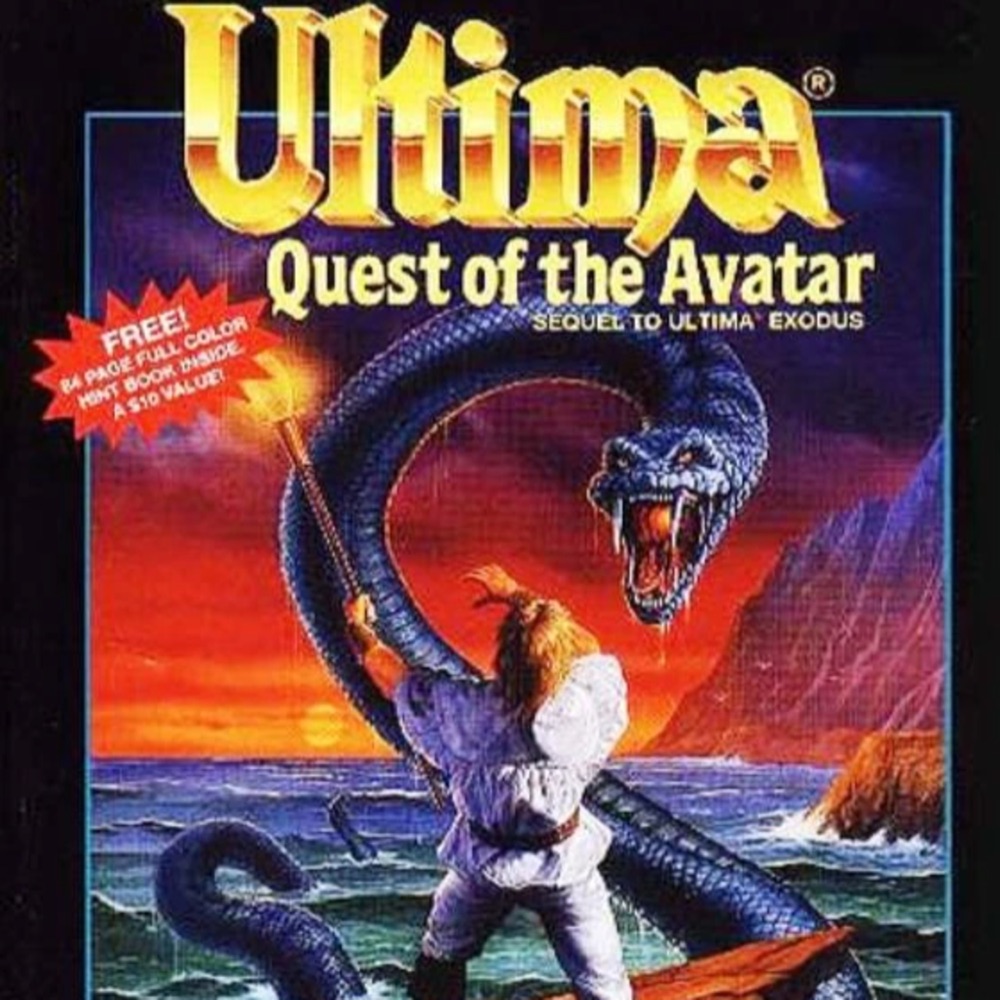
420 · Ultima: Quest of the Avatar
Ultima IV: Quest of the Avatar, first released in 1985 for the Apple II, is the fourth in the series of Ultima role-playing video games. It is the first in the "Age of Enlightenment" trilogy, shifting the series from the hack and slash, dungeon crawl gameplay of its "Age of Darkness" predecessors towards an ethically nuanced, story-driven approach. Ultima IV has a much larger game world than its predecessors, with an overworld map sixteen times the size of Ultima III and puzzle-filled dungeon rooms to explore. Ultima IV further advances the franchise with dialog improvements, new means of travel and exploration, and world interactivity.
From Wikipedia: Ultima IV: Quest of the Avatar (CC BY-SA 4.0)
Ultima IV is the game that broke the weekly book-club format. The show was meant to cover NES games in quick bites, and this one could have taken years in 1990. Joe was out, so Mike and Sean played it, and we both admitted we were out of our depth. The ambition is hard to argue with: there is no dark lord to kill, only eight virtues to master.
What impressed us
- The opening test. Before you exist, you answer ethical dilemmas, and your answers decide your class and which town you start in. Honesty gives you a mage, compassion a bard, valor a fighter, spirituality a ranger, humility a shepherd. We loved it, then grumbled that if the manual admits trial and error works, just let us pick.
- A morality system that watches everything. Fleeing a hostile fight costs honor, while fleeing snakes shows compassion. Shopkeepers are "blind," so you pick how much gold to hand over. Chests are not yours to open. You can attack anyone, Lord British included. Nobody tells you any of this, though, and it is also gameable: leave and re-enter a town to keep tipping the beggar.
- The manual. Sixty-four pages of lore, including a subway-style moon gate map. It even leaves riddles half-filled, like the stone colors and the truth, love and courage triangle.
- The ending. The last answer is that the eight, turned sideways, is infinity. We agreed that after a hundred hours, working that out on your own would feel great.
What wore us down
- Battles. Grid-based and turn-based, with up to four party members here instead of eight. Ranged weapons are the cheat code, and the new auto-attack button just helps you survive the thirteenth orc fight.
- First-person dungeons. False walls hide the way forward, and you can't finish without them, since the runes and stones come from there. We wanted any other kind of puzzle.
- The moon gates. Clever fast travel, but you can't see where they are on the map, even though the manual tells you.
- Time. After the hour-long episode, with no end in sight, we both knew we had barely dented it. Using a guide, we agreed, defeats the point.
Worth knowing
The NES port dropped the typed dialogue (the PC version reads only the first four letters), drops the need to mix herbs, and looks closer to Dragon Warrior and Final Fantasy. We noted that Richard Garriott was reportedly the only person to have finished it at launch, which Wikipedia supports. Ultima V is coming.
The bottom line
Skip it. Neither Mike nor Sean voted it onto the Essential Games List. Mike still told listeners they owe it a look if the idea intrigues them, from a historical standpoint, and Sean called it cool and deeper than anything else on the system, apart from combat, but with too much foundational friction for him. In 1990 we suspect only 30-year-olds were playing this, not 12-year-olds.
Written from our conversation in this episode.
- FREE 64 PAGE FULL COLOR HINT BOOK INSIDE! A $10 VALUE
- 1. General Overview (NES version)
- What it is: An open-world, party-based RPG where the win condition is not “kill the Dark Lord,” it is prove you can live as an Avatar by mastering eight virtues. Wikipedia
- Where it sits in the series: Ultima IV (1985) is the pivot point from the earlier “Age of Darkness” games into the “Age of Enlightenment” trilogy. Wikipedia
- NES release identity: On NES it was released as Ultima: Quest of the Avatar (FCI and Pony Canyon), and it is a major redesign rather than a straight port. Wikipedia+1
- Offbeat questions7
- What do you think about an RPG you “behave,” your way through rather than one you “beat”
- 2. Quick recap of Ultima I to III (how they evolved, not just plot)
- Ultima I (1981): the blueprint, and a kitchen sink
- Core shape appears: Overworld exploration plus dungeon crawling, early “open world” vibes. Wikipedia
- Wild design swing: It even includes a first-person space combat segment, which is very “early PC RPG trying everything.” Wikipedia
- Ultima II (1982): scale, assembly speed, and time travel as structure
- Bigger scope: Explicitly described as having a larger world and gameplay advances vs Ultima I. Wikipedia
- Time travel becomes the gimmick and navigation puzzle: multiple eras linked by time doors, plus optional Solar System travel. Wikipedia
- Series tradition starts: It is cited as the first Ultima to include a map in the box, a tradition that became part of the franchise identity. Wikipedia
- Ultima III: Exodus (1983): the party game and tactical combat “click”
- Huge mechanical leap: You now control a party of four, not a single hero. Wikipedia
- Tactical battles: When combat triggers, it shifts to a separate tactical battle screen where each party member takes turns. Wikipedia
- Classes expand the “build” conversation: Multiple classes, party composition becomes a real decision. Wikipedia
- 3. What Ultima IV changes (the big franchise evolution moment)
- New mission statement: Ultima IV shifts away from “hack and slash, dungeon crawl” priorities into a more ethically driven, story-forward structure focused on moral self-improvement. Wikipedia+1
- Virtue-first design: Your actions change how NPCs treat you, and your progress is measured through the Eight Virtues, not a final boss checklist. Wikipedia+1
- World and interactivity expand: Larger world than earlier entries, more dialogue focus, more travel systems. Wikipedia
- Offbeat questions
- Is Ultima IV basically “a philosophy class disguised as an RPG,” or is it still a classic grindy RPG with a smarter framing? The New Yorker+1
- NES vs PC: what you gain and lose (Ultima IV)
- What you gain on NES
- A cleaner, console-native presentation: Graphics and music were completely redone for the NES release, so it feels like a bespoke console RPG, not a straight computer port. Wikipedia
- Less spell friction: Spellcasting is simplified, including removing the need to mix spells. (In practice, the NES spell list and recipes are also adjusted, with some spells removed and others added.) Wikipedia+1
- Party size as a convenience lever: Since the game caps you at four party members, battles can be quicker and simpler to manage than the full “bring everyone” computer experience. Wikipedia+1
- What you lose on NES
- Conversation depth and world texture: The original computer versions are built around a typed keyword conversation system, and the NES port greatly reduces dialogue options, which can flatten investigation and role-play nuance. Wikipedia+1
- Less of the “big PC RPG” feel: The NES changes are explicitly tied to cartridge constraints versus multi-disk computer releases, so the game is more curated and condensed overall. Wikipedia
- 4. NES version specifics (what makes this version its own thing)
- This is the part worth treating like a “remake design document.”
- Redone presentation: Graphics and music were completely redone. Wikipedia+1
- Conversation system heavily reduced: Dialogue options are greatly reduced compared to other versions. Wikipedia
- Party management changes:
- You cannot have all seven recruitable characters available at once
- Party is limited to four, others stay at a hostel in Castle Britannia and you have to return to swap Wikipedia+1
- Combat and convenience:
- Adds an automated combat option Wikipedia
- Magic simplified:
- Spellcasting simplified, including removing the need to mix spells Wikipedia
- Offbeat questions
- Do you think you are playing Ultima IV, or “Ultima IV: The Highlights”?
- 5. Story and Objective (Ultima IV in one breath)
- Setting: After the first trilogy’s villains are gone, Lord British believes the world needs a new purpose, so he declares the Quest of the Avatar. Wikipedia
- Goal: Achieve enlightenment in all eight virtues, then descend into the Stygian Abyss and reach the Codex of Ultimate Wisdom. Wikipedia+1
- Three quarters of the world disappeared, continents rose and sank, and new cities were built to replace the ones that were lost.
- The Significance of 8
- 8 virtues
- 8 towns
- 8 characters
- 8 directions
- 8 moon gates
- 6. Character creation and “Virtue as build”
- The gypsy test: Instead of point-allocated stats, you answer ethical dilemmas that determine your starting profession tied to a virtue. players must rank the Eight Virtues and whichever stands as their highest priority determines the type of character they will play.
- Human-only: Ultima IV locks you to human race. Earlier games allowed other races. Wikipedia
- Virtue profession quick hits (1–2 lines each)
- Honesty: Mage
- Compassion: Bard
- Valor: Fighter
- Justice: Druid
- Sacrifice: Tinker (or Julius in NES)
- Honor: Paladin
- Spirituality: Ranger
- Humility: Shepherd
- Offbeat questions
- Does it feel cool that your “class” comes from your answers, or does it feel like a quiz you want to game immediately? Wikipedia
- 7. Core gameplay loop (what you do for dozens of hours)
- Explore Britannia: Towns, castles, wilderness, dungeons, shrines. It is open-ended and most objectives can be tackled in many orders. Wikipedia
- Talk and learn: Gather clues, learn mantras, find runes, locate shrines. Wikipedia
- Manage virtue: Your choices in mundane actions (stealing, running, bragging, giving) matter as much as your combat wins. Wikipedia
- Train, gear up, and survive: Leveling and equipment still matter, but they support the virtue quest rather than replace it. Wikipedia
- 8. Combat and party play
- Core system: Like Ultima III, the series uses party-based tactical battles. Wikipedia+1
- Terrain matters: Battle landscapes shift based on where you are when combat begins. crpgaddict.blogspot.com
- The battle command list (what each one really does)
- The NES battle menu is basically five options:
- 1) AUTO
- AUTO lets the computer decide what that character should do.
- The manual notes that AUTO often repeats the last command you input and that it rarely uses projectile weapons or magic. So it’s convenience-first, not “smart tactics.” Digital Press
- 2) ATTACK (and how it chooses melee vs ranged)
- This is a big one on NES.
- If you are in range for a hand-held (melee) attack, the character uses their hand-held weapon.
- If you are out of melee range, the character will use a projectile weapon (if equipped). Digital Press
- 3) CAST (spells in battle)
- CAST opens your spell list, you choose a spell, and then you choose a target using the same target box idea used for projectiles. Digital Press
- Spells depend on your herb (reagent) supply. The manual notes that if you don’t have the required herbs, the target box won’t appear, and you’ll get a message indicating the entire party does not have the herbs for that spell. Digital Press
- 4) USE (items in battle)
- USE in battle works like USE in the normal command list: you pick any item the party is carrying and use it with that character. Digital Press
- 5) MOVE (positioning, spacing, and retreat)
- MOVE puts an arrow next to the party member and you select a direction for them to move. Digital Press
- Retreating is not a separate button. To retreat, you use MOVE and walk a character off any edge of the screen.
- And it’s not “one command and everyone escapes.” Each character must retreat off-screen individually. Digital Press
- Important Ultima IV flavor: the manual warns that retreating can lower your Virtue level. Digital Press
- Ranged weapons are disproportionately strong on NES
- Because ATTACK naturally swaps between melee and ranged based on distance, ranged setups become very dominant:
- StrategyWiki flat-out notes that ranged weapons give a strategic advantage by hitting enemies before they can reach you, and that if the whole party is equipped with bows, you’ll often win before enemies land even one hit. StrategyWiki
- That matches the “shape” of NES fights: lots of enemies, lots of spacing, and your first priority is often to start removing threats before they close in.
- 9. Virtue system (the part you build your episode around)
- Eight Virtues and how you raise or lose them:
- Honesty: Pay fair prices (blind merchants), do not steal. Wikipedia
- Compassion: Give to beggars. Wikipedia
- Valor: Do not flee. Wikipedia
- Sacrifice: Donate blood at healers, help others at a cost. Wikipedia
- Humility: Choose humble dialogue responses, avoid boasting. Wikipedia
- (And the other virtues are supported via a mix of combat restraint, exploration, shrine progress, and choices.) Wikipedia
- Shrines, runes, mantras: Find the rune for a virtue, learn its mantra, then meditate at the shrine to advance. Wikipedia
- 10. Travel systems and “world logic”
- Multiple travel modes: Foot, horse, ship, and even air travel
- Time matters: The clock runs while the game runs; certain actions or systems depend on time. Wikipedia
- 12. Things you’d only know if you played this a lot (especially on NES)
- Virtue landmines are everywhere: The “wrong” mundane action (stealing from chests, short-changing, bragging, fleeing) can quietly wreck progress. Wikipedia
- Mini deeper dives with prompts (no jokes)
- Deeper dive A: Ultima IV as “systemic role-play”
- Prompt: Is the virtue system encouraging you to role-play a person, or just to obey a rulebook with a halo on it? The New Yorker+1
- ENDING
- Confirm you’re truly “maxed”: all 8 virtues are fully mastered (and you have the full party of 8 companions).
- Gather the Abyss key trio (if you don’t already have them):
- Bell of Courage
- Book of Truth
- Candle of Love
- Bring the full set of virtue items you’ll need:
- All 8 Runes
- All 8 Virtue Stones
- Go to the entrance of the Great Stygian Abyss and use the Bell, Book, and Candle to open the way.
- Descend through the Abyss (multi-floor dungeon crawl): survive traps, monsters, and long navigation while pushing deeper.
- At the virtue “gates”/checkpoints inside the Abyss, use the matching Rune + Virtue Stone to pass each virtue trial and continue downward.
- Reach the deepest chamber and claim the Codex of Ultimate Wisdom.
- Return and “complete the quest” by reading/using the Codex to affirm the truths of the virtues, which marks you as the Avatar.
- 13. Ultima V to VII (how the franchise kept evolving after IV)
- Ultima V: Warriors of Destiny (1988)
- Simulation leap: Introduces a time-of-day system and NPCs with daily schedules. Towns start feeling like machines with routines, not static screens. Wikipedia
- Conversation depth remains: Continues the keyword-based conversation style, with chaining keywords for more detail. Wikipedia
- Tone shift: The game pushes a more oppressive Britannia and uses systems like the Shadowlords to make the world react to power. Wikipedia
- Ultima VI: The False Prophet (1990)
- World continuity jump: Moves to a single-scale, continuous world rather than separate world maps and zoomed-in city maps. Wikipedia
- Interactivity expands: More object manipulation and a more streamlined interface (including icon-based input), pushing toward modern “immersive world” expectations. Wikipedia+1
- Perspective change: Dungeons shift away from earlier first-person dungeon style into the same general perspective as the world. Wikipedia
- Ultima VII: The Black Gate (1992)
- Major engine and interface transformation: Fully mouse-driven with drag-and-drop item handling. Wikipedia
- World no longer “feels grid-based”: Movement and item placement are less constrained by visible tiles, and the world becomes more layered and stackable. Wikipedia
- UI invention that echoes forward: Introduces “gumps” (graphical pop-up interfaces for containers, books, etc). Wikipedia
- Essential Games List segue
Auto-generated transcript. Each paragraph starts with its timestamp. Speakers are not identified.
Ultima, Quest of the Avatar, free 64-page full-color hintbook inside, a $10 value.
And welcome to NEStalgia, a chronological exploration of every NES game released in North America. I'm Mike. And I'm Sean. Are we obligated to provide $10 worth of value on this episode now? Well, I mean, with inflation and what people charge for $10 these days, I think we can get away with a lot. It says that it comes with a 64-page full-color hintbook.
They're calling the manual a hintbook. It really is just the actual manual of this game. But the manual, it doesn't refer to itself as such. It refers to it as the Book of Lore. And this thing really is 64 pages of the history of Ultima, giving you a little rundown of where it's been, where it's going, and then proceeds to just be such a loving, what you wanted manuals to be. What we talk about for manuals, this is actually what this manual is. Did you get a chance to look at this? Yeah, I read it front flap to back flap. Um, it's necessary to even put your pants on in this game. So I'm glad I did that. And yeah, it's that there's a lot going on. It's very pretty. The, uh, as opposed to a lot of manuals that actually like, uh, it's coherent mostly.
Um, but it's kind of pales in comparison to the original manual for this game. I'm glad you brought it up. I have that one as well. And, uh, that one is, uh, instead of being the book of lore, it's, uh, it's written in text that I can't even understand because I guess you have to know what's going on in Lord British's world to read that text on the front. But then like, it opens up to a, the book of mystic wisdom. And it, uh, has, it, it's almost like a holy Bible for this world.
Well, there's two, right? There are two. Yeah. And one is like, I think we get one page of history, um, of like what happened in Ultima thus far. Whereas I think like you get that book that you're describing and then also kind of like
a traveler's guide to this world and like talks about politics and like actual lore book, uh, which I thought was pretty cool. Didn't read that because we're not doing Apple to nostalgia, but, um, it looked pretty cool. Yeah. It almost reminds me of like when you start to get into Dungeons and Dragons and you read like, you know, the books for just like, there's a whole book for character creation. There's a whole book for monsters or the whole book for different worlds and different, uh, or not even worlds, but different places in the world.
And if you just read those, you can almost like play those games and do the world building in your head. You don't even have to play the game. I mean, that's half of D and D books to me nowadays because I haven't really played D and D in over like three or four years, but I'll still go back and I'll look at, um, uh, some of the, I forgot what you call them, like the modules, which is like basically how you're supposed to set up a game, but they're interesting enough just as casual reading.
When I first started this podcast with you guys, um, the intent behind nostalgia wasn't just because I love the NES. Uh, I don't know if this is a confession or not, but, uh, I chose the NES both because I always wanted to, uh, cover Nintendo and play all these different types of video games, but also because I thought it was an easily digestible, uh, you know, content for us to
play weekly because when you look at games like super Mario brothers or punch out or legend of Zelda, like they are, they can be epic, right? Like you could just own super Mario brothers and play it for months. You could just own punch out and keep going round after round, hoping one day you'll get to Mike Tyson. Uh, the legend of Zelda really required months because it back then, if you didn't have guides, you had to rely on playground knowledge, but still like for the modern day for 2026,
it's a lot easier to understand and play those games in quick moments. And then, um, you know, on a weekly basis, host a podcast where, uh, we do like a book club thing and talk about them.
That exercise, uh, lost its battle today because there is absolutely, we are just out of our depth here, right? I don't know. Am I, am I talking out of turn, Sean? No, no. I mean, I, I, I like the cons. I like this game on paper. Like I, this is the kind of shit that I, when I didn't have a full-time job would be like super into, but this is, this requires a lot of you and more than you can kind of do in a week.
Yeah. This is a game that I believe, uh, could take in, in 1990 could have taken years. Yeah. And, and certainly even with a guide today, uh, which, which is no fun by the way, I should, I should, we should call that out right away. Is that like, this is, if anything, this is the one RPG that you shouldn't be using a guide for, because you're supposed to be playing as yourself. You're supposed to be doing the things you want to do. And we'll get into all of that, uh, in a bit, but like, you know, even with all that information, it's not the kind of game where it's just like, okay, I go here, I defeat this boss, and then I collect this item, and then I can go, uh, that unlocks this gate to go to this next town.
It's, it, this game isn't that. This is an open world, uh, RPG where the win condition is not to kill some dark lord or stop evil from taking over the earth. It is to prove you can live as the avatar in, in the Ultima world by mastering the eight virtues, uh, of life, essentially. Even like, forget about the eight virtues of Ultima, the video game. It's just really like eight virtues that everyone, uh, should withhold themselves to. Be the best person possible.
Right, and so that's kind of crazy because we're talking about the fourth entry in the Ultima franchise. So it already had three games where it was essentially just your standard RPG of, uh, you know, go ahead and, uh, conquer, uh, all these little feats in the map until you eventually take down the big bad. Uh, Ultima 3's big bad, um, allegedly, like, ends the era of, of, like, bad times for this. And instead now, it's just about being, uh, you know, morally self-improving yourself and, and, uh, and showing that you can be the best person that you, uh, that you set out to. Whether you like it or not. And so that becomes a very unclear objective that you just kind of learn as you play the game how it judges you on those eight virtues.
Yeah, it's very open-ended. And usually when we say open world, uh, we're usually joking because everything is. But we also just mean that, like, oh, it's sequence breaky. And, like, no, this is, like, very, it, there, there are, there are win conditions, but they're not very clear and they're not very, uh, overt. Like, you just kind of have to just do the best that you can do, just sort of wander and be a good guy.
Uh, it, it's kind of, in any other circumstance, I would say this game is lacking stakes. Yeah, because, you know, you are kind of, uh, not given an assignment. Uh, you know, it's not even really clear where you should go next based on who you become. Because the first big test of the game is finding out, uh, your, your character creation, uh, judgment test. You have this thing at the beginning of the game before you ever become a character where you just answer these ethical dilemmas that determine your starting profession, which is tied to, uh, you know, the virtue that you most align to.
So if you, uh, if you got the honesty virtue, you become the mage, compassion, the bard, valor, the fighter, justice, the druid, sacrifice of valor. Yeah, I said valor, didn't I? You did, yeah. I'm fast reading them here. Uh, honor, the paladin, spirituality, the ranger, uh, which is what I usually try to be. I don't know why. I, I, I don't, I don't know enough to figure out why I want to be the ranger, but I like that class. Uh, humility. I think it's because you like the New York, you like the New York Rangers. Yeah, I like the New York Rangers, right.
Good enough reason as any to pick that class. Uh, and then humility, which, uh, leads to the shepherd, which even the manual I think calls out is going to be the hardest class to play as. But depending on which one, you know, you still get to choose your name, of course, but when you get to, let's say you were, uh, the mage, you wind up in a different town too. Yeah. Than any of the other ones. So you're even like how you start the game, where you are in the game, what's important to you in the game is completely, uh, up to your answers in this test. Uh, and first of all, I just want to say that this is awesome.
I really like this, uh, kind of contextualizing your character creation. I, the first exposure I had to something like this was Elder Scrolls three Morrowind, where you get to like a census office and there is like, do you want to murder the poor? And I'm like, no, it's like, okay, you're a paladin. And I was going for paladin. I really wanted to be paladin after reading that page of all of the different, um, all the different classes. But I got fighter.
Um, but yeah, I really liked the idea of alternate starts too. Like the, the, the fact that you can start in, um, multiple different towns, I don't see again until like dragon age and or at least in my experience, don't see until dragon age. So lots of cool stuff here. Uh, but again, doesn't help the whole, like, uh, I don't know where to start of all.
Yeah. And so to, just to give like, I guess some, some ground rules here, uh, again, even though there isn't, even though the only objective of the game is to, um, master the eight virtues, there are, there is like a, um, there's a significant, uh, objective at the beginning of the game. And that is to go to these other towns, meet your other party members, uh, have them join you and, uh, start working towards, um, mastering those virtues, which, uh, those eight virtues, as I mentioned, honesty, compassion, justice, and all that stuff.
They, they are calculated in ways that aren't just, you know, go beat the honesty boss, right? Like it's, it's, it's determined at all times throughout the game based on interesting decisions you make as simple as, uh, you know, if you run into, let's say you have a random encounter out in the world, uh, and it's against, uh, let's say hostile enemies.
Then if you flee the fight, you're going to lose, uh, some of your honor, um, points. But if you get into a random encounter with, let's say snakes, well, snakes aren't trying to attack you. They're just there. And even though they will attack you, if you approach them, that one requires you to flee because you need to show compassion.
It's a, it's a very, yeah, right, right. Yeah, yeah, yeah, exactly. It's like, it's an interesting balance that it, the kind of thing that you don't learn right away that you're being even scored on those kinds of things, because you, you could just think too of every time, uh, a beggar asks for money, uh, you know, that's what, that's what I'm being judged on. And so, yeah, I'll throw them a couple of coins every time. So this way I boost that score, but even though those things, again, it's all very hard to learn what is being calculated. And so the game is kind of, uh, it's, uh, it's a little bit of forced coercion to being a good person too, even though you should just want to be a good person.
Should, yes. But we can, we all know that it's really easy to, to be bad, especially when so many, so many shopkeepers are blind. I feel like they all went into the wrong profession. Um, that's another. Well, do you think they're actually blind or do you think they're just testing you? Yeah, that's also, I, I read in the manual that like, everyone's just testing you and you're never actually just taking advantage of them. Yeah, what is this, the Truman Show?
Yeah, right? Like, I don't like that. I, I wish that like, you know, if I actually rip somebody off, I should feel bad about ripping them off and not think like, maybe I should just rip them off. They're going to try and rip me off. Anyway, um, the, the amount of, uh, I like the concept of like, Hey, you have to give this guy the right amount of money or you're going to get honesty points taken away. Uh, that, that's pretty cool. That's a very obvious version of it calculating your points. Um, but yeah, you, there's a lot of stuff that you have no idea if it, what it's going to affect.
Yeah. And you mentioned the blind shopkeepers, which, uh, for those of you not in the know, just means that, uh, even though they tell you the price of things, you can choose how much gold you want to hand over. So in order to, uh, boost the correct virtue, you need to give the appropriate amount.
And that happens with other things too, that you might not realize, like there are just like you would expect in a Zelda game or other RPGs of the time, there are chests in the world, but unless they were like kind of spokenly given to you, you shouldn't open those chests. They're not for you. So opening those chests and taking the contents inside is also a bad thing to do. And you lose points for that.
Uh, and, and what I think is funny about that is, uh, first off you're, you just have been trained completely differently by 1990 times to think of like treasure chest in that fashion, right? Like you, you see a treasure chest, you're going to open it in a video game. That's just, the game is, is almost getting a little meadow with you there. Yeah. At what point, like every other chest I've seen in every other video game has been for me. What do you mean? It's not for me.
Right. And then the other thing is you can also attack anyone you want in this game, uh, using the attack command, including Lord British. That is like just a, a fight you can do at the beginning. It'd be like thinking, uh, in Pokemon, just like challenging Professor Oak to a battle at the beginning of the game. Like you're just not allowed to do that, but here, sure, go ahead. You're going to get your ass whipped. I think that it's, it's kind of cheap to just, like, I never would have tried to attack the children in the village or the beggar in the street.
Um, but you're, but you're giving me an explicit option to do so now. You can't then judge me for using it. Right. The game, the game in a way has a hard, it's, it's always just going to be a problem in video games where, uh, you can, you know, you can save, you can reset, you can do whatever you want. Uh, there's sandboxes.
It's trying to say like, Hey, you know, it's up to you how to be a good person. But realistically, like, no, we've created these decisions. You just have to pass our tests.
And, um, and if you don't, you know, it's like, that's just going to stop progress in the game for a little bit. Like, I feel like in some ways the eight virtue system was designed to kind of stop the, uh, the grinding at the time of video games where like the whole idea was just min-maxing your characters. And here it's like, Oh, well you don't have to do that because you're being judged on these other things.
But it's like, you can still min-max, like donating gold to beggars, boosting that stat fast. Because granted, you can only, uh, do it the first time you, uh, you enter the town. But if you just keep leaving and re-entering, you're going to continue to get the bonus. So then it just kind of becomes a different kind of grind. Yeah, it also will lead to other kinds of, I think, like unhealthy, uh, patterns.
Like, you cannot run from random battles if they're against evil things without getting, uh, some other virtue drop. So, like, it would, you know, you'll be stuck somewhere. And you, you've got like a, a tenth of your health left. And you have to weigh like, Oh, but I don't want, because it's kind of like staircase up, elevator down with these, from, from what I've seen with all these virtue scores. So if you just do like one bad thing, it's going to take a lot more grinding up your valor, uh, to, to sort of counter, uh, a retreat.
So, I don't know. Yeah, they are unfairly balanced. I agree with you there, especially because, uh, certain actions in general can just tank the score and make it a lot harder to recoup. So it's, it becomes a game of just always being watched, like, like, as if, you know, because God is always watching you just do the right thing. Uh, and thankfully, like the right thing isn't as subjective in this video game as it is in real life. I think we can all agree that, uh, you know, being judged on, uh, fleeing a battle, uh, is more appropriate in a video game than in real life.
I don't know, Mike, if you've ever run away from a fight, that means you're a bad person. Right, you're a chicken. Yep. Little bitch. We, we could keep talking about the systems Ultima's laying down, but I think it's also important because we're talking about this game in the NES context, uh, just to say how much has changed between when Ultima 4 first came out on, uh, like, DOS and Apple II in 1985,
and this game on the NES, because it's only five years, but they really did a huge overhaul, both between, uh, like, what the computers are capable of doing and what the NES is capable of doing,
but also graphically to make it more friendly to the types of NES games we play. If you look at this Ultima 4 on a computer, you're looking at stick figures and, uh, you know, like, very few animations, but you have a much more detailed UI, uh, informing you of a lot of things, uh, such as, like, actions that are happening that, you know, that you couldn't see visually, but also when you're talking to, uh, you know, NPCs in the town, you have full reign over the conversations because you have a, uh, a keyboard at your disposal. Yeah. So you can type in text commands.
So they're asking you, uh, you know, they're giving you dialogue and basically if you know how to game it, the system is, is figuring out what, what is kind of like the keyword in their dialogue to question them on that, to continue to get them to keep talking, to reveal information. The NES wasn't about to sell some kind of keyboard peripheral, or maybe it was, but, uh, it doesn't do that and instead streamlines that whole thing. There is no typing in responses.
Uh, while we're on the subject of that, I just thought it was interesting that I did learn that through the game's code, it can only read the first four letters of whatever you type. So you can kind of get a feel for like useful phrases or not phrases, but words to type, because if it can only read the first four letters, like what's important, but that is a totally different kind of dialogue system than what the NES lays out.
I think that between like the pretty fying of it, like it's, this is a much prettier game than the original release. I think even the game is designed to look a lot more like Final Fantasy and Dragon Warrior. Like specifically, it's designed to look like other JRPGs that we've seen on the system to be more friendly. But, but I also, yeah, it just, even compared to like Final Fantasy, like this game looks better than that.
I, I, between like, there's actually like shadows and stuff and it, I don't know, the colors look better to me. Very, very pretty game, uh, from JRPG NES standards. Uh, but I also think I appreciate the streamlining of the, uh, of the dialogue system and, and just the UI in general. Like if you look at gameplay, the screen is just sort of like, it might be two thirds of the actual game screen. And then the rest of it is like, uh, an event log, which is just basically spammed with your directional movements most of the time. And here at least it's just showing you combat.
And if they really wanted to allow for a more like free flowing conversation element here, they could have just used a dynamic, like multiple choice thing. Like you could just have like, who are you? What's your name? Um, uh, what's your job as like default questions you can ask. And then as you get those keywords, it could populate that. Maybe it's just, maybe that's kind of making it way too easy. But in terms of, do we need that in this game? I think that I, I appreciate the streamlining of it to just tell me what, don't give me the option to miss something when my tool set is kind of constricted compared to a PC.
I don't know. I'm rambling, but no, I think you actually make a good point though, at the end that you almost have to, because of, because of the scope of the game and how, uh, free your adventure is. The game relies heavily on these NPCs giving you hints on things that you wouldn't even think to do. You know, uh, walls you can walk through, areas you should check out, where runes might be.
Uh, these things are necessary. And in the original, uh, iterations of these games, it requires treating every single NPC like they know something, you know, like, like you have to really fish for, for answers because you want to make sure you don't miss any potential hint. Because for all you know, one of the, uh, one of like the final things to get to the end of the game, uh, which, which is, uh, just a task in its own. You would think just mastering the eight virtues is, is the end game accomplishment. But then you, you know, kind of complete, you, you go on the beginning of a final quest where you have to assemble this ultimate codex.
It's like to find those things in the world, uh, without a guide sounds truly random, but the NPCs are, are your hint here. And so being able to just talk to them once and get the understanding of the information they have for you is a huge bonus in the NES version. Or twice or three times, but at least you don't have to like type something in first. Right. Correct.
Uh, also another change in the NES version, uh, you can't walk around with your entire party at once. Uh, in the, in the computer game, you could have, even though it would obviously still only show on the screen, your bone stick figure. When you went into battle, you could have all eight players, uh, you and the seven recruitable characters who represent obviously the other virtues, uh, all fighting at once. In this game, you're limited to just four at a time. Uh, the others stay, uh, at Castle Britannia.
So in a way that sounds like, oh man, I, I want to have the whole party here. But it, it also like, when you think about the combat system, which we did cover in our ultimate three episode, it's the same here where, uh, this isn't turn-based fighting. This is, uh, real time fighting in a, uh, in a, it's like RTS, right? Well, it's turn-based, but it's not, like, just standing on one side of the room and press attack. Like, it's grid-based, turn-based, um. Right, it becomes like a tactical.
Yeah, almost. Yeah, almost, right, like Fire Emblem. Yeah. But you don't get, uh, you have a 96% chance to do this. Uh-huh. Uh, the point being that when you have to do that for all eight characters, battles can take, uh, quite a while. Because you have to select for each character what you want to do. And so to only have four in a party, uh, kind of streamlines the amount of commands you have to give. And the game also added to the combat section an auto, uh, attack. Which, uh, is the, the first thing on the dialogue boxes is, uh, an auto.
And apparently all that really does is your, is, like, your most recent action. It just does it again. There is a chance, potentially for some randomness. Well, it'll move you totally. So if you're not, like, so because I was the fighter, I just had an axe. Um, and then at least auto will move you closer to the enemy first before doing anything. Right. And then it'll just attack. Right. Um, I don't know what that would do in, if you had, like, a sling or something, um, something ranged. I imagine it would just keep attacking, but, yeah.
Well, ranged, uh, projectile weapons in general are, like, a cheat code in this game, uh, compared to, compared to the melee attacks. Uh, you basically want to have ranged attacks for everybody, uh, and thankfully can. Uh, you know, I don't know what that would do in this game, but that is the, that is the way to play this game or else these battles are going to take forever. Uh-huh. Yeah. Especially on the open water. Yeah, exactly. Right. I, and thankfully, I think every, every class can have ranged weapons. Some can only just have the sling, but for the most part, everybody has ranged weapons.
And these battles, uh, you know, varying degrees of, of interesting. Like, I, I just, for some reason, I don't care about this. I don't care for this battle system, I guess is what I should say. I find it to just be tedious and doesn't really play into the kind of, um, combat systems that I like in video games where you have to watch every single person take a turn to do such a, uh, such a small thing in the game. Like, it works in games like Final Fantasy Tactics because that is the level, right? Like, it's a, it's a very thought out arena and the types of enemies that you're going up against for a particular thing.
Like, uh, all, all that is balanced appropriately. Here, it's like, okay, fight, um, you know, fight some orcs again for the 13th time. And it's like, well, you know, I just gotta do the same thing I've been doing. And so, thankfully, there is that auto, but it's still just, it still just takes time. I mean, you're describing, like, every JRPG we've basically played so far in this system. But those are, but those don't require you to think about moving around and waiting to even get to the battle. You know what I'm, I think these battles. They'll just take long. This is even worse than that, but yeah, it's, it's still just attack, attack, attack.
And to cast spells in this, uh, in this world in general, whether, uh, any version of Ultima, uh, there were, uh, it was, it was dependent on the supply of herbs you have. And this is covered in depth in, in the manual and especially in the computer manual. But, uh, the NES version changed that as well so that you don't have to actually mix the spells, uh, mix the herbs to create the spells. It's just as long as they're in your inventory, you can, you can successfully cast the spell.
And I, I find this to be a little more interesting, uh, than, than the, the typical, uh, MP measurement. You know, of just like, this is explaining how spells are even crafted in this universe. I feel like we don't ever get that context in our Final Fantasy games. No, I mean, this is more, uh, Dungeons and Dragons where you have to have, um, certain effects on you as a magic user. Uh, at least as a, I think like a mage, if you were a warlock, it doesn't have the same, doesn't have the same systems. But like, yeah, you have to have certain items in your inventory to use the magic.
And I, I, I guess it, I guess it still holds. I, I think that there is something missing here. Like, it's just sort of like a half, like a half measure of a system now that they removed the other part of it. It's just sort of like just in time spell making, I guess. Uh, that, because if you're going to have this system, because you have MP too, but you also have, to have like the reagents or regions, I don't know how you pronounce it.
Um, to make the spells usable, wouldn't you want to then have to like have some kind of tactical thing that the player has to do for them to, for it to, I don't know. I think I would rather have, you have to like craft the spell first and then you can use it just to round out the whole system. And I think that's just sort of like a half, half baked version of the PC version.
Interesting. Yeah. I, I think I'm in favor of it because it just speeds up. Like, I guess I feel like if, if encounters are going to be this big of a thing, then they should reward more than what they do.
Uh, because it's a, it's a, it's a, it's a much larger commitment. We were joking about the, uh, JRPG battles, but even in those grinding things, I think of it as grinding because it's truly like thoughtless too. Like you're just like, at a certain point, you know that you're higher level than the other enemies. So you just choose to have everybody attack, uh, not even thinking about like, yeah, we'll just heal afterwards. Like after the battle's over. Cause we, we're not in any imminent threat.
Whereas like here, you know, some mismanagement on, uh, the herbs you have or, uh, the amount of HP you have or who you're bringing, you know, like who you're, how you're moving in the battle. What type of, um, environment you're in for the battle, all those things can change. And so it just becomes a lot more time consuming where like the game wasn't really supposed to be about battling.
Yeah. But we say that and it still kind of is like, I feel like like 30%, if not more of the game is still in the battle screen. Of course. So, I mean, it is still about battling. Yeah. I think I'm just saying, I think that the, the game's creators were trying to, uh, to create a different kind of RPG. And they were taking a step back from the battle focus a little bit.
But there are some interesting things going on in this overworld too, that lead into these battles. Uh, and I, I wanted to get back to, uh, the number eight for a minute because there's a lot, there's a big significance to the number eight in this game. There's the, the eight virtues. Uh, there are the eight towns where you meet each one of, uh, those characters who holds those virtues. There are eight, uh, there's the eight cardinal directions, obviously, of which each town leads.
Which leads to each one of those directions leads to one of the towns. So you could basically go in any direction from where you start the game, no matter who you are. Right. And like, if you go, if you choose a direction, you can't choose wrong. You're not going to like wind up in the woods and hit a dead end. You're going to run into another town eventually. So the game, you know, uh, uh, welcomes that freedom. But also then there's these moon gates and there's eight of those moon gates and eight phases to those moons that open those moon gates. So there's a lot of the number eight coming into play here.
And I guess that's like probably more thought out than I'm giving it credit for. No, no, I think you're giving it too much credit. Well, I know, I know I'm not giving it enough credit because it winds up becoming a huge answer at the end of the game, Sean. Well, regardless, the whole, I think that you're onto something at least with, yes, there's, there's eight virtues, but every single one of those other things that you gave eight for are just based off of the fact that there are eight virtues.
Like, yes, there's eight towns because each town is related to the eight virtues. And yes, there's eight group ribble companions because there are eight virtues. And I guess there's, there's eight cardinal directions because that's how the compass works. But also because there's eight towns in eight directions. Like, I just think that there's only truly one eight and the rest are just derivative of that.
Fair, fair point. But what, but what's the thing? What was the thing you were going to say? No, I was just going to say that like, when, when you think about it, right? Like the, the world itself is well constructed, even if it is just based on that number eight, like it is, it is a, it is a gigantic world compared to what we have played so far. Even Ultima three, which felt large is a tiny section of this. And, uh, you know, in my playthrough of this, I didn't even get close to seeing these eight towns, let alone like do, do much.
So in playing this, the moon gates was like the only way that I was going to be able to, um, see a lot of this game. And it wasn't something I could totally wrap my head around via the manual. I needed to do a little more reading up on this online to understand, like, obviously the moon gates just appear. So if you happen to be in the moon gate subway map didn't help you. Right. I mean, I guess like in a way it did, but like, I still didn't understand like where it was going to lead me to. Like, it made sense of like where they are, but not like how I was going to get from one to the other.
And I agree that it is kind of like a subway map, but the appearance of them, I, I, I only got it after the fact that it's like, okay, it has to, because there's two moons in this, uh, in this universe for the, the, the, uh, what is the name of this world? What is the name of the planet? This is just Britannia. Britannia. Okay. So it's the land of Britannia, but the, the land and I guess like the planet it's on has two moons that revolve around it. That's somehow like one's always in the West and one's always in the East, but that's not how moons work. But anyway, go on. I just wanted to say that.
I think that's very important to say. Uh, and you see those moon phases as you're, uh, walking around in the overworld. And so that, uh, you know, based on the, the, the, the position of the moons that opens up the moon gates to teleport you from one to the other. And that becomes, uh, an interesting solution for fast travel, uh, that, you know, we just haven't experienced before. Yeah. I, I guess I don't, I really liked the creativity of it.
Um, and then I like the whole, like, all right, the first moon is your, uh, is, is, is your, uh, your, your, where you started. And the second moon is your destination. But then I go into like, wait, this is like super, uh, this is just sort of all over the place. And you could, you could say on one hand that, oh, it's just like to make it more mysterious. But then in the manual, it gives you like an actual, it gives you the subway map and it gives you all the rules for it.
And I, I just don't know why they, they, they got so convoluted with, with, with this system when they could have just had like, I don't know, like a hot air balloon system, like where you would talk to a guy and he'd be like, would you like a ride? I'm only open on these days. And that would just make a lot more sense. I don't know. Right. I think the moon gates though, just to add something otherworldly to those, this way it doesn't just feel like you're in like.
Like you need, you need these other. Well, last thing on this, if, if you're going to tell us exactly where the moon gates are in this manual, that isn't just a hint book. Like it is a paratextual, like, like you need this, like this is the manual is part of the game. Why have them hidden? Like you're going to tell us where they are anyway. Why not have a little thing on the map? Like the little stonehenge thing that you see in the beginning of the PC version of the game. Like just have that on the map. So I know where it is.
Yeah. I, I hear you. I mean, the manual does have a little bit of, um, I was going to say fun with you, but it's really more just like, uh, riddles or, uh, or trying to start clues, but not finish them. There are some certain parts where it asks you like, you know, we filled out this one particular line. Like, can you match the rest? And so for the, the, uh, it has the virtues and then it has truth, love, courage, and then the color of, uh, I think it's the color of their stone.
Oh yeah. It's the stones. And, but that's left blank too. Intentionally. So you have to kind of like solve that for like, that's what those colors mean. And the truth, love, and courage of it, like, that's very interesting too, because that, that's not explained, but each one of these virtues also like falls into, uh, this truth, love, courage triangle where like they, some are, some are truth and love. Some are love and courage. Some are courage and truth. Like some are just truth. It's, it's crazy.
Uh, but you have to understand that to, to, and you know, it sounds like, again, that just sounds like a philosophy course. Like you just have to, you know, you can't, you can't take your best guess, but in a, in a certain sense, you do need to just use some reasoning to understand this stuff too, by what the, the world tells you. Yeah. But you need that stuff to finish the, the later half of the game. So you are kind of putting together a puzzle with the assistance of the manual here as well.
For those things. Yes. But for something as simple as like, where are the moon gates? They just tell you. Yeah. I mean, they also just tell you sometimes about hidden rooms too. Like, you know, for the maps of towns, they're like, just so you know, there are two hidden rooms in here. And it's just like, yeah, cause that was a pretty stupid thing to do. Like you shouldn't be able to walk through walls to find new stuff. That shouldn't be something that we have to think about. And maybe this was just one big elaborate piece of DRM. Who knows? And then there's the dungeons.
Ah, yes. Our favorite. Our favorite type of thing. First person dungeons on the NES. We've seen this with so many games. Most recently it was that Serpents game. Serpents and what was it? Serpents and what? Yeah, it was one of those.
Serpents and... Slitheries. No, it was... Slitheries. Serpents was the end. Serpents was the end of it. It was like... Super Serpents. Yeah, Super Serpents. No, it was Swords and Serpents. Swords and Serpents. It was, you know, a game we didn't really care for. But some people have written in to say it's a pretty good game. Or at least an interesting game. I think the problem is I'm just never going to care for this kind of exploration.
And it remains very punishing in Ultima. I've just decided I don't like mazes, especially in first person. And I think that just goes beyond video games. Like if you put me in a labyrinth, I would not have fun. Like I don't want to go into a hedge maze on some like rich person's property or a fall exhibition or anything. Like just don't put me in mazes. Yeah, and I think the problem is, again, with these mazes is that not even that it can become aimless. I think like there is some focus here. It's not like a labyrinth of floors and traps and stuff. But there still is like walls that you can walk through and, you know, and shit like that where it's just like, please.
Like we're not there yet as a society where we can spend this kind of time figuring this stuff out. Like why do they – I don't know why they make it that hard. Like that's just me personally. I'm caving here and saying like that's the kind of stuff that tells me I'm not going to be able to play this game.
And maybe that's just such a weird line to draw on the NES library. But like that's the kind of stuff that for me just isn't even fun because it's going to require – Now here's what bothers me. It's not even that it's that hard. Like maybe the first time in your entire RPG playing career you came across a false wall and your mind was blown by it. It was like holy shit this is a giant secret. Never would have even thought something like this could exist in a game.
So wow. You did it. False walls are a thing. And then it became a trope. And now not only is it the trope of the false wall but it's the only thing that they can think of to spice up a maze. Like how about some other kind of puzzle that requires some like just contextual thinking and not let me just bang my head up against every wall I see. Be like oh maybe I should take this rock and put it with these other rocks in this like triangle of rocks. I don't know. Something more interesting.
Like oh how do I unlock this door? Maybe there's like this thing I can pull in another room. Like just do that. Like not everything has to be invisible walls. And I'm done with my rant. And unfortunately like – One trick pony. Yeah, yeah, yeah. One trick pony sure. But also like unfortunately this is the actual like locking to the end of the game. It is completing these dungeons.
You know, master the eight virtues or not. If you don't collect the runes and stones of these virtues then you're not going to be able to complete the game. And so this again it's like you can be an honest, compassionate, sacrificial person with a lot of humility. But it's not going to matter if you can't actually play the first person dungeon parts of the game. And I guess I would say like if you're willing to master the virtues you're probably going to also overcome these dungeons.
Which, you know, I guess what I'm laying down is that it's just a very large commitment. One way or the other. This isn't the kind of game that like you can be like, you know what? I'll focus on honesty. It's like it's just not going to work out for you, bud. You know, like you got to be all in on the world and its systems. And I just – I think it's such a shame that we're getting such a cool – such a cool game. Such a radically thinking game for the time.
And then like this type of thing feels like it gets like abandoned or relegated strictly to the PC going forward. Whereas like technology did get better on consoles too. And you just wish that like we know that certain things in these RPGs can be streamlined where you don't have to have a talk button. You don't have to have – you know, we saw it in Dragon Warrior like a stairs button, right? It's like as these things got better, it's kind of weird that we never got like a more streamlined version of these types of games. Oh, we did. But like what would you – I guess like what would you say though? Like still with this kind of scope, we got something of this scale? No, I mean it was going to be a joke.
Like a streamlining of – because again, like I do want to give this game credit where it's due. This whole morality system is more complex than anything until probably the last like six, seven years in terms of like quote unquote morality systems. Like then we saw it again like Bioshock. Like are you going to kill the girl or are you going to save the girl?
Like it was just very binary and it's like are you going to be good or are you going to be evil? Where this is like are you going to be honest or are you going to be a liar? Like are you going to be compassionate or are you going to be cold? Like there's so much more going on here. And that was what I was going to jokingly say is like yes, we got a streamlined version of morality later in video games.
But not in any actual sense. But you also have to think and I'm totally making a stretch here but like Ultima 4 taking a swing like this into what even an RPG could be about. You know like not having to have some big bad or anything. Kind of like leads eventually into even games like Fallout, right? Other CRPGs to probably take inspiration from this of on a different scale of course. But taking these systems that were laid down so early and not quite refined yet and expanding them even larger. Yeah. No, for sure. And you know the whole Bethesda stuff with like Morrowind and even well I guess even before that with Arena and Daggerfall. Like yeah, this is in terms of just scope, open-endedness, that this definitely set the bar for the whole genre.
But yeah, it's not without its pitfalls. After you have truly maxed all eight virtues, you have to get the, there's like a three-part key that you have to assemble. You have to have the bell of courage, the book of truth, the candle of love.
And then once you have all eight runes and all eight virtue stones, I don't even know how to say this, the great Stygian abyss. You have to like get to the entrance of that. Stygian. Which is a feat in and of itself because it's also, I think this is where those pirates are.
And so you're doing a bunch of boat battling and you have to get your, you know, your ship ready to take them on. But you descend through the abyss, which again leads to a multi-floor dungeon crawl, of which of course there are monsters and traps. But keep in mind, like there's no fast travel back out of there either. You know, like you made the trek just to get to the abyss. You have to be incredibly well equipped for this encounter because it's a long, it's a long journey. It was a long journey to get there too.
It's not like there's some healer hanging out outside. It's like, yeah, just come back up out here and I'll heal you. And then once you get to like the final chamber or whatever, that is where again, you know, you have to prove your understanding of the eight virtues. It's more of like another morality test, only this time with actual answers.
And that's where the significance of the eight comes into play again, Sean, because the final answer is, is you have to turn that eight sideways to reveal that. Infinity? The answer to everything is infinite.
That's so cool, dude. It's so cool, dude. And let me tell you, it actually is cool. Like, I feel like that's the kind of thing that if you played this game for a hundred hours and you finally came to that moment where you realized you just have to, you know, flip that eight or turn it or turn it 90 degrees. I feel like that would actually unlock a very proud moment in someone's head. And if assuming, of course, that they were able to come to that conclusion on their own. I agree.
I think that it's just not the right time in my life to be playing this game to really appreciate it. And that's a great point, too, Sean, because because that you're right. It's not. But in 1990, theoretically, only like people like us were the only ones who could have played a game like this.
What 12-year-old is getting their hands on Ultima 4 and jiving with it as opposed to playing like, you know, we just had we've had Super Mario Brothers 3. We've had Mega Man 3. We've had Castlevania 3. It's like those are established franchises on the console they love. That's where they're going to be. I'm not doubting that people own this game. But do you really think kids were putting up with this system? It was clearly like 30-year-old men loved that. 30. That's a good point.
I imagine we'll get some comments that said that I was the 12-year-old that was really into this. Well, I could imagine you being the 12-year-old to the listener. I'm going to talk to you directly. I could imagine you being the 12-year-old and being into this and it being even formative. But I'm not I'm going to be a little skeptical if you told me you beat the game. I'm going to be skeptical.
It's funny that I think you mentioned something along the lines at the very beginning of the episode, too, that I read. I don't know if it's true or not, because it was on the Wikipedia. But it was like Richard Garriott was when this game shipped, he was the only one to have beaten it, which doesn't bode well for its quality assurance.
But it very much is is fitting for a game like this that the only guy that finished it was the guy that designed and wrote the whole thing. And if you think about where Ultima was beforehand, the first Ultima, I mean, which is so early 1981, it's incredibly impressive, even just that it was made that in wizardry were like the RPGs at all in general.
And that one even like tried a wild swing of having space combat inside it. So it wasn't even just like, you know, you know, at the end of the game, it's like we're going to space like that's cool. That's something different. And then the second one was like, no, if you don't forget space, it's all about time travel now. So, all right. You got, you know, you got me interested there. The third one, forget about you're not just a singular hero anymore. Now you have a party. And that was the one that also introduced the tactical battle shift instead of, you know, instead of just having one on one battles.
And now it's like, well, forget it. Like, forget everything you knew about Ultima because now we're doing a morality system. And, you know, there's still that dungeon crawl part of the game and everything. But I feel like this is such a big swing that love it or hate it. Like, you got to respect it. Of course. Yeah. Where it goes from here. I actually don't think we get any of these on the NES. I don't think we get Ultima 5, 6, or 7. But I'll cover them real quick. Ultima 5 introduces a time of day system where NPCs have daily schedules. So, so much for Shenmue being the first thing to do that. Any chance I can get the dunk on Shenmue, I will.
The conversation depth still has the keyword based conversation style where you just have to, you know, figure out what the clue is to get them to keep talking. And by clue, I mean, like, they mention a town. And so then you shoot that town back at them. And they're like, oh, of course. Yeah. Let me tell you more about it. Can you flirt? You know, they didn't mention any romances. So you'll have to wait for fable. I'm not even talking about romance. I just mean, like, flirting with the NPCs. Yeah, maybe there is a thing where, like, if you, you know, you say you look cute. But remember, it's only the first four letters. So they're not going to, they're just going to say you look. Just say cute. You look.
Cute. And they'll be like, oh, thanks. Yeah. But then Ultima 6, what's the difference here? It's a, it's, my notes say that there's more object manipulation. That's not a good note. I don't know what that means.
It's more object manipulation. I guess maybe more like you can interact with more things in the world. Like maybe if there's like a fireplace, you can interact with it instead of it just being part of the set design. Yeah. Flush the toilets is great. You could do that in Deja Vu as well. Oh, yes. That's true. Yeah. You can do that in Deja Vu as well. Ah, yes. That's true. And Ultima 7 is completely, I mean, now we're in 1992. That's Underworld, right? What's that? Is that Underworld? It's called the Black Gate. Hmm. Maybe it is. And that one is now fully mouse driven. You can drag and drop things on screen. So it's no longer heavy reliance on the keyboard.
And it introduced graphical pop-up interfaces. What the hell? Pop-up pads? Yeah. You know, it's just funny. It's like, I guess like the NES technically had that already. Like we already had tons of graphical pop-ups. We have little text boxes and stuff. I guess in the computer versions of these games, they were still being like relegated to the right side of the UI. And they were finally like, hey, you know what? Here's a concept. Windows. And they had to pay Bill Gates like $3 billion.
Did you ever think about Windows like that growing up? That Windows was about the Windows that you had? Yes. Did you know that? I wouldn't say that I knew that when I was a kid. It was more of like maybe an early 20s. Like, oh, that makes sense. Yeah. Because you know what the problem is for us, us two, maybe specifically, and not our older audience, is that we didn't. I mean, I had an Apple II in the house before that, but I was too young. Like we had Windows and I was three. So like an Apple II existed in the house, but I didn't quite understand where computers had come from before. So it just seemed like Windows was like the idea of having Windows on your screen to control different applications. It was just what a computer was.
Yeah. I didn't realize that they were anything else before that. Except at my elementary school where they were still running some version of DOS for some reason. But yeah, I grew up at 95 and it was completely graphical user interface at that point. So yeah, it didn't really make any sense to me for it to be anything other than that. You ever have like a desire to get like an old computer and just maybe not play Ultima 4 on it, but like just have one and mess around with it? Yeah, before COVID, I wanted like a Commodore 64 and to play around with that. But then I think like retro PCs kind of skyrocketed in price at that point. And I was like, maybe I don't want that.
Yeah. I feel like if I got a Commodore 64 or something of that scale, like I would mostly just wind up falling into the same video game trap of like trying to now play a bunch of video games on it and stuff. I guess I would need something older, like a VIC-20 or something like that. So that is truly just like instructional programs that you kind of make on your own and just have fun executing them and having them do different things. Like that's what I need. I actually need less choice than ever in my life because I'm the guy now that like when I hack a system, right, and all of a sudden I have 2,000 games on it, I'm not playing any of them.
Think about it. You're on Netflix, right? How often are you just scrolling? Well, that's also because they have a very bad library now. They do have a bad library. Yeah. That's not just because you're paralyzed by choice. It's just that all the choices are shit. Yeah, that's true. They need an Ultima TV series. That'd be cool. You think Ultima could ever come back? It kind of needs Lord Britain, right? Lord British. Yeah, I don't... I really don't know what... Because Ultima Online is still... Like, it still kind of lives in the public conscious a bit. I know that Ultima Underworld is seen as this like... Er... What do you call it? Immersive sim. But... I don't really know what... If the lore is like anything that people think about.
It's always just about... Oh, this is a cool game. I think they killed Lord British in Ultima Online. Oh, yeah. I think I remember hearing about that. Which is upsetting, I think, right? Like the guy who made the game. Yeah. And everybody's immediate reaction is, I should kill him. Well, I think they also had complete like ecological collapse in Ultima Online. Because it was trying to like simulate ecosystems. And then everything died.
Maybe I'm thinking of something else. Yeah, well, no. Because I mean, historically, you can... Like I even mentioned earlier in this episode. You can fight Lord British in Ultima 4. But like historically, I guess once you've introduced the idea of being able to kill God, you want to continue to do it. That's true. One more thing I want to touch on, Sean. A bit just like the character creation of it all. Once you figured out that it was like based on your answers,
do you think like in future playthroughs, which you're not going to do, of course, but in future playthroughs, that would make you like gamify your choice? Like to make sure that you pick the best answers to be the right class? Or do you think it's actually an interesting... Okay, yeah. So it's kind of like unavoidable. Yeah. I mean, they even mention it in the manual. It's like, yeah, with some trial and error, you figure out how to get all of them. Like, okay. If that's the case, just have a select what class we want to be.
So who did you wind up as? I am not backtracking on me saying that it's a cool way to do it, but if you're going to just outright explain that if you want to just pick a class, just answer correctly on these things, then just let us pick a class. Who did you wind up picking? It was the fighter. Oh, very cool. Yeah. I got the mage. You're a silly goose. I'm a very honest guy. What can I say? Last time, Ultima 3, our Ultima 3 episode, which, by the way, these games aren't numbered on the NES. They're just Ultima Exodus and Ultima Quest of the Avatar.
That episode was like two hours and 45 minutes long. That's like a feature-length movie and then some. So why is this episode winding down at the hour-long mark? Well, Joe's not here. He would have probably... Joe makes everything so freaking long. No, no, no. No, it's just another person's opinion that I think just adds cumulatively.
Second, Joe makes everything so fucking long. That's a joke. And I think, you know, we kind of covered... You know, this isn't that crazy different. We probably talked more about the nuts and bolts of the first one, right? Well, that's the thing. That was also our first RPG, really. Yeah. That came before Final Fantasy. It came before Dragon Warrior. So we had a lot to like lay down. But also we have... In the meantime, like we've had... Keep in mind, Ultima Exodus.
Are you ready for this, Sean? That game came out in like April of 1989. So one year later, we get Ultima Age of the Avatar or Quest of the Avatar. That's like a year and seven months later. A year and seven months later, but it's actually five years later in our recording schedule. We recorded that Ultima Exodus episode in like April of 2021. 2021. So we are truly due... We had so much time on our hands in April of 2021. I know. We had nothing but time. I was just murdering time back then.
And now I'm looking at things and it's just crazy to think that like we've just covered a lot in general on this show. And so now when you focus truly on like the games, it's like, yeah, I mean, the world is massive. There's tons of NPCs to talk to. There's tons of things to like learn. There's tons of puzzles to solve, riddles to solve.
There's a whole like sailing exploration and hot air balloon exploration and Moongate exploration. I can only cover those things in so much depth here because as I mentioned at the beginning of the episode, this one, I just truly don't have... I could have played this game for five more months and I'm not so sure I would have made much more of a dent in progress. Unless I did the truly unfun thing of just going online and looking at exactly what to do next. I'm currently playing Dragon Quest 3 HD 2.5, whatever it's called.
What the fuck are you saying? I know, right? It's just a bunch of numbers. That's how Square likes to name things now. But for nostalgia purposes, that's Dragon Warrior 3, but as Dragon Quest 3 on the Switch. And, you know, it's like a nice HD remaster. That game introduces a bunch of quality of life stuff. Not quite on like the pixel remaster scale where like you can say I want to get four times experience or four times the amount of gold that I usually get.
But it introduced a like help system where you could toggle on like, you know, show me where I need to go next on the map. And it would just put a giant yellow circle on the map of where you need to go. And that sounds like, well, what's the problem? It's an RPG and like you always just got to kind of figure out where you got to go next. But these games intentionally like were like it wasn't just go to the next town. These games were intentionally designed to be a little vague so that you did live in their world and explore.
And we haven't gotten to Dragon Warrior 3 yet. But playing Dragon Quest 3 on the Switch, I will just tell you that I really like, even though it is incredibly streamlined and has no morality system. I like the way that that game sets out a giant world for you and doesn't tell you where to go next. And it isn't just like, oh, it's just the next town. Like there are times where there's actually like four different places to go.
Is it that now the sort of secret way to learn about these things is just somehow intuitive and like thoughtful instead of like I touched the wall this way? Is it right? Is it that? Yeah, I agree. I agree. I think the problem is is that we are playing Ultima Quest of the Avatar in 2026. But in the podcast chronologically in 1990 and not in 1985 where like this would have blown minds. When we're talking about putting this game up against Gyromite and Hogan's Alley and Kung Fu. Like, yeah, this is a no brainer. The value that it is delivering again, Kung Fu is a great game.
I consider to play it. But the value it's giving over a game like Kung Fu, which could be over two minutes if you suck at it, is just it's just insane to think about. It's we're talking two completely different scales. Yeah. So I guess I kind of did the essential games list. You did. So I guess. Play the music. Yeah, I'll play the music.
I think I have something else I could say, though. And that is that if you are listening to this show and you still enjoy these older games, I still am going to, for whatever weird reason, recommend Ultima Quest of the Avatar to you. I'm not going to give it the essential vote. But to the person who's listening who heard this episode and hasn't touched this game yet but thought it sounded interesting, you owe it to yourself to see if this could be your next big game. Because everything that it does has been done since then. But in a lot of ways, this has a lot of interesting firsts and even if not firsts, just interesting ideas around.
Like you have to remember the creators of this game, like they basically created their own religion, their own philosophy, their own world, their own towns. Like they really went out and built a world on the promise of, you know, the tabletop games of Dungeons and Dragons for real in Ultima 4 in a way that like maybe like Final Fantasy and Dragon Warrior only do like 25% of as much. Like you don't, you don't wind up questioning as much in those worlds because everything is just stated to you so matter-of-factly.
Whereas in Ultima 4, like there is this larger thing going on than just you, the player. And you're not just like one of the, you're not just like one of the heroes of light, you know? You're not like predestined to be the best. Like you're playing as the quote-unquote avatar who just has to be you doing the adventure. You get to play this game how you want. And so I think all that stuff is very interesting. It didn't grab me because to be honest, I played video games much later than this as my introduction. And so to go backwards this far is maybe just a little too much for me. But I do, from a historical perspective, appreciate what this game did. Sean? Yes, yes. You are, you are Avatar, the last virtue bender.
And like I've, I've been touching upon it this whole time. I do have to give it credit for being more than just kill the guy with the evil name. Uh, like this is, there's actually some nuance here and the stakes are lower, but it, it means that it, it can, it's not really telling a story, but at least it's, it can, it can, serve a plot, it can serve a beat to beat, moment to moment experience that's, at least it feels different than every other RPG that we've played. Uh, I think there's more depth here than we're used to on the system in terms of NES, in terms of NES games, uh, not combat wise.
Um, so yeah, I think it's, I think it's cool. I, I don't, I think there's still too much here that, like I'm not anti-friction. I think that there has to be friction, but I think there's still way too much just like
fun, foundational friction for me to truly enjoy this game. But yeah, I know that a lot of people don't have that same qualm. So yeah, absolutely play it. But I probably not going to revisit this, but there are still ultimate games I'm looking forward to. Maybe not on the NES, but just in terms of, uh, retro stuff that I haven't checked out yet. So still cool. Not essential. It looks like we will get Ultima five. Oh, will we? Cool. Yeah. I, I, I, I didn't want to spoil it, but I looked it up because of your, you know, what you just said. And it looks like we will get another chance at it.
Maybe my opinion will change with Ultima five, but I will say as one final takeaway, um, I have a book of JRPGs and another book of CRPGs and I love reading those books, but I do get sad when I play games like this and realize that a whole history of probably, uh, I don't probably dozens of interesting ones, but also just hundreds, if not thousands of actual games that exist in the video game codex, uh, or Canon, uh, are just not, uh, they won't grab me. Even though I think like when I read about them, I'm like, Oh, that sounds so cool. But the gameplay is just a little too archaic. Uh, and I think that's what's happening here.
Maybe Ultima five will polish some things up next week. We are doing our best of 1990 Ultima four was indeed the last game of 1990. Uh, that's just a coincidence really, because it's, uh, starts with the letter you and it was released in December. So we sort those alphabetically, uh, best of 1990 sure going to be a long episode. It's been, um, it's been a couple of years since we did our best of 89 and, uh, don't worry. We'll pick up right where we left off because our first game of 1991 is advanced dungeons and dragons heroes of the Lance. Ah, yeah. All right.