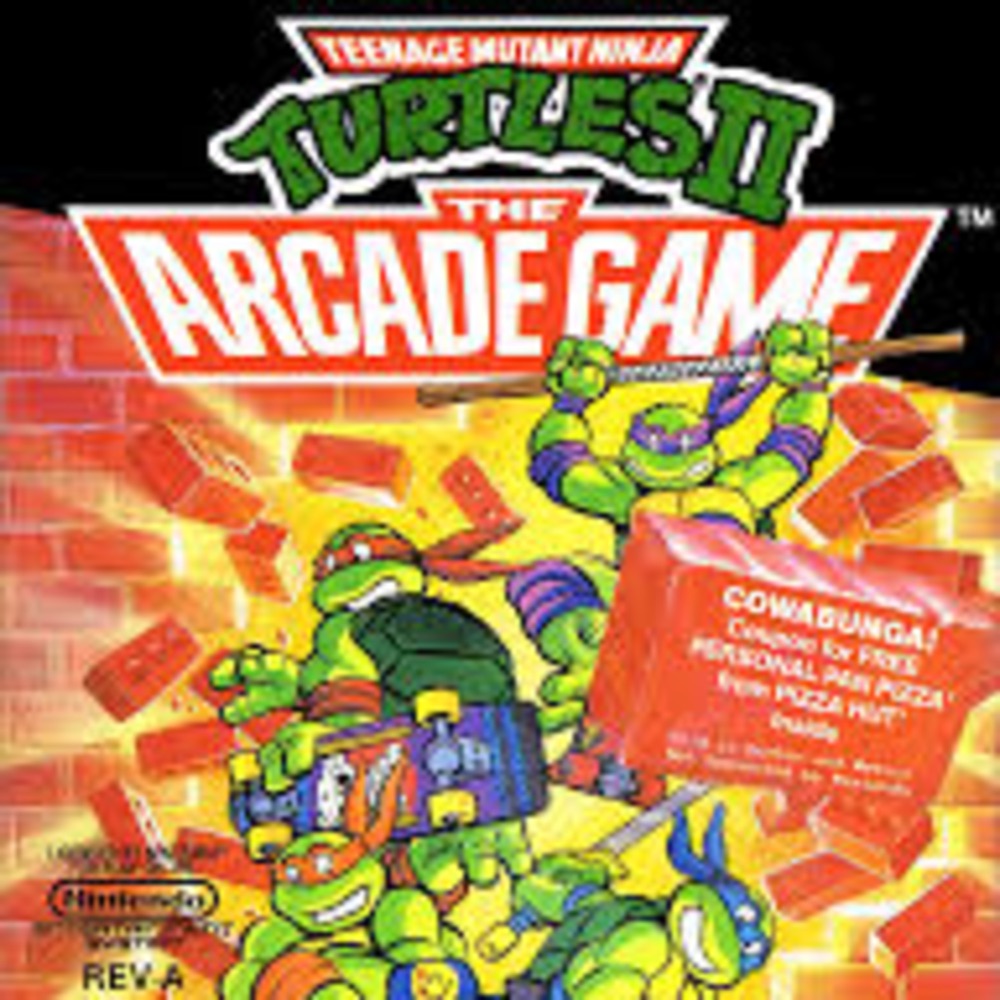
418 · TMNT II: The Arcade Game
Konami's NES take on the arcade beat-em-up, released under its Ultra Games label while the turtles were everywhere: the live action movie in March 1990, the cartoon in season four. It is not a sequel to the first NES game, which we were not fans of. Mike, Sean and Joe went in hoping the arcade-always-wins rule would not apply. It mostly did, and we still had a decent time.
What works
- It looks like the cartoon. Pixel art this close to its source is rare on the NES, and the sprites and backgrounds, down to the generic New York skyline, read as the show.
- Boss variety. Rocksteady charges, Baxter shows up as a teleporting machine and later as the fly, and the snow stage's Tora and the later Shogun exist only in this game. The finale is in the Technodrome with two Shredders, so he does have you double teamed.
- Two-player. Two players is the best way in. It is almost monotonous solo and transformative with a second player.
- Pizza Hut. The box promised a free personal pan pizza through a coupon on the back of the manual, good until the end of 1991, and Pizza Hut signs hang in the background. The Cowabunga Collection removed them.
What doesn't
- Two buttons, four near-identical turtles. You attack and jump. The weapon changes reach and speed: Donnie's staff reaches farthest and swings slowest, and Raph's are shortest and fastest. Otherwise character select barely matters, and the jump kick beats the regular attack, so you end up jump kicking everywhere.
- No growth. No pickups, no new moves, no special attacks like other TMNT games, yet it runs long for a beat-em-up and gets samey. Joe called the missing third attack a big deal.
- Hits that don't land. We sometimes stood next to the little dinosaur things and could not connect.
- Missing attitude. The arcade game shouts cowabunga when you grab a pizza. Here you get a chime. The one nice touch is a turtle winking at the camera if you stand still.
- Downgraded visuals. Flicker and a limit on enemies on screen. Four players would have been a mess, though it is fine for the game to just be a party.
Beyond the game
A search says Shredder was named after a cheese grater, which beat our guesses. The Cowabunga Collection also adds six attack buttons that all do the same thing.
The bottom line
Play it. It is a good hang with a second player, and the presentation is a treat. But no one voted it onto the Essential Games List. Mike said the port is serviceable but now lacking and the real thing is a four-player arcade cabinet. Sean said the arcade game leans on presentation and the downgrade strips even that. Joe was underwhelmed and found it repetitive despite his childhood memories. That is three no votes, our second non-essential TMNT game on the NES.
Written from our conversation in this episode.
- You may have Shredder double-teamed, but he still has you outnumbered
- 1. General Overview
- What it is
TMNT II: The Arcade Game is a home conversion of Konami’s 1989 TMNT arcade beat em up. - Release and labeling
Released on NES in December 1990, and published in North America under Konami’s Ultra Games label - Konami used the Ultra Games label on NES as a workaround for Nintendo of America’s licensing rules.
- Nintendo capped output per publisher. Under Nintendo’s standard NES license, each licensee was limited to five new NES games per year (and there were other tight controls, like exclusivity windows). This “five games” limit is explicitly described in the Atari v. Nintendo court decision when it summarizes Nintendo’s license terms. digital-law-online.info
- Konami wanted to release more than five games. So Konami created a separate U.S. subsidiary/shell publisher, Ultra Software Corporation (Ultra Games), and published some NES titles under that label to effectively get an additional allotment of releases. Wikipedia+1
- It went away once it stopped being useful. As Nintendo loosened restrictions around the early SNES era, Ultra Games lost its purpose and Konami phased it out (the label is generally cited as ending around 1992).
- 2. TMNT as a franchise in 1990
- Peak visibility moment
The live-action Teenage Mutant Ninja Turtles (1990) film hit theaters March 30, 1990 and became a huge box office success, crossing roughly $200M worldwide. Wikipedia - Cartoon was still cranking
The 1987 animated series rolled into Season 4 starting in 1990, expanded to 41 episodes, and even shifted partway into CBS Saturday morning programming. Wikipedia - Merch machine at full blast
A Los Angeles Times business piece later described the Turtle fad as peaking in 1990, citing it as an enormous share of the action figure market at the time. Los Angeles Times - Video game ecosystem
Konami already had the 1989 arcade brawler out in the world, and the NES port arrives right in the middle of “Turtles are everywhere.” Wikipedia - 3. Story and Objective
- Setup
Shredder is back, April gets kidnapped (again), and the Turtles run through ten level to stop him and the foot clan. The NES manual text leans hard into pulp narration and escalation. GameFAQs - Goal
Finish the stage ladder, defeat the big bads, rescue April. - Offbeat questions
- Is thef story window dressing, or does the “bounty hunter” angle actually make the NES port feel more like a sequel than a port? Wikipedia+1
- 4. Core Gameplay Loop
- Moment to moment
- Walk right, beat Foot soldiers and themed enemies
- Use jump attacks to control space
- Grab pizza to heal
- Hit a boss gate, learn the pattern, repeat GameFAQs+1
- Modes
- 1-player
- 2-player co-op (simultaneous) GameFAQs+1
- Why it works
It is built around satisfying crowd control and readable enemy “tells” - Team personality quick hits (NES)
- Donatello
Longest weapon range (staff), great for controlling crowds from a safe distance. The tradeoff is his normal swing is the slowest, so whiffs feel expensive. GameFAQs - Michelangelo
Second-longest reach (nunchucks) with a swing that feels “wide” and forgiving in scrums. Still slower than Leo and Raph, so he plays best when you are already in control of the screen. GameFAQs - Raphael
Shortest reach (sai), but fastest normal attack, so he is the most aggressive and best at rapid clean-ups once you are in. You will rely more on jump-kicks and positioning to avoid getting stuffed at range. GameFAQs - Leonardo
Second-shortest reach (sword) and second-fastest swing, so he feels like the “steady middle.” If you do not want to think about matchups, Leo is the simplest “always fine” pick. - 5. Controls and Combat Feel
- Basic controls (NES)
- A: Jump (also used to confirm turtle select)
- B: Attack
- A + B: Jumping kick GameFAQs
- Combat language
- You win by spacing, juggling knockdowns, and not getting surrounded.
- Enemies often enter in waves that punish standing still.
- Character feel
The NES version is generally discussed as more streamlined than the arcade, with a simpler, more consistent combat rhythm. Old School Gamer Magazine - Offbeat questions
- Is the “jumping kick” the real main weapon, with the normal attack as backup? GameFAQs
- 6. Cartoon and toyline DNA (1987 series vibe all over it)
- The villain stack is straight from the cartoon
- Krang + the Technodrome as the endgame: Fighting your way to the Technodrome and dealing with Krang screams 1987 show (Krang is a cartoon-created character, later used broadly across the franchise). StrategyWiki+1
- Bebop and Rocksteady: Iconic cartoon henchmen show up as bosses in this game, and their origin is tied to the 1987 animated series rollout. Wikipedia
- General Traag and the rock/stone warriors angle: The whole “Dimension X stone warrior” flavor is a 1987 show staple, and the game leans into that. Wikipedia+1
- 7. Difficulty, Lives, and NES-era Fairness
- How it pressures you
- Getting surrounded is the main danger
- Some enemies are less threatening individually, but brutal in combination
- Scoring oddity
The GameFAQs guide calls out a goofy scoring reality where you need an absurd number of points for extra lives because enemies award tiny points. GameFAQs - Offbeat questions
- Is the game hard because it is designed to be hard, or because you are always one bad corner away from a pile-on?
- 9. Differences between the NES version and the 1989 arcade game
- This is the big “compare and contrast” section for your episode.
- Big structural differences
- Players
- Arcade can be up to 4 players
- NES is up to 2 players Old School Gamer Magazine+1
- Content additions on NES
The NES port adds two new levels and two new bosses created for the port, Tora and Shogun (not TMNT canon). Wikipedia+2Nintendo World Report+2 - Stage expansion and boss swaps Several arcade stages were extended on NES, and a key swap: NES uses Baxter’s mutated fly form in that spot instead of the arcade’s Bebop and Rocksteady pairing). Wikipedia
- Feel and “arcade-ness”
- Arcade presentation
More voice clips and dialogue, more spectacle. Nintendo Fandom - NES gameplay adjustments
Often described as more streamlined, less combo-centric, and more consistent in how many hits enemies take. Old School Gamer Magazine - Balance and recovery
- Health behavior
One documented change: NES refills health after boss fights, while arcade does not do that in the same way for several bosses. Nintendo Fandom - Small but fun “port fingerprints”
- The NES port era also includes notable Pizza Hut product placement in connection with the game’s marketing and materials. Wikipedia
- 1) PIZZA HUT - The box callout: “This game comes with pizza”
- Early print runs straight-up advertise the deal on the retail packaging. The box copy calls out a free Personal Pan Pizza coupon inside and even includes regional fine print like void in Quebec and Mexico (plus the classic “Not Sponsored by Nintendo”). Nintendo Player
- Why that matters for the era:
- This is pre-internet hype. The box is the billboard.
- For kids, “new TMNT game” plus “pizza tonight” is basically unbeatable leverage.
- Collector angle:
- There are later “no pizza offer” variants where the front-of-box blurb is removed. PriceCharting
- Heritage Auctions has even singled out “with Pizza Offer” as a notable feature of early production copies. Heritage Auctions
- 2) The manual coupon: a literal tear-off “quest item”
- The coupon itself is on the back of the instruction manual, meaning you had to either:
- cut it out, or
- tear the manual (a tragedy you only understand years later).
- Key specifics that are great to say out loud on the pod:
- It’s for a FREE Personal Pan Pizza at Pizza Hut.
- It had a hard expiration: December 31, 1991. Nintendo Player
- Later runs removed the coupon entirely, and even the manual/box callouts disappear. Nintendo Player+1
- This is such a clean “1990 childhood” story beat: you bought the game, and the manual itself is your ticket to dinner.
- 3) In-game advertising: Pizza Hut is literally in the scenery
- This is the part people remember most, because it’s not subtle.
- The NES port includes Pizza Hut signage in the background as part of the city set dressing.
- Some guides even call out moments where Pizza Hut signs fall down during the stage, affecting what happens on-screen. GameFAQs
- Podcast framing ideas:
- It’s “synergy” before we used the word synergy every 11 seconds.
- It also fits the IP so naturally that it almost feels like canon marketing: TMNT is pizza, so Pizza Hut becomes “official turtle fuel.”
- 4) The “afterlife” of the promotion: why it disappears in re-releases
- Fast-forward to modern collections and ports: licensing is the buzzkill.
- Reviews of TMNT: The Cowabunga Collection note the games are preserved as well as they “legally can be,” specifically calling out no Pizza Hut advertisements. GoNintendo
- That lines up with the broader pattern: time-limited brand deals tend to get scrubbed when games are re-released decades later.
- 10. Legacy and where it sits in the TMNT game lineage
- Why it matters
It sets the template for “Konami TMNT beat em up at home,” and directly leads into original console entries that borrow its structure and feel. Wikipedia+1 - Re-releases
Both the arcade and NES versions were later re-released in Teenage Mutant Ninja Turtles: The Cowabunga Collection (2022). Wikipedia - 11. Sequels and spinoffs
- NES follow-up
- TMNT III: The Manhattan Project is an original NES beat em up built in the same general lane, not an arcade port. Wikipedia
- Arcade follow-up lineage
- Turtles in Time (arcade 1991, SNES port 1992) is Konami’s next big leap for the formula. Wikipedia
- Genre side quest
- TMNT: Tournament Fighters exists as three different fighting games across NES, SNES, and Genesis in the 1993–1994 window. Wikipedia
- Mini deeper dives with prompts (no jokes)
- Deeper dive A: Port philosophy
- Prompt: What does a “good port” mean in 1990, visual accuracy, or designing a version that plays well at home? Old School Gamer Magazine+1
- Essential Games List segue
Auto-generated transcript. Each paragraph starts with its timestamp. Speakers are not identified.
TMNT 2, the arcade game. You may have Shredder double teamed, but he still has you outnumbered.
TMNT 2, the arcade game. And welcome to NEStalgia, a chronological exploration of every NES game released in North America. I'm Mike. I'm Sean. And I'm Joe. Is it possible to be outnumbered while you're being double teamed? Yeah, I mean, that was a little bit of a weird, because being double teamed implies that there's two to one against you. Right, but I guess he has the whole entire Foot Clan. Right. What are we talking about?
The back of the box? Double teamed? The turtle? Oh yeah, the feet. Oh. So here's what they call, they're called the Foot Clan because they have more toes than the Ninja Turtles. So they're bragging. They're like, look at us. We have real feet. True feet. We have feet. Yeah. I like that. Turtles have three fingers and three toes.
Is that the end of the episode? What happened? I was just going to say that all about do it. No comment? Yeah. Geez. No comment. Rough crowd. It's fine. We're all stunned by that fact of turtles. They're saying double teamed on the back of the box because you can play this two player at the same time. And, you know, take that is the preferred way to play any beat them up. It's like if there were two player beat them up, if it was four player beat them up, if it's six player beat them up, it's always best to play with the maximum number of players on screen because that's the most chaos. That's the most button mashing satisfaction.
That's the most like way to stay alive in the game because you don't have to deal with all six at the same time. You can have your friends help you out. And that was clearly the intention with the game that this is based on, which is, of course, the Teenage Mutant Ninja Turtles arcade game here on the NES. It is not a sequel to the first NES game, which we, you know, I don't want to say we were like harsh on it or whatever. We just weren't fans of it.
It certainly gets a worse rap maybe than we gave it. So I think like in general, TMNT is a franchise we like and we want to like these games. And this one took the arcade game and brought it right to the NES with more levels and more boss fights and new features. So like who's to say that the old adage of the arcade game always being better than the 8-bit counterpart is true here. We're going to give this a real shake. I didn't know that there were more levels.
I've never been very good at this game in the arcade. I basically, you know, you put a couple quarters in you and whoever you're playing with die pretty quickly. And then you move on to another game, at least for me. I know that probably you guys and our target audience would have spent more time at the arcade machine than me. So I just had no idea that this was, this had more stuff. Well, I'm probably coming in. I also had no idea, but maybe for the opposite reason. I'm sure I played this in the arcade because it's kind of just ubiquitous. But like I feel like I don't really remember it so much in the arcade, but I did play this as a kid.
I think the first TMNT and then the one that I actually liked, which I thought was maybe this one that we still didn't get to was it was the one where the second level is the surfing level. I used to love that. It's not this one. But me and my cousin used to play a lot of TMNT games. It's not Battletoads. No, it's TMNT. But this is one of the TMNT games I did play as a child. And I also never knew that this was like an expansion on the original game. I just thought this was a port.
It's worth mentioning and we'll get into it, of course, about the expansion part. I guess I'm just saying that like it has more than the original game, but it also could arguably have less right like the the presentation here. If you've ever looked at the arcade game or played it, it feels like it's, you know, a direct adaptation of the very, very popular cartoon.
It's it's using that same art style and it's the cut scenes and the pixel art are doing that much better than the NES could hope to. So I think for me, this is the one that like I like grab my eyes a lot at the arcade was like, whoa, this is basically the cartoon now as a video game.
And regardless of how you feel about beat them ups, it's the same reason why like the Simpsons arcade game and the X-Men arcade game are like fondly remembered, not just because they're good beat them ups, but because it's like it's taking the art style of that thing that you like. And the world of that thing that you like and making it into a fun little mindless video game where like the the characters that you've come to expect all make appearances. And you're just kind of like, OK, I died time to put in another quarter to keep experiencing what's happening. And that's no different here.
And whether you're playing as Donnie, Mikey, Raff or Leo, you know, it's fun to just like change it up with the weapon. But I've never thought about like, oh, well, I want to use the bow staff or I want to use the nunchucks. It's like, no, I just want to play as my favorite Ninja Turtle. And hopefully nobody else in my party, you know, picks the same.
Yeah, you make a good point that I hadn't really thought of until right now. But the fact that it's pretty rare for an NES game to have a pixel art that is so one to one to its source. Like even when something's based on, you know, a cartoon, I feel like a lot of times it's like this tiny little pixel that like you can like squint and imagine it's the same thing. Like not even just on like an artistic level, on a technical level, like it's kind of impressive that this does that these do look just like the cartoon characters, even in this like pixel form. I'm surprised I never noticed that we don't see that quite as much.
Yeah. And when they try, it ends up looking kind of awful. Yeah. I mean, maybe TMNT is just like, especially that 80s TMNT is just like the perfect level of like not realistic looking enough, cartoony enough that you can kind of make it out of a few pixels as well. It's also a pretty realistic Pizza Hut logo.
One to one. Yeah, yeah, for sure. And I don't know about you, but I'm craving some Pizza Hut right about now. Get a slice. Right. So go to PizzaHut.com and order your slice now. Use the promo code. No, no, we're not chilling like the game did. And it's worth mentioning game was made by Konami, but they use the Ultra Games label for the NES. And that was I think we might have talked about this once before, so I'll be brief about it. But that's the workaround for Nintendo of America's licensing rules where they had like a certain number of games you could release.
And since Konami had hit that threshold, they were like, all right, we'll just open up another company and release the games under that. So Konami used Ultra Games as its like additional kind of funny, you know, that they would do that for something as like, I mean, TMNT is arguably at its hottest in 1990. The movie, the live action movie where they wear the suits, which is still amazing and absolutely holds up. That came out in March of 1990. So that's out and a huge success and was a big box office success. The cartoon is on season four. So it's having a run. Merchandise is like all that stuff that you should have bought in 1990 and kept it in the box is now worth thousands of dollars.
Because, you know, of course, you should have never played with your Technodrome and you should have just kept it in the box. Just like Mighty Morphin Power Rangers, too. It's like, who was the freak who kept that shit in the box? Like, guys, that stuff was meant to be played with, like, for real, real.
I don't know if you asked me, I would have thought it would have been you, Mike. I feel like you have more boxes. Yeah, that does sound like a Mike thing. You have more boxes of at least old video games than anyone I know. That's true, but that was my mom. See, like the kids, I would have thrown out all those things in a heartbeat. My mom was the one who was, like, smart enough to realize we should keep them. But I guess what I'm talking about is, like, you know, there were some really nice TMNT sets. Like, you know, the action figures themselves are worth good money, too. But there were some real, like, play sets or larger vehicles that, you know, now, especially in the boxes, are just, like, ridiculous numbers.
Same with Mighty Morphin Power Rangers with the Zords, if you have those giant Zords still in the boxes. But it's like, those things were meant to be, like, smashed into each other. You were supposed to take one figure and smash it into the other figure, not preserve them for your investment portfolio. You got to buy two copies. And the game starts off with Shredder is back and he's kidnapped April.
What's new? The Turtles have to – it's set up, like, scenes, which I guess further, you know, reinforces the whole cartoon thing. But each scene is just a different setting and a different boss. And so you basically otherwise are just doing the same thing that you do in any particular beat-em-up where you walk for a little bit, encounter a bunch of enemies, take down all enemies, and suddenly you're allowed to start scrolling again.
Do we want to talk? Can you guys remind me, like, what April does for the – like, is she, like, their collective girlfriend? Is it, like, a big holly? Well, she's, like, a reporter in this iteration, right? And then I think one of them is, like, the love interest. Well, yeah, but one of them is, like, crushing on her the whole time. And it's different in the Nickelodeon version than the – Okay. So, like, yeah, let's remove the romantic entanglement. Like, let's just say that this is, like, a workplace. Like, what does she do for the team? Is she just there to be – She's got the scoop. She can tell them where, you know, where, what, and things are happening in the city.
Yeah. Also, she's, like, a journalist. Yeah, yeah. Yeah, she's, like, the lowest lane to Clark Kent, you know, is my – She's a collector, Clark Kent. I don't know as much about the 80s cartoon, but that was always my understanding of it. And, you know, as far as, like, any romance between April and the Turtles, like, it is possible, Sean, to just also, like, want to save your friend. Oh, I get it. Like, if you were kidnapped, I would hope that I would be able to rescue you. Probably not successfully, but I would try to. And I would hope that the news wouldn't cover it as, you know, host of Nostalgia Michael Esposito tries to rescue his lover, Sean.
I've never – yeah, I've never been in a situation where I was trying to rescue someone that I wasn't in a romantic relationship with. Right. Well, I mean, it's true, though. I get it. Like, video games have trained us that you're rescuing a princess with the expectation that you're going to get a fucking kiss at the end. See, but it's funny because, like, is it ever implied in, like, most of these games that, like, you're going to get a kiss? Like, does Mario get a kiss? He does. Okay, does Link? That turns out that, like, Princess Peach is actually, like, his aunt. Right. Sister, actually. Same thing. Yeah. Sorry, we're getting off topic. You're thinking of Star Wars.
It's okay to get off topic. But if you want me to get us back on topic, I guess this is, you know, since I mentioned that you're not necessarily playing this game with a strategy in mind of, like, I've got to use the bow staff, right? You're playing with your favorite turtle. Who'd you pick? I picked Leo because that was the first option. I don't really have any, like, you are the turtle guy. I've never really cared about this game. I think that's why, because you managed to pick incorrectly.
Okay. Hold on. Like, there was no wrong answer, and then you chose Leo. Because I was going to say, I think it is maybe a boring answer, but I also picked Leo. I just like swords. And I like blue. So I always used to pick Leo. Yeah. I don't have any attachment to these guys.
I always did, like, see, and this is maybe where we'll get into, like, the gameplay and the differences. I always liked, in some of these TMNT games, trying out with the swords and trying, and then, like, trying the bow staff and, like, seeing, oh, what different moves do they have based on, you know, based on their weapon. And there's not that many moves in this game. Yeah. There's a tack. So it, like, doesn't feel like it matters too much. I will say, I'm saying this right now, admittedly, in this playthrough, I just played as Leo the whole time. I guess I'm making some assumptions here about playing as Donnie or Mikey or whoever. But it just doesn't feel like there's too much difference.
So Sean was going to cover it, and he got 50% of the way there. There's a tack, and there's jumping attack. Yeah. Right. So that is the extent of the game, and that is the extent of the Ninja Turtles' personalities, at least in terms of inputs that you can do. So the only changeup between them is that it isn't just a pixel art weapon. The weapon actually does impact their reach and how fast they can attack. So as you can imagine, it is a pretty simple formula of Donatello with the staff has the longest reach, but it is the slowest attack. And Raph has the shortest reach with the, I think I'm saying this right, the size? Forks? Yeah. I think I'm saying this right, dinner forks.
And it is the fastest attack, though, in the game. So if you miss, it's kind of like whatever. You can go back to attacking. Whereas if you miss with Donnie, you know, especially in the later stages, some of those more pesky enemies will start to be able to barrage you. But that's like it. And so that's kind of strange, right? Like that this is the whole personification of the Turtles' personality. Arguably the most interesting part about the show is the four Turtles, and this is how they get covered. And meanwhile, like all the enemies have various attack pools, and all the bosses have, you know, like flavors specific to them.
You know, like I'm thinking about Rocksteady and his charge at you, and Baxter. And you fight Baxter twice in this one, or is that the arcade? I think you fight him twice in this one. Once in the machine, and then once as the fly.
And, you know, so like they're playing into those. Yeah, they're playing into those. The fly is pretty later in the game, but the machine one where he's just like teleporting above the ground, and he has those annoying. I wish I knew the name of those guys, but they're like little pet dino things. Yeah. Those things. Oh, I hate those. Yeah, those are annoying. That's what I'm saying, though. It's like, okay, cool. That's like, that's some interesting stuff to both fight and take down, while you feel pretty generic.
Yeah, there's two things missing for me that I feel like if one of them were there, I'd be a little more okay with it. One is that there's no difference, really, other than the minor one you mentioned, between the turtles. So your character select doesn't really matter that much. And the other is that you don't, there's no evolution. There's no pickups of different weapons, or you don't learn another move at any point during this game.
And like, I don't need that in every game, but like not having either of those things in this game being, you know, kind of long for a beat-em-up, is, to me, is a little hard to forgive. Because it does get just so samey. There's only one thing you can do. I mean, yes, you can jump kick, and you can swing. But like, I don't know. Because like in the arcade game, there was another button, right? Like, wasn't there like attack and kick or something? Or was it all just one attack? I only remember one attack, too. I will look that up for us, but I only remember one.
And I think I'm like, came into this conflating it with other NES PM&T games, where there's like, everyone has like, just one little super attack. Where like someone did like a, I think Leo did like a spin with both his swords out at his side. And like, yeah. Or like a grab. Or like, they're had to do something else. Yeah, or rafted like he rolled into a ball and like a, whatever.
But it's just, having nothing like that at all just makes it feel like these are just Ninja Turtles pasted over generic video game fighters. I mean, it's even worse when you start to realize that the jump kick is better than the regular attack, too. So now you're just forced to be like jump kicking everywhere you go. And now you're not even behaving like a hero. Not even using the unique weapon. Right. So that sucks. But confirming that the arcade one for this one was just the jump and attack, which is fine. You know, that's what we get.
But thinking about like the rest of the game, right? Like the not being the turtle, just like the world and all that. Don't they do a good job of making it like the TMNT world and not like the Ninja Turtles are in. Forget about the fact that the Foot Clan's everywhere. But that like just the world itself and the storyline and everything, it feels like a Saturday morning cartoon and not just like, oh, they've been transported to some convenient NES video game like we've seen with some other franchises. Well, I can definitely tell that they're doing their best to sort of create the same sort of landscapes as the arcade version. I mean, it looks like an 8-bit version of those backgrounds.
So aside from all the Pizza Hut logos, which I assume were also in that game, it just has that like beat-em-up vibe. Yeah. And like the art, the style, like the colors, everything. You're right. It does kind of remind me of, I mean, not even kind of. It does look like, in the same way we said that the sprites look like a decent translation of the cartoon characters. Like, yeah, it looks like the backgrounds of the cartoons. Even the like city, the skyline in the back there, which I don't remember exactly how it was in the cartoon, but I think there was always just kind of like a generic New York City skyline, like pasted in the back of the, you know, background of things and stuff. Like, it looks like, it looks like the animation.
Yeah. And so I think it's kind of like, forget about the fact that the turtles are kind of lame. You're still like, if you're buying this game for the TMNT world and to play in it, I think they're doing a great job of achieving that. But Sean, the Pizza Hut thing, if you want to get into it for a minute, it was a pretty big deal for this NES game because it's even advertised on the box. The box calls out that the game comes with a free personal pan pizza.
Oh, shit. So you got it. There was a coupon. So there was a cutout? Yeah. No, it was in the box. There was a personal pan pizza in the box. It was one of those, like, big box games. Yeah. But yes, you could get a Pizza Hut pizza personal pan. I don't know. Like, is that actually any big or is like Pizza Hut pizza scaled down? I've never had Pizza Hut. I've only had Domino's.
I'd say it's probably about the same size as like a personal Domino's pizza. Okay. So, yeah, not a full size pizza by any means. But I think we talked about this when we were talking about. Still value. Definitely added value. Okay. And when we were talking about the Noid on that episode, I was calling out that, like, Domino's fulfills a different niche. And I'm sure Pizza Hut does the same, fulfills the same need that Domino's does. Where it's like, it's not at risk of taking out, you know, Joe's Pizza down the block. But it is competing with Domino's and likely CC's and all that other stuff. It's a different category. I need to clarify. This is a different niche.
Because Pizza Hut was a sit-down restaurant. I don't think Domino's is a sit-down restaurant. Oh, interesting. Yeah. Okay. That's a good call-out. Yeah. Because I... There was like a... There was also like a... For food that wasn't pizza. Maybe even for food that was pizza. There was like a... Like a little... Like, it was kind of like a salad bar slash... What do you call it when it's not just salad at a salad bar?
A buffet? And a pasto? Buffet. All right, cool. There's kind of like a buffet vibe to it. So, yeah. I had some family dinners at Pizza Hut. They have like... I wish that it were true that they had like a section that was called food that is pizza and food that isn't pizza.
It's entirely possible. It's been a while. Now, here's the part that sucks. The coupon wasn't just inside the box. It was on the back of the manual. So, you had to cut it out. And it's probably a pain you could only understand years later when you're looking at your beautiful copy of the game and seeing a big hole. I'm sure that the 11-year-olds were like, oh, is it going to really reduce the collector's value of this? Well, they should have just printed it on the back of the cartridge. You got to break the plastic off and bring it in.
It removed... They removed the coupon after a certain amount of time because it did have an expiration as well. This wasn't a free personal pan pizza for as long as Pizza Hut remains open. It was until the end of 1991. So, you had a whole year to redeem it. And so, I wonder which print run is worth more. Is it the with the coupon run or the after without coupon run?
Almost positively, it's with coupon, with coupon, not taken out. Yeah. You would think so. But I'm trying to think. There's one weird Xbox 360 game where the greatest hits one is worth more. Or PS2 game where the greatest hits game is worth more because they actually made less of them. Oh, God.
So, that, yeah. That feels like something that would happen to, like, Silent Hill, right? Like, it would be like, you know, the original game just sold so many. It's like, yeah, time to put out a greatest hits and it just didn't sell as many and the game is artificially rare. Does this have a promo for Metal Gear Solid or for whatever other Konami game was coming around that time?
Yeah. Exactly. And Pizza Hut is not just a free pizza that you can redeem. It's also inside the game. As Sean mentioned, blatant advertising. The Pizza Hut signage is in the background as part of the city dressing. And there are... It's the only, like, business... Right. That's operating in New York City. Well, Shredder shut down everything else. Shredder has a Pizza Hut obligation.
Yes. He's a franchisee. Right. Well, as a cheese shredder, you would imagine that he has a business implication in Pizza Hut. That's not why they call him the Shredder? He's not shredding cheese? I never really knew. I mean, now that you mention it, like, I got to... Because, you know, TMNT being originally a parody, that probably is why they call him the No, it's definitely not. But I appreciate you going along with the bet. Well, so why do they call him Shredder? It's funny how I said that so definitively. But, yeah, I actually don't know why. I don't know the origin of the name. I just remember a commercial for TMNT water-based toys.
What would you call it? Like, those super soakers? And they were like, you know, hey, Shredder, get wetter. And they sprayed him with water. I was like, yeah. And also, just to show how on it I am today, I was looking up the origin of the Shredder name, and I just typed in Shredder on Google, and I'm looking at pictures of Shredders, like paper Shredders. I'm, like, really doing hard research right now. Well, here's my hard research. It was just the AA overview, so I always take out the grain of salt. But named after TMNT co-creator Kevin Eastman was inspired by the household cheese grater in the early 1980s. Oh, my God. And they originally called him the grater. Can you really say inspired?
Like, is inspired the right word? Let me look for the source here, but. I think Kevin Eastman had the same idea I had, which was, like, in middle school, I remember thinking of, like, I should make a horror film where the serial killer or whatever kills all of his people with a cheese grater. Because, like, could you imagine he has to go down on your skin and get to the bone and everything, and, like, it would just be terrifying. I don't like that. So, that's the Shredder. That's the Shredder. I can't believe that I so confidently came up with an origin story, dismissed it, and then found out it was true all in five minutes. I did.
That's what you get when you listen to Nostalgia. I did once make a history of TMNT 35th anniversary video, so I probably knew it then. Was that a school project? No, it was a work project. Oh, okay. Yeah. The TMNT Cowabunga Collection did remove the Pizza Hut advertisement, Sean. So, if you want a game free of advertisement, you can go play it on the Cowabunga Collection.
Yeah, it's just generic pieces. Yeah. Oh, no, and they also added six additional attack buttons. Wow. Not even a laugh. Come on. They all do the same thing. Yeah, six attack buttons, but they don't do anything different. He still just swings the bow staff or the size. Size. That's what I was. Not dinner forks. Yeah. Dinner forks. But you did say size. I did. I know. I was joking. I was trying to. I got it. I can't do anything serious right now.
But everybody's. Did you guys. Okay, I'm going to talk about the game. Yeah, because I was about to say, everybody's here. I'm going to ask a question about the game. Yeah. Everybody's hearing this.
You got the Krang. You got Bebop and Rocksteady. You got made up characters like that. The snow level. Whoever that guy was. Okay, so he is not a real. I was wondering. He is not part of the cannon. The snow plow is not a character from Teenage Mutant Ninja Turtles. Well, I was specifically referring to the boss at the end of the stage, which apparently. He's like a wolf or something. I mean, he looks awesome, right? He's got a biker jacket. He looks like he's friends with Bebop and Rocksteady. But apparently his name is Tora.
And his only appearance is in this game. Tora. It's funny because. Like what other franchise has so many possible obscure villains that you can choose from. But maybe they ran out somehow. And on the other hand, I don't think you shouldn't come up with original characters for your thing. But they're trying to be so one-to-one with TMNT. It's just surprising that they're like, and we'll make one original boss. Right. The manual says, because Shogun, another boss later in the game who's also only cannon in this particular game. They show up as these two infamous intergalactic bounty hunters are looking to tag team the turtles. Which is weird because they don't. You fight them individually.
Tora will test your skills in the radical new and never before seen three part one. That just rolls right off the tongue, right? Like he'll show up in scene three part one. It's like you couldn't just like say the snow level. And then Shogun will shock your senses in scene six. The entirety of it. The one-of-a-kind challenge that will change you from green to black and blue. Oh, man. They paid people to write this shit. I should go back to be a copywriter in 1990.
Honestly, it would be like a cheat code because they just would have no idea. They wouldn't imagine that you could just tell them, actually, we don't even need to write all this. Like you could write less. Just put the control scheme on one page and that's an insert. And so where those bosses show up is also the additional add-ons to the game. So it is not like a huge chunk. It's not like it's like a whole other half of the game or whatever. It's just those particular things were added on. And I think that's interesting for two reasons. One, when you play it in the arcade enough and then you finally get the home port,
would you be like upset if it was just the same game? Like you kind of just didn't you just want to bring it home? Like were you expecting new content and new boss fights? Like did they need a selling point for this or could they have literally just been like, it's the game you love at the arcade now on the NES? Well, I guess because you're not like required to put money into the machine anymore. You've front-loaded your quarters when you bought the game.
Maybe it's just really short otherwise. And they just wanted you to think you got more value. So they put some fluff in there. That's the only thing I can think of. Yeah. I wonder in the arcade game and stuff, do you have the same amount of lives and the same amount of continues and all that? Or did they make it a little easier on that point, which would then make the game feel shorter if they didn't add more?
You know, that is interesting because I did feel like I wouldn't have. I didn't get to the end of this game on the NES, but I feel like I would have put more quarters in based on like my time at the arcade compared to playing this NES game and getting like the, you know, theoretical game over. So I have to imagine it's one or the other. It's either that there is less health or the difficulty of the enemies. Like they're just, they hit a lot harder or hit more often or something.
Yeah. Did you guys notice at all that, like there were just some instances of your attacks not actually hitting even though you're literally standing right next to them? Not necessarily. I don't think so. Yeah, I think maybe like sometimes, sometimes maybe I didn't see like a knockback, but it's still like sometimes I would kill someone and they didn't fall over, but like it's, they still got the damage. But yeah, for the most part, I didn't really notice a hitbox problem or anything like that. Yeah, especially with the little dinosaur thingies.
I would just be standing next to the guy and just, and even like sort of micro adjusting. I'm like, oh, I must not be on the same like axis as him. So I'm like trying to get closer and closer and it just, until, maybe it was like they needed to be in midair when you hit him. Maybe that was it. But there were just moments where I felt like, I don't think my hits are registering. And that was kind of annoying. Yeah.
Thank you.
But is the game funny? Does the game lead into the comedy tropes at all? Or is it strictly just like an action game? Well, I remember in... Go ahead. Well, I remember in the arcade game that when you picked up the pizza, which was also a very detailed sprite, you would get the cowabunga. And maybe correct me if I'm wrong, but that does happen, right? The cowabunga. They would say cowabunga. Like that felt pretty iconic to me. And you don't get that here. And I think they could have done it. We've heard voices in NES games. And I think that they could have done a cowabunga. And maybe that's not super funny. But at least was... Like that was the vibe of the game to me. Was just like cool dudes doing cool dude stuff.
And instead you just get a little chime when you were to pick up a pizza here. So maybe not like a humor thing, but like a fun attitude was missing. And when I think about this original cartoon, was it funny because it made a lot of jokes and was trying to be funny? Or is it funny now to look back on it and be like, wow, this is so campy and so childish. And so they're all so happy and silly and fun. But it wasn't like it was a comedy. Yeah, that is a good point. It was funny because it was bad. It's a good point, Joe. It almost has like a secondhand Batman 66 syndrome going for it. Yeah, exactly. Batman 66 was never trying to be a comedy. That took Batman very seriously for the time and then wound up being incredibly funny.
Yeah. So it ended up not being like funny, but being silly by accident. Or just like in vibe. And I think like the one thing that stood out to me for this kind of having that vibe is like, if you stand still for too long, whoever you're playing as will look at the camera and like blink like in a cartoonish way. And it's just like, yeah, like they didn't need to put that in. And it's just kind of silly and like a little goofy and like not like tough ninja behavior.
So I guess that's the one thing I can think of. That's usually the sign that the developer cared a little bit about the game when there's some kind of idle animation. We've seen it in Super Mario 64 and in Sonic the Hedgehog where both of those have like something where depending on how long you have them sit around, they even change their idle expression. Mario will actually fall asleep in Mario 64 and have like a little like bubble come out of his nose as he snores. Yeah. Crash Bandicoot used to like juggle Wumpa Fruit and you'd throw one up in the air and would splatter on him. But you got to wait for like 20 seconds for that to happen.
Last week we covered a, I mean covered is one way of putting it, but basically they released a version of an NES bundle that included four controllers and an accessory for it. This game comes out the same month as it. Was it a mistake not to try to like sacrifice some of the quality of the game to make sure that you could have four players play as all four Ninja Turtles at the same time? Forget if that's who knows. That's probably not even possible. Right. But like it does feel a little strange that there are four turtles and they're saying, you know, play with one other player, like leave two turtles behind.
Yeah. I was going to save this for the essential games list, but like it is really hard not to ignore the visual compromises that this game had to make for it to do what it was doing. There's flickering on sprites. It's there's only so many different enemies that you can have on the screen at once.
Just lots of visual downgrading here. I think if you had four players, it would be a mess. Yeah, absolutely. I can't imagine this game running with four players, but technical limitations aside,
I think that this is the game to do it with because it's like, let's be honest. This isn't like this isn't winning some like gameplay award or anything like just, just let people have fun if you can do it. But like, yeah, I don't believe it would be doable, but like, yeah, this is like, like the, the new super Mario brothers series where it's like, yeah, like the multiplayer is like not the best game design, but it's just like, oh, it's just there to have a party, you know? And we mentioned that April was kidnapped and that the goal is to save her. That is a goal that gets resolved pretty early on.
You, you have a lot of game, you can get a kiss, right? You have a lot of game to go after that though. You have to then save splinter. And then it winds up becoming a, you know, a much bigger deal with the Krang. And I believe I didn't get to it, but the final, the final battle is in the technodrome. Do I have that right? I think so. That's that big. I'm not sure. It's just a giant spherical thing. Yeah. Oh, okay. That sounds awesome. Right. And you fight two shredders. So it sounds like he's got you double teamed. Whoa. Oh, last question before the big question.
Uh, this is a, this is a part of an arcade game and I'm sure we've gotten into this on some level in, in the past. So feel free to give a short answer here, but for an NES game to be a good port, right? So talking specifically about the NES to be a good port of a game. Are we talking about visual accuracy or designing a version that plays well at home? Like which one would you rather have in the good?
The latter. Yeah. I mean, if we're talking about like what, what, what I'd want, it is just like, does it capture the feeling of the game? Like, obviously you're going to have to make some compromises going from what you can visually put on to an NES cartridge compared to an arcade cabinet. But yeah, and, and they, and they did that here. Uh, it still feels like the game.
And I, if it were, if they had to like switch up the mechanics and just like it, it, it looked like the arcade cabinet a bit more than that would be a very different game. Yeah. I think, I mean, I think I, yeah, I definitely want both, but I, I gotta say it's probably like 60, 40, maybe even 70, 30. Like the, the feel is way more important to me, but like, yeah, it's got to look a little bit like it. All right. And now we will get down to the, uh, what's like a turtle pun here. We'll get to it's turtles all the way down. It's the essential games list all the way down. Is that what I'm going for?
It's turtles all the way down. there's no, the whole like earth rests on a turtle, right? And some religion standing in a circle, Joe, you don't have to take it there. Okay. Hey geez. It's not a bad thing. Uh, yeah, it's time for the essential games list.
Wow. It's been a while since we had an official essential games list. here we are. And look, here's the actual verdict, whether it's the arcade game or it's the NES game. Like neither one is, neither one is like perfect or, or what I would go to for, uh, my, my beat them up experience. Right. But both, whether it's, you know, the, the compromises on the NES port or the arcade game, both are an incredibly good hang. And I think that's, what's important is like they, Konami once again, made like a fun game for the Ninja turtles, even if it's very basic punch and jump punch or a jump kick. And, uh, somehow they still managed to capture the essence of TMNT in the process. And so this game can, can be, especially if you're not a TMNT fan,
almost monotonous, uh, if you're playing solo, but can be transformative once you add a second player in there and have more fun. But trust me, the real experience is with four players at an arcade and this arcade was all over the place. So it can't be that hard to still find some out there. So that's the way I would recommend checking this thing out. The NES port winds up being serviceable for the time period, but now very lacking.
So it's a no for me. What about you? Show, show. I was going to say Sean, actually. I was only going to direct that at Sean, but I wound up like choking on my breath there. Uh, so what do you say, Sean? Yeah. I mean, I know that I just sort of finished saying that it, it's a good port in that it, it still feels like the arcade game in a way, but I think that more so says that the arcade game is, is really leaning a lot on presentation.
Um, because there, there really isn't anything else, uh, going for it. Um, so you're really just getting the purest form of up to two player version of the arcade game. Um, and I don't think that that's really that great. Uh, if you, if you downgrade it, it's no longer all that impressive.
So, um, I'm going to say it's not essential. Joe. Yeah, I was a little disappointed in this because these TMNT games are like, uh, a big nostalgic part of my childhood, but they're also games that I haven't revisited in a very long time. So it's kind of excited to see this one come up. And honestly, like, I don't know. Uh, I'm pretty underwhelmed with it. The presentation is great, but it's, to me, it was a pretty boring experience. Like, I, I don't know, just not, not having that third option of an attack made a huge difference where I just felt like, Oh, they're really, and I did play this two player and it kind of felt like, yeah, there didn't really make too much of a difference.
Um, which character we were. And, and, and it was kind of samey. It's, you know, they're throwing a ton of enemies at you, which a lot of beat them ups do, but then without any variety, it just felt too repetitive for me. So I, as much as it pains me because this, this had a place in my heart, in my childhood, I didn't really enjoy this. So I'm going to say not essential. All right. That is a three nose in our second non-essential TMNT NES game, but we do have more on the way. Uh, TMNT three.
I don't know why that was hard for me to say. I mean, maybe I'm just, uh, tapping out here towards the end of the episode, but TMNT three, the Manhattan project, uh, is the next, uh, is the next game up. And then there's also TMNT tournament fighters, which is like, at what point does every franchise just get a tournament fighter game? You know, like, like where is like, who, who do you want to have the next like little, uh, straight fighter ask style fighting game, which franchise? Hmm.
Grub, why didn't crash bandicoot get one, Joe? You mentioned that earlier. I don't know. They got the, the cart racer and they got like the Mario party ripoff, but then, Oh, is it Mario party? It might be one crash bash. Oh yeah. I never knew what that was. So much, you know, a little hot take here. So much better than you say the same thing about that too.
CTR. Yep. Better than Mario cart. Mario, Mario cart is maybe better for like, Oh, let's just sit down and like, have like, just kind of goof around and play or whatever. I think, no, CTR is when you're getting serious. CTR, I think can be a more competitive racing game. Just fewer people play it. So CTR is faster. My memory of CTR is pushing Joe to, um, go a little faster. That's right. And I did. Yes, yes, he did. Let the record show. We can't end the episode unless we show that Joe did in fact go a little faster. You