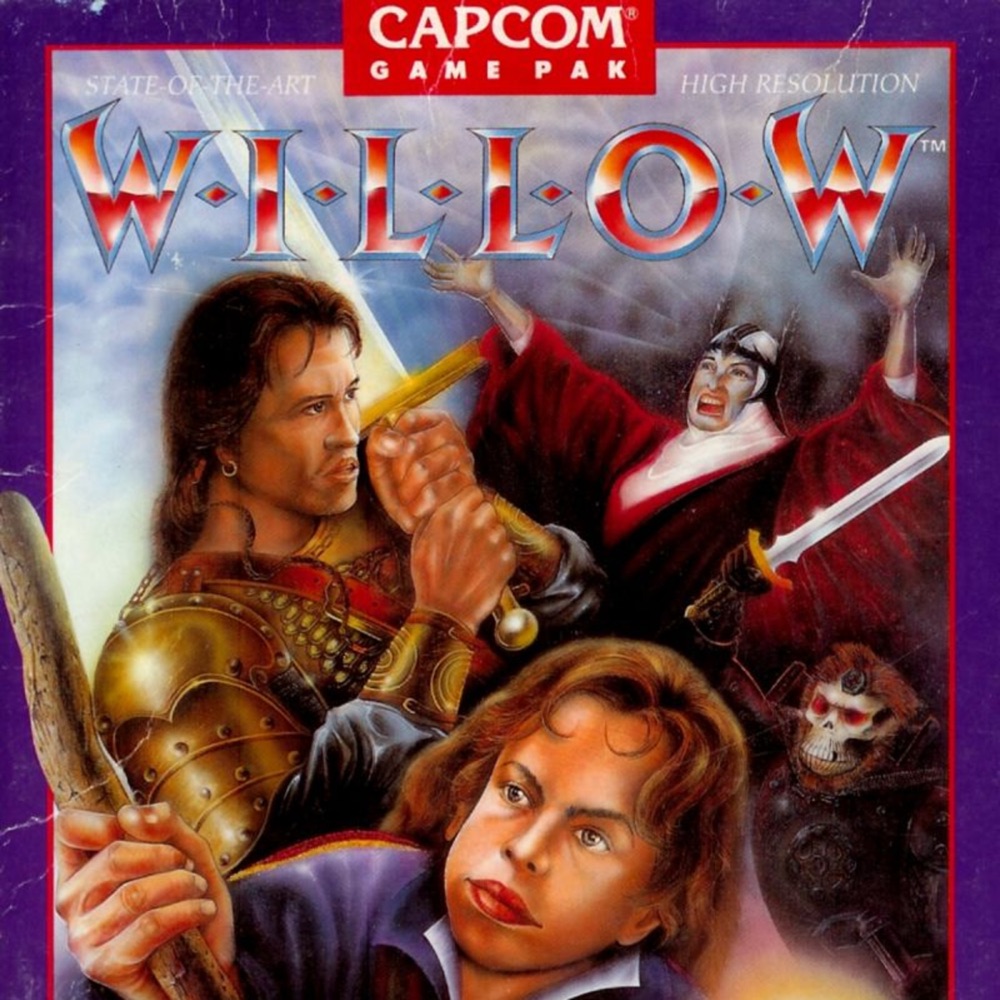
250 · Willow
Ranked #5 in our Top 10 NES Games of 1989 →
Willow is an action RPG based on the movie with the same name. The player assumes the role of Willow, the chosen one who must restore human form to the benevolent sorceress Fin Raziel and destroy the evil sorceress, Bavmorda. While the game follows the movie's plot somewhat most of the time, it also expands on it and introduces characters, races and enemies not found in the movie.
Willow closes out 1989 and is the 250th NES game, a coincidence we spent a minute marveling at. Capcom made it a year after the film, and it has almost nothing to do with the movie: no baby to escort, and quests that never happen on screen. We decided that is a plus. It plays like a game built to be a game.
Why it works
- You always know where to go. Townspeople tell you what to do next, paths branch gently, and almost nobody needed a guide. After Faxanadu and Zelda II, that was a relief. Conversations snap into their own window with room for full paragraphs, and we guessed the small view is how it affords the text.
- A story that moves. Towns thank you after you beat back their enemy, quests build on each other, and nearly every character you meet comes back near the end. It is a Zelda clone with experience points, magic and real conversations.
- Magic that changes how you fight. The ring of fire is one you stand inside, the wind spell hits every direction, and the late lightning bolt, at 20 MP, mows down what used to give you trouble. The fire spell arrives right after the bat cave where you needed it most. Heavier swords swing slower, and the shield works only when you aren't attacking, so you wait out projectiles and then go in.
- Fair deaths. You lose the experience since your last level and go back to the last town or heal spot, items intact. We died about as often as in a modern game and never felt cheated. The snake man early on has a pattern you learn in a few tries.
- It looks great. Willow's sprite reads like Super NES, with clear orange hair, and the backgrounds look painted. The giant fairy at Lake Chief sells her scale.
What doesn't
- Two late snags. An old man gives you something only after you talk to a second person further along, and near the end you have to grind to face the last boss.
- Thin music. Battle music is the overworld track sped up, and dungeons have a single tune. The grass-shaking that announces a fight is two frames, and we weren't all sold on it.
- No puzzles. Combat carries everything. It never bothered us.
- An 18-digit password.
Beyond the game
Producer Tokuro Fujiwara also worked on Mega Man 2, DuckTales and Ghosts 'n Goblins. The director said Capcom licensed outside properties because its own characters, Mega Man included, could be too niche. A Disney Plus series landed the week we recorded.
The bottom line
Essential. The vote was split. Sean said no: for all the praise, it is too derivative at its core. Joe said yes and was smitten, calling it the epic adventure he is always after. Mike changed his vote to yes to break the tie, because the game gets right everything it sets out to do, even if that is simple. Crystallis, which one review called the far better Zelda-style game, will be the real test.
Written from our conversation in this episode.
- Long ago, in a time of magic and sorcery, an evil sorceress named Queen Bavmorda ruled the land under a reign of terror.
- NES Longplay
- Introductions
- We’ve made it! The last game of 1989
- And it’s the 250th game released for the NES, do you think they did that on purprose
- Willow the movie
- The game is loosely based on the movie
- So really Willow becomes one of those Power of Marketing things. Movie. Story by Lucas. Directed by Howard. Starring Val Kilmer. Of course they were gonna sell toys, but having Capcom make the video game is a step above. LJN could’ve snapped this up too.
- George Lucas also knows about the toys
- We’ve made it! The last game of 1989
- Overview
- Willow NES is a 2D ARPG very similar to the Legend of Zelda, but with many NPC characters to talk to and towns to visit as well as an Experience Points and Magic system similar to almost every ARPG we would see in the 16 bit days.
- Gameplay
- The reveal in the intro video
- That special power was…MAGIC
- Combat
- Ground shakes in combat
- Each sword weighs in differently, and thus affects the speed at which Willow can swing it.
- Spells
- Spawning enemies
- I don’t like how they spawn in
- Has a pokemon like structure to the repetitive yet simple battles to gain EXP
- EXP and leveling
- Story checkpoints to gate off content
- Lack of puzzles
- Most of the mystery revolves in not having a map and just getting into dead ends or unsure if you might have missed something by not going everywhere
- Graphics
- It needs to be said that while the art might look simple, it’s pulled off to great effect.
- The reveal in the intro video
- Development
- Capcom director Yoshiki Okamoto commented that the game was part of a broader strategy of Capcom at the time to appeal to a wider audience by using established characters from other media, as their original characters could be too niche.
- Tokuro Fujiwara who was the Producer of Willow was also the Producer of Essential Game Mega Man 2 and currently non-essential DuckTales. As well as Director of Ghosts N Goblins
- Sequels and Spinoffs
- The same year Capcom also made a side scrolling platform and run and gun Arcade Game
- BUT the first Willow game was developed by Mindscape for computers. It’s mini-games based on scenes from the film.
- Like a a first person maze, where if you go in the wrong room, you lose and start back at the beginning.
- EGL
- Willow is a complete package and while it might be simple, it gets everything it sets out to do right. At worst the game isn’t respectful of your time, but I’d argue most of the 50+ hour games of today aren’t really either.
- BEST OF 1989
- The EGL may never be the same
- NEStalgia Byte - Kid Dracula
Found automatically from the transcript and checked, but it can miss things or pick the wrong page. Spot a mistake? Tell us.
Games
- Willow mentioned at
The episode's game: Capcom's 1989 NES action RPG loosely based on the film, with a story of its own.
- Faxanadu mentioned at
Earlier NES action RPG compared to Willow for exploration and experience points.
- Zelda II: The Adventure of Link mentioned at
Earlier game with towns, NPCs and exploration, compared to Willow.
- Castlevania II: Simon's Quest mentioned at
Cited for cryptic, space-limited NPC dialogue that Willow avoids.
- Kirby's Adventure mentioned at
Late NES game that shrank its play area under a HUD to do more with the hardware.
- Shadowgate mentioned at
Previous episode's game, played in a small window to save cartridge space.
- The Legend of Zelda mentioned at
The original game that Willow is called a clone of, minus puzzles and with experience points.
- Dragon Warrior mentioned at
NES turn-based RPG that Willow is said to outdo in sense of exploration.
- The Legend of Zelda: Skyward Sword mentioned at
Its shield-and-strike timing was compared to Willow's shield mechanic.
- The Legend of Zelda: A Link to the Past mentioned at
Compared to Willow for sprite quality and feel; Link's hair color joked about.
- The Legend of Zelda: Breath of the Wild mentioned at
Its giant great fairies compared to Willow's fairy at Lake Chief.
- The Legend of Zelda: Ocarina of Time mentioned at
Mentioned because Willow can acquire an ocarina.
- The Legend of Zelda: Majora's Mask mentioned at
Joked about as the Zelda game Willow's monster-helmet spell resembles.
- Mega Man 2 mentioned at
Essential Games List game produced by the same person as Willow.
- DuckTales mentioned at
NES game also produced by Willow's producer.
- Ghosts 'n Goblins mentioned at
Arcade game Willow's producer directed.
- Ghosts 'n Goblins Resurrection mentioned at
The producer's most recent game, released in 2021.
- MadWorld mentioned at
Black-and-white Wii game with a chainsaw that the producer designed.
- Anarchy Reigns mentioned at
Spiritual successor to MadWorld released on Xbox 360 and PlayStation 3.
- Willow (arcade game) mentioned at
Capcom's 1989 side-scrolling arcade game based on the film.
- Crystalis mentioned at
Zelda-style NES game 1UP said is far better than Willow.
Hardware
- Sega Genesis mentioned at
16-bit console with action RPGs that play like Willow.
- Super Nintendo Entertainment System mentioned at
Console whose sprites and backgrounds Willow was said to resemble.
Companies
- Capcom mentioned at
Developer of the NES Willow, praised here over the usual rushed movie-game publishers.
- LJN mentioned at
Publisher known for quick-turnaround movie tie-in games on the NES.
- Naughty Dog mentioned at
Studio mentioned for modern games that checkpoint seconds before a death.
People
- George Lucas mentioned at
Wrote the story for the Willow film.
- Ron Howard mentioned at
Director of the Willow film.
- Val Kilmer mentioned at
Actor in the Willow film.
- Yoshiki Okamoto mentioned at
Director of the game, who said Capcom used established characters to reach a wider audience.
- Tokuro Fujiwara mentioned at
Producer of Willow, Mega Man 2 and DuckTales, and director of Ghosts 'n Goblins.
- Goichi Suda mentioned at
Also known as Suda51; guessed as the creator of MadWorld.
Film, TV and music
- Willow (film) mentioned at
The 1988 fantasy film the game is loosely based on.
- Willow (TV series) mentioned at
The Disney+ continuation of the film released the same week as the episode.
- Lady and the Tramp (2019 film) mentioned at
Disney's live-action remake, joked about as a sign Disney will revive anything.
Articles, videos and sites
- Video Games & Computer Entertainment mentioned at
Magazine that gave Willow 7 out of 10 for graphics but faulted music and passwords.
- IGN mentioned at
Ranked Willow 89th best NES game.
- Nintendo Power mentioned at
Its final issue ranked Willow 254th of 285 best Nintendo games.
- 1UP.com mentioned at
Called Willow a poor Zelda-inspired game and preferred Crystalis.
Other
- Pokémon mentioned at
Franchise one host compared Willow's starting-town adventure feel to.
- Mega Man mentioned at
Capcom's own character, called too niche for a wide audience compared to the film license.
- NEStalgia Essential Games List mentioned at
The show's list of NES games that define the system; Willow was voted in.
Auto-generated transcript. Each paragraph starts with its timestamp. Speakers are not identified.
Willow, long ago in a time of magic and sorcery, an evil sorceress named Queen Bavmorda ruled the land under a reign of terror.
And welcome to NEStalgia, a chronological exploration of every NES game released in North America. I'm Mike. I'm Sean. And I'm Joe. Guys, we've made it. It's the last game of 1989. That's actually incredible. How long have we been in 1989?
We've been here for a long time. We started in on like January of 2021. Wow. So it's been about two years. I've already had kids, put them through college. It's been a long time here. Yeah. Joe, what was your question?
What was our next longest year? I feel like we haven't even come close to this long. Yeah, no, it's always just getting progressively longer and sad news next year, 1990 is even longer. So these best of episodes that are always how we end each season are only going to get increasingly further away. But funny enough, it's not the number of episodes or rather number of games we played this year. That's interesting. It's that we're ending 1989 and it's exactly the 250th NES game being released. That's not like on purpose, right? Like that's just a fun coincidence. I mean, I don't think there's any significance to the number 250 after what, four years? So I think that's just you and your numerology, Mike.
Right. Like Nintendo wasn't like, well, we have to release 250 games by 1989 and then we can just put all the games into syndication. Right. That's what it is. Yeah. And then all the actors who played all the sprites get their royalties. Yeah, they get the royalties.
Yeah. Very funny, Joe. I like that. Before we talk about Willow the Game, we should talk about Willow the Movie, of which the game is loosely based on, if anything really, maybe some character names. And speaking of character names, in the back of the box that I read before the theme song for Nostalgia, I said Queen Bavmorda. Does that, like, I didn't watch the movie. Does that sound right? Does anybody know? Like, that's a tough name to say out loud. That's how I've been saying it in my head, Bavmorda.
I mean, Mike, not only have I not watched the movie, but until I saw this come up, I had never even heard of the movie. Okay, but come on. This movie has everything. This is like the power of marketing at work. It's a story by George Lucas. It's directed by Ron Howard. It's got Val Kilmer. Of course, this thing, you know, they were going to make toys for it and everything, but having Capcom make the video game is like a step up. Because usually with movie games, you get like LJN to snap up these games and just do like a quick rush job. But I guess I'm not saying George Lucas directly talked to Capcom, but somebody knew like, hey, who's making good games these days?
Yeah. Did anybody see the movie to compare it to the game? I mean, I'm curious as to how close it even comes. All right. Well, Joe, for the sequels and spinoff section, there are like three different Willow games that were all made for different platforms. And it varies on how closely they get. But the NES version is probably like the furthest away from the idea of even what the movie was like a lot of these quest things that we go on throughout the game. And those things don't even happen in the movie.
Yeah. I watched the trailers. There was a couple trailers that I watched. And they mostly focused on you trying to like escort a baby with like a band of brotherly what's its. And there wasn't a baby in this. So I have to say that it's pretty far off from the plot. Yeah, I saw the trailers. I feel like the baby is referenced a lot, but never like you're never escorting a baby anywhere. There'd probably be a whole different type of gameplay loop.
And I guess like, you know, now in 2022, when you're playing Willow, the video game, it doesn't even matter. Right. It's actually fine that it's not related to the game at all because we didn't watch the movie and we didn't. You know, this isn't a movie review party. So we're just playing the video games. But it would have been on right to play, you know, to watch the movie and then find out there's the video game.
And it's a completely tangential story. I guess the most surprising part of that is just that it seems to be a much more story focused video game. So the fact that it kind of skirts around it as much as it does is like that makes it weird. Because we played a lot of video games based on movies that have nothing to do with the movie. But they're just like, here, shoot the thing.
Right. Well, I would say, though, that this this game, if I mean, again, I can't even confirm how the how much it skirts away from. From the actual plot of the movie. But but it seems like it does quite a bit. And I think that that is a almost exclusively a positive thing for this game. It never felt like it was taught you're doing some arbitrary thing because it happened in the movie. It felt like this game was built to be a video game.
Like it felt like they did it the right way where they they based it on like the source of the story rather than like, let's take the movie and translate it directly into a video game or like the opposite where it's like, let's just take the characters and make them do shit. That is fun. It's like got a nice balance of like the story. I'm assuming at least the like the heart and the base of the story is there. But they didn't feel married to it all. And they like it seems like they decided they decided let's design a good video game and not just design a copy of the movie. I think that's a great point, Joe.
And I was also just checking, you know, the movie came out a year ago. So it's not even that the movie in the game came out around the same time and that they just were given like a log line and maybe some like like a deck that showed like who these are the characters and these are their bios.
It was it was already released. And so, you know, I don't know what video game timelines were like back then, but it wasn't, you know, the seven year timelines that some AAA games deal with now. So it is it is a little strange, but I, you know, having played the game and having the hindsight behind it. Yeah, I do think that it's for the best that there's no tie into the movie because I understood at all times in this game what I was doing and where I, you know, like what my task was. And if I got lost, it was more, you know, you just don't you don't have access to a map. So you just got to kind of like explore for a little bit, but it's really hard to get like lost lost in this game. Would you agree with that?
I think there's enough there's enough landmarks and like the directional objectives, like the people in the game are pretty good about like, hey, this is where this might be. Nudge, nudge, wink, wink. And you can kind of get a mental map in your head pretty good.
So, no, I think that the exploration in this game is is is pretty clear. Yeah, I'll come right out the gate and say one thing that I noticed about this game that I don't think I've really noticed about any other games is what games of this style where you're on this kind of like long adventure is that this is the first time that I've felt almost no need at all to ever look at a guide. Like, and I think that that has to do with like, yeah, what you're saying, like the world isn't the world is designed to feel big and vast, but it also does not feel super confusing. You don't feel like you can get like super lost it like it. It feels like you're guiding yourself, but also it never it never seems messy.
Okay, yeah. And then you're going to be like, yeah, I think that's the first time that you're going to be able to do with the game where you just feel like you don't know what to do next. In those games, you're not really progressing. You're the same character. You've always been. You don't gain experience. And I feel like that's one thing that will has going for it. It also in terms of exploration has pretty locked ideas, at least in the beginning, right? Like you can only go north. They tell you that the next thing to do is north. You go north. And then afterwards, they maybe introduce the idea of branching paths where it's like you can go east or west, but it's not like you can go east and then north, south and west.
You know, it's like after that, you kind of are like, that's the next thing that I have to do. Or if I went the opposite direction because I didn't listen to anybody in the town, I'll get punished for it maybe by some strong enemies or maybe there will just not be anything to do there yet for me. But they don't completely let you just walk around the entire map without your sword and have no way to do anything and then be like, well, how the hell do I even get back to the beginning? That problem never occurs.
Yeah, yeah. And, you know, to clarify, you know, what I was saying there, I guess I don't just mean as far as navigating the map. I guess I mean other games that we've played, they're similar to this, whether it's like Faxanadu, which is kind of similar or or even Zelda 2. You know, these are both different, but they have like a similar kind of goal to it where you're where you're exploring and in this like large story based game.
Those games, there was always times where I felt like I didn't know where to go, but I didn't know what to do next. This game has a does a good job of like letting you understand the layout of the world, but also letting you understand this is your goal. This is where you should be trying to go. So I won't say it never happened where I got like lost, but almost never.
And that probably comes down to the fact that there's minimal flavor in the dialogue. And what I mean by that is that they're being pretty clear about what you need to do depending on the person you talk to. There's very little like, you know, oh, I wonder what they mean by that or, you know, or just like, oh, this is just somebody's building the story of this town. Like this person is just explaining what happened in this town. And now I have some world building for the most part.
Characters in this game are really just telling you about items you'll later get or who you should speak to or where you should go, which is helpful, right? I'd say that there there's still flavor and there are like a couple like huts per town where you'll get just like, oh, no, the evil. What's a Bob that they took my they took my chickens or something along those lines. And like even there's the two little guys like they're obviously there for comic relief. I think it's it's not just utility.
And it's more so I think a lot of the games that we've seen this in before are just so like laconic that they only say like seek out green mountain. And then you have to just assume like, I don't know, is that is that like a poem? Like, are they just are they just trying to give me this info? So I think it's just that it's it's conversational enough that it's more clear to us.
Yeah, I mean, I agree that it's never that there is flavor to it. But I do think that it is that there is substance there just as far as directing you where to go, which. So I guess I agree with both of you. Yeah, exactly. It's effective. And it well, as I was playing it, I was like, it kind of got me thinking like, wait, what about what is it about this game that suddenly we're capable of having multiple full paragraphs for all these characters? Whereas like something, you know, we had like Castlevania 2 or like Zelda 2 where it's like, oh, they had to they had to fit in what they were trying to say in like in like seven words or something. And that's where everything got confusing. That comes down to presentation, right, Joe?
I mean, when you talk to somebody, you enter a different kind of cut scene where, you know, the actual graphical sprites and characters are a much, much smaller section of the screen to your benefits. This way you can fit more text. And they, you know, they clearly like designed with it in mind. I think in Zelda 2, you don't really like break away from the same view.
In this, when you talk to any character, be they in a hut or in the overworld, it snaps you into a different more, you know, like there's a bunch of different frames going on inside of the inside of the. Sure. I guess I'm just like what was stopping those other games from just having the text box and then scroll to the next text box and in the next text box until everything you want to say is said. Oh, yeah, that's a good point. Yeah, that I don't feel like this game does.
Yeah, and before this, I was kind of just under the impression that there was like this weird limitation of the NES that like you couldn't have as many characters or whatever, which when I look back at it, like it doesn't really add up because you can obviously do things that are more robust than text.
So I don't know. I mean, I don't know what I'm talking about when it comes to game development. So maybe I'm just missing some obvious point. But something about this game was able to just be really clear and robust with the dialogue, whereas a lot of other games that were trying to do the same thing for some reason felt like they had to put it into code.
That's something that I really liked about the game, though. I don't know. I think with older games, a lot of these things that seem very clear to us just weren't really codified, at least in the home console market. But just going into these sort of dialogue mini scenes with each having a variety of backgrounds and they each have those panes and everything is just very clearly presented to you. And that even moves on to like the start menu being very clearly presented. And even on the overworld, you always have all the information you might need just right there in the top left corner. It all feels very polished and very cleanly made.
And Joe, one last thought on the end. I'm obviously not an NES developer either, but I think what I was trying to say is just that, you know, there is a certain amount of like capabilities with the within like the screen. And so I know for like Kirby's Adventure, a game that we'll get to sometime on this podcast, they actually like to to make it so that they could do more with the NES hardware.
They, you know, they made the actual like real estate of what happens in gameplay much smaller. And they put on like, you know, a HUD over it to mask that. But ultimately, you are playing like out of the 248 pixels that you're supposed to get. You're only using like 112 of them or something like that. And so I was saying that maybe that's how they pull off this this feat of being able to program more text into each one of these mini cut scenes because they're reserving power from everything else by making the pixelated characters so much smaller and in a little window.
You know, similar to like how Shadowgate was played the entire game in a very small window because it would have taken more power is probably not the word, but just like real estate for the cartridge itself. Like they would have needed a massive cartridge or a different kind of cartridge than Nintendo was producing to do it the same way as computers were doing it.
That makes sense. Yeah, I see what you're saying now that that tiny little like compressed version of the big screen takes up so much less. I'm assuming room or whatever you want to call it to make room for the text. I'm assuming room for the text.
So this is probably a good point to explain the game to everybody who hasn't been following along. I think we've actually done a great job, though. You know, you guys are using a lot of strong examples of other games we play that are similar. And yes, like a lot of people would call this just like some of the other games that we played a Zelda clone. And it kind of is in some regards. It's a you know, it's a 2D ARPG. Zelda didn't have experience points in in this game you do. And unlike the first Zelda, as we mentioned, there's NPC characters that you can talk to, too. And towns you can visit and quest to go on to get the next thing.
The experience points and the magic system, that idea is similar to other games we played like Fizanadu and stuff, but also just a lot of 16 bit like Genesis and Super Nintendo games that were ARPGs are very similar to how Willow plays. And so, yeah, I was kind of shocked from both a graphics point of view, but also, you know, a the game is simple, but it's it's it's so streamlined that it always works. You know, like the gameplay that the gameplay loop, the the tasks, the quest, the the items you receive, like it's never really becoming anything more than a Zelda clone. But as a Zelda clone, it's totally working for me. I don't know what you guys think about that.
I don't know if I would say that it never becomes anything more. I mean, more is maybe the wrong word, but it definitely kind of branches into its own territory, at least with the with the experience and the and like the leveling up and whatnot. Maybe maybe that's maybe I'm putting too much weight on that element of it. But like that made it feel very different to me than at least the original Legend of Zelda.
But I do agree with you that I felt like everything felt like it worked cleanly and the like the the gameplay loop was simple enough, but it feels like you're progressing as you play. I mean, I had a had a blast with it as a Zelda clone or otherwise. Yeah, I think one of the main differences between like like Zelda while the gameplay itself is very Zelda.
The experiences is it has more unique here because of the more focus on story, like the fact that you get pulled into these dialogue panes and there's more context to what exactly you're doing. You're not just sort of wandering into a cave and having a few lines of dialogue said to you. And then maybe after that, you won't hear more dialogue for a while. Like there's actual conversations. There's like arcs when you go back to a town that you sort of beat back the enemy of like they will go and thank you. Like it just feels a bit more narrative.
Yeah, it's lived in for sure. I agree with that. And I do like that touch too, Sean. That's a great point that you mentioned is that it's not can you you know, like you must go to the cave and defeat blah, blah, blah, and then defeat the monster in the cave. Go back and they're like, you must defeat the monster in the cave. They do kind of evolve or at least you know, there's there's story checkpoints. And yes, like that also means that content will be gated off because you have to complete those story checkpoints before you can move forward.
But it makes it feel much more like an adventure than, you know, like, like that you're helping out these towns and you're growing with these other characters. It makes the experience part of the game, the gaining experience points more than just a, you know, a grinding enemies thing. But you're also experiencing like the progress of this world that is currently being affected by Bob Morda.
Yeah, it does a great job of like really contextualizing everything you need to do. It never feels like it's just giving you some vague weird hint that's just like, OK, obviously, they just want me to go to this next. It does feel like everything exists for a story purpose, even if it was probably there for a gameplay purpose. It just feels like they put thought into like, OK, what would the story of why you have to do this next be? Like, so I never felt like I just was told what to do, but I always felt like I knew where to go because I was fouling the story.
Whereas I feel like other games have sometimes there's been like those two elements have been sort of divorced from each other. And another thing to go back to the comparison with Zelda or Zelda likes is that, you know, there's not really there's no puzzle solving in this game, really. It comes down to the combat. The combat system is the core of the game and learning how to attack enemies, but also use the various magic you get is the core gameplay loop.
And not that that's a bad thing, that there aren't puzzles, but it's worth mentioning that, you know, certainly Zelda games have definitely evolved to the point where puzzles, you know, are like a huge part of the game. Like going into dungeons and moving rocks into certain patterns to like get by even another game that reminds me a lot of Willow Pokemon has a puzzle element to it. And Willow never went in that direction.
And I just wonder, you know, did you guys notice that at all? It didn't bother me. I'm just it's something I noticed. I noticed it. I think that there's there's enough variety in the enemy designs and a good enough like control scheme for the combat that I it I buy it that this is just a more action focused game like between the different patterns. Like it's not just like, oh, there's another like two by one enemy that just looks a little different and they're going to call it a different enemy.
They all seem to have their own patterns and like kill conditions and like the magic affects them differently and the magic itself adding a bit to that. So I think there's enough there to say that it's just not puzzle focused and not so much like the lack of them. It like had a hole in the game.
Yeah, I actually didn't really notice or think about the fact that there are no puzzles. I mean, now that you mention it, it's apparent, but I, you know, I love a good puzzle, but I think I was just having a good enough time with what they offered in this game that I wasn't feeling like it needed to add more like Zelda like dungeon-y puzzles.
And my Pokemon analogy is kind of funny because some people will argue with you whether Pokemon is a JRPG or not. But my my thinking of Pokemon is just because that's what I played when I was a kid and getting that feeling of adventure. But really JRPGs have always been doing this where they start you in your hometown and you like talk to your folks and they say like, you know, have a, you know, like go on this mission. And like you talk to the local guy who in Pokemon is Professor Oak, but I don't remember his name here, but he gives you your first sword. High Aldwin. Oh, no. High Aldwin was one guy. Oh, yeah. But he gives you the magic, right? Like the acorns. Yeah, the acorns.
And then Von Carr gives you the sword. Right, right. And so, you know, like that whole like trope that always happens in JRPGs. It's funny that I think of Pokemon, but really, like I just think even if it's been done before, it's just done really well here. And there's like immediate buy-in into the process just by the way the game starts, you know, being so straightforward and being like go north. And then you go north and you run into some enemies on particular screens and then you meet the next town. And it's like that reminded me of being in Pallet Town and going to Viridian, you know, that's just that's that's where my mind went.
Yeah, I definitely felt that, too, because it it just feels like such a condensed world. Like even back when I was a kid, it was just like, oh, like the next town over is only like three or four screens. But yeah, I didn't actually put that together until now. But now that you say it, like that's that's just it.
And I'm not trying to like start a fight here between turn based RPGs and ARPGs because they are completely different genres. But I feel like just because we played Dragon Warrior this year as well, this game kind of and I know like in the Japanese like library, Dragon Warrior was a much earlier game. But this game kind of like eats Dragon Warrior's lunch just in the terms of ideas that it was setting out, right? Going out on an adventure and that sense of exploration. Like in Dragon Warrior, you're just walking over in a world map and so you don't really get that sense of like crossing over a desert or being in a forest.
But, you know, Willow's able to do it a lot more convincingly because you are real time attacking other enemies and still going through those environments, but actually like getting lost in them. Yeah, I mean, I think whether whether or not it's it's turn based or action, there's just like there's just a polish to the design of the world of Willow that is more attractive.
Personally, you know, I mean, it just depends on what you're what you're you know, what you're looking for, I guess. But for me, it's just this world that feels like a world, you know, whereas the you know, like Dragon Warrior.
Maybe feels like a world, but not not as robust as this. I mean, you know, that feels like the the elements, the concepts that you want in your world. Like, oh, the desert area, the cave, this. But this feels like everything has been. I don't know. Everything is much more more intentional feeling. There we go. There we go.
There we go.
When you play every game on the system like we do, and we've now just hit our 250th game, you know, I think sometimes developers do stuff that is really cool on paper and, you know, like, oh, neat ideas, didn't think they were thinking of this stuff back then, but the hardware just wasn't there yet, and we've experienced a lot of cool ideas. I'm not arguing that Willow is lame, but it is a very simple game, and yet it's a very, it's a long game by NES standards, right, in terms of, like, the story and scope and the world, and there's a, even though it's simple and straightforward, the combat system and the magic and experience points that you develop,
I feel like add and, you know, do enough of a job here that I wasn't really left, like, wanting more. I wasn't thinking of, like, oh, well, you know, it would have been cool if they added, like, day and night cycle, right? Just stupid stuff like that, but you know what I mean? Like, the other things, it was, it never bothered me that the game didn't really evolve. Yeah, I think that, like, you don't need to be particularly challenged to the point of, like, having to try over and over and over and over again for something to be fun. Like, I think the systems there are fun, and all the other, excuse me, all the other tangibles, like, just the graphics are, this is a very pretty game, like, the sprites are beautiful.
The, all those little quality of life touches in the UI that I mentioned before, like, it's just a pleasant game to play, and I don't think that, like, incredible difficulty is necessary for it to be considered worthwhile. Yeah, I mean, to that point, I think that as far as difficulty of the game, there are elements that are really difficult, but it never feels, it never feels ridiculously punishing. It doesn't feel like it just lets you slide. Like, I think they just found a good balance that a lot of NES games haven't found of, like,
the punishment that sort of supplements the difficulty of it, where it's like, if you die, you lose all the experience you've gained since your last level, and you go back to, like, the last town or place you healed. You don't go back to the beginning of the game, you don't go down a bunch of levels, you don't lose any of your items, but you also never feel like it's okay to just die at any time, because there is a consequence.
So, I think that they found, like, a pretty sweet spot compared to, like, some other games. Yeah, and even just deaths in general, this is gonna be a weird statement, but I understand what I mean. You guys let me know if it's confusing.
I died as many times in this game as I die in, like, modern games. Like, the pacing of death felt right. You don't die that often in modern games, unless you're playing, like, you know, on a harder difficulty. Like, games are just made a little easier now than they were back then, and I feel like when I died, I, you know, I accepted my deaths in Willow, because it didn't happen, like, every other screen, or, like, I was severely underleveled. Like, it just was like, oh, I wasn't prepared for that challenge, and next time I know to either go around those guys, or deal with them differently, or make them come to me so I can broad strokes or, what do you, yeah, like, swing the sword wider.
You know, like, I think that's just, like, a funny idea that this game might have, you know, might not have been as intense in difficulty as other games back then, but that is now a plus, like, in retrospect. Yeah, that wasn't really something I was thinking about, but I, you know, looking back, I think I agree.
It was, I mean, I wouldn't say, actually, that modern games are just easier. Like, at least with this, there is some punishment to dying that's not just, like, in a Naughty Dog game. It's like, oh, you last saved 39 seconds ago, or something like that. Like, there's still a, you're still setting back if you've died, but it's, you don't die as often as in some of the games we played recently.
Yeah, I think that, for me, it just, what it came down to is it all felt fair. Like, I didn't feel frustrated all the time whenever I would lose, whenever I would die. It wasn't frustrating. It was like, like you said, Mike, now I gotta go back and try it again, and I got an idea. Like, that's kind of, like, how I feel in, like, not even just modern games, even, like, games in, like, the 90s. Like, the late 90s, you know, where I'd be like, okay, I died here.
It's not so frustrating that, like, okay, now I gotta go do all this stuff again, or, you know, I'll never... A lot of games that we play, I feel like you go to a boss, and you don't know the thing you need to do.
And the only way to know it is by, like, somebody telling you, or, like, getting there a million times and taking a ton of time to, like, figure it out. Whereas this, there were a couple times I got to a boss, didn't know what I needed to do, like, didn't realize I needed something else, died, and then was like, okay, let's try something else. And I went and explored more, and then came back with, like, armed with knowledge. And I felt like that that, the game was designed to let you do that, rather than to be like, well, you died, start the whole game over, maybe next time when you get here, you'll know how to do it.
To get into the combat, I feel like the easiest way to talk about the combat, we've already said up that this is a Zelda game, and that it happens in real time and everything, is that there's not combat at all times, and you'll know when there's combat, because when you enter a particular screen, it'll just start, like, the environment will just start shaking. And, you know, I don't know about you guys, but that kind of caught me off guard. It's a violent kind of shake, and I don't know if it was necessary or not. I get it that it communicates that there are enemies coming, but so are the enemies on the screen are communicating to me that there are enemies here.
I mean, I know there are parts where the screen does shake wholesale, but I also was noticing that it's mostly, like, oh, the grass starts blowing, or, like, the leaves and trees. It's not the whole screen all the time. Right, right, it's like an atmospheric thing, which could work, but I just feel like it happens, it's like they designed two frames of it, you know, like, grass to the left, grass to the right, and it just shakes between those two. And maybe I'm being, like, you know, I'm exaggerating the effect, but to me it was just, is this necessary?
I mean, I can see both sides of it. It is a little jarring when you first get to it, and yes, maybe it is definitely not necessary to tell you that there are enemies on the screen, because there are enemies on the screen.
But I did feel like they were trying to go for, like, this, like, sort of anime style, the battle starts and, like, wind is blowing through the grass, like, you know, like, as you're squaring off with the enemies. And I thought that was cool.
I liked it, but I'm not going to defend it and say it's like, oh, yeah, that was definitely needed, and it definitely, like, fully only exclusively worked. I can get people getting annoyed with those two frames of animation. And then within combat, you'll have your sword, which you can upgrade several times, and obviously certain swords are stronger than others, but it comes with a, like, a weight to it. And obviously there's, the only way to translate that weight is just how fast you can attack in rapid succession. So the heavier the sword, the more time it takes to swing that sword.
You get a shield eventually, and the shield I thought was pretty cool, because I was like, oh, what button do I have to use for the shield? And it's like, no buttons. Like, when you're not doing anything, it's your shield is active. And when you're doing anything else, then you can, then your shield won't help you. And then the big thing is the spells and the magic, which I feel like is the thing in the game that evolves and spices up the combat gameplay. And even early on, I was surprised by, like, some of these spells and the power that they give you. And, like, that one that creates the circle of fireballs, I was like, oh, this is op right now. Like, I'm going to walk all over enemies whenever I have this. Yeah, that was the first one.
Not exactly did I think it was, like, it was op, but I thought it was very, um, it was just designed uniquely. I feel like a lot of times we see magic, and it's like, okay, this is the fireball, and here's the lightning bolt, and they're, like, the same kind of thing, and they're, like, slightly different. But it's, like, it feels like most spells not only, like, do a different amount of damage or whatever, but also, like, they have a different effect or, like, a different way you have to think about using it. I mean, you mentioned the fire thing.
That's one of my, that was one of my favorites because it was just so cool. You create a ring of fire around where you're standing, and then you use that as, like, a fork. You know, you stay in that ring of fire as you're fighting.
Like, it just makes you think about it differently. It's not just shoot a fire projectile. You know, that later on, there's, like, a wind thing that, like, is, like, an area of effect thing that shoots in, like, all directions. It just felt like each thing was, there was thought put into each spell.
Right. It might be a stretch here, but I'm even going to suggest that, like, certain things, not every single one of them, but, like, that fire one, for instance, it felt like it was something that you first go through that cave, and there's those annoying bats that, you know, if, depending on where they come from, you can't reach them, and then if you don't attack them quick enough, they turn into, um, I guess, like, the vampire version of themselves. Or beast version of themselves. It's a bigger bat. Yeah, bigger bat. There you go. Couldn't tell what they were going for.
But then once you, uh, once you do everything in that cave, you get the fire spell, and then when you're doing, uh, that, that thing, it makes it so much easier to deal with the bats, like, specifically. So it was, like, a cool instant gratification thing of not a spell that you'll need later. It's, like, now you can actually, uh, go through this cave, uh, on the way back out much easier.
Yeah, I mean, that's, that's, I, that went over my head, but now that you're saying it, it does make sense. It seems like it was intentionally designed to show you why you, like, why you didn't realize you needed this spell. You know, it's like, oh, the whole time these things are so annoying. It's like, oh, this spell's perfect for dealing with these things I was just dealing with. Um, in RPGs, people are usually guilty of, you know, like, saving their items, uh, for the end, and, uh, there's not really items like that.
But the, the magic that you have, especially early on when you don't have much MP, uh, you know, I, at least, was guilty of not using it. And it was, like, freeing once I finally was like, no, screw it. Like, I'm playing this game. I'm probably not gonna beat it. Like, I just want to experience it. I started using my magic for fights that I just didn't want to deal with anymore. And it makes me think just in general about RPGs and how I should probably just use shit more often. Um, but I don't know. Did you guys, like, conserve your MP, or were you pretty free with it?
Yeah, there were points when I, because I got a healing spell, and I noticed I wasn't really picking up anything that could heal. You have to go to, um, a specific house in towns to heal otherwise. Or pick up things from treasure. It's not a usable item. It's just like, here's a treasure chest. There's a doctor in there, and he's gonna heal you. Um, so, there were points where I was sort of just conserving it to, like, oh, I might need to use the healing spell. Uh, but, yeah, at a certain point, I kind of got bored and decided to start spamming fire hexes on the ground like we've been talking about.
Yeah, and I think that, uh, because the healing spell, whatever that is, the scepter, or whatever that thing is that you use to heal, that takes 20 MP. But most of your, at least, like, for the first half of the game, most of your attack magic takes 5 MP. So, it did feel like it gave me some incentive to not just save for the health, because I was like, well, okay, 5 MP. I can use four things, and it costs as much as one heal. Like, I can afford that, and then I can still heal a bunch of other times.
Um, so I felt like I had reason to use at least a fire sometimes. Uh, admittedly, I didn't use a lot of the other ones until late game, when I got, like, there's, like, a lightning bolt, which also takes 20 MP, but it's just completely overpowered. So, I used that a lot, but, um, but that was, I think, deliberately a late game thing to show you. Like, look how powerful, now you can just mow down everyone that used to give you trouble.
Right, because when I think about the game's combat in general, it seems that the system is really built around the magic, and that you should be using it often, because otherwise, you know, the sword is just designed as the, I don't want to say backup, but, like, the option for, you know, just the most generic, like, uh, you know, you do some damage, and then they, you know, get some knockback, and then they come back at you, and you swing again. Like, that can get very repetitive.
The magic kind of spices things up a little. They do some creative things with the sword combat, uh, specifically with the combination of the sword and shield, where there are certain enemies who will, you know, fire a projectile at you, and you'll have to make sure that you're not trying to attack them so that you can properly block it, again, by not doing anything. That's how you use your shield. And then once that projectile seems like it's out of, uh, the way, or that they're not going to shoot another one, then it's time to go in for the attack, and that's kind of a cool, uh, again,
reminds me of some more recent Legend of Zelda games with the way that they designed, uh, I'm thinking of, like, Skyward Sword with the Wiimote and the Nunchuck, and how you had to use the Nunchuck with the shield and then strike at the right time. You know, there's a timing thing there that's not, it's not hard, it's not challenging at all, it's just, you have to be patient, because if you don't, you'll just take the damage. And, uh, it teaches some cool swords play for otherwise very basic melee combat.
Yeah, and that timing really helped me to, like, uh, appreciate and enjoy the, the combat more than other games that I feel like make the mistake of really not including this type of, like, rhythm aspect to it. Like, you fight, early on you fight, you think it's a boss probably at the beginning, but it's really not, it's like this, um, I don't know, it's like this snake man. Yeah, he's guarding the pathways. Yeah, and like, it's a challenging fight, and, but it's, but it's not, it's not like a lot of other games I play where you just kind of, like, gotta run in and slash and then, like, run away and hope you don't get hit and try not, you know, just,
like, it feels like there's actually a very deliberate, after a couple of fails, I kind of realized, okay, there's a deliberate, like, battle pattern to this guy that I have to kind of learn, like, run in for a couple hits, he's gonna shoot, so I gotta get to a spot where I can, like, dodge between his projectiles, then get another couple hits, run away, you know, that felt, I keep, we keep using this word, like, modern games, but, like, that felt like what I'm used to playing in modern games and not what I'm used to playing for a lot of games for this podcast.
Sean, you mentioned at the top of the episode, or near the top of the episode, that it's a very good-looking game. Did you want to speak to that a little more?
Sean, I think one of the best examples is just Willow himself. Like, that, like, sprite looks like it could be in, like, Super NES to me. I don't know if it's just the color scheme or the lining or whatever you want to call it. I just really liked playing as him. And the backgrounds are pretty detailed as well, and it's not, like, you know, coming from a game that it just looked like, oh, here's just random textures sort of scattered around. Like, it just, it felt very, like, painterly.
It's funny about the Willow sprite in specific because, you know, you were mentioning Super Nintendo sprites, and to this day, I still don't know if Link in Link to the Past has pink hair or if that's just part of his hat. Like, and that's a sprite, you know, like, that's a sprite in 16-bit and they couldn't make it clear. But here it's, like, very clear with the orange hair, you know? So, kudos to this game for getting it right, even what 16-bit games couldn't necessarily do.
Yeah, and, like, it's funny that what you both just said has kind of evoked things that I was thinking before. I mean, for one, I thought that personally the background, right away the backgrounds, especially when you go in a cave, the first thing I thought was, like, this feels like Super Nintendo.
Um, and also, admittedly, I've only played the opening hour or so of Link to the Past, but I kept thinking, like, this feels like playing Link to the Past. Now, maybe I'm, again, I have only, maybe I'm misremembering what it feels like to play Link to the Past, but, like, both of those, this was, just felt like it was, like, just, I don't know, a little bit technically above what I thought I would see on the NES.
Since we're just nonstop with the Zelda stuff, I might as well mention, too, that there was a, uh, there was a moment when you get to Lake Chief, uh, and you meet the, it's a cutscene, obviously, but, uh, they show your little guy, and then this just, you know, massive woman, uh, in, in the sky, she must be, like, uh, you know, a spirit or whatever.
She's the, the fairy, the great fairy of that area, and obviously there are great fairies in Legend of Zelda 2, and in Breath of the Wild, no less, they're, uh, the great fairies there are gigantic, and it's really, like, uh, it's, it's really cool the first time you run into one of them, it's less cool the other three times, but the first time, it's, like, wow, like, the, you know,
they've never done it like this before, like, the great fairy always has a big entrance in, in Zelda games, but now here, like, you can feel her massive presence and, like, that she protects this land, and effectively enough, like, I'm gushing over it, but, like, it did it just the same with 8-bits and Lake Chief, uh, when you meet this, uh, this fairy. It felt like, uh, you can sense the scale of the character that we've met. I, uh, I didn't get that far.
Well, I don't think, you know, I didn't beat the game. I, I did get, I did get further than you, but, uh, I didn't beat the game. I didn't feel the need to beat the game. Joe, did you feel the need to beat the game? Did you beat the game? I, I didn't feel the need to beat the game, but I did beat it. So, I, so I, I played for a little while, and I, and I felt at one point, okay, I have enough to, to, um, to talk about this on the podcast. I don't feel like I need to beat the game. I think at that point, I was just a little over halfway through.
Um, but I just had time still before the podcast. You know, I had a couple days still, and I was like, it shouldn't play it more. So, I did, um, I did end up beating the game. Yeah, that's an interesting point, too, of not feeling the need, but just kind of, uh, doing it. Cause, you know, there is that. Sometimes you feel the need, and that, like, hurts the gameplay experience. Cause you feel like you're like, I just gotta finish this. Like, I gotta find out how it ends. Uh, whereas you were just playing more casually and got there.
Exactly, yeah. And, you know, and I'll say from the perspective of, I'm not sure how much, uh, how far away from the end you were, but I, I would say that there were a couple of things, um, maybe in like, I think, I think they were both in the last, or second to last, like, area of the game. Um, that, uh, were negatives. You know, like, but not, not enough to, like, really hurt my experience, but for one, there was one time I remember thinking that something happened that I just couldn't have known without a guide.
Uh, which is still remarkable that I didn't do that any, any more than one time because of how often we see that. Um, but it was something where it's like, okay, you run into this old man, you, he doesn't do anything. You keep going, you progress quite a ways further, you run into someone else, also doesn't do anything, and then apparently after talking to that second person, you have to go back to that old man, and then he'll give you something.
So, like, that was kind of annoying, like, I wouldn't have known that. Granted, it's all pretty linear at that point, so eventually I probably would have found my way back to that old man just by wandering, but, like, that seemed like, that seemed like the antithesis of what this game has been doing the rest of the time, so that was kind of annoying. And the other thing was there was a point when you get towards the end where it's like, okay, you do need to grind up to a certain level in order to be strong enough to have a chance in the final boss. At that point, grinding wasn't that much of a pain because you have some spells that can just destroy everything on the screen,
but I can see that being, like, a slight negative for people when they get to the end, but, uh, it seemed like they were just trying to, like, uh, you know, make, like, a major challenge at the end, and they didn't, um, you know, factor in that, like, not everyone's gonna be a high enough level.
You know, we're talking about, uh, all of these different things that, uh, Willow acquires, and, of course, he would also acquire an Ocarina, which, uh, you know, there's a whole Zelda game around that one as well, so, wow, we've almost, we've almost talked about every single Zelda game inside of this Willow episode. I don't think there's a mask, so I don't think we'll get, uh, the whole way there, but, um, you know. Well, there's sort of a mask. I mean, it's, it's that spell, but it looks like it's, like, a helmet you put on that turns you into a monster.
Perfect. Oh, the, the, I know, I know what you're talking about because I'm looking at the guide. I didn't get that far. Yeah, what's it called? Uh, it looks like, actually, you know, to go back to the Pokemon reference, too, it looks like you're wearing, uh, Cubones. Cubones, yeah. Skull. Yeah, yeah, yeah, so everything was based off of Willow, guys. Just know that this game was so influential for the video game industry.
No, for real, uh, just a little bit of development stuff. Uh, this game was made by Capcom, obviously. The director, Yoshiki Akamoto, uh, commented that the game was part of a broader strategy from Capcom at the time to appeal to a wider audience by using established characters from other media because their original characters could be too niche. The reason I mention this is not because it's just some weird abstract quote, but he is saying that at the time, Mega Man, the Capcom character,
is too niche for the wider audience of video games, and we need to appeal to people by using, uh, the hit film Willow, uh, and sell, you know, and sell this to our people. This is the stuff that will get people excited for video games, and obviously, like, if you decide which franchise is more popular, the massive Willow multiverse or, uh, or Mega Man games, clearly, uh, time has been more kind to Capcom's original characters. Hey, man, I mean,
Willow's out again now with new stuff. Like, just a week or so ago, you know? Willow 2? Oak? It's a Disney Plus show now, isn't it? Is it? Yeah. It's funny, I heard about this, uh,
today. I was like, wait a minute, this is the game we've been playing. That's what I'm saying, like, I, I, this is a huge, just cultural blind spot for me, and I didn't even know that there was a new one in production, so, that, that's a thing. Yeah, you just broke this story to me, that's for sure. Uh, it's gonna be on Disney Plus. Uh, wow. Actually, this is crazy.
Guys, the nostalgia curse happens again, and not really curse, but, like, we spoke of it, and because we recorded this episode, it's happening. You remember that time we recorded Castlevania, and it was right on Halloween, like, as if, like, that's random? But no, that's just the way the books work. We don't say what episodes get recorded when. Willow is releasing, the, the, the new series is releasing, uh, the same week as this episode.
So, our listeners in the, the future, have already maybe seen that it's on their, uh, their playlist. Yeah, but more so, I'm saying that, obviously, uh, we, you know, to, to boost podcast sales, we funded the Willow TV series on Disney Plus long ago to coincide. It's a marketing plan. Yeah. Uh, for us, you know. It was right before we, we recorded Ten Yard Fight.
I think it's funny that people that have seen, um, like, trailers for it will look at, like, oh, upcoming nostalgia. Oh, Willow. They must be going out of order to capitalize on the Willow hype. And then they're gonna listen to the episode and be like, oh, no, they're just idiots. They just didn't even know. Right, right. They're gonna search for Willow and find this. And you know what'd be funny, too? If Willow on Disney Plus decides to tell the story of the video game because the video game didn't tell the story of the movie.
Right. The game based on the movie based on the game, except I said that backwards. And, uh, one more piece of development. Sean, that's so funny about the show. I was never known. I didn't have that in my notes at all. I thought you were gonna get into it earlier. Thought it was a dead, thought it was a dead franchise for sure. But Disney will revive anything if you want them to. I mean, they made that live action Lady and the Tramp film, so they'll do anything. Anything Lucas. When's live action Aristocats coming, right? That's what we all care about. I want to see cats play jazz instruments.
Toku, I'm not gonna say this name. The guy who was the producer of Willow, not the movie, the video game, not the Disney Plus show, the video game. He was not only the producer of Willow, he was also the producer of essential game Mega Man 2 and currently not essential game DuckTales, but also the director of Ghosts and Goblins. So, safe to say, this guy, you know, especially back in these days, knew what was good. A lot of great games attached to, I'm gonna try it, I'm gonna try it. Tokuro Fujiwara. That's great. I think you nailed it. Yeah, the P and the H are silent. No, I'm joking. There's no, there's none of that.
None of that. Most recent game he made was Ghosts and Goblins Resurrection in 2021, but the most recent game other than that, that he did the game design for was Mad World, that weird Wii game that had a chainsaw and was all like black and white, but the chainsaw would produce the red blood so that the red color would get everywhere in your black and white games, and it's like, whoa, this is coming to Wii? Like, are you sure about that? Is that like a, like a Suda, not Suda, one of the guys with the weird names that looks like a forum handle.
Yeah, Suda51 or Swery. That's No More Heroes is what you're thinking of, which is not the same kind of game, but no, no, but good call. Mad World was made by Sega, and that was like, it's just a weird time where like people were referenced, you know, like back when there were console wars, people were referencing like, yeah, well, the Wii has games for mature audiences. They have Mad World, and it's like nobody's itching to play Mad World, I tell you. Sorry to all the Mad World fans out there. Right, right. It did eventually go to the Xbox 360 and PlayStation 3 as well, so no, it didn't. A spiritual successor went to the Xbox 360 and PlayStation 3. Or did it? Called Anarchy Reigns.
On the sequels and spinoff side, since I didn't know about the TV show, I'm just going to stay in the video game world. I'm sure they also, you know, released a soundtrack on vinyl that you can buy that's probably a hot collector's item these days. They probably, you know, George Lucas loves his toys. He got a sweet toy deal at Star Wars at the beginning, and that's how he made most of his billions was through those toys. So I'm sure he made toys for Willow, and I'm sure some of you guys own them. But we're not here to talk about toys or Disney Plus shows. We're here to talk about video games, and that's what the sequels and spinoff section is today. Because the same year as the NES game,
Capcom made an arcade game for Willow, which is not like this at all. It's a side-scrolling, like, run-and-gun style game. And I used run-and-gun lightly there, but that's the closest analogy I can think of. But that one, not that it, like, follows the events of the movie, but I think has more movie characters in it. But the first Willow game was developed not by Capcom, but by Mindscape for computers.
And it's, like, five minigames based on scenes from the film, such as a first-person maze that when you go into the wrong room, you lose, and you start right back at the beginning. Oh, that sounds perfect. Yeah, perfect. The kind of stuff people love. Just what Joe was talking about with deaths, right? Like, you always want to go right back to the beginning. That's how I do it with books, too. If I read a word wrong, I go right back to page one.
I don't think I understood that paragraph. I'm gonna, yeah. Yeah, start over. Right. And we're not gonna start the episode over. We're actually gonna end the episode on the thing that we've been doing for the last 250 episodes, and that is the Essential Games List.
Sean, your vote for Willow. I've been, we've all been singing the praises of Willow. I may not have known it was an intellectual property and a popular one at that, though apparently the movie didn't get rave reviews.
That's not playing into my vote, but I just wanted to note that it's okay that I haven't heard of it because apparently it wasn't very good. It was like, okay. But yeah, we've been, we've been singing the praises of Willow, and I stand by everything I've said, like with all the, like how well it's presented, the visuals of it,
how, how good the combat feels and the, the, uh, uniqueness of some of the magic items, and I like all these things, but like I, I don't know if I can go as far as to say that this is a, um, an essential game because it, it is quite derivative, um, in some of the more core aspects of it, so I'm gonna go with no.
Joe, your vote. Okay, yeah, I've also been singing the praises of this game. Um, there's a bunch of things that I feel like I still haven't talked about, and I'm just gonna lightning round through them real fast, like, the intro of this game blows me away. Very, like, epic feeling, you know, that you don't come to expect for an NES game. Joe, wait, the intro, I did have a note about this, so I'm glad you brought it up. Yeah. Uh, it is a great intro, and no, no, like, disrespect here, the writing is what the writing is, but I thought it was funny that the, the, like, the reveal in the intro video of, like, and that special power was magic. It's like, isn't that also just as vague as special power? Like, that's the thing, and that magic was magic.
I mean, yes, if you look into that, it's, it's kind of, it's kind of funky, but, like, it sucked me right in. I was like, oh my god, it's magic! Like, what? Like, I was like, even though there's been magic in, like, every game we've played. But, uh, but I loved that. You know, it was just such a cool, like, it was cinematic, you know? Um, but then, like, having beaten the game, too, like, there's, there's some really cool stuff. Like, I, I encourage you guys to, to get to the end of this game, because, like, there's just these cool little story beats that, like, lead into the finale.
Characters that you've met throughout, like, come back into play in interesting ways. Like, I think almost every character that you've met throughout, like, major player, comes back in the end in some way that you need to, like, interact with them, get something from them. They help you out of spots and everything. Like, that was really cool. And, like, just, like, the, even the end credits of this game are, feel more advanced than, you know, feel more cinematic
than anything we've had before. And we didn't even talk about, like, the boss battles and everything, but even that, like, it's just the whole way that, this whole game just really, if you can't tell, I am smitten by this game. Like, I felt like this game was made for me. It's, it's, it's, it's that adventure I'm always talking about. It was epic. It never felt like I needed to go to some outside source to figure out what I'm supposed to do next. I always felt like I was in control and I had, like, a variety of gameplay options of how to play with different magics and everything felt, it never felt janky. It felt like I was playing a, a, a game from a later era.
So, I am definitely 100% going to vote for this, uh, essential. And I, I mean, I, I just think this was, like, such a treat for the last game of 1989. Um, so, yeah, essential. And we should just mention that Joe's been looking forward to Willow, not that he's played it before, uh, in the past, but that, uh, you casually, like, mentioned this to me back in, like,
like, mid-2018. You were like, oh, one day we're gonna play Willow. Like, yeah, well, let me, let me elaborate on that, too, because I don't want anyone to think that my opinion was colored because I was anticipating it. I just one time saw the intro to Willow and thought, wow, that's really cool. But, like, I had no idea really what to expect from the game, and it seemed, like I said, the very beginning of it, um, but I wasn't expecting to love it as much as I do. I mean, I was hoping to, but I was like, you know, it could just be another RPG. It just always looked like a really cool told story.
Um, so, yeah, that's why. Joe, you were mentioning, uh, that 1989 is ending on a really cool note with Willow, but I'm sure fans would like to, not that you've forgotten, you're one of the people who voted, but fans would like us to remember that Zelda II, The Adventure of Link, was the finale of 1988. So maybe there is, like, a thing here where they do try to put the, save the best for last as the big push, you know, for the holiday season. That's crazy, that was that long ago. Yeah, it's been, it's been a long time. We recorded that episode,
uh, probably, like, three years ago now, but people still talk to us about it, and who knows, maybe next week that'll change, maybe it won't. The only thing important right now is whether Willow's getting on the Essential Games list because Sean was a no, Joe was a yes, and for the first time in maybe, um, 500 episodes, even though we've only recorded 250, I have some power in the, in the vote here. And so, to me, you know, I changed my vote just to take the power away.
Uh, Willow is a complete package, and, while it might be simple, and I, you know, I use that word a lot, simple, straightforward, you know, even, uh, not that I want, like, Castlevania 2, like, what the fuck is that guy telling me? Like, I like that they're being clear about it. I also don't mind, you know, puzzles, and, uh, and rumors, and, uh, exploration, encouragement. I don't need them to necessarily, like, tell me where I'm going next. But even though it's a very simple and straightforward game, it gets everything that it sets out to do right. So, at worst, this game just isn't respectful of your time,
uh, not in, like, the grinding thing, because I never really ran into that. Joe mentioned that that might be a problem later. But not respectful of your time in the sense of, like, you don't have a map, and sometimes you might go in the wrong direction, and then you gotta, like, backtrack a little bit. But what modern game, or modern 50-plus hour game, this game's only probably about five hours long, if you know what you're doing, uh, what modern 50-plus hour game
doesn't, like, also waste your time a little bit here and there? Uh, I don't really think that that's, like, the end of the world. And when I look at, like, the current Essential Games list, I think it'd be a mistake not to have Willow on there, at least for now, uh, because I really enjoyed my time with it, and I think, again, everything it set out to do, it did. It just probably left a little, uh, more to desire. And just to further, like, go over the point of that we were singing its praises, and even just, like, trying to look at, like, well, what was negative reception like back in the day?
And, uh, this magazine, Video Games and Computer Entertainment Magazine, gave it a 7 out of 10, praising the graphics, but was critical of the music and the complex password system. It's like, maybe, maybe those are problems, but come on, you're gonna detract three points for some music, which personally, not the worst music I've ever heard in video games. Honestly, some of it was probably pretty good. I don't remember it that much, so it couldn't be bad if I don't remember it. But password systems get a pass, right? I do remember some of the tracks. I did like, uh, some of them. Some of them also, though, are kind of repetitive over time. Um,
but just on your point about the, uh, password systems, I think that's just, that was a priority for some people. Like, if it's completely unwieldy to be able to continue your progress, like, I think that's a big deal for people that aren't, like, that didn't have, like, a smartphone to take a picture of something or, uh, any other
possibly less than gray market legal way to play a game without having to write down a password. So, I think it's just a matter of modern priorities. Yeah, I agree. Uh, because I don't even remember the password. I think the password is, like, 12 digits. So you can write that down in a couple seconds. 18. Oh, 18. That's a lot. But, uh, but I will say that, yeah, I was going to mention, I forgot too, that, like, another thing that I would, like, give a minor negative is that, like, I wish there was a little more music variety in this game as well. It's like, it's like there's, like, one track that's, like, a lot of the overworld theme and then switches to a battle track which is just, like, that same track a little sped up.
Kind of, yeah, that got kind of annoying. Especially because there's some really, really good music later in the game. But, definitely not enough to, like, put even, like, one, you know, a mark against it for me. Now, Joe,
that track and then when you're in the dungeons you're only ever hearing the dungeon track. So, you know, that game, what, should I take a point off of it too? Is it not a 10 out of 10 because the music's kind of repetitive? Yeah, right. I'm gonna take it, I'm gonna vote to take it off the Essential Games. Very good. Next week, next week when we do our Best of 1989, that's when we kind of, like, take a look at the entire Essential Games list. You don't want to miss it, but also if you're not familiar with that whole concept of what these Best of episodes are, do yourself a favor and go back to at least the Best of 1988 to see all the shenanigans that went on in that episode. To close out Willow, because we'll actually close out 1989
next episode, there's no point in doing that here when we're gonna have a whole episode about the entire year, I'll just say Willow was the 89th best game for the NES according to IGN, which to me personally means nothing, but I'm just throwing out some stats here. The final issue of Nintendo Power ranked it 254th out of 285 for Best Nintendo Games Ever. Again, how do you come, why 285 I think is because that was how many issues of Nintendo Power, but how do you come up with like the difference between the 254th game and the 253rd game? List should never be that large. I think like, let's keep it the top 10s. And other modern reviews from 1up.com
cited Willow as a rather poor game inspired by The Legend of Zelda and said, Crystallis, which we haven't gotten to yet, is a far better Zelda style game. So, if that's true, not saying it is, we'll find out. Willow might have, be in Jeopardy later, but as of right now, it's on the Essential Games list. No, we have another Jeopardy game. We do. We'll talk about Willow. Yeah, let's do it. We do have another Jeopardy game. Let's do that instead of Best of 89. Yeah. Let's break sequence. You've heard it now. We're going right to Jeopardy, what is it, 25th Anniversary? Did we play that one yet? Jeopardy Senior. Yeah, because we played Junior. You're right, so we didn't play 25th Anniversary. That's it. That's the game. We'll see you next time. Bye.