246 · Shadowgate
Ranked #6 in our Top 10 NES Games of 1989 →
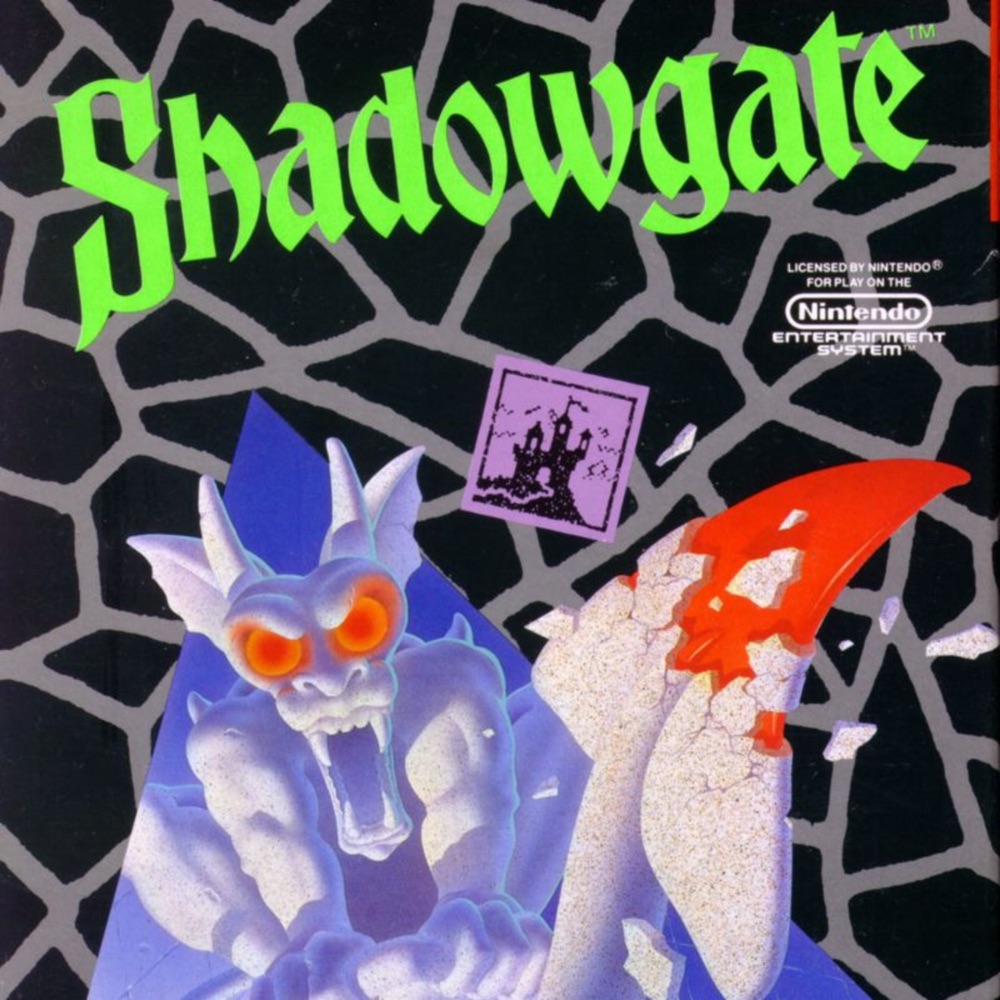
Shadowgate is an adventure game set in a fantasy world. Players take the part of an adventurer sent to the ancient keep of Shadowgate on a quest to find a mystic artifact known as the Staff of Ages and stop the evil Warlock Lord from summoning a horrific demon known as the Behemoth. However, Shadowgate has become infested with the Warlock Lord's demonic minions, not to mention the castle's still functional booby-traps.
Shadowgate is a first-person point-and-click adventure through a warlock lord's castle, unlike almost anything else on the system. You pick a verb, pick an object, and the game reads you the next paragraph, like a choose-your-own-adventure book. We called it a precursor to escape rooms, though we argued over whether it is one or a close cousin.
What works
- Verbs for everything. Move, look, use, open, close, take, hit, speak, self. Every object accepts every command, so even a plain room has plenty of permutations. Nothing relies on reflexes and there is no combat screen, which we thought was right; a half-baked battle system would have hurt it.
- Dying creatively. Take the book in the second room and you're dead. Step on the tomb slime and the Grim Reaper shows up. Lift the pot at the lookout and the alligators "really enjoy your company." Death sends you back one screen with your items, so experimenting costs almost nothing.
- The frozen orb. Freeze the lake to get past the shark, then melt the ice with a lit torch to get the orb back and use it on the hot floor later. It is what you would try in real life, and the sphinx's riddles give all the junk you picked up a reason to exist.
- An interface that aged well. Item, then use, then target felt tedious at first and stopped mattering fast. The text tells you what happened, so you are never squinting at pixels.
- Slow escalation. A fairly ordinary castle of bones and rocks turns eldritch, and your inventory grows to pages.
What doesn't
- The torch. It burns down as you act, and when it dies you die. With a one-screen setback it never creates urgency, and it is the least interesting way to go.
- Hints from nowhere. The key in the skull is a lateral-thinking tutorial, the waterfall passage isn't on the mini map, and the spell you learn by looking at a wall three times is easy to miss. The lit torch in your inventory can be selected, which sent Sean and Mike to a guide. The NES-only hint button helps, though "don't forget you can set things on fire" is a blunt patch.
- The cursor. Hug the right edge and you can slip into the inventory. Mike took that as a reason the mouse versions win.
Beyond the game
The hint book cost $5.99 and gave three tiers per puzzle, from vague to the answer. The game began on MS-DOS in 1987, and later came to Game Boy Color, N64 and a recent Steam and Switch remaster. An achievement says you can finish in 90 moves.
The bottom line
Essential. The vote split. Sean put it on tentatively, unsure because the other versions are probably better. Joe voted yes and said he would never take it off: the game feels made for him, and better point-and-clicks existing doesn't stop this from being a fantastic one. Mike held back and called it a play-it for NES fans, since a mouse and keyboard suit it better. It is still the most immersive adventure we have played on the system.
Written from our conversation in this episode.
- Your Next Move Could Be Your Last
- NES Longplay
- Introductions
- point-and-click adventure video games
- Plot
- The player enters Castle Shadowgate, residence of the evil Warlock Lord. Try to navigate the labyrinth and find the Warlock Lord before he can summon Behemoth.
- "The last thing that you remember is standing before the wizard Lakmir as he gestured wildly and chanted in an archaic tongue. Now you find yourself staring at an entryway which lies at the edge of a forest. The Druid's words still ring in your ears: Within the walls of the Castle Shadowgate lies your quest. If the prophecies hold true, the dreaded Warlock Lord will use his dark magic to raise the Behemoth, the deadliest of the Titans, from the depths of the earth. You are the seed of propmmhecy, the last of the line of kings, and only you can stop the Warlock Lord from darkening our world FOREVER. Fare thee well"
- Breaking down what you can do in this game
- MOVE
- You select where to move on a minimap that shows open areas via square boxes
- Did you need the minimap?
- LOOK
- This allows you to get better descriptions of specific things in the room
- USE
- Use an item, usually a combination of select the item you want to use and then what you want to use it on
- OPEN
- CLOSE
- TAKE
- Take anything you see
- HIT
- Throw a punch at anything on screen
- SPEAK
- Talk to people
- SELF
- Use items on yourself
- SAVE
- CARD
- Move between inventory and spells
- GOODS
- MOVE
- Gameplay
- The tutorial of entering the castle
- You really can’t play this kind of game with a guide. It feels weird doing everything in order, less natural.
- Death might be constant,but it’s not a major penalty
- And death is also very creative
- Puzzle Solving
- The manual wants you to order the hint book. Designed this way on purpose? ALSO that’s all the manual offers you.
- The hint book does have a cool system though. It has three levels of hints. A, B, C. A gives you a vague hint, B is more informational, C is explicit.
- ????? The hint feature is NES exclusive, but not always helpful
- The manual wants you to order the hint book. Designed this way on purpose? ALSO that’s all the manual offers you.
- Only a finite number of torches are to be found throughout the game, which effectively acts as a time limit to proceedings.
- Weapons
- Can be found, but not used as combat, more like item checks at particular moments
- Secrets
- Sequels and Spinoffs
- The original MS-DOS game can be played for free on Archive.org
- In 1999, Infinite Ventures licensed the NES version of Shadowgate to KEMCO and it was ported to the Game Boy Color with enhanced sprites and animations also under the name of Shadowgate Classic.
- Beyond Shadowgate - TG16 1993
- Unlike the first Shadowgate, this is a platform game - not an action game, but a classical point-and-click adventure viewed from a platform perspective. You can move your hero around, examine, manipulate, and take objects.
- Shadowgate 64: Trials of the Four Towers - 1999
- 3D first-person adventure game
- Shadowgate was remastered in 2014 available on Switch and other consoles, same game for the most part, just with nice artwork and QOL improvements.
- EGL
- Next week - Short Order/Eggsplode
- NEStalgia Byte - B Wars
Found automatically from the transcript and checked, but it can miss things or pick the wrong page. Spot a mistake? Tell us.
Games
- Shadowgate mentioned at
The episode's game: a first-person castle adventure with a text-driven point-and-click interface and many deaths.
- The Portopia Serial Murder Case mentioned at
Famicom adventure from the Nostalgia Bites episode, compared to Shadowgate.
- The Legend of Zelda mentioned at
Its opening cave and sword used as an example of an early tutorial.
- Super Mario Bros. mentioned at
World 1-1 mentioned as the classic tutorial that teaches jumping over pitfalls.
- The Witness mentioned at
Puzzle game referenced for the moment of realizing a solution.
- The Elder Scrolls V: Skyrim mentioned at
Used as an analogy for how junk items get a reason to exist.
- Beyond Shadowgate mentioned at
The 1993 TurboGrafx-CD sequel, a point-and-click adventure viewed from a platform perspective.
- Shadowgate 64: Trials of the Four Towers mentioned at
A 1999 first-person 3D Nintendo 64 entry in the series.
- Shadowgate (2014 remake) mentioned at
The 2014 remaster with redesigned rooms, released on Steam and current consoles.
- The Secret of Monkey Island mentioned at
LucasArts point-and-click adventure compared to Beyond Shadowgate.
- Tetris mentioned at
The NES version, a past non-essential game used as a contrast for how well a port uses the NES.
- Bokosuka Wars mentioned at
The next Nostalgia Bites game.
- Silent Service mentioned at
A Sid Meier submarine game coming up in the show.
- The Uncanny X-Men mentioned at
Upcoming NES game based on the Marvel comic.
- Willow mentioned at
Upcoming game based on the fantasy film and the last game of 1989.
Hardware
- MS-DOS mentioned at
Computer platform of the 1988 Shadowgate version the NES port followed.
- TurboGrafx-16 mentioned at
Console that received Beyond Shadowgate in 1993.
- Game Boy Color mentioned at
Handheld that got an enhanced 1999 Shadowgate, sometimes titled Shadowgate Classic.
- Nintendo Switch mentioned at
One of the current consoles where the Shadowgate remaster is available.
- Power Pad mentioned at
The floor-mat controller used by next week's two games.
- Commodore 64 mentioned at
Home computer joked about as never having had a Power Pad.
People
- Sid Meier mentioned at
Designer of Silent Service.
- George Lucas mentioned at
Story author of the Willow film.
Film, TV and music
- Willow (film) mentioned at
The 1988 fantasy film the Willow game is based on, with a story by George Lucas.
Terms and events
- Escape room mentioned at
Live puzzle-room experiences the game is compared to.
- Point-and-click adventure mentioned at
The genre of adventure game Shadowgate belongs to.
Articles, videos and sites
- GameFAQs mentioned at
Site with a guide listing the game's many deaths.
- Internet Archive mentioned at
Site where the computer versions of Shadowgate can be played for free.
Other
- Final Fantasy mentioned at
RPG series used as a contrast with Shadowgate's first-person, book-like play.
- Nobunaga's Ambition mentioned at
Menu-heavy Koei strategy game compared to Shadowgate's interface.
- NEStalgia Essential Games List mentioned at
The show's list of NES games that define the system; Shadowgate was voted in.
Auto-generated transcript. Each paragraph starts with its timestamp. Speakers are not identified.
Shadowgate, your next move could be your last.
And welcome to NEStalgia, a chronological exploration of every NES game released in North America. I'm Mike. I'm Sean. And I'm Joe. And we are playing today what could be seen as the precursor to all current Escape the Room style experiences across the world, right? This is kind of an Escape the Room, except for you've chosen to go in the room. I mean, you could call it that. I'd also just say it's a like a point and click adventure game.
Yeah, I feel like Escape the Rooms have always sort of reminded me of this format of game, but it wasn't until you know, later in my experience of playing this game, I actually did start thinking specifically this feels like Escape the Room. So I don't know. It's like one of those chicken and egg things like something came. They're both kind of evoking each other.
And Sean, you're spot on. It is absolutely a point and click adventure game. I only noticed as I was getting like further into the game that it just became a lot more about my inventory and less about like what was going on in the actual rooms that that made me start to feel like an Escape the Room where I have to deal with the tools that I've collected less, you know, less pointing and clicking than I'm used to in these kinds of games where like, okay, it doesn't matter what you have available to you.
It's what's on the screen that you're like trying to puzzle solve based on that, not based on what you've collected so far. Yeah, I guess there is enough of a difference between the two types, but I guess I would consider Escape the Room more a subgenre of point and click adventure.
Yeah, I guess Escape the Room, I would say is like just solely focused on like puzzle solving where this is like there's a lot of puzzle solving, but there's also just like a lot of general adventuring going on. And there's a lot of story too, not even just like what you read in the manual and stuff like that, what we're used to in games. There's a lot of dialogue to or exposition or narrative to read throughout the game.
And then to also look at all the objects in the room and get detailed descriptions on that stuff. This is a very text heavy game compared to what we're used to on the system. I think that a lot of the backstory, it's a little opaque and in some of it, like because there is definitely a text limit, it doesn't, I couldn't entirely get what all of the, like the circle of 12 and the something of seven, like I didn't really get what all that was. But you're right, I mean there is a lot of that.
Yeah, I also think that it being text based primarily, I mean obviously there's images too, but it's just normally stills with like very few animations and stuff. Kind of, while like the text is obviously limited, it kind of helps to like remove limits in the video game sense of as far as like letting them do a lot of different things. Because when it all boils down, all they have to do is text.
Yeah. Like in that kind of, I think, whether artificially or not, like I think it makes, at least while I'm playing it, it makes me be able to kind of like immerse myself and like kind of make it, it feels like a much more robust game than other like games in this like fantasy genre. Just because like, it's almost like reading a book. Yeah, and I think that becomes the whole like appeal of Shadowgate 30 years later, right? What I'm saying is that in other fantasy genre games, you know, you could use like Final Fantasy as an example here.
You control this group of characters on their epic adventure and you directly interact as that character in the overworld doing these things, saying I, you know, like attacking and being tactical. In this game, you are a character and you are exploring this, you know, castle throughout first person view. But the way you interact with this kind of video game is way different than, you know, it's gonna sound silly, but like any of the platformers we've played or anything else. Like you're not, you just have like the shield on you and provided that you have the shield equipped, the game does all the work for you.
There's no like, okay, now we're switching to a combat mode where you fight the dragon, right? It doesn't, the game never takes that way. So in that way, Joe, I totally understand what you're saying, where it does become more of a book where you're collecting these things or choosing. It's like a choose your own adventure book. You're choosing to perform an action and then based on where you are, what you have, what you've done, the game kind of like reads the following paragraph to you. And then you choose the next part of the adventure based off of that information.
Yeah, you're not like, you don't have skills in this game. Like you don't, if you, in the game, you are like an adventurer night guy. So it assumes that if you have the correct equipment, you're probably going to do pretty well. Otherwise, it would be kind of weird and pointless.
Right. If it relied on reflexes or fast input from the players at any point, that could get a little weird because of the way that the game works. So I feel like before we get any further, similar to what Sean and I did in our Nostalgia Bites episode, the Portopia serial murder case, we should explain or, you know, just talk a little bit about all the different things that you're allowed to do in this game. And as a brief overview of that, you're allowed to move where you select in a little mini map.
It shows you open areas via square boxes, and then you can click on those square boxes. Or if you see said door on the actual screen, you can also move into those. You can look, which allows you to get a better description of specific things in the room. So you might be able to tell it's a sword. But if you look at the sword, it would give you a more detailed explanation of what that sword could possibly be used for later on in the game. Or it could be a very, very vague hint that you wouldn't be able to understand without the accompanying strategy guide.
There's the use function, which allows you to use an item, usually a combination where you select the item first and then what you want to use it on or use it on yourself. There's open and close, which is as straightforward as it sounds. You can open up a door or a chest or anything else that you think could open and then close it as well if need be. You can take anything that you can see and you can hit anything that you want. Not saying that it will actually let you take those things or that hitting those things will do anything, but the option is available to every single object in the game. You can speak by talking out. You can control yourself by the self option, which allows you to use items on yourself or do things in the room with yourself.
And then additional things you can save. You can move between the inventory and you can see all your goods. Those last three are really more of like inventory and game management things, not necessarily related to the actual world of Shadowgate.
But I think now that we've laid out those moves, that's kind of that shows, I think, how many permutations in any given room of things that you have available to you. And what makes this game so broad and branching from the player's standpoint is that every single room you enter, you could just try to brute force your way into another room or into collecting everything in the room. But that's not the best way to play Shadowgate. And you kind of need to understand everything you can do here and then use those tools to explore said room.
Yeah, and that being said, I feel like they do a really good job of because you're thrown into this game with all of these options. And it's almost a little overwhelming at first because you're just like all these things you can do. And I think there's just some really good game design in just the first couple of rooms that that gives you that teaches you what to do and when to do it. And like the kind of things you should look out for in this game, like in the very first two rooms, you know, you get to the second room. There's already a dead end. There's a locked door without a key.
And outside of it, you have a door that you would have presumably already used the open command on. And if you start looking at things, you'll find like there's there's a skull, a little skull above the door that says like, oh, this really makes you think that like that like danger lurks inside or something. It uses the word lurks inside, making you think like, you know, there's nothing else you can do here. So you might just start trying to like use the open command on the on the skull, maybe because it said something lurks inside when you clicked on the skull, too.
So it's like giving you that like a little bit of a little bit of a like a lob ball of a puzzle just so you can like understand like, oh, OK, not everything is necessarily exactly as it seems. And I should try things.
And then following that, you go into the next room and right away, there's a book that you're just like, I'm going to take this book and you take the book and you die. Like most people, I assume, just like they see a book and like, I'll take it, see what it is. But if you would, if you examine it first, it kind of gives you this like idea, like maybe I should be careful, you know, so like it kind of gives you the idea, like examine things. They'll give you hints and like try different things like that you wouldn't expect. Right off the bat, you kind of know, like that's the kind of game you're looking for. It's not going to be necessarily like telegraph for you. You're going to have to figure things out.
Yeah. And stepping back a bit, just to talk about the actions that you can take, it is a very wide like palette of interactability when it comes to like what you can, how you're interacting with the world, what options you have. Um, and going back to like comparison to that, to Portopia, uh, which was a lot more focused on like mystery solving and the things that you could do were very much about solving, uh, murder cases. Uh, this one is much more just like, what can you tactic or tactilely with your hands do, uh, in the space provided? Uh, but going off of Joe's point, yes, I think that those are really cool, uh, tutorials in, in those first couple areas. I, for one, I felt really dumb.
Uh, I actually did have to open up the guide immediately because I couldn't understand that opening a skull was a thing. Um, and, uh, but I definitely died when I took the book. Like, so that, that taught me that anything could be a trap and I should be wary of these things. Uh, but the skull thing was more of a, like, well, okay, this game is starting me off on the wrong foot because it's immediately going to, to something kind of out there. I thought maybe it could, could have started with something a little bit more, a little less, um, lateral, lateral thinking and more so just like, okay, this is how you interact with something.
Yeah. I, I think it's because, uh, in Legend of Zelda, right, the tutorial there is to enter that cave that is very clearly seen to the person. You can go walk off without a sword and try to get as far as you can and you'll have nothing to fight back with, but you enter the cave and then you get the sword. That's, that's somewhat of, of a very beginning tutorial.
There's the Super Mario Brothers World 1-1 where obviously we've talked about it at length in that episode, but it teaches you the idea of jumping over pitfalls. This game probably has to be a little more difficult just to, you know, set up the idea of what you're, how you're going to be solving puzzles in this game.
It's not like the world's hardest puzzle or anything. Uh, I think Joe saying that, you know, by using the look function, it would give you a little more detail about that skull and you'd be able to theoretically solve it on your own. I'm not saying you're dumb, Sean. I didn't solve it either. Uh, but it's not like, it's not the world's worst tutorial either. It's not like they purposely made it hard, but yes, they totally could have had something that was more chest-like that you then had to open to find the key that you needed. And then you understand like, oh yeah, yeah, yeah. So I got to open things to get items.
I got to take said item and then I have to use it on the door in the same room. This one's a little interesting because you actually have to like exit back out of the castle and go use the only other thing in your surroundings. Uh, but I, I do think it's a great puzzle now that I've played most of Shadowgate. Like I do think it has a great way of explaining to you that this game is going to have some, uh, really, uh, little hidden trinkets all around that you're going to have to kind of explore the pixel art and say like, hmm, maybe this isn't just on the wall. And maybe this is something that I need to interact with. You know, we've seen that a few times in this game, even bricks.
It's like, hmm, that brick is slightly off colored. I should hit it. You know, you can definitely tell that like this game, it, it, it lends itself well to sort of like playing as a team with like, Ooh, why don't you try using that on that? Or like, well, that thing looks weird. Let's, why don't you try doing that? Um, but the game definitely expects you to get stuck a lot because I feel like the only way that somebody would decide to try and open a slightly brighter brick than something else is if they've literally tried every other option.
Well, I'll say too, that I, I may have been, um, been a little generous when I said like, Oh, the hint of like something lurks inside, uh, is a great hint. I mean, you know, maybe that that's still kind of a tough hint.
I guess I kind of like lucked into this, but, but like, I just went into the second room. There was no key there. I went back out and I just started trying things and I was like, well, there's only a few things on the screen, so I'll try this skull. I did try to take the skull, but that wasn't it. Yeah. Cause I feel like if you just imagine a world where the guide is not that accessible to us, I feel like just with time, like there's only so many things you could try.
And so like, it's not that that puzzle in itself is not like a game breakingly frustrating puzzle where like, if you just didn't have the option to, to look at the manual, you probably would have found it eventually just by trial and error. And then that kind of shows you two things that like things aren't always as they seem. And like the solution to the problem you're having is not always in the same room. You might have to go back and remember something else. Like, I just feel like that sets up that for the game.
And an important thing here too, when we're talking about looking at guides or stuff like that, it's, this game is not a game that you can play with a guide. You're not playing it then at that point, especially because there's no inputs to be done really. That feels like you're just, you know, watching a YouTube video at that point. It feels weird doing everything in the order exactly as intended. This game is at its best when you have the, you know, as they reference it in the manual, the Shadowgate hint guide book, which you could have ordered for $5.99 back in the day.
If that had come in the mail, which is what I wound up using for my playthrough, that just gives you hints in three different layers of difficulty. It has an A tier, a B tier, and a C for each kind of puzzle in the game. So first you figure out. And C is just telling you where it is, right? Right. C gives you the answer outright. B is a little more suggestive. And A is so vague. It's like sometimes I just go right to B. I'm like, okay, well, what the hell does that mean?
Do these correspond to the in-game hints? No. No, they don't. It's more like there's a layout of very specific spots where you will get stuck in the game. And you look at that specific thing that you're stuck in. And it has a line in it for like, you know, what you're trying to do. And it says, go to A32, B47, or C6. You know, so then you go to the index. First, you try the A thing. See if you can solve it based off of that. If you still can't figure it out, you go to the B. And if you still can't figure it out, ideally, you would then go on to the C, which would tell you the answer outright.
That's the creative way to still like get a solving mechanic that doesn't revolve around using a strategy guide for this game. Because when you use a strategy guide, I don't know, the whole point of the game, right, is that you're going to die. They come up with so many kinds of creative deaths and weird deaths and things that you wouldn't think could kill you, do kill you. The point of the game is to explore and just kind of, you know, try to take every single thing in the game or open everything you see. Because you're always just, when you die, you're just going to start back on the previous screen, right? So it's not like experimentation is frowned upon. Using a strategy guide was something that right away just didn't sit right with me.
Yeah, I agree. I feel like it's like if you were to compare it to like Super Mario Brothers and you're playing that and you're stuck in that endless dungeon and you just don't care about this puzzle because you just want to go stomp on some Goombas or whatever.
Maybe you'd use a guide so you can get back to like the gameplay element that you like. This game, the gameplay element is figuring out where to go next. So if you look up where to go next for everything, you're not doing the thing that is supposed to be the challenge. But I'm also, I'm not going to frown upon somebody that like has been trying to get past this one thing forever. And they've been playing normally up until then. And they just, you know, they just need to get past it so that they can enjoy figuring out other things.
Yeah, and I won't pretend that I didn't use a guide at all either. I did a couple times towards the end. Only though, I'd say because, well, one, because I wanted to finish the game before we recorded this. And two, because I've just been burned by NES games before in the sense where it's like, well, this, you would absolutely never figure this out without a guide. So I'm like, well, if that's, what if that's happening right now and I'm just wasting my time and I need a guide.
And then I would look and sometimes I would think that that's the case. And then maybe like later on, I would realize like, oh, you know what, there kind of was a hint. And if I had unlimited time, maybe eventually I would have figured this out. But like some of them are pretty, you know, pretty vague. So I like, I think they're all possible, but some of them would take you a long time.
Well, I had an experience like that earlyish on in the game where I got to the room with the tombs in it. There's like three tombs on each side and they're closed or whatever. So I just started opening them from left to right. And I opened the middle one on the left and green slime oozed out. And it blocked me from exploring the rest of the tomb because no matter what I did, I would walk on that slime and it would be like, you just got slimed. And then the Grim Reaper would show up and I'm like, what? Like that's a death?
What's in the slime? Like, why can't I jump over it or whatever? Anyway, not the point. The point being that for the longest time, I assumed that I had just like, I had just gotten stuck in the game. Obviously, you can't soft lock yourself, but I assume. So you mean you thought that the slime needed to be poured out? No, or that by pouring it out, I blocked myself off from those other doors. The only other doors in the game that I thought were left at that point.
I thought I had explored everything else. And thanks to the nostalgia discord, I just wound up throwing it out there. I was like, you know, I'm trying to like brute force my way to exploring those other tombs. There's a mummy in one of them that I could technically interact with. Everything else I can't interact with. What am I missing?
And, you know, even then I got like some polite hints about, you know, have you been to the basement? Which is pretty suggestive, but I was like, I definitely have not been to a basement. I wasn't told how to get to that basement, but after just going back to the other rooms and just looking through things, sure enough, I got to the basement on my own. Like nobody told me specifically the things I had to interact with or take or whatever. And I don't know, that's like a cool thing where, yes, every puzzle is possible and is solvable. But sometimes you just need that reassurance or modern day functions of the Internet to just kind of lead you in the right direction and make sure that you're not completely screwed, right?
Well, if we're going to share points where we got stuck because of certain things, I want to talk about torches. So, so there's like torches are used and it's basically to counter just trying to brute force and trying everything. I think like there's enough, like anytime you perform an action, even like looking, moving, using, whatever, your torch loses a little bit of a little bit of itself. Um, and once it gets low enough, you'll get some like scare tactic music and it's like, okay, I need to light another torch.
And if I don't, then I think the game's over because you're stuck in the dark and you fall over and hit your, hit your face, whatever. So, in your inventory is torch and it shows you the number of torches you have. And then on your inventory, it will, it has a couple torches. You can have two torches lit simultaneously. You can use them to stagger so that you're never like at risk of running out.
But at a certain point, you need to light certain things on fire. There's another line item for a torch. I learned later that it's a very special torch that has like some rings on it and it's like, uh, it's actually a weapons sort of torch. But I just took it as, oh, this is the torch I use when I actually need to use it in the world. Um, uh, so that I don't accidentally light another torch when I don't really need to and waste that torch.
You guys are following me right now, right? Yes. So, there's another way to interact with the torch and it's to literally navigate your cursor to the light, to the torch that's lit. I did not know that you could select it. I thought it was just like a part of the HUD, an indicator. But you can select a lit torch and then start the fire or melt the thing, uh, on the screen. I just, that's just something that I don't think I was dumb in terms of puzzle solving. I was just dumb in terms of knowing the actual user interface. So, that I had to look up the, look up a guide for. I got stuck at that same point too. And I was doing the same thing. I was using that like alternate torch or whatever, the one that's not part of your other collection of torches.
Uh, and, and I was using it in a couple of things. And then it wasn't until I went somewhere else that I didn't even know I needed to use a torch. And I found out, uh, eventually that, that there are these in-game hints. If you hit start, it gives you a hint in a lot, in like a lot of the room. Which is exclusive to the NES version. Sorry to cut you off too. Oh, is it? I just thought that that was, that's a really cool, helpful thing for a game that had been out for a while. They probably decided like, hey, we should probably include this because the NES audience is younger than the computer audience.
Yeah. Right. And I imagine they probably also saw like the things that were like, okay, maybe this isn't like so intuitive to solve. So, maybe a hint would be warranted here. But at one point it said like, hey, don't forget you can set things on fire. It said something like that. And I was like, yeah, but I've been trying that. And that's what just like made me like, it did make for a really cool, like the witness style moment where I was like, oh my God.
Like, could it be? And then when it worked, like it was like, oh, that's really cool. It worked that way. So, you came to that conclusion by yourself. I came to that conclusion with the game's hint. I mean, because it kept telling me something needs to be set on fire and my torch wasn't setting anything on fire. So, like, I guess then I was like, well, there's that one that's on fire.
But, like, I don't know. I feel like it's giving me a little too much credit because it is like, it was just telling me you have to set something on fire. And I tried everything else that could set it on fire. And then finally I was like, okay, well, that's there. Maybe I can select that. Now, Joe, do you feel like that kind of hint, though, is that that's a good puzzle?
Like, the game kind of had to go out of its way to give you an additional hint for something that wasn't really story slash adventure slash castle driven. It was something that, like, the game handed over to you because they probably didn't communicate well enough how to defeat the Wraith otherwise. Yeah. Like, what should it? Well, so this this at this point that I'm talking about is the mummy. Oh, OK. That comes out.
And like, yeah, I think I totally agree. I think like something an alternative that should have happened should have been like, you know, the text should have said, like, the mummy comes out and it and it smells like gasoline or something like that. Like just something that makes you think, oh, I wonder if it's going to start on fire if I let it on fire or like its wraps are so dry that they, you know, better keep it. I don't know. Like, that's almost too obvious also.
But like some some contextual thing that like maybe there's a burnt mummy next to him or something. Right. Just like then there's a contextual clue rather than the game saying, don't forget you can set things on fire. Yeah. Hint like that is. Yeah. Like not the best kind of hint. But I imagine that that was something that like they realized, oh, and the PC version, like nobody's been able to really figure this out because it's just kind of random. So let's just toss in this like easy hint.
The castle itself is full of secrets. Like that's the whole idea, right, is that this castle is crazy and there's all these different things that you're going to have to try to figure out how to get to rooms that don't technically exist or whatever. That's how the king pitched it to you. Right. Yeah. When they were building it, they were like, yeah, this is going to be like crazy. This is going to be like the world's hardest castle to navigate. Like that's why I'm building it like this. And that's why it's going to have a waterfall. But speaking of the waterfall, that's what I'm getting at is, you know, similar to the torch thing that you were talking about, Sean, where you're like, oh, I didn't think I could actually touch the torch on the UI.
Sometimes they, on purpose, don't show things on the little mini map that are areas you can go to as well because they're trying to keep them a secret. Like going behind the waterfall to find the red blue and I think it's a white gem. To find those three gems, you have to go behind the waterfall, but it doesn't show up on the mini map. So therefore, you either have to notice the small little hole, select move and click into it, or you have to find out about it via, you know, some hint that isn't necessarily like given to you inside the game.
Contextually, that is. Not contextually, yeah. Non-contextually. Honestly, this was one of, maybe it was the first time, it was one of the first times that I used a guide because I was like, I was just lost in all these rooms. See, because I actually got there. I feel better about myself now. Yeah, I feel like it just comes down to like circumstance because you can kind of see like a crack behind there. I'm assuming that's what you noticed or like. I noticed that there was a, there was more gap than I would have expected on the waterfall. And I'm like, oh, maybe.
And then it worked. So. Yeah. See, isn't that like a really cool moment? Yeah, it is. I like those. I didn't think it was going to work and it worked. But it also, I do get what Mike is saying in that you've got this tool that is sort of simplifying it, making it easier to navigate so that you don't have to keep clicking around the screen. It's just pointing to where all of the entrances and exits are, places you can go.
And yet, in just a small amount, I think it happens somewhere else where you can, I think there are other points where there are secret passageways that you have to actually manipulate the screen instead of using the nav box. But if it's only a couple exceptions, it kind of makes you second guess that as a tool. I don't, I don't know.
Yeah. And I went through the map and tested out the hints. And the hint there was, take a look at that waterfall. Kind of looks like you could fit behind there or something like that. Like, it was literally that.
So, like, had I known about the hint, that one would have been a really easy one, actually. But, like, I just didn't know that it would do that. And I guess going into a little bit more detail, unnecessarily, there are other secret passageways that you will, like, oh, you hit the book and so it opens. And now on the little nav pad, there's another entrance that you can use. Maybe if you just looked at that little dark crevice and then you just exclaimed to yourself, like, oh, I can get behind there. And then it opens the entrance and that fixes the issue logically. But, well, they didn't do that. Yeah. And I'm less concerned about number of secret passages.
My point was actually going all the way back to the torch thing again of just how the game itself, like, the way it sets up all the things that you can do in the game and the inventory that you have. The fact that little things like that, using the torches that are actually lit on your screen, like, not knowing that those are interactable, not knowing that there's passageways you can go behind, at least the very first time you do it. Instead, looking at things and requiring to have to look at them several times for it to actually trigger the thing. I'm thinking about that E-rope room or what? E-pro. E-por. E-por, yeah. I actually said rope backwards, but just the E part, not the whole thing.
Big Latin. Yeah. E-por, you know, you have to, you learn the spell by looking at it three times. And the first time it doesn't, like, suggest that anything is going to happen. And the second time it kind of hints that, like, you know, oh, maybe you're seeing something. And then the third time it actually teaches you the spell. I don't know. It's just little things like that with the way that the game set itself up to work that are a little disappointing.
They're fun secrets and they feel good. Like, Sean, you were saying you feel proud of yourself to have known that you solved the waterfall thing on your own. That was also a joke, but yeah. Yeah, yeah, but you know what I'm saying. Like, to the right player, anything that requires some kind of intellect, right?
The game didn't necessarily hand it to you. You could just go open any door in this game, right? You're not going to feel good about, like, yeah, I opened that door and I walked right through it, right? Like, that's not the appeal of the game. The appeal of the game are the secrets, but I think some of the secrets or, you know, even just a good batch of them require something that the rules of the game, especially given the limited, very limited manual explanation of, like, how to do anything in this game. I don't know. It just doesn't feel like it's fully player friendly.
Well, on that note, I mean, okay. There are several specific instances that we have pointed out in which the game is not fully player friendly. But I did just want to say that, like, once you realize that, yes, there's a key in the skull and, yes, you can use the torch to light things and whatever,
the actual usability of this interface, in general, I found to be very player friendly. Like, I know what that map is doing. I know that you can use stuff on yourself in ways that I didn't fully understand in games like Nobunaga's Ambition, which is also a very menu and text heavy game where I was just sort of like, I don't know, I guess I'll buy some rice. Like, there is, and I know it's not the same thing, but there's enough feedback and the feedback is quick enough and the descriptions are clear enough and the translation good enough that I did think that this actual GUI has aged pretty well.
Yeah, I kind of felt the same way because I'll say at first, like, I noticed the age pretty quickly where I was like, okay, yeah, I have to open the door. I have to unlock the door. Then I have to click open. Then I have to open the door. Then I have to click move. Then I have to move through the door.
Then I have to select the item. And then I have to select use. And then I have to like combine it with the, like, you know, I have to select the slingshot, but then I have to also select a stone. And I have to use the stone on the slingshot, then use the slingshot on the enemy. and I was like at first I was like man this is tedious but I'll say that evaporated pretty quickly like I just got used to it and it was like yeah there's an extra step here and there but it did feel pretty organic and it was like
it was never I was never super confused minus a couple of things where it's like yeah we didn't know that you can use those torches and what not that felt like deliberate like a deliberate moment to be an aha moment so like the interface never felt like it held it back for me or like
or made things confusing and I think a lot of that is because again because it's text based so like a lot of the things that might be confusing in another game you use something on a door and something happens and they're trying to rely on this like pixelated imagery and sound to happen like this is just they just describe what happened so like there's clarity there where there aren't in a lot of other games
and whether the actual story is good or deep or intriguing this is one of the most immersive NES games we've ever played not just from a storytelling point of view but from a you know video games let you explore another world point of view right yeah and I think even compared to its closest analog Portopia Murder Mystery I think like I was again minus the torch thing I was never sort of taken out of it as much
as that game there were more instances where I'm just like okay how do I actually how do I how do I manipulate this game to do what I want it to do in in there were less in this game than there was in Portopia is what I'm trying to say there are tons of items that you find in this game tons of weapons that you can equip on yourself armor what have you spells you can learn to then use
my point being we can't we can't go over everything and I'm not asking you to necessarily call out favorites but what do you think about the fact that there is no combat system or that there is no um you know these things act like checks uh at particular moments like oh you can't get any further in this room because you don't have this item either equipped or combined with the right thing or using it on the right thing it's really just acting as um progression points granted a little more skillfully than we've seen in most games but they're not actually like you know having the sword doesn't require you to then uh use the sword on any uh enemies
I think that like well just splitting that up into the first part of the question being like there's no combat and it's all based on these like more cerebral things I think that's perfect for this game and I think a lot of other games would have thought we're making a video game on the NES we need to we need to have some action-y element I mean think of all the other games that have tried to do like 3D quote-unquote
exploring through like a maze this accomplishes the same thing of exploring through a maze but it's not doing like a 3D effect it's not making you like run it's not making you do any sort of attack it's just focusing on what the main thing it's trying to do and I think that that's why it feels like so much more complete of an experience because like it's just playing to that strength and not trying to like add
other elements of gameplay for the sake of like making it more video game-y because that's just not what it's trying to be yeah I agree I'm you're speaking to a guy who's one of their favorite games is a game in which you have a gun but there is no combat system so I think that that was also like using weapons more so as tools in an exploration slash adventure situation and not so much a twitch
like testing of skills of video game skills I think that that was what this game needed and if it didn't do that and it went in a like alright and here's the we're gonna take you to the battle screen and it's gonna have some half-baked battle system that would have really hurt the game correct me if I'm wrong but there is a sword in this game you don't use that sword for anything right or did I forget I could have swore I used no I used the sword to kill the golem thing after I hit him with the sling
otherwise he gets back up oh yeah I did that too that's right and then when you examine him afterwards it's like yeah it's dead what'd you think stabbed him with a sword a little sense of humor I forgot that that happened because I was just noting that in the manual it says like all you need is your wits and like and a sword would be helpful too and I thought maybe that was like a little winky joke to the fact that you'll get the sword and never use it oh I also I did kill myself with the sword once accidentally I kill myself just by hitting myself
I just saw stars I thought that you had to equip the sword so I used the sword on self and they died there is a write-up guide on game FAQs for just the the deaths and all the different ways to die if you wished to to know them all it's for the NES version but I'm sure it's not too different from all the other different versions you don't have to tell me a favorite death or anything but I do feel like that's part of Shadowgate's allure right is the fact that you are at least for me I was constantly creatively dying it wasn't always the same thing over and over again in fact if anything it sucks that the torch system is the thing that kills you the most because you wind up running out of your torch or whatever
that's the least creative death in my opinion is what I can't survive in the dark like I'm like I got this far but now that the lights are out I suck I'm sure I have enough time to to light another torch but some of these other ones are are just very creative I even like the you got slimed one I know I was like you got slimed I know I was pissed that like I thought I locked myself but the idea of being slimed is just like I don't know that yeah that could be gruesome or it could be really funny well there was no pain my favorite way that I died was pretty early on where there's a trap door and it's it leads to the e-pore room you can go down and the
moment that I realized that maybe things weren't going to go the way I thought they were the description said that you fall for a few moments and then it shows you the room and I'm like oh okay I'm in the room and then it says oh no you've broken both your legs you're not going to die immediately but you're you're toast it's gonna take a while bye I wish I could think of like I know there were a couple that I was just like come on it's just like it's like comically over the top like gruesome and just like how I randomly died but I cannot think of any right now and I like the descriptions though too it's one thing to just say like you know you died from falling or you died
from impaling yourself but like they really go into detail I'm only using this one as an example because I haven't pulled up on the game FAQs thing but on the lookout point where you find the gold pot if you choose to take the gold pot it doesn't just say that the alligators ate you it says as you move the pot you realize that you have fallen for the oldest trick in the book you suddenly find yourself knee-deep in the moat it seems that the alligators really enjoy your company like it just you know you picture what happens next with you and the alligators you know
well there was also one that like this is one that I was playing with a couple friends too like you said like where we were trying to figure things out together and we were all just like what like come on where what it was was there's that room with the three mirrors oh yeah the center mirror is the one where you see a reflection and I guess that's like your hint that like that's the one one of them takes you to space but yeah that's the one you you you hit that mirror and it says behind the mirror is a portal to the middle of outer space you're sucked through and like you're like it's just like what
it's crazy it's crazy I told you yeah it's a crazy castle when the king does um it's not a king though right it's um it's a warlock lord who you're going in warlock lord yeah I don't know if it's the warlock named lord or if it's just the warlock ward lord and the castle is castle shadow gate uh that's where the name comes from I'm I mean you know we don't have to get into a lore or anything but I think
that that's funny that uh we went the whole thing with without explaining why it's called shadow gate yeah you can save in this game but you know if you're playing it uh you know through emulation or whatever uh or however you choose to play video games these days I I noticed that you know just using the torch thing as an example again when the torch goes out you die and then you're only just brought back
one previous room at least in my experience maybe later on in the game it moves further moves you further back but that's not really like a lot of punishment you don't lose any of your items which which I think is a good call because that'd be kind of confusing to do inventory and see if you can spot what you're missing or missing all of it that would be crazy too having to re-explore the whole castle uh but
because you just go back one screen I almost never bothered relighting my torches before it was too late I would just accept the punishment of death go back one screen and just have a new fully lit torch uh to me I didn't have to think about an inventory system for that kind of stuff a lot of times in this game death is one it's fine that it's easy and to to come right back because then that encourages
exploration but if there's you know if they're gonna have like things like oh the torch goes out and you die it just feels like well then what's the punishment for death yeah I mean I guess it would make it more punishing if uh it just brought you back to a set place with the same amount of torches or just that one torch at that torches level um so that you'd have to go and find one real quick but it's a finite resource and that would definitely lead you to soft locking so I really don't know what their other option would be unless there were set checkpoints
um but even then you just you've already solved the puzzle so it's not going to take you too much longer now that you know how to do everything so I don't know how you would punish the player in this situation yeah that's a good plan I was thinking the same thing it was checkpoints but but that's true if you already know the answers you're just making them like do more work because adventure games yeah in adventures games in general like that's that's it's kind of it like deaths are just the thing that they're usually funny
um and it's just like okay you need to you're just going to be stuck like the fail state is being stuck not so much dying yeah I mean I'm of two minds of it because on one hand and this is probably the one that I that I lean more towards I think that it not being super punishing is good for this game particularly because the game is not about overcoming these challenges that like you need to try and redo or anything it's about your progress and like figuring
out the puzzles and like there's nothing particularly satisfying about like game over redo all these puzzles that you already know the answer to yeah so like I'm glad that it's not punishing too punishing for this game but you know Mike you have a really good point about like the torch thing like that was clearly implemented to give you like a sense of time a sense of urgency and it's sort of like completely and immediately undermined by the fact that there's no real
punishment for letting your torch go out other than going back one screen so I'm not really sure what the alternative is but but that also leads me to the question isn't it possible already to soft lock the game I mean quote-unquote soft lock I guess just fail if you run out of torches and you I mean you can just run out of torches and then you and then when you die you go back one screen and still don't have enough torches
but I think you get the fully lit torch and you can go pretty far on a torch so you'll die a lot but you will know what to do do torches respawn like no so like couldn't you just run out of torches and everywhere that I guess there's always like going to be more torches as you progress yeah and then once you do progress then that problem will probably go away yeah but I guess it's really just a an annoyance
yeah on the discord one of our discord users told us that there is an achievement for the retro achievements website which is where you can link it to emulated consoles and then unlock achievements that way yeah really cool stuff there is an achievement for this game where you just use three torches through the entire game and I believe if the math is right that is 90 moves so it is possible to beat this entire game in just 90 moves granted that doesn't I don't think that means 90 actions that means 90
actual moving from one screen to another okay so maybe it is just movement that makes the torch go okay that's the way I remember the torches at least it never went out in the middle of an adventure for me but maybe that's not true maybe I'm misremembering
yeah I'm also at the point where I'm not sure if I'm remembering correctly but I actually thought the opposite I thought that there was a time where like I did something I searched something or I picked something up and then suddenly the torch ominous music came on yeah who knows
we should know there's no way to know I'd like to jump back real quick and talk about I know we were talking before about like items and we weren't going to talk about our favorite items but this is one that's true I necessarily was my favorite necessarily say it was my favorite but it's one that stands out to me as something that's like a good a good indicator of like the the interesting thought that was put into a lot of these puzzles and that's there's a I think it's like an icy orb or a frozen orb or something that's an orb you get early on that is really cold yes and in you know there's a spot that you've probably already been at this point where there's a lake
and on the other side of the lake there's a skeleton holding a key and in the lake there's a shark so you can't get to the key you can't swim over there because the shark will eat you
and not you know it doesn't take like the most intuitive mind to be like oh to make the connection like maybe I can freeze the water but it is kind of a cool like connection to make it might not be the first thing you do but you freeze the water the orb gets frozen underwater you walk across you get the key you move on later on there's another point where you're in a room where like the the floor is so hot you can't even enter the room and you're like oh if only I still had that orb and I think
eventually I kind of realized that there was a way I don't remember how I did it I don't remember if it was a lit torch is it a lit torch yeah use a lit torch so this must have been after I found out you can do that use a lit torch on the ice that melts it for long enough for the orb to like
come dislodged from the ice and float up you let go it freezes again you can pick up the orb and reuse it and it's like that's just that's like something that you would think of if this were real life you know it's not like a rule or whatever it's just like oh this is how this is how physics works shadow gate is real life you know what I mean like it's not just like no I appreciate that there's a there's a puzzle here with like these there's four puzzle elements it's just like what would I do in this situation like and the whole game's not like that but it is cool to be like oh I thought of it and I was able to do it yeah that it's sort of in microcosm one of the
things that I point out in in a lot of these episodes of just like abilities not just and like not just being key items having multiple uses for things and I'm usually talking about like your weapons or your just you know abilities in like an action game or a platformer but in this situation there is there was a spell that you use and then when you try and use the spell again for some reason or other they'll just say like oh you don't need this spell anymore which just makes the spell a key item and I know that the the ball the ice sphere is just just a key item you are also using it multiple times in different contexts
so I really appreciated that and I'm glad you brought that up because I kind of forgot about it yeah and like you know if we're being like honest and really looking at it like yeah it's not like I could have gone off the rails and done something interesting and unique that they didn't intend but like the first time you play it it's like well yeah they they intended that but that doesn't matter you know but like so like I guess I'm saying that it's like it's not exactly like I feel like what you're often looking for which is like
an ability that you can use it's the spirit of like the moment you need to use yeah but like but this they just put more thought into it it's not just like it's not just like this simple like lock and key mechanic you know it requires thought I think it's worth mentioning how the game progresses too uh just probably from the inventory standpoint as well uh you don't really hold on to everything forever and uh the game does kind of feel like it changes as you uh explore the castle not necessarily from a gameplay perspective but more from like uh surroundings and awareness uh the the beginning of the game
the the items that you collect there and like kind of like you know world that you're building in your head I feel like it changes pretty drastically especially the number of spells you'll go on to learn and the types of encounters you'll have it definitely uh gets a little crazier uh the longer the game goes on
yeah it goes from just like yeah a pretty mundane castle where you're just like okay I found a bone and I'm picking up rocks and oh I got a sword to okay this is the staff of the golden twelve and this is the yada yada of something or other and it you're definitely stepping into a more uh like eldritch place um and there is an escalation there so it because there's never a point where it's like okay now this is where the heat turns on but it's sort of a slow burn to getting to uh this place is crazy like the construction workers said
and it becomes a it becomes like a a thing where suddenly later in the game you have pages and pages of things in your inventory so it's not just like the puzzles become harder just in that sense where it's like sometimes just by process of elimination early on you can be like well i have these four items maybe one of them works on this thing once you have pages and pages of it like you really have to think or else waste a lot of your time yeah in in just trying things but there is something kind of satisfying also about like
uh a puzzle that you're stumped on and suddenly you realize it's an item you've had for like hours yeah that you had never knew what to do with like oh why did i pick up this skull yeah exactly yeah there's a sphinx at one point that that will just every time you talk to it'll just ask you a different riddle and like the answer to the riddle which are always pretty easy but still kind of cool the answer to each riddle is just like an item you
might have picked up or you might not have so if you didn't pick up that item like you're not gonna get past the sphinx this time until you go get whatever item they're talking about which really just gives a reason for all of those otherwise just junk items if we're using like a like a skyrim analogy it gives them a reason to exist yeah is that a known thing with sphinxes this is off topic to yes yeah they tell riddles yeah
cool uh joe near near the sphinx uh that that woman who's like tied up too that was an interesting uh gameplay moment for me we have to uh stab her with a silver arrow to reveal that she is a wolf uh and the wolf kind of looks like an unintimidated dog too so it's like oh i guess it really wasn't like this really wasn't that bad yeah like did i really need to kill this thing too but obviously if you
didn't do anything to it it would have attacked you and you would have been tricked so you have to do that moment yep yeah exactly don't trust the women uh but here we are but i don't i don't remember exactly what it was but there was some context around that room maybe it was like a growling she was in the moonlight she looked really nice in the moonlight which is moonlight
werewolf yeah but there was something else too where it's like in the room before you heard growling there was a cage or something oh yeah where it was like there was another dog in the laboratory but i don't know if it was the same also it doesn't make sense that she's in the moonlight so that's when they turn into werewolves that's true yeah that i just never mind that
but you know speaking of interesting things near the sphinx there's there's a puzzle much later in the game towards the end of the game where there's these three levers and this is the most escape room vibe i got through the whole game there are these three levers and in the sphinx room there is a on the stairs there are just like images of lines like all facing up and then two facing up and one facing down and then like one facing up two facing down which is kind of like illustrating
like the steps of which when you should which levers you should pull down in which order oh and you might not make that connection right away because there's really no connection to like what does this room have to do with that lever room except for the fact that there are these weird lines on the stairs so like if you're really oh i see this game for a long time yeah if you're really playing this game for a long time like that would be something that i feel like you would
you would you would probably put in your back pocket like what does this mean and then when you're at the levers i don't know how long it might take you because admittedly i did look that one up and then i hated myself for it because i felt like it would have been so cool to have figured that out through the the symbols on there and i had noted the symbols like i said i
was kind of rushing just because i wanted to finish it this week but um but like that's a cool one to me i know that that would be one that a lot of people would probably get really frustrated with and i probably would too but it's like it's really difficult but i don't think it's like crazy unfair because of how like just because of how unorthodox those symbols on the wall are that should and by now
like you're that's that's far enough into the game that you not only know the mechanics but you also sort of just get the gist of what they want you to do and by now you should know that there's gonna be some unrelated stuff that comes into play later um so if you play long enough you'll probably make the connection yeah and this could be specific to me but i do feel like sometimes the
difference between visual cues within a room and text-based cues even through narrative storytelling in this game uh really make the difficulty of the puzzle uh you know like wildly different so i'll use the throne room as an example with that giant skeleton when you first enter that room it just tells you that you've entered the throne room with a giant skeleton wearing a golden crown
obviously like somebody who made it this far shouldn't try to take the gold crown of the skeleton but instead you would notice that he has one thing in one arm and nothing in the other and so the game wants you to put the hopefully this isn't a spoiler alert i've they want you to put the scepter into his other hand and then that opens up like a side of the wall that then the game uses the narrative to tell you uh you know the wall
has opened and reveals a ring-shaped hole and it's like we're how far into this game now and you're telling me like the shape of the hole of what would fit in it and i just literally the thing i have right exactly i just happen to have a ring in my inventory like i don't know like that's the kind of thing where like yeah visually it would be hard to make it i guess ring shaped
and not be silly right like not be a comical like ring sketched onto a wall but yeah sometimes the text clues are just easier right and again i know we're not trying to like redesign the game here but if they just did close-ups for stuff like that there i think there are some other situations where it would warrant it instead of just defaulting to descriptions but i and and i'm sure in later shadowgate games um it does do that then it would just be like oh here's what it looks like and then you just see a circle carved into it um
like at scale and it wouldn't be as on the nose but it would still be pretty easy you know like like oh i've had this ring for a long time yeah i can see that being for sure i'll i'll admit when i got to that point i actually didn't have the ring yet so as easy as the puzzle was that i need a ring there i was like well where the heck do i get this ring so i had to go back and like re-explore the whole castle so it was still uh you know it's still a challenge on my end
on the sequels and spinoff side the original ms dos game shadowgate came out only two years prior in 1987 so that means it must have been pretty successful to then immediately like within two years time get a nes port a lot of times with these computer games you see you know it's from 1983 1985 like uh you know only two years time feels like a lot of that also just went into porting the game over to the nes for anybody who wants to check out that version it's available uh to be played for free on archive.org
yeah so maybe sean you know you see the differences uh the color palette is definitely different in uh in that version of shadowgate it's black and white right well i believe yeah that's what i was gonna say i believe the first the very first version of the game is black and white but i think this archive.org one lets you play like a couple of different computer versions and so you could play like a very pinkish toned uh maybe that computer was only capable of like red color values but yeah a lot everything's just kind of pink or is it just like uh an old game boy color uh playing a game boy game
where you can change the oh that could be what it is right yeah yeah yeah uh anyway that's an option for people and then shadowgate kind of went like m.i.a. for a while until 1993 for the turbo graphic 16 it's called beyond shadowgate and unlike the first shadowgate this one is not a point and click adventure it is a platform game not in yeah not an action game though uh like a it's a classical point and click style adventure game viewed from a platform perspective you can move your hero around examine manipulate and take objects uh if you have a moment look up beyond
shadowgate to just kind of get the idea of what i'm talking about i'm i'm confused so there's you're like clicking on things still and yeah examining things so isn't that just the point and click game or are you actually using directional buttons and a jump command to to platform well that's a good question sean i didn't play the game so i can't say this just looks like a point and click adventure game mike are you sure though because i'm thinking like in a point and click adventure game with your your character on screen and you click on things and then he goes to them right and like interacts with
them yeah yeah i can't say for certain that that's what the turbo graphic 16 version does okay and then in 1999 uh six years later uh 12 years after the original release we get the game boy color version of shadowgate so i know everybody's dying to take shadowgate on the go and the game boy color version with uh enhanced sprites and animation um finally came out and in certain regions was released as shadowgate classic but um i i think shadowgate also is just fine as a title do we have any preference does it have to have the classic thing is that just like my is that marketing
i'd prefer uh new shadowgate right because it's really not though right like even shadowgate classic it's like well there's only two games released and nobody really knows about beyond shadowgate so yeah i think you need to have a lot more games in your lineup before you can start being like and shadowgate it's just shadowgate that's what that's what shadowgate was you made the same game it's shadowgate again maybe just make it crystal shadowgate yeah yeah shadowgate gold and silver but maybe they named it shadowgate classic because that same year in uh 1999 shadowgate 64 trials of the
four towers was released and sean again not a game i have played but this one looks like a 3d first person adventure game no pointing and clicking uh even though that probably would have been a better game on the n64 can you tell me that that title one more time shadowgate 64 trials of the four towers and granted like if you uh see a book or a uh a flute you you can you get a
text interface that says will you take the magical instrument and you can select yes or no but that doesn't make it a point and click no no this one looks very different having not played it it almost looks like a fixed camera perspective like like almost like a survival horror game in a way but i don't know um that's interesting and in 2014 and still to this day they're releasing uh this version of the game shadowgate was remastered for
uh steam all the current consoles at that time now it's available on nintendo switch um it's basically the same game as the original shadowgate that we played today but with really really nice artwork and uh quality of life improvements i kind of am interested in this like uh after having played uh this version just to see what are the quality of life improvements and how did they did they fix the game at all like in any particular ways or is it really just like a lot more moody i see a radial
like menu that probably makes it a bit more easy to interact with things yeah and even just you know what i'm saying though right like if you look yeah yeah steam page like just even the design of it like the fact that every single room has been uh redesigned i wonder if they um you know made the hints a little more suggestive in inside the room yeah i'm i'm definitely interested in in playing any other versions of this game and seeing what it did but i feel like this is not a game you can replay pretty close to when you first played probably like i need to wait until i forget everything and then i'd love to replay it someday so you're gonna move on to beyond shadowgate that in that yes and
i'll let you know what it is i think what i was trying to say there sean with beyond shadowgate is that in that game it's a different kind of point and click where it's more like you're you're watching your character like and you're solving puzzles with him inside of the room rather than like the first person like just i don't know yeah i guess it doesn't sound that different but to me it seems like it's a different kind of thing where like you're having your character move about the room rather than the static position of just like i'm gonna place the sword here and i'm gonna uh take this book like in this one you
kind of have looks like make your character move around yeah to me like just looking at screenshots uh it just looks like a monkey island kind of thing where you're you might be clicking around and you click and he walks over there um just that that classic style look but maybe maybe it does control differently no i think you're right though i think that's what i'm saying is i misspoke about my first line where i was like this is a platform game not a point and click game i'm just saying it's a different kind of point and click game similar it's more like monkey island and less like shadowgate i would say that those are two different kinds of games
oh yeah i mean like maybe subgenre yeah yeah yeah exactly and that and this one probably because it comes after uh secret of monkey island it's like yeah we're gonna do more like that because that was a really uh that made money selling game yeah it made a lot of money and i'd like to make some money i'd like some money mike i would love some money and you know we're not gonna get it right now because we have something bigger to do sean wondering how you were gonna do that segue right uh some people think that they can bribe us with money to get games like shadowgate on the essential games list but in truth we just vote on the segment which is called the name that i already said it was which is the essential games list
sean your vote i um i'm in a bit of a pickle here because i do really like shadowgate and i i i do think it it uses the uh the abilities and the limitations of the nes really well um i think that for a uh an 8-bit escape the room slash point-and-click adventure style game um this works really well and the the puzzles are great and the um some of the puzzles are great and the art looks cool if a
little simplistic um but it's it's such a good port apparently that it's basically the same as every other release of this game and i can only imagine that some of the other releases are better than this game in terms of like visual fidelity and maybe uh ease of use i don't know um so i i don't really know what to do in this situation um as maybe i can just do this as like a tentative a tentative yes a
tentative essential i'm gonna i'm gonna do that and you can tell me if that's legal or not well i mean we only have a few episodes before where you'll have a chance to take it off so i mean i feel like i've done that before where i'm like i'm gonna put this on and then maybe i'll decide to take it off later but remember yeah we all have to agree to take it on that's true that's true i'm going to tentatively say that this is an essential game i'm going to jump in instead of having uh joe vote next but i totally agree with the gamifying the essential games let's just have the fun right so go ahead and put it on and see if that strategy pays off um you know just going
to two things that you said about using the power of the nes or just even the experience of playing on the nes yeah i think this game does it a lot better than not essential game tetris did where like people wanted nes tetris to be on the essential games list probably most just because that's the one that they played a lot and it was crazy popular and it kind of shook up the states at the time as like you know everybody's playing nes tetris like that specific version was the one that put tetris on the map but it really didn't like use the full power of the nes or even just feel like an nes game that could have been on any console and you'll all know it but like
shadowgate is also on every console and so to answer the other part for sean you know knowing that this is a point and click game i gotta think that just the quality of life improvement of having a mouse on a computer and being able to freely move around between the the actual room that you're in the mini map the items uh in your inventory all that stuff plus a keyboard is gonna go way
better than what the nes version laid out here and for that reason alone um there was one thing that i didn't quite talk or none of us talked about really was the cursor for the uh for the like the in the room section where all of a sudden it gives you like your mouse clicker in the room there is an annoying thing on the sides specifically on the right side of the room where if you're kind of like
just hugging that edge for whatever reason i'm not saying you have to be but if you are trying to click on something whether it would work or not there's a chance that you might accidentally just push a little further than you might think and even though it doesn't look like you're on the edge of the screen you will now move back over to the inventory and then you'll have to come out of the inventory back to the room and you won't start on the edge you'll start back in the center and just little things like that make me think that like with a mouse this game is
superior and for that reason i'm going to say that shadowgate is more of a play it for nes people because it's more for fans of the nes than for like everyone must play the nes version of shadowgate and that's where i stand and i just want to jump in real quick before joe talks again i'm sorry to interrupt you uh for the second time um but i just want to counter that i think that that was a very elegant solution to having to like use another input to like switch between your inventory to the the action menu to the uh the actual view of the room you're in that that it was just directional it felt very intuitive and yeah at the edge it may think you're trying to move over to
your inventory but in any other that was rare enough for me that it i just i appreciated that ease of use in the user interface so i that that's just my little thing joe your vote well i'll start with um the fact that i this is this game was made for me like this is a game that like i feel like if if i grew up if i played this game growing up i would have absolutely like fallen in love with it because it's just what i'm always talking about i mean this one really just has the essence of an adventure and it's and it's one that you you know it's not just an adventure because you're in a castle but it's because like the it's it's very immersive
and it gives you this like feeling of progression in a way that we're not used to on the nes because it's not this action-based game um i had a i mean i had a blast with this game i really did um as far as what what what you guys are talking about with like the user interface and like the you know some things that were maybe not like perfectly user-friendly like the like the arrow um or like the the benefits of using a keyboard i feel like that stuff was
so what is definitely there you're not wrong at all but like it was so minimal to my experience where it's like pretty quickly got used to that and like yes it would have been nice to have a mouse but it didn't really bother me to to use the arrows to move the mouse around because it was never like it was never janky minus the the point you brought up mike but but i agree with sean it really never bothered me because it happened like once or twice to me but um
yeah there are a couple things like that that could be better there are a couple times where you know the hints could be a little less straightforward and overall i guess i'll try and sum this up a little bit i i know that what i love about this game is just a lot of elements that are just inherent to most point and click adventure games so like not even just talking about other shadow gate versions i know that there are like tons of other point and click adventure games that are probably as good or
much better than this game and that was kind of starting when i was playing it making me think like well you know should i vote this is not so i really want to because i really really like it but then i kind of thought to myself like no just because we've kind of had this debate before but just because i know there are better point and click adventure games doesn't mean that this wasn't like a fantastic point and click adventure
game and like i had such a good time with it friends of mine that i played with that don't play all these nes games like we do we're having a great time with it uh i'm going to put it on the essential games list and never take it off on the when when you try and vote it off sean so sorry but but i'm going to put it on the essential games list for now and everyone every episode has a chance for an essential game and that's not to discount short order and explode
which come out next week uh two power pad games we're going to give them the same shot i don't know if the power pad was ever released on the commodore 64 but that's not going to disqualify it either uh we're going to give this those two games it's two and one wow uh we're going to give them a fair shakeout along with all the other games that we play except for the ones on nostalgia bites that's our patreon.com slash nostalgia only episodes where we look at the famicom library those are not eligible for
the essential games list but they're pretty cool games uh we teased a lot today about the portopia serial murder case and i do think anybody who enjoyed shadowgate would enjoy playing that game as well but that's not the next episode of uh nostalgia bites the next episode of nostalgia bites is bocosuka wars and you know just the idea of what that title could mean should excite some people you just love to say it you just love to say bocosuka wars see it rolls right
off the tongue like that um lots of other games coming up just a little tease of things that are coming up if you're not like on the discord or checking these things out on the reg if you want to play along we also have silent service that's a sid meyer game uh the uncanny x-men it's based on a comic book if you haven't heard of them uh willow what's willow based off of is willow a movie
yeah i think it's a george lucas movie yeah i think that sounds right i thought it was an m night shamalan movie oh that's the village yeah now i'm looking at willow and i can't tell but i thought it was a quentin tarantino right oh wait no no that's reservoir yeah yeah but important thing about willow it's also the last game of 1989 and that goes into our best of 1989 where uh we'll probably just add the remaining 249 games that we played so far onto the essential games list yeah wow film