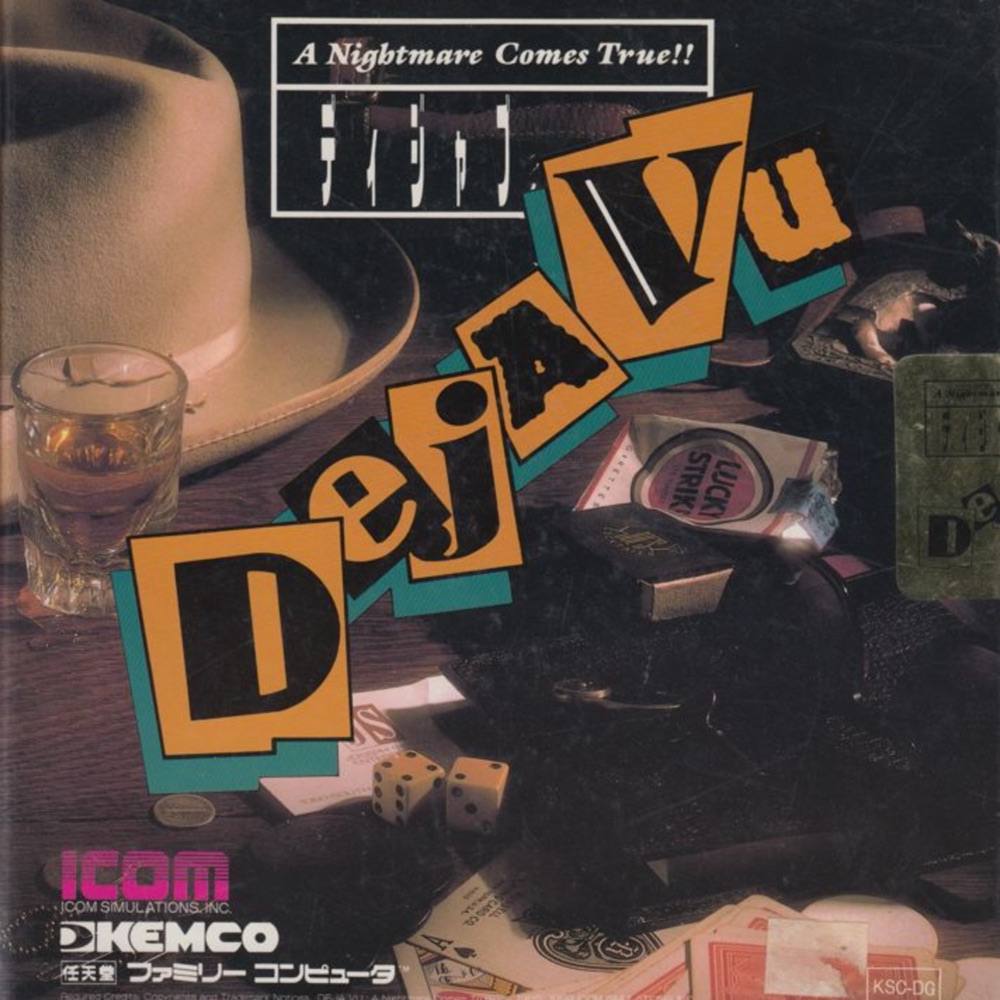
405 · Deja Vu: A Nightmare Comes True!!
You wake up in a filthy bathroom, memory shredded, trench coat on, with Chicago’s icy wind waiting outside the window. Every screen is a little noir diorama where you poke, examine, and piece together a murder you might have had a hand in. The interface feels like rifling through a cluttered desk drawer, but uncovering the truth is as satisfying as solving your own crime novel.
Déjà Vu puts you in a bathroom stall in 1941 Chicago as private investigator Ace Harding, with amnesia and a case that turns out to involve you. It comes from ICOM Simulations, the Shadowgate team, and the NES port was handed off to Kemco. Mike, Sean and Joe were on this one, and we all liked it.
Why we kept poking around
- A city to goof around in. Shadowgate locked you to one puzzle per room. Here you chase leads between addresses by cab, and every place is a little fun house. We each reached the secret casino by a different route: the elevator from the dead man's room, the sewer, or the loose book on the bookcase. That we all found a different way in was the part we loved most.
- Acting like a jackass is rewarded. Shoot yourself and it says you went out with a bang. Speak to a toilet and it tells you that you're talking to a toilet. Start a car with the wrong key and it blows up, because the woman told you she rigged it. We compared the sandbox feel to Grand Theft Auto, at a much smaller scale.
- The slot machine. It pays out far too often, which is how we ended up with 30 coins early.
- A story with an ending. You were framed by the mafia, and the doctor who injected you with amnesia drugs is no doctor. Winning means proving your innocence at the police station, which also means dumping the incriminating evidence in the sewer first. We put it in the upper echelon of NES stories. The music cue when you recognize yourself in a photo is corny but works.
Where it bites
- Soft locks. The cab only takes quarters. You start with seven and a $20 bill nobody will break, so Sean got stranded in a neighborhood with no way to get more, having never saved. He called that a cardinal adventure game sin, and Shadowgate didn't commit it.
- Guess and check. Dying if you enter a certain room before taking the right medicine, or having to know which items to dump in the sewer, felt unfair. The desk with no visible drawers, and the wine bottle you must hit instead of take, sent us to a guide.
- Small annoyances. The move screen's blue squares are confusing, the game scolds you for walking into a closed door, and buying bullets means a separate take for each one. We wanted a "please" verb, since "take" sounds like stealing.
The bottom line
Play it. Nobody voted it onto the Essential Games List. Joe called it a definite play it that fell just short of the heights Shadowgate hit for him, and he had to finish with a strategy guide. Sean liked it better than Shadowgate overall but said he couldn't vote essential after the soft locks, and we agreed the NES cursor is a worse way to play than a mouse. It is influential, but later games run with the idea better. Try it for the wandering and the wisecracks, and save often.
Written from our conversation in this episode.
- Ironically maybe, Deja Vu is about amnesia.
- Introduction
- What it is: A MacVenture-series point-and-click adventure set in December 1941 Chicago. You’re amnesiac PI Ace Harding, waking in a dingy bathroom and unraveling a frame-job. NES port by Kemco/Seika of ICOM Simulations’ 1985 classic. (Wikipedia, HG101 – MacVenture overview)
- Why it matters: A rare cursor-driven adventure on NES with a full verb panel, multi-pane UI, and real fail states (arrest, overdose, bad wrap-up). (StrategyWiki, Manual)
- amnesiac PI as a trope
- Release, Credits, & Context
- Release: Originated on Mac (1985), later Apple II/DOS; NES localization ~1990 (Famicom prior). (Wikipedia)
- Developer/Publisher: ICOM Simulations (original) / Kemco/Seika (NES). First of the MacVenture trilogy on NES with Shadowgate and Uninvited. (Wikipedia – MacVenture)
- Nintendo content tweaks: Drug/alcohol/violence wording softened; puzzle logic largely intact. (TCRF comparison)
- Discuss now: Which MacVenture is the best gateway—Déjà Vu, Shadowgate, or Maniac Mansion—and why?
- Core Gameplay Loop (sleuthing cadence, with “only-if-you-played” details woven in)
- Loop in one line: Search → EXAMINE text → OPEN containers → USE/SHOW items → Travel by cab → Cross-check alibis → Manage meds/money until your timeline and evidence clear Ace. (StrategyWiki)
- How the NES UI actually behaves: You move a cursor with the D-pad, choose a verb, then click a target. Many actions are two-step; the confirmation appears only in the text pane. If you skip reading, it feels like nothing happened. (Wikipedia – MacVenture)
- Hands-on cue: To loot a wallet, you must OPEN → wallet to reveal contents, then EXAMINE each found item. EXAMINE on a closed wallet just says “It’s a wallet,” and you’ll miss cash/ID.
- Cab travel is learned info + money: New destinations appear only after you’ve EXAMINED an address (note, matchbook, card). Every ride costs cash, so wasted trips reduce options until you find money (e.g., bank access after proving ID). (Manual)
- “Show, don’t tell” NPC logic: SPEAK often does nothing; NPCs react when you SHOW/USE the right item on them. Example: at the bank, showing the correct ID moves things forward, showing the wrong one gets you flagged. (StrategyWiki)
- Medicine is a real timer: Take too few pills and text hints get vague/you pass out; take too many and you OD. There’s no big meter—only text like “you feel dizzy,” so you must space doses. (Wikipedia)
- Discuss now: Does the medicine timer add meaningful tension, or just stress players out?
- Locations & Travel Economy (how places actually play, spoiler-light)
- Area flavor & what you learn by doing:
- Bathroom & Office (tutorial) — Teaches container logic: OPEN to reveal, then EXAMINE/USE. First evidence cascade happens here. (StrategyWiki walkthrough)
- Back Alleys / Toughs — The game lets you try HIT; most of the time it backfires (knockouts, robbery, arrest). Safer to leave or SHOW a relevant item.
- Pawn Shop / Bank / Bars — NPCs respond to proof, not talk. Bring the right ID or document. The wrong item can close off an option temporarily.
- Hotels / Hideouts — High info, high risk. Scenes can escalate if you were seen elsewhere carrying the wrong item.
- Endgame “cleanup” spots — The city effectively grades whether you wiped prints, disposed of incriminating objects properly, and stopped walking around with evidence. Get this wrong and you hit a bad ending. (General refs: StrategyWiki, Manual)
- Puzzles, Consequences & Fail States (the “combat” of a noir adventure)
- The game assumes you’re a PI, not a brawler: HIT is in the verb list, but it’s rarely the intended first move. Use EXAMINE/SHOW/USE to prove things; fighting often leads to knockouts or cops. (StrategyWiki – Endings)
- Evidence procedure matters: The logic checks what you actually did with items—did you wipe surfaces, did you dispose of items in sensible places, did you carry incriminating gear into official buildings.
- Hands-on cue: Tossing everything into one obvious bin may still fail. Wiping and staged disposal in the right order is safer.
- Multiple easy fail states: Arrest for carrying the gun or bloody items into the police station; OD by double-dosing meds; get jumped at a rough spot while low on health. Keep two saves: a roaming save and a pre-cleanup save. (TCRF)
- Text window is the hint system: Clues are often one line. Read before you move.
- Discuss now: What’s the right ratio of punishment vs. forgiveness for a console adventure like this?
- THE FUN STUFF
- Use SPEAK on everything—the corpse, the toilet, the safe, your hat. The game dishes out snarky “you’re talking to a ___” replies that feel like a stand-up routine.
- HIT OR SHOOT YOURSELF yourself. Ace will actually take the punch; keep it up and you can knock yourself out. Detective work! Game says GO OUT WITH A BANG before you shoot yourself.
- Chug the wrong meds from Dr. Brody’s stash or take them in the wrong order. Side effects include wooziness, blackouts, and hilarious “welp, you died” text.
- Flush random items in Joe’s Bar bathroom or toss stuff into the sewer whirlpool out back—yes, including crucial evidence or your cash. Congratulations, you just soft-locked your own life.
- Refuse to pay the cabbie or try to tip him with nonsense. He doesn’t think it’s funny; your ribs will disagree.
- Call the police while still carrying incriminating items (gun, bloody evidence). Watching Ace get instantly arrested for his own “confession by inventory” is grimly funny.
- Try to PUT the dead body in your inventory or drag it around. The game claps back with “he’s a bit heavy,” noir deadpan.
- SPEAK to the gagged woman in the trunk before you untie or dose her—enjoy a chorus of muffled non-answers.
- HIT doors, safes, and furniture like a caveman detective. The game keeps a straight face and lets you.
- PAY random NPCs with wildly wrong items (keys, notes, syringes). It’s like bartering on a different planet.
- OPEN things that obviously don’t open (street lamps, toilets, phones). The UI will try very hard not to laugh.
- USE truth serum on yourself. Spoiler: you don’t become a better witness.
- Leave the murder weapon where cops can find it, then swagger into the station to clear your name. Comedy = handcuffs.
- Hit “GO” to the wrong neighborhood repeatedly with no cash. Enjoy the loop of getting dumped and/or shaken down.
- Examine every piece of trash like it’s the Rosetta Stone. The game rewards obsessive rummaging with wry one-liners.
- STORY BEATS
- You wake up in the bathroom of Joe’s Bar in Chicago with amnesia, a sore needle mark, and only a few items to go on. GameFAQs
- Exploring the bar leads you upstairs to a secret office with a murdered man (Joey Siegel) and a wall safe you can’t yet open. StrategyWiki
- Clues in the bar (like a doctor’s bill) point you to Dr. Brody’s office—evidence you’ve been drugged and a hint at how to treat it. GameFAQs+1
- You follow the paper trail around the city to regain your bearings:
- Dr. Brody’s office supplies the drugs/info needed to counter your condition.
- Your own P.I. office (Stanford Arms) helps re-establish that you’re Ace Harding and arms you with more leads. walkthroughking.com
- You track Joey Siegel’s apartment and connections, gathering addresses, combinations, and names that tie the players together. StrategyWiki
- A tip takes you behind Joe’s Bar to a car trunk with a bound woman; under truth serum she gives you a key address that advances the case. walkthroughking.com
- You visit the Auburn Road estate, rough-and-tumble your way past the staff, and uncover ransom notes/notepad impressions that expose motive and timeline. walkthroughking.com
- With more searching, you finally open the safe in Joey Siegel’s office, pulling a folder and key that link the murder, the money, and who’s framing you. StrategyWiki
- To avoid getting pinned with the killing, you ditch the murder weapon in the sewer whirlpool behind Joe’s Bar. walkthroughking.com
- Armed with the diary, notepad impression, letters, and the safe’s contents, you go to the police; the compiled evidence clears your name and wraps the case.
- Comparisons & Legacy
- Follow-up: Déjà Vu II: Lost in Las Vegas continues Ace’s story (Wikipedia)
- A port for the Nintendo Entertainment System was advertised in an issue of Nintendo Power in 1993, but was cancelled mid-development, possibly due to it being released after the NES's lifespan had ended.[1] A version for the Game Boy Color, developed by Kemco, was released as part of Deja Vu I & II: The Casebooks of Ace Harding in 1999. Like its predecessor, elements were censored in this version, such as replacing the game over screen depicting a gun wielding Grim Reaper with a gravestone. However, some scenes, including the ending, were expanded upon with more detail.
- Deja Vu II received generally mixed reviews; critics praised the story but were divided on the gameplay and puzzles.
- Discuss now: If you modernized this, which QoL (hotkeys, text logs, hint tiers) keeps the soul intact without removing the challenge?
- We’ve been here before, or have we. It’s time for THE ESSENTIAL GAMES LIST.
- Ironically maybe, Deja Vu is about amnesia.
Auto-generated transcript. Each paragraph starts with its timestamp. Speakers are not identified.
Deja vu. In this case, what you don't know can kill you.
And welcome to NEStalgia, a chronological exploration of every NES game released in North America. I'm Mike. Hey Mike. Oh, I'm Sean. And I'm Joe. Ironically, maybe, deja vu is about amnesia. Yeah? I think that that's true. I accept this. Both as a video game and as a term. Yes. The word means kind. No, it actually doesn't. It doesn't, right? But experiencing deja vu is a form of amnesia. It's future amnesia. Yeah. I think we'd be like misrepresenting what deja vu is. But I think if you have amnesia and then you suddenly get like a memory starts coming back to you that you used to have, that would feel like deja vu. It's like, oh, I feel like this moment's happened before because you're remembering something that happened before.
Whereas deja vu, I know, is actually just like something that you're living in right now. And it feels like you already have that memory. So they're like adjacent. So it's kind of like, you know, we're not we're not being literal with deja vu. But yeah, there's still like brain brain not do good work good sometimes. Exactly. And what deja vu is, is it's a point and click adventure game set in 1941 Chicago. You're a private investigator, Ace Harding, who suffers from amnesia, awakes in a bathroom stall and slowly unravels a case that actually involves him.
This is just an NES port. It's not exclusive to the console, but it is kind of in line with some of the other point and click games that we've had on the show. And I guess like the the series of games is known as like Mac Venture style games. These point and click. Mac Venture. Yeah, I'm not sure. I don't know enough about the history of these to know why that's called that. But it's like maybe that's the. Company or maybe that's. Macintosh adventure games. Yeah. Like maybe it's like that. It says it says it's a series of menu based point and click interface games like that's how they're known for.
Deja vu Shadowgate and the uninvited, which I think also comes to the NES or like what these are for. And they were developed for the Macintosh by ICOM simulation. So they're all made by the the same the same team. So do you feel that Shadowgate DNA in Deja Vu? Absolutely. I like the the change in tone and setting, but it's very Shadowgate for sure.
And what do you think about the amnesic private investigator as a trope specifically in video games, but also in media as a whole? Well, I was going to say, you think this is the first one of our first instances like is this kind of where that trope in video games came from? Have we had other games on the NES where you're you're you don't remember anything because it's such a common trope in games? No, I agree. I can't think of one off the top of my head.
I feel like there's a lot of like not point and click adventure games, but like text based text based adventure games that probably play around with that. Right. Or the twist of like you being someone more important than than you realize, you know, like when you when you start this game. Darth Revan. Right.
When you start this game, it doesn't become inherently obvious that you are like you don't know who you are. You know, again, you're just waking up in this bathroom stall and you're just kind of wandering around. And then this case really kind of naturally presents itself to you. But Sean, you know, Disco Elysium, kind of the same idea. I think it's just a very I mean, yeah, maybe it's a little overdone, but it's incredibly useful. useful for having the world explained to you in a way that like, yeah, generally characters that live in a world don't need the world explained to them. But maybe somebody with amnesia does. And it's a good excuse diegetically to have these explanations made to you.
Now, that's not so much what's happening here. There's no deep lore that's being explained to you as some like outsider to society. This is more so just a setup for a mystery that happens to involve you. So maybe it's not done for the same reasons, but it's a you know, it's a versatile trope. And I think tropes are meant to be used. And this is this is a fine use of it. And like any good investigator, whether you know it or not at the start of the game, the screen is very similar to Shadowgate in that you have your, you know, your commands or your verbs on the bottom of the screen. And then you have your notebook where you're keeping tabs on everything. But also, I guess your notebook is your inventory of like things you have.
And that's on the right hand side of the screen. And then on the left hand side is this very small but detailed interactive window of, you know, from your POV, what you're seeing in the scene. And you can click on things and you kind of the gameplay loop is you verb into the object. And then the game tells you what's very dirty phrasing.
You verb into the noun. Right. So, you know, you might search something, you might examine something, you might open something, take something. But this idea of just essentially using that to kind of make the what would have worked as a text adventure game, but now with a visual component to it. Yeah. And I'm trying to remember if these because there are some shortcuts in this that make that because what describing like that makes it sound more tedious than it is. There are some shortcuts that I can't remember. It's still a little tedious. It didn't bother me as much maybe because I wasn't expecting some of these shortcuts. Were they in Shadowgate where like you can press B to cancel out of any verb you're doing.
And then also you can just click on any door, any anywhere to move in that direction. It's a great question. It's something I wondered as well, because it also like kind of remembers where your cursor was, too. So, right. If that's something that I noted. Right. If you cancel out of the open thing because you didn't want to open that particular thing, you're still on open rather than having to go back to it. Yeah, I guess. And the only reason that I said that there is still some tedium is that like no matter how like sort of no matter how intuitive everything else works, you still have to make sure you open doors before you try and walk through.
So true. That'll be something that I kept doing. But in general, it's got a good streamline. Like, yeah, there's a few pages of items in your inventory pretty quickly that you'll have to like change pages on. But in terms of just like it all, you didn't need to read the manual to get to get how it really worked. Right. But if you take it at face value, there are some things that like are obvious that you have to do, but could have been shortcuts if they would have made the leaps with the player, such as you can't leave a room until you open the door. But if you clicked on the move screen that wherever.
So there's this other thing on the bottom hand side of the screen where you see move and you have these blue squares which represent any particular area that you can move. But it's supposed to be a top down view of the first person view that you're viewing. So sometimes this move screen with many squares can get kind of confusing about which square is which.
Eventually, you'll figure it out in your head. But it is a little disorienting at first. Just to say, I want to move to this door and then the game tell you, you know, you have to open that. It's like, OK, but you could have understood that I was trying to do that. And it very much does understand that you know that because it's a very, every time that happens, there's a very like talk down to you vibe. You can't, you can't, you can't go through doors before opening them silly.
OK, thanks. Like that should just be assumed. And it's important for like things later in the game too that you wouldn't, you know, you wouldn't want certain things to be not necessarily opened, but to examine things to find things within things. You know, that bathroom is like the tutorial where you have to like, sure, there's a coat in front of you and you can just take the coat. But if you don't examine it, you won't find out what's inside the coat, you know, and then you have to take those things. That actually took me a very long time.
Right. So it's like it needs to teach you that right away because otherwise you would just expect that by, you know, by opening something, you automatically get it all or by examining something, it adds it to your inventory. It's like that's not how it would work. Well, I have a question for Joe, actually, because I think you kind of gave an acknowledgement of that when I said it. Um, how far into this game did you get before you actually went through the pockets of the coat? Well, so I was just going to say I had almost the opposite problem.
I went to the pockets of the coat immediately. First thing I did, I examined it, then I went to the pockets, I took everything out of it. Then I left, I walked away or whatever, and I was trying to figure out where to go next or whatever. And somehow later in the game, I ended up back there.
And then I took the coat. Like I went to the pockets without taking the coat. Like I opened to the coat while it was still on the hook. Wow. And then when you take the coat, underneath the coat is a gun on a holster that was not in the pockets of the coat. So it didn't, wasn't there. So like I did the opposite. I was like, oh, intuitively, I think I should open this coat. That's really funny. But I didn't take it to see what was underneath it until much later in the game. And I was like, oh, I could have used this gun like three times already. So I, I like escaped to the bar.
Um, I, you know, went into the, went into the basement through the secret, uh, through the secret casino and found the dead body and jumped onto the fire escape all while wearing my coat. So, and not, not knowing, not knowing that I had money in there, that I had like, uh, that I had clues in there. Um, so I, I got to a point of just like, where the hell am I supposed to get, how am I supposed to like acquire currency? Like, can I, can I do a day job while I'm out here? Like, and then I just, you know, opened the coat and there everything was.
But I will say there is a, uh, not quite a day job, but I guess it's some people's day job of the casino that is just like an unlimited money creator. Well, I needed the money first. Did not know that that was the case. Yeah, but I think that you can also just, I don't know, but I think you can just like unlimitedly like check the slot machine, like.
Oh wow. Like find a coin, like one coin or something like that. I think there's a way that you're not locked out. I just know I want to be at that casino because like, there's never been worse odds for the casino than that specific slot machine. Like it, it pays out way too often. It's crazy. I didn't even think to gamble. And that's, this is me talking. Well, I was like, who the hell am I talking to right now?
Yeah. I ended up with like 30 coins pretty early. And then I was like, all right, great. I'm like set. Which foreshadowing, I just, this is why I got like softlocked three or four times is because I didn't have enough money. Not knowing that in addition to not ever being able to spend your $20 bill, did not know that you could gamble. So. You can spend it.
We'll, we'll get there. Yeah. I think. I thought you could. No, you can. Yeah. You spend that $20 bill. No problem. The cabbie won't take it. No. Oh yeah. Nobody takes a separate, I only know of one place that takes it.
What I think is so cool about this game is that even when I finally did get stuck and resorted to an FAQ, when I was reading like the order of events, I was like, that's not how I did it. Like, did I miss something, but I didn't miss something. I just got to the casino probably like less than optimally, but there, there was like another way to get there. And it's like, it does give a better sense of a, uh, you know, explore and goof around vibe than Shadowgate was giving where that felt like, yeah, I mean, you know, you could kind of go around, but you were very like locked to the puzzle. This isn't like every room is a puzzle. This is, you're trying to piece together where to go next based on the information you have.
Yeah. I did like, uh, learning like how there were several entrances and the fact that like, again, you find a key in that jacket that lets you open the front door of the bar. And I kept going in thinking that I'm going to have to go up to the third floor of this bar and jump out the window to get back to the street. Or I could go down into the sewer and then come up through a hole in the floor to get back into the bar. And then I found out that there was a key for the front door. So yeah, there are several ways to get around the map in addition to several ways to go across like the larger expanse of the game, usually by hailing a cab or just in terms of like order of operations of where you go first.
Yeah. There's even random events that can happen to you on the street too. It's not guaranteed that you're going to be mugged. Yeah. But you do get mugged and it is a pain in the ass.
So what do you do? You just hit that guy, right? Yeah, like over and over again. Yeah. But I think there's a limit. I think if you hit him enough, eventually you will have to pay or he'll hurt you. Did you ever get cornered by the lady? What's the lady's deal? She's got a gun? She's got a gun. I shot her and then the cops came because I was right in front of the police station. Yeah. I'm not proud, but I punched her. I think that was the right thing to do actually because she was about to pull a gun on me.
But I was like, I got a puncher. Here's the interesting thing. And you're getting to what my favorite part of the game is that if we think about the Grand Theft Autos or even the L.A. Noire of all that stuff, those games are so fun, not because of the actual story mode, but because of the sandbox environment you're put in and how you choose to interact with things. And while this game isn't on that scale by any means, there is so much fun that you can have in this game by acting like a jackass. Oh, yeah. You can get the gun, select shoot, and then self, and then the game will be like, oh, way to go out with a bang.
I did appreciate that. I did appreciate that you could shoot whoever you want. You would, like, that is the end state. I did like that I thought I got around the money thing by starting a car with a key I found, and then you immediately just blow up. And it's not even just like a bullshit, like, wow, how was I supposed to know that? Like, if you talk to somebody, or maybe if you read a note or something. No, it's the woman. Oh, it's the woman. Yeah, she's just like, yeah, yeah, I rigged that to blow. And it's like, oh, okay.
Yeah. So I do appreciate the level of interaction and all the fun fail states that you got here. Yeah. Another fun thing is, like, forget fail states. You can also, like, soft lock yourself out of the game by doing really stupid things like flushing toilets, flushing your inventory stuff down the toilet. Like, literally watching, saying goodbye to the game as you watch it swirl down. There's no animation for it, of course. The game is kind of lacking that. It's all still screens instead of animated screens.
But then there's also, like, the game is kind of snarky. I think you referenced that, Sean, but, like, if you're being stupid, it'll imply so. But, like, you can use the speak command on that same toilet, and the game will tell you, like, you're talking to a toilet. Really? I didn't know that. Yeah, I didn't either. There's a lot of things that I tried speaking to, and it would just be like, what are you doing? And I thought for a while it was like, oh, wow, it's actually, maybe it's, if only if I talk to that thing, it says that. But no. If you talk to inanimate objects, it usually just asks you what you're doing.
Yeah, or it says, like, or if you examine them, it says, like, nothing unusual here. If it's usually examined, like, blank spaces or whatever. But it is cool that, like, sometimes it does have, like, a little flavor text just to add to it. Like, there's a lot to discover in the game, not even just on the way to beating the game, but just exploring the world and seeing what you can do. Throughout the game, there are these, I guess we'll call them deja vu moments where there's, like, a music cue, and I guess it shows you.
So now it switches POVs, but it shows you, and it reveals, like, a twist of sorts. It's, they get grander, but that deja vu moment as a repetitive cue also works really well from a, like, not repetition, but even just sound perspective. How do you mean? Like, just, you know, that, like, every time you hear that specific thing, it's, like, you've learned something bigger than just, like, collecting another thing in your inventory or another address. Yeah, I guess it was, I didn't really put together that whatever was happening would be, like, a big moment. Because I remember I was just going up some stairs, and I thought I was just getting, like, lightheaded. Because it's, like, you don't feel so hot.
You really need to take a break or something. And I'm, like, I'm just walking up some stairs. And then it didn't happen again until I, like, went to an office, and I guess it was my own office. But maybe you don't know that yet, and you're sort of getting that deja vu, as you might say. So, yeah, I guess I see that. Yeah, or, like, when you look at the picture and you recognize yourself.
That I didn't see, yeah. Yeah. Oh, yeah, there's, like, a picture on the wall that is of Bob Oxer, and it's you. And then that image comes up of your face, and that music plays. And it's a little corny, but it is kind of, like, it is kind of cool. And it's kind of, like, mysterious. And it catches your interest of, like, oh, man, what is going on? Like, this is such a creepy situation for this guy to be in.
You got to just kind of suspend your, like, cringe a little bit. And while you guys were talking about whether or not you pulled the items out of the coat, the first moment where I had to actually look at a guide was because the desk above the bar in the office didn't... You weren't... Because of the point of view, you're facing... It didn't read like a desk, did it? It didn't... I mean, like, the guy was hunched over it, if I recall. Like, there was another one that wasn't. But there was another one where a guy's hunched over the desk, so you knew it was a desk.
But he... The drawers would be on his side. So you would think you have to, like... Yeah, you can't see there's anything to open. Right, right. But the only way to progress is to open those drawers. And so I guess I could have just tried spamming commands around the room, but I don't have time for that. So that was... Yeah, it kind of defeats the purpose of the game. You're not even playing the game anymore. You're just... I got there. That's like, you know, maybe you guys knew you could gamble. At least I opened that desk pretty easily.
Yeah, I did the same thing as Mike. I was like... I had no idea. I finally looked at a guide and it said, like, open the desk. And I was like, oh, yeah. And there's no visual indication that there's, like, a drawer involved in this desk. Because if you know everything to do in the game via a guide or whatever, it's a pretty short game. But it's also, like...
It's not even short because you're just doing everything. You're missing the actual personality of the game. I feel like the best part of this game is the vibe. Like, just the world that they put you in. Not that it is, again, keeping up with modern open worlds or anything like that. But for what we've experienced, like, in terms of building out a story and a character and the people you interact with, I had more fun just tinkering with things.
Kind of like what we did in Maniac Mansion, too. Where you would just, like, fuck around in the mansion for a little bit. You know? Like, yeah. Let's see what's going on over here. Right? And, like, everybody was, like, following their own scripts. That wasn't quite what this game was doing. But I was interested in just exploring it. So, like, when you got a new address, I wanted to make sure I, like, saw everything around here first before I went to the next location.
You know, that's kind of a... That was a priority for me in a lot of games. I think in my earlier days of just, like... I want a bunch of toys to play with. And I think everywhere you go in this game is kind of like a... It's like a fun house in itself. And there are weird ways to interact with stuff. So, yeah. This was very much up my alley in that sense. Now, is the actual story, though, as strong as the world that you're put in? Like, is this amnesia? And then, like... I guess some spoilers here. But eventually you find out that you're being framed by the mafia for the murder of somebody that they didn't agree with.
And the doctor that you went to go see was actually not a good doctor at all. But the one who injected you with these amnesia drugs and you need to take medicine against them. Is that part compelling? Does that part, like, hold up? I don't know. If I were watching a movie or reading a book, I don't know if this would be like, oh, my God, what a standout story. But because I'm doing it and I'm solving it and I'm playing an NES game that is causing me to experience this story myself, it does stand out to me. I mean, as far as stories on the NES, this was one of the more engaging.
And, you know, there's tropes and there's generic parts. But also, like, there's stuff I didn't see coming. And I was interested enough to, you know, for it to keep driving me forward and not just like, oh, I want to see what this game can do. What is in this area? What's it's like? No, I do want to find things to help me solve this mystery. And it does give you this satisfaction when you find something that feels like it's going to be like a key part in in the solving of the mystery. Yeah, it's funny.
I'd actually because we'll get into it how I soft black myself several times. But so I didn't know how the game ended until you just sort of gave the very brief spark notes version. But that I will grant to Joe's point, any story that actually has some sort of self-contained narrative and isn't like sound like a five year old child made up the aliens that you're shooting in a shop. Like, I'm a huge fan of that.
And I think that is that puts it in the upper echelon of stories on the NES. Yes. But granted, when you said like the basic like key points there, you kind of get that vibe in the bar. Like you don't even need to leave the bar. And you're already kind of like, oh, some doctor injected me with something because there's all this shit on the on the counter. And I, I work above a doctor and they keep mentioning the seagull guy. There's a there's a very large lady in the trunk of this car. This all makes sense. Yeah.
And Sean, just to be clear, that's kind of the story beats I gave were just like the the entirety of the setup of the the amnesia element. The final like win state is actually pretty interesting because then once you piece it all together, you have to go to the police and prove your innocence.
And you, you know, you're basically like tracking down all the correct evidence. But furthermore, you have to get rid of the bad evidence, the framing stuff. Like if you go into the police.
That's illegal, Mike. But I'm saying, yeah, exactly. That's what's so weird, though. It's like if you go into the police station, the game. Oh, yeah. The game assumes that you handed over everything. And so then they find the other stuff and they're like, all right, well, you're you know, you clearly did it. And so it's like you have to not only find everything that would prove that the mafia was behind it. You have to throw out the bad evidence. That is funny. And I did when I went onto the street the first time and saw the police station, I had already seen, you know, a lot of evidence for wrongdoing.
I guess you always would. But I guess there is some there is some version of this game where you just sort of find your way outside and beeline to the police and have no idea why they've arrested you. Right. Is the is the jump from the bar to the sewers like too drastic?
Like, why are we traveling by sewer like so early in the game? You know what I mean? Like, could it have been more like could it have gotten more extreme as time went on? It's kind of weird that you can just go like straight from waking up in this bathroom to like and he chose the sewers to travel around. Yeah. But I guess it depends on on your playthrough. I feel like it wasn't quite as quite so early for me that I found the sewer because I kind of had explored a lot before. You know, I like and I was, you know, outside seeing the manhole cover and I was like, well, I wonder what's down there.
So, like, I feel like it didn't happen right away. And also, it's like if I'm like, I get that I'm trying to solve some mystery. So, like, I don't know. It's not it wasn't that crazy to me to be like, oh, I wonder if I can, like, you know, get into an unlocked area through the sewer or something. But I get what you're saying that it's not like it may be like it has a totally different vibe than the rest of the area. Well, Joe, that's a great point. I liked it. It is a great point because that's not how like I didn't open up a sewer. I didn't open up a manhole to go down into the sewer because I agree that would be a bit of a stretch.
I opened the curtains of where the dead guy was, saw the fire escape, went upwards to the third floor, got on the elevator and rode the elevator down to the casino. And then, yeah. And that takes it. See, I went the opposite. I got to the casino by going outside, going into the sewer, exploring, and then ended up in the casino, which took me to the elevator, which took me back to that room where that guy was. And I was like, OK, now I understand there's an elevator that will take me through this building.
So, like, it wasn't like, oh, I just went from this building to the sewer somehow. It was like, no, I went outside and deliberately crawled into the sewer. Just for completeness and balance, I guess I'll say that I got into the sewer by going down into the basement from the main room of the bar, hitting the loose book on the bookcase, having the bookcase move out of the way, going into that central room, finding the whole casino and elevator situation, but also seeing the ladder down into the sewer. But all this that we've said of how he got to the sewer, do you ever need to go into the sewer? It's a great question. Yes. Yes, you do.
Well, as far as I know, unless the toilet, which I didn't know about, is another way to do it, later in the game, towards the very end, you need to get rid of evidence. I see. And there's this big, deep water area that you can throw all your evidence in, so I guess that's the only way to get rid of things.
But I love that we all found it in different ways. That's actually really, really cool. And I also, I didn't know anything about the book until I watched a video after I had played it.
Yeah, I thought you were going to talk about the wine bottle. Yeah, sorry, you're right. Wine bottle. Oh, the wine bottle. Did you select that because there was no dust on it? I examined and it was weird that it said that the one on the far right has no dust on it. So I just hit both of the ones on the right and the one actually caused the door to open. So I, yeah, thought that was pretty cool. Well, that's what makes me a little upset is because I saw that first before I wound up doing the fire escape route. And I got the notification that like, this one looks different.
And I tried to take it rather than hit it. And that doesn't work. And I get it. It's a push in to do it all. So that's why you have to hit it. But I wouldn't think to hit something that looks different. You know, they should have just like programmed both to accept that. Right. So I just kind of gave up there. But I shouldn't have, I guess, is the story. Also, you have to go into the sewers because how else are you going to see the alligator?
Yeah. That's true. That is a random event, right? Yeah, it's a random event. There's a bunch of oddball stuff in this game. Or is it the first time you go to the deepest part of the sewer? I don't know. I think it's random.
Okay. So here, let me just, I have a negative because we've been very positive. And I know that anyone in their right mind would immediately try to gamble with the money they have in their pocket. But I just need to explain. I mean, I did softlock. And I thought maybe, oh, maybe this is like an order of operations thing. Like I have to go to the right, go to the right address before I go to the next address. And you have to sort of route out your cab movements to make sure that you don't run out of money. But I thought that my seven quarters and my $20 bill were the only things that I had to go on. So, first, I think it is absolute bullshit that your $20 bill can't be broken into change in a cab. I already mentioned this, but it's a big deal to me.
Because this cab driver only accepts quarters. Of which, you start with seven. And yeah, you can gamble to get more. But I thought maybe at these other locations there would be some way to get more quarters. But there is not. At least as far as I know. Like I went to the apartment high rise. Thought that the little puzzle to get up there was cool. Found another address to go to. And like, all right, cool. I've got a lead. I go back to the cab. Try and pay with what I have. He doesn't like it.
And I just could not go forward. And I could have saved and gone back to it. But I did not save. So, I played again. It is weird that you can't get more coins any other way than gambling. There needs to be some other. This is something that like, it's a thing in adventure. At least in modern adventure games. Because a lot of us are dum-dums. Like, redundancy. Like, there needs to be other ways to just be able to progress if you maybe softlock one branch. Right. Especially because in this game there are these multiple locations that you need, as far as I know, the cab to get from one to the other.
And yeah, like, at least then let me walk all the way back somehow or something. Exactly. I thought I'd be able to walk. There's no way to beat the game. I'm just stranded here now forever because there's no quarters in this neighborhood. Yeah. So, that's just my, that's my peeve.
But yeah. I mean, if we want to get into negatives, I have a couple as well. I think that like, the main thing is that, and I don't remember how much Shadowgate felt this way too. But I don't think it felt as much like I need, like there was some randomness. Like, in this game there are things that I'm like, yeah, I get now in retrospect why this is the way it is. But like, I don't know if I could have figured this out. Like, dumping the items in the sewer before going to the police. Like, which items you have to dump into the sewer. Or without a guide. Like, that's, like, I don't even fully understand why I'm dumping these items into the sewer. Like, they incriminate me. But like, why? Just because I have them?
But like, can't I just say like, hey, I got these while I was, while I found all this other evidence that shows that I didn't do this. And that this guy did. And like, I stole this out of his state. Whatever. Or does it incriminate you for like, stealing or whatever. But then there's like, other things. There was like, something where if, you know, there's a point where you can find the way that you need to like, find which medicines will counteract the medicine that was given to you that's giving you this amnesia. That's giving you this headache and all that. And if you don't do that before you go into a certain room, you die.
And it's like, wow. How would I know that? Yeah. Like, how would I know? You know, it's like, I guess it's kind of like, if you're, if you're not like, looking too hard at the game, it's like, oh, it's just a time that you just died because you waited too long to go there. But it's not like, oh, you go into a certain amount of rooms after a certain amount of moves, you'll die unless you've healed yourself. It's just like, this room, because of the way that like, you have to have your memory back before it like, makes sense the way you progress. It's like, oh, if you walk in that room before you got it back, like, it's like, oh, you're, now you've died from, you know, you didn't heal yourself. And like, I get it.
Like, there's a quick, you know, it saves like the, the moment before you die anyways. So it's like, not like that much of a punishment, but it just felt like there were a lot of things where like, there were more guess and check trial and error than like intuitive, like puzzle solving that. And I, again, it's been a long time since Shadowgate, but I do remember some times in there where I was like, oh my God, this is so frustrating. I can't figure it out. And then I figure it out and it's so satisfying because it's like, I figured it out.
Whereas this, I felt like, I felt like, even if I did figure it, I felt like there were a few times where it was like, I kind of like just lucked into that. Like, or like I looked up a guide. I remember when you, when I first went into the, uh, uh, the restraint doctor medicine room in the bar, finding the, uh, medicine that just died on the table and not so much in the shelves or anything. Like I only picked the stuff, picked up the stuff on the table and I tried to take it. Like, I don't know, just playing around. Like, let me just take this random drug that I found. And it just said, you can't do that.
And I don't know if we need to like find a syringe later in the game or something, or if it only will let you take certain drugs together. I don't know. This bothered me a little bit too, because it's, it's like not those drugs on the table. There's like also drugs in the garbage can. In the garbage can. Yes. I see. Yeah. So it's like, I mean, that, that's, that, that is kind of cool, but it's just like, it was like a weird red herring that there are these other like drugs on the table that like you can't take.
And one of them, I think you can. It lets you take them into your inventory, but you can't ingest them. Yeah. It just, if anything, just have it be another like death sequence. I don't know. But it does, it does, I think it's useful in another way. At some point you have to give it to someone else for some reason or something.
Well, one of them is the, I don't know if it's that particular medicine that you're picking up. In that scene. But there's a, there's like the truth serum medicine. Yes. Nice. And then just to go back to a question you had posed, Joe, to the best of my knowledge, I cannot recall a single random encounter in the sense of like truly random in Shadowgate. But again, Shadowgate was more like you enter the next room. Now you have to solve the puzzle in that room to, to go forward.
This is more like there's not a puzzle in every single screen. It's just like certain screens you, you will interact with multiple times as the story unfolds and other areas are just like, well, once you've, once you've collected everything in that room, you're done with that room for the rest of the game. The $20 bill thing, besides not being able to break it, Sean, there's also like, there's a chance to get a second $20 bill. And I can't figure out what you would use it on because as far as I know, the only thing you can use the $20 bill on is the gun, right? Yeah. So why would you need $40?
How much are bullets? Are those a quarter each? Those are a quarter each, if I recall, which is a great price on bullets. Yeah. But it, but it sucks. You have to buy them all individually. And yes, you have to move the cursor to each one. And, and you have to say take. Take sounds like you're stealing it. Did anybody else think that they were stealing these items? Yeah. I would like want to talk to the guy. I want a menu or something. A verb that says please. Yeah. Where's the please verb?
Wait, wait. Please be as a verb as in like you're pleasing someone. Oh, no, no. I mean, it's just specifically like instead of just speaking. It's like say please. Say please. Yeah. At. Say please at the. Say please at. Yeah. There was a second deja vu game. Deja vu to lost in Las Vegas. Can you believe this guy? See, they should have just called it deja vu. Right. Now. Wasn't this in Las Vegas?
No, this is Chicago. Chicago. Whatever. Lost in Las Vegas. It sounds like. I mean, I didn't play this game at all, but it's like. Did he really get amnesia or lost again in a different place? Like maybe this guy should just consider taking a break. Hey, it's like home alone to lost in New York. Lost in Las Vegas. Yeah. Who copied? What bandits in this? Left home alone again. Wet bands were last week, but it all connects. And deja vu one and two both came out on the Game Boy Color. That's like a collection. Wow. That's pretty crazy. That is nuts. If you're asking me, I feel like. Not that I. Game Boy Color is better than finance on the original Game Boy. But I also just don't think there's enough real estate on screen. Yeah. It is small.
Confirmed. Well, I just. I bet. Before you said that, I was like wondering why you both agreed that it was nuts that it came out on the Game Boy Color. But I guess. Yeah. Because of the small screen. Yeah. Deja vu to receive generally mixed reviews. But apparently like story, you know, back then at least was just as good as the first. So almost not really worth talking about. Yeah. Worth talking about for a minute and a half. All right. We've been here before. Or have we? It's time for the Essential Games List.
I'll be honest. I had a lot of fun with Deja Vu. Didn't get to the end, but had enough like experimenting that I feel like I can confidently vote on this one. My feelings are still the same as they were for Shadowgate and Maniac Mansion in just that like the NES is not my preferred way to play these games. This one might be less essential than Shadowgate or Maniac Mansion though. Like as just video games, like if they were with a mouse and keyboard.
Like I played through Snatcher earlier this year and that is not necessarily like this, but in many ways is just like a visual novel where you are on screen and you interact with things and the story beats and just like everything. Like I do think Deja Vu is very influential to video games in a lot of ways. And so you can't discount that either when you're thinking about the Essential Games List. But my time with it on the NES just wasn't like the best way I feel like to experience this game. And I think everything else that iterated on this, we've given a lot of examples of modern games and even like what's now considered retro games that kind of take this and run with it better.
I'm comfortable more than I was with Shadowgate and Maniac Mansion leaving this one off the list. Joe? Yeah, I think as far as the NES point of it, I get what you're saying. I think that I just in the past have expressed that like it doesn't hurt my experience as much as it does for you guys. Like it doesn't bother me that much. So I think that for me, moving the cursor around the NES is like a minor, minor nuisance, but I get it.
But that being said, I did love this game as well. And I love that they kind of took what Shadowgate did and they brought it into this like new environment, not only a new environment, like a new genre where you're not just like, yeah, going through this creepy labyrinth, but you're exploring this city and like kind of you kind of have a little more freedom. And I like that idea. I think what something about Shadowgate just hit me a lot harder than this game and Maniac Mansion too. I wasn't really comparing it to that, but that's a good comparison. But like this game, I liked a lot, but I felt like I needed to open up a strategy guide more for this one. And like I did eventually get to the end with a strategy guide.
But I think that just something, maybe it's like the music in Shadowgate and the vibe of like the kind of like the genre of it, it hits me more or whatever. Something about that just like was like pure essential to me. Whereas this one, I think this is definitely a play it, but it just, and maybe I'm comparing it too much to Shadowgate, but it just didn't, it never got to quite the heights I was hoping for it when I started playing it. But like, I really did like it a lot and I really liked the explore and goof around vibe that, that is in this. But at the end, I think it falls just short for me. Sean. Yeah, I really liked this game.
In many ways, I like it a lot better than Shadowgate. I think it's, it's sort of a similar reason as to why you might have the opposite opinion, Joe, whereas I just prefer this setting. Um, I think that all of the systems, like the, like the, the technical aspects, like just the way everything's set up. Um, it felt a lot more streamlined. Maybe, I don't even know how stream, maybe it wasn't more streamlined than Shadowgate, but this felt more like holistically designed to me.
Um, than Shadowgate. But unfortunately, this game, uh, really, really got on my nerves in some very specific ways. Like I just, like I just described. I think that if there was some way to find change in the couch cushions somewhere other than in the casino and I was able to progress without having to reset, uh, in, in a way that's like, not like, I don't know. I feel like there are reasons to say that like, all right, this is, you failed, this is a lost state, but to have it so far into something that's not easy to roll back from, it's kind of a cardinal sin for me.
Like it's a typical, like, uh, a typical adventure game sin. Um, I don't think that really existed in Shadowgate. And I think that Shadowgate also gets the benefit of novelty where it was sort of the first time we had seen something like this.
Um, so I think this one might have more of a lasting impression on me, but I, it, it, it really peeved me. So I don't know if I could, if I can vote essential, even though it doesn't really matter at this point. All right. Uh, to close the loop on the Shadowgate talk, I would also just throw in that I feel like Shadowgate is more rewarding gameplay, like moment to moment. Like you're solving what we're calling puzzles quickly and in, and all the time.
Whereas like you can get kind of stuck in deja vu and just wander about and that doesn't feel as good. So there's more of like, but I do prefer, I do prefer the idea of solving a murder mystery than like escaping a bunch of really elaborate, like, um, like traps. I like, I think it feels, it feels more, uh, it feels more cerebral than that. What if it was solve a murder mystery or defeat Satan twice?
That's true. You got it there. There you go. All right. Uh, no, no, I, I am very impressed by this game. Um, I, I agree, Sean, I'll be thinking about it, but I'm still thinking about Shadowgate too. So just quality games coming out of what is their name? Icom. I think it's Icom. Like I Carly. Yeah. That's where it came from. Yeah. It's Icom simulations, but they didn't do the NES port. They did the Mac version. They created the game and then they, um, put it over to Chemco to make the, uh, NES port. So they didn't even, they don't even view this thing as an official product. They're like, yeah, it's not worth our time. We don't know how to, what's the third one that we haven't played yet? The uninvited.
Yes. Okay. I'm excited for that based on these. Yeah. Ooh, it's going to be so scary. It does sound like a horror game that I've heard about. It's yeah. Well, also, I like that too about, well, no, I guess like is Shadowgate horror? No, it's just skeletons. Skeletons. Yeah. Which are spooky, but not horror. Yeah. Ironically, maybe deja vu is about amnesia.
Deja vu. In this case, what you don't know can kill you.
And welcome to NEStalgia, a chronological exploration of every NES game released in North America. I'm Mike. Hey, Mike. Oh. I'm Sean. And I'm Joe. Ironically, maybe deja vu is about amnesia. Yeah. I think that that's true. I accept this. Both as a video game and as a term.
Yes. Yeah. The word means kind. No, it actually doesn't. It doesn't, right? But like experiencing deja vu is like a form of amnesia. Future amnesia. Yeah. I think we'd be like misrepresenting what deja vu is. But I think if you have amnesia and then you suddenly get like a memory starts coming back to you that you used to have, that would feel like deja vu. It's like, oh, I feel like this moment's happened before because you're remembering something that happened before.
Whereas deja vu, I know, is actually just like something that you're living in right now and it feels like you already have that memory. So they're like adjacent. So it's kind of like, you know, we're not being literal with deja vu. Yeah, there's still like brain not do good work good sometimes. Exactly. And what deja vu is, is it's a point and click adventure game set in 1941 Chicago.
You're a private investigator, Ace Harding, who suffers from amnesia, awakes in a bathroom stall and slowly unravels a case that actually involves him. This is just an NES port. It's not exclusive to the console, but it is kind of in line with some of the other point and click games that we've had on the show. And I guess like the series of games is known as like Mac Venture style games. These point and click. Yeah, I'm not sure. I don't know enough about the history of these to know why that's called that. But it's like maybe that's the.
Company or maybe that. Macintosh adventure games. Yeah, yeah. Like maybe it's like that. It says it says it's a series of menu based point and click interface games. Like that's how they're known for. Got it. Deja vu, Shadowgate and the uninvited, which I think also comes to the NES are like what these are for. And they were developed for the Macintosh by ICOM simulation. So they're all made by the the same the same team. So do you feel that Shadowgate DNA in Deja Vu? Absolutely. I like the the change in tone and setting. But it's it's very Shadowgate for sure.
And what do you think about the amnesic private investigator as a trope specifically in video games, but also in media as a whole? Well, I was going to say, you think this is the first one of our first instances? Like, is this kind of where that trope in video games came from? Have we had other games on the NES where you're you're you don't remember anything because it's such a common trope in games? No, I agree. I can't think of one off the top of my head.
I feel like there's a lot of like not point and click adventure games, but like text based text based adventure games that probably play around with that. Right. Or the twist of like you being someone more important than than you realize, you know, like when you when you start this game. Darth Revan. Right.
When you start this game, it doesn't become inherently obvious that you are like you don't know who you are. You know, again, you're just waking up in this bathroom stall and you're just kind of wandering around. And then this case really kind of naturally presents itself to you. But Sean, you know, Disco Elysium, kind of the same idea. I think it's just a very I mean, yeah, maybe it's a little overdone, but it's incredibly useful for. Having the world explained to you in a way that like, yeah, generally characters that live in a world don't need the world explained to them. But maybe somebody with amnesia does. And it's a good excuse diegetically to have these explanations made to you.
Now, that's not so much what's happening here. There's no deep lore that's being explained to you as some like outsider to society. This is more so just a setup for a mystery that happens to involve you. So maybe it's not done for the same reasons, but it's a you know, it's a versatile trope. And I think tropes are meant to be used. And this is this is a fine use of it. And like any good investigator, whether you know it or not at the start of the game, the screen is very similar to Shadowgate in that you have your, you know, your commands or your verbs on the bottom of the screen. And then you have your notebook where you're keeping tabs on everything. But also, I guess your notebook is your inventory of like things you have.
And that's on the right hand side of the screen. And then on the left hand side is this very small but detailed interactive window of, you know, from your POV, what you're seeing in the scene. And you can click on things and you kind of the gameplay loop is you verb into the object.
And then the game tells you what happens. It's very dirty phrasing. Right, right. You verb into the noun. Right. So, you know, you might search something. You might examine something. You might open something, take something. But this idea of just essentially using that to kind of make the what would have worked as a text adventure game but now with a visual component to it. Yeah, yeah. And I'm trying to remember if these because there are some shortcuts in this that make that because what describing like that makes it sound more tedious than it is.
There are some shortcuts that I can't remember. It's still a little tedious. It didn't bother me as much maybe because I wasn't expecting some of these shortcuts. Were they in Shadowgate where like you can press B to cancel out of any verb you're doing and then also you can just click on any door, anywhere to move in that direction? It's a great question and something. It's something I wondered as well because it also like kind of remembers where your cursor was too. Right. That's something that I noted.
Right. If you cancel out of the open thing because you didn't want to open that particular thing, you're still on open rather than having to go back to it. Yeah, I guess. And the only reason that I said that there is still some tedium is that like no matter how like sort of no matter how intuitive everything else works, you still have to make sure you open doors before you try and walk through.
True. That'll be something that I kept doing. But in general, it's got a good streamline. Like, yeah, there's a few pages of items in your inventory pretty quickly that you'll have to like change pages on. But in terms of just like at all, you didn't need to read the manual to get how it really worked. Right. But if you take it at face value, there are some things that like are obvious that you have to do but could have been shortcuts if they would have made the leaps with the player such as you can't leave a room until you open the door. But if you clicked on the move screen, the wherever.
So there's this other thing on the bottom hand side of the screen where you see move and you have these blue squares which represent any particular area that you can move. But it's supposed to be a top down view of the first person view that you're viewing. So sometimes this move screen with many squares can get kind of confusing about which square is which.
Eventually, you'll figure it out in your head. But it is a little disorienting at first. Just to say I want to move to this door and then the game tell you, you know, you have to open that. It's like, okay, but you could have understood that I was trying to do that. And it very much does understand that you know that because it's a very, every time that happens, there's a very like talk down to you vibe. You can't go through doors before opening them, silly. And it's like, okay, thanks. Like that should just be assumed.
And it's important for like things later in the game too that you wouldn't, you know, you wouldn't want certain things to be not necessarily opened, but to examine things, to find things within things. You know, that bathroom is like the tutorial where you have to like, sure, there's a coat in front of you and you can just take the coat. But if you don't examine it, you won't find out what's inside the coat, you know, and then you have to take those things. That actually took me a very long time.
Right. So it's like, it needs to teach you that right away because otherwise you would just expect that by, you know, by opening something, you automatically get it all. Or by examining something, it adds it to your inventory. It's like, that's not how it would work. Well, I have a question for Joe actually, because I think you kind of gave an acknowledgement of that when I said it.
How far into this game did you get before you actually went through the pockets of the coat? Well, so I was just going to say I had almost the opposite problem. I went through the pockets of the coat immediately. First thing I did, I examined it, then I went through the pockets, I took everything out of it. But then I left, I walked away or whatever, and I was trying to figure out where to go next or whatever. And somehow later in the game, I ended up back there.
And then I took the coat. Like I went through the pockets without taking the coat. Like I opened the coat while it was still on the hook. Wow. And then when you take the coat, underneath the coat is a gun on a holster that was not in the pockets of the coat. So it wasn't there. So like I did the opposite. I was like, oh, intuitively, I think I should open this coat to the side. That's really funny. But I didn't take it to see what was underneath it until much later in the game. And I was like, oh, I could have used this gun like three times already. So I like escaped to the bar.
I went into the basement through the secret casino and found the dead body and jumped onto the fire escape, all while wearing my coat and not knowing that I had money in there, that I had like, that I had clues in there. So I got to a point of just like, where the hell am I supposed to get? How am I supposed to like acquire currency? Like, can I do a day job while I'm out here? Like, and then I just, you know, opened the coat and there everything was.
But I will say there is a, uh, not quite a day job, but I guess it's some people's day job of the casino. That is just like an unlimited money creator. Well, I needed the money first. Did not know that that was the case. Yeah, but I think that you can also just, I don't know, but I think you can just like unlimitedly like check the slot machine. Like. Oh, wow. Find a coin. Like one coin or something like that. Like, I think there's a way that you're not locked out. I just know I want to be at that casino because like, there's never been worse odds for the casino than that specific slot machine. Like it, it pays out way too often.
It's crazy. I didn't even think to gamble. And this is me talking. Well, I was like, who the hell am I talking to right now? Yeah. I ended up with like 30 coins pretty early. And then I was like, all right, great. I'm like set. Which foreshadowing. I just, this is why I got like softlocked three or four times is because I didn't have enough money. Not knowing that in addition to not ever being able to spend your $20 bill, did not know that you could gamble. So. You can spend it.
We'll get there. Yeah. I think. I thought you could. No, you can. Yeah. You spend that $20 bill. No problem. The cabbie won't take it. No. Yeah. Nobody takes it. I only know of one place that takes it.
What I think is so cool about this game is that even when I finally did get stuck and resorted to an FAQ, when I was reading like the order of events, I was like, that's not how I did it. Like, did I miss something? But I didn't miss something. I just got to the casino probably like less than optimally. But there was like another way to get there. And it's like, it does give a better sense of a, you know, explore and goof around vibe than Shadowgate was giving where that felt like, yeah, I mean, you know, you could kind of go around, but you were very like locked to the puzzle. This isn't like every room is a puzzle. This is, you're trying to piece together where to go next based on the information you have.
Yeah. I did like learning like how there were several entrances and the fact that like, again, you find a key in that jacket that lets you open the front door of the bar. And I kept going in thinking that I'm going to have to go up to the third floor of this bar and jump out the window to get back to the street. Or I could go down into the sewer and then come up through a hole in the floor to get back into the bar. And then I found that there was a key for the front door. So yeah, there are several ways to get around the map in addition to several ways to go across like the larger expanse of the game, usually by hailing a cab or just in terms of like order of operations of where you go first.
Yeah. There's even random events that can happen to you on the street too. It's not guaranteed that you're going to be mugged. Yeah. But you do get mugged and it is a pain in the ass.
So what do you do? You just hit that guy, right? Yeah, like over and over again. Yeah. But I think there's a limit. I think if you hit him enough, eventually you will have to pay or he'll hurt you. Did you ever get cornered by the lady?
What's the lady's deal? She's got a gun? She's got a gun. I shot her and then the cops came because I was right in front of the police station. Yeah. I'm not proud, but I punched her. I think that was the right thing to do actually because she was about to pull a gun on me. I was like, I got a puncher. Here's the interesting thing and you're getting to what my favorite part of the game is that if we think about the Grand Theft Autos or even the L.A.
Noire of all that stuff, those games are so fun not because of the actual story mode, but because of the sandbox environment you're put in and how you choose to interact with things. And while this game isn't on that scale by any means, there is so much fun that you can have in this game by acting like a jackass. Oh, yeah. You can get the gun, select shoot, and then self, and the game will be like, oh, wait, go out with a bang.
I did appreciate that. I did appreciate that you could shoot whoever you want. You would, like, that is the end state. I did like that I thought I got around the money thing by starting a car with a key I found, and then you immediately just blow up. Yeah. And it's not even just like a bullshit, like, wow, how was I supposed to know that? Like, if you talk to somebody, or maybe if you read a note or something. No, it's the woman. Oh, it's the woman. Yeah, she's just like, yeah, yeah, I read that to blow. And it's like, oh, okay.
Yeah. So I do appreciate the level of interaction and all the fun fail states that you got here. Yeah. Another fun thing is, like, forget fail states. You can also, like, soft lock yourself out of the game by doing really stupid things like flushing toilets, flushing your inventory stuff down the toilet. Like, literally watching, saying goodbye to the game as you watch it swirl down. There's no animation for it, of course. The game is kind of lacking that. It's all still screens instead of animated screens.
But then there's also, like, the game is kind of snarky. I think you referenced that, Sean. But, like, if you're being stupid, it'll imply so. But, like, you can use the speak command on that same toilet. And the game will tell you, like, you're talking to a toilet. Really? I didn't know that. Yeah, I didn't either. It's the games that I tried speaking to, and it would just be, like, what are you doing? And I thought for a while it was, like, oh, wow, it's actually, maybe it's, if only if I talk to that thing it says that. But, no. If you talk to inanimate objects, usually it just asks you what you're doing.
Yeah. Or it says, like, or if you examine them, it says, like, nothing unusual here. If you just, like, examine, like, blank spaces or whatever. But it is cool that, like, sometimes it does have, like, a little flavor text just to add to it. Like, there's a lot to discover in the game. Not even just on the way to beating the game, but just exploring the world and seeing what you can do. Throughout the game, there are these, I guess we'll call them deja vu moments where there's, like, a music cue, and I guess it shows you. So now it switches POVs.
But it shows you. And it reveals, like, a, you know, a twist of sorts. They get grander. But that deja vu moment as a repetitive cue also works really well from a, like, not repetition, but even just sound perspective. How do you mean? Like, just, you know, that, like, every time you hear that specific thing, it's like you've learned something bigger than just, like, collecting another thing in your inventory or
another address. Yeah, I guess it was. I didn't really put together that whatever was happening would be, like, a big moment. Because I remember I was just going up some stairs, and I thought I was just getting, like, lightheaded. Because it's like, you don't feel so hot.
You really need to take a break or something. And I'm like, I'm just walking up some stairs. And then it didn't happen again until I, like, went to an office. And I guess it was my own office. But maybe you don't know that yet. And you're sort of getting that deja vu, as you might say. So, yeah, I guess I see that. Yeah. Or, like, when you look at the picture and you recognize yourself.
That I didn't see. Oh, yeah. There's, like, a picture on the wall that is of Bob Oxer. It's you. And then that image comes up of your face, and that music plays. And it's a little corny, but it is kind of, like, it is kind of cool. And it's kind of, like, mysterious. And it catches your interest of, like, oh, man, what is going on? Like, this is such a creepy situation for this guy to be in. You got to just kind of suspend your, like, cringe a little bit. And while you guys were talking about whether or not you pulled the items out of the coat, the first moment where I...
I had to actually look at a guide was because the desk in the... Above the bar in the office didn't... You weren't... Because of the point of view, you're facing... It didn't read like a desk, did it? It didn't... I mean, like, the guy was hunched over it, if I recall. Like, there was another one that wasn't. But there was another one where a guy's hunched over the desk. So, you knew it was a desk. But he... The drawers would be on his side. So, you would think you have to, like... Yeah, you can't see there's anything to open. Right, right. But the only way to progress is to open those drawers.
And so, I guess I could have just tried spamming commands around the room. But I don't have time for that. So, that was... Yeah, it kind of defeats the purpose of the game. You're not even playing the game anymore. You're just... I got there. That's like, you know, maybe you guys knew you could gamble. At least I opened that... I opened that desk pretty easily.
Yeah, I did the same thing as Mike. I was like... I had no idea. So, I finally looked at a guide and it said, like, open the desk. And I was like, oh, yeah. And there's no visual indication that there's, like, a drawer involved in this desk. Because if you know everything to do in the game via a guide or whatever, it's a pretty short game. But it's also, like...
It's not even short because you're just doing everything. You're missing the actual personality of the game. I feel like the best part of this game is the vibe. Like, just the world that they put you in. Not that it is, again, keeping up with modern open worlds or anything like that. But for what we've experienced, like, in terms of building out a story and a character and the people you interact with,
I had more fun just tinkering with things. Kind of like what we did in Maniac Mansion, too. Where you would just, like, fuck around in the mansion for a little bit. You know? Like, yeah. Let's see what's going on over here, right? And, like, everybody was, like, following their own scripts. That wasn't quite what this game was doing. But I was interested in just exploring it. So, like, when you got a new address, I wanted to make sure I, like, saw everything around here first before I went to the next location. Yeah. That was a priority for me in a lot of games, I think, in my earlier days.
It's just, like, I want a bunch of toys to play with. And I think everywhere you go in this game is kind of like a fun house in itself. And there are weird ways to interact with stuff. So, yeah. This was very much up my alley in that sense. Now, is the actual story, though, as strong as the world that you're put in? Like, is this amnesia? And then, like, I guess some spoilers here. But eventually you find out that you're being framed by the mafia for the murder of somebody that they didn't agree with.
And the doctor that you went to go see was actually not a good doctor at all. But the one who injected you with these amnesia drugs and you need to take medicine against them. Is that part compelling? Does that part, like, hold up? I don't know if I were watching a movie or reading a book. I don't know if this would be like, oh, my God, what a standout story. But because I'm doing it and I'm solving it and I'm playing an NES game that is causing me to experience this story myself, it does stand out to me. I mean, as far as stories on the NES, this was one of the more engaging.
And, you know, there's tropes and there's generic parts. But also, like, there's stuff I didn't see coming. And I was interested enough to, you know, for it to keep driving me forward and not just like, oh, I want to see what this game can do. What is in this area? What's it's like? No, I do want to find things to help me solve this mystery. And it does give you this satisfaction when you find something that feels like it's going to be like a key part in in the solving of the mystery.
Yeah, it's funny. I'd actually because I didn't do it how I soft black myself several times. But so I didn't know how the game ended until you just sort of gave the very brief spark notes version. But that I will grant to Joe's point, any story that actually has some sort of self-contained narrative and isn't like sound like a five year old child made up the aliens that you're shooting in a shmup. Like, I'm a huge fan of that.
And I think that is that puts it in the upper echelon of stories on the NES. But granted, when you said like the basic like key points there, you kind of get that vibe in the bar. Like you don't even need to leave the bar. And you're already kind of like, oh, some doctor injected me with something because there's all this shit on the on the counter. And I I work above a doctor and they keep mentioning the seagull guy. There's a there's a very large lady in the trunk of this car. This all makes sense.
Yeah. And Sean, just to be clear, that's kind of the story beats I gave were just like the the entirety of the setup of the the amnesia element. And the final like win state is actually pretty interesting because then once you piece it all together, you have to go to the police and prove your innocence. And you you know, you're basically like tracking down all the correct evidence. But furthermore, you have to get rid of the bad evidence, the framing stuff. Like if you go into the police, that's illegal, Mike.
But I'm saying, yeah, exactly. That's what's so weird, though, is like if you go into the police station, the game, the game assumes that you handed over everything. And so then they find the other stuff and they're like, all right, well, you're you know, you clearly did it. And so it's like you have to not only find everything that would prove that the mafia was behind it, you have to throw out the bad evidence. That is funny. And I did when I went onto the street the first time and saw the police station, I had already seen, you know, a lot of evidence for wrongdoing.
I guess you always would. But I guess there is some there is some version of this game where you just sort of find your way outside and beeline to the police and have no idea why they've arrested you. Right. Is the is the jump from the bar to the sewers like to drastic?
Like, why are we traveling by sewer like so early in the game? You know what I mean? Like, could it have been more like could it have gotten more extreme as time went on? It's kind of weird that you can just go like straight from waking up in this bathroom to like and he chose the sewers to travel around. Yeah. But I guess it depends on on your playthrough. I feel like it wasn't quite as quite so early for me that I found the sewer because I kind of had explored a lot before. You know, I like and I was, you know, outside seeing the manhole cover and I was like, well, I wonder what's down there.
So, like, I feel like it didn't happen right away. And also, it's like if I'm like, I get that I'm trying to solve some mystery. So, like, I don't know, it's not it wasn't that crazy to me to be like, oh, I wonder if I can, like, you know, get into an unlocked area through the sewer or something. But I get what you're saying that it's not like it may be like it has a totally different vibe than the rest of the area. Well, Joe, that's a great point. I liked it is a great point because that's not how like I didn't open up a sewer. I didn't open up a manhole to go down into the sewer because I agree that would be a bit of a stretch.
I opened the curtains of where the dead guy was, saw the fire escape, went upwards to the third floor, got on the elevator and rode the elevator down to the casino. And then. Yeah. And that takes it. See, I went the opposite. I went for that. I never I got to the casino by going outside, going into the sewer, exploring, and ended up in the casino, which took me to the elevator, which took me back to that room where that guy was. And I was like, OK, now I understand there's an elevator that will take me through this this building.
So, like, it wasn't like, oh, I just went for this building, the sewer somehow. It was like, no, I went outside and deliberately crawled into the sewer. Just for completeness and balance, I guess I'll say that I got into the sewer by going down into the basement from the main room of the bar, hitting the the loose book on the bookcase, having the bookcase move out of the way, going into that central room, finding the finding the whole casino and elevator situation. But also seeing the ladder down into the sewer. But all this that we've said of how he got to the sewer. Do you ever need to go into the sewer? I great question. Yes, you do.
Well, as far as I know, unless unless the toilet, which I didn't know about, is another way to do it later in the game. Towards the very end, you need to get rid of evidence. I see. And there's like that big deep water area that you can throw all your evidence into. I guess that's the only way to get rid of things.
But I love that we all found it in different ways. That's actually really, really cool. And I also I didn't know anything about the book until I watched a video after I had played it.
Yeah, I thought you were going to talk about the wine. Yeah. Sorry, you're right. Wine bottle. Oh, the wine bottle. Did you select that because there was no dust on it? I examined and there was it was weird that it said that the one on the far right has no dust on it. So I just I just hit both of the ones on the right and the one actually caused the door to open.
So I yeah, thought that was pretty cool. Well, that's what makes me a little upset is because I saw that first before I wound up doing the fire escape route. And I got the notification that like this one looks different. And I tried to take it rather than hit it. And that doesn't work. And I get it. It's a push in to to do it all. So that's why you have to hit it. But I wouldn't think to hit something that looks different. You know, they should have just like programmed both to accept that.
Right. I just kind of gave up there. But I shouldn't have, I guess, is the story. Also, you have to go into the sewers because how else are you going to see the alligator?
Yeah, that's true. That is the one that isn't a random event, right? Yeah, there's. Yeah, it's a random event. There's a bunch of the first time you go to the deepest part of the sewer. I don't know. I think it's random.
Okay. So here, let me just, I have a negative because we've been very positive. And I know that anyone in their right mind would immediately try to gamble with the money they have in their pocket. But I just need to explain. I did softlock. And I thought maybe, oh, maybe this is like an order of operations thing. Like I have to go to the right, go to the right address before I go to the next address. And you have to sort of route out your cab movements to make sure that you don't run out of money. But I thought that my seven quarters and my $20 bill were the only things that I had to go on. So first, I think it is absolute bullshit that your $20 bill can't be broken into change in a cab. I already mentioned this, but it's a big deal to me.
Because this cab driver only accepts quarters. Of which, you start with seven. And yeah, you can gamble to get more. But I thought maybe at these other locations, there would be some way to get more quarters. But there is not. At least as far as I know. Like I went to the apartment high rise. Thought that the little puzzle to get up there was cool. Found another address to go to. And like, all right, cool. I've got a lead. I go back to the cab. Try and pay with what I have. He doesn't like it.
And I just could not go forward. And I could have saved and gone back to it. But I did not save. So I played again. It is weird that you can't get more coins any other way than gambling. There needs to be some other. This is something that it's a thing in adventure. At least in modern adventure games. Because a lot of us are dum-dums. Like redundancy. Like there needs to be other ways to just be able to progress if you've maybe softlock one branch. Right. Especially because in this game, there are these multiple locations that you need, as far as I know, the cab to get from one to the other.
And yeah. Like at least then let me walk all the way back somehow or something. Exactly. I thought I'd be able to walk. There's no way to beat the game. I'm just stranded here now forever because there's no quarters in this neighborhood. Yeah. So that's just my, that's my peeve.
But yeah. I mean, if we want to get into negatives, I have a couple as well. I think that like the main thing is that, and I don't remember how much Shadowgate felt this way too, but I don't think it felt as much like I need, like there was some randomness. Like in this game, there are things that I'm like, yeah, I get now in retrospect why this is the way it is.
But like, I don't know if I could have figured this out. Like dumping the items in the sewer before going to the police, like which items you have to dump into the sewer without a guide. Like that's, I don't even fully understand why I'm dumping these items into the sewer. Like they incriminate me, but like why? Just because I have them, but like, can I just say like, Hey, I got these while I was, while I found all this other evidence that shows that I didn't do this and that this guy did. And like, I sold us out of his state, whatever.
Or does it incriminate you for like stealing or whatever? But then there's like other things. There was like something where if, you know, there's a point where you can find the, um, the way that you need to like find which medicines will counteract the, uh, the medicine that was given to you. That's giving you this amnesia. That's giving you this headache and I'm all that. And if you don't do that before you go into a certain room, you die.
And it's like, wow, how would I know that? Like, how would I know? You know, it's like, I guess it's kind of like if you're, if you're not like looking too hard at the game, it's like, oh, it's just a time that you just died. Cause you waited too long to go there. But it's not like, oh, you go into a certain amount of rooms after a certain amount of moves, you'll die unless you've healed yourself. It's just like this room because of the way that like you have to have your memory back before it like makes sense. It's the way you progress. It's like, oh, if you walk in that room before you got it back, like, it's like, oh, you're now you've died from, you know, you didn't heal yourself. And like, I get it.
Like there's a quick, you know, it saves like the, the moment before you die anyways. So it's like not like that much of a punishment, but it just felt like there were a lot of things where like there were more guess and check trial and error than like intuitive, like puzzle solving that. And I, again, it's been a long time since shadow gate, but I do remember sometimes in there where I was like, oh my God, this is so frustrating. I can't figure it out. And then I figure it out. And it's so satisfying. Cause it's like, I figured it out. Whereas this, I felt like, uh, I felt like even if I did figure it, I felt like there were a few times where it was like, I kind of like just lucked into that. Like, or like I looked up a guide.
I remember when you, when I first went into the, uh, uh, the restraint doctor medicine room in the bar, finding the, uh, medicine that just died on the table and not so much in the shelves or anything. Like I only picked the stuff, picked up the stuff on the table and I tried to take it. Like, I don't know, just playing around. Like, let me just take this random drug that I found. And it just said, you can't do that.
And I don't know if we need to like find a syringe later in the game or something, or if it only will let you take certain drugs together. I don't know. This bothered me a little bit too, because it's, it's like not those drugs on the table. There's like also drugs in the garbage can. In the garbage can. Yeah. So it's like, I mean, that, that's, that, that is kind of cool, but it's just like, it was like a weird red herring that there are these other like drugs on the table that like you can't take.
And one of them, I think you can. It lets you take them into your inventory, but you can't ingest them. Yeah. It just, if anything, just have it be another like death sequence. I don't know. But it does, it does. I think it's useful in another way. At some point you have to give it to someone else for some reason or something.
Well, one of them is the, I don't know if it's that particular medicine that you're picking up in that scene, but there's a, there's like the truth serum medicine. Yes. Nice. And then just to go back to a question you had posed, Joe, to the best of my knowledge, I cannot recall a single random encounter in the sense of like truly random in Shadowgate. But again, Shadowgate was more like you enter the next room.
Now you have to solve the puzzle in that room to, to go forward. This is more like there's not a puzzle in every single screen. It's just like certain screens you, you will interact with multiple times as the story unfolds in other areas are just like, well, once you've, once you've collected everything in that room, you're done with that room for the rest of the game. The $20 bill thing, besides not being able to break it, Sean, there's also like, there's a chance to get a second $20 bill. And I can't figure out what you would use it on because as far as I know, the only thing you can use the $20 bill on is the gun, right? Yeah. So why would you need $40?
How much are bullets? Are those a quarter each? Those are a quarter each, if I recall, which is a great price on bullets. Yeah. But it, but it sucks. You have to buy them all individually and yes, they have to move the cursor to each one. And, and you have to say take, take sounds like you're stealing it. Did anybody else think that they were stealing these items? Yeah. I would like want to talk to the guy and then pull up a menu or something. A verb that says, please.
Yeah. Where's the please verb? Wait, wait, please be as a verb, as in like you're pleasing someone. Oh no, no. No, I mean, it's just specifically like instead of just speaking, it's like say please. Say please. Yeah. At. Say please at the bullet. Say please at. Yeah. There was a second Deja Vu game. Deja Vu 2 Lost in Las Vegas. Can you believe this guy? See, they should have just called it Deja Vu. Right. Wasn't this in Las Vegas?
No, this is Chicago. Chicago. Whatever. Lost in Las Vegas. It sounds like, I mean, I didn't play this game at all, but it's like, did he really get amnesia or lost again in a different place? Like maybe this guy should just consider taking a break. Hey, it's like home alone to lost in New York, lost in Las Vegas. Yeah. Who copied who? Left home alone again. Wet bands were last week, but it all connects. And Deja Vu 1 and 2 both came out on the Game Boy Color. That's like a collection. Wow. That's pretty crazy. That is nuts. If you're asking me, I feel like, not that I, Game Boy Color is better than finance on the original Game Boy, but I also just don't think there's enough real estate on screen. Yeah. It is small.
Confirmed. Well, I just, before you said that, I was like wondering why you both agreed that it was nuts that it came out on the Game Boy Color. But I guess, yeah, because of the small screen. Yeah. Deja Vu 2 received generally mixed reviews. But apparently, like, story, you know, back then at least, was just as good as the first. So, almost not really worth talking about. Yeah, worth talking about for a minute and a half. All right. We've been here before. Or have we? It's time for the Essential Games List.
I'll be honest, I had a lot of fun with Deja Vu. Didn't get to the end, but had enough, like, experimenting that I feel like I can confidently vote on this one. My feelings are still the same as they were for Shadowgate and Maniac Mansion in just that, like, the NES is not my preferred way to play these games. This one might be less essential than Shadowgate or Maniac Mansion, though, like, as just video games. Like, if they were with a mouse and keyboard.
Like, I played through Snatcher earlier this year, and that is not necessarily like this, but in many ways is just, like, a visual novel where you are on screen and you interact with things and the story beats and just, like, everything. Like, I do think Deja Vu is very influential to video games in a lot of ways, and so you can't discount that either when you're thinking about the Essential Games List.
But my time with it on the NES just wasn't, like, the best way, I feel like, to experience this game. And I think everything else that iterated on this, we've given a lot of examples of modern games and even, like, what's now considered retro games that kind of take this and run with it better. I'm comfortable more than I was with Shadowgate and Maniac Mansion leaving this one off the list. Joe? Yeah, I think as far as the NES point of it, I get what you're saying. I think that I just in the past have expressed that, like, it doesn't hurt my experience as much as it does for you guys. Like, it doesn't bother me that much.
So, like, I think that for me, the, like, moving around, moving the cursor around the NES is, like, a minor, minor nuisance, but I get it. But that being said, I did love this game as well. And I love that they kind of took what Shadowgate did and they brought it into this, like, new environment, not only a new environment, like a new genre where you're not just, like, yeah, going through this creepy labyrinth, but you're exploring this city and, like, kind of, you kind of have a little more freedom. And I like that idea. I think what, something about Shadowgate just hit me a lot harder than this game. And Maniac Mansion, too. I wasn't really comparing it to that, but that's a good comparison.
But, like, this game, I liked a lot, but I felt like I needed to open up a strategy guide more for this one. And, like, I did eventually get to the end with a strategy guide.
But I think that just something, maybe it's, like, the music in Shadowgate and the vibe of, like, the kind of, like, the genre of it hits me more or whatever. Something about that just, like, was, like, pure essential to me. Whereas this one, I think this is definitely a play it, but it just, and maybe I'm comparing it too much to Shadowgate, but it just didn't, it never got to quite the heights I was hoping for it when I started playing it. But, like, I really did like it a lot, and I really like the explore and goof around vibe that is in this. But at the end, I think it falls just short for me. Sean? Yeah, I really like this game.
In many ways, I like it a lot better than Shadowgate. I think it's sort of a similar reason as to why you might have the opposite opinion, Joe, whereas I just prefer this setting.
I think that all of the systems, like, the technical aspects, like, just the way everything's set up, it felt a lot more streamlined. I don't even know how stream, maybe it wasn't more streamlined than Shadowgate. But this felt more, like, holistically designed to me than Shadowgate. But unfortunately, this game really, really got on my nerves in some very specific ways, like I just described. I think that if there was some way to find change in the couch cushions somewhere, other than in the casino.
And I was able to progress without having to reset in a way that's, like, not like, I don't know. I feel like there are reasons to say that, like, all right, this is, you failed, this is a lost state. But to have it so far into something that's not easy to roll back from, it's kind of a cardinal sin for me. Like, it's a typical, like, a typical adventure game sin. And I don't think that really existed in Shadowgate. And I think that Shadowgate also gets the benefit of novelty, where it was sort of the first time we had seen something like this.
So I think this one might have more of a lasting impression on me, but it really peeved me. So I don't know if I could, if I can vote essential, even though it doesn't really matter at this point. All right. Uh, to close the loop on the Shadowgate talk, I would also just throw in that I feel like Shadowgate is more rewarding gameplay, like, moment to moment. Like, you're solving what we're calling puzzles quickly and all the time. Whereas, like, you can get kind of stuck in deja vu and just wander about, and that doesn't feel as good. So there's more of like a... But I do prefer, I do prefer the idea of solving a murder mystery than, like, escaping a bunch of really elaborate, like, um, like, traps.
I like, I think it feels, it feels more, uh, it feels more cerebral than that. What if it was solve a murder mystery or defeat Satan twice? Nice. That's true. You got it there. There you go. All right. Uh, no, no, I, I am very impressed by this game. Um, I, I agree, Sean, I'll be thinking about it, but I'm still thinking about Shadowgate too. So just quality games coming out of, what is their name? Icom? I think it's Icom.
Like, iCarly. Yeah. That's where it came from. Yeah. It's Icom simulations, but they didn't do the NES port. They did the Mac version. They created the game and then they, um, put it over to Chemco to make the, uh, NES port. So they didn't even, they don't even view this thing as an official product. They're like, yeah, it's not worth our time. We don't know how to. What's their third one that we haven't played yet? The Uninvited?
Yes. Okay. I'm excited for that based on these. Yeah. Ooh, it's going to be so scary. It does sound like a horror game that I've heard about. It's yeah. Well, also, I like that too about, well, no, I guess like is Shadowgate horror? No, it's just skeletons. Skeletons. Yeah. Which are spooky, but not horror. Yeah. Ironically, maybe Deja Vu is about amnesia. Go! Thank you.