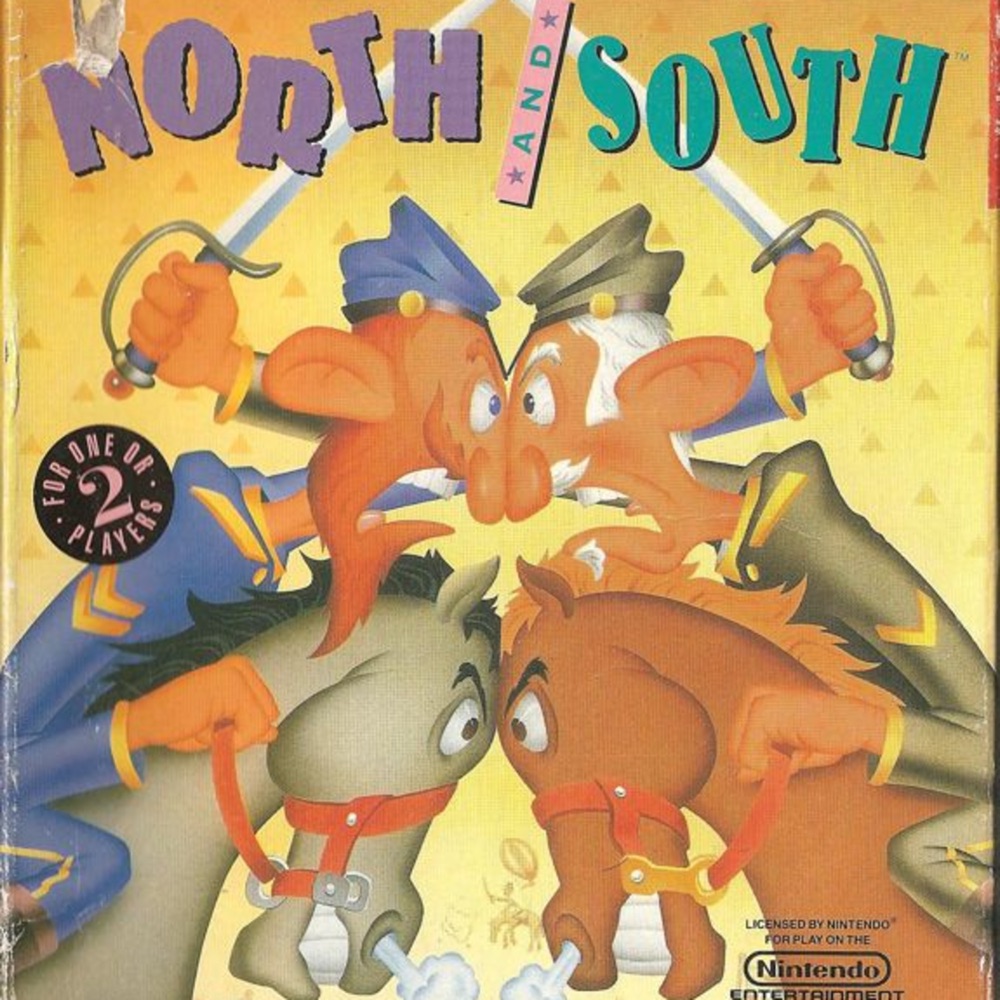
413 · North and South
North & South is a strategy action game released in 1989 for the Amiga, and Atari ST and ported to the Nintendo Entertainment System, Amstrad CPC, MSX, MS-DOS, Commodore 64 and ZX Spectrum. It was developed and published by Infogrames.
North & South is Risk with a side-scrolling stunt show attached. You pick the Union or the Confederacy, take over a cartoon map of states, and settle the fights yourself on the field. It started as a computer game based on the Belgian comic Les Tuniques Bleues, and it looks like it: a serious war drawn as a cartoon. Only Mike and Sean recorded this one, though Mike had played it earlier with Joe. After a run of Koei-style spreadsheets, this was the strategy game Sean said he had been hoping the NES would have.
Where the fun is
- Strategy light, in a good way. You choose a start year from 1861 to 1864, then move armies state to state and grab empty ones for free. You don't ration rice or marry into dynasties. We thought it was just enough strategy for anyone, even a ten-year-old.
- The railroad is the economy. Each turn the train collects tax from the rail towns you hold, and five bags of gold buy a new unit. Mike and Joe fought over rail towns and ignored Maine. Armies can merge, but a merge can never be undone, and a big stack is only one unit on the board.
- Battles with a controller. Infantry, cavalry and artillery all move at once, and the cannons carry you. It rewards multitasking over bigger numbers, so a misplay can flip a fight that should have been safe. A narrow win leaves you with a lone cannon, and one loss can start a death spiral.
- Optional chaos. Storms freeze an army in place, Mexicans and Native Americans attack at the edges, and European reinforcements land in North Carolina, which makes that state matter. Mike wished for more of this kind of geography.
Where it goes thin
- The raid mini-games. Forts and trains are side-scrolling runs where a knife-throwing soldier races a clock, with no jump button and ladders to climb. The attacker is nearly invincible while the defender pops in at random, and Mike said it cost Joe the game. We both thought the defender was too weak and that army size should matter.
- Easy to miss the game. Against the computer on level one in 1861, few units are on the board and the war ends in what felt like six months. Multiplayer is probably the right way to play.
- Once is enough. Mike had a lot of fun figuring it out with Joe, but once they did, they moved on.
Beyond the game
Ports ran across Amiga, Atari ST, C64 and ZX Spectrum. Two remakes arrived in 2012, and in 2020 the series reached the Switch with first-person shooter battles.
The bottom line
Play it. In the Essential Games List vote, we both left it off: Mike won't come back to it and found the action parts too divided from the board game, and Sean called it not essential but recommended it. If the Nobunaga games made you doubt you like strategy, this scratches the itch.
Written from our conversation in this episode.
- Your combat prowess and brilliant strategy could rewrite history
- 1. General Overview
- What it is
North & South is a mash-up of turn-based strategy on a map and real-time action mini-games (battles, fort raids, train robberies), all wrapped in a Civil War campaign. Wikipedia+1 - The hook
It looks like “Risk-lite” on the map, then suddenly turns into little minigames when armies collide or when you try to take a rail town. Wikipedia+1 - Offbeat questions
- Is the main appeal the strategy layer, or is it really the fact that strategy is just a way to trigger mini-games? Wikipedia
- 2. Source Material and Tone
- Based on a Belgian comic
The game is an adaptation/spin-off of Les Tuniques Bleues (The Bluecoats), which is set against the American Civil War, but the game leans hard into comedy and caricature. Wikipedia+1 - Tone clash on purpose
It treats a serious subject with cartoon visuals - Offbeat questions
- Does the light tone make it easier to approach, or does it flatten the “Civil War game” part into window dressing? Wikipedia
- 3. Setting, Objective, and What the “War” Actually Means Here
- You pick a side
Union (North) or Confederacy (South), then play out a simplified version of the conflict on a state map. Wikipedia+1 - Start year choice
You can start the campaign in different years (1861 to 1864), changing the opening situation. Wikipedia - Winning
The practical objective is to take territory, build up armies through income, and grind the opponent down until they cannot hold states. Wikipedia+1 - Offbeat questions
- When you “win,” do you feel like you won via smart positioning, or because you were better at the mini-games?
- 4. Strategy Layer: The Map, Turns, and Capturing States
- Turn-based movement
On your turn you move armies from state to adjacent state, generally once per unit per turn. DigitPress+1 - How a state flips Multiple capture cases: empty states, enemy-controlled states with no defending army, states occupied by an enemy army (battle), and rail towns that force a fort mini-game to fully claim. DigitPress+1
- Joining forces
You can merge armies by moving onto a friendly army, up to a cap (manual calls out max totals like 3 cannons, 9 cavalry, 18 infantry). DigitPress - Surround captures
There’s a rule where you can flip certain states by occupying all adjacent states (manual describes “surrounding your opponent”). DigitPress - You can check the composition of an enemy army on the map by moving the pointer over it and pressing A, which shows the counts of cannon, cavalry, and infantry. This becomes the difference between “sure, I’ll attack” and “I’m about to feed my cannons to a cavalry stack.” DigitPress
- 5. Economy and Railroads: Why Towns Matter
- Money loop
At the end of turns, states generate income, which then helps generate soldiers and keeps you expanding. Rail towns are especially important. Wikipedia+1- Notice how you don’t have to then manage feeding an army or keeping civilians happy or raising taxes
- The railway “tax” concept
The manual highlights controlling towns along the railway route to collect revenues, and also explains the idea of intercepting the opponent’s taxes by attacking along their train route. DigitPress - Offbeat questions
- Do you play this like a land-grab game, or like a “railway economy” game where the train route is the real win condition? DigitPress
- 6. Action Mini-Game: Battle (Infantry, Cavalry, Cannon)
- When it triggers
Opposing armies in the same state drops you into a real-time battle screen instead of resolving it abstractly. Wikipedia+1 - Unit roles
- Infantry: short-range volleys, can move freely.
- Cavalry: fast melee charges, limited movement behavior.
- Cannon: long-range shots, movement is constrained (vertical only is a common description), and cannon ammo is limited. Wikipedia+1
- Controls and unit switching
Manual describes using B to choose what type you’re commanding, and A to initiate movement and attacks. DigitPress - Bridge and choke points
Some battlefields hinge on a bridge that can be damaged or destroyed by cannon fire, radically changing the fight. Wikipedia - Offbeat questions
- Is the cannon the “real” win button, and everything else is support? (A lot of players end up playing it that way.) DigitPress+1
- If the action segments were removed entirely, would the remaining map game still be fun?
- 7. Action Mini-Game: Capturing a Fort (Side-scroller)
- When it triggers
States with a town (often tied to rail stations) may require you to complete a fort assault mini-game to truly claim them. Wikipedia+1 - What you do
You control a single soldier running right under a time limit, using knives or punches, navigating obstacles like dogs and explosives, climbing ladders, and reaching the flag. DigitPress+1 - Risk factor
Failing the fort run can stall your conquest even if you are winning the map game. DigitPress+1 - Offbeat questions
- Do you treat fort captures as a fun skill check, or as an annoyance that interrupts the strategy layer? DigitPress
- 8. Action Mini-Game: Robbing a Train (Side-scroller)
- Why it matters
Train robberies are basically economic warfare. Pull it off and you steal the opponent’s tax revenue from their rail line. DigitPress+1 - How it plays
Jump onto the train, move across cars, deal with enemy soldiers, and reach the engine before time runs out. DigitPress+1 - In the train sequence, if you collect 5 bags of gold, you get a new army you can place on blinking states. That can swing a campaign harder than winning one normal battle.
- 9. Options and “Chaos Switches” (Disasters)
- The game has toggles that add wildcards and map friction.
- Native Americans and Mexicans
Optional threats that can periodically attack or bomb certain areas and mess up armies. DigitPress+1 - Storm cloud
A moving cloud can disable movement for armies under it. DigitPress+1 - European reinforcements
Optional setting that can deliver reinforcements to the side controlling North Carolina - 10. Multiplayer and “How This Plays With a Friend”
- Head-to-head
Two players can play the full campaign, and the action segments become direct skill contests instead of AI chores. MobyGames+1 - Offbeat questions
- With the minigames Is this secretly a party game pretending to be a war game? MobyGames+1
- 11. Things You’d Only Know If You Played It a Lot
- Cannon management is everything
Cannons have limited shots and can withdraw automatically, so experienced players treat cannons like a resource you preserve, not just a weapon you spam. Wikipedia+1 - Merging is a commitment
You can stack up to the cap, but you cannot freely “unmerge,” so you can accidentally create a slow, awkward doomstack that is great in battle but clumsy on the map. DigitPress+1 - 13. Ports, Remakes, and Other Versions
- Original computer releases and ports
Started on Amiga and Atari ST (1989), later expanded to platforms like DOS, C64, ZX Spectrum, and NES. Wikipedia+1 - In June 2012, Microïds released The Bluecoats: North vs South,[5] a remake for iOS and Android compatible devices[6] and for Windows.[7] The iOS version received a metascore of 60 on Metacritic.[8]
- The Steam PC and the console versions were later delisted
- Another remake, titled North & South: The Game, was released for iOS on November 6, 2012 by bitComposer Entertainment AG.[11]
- In 27 October 2020 The Bluecoats: North & South was released for Nintendo Switch by Microïds. It features FPS gameplay
- Other alternative-history Civil War media
- North & South literally invites you to “rewrite the history books.” If you want a quick “if you like the idea of changing the Civil War outcome…” segment, here are some strong touchstones.
- Confederate victory timelines (the big alternate-history lane)
- The Guns of the South (Harry Turtledove, 1992)
Time-travelers arm the Confederacy with modern rifles, and the Civil War veers wildly off the rails. Wikipedia - Abraham Lincoln, Vampire Hunter, by Seth Grahame-Smith, recasts the Civil War as a war on vampires that use slaves as a food source.
- Damnation is a steampunk shooter released in 2009 for PS3/360 that is a steampunk version of the civil war
Auto-generated transcript. Each paragraph starts with its timestamp. Speakers are not identified.
North and South, your combat prowess and brilliant strategy could rewrite history.
And welcome to NEStalgia, a chronological exploration of every NES game released in North America. I'm Mike. And I'm Sean. You could rewrite history. Uh huh. Yeah. Is that really like, is that the selling point of the game?
Did you have the chance to right some wrongs? No. I don't, I think it's just for people that are very interested in that time period, Mike. Agreed, agreed. North and South is a mashup of a turn-based strategy game and real-time action. What I'll be calling party games. Uh, because I want to make this sound like Mario Party as much as possible throughout the episode. But it's all wrapped under a civil war campaign. That's right. The North and South that are in the title of the game are referring to the North and the South, uh, fighting in the Civil War between the years. The American Civil War. Right. The American Civil War, 1861 to 1864.
Uh, you know, it, it basically approached, the game is approached from a risk light, which is funny because we were talking about risk last week for no good reason. But you have this map where, uh, you know, each state is a, uh, is a territory up for grabs by both the North and the South.
And, uh, you want to, just like in risk, you want to conquer all the territories. You want to do that here. But in order to do so, it isn't just, uh, my number's bigger than your number, roll some dice thing. It's actually, uh, each, each time you try to take something over, turns into a little party game where the armies collide. Or you try to, uh, steal the railroad.
Or you try to infiltrate a, uh, uh, uh, what, what is that? Is that just like a town? Is that a, is that? It's a fort. Okay. Yeah. Try to infiltrate the fort. Uh, all these little things to just spice up the gameplay a little bit. So it isn't just risk or it isn't just strategy. They're adding, they're adding some video game components to this. Otherwise, what would be if we're looking at some of our grander strategy games that we've played by Koei. This isn't that. So first question is the main appeal, the strategy layer, or is it really the fact that the strategy is just a way to trigger these mini games?
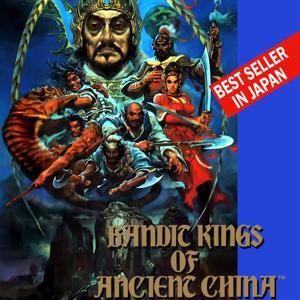
Um, that's a good question. Um, I, I would say that, yes, I think my, I think the main appeal is the strategy because I don't think that there's any real depth in the mini games. Um, and if I can, if I may, I think that this is finally the kind of strategy game that I was looking for on the system. Um, I think I got a little bit ahead of myself when I said at one point that I was looking forward to something such as, um, uh, Nobunaga's ambition or romance, the three kingdoms or Genghis Khan or whatever the hell else we played recently. Um, this is what, this is more what I'm looking for. Uh, something that has strategy, um, but isn't just a giant spreadsheet. Yes. Agreed. Uh, the one we played most recently was Bandit Kings of Ancient China.
I remind you, sounds like a, uh, a song wings would have wrote, uh, in the late seventies. Uh, yes, I agree with you. I think that, uh, especially on an eight bit system, this makes more sense, but I don't want you to forget. And I'm pretty sure back then you were, you were playing all the games too. So I think you were on the episode defender of the crown.
That was kind of a game like this. That was like strategy adjacent. There weren't like the party. Uh, I I'm sorry. I'm not, I can't call them party games any longer. I really wanted to force it, but they're really just like light mini games. Um, that do have, that do have fail states. Like you, it's not just like there. And there is depth to the one-on-one combat. Not so much the raid the train, but yeah, there's depth there.
But it's all everything. Both the, the fact that there is a civil war, the fact that, um, you conquer these states, the fact that you fight off in a war, it's all kind of done under this, uh, cartoonish, uh, like comic vibe with both the art style and just like the overall behavior of, uh, like the animation in general. And that's because the game is an adaptation of, uh, like a French comic about the American civil war, uh, Les Tuniques Bleu, uh, which is the blue coats.
And, um, I, I guess like, is that necessary? Like I did not look into this comic at all because I didn't feel like, I don't feel like a, it doesn't feel like a licensed thing. Like, yeah, I could be inspired by that, but is it really like enough of a thing? Like it just, this kind of feels like a standalone game. You don't need to know any other material other than the fact that the civil war happened. Well, I think that's why, unlike a lot of situations where, you know, a game would be based on a property that we just don't have in the States, they didn't find any reason to change anything because
maybe it, maybe it's beloved in Belgium or wherever the fuck it's from, but. Oh, you're right. No, it is Belgium. Yeah. But it, to us, it just looks like a cartoonish version of the civil war, which is a choice in the States, but, um, I think it still works. If you're going to make a civil war game, then why not just use what's already been made? It's a, it treats a serious subject with cartoon visuals. And so I ask you, does the light tone of it all make it easier to approach playing this game as the South or does it flatten the whole thing?
And just, you know, it's like window dressing for kind of a, an outcome that's just not comfortable for a North American landscape. I can totally understand why, like, you know, similar to, you know, playing as the, uh, the Japanese in, in some of the world war two shmups, why it's like, it's okay. But like, it, you know, the civil war game happening and being released in America. Yeah. Do you know, there's, there's some conflict there.
Um, I mean, this isn't the only, Oh no. Yeah. We'll get into it. This isn't the only civil war, uh, like strategy game. I, I don't think there's any, but yeah, your point it being kind of this light, I don't have a problem with it. I think there's also like much weirder things going on in this game than just the fact that it is a civil war, uh, cartoony game.
Um, I, I think I like the first moment that I like thought, Oh, this is going to be weird is when in the opening sort of summary, uh, when you start a game in 19 and sorry, in 19, in 1861, uh, it says that the Confederates stormed, uh, Fort Sumner, which is not a thing or a real place. Um, but it was, it was just, I was just sort of like stealing myself for like, this is going to be weird and it ended up being weird, but we'll, we'll get there. We'll get there. Yeah.
So you, you pick a side, the union or the Confederacy, and, um, then you can start the campaign in, in all different years between 1861 to 1864. And that does change the, the opening. So it's kind of like a, a chess thing where the opening board, it can be a little different dependent on skill level and everything and how you want to go about that. But the practical objective is to take territories, build up your army through the income gained, uh, mostly through the railroad where the railroad is key in this game and then grind the opponent down until they cannot hold any more of their states.
When you win in this game or even just make progress, do you feel like it is because of a combination of smart positioning and being good at the mini games? Or is it, is it like predominantly like just a numbers game or just a, I'm really good with a controller? I think it's, I'm really good with a controller, at least when it comes to like the one-on-one battles. Um, I think it's important to wait, that we actually kind of give a little bit of an overview of how these work. Um, yeah. You have, uh, infantry, cavalry, and artillery.
Now, if this were any other strategy game that we've ever played, there would be like a turn-based, like select what they do. And then you would watch that occur maybe. Um, or it would just be a literal number cruncher calculator, which would say like, oh, civilization style, like, uh, which, which of these wins. Um, but no, you go with however, whatever the number of infantry, whatever the number of cavalry and however many, uh, uh, giant cannons you have.
And you have. The cannons are, the cannons are the brute force. Yeah. That is, yeah. You live and die by your cannon. So, you have to concurrently control all three of these things. Now, they make it simple enough to switch between control of sending your cavalry forward, manually controlling the formation, and, uh, like, fine-tuning where your infantry goes. And then you have a more, like, you have like a, it's a longer shot selection for the artillery. But you have to do everything at once. And you kind of just have to be really good at multitasking.
Um, so there is a big skill. I don't know about a big skill ceiling, but skill at this part of the game can determine whether you win the strategy portion, whether or not you're any good at strategy, I think. Yeah, it's a great point because there, there's, there, the way that they position you, too,
it is just, like, one side's on the left, one side's on the right, and then depending on where you are, there's, like, a river or a canyon, and then there's some bridges that you have to cross over, and... Sometimes. There's also just big open fields where there's just, like, trees to go around. That's true. I guess what, my, my point being is that, like, you would think whoever has more troops is going to win, but Deshaun's point about multitasking, I did play this game with Joe who couldn't be here. Um, but when we versed each other, there were times for both of us where it was just, like,
you know, a misplay on the controller could completely screw up, like, you, you could get your cavalry over to the cannons and get the job done. And it didn't always guarantee, like, the numbers game, and so could, the tide could change very fast, um, in something that should have been a sure thing now becomes, like, a,
um, you know, a risky decision of, like, well, my opponent might be better at me than this, so I don't know if I want to go win there while they have equal amount of troops. Yeah, and then there's the fact that you, however many troops are left, if, like, if you did win, but it was, like, you only just barely won, or if you somehow, uh, retreated, like, that unit now only has as many, like, they might only have, like, two infantry left, or they'll just have the cannon. So, you then have to sort of sacrifice a pawn on the board to reinforce, um, and, uh, and wait for the train to come around to actually pay you enough taxes to get another unit.
Um, so, it can be, once you lose a battle, it can be kind of like a death spiral. As far as, like, for the strategy layer, uh, it's turn-based movement. On your turn, you move armies from state to adjacent state, um, and you can move all your units, too, so there is a lot of, uh, movement going on, and everybody can see this, too. It's not like you can hide what you're doing from, uh, your opposition.
The, the part of me that, like, maybe it's too simple, is, like, I do kind of wish, I'm not trying to ask for it to be, like, a whole nother game, but that there was some kind of, like, Oregon Trail component of, like, moving an army across different state geographies. Like, if you're crossing a river or something, that there could be some potential, like, dysentery or casualties along the way of, like, just, you know, things that just go wrong when you're trying to, you know, command an army. In the grand step strategy space, we call that attrition.
Okay, sure, you know, like, just, just little things that could potentially happen. It doesn't have to be, again, a whole thing that, like, the player has to control, but just, to, to spice up, uh, and make, like, you know, oh, crossing a river versus, like, well, this is just, you know, crossing, you know, uh, land to land as opposed to, like, over a mountain or something. Like, just maybe a little more strategy there is a little too simple, but once you get over that,
uh, you, there are multiple ways to capture states, and, and it's not, it doesn't always involve conflict. They're, first off, depending on what year you pick, there might be empty states, so there, you might immediately rush to those states because once you land on an empty state, you acquire it. It's like monopoly rules, but you don't even have to pay anything.
Then, if there are enemy-controlled states with their flag but no defending army, you capture those. Then if, uh, but you do have to, um, you do have to infiltrate their fort. Uh, then there, uh, states that are occupied by, yeah, if it has a fort. Then there are states occupied by the enemy army where you have to do the battle that we were talking about with the three different units. And last but not least, there are the rail towns.
Um, those are the ones that force the fort minigame. Um, and, and you have to, uh, take down, you have to basically get, it's a race against the clock to get to the flag at the end. It's kind of weird. It's like Super Mario Brothers. You're, you're in like a side-scrolling stage where you have to try to get to the flag within the time limit. But the other player, whether it's a human or the computer, kind of just randomly spawns into the screen every now and again and, and gets in your way. They have a certain amount of lives. You have infinite lives. You just have to, uh, you know, like they're just basically blocking you off to not be completed in time.
Yes, exactly. But I don't want to, I want to focus on the strategy layer before we get too into the games because I feel like it's best to break these things up. There, there are other things you can do. You can join forces, you can merge your armies. So if you have, uh, like one cannon and two cavalry, and then you have three cannons and eight infantry, you can merge those together by moving one into the other, but you can never undo a merge. Yeah. So it is, it's very permanent. It's very purposeful. It, it doesn't feel like a bug to me. It feels, uh, like something that they put in design. So this way you couldn't just do this without any kind of repercussions.
And then you can also, um, you can do surround captures, which is something that didn't come up in, in my experiences, but you can theoretically own all of the states of occupying an adjacent state. And then just like you surround that state and, and acquire it. That is pretty cool too. Making giant like perimeter breaches. It is cool. Um, but now that we're talking about this layer, um, especially, and I guess only if you're playing against the computer, it's very, it's very easy, um, to just not see any of this.
Because you've just rushed the two enemies that are on the board in an 1861 start, and you may have won those battles and the game is over six months into what the war would have been. Um, right. So I think this is definitely like stuff you might see in a multiplayer game, which I think is the correct way to play this game. Um, it's just that there, and I, again, I only played, uh, on level one of the, like playing as the North against a level one confederacy, uh, in 1861, where there's only a couple of units on the board. So I felt like I was missing a lot. Like this just, it's got all of the bones of a, like a simple strategy game, but one that seems pretty fun. Uh, it just felt like there wasn't enough time for me to see everything.
Uh, so I guess I could have played it on harder difficulty to get to that point and actually explore those, uh, strategy layers, but I ended up not doing that. Yeah. I mean, I also think it just comes down to the kind of, uh, whether it's a computer opponent or a human opponent, it just comes down to the situation. Cause I think a lot of those things that I described, you, you might, if it's a human opponent, you might face someone who also plays similar to you, right? Very like, okay, you're going here, I'm going there. And then there are other ones who are like, well, I want to capture those rail towns. You can take every other state. I don't give a shit.
You know, it's like, there are, there are different outcomes to the game where it's not just so simple of like, uh, I just have to eliminate every, um, uh, every opponent because there's a whole, like after everybody's gone, there's a replenishing stage of the, you know, the, the States that you, uh, that you own and especially the ones that are connected to the railroad, those help generate new soldiers, which are very important, um, to the game because they, again, soldiers aren't even just an individual soldier on that battlefield. They count as a whole like division, right? A whole division that can continue to conquer, uh, states that aren't occupied.
So, you know, you might have an incredible army by merging everybody together, but you're just one unit on the screen moving around, whereas somebody else could have five smaller units occupying five different turns that they can make. So there is still some like there's not a ton of depth, like not enough that I feel like a 10 year old couldn't at least attempt this game. Like Nobunaga, I feel like is out of a 10 year old's reach, but there is still some good decision making here to be had.
Uh, especially when you introduce the optional stuff, you know, there's the ability to introduce, uh, storms and, uh, Europe and, uh, native Americans and Mexicans into the game. Yeah. And, and all those things are like, you know, optional additional ways to, so the native Americans and the Mexicans are, uh, they can periodically attack. Uh, I think the Mexicans, uh, what is it? Do they attack whoever owns Texas?
They're very much, they're always on a siesta until they decide to trigger and they will, I think they'll attack a unit that's in one of the southern spaces, but right. Okay. Uh, and then the native Americans are kind of like that only they're always on the lookout. Um, and we'll attack you if you're in more of the Midwest spaces. So, uh, very
French wave, uh, maybe American, but I think, uh, the French can get off easy on this maybe. Yeah. Yeah. The, the storm cloud, uh, which I had all these turned on in my game against Joe, um, the storm cloud makes it so that whatever, wherever the storm is on that state, you can't, you, the army on that state cannot move. Uh, you, and so like that happened and that was kind of, that's kind of, I guess what I was looking for, for movement in general is just more of that kind of stuff to just not, not even introduce some randomness, but just make it so that it felt more, like I wasn't just, uh, moving pieces across board spaces, but that it actually felt like a real environment that, you know, you were trying to conquest.
I did like that. Um, maybe not so much the, uh, the context for the other two, but something like weather change, uh, just like giving you some actual geography or something to actually, uh, uh, differentiate, uh, so that it's not just a symmetrical game, um, is always good. Something to throw a wrench into it, uh, makes it feel like a more engaging strategic situation.
And the last one, the European reinforcements, uh, a boat will, um, come to the United States, to whoever is occupying North Carolina and, uh, deliver reinforcements. Uh, and obviously like the, uh, the French were instrumental in, uh, changing the tide of the civil war. So I think this is the one that feels kind of weird that it's optional, but instrumental in turning the tide of the civil war. Weren't they like they supplied the arms that they, that the North desperately needed and they could have went with the South.
Oh, they were kind of like a, let them fight for a while. And then they just chose the union. I thought they were just, I thought it was more like a revolutionary war thing and not so much a civil war, but I guess, I don't know. They just keep coming back. They just can't get their hands off of America. The French are rose, huh? I know. Right. And what do we do for them? We rename our fries.
Uh, yes, no, but it's true. It's not, it's not as big as the American revolution where obviously like, you know, who knows what the outcome would have been. It would have just been longer, but, uh, definitely, definitely would have been longer. But, uh, here I think it's interesting that they make it North Carolina
because making it one state, as opposed to just the coast in general, like kind of supplying the coast via boat makes it so much more important. Like it, it, it, it can't be stressed to how valuable
reinforcements are in this game. And that's why, again, you go after the railroads and you go after North Carolina, um, because those ones will continuously deliver basically arms for you to not be brute forced out by your opponent. Um, in, in the mini game section, you'll still always have a supply of people.
Speaking of with the railroad and everything, the, after everybody makes the moves, the train also, um, makes it stops. And if basically whatever you, whatever railroad towns you own, you collect a tax on those. And when you collect five bags of gold, you get a new army unit. And so you can have multiple, uh, if you own all the rail, you can get enough to have everything. So me and Joe really fought over those railroad States and didn't really care about what was going on in Maine or new or New York. Cause the map is kind of weird. I guess it's a very strange map. Uh, but I think it mostly works. I think that, uh, it's, I guess, um, what am I trying to say here? I think this would make a really good board game.
I don't really know how you would, I don't know how you would sort of make the, uh, the, the mini games or like the battles actually engaging and not just like a dice roll. Uh, but, uh, you do like duck, duck, goose. Yeah. But it seems like they didn't really care so much for, you know, geography or, uh, historic railroad routes. Um, but that sea really makes it hard to control the whole thing. So it's at least designed for balance. So that's pretty cool. Also, I think we mentioned it, but like, if you are in enemy territory and
happen upon, uh, one of these towns, you can just sort of get some wild west boarding of a, uh, boarding of a train and he'd kind of do like a variation of the, uh, of the fort mini game. Um, it's, it's interesting. Yeah. And I think both of those, we can go a little more in depth on those now, both whether it's the fort or the train, still the same idea. You control a single soldier, uh, in a side scrolling level, just running to the right under a time limit. Uh, you have, uh, like knives that you can throw, right? You throw the knives. You are a knife throwing soldier. Yeah. No guns, no such thing as guns.
Uh, and then you, once you run out of knives, you can punch. Um, and, and so in the fort, there's obstacles, like there's dogs, there's explosives, there's ladders you have to climb because obstacles make it this way. You can't, you can't, you don't have like a jump button. Uh, you have, so you have to, if something's in your way, you have to climb up a building to go around it. Uh, typical, you know, uh, fort stuff. And then as long as you, there's like a, there's a, a boot and there's a clock, like, like a typical clock that you would to stop an alarm clock. It's like a boot with like a mouth. Yes. And both those things are at the bottom of the screen racing against each other, but it's actually the boot is you and the clock is time.
And so you have to try and this sounds very complicated. It's actually pretty easy and can be fun. I think they messed this up though. And I think I could speak for Joe here too, because it lost him the game, but I think they messed it up because of how the opponent spawns into both of these, whether it's the train or the fort, the, the one, the single soldier running to the right is basically invincible, can only be temporarily knocked out. And the opposition can, can control how they spawn in. Like, I think you hit the button to confirm that you want to come in, but you do just kind of pop in to the screen. It's not like you,
you, you just kind of spawn out of thin air and it creates some awkward encounters and it makes it a little easier for the, uh, the defender. Yeah. The attacker to, to anticipate and get around. And even if they don't get around at the first time, they'll get around at the second time. I really think you should have been able to incapacitate the attacker as well. And just like knock them off the train and the train moves on without them. Right. Or the fort is like, you know, you take enough damage and you're dead.
Uh, it should have been that in addition to the clock because it, it, it makes it too easy. I think that, I don't know that that kind of like will just lead to turtling at that point. Right. Like, sure. Yeah. No, I mean, I'm not, I'm not saying that the game is unbalanced. So I feel like they, they had their reasons.
I just feel like the, the, uh, the defender feels incredibly weak in both these scenarios. Hmm. I guess I need to play multiplayer. Well, I was able to successfully defend. So it was Joe. Uh, but I do know that like once I got better at attacking, Joe was no longer able to defend against me, or at least they come, you know, in our game, come up with a strategy at enough time.
I'm sure he would have eventually figured out a way to turn tides back, but it basically made it so that at one point I was losing pretty badly. And then it just became a, well, now it's just, you know, a matter of how many times can we do the train game before I take all your towns, all that to say the single soldier thing also feels very strange because the whole thing is about this, you know, like your army, right. And you're merging troops and how many cannons you have. Cause remember, if you lose your,
if you win the fight, but still the opponent was able to take some of your cannons or cavalry or infantry out that, that number sticks with you. So that whole part is tracking. But then at the end of the day, they just have like one lone guy go in to infiltrate this stuff. It's like, not that you should have a cannon in this side scrolling thing. That wouldn't make any sense either, but the army count should matter for both sides too. If you're defending, if nothing else, then maybe like the amount of like, cause you have a, basically a lives pool as a defender of how many guys you get to like interfere with the, the attacker. And maybe it should also affect how many knives you have. I don't know, but I agree. There should be something there.
Something to just, because this part really did feel like, and it's supposed to be right. It is the, it is a skill check thing. It is like a moment to shift tides without just being like, uh, I know exactly how to, uh, take all your states, right? It's like, no, you have to prove it in actual video game gameplay. Makes sense. It's the thing that separates it from the board game that Sean was describing. I just am not completely sold on it.
The game originally came out on computers for, uh, Amiga and Atari ST and a whole bunch of others. DOS, uh, C64, ZX Spectrum, which I think they say ZX Spectrum. I like that. Should we be saying that going forward? I call it the ZX Spectrum because it's a European thing. So, right. And so it makes sense for this game to be a computer thing. And it's kind of interesting that it came over to the NES, but sure, we'll take it.
What's more interesting is that after the release of this game and all of its, uh, ports to other platforms, the, the license, right? Of the blue coats kind of went silent and has like a very recent explosion in the 20 in 2012 where two different games came out in 2012, uh, North and South, the game. I don't know why they needed that. The game part, like it, first off it was released on iOS. So it's like, did they, were they worried about getting sued?
Yeah. It's this game remade. Wow. Uh, so totally different graphics and everything, but like, yeah, it's this game, but also like, were they worried about getting into, uh, like a lawsuit with a maps thing, like North and South, like, uh, can't, you have to, you have to make sure it's identifiable the game. And then there's also the blue coats North verse South, which makes, makes a lot more sense, right? North verse South. Is it also just this game? It's a remake of this game came out in this, listen, that, that one, the blue coats came out in June of 2012, North and South, the game came out in November of 2012. Did, did like the copyright expire extra early?
I don't know, but if they're both remakes of the exact same game made by two different companies, that's even more confusing to me. Yes, they, they are. Um, and what's even more confusing is, is that the, um, the first, the second one, the blue coats North verse South, uh, the, the steam version and the console versions are all delisted. So you can't even get them. Darn. Yeah.
Then we went eight years without any North and South games. And that was very sad, but thankfully, uh, on October 27th, 2020, the blue coats North and South. It's like, how many variations of this title can you come up with? It's not, it still feels complicated to North and South. It should be North versus South, right? Or North South North North slash South. Everybody's saying North and South, but nobody's saying South and North. Well, there's a reason for that. Okay, good.
Uh, anyway, that game in 2020 was released for Nintendo switch. Uh, it's by the same people who made, um, the blue coats North versus South and, um, uh, yeah, the one that was delisted, but here's the kicker they added because now it's on switch. They added an FPS, uh, like battle. No way. Yeah. So there's still the, there's still the strategy stuff, but then when you go into the battles, it's all, uh, FPS. Like, is it a competent FPS or like, uh, from what I watched it? Yeah. It's probably just using the gun real engine.
Okay. Wasn't expecting that. It's very strange. Yeah, I know. I know. It's, it's $20 and it could be yours. We'll see. Not delisted yet. Uh, and here's the thing, uh, alternate history, civil war stuff, even if it's uncomfortable. Um, it's a thing. There's other media for it too. Uh, notably Abraham Lincoln, vampire hunter. I was thinking of the turtle. Was that what you were expecting? Yeah, no, no. I'm thinking of, uh, that the one alt history author that people know about. Is it the book, the guns of the South? Yes.
Okay. Yeah. That's the time travelers arm the Confederacy with modern rifles so that they can turn the tides of the civil war. That is very much a turtle dove book. Yes. Yeah. Uh, so, you know, I, I like to think of Abraham Lincoln, vampire hunter because it did take place during the civil war, right? It has. I would imagine. No, no, you know what I'm saying? Like, it's like, it basically is like a redo of the war where now vampires are using the slaves as a food source. Like that's kind of crazy. Yeah. That's interesting. I suppose. Not, not time travel shenanigans to change the outcome of like, is anyone doing that for Germany?
Is anyone writing books about time travelers assisting Hitler? Isn't that like, isn't that man in the high cat? No, that's not man. Isn't that man in the high castle? Yeah, that's actually true, but that's alternate history, right? Is this not alternate history? No, no, no. That was a time traveler thing. The guns of the South was like time travelers from the future got mad about the, you know, they were like, Oh man, if only we could change that civil war. So they go back in time. I don't think, is that what happens in that Amazon series?
I mean, it was a Philip K. Dick book. I know. I know it was a book first. Sure. But like, I'm just saying like, I didn't watch enough of it. Is that, is it, is it revealed that they went, they traveled through time to do that shit? I thought it was just like, Oh, I think it's, you know, again, this is this, maybe this is all just a spoiler thing, but who gives a fuck about spoilers for, well, it's good that you give the warning though, because I think I have not given the warning before, but I think it's more just like a weird quantum time fluctuation, uh, because there is an awareness of a timeline in which the, the, the allies won.
Got it. Is that the same thing then for all mankind? Are you aware of that Apple TV show? I'm aware of the Apple TV show, but I do not have Apple TV, so I'm not sure. Uh, and then,
uh, the only other thing I had here was a video game, uh, called damn nation. It's a steampunk shooter released in 2009 for the PS three and three 60. And it's a, uh, steampunk version of the civil war. Huh? Now that sounds interesting. Uh, I guess, I, I, I, I guess, uh, I'm, I guess I'm curious what you mean by that. You're not, well, you're not picking, uh, you're not picking sides there. You're not trying to rewrite history. You're just doing it in, in steampunk form. Now, if we're just sort of going off of vibes here, um, a game that I kind of want to try was like, like a seventh generation FPS called, uh, I think it was darkest of days where you play as a,
um, you, you play as a, somebody that was supposed to die in the American civil war, but in the final moments, some like inter time corporation comes in and like kidnaps you. And it was like, uh, we're, we're, we're basically like the, in that Loki show, like the authority to make sure the timeline stay correct. And we need, we need great soldiers. So we're, we're recruiting you to go into different time periods and make sure that with our fancy technology that things go correctly.
Um, and just a cool concept. And no one's doing, uh, like time travel where they take the fire away from man, you know, like we're, we're, people aren't going back far enough. Right. I would do that. Yeah. Yeah. Just like stop the fire. Like you don't know, you don't get that actually. And they give it to lizards instead and lizards are like, Holy shit. I would give it to lizards. I think that like lizard people, whether they exist today or not, we need more of them. What do you mean? Weather
lizard people might not exist, but you know, it does exist, Sean. The essential games list.
That's right. And here's my vote for North and South. Uh, first off, if we're doing essential titles list, it's just not it North and South. I'm just not a fan of it. I'd let it be known. I don't hate it, but it just feels incorrect. Uh, the actual game, very approachable. You'll notice that in this game, you don't have to, um, like, uh, divvy out or ration out your rice for the winter. You don't have to, um, you know, uh, swoon over, uh, another person's, uh, another captain's like princess and, and marry families to create new dynasties. There's a certain level of strategy here and it's like just enough for anyone.
Uh, it's very accessible. This game. Is it actually fun though? Uh, I had a lot of fun playing it with Joe, like, as we were figuring it out, but I think it was because like, it was as we were figuring it out. I think once we figured it out, we didn't like feel an urge to be like, Oh, and let's do, let's jump into another game. Uh, it was kind of like, all right, that was North and South and we moved on. So for that reason,
I'm going to leave it off the list, but I would also say that I think that the, uh, I was calling them party games. They're actually barely even mini games. They're just kind of like action side scrolling parts of this game. Uh, those are, those could be a lot better than what they are. They are, if anything, just little, uh, little breaks between the, uh, board game component of this, which feels like the, uh, the largest and most important part of the game.
So it's a little too, um, divided for me to put it on the essential games list, but I also don't think I'll be coming back to this one. Sean. Um, yeah, I, I think one of the things that really succinctly illustrates how I feel about strategy games on the NES, um, was your comment about the rice. Um, I, I really, the amount of minutiae that these games have gotten into in the past, uh, for what it can actually simulate and show you in a more, uh, a more visual and like gameplay wise, uh, has made me kind of like, Oh, I kind of hate strategy on the NES. And I guess this isn't really strategy or this is baby strategy or strategy light. But like I said, at the top of this episode, like this is the kind of, this is the kind of strategy that I like.
Um, now to counter another thing that you said though, like I do kind of like the whole, uh, gotta marry the princess. If there was a way to make sure that like, um, Robert E Lee or Stonewall Jackson had to get into like a diplomatic marriage with Sherman or something like that. Uh, that would be pretty interesting to me. Um, I know that would, that would be some pretty hardcore, uh, alternate history, but what else is there, uh, when you're getting into these kinds of games? Uh, that said, um, I don't know if this is like essential kind of stuff. I, I would definitely say if you thought yourself a strategy game enjoyer before all the games that we've played, but we're starting to second guess yourself, try this game out. Uh, uh, it's goofy.
It's, uh, it's weird, but I think it scratches an itch that the Nobunaga likes have not. Um, and it's definitely, it sounds like at least a cool multiplayer game, uh, judging by the fun that, uh, Mike and Joe had without me. So, uh, not essential, but I recommend it. I will play every, uh, 1991 multiplayer game with you tomorrow. Okay. Yeah, we'll do it. We'll get them all tomorrow. That's how we do the show. By the way, guys, we play every game for the year, uh, in one day and then we just wait a week after week to review them. So Joe and I played North and South. That was 2019, right? Yeah. Back in 2019.
Uh, can't wait to get to Wario Woods, which we played in 2020 during COVID. No, this is all a joke. Uh, the real story is that up next, uh, is East and West. Uh, we're going to take care of the other, uh, two things on the compass because nobody ever made those games. Is that like a Tupac versus Biggie sort of thing? That's exactly what happened. Yeah. It's kind of crazy, but you do, uh, you do, and it's not like GTA or anything. It's literally just this, but, uh, one script and all that stuff. That's ok. That's ok. That's ok.