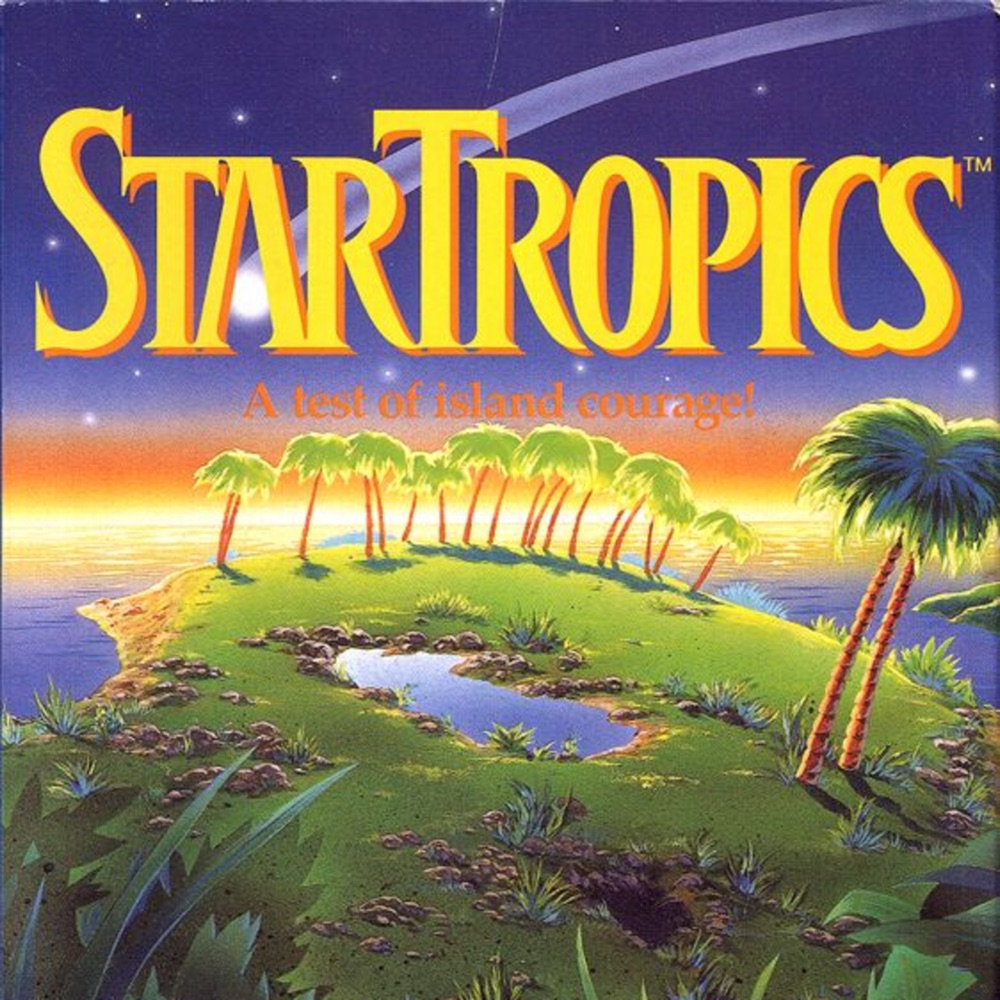
415 · StarTropics
StarTropics is a 1990 action-adventure video game developed and published by Nintendo for the Nintendo Entertainment System. Unlike most of Nintendo's games, it was never released in Japan, and was released only in North America and Europe. The story follows teenager Mike Jones as he embarks on a quest to rescue his uncle. Gameplay involves exploring settlements and navigating dungeons to progress.
StarTropics is a Nintendo-published top-down adventure that never came out in Japan and landed in North America in 1990 as the big holiday game. You play Mike Jones, an ace pitcher who goes looking for his archaeologist uncle and ends up with a yo-yo, a submarine and a talking dolphin. Mike, Sean and Joe played it. Its reputation set a high bar, and it cleared it.
What makes it essential
- Zelda's coat, a different game. The menus and view are familiar, but movement is chunky and grid-based, you hop between tiles, and the dungeons lean closer to puzzles than swordplay. We agreed it borrows chunks of Zelda and builds something else around them.
- Set pieces, chapter after chapter. A dolphin, a fortune teller, dressing up to get into She-Cola, being swallowed by a whale, the underwater caves, and a giant piano you hop across in a Do Re Mi sequence. Joe said it felt like a real grand adventure and may even crack his NES top 10.
- Puzzles you can solve from context. The Rod of Sight is the best case. Doors open when you clear a room, so at a dead end you suspect an invisible enemy is the switch. The boss you sink by cutting it loose was a favorite.
- Dungeon items for that dungeon. The baseball bat and snowman freeze make the octopus fight, and we liked trusting the game to hand us what we need.
- Charm. The story is thin (we compared it to original Pokemon in how it pulls you along), but the humor lands, and short text boxes beat eight minutes of cutscenes.
- A real ending. After the credits you get pixel art of every notable scene, plus a look at what you look like as a girl.
Where it frustrates
- Very linear. It looks open and is not. It is what people feared Zelda would become before Breath of the Wild, and the gameplay carries it anyway.
- The yo-yo. Short range, and your weapon depends on hearts, so a hit can drop you back to it. Only gun ammo hurts the Main Engine boss.
- Traps and a coin-toss 1-up that can cost you a life. We called it "bitch ass game design", and Switch rewind helped.
- One dungeon track. One more song would have done it.
- Turning before you move. Eight frames to face a direction felt wrong at first, then fine. A ROM hack that shortens it made combat too easy.
Worth knowing
A letter in the box has to be dunked in water to reveal the sub's frequency code. Rental shops were out of luck, and Switch Online offers no fix, though the Wii and Wii U versions did. The sequel, Zoda's Revenge, arrives in March 1994.
The bottom line
Essential. All three hosts on the episode voted it onto the Essential Games List, so it was unanimous. Mike called it one of the great games on the NES. Joe said he loved it. Sean said great game too, and that people would take his head off otherwise.
Written from our conversation in this episode.
- Tropical Adventure of Epic Dimensions
- 1. General Overview
- What it is
StarTropics is Nintendo’s 1990 top-down action-adventure for NES, following a “towns plus dungeons” structure that often gets compared to Zelda, but with its own tropical, pulp-adventure vibe. Wikipedia+1 - Who made it
Developed by Nintendo R&D3 and Locomotive Corporation, published by Nintendo. Produced, written, and directed by Genyo Takeda. Wikipedia - Release footprint
Not released in Japan. Released in North America (1990) and later in Europe. Wikipedia+1 - Core identity
Exploration, puzzle-solving, and action combat with a signature main weapon: a yo-yo - Offbeat questions
- Does StarTropics feel like “Nintendo does Zelda in the tropics,” or like a different vibe just wearing Zelda’s clothes? Wikipedia
- Is the yo-yo as iconic as Link’s sword, or does it feel like a placeholder until you get “real weapons”? Wikipedia
- 2. Story and Objective
- Premise
You play as Mike Jones, a teenager who travels to a tropical archipelago to visit his archaeologist uncle, Dr. Steven Jones, and quickly gets pulled into a rescue mission. Wikipedia- The Menu screen looks just like Zelda that I was cheeky and named myself Link. My surprise when it was calling me Mike was some Doki Doki Literature Club moment.
- The broader hook
It escalates into ancient-tech sci-fi, with island cultures, ruins, and a bigger mystery behind the disappearance. Wikipedia - Every Town named after COLA. And we’re from AmericaCola (which is an awesome name)
- Offbeat questions
- Does Mike Jones read like a deliberate “teen adventure hero” archetype, or does he feel unusually plain for a Nintendo protagonist? Wikipedia
- How much does the story actually motivate you moment to moment, versus the game just being a chain of clever obstacles?
- 3. World Structure and Core Loop
- Overworld exploration
You move through island towns and outdoor areas, talk to NPCs, and use items to unlock new routes. Wikipedia+1 - Dungeon progression
Each major area tends to funnel you into a dungeon or setpiece where you solve puzzles, collect key items, and beat a boss to move forward. Wikipedia - Island hopping and vehicles
The game explicitly mixes travel on foot with travel using your uncle’s submarine, the Sub-C (with assistant ROB), which creates a “chaptered adventure” feel. Nintendo+1 - Offbeat questions
- Does the submarine make the world feel bigger than it is, or does it mostly function as a chapter selector? Nintendo
- Do the towns feel like lived-in places, or more like signposts delivering the next hint?
- 4. Controls and Combat Feel
- Movement and hitbox feel
Mike’s movement is more “action game” than “RPG,” and the way he jumps and collides with enemies is part of the learning curve (especially early). Nintendo World Report+1 - It has that terrible movement decision where Mike stutter steps when changing directions, it leads to a lot of awkward movement in the top down game. He also can have forward motion while using the yo yo
- In the dungeons there are many squares that you can only jump in or out of. What exactly do these squares look like in 3d to be designed like that?
- Primary weapon: the yo-yo
The yo-yo has range and timing that forces spacing. It is not like a sword, it has its own cadence. Wikipedia - Main weapon progression
- Island Star (yo-yo): your starting basic weapon. 任天堂ホームページ+1
- The yoyo is so boring to use after a while.
- Shooting Star: major upgrade from SheCola, and it replaces your yo-yo once you have 6+ hearts. 任天堂ホームページ+2StarTropics+2
- You turn into a girl to enter Shecola. She says you must be from SheCola just cause you look like a girl
- Super Nova: powered-up form of the Shooting Star, requiring 11+ hearts to use correctly.
- Offbeat questions
- Does the yo-yo combat make normal enemies feel like a positioning puzzle, or just slower than it needs to be? Wikipedia
- Are the baseball-themed items charming flavor, or do they pull you out of the island-adventure tone? Wikipedia
- 5. Items, Tools, and Puzzle Language
- Key items as progression gates
StarTropics is built on “get an item, recontextualize the world,” with tools that let you cross hazards, access new zones, and solve dungeon-specific puzzles. Wikipedia - Real examples of “key items as progression gates”
- StarTropics loves giving you an item that changes what “counts” as a wall, hazard, or enemy.
- Bottle note + code (Chapter 2)
- Before: black “wave” tiles are just blocked water.
- After: you activate Sub-C’s submergible system and can press B on those waves to dive through rock barriers and reach the next cave. tartarus.rpgclassics.com+1
- Crystal Ball (Chapter 3)
- Before: the fortune teller is a dead end, and SheCola is effectively locked.
- After: retrieving the Crystal Ball triggers the chain that gets you into SheCola (including the transformation workaround), which then leads to your Shooting Star upgrade and the path to the Hermit. tartarus.rpgclassics.com+1
- Rod of Sight (Ghost content)
- Before: you can take damage from “nothing” and can’t fight back.
- After: Rod of Sight reveals invisible ghosts (the enemies page even calls out that you can’t see them without it). 任天堂ホームページ+1
- Captain Bell’s memorial music clue (Chapter 5)
- So America is AmericaCola but Britian is just Britian? Captain Bell is british.
- Before: flames block the exit path.
- After: you interpret the parrot’s “Do me so far, do me” hint as literal solfege, play the organ sequence, extinguish the flames, and only then can you reach the dungeon that clears the strait. tartarus.rpgclassics.com
- The letter-in-water frequency (Chapter 4)
- Before: you don’t have the tracking frequency needed when Nav-Com asks for it.
- After: the water-revealed frequency becomes the “real-world” gate that unlocks the next step. tartarus.rpgclassics.com+1
- Magic Cubes (Chapters 7–8)
- They are literal progression keys inside the alien ship: collecting them upgrades your gear and is required to resolve the story and reveal the Argonian survivors.
- NPC hints matter
The game expects you to talk to people and interpret directions. It is designed around curiosity and note-taking. - Offbeat questions
- Does the game do a good job teaching its puzzle language, or is it at its best when you are slightly confused and experimenting?
- How often are you progressing because you solved something, versus because you talked to the one NPC who tells you exactly what to do?
- 6. Dungeons, Bosses, and Setpiece Variety
- Dungeon identity
Dungeons are typically thematically tied to an island or region, with unique hazards and puzzle gimmicks. Wikipedia - How dungeons work in StarTropics
- The game has two modes:
- Travel stage: overworld islands and Sub-C navigation. You talk to NPCs and move between islands. 任天堂ホームページ
- Battle stage: triggers when you enter tunnels/caves (the dungeon spaces). You fight, solve room hazards, and manage weapons/items from the pause menu. 任天堂ホームページ
- Dungeons are multi-room, top-down labyrinths with:
- Enemy rooms mixed with hazard rooms (spike traps, moving dangers, “can’t be destroyed” obstacles).
- Puzzle “reads” that often involve fake walls, hidden entrances, or using the correct magic item for that dungeon’s gimmick (Ghost content is the cleanest example). tartarus.rpgclassics.com+1
- The game frequently scores you after finishing a dungeon, reinforcing the idea that each one is a contained challenge run. tartarus.rpgclassics.com
- Structure-wise, the later-game dungeons escalate into themed “sectors” (the spaceship is literally broken into Sector 1, Sector 2, then the Control Center).
- Boss structure
Boss fights act as chapter caps, often requiring you to recognize patterns and use the tools you have recently obtained. - Enemy design
The enemy mix leans into “tropical weird plus sci-fi weird,” rather than pure fantasy. - Tropical weird
- Dodo (yes, extinct dodos) rushing you down. StarTropics
- Octot hopping around wet regions. StarTropics
- Looper snakes in multiple behaviors/colors. StarTropics
- Mud-o-fish / Puff style water ambushers. StarTropics
- Undead and “island ghost story” weird
- Muumu (mummies) and Bonehead / Bonedog. StarTropics
- Minie (invisible ghosts) that only become fair fights once you use Rod of Sight. StarTropics+1
- Pirate Ghoul that’s best handled via reflected projectiles (mirror logic). StarTropics+1
- Sci-fi weird
- Death Discs (spiky “keep coming” hazards with stronger gold variants). StarTropics
- Electricity hazards that chase/pattern around you. StarTropics
- Mobilized Turrets and Space Troopers that feel like you suddenly walked into a different genre once the spaceship starts.
- 9. The Famous “Dip the Letter in Water” Moment
- What happened on original NES carts
The NES release came with a physical letter from your uncle. At one point the game requires a radio frequency, and players were expected to dip the letter in water to reveal the hidden code. Wikipedia+2Nintendo+2 - The code
The frequency is 747. Nintendo Support still publishes this directly. Nintendo Support - In response to questions from fans, the code was also published in Nintendo Power.
- Re-release handling
Virtual Console versions reproduced the letter in the electronic manual. Switch Online initially confused some players because the physical-letter trick doesn’t happen, so Nintendo also published the code online. Wikipedia+2Nintendo Support+2 - Offbeat questions
- Would you rather a game do something bold like this, even if it ages poorly, or keep everything self-contained?
- Island towns and the main story hook in each
- Chapter 1
- CoralCola (C-Island)
- Hook: Your uncle (Dr. Jones) has been kidnapped, and the Chief points you toward the island’s “test of courage” to begin the rescue. You get your first weapon and head into your first tunnel dungeon. tartarus.rpgclassics.com
- Chapter 2
- No named “Cola” town here (lighthouse and a seaside hut area)
- Hook: A dolphin begs you to find her missing son. While searching, you find a bottle with a note from your uncle saying he was abducted by aliens, and you activate Sub-C’s ability to submerge. tartarus.rpgclassics.com+1
- Chapter 3
- MiraCola
- Hook: The Sub-C is wrecked, and MiraCola offers repairs if you solve their crisis: the chief’s daughter Bananette is in a deep magical sleep, so you have to seek a cure. tartarus.rpgclassics.com
- SheCola
- Hook: You need help reaching the Mountain Hermit, but SheCola is gated (only women can enter). You end up restoring the fortune teller’s Crystal Ball and get transformed so you can enter and receive a major weapon upgrade. tartarus.rpgclassics.com
- Ghost Village
- Hook: You drain the pond to retrieve the Crystal Ball, which is the key that unlocks the SheCola path forward. tartarus.rpgclassics.com
- Chapter 4
- TunaCola
- Hook: You chase leads, get swallowed by a giant whale, reunite with Baboo, and retrieve a lighter to escape. This chapter also tees up the famous “dip the letter in water” frequency code setup. tartarus.rpgclassics.com+1
- Chapter 5
- BellCola
- Hook: The strait is blocked by a ship. BellCola’s chief points you to Captain Bell’s legacy, you solve the memorial organ “Do me so far, do me” puzzle, then clear Captain Bell’s cave so the ship sinks and the route opens. tartarus.rpgclassics.com
- Chapter 6
- Howduyadu-Cola
- Hook: You’re navigating by coordinates and hidden passages, then you finally reunite with your uncle. He explains the Argonia backstory and that the aliens took the three Magic Cubes, setting up the assault on the alien ship. tartarus.rpgclassics.com
- Chapter 7
- Zoda’s spaceship
- Hook: You board the ship, clear Sector dungeons, and collect Magic Cubes. The first cube upgrades your main weapon into Super Nova, and the second cube boosts your max hearts. tartarus.rpgclassics.com+1
- Chapter 8
- Zoda’s spaceship and then back to CoralCola
- Hook: You confront Zoda, get the final cube, escape the exploding ship, and return to C-Island where the cubes reveal the Argonian survivors.
- 10. Legacy, Reception, and Modern Availability
- Direct sequel
- Zoda’s Revenge: StarTropics II (NES, March 1994)
The only direct follow-up, continuing Mike Jones’s adventures. GameFAQs+1 - Series status
StarTropics became a small Nintendo cult favorite and spawned exactly one direct sequel. Wikipedia - Modern ways people actually play it
- Wii Virtual Console (2008) and Wii U Virtual Console (later) Wikipedia+1
- NES Classic Edition Wikipedia+1
- Nintendo Switch Online NES library (added March 13, 2019) Wikipedia+2Nintendo Life+2
- Offbeat questions
- Does StarTropics feel like a missing pillar of “Nintendo adventure history,” or like a great oddball that stayed small for a reason? Wikipedia
- If you were introducing it to someone today, would you pitch it as “Zelda-adjacent” or avoid that comparison entirely?
- Mini deeper dives with prompts
- Deeper dive A: StarTropics as “Nintendo’s American adventure game”
- Prompt: What feels most “American” about it: the baseball items, the teen hero, the pulp island serial tone, or something else? Wikipedia
- EARTHBOUND
- Essential Games List segue
- Startropics is what people fear Zelda would be before Breath of the Wild. An incredibly linear experience where everything is streamlined so that the next place you approach or room in a dungeon is forward progress. There’s set dressing to distract you but everything is planned down to the dialogue.
Found automatically from the transcript and checked, but it can miss things or pick the wrong page. Spot a mistake? Tell us.
Games
- StarTropics mentioned at
The episode's game: a 1990 Nintendo top-down adventure where Mike Jones throws a yo-yo through islands and dungeons.
- StarTropics II: Zoda's Revenge mentioned at
The 1994 sequel, which the hosts say they will reach very late in the show.
- Doki Doki Literature Club! mentioned at
The visual novel with a moment where it uses the player's real name.
- The Legend of Zelda mentioned at
The NES game StarTropics is most often compared to in look, dungeons and the yo-yo versus sword.
- Duck Hunt mentioned at
One of the games in the NES compilation re-release the hosts mention at the start.
- World Class Track Meet mentioned at
One of the games in the NES compilation re-release the hosts mention.
- Pokemon Red and Blue mentioned at
The original Pokemon games, whose light story the hosts compare to StarTropics.
- Pokemon Legends: Arceus mentioned at
A modern Pokemon game the hosts say is full of cutscenes.
- Pokemon Legends: Z-A mentioned at
The most recent Pokemon game the hosts say they watched as mostly text-heavy cutscenes.
- The Legend of Zelda: Skyward Sword mentioned at
Example of the linear Zelda era people complained about before Breath of the Wild.
- The Legend of Zelda: Breath of the Wild mentioned at
The open Zelda game, whose heart gating for the Master Sword is compared to StarTropics's weapon upgrades.
- Uncharted mentioned at
A very linear modern series that one host compares StarTropics to.
- The Witcher mentioned at
Used as an open game one host also enjoys alongside linear ones.
- Rygar mentioned at
The NES game whose weapon the hosts compare to the yo-yo.
- Ratchet & Clank mentioned at
Cited as an example of a 3D action game one host did not grow up on.
- Metal Gear Solid mentioned at
The other game known for needing a code printed on packaging, Meryl's codec frequency.
- Snatcher mentioned at
The Kojima game joked about as coming next.
- Contra mentioned at
An NES game that turns into graphic alien imagery late, like StarTropics.
- Wii Sports mentioned at
The game whose Wiimote swing the fan sequel imitates.
- EarthBound mentioned at
Another Nintendo game with a baseball bat, a yo-yo and a normal kid, compared to StarTropics.
- EarthBound Beginnings mentioned at
The Famicom Mother game, which the show plans to cover on its Patreon.
- Castlevania mentioned at
Subject of a ROM hack that removes knockback, used in the discussion of ROM hack improvements.
- The Elder Scrolls V: Skyrim mentioned at
Example of a game where someone might mod out the encumbrance system.
- Dark Souls mentioned at
Example of a game where someone might mod out losing souls on death.
Hardware
- NES Four Score mentioned at
The four-player adapter that new NES releases are supporting.
- R.O.B. mentioned at
The NES robot accessory that the sub's copilot looks like.
- Wii Virtual Console mentioned at
The service where the game's water-dunking code letter was recreated online.
People
- Chris Pratt mentioned at
The actor who voiced Mario and is joked about voicing Link.
- Shohei Ohtani mentioned at
Baseball star named as a pitcher who is also a good batter.
- Hideo Kojima mentioned at
Metal Gear Solid's designer, joked about in a discussion of who invented the packaging trick.
Film, TV and music
- Dragon Ball Z mentioned at
Anime cited for characters named after foods, like Zoda and Cola names in this game.
- The Shawshank Redemption mentioned at
Used as the example of a well-told story the hosts say StarTropics does not match.
- Big mentioned at
The 1988 movie with the giant walkable piano that the game's piano puzzle recalls.
- The Goonies mentioned at
The adventure film with a piano that opens a door, which the game's pirate and piano puzzle evoke.
- Godzilla mentioned at
Used to describe the chubby shape of Zoda's final form.
Terms and events
- Isekai mentioned at
The anime and light novel genre where a person is transported into another world, compared to the game's opening.
Articles, videos and sites
- Nintendo Switch Online mentioned at
The subscription service where hosts played StarTropics, which does not include the manual's code letter.
Other
- Mario mentioned at
Compared as a human hero who was turned into more than a plumber; also joked as a lookalike mayor.
- Final Fantasy mentioned at
Cited as a series with stories that reward thinking about what is going on.
- Shin Megami Tensei mentioned at
A Famicom-era franchise start the hosts plan to cover on their Patreon.
- NEStalgia Essential Games List mentioned at
The show's list of NES games that define the system; StarTropics was voted in.
Auto-generated transcript. Each paragraph starts with its timestamp. Speakers are not identified.
StarTropics, Tropical Adventure of Epic Dimensions.
And welcome to NEStalgia, a chronological exploration of every NES game released in North America. I'm Mike. I'm Sean. And I'm Joe. In terms of, you know, best thing to have on you during an alien invasion, are you going for the yo-yo first? Always. If I'm a pitcher, yeah. What else would you want? What's another object that a pitcher would use other than a yo-yo?
Like a pitcher plant? Like a pitcher, like a baseball pitcher. Oh, I mean, I would have said something along the lines of like, very fertile soil. Yeah, that too. If you were talking about the plant. Yeah. But I don't really know what else. What do you ask? Well, what's weird is that, well, because that's the main weapon of the game and it's also not something that he had ready. Like, it's something you have to acquire.
That's true. I mean, I could, I sort of get the leap in logic where it's like, oh, he throws a baseball, but then the baseball's gone. So you need something that like you can throw that'll come back to you. Like I get where they were trying to go, but you know, I don't know if exactly translates.
I guess what was he supposed to be doing? Like he didn't even have any luggage on him. Was he like going on vacation? I didn't really quite. Well, I have a question about that, Sean, because I was going to ask this and I don't think it's this, but the way that the game starts, you could argue that Star Tropics is one of those very popular isekais right now. Excuse me? And Izekai is where you get transported into the game, you know, you're from Earth and then you go into Jumanji. So this is Ready Player One?
Yeah. Well, it's like a whole genre now. It's got its own like Wikipedia page and everything. But like, we don't really know a lot about Mike before the game starts. And I guess he just like his uncle lived here, his alleged uncle. And so you could just assume that he lived here. But like, why does he start on what looked like a helicopter pad? Like, it does feel like we're missing some pretty important information about how he got here.
Yeah. I think that first of all, the whole his name being Mike thing kind of threw me for a loop because I had just gotten done name myself or I guess it naming the save. Yeah. My own name. And then it's Mike. And I'm like, does Mike know the people that did this? Like, did you do this to me, Mike? And I have an even better story than that. I was playing on Nintendo Switch Online and with the NES package on there.
And I named it because the character entry screen looks so much like the Legend of Zelda. I was trying to be a little cheeky and name myself Link just to see if like they would do anything about it. It still called you Mike. And it still called me Mike, but that freaked me out, Sean, because then I was like, wait a minute, is this like a Nintendo Switch Online thing where it knows my name? Yeah, they're like, we know your name's Mike. That link, asshole.
Right, right, right. So they just started calling me by my name. It was very like, there's a moment in Doki Doki literature. I was going to say it, but that could be a spoiler. It could be a spoiler, but come on, who's going to play that game if they haven't already? That's true. That one listener who comments right now.
Mmm, that's too bad. Yeah. And so reframing in a second, let's get away from Mike and the yo-yo. Star Tropics is a top down action adventure game for the NES. It is very often compared to the Legend of Zelda, but I think we're all going to say that it's not the Legend of Zelda pretty quickly as we get into it.
It has its own like tropical, hence the Star Tropics vibe going on there and all of the islands and towns having named after Cola. I didn't figure this out until the end of the game. And so I'm very sorry to say this, but the villain of the game is a guy named Zoda. And I finally figured out that that was supposed to be soda in relation to the Cola naming convention of like the world and everything. So I thought that was kind of cute in the long run.
Wow. I didn't put that together. But yeah, I thought that it was just trying to be cute with food names. But it only did the one food. Yeah. I mean, it caught the Cola thing. I mean, it's just like, it's trying to be... Well, there's like Banan Girl. Oh, I don't remember Banan Girl. The sick daughter. Oh, yeah. I guess I never really thought of that as banana. I thought it was like Bernadette or something. It's like how in Dragon Ball Z, all the characters are named after vegetables. Yeah. Or clothing.
I did appreciate that like, it was just interesting that they like were trying to go with this, like, this idea of what like Americans like. Where it's like Cola and, you know, baseball. Speedos. Fat uncles. And just like, it's just like, oh, this is what it's like to be American. Everyone has this experience. But honestly, it was just like, it was interesting because this feels like such a Japanese game. But like the setting feels like weirdly American, but also tropical.
So like, you know, it's an interesting mix where you're like all on islands, but it's like, oh, this is like a regular American boy. But then it's also still like wizards and, you know, fortune tellers and monsters and just different for the NES. And it was developed by Nintendo. Nintendo R&D 3 and Locomotive Corporation developed the game together, published by Nintendo.
Here's the interesting thing. Never came out in Japan. It was released in North America when we're recording in 1990 and later in Europe. But this game, even though it was made by Nintendo. We're recording in 2026, just by the way. Oh, yeah, that's a good point. We're not living in 1990. You didn't find a very, you didn't find the very first podcast. But we are the only video game podcast. True, true. Go on.
No, I just think that that's like, it's, you know, the NES is having it's probably its biggest moment ever. When you think about the compilation games that we're going to be talking about that they've re-released like Super Mario Brothers and Duck Hunt and World Class Track Meet altogether. They had the four player adapter and we're making games for that. It just feels like right now is like the height of the NES. And then we're also getting this, you know, Christmas release of Star Tropics where it's like, you know, this is the big game for the holiday.
And it's not a surprise that it kind of tries to borrow some things from Zelda while being its own thing here. And I just feel like, yes, I agree with the it's funny that the islands are cola and stuff like that. But the larger like little kid going out on and I guess we'll debate how young this guy is. But little kid going on an adventure that kind of goes over his head similar to down to the receiving of the yo-yo being the legend of Zelda.
You know, it's dangerous to go alone. Take this like this does become a pretty big adventure from what starts a relatively small scale of just small little town enter dungeon. Like the first couple chapters don't necessarily give away like how big this game can get. Well, I mean, you do escalate to talking to animals and saving like and having that kind of interspecies communication pretty quickly.
So, I mean, it's not it's not a crazy shift. Like once that happens, then aliens is kind of like a foregone conclusion. You think that it goes from talking dolphins to aliens just like that? I mean, it's just not once you got talking dolphins, all bets are off is what I'm saying. Sure. I guess once you have a giant snake in a cave, all bets are off. Sure. Okay, I'm glad we're in agreement.
So talking about Legend of Zelda, though, I don't know. I actually outside of the menu system looking alike and everything in the top down part of it, I think that these games are very different. Do you guys agree?
Um, in there are more different like it's not a complete Zelda clone. I think that there are tons of similarities and tons of differences. Like it's like they took chunks of Legend of Zelda and then build other stuff around it is what it feels like to me. I mean, the dungeons like very, very similar, but then have these mechanics that are completely never anywhere to be seen in like any Zelda game that I'm aware of. So it's just yeah, I think the answer is kind of both if that's not a cop out. Yeah, it borrows a lot of the visual language of Zelda, at least the first one.
And then the gameplay itself is a completely different genre. I wouldn't even call this game action adventure. I would say that it's almost more of a puzzle game than I know that there are enemies that you fight, but everything else like between the grid based movement and just how you actually go forth within the game is much more like puzzly than anything. So, yeah, I think it's it's wearing it's definitely wearing a Zelda coat of paint, though.
Yeah, I mean, even the like for the as far as the similarities like in the dungeons, I mean, the way that you fight. Yes, you have a yo-yo, but I mean, it's pretty much your sword. And if you have enough health, you have a turns into a projectile and there's like, you know, items to turn the lights on and there's different like clothes you can wear that give you different power ups and things like that. Like that all is like it feels like the DNA of Zelda. But yeah, like you said that the tile layout and like the actual platforming that's in this game gives it like a totally different feel. So it's like, I don't know. I do think it is.
I wouldn't go as far to say like, oh, yeah, this isn't really like Zelda at all. Just kind of looks like it. I think it's very, very similar to Zelda. But like it's not just a straight clone. Like it has a lot of its own stuff, too. You play as Mike Jones, a teenager, Mike Jones, classic, who travels to visit his archaeologist uncle, Dr. Stephen Jones, and quickly get into a rescue mission by the town chief or mayor or whatever they call him in the game. And it escalates quickly into ancient tech sci-fi and ghost town and evil ruins. And I guess there's a larger mystery behind the disappearance of his uncle even.
But does Mike Jones read as this deliberate teen hero like that you would see in a movie, an American movie specifically? Or does he feel unusually plain for a Nintendo protagonist?
I mean, Link's pretty plain. You know, he's like a template for you to put yourself onto, to project your own personality onto. But he has the fantasy element going for him. He's not just like you. You know, I feel like Mike is very like, this is a human boy.
And he doesn't have like, he doesn't have anything. Like you could say Mario, right? Human man. But technically they Mushroom Kingdom-ified him and made him more than just a plumber from Brooklyn. Human Italian man. I guess, I guess in that sense, it seems intentional where it's like, yeah, he is. I mean, other than being like an ace pitcher, he is just like, oh, he's just like an every man. And you can like put, you can just say like, oh yeah, he's just like me. He's a kid growing up in the United States. Ace pitcher. Just like me. Yeah. Ace pitcher. Ace pitcher, you know, uncle who's a scientist on tropical islands, helicopter, private helicopter rides just like me.
But like, yeah, there's not, he doesn't talk is what, you know, like a lot of these old JRPGs and stuff where like the protagonist doesn't talk. So you can be like, oh, he's me. Or like, I'm doing, I'm treating him like I would, the way I would behave in this game.
Yes, you're right about that, that he kind of does have a link persona in that regard, that he doesn't, he's a silent protagonist who just accepts what's going to him. And I always wonder, are they just leaving without what he says? Or is the whole rest of the world like, that was fucking weird. Guy didn't say a word to me. I think all video games with a silent protagonist are kind of like having you mentally self-insert what a conversation would be like, you know? Yes, I agree with that take. And that's why Link will talk in the Legend of Zelda movie.
Oh, he's going to be voiced by Chris Pratt, isn't he? Why not? He could be both and then they save on money when they bring him the movies together for the Super Smash Brothers movie. How much does the story actually motivate you moment to moment versus like the gameplay? Like this is trying to tell a large story. Are you buying into that at all? Or is it more like this is a fun game and I just want to keep exploring this world? Yeah, there was, the story's pretty weak in this game. And there's a lot of like funny moments.
Like the, like talking to your Rob in your ship. Uh, and then talking with the dolphin and then finding out that there's a, uh, that there's like a, an Amazonian place. Um, and talking to all of the shirtless mayors. Like that's fun. It's, it's cute. It's, it's like funny and has, has a sense of humor to it. But like at no point does this, like at least in the amount that I played, is there, is there much of like a high stakes plot happening?
Yeah. I mean, it, with, it's not, I never like invested in it. Like I would be if I'm watching the Shawshank Redemption or something like that, where I'm like, oh wow, what a well-told story this is. But, but as far as adventure game, kind of like this, kind of, kind of gives me, and I, you know, it's funny to say this because it came after this, but like original Pokemon vibes. Where I'm not like, well, no one's writing home about the, the amazing story in Pokemon. But it was always enough to be like, oh, to make me feel like I'm on the adventure. Like that's, as much as I do love like a Final Fantasy where the, like I'm, I can like really think about like what's going on.
Sometimes this is all I need. It's like the story is just being told through like, oh, I'm exploring the world. There's an environment and like it's pulling me along. But as far as like, am I driven by the story or am I driven by the gameplay? I think this game is like really designed.
If this is their intention, designed very well around driving you forward without you having to even like really pay attention. Or like, you know, to the story itself. Like it usually is like, it's not an open world like Zelda where you have to figure out where to go. It, it corrals you to the next part of the story. Every time you have to kind of take it in chunks. So it's like, that's what drives me forward. But I appreciate that there's this little charm and I can feel like, oh, here's a little lived in world. Yeah, exactly. There's charm. That's not to say that I think it's bad that there was that like I wasn't getting sucked into a really thoughtful story. Like I also prefer this to every other cookie cutter.
Like whether it's a fantasy RPG or if it's the shmup where the alien race has invaded Earth and you're the only ship that can save it. Like it's like it's better than both of those. Give me weird sci-fi tropical goofballery over that every day. Yeah. And I wonder, you know, I, I, I wonder if there's, if this is kind of like a lost art of having like a world, your video game world, just be sort of told more through like you exploring, just talking to people. There's a quick text box here and there.
And then like, so the story is kind of just told through like the gameplay in that sense. And it's not trying to be this big, heavy story. And I'm going back to Pokemon because that's what I remember falling in love with when I played Pokemon Red, like in 1997.
But like now when I play a Pokemon game, it's like, oh, here's, here's eight minutes of cut scenes. Then you walk for, you walk for five minutes and eight more minutes of cut scenes. And like, we also didn't like make a really good story. Like Pokemon, I swear, like, like, I think I watched before I played it. I watched like a YouTube video of Legends Arceus whenever that one came out. And I was, I swear I was scrubbing through the whole video, just trying to land on a spot that wasn't a cut scene. Like, I'm just like, why? Like, this isn't a good story.
That happened to me with the most recent one too. Legends EA. It was like, I was like, oh, let me see what this game's like before I buy it. And somebody upload the entire game and it was just cut scenes. And not even like, not even cut scenes with dialogue and action. It was like text boxes.
Heavy text dumps. And like, hey, that's like maybe okay if you have like a really good story. But like Pokemon is not known for that. And like if this game of Star Tropics had like only heavy text dumps with this crazy story. Like, I got to say, I probably wouldn't care. You know, it's just more about like, oh, I can fill in the gaps with my imagination for this. Like, there's nothing that important. Like, this isn't that important of a story that I need to know every detail.
So like, I think that that, like, I kind of miss games that do that. You know, I like there being some of both. So I played the entire game. And I will say, even if the story, whether it's cheesy or grand or, you know, whatever, if it's just told in the background, it is, it does have a set piece every single chapter, which I like one that they even broke them up into chapters that you have this pacing of like, you know what, today I'm just going to beat chapter five, right? Like, that's your goal. And then you go and do that thing. And then you can move on with your life. It's not like, oh, I wonder how much more I have to go here.
I just like that, like, even though it was all in the tropics and everything, and that the, the, the dungeons themselves always played the same music track and looked kind of exactly the same, that the actual like story beats were, you know, whether it was getting the parrot or with the fortune teller and dressing up like a girl to get into the town. Like there's a lot of memorable moments in this game.
It's just kind of weird. And maybe this is my like 2026 expectations, but it's just kind of weird just how linear this game is. Like it, it tricks you into believing that it's more like Zelda in the sense of like, go wherever, do whatever. It's like, you have to do exactly what it wants you to do at all times.
Um, even, even in the dungeons, like there is no bomb this wall to, uh, you know, explore these optional side parts of the dungeon. It's just kind of like, there's a few things like that I will admit, but for most part, it's a straight line that like, if you broke out the map for this game, you could just take a red Sharpie and draw the line of like, you do this, then you do this, then you do that. There's no backtracking unless it's forced into the story itself. And so I'm just kind of surprised a little bit about the, the Zelda comparisons in this regard, because to me, this feels like what a lot of people were nervous.
Zelda was going to become during the 3d Zelda era, like with Skyward Sword and everything before Breath of the Wild, people were like, this shit's all linear and you just go wherever you're told and you just do that temple. And you know, they wanted it more like, I guess what Breath of the Wild would become. And here we have StarTropics kind of doing that, but maybe it works well because it's a 2d 8 bit NES game where the gameplay is enough to maintain your attention and enjoyment.
Yeah. And that's why like, I, I specifically meant that like, it takes the visual language of Zelda and then it puts the game itself like on top of that. Um, and I think the places where it is most obvious that you're railroaded in places that you wouldn't think like the world map is super like gated and the, even the towns you have like specific tracks you have to go through to like, make sure you talk to everyone. And, uh, you have to go around in a circle in that one big town where like, uh, in order to get into like the main building, you have to go into like a thicket.
And, uh, it was very strange. If we could park there for a second, Sean, what did you think about that with the very first town making it so that you had to talk to everybody before, uh, you could talk.
I didn't notice that you had to, because I was just going to talk to everybody anyway. But like, I read after the fact that like people would get kind of not stuck, but they would have gotten like tripped up by like, Oh, I have to go find this person to talk to or they won't let me through. I thought I just like did hit a trigger that made the guy get out of the way. Um, but like one trigger, not like a list of things I had to do. Um, but like, I just meant more so in like the, the actual layout of these towns that you have, there's like a circuit that you have to go through.
Um, but yeah, it's, it's weird that it's linear in, in like a, in the visual world that it like sort of is telling you that it's more open than it is. But I don't know. I don't think it, because the game isn't about that. Those are just sort of like the glue holding all of the, the dungeons together really.
And the last thing I'll say about story specifically, like, I think that this game has a lot of things that happen, but they're not like all really, I wouldn't say that they are like together a story. Like, yes, there's a parrot and there's the, there's dressing like a girl. And then there's the, uh, uh, there's the dolphin and all of that. But none of those things really have to do with each other. Yeah. It's just like your wacky adventures on your way to find your uncle. Things happen. Um, but yeah, as far as the, um, as far as the, the linear, the linearity, I guess.
Um, yeah, it did throw me off at first because even just like, you know, oh, we're playing Star Tropics. Let me look up what it is. Like looking at like a screenshot of it. I'm like, oh, cool. Like an open world, you know, overhead game. And that's not what it is at all. But I think that if, for me, like, if I'm not like going into it, you know, I'm not, I haven't, wasn't a Zelda fan until this podcast really, you know, particularly.
So like, I didn't grow up with it, but like, yeah, if I had grown up with the Legend of Zelda and then it got like really linear, you know, like this, I would be, yeah, I'd be pissed. Cause it's not a Zelda game, but like there is room for both of these things and like what I want to me. This is like, like, uh, playing like I could, I could play the Witcher and I can play Uncharted and I like them both. And like, to me, this is almost like weirdly, like an old version of like what Uncharted does now. Or like Uncharted is like, you can only, it's extremely linear and it's always just, you're going down like to this thing. You're seeing what's over here. You maybe will explore like a tiny little area, tiny little area.
That's what this was. It's like, we know the story we want to tell you. We're just going to have you go on this exact adventure. And like, yeah, like we're, we're not like pretending you have this crazy freedom. You're just going to go from here to here to here. And this is the story you're going to tell. And like, I was surprised at how I did find it like a little refreshing because I love an open world where you have to figure it out yourself. It was kind of nice to just be like, cool, like I'm making progress, you know, like really like of no merit of my own. It's just like the game is corralling me into progress, but it felt kind of good.
Yeah, I agree with that take. I think for sure that this could have gone the way of a, an actual overworld Final Fantasy style where you can explore things in your own order, but then you get to that town and it's like, well, you're just not, you're just not there in the story yet. Like, congratulations for getting to this town, but there's nothing to do here. It's like, it's not that kind of game. And so I have no qualms about that.
Sean started talking about the dungeon. So I think it's good to get to that. As we mentioned, you're going from town to town in this game, but along the way to kind of complete the chapter, you always have to find the dungeon and then you go into, you know, that's where all the combat and all of the puzzle like stuff in the game is because there's, there's two different methods of movement. There are just, there's normal land where anywhere you walk, you can just walk like you were in the overworld. And then there are these tiles, which require a different kind of movement from the rest of the game. And that you are doing, uh, you're jumping from tile to tile.
And while I don't quite understand how these tiles look in a 3d capacity, like if we were to get away from the top down view, why you have to jump onto them and hop from them and why you're able to like hop across larger land things than you would otherwise be able to. But it's not just about these tiles acting as a different kind of movement. These tiles have secret tiles in them that, uh, have like a foot icon that when you step on the tile, it reveals a, uh, a secret button.
And at first I was just kind of like, well, why wasn't that just the button? Like, why wouldn't you just touch the button? And then that does the thing like you found the secret, but I get that. But it's, it's all about, the game is about movement and dealing with the combat while trying to progress. And so a lot of these secret spaces, uh, especially early in the game are just optional things, things that you don't necessarily have to do, but will reward you with cool power-ups or,
um, a way to replenish your health or even, um, an additional heart, which is a big bonus that you certainly would need eventually. Like maybe not early on, uh, the game I think does a great job, especially in the early dungeons of making it not feel particularly challenging while also getting you used to the idea of like what these dungeons are, what you're going to be doing in them.
And also the kinds of things you should avoid. Like there is a, in the very first dungeon, I believe there is just a room that if you go into it, you jump to your death. There is nothing else to do in that room. And so it's kind of like teaching you, well, you know, anything can be behind these rooms. So, uh, approach with caution. Granted, that doesn't mean you die. Uh, you just take, you just lose a little bit of life. Well, you do die.
But it's a, it's a, uh, you don't die though, like losing all your hearts, right? Are you talking about the one where you fall into, like if you, into the water? Yeah. I thought that killed you. Like it killed me. Okay. So yeah, I'm just misremembering then. Um, so, so that, okay. I guess that does kind of suck because when you die, you don't just go back to, um, the previous room, uh, which, which you might think you would, but, uh, you kind of have to, I think the worst part about any dungeon is if you do die, because you have to do a little bit of backtracking and it's hard enough, especially in the later dungeons, getting, far enough to make progress, let alone, uh, retread old ground.
Yeah. So there's like two things you gotta get used to here. And, and one is the new movement rules. Um, it is, it is a very like thick and chunky, like grid based movement. Even when you're not jumping between these tiles that we were talking about, um, that can be really interesting to get used to. And I think it is good that these early levels are easier because of that. Um, but even though they are easier, like throughout the entire game, there's a lot of just like, I want to call it like bitch ass game design or like it, they're, they're like kind of making fun of you for certain things. Like that room that Mike was talking about where you jump into the water.
That is like, it's a trap. There's so many traps in this game, uh, which I, I kind of like, I appreciate it, uh, because I was playing on switch and had rewind ability. But if I wasn't playing on switch and I spent all that time and then died, uh, because I fell for one of the game designers tricks, I might've been a little bit more annoyed with it, but I get it. I appreciate it. I play from soft games. So, uh, I'm, I'm not like, I'm not mad, but it kind of had that, that vibe to me.
It is interesting to how like, you know, at the beginning, yeah, the, the movement stuff that we're talking about, it starts out as like, Oh, this is weird. And you're getting used to it or whatever. But like, by the end, like the movement becomes kind of part of the puzzles. Like, especially, you know, you're talking about Mike, you're talking about, I guess it's not a movement thing, but you were talking about like the, um, you know,
you, you step on a pressure plate and then that opens a button and you step on a button. Like a lot of times the order that you got to step on things matters in a certain way. How, which door you enter a room from and there's a secret door that leads to another pressure plate that, you know, whatever, or like something's coming for you. You gotta, you gotta hit, you got, you gotta kind of figure out the order that you're going to press the pressure plates before the thing gets you things like that.
It's like, it gets clever with these puzzles with like incorporating these puzzles into the, this game design. Yeah. That's why I wouldn't say that it needs like they needed to change this because the whole game is so designed around the way that you move, but it is not how you would expect to have to move, like to have to kind of buffer like the, the way that you're facing before you can walk in that direction. It almost feels more like kind of like you're drifting through the game.
I don't know how to really describe it. It's possible to me, you know, using that. So it's eight frames that requires you to, to turn essentially. So you can't, you're frozen while you are putting in the next input of which direction you want to face. This isn't the kind of game where you can be facing forward and then just press right on the D pad and jump in order to jump to the next tile. You have to first turn to the right and then be able to jump to that tile.
So it's kind of like your brain reworks it out very fast, but it is like two presses when it could have been one, but it also would have been graphically weird. It would have just been a questionable thing to, to, to do it any other way because they clearly designed the game around that, uh, that input delay, especially given that like there's a timing mechanic to a lot of these like platforms and stuff, the ones that, that vanish as you have to time out your jumps and get back to safety.
It would be weird if you didn't have that and you were just able to kind of roam more freely. I did, after playing through the entire game, I did download a ROM hack that didn't remove this, the, the facing directions, but did make it so that instead of eight frames, it was one frame and it makes a lot of combat a lot easier in the way where it's like, they probably trivial.
Not yet trivial. Uh, they probably didn't want that to be the case and they designed specifically, I'm thinking about even just projectile stuff. Like when you're able to get out of situations so much easier, that kind of stuff gets a lot like, you don't have to worry so much about, well, I'm on this platform right now and I might be in a corner. It's like, you'll be able to get out of it faster without the eight frames.
And so it's something I complained about like in my head while I was playing the game at first, but by the end of it, it just becomes something that like, yeah, occasionally still I was like making like an error where I was turning, but not able to like get away from the, the attack quick enough because you have to turn and then move. And I would have liked to have just moved, but the game wasn't designed that way. So you can't really count it against it. Yeah. I kind of had the same, the same thing at the beginning. I was like, what the heck is this? But then honestly, not too far into it. I was pretty used to it.
Like I was surprised at how quickly I adjusted and when something like that would happen, it felt like, yeah, that was supposed to happen to me there because I wasn't, I didn't, I didn't play, I didn't get out of there playing by the rules. I just didn't get out of there quick enough. Like I knew the rules and like, I knew how it worked and like, yeah, I put myself in that position. I knew I would have died. I didn't get to where I am today playing by the rules.
If you think about the octopus boss fight, right? That's, that's one that I, at first I thought was very challenging. I was like, what the hell? Like this spread is everywhere. And how am I supposed to dodge any of this stuff? Then once you figure it out, it's actually a really fun boss fight.
But if you don't have to like take the time to turn in addition to jumping, you can get out of any of those projectiles. Like it doesn't matter where the hell you are. You could just say, okay, they're shooting to the left. Let me get over to the right here. It's, you know, because of it being slower, you have to kind of watch where the spread is going, whether it's from left to right or right to left. Like you have to kind of bait the octopus and then the hop, start hopping away in order to avoid that attack and then get back into place because he's most likely going to then swim up and approach you.
In which case you can then attack. And there's, you know, just another fun example here is like the things you collect in dungeons are only good for that dungeon. And so a lot of stuff in those dungeons are designed around the boss fight or the types of enemies you'll encounter. And in that octopus one, you'll acquire both a baseball bat and it's like a snowman icon,
which, you know, the game obviously probably the manual would have probably told you, but the game doesn't tell you anything about it. And the snowman is a representation of like a freeze enemies, a stop time thing. And so you can use that snowman that you found earlier to freeze the octopus and then you can use your baseball bat to hit them like crazy. And this way you don't have to hit with the yo-yo like two or three times and then go back to the whole projectile spread attack and hope to bait him back in. The yo-yo is a fun weapon and a fun idea, but it is a very basic weapon with a very limited stretch. And I think you have it for way too long. You mean until you upgrade it?
Yeah, until you upgrade. That's what I'm saying. Like, I think you have that item for way too long. And even once it upgrades, I kind of hate that it's based on how much hearts you have that dictate like what weapon you use. It doesn't really make sense that based on how many hearts you have, you have the shooting star or eventually the supernova. And then you go back to the yo-yo, you should have just been able to like, now I've just upgraded my weapon to the shooting star. And that's what I have now because it really sucks to have the yo-yo in the later dungeons.
Yeah, I figured that was, I mean, to me that felt very Zelda. I mean, not getting it later because of Zelda, you have the like projectile sword early on, but just that like you need all your hearts in Zelda to shoot the sword. Right. But you collect other swords in the original Legend of Zelda and they don't go away. True, true. And, you know, the weapons that you collect in this game, other than the yo-yo slash shooting star or whatever, they like only exist in the dungeon you collected them in and then they're gone. Right. Which is interesting because it feels like it's also like part of the puzzles sometimes. Yeah, but sometimes, at first I was confused by that, but then it felt like much more freeing.
Like I could just trust in the game giving me what I actually need in the dungeon instead of like, I guess I should save these baseball bat swings for when I think I'll need them. Right. Your baseball bat ammo. Yeah. I guess it would be durability or something. Yeah. Yeah, I guess. Yeah, we're thinking the baseball bat cracks, right? But like even if you don't hit anything, a swing, and you're like, well, it's one step closer to breaking now. You swing that hard. That's how good of a baseball player he is. Well, pitchers usually aren't great batters. Unless you're Otani.
Fair. There you go. Now, forget the... Forget Otani. Forget my other complaint about like, you know, the shooting star downgrading to the yo-yo with health. Just, can we go back to the yo-yo for a second? Like, I do feel like it does suck just in terms of range and how many times you have to hit enemies with it. It's not the... It's a fun idea, but it's not the most fun thing to use.
No. It's at least... I'm at least thankful that they... That it does stagger enemies so that even though they might be moving towards you in their animation, like hitting them with the yo-yo will at least maybe let you get in another hit on the yo-yo. So, when they're stronger, you're probably still going to get hit by it. But you can probably take a cobra with just the yo-yo. But I do agree that it's not like... It's not fun.
I'm going to have a really hot take here. But I'll say that I... Not necessarily that, like, I think it's better, but it felt better to me using the yo-yo than using Link's sword in Zelda 1. Oh, that is a hot take. Thank you for using the term correctly. Link's sword is much shorter range. And in my memory, it is slower. I could be wrong. It probably is about the same. But this felt fine to me. You know, it felt like...
Almost like the Rygar weapon. You know, it's like you can kind of hit a lot. You can hit really fast, rapidly. Yes, a lot of enemies do take a ton of hits. But even like the mummies in some of like the mid-levels and stuff, that they take like 10 hits, like I feel like I can stagger them enough and like kind of button mash to kind of keep them out of my way.
Because I can stay two or three tiles away from them and still hit them. Whereas in Legend of Zelda, Link can only stay, as far as I remember, one tile away from an enemy to hit them with a sword. But I feel like Link's sword hit like a heck more of a punch, didn't it? Well, probably when you upgrade the sword, yeah, yeah. But I'm just saying strictly on like my ability to control it,
this felt... Like I think I was better at this game than I am at Legend of Zelda because I'm not great at like these 2D overworld tile-based action games. Like, you know, I was so used to JRPGs of this style that like playing like an action game as Link when I first played The Legend of Zelda, I was like, man, like I'm not good at this because I'm used to either a game like this is going to be like turn-based or strategy-based or an action game is going to be like a 3D world where I'm like playing Ratchet & Clank or something. Well, don't forget, Joe, that, you know, the bombs, the boomerang, the arrows, you know, in Zelda. Yeah, look, I'm not comparing it to those. I'm just comparing it to the Link's sword versus the yo-yo.
This felt better to me. I mean, it feels... I think that's a fair comparison and I think you are correct that this does... This is spammable where the sword really wasn't unless you were like right next to the enemy.
It's not even like the range that... I think it's like it's just certain enemies and maybe it's mostly just later enemies where I kind of noticed like it really sucks to get hit by anything because not only does it make it like, oh, you know, they do more damage, so how many more hits can I take? But it's also like now my weapon's worse too and these later enemies are pretty brutal. They're fast.
There's a lot of them. They fight differently than just like collision detection. So it just became one of those things where it was like, oh man, maybe it goes back to my original complaint here, but I just wish that once you upgrade from the yo-yo to the supernova that like we're done here now and that's the forward progression. Speaking of the shooting star one, the middle upgrade, that's the first upgrade. You can only receive it if you have enough hearts.
So if you missed any of the optional hearts along the way, you might be able to receive it, but you can't use it, but you definitely won't be able to use it until you have six or more hearts, which is another funny like Breath of the Wild thing that I didn't mean to compare it to here, but in Breath of the Wild, you have to have a certain amount of hearts to be able to pull the master sword,
which you can find right away if you know where it is in the game, but you need to have like, I think it's like 12 hearts or something in order to successfully pull the master sword out. That's what this reminds me of, like by gating it. The shooting star, you don't get it until She-Cola, which I think is like chapter four or five in the game. And just want to talk about She-Cola for a second, because that's the one where you have to
talk to the fortune teller and dress up like a girl in order to enter. And the woman at the gate won't let you enter until you're dressed like a girl. But when you are dressed like a girl, she says, oh, you must be from She-Cola. And it's like, because I look like a girl? Like, is this where all girls are born? All pro. Right. Like all girls are from She-Cola. What were the other girls doing? Someone else said, oh, you must be from her cola. Like, oh, there's another,
and it's just so funny to me that like everyone, it's like, oh, there's like, there's regular guards and then there's She-guards. Like they're not regular guards because they're women. It's just like everything was She. Like it was like, oh, this is the She-warrior. These are the She-guards. These are the She, it's just like, I think they're just guards. I will admit that this is where I got stuck because instead of what I learned later of going around the back to find the fortune teller, I sort of left that area and then went to the haunted place and then kind of got stuck in that labyrinth. So. Oh, yeah. This is where my chronological.
Exploration of any, every NES game in the rest of North America. This is where I'll have to keep it to, keep it to theory instead of what actually happens in the game. It is nice though that Chicola like is just full of, you know, women warriors. Bikini clad women, yeah. Hey, warriors. True. We talked about in the dungeons that, you know, those tiles have the secret,
the secret steps that you have to press on in order to progress. How, how much of that is actual like puzzle solving versus like, I enter a room, I'm just stomping on every single tile just to see what happens. Well, there's still like, it's not just like process of elimination there. Like it, there's also like when the lights turn off, like there was one room where the lights turn off and you, at first I thought like, oh, I'm just gonna have to memorize what happened here or like, oh, did I, did I like pick up a torch that I can turn on? Like, but no, there's also like, there's other tools that you can use to sort of navigate safely.
Like you can trigger the, the cobras to sort of come at and come out and they kind of show you by their line of attack, what is walkable and you see like which one that you're actually going, that you'll actually have to jump to by which one gets closest to you. So I thought that some of that stuff was very, not unique, what was clever and kind of like a, a more like intuitive puzzle design.
But yeah, there are definitely rooms where it is that, where it's just jump on everything. Yeah. In the overworld, other than going from town to town, you also acquire a submarine known as the Subsea and there's a familiar friend as your co-pilot. It's Rob. Does look like him. Is it meant to be? I think it is. I think it's meant to be him. It's just too similar.
But yeah, he's not named Rob, which is weird. But Joe, I get where your hesitation comes from because it's now been five years since they released anything related to Rob. Rob for the system. But I think it's too, it's too similar. It can't be a coincidence. Yeah. I mean, I'm not even really like hesitating. I just hadn't even considered it. I forgot, like didn't even realize there was a possibility. But I like stuff like that. Like I kind of like
how, how like, you almost wish that Mario did have a cameo in the game. I mean, maybe he is that mayor in the first, in the first town. He kind of looks like him. Big belly, big mustache.
I don't know. That one, maybe I hesitate. Yeah, that one I hesitate on too. But I just wish like, you know, there's more than enough references to go around on things. Why not? But that, that submarine has a lot of
unique systems in it to traverse. but it's all kind of just, you can't use this until you find X, you know, so there's the- A submarine that you can't, you can't actually go under the water. Right. And only in specific places until you put in like a code and like I saw later in the game, there's like a, there's an obstacle that you have to get past but all you have to do is go under the water for that. Like the submarine is a boat. Just call it a boat. It should just be a boat.
And once you do get that ID code from a note in a bottle left by your uncle, you will be able to dive down into whatever the black waves are and those black waves just lead out to another one so it's kind of just like A to B. It's like a little passageway basically. a little passageway. And then there's also other ways to read too of you don't need a
code to do this next one but you can see kind of this these waves coming out of this one tile and that means that you can swim kind of through the land that you're seeing there and that one wasn't as confusing as the on land equivalent of just oh yeah you can see mountains but don't worry you can just enter those caves. Yeah, just push right into the mountain. What the hell was that about? Was that ever mentioned by any NPC in the game? No, but you found that on your own didn't you? Sure. I had nowhere else to go. Yeah, I guess that's just it. You just gotta push up against it. Like I would I would usually complain about that but when there are so few options of what to do next
it felt like it felt intuitive enough for me so I'm going to I thought there was usually a visual indication a subtle, subtle one but like it'll be like a shade right at the tile that you can push through. It was just the fact that the mountain range was going to like a place that I could see a heart so I was like oh maybe there's a way to get over there and I was right but I do agree that it's not very well communicated but I did get it. They were a little cruel about the heart one too because there are three possible entryways
via the mountains to reach that heart and only one of them is an actual passage so you might get discouraged if you try the first two and just be like oh I guess you can't walk through these mountains after all and walk away but yes you have to do it to get to the bottle right? That's the only way to get to the message in the bottle? I thought that was the underwater stuff but no you can't get underwater until you have the message oh you're right you're right same thing there you go yeah same thing
okay and then just some other these are just some other memorable moments I wanted to talk about the rod of sight in the ghost town I keep calling it ghost town but I guess it's like just a ghost town that then reveals itself to be like a ghost dungeon right? I thought just a graveyard that you can like enter one of the graves yes you can enter one of the graves that's true and then when you're in this ghost thing there are some
like there ghosts you can see and then there are just some that are like hidden and if you use the rod of sight enemies that at first it's like enemies that would have attacked you like you could see they're taking damage from you or you're taking damage from them and then when you use the rod of sight they appear to be able to attack them and then there's other rooms where like they're hidden in the walls and stuff and like that's the only way to clear them out I think that's a good use of a puzzle but it's also dumb it requires you to make sure you use the rod of sight in the room to test it but it worked as far as getting me to feel like I solved the puzzle because I was like I had already learned
two things that some doors open up when you kill everything on screen and some things can't be seen on screen so when I came into a dead end for a long enough time I'm like okay well is there an enemy here that I'm not seeing and like there was basically an enemy that's just like a switch because it's not going to attack you or move but like I don't know I thought it was kind of a cool little puzzle because you solve it without like needing any like external clue it's just like all your context up to that point kind of gave you the tools you need to solve it I like that I might not have known about the rod of sight and that's why I got stuck here oh god but there's also a bunch of like false exits in that dungeon
that that is really discouraging to just end up like back at the entrance and you have to go back in well and to be fair the only reason I knew about the rod of sight is because I was looking for the crystal ball which you're trying to get so you can get into she cola you got to talk to the you know the fortune teller or whatever looking for a crystal ball and I saw the rod of sight and I was like what the heck is that that looks like the end of this dungeon there's a thing there that kind of looks like
a crystal ball maybe so I grabbed it nothing happened I was like great I got the crystal ball and I went back and then it wasn't so I realized okay that must be an item I can use and then I had to go all the way back and then realize okay this is like I can use this in my inventory in chapter 5
you learn of a man named Captain Bell who in 1680 battled with pirates and now his ship is kind of just like stuck there on the island you learn that he's British so he's from Britain he's not from Britain Cola so there's Americola but then there's also just Great Britain in this game like what's happening what are the rules of the geography I think that's where when you know when America was discovered that's where the timeline from our real timeline to this timeline diverged so 1492
yeah and it was it became Americola and then that split off into StarTropics universe and then America split off into our real universe I can dig that yeah I think that's in the manual also in this chapter chapter 5 is the probably the most interesting puzzle in the game the piano where you have to put together two different sets of clues in order to figure out using do re mi fa so la ti do you have to figure out the correct sequence to hop on the piano
and it's a giant piano and to the scale of mic it makes it look like they're making an exact reference to big here did you guys feel that as well I didn't get to this part in the game but I whenever I see a giant piano you can walk on you know that's what I'm thinking so I guess it like it yes definitely is very big coded I think I got more goonies from it because it's like the piano that opens a door you know like the I don't remember what it does in the goonies but they have to play the piano in a certain way to I don't know did you walk on it in goonies you didn't walk on it but yeah it was it's a good call though because it you know the whole game also has kind
of with the yeah that you know the pirate stuff the goonies vibe but I think big being released like two years before this game probably makes it more of a I mean a likely poll right I actually didn't know what when it came out but I will always agree with that big piano means big great I guess Joe what I was saying is it's my idea so it's right oh well I don't want to be fired from the podcast so I don't want anyone to think though because I jumped ahead to chapter five that I wouldn't talk about probably the most famous part of this entire video game is which I'm sure none of us experienced based on how we play these video games but there is a tracking frequency
that Rob needs on the sub c in order to to make any forward progression and the hint is given in game but the only way to actually reveal the frequency requires you to own a physical copy of this game with a manual it's not just enough to just own the cartridge itself you need the manual because you will be dipping apart a letter that was included in the box in water and that will reveal the frequency code needed in order to progress in the game let's forget about you know the fact that like anybody who rented this a blockbuster was screwed let's forget about how it requires modern day gamers to just look up the code on Google for the time is this a great idea or is this just DRM
it's a great I can also imagine reading this once and like you throwing it out or your parents throwing it out yeah right then getting stuck that way and I mean you didn't read at the bottom it says note this letter is very important so please hold on to it till the end of the game oh I didn't I didn't see I'm joking anyway like it does say that but it's like it's in such small text that it's like come on like you're making
it seem trivial I think it's a great version of what it's what it is I just don't think that kind of thing ever is like well I guess because of the things you mentioned because of like what if I don't have it anymore or like what if it's 30 years later nobody has it anymore it's funny because I also remember the like Metal Gear Solid is the only other game that I can really think of this kind of stuff with with
Meryl's codec frequency being on the back of the box I didn't I genuinely did not put together that that they literally meant the CD case but I remember renting that and I think Blockbuster had or whoever worked at Blockbuster and was labeling these these discs actually had the presence of mind to put Meryl's codec frequency on the back of the box oh interesting that I was saved from that once so but I also understand that that could have happened in this day and age it is funny though because that is the only other one that I know of too and I never knew that like something predated it so much you know it's like well man Kojima I mean Metal Gear Solid must not be a very good game if it's just copying these things
Kojima's so he's not even unique yeah yeah he pretty much just rips off other other artists you know never never an original thought from that guy but he he did invent COVID oh did he and the last 25 years so and he also predicted the uprising so he's pretty good he's got a good track record I'll I'll stand by for the snatchers that's next here's here's an interesting thing on that piece of paper as well the part that would have clued me into
that this is important not the small text that says this is very important so please hold on to it it's the text above that that says caution do not taste eat or otherwise consume this paper that would that that tells me something they didn't warn me about eating the rest of the manual and what what is covered under otherwise consume are you gonna snort it well yeah there's a couple more orifices okay standing standing very still for a set amount of time
everybody will understand that reference of course that's why we record the show so that everybody understands everything we say no but in all seriousness this is something that is required so it's a little unfortunate that we have to do it this way because Sean you played on Nintendo Switch online as well and they did not do anything cool to fix this it is just something that you have to Google or read a guide for
but here's the weird part when this game came out on either Wii or Wii U virtual console they actually did make like a little like landing site where you could virtually dunk the paper in water to reveal the code so why not just include that in the Nintendo Switch online that's really funny I also don't know why they wouldn't do that but I also thought there might be like I don't really play even though I pay for the service I don't really play too many of these games on the Switch so I was actually surprised I just didn't even have a manual so I guess they just like it's just low low priority for them in the in the
in the
Thank you.
I don't know how many games keep the rotting carcass of the enemy you just defeated on the screen. It's not. Yeah. Especially in the NES, I mean. And then there's like, you know, most of the bosses are just like hit them a lot and eventually they'll die.
The one, the lava level, that boss threw me off because there's no way to hurt it. You have to click the switches to separate it from the main part of the island so that it sinks.
And like just none of that works for me. I was just going to say that was like my favorite boss. I thought that was so cool. It's a great puzzle once you realize it. But I'm saying like the rest of the game doesn't work like that. Like separating things doesn't make them sink. There are separated things. Yeah, but it's not regular buttons. You can press the thing and it's separated.
You see, okay, click that and now it is separated from the thing. Like that's the only thing you can do. I don't know. I thought it was, you know, I thought it was clear that it was going to sink. I don't know why. You're right. Like nothing else sinks. But like I thought that that was like it felt like a boss battle, but I wasn't like fighting in the traditional way. It was like a very nice change up to me. It's okay for me to have bad takes.
Well, you said it though, so it's got to be right. You're the owner of the podcast. Maybe this is a bad take too, but same level. I was very frustrated by that like long passageway where you can see there's nothing but tiles to your left and right.
And it's just all the way up in both directions. And if you choose the left path, you just keep jumping for a really, really long time until it's a dead end. Yeah. And then jump all the way back. Right. It's like that part already frustrated me. And that's right before you get to the boss. So maybe I was just a little fed up at that point. Yeah. I might have just gone the other way because I don't remember that. Maybe it's a 50-50 chance. Yeah. And the last thing I want to say is, you know, with the aliens and everything, the boss fights there. I mean, those entire last two levels when you're on the first run, the UFO.
And then I think you're in the alien. No, maybe you're always in the UFO. I can't remember if you're just going deeper into it or if you're now on the alien planet. But all of those enemies are tough, especially like the beginning of the when you're on the UFO. I just wasn't expecting the like the dungeon to work like that. Like, I don't know if you guys got to that part or can see it on video. But it's all anything you can walk on is tube based.
And anything that looks like it might be land isn't land at all. Like, it's all just floating pipe structures that you can walk on. And so I immediately just kind of fell to my death when I first got on here because I was like, oh, that's just land. It's like, no, it's not land. But then it's like, how does this ship work? Like, I guess they're aliens, so they don't need it to work like how we use things. But it was a little tricky. Oh, I see what you mean.
Yeah. I mean, I think I would have learned pretty quickly that that's the only thing you can walk on. Oh, yeah. You learn the first time you do it. The first time you do it, you're like, oh, that's not land. Okay. Moving on. And then in the final chapter, there are technically three boss fights. And the first boss fight is, for me, my favorite one in the game. It's what I think the game should have ended on. It is this fight with Zoda where it's his giant floating head. And then he has hands come in from either the left or right and kind of swipe at you and grab you. And it's just like, it's a perfect fight.
But I guess, like, it doesn't make sense for the yo-yo. Like, if you were hurt enough with the yo-yo, you can't necessarily reach him unless he got just close enough to you. So you would have to have the supernova for this one. But it was a really well-done boss fight. Then you proceed to, immediately after that, get a pill, which restores all your hearts. And it is all of them by that point. You'll have, I think, 20 hearts. And so you think you're in good shape. But you might wind up like me in the second boss fight against the main engine, I think is the official name of this boss. But this is a tricky one because there are two trap doors where the only part to hit the main engine is.
And enemies that are basically stormtroopers with very heavy damaging projectiles, they pop out of them. And then you have to go on those trap doors while they're shut and wait for the engine to open up so that you can hit the piece in the middle. But then that piece closes and stormtroopers come out or you fall through the door. It's a whole bunch of things that can go wrong. And while the engine is shuttered, it is repairing itself. So you have to hit this thing like pretty much as hard as you can, as fast as you can, as long as you can, so that it doesn't repair itself completely. So you have another shot to whittle it down the following time.
And while you're doing that, you're getting hit by things or you're falling through these trap doors, which reset you back so that you have to go track down to the main engine room again.
And you're probably taking enough damage by this point that the pill you got might have dropped you back to yo-yo. And what sucks about that is there is no way, and this is confirmed, there is no way to hurt the main engine with your yo-yo. So that really sucks. Yeah, that is not forgivable. Right. You will be able to get some limited gun ammunition that you can replenish, but not in the same boss fight. So you're effectively resetting the room and trying again.
So it becomes a really, really hard gate if you just don't either know what to do or don't do it correctly right off the bat. Yeah, that's pretty mean. But the third and final boss is Zoda's like official final form, which is that he's kind of like this alien dinosaur looking thing. And he's gigantic sprite. But what I like about this, even though I think it's kind of a shitty final boss or whatever in terms of compared to his first form, it brings in the tiles to the fight. So the first fight with just Zoda's head was just in a free roaming space.
And it makes sense to end the game with something that requires you to kind of, Zoda has to adhere to the same rules of jumping across the tiles. And so it makes sense that after doing this for the whole fucking game that you would have to, you know, show off your skill against Zoda on this floating tile set. Yeah, I dig. He kind of looks like a cute Godzilla that Vonat's a little bit. A cute? Yeah, I mean, maybe more so just as like the shape of his body. He looks just kind of like chubby. Oh, I thought you were just, I thought you were saying a cute, like small, like chibi. Yeah, I mean, like he almost has chibi proportions as far as bosses go.
He's a cute angled Godzilla. Obtuse. Did not mean, just to clarify, did not mean the angles. I know, I know. You know who else is obtuse though? Calling back to Shawshank Redemption, the warden.
How did we get to Shawshank? Oh, yeah. Yeah, from an hour ago. Because this isn't as good of a story as Shawshank Redemption. That's true. Not take. That's true. Right. No, it's that. Yeah, that's actually using it incorrectly. But after you beat the game and everything, you get these nice little like cut scenes, not cut scenes, really nice pixel art of every scene. Every notable scene in the game. So you'll see like, you'll see the map of Star Tropics. You'll see you facing off against the giant snake. The list goes on. Where was the cameraman during all this? Like who took these pictures? Who took those pictures? A good question. You also get to see what you look like as a girl, which might be worth it for me alone.
Just getting some closure on that. Closure. Sure. But here's the interesting thing. I don't know why we're just seeing all this pixel art at the end of the game. These should have been cutaways during those moments. Like right before you fight the snake, you see this giant, awesome pixel art of the encounter. And then you go into the fight. Like that would have hyped me up a little more. And then just reuse them again at the end. Sure. Like now see them all in sequential order. But I don't think we needed to wait till the end of the game to see a little more art. This is your reward, Mike. We all know you were itching to see what girl Mike looked like. Right. So you got to wait till you beat the game.
Boy, was I rewarded. You were. Oh, there she is. Just came up. Oh, you saw her. Yeah, because I did not get to the end of the game. I only got to the middle of chapter six. So I did not know that all this pixel art was here. Pretty cool. Ending like reward for an NES game that usually just says like you're done. Right. Yeah.
Well, think about it. Even for the chapters themselves, like they do kind of do a like a coming up next thing. You know, like they tell you, I'm grabbing chapter fives. Sub C is searching for Dr. Joe's location, but the straight is blocked. It kind of like reminds you of where you were. Right. So it could be episodic. When you beat the game, Mike, did you put bananas in your ears? I did. I didn't. Oh, all right. I feel like you aren't really like in the spirit of the game. I'm missing a reference. Isn't that like a reference in the game? Isn't there like, isn't there an image of bananas in the ears?
Maybe. Yeah. I don't know. Yeah. You're making me question. Sean, are you okay? I'm okay. I'll be all right. Just kidding. Let me look. Bananas. Don't even search here. Bananas in the ears. Ears. Star tropics. Bananas of ears. Itch came up as a. Star tropics is obsessed with jamming bananas in your ears. Yeah. What is this?
I don't remember this happening. So here's the thing from game FAQs. So I just beat the game for the first time. Pretty good game. I had a lot of fun. I found it quite playable even today.
What was the whole banana in your ears thing? I saw the picture. Oh, it just came up on my. Let's play. I'm watching the guy. Kid, a kid putting bananas in his ears. Yeah. I don't know why I. We talk about those alien children at the end that you save. That's also very strange. They look very weird. I didn't know that you were saving alien children. I thought the aliens. I thought that's who we were fighting. My surprise when we save them from genocide. Yeah. I feel bad. I don't recall this banana in the ears thing at all. I mean, it's literally the very last picture in that end credits like reward. Reward. We're just calling it a reward. Yeah. The reward. The secret ending. The deep dive. Deep drive or whatever it's called.
Apparently, bananas in your ear is an old phrase referring to when someone isn't paying attention. And I need to make it clear that this is not a bit. I'm not doing a bit where I wasn't. Did you chat GPT that? No. I'm looking at the same thing. It's on game FAQs. Yeah. It's on game FAQs. But I'm just saying like, this isn't a bit. I genuinely miss this.
That's funny. Well, I didn't realize that like the bit would be that you weren't paying attention. Right. Wow. Yeah. 4D chess over here. Anyway, to wrap this whole thing up, little sequels and spinoff section here. There is a second game. We will play it towards the end of our lives because it comes out in March of 1994. So that's like 2080. Yeah. I probably won't even remember playing StarTropics at all. By then. Yeah. What would you call StarTropics 2?
Is it Zoda's Revenge? It is. Zoda's Revenge. StarTropics 2. I would have went for more of a cola pun while we're at it. You know, like Zoda's Fizz. Mr. Pibb. Yeah. Because StarTropics, like the title just sounds so like comfortable and fun. Zoda's Revenge sounds like it's going to be like mean. I think the whole game has that vibe, by the way. Yeah. I do think they really did a great job with the whole StarTropics thing, Star Wars, you know, alien sci-fi stuff. Like there's just the right amount of it at the end of the game that the whole Tropic vibe is one thing. And then the whole like alien thing is reminds me very much of a lot of NES games that just kind of at the end get like way too weird with it.
I'm trying to think of like, you know, even Contra, a game that is pretty, you know, metal throughout all of it. Like as you go on, you start to see some pretty graphic alien imagery as you keep getting into the later stuff. And that's kind of like it does kind of come out of nowhere in StarTropics once you're on the UFO of like, what the hell are these things? I was fighting freaking ghosts and apes, right? Like I was fighting regular animals not too long ago. You do have it. You do talk to a dolphin though. So I'm saying all bets are off once you talk to a dolphin.
There was a fan made StarTropics 3 as well that I know nothing about. It's called The Return StarTropics 3. And it looks like it came out like they're saying it came out on the Nintendo Wii, but not like officially, just like as homebrew, I guess. Hmm. But the game uses a motion sensor for hitting enemies with the baseball bat by swinging the Wiimote like you would in Wii Sports.
That's kind of cool. Thanks for clarifying like you would in Wii Sports. The only game where you swing the Wiimote. They did that. I know. I'm talking to them. Is this a real game? I can't figure out what's happening right now. I'm a little like, I think this is a fake game, but now I'm getting baited into thinking because it came out on Wii. No, it's okay. It's a fan made project. They trick you sometimes, man. They look so legit. Yeah. They're good. Putting effort into things.
Music in this game. Corporations. What about the music in the game? Thank you. Music in this game. I enjoy it, but it is also kind of like recycled a little too much. We talked about how the dungeon music is just the same. Yeah, it's wallpaper music. Right. But it was good. The first time I heard it, I was like, oh, this is nice. Yeah, it's definitely a good track, the one track. Yeah, the one track.
Yeah, I would have liked a little. I do appreciate that it's like, oh, yeah, again, it's like this tropical fun vibe when you're on the overworld and everything. But hey, sometimes things are a little more serious or a little darker or whatever, or even just change the music so I can do something else. Just have one more song. I think if they had one more song, it would be fine. Oh, and did you guys get up to those bowling ball enemies? Oh, yeah. I did see them.
Screw them in particular. It took me a long time to realize, you know, I would do a lot of like, you know, ducking into one room as the bowling ball rolls by. But do you know that you can just hit it with your yo-yo and it freezes for like 10 seconds? Yeah, to freeze it up for like half a second. No, not 10 seconds. Well, okay, but functionally, enough time for you to like do whatever. 30 to 40 seconds.
Yeah. But like you free it freezes for I mean, maybe two seconds, but then you just hit it again when it starts to move and it freezes again. Like functionally. Yes. You have defeated it. That is true. Um, but I, I wasn't even thinking about the big ones. Uh, I was thinking about little ones. Oh my God. Those little ones. They are so much worse. Yeah.
Especially when they start to like compound on each other. There's like a pattern of them and you got to hit two of them and get them to start moving. They're crossing each other at different tempos. Cause nobody knows, I'm not describing this to anyone who hasn't played the game. So no one knows what I'm talking about. It doesn't matter. Give it a try. Yeah. Uh, and here's another thing. There's, there's plenty of power ups and stuff that we didn't talk about because the game's too large, but the, the one up, uh, mechanic thing is very interesting because it's, it's not a guaranteed one up. It is a, uh, it's a coin toss, I believe where, uh, you can either get a one up or lose a life.
Yeah. A little sign. What were we calling that? Oh yeah. Bitch ass game design. Yeah. Right. Yeah. I didn't realize that until, until like late in the game. I think you just got lucky every time. You could also get two. I feel like maybe there, maybe it's like scripted, which one is the negative one. And it's like the one trap. I didn't like play test it to see if it was randomized per one up, but it, it, yeah, it can do that. And, uh, that's me.
It would be funny if it was just random though. And there was really bad odds on losing a life. So it was like, Oh, that never happened to me. Like, sorry. Zero. The game just ends. And what do you think feels the most American besides the cola about Star Tropics? Is it the, is it the fact that the guy's name is Mike and he's just some regular kid? Is it the baseball items?
Is it the alien part? Like what, what, what, what to you screams American? Yeah. I mean, I guess the baseball thing is like the, the big thing and everything else is like, I think it's like a mixture of like, well, I know that there, that it's meant to be American. So like, I see it. Yeah. There's nothing.
Yeah. Aside from them saying, are you from Americola? And yeah, it's, yeah, this isn't like earth bound. Yeah. Which is another, you know, Nintendo, uh, franchise that, uh, has a baseball bat. And a yo-yo. That's true. And a regular kid.
Is Mike just getting replaced by Ness? I think that, I think that this is basically, he's a proto Ness. Isn't that so weird that the character's name was Ness and he was on the Ness? Was he on the Ness or was he on the SNES? He was on the Ness. He's on the, he's in the original earth bound as well, uh, which was called mother. Um, we'll play it on a bites episode for sure. Oh, I didn't realize. What's a bites episode? Those are, uh, Okay, now go on Mike. Do your pitch. Yeah. No, it's okay. I'll do your thing first. I'll answer your question.
Uh, earth bound is not a remake. There earth bound is mother two. So there's mother, mother two and mother three. Uh, but in America they are known as earth bound beginnings, earth bound and, um, mother three because it never came out in America. Got it. Uh, yeah, no, my pitch was just that, uh, we'll cover earth bound beginnings someday on our Patreon, which is patreon.com slash nostalgia. Once a month we do a Famicom game. So you better believe that we'll do, um, earth bound and I don't know, Shin Megami Tensai because I believe it started there as well. So we'll just get to the beginning of every franchise eventually. Just like every episode eventually gets to the essential games list.
I said it earlier in the episode, but I truly believe that Star Tropics is what people feared Zelda would be before Breath of the Wild. An incredibly linear experience where everything is so streamlined that the next place you approach or room in a dungeon is always forward progress. There's tons of set dressing to distract you, but everything is planned down to the dialogue. Somehow, even if that sounds scathing, none of that mattered during my time playing this game and any sort of, uh, flaws or qualms I might have with this game, it is impossible to deny that, uh, this is one of the great games on the NES.
Uh, is it a little limited by, uh, the time that it was made? Yes, but in terms of other NES games we've played, few have had an adventure this grand. And I know that that's funny because we were talking about how this story is just kind of whatever. I don't really feel that the story is just whatever. I think that, uh, it's silly. It's pulpy.
It's a chapter of the month style adventuring, but it is an adventure nevertheless. And I really enjoyed, uh, this journey both from, uh, the gameplay side, from the story side, and just seeing, like, what they would do next. Even if it is very linear, that provides a focused experience that creates a lot of memorable moments like, uh, the piano and figuring out the, uh, the Do, Re, Mi code in order to open up the next gate.
There are certainly, uh, things in this game that, uh, bothered me at first that I even eventually, like, came around on, such as the movement. It was something that I thought was going to be, like, well, this might hold it off the list while I was playing. But in the end, it didn't matter. And I still made it all the way through this game, not in spite of it, but alongside it. So, for me, this is an obvious essential games list choice.
Joe? I, I'll just come right out and say I completely agree. Uh, this, I, I love this game. I mean, yeah. Or are there flaws? I mean, there are flaws in some of my favorite games of all time. I mean, in all of my favorite games of all time. So, this, this, this is another game that was kind of made for me. The, the feeling of adventure, the feeling of progressing through this adventure was, you know, like, like, I love the, the fact that I can, like, I can say, like, yeah, I got to the underwater caves. Like, and it's like, that's just such a unique, starting this game, you don't know that there's this underwater cave section. That there's a, you know, piano puzzle area. That there's, you get swallowed by a whale at one point.
Like, it just feels like you went on, like, a real grand adventure. And then on top of that, uh, you know, the, the linearity of it kind of lent to what it was designed around doing. And then the dungeons, I mean, I, I really started to enjoy the, the puzzle elements of the dungeon. The fact that it felt like platformy in a way that it's very hard for NES games to do in this top-down style.
Um, and it, you know, it kind of had a good balance of, like, action, platform, and puzzle to me. I, I, I think this is, this is a great game. And honestly, and, you know, recency bias here, but, like, this, I, I'm kind of considering this when we do our, like, oh, what's your top 10 of the year? But, like, maybe even, uh, infiltrating my top 10 so far that we've played at all, uh, NES games. So, definitely, uh, essential. Sean? Yeah, great game.
Um, it, it, it, it's reputation definitely preceded it. Um, so, uh, it really did have a high bar to, uh, to, to, to actually impress me. And I think that it still did. Um, I'm also voting it essential. I feel like people would try and rip my head off if I didn't. Um, but also, like, it, the people that, that, that do have a problem with the, with, like, movement and, like, feel that is, like, a complaint to, to, to keep it out of their even, like, liked games.
Like, that would need a ROM hack to change the way that it moves. It's like, I don't know. It feels like you're not actually playing the game anymore, man. Like, it's, it's just weird that that exists, uh, to, to me. Uh, I wanted to, I wanted to shout that out when, when we were talking about it in the episode. So, I just wanted to throw that in there. Uh, I have nothing new to add to that, to your, uh, to your breakdowns, though. It's, it's, uh, I do still think that the, the story is bullshit. But I think that there's enough going on, like, that it, it's, like, it's, it's still, like, a sequence of funny or fun things.
And that's good enough for me, especially on the NES. So, uh, very enjoyable game. Sean, I'm glad you brought that up about the ROM hacks, too, because it's just something I've been thinking about in general with all of the ROM hacks that exist. Because there's, like, a lot of different categories of ROM hacks, and the ones that are in the improvement category are always so interesting. Because improvement is, like, such a statement.
Oh, yeah. You know, like, like, it's, it's one thing to make a hack where, uh, you know, oh, instead of Simon Belmont, it's Mario, right? Like, that's, that's cute ROM hack idea. To call something an improvement that could drastically change the game, and I use this example on our Discord, so apologies for the people who, um, already heard it. But the, there is a Castlevania ROM hack that removes the knockback. And while I personally enjoy that, right, it makes the game significantly easier, uh, it makes it, uh, more fun for me because the later stages have, uh, flying Medusa heads that purposefully knock you into nothing. So that you, uh, automatically die.
That is just not the developer intention. And if there wasn't knockback, they would have designed the levels differently, right? Yeah. They, they designed it with, like, knowing that those Medusa heads were doing that to you. So sometimes I question, uh, the intentions of the improvements. Yeah, it's like. As a statement. If you're going to mod out, like, your encumbrance in Skyrim, or if you're going to mod out, like, losing your souls on death in Dark Souls or something. Like, I'm not saying that these are things that people do. Maybe those mods exist. But it seems, like, akin to that. Like, you are just, you are removing a mechanic. Not so much. Yeah. Like, removing a disturbance.
I'd even say it seems worse than, like, modding out your encumbrance in Skyrim. Because, like, it's so fundamental to the, to the core of this game. Where, like, there's just a fine line. Where, like, I, you know, I, I, I'm open to some ideas of these, like, quality of life improvements in ROMs. But, like, it's a very fine line between what's a quality of life improvement of, like, basically a developer mistake that should have been better. And what's just, you're just changing it to a different game. Like, this is not, the game is no longer designed around the way it plays anymore.
And I think that's what, like, removing the, uh, the movement thing. Which, like, a movement thing that, like, you know, maybe, you know, it's just me. But, like, didn't really seem like too much of a factor on my end. Like, it was not like, oh, this is unplayable, like I thought it was going to be. So, yeah, I think that would, that would change way too much for me. I just thought of one more moment in StarTropics, just to bring it back to StarTropics before we end the episode, that was just crazy.
And I don't even remember what chapter it was. But it's when you're in, like, the, you're in the sub and the world map gets a lot bigger. So there's a lot of different islands you could potentially land on and such. And there's that hut that you land on and you go inside the hut and it's just a skeleton in there. And you approach it and the game text box says, who was this? And that's just like, that's a meme if I've ever seen one, right? Oh, wait. I have one too. When you go, it's very early in the game and you go into the lighthouse. And the guy just wants you to go hang out with his wife alone. Yes. I don't know if I remember that part. That's it. That might have just been in Sean's ROM hack. It's a quality of life improvement, really. My wife's alone at home. Why don't you go say hi?
I'll be here.