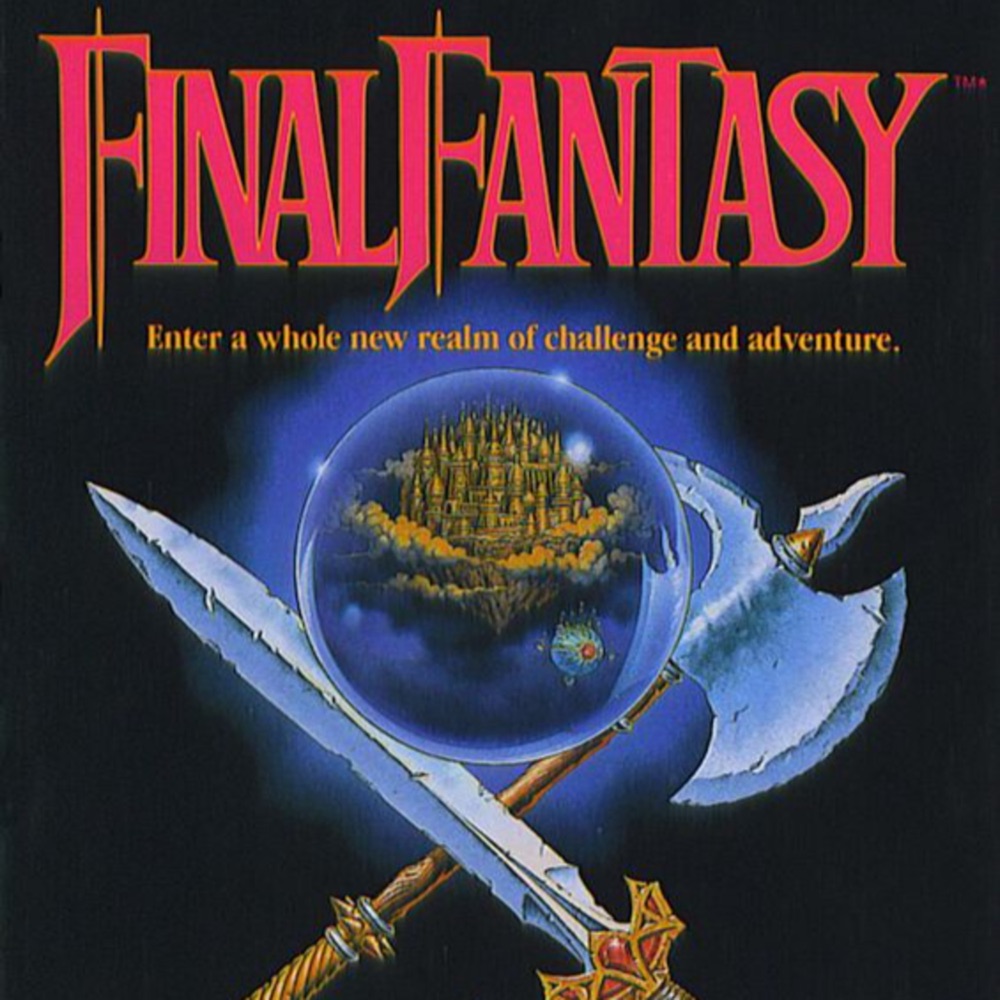
341 · Final Fantasy
The world is veiled in darkness. Winds don't blow, the seas are stormy, and the earth rots. All people can hope for is that the ancient prophecy will be finally fulfilled. "When the world is veiled in darkness, four warriors will come..." And indeed, they come - the four characters you have previously chosen. Their first quest is to free a princess from the evil knight Garland, and then the real journey begins.
This is the only time Final Fantasy gets a regular NEStalgia episode, since Final Fantasy 2 and 3 never came out here. It's a rough, buggy, grindy game with real ambition behind it, and all four of us were glad it exists.
What makes it essential
- You build the party. The first screen asks you to pick four classes from fighter, black belt, thief, white mage, black mage and red mage, with no restrictions. Four fighters is allowed, and so are four black mages. The red mage, which learns both kinds of magic, was the class we found most interesting.
- A real battle system. After Dragon Warrior's lone hero, we finally see the party on screen, swinging swords and casting fire. The menus make sense, and we called it the best turn-based battle system on the NES so far.
- A story that keeps growing. You rescue a princess, the oldest trope on the system, then the king sends you after four crystals, and the Final Fantasy theme rolls over a Star Wars-style scroll. The last dungeon drops you at the Temple of Fiends 2,000 years in the past, and the first boss you beat is the final one. We spent a long time taking the time loop apart and loved it anyway.
- A world that opens up. A ship comes early, after a pirate fight, then a canoe, then an airship with no random encounters and landing anywhere.
- The music. Nobuo Uematsu's ship theme and town theme are cozy enough that we'd leave the game running just to hear them.
- Amano and the D&D look. Dragon Warrior is cartoony; this one is gothic. The party never speaks, so we filled in their stories ourselves.
What doesn't
- Bugs. The were sword and rune sword don't do what they say, the ice sword doesn't hit ice-weak enemies harder, and intelligence does nothing. Spells have three-letter names and no descriptions, and swords show no stats, so we couldn't tell broken from misunderstood.
- Grinding. The only inn is back in the first town, and we ended up underleveled early on. Magic runs on per-level charges, not MP. If two characters target the same enemy and the first kills it, the second swings at empty air.
- Cruel spots. The earth cave, the Astos fight and nine-enemy encounters hurt. The rare Warmech encounter casts Nuke on the whole party 48 percent of the time.
- Menus. Buying 99 heals means going through the purchase 99 times.
Beyond the game
The "Peninsula of Power" is a map glitch that doubles as the best grinding spot, and the Pixel Remaster removed it. We also went through the ports, including the Game Boy Advance version's switch to MP.
The bottom line
Essential. All four of us voted it onto the Essential Games List. Mike called it a classic that anyone exploring the era should play, and Joe said nobody who gets past the quality-of-life problems walks away disappointed. Sean voted yes too, with a caveat: don't play the NES version. The remasters fix the bugs.
Written from our conversation in this episode.
- Introduction
- Brief overview of the significance of the original Final Fantasy on the NES.
- Mention of the key topics to be covered: class system, open world, combat, storyline, random encounters, music, technical achievements, legacy, magic system, NPC interactions, and Easter eggs.
- Class System
- Character Classes: Players choose four characters from six classes.
- Fighter: High HP and strong physical attacks.
- Example: Fighters are critical for absorbing damage in battles against tough enemies like the Earth Fiend, Lich.
- Thief: High agility and evasion.
- Example: Thieves excel in escaping from random encounters, making travel safer.
- Black Belt: Strong unarmed combat.
- Example: Black Belts deal massive damage to bosses like Kraken without expensive equipment.
- White Mage: Healing and protective spells.
- Example: Essential in battles against the Fire Fiend, Kary, for their healing spells.
- Black Mage: Offensive magic.
- Example: Black Mages are key for casting powerful spells like "NUKE" against the final boss, Chaos.
- Red Mage: A hybrid class capable of using both black and white magic and decent in combat.
- Example: Versatile in early-game battles against weaker enemies.
- Fighter: High HP and strong physical attacks.
- Open World Exploration
- Non-linear Progression: Players can explore various locations without a fixed order.
- Exploration: Discovering the town of Crescent Lake and receiving the Canoe to access new areas.
- Dungeons: Finding the hidden Marsh Cave and navigating its mazes to retrieve the Crown.
- Key Towns and Locations
- Corneria (Coneria):
- Significance: The first town the players encounter, serving as the initial hub for equipment, spells, and storyline advancement.
- Story Beats: The journey begins with a mission to rescue Princess Sarah from Garland at the Temple of Fiends.
- Unique Elements: Players can interact with NPCs who provide hints about the world, and it is the starting point for many quests.
- Pravoka:
- Significance: The second town players visit, known for its pirate problem.
- Story Beats: After defeating the pirate Bikke and his crew, players obtain a ship, significantly expanding exploration possibilities.
- Unique Elements: Pravoka introduces players to new spells and weapons, making it a crucial stop for preparing the party.
- Elfheim (Elfland):
- Significance: A town inhabited by elves, facing a crisis with their prince under a sleeping spell.
- Story Beats: Players must find the herb to wake the Elf Prince, which is key to advancing the storyline and obtaining the Mystic Key.
- Unique Elements: Elfheim offers some of the game's most powerful spells early on, and its aesthetic sets it apart from other towns.
- Melmond:
- Significance: A town suffering from the effects of the Earth Fiend, with withered plants and dying earth.
- Story Beats: Players learn about the location of the Earth Cave and the Earth Rod, necessary for progressing deeper into the cave.
- Unique Elements: The visual decay of Melmond reflects the storyline, emphasizing the need to defeat the Earth Fiend, Lich.
- Crescent Lake:
- Significance: A serene town located near a crescent-shaped lake.
- Story Beats: Players meet the Circle of Sages who provide the Canoe, allowing exploration of rivers and access to new areas like the Ice Cave and Gurgu Volcano.
- Unique Elements: The town's layout and the gathering of sages make it a memorable location.
- Gaia:
- Significance: A town with unique architecture and inhabitants.
- Story Beats: Gaia is where players obtain the Oxyale needed to explore the Sunken Shrine, an underwater dungeon.
- Unique Elements: The town is visually distinct and offers rare spells and items.
- Onrac:
- Significance: A coastal town with access to the Sunken Shrine.
- Story Beats: Interaction with NPCs here provides crucial information about the Fiend of Water, Kraken, and the necessary steps to reach the Sunken Shrine.
- Unique Elements: The presence of underwater elements adds diversity to the game's exploration mechanics.
- Lufenia:
- Significance: The ancient town of the Lufenians, key to understanding the history of the Sky People.
- Story Beats: Players receive the Chime, which grants access to the Mirage Tower and eventually the Flying Fortress.
- Unique Elements: Lufenia’s futuristic and mysterious ambiance sets it apart from other towns.
- Unique Exploration Opportunities
- Exploring Ahead of Time: Due to the game's open-world nature, players can sometimes explore areas before they are fully equipped or ready, leading to challenging encounters and potential rewards.
- Example: With the ship obtained from Pravoka, players can sail to various coastal towns, potentially reaching Melmond or Crescent Lake earlier than intended, encountering stronger enemies and tougher dungeons.
- Risks and Rewards: Venturing into areas like the Ice Cave or Gurgu Volcano prematurely can be perilous, but it can also lead to acquiring powerful items and experience points, making subsequent areas easier to handle.
- Dungeons and Hidden Areas
- Marsh Cave:
- Significance: One of the first challenging dungeons.
- Story Beats: Players must navigate its labyrinthine structure to retrieve the Crown for Astos.
- Unique Elements: The cave's dark and ominous atmosphere, coupled with tough enemies, makes it a memorable early-game challenge.
- Earth Cave:
- Significance: The location of the Earth Fiend, Lich.
- Story Beats: Players descend multiple floors, battling through undead enemies to reach and defeat Lich.
- Unique Elements: The increasing difficulty and depth of the cave build a sense of progression and achievement.
- Ice Cave:
- Significance: A critical dungeon for obtaining the Levistone, which is necessary for acquiring the airship.
- Story Beats: The dungeon’s treacherous layout and powerful enemies like the Eye create a significant hurdle.
- Unique Elements: The slippery floors and hidden passages add complexity to navigation.
- Gurgu Volcano:
- Significance: The lair of the Fire Fiend, Kary.
- Story Beats: Players must traverse fiery floors and battle fire-based enemies.
- Unique Elements: The volcano's environmental hazards and the climactic battle against Kary highlight the game's difficulty curve.
- Mirage Tower and Flying Fortress:
- Significance: The final areas leading to the Air Fiend, Tiamat.
- Story Beats: The journey through the Mirage Tower and the advanced technology of the Flying Fortress culminate in a showdown with Tiamat.
- Unique Elements: The shift from ancient ruins to a high-tech fortress provides a dramatic change in scenery and tone.
- Turn-Based Combat
- Unique Strengths of Each Class in Combat
- Fighter
- Strengths: High HP, strong physical attacks, and the ability to equip the best armor and weapons.
- Combat Role: The Fighter serves as the party's tank and primary damage dealer, absorbing damage from enemies and delivering powerful physical attacks.
- Example: Against the Earth Fiend, Lich, Fighters can endure Lich's powerful spells and deal consistent damage, making them invaluable in prolonged battles.
- Thief
- Strengths: High agility and evasion, eventually upgrades to the Ninja class with access to some magic.
- Combat Role: Thieves are excellent for quickly escaping from random encounters, reducing the frequency of battles during exploration. As Ninjas, they gain access to some spells and better equipment.
- Example: In areas with frequent random encounters, Thieves can help the party avoid unnecessary fights, conserving resources for tougher battles.
- Black Belt
- Strengths: Exceptional unarmed combat abilities, increasing damage as they level up without the need for expensive equipment.
- Combat Role: Black Belts (or Masters after class upgrade) deliver massive physical damage, especially against bosses, without requiring investment in weapons.
- Example: Against the Water Fiend, Kraken, Black Belts can deal high damage even with basic equipment, making them cost-effective and powerful.
- White Mage
- Strengths: Healing and protective spells, including "CURE" and "HEAL" spells.
- Combat Role: White Mages (or White Wizards after class upgrade) are essential for keeping the party healthy, curing status ailments, and providing defensive buffs.
- Example: During the battle with the Fire Fiend, Kary, White Mages can use "CUR4" to fully heal party members and "HARM" spells to deal damage to undead minions.
- Black Mage
- Strengths: Offensive magic, including powerful spells like "FIR3," "LIT3," and "NUKE."
- Combat Role: Black Mages (or Black Wizards after class upgrade) excel in dealing elemental damage to multiple enemies and exploiting enemy weaknesses.
- Example: In the final battle against Chaos, Black Mages can cast "NUKE" to inflict significant damage, softening the boss for the rest of the party to finish.
- Red Mage
- Strengths: Versatility in using both black and white magic, and decent physical combat abilities.
- Combat Role: Red Mages (or Red Wizards after class upgrade) are versatile support characters, capable of filling both offensive and defensive roles as needed.
- Example: In early-game battles against weaker enemies, Red Mages can cast offensive spells and still deal respectable physical damage, making them adaptable in various situations.
- Unique Enemies and Strategies
- Ocho (Octopus)
- Strategy: Ochos use poison attacks that can cripple the party. Having a White Mage or antidotes ready is essential.
- Example: In the Marsh Cave, encountering multiple Ochos can be deadly without proper preparation, requiring players to balance offense with timely healing and poison cures.
- Mindflayer
- Strategy: Mindflayers can paralyze party members, disrupting the battle flow. Using items or spells to prevent or cure paralysis is crucial.
- Example: In the Ice Cave, Mindflayers can incapacitate the party, making it vital to defeat them quickly with powerful spells or concentrated physical attacks.
- Sorcerers
- Strategy: Sorcerers have high evasion and can cast instant-death spells. Using spells like "FAST" to increase attack speed and "MUTE" to silence them is effective.
- Example: Encountering Sorcerers in the Earth Cave requires a balance of offense to defeat them quickly and defense to protect against their deadly spells.
- Lich
- Strategy: Lich uses strong ice and death spells. Fire-based spells and high physical damage are effective, while healing and protective spells are necessary to mitigate damage.
- Example: During the fight with Lich, having a balanced party with Fighters for damage absorption, Black Mages for fire spells, and White Mages for healing is key.
- Kraken
- Strategy: Kraken has high physical attack power and can attack multiple times per turn. Buffing the party's defense and using powerful spells to exploit its weaknesses are essential.
- Example: In the Sunken Shrine, preparing with spells like "RUSE" to increase evasion and "FAST" to boost attack speed helps counter Kraken's formidable attacks.
- Balancing Offense and Defense
- Offense: Maximizing damage output through strategic use of spells, physical attacks, and items. Ensuring that characters like Black Mages and Fighters can deal maximum damage during critical moments.
- Example: Using "FAST" to double a Fighter's attack speed against difficult bosses, ensuring that powerful spells like "NUKE" are used at optimal times.
- Defense: Protecting the party from damage and status effects through healing, buffs, and strategic use of items. Ensuring that White Mages and Red Mages can provide consistent healing and protection.
- Example: Using "INVIS" to increase evasion and "CUR4" for full-party healing during prolonged battles, especially in dungeons like the Temple of Fiends.
- Magic System in Final Fantasy I (NES)
- The magic system in Final Fantasy I is integral to gameplay, involving strategic use of spells by different classes. Here’s an in-depth look at how it works:
- Spell Levels and Slots
- Eight Spell Levels: Spells are divided into eight levels, with each level containing four spells.
- Spell Slots: Instead of using MP, characters have a limited number of uses per spell level, replenished by staying at an inn or using specific items.
- Magic Classes
- White Mage
- Role: Healing and support.
- Key Spells:
- Cure Series: Restores HP (CURE, CUR2, CUR3, CUR4).
- Harm Series: Deals damage to undead (HARM, HRM2, HRM3, HRM4).
- Protective Spells: INVIS (increases evasion), AFIR, ALIT, and AICE (protect against fire, lightning, and ice).
- Black Mage
- Role: Offensive magic.
- Key Spells:
- Elemental Spells: FIRE, FIR2, FIR3; LIT, LIT2, LIT3; ICE, ICE2, ICE3.
- Status Effects: SLEP (puts enemies to sleep), LOCK (lowers enemy evasion), BANE (attempts to instantly kill enemies).
- Powerful Offense: NUKE (highest damage spell).
- Red Mage
- Role: Hybrid of white and black magic, with some limitations.
- Key Spells: Can use many spells from both schools but not the highest levels (e.g., CURE, FIRE, and their stronger versions, but not CUR4 or NUKE).
- Black Belt and Fighter
- Role: Primarily physical combat.
- Magic: These classes do not use magic but benefit from magical support.
- Spell Effects on Enemies
- Elemental Weaknesses: Using the correct elemental spell against enemies weak to that element maximizes damage (e.g., LIT spells against aquatic enemies).
- Status Ailments: Spells like SLEP and DARK can disable or debilitate enemies, making battles easier.
- Non-Combat Spells
- Support and Utility:
- HEAL Series (White Mage): Restores HP to the entire party.
- PURE (White Mage): Cures poison status.
- SOFT (White Mage): Cures petrification.
- Exit and Warp (Red Mage/Black Mage): Allows for quick escape from dungeons.
- Acquisition of Spells
- Spell Shops: Found in towns, selling spells appropriate to that town’s progression level.
- Gold Cost: Spells must be purchased, and higher-level spells are more expensive.
- Character Limitations: Each character can learn only three of the four spells per level, requiring strategic choices.
- Strategic Use of Magic
- Balancing Offensive and Defensive Magic: Effective use of offensive spells to deal damage and defensive/support spells to protect and heal the party.
- Resource Management: Deciding when to use powerful spells and conserving spell slots for critical moments.
- Preparation for Boss Fights: Ensuring the party has the right spells for elemental weaknesses and healing needs.
- BOSS FIGHTS
- 1. Garland
- Location: Temple of Fiends
- Abilities: Primarily uses physical attacks.
- Strategy:
- Early Game Preparation: Since Garland is the first boss, ensuring your party is at full health and equipped with the best available gear from Corneria is essential.
- Offensive Approach: Use your Fighter and Thief for physical attacks while your Black Mage casts offensive spells like "FIRE."
- Defensive Approach: Have your White Mage ready to heal any damage taken. Since Garland's attacks are not too powerful, the focus can remain on offense.
- 2. Pirates (Led by Bikke)
- Location: Pravoka
- Abilities: Multiple pirates attack simultaneously, but their attacks are relatively weak.
- Strategy:
- Crowd Control: Use spells like "SLEP" to incapacitate multiple pirates at once.
- Focus Fire: Concentrate attacks on individual pirates to reduce their numbers quickly.
- Healing: Keep an eye on the party’s health, but generally, the pirates should not pose a significant threat.
- 3. Astos
- Location: Western Keep
- Abilities: Casts powerful spells like "RUB" and "FIRE2," which can instantly kill a party member.m
- Strategy:
- Magic Defense: Use "MUTE" to silence Astos and prevent him from casting spells.
- Physical Attacks: Focus on physical attacks from Fighters and Thieves while supporting with healing spells.
- Revival Items: Keep "PURE" potions and revival items ready, as Astos' spells can cause status effects and instant death.
- 4. Vampire
- Location: Earth Cave
- Abilities: Uses physical attacks and drains health with each hit.
- Strategy:
- Holy Magic: Use "HRM2" or "HRM3" from your White Mage to deal significant damage.
- Healing: Maintain high health levels to counteract the Vampire's draining attacks.
- Offensive Spells: Black Mages should use spells like "FIR2" to inflict heavy damage.
- 5. Lich (Earth Fiend)
- Location: Earth Cave
- Abilities: Uses powerful spells like "ICE2" and "NUKE."
- Strategy:
- Fire Spells: Exploit Lich's weakness to fire by using spells like "FIR3."
- Defensive Buffs: Use "INVIS" and "PROTECT" to mitigate damage from Lich's spells.
- Healing and Status Recovery: Keep your White Mage focused on healing and removing any status effects.
- 6. Kary (Fire Fiend)
- Location: Gurgu Volcano
- Abilities: Uses fire-based spells and physical attacks.
- Strategy:
- Ice Spells: Exploit Kary's weakness to ice with spells like "ICE2" or "ICE3."
- Physical Attacks: Strong physical attackers like Fighters and Black Belts should focus on dealing consistent damage.
- Fire Resistance: Equip items or cast spells that reduce fire damage, and keep healing spells ready.
- 7. Kraken (Water Fiend)
- Location: Sunken Shrine
- Abilities: Uses powerful physical attacks and water-based spells.
- Strategy:
- Lightning Spells: Exploit Kraken's weakness to lightning with spells like "LIT3."
- High Defense: Use "RUSE" to increase evasion and "PROTECT" to bolster defense.
- Healing: Regularly heal party members to counter Kraken's powerful attacks.
- 8. Tiamat (Air Fiend)
- Location: Flying Fortress
- Abilities: Uses a variety of elemental spells and multi-target attacks.
- Strategy:
- Balanced Attack: Use a mix of physical attacks and spells to counter Tiamat's varied resistances.
- Buffs and Debuffs: Use spells like "SABR" to increase your attack power and "SLOW" to reduce Tiamat's number of attacks.
- Elemental Resistance: Equip items that reduce elemental damage and keep healing spells ready.
- 9. Chaos
- Location: Temple of Fiends Revisited
- Abilities: Uses a wide range of powerful spells, including "CUR4" to heal himself and "NUKE" for massive damage.
- Strategy:
- Long Battle Preparation: Prepare for a lengthy battle with plenty of healing items and spells.
- Debuff Chaos: Use spells like "SLOW" to reduce Chaos's attack frequency.
- Maximize Damage: Use your strongest spells and attacks. Spells like "FAST" to double a Fighter's attack speed and "NUKE" from a Black Mage are crucial.
- Healing Priority: Constantly monitor and heal the party to keep everyone alive, as Chaos's spells can be devastating.
- Warmech Summary:
- Location: Found on the bridge leading to Tiamat in the Flying Fortress.
- Encounter Rate: Very low, making it a rare and unexpected encounter.
- Abilities:
- Uses "NUKE," a powerful spell that can devastate the party.
- Strong physical attacks.
- Difficulty: Considered one of the toughest enemies in the game.
- Strategy:
- Be well-prepared with high levels and the best equipment.
- Use defensive buffs and strong healing spells.
- Employ powerful offensive magic and physical attacks to defeat it quickly.
- Epic Storyline
- Narrative: The journey to restore the power of the four elemental orbs.
- Quest Progression: After defeating each Fiend, players see the corresponding orb light up, showing tangible progress.
- Time Loop: The revelation that Garland is the mastermind behind the time loop adds a complex twist to the story.
- Random Encounters and Grinding
- Frequent Battles: Players often face random encounters while traveling.
- Grinding: Leveling up in the Ice Cave to prepare for the challenges in the Temple of Fiends.
- Resource Management: Conserving spells and healing items during long dungeon crawls like in the Mirage Tower.
- Not being able to attack the next enemy because the enemy you selected is now dead
- Music and Sound Design
- Iconic Themes: Nobuo Uematsu's compositions have become legendary.
- Opening Theme: The introductory music sets a heroic tone for the adventure.
- Battle Theme: The dynamic and intense battle music enhances the excitement of combat.
- Technical Achievements
- Graphics and Animation: Detailed sprites and environments for the time.
- World Map: The large, interconnected world map is impressive for the NES hardware.
- Battle Animations: Unique spell effects like "FIR3" and "LIT3" showcase advanced graphical capabilities.
- BUGS
- Were Sword - Does not inflict more damage on Were-creatures.
- Rune Sword - Does not inflict more damage on magic-using or supernatural creatures.
- Dragon Sword - Does not inflict more damage on Dragon and dragon-kin creatures.
- Coral Sword - Does not inflict more damage on sea creatures.
- Giant Sword - Does not inflict more damage on Giants/Ogres or their kin.
- Flame Sword - Does not inflict more damage on Fire-weak, undead, or regenerative creatures.
- Ice Sword - Does not inflict more damage on Ice-weak creatures.
- Sun Sword - Does not inflict more damage on undead creatures.
- Light Axe - Does not inflict more damage on undead creatures.
- Xcaliber - Does not inflict more damage on every creature-type and elemental weakness.
- Legacy and Influence
- Impact on RPGs: Set standards for future RPGs in storytelling, mechanics, and world-building.
- Success: Final Fantasy's success saved Square from bankruptcy and established the company as a major player.
- Series Continuation: Elements from the original game, like the class system and certain spells, continue to appear in later Final Fantasy games.
- NPC Interaction and Clue-Gathering
- Critical Information: Talking to NPCs provides hints and directions.
- Quest Clues: An NPC in Elfheim gives crucial information about the Mystic Key needed to progress.
- Hidden Items: NPCs in Melmond provide hints about the location of the Earth Rod needed to access the deeper parts of the Earth Cave.
- NES CENSORSHIP
- Crosses removed
- Churchs are now clinics
- Last level is a triangle instead of a hexagram
- Medusa wears a top
- Spell names are a little strange cause of a 4 character limit
- Technical Limitations and Hardware Transition:
- When Final Fantasy II was released in Japan in 1988, the NES was reaching the end of its lifecycle in the U.S. Final Fantasy II utilized more advanced technology that would have required significant localization efforts, particularly with text storage and memory, which were constrained on the NES (Wikipedia).
- By the time Final Fantasy III was released in 1990, the Super Nintendo Entertainment System (SNES) was about to launch in the U.S., making it financially and logistically impractical for Square to localize and release an NES game on older hardware (The Final Fantasy).
- Market Uncertainty:
- The American market for RPGs was relatively small and untested during the late 1980s and early 1990s. After the success of the original Final Fantasy in the U.S., Square was cautious about the profitability of releasing the sequels, especially given the mixed reception and market conditions (Wikipedia).
- Resource Allocation:
- Square was already heavily invested in the development of Final Fantasy IV for the SNES, which they saw as a better opportunity for success in the U.S. market. Allocating resources to localize and promote Final Fantasy II and Final Fantasy III on the NES, when the company was focused on the new console generation, was deemed inefficient (The Final Fantasy).
- MSX2 (1989)
- Enhanced Graphics: Improved color palette and sound but slower gameplay.
- WonderSwan Color (2000)
- Graphical Overhaul: Enhanced sprites and backgrounds; expanded dialogue.
- PlayStation (2002)
- Final Fantasy Origins: Added FMVs, rebalanced difficulty, and new bestiary.
- Game Boy Advance (2004)
- Dawn of Souls: Included 4 new dungeons, easier difficulty, and MP system
- PSP (2007)
- High-Resolution Graphics: Enhanced visuals, additional dungeons, and music remaster.
- Mobile Versions (2004–2016)
- Simplified Interface: Touch controls, auto-battle feature, and further graphical updates.
- NES Classic Edition (2016)
- Emulated Original: Faithful recreation of the original NES experience.
- Pixel Remaster (2021)
- Modernized Visuals: Updated pixel art, orchestral music, and quality-of-life improvements. NO PENINSULA OF POWER
- Conclusion
- Recap of the unique features and hidden gems of the original Final Fantasy.
- Invitation to listeners to share their own experiences and favorite moments from the game.
- Tease for the next episode
Found automatically from the transcript and checked, but it can miss things or pick the wrong page. Spot a mistake? Tell us.
Games
- Final Fantasy mentioned at
The episode's game: Square's 1987 JRPG, released in North America in 1990, with a party of four chosen classes.
- Final Fantasy XVI mentioned at
The newest mainline entry, credited with returning the series to prestige.
- Final Fantasy VII Remake mentioned at
The remake series that, with FFXVI, helped restore the franchise's standing.
- Final Fantasy XV mentioned at
Entry hoped to be a return to form, with four friends traveling by car.
- Final Fantasy VII mentioned at
The 1997 PlayStation game that introduced two of the hosts to the series.
- Final Fantasy VIII mentioned at
The PlayStation game one host played for years, with a train mission and a tough boss.
- Final Fantasy VI mentioned at
Super Nintendo entry, played after Final Fantasy VII.
- Final Fantasy IX mentioned at
The PlayStation entry that dropped much of the sci-fi look.
- Final Fantasy X mentioned at
PlayStation 2 entry with a linear map and no overworld.
- Final Fantasy XI mentioned at
The online entry one host skipped.
- Final Fantasy XII mentioned at
Entry with the Gambit system, often defended as a hidden gem.
- Super Smash Bros. Melee mentioned at
GameCube game whose trophies sparked one host's interest in retro games.
- Quest 64 mentioned at
N64 RPG that was one host's first, and a poor introduction to turn-based games.
- Final Fantasy IV mentioned at
Super Nintendo game, released in North America as Final Fantasy II, that hooked one host on the series.
- Dragon Warrior mentioned at
The earlier NES RPG with a single hero, compared to Final Fantasy's party.
- Fax (Faxanadu) mentioned at
A previous Essential-list NES action RPG, which one host used as a party member name.
- Mike Tyson's Punch-Out!! mentioned at
NES boxing game one host named a black belt party member after (Taiso).
- Archon mentioned at
Game one host named a black mage after.
- Rygar mentioned at
NES game one host named a white mage after.
- Adventures in the Magic Kingdom mentioned at
The earlier NES Disney game, compared to the town and castle layout in Corneria.
- Earthbound mentioned at
Super Nintendo RPG whose battles don't show your characters.
- Pokémon Red and Blue mentioned at
Games with known stat bugs, like attacks that can miss at 100 percent accuracy.
- Star Fox mentioned at
Game whose first planet, Corneria, shares a name with Final Fantasy's first town.
- Nobunaga's Ambition mentioned at
Strategy series compared to Final Fantasy's hidden stats.
- Final Fantasy: Stranger of Paradise mentioned at
Action RPG prequel that retells the Chaos story with Jack Garland.
- Chrono Trigger mentioned at
Super Nintendo RPG used as an example of a good final-boss reveal and ports with new dungeons.
- Final Fantasy Pixel Remaster mentioned at
The remaster with auto-battle, encounter toggles and no Peninsula of Power.
Hardware
- PlayStation mentioned at
Sony's console, on which a Final Fantasy VII demo disc was a first exposure to the series.
Companies
- Square mentioned at
The developer of Final Fantasy, rumored to have named the game because it was their last attempt.
People
- Yoshitaka Amano mentioned at
Final Fantasy's illustrator, whose gothic art contrasts with Dragon Warrior's cartoon style.
- Akira Toriyama mentioned at
Dragon Ball creator who drew Dragon Warrior's characters.
- Tetsuya Nomura mentioned at
Final Fantasy and Kingdom Hearts designer, who reportedly wanted Final Fantasy XV to be a musical.
- Nobuo Uematsu mentioned at
The composer of Final Fantasy's music, praised throughout the episode.
Film, TV and music
- Final Fantasy: The Spirits Within mentioned at
Square's 2001 CG film that nearly sank the company.
Terms and events
- Distant Worlds: Music from Final Fantasy mentioned at
Live orchestral concert series of Final Fantasy music.
Other
- Fighting Fantasy mentioned at
The title the creators reportedly considered, which became Final Fantasy.
- Kingdom Hearts mentioned at
Square Enix series that connects to Final Fantasy VIII, with its time loop and Disney crossover jokes.
- Dungeons & Dragons mentioned at
Tabletop RPG whose bestiary and rules heavily influenced Final Fantasy.
- The Black Mages mentioned at
Rock band led by Uematsu that arranges Final Fantasy music.
- NEStalgia Essential Games List mentioned at
The show's list of NES games that define the system; Final Fantasy was just voted in.
Auto-generated transcript. Each paragraph starts with its timestamp. Speakers are not identified.
Final Fantasy, Dragons and Broadswords, Mystery and Adventure, Final Fantasy has them all.
NOSTALGIA And welcome to NEStalgia, a chronological exploration of every NES game released in North America. I'm Mike. I'm Sean. And I'm Joe. NOSTALGIA The day has come. Destiny has arrived. It is not our final fantasy. It's not even the final, final fantasy we'll even play in our lifetimes.
But there is something we need to get out of the way real fast. And that is the rumor that has been spreading for nearly, what, 30 plus years now about Final Fantasy. NOSTALGIA And its meaning for either the creators or developer square at the time. NOSTALGIA That's what we're leading with? NOSTALGIA There is a belief. NOSTALGIA Yeah, we talked about this. There is a belief that I just, I feel like it needs to be cleared up. And that, that is the origin of Final Fantasy itself, right? NOSTALGIA The origin of all things.
NOSTALGIA I don't know why. I don't know how the Japanese language works. But they liked the idea of alliteration with two Fs. And they were trying to do fighting fantasy. Which is definitely weaker than Final Fantasy. I don't know if fighting fantasy, like fighting fantasy works for one game. I don't think anybody's looking for fighting fantasy 2, unless it's like a brawler. NOSTALGIA It's funny because, realistically, Final Fantasy should be the one that only works for one game. Because of the word final.
NOSTALGIA But Final Fantasy is like an epic, like, accident. In the sense of like, it truly does bring on this idea where, obviously this rumor would have started from. The idea that like, Square was so down on their luck that this was going to be their last game. They would close the studios. So they just had one Final Fantasy.
But it also like, those words are great for, you know, myths and legends. And the kinds of stuff that you deal with in the game Final Fantasy. Where I don't think fighting fantasy conveys anything other than maybe the combat system. You know, like there's so much more to this game than that. I completely agree. I mean, Final Fantasy, in my opinion, is the perfect name. But, yeah, I think that my issue with fighting fantasy is more that it doesn't give me the vibe of like the combat system. It makes me think of a fighting game. It makes me think it's like a fantasy version of Street Fighter or something. I also think we're trained by decades of knowing Final Fantasy to think that. But I also agree that, you know, it does roll off the tongue better.
But I think if it was fighting fantasy and Final Fantasy 8 came out, I think we would still be like, oh, I can't think of it being called something else. Like, I don't know. Well, yeah, yeah. I mean, totally because we are trained by recognition. But just something about the word Final Fantasy, like it doesn't mean anything. And that's why it's so cool. Because it's like Final Fantasy. It's like almost got this air of mystery to it. We're like, why is it the Final Fantasy? It's like, this is the end all fantasy story. I know that's not what they're going for. But perfect. Financial fantasy right now. It's closer to final. It's the F-I-N-F-I-N thing. Yes. That was Wall Street, kid.
It's fun that the Final Fantasy thing is the only thing that's not final about the franchise, right? Like, no matter what, there's always more Final Fantasy on the horizon. Even now, we are up to 16, probably going to get 17 in the near future.
Don't never say never to this franchise. I think that's like, what's interesting is that what should be, oh, Final Fantasy, like the last one. It's like, no, it just keeps going. And it's definitely one of the premier video game franchises in a, if it was a stock, you would see a very shaky chart, right? Like, it kind of falls in and out of favor from time to time. But I do think Final Fantasy 16 and the seven remakes have put Final Fantasy back into like, some of its highest territories ever. Would you guys agree with that? Yeah, it's prestige again.
Yeah, yeah. I think that, honestly, I think there was really only like, since it got, since it became prestige, I think there was really like, just like one long dark era. What's the dark era? 11 to 15. I'd say, yeah, 12 being like a bright, supposedly, I've never played it, like a bright gem in the dark era. But like, yeah, I completely agree.
Yeah, I could see that, especially because I think 15 was one that a lot of people were banking on as, you know, like a return to form. And like, you know, oh, we're back to these four, you know, just these four bros hanging out, you know, in a car. And it's going to be something like, you know, the four bros that you have in Final Fantasy one. Hanging out in the car. Well, no car, but I mean, hey, there's some pretty cool vehicles in this game, you'll have to give them credit for that.
But, you know, it didn't quite deliver. And while we're on the, you know, subject of origins of Final Fantasy, I would love to hear your guys origin story with Final Fantasy. It is something that none of us played Final Fantasy one as our first game, or even necessarily our second game, right? So, Joe, where were you, where and how were you introduced to Final Fantasy? It's hard to say exactly like when, but I know it was after I got my PS1, I had a demo disc with Final Fantasy seven on it.
And I had never played a, like a JRPG before. So, like, just the idea of these, this like stat turn-based system where it's not about like the action, it's about the strategy and it's about the, this story with, it felt so adult to me.
That really like held a major allure to me. I thought that was so cool and I was so fascinated by the story. And I played like the opening bombing mission of Final Fantasy seven a lot as a kid, you know, like I didn't know what was really going on. And I, you know, never even really knew what the full game was like. Um, and it wasn't until I was in fourth grade and a friend of mine came over and he brought Final Fantasy eight and we played, oddly enough, another train mission from disc one of Final Fantasy eight. And I was hooked on that. And like the literally the next day I begged my parents to take me to wherever media play or wherever I went and I got Final Fantasy eight.
And I, I've told this story so many times on the, uh, on the podcast, but played Final Fantasy eight for like, for like eight years, getting stuck on different things, not really understand what I was doing. And then finally, like when I was a junior in high school, I was like, I've been playing this for so long and I am doing so bad. I'm going to start over. And I started over and then beat it in like a week. But like same save file the whole time. Yeah. I was, I would play, like I played up until, I mean, Sean, you're familiar. I played up until disc two when there's the, um, the, the missile base mission and I got stuck on a boss there. And I was stuck on that boss for like three and a half years.
Like I would just come back to it every couple of months and like, can I beat it now? Nope. And then, um, cause I didn't really know how to play, you know? Yeah. And then when I got older, then I played it and I disagree. I think it's a great, I think it's, once you learn how to play, it's a great, great system. No, I agree. I'm sure we'll talk about that later. But, um, but yeah, so Final Fantasy eight was like in the zeitgeist of my childhood, just always like those characters were always there. That's what got me into Kingdom Hearts.
That's what got me, um, into other games. I eventually played seven and then I went back and played six and I recently played nine and I've played. Four and one and everything. And I, I, I, I love the series because of that. Yeah. I mean, similar to Joe, Final Fantasy seven was my first exposure. It was more so like, uh, my stepbrother was like, Oh, I got this game. It's supposed to be the best game ever. And then we were kind of like taking it back at like how weird it looked. Uh, and then we sort of watched him play for a while. And then I started my own save when he wasn't looking and yada, yada.
Um, then moved on to eight, then mostly skip nine because it got rid of all like the, the sci-fi stuff. And that's sort of what like drew me to it. Um, came back with 10, uh, didn't really care for online stuff. So skipped 11, 12. I played and fell out of very quickly. And then I just sort of like, you know, uh, I, I hibernated for a while and some say that that hibernation never really ended. Uh, but some say it's a legend, uh, until, until seven remake. And I, I played like, I think my first exposure to final fantasy one was I was, uh, I rented for a weekend, the PlayStation one, uh, re-release with the, uh, new fangled FMVs, yada, yada. Final fantasy origins.
Yes. I grabbed that and was not prepared for how much of a technological step back it was. Um, but you know, I think I played through the first island or maybe got to the boss of the first island was just like, huh, maybe this isn't for me. And again, this was, I don't even know what year that came out. It was probably like 11 or 12. Uh, maybe. Yeah. Something like that. But I played, yeah. FF7, 1998.
Kind of just stuck with that as my, as my identity for a while. So, and I think I've told a version of this story somewhere, so I'll abbreviate it, but I started getting interested in retro gaming much earlier than like I was playing video games for in a weird way. Like Super Smash Brothers Melee with its trophies and, you know, weird, like this is the first appearance of this character. Like really got me into the idea of playing these older games and that there was like a history to franchises and stuff. So before I even had like a Wii, I was going backwards and being like, well, I got to get a Super Nintendo. I got to get an NES. So I was like this weird 12 year old who was like asking my mom on eBay to like buy me old consoles and stuff.
So, uh, I, I didn't really like play modern Final Fantasy when it came out, but I also didn't play like the old Final Fantasy games too far from their like original release when you actually think about it. What wound up happening for me though is turn-based RPGs for whatever reason eluded me when I was a, when I was a kid, like other than Pokemon, I wasn't that interested in them. And I think I had tried a few, uh, I know my first ever was Quest 64 and that's a terrible game. So it was just like a bad introduction, but like, I didn't really feel like I fully grasped the concept or whatever.
So as I started getting more into retro gaming, I knew about the prolific Final Fantasy franchise, but I didn't think of Final Fantasy as the 3D entries of 7, 8, 9. Like I didn't even think about those games when, when like I tried to picture Final Fantasy in my head. It was the images of like 1, 4, and 6. Like that's what I thought was like, oh, I got to go experience that stuff. Not, I got to go experience the bombing mission in Final Fantasy 7. So my first entry was Final Fantasy 4, what we know is, or what we knew at the time is Final Fantasy 2 on the Super Nintendo.
And that game immediately like hooked me just from a, just from a story point. Like to Joe, to Joe's thing, it was like, we played video games that are before that do all sorts of different stuff, but it never had something that felt so like, you know, oh, this is like a movie. Like this is, you know, it takes like the next narrative step in video games. And it's weird to say that as somebody who was playing them in my teenage years, because I should have been exposed to more narrative driven games, but I was mostly playing sports games, platformers, party games, racing games. I wasn't really looking for these epic stories until after my introduction to Final Fantasy 4.
So I have Final Fantasy 4 to thank for that. And that got me hooked on immediately trying all the other Final Fantasy entries. And I have not played them all, not even close to them all. Actually, it's, it's weird. It's like everybody has their own numbers. And I feel like very rarely do you get somebody who's like, yeah, I played all of them. Like there are people who love Final Fantasy, but probably like never touched. And then they insert like three numbers that you'll be like, that's crazy. How did you not play that one? Like that just happens. Yeah. But we're here to talk about Final Fantasy 1.
And, you know, rather than do any sort of deep historical, you know, look into the franchise of how it started or talk about who worked on it and the coding and everything. I feel like that's a different podcast. And I think we should just start to get into the actual game. And there's no better way than to start a file of this game and get into the character creation. The class system and the party you make is the immediate answer to, well, how is this different than Dragon Warrior, right? In Dragon Warrior, you're one character taking on, you know, enemies one at a time as you progress as a single entity.
In Final Fantasy, you're a party of four. Now, that's not unheard of on the NES. We have played since Dragon Warrior other RPGs that, you know, are mostly ports of PC games. So maybe they're a little wonky when they get brought down to the NES or they're a little too large in scope. Or they try to do this pseudo 3D thing that doesn't really work. So we've seen examples, but we haven't been sold yet.
Final Fantasy immediately tells you you are a party of four and that you're not locked into any particular classes. If you want to make four fighters, go for it. If you want to be all magic users, go for that too. If you want to be four white mages, I don't know if it's possible to beat the game, but you can certainly give it a try. The game gives you that freedom from the start. And so I would love to hear what your guys' parties were, but then also, you know, a couple thoughts on the class system. I'm going to jump right in here and say, you know, coming from the future, and this will always be our perspective, coming from the future,
it's a little jarring that the first thing that you really see in this game is create your party. And that's not even just because the feature doesn't really stick with the series for that much longer. It's just because I'm used to, and I think we're all, or Joe and I, are used to very specific, story-driven, character-driven gameplay here, where you may get to change the character's name, but the way that they interact with the world, like, that's their character.
And so seven, eight, nine, ten, yada yada. Four does it as well. Four, five, six, two, I believe. I mean, two, it doesn't, doesn't three even have set characters? Isn't every Final Fantasy after this until the, until the MMOs have this? Yeah, set characters, yes. But you can change, you can choose classes and other ones where, like, theoretically, because of Final Fantasy VII's, like, stats for each character, there is, like, an intended role, right? Like, you don't get to say, like, and I'm going to build Cloud to be a mage, right? Like, it's like, he's just, he's just Cloud.
Yeah. Right. So it's weird going into this and not, like, and not seeing, like, a, a very written story where your characters are characters and more so RPG characters. Um, so that, that was cool. That was, I'm fine with that. I'm opening my mind. So I go in there and I see a bunch of, I see a bunch of sprites that are very familiar to me just from, you know, culture through osmosis because I, again, I didn't play too much of Final Fantasy I when I rented that Origins disc and I really didn't touch it since. Um, so this is as blind of a playthrough as you're going to get.
Um, but, you know, I, so I went with a fighter because, you know, he's the first one that shows up and you have to imagine he's going to deal some good damage. Um, and then I went with a, uh, I went with a monk or I guess a black belt, uh, because I did a little bit of research and learned that thieves were broken. Um, and then I went with a black mage because Vivi and a white mage because you gotta have a healer. And, uh, I know that, you know, going back, I kind of wish that I, I put a red mage in there instead of a black mage because of firstly the drip.
Um, and secondly, because apparently they're just mostly better than the black mage. So there are some regrets, but that, that was my, that was my, uh, setup. Interesting. See, so I, I didn't do enough research to go to decide if red mage or black mage is better, but, um, well, I'll get into what I did.
So my first experience with this actually was years ago, probably end of high school or beginning of college for me. I played Final Fantasy one on the PSP, um, where there's a lot of quality of life improvements. So I already had beaten this game. I was already familiar with it. It's been a long time, so I forgot a lot, but I had a lot of the same thoughts that you're talking about, Sean, back then where I was like, well, I was expecting like deep character driven stories.
And there's really not that here. There's, there's a, for the time, there's a pretty deep story, but it's, it's, it's the silent protagonist story. You know, there's no, oh my God, what's my fighter thinking right now? Cause he's just a stand in for you. Pretty literally a stand in for you, but we'll get into that another time, I guess. But, um, so I originally on the PSP, if I remember correctly, I definitely had a fighter. I definitely had a thief and I definitely had a white mage.
I, oh no, I'm sorry. I definitely had a red mage. I can't remember if I had a white mage or a black mage. I gotta say I must've had a white mage cause I wouldn't have gone without a healer, even though your red mage can be a healer. So actually I might've had the black mage and the red mage. Um, I don't remember exactly like what my thoughts would have been on that party, but just to get that out there, that was my original first party. It's my first hall of fame party. This time, uh, I, I went with a fighter named Fax in honor of Fexanadu. Uh-huh. I went with a black belt named Taiso in honor of Mike Tyson's punch out, uh, a black mage named Ark in honor of Archon and a white mage named Ryga in honor of Rygar.
And, uh, I, I will say that, again, don't, not remembering too much about the PSP stuff. I was surprised that like, it does give you, it does give you different ways to play the game. I imagine, you know, I'm imagining like if I didn't have the fighter and black belt combination, like there might be things differently. Or if I didn't have a black mage at all, like, you know, there's, the way you think about the game must be different. Now granted, compared to other Final Fantasies and stuff, like, this is obviously a much more basic strategy system.
But, uh, but I, I guess I was expecting it to be really basic. And it was a little more robust based on the party layout alone than I was expecting. My party was, uh, fighter, white mage, black mage, red mage. And if you can't tell, it's just because I love magic. Um, should I have had a black belt? Yeah, apparently they're also like uber ridiculous.
Uh, so maybe. But, uh, I, I liked my party. Uh, I would also love to get into how our parties fared throughout the game as we continue to explore. Because that is, that is like the ultimate freedom of this game is that it, it does allow you to just pick even just four of the same character classes too. I, I, I think that that's kind of unexpected for the time that you could be like, yeah, and we're just four black mages. And we're just gonna wing that, right? Like, the game gives you the freedom to screw up in a way where it's like, yeah, you'll probably, you'll probably get somewhere, right? Like, I, I don't think four black mages would suck at the beginning of the game, but it might suck at certain points later on.
Uh, the best balance is probably at least having someone who can cast some form of healing and someone who can cast some form of, uh, you know, the offensive magic. And I, I think that each class, whether you're the fighter with the strong physical attacks and high HP or, uh, the black belt who, for whatever reason, uh, you know, don't, don't equip anything on him. And he only gets stronger from there on out. Don't, don't give him any kind of weapon.
Uh, the thief with high agility and evasion, the white mage for all sorts of protective spells, the black mage for offensive spells. And then the red mage is this hybrid of, like, able to learn black and white magic. But as a result, in combat, it's not necessarily as effective as either the white mage or a black mage may be at its particular spells.
I, I think the red mage is, is the most interesting. But stronger physically, too. Yes, yeah. But, but the red mage, to me, is the most interesting of the classes because it is the hybrid class.
Uh, it was the most intriguing for me. It was the one that I actually did say, like, okay, I'm going to make sure that when I'm assigning level one, level two, level three spells to my red mage, that he is going to have that mix of black and white magic and put him at the bottom of my party. So this way, you know, if anything should happen, at least he might be protected to be ready to either go on the offense or, uh, you know, protect another, another party member. Or, I, I really enjoyed the red mage class specifically. Were there any other, um, you know, highlights or, or, uh, not so highlights of these classes? Ones that, uh, maybe confused you for their purpose?
Well, I, I am sure that the red, again, it's been a long time since I've used the red mage, but I'm sure he does a similar thing with its, like, level three spells. But, uh, I found the black mage very good for grinding, because you can, you run into a horde of, you know, whatever, 16 enemies, and you can use, uh, higher level, level three and above offensive magic to hit everybody. Area of effect hits, you know, like, are basically very good for black mage. So, like, that was very helpful just when I'm out in the field, you know, just, just ready to fight anyone. That was helpful for leveling up the whole party.
Yeah, I think, uh, to, I, you kind of have to get a little bit into the details of the, of the battle system, which I'm sure we'll, we'll do more of later. Later, but, I, I think my, my lowlights for all the mages is just the magic system.
Um, where you don't have, like, an MP, and you don't really have, like, the equivalent of a, of an ether that, that's, like, just dropping here and there. Um, you have charges, and unless you're just sort of circling a town, just grinding, um, like, say you find yourself deep in a dungeon, uh, those charges can run out real quick. Um, so, I, I think that that turned, turned me off to most of the magic. I mean, I still used it, because you have to, um, but in terms of how satisfying it was, it was like, oh, I really don't want to use this, because I don't want to burn a charge on something that might not even hit, you know?
I hear what you're saying, yeah, yeah, that, that, that was definitely, um, aggravating at times. But, but, to play the Devil's Advocate, I did sort of, I, I sort of liked that, the, the no MP, that each, basically each spell has its own MP or its own charges, because that did make me, yeah, like, I'm not going to use my high-level magic on this random thing when I'm in a dungeon. I'm going to wait for the boss, or, you know, use it when I feel like I need to. And then when I did use it, it was, I did get a little satisfaction, because I'm like, well, yeah, that's not something I can do all the time. You know, that's like, I, I, I went for a high-level attack here, where I couldn't have, or I, you know, I was saving that for this guy.
I, I, I mean, I, I see it both ways, but, like, I, I, that's one thing I like about the Final Fantasy series, is that every, you know, every battle system is always different, and this made me think differently than I do in other Final Fantasy games.
So after you pick your characters, the game starts, and you are, uh, literally dropped into the overworld, uh, you're not, like, talking to the king, and he's explaining your mission. You are just free to roam, uh, the battlefield, if you will. However, you don't have any equipment just yet, so you might not want to explore too far. Uh, it, that might be a push in a weird direction, but it can certainly happen that someone would think, oh, I'm not gonna go see that town directly in front of me, I'm gonna just go explore.
Obviously, they do put a giant castle and, uh, a small set of, uh, houses, uh, around that castle. It was interesting that when you walk into this area, nothing happens, but then when you walk into a particular house, that just takes you to the, uh, the town as a whole. Well, it's the Magic Kingdom, right?
Yeah, but walking, yeah, it does look like that a little bit, right? You're walking down Main Street, right, up to Cinderella's Castle, but you walk into the castle. See, it's Kingdom Hearts before Kingdom Hearts. It's Disney and Final Fantasy combined. No, it was, uh, it's, uh, uh, the Disney, the Disney game we played, where it's literally the Magic Kingdom. Oh, yes, Adventures in the Magic Kingdom. Yeah, yeah, yeah. But there's no Final Fantasy in that. True, true. That you know of.
True. I didn't play it. But, yeah, so, uh, you know, just an interesting observation on the world map and how it works that, uh, you know, the various little houses will just bring you to the same town. The castle, of course, bringing you to the king, uh, where you can learn about your mission, or just not. Like, it's up to, I guess it's up to the player, right? Like, I, I naturally had to go to the castle and talk, but I guess you don't, it's not a necessary requirement.
Uh, but it is a requirement to go into the town and talk to the townspeople and, you know, load up on your first equipment with the small amount of gill you have. And, again, it's a small amount of gill. There is a way to screw even this part up very early on, right? Like, for people whose first time it is. Yeah, this game is soft-lock the game, pretty much.
But if you have, I say that in half and jest. But if you, maybe people don't have it internalized yet, but we've already seen, like, Dragon Warrior. We've seen, uh, we've seen these 8-bit RPGs. Like, there is some, like, amount of instinct to, like, okay, go to town, go talk to the king, uh, go to the dungeon, uh, come back to the king once you clear the dungeon. And I, I appreciate that, like, they kind of put you in a little, in a little pen. You're kind of on a tutorial island here, and you, you're not gonna get that far without learning how the game works.
But, of course, we powered on, and we did, uh, equip the right stuff. Uh, you know, we don't have to get into every time what we do, and, you know, did we, did we try to buy everybody just the weapons and move on? Did we, did we go for the armor stuff? Did we buy some magic? That stuff can all be divvied out in time by just grinding out, uh, right in front, uh, of the towns. This way you're never too far away from an inn, and eventually you'll just be able to move on.
But I want to go back to what Joe was taught, was maybe dropping earlier, about that these guys really are just, like, stand-ins. You know, they're, you know, they're not, uh, they don't play a role in the story necessarily, other than the fact that they are the four warriors of light who were one day, like, predicted that they, you know, a prophecy was told that they would come and, uh, you know, and basically save the world, right? Right. But it, it really is, like, they just drop into the story.
Like, there's no explanation for, like, where they came from. They just show up in the grasslands. You have to come up, you have to fill up all the gaps of the party. The, the, the, the world is alive, the townspeople will tell you things, but your party is faceless.
Yeah, it's all, it all, as far as your party, for me, it all comes down to your imagination. Like, that's, that's what it is. And I will say, like, I, I do have little, like, stories in my head of, like, how these characters get along and what they're each like, because I need, I need that when I play a Final Fantasy game. But yeah, it's not, it's not there for you at all. Yeah, maybe I don't have the same level of, uh, of imagination as you guys, because I just took that as, like, oh, it's an old game. They didn't really care.
Yeah, they probably didn't. Yeah, I mean, I don't think, yeah, I think that, that's me doing the work for them. But I do it anyways. But I would have a problem with the idea of just, like, you know, four beings were teleported to, to this entrance. Like, I don't need to know. Please, never create any kind of Final Fantasy 1 prequel on PS5. We would hate to see that. Uh, but, but, I don't need the explanation.
Has anyone even looked at that? I, I remember hearing about that. We just have to kill Chaos. Ignored it forever. Yeah, that's all he wants to do is just kill Chaos, Joe. That's, that's what it's all about. No, I know, it's, I am obviously talking about that game. But, uh, let, let's not, let's not deviate too far because we can wind up talking about a lot of Final Fantasy games as we keep going on.
I don't need a backstory. I agree with Joe. I like to just kind of create my own story. Uh, but, you know, it's the same thing of, like, what's Mario doing in the Mushroom Kingdom, right? Like, thank goodness Nintendo didn't feel the need to, like, put a cutscene before you start World 1-1, right? Like, it's just, he's just there, and he just knows he has to go save the princess, and that's actually very similar to what we have to do, right? At the start of the game, the king tells you, you gotta go save his daughter, so you set out on this quest. You have to grind for quite a bit to, to get up to the level.
So, I think now is naturally the best part to start talking about the turn-based combat, uh, because this is something you're going to do over and over again. And it is the gameplay loop, and, uh, while depending on which classes you picked, your, your gameplay loop will differ.
Uh, certainly if you are four fighters, you'll have a much different game than having to manage, uh, you know, uh, your party in the sense of which magic spells should I use, who should I assign to, who should be in the front, who should be in the back. But these are all things that you will have to think about as you're playing Final Fantasy. So, thoughts on the, uh, turn-based system, and, you know, feel free to look ahead, but also, you know, look into the past, too. We did have Dragon Warrior lay out a turn-based system that isn't too different from this, but now, we're a party. Well, I'm happy that I can finally see my guys.
Um, with, with Dragon Warrior, um, you don't have that. Uh, and even going into the Super NES with, like, like Earthbound, you don't see your guys. Um, I think that's really important for me. I kinda need to see my characters in action. Again, I don't have the same level of imagination as you guys, so it's really important. Um, and I think that goes a long way. Like, just seeing, like, when you press attack, or you cast a spell, and there's slight differences in their animation, and you see the fire, or you, uh, you see the ice, or you see the sword, little, like, for a split second, um,
when your fighter takes a swing. Uh, it actually makes it feel more like a game. Instead of, like, a program, uh, that, that is a video game. I don't know if that makes any sense. But, uh, so I, I really appreciate that. Um, and, you know, you get into, uh, the, like, the, the menu makes sense. The fact that, like, you choose who you're attacking, and you choose, uh, you can, you can, like, back up in the menu. Just a lot of quality of life improvements from, uh, from earlier games. It felt very manageable.
Um, yeah, I, I mean, like, from just the most cursory view, I, it's, it's a very fine, uh, a very fine battle system. Yeah, I'm, I, I feel similarly, I think, I'm in this kind of weird in-between situation where when I compare it to games we've played on the NES, I think it's the, the best turn-based battle system that we've had, in my opinion, by far. But it's also hard for me to not compare it to future Final Fantasy games, and there I do see, where I see all quality of life improvements compared to older games that we've played, I see all the quality of life, uh, opportunities that they could fix, uh, from later games. You mean ineffective? What's that? You mean ineffective?
I don't, I don't understand the question. Oh, okay, no, I'll get into it. Sorry, go on. It's a problem. Oh, ineffective, ineffective. I thought you said you mean an-effective. Oh. Ineffective, yes, I, that's exactly what I'm getting at. I was just gonna word it differently. But yes, that is like my first, not just in the battle, the, the battle mode, but, uh, just in general, this is my first quality of life pet peeve about this game, where if you, if, if you attack the same person with two of your characters, and the first one kills that character, the other one will just, like, attack the empty air.
Uh-huh. And it'll be ineffective and won't do anything. And nobody is that stupid, right? Like, no, we can't believe that they would actually attack air because our brains originally told them to hit an enemy that once was there. I, I can, I can get a little bit into the, the devil's advocate thing here, too.
Now, it really depends on how you're viewing this. Now, if you're saying that this is, like, you're all kind of, your, your turns are all happening concurrently, then you might all think to attack the same place, but, like, only one of them kills him, and the other guy's just stabbed in a dead body. Now, that's just the devil's advocate.
I think, you know. No, I completely, I completely agree with that on the, like, functionality, what's actually happening here. When I play a Final Fantasy game, I, I don't imagine that they're actually standing in a straight line and waiting for their turn to attack and attacking. Like, I, and I get that functionally. But, me, the player, I am seeing it turn-based, and yes, like, I get it. Like, how would they know? But, like, I'd like to think that they're coordinated enough to make those decisions.
But, well, apparently you weren't. I guess not. But this, this bothered me. But also, you know, it also did lead to different ways you got to think about it. And I don't know if this is really, like, I'm not going to say this is a feature and not a bug. It's definitely a bug. But, like, yeah, I did have to think about, like, how can I spread out the damage I'm doing to do the most damage without wasting a shot on anyone? Which is, works out well sometimes, but also other times it's, like, it would be nice to just, like, overkill this guy.
But I never know if, like, I'm going to just waste a whole shot. So, like, it would be nice to, like, get less people on, you know, enemies on the screen right away by just, like, attacking one person. But I do end up saying, like, okay, my two hardest hitters are going to have to attack different enemies, even if they don't take out either of them and just lower their HP on the first two turns. So the next two turns they take out both of them, I'm not wasting a whole swing.
Even if it's not a bug, right? Like, even if it is, like, oh, it's intended, right? Like, you shouldn't. Well, there's a reason they moved over to attack redirect, you know? Right, right. But that's what I'm saying is, like, there's never an implication for, like, a scenario where you shouldn't hit that other enemy, right? Like, there's never a, like, oh, and because you hit that enemy, now you're poisoned, right? Like, enemies can poison you, but not from physical attacks. So there's never a reason to say, like, oh, well, thank goodness he didn't accidentally deal some damage to the enemy behind him. It's like you always want to be dealing damage.
But I do agree, though, with Joe's developer apologist answer. Because, yeah, it does kind of create, intended or not, emergent strategy. Now, maybe if this game had more, like, less battles, I could have the patience for it. But you're going to be in this screen all the time. And I even just like, when you choose to, this game has random battles. Whether you're in a dungeon, the overworld, or whatever, you're going to keep falling into this. And unless you want to run away a lot, you're going to have to do this mental math each time you fight. And, you know, when you're grinding, you don't want to have to do this. So, yeah, they finally, they got together. They implemented attack, redirect somewhere down the line. Don't know if it was FF2.
You guys would have the better answer for that. Because, yeah, when I was talking earlier and said, like, great battle system, I kind of just meant the vibe, the UI. That is such a pain in the ass. It kind of spoils things. Yeah, that's why, I mean, I think that it would have spoiled things a lot more for me if I wasn't so reliant on my black mage.
Because that made it so it's like you could do a lot of area of effect. Not worry about that. And is the combat system too simple compared to modern? Obviously, modern turn-based RPGs are mostly becoming ARPGs. But even just from a RPG of any kind of combat standpoint, is it too much of just, oh, do the physical attack if you're this guy? Oh, do the magic attack if you're this guy? Like, how varied can the individual battles become?
It really turns into, like, you can tell by the philosophy that they kind of grant the higher level encounters. And that you kind of see foreshadowing early on when there's maybe just one enemy or two enemies in the screen. But they're, like, in the back, in the corner. And you're like, oh, God, is this whole field going to get filled up? And then, lo and behold, the whole field gets filled up. And really, the way that they kind of scale things at this, throw more enemies at you.
And I think that shows you that the battle system is very simple. And there are, you know, there's status effects to be wary of. And there are strengths and weaknesses that these enemies have. But, like, there's no, like, interplay between enemies where one keeps healing the other. So you kind of have to prioritize this that you'll see in later games.
There's, it's really just attrition when you're in these battles. I don't know if you agree. Yeah, I don't want to be rude to all turn-based RPGs at the same time. But it's amazing that we ever had the time to do all this. Like, we've all, we all played these kinds of games at some point in our life. And we all kind of agree to the contract of the game that this is the gameplay loop.
And eventually, you know, you probably, like, figure out a way to just zone out and do it. Or you just get so good at it that, you know, you don't mind the grinding of it. But it is kind of crazy now as an adult with a job and a family, you know, and, like, things to do outside of the, like, potential, you know, today I'm going to play Final Fantasy all day, right? Like, that used to be a thing that we could do. But now it's like, wow, how did we ever used to do that? Like, we, it's not even that it's so simple that it's bad. I do think that this is a great combat system for the NES's time.
Especially because it does make each class of character feel unique. Something that is a bit of a concern, right? That, like, well, what if everybody's just, like, this guy's holding a sword and this guy's holding a cane and this guy's holding a hammer, right? It's like, no, they actually do different things and it's fine. It's, you know, you can just make them attack, but they also have different roles. Here, I think it's just, especially with the grinding that's required, there is just a time commitment that needs to be recognized. Even just early on to get to the title screen role at the beginning of the game, which we'll talk about, just to get to that moment requires a fair amount of grinding.
Yeah, grinding, I'm never a fan of grinding. But I just, I think this isn't a, what we're talking about isn't a problem with the battle system. It's a problem with encounter design, which can have a good battle system attached to bad encounter design. And when I say that, I mean, let's just throw a bunch of enemies at you.
Now, when I say that that's not a problem with the battle system, that's not to say that this doesn't have problems in the battle system. I think that the fact that we, I think we need to acknowledge that the version of the game that we're playing is broken in many ways. Beyond belief, actually. Like, there are core stats, things that level up when you level up that do not work. Yeah, and that's why, sadly, you really need a guide for this, because there's a lot of things you can buy, too. A lot of things that are just, because this is broken, don't bother.
Yeah, I have a whole list here of swords that don't do what they're intended, okay? So you have the were sword, right? Well, that doesn't inflict any additional damage on were creatures, so that doesn't, that does nothing. You have the rune sword, which doesn't inflict more damage on magic using or supernatural creatures. So that's broken. This continues to trend for eight more swords. Like, the ice sword doesn't do more damage to ice-weak creatures? Oh, well, then maybe it does it to fire creatures. Nope, not there either. The intelligence stat does nothing.
Nothing, yes. Are we certain that the ice sword is supposed to, like, in later games, do they fix it? Yes, all these things are fixed, which is why they're reported bugs in the- The version that you played, yeah. To be fair, this is the NES version. Like, we're talking specifically about the NES version. I haven't cross-checked the Famicom version, but my understanding is that at least more than a few of these did not exist in the original Japanese release of this game and became an issue when putting it on the NES. Really? Yes. You would think it would be the other way around.
Yeah, right, that they could take the time to fix the bugs. I mean, it's been three years, guys. This game came out in 87, and here we are in 1990, and we've gotten a worse game. Now, granted, there's some charm, probably, and some people like the bugs, just like there are bugs in Pokemon Red and Blue, right, Joe? Like, there are known stats that don't necessarily work the way they want or that, like, every attack, no matter if it has 100% chance or not, can technically still miss.
Like, those are fun things, but I don't think it's fun when you buy equipment that is supposed to do something and does nothing or the opposite. Or, yeah, spells that will actually make it harder to complete a fight than give you a buff on something. Right. It's pretty wild. There's actually no, there's no real way to see what they're supposed to do or to, there's no real way to even figure out that it's not working because there's, you buy a sword and there's no stats visible on that sword. Yeah. So you still don't even know, like, I guess this was just a bad sword, it's not really doing anything. Like, there's a lot of, that's more quality of life stuff where it's like, I need to know what this spell does before I buy it, you know?
And then when I buy it and it does nothing, I'm like, I guess I'm just not figuring it out. I guess I just don't, I can't figure out when the right time to use it is, but really it's just a bug. And so bugs aside, grinding aside, you know, just another, I don't want to say, it's an early strike against the battle system, is that the only inn you have access to is back at the first town, which is called Corneria? Corneria? Yeah, I think it's Corneria. Cornelia, I think is what they call it later too. I don't know. Anyway, that's funny because Corneria is also the first planet you go to in Star Fox. Yeah, so, all right.
Never mind that. Yeah, that's the inn, right? But, you know, if you are trying to get there without grinding to the first dungeon, I guess you would call it, it's a one floor dungeon. To get there is a lengthy series of combat encounters that will most likely have you returning back to the inn to be healed up to eventually try to get a little bit further in the grass. And maybe that's the intended way to, like, understand how the game works. That, like, you're, you know, you're kind of being pushed by the game to say, hey, you're not quite there yet. Like, these encounters are getting harder. These enemies you're not quite ready for. Like, maybe get to level four. Maybe get to level five, et cetera.
That's fine. But that is not necessarily a trend that continues throughout the game. It's just in this first area. From there on out, it's always kind of like, well, you can grind nearby to a town and stick there. Or you can go to a dungeon and come out of it. But it's not necessarily as being dropped in on level one as the start of the game is. And so that was another thing I noted of just like, oh, it is taking a while to get the game going. Maybe you just grinded for longer at the beginning than me. But I, for the first few hours of this game, I found myself consistently underleveled and would have to grind again.
I do have a problem with grinding. Yes. I do it a lot. Oh, oh, I see. Yeah. Like, I do usually, I would love to try something underleveled. But I've never, I've never done that in a single video game. I probably have always been five or ten levels above the recommended, like, final boss fight. I do that now with games I'm familiar with just by virtue of playing the game efficiently. But never in blind runs, I don't think. Like, I think also, were you guys both using guides?
Yeah. Well, here and there. The first time I played this game, I used a guide. This time I did not use a guide. I'm not, I just didn't want to get everything. I didn't want to be like a 100% guy again. Right. I knew where to go, so it didn't matter. Right. I started out not using a guide, and I think that made me level up a lot more in the earlier stages of the game because I was always just getting into fights.
As I'm exploring where to go, I'll go to the wrong place. And going to the wrong place means, you know, 45 more battles. You know? So, I was, I think I might have been overleveled for a large part of the game also, but not because I was going out of my way to grind, but because, you know, the first quarter of the game I wasn't using a guide. Then I started using a guide, and I felt it catch up to me. But even, like, the four fiends, up until the, what's his name? The wind fiend, whatever his name is. I don't remember. Not Bahamut. Hold on, hold on. I've got this.
Me too. Windoleo. Tiamat, right? Oh, yeah. Yes. But all the fiends were, I was, like, surprised each time when I beat them. I was like, well, that really wasn't that hard. Well, there's also some pretty significant difficulty spikes. Like, the first, once you go into that cave, like, that was where I was just like, all right, I guess I just gotta, I just gotta sit at this town and grind five levels and try again.
Because, like, I would just get curb stomped whenever I set foot in there. Yeah, for me, the first difficulty spike I experienced in the game is when you're trying to wake the elf prince.
And that other guy, I think Astos is his name. He, like, you think you're talking to the elf prince, and then it's like, surprise, boss fight. Like, I don't know if I just wasn't ready for that or whatever. Like, I'm sure I didn't have a full health party, but, like, that fight was also just like, wait, this is way harder of a battle than I've been running into with the random encounters. And that was the first time I, like, wiped out, like, as a party and said, like, wait, when was the last time I saved? Like, what was I doing? Like, am I in trouble?
Like... See, I think my difficulty spikes came more, less from the boss battles themselves and more from the dungeons. Like, at first, like, Earth Dungeon, that kicked my ass. And, like, not because any individual battle was tough, but it was like... You're getting poisoned here and there, and you didn't buy a shit ton of pures and... Right. And that's the first time I had to, like, really learn to manage the spells I'm using more carefully and, you know, because by the time I get, like, to the end... Okay, yeah, I got to the boss, but, like, I got nothing left to attack it with, you know? Or, like, people are dead or, you know, so I had to really learn, like... Okay, this is a lot about preparing before you go into these dungeons.
And the game does wall you off early on of, like, where you can go, right? Like, so at the very beginning of the game, you are... You're at Corneria, and then you have to go to the Temple of Fiends to rescue Princess Sarah, and that's where you fight Garland. Tutorial Island, yeah. Yeah, what's that? Tutorial Island. Yeah, Tutorial Island, right. Right, and you fight Garland, and you beat him, and that's it. You did it. You beat the game. It's incredible, right? Like, the princess has been rescued. Everybody's thanking you.
And the king is like, hey, wait a minute, hold up. You guys are those four warriors of light, aren't you? My daughter's been telling me about you guys, so why don't you go get those four crystals? And they don't say anything. They're like, yeah, sure, probably, right? Joe, what was your imagination answer for that? Did they say yes? Yes. You had a pipe. Yeah, my imagination answer was that the, well, I got a different answer for each character, but my party leader, which is my fighter, was all about it.
Yeah, good. Okay, and then you continue past the Temple of Fiends yet again to go over the bridge, and when you go over the bridge, all of a sudden, it's like a cutscene of sorts, where you actually see little silhouettes of the Final Fantasy party, not necessarily yours. It would be kind of cool if they made it for fighters or whatever, but they just give you a ragtag group of people about to cross over a bridge, and there's a little scrolling text, kind of like Star Wars in a way, right? Like the opening scroll, it's like, you know, and so they went on, right?
And the Final Fantasy theme, which is not a franchise theme yet, it's just the theme for this game, but it will appear in every single Final Fantasy game, starts rolling. And I'm just like, okay, now this is cool. Like that is early on, and it's, yeah, it's a cool moment in the game, something that is almost saying like, yeah, we know we got a good adventure ahead. Like you might have thought that like what we laid down was kind of basic, but wait till you see where this game goes. And I think that is the strongest thing about this game is that it continues to go. It continues to push further as the story progresses.
It's funny how often that like trope has been used in games up until even now. Like you played like a good half hour or even an hour or even two hours of a game, and then you get the title drop. And I feel like this is the first time we're seeing that. I mean, this is really the first time it could have happened, right? Right. I can't think of another example. I mean, yeah, how many other games have we played where there's even an hour of gameplay involved?
Yeah, I love that kind of thing, though. I love when I see that in a game. I think that love started for me with Kingdom Hearts 2 when it's like, yeah, you're like three hours in when the title appears. But also, I find it very cool that they start this game with like, you need to save the princess. Just like every other game. You know, like so many other games have saved the princess. And yeah, then when you get to this point, it's like, well, this story is going to evolve. And it continues to evolve over and over and over again.
Like every time you think like, okay, I know what I'm doing. I know what this is like. No, there's like a bigger thing happening here that you don't know about. And that, I think, is in the DNA of Final Fantasy. I think like most, if not all of the Final Fantasy games that I've played, you kind of start out on this like small little journey. You feel small. But then like as the game goes on, you realize, well, this is a massive world ending, world saving, time loopy thing that like we're doing, you know. And it's just, I love that about the series. And it's cool to see like this is how it started.
Joe, it's funny that you mentioned that about the princess thing too. Because that's even potentially a shot at rival developer Enix who, you know, made Dragon Warrior. And in that first game, the whole thing is save the princess, right? Like you finally bring her back and you marry her or whatever. And like that was the game and Final Fantasy is kind of laying that down as like, no, that was just chapter one.
Like now you got an even bigger journey ahead of you. And I think that also says something about how like Dragon Warrior with art by Akira Toriyama of Dragon Ball fame is more like cartoony and silly and friendly. You know, the slimes and stuff like that. Like there's, there's, it's more lighthearted. Whereas Final Fantasy with Yoshitaka Amano's art, which, you know, he's a much more serious gothic kind of illustrator.
You know, that art leads into a more, you know, obviously he didn't do the pixel art. But like the pixel art even itself is darker in tone, those goblins and everything that anything you would have ran into in Dragon Warrior. It's more Dungeons and Dragons-esque, which makes total sense when you understand that Final Fantasy, as we know it, the game was basically just ripping from a Dungeons and Dragons bestiary of the time, right?
Yeah, and that kind of also echoes in the fact that you're creating your party. Your party doesn't really have any set connection to the world. I see, I see the, the parallels there.
But also I believe they literally took like exact names and potential stats from the Dungeons and Dragons books. Stats? Yeah, into the, into the game. Oh, wow. Okay. Final Fantasy on the NES or sorry, on the Famicom, whatever version. I don't mean to single it out. But Final Fantasy 1 under the code probably has a lot of explanations for why it's so buggy and broken.
Because I was surprised at how many calculations and stats are being run in the background through this game where every, every enemy is kind of designed. You know, we're always talking about looking for those curated gameplay experiences and platformers where it's like, yeah, enemies aren't just spawning. They were placed there to do this thing when, when you run into that part of the stage. In a way, Final Fantasy can't do that because of its random encounter system.
But I, I was surprised at like how every time you try to evade, like there is an actual, like beyond a dice roll, there's a calculation of like, well, what's the enemy's evasion score? What's your evasion score? Roll this number. What's that number come back as? Okay. Then that means that they successfully evade. Like there are a lot of stats behind the curtain here that build up like this actual turn-based combat gameplay. You think the one that was most visible just to, I guess, the more untrained eye is, uh, the whole concept of absorbed, which I guess is kind of like a defense measurement where it's kind of just like a one-to-one.
How much, how much HP does your, okay. So how much damage do you do and how much of that gets absorbed? And that's like, I was just seeing like, I was either doing one damage, two damage, one damage, and then, oh, I, I crit and I finally did 34 damage. There's really no way for that to make sense unless there's just like some very basic additive property going on there. So it, I was able to at least learn what was going on there.
So if you look at like, uh, I'm just going to pull up the goblin, the very first enemy you'll probably run into in, uh, the NES game. Uh, it's common stats are HP 8, Defense 4, Evasion 6, Magic Defense 16, Attack 4, Accuracy 2, Hit Number 1, Crit 1, Experience 6, Gil 6, and then, uh, a, it has, it's immune to undead spells. Like, there are other elemental affinities it could possibly have and status affinities it could have, but like, that is a lot of information being programmed for like every single enemy in the game.
Yeah, it's, it's, it's funny because none of that really means anything to the player, so I guess it doesn't matter that you don't have that. Of course not, yeah. Is that more than Dragon Warrior? Well, see, that I don't know, but I guess what I'm saying is, is that, you know, it, it, behind, like, with the Dungeons and Dragons element of it and everything, that everything is getting, uh, like, rolls and calculated.
I, I think I just, I think I, that's what, that's the argument I was making. Not necessarily that, like, this is the first video game to give defense stats to enemies. Oh, okay. Yeah, no, it, it's still impressive, and you can kind of, you can kind of feel, uh, the, the computer, the, the console chugging with how slowly it does take to output those calculations sometimes, but that could also be there for dramatic effect.
Yeah, but then also it's, it's like a blessing and a curse because it is cool that all that's happening, that makes it so much more robust, but there's a lot of, there's a lot of spells that will up some of those stats or lower stats of an enemy or, you know, like, up your evasion or, or your defense, but again, you don't know what those do. And they're all just, like, three letters, so, like, it's cool that it's all in there and it's all part of it, but, like, if I, you know,
if I didn't have a guide. Yeah. Those would be useless, I would never use them, I don't know what, I don't know what B-R-A does, or B-R-A-K does, because it's supposed to be Break, which I still don't know what that does, but, you know, unless I look it up. I think the counter-argument to this is that if, if we'd have played it for longer and were super fans, then we'd know and we'd be able to take advantage, but this, this sort of, like, reminds me of playing, like, Nobunaga's Ambition and Romance of the Three Kingdoms, and, like, I don't know what this is doing, but it's changing some stat, and I don't know how it's changing that stat, but I'm doing it wrong.
Right, right. Yeah. And I don't know if you need to care, you know, that, like, okay, so I loaded up another one here, the Sandworm. Uh, it, it even has, like, a script of, like, how, what it, what it should do. It has a 50% chance of attacking, and it has a 50% chance of using the spell Earthquake, right?
It's, like, those are, those are things that are, you know, at least thought of on a developer level of, like, how should we balance this, right? And then there's also morale checks of, like, how, how an enemy decides if it should flee or not. Uh, it, it has a morale score, checks that against the party, and then, like, for instance, to go back to the Sandworm, if, if the party level is immediately, anybody's over level 23, it's like, yeah, I'll leave. That's cute.
Yeah, I didn't realize that either. I think I see, I saw a, an enemy flee, like, once, and I didn't really, I just thought, oh, this must be an enemy. That does that, but I didn't realize that it was built in that way. Like a cactore. So, no cactores in this game. Yeah, no, no cactores, no chocobos. Yeah, they're not, yeah, they're fake. Fake Final Fantasy.
But there was something, there, there were, there were two things, oh, there was, is, is, did they mention, I can't remember if this was in the PSP version only, or if this happened, but, did they mention Sid as, like, the airship? Oh, that's a good question. I don't remember Sid. I think it might have just been in the remaster. Yeah, I don't remember Sid being in this game. But, um, the other thing I noticed, Ochoos. I think it was called an Ocho, but those are, like, those are common, I see those in every Final Fantasy, um, and that was an enemy.
Okay. That's pretty cool. I'm getting the vibe that, that maybe that's only, like, a me thing, but I, I always recognize the Ochoos. But I'm like, oh yeah, there are Ochoos. Ocho, Ochoos, I don't remember. I'm glad that you appreciated it.
Yeah, there aren't a lot of the staples. So it makes you wonder, what are the staples of Final Fantasy that are in this game? And I, I guess the only one that comes to mind right away is Bahamut. Yeah, Bahamut. Um, Bahamut, the Black Mage design, uh, the... But isn't the Black Mage design there, like, isn't... I know, it's just nine. No, I know, but isn't nine, like, didn't, didn't they make Vivi that way because of an homage to one? So, you can't be doing the 2,000 year time loop, Sean. You can't go the other one.
Airships. Uh, yeah, airships, that's a good one. Uh, I... Crystals? Crystals, yeah. I mean, orbs, they're orbs. They're orbs, but... Well, you know, orbs are basically just, uh, spherical crystals, right? Mm-hmm, right. And the music. I like... Yeah, the music, yeah, yeah. Okay, good call. Uh, I like that we were getting, uh, into the airship, though, and Bahamut and stuff, because we really should talk a little bit more about this, uh, for lack of a better word, uh, open world exploration here.
Uh, because it's not. It's, it is gating you, but it is gating you in a way where you could theoretically, like, go to towns out of order. Like, you can't go to the end of the game, but you can go to an area that you're not quite ready for and get completely, uh, trounced on. Or maybe speak to characters that you don't have the key item for yet. Uh, so there is some exploration, but the way the exploration opens up is, of course, first in, uh, after you defeat, uh, Garland, you get the bridge opened up for you. That is not, you're not able to cross that bridge beforehand.
Uh, I don't even think it's there. I don't, I don't remember if it's there or not. But anyway, there's a, there's a way to... Yeah, so now the bridge is added. You can cross over that. So it's like, what are they gonna do? Just constantly, like, open up dungeons and, and add bridges to the game map?
No, we're gonna... So they won't do that until 10. We're gonna, uh, give you a boat right away. It's like the second town is, uh, you know, there's, there's pirates there and you gotta defeat, uh, the, the pirate, the pirate and his crew. And then you get, uh, the ship. And now you can just go sail the sea. And that's the amazing moment where you, like, build this idea in your head of, like, the, you know, like, the world, right? Like, cause you can kind of, you can't dock anywhere, but you can see most of it. And you probably are saying, like, huh, I wonder how I can get to this. Or, you know, there's not enough in the overworld that's, like, interesting to say, like, oh,
I wanna, I wanna go there, right? Like, if there was actually, like, visually different towns, that would be kind of cool. But it is still cool to immediately not get, like, oh, and now you guys have a bike, right? It's like, no, now you have a ship. And you can actually just go around all the water in the game. I do really like the setup and how kind of absurd what's happened to that town is.
Just like, oh, we got attacked, we got taken over by pirates. And then you go talk to the pirate guy and it's like, yeah, I took over this town. What are you gonna do about it? And then you fight him and it's like, all right, we'll go. And then, like, I don't even know how long, how much later it's like, oh, our town, it got taken over by vampires. I'm like, what is going on here?
Well, also, you can go back and talk to the pirates, like, later. And they're basically like, yeah, we're being good now. Like, but they're still in town. Do you think that that would just be one episode of the Final Fantasy anime? Or would that be like 10 episodes of them just fighting the pirates? That's a good question. It would be one episode. This is all Pokemon style. It would be one episode. It'd be like, oh, we gotta help the townspeople. And then they leave. Monster of the Week. It's like a team rocket, but they choose a different thing to be each time. So once you have the ship, then you meet the elves in Elfheim.
And their prince is cast under a sleeping spell. Sorry, I should have mentioned, by now we've also probably met Matoya, who has the absolute most legendary song in Final Fantasy. I love that song. Do you guys know that one?
It's the one that you're about to play, right? It's the one that, yeah, I'll play it, but I could also just hum it because I'm so on it. It's the one that's like, do-do-do-do-do-do-do-do-do-do-do-do-do-do-do-do-do-do-do-do-do-do-do-do-do-do-do-do-do-do-do-do-do-do-do-do-do-do-do-do-do-do-do-do-do-do-do-do-do-do-do-do-do-do-do-do-do-do-do-do-do-do-do-do-do-do-do-do-do-do-do-do-do-do-do-do-do-do-do-do-do-do-do-do-do-do-do-do-do-do-do-do-do-do-do-do-do-do-do-do-do-do-do-do-do-do-do It's Matoya's theme. Come on. Is Matoya a man? I thought Matoya was a woman. I thought it was a woman. I'm saying a woman. I'm putting my foot down on woman. I accept. Who can't see, so you need to get
the glasses, right? Yeah. That's funny. It's not like, you know, you have to get the sorcerer's eye or anything. You have to get a pair of glasses. Yeah, and it's gotta be her specific glasses, and they're like on some other continent. They just wound up there. I don't know how to explain it. But also, she has all those broomsticks just sweeping around, and is that also a Kingdom Hearts reference? Yeah, yeah. That's Sorcerer's Apprentice. Yeah, there you go. The 2,000 year time loop, right? Yeah, they did it. It was actually everybody here got Norded. I was just gonna say, we're joking, but you know that
Nomura is gonna connect that time loop to Kingdom Hearts 4 somehow. And it's gonna turn out like, oh, yeah, Sora is Chaos or something. Sora is the four warriors of light. Those were just his master, valor, and wisdom forms. In Final Fantasy VII Reuters.
Yeah, right. Absolutely. That's where it's really gonna all come out. Alright, so after you do all that, I mean, I'm not gonna keep, I'm not gonna give all the story beats or whatever, but then you start fighting the actual fiends to get the crystals and everything, so that's kind of important. These fiend boss fights, are they the hardest in the game? Or is it just like, the hardest in the game is when you fight nine wolves and you have like, very little HP? I think it's very similar in difficulty. Right? Like, there's just like a bad timing, though, of just like, you know,
one boss, when you're all like, fully healed and everything, is mostly okay, versus like, when you go into a random encounter and you just see nine enemies and you're like, son of a bitch. Yeah, because you're not even gonna be able, you're gonna have a chance to try to run, but like, during those chances, you might get hit nine times and then still not run and then still have to get hit nine more times, like, you really gotta just, at that point, weed out as many enemies as you can, like, there's no running from those without taking significant damage. And after you get the boat, naturally, you would wanna get the canoe.
Doesn't that feel a little strange? The order? It does. It 100% does. But it works in the way that they make these things work. Like, it's like, the boat lets you travel further and then the canoe lets you travel to more, like, specific places. they could've at least made it. Yeah, I've got a ship. And a more impressive vehicle. Like, okay, you got this pirate ship for the ocean, maybe a riverboat, like, with an old-timey steam engine for the rivers. Yeah, but then I'm thinking, then I'm thinking, how are they carrying this riverboat with them everywhere? Like, canoes, people carry canoes. That's true. You have to make it mobile. Right. And everything else about this is realistic, so I wanna make sure that it stays that way. It's the one hitch.
Yeah, yeah, right. And then you get the airship, which, I'll be honest, the first time I played Final Fantasy I, the airship is obviously a huge part of Final Fantasy IV as well, and most Final Fantasies. Most Final Fantasies, yeah. If not all of them. But I did, when I first played Final Fantasy I for the first time, I did, like, have a moment where I was like, you son of a bitches did it. You know, like, I was still impressed that it was in the very first game. Yeah. And that's something we're doing, is like, we're actually flying above, able to go wherever we want, like, certain areas that you could have never gotten to otherwise are now free to go. So, that was so cool.
Yeah. And I think they, I mean, I was a little surprised how early you get it, but I do think they did a great job of, like, by the time you get it, you're probably just getting tired of, like, your methods of exploring the world and how long it takes you to get everywhere. And you've probably seen most places, and you're like, it takes me forever to get here and forever to get there. And it is so satisfying to, like, first take off and be like, there's going to be no right of encounters, and I can go anywhere. You know, like, I can land anywhere I want. Now that I have an idea of the world, now I can access all of it. And I think that that
was a very well-designed moment. And it's one of those things that it's just, again, so in the blood of Final Fantasy as a series, and they always, they mostly always nail it as, like, a moment of satisfaction and not so much mastery, but, like, okay, now I'm playing the game that in 7, in 8, in 6, or whenever you get these, these vehicles,
um, just that feeling you get that when I finally got to the point where you get the quote-unquote airship in Final Fantasy X, uh, and it just gives you kind of, like, a map where you can click on a place with a cursor, I felt like I had actually been scammed. Like, you robbed me of this classic Final Fantasy feeling of getting the airship, uh, that you just, you don't quite know what you got until it's gone. But, no, to see that that started here is really funny. Yeah. I mean, and that, that underlines my overall problem with X altogether, which is even, the broader sense is that there is no overworld map.
And, that sounds petty, or whatever, but, like, I think there's ways to do it without it. Yeah. I think there's ways to do it without an overworld map, but, like, to make it so linear hurts a lot. I still want to finish X one day because I think I'll really like the story and I really like the combat, but that has always been such a hard thing to get past. and honestly, since X, I'm like, they gotta get back on this somehow and I think they're only just doing it now.
Yeah. Uh, Final Fantasy XV also had a weird thing where you, in order to get the airship, which is your car turns into a flying car, uh, in order to get that, you have to beat the game. Oh. I mean, like, that's weird, right? Like, like, hey, here's the cool thing, it happens after the game's over. Right. Um, at that point, it's just like, uh, it's almost just like a wink and a nudge. Right, right. Now, I will say, uh, we tried not to get too far off, we will get back to Final Fantasy I after this Final Fantasy, uh,
franchise talk. Uh, Seven Remake Part III does have an opportunity to completely reinvent the airship or make it like Final Fantasy X's pick a location and now you can just fly there. I have a bad feeling that it's just gonna be the Final Fantasy X, pick a location and fly there because that's what the, the, the Bronco was. Uh, but, well, you did get to, yeah, that's true. You did get to go around eventually in the boat Bronco. That's true. do you ever fly the, the Bronco in the original Final Fantasy? I thought it breaks before you ever get into it. Like, I thought, it did break before you got into it. Uh, it was a cutscene. So you never got to fly the Bronco. but I'm saying that, like, if,
like, I mean, I guess the airship, you're right, you're right. I just don't know how they're gonna do it. Like, but you know what I'm saying? Like, it's like, I didn't play 16, but this is free to spoil it. Joe, is there an airship in 16? No, and 16 does, like, I was pleased with 16 because my expectations were so low. And, you know, like, there are, 16 has a lot of things that don't feel Final Fantasy, and one of them is the way that, the open world, you go to areas that you can walk around, but not areas like, Seven Rebirth, where they're, like, massive open world areas in their own respect. These are, like, small, like,
you just go to this area and it's, like, a field. Like, a hub and spoke kind of thing. Yeah, and then you go to this other area, and some of them are bigger than others, but, like, it is, you call up a map and, and you, select this location, you go there, and it's a pretty small location, and there's battles there and whatnot. I, at the time, thought, like, okay, this is, like, the, the seeds of a good solution of how to make these massive PS5 level worlds when you can't, you know, you're doing so much else that you can't make it, like, a full, open overworld,
like, Final Fantasy of old. And I was, like, yeah, this is a good step in the right direction. It wasn't until Final Fantasy 7 Rebirth came out where I was, like, okay, no, this is a good step in the right direction. Like, this feels like we're back on track fully now. The overworlds are dying, and we need to tell them to stop. Yes, that can be the plot of the next Final Fantasy, to be honest. Overworlds are dying, we need the crystals to save the overworlds.
back on Final Fantasy one. Uh, since we were talking about story beats and everything, I think there is, this is not a story beat, but it is a, uh, interesting glitch in the original game, and in most versions of Final Fantasy, this is left in, uh, and it is the, uh, best way to grind in the game, is known as the Peninsula of Power. Did either of you take advantage of the Peninsula of Power? You know, I read the words Peninsula of Power at one point in the guide, and, like, luckily, this is the Peninsula of Power that you're passing by, and I was like, I don't know what that is, tonight.
I, I don't, isn't there like one tile or something that has like three powerful enemies or something? Yeah, it's a little section of a map. I've only seen, I, I didn't really spend any time there. I've seen videos about it, how, like, you can pretty much, uh, like, it's just a crap load of experience and gold that the enemies here drop. Um, I, I like that it's sort of, it,
you know, knowing about future games, there are, there are similar locations just on overworlds that I really liked that concept. I just didn't take advantage of this one. Are they dropping all this experience because they're very difficult battles? Yeah. Or is it just, yeah, they're very strong enemies. So you do have to be able to take them on, but granted, uh, you know, it's not, it's not impossible. So provided you're a full health party and you go in there and you just go to that one tile and then, you know, use a, use a tent or something immediately after and take on the next one, you could, you know, level up very quickly that way. And the reason why it is those three tiles or whatever is because the, uh,
their game map is divided into like area enemies, enemy areas. so there's like a square and for whatever reason where they put these powerful enemies, it just bleeds into the top of that peninsula. Just those three tiles. Oh, other, and then the rest of it's in on a separate area, but it's just there. So where you would normally run into enemies that should be your level. Instead, you'll just hit those three tiles that will register in as a stronger enemy area. That's funny. Yeah, things are a different part. Not intentional at all.
Uh, and one of those things that you would have never found out unless by accident or reading one of those like, you know, NES guidebooks, uh, that Joe, you recently bought one of those. Uh, yeah, but it was a, it was a PlayStation, a PlayStation 2. Oh, you're talking about that guidebook. Okay, I bought a Ratchet and Clank. Yeah, you know, I'm talking about like NES tips.
Yes, okay, I did buy the unofficial tip for NES, but unfortunately it does not go as far as 1990. I think it ends in like 1988 or something. That's funny. I thought that it was just there as like, you know, because like in the, I remember, I think it's Final Fantasy VIII, there's like the heaven closest to heaven, and the island closest to hell, and those have like super powerful enemies, and like they drop rare stuff.
I thought this was like their version, the first version of that, but no, it's just a map glitch. That's funny. I mean, maybe it was like, okay, this map glitch happened, but let's just make it intentional in later games, you know, but you know, it's funny because I was going to mention the island closest to heaven and the island closest to hell as well, but as you said it, I'm wondering, is it ever, is that just like the community named in those? No, if you open up the map, it tells you that's where you are. Oh, it does tell you, okay. Open up the menu, yeah. Gotcha.
Moving along in the story, so we have some boss fights, and we don't have to talk about every single one of them, but well, it is worth mentioning Garland the first fight because the only thing you can, the only frame of reference you have at that point is that, you know, he's just who you have to beat because they've made him this bigger deal, right? like it's not another enemy, it is a boss fight, but it's not particularly a challenging fight or whatever, he's pretty easily taken care of and you move along in the story. Then, you know, I mentioned Astos later on because he casts fire two,
which can pretty much, depending on what levels you are, it can instantly kill a party member, and you know, I think that was a problem I ran into is like, I already didn't have full health on everybody, and then you lose one party member, and now you have three people dealing somewhat moderate damage to a guy who can very likely just cast fire two again and kill another party member, and so you're kind of just like erasing him on whether he'll cast these powerful spells or just attack. Yeah, it would have been nice if there was like a phoenix down you could throw. Absolutely.
Well, there's a life spell, right? There is, I don't know if you would have it in time for Astos. No, you definitely wouldn't have it at that point, but I asked because I never bought it, so I wanted to make sure that it does what you think it would do, where it revives someone who's died. Yeah, right? Yes. Because you have no idea what these things are actually going to do when you buy them. Or just have like a man award or something, you know, like these defensive
status things that don't exist. Sean mentioned that you have to take down a vampire, which is interesting. You know, vampires being in this world, was that, that wasn't weird, right? We already had like other undead enemies. It's like, okay, sure, Dracula can show up too. Yeah, yeah. Yeah. I mean, we're gonna have four fiends.
Yeah. And it does feel something about it. Maybe it is the vampires and the dwarves and the elves. It feels a lot more like, yeah, these are all just like the, the top line generic fantasy beings. Well, it's D&D. Whereas like, later Final Fantasies. Yeah, you're right. Yeah. But like, later Final Fantasies start to feel like they have their, more of their own world building. And you know what? Yeah. Actually, I did look up what an Ocho was and I do recognize them for later games, Joe. So I, ah, yeah. And, and so, yeah, that would be one of the most iconically Final Fantasy
guys. So I, I grant you that, but he's not a boss. Thank you. Yeah. And they, they always look similar to Mauro Burrows or whatever. Running into Bahamut is important though because it is another, uh, this game can be pushed even further moment where, uh, you have to, uh, complete his challenge and as a result when you come back to him, he will upgrade, uh, the class of all your characters to their next stage. And, uh, that is hugely important for, uh, finishing the game. Their small stage. Yeah, but yeah, they all, they all like grow up. They were like boys before I didn't realize like we were playing with like 12 year olds and now they're like men, you know? Yeah.
And speaking of which, I always thought that the white mage was a woman. Yeah, I did too. Am I wrong? I think, I don't think, I believe in the PSP version that you played, Joe, I believe it does assign like names to them if you, if you choose not to. And I believe that the white mage name is Sarah. Oh, but you're saving Princess Sarah, aren't you? It's something like that. I don't know. I might be speaking out of turn. I didn't play the PSP version, so I might be speaking out of turn. Gotcha. But that was my understanding as well, that the white mage is a woman, at least in later versions,
of the game. But they get like a cool like graphical upgrade and you know, they got big muscles. Yeah, they're not mages anymore, they're wizards. Yeah. You know, I gotta say I'm a little sad though when the black mage like takes his hood off and you don't see the like, the VV look anymore. That's true. Like I love that look. Yeah, it's pretty goofy. And it's like, oh, he's got like a mohawk or something, I don't look very wizardy. Still in oversized garments. Yeah. I dig it. I was just trying to find out if the white mage ever got a name and I'm not doing great on it.
Pixel remaster. Yeah, I'd love to know, but in the memory of heroes novelization, I don't even know what this is. The white mage is named Flora. So maybe. I mean, and also looking at the, the sprite for the white wizard, I mean, it could be a woman.
Yeah, that's what I'm saying. I still even playing the NES version, I thought it was woman and it just dawned on me like recently. I'm like, I guess you can't really tell if it, you know, whether it looks traditionally male or female, but, but I mean, then I was looking at, yeah, honestly, even the other sprites could, could go either way. So yeah, this is, this is a gender neutral game.
Yeah, exactly. But like, yeah, I'm looking at, I mean, the, the red mage, I mean, that could be, that could be a woman. Moving along. Long pause there. Yeah, we, you know, the, the classes, regardless of their gender. Let's, let's just focus on that, that class change. Cause that now, you know, there's other than just like an obvious stat boost and everything. Uh, it is an important turning point in the game.
It's communicated. Well, I think as like, you know, the importance of it and, and, uh, and all that, but did it actually, did your characters feel different? You had been playing as, uh, fighters and as, uh, you know, black belts. And now you, now you've upgraded. Did it feel like they actually upgraded or did it just feel like, Oh, it's a name change and a sprite look.
Yeah. I had no idea how it was different. I, I was certain that somehow they were different, but I didn't, I didn't feel at least psychologically though. Like if you're getting that kind of visual change and you've just been bestowed this by a dragon, um, like it, you know, it has that psychological feel to it. That's a good point. totally. You're getting upgraded by a dragon. It's not like the king.
It's not like you went back to corneria. Now the king is like, Hey, uh, you know, you want it, you want to be class changes. And he just says, now you're a black wizard. And it's like, thanks. You know, it's not, it's not like a wizard of Oz moment. It's like an actual dragon granted you these powers.
Yeah. I remember when I first played the PSP version, I was expecting it to be almost Pokemon-esque. Like I thought like, okay, when the, when the fighter gets to, level 14, he becomes the knight or whatever. Yeah. I thought it was, they were each level up and, and grow into their next, uh, class at their own particular level. So it was weird that there was like, Oh, all at once, it's just going to happen because I went and talked to this dragon. And speaking of which, can you miss that? You have to do that.
You know, I was looking into that. I don't think it's, uh, it's a hundred percent necessary. I think you don't have to do that. That's, that's what, that's the kind of conclusion I came to as well, but I didn't test it in my game. I did upgrade my class, uh, probably just cause I wanted to see everything through, but, um, I couldn't find anything that said that you can't do it. And there are certain like spells that only, uh, like only the red wizard, uh, could learn these spells. The red mage could not. So like, it does seem like there is an incentive for like why you should do this kind of thing other than just like stat boost and stuff. But I, I'd be a pretty wildly major thing to be missable,
but it, right. From what I remember, like it, it does nothing gated or like, it's not, it's not like unlocking some future gated moment. I don't know. Yeah. It does feel like it would be a pretty big missable thing, but it also feels kind of in line with like games of this era. It's like, yeah, you can just not do that and go through the whole game as you know, your weaker form. I'm looking it up right now. While Joe's looking that up, we will jump right to the end here. Uh, after the four fiends are defeated, you, uh, have to go and, uh, take on the big final boss who is chaos. It as like the entity chaos, like the, like chaos itself.
Or is that just like a name that he gave himself? Like I'm chaos. Like, cause it's kind of, kind of real low energy to name yourself chaos. How? No, instead of being the concept of chaos, you know what I mean? Like he was, he was like, when people talk about chaos, that's what's happening. Actually, this evil, uh, time traveling, uh, entity was always chaos. Not necessarily like, Oh, and he just calls himself chaos, but he's actually Garland. Well, either, you know, either you named yourself something or your parents did. So maybe Garland, like, or chaos is mom and dad,
uh, just really want to name chaos. You know, no, you can't, you can't really like judge people on this kind of stuff. I took it as like, he somehow became chaos after, you know, the, the whole,
the whole time loopiness of it. And, uh, forgive me if you said this, I was half paying attention and half trying to figure out if you need to upgrade your characters. And I still don't know the answer. So that's what I'm talking about. I tried to do it and I couldn't like get a, get a concrete answer on that, but maybe that just proves that it's not possible to skip it. Like it was, it would be like not worth mentioning because you have to do it. Right. But maybe chaos is just like a name. And then like, he was so powerful that we just named the concept of things being disordered and full of strife. That's what I want it to be.
So what happens is, is you're at the big final dungeon and then all of a sudden it's a flash and you're back at the temple of fiends. Only it's 2000 years in the past. And that's pretty freaking cool. Uh, and then you, uh, bump into Garland from the beginning of the game. And that's pretty cool, right? Like, whoa, the guy that we beat so easily and kicked off this whole game, he's the big bad. Like, I like that, but you know, not to be a downer here. I just, I just feel like this is the perfect time for two guys that are pretty into time travel to just explain it to me. I don't think it all checks out here. I think I'm missing something.
No, I think you're right. Okay. I think you're right. Sadly, as much as, as cool as I think this is, I think you're right. Okay. Can we just dream drop back there? So, uh, that's a kingdom hearts reference for those of you keeping score. Um, the only one I know, by the way, the way, the way chaos describes that it works is that when we defeated him at the temple of fiends, the fiends themselves brought him back 2000 years to the past where he then sent them to the 2000 years into the future,
creating this time loop where they live forever. However, but how could they have ever first sent him? Well, okay. So that part, yeah, that part doesn't check out in the way that any time loop doesn't check out. And I think that's deliberate. Cause that doesn't bother me because like, that's where there's like this mystery of it. Like they even say, nobody knows how it started. Nobody knows how it began.
That part, like, fine. Like that's like the weird anomaly is like that there was a time loop and nobody knows what first kicked it off. What bothers me more is that the time loop, the end of the time loop happens before you start your journey to save the world and like restore light to the, to the orbs or the crystals or whatever. So by the time you go back, like you've restored light to the orbs or crystals.
And the sages tell you that Garland has started this time loop and that's what's happening. He's in that time loop, but you've already passed the time loop. So it doesn't matter. It would have mattered back then, but we already passed that time. So stopping the time loop won't change the present. Now that's what bothers me the most. Like any conversation about time travel, uh, it's all nonsense because like it, you have to do three or four conclusion jumps just to, so like, let's just, they didn't think it through. They, it made sense to them. I have my headcanon. Like I, I, I fixed the problem at least in my head. And I don't know if this is true, but my headcanon is that this time loop, like even though they restored light to the four crystals,
though, they did not, that was not enough to restore the damage that's been done over the past 2000 years of the stuff being gone. So the only way to stop that is to go back to the source and stop it from ever having happened at all. So then you have to destroy the time loop. Why is this guy Garland with level six base stats in the beginning of the game when he could be chaos? If he keeps getting sent forward and back. Let me just headcanon this. I'll give you my headcanon. This is a meta headcanon. You square, like, this is just what they do. They have to get you from point A to point B. Point A is you're just a bunch of nobodies,
and you're just walking around a grassy field. Point B is you kill God. God. And this is just their first attempt at doing that. They kind of fumbled the ball a little bit here, but they got there. Later, they get a little bit more, like, it makes a little bit more sense how you kill God, but it just gets more and more ridiculous how you get there. This is just a, it's just a sloppy way to get to killing God. Yeah, I mean, I totally see that for sure.
But as you were speaking, I came up with another problem that I have with the time loop, and I'm just going to keep throwing these. I can't just be like, well, you know, it's fine. It was their first attempt. The other problem that bothers me is that Garland goes back in time, and maybe back there, that's when he, you know, merges with these forces or whatever, and that makes him chaos, whatever. That part doesn't bother me so much,
but what bothers me is like, yeah, so he's living out this, this 2000 years over and over again, but if he's the one traveling through time, isn't he aging? I mean, shouldn't he, with each loop, he be getting older? It's not like, if, if the idea is he went back 2000 years and lived all the way back to the beginning and somehow forgot about the 2000 years ago, why isn't he 2000 years older? No, I don't think that's happening though.
I think he's being sent to that moment. Oh, he's being sent again to the future? Right, right. And that he's, okay. I don't know. I just don't know what the end game is. It sounds like for him, he is stuck in a perpetual state of dying to the heroes in 2000 years in the future and just waiting for them 2000 years in the past and not existing at any other point. So what's the point? that's right. That's my point is like, if he starts out at dying and goes back to make this loop until he dies, but then the heroes destroy all his stuff in the future. Anyways, his loop is self-contained. He has not taken over the world. He's taken over. He's taken over that loop of time, but the rest of, you know,
he has no future in this. I just like what you said there of like, the heroes broke all his stuff in the future as if they just like kind of broke into his house and just ransacked, like they broke like a chandelier or something.
Now, I, I guess the, I guess the actual like intention, and I'm going to be kind here. Maybe this wasn't theirs, but I'm saying, I guess the actual intention was that this isn't an infinite loop. And then instead the idea was Garland is not necessarily chaos. When we first encounter him, we kill him there, but the fiends recognize that he can be something more. So they bring him 2000 years to the past to make him into this chaos being.
They go into the future to cause all this, for lack of a better word, chaos. Well, we continue to grab the crystals and everything. And that brings us 2000 years to the past where chaos, us. Now Garland, now as chaos hopes to kill us so that it doesn't continue a loop with, with the heroes so that essentially he can then go back to the moment where he had princess Sarah captive and the four crystals that they've now brought to him and the power of the four fiends all at once. But why was he so weak? I like that. I think that's a great explanation. He wasn't, he wasn't chaos yet.
He, the, the fiends made. Okay. Now why they chose him and not the pirate, you know, go figure. Okay. I feel like that's another prequel game. We're waiting to, to find out about. Yeah. I'm sure. It's not very smart.
What's that game called? Final fantasy origins of chaos. What's it called? I forgot. I don't remember. It's called something of, of chaos, right? Final fantasy. Chaos. Sorry guys. I gotta do this live on the show.
It's from. Stranger of paradise. Strangers of paradise. There you go. I'm sure that it's gotta be explained a little more in that game, right? I don't know. Yeah. I would imagine that. Yes. They would like update it with some like really convoluted. Yeah. It's not, it doesn't make any more sense than what you just said, but it's gonna, there's gonna be dozens of hours about it.
Yeah, exactly. But I, I like what you just said. I think that, that it, you know, and I'm, you know, and I'm, I'm kind of shitting on this whole time loop thing, but I will say that when I first played it and I got that time loop part, even with like, even knowing it's not like the, it's not like the perfect time travel thing. I really liked the idea of it. I like, thank you for saying that. It's a cool, it's a cool twist. Yes. Cause I think that needs to be recognized is that like, not everybody needs to think about the time part that much. And it is just a cool twist to lay down. Yeah. Especially now.
Yeah. In a game where they didn't necessarily lay out a God, right? Like they, like it was never tased of anything else. So it is kind of unexpected that the first boss you beat is actually the final boss. That is a cool change. I don't like games where, and I think, I think this happened in the first breath of fire where like, like all of a sudden the final boss is just a character you'd never heard of. Like, I don't like that part. Uh, to go back to the whole God thing,
like final fantasy seven does that fantastically. I feel like, I feel like I totally understand like who Sephiroth is, who Jenova is, who, you know, like who we're fighting when it's just shirtless Sephiroth versus cloud at the end. Like I think I, all those like things work out great. I feel like sometimes the God thing does just wind up being like, uh, and why is this? Should I give a fuck? Like I thought I was fighting, uh, you know, it could be chrono trigger levels, right? I just wanted to play cards.
Yeah, exactly. Chrono trigger takes it like, uh, in a fun way though, where you think like Bagus is the big bad. And then like, you can have them join your fucking party. Like go, go for it. And you know, you know, Lavos is the actual big bad. It's not like, Oh, and you know, I guess actually there is a moment for chrono trigger spoilers here.
Lavos isn't like that. Then eventually it's like an alien that you fight in the like second stage or whatever, but like, that's fine. I never thought Lavos was part of love. I never thought he was part of this planet. Yeah. He's eating the planet. Yeah. And you know, and I'll say again, without spoilers, I know that, uh, there are people that have issues with the, um, rightfully issues with the final fantasy eight final boss and being kind of like a little bit out of left field.
And I don't know, maybe we should do a spoiler cast about final fantasy eight at some point, because I actually, I think I can, I think I can defend it at least about, I really like it. And I think there's a lot more. There's a lot more reading between the lines. Yeah. And there's a lot more, you have to read between the lines and kind of,
it's a lot more, you have to interpret it than it being like, okay, it's Sephiroth and Sephiroth is becoming godlike. It's like, okay, who is this person and why? But like, I think it just depends on like, how, how you want to read into it. But I, I really, really like it in final fantasy. I just had to, I had to throw the old defense of that out there. Oh, I had to, while Joe was doing that, just read a little bit of this Strangers of Paradise stuff just to try to understand Chaos a little better. And I don't. I understand him less now.
Final Fantasy Strangers of Paradise. Or Strangers of Paradise Final Fantasy Origin, as it wants to be called, is a alternate universe prequel to the first Final Fantasy game. Which is just great, right? Shouldn't they all be alternate universe prequel? Solo? That was an alternate universe prequel for a while.
I mean, everything. Where they have asymmetric street wear that your main character wears. Right. Now, are you ready for this? The main character, the guy who wants to kill Chaos, right? The guy who says it like a thousand times in the game, and that's all we know this game for. At least the trailer. I played the demo, and I just thought it was nonsensical garbage. But the main character's name is, get ready for it, Jack Garland. Ah! Okay? So, knowing what you know about Final Fantasy, where do you think Strangers of Paradise is going to be?
That's kind of cool. He becomes the darkness, he goes into the darkness manifest and becomes a demonic being that resembles the Chaos entity. Well, yeah. If you end up going into the darkness manifest, what do you think is going to happen? But do you know why? It's like a parent reprimanding your child. Well, you went into the darkness manifest. Why? Do you know why he went to the darkness manifest? Why? Because the Lufenians, remember them? Yeah. They're the people in the flying tower thing. They actually are the reason for Chaos. And they have goaded Jack and his party into helping them kill Princess Sarah in this alternate universe. Oh! So, he becomes...
Honestly, we're poking fun at this? I think I gotta play the game. Yeah. So, wait. I'm invested. So, he becomes Chaos and is disgusted by the Lufenians' manipulation. And now, Jack and his other buddies and whatever use the darkness to become Chaos and collaborate with four new warriors of light and train them on being able to take down the Lufenians. Yeah. So, how about that? Wow. We got... It's like, you know, every story has two sides.
It's like the Wicked of Final Fantasy. Yeah, that's the Wicked of... Yeah, that's actually probably... Isn't that what happened, right? Like, didn't they at one point want Final Fantasy XV to be, like, a musical?
Is that so? I'm pretty sure... Just, like, Google that for me, Joe. You can't be serious right now. I'm pretty sure at one point they were working on that. I'm sure Final Fantasy XV the musical is, like, one absolutely necessary piece of lore that you need to finish Final Fantasy XV. You have to go see the Broadway musical, but... Well, there is, like, a... There was, like, a Netflix anime you had to watch because that was, like, actually going to be, like, chapter seven of the game. Yeah, there's, like, a book or something, too. Yeah, there is a long book.
There's canceled DLC. Compilation of Final Fantasy XV. I mean, this is just the first thing that comes up. It's on Reddit, so who knows who said it. But, like, it says, I know that Tetsuya Nomura wanted Final Fantasy XV to be a musical during development, but got completely shut down by the higher-ups in Square. Now, are you saying... And I didn't even click on the link, so I can't read further. Are you guys saying that there should... That he wanted there to be a companion piece that was a musical, or that the game itself was going to be a musical? I was joking about that, but according to this random Reddit user, this was Tetsuya Nomura's idea for the game. Don't worry about the random Reddit thing. I've got IGN. June 13, 2013.
There's a strange parallel universe where Final Fantasy XV, or maybe Versus XIII, turns out to be a full-blown musical. Song and dance numbers, choreographed movements, and a lyrical look into the human condition. Sadly, this game was only a pipe dream that existed in the mind of Tetsuya Nomura for one day a few months ago, after coming into the office the morning after watching last year's film version of Les Miserables.
Well, okay, but here's the thing, though. All the PS1 Final Fantasies, VII, VIII, and IX, they do, when I play through them, give me more of the feel of a play than, like, a movie. It's like, I've always gotten play vibes from... Well, VI has a fantastic opera. VI also, yeah. Oh, great opera. VII has a great play. VIII has a concert you can go to.
Yeah, yeah, and you can make, you can be involved in a concert. That's true. But... But I don't mean, like, musical, I just mean, like, the way that stories are told, the way that it's presented, reminds me of a stage play. Now, did Final Fantasy I, the game we're talking about right now, did that feel like a stage play? It did not. Because there's not enough character, individual character development yet. Agreed. It felt like a, like a book, but like a book that was written a long time ago, so like, I can't really relate to the way that they're telling the story. A paperback, choose-road adventure novel. Yeah, it's like, it felt like I'm reading the Odyssey or something, where I'm like, yeah, it's a good story, but like, this isn't how we talk.
That's funny. We talked about all the bosses, but do you guys know about the secret super boss? Yes. No. War mech. It's a giant mech. Also known as the Death Machine, is located inside the Flying Fortress. Okay, I think I saw footage of this. Yeah, it's on the bridge leading to Tiamat, the final fiend. It has a 1 in 64, no, 1 in 64 chance is maybe the Pixel Remaster. It looks like 3 in 64 chance, which is weird. 3 divided by 64, I don't know if those are better odds than 1 in 64. Anyway, it has an extremely rare chance of appearing, but it is the most powerful random encounter in the game.
And it's, I think it's more powerful than any of the game's bosses, too. Yeah, it is. I watched, like, a video about all the, like, the history of a super boss, which is another one of those threads that connects it to the other Final Fantasies. There you go. Mm-hmm. But it, like, it's not quite that because it is just a random encounter, and it's really just there. I'm pretty sure that they didn't intend for you to ever beat this thing. Like, it's there to screw up your plans and to just party wipe you if you don't run away.
Um, because you don't get anything for beating it. It's really just for bragging rights. And brag to who, though, too? Like, I feel like nobody's, nobody, you could just tell them you beat it. Like, who's gonna be there for it? I mean, you know, you could tell anyone. You don't want to get a trophy. No, no, because, like, you have to say you beat Ruby or Emerald Weapon, but then, like, someone's gonna come over your house and say, show me. Okay, then I guess, I guess you could show them in the same way you beat Ruby or Emerald. You get the Polaroid. Yeah. Until you snap a photo.
Ruby and Emerald give you something, though. You're right, you're right, you're right. Like, this is a random encounter, not a boss fight, so it kind of, um, I don't know. It kind of blends into that territory. But I think it is still a super boss, and I really don't think they intended for you to beat it. Yeah, that sounds right, because looking at the stats here, we're looking at 2000 HP.
80 defense, uh, 128 attack, 200 accuracy. Yeah. What's the point of going above? Uh, 100. Anyway, it looks like max accuracy is 255, so 200's pretty good, but not great. Um... Wait, it sounds like max accuracy is... Oh, wait, 255 is max accuracy? 255 is max accuracy? 255 is the max of everything, I think. It's not a percentage. Yeah, it's some integer thing, yeah. Zero to 256. I see. But it's, the first bit is zero.
Yeah, so 256 is the overflow, right? Yeah. Um, yeah, isn't that why, isn't that why there's a chance of, there's a one in whatever chance in Pokemon of missing, even when you have 100% accuracy, because they, like, did that math wrong. Right, right. They forgot about zero. Yep, they forgot about it, so yes, that's why it, even if it, even if it says it's 100% accuracy, it still has that 1% chance. Uh, here's what also makes Warmech so hard. It has a 48% chance of using nuke.
So, that is the strongest black magic spell in the game, uh, and it will obviously, um, just do an incredible amount of damage on not just one member, but the entire party, so I'm not really sure, you know, what you do there. It seems mean. Yeah, the range of damage is anywhere between, like, 80 and 360, and, uh, well, that won't wipe out your party in the first hit when he has a 48% chance of casting it, and it casts on your entire party.
Yeah. That does mean that you could be as few as three turns before your entire party's dead. Like, I get tucking him away in the corner, and it's kind of like, I dare you to fight me, but to make it a random encounter in a place that you have to go through to beat the game. And, like, three out of 64 is just under one of 16, so it's not crazy that you would run into him. Uh, it just seems mean.
But this is the stuff of, this is how, like, legends are made, right? Yeah. This is, this is, like, something where, like, somebody would tell you that they fought a mech in Final Fantasy I, and you would never believe them.
Yeah. Yeah, I love that. I mean... He says that. Bringing it back to Final Fantasy VIII, which, you know, obviously, it's clearly my favorite, because it's the one I'm talking about the most. There's a time when I was playing, after playing for years, and I ran into a battle, there was nobody on the other end of the screen. It was just my party alone, and then up for, like, two seconds, a flying saucer UFO flies by going... And I was, like, I was, like, shook. I was, like, what on earth was that? And then the battle ended. And I, and I didn't have the internet at the time, so it wasn't until, like, years later that I was able to Google that and find out it's a thing, and it's very rare.
That's funny. I never had that happen to me. Yeah, there's, like, I guess there's four possible places you can run into that. But, yeah, like, this is, like, a, this is, like, one of those kinds of things. Except the UFO doesn't nuke you. It doesn't nuke you, no.
We have to talk about the music a little bit more than me just humming it, though, because this is, we've had games where Nobuo has been the composer on them for Square on the NES so far. But this has gotta be, like, probably one of the best NES soundtracks I've ever heard. Like, there are songs that should be annoying when they play for a long time, and yet the song for the ship, when you're, not the airship, but just the regular boat, when you're riding around in that, I don't care. I'll fucking leave the game on and just, I'll just do, I'll just do something else and just listen to that. That is, like, there's so much joy. Why don't you hum that one?
You know? So, it's like, I can do them all. I can do every song, Sean, because they just, they bleed into one another and they remind me of, like, a feeling that is more nostalgic than it has any right to be. I played this game for the first time when I was, like, 24. Like, it shouldn't be nostalgic. Same with me, though. Same with me. They, like, feel like nostalgic songs even the first time you're hearing them. I mean, the town theme? Yeah. It just feels so cozy. Yeah. It's so cozy and, like, it, I do think this is one of the first games we played where every,
every track really does a lot of work in giving you the feel and vibe of where you are. You know? The, the, the cave themes and everything. It's like, okay, you're, you're cozy, you feel good, you're, you're, everything's happy. Then it's like, yeah, the, the water theme does feel, like, very adventurous when you're on the boat and everything. And the, the cave themes are eerie and, and, you know, they, a lot of games go for those things. But I don't know. There's something specifically about these ones that feel like.
We've, we've moved into a new era of video game music to me. It was really nice to boot up the game and pretty much immediately be greeted by Prelude, which, you know, we've heard very, many different renditions of.
Um, but just that very simple, like, arpeggio or whatever it is, I guess, scale run, uh, over and over, like, that feels like home to me. And I have to give a shout out as some guy who has, uh, like 60 Final Fantasy albums on my iPhone. I have to give a shout out to all sounds of Final Fantasy 1-2, uh, which is not available on any streaming service. You will just have to find a way to buy this or download it. Uh, but it came out in 1988, uh, right after Final Fantasy 2 came out. Um, and it is just the music from those games, uh, of Final Fantasy 1 and 2, which is nice in itself to listen to, um, the, you know, the 8-bit tunes.
But there is two tracks on it. The first track, Welcome to Final Fantasy World, and the final track on the album, track number 49, Farewell, uh, Final Fantasy World. Those two tracks should just be played next to each other because they literally bleed into one another, and they are, like, orchestrated but rock versions of all the tracks from Final Fantasy 1 and 2 as a medley that just, like, bleed into one another.
And it just rocks. It just makes me think of, like, I, I'm, like, transported to New York City, like, Chinatown Underground Mall, where I just, like, go buy some Dragon Ball action figures. Like, that's what it sounds like. Like, it sounds like that mall in Chinatown, which I know is, like, exclusive to me, but, like, it just feels like that.
And Final Fantasy has a way of doing that, like, a lot. Like, the first time I hear a song from, like, Final Fantasy 5, before I ever played it, I heard the main theme, and I was just like, yeah, that's a vibe. Like, I want to play that game just because of the theme song. And, like, that's how good Nobuo Mezzo is at his job here of making these songs, like, instantly register with you on a way where I just don't even think about any soundtracks that way, you know? Yeah. To the listeners that may feel like they're missing out and they don't want to, you know, track this CD down, fear not, because, like, after the show wraps up, Mike's gonna hum the entirety of it. So, don't you worry.
Yeah, we'll record it. We'll put it for patrons so they can listen to the whole album of Mike's hummed. We're gonna gate it. All right. Final Fantasy. I would rather hum the Black Mages album, which is Nobuo Mezzo again as a rock band with a few friends, and it's like proggy, prog rock, but they do most of, for the first album at least, Final Fantasy's 1 through 7 tracks, and they do have a great rendition of Final Fantasy 2's main theme, but also Final Fantasy 1's battle theme, which is great. But it does make me think about something else with the music, and that is, once again, similar to, like, in a weird way, Castlevania, the music here is not, like, it's not movie soundtrack score, you know, orchestrated.
Like, I know Distant Worlds exists, and that's, like, with a live orchestra doing these things, but, like, I don't ever feel like that's the right tone for this Final Fantasy music. It is kind of dancey and loose and more like, I don't know, like, it's more fun than, like, hearing a bunch of violins do it. Like, yeah, it's nice to hear, you know, the Advent Children strings and everything, but it's also just as much fun to hear the, sorry, the One Winged Angel version of Advent Children with the rock guitar. Yeah, like the dubstep remix. Yeah, it's more, you know, like, it's fun to hear that.
No, I agree. I mean, I agree it's fun to hear that, but I do think that the vibe for me, maybe because I started with Final Fantasy 8, really, and that does have, like, an actual orchestra, you know, sound in it, that, like, you know, when I hear it, I do think it gives me the vibe of, like, orchestrated music, even though it's just, you know, 8-bit stuff. Yeah, I just wish they would lean, go back a little bit more into the silliness.
Like, there's this one track, it's funny, so Final Fantasy 7 Rebirth came out with, like, an 8-CD version of their official soundtrack, and on those 8 CDs, the song that plays, where you're riding the dolphins under Junon, does not play on any of those 8 CDs, and that's a travesty, because how did we get 8 CDs, and we didn't get that amazing track that plays when you're doing that little dolphin minigame under Junon?
Here's what's weird about it, that song sounds to me a lot like Sonic Adventure 1, you know, like, it has, it has, it's not even, like, Final Fantasy-esque, it's like Sonic Adventure 1-esque. Riding around at this Venus. That's Sonic Adventure 2, but we forgive you, King. Don't call me that. I've come to make an announcement.
We should probably move on, because it seems like I'm the only one who wants to gush about the music. No, no, it's good. Can we talk about, what's your favorite Final Fantasy tracks overall? Ooh, overall.
I have a million of those, I don't even know if I can pick one, but I'm curious what you guys think. I think I would give it up for the Final Fantasy V main theme, On Our Way. I do really like that. There is also Final Fantasy VII's On Our Way, which is the track that plays when you get to Calm, and I really do like that as well. Yes. I considered having that be, like, one of the songs that plays in, like, my wedding procession. That's how much I like that song. But actually, the theme of love from Final Fantasy IV is also really good stuff.
So, sorry for the biased answers. I'm obviously picking games that I've played, but those are three solid ones. I'd say, for me, it would either be City of the Ancients from Final Fantasy VII, or The Extreme from Final Fantasy VIII. Good choices, for sure.
I'd probably, one that always sticks in my heart is Terra's theme, kind of like the main melody of Final Fantasy VI. But that just has this feel of, like, a quiet beginning to, like, an adventure. Maybe because it's, like, takes place at night in the winter on a blustery day. But also, you know, I gotta love Liberty Fatale from Final Fantasy VIII. Oh, yeah. And one that I forever thought was from Final Fantasy XII and just realized it was from Final Fantasy XI. And I'm trying to remember what it's called. I think it actually is, like, the origin of the term distant worlds.
Oh, shit. Of course, I'm blanking. I gotta go to my Spotify and look at it real quick. I was just kidding earlier with my answer. It's actually just the gold saucer theme on repeat, which I'm pretty sure could be used as a form of psychological torture.
See? Everybody hums on this show. Yeah. My, uh, the other one I was thinking of was Memoro de la Stono. I don't know how I forgot that one. Yeah, yeah. How the hell could you? Yeah. But fantastic. Oh, sorry. Um, real quick, since we're all Final Fantasy VII fans here. Uh, Tifa or Aerith's theme?
Aerith's theme. Hands down. Hmm. I don't know. I do like them both. They have such different... The use in Jenova. I don't know. Tifa's kind of that, like, quieter, like, sadder... I don't know. I thought I liked Tifa's theme, and then as I was, like, as I was pulling it out of my brain, I started, like, transferring it into, like, I was humming Aerith's theme instead. So I think I have to give it to Aerith. Well, it's hard. It's harder for me to call up Tifa's theme, but it's like...
Yeah, the flute. The MIDI flute. Yeah, yeah. Wow. I'm tone deaf, by the way, so sorry for my terrible... Which weird is, I knew exactly what you were doing there, but nobody else would. Yeah. But if you're gonna use, like, a theme that's out of tone in a boss, like, just this, like, soft, sweeping song during, like, a boss after an emotional event, like, that just drills into your brain. Like, that use of music is beyond anything else I've seen in the video game at that time, so... Yeah, it's very difficult for me to decide between the two, but...
Anyway... Yes, beyond even the music of the game, though, too, I talked earlier about Yoshitaka Amano's art for this game, which is actually kind of crazy because... Final Fantasy 1, you mean, right? Yeah, sorry, what was I... Yeah. Cool. What was I talking about? Oh, 7, 8, 10, 12, 14. No, yeah, because he does them for a very long time. Um, he does them for, from 1 all the way to, I think he still, I think he still does the logos. Yes.
Yeah. I've even seen some concept stuff with, like, Cloud and stuff for 7. Oh, yeah, no, he did, he did a lot of 7 stuff, but unfortunately that was also when, uh, Nomura was like, I'm the character designer. Yeah. And so there's, like, two totally different looks, like, some of those characters that Amano draws as, like, this is Aerith, it's like, isn't that just Terra? Like... Yeah. Uh, but he has a, he has a history of doing that in general.
Uh, just be, I don't want to go on a tangent about this, but I just want to say that I could also talk forever about the logos. I love the mainline Final Fantasy logos. Well, I think we should, I think that's where I was heading with this, we should talk about just the logo, hopefully, for Final Fantasy 1, because the box art that we got in North America, uh, is, is not representative of Amano's art style, or even, like, the Final Fantasy
franchise. I actually, for the longest time, having never held it in my hands, you know, like, having just looked at it from, like, a small JPEG, the, the original, like, North American box art for Final Fantasy 1, I always thought that was, like, a ninja holding a sword and, and an axe. Like, behind the, the orb? I thought the orb was, like, the ninja's head.
No, it's very, like, the one we got, it, it's very, you know, Tolkien, uh, like, sword and sandal kind of thing, almost, like, going in that direction, and the, uh, like, the, the typeface, while it's interesting in its own right, it, it just isn't, it just isn't Final Fantasy. It, it, it, but, like, we have, if we go over to the, is it the original, like, the, the one with the, the, the font, the font choice that we're used to, and, like, the very colorful knight, is that the original, uh, box art?
The original box art for Final Fantasy 1 doesn't, it, well, it wouldn't have, like, Final Fantasy written in English, it would have it in, like, this, um, it would have it in kanji, but it would be, like, blue icicle look, if you know what I'm saying. Okay. Does that make sense? Yeah. Um, and it would have the, um, one of the warriors with, um, with his sword, and, you know, he's, like, a side profile. Okay, so it is that art, at least. Yeah, presumably, Princess Sarah is the, is the woman in the background. Well, that's cool. I gotta look it up, because I don't think I've ever seen the original Famicom box art, um, or logo, or whatever, but, oh, okay, yes, I have. Yeah, you have, yeah, yeah, I'm just saying you probably haven't seen it like that.
Yeah. Yeah, because eventually they would, they would go back and, just like, you know, Star Wars would go back and number them. And that's what they did with Final Fantasy I as well, and they would eventually, like, adopt those Roman numerals, and everything would be, uh, the Final Fantasy I with the, then, like, the logo in Amano's style behind the words Final Fantasy.
Right. Um, but, I mean, I'm happy with, like, the, the, yeah, the updated George Lucas remastered versions of the logos for, like, one and two, because I love the, the connection. I love the way that all the Final Fantasy logos have that, like, that simplicity. There's, like, one element that is, like, from the story behind the font, and that's really it.
Yeah. And something about that just, like, feels really simple and sparks my imagination every time, and I love that each one has a different thing, and there's, like, a different way that you learn as you're playing how that logo, how that image behind the font is connected to the story. And they all kind of have to do with something that is really driving the theme of the story, and I think that's so cool.
And I, and I do feel like they, they've, in later, more recent Final Fantasies, they, they overcomplicate it a little bit. Yeah. Do we know what, do we know what that dragon, like, thing is on the Final Fantasy I, uh, art? Um. Like, over the shoulder? I don't, I think maybe it's, oh. Dragon. Maybe it's the, like, you know, this is in, like, the later versions of it, not the original Famicom release, so I'm just trying to figure out, like, what is that supposed to be? Like, I don't even think it's a dragon, but.
Yeah, I'm not sure. Maybe that's, like, his hair. No, his hair is clearly. No, even on, even on the original, uh. Oh, you're talking about that little thing, that, like, thing is literally coming off of his shoulder. Yeah, on, off of his shoulder. It's like a crowbat. Yeah.
I have no idea what that is. Yeah, this, though. It's a little bizarre. I mean, the bats, maybe it's the, no, maybe it's the bats that are the, the, the five sages or whatever, the five people from the old civilization that were turned into bats that you find at the very end of the game. Oh, okay. Maybe. Yeah. Did we know that, did we know that the Warriors of Light were, all looked like Jeremy Allen White? Yeah. No, I think that's, that's stated by. Wait, look at the hair, look at the hair and the nose. It's there. I don't, I don't understand.
I, I see it. But also, that doesn't look like a warrior to light of me at all, like, in the game. No, none of them have that, like, cool. Yeah, the helmet. I guess the, the, well, the fighter, right? Kind of has a helmet on the hair, isn't he? Or no, he's got hair. Oh, that's right. So that's, I'm saying, like, they should have made, like, Chaos, the, the back logo for this. But I guess that's, that's just, like, not the way that they were designing these logos. Yeah, that's kind of like what they did in Final Fantasy XII.
Well, the point of the whole, like, Amano thing, anyway, is that, like, he was just going to town designing all these things. And then they were like, yeah, we can't turn these into pixels. And they even asked him at one point, like, to make pixel art as well. And I guess it just, like, it's a different, it's a different kind of skill. So they didn't go with that. But for Final Fantasy XII, XII, I think all the way up to maybe, maybe XIV, I think up to XIV, he was doing, like, full bestiaries of, like, every enemy you would run into, like,
in his style. Which is, like, really cool to see, like, this is what Amano thinks a bomb looks like. This is what Amano thinks a chocobo looks like. That is cool. I like those, I like those things. But it was also interesting to see how then the pixel art. They just never used it. Yeah, like, the pixel art team then has to, like, be like, oh, shit, like, how do we make this? And they just make something completely different.
Follow that up with, you know, a lot of Final Fantasy, especially one, relies on, you know, to go back to what Joe was talking about in the beginning, it relies on imagination. It does rely on you kind of building out this bigger story, like how when I hear the music, it means something more to me than just, like, riding a ship around in an 8-bit art game, right? Like, it's so much more than that. I think that's what Amano's art does really well, too, is, like, expands the idea of, like, what you did in this 8-bit game and makes it into feeling like something larger, something
that you can picture in your head, something that, thankfully, doesn't have, like, a movie based on it where everything is spelled out for you and you get to kind of create your own story. So what I think Final Fantasy 1 is and what Joe thinks Final Fantasy 1 is and what Sean thinks Final Fantasy 1 is are all different. Huh. Sorry, I'm just staring at an image of all the logos of Final Fantasy. We've lost them. And I can't take my eyes off of it. Yeah. But yeah, no, I mean, it is.
It's all about imagination. End credits. I did want to take a minute to... No, we're not there yet. Oh. I did want to take a minute to go over the ports for the game. So, obviously, there was the Famicom version first. That was in 87. Then, before even the NES version, there was a version released for the MSX in 1989, which has an improved color palette, a whole new, like, sound to it. Like, the MSX was capable of more sound. So, I think we talked about this in the Metal Gear episode as well, but, like, I don't know. It just... It's not even higher fidelity.
It's just, like... It actually is, like, a different arrangement of Prelude and the main theme and Matoya's theme and all those different things. So, it's worth checking out if you do like that music as much as I do just to hear those differences. It's the kind of thing where we've heard the original so many times that, like, to hear the MSX version's a little like, that's not Prelude, but it could have been if that was the more popular version. It's just, like, a different sound chip that's gonna give everything a different timbre, so... Right, right. Yeah.
Unfortunately, the MSX one has, like, not, like, loading screens where you actually see... No, you don't see, like, a loading bar or anything, but it does take longer to load into
random encounters. Ooh, God. That will just kill a game, right? Like, the fact that it, like, goes to black and waits, like, three to four seconds before the battle, like, emerges is bad. No, that's untenable. Yeah. Well, at least there's not a lot of random encounters.
And then we got our version in 1990. And then we get the WonderSwan color version in 2000. That is the next time Final Fantasy 1... In 2000? Yeah, Final Fantasy 1 is released, uh, again, in, for the WonderSwan color in 2000, with, again, just for the first... Actually, for the first time, really, enhanced sprites. Like, the... The MSX version was, was the same sprites, but, like, with more, like, more colors. Uh, the WonderSwan color version actually is, like, enhanced sprites and new backgrounds and, obviously, a whole new script and everything. They expanded on the dialogue. So that's pretty cool.
And then we got Final Fantasy Origins on the PlayStation, which added those, uh, cutscenes to the game. So, Sean, having played that, do you remember the cutscenes? Or at least the opening one? Like, did it grab you? I mean, it... My memory of it is so faint. I vaguely remember, like, uh, maybe it was actually the one for two. Like, there was a guy with a bandana, I think.
Um, where I have, like, little faded Polaroids in my brain. But, no, I don't remember anything about the Final Fantasy 1 ones, at least. It is funny that this would be a thing that they would continue to do, though. Like, they even did this with Chrono Trigger on PlayStation. They were like, yeah, this needs full motion videos. Like, that'll sell them. But, well, I mean, it did sell. But those, the Chrono Trigger was, like, anime, right? Yeah, those were anime. This was, like, CG. But, no, Sean's right. They did sell. It was, like, that was so impressive.
Like, the, the, when they were going from, you know, 7, 8, 9, into starting a movie business, and tanking, like, almost killing the company with, uh, uh, with the movie. Spirit, yes. Yeah. Spirit's Within? Spirit's Within. Like, this, that was the way that they were, like, moving the business.
Yeah. Yeah, FMVs were all the rage, uh, in the PS1 era. Well, it is, like, a known thing, though, too, of, like, for Square games, it was always the beginning and the end of the game. Like, I always remember, especially even with Kingdom Hearts, like, getting to the end of the game and being like, oh, I can't wait to see what the, what the cutscene looks like, because that's where they're going to put all the fidelity. There were a couple more sprinkled in throughout some of them, but, yeah. Those were the ones that they poured the most money into.
In, um, go, go for it, Joe. Do you have a thought? No, go ahead. Okay. Let's hear the next one. In 2004, we had the Game Boy Advance version, that is Final Fantasy 1 and 2 Dawn of Souls, uh, which includes four new dungeons, an easier difficulty, and probably either controversial or very well received. It finally changed the magic system from a, you can use level three spells this amount of time, to just this normal MP system that had become known in the Final Fantasy world by that time. So they were like, yeah, now you just have MP, and every magic spell costs a certain amount of MP, and once you run out of MP, you can't do any spells. But, uh, what do you think? Is that controversial to change Final Fantasy 1 in such a... Yeah, I think so. Eh.
Yeah, because that makes it different. That makes it a different game, you know? That makes... That's what made... That's what one of the many things that sets this battle system apart from Final Fantasy 2s or Final Fantasy 3s. I mean, Final Fantasy 2, we know, has a lot of other things that set it apart. But, like, yeah, that bugs me a little bit. And now I'm actually trying to remember if the PSP, I think, also did that. And I just didn't... You know, that was, like, 15 years ago that I played that, so I just didn't remember. I consider it an improvement, but I also understand that it is a pretty significant fundamental change. Uh, so I understand where you could take that, but I'd be happy with that.
Okay, Sean, well then where do you stand on four new dungeons? And not just for Final Fantasy 1, like, where do you stand on, like, the, hey, we're re-releasing this game and we've added a post-game dungeon, like... Do you have to go there? No, it's a post-game dungeon. Oh, post-game dungeon. Yeah, sure. Yeah, yeah, yeah, sure, right? Like, I think I agree with you. It's harmless, uh, so please include them if you want. But I, that doesn't sell for me. Like, even Chrono Trigger on DS, which was the first time I ever played Chrono Trigger, I think by the time I got to that, like, new post-game dungeon they added, I was just like, I think I'm done with Chrono Trigger. Yeah, I'm burnt out on this game.
I don't think I need any more than what they originally intended to give you. But something like Chrono Trigger I'm more, I'm much more interested in because Chrono Trigger, you know, let's face it, is a lot more fun to exist in the Chrono Trigger world and run around and level up and explore than Final Fantasy. Well, Final Fantasy 1, like, I think once I'm done with the story, I'm like, that was, I'm satisfied, you know? Yeah, I understand that.
Uh, the PSP version that Joe played, Joe, you are right, uh, the MP system is there. Uh, actually everything from the Game Boy Advance version is there, but the music, um, got a remaster as well. Uh, and the visuals now are, like, it's not, it's not 3D. The only ones I can think of that are 3D are, like, those, uh, DS games that got, like, complete graphical overhauls. But it is, like, the highest, it's the one that, like, everything afterwards is based on, right? Like, is that, is that a good way of describing the PSP version where it's, like. With the Pixel Remaster. Yeah, yeah, it's like 2.5D in a way, but not really. Yeah. Not even that.
Yeah. I was gonna say, like, I have a hard time differentiating what the PSP version looked like compared to what the new Pixel Remasters look like. I'm sure it's different, but that's kind of what I, that's what my memory tells me. Well, it's funny, because, like, yeah, the Pixel Remaster one actually is a lot different because it goes back to the, like, pixel art, but, like, making it look much prettier. Whereas the PSP, I wouldn't quite call that pixel art. Yeah, it's, like, almost like little, little marker drawings. Yeah, yeah, yeah.
It was fine, actually. They did it pretty tastefully. Um, but the PSP also had at least one FMV at the beginning. Yes, but I think it was the same FMV as the PlayStation. Is it? What I remember distinctly is a, is a guy with a sword tiredly fighting a dragon. He's, like, stumbling as this dragon is coming at him and, like, attacks, and then it's, like, Final Fantasy. He's just, like, really cool. It has nothing to do with the game. Yeah, he is. Yeah, I remember him, like, kind of stumbling as he's, like, being tired. Like, you know. But, but there's nothing, there's nothing, you don't fight a dragon, like, really, right? I guess, like, Tiamat is sort of, like, a dragon thing, but. Yeah, I'm sure there's dragons.
And there's dragons that, like, help you and that you talk to and stuff. We didn't actually play the game. It's all right. No, hold on. What about that? There is that, like, dragon. Um, where is he, though? Where do you fight that dragon? Where do you fight this dragon? It just made me think that, like. There's a couple different dragons, I thought. Nah, maybe not. It made me think that this was gonna be, like, the final boss of the game or something. It's the dragon, yeah. Oh, this is, like, a big part of the story is this dragon. And, like, I mean, they made an FMV. The only FMV is about this dragon.
Yeah, I guess. I get, I can recall a few dragons. Dragons, but I think they're just called, like, dragon and whatever that one with the W is that I don't really know how to say. A wevern or whatever. Wyvern? What? Wyvern? I always say wyvern. I think it might be wyvern. Wyvern, yeah. I always like the sound of wyvern. Well, what's the other one? Worm? Worm. Oh, yeah, yeah. So, those are in the game, right? I'm not making this up. I guess, yeah, those are dragons. I don't remember there being a wyvern. Yeah, I think there is.
I think it's just the worm, but it's blue instead. Gotcha. I'm not saying, like, look, I know what you're saying. You're saying you fought a big dragon as, like, a boss fight or something. Like, that's what the FMV, the FMV wouldn't say, like, you know, okay, for the opening cutscene, let's have an epic fight with the heroes and nine goblins. That's not what they're going to write down. They're not promising that, you know?
And moving along, then we have the mobile versions of Final Fantasy 1, which just added, like, the touch controls and stuff like that. But also, a controversial feature, even to this day, probably, the auto-battle feature. What do you think about auto-battling in a game where the balance wasn't intended for you to auto-battle? I think if you're trying to sell this to the kind of person that will play a game for the first time on a cell phone,
you're probably going to want to put some pretty crazy quality-of-life features in there, because these people are playing the game on a commute. Or, you know, like, it's... Or if they're a fan, they don't particularly need to experience the grind. Like, I don't think that it's a crazy, like, sacrilege to put something like that into a mobile game. Yeah, I agree. And I've come full circle on this, or I guess 180 on this, from what my opinion used to be, because I used to be like, absolutely not. That is stupid. That's against the spirit of the game.
But some of these where it's like, yeah, if you're just grinding... As long as the auto-battle doesn't actually help you in difficult battles, as long as it's just like, yeah, I'm going to just auto-battle through this to get some experience or whatever, I'm just going to have it on auto-battle until I get to a dungeon or something, you know, where, like, then suddenly you're at a disadvantage if you're auto-battling, and you've got to shut it off and you've got to actually make decisions. I'm okay with it. I'm okay with it to help with grinding.
The NES Classic Edition version just takes the actual NES game and just puts it on the NES Classic. Works and all. Yep, everything included. So, wishful thinking if it was going to get any upgrades. And that leads us with the Pixel Remaster, which, you know, it has the ability to switch soundtracks between the PSP version and the original songs. It has some quality of life improvements, like the auto-battle feature from the mobile versions, but also just saying, hey, turn off encounters for a little bit. Like, you can literally just go on the menu and say, no encounters, and then just continue on your way. You can say, you know what?
Experience? Give me, like, four times the amount of experience that you would have given me for each battle. Or you could say, just keep it the same, but actually, gill? Give me four times the amount of gill that you would have given me. You can balance the game however you personally please. And I think that leads to a pretty slippery slope, if you're not careful. But most importantly, for whatever reason, nobody asked for it, but the Pixel Remaster decided,
Power of Peninsula stops here. And they removed it. The only version of the game that doesn't have the Peninsula of Power is the Pixel Remaster, which doesn't make sense, because they would have to go in and fix those three tiles. One thing, yeah. That's weird. But they said, you know what? To hell with it. We don't want it anymore. But go ahead and ask for four times experience upgrades. I think, going back to all of those features that, like, that you were mentioning about the most recent version, about, like, give me four times experience. I don't want to butt fight anything.
I also think there might have been a point in this podcast where I would have, like, really been upset by something like that. But I think now, like, the games, like, if you want to experience the game the way that it's meant to be played, you don't have to use that stuff. And you probably shouldn't. But in just purely a video game, what's the word I'm looking for? Yeah, well, you're looking for the Yoshi mode. No, no, no, I'm not. You can't die, and, like, you just play as Yoshi, and nothing hurts you. No, I mean, like... The museum version of the game. Exactly. That's the word I'm looking for. You have a better word for it. It would be video game, not restoration, but... Preservation.
That's it. I brain farted, couldn't find that word. But that's what it's there for. It's like, experience this. It has meaning. Play around with it. But the actual experience is also here if you want it. Yeah, I'm just not sure how much of the game exists once you turn off encounters and say, give me four times experience every time I fight things. Like, I'm just not sure how much of the game remains for Final Fantasy 1 in particular, you know? Yeah. I mean, I guess what you could do, and I can see myself even doing this, don't tell anyone,
but is you could play through the main parts, but then when you get to a point where, like, okay, now this is a time where I would just do a bunch of grinding, like, and I don't want to do that because it's boring, turn experience up to 20 times, do three battles, and be like, okay, I did all that grinding, but I just got it out of the way much more quickly. I would have done it anyways. It would have happened. I just saved time. You know, however you gotta make yourself sleep at night. And then turn it back off and then play more of the game, you know? Yeah, there's shortcuts to, you know, show your son that won battles. Like, remember, like, this is what we used to do, son. I don't know what I'm doing. We've been talking for too long.
You may be asking why this episode is so long, right? What are these guys, why do they want to talk about Final Fantasy so much? And that's because this is the only time we get to talk about Final Fantasy on Nostalgia. There will be no Final Fantasy 2, as we know it on the NES, or Final Fantasy 3. There is a Final Fantasy 2, which is technically Final Fantasy 4. It's all very complicated. But for the first time, I would like to explain that away. The notion of maybe why there was no Final Fantasy 2 Japan release in North America. Will you guys humor me?
Sure. Yeah, this is the first time you're dropping this news. This is the first time it's ever been officially revealed. This is the first time it's ever been revealed. I'm making a compelling argument for it, okay? Okay. First, Final Fantasy 1 was released in 1987 in Japan. 1990 in North America. And really, mostly a push on, like, you know, Nintendo's part after the success of Dragon Warrior and everything. So, you know, the delayed entry was mostly because RPGs weren't seen as something that would sell incredibly well in the States.
We get Final Fantasy 1 on the NES. It's going to take time to find out if there's an audience there in the States for it, right? By that time. Final Fantasy 2 was released in Japan in 1988, okay? Final Fantasy 2 had more, you know, like, probably more advanced technology on some level or whatever. But I don't think that there is a technical limitation for the NES cartridge. Instead, I think that Final Fantasy 4, what we know as Final Fantasy 4 in Japan, Final Fantasy 2 for Super Nintendo, that's, like, that's coming. That's coming real fast. Final Fantasy... Yeah, that's true. Final Fantasy 4 is 1991.
So, why would you waste your resources on debating bringing over Final Fantasy 2 and 3, where 2 wasn't even really that well received and 3 is now a older NES game, when you could be delivering Final Fantasy 2, your next big entry in the series for this new market in North America, as a Super Nintendo game, not that much longer after the release of Final Fantasy 1 on NES. I think this is where the lines get blurred a little bit, and people don't realize just how close we are to the release of the Super Nintendo. That's next year, right? Like, that's kind of crazy. 1991, we're going to have the Super Nintendo.
And we're going to have a Final Fantasy 2 slash 4 on our hands pretty quickly after that. Yeah, it makes sense. I mean, in terms of what would you rather use your localization resources on, I don't think that there's really an argument to be made for these older games when you have something brand spanking new right around the corner. And I don't know the exact date of when Final Fantasy 2 slash 4, like, came to America, but the latest I could think is 1992, considering it came out July 19th, 1991 in Japan.
So, you know, again, that's only two years after the release of Final Fantasy 1. So you have to think the reason 2 and 3 didn't come is just because they wanted to move ahead and, you know, doing the kind of, like, Mega Man 1, 2, 3, 4, 5, 6 all on the NES before Mega Man 7 on the Super Nintendo isn't, like, as solid a strategy as Capcom might want you to believe. And it's also not like they're serialized.
Like, they're all their own story, so it's super easy just to slap a different Roman numeral on it. Yeah, don't you think that's actually the greatest thing about Final Fantasy as a series? Like, Dragon Quest can't say the same thing. Some of those games are trilogies, to my understanding. You play as the same, or, you know, you play the same main character, Erdrick or whatever,
across, like, three different games or something like that. Yeah, they exist in the same world. Whereas the greatest thing about Final Fantasy is that every time they get the chance to start fresh, both story, game mechanics, and then there are just these tropes that we've been discussing with Chocobos, Moogles, all that, that they just get to continue to kind of, well, this is how we keep it Final Fantasy. I just love it. It's pretty hot. Yeah, I mean, I agree. That is my, there is just, it's hard for me to put my finger on, like, how much of this is just me being a fanboy, and how much of it is real, but, like, there's just something. When you hear, for a long time, when you hear a Final Fantasy story is coming,
you know it's going to be its own new world, its own rules, its own lore, and it's, but it's still going to feel like a Final Fantasy. It's still going to have all these connected themes and everything, and that's why I'm always so excited to play a Final Fantasy that I haven't played, because it's, they're all these different stories, but they're all also these, this same level of, like, epicness to each of them, and, like, up until, yeah, what we were talking about, like, 11 through 15, you kind of always expect, like, a really high-quality story experience.
And there's still people who are just like, hey, I still play 11 online to this day, you know, or people who defend 13, or defend, you know, 12 had, it's like, 12 had, like, a weird run, and I feel like the Zodiac version really, like, helped it, you know, fall back into favor. I mean, people swear by 12, and I still really want to play it. Don't worry about doors lies. That's, uh, that's from the game, don't worry. It's all good. Yes. You should really play 12. I think 12 is fantastic.
The Gambit system is another, like, you know, like we're saying, it's another really fun way of reimagining the Final Fantasy Combat system. Yeah. And that's the other thing. It's not just the story. They reinvent the gameplay system, like, every time. Like, they go really hard. Like, Final Fantasy 7 to Final Fantasy 8 to Final Fantasy 9, they're, like, completely different games, but they still feel similar. Yeah, if every game had materia, I'd be fine with it. If every game was the materia system, I'd be like, yeah, what's up?
I wouldn't. I want them to keep changing things and evolving it and seeing, like, different ways to do similar things, you know? Like, that's what I love about them is, like, learning the new system. And two and three are different, and they were released in Japan, so there is a chance on our Nostalgia Bites podcast, which is only available. It's gonna happen. Just admit it. It's only available at patreon.com slash nostalgia. I don't know if it'll hit, like, two-plus hours of talking about those games, but, yeah, it's gonna happen. Sean's right. We're gonna play probably every RPG that never came out here on Nostalgia Bites because we just eat those things up.
But, yeah, if you want to see that, the best way to tell us is on patreon. patreon.com slash nostalgia. And I think I feel pretty good about everything we talked about for Final Fantasy 1. Is there anything, any moment that we didn't touch upon that you are surprised this many hours into the show that we didn't bring up? Like, the fact that they removed... Oh, I'm sure there are, but I can't think of them. The fact that they removed all the crosses and changed the churches to clinics, and the last level is now a triangle instead of a hexagram, and Medusa's not topless. Aw. And the spell... Yeah, but the mermaids are. Hey, well, mermaids, of course, they have to be.
Why do they have to be topless? No, I don't think... Are they really topless? Have you ever seen the Little Mermaid? Are they actually topless? The sprites look like... I mean, you know, as much as six pixels can be topless, but, yes, it looked like it to me. I'm looking into it. I want to pull up the original NES sprite. Yeah, they're topless. But they don't have boobs. I think Medusa had boobs. Well, that's what I mean. It's just a few pixels. Yeah, Medusa was like the... When you're actually fighting Medusa, it was a bigger sprite, right? Yes. So, naturally, she'd have to be covered.
Right, right. You know, that's another funny thing. There's just like a mix of mythologies as well, right? Like, there's Christianity, there's Greek mythology, there's vampires, there's werewolves, there's like... Zomboles. Yeah, Zomboles, you name it. Catmans. Goblins. Like, everything's in this game. This is like Smash Brothers. Everyone is here. Every religion is here. Oh, God. All right, no, for real. Smash Brothers for religions. Which one? On the essential games list?
It would be kind of funny to say, no, it's not essential. It'd be kind of funny at this point. Don't really know what ground I'd have to stand on. But I did think about, well, what would the haters say? Okay, the haters would probably say, how is Zelda 2 not essential, but this is. And I think my only argument there has nothing to do with Zelda 2. So, forgive me to those people that might say that. But... You just had to bring it up.
But here's the argument, okay? When I talk about, like, we're wondering if these games are still, like, playable today, or do they still hold up today? I never say that, like, I'm directly comparing Final Fantasy 1 to Final Fantasy 16. That is like a fool's mission, right? It's just... The developers had completely different timelines. They had completely different skill structures. They were in the industry at different times.
Technical limitations. It doesn't make any sense to do it that way. That's not what we're saying. But instead, I'm offering, when you have the opportunity to play Final Fantasy 16 and Final Fantasy 1, should you play both? Or should... Or do you get what you need out of Final Fantasy 16? And I think that's what makes Final Fantasy 1 so interesting to me, is that right here, in the very first entry in the series, which seems kind of obvious now in hindsight, like, of course, there would be 16 plus countless spinoffs if a franchise knocks it out of the park. But they really did here. They really did knock it out of the park.
Yes, it's incredibly grindy. Yes, it's incredibly buggy. None of that stuff bothered the fans when the game first came out and created a group of diehards. And it still really doesn't matter today. It does suck a little bit that, you know, you buy a spell that you think is going to do one thing and it does another.
Or because of a, like, integer overflow, this thing doesn't actually work. Or this stat doesn't mean anything. Like, those things do stink. But the game still completely works. It is playable. It is beatable. It is enjoyable. And I think when I'm talking about, like, are these games still playable today? Or still worth playing today? Sorry, still worth playing today? I can't think of a reason to say, no, Final Fantasy 1 is best left in the past. Like, maybe that's true.
Final Fantasy 2 and 3, and that's why they never came to North America to begin with. I have my own explanation for why that is. But Final Fantasy 1, whether you're playing it on the original NES or you're playing the Game Boy Advance version, which looking over all the different versions is probably the next one I would try. Or you're playing the PSP version like Joe or the PlayStation 1 version, which I think has load times or something, something weird about it.
No matter what version you play, even if it's the Pixel remaster, you can't go wrong here because you're still getting the Final Fantasy 1 experience, which is definitely an experience worth having for any gamer who's into, you know, exploring the classics. This is a classic. That's what gets it on the Essential Games list.
Joe? Yeah, it's... I won't bury the lead. Like, obviously, I'm a big, big fan of the series and this game in particular. I will vote it onto the Essential Games list. I'm just going to say that the... You know, I won't pretend that there aren't a lot of quality of life flaws. You know, things we didn't even mention. Like, you can't select how many peers or how many heels you're buying. You have to, like, go through the menu. You want to buy 99 heels? You got to, like, menu that 99 times. Like, it's to the point where, like, I'm doing 99... I'm, like, trying to stock up on my heels.
I'm watching a YouTube video while I'm just, like, pressing A over and over again until I'm done. You know, like, it takes time to do stuff like that. But, like, there's plenty of room for improvement, but it's all quality of life. And none of it outweighs just how great the game is. And, you know, sort of piggybacking on your points, Mike, the fact that they're all, like...
You can't really compare this to Final Fantasy 16, which may be a weird example because that's such a departure from the regular series anyways. But, like, or any Final Fantasy... You can't compare it to Final Fantasy 7 or Final Fantasy 6 or X or whatever. Because, for one, they're all different stories and they're all different gameplay things. They all have their own things to offer.
And looking at this in a vacuum, I mean, I don't think... If you can get past those quality of life things, I don't think anyone walks away from this disappointed. You know, unless you hate JRPGs or something. So, I think this is just absolutely a play it. It's really cool, especially for a Final Fantasy fan, especially, like, someone like me born in the 90s and, like, not really having played this 1990 game. It's really cool to go back and see the origin of it and to see how much it holds up. So, yeah. Absolutely essential.
Sean. Alright.
So, it's an essential game now. I feel, though, that I have an obligation to at least, like, plead the case that, like, the rules and regulations for the essential games list... We always have our back and forths about what it actually means. And in one episode, it might mean one thing. In one episode, it might mean another. It doesn't matter, because we make the rules and you have no say. But, you know, if we want to pretend that it has rules... I can't compare this game to Final Fantasy XV, XVI, XVII, XVII. But I can compare this game to its remakes. Or not even just the remakes, just the remasters.
And if we're going by the letter and spirit of the law, this is not how you should play this game. The original NES version is not how you should play it. Play it on something more modern that fixes the bugs. Maybe it looks a little better, too. But that's just a taste thing. But, like, there are objectively better versions of this game than the NES version. But, in the spirit of Final Fantasy love, I will ignore those rules of the essential games list.
And just, like, headcanon that to be like, Oh, it's all just the same game. It's really just the same game, right? It's all the same thing. So, yeah, it's essential. I'm voting it essential. But, do not play it on NES. Play it on something else.
I recall making a similar plea on the Shadowgate episode and almost getting shadow banned from the Discord.
That's a joke, obviously. I control the Discord. No worries there. It's fine. But I did say that Shadowgate best played on a PC with a mouse instead of the NES functionality. But that's fine. That's fine. And I'm glad that you chose the Final Fantasy episode to have an episode. I voted for it to be essential. Yeah, yeah. In a weird way. You're weird. Okay. That's cool, too. Would you vote Final Fantasy VII PS1 to be essential?
Or would it have to go to, like... What? For, like, an essential PlayStation 1 game? An essential PlayStation 1 list. Yeah, because the remasters didn't change the game and fix bugs. It just added the bullshit. I guess I was just trying to look for, like, a weird, like, Final Fantasy VII PC port. They had to fix the game. That's it. That's all I'm saying. Yeah, gotcha. Gotcha. That's true. In fact, they actually broke a game that wasn't that broke.
Right? Like, the Famicom version was pretty okay, apparently, by all accounts. So, what happened here? See, Sean, I was gonna... Like, I was thinking the same thing of, like, yeah, this isn't the, you know, maybe the definitive version, but, you know, but I'm gonna ignore that in the sake of Final Fantasy. But I was ignoring it by ignoring it. You brought it up. You brought it to everyone's attention.
Now I feel like, oh, now I gotta defend this. You don't have to defend it. I'm just saying. You don't have to defend your stupidity, Joe. No, I'm not gonna defend it to myself now, because, like, I was just trying to not even think about it. And that way I could be like, yeah, I feel great about this. Now I'm like, oh, shit. Like, I gotta think about this now? So, I'm just gonna pretend I didn't hear you. So, with Final Fantasy and Super Mario Bros. 3 out of the way, what's left to, like, really look forward to? Pictionary.
That's next. That's, like, three weeks from now. Okay. Pictionary 2. Okay. That's fine. I don't know if that's coming, but what did you say? What did you say, Joe? I said Tim Follin. Yeah, oh, I thought you said, I thought you said, like, another game. Well, there should be a game about Tim Follin. Tim Follin, the NES game, yep. No, come on. What are you really looking forward to? Oh, let me look ahead here. Is it Dragon Warrior 2? Snake Rattle and Roll. Gun. Okay, Snake. That's the path, isn't it? No, Snake Rattle and Roll's coming up. Okay. I'm gonna say it. I'm looking forward to Castlevania 3.
Dracula's Curse. I just, my eyes just landed on that when you said that. I think that that's gonna be a pretty interesting thing because of the hot mess that Castlevania 2 was. Castlevania 2 was a great game if they just got rid of that part where you have to listen to the townspeople to figure out what's doing, where to go next. Yeah, all those RPG elements that we did. Yeah, if they just got rid of the RPG elements, that would be a great action game. Error. You know one that I'm looking forward to because I've heard about it a lot and I don't know anything about it really? Star Tropics. Okay. No idea what it is. Great. I am too. No, no, no. You have to give us an answer that's not, that's not pictionary. I don't have the list in front of me.
Kickle Cubicle? Kickle Cubicle. I mean, that's one, obviously. I know you're a big Kickle Cubicle fan. You've been, you won't shut up about it. Kickle Cubicle? Is that really the name? Yep. Kickle Cubicle is the name. It's a puzzle game. Um, you know, bear with me right here. Um, how about, um, how about, uh, North and South? Doesn't mean anything. Great. Civil War game. Oh, shit. Okay. Say something, Final Fantasy, for the end of the episode. You sure am messed up, Cloud. You sure am messed up, Cloud. Oh, shit. Thank you.