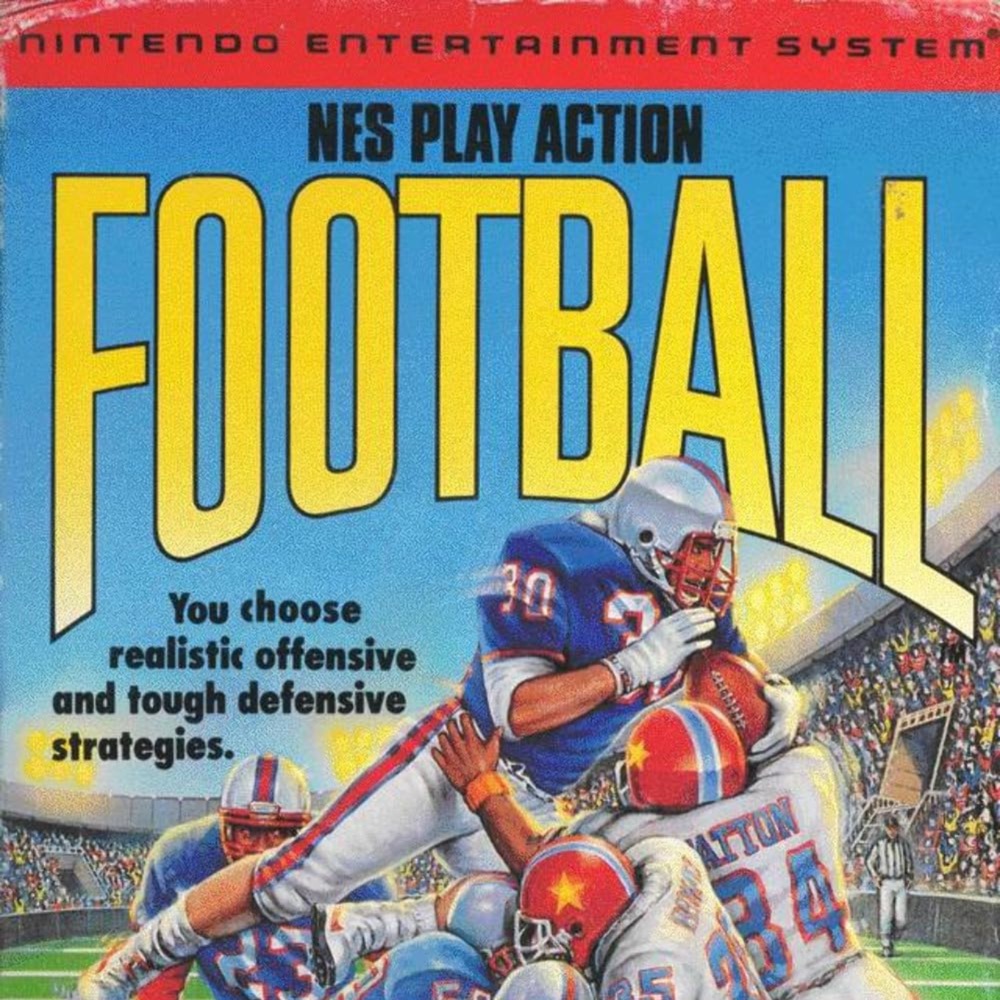
369 · NES Play Action Football
Nintendo takes its game to the gridiron with NES Play Action Football. While Nintendo did not get the NFL license for this one, it did secure the license of the NFL Player's Association, so the 8 teams to choose from (all named after the appropriate NFL cities) are all stocked up with real pro players from the 1989 season.
A game with NES in the title, made by Nintendo, and the fourth football game we've played after 10-Yard Fight, Tecmo Bowl and the disappointing NFL one. Only Mike and Sean were on this episode. There's no NFL license, only the players' association, so Marino is on the Dolphins and Montana is in the game, with eight big-market teams. Squint hard enough and you get an NFL game. Whether it's a good one is another story.
What it gets right
- It has everything. Screen passes, injuries, substitutions, fumbles, interceptions, a ref who calls first downs, and players who say hut until the ball is snapped (it auto-snaps after eight). We doubt Tecmo Bowl even has a screen pass.
- Four-player play. You can run two-on-two, with one player as quarterback and the other as running back, then switching to the receiver the pass goes to. Each play is a direction plus a button, and in multiplayer the game doesn't flash the play name. Playbook cutouts let teammates point at a card instead of saying it out loud.
- A tidy playbook. Every screen shows one pass and one run.
- Touchdown animations. A run, a catch and a dive over the goal line each get their own replay. Taking a knee for a touchback by accident made us laugh.
What gets in the way
- The 45-degree view. It sounded better in the pitch meeting. It isn't isometric and gives no depth, but it tilts your controls (up moves you up and to the right), cuts off the field, and makes the ball hard to judge. Every catch we missed was a ball that dropped sooner than expected. An arrow marks the landing spot only on the zoomed-out view.
- Buried controls. Switching playbook pages takes A and B together, and no play action pass appears until you do. Sean couldn't find a field goal on fourth and seven and punted instead. The manual explains everything else.
- Sluggish, with little AI. Players feel like trucks with too much momentum, blockers do little, and our runs died after ten or fifteen yards. Tap A, don't hold it, for a burst of speed. Fewer players on screen, like 10-Yard Fight, might have run snappier.
- Punt returns and defense. You can't find your returner, and switching players means pressing both buttons, which can trigger a dive tackle. On level one, a zone blitz and a switch to the tackle gets a sack almost every time.
- Thin around the edges. Difficulty is just level one through four, and "playoffs" are a sequence of teams, not a bracket. Play to play it's a sim, above that it's bare.
The bottom line
Skip it. We both voted no on the Essential Games List. Mike said Tecmo Bowl was faster, simpler and more "video game." Sean said it's too jank to be essential, whatever nice things he had to say about the details, though he did beat the Dolphins badly enough that Marino got pulled. In our haunted-game check, Mike found no ghosts and Sean called it blessed.
Written from our conversation in this episode.
- Real pro action in the NES Power Bowl
- Introduction
- Brief Overview of NES Play Action Football
- Released in 1990 by Nintendo for the NES.
- Developed as an alternative to arcade-style football games of the time.
- Attempted to provide a more realistic simulation of football.
- How It Stood Out from Other NES Football Games
- Isometric perspective instead of the top-down or side-scrolling view used in games like Tecmo Bowl.
- Focused more on strategy and realism rather than fast-paced action.
- Featured team management elements like injuries and substitutions.
- Appeal of 8-bit Football Games
- Early attempt at bringing real football mechanics to consoles.
- Nostalgic charm—how limitations of hardware led to creative solutions.
- Comparison to modern football games—what’s still fun about it today?
- Gameplay & Mechanics
- Isometric Viewpoint
- Uncommon choice for NES football games—closer to how later Madden games evolved.
- Made it more immersive but sometimes difficult to judge distances and movements.
- Did it work well, or was it frustrating?
- Team Size & Strategy
- Featured 8 players per team instead of 7 (as in Tecmo Bowl).
- Created a more strategic, full-team experience.
- The trade-off: slightly slower gameplay but more tactical depth.
- Playcalling System
- Menu-based, requiring players to select plays before executing them.
- More options than Tecmo Bowl but less intuitive.
- Did it feel too slow and complicated for casual players?
- Offensive Controls
- Passing: The quarterback can move before throwing, but the system requires precise timing.
- Running: Players can sprint but have limited endurance.
- Playcalling: A menu-based system allows for a variety of plays, including running and passing formations.
- Defensive Controls
- Players can switch between defenders mid-play to chase the ball carrier.
- Tackling mechanics require good positioning; diving tackles can be risky but effective.
- Interceptions are possible but require precise player control.
- Special Moves & Strategies
- Spin moves and stiff-arms allow runners to avoid tackles.
- Timing on passes is key—defenders can easily intercept poorly thrown balls.
- Clock management and play selection play a major role in success.
- Passing & Running Mechanics
- Quarterback movement before passing—less fluid than Tecmo Bowl.
- Limited passing windows—could be frustrating for players used to faster football games.
- Running game was a key part of success—how well did it work?
- Realism Factors
- Fumbles and injuries added a level of unpredictability.
- Weather conditions affected gameplay—rain and snow slowed players down.
- How did these elements affect strategy?
- Graphics & Presentation
- Isometric Perspective
- Ambitious for the NES but sometimes confusing to read plays.
- Compared to Tecmo Bowl’s side-scrolling simplicity, did it help or hurt immersion?
- Player Animations & Stadium Atmosphere
- More detailed player sprites than earlier football games.
- Could be a bit stiff compared to the fluidity of Tecmo Bowl.
- Field details and crowd effects—did they enhance the experience?
- Lack of NFL License but Realistic Team Representation
- City-based teams mimicked real NFL franchises (e.g., “San Francisco” was clearly the 49ers).
- No official player names, but the game had distinct team strengths and weaknesses.
- Did the lack of an NFL license hurt its appeal?
- Sound Design
- Included crowd noises, whistles, and basic sound effects for tackles and plays.
- Play-by-play text added a unique touch.
- Compared to Tecmo Bowl’s catchy music, did it feel immersive or dull?
- Multiplayer & AI
- Multiplayer Mode
- Supported up to four players with the NES Satellite/Multitap.
- One of the few NES football games to allow that many players at once.
- Was it better as a multiplayer experience than single-player?
- AI Difficulty & Fairness
- Could be unpredictable and frustrating at times.
- Computer-controlled teams could sometimes feel overpowered.
- Did the AI actually play like a real opponent, or did it feel scripted?
- Head-to-Head Play vs. Solo Mode
- Playing against a friend added unpredictability and excitement.
- Single-player mode could feel sluggish and less engaging.
- Which mode made the game shine the most?
- Legacy & Comparison to Other Football Games
- How NES Play Action Football Compared to Tecmo Bowl
- Tecmo Bowl was faster, simpler, and had arcade-like action.
- Play Action Football was more strategic but slower.
- Which style of gameplay aged better?
- Depth vs. Accessibility
- Play Action Football had more realism but was less accessible to casual players.
- Tecmo Super Bowl balanced realism and arcade action better.
- Did NES Play Action Football try too hard to be a simulation?
- Did It Set Any Precedents for Later Football Games?
- Introduced elements like weather and injuries, which became staples in later football games.
- The isometric perspective was an early attempt at a more TV-like view.
- Did it influence later titles like Madden, or was it a dead-end approach?
- Nostalgia Factor
- Does it still have a fanbase today?
- Is it fun to revisit, or does it feel too dated?
- Final Thoughts & Fun Stories
- Personal Experiences & Memories
- First impressions of the game—was it exciting or frustrating?
- Did you ever pull off an amazing play that stuck with you?
- Any funny moments or glitches?
- Most Memorable Aspects
- The challenge of mastering the passing game.
- How playing with friends changed the experience.
- The charm of 8-bit football despite its flaws.
- Does It Hold Up Today?
- Would you recommend it to someone new to retro football games?
- Is it a hidden gem, or does Tecmo Super Bowl overshadow it too much?
Auto-generated transcript. Each paragraph starts with its timestamp. Speakers are not identified.
NES Play-Action Football, real pro-action in the NES Power Bowl.
NEStalgia And welcome to NEStalgia, a chronological exploration of every NES game released in North America. I'm Mike. I'm Sean. And today we are playing a game that has NES in the title. Have we gone meta?
I think we've been really hyping this up, the whole NES, NES. I don't know if I have much more to talk about, Sean. It's another football game on the NES. I mean, you say that as if there's been a dozen. There's only been like two, three so far, right? What are the three? What are the three in your mind? I want you to list off everyone that you can remember because this will be interesting. Okay. So obviously there's Tecmo Bowl. Correct. The only essential one. Which I think we all like that. We've got 10-yard fight, our first episode ever. Hell yeah. And then one of them was named after a quarterback. John Elway. Yeah. Okay. It was John Elway.
John Elway's quarterback club or something like that. I think that was right. Yeah. And there's one more. There was one more. Yes. It's very obvious, but I don't expect you to get it. Wow. That's kind of insulting. But tell me, Mike. I believe it was just called NFL or National Football League. Oh, I think you're right. And I don't remember a, I can't conjure a single image in my head of what that looked like. I know it was very disappointing. Yeah. It's called NFL football. So National Football League football. And the weird one about that one was that it was developed by Atlas, the people who make Persona now.
But NFL football was cool because that had the NFL license. So you could play as the team. They only had like 12 of the teams though, right? I don't remember that part. But I do remember that that didn't matter because you don't want to be the Buffalo Bills if the game sucks. Yeah. I mean, that's true. The problem here, of course, with NES Play Action Football, a game made by Nintendo, released for the NES, is that they didn't get the NFL license, but they also just didn't seem to care. Did you notice that like the teams are, even though they're not calling them the Los Angeles Rams, they are the same, like the players' names? Yeah, they got the license from the NFL Players Association.
Yeah, but also like, and then they're matching them to the teams from the cities they were in. For sure, for sure. So like, Marino's on the Dolphins, Montana's in the game. It's like, you know, it's like, they got the right people. So it's basically like, just squint hard enough and you are playing an NFL game. I agree. And I think at this point, when it's really hard to even put a logo on a screen with like the amount of pixels that you have, I think that just the NFL PA license is enough.
And it's like, I'd say that if you had to choose between having the teams and having the players, I think the players in the league are more important than, or at least more like, you can connect with them more than like the league itself. At least in my opinion, at this point in our journey of simulation.
And how many players need to be in the game for it to like, for it to feel real to you? Like if it was just, you know, Josh Allen's NFL football, and he was the only real NFL player because it's his game and everybody else is just made up. Can you, can you get into that? I think that that's a ridiculous thing. And I, but I also don't think it's too far away from how they did it here because they only did like eight teams, which I don't truly understand.
Like why they're only doing, it's like, it's like New York, Miami, Denver, LA. It's like some, yeah, Chicago. Like these are like the big market teams for the most part, but I don't really, I just don't know why they did it that way. Like if you're going to get the license for the whole union and have, you'll, you have access to every big name. You're only going to have a, a quarter of the league in it. Not sure why. Yeah. It's 1990 and you choose the New York giants over the Buffalo bills. Well, this is 1990. So we haven't even been, you know?
Okay. So it's, it's just coming pretty soon. The Buffalo bills, like the ones that we want to play where they're going to be the best team in the league. The team's there. It's just, uh, it, you know, there's still the bickering bills right now. Right. The stats aren't adjusted for them being the best. It's true. You know, it's like really upsetting when every version of MLB, the show comes out. And it's like, if the Mets had an, had an okay year, the same players that were in the, you know, run the previous year now have like weaker stats. It's like, they're the same players, but they're older now.
I don't know. We're older now too, since 10 yard fight. We are. And that's what I kind of wanted to talk about because I'm not trying to be mean to this game. This game is not 10 yard fight, but is it really like we're talking now five years later after 10 yard fight, obviously much longer in the podcast time, but five years between 1985 and 1990. And I don't think that this is feeling all that different from 10 yard fight. Well, okay. Let's, let's talk about like the most obvious difference here. And that's just the perspective.
Yeah. And that's what we're, that's what we're going to focus on. I feel like a lot, right. Do you want to, do you want to talk about what the perspective changes? Yeah. It's, it's one of, it's just one of those decisions that you kind of have to wonder like, wow, this sounded a lot better in the pitch meeting than it did in execution.
Um, so we've seen vertical football in 10 yard fight. We've seen horizontal football in Tecmo bowl, at least in terms of like, what is the orientation of the field on the screen? Mm-hmm. And both of them have their pros and cons, but at no point did I think that moving everything 45 degrees for like this faux 3D effect on this system would make things feel better. It's better. It's obvious. It's definitely a striking image.
Right. And it's just 45 degrees. It's not even really like isometric. Like I don't get any sense of 3D depth out of this 45 degree thing other than the football, but we can, we don't have to change topics right away. But like the football being, having this depth effect to it actually made it like harder for me to catch the ball a lot of times. Especially because it's also shifting your controls in a way that I think we've complained about before, where if you're pressing up, you're actually pressing up into the, you're actually going to move up into the right. So it's all like cardinal, it's all cardinal directions if they put like a compass on your screen and shifted it a bit.
It's not even like it's a broadcast view, you know? No. This is the closest they could get to a broadcast view. Yeah. And yet you're still like, because of the 45 degree thing too, like a lot of the field is cut off at all times.
Yeah. And, and I was like, okay, maybe they did this so that there would be more visibility, but like you have all your visibility in the horizontal view. Like that was like the problem with, with 10 yard fight and any other game that may or may not have had a vertical orientation, um, was that you need to see downfield and you couldn't see downfield. And this is taking like the worst of both worlds here, um, by kind of obfuscating your controls a bit and also limiting your view. Now, at least it has like, it, it understands that at like the, the most zoomed in points. So a lot of the time, uh, at least when you're passing, it will zoom out to show more of the field, but it's still very strange, uh, how, how it goes about that.
And another parallel to 10 yard fight, uh, which I promise I'm, uh, you know, I'll get off this. I'm not, I'm not really saying that they're on the same level in terms of controls and depth, but it's interesting that when you start the game, uh, in 10 yard fight, if you recall, you started off being like choosing your difficulty and your difficulty was like, is this a high school football match?
A college football match, you know, like the pros. And, and that was like some nice flavor text that wasn't necessary. It, you weren't expecting it in that game in this one, they stripped that. And they're just like level one, level two, level three, level four. It's like, which one are you? And it's like, what does that mean? What does it mean to be level four?
Yeah. I think maybe a typical easy, medium hard would help here, but I didn't really think about that. I, that's just, that's where the parallels end though. Uh, at least for me, uh, then it starts to, it does, it does have a little more depth to it. Uh, you do have substitutions, you have injuries mid game, you have, um, the ability to, uh, fumble the ball, intercept all that fun stuff. So, uh, talking about the actual game now, the moment to moment, what did you think about the presentation? We mentioned that this isn't quite meeting the, uh, broadcast values, but other than the fact that the field is somewhat cut off, how is the presentation of football in this game?
So one of the things that I appreciate about this game is that at least everything is there. Um, in a way that it, it, not so much in 10 yard fight, like where it was like, you just can't do the things that you should be able to do in football. Uh, that tech mobile definitely solved. And this one has solved in a more, uh, I would say, come not complete. Uh, it, it has solved this in a more comprehensive way, but not in a way that is easy to play like there. So the first thing I was going to say at one point while I was playing this game, I was like, Oh, I can't wait to say this.
They call it NES play action football, but in nowhere in the, the, the playbook is there a play action pass. Now I found out that if I had to, I had to do a button combination to change the page of the playbook and lo and behold, there's the play action pass. But I was just, I was actually surprised that it was there and able to be implemented like, uh, everything in terms of the playbook, all of these different play concepts on the, on the defensive and offensive side of the ball.
Uh, like the fact that they're there is just impressive to me. Like screen passes. I don't think you can even do in tech mobile. Um, but in terms of how it feels to play these things, it's like, it's just like the execution, the timing, the feel of controlling these, these players. It's really not hitting the mark. It feels very sluggish, uh, where, where a tech mobile felt very snappy.
Um, in terms of presentation, like, like present, like a broadcast way, like it, it, it's, it's more like being at a game cause you're seeing everything on the scoreboard, uh, which I guess is all right. Like it's like, there's at least like you see the, the ref and you see like what quote unquote highlights on, on the, uh, the jumbotron. Like it's, it's got stuff, but it's all very hackneyed.
Yeah. And you've got the, uh, the ref, since you mentioned him, he, he has a voice for first down. Yeah, that's cool. Uh, which is fun. And, uh, even the, the players have their, uh, hut, hut, hut. I think they just keep saying hut. And they say hut until you snap the ball. Yeah. And I think you actually, I think you can, they, they will just auto snap after like eight huts, uh, which is true.
But, uh, you know, you were mentioning the playbook. And I think also that what I like about the playbook is the, um, efficiency of it all too. That like in every single, um, play, they present to you both a passing play and a running play in, in the same picture. Yeah. So you can kind of like just choose based off of that. I actually didn't know about the turning the page feature, Sean. So do you, do you remember what buttons those were? You have to press a and B at the same time. The only reason that I even figured this out is because I was in a, in a field goal situation. Like I, it was like fourth and seven at the 20 yard line. And like, well, I'm not going to go for it. So I'm just going to take the field goal. And I could not find the play.
I saw a punt. And I know that like, if you're on defense in your, and the offense is punting, whatever play you, you select is going to be a punt return. Well, that's what I was about to ask. Cause I, I didn't see a punt return option. And so I was wondering if, so I thought it was going to be like that. So I was like, okay, maybe if I just select punt, it will, it will kick a field goal instead. If I, if I'm in this situation where I'm, I don't know, within the 40 and it didn't do that. It punted. And I'm like, hold on a second. There has to be a way to kick a field goal.
And then I had to, then I had to like scour the, it's not like its own section. Like it should be a thing that says, here's how you kick a field goal. Cause it explains literally everything else about the game, but buried in one of these paragraphs is here's how you changed the pages of the playbook.
And it took me way too long to figure that out. And yeah, like, that's how it was like, wow, there's actually a lot of plays and a lot of different concepts that you can do. It's just, they all kind of feel weird to do.
And then, you know, a huge feature for both the play calling, but also for the game that it has over Tecmo Bowl is that this supports four player multiplayer. And so you can do a 2v2.
And while it's similar in play calling where, you know, you just select your thing, but it doesn't tell the opponent what you selected, you know, cause it's just a sequence of inputs of up and A or up and B.
But they did include like playbook cutouts for like each team to like have so that the two players could like point to it. Talk about it. Yeah. Like, yeah. Like point to it on the sheet of paper and then you could, you know, like, so this way you're agreeing on it rather than talking about it out loud and revealing your play. Okay. That makes a lot more sense than how I read it because, uh, and I'm, I imagine it doesn't cause in the, okay. In one player, it has the same situation where all of your, like there's the, the eight plays on, on the screen. And then it's just a directional button and a face button is the combination for each of those plays. Now it then flashes the play name to confirm that you selected it.
I, I was reading that Wikipedia page thinking like, oh, they have all these like codes and cards so that you can have some secrecy if you're playing in the same room as each other. Like, why don't they just not have it flash the play name? Yes. So now I'm imagining now that in, in multiplayer, it does not flash as play name and that's just for local communication. Is that correct? Yeah. Okay. Yes, that is correct. That's actually, yeah, that's nice.
Yeah, that's nice. And then also like, you know, I wasn't able to like do this, but the way that it handles like what the, what the first player does and what the second player does, like in a, as a role is pretty interesting too, where like the first player basically controls the quarterback and then like whoever would be the, the, the first pick option on, on defense. And the second player will control the running back. And then the receiver that the quarterback threw the ball to, you know, some first players, quarterback, you throw the ball, you were the running back. Now you'll switch to the receiver. So there is like, there's a true co-op experience to be had there.
Yeah. And I've actually never played any kind of, in terms of sports games in general, I have never played cooperatively. I only play against people. I know that a lot of people that I know that still play sports games will do the, whether it's like NBA 2K or Madden, they'll do this thing of like, oh, I'm going to play the receiver. I'm going to play the running back. Like I never really got how that worked even today, but it's interesting. That's already a thing here.
Yeah. And just to go more on that thought, I think it depends on who I'm playing with too. Like, I feel like if I was playing you, we both have a good understanding of video games in general. And while you may know more about Madden, I would feel comfortable playing against you. Whereas like if I'm playing with my wife on any particular game, if there's an option for us to play together, like even Mario Kart, if there's an option for us to be on the same team in Grand Prix, we're going to be on the same team. Okay. Yeah. You don't want to, you don't want to like, just because I'm going to win. Negative energy. I'm going to win every time. It's not even a fair fight.
Yeah, I agree. I agree. And that's just a tip for people in general. If you want to play more video games with your wife, try not to win all the time. Now, if it's your kid, definitely never give them a chance to win. Yeah. You're basically making sure that your kid only gets participation trophies and you let them win every video game. Like you're older than them. It makes sense that you're beating them. They have to, it builds character. It does. And that's how you get good at video games, by the way, just getting older.
My stepdad never let me win in NFL 2K5. So that's why, but then I, then I would just play as the Eagles with Terrell Owens and he'd get mad that every like deep straight would be a touchdown. So there's a football game in NFL 2K5. I thought it was just a crib simulator. I know. That's where I spent most of my time too.
Hell yeah. All right. Moving on here. We, I, I did mention about the football and catching it. And it's not something that's impossible to like rework or whatever, but there is something strange about the isometric thing or 45 degree thing that they're trying to like give off this 3D thing. But I never, the game never gave me the impression of 3D, but the way that the football is thrown in the air. And then like, it really does need like a target landing spot, right?
Like that would be probably trivially easy if you knew exactly where it was going to land, but it does need like a general area because what winds up happening is I basically have to recalibrate my brain seeing the ball and realize that it's going to drop earlier than later. Like every catch that I didn't make was because I just thought it was going to like go a few more yards. And instead it was like, Oh no, actually, uh, that that's the end of that. Uh, and I can't remember now cause I'm not looking at gameplay footage, but like, was there a shadow for the ball? There is. So, okay.
There, there is also a target, but only in that zoomed out mode. Like basically if you're in a passing by, if you're in a passing point. Oh, that's what that arrow is. Yeah. That arrow points to where the ball will land. But once you zoom in, it is not there anymore. And I do feel like that's a little bit better that I actually just didn't understand the arrow. I thought the arrow was pointing like, cause I guess the arrow, yeah, I guess the arrow points. Yeah. It points at a point.
Yeah. I don't, I sometimes it, I think sometimes it's pointing up. I don't really know what that whole situation is, but what causes it to be up or down. Yeah. But it is there. I just don't think it's there once it zooms into like the action view, if you want to call it that. And there are some like things you can do to make your player run faster or shake off players, but there's not really like an animation for it, or at least it's not not, if it is, it's very subtle. But like if you rapidly tap, I think it's the A button while you have the ball in possession, you will run faster.
Oh, you had to tap it? Yeah. You had to tap it. Oh, I was holding it. I was tapping it. And it was working. I was, I was faster than them, but I was also playing on level one. Yeah. I was playing on level one too. I was trying to do. Uh, but I, the way that players that you are not directly controlling behave is very strange. Um, cause I, I was trying to do less of like, Oh, I'm going to juke here and do a spin move here. There's no spin move button. Um, I, and I was trying to like use my blockers and there's just so little, like there's just
so many things going on that I don't think any particular, uh, non-player character has much AI to them. So like the blockers aren't really doing much. And so I was pretty much running for maybe 10, 15 yards and then getting stopped. I would, I would hold down the A button to try and outrun them. I get a little boost of speed, but anyway, I would, I would definitely get caught. So maybe I was just playing the game wrong.
Where do you think this falls on the like arcade versus simulation for 1990? Not, not for today. Obviously this would be a very arcadey game by that standards, but like, it's not quite like you, you said it was a little sluggish and it does have like, you know, some good playmaking options and everything. Is it, but it's not really trying to be a sim. Like, yeah, there's injuries in the game and everything, but it's not like you do like a full season or like manage a team.
You know, I struggled with thinking about that. At the micro level, like game by game, this is 100% a sim. The gameplay is sim gameplay. Everything above that. No, it's too bare bones. It is, it's, yeah, you can play playoffs, quote unquote, but it's not even showing you a full bracket. It's just showing you a sequence of teams. You have to be in sequence.
But no, I think at the, at the gameplay level, this is 100% a sim. So then let me ask you this question. By, by, did they lean to, did they try too hard to be a simulation and the tech for at least them wasn't there and it kind of made it a tougher game or maybe a more sluggish game because of that? Like, should it, should they have leaned in more to the 10 yard fight stuff that, that they had originally gone with? I think so. I think maybe if they actually did the eight on eight thing that, that you, uh, had, oh, you didn't mention that.
I'm, I'm, I'm, I talked about it before the show. What do you think? Yeah. Um, if they did fewer players, like if they didn't show the full offensive line and there were just less agents on the screen, maybe there'd be better performance. I have to imagine that a lot of this is performance related, um, because it doesn't feel like it's supposed to be this slow. Um, maybe if, if there was just less stuff going on, if they simplified blocking, uh, like this is me talking up my ass, then maybe there, it would be a quicker, it would, it would feel more snappy, but it just doesn't feel very snappy.
Um, so all of those, it's definitely a sim. It's just like, not, it's not that fun to play because of these feels situations. What did you do on like a punt return situation where you're punting to try to find your player again on screen? Like, yeah, you can't, you can't, right? Like you're not, you can't see yourself and you're that person. And like, I feel like I was just kind of pretending like I was heading towards, like if I kicked it bottom, the screen, like you're just heading. That's what I'm used to doing in Madden. Cause at least in Madden, it'll show you a little arrow as like where your guy is in relation to the camera.
This doesn't have that. And I, and that, that was my muscle memory kicking in. But then once I was like, wait a second, there's nothing telling me where anyone is. I would just wait until the, the first player on my team would enter the screen, which is way too zoomed in. So you really don't have much time to react because again, your players are all like big trucks that have like way too much momentum sometimes. And so I was, it was basically just putting my, my, uh, my fate in the hands of the football
gods, hoping that the first player that comes onto the screen is well positioned. And then you have to do that really awkward thing because the switch character button is pressing both buttons at once. Uh, which while you're trying to track somebody, uh, and like you can accidentally do like a, uh, a dive tackle and completely take that player out of the play. So it, it's not that too.
Playing defense was super frustrating because of that. Even though at a certain point you realize that just, uh, zone blitz and then switch to the tackle almost guarantees a sack, at least on level one. Um, if they do get past that, you're almost always left in the dust.
Did you pull off any amazing plays, anything that stuck with you? Uh, at least for the week that you were playing the game? Um, yeah, there was like a punt return that I, that, that I really appreciated.
And, uh, like just the different ways you can score a touchdown, like just seeing those like scoreboard animations of like, if you run one in as opposed to throwing one, like a catch in the end zone or like a dive over the, uh, over the goal line. Like they all have different animations for that. So those were cool to see. Um, uh, yeah, I had like some deep passes that I thought weren't going to get caught. Cause like over time you, you, you do get the hang of playing this at least to some extent, but it just never feels right. But once you do do something, it does feel pretty good.
It does show a different, like, uh, cut scene replay, obviously more stylized than just showing the gameplay again. But like, depending on how you scored, uh, it has an animation for each one, whether you, uh, ran into the end zone or had an awesome catch or a field goal, uh, or a safety. Uh, safeties can happen in this game. And that's my only like standout moment was that I accidentally did a safety.
No, not a safety did a touchback. And I, I didn't know it was in the game before I did it. And I was like, Oh neat. They, they put that in the game too. I caught the ball in the end zone and I, I think I was pressing the button. And I was thinking was going to make me start sprinting. And instead by pressing that button while you're in the end zone, you just take a knee. Yeah. And I was like, well, uh, they have that too. So yeah, I guess that's another, uh, case in point for why this is leaning closer to the simulation, uh, experience. Yeah, absolutely.
And yeah, you mentioned, you know, again, I, I don't think like for, for what they set out the game to be, like, I don't think it is incredibly challenging unless you're challenging yourself with the, uh, higher difficulties. But I, I think it is something you have to, uh, like learn again, if you're coming out of Tecmo Bowl and then you're switching over to this, like it, it just behaves, uh, at a different speed. The ball, uh, the ball definitely is, uh, is received differently.
And, uh, I think overall, whether or not, you know, like we already know Tecmo Bowl is an essential game, whether or not, uh, NES play action football is, we'll decide, but it is definitely a different game, which must have been one of their games. Their goals, right? Like you're not here to try to, you're, you're competing with Tecmo Bowl. You're going to try and do something different, not try to copy it.
Yeah. I think they, like they did the easiest way to, to make it stand out. And that is to have a fully unique view. Like that's, that's kind of why I still have a very clear recollection of Bases Loaded, which was that, uh, more broadcast-y, uh, behind the pitcher. Behind the pitcher. Instead of this weird, uh, perspective that kind of makes it not actually how baseball is, is played. Um, so, and that, that's why I'll probably remember this game, thinking about NES, a baseball, oh my god, thinking about NES football games. Um, but yeah, it just, does that serve the experience of playing it? I'm not sure. Are you actually the umpire in every other baseball game? Like, that's the viewpoint. You're basically looking through the umpire's eyes.
The umpire is just the guy also holding the camera. Like, didn't they do that during the, uh, the, uh, the World Series last year? Like, they actually put a body cam on them? Yeah, I feel like they just, yeah, they have cameras on everything. They put cameras on the bases now. Yeah, that's the, that's the thing. Like, even in the NFL playoffs last year, they had the Madden V, which I had never seen before. I just want to watch all sports in the appropriate video game camera views that didn't exist before the video game.
Yeah, it'd be funny if, like, MLB TV had an option to be, like, and you can choose the bases loaded view. You can choose the RBI baseball view. You can choose the NES baseball view. Goalie cam for NHL. Yeah. Yeah, very cool. Uh, anyway, we're gonna move on to our final topic, which is whether or not NES play action football is haunted.
NES play action football shows no signs of being haunted. Uh, there was no, nobody ran through each other. Uh, when people connect, that's, uh, that stops all motion on them. So that's a good sign. There are no ghosts on the field. Uh, people can get injured. That is scary, but it is not horrifying. So I would not say NES play action football is haunted. Sean? Um, I, I, I agree. I actually think it might actually be, uh, blessed. Because, uh, it was a game in which I was beating the Miami Dolphins so badly that it made them pull Dan Marino. Um, so I was really into that, and that made me feel good feelings. Um, uh, so yeah, definitely not haunted. Now, whether or not it's, it's essential, no.
Um, it's too jank for that. I, I do have, I did have a lot of, like, nice things to say about it, but, like, that's just because of the, uh, the geeky nature of which I, I view a lot of sports games, uh, minutia.
Uh, but no, in terms of how, how it feels to play, it's, it's, it's nowhere near up there with Tecmo Bowl. Yeah, I will also give my essential games list vote. And Tecmo Bowl was faster, simpler, and by all scientific measures, Tecmo Bowl was more video game. That is the new thing I am measuring things by, is how video game are they? And I know what you're saying, Mike. This is a video game. No, there are video games, and there's video games, and we all know which side NES Play Action Football is on when you compare it. If NES Play Action Football is on the left, and Tecmo Bowl is on the right, I guarantee you, you're gonna place the word video game closer to Tecmo Bowl.
So you just know what I mean. I do know what you mean. It's a vibes, it's a vibes thing. So Sean, what is the vibe for, uh, Super Tecmo Bowl? Because that's gonna be coming up. Is that something, like, can we judge that fairly? Or is that just, like, automatically on the essential games list? So I've actually never played it. Um, so I'm really looking forward to whatever makes this one leaps and bounds better than Tecmo Bowl. Because every time, like, I've seen footage of it, it looks almost identical.
Um, and I know that, you know, Bo Jackson and Thurman Thomas are, like, you know, like the Alpha and the Omega of these. So I'm looking forward to that. But I just don't, I don't know what it can do so much better. So I'm excited. And, of course, I made the, uh, critical error there of calling it, uh, Super Tecmo Bowl. But putting Super in the front is something you're only allowed to do when it's a Super Nintendo game.
It's, uh, Tecmo Super Bowl, which would obviously make a lot more sense. Uh, back when people could say the word Super Bowl without being sued by the NFL. Uh, now nobody can refer to anything as the Super Bowl. You're not allowed to say the Super Bowl in your marketing. You just have to, uh... The big game. Yeah, the big game. Right, exactly. But Tecmo got away with it. Tecmo Super Bowl. Uh, and I look forward to that one. And I'm glad that we were able to keep it short so that we still have something to talk about on that episode. All right, I'll stop talking now. No. Thank you.