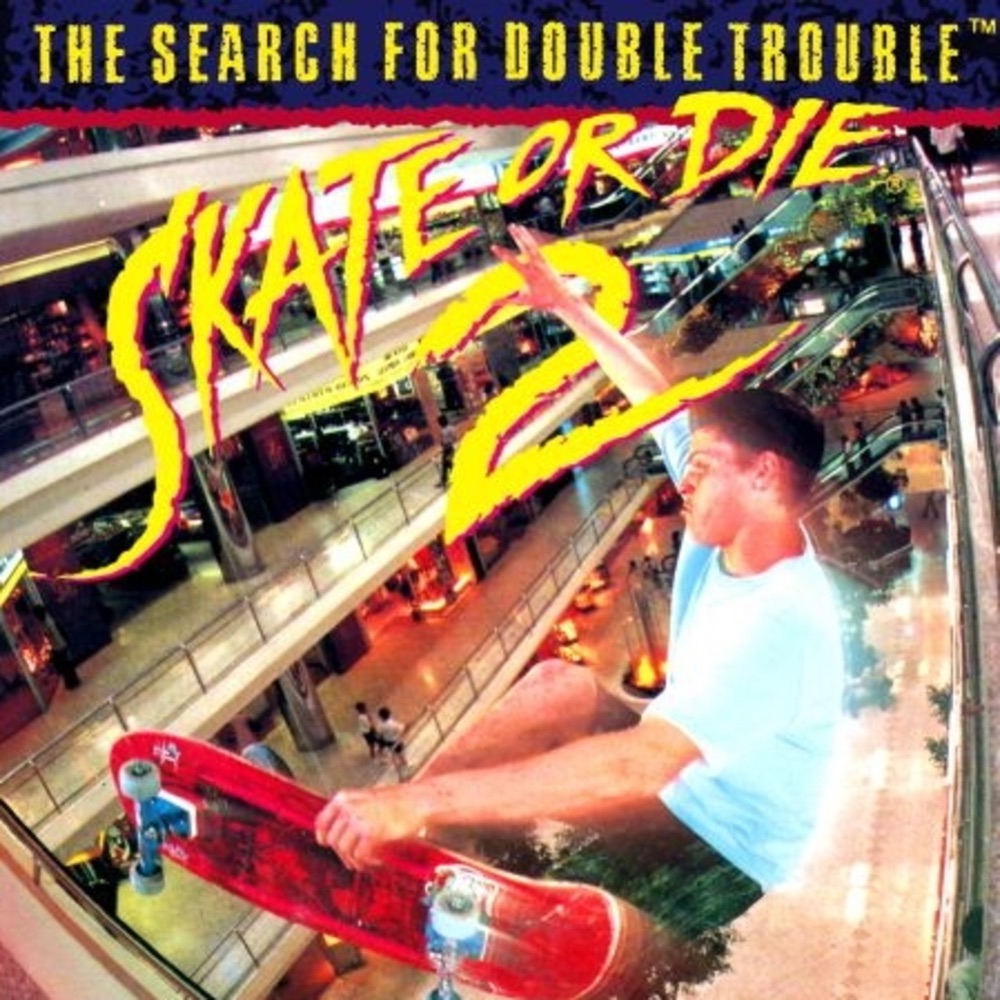
373 · Skate or Die 2: The Search for Double Trouble
In this sequel to Skate or Die, you have the option of just skateboarding on a ramp, or to go through an adventure. In the adventure, you are in a small community called Elmood.
Skate or Die 2 is a very different game from the first one, and we spent most of the episode on that. Mike, Sean and Joe went in expecting a skateboarding sequel and got a side-scrolling adventure where the board is mostly how you get around. The more we talked, the more the interesting parts turned out to be the parts that didn't work.
Where it loses us
- Nothing is explained. We skated to the end of the first level and found a dead end before noticing a door with an arrow. Talking to the skaters is how you find out anything. The first level is: skate to the door, go in, fight the mayor's wife with a paintball gun in a warehouse.
- The skateboard is a trudge. Left and right only, with several kicks to build speed, and a K-turn to enter a door you overshot. It made us want to play Tony Hawk. We compared it to Paperboy and BMX, with the board as a means to an end.
- Skateboarding as scenery. There are no rails to grind or ramps to launch off, and nobody attacks with a kickflip. You shoot a paintball gun. The mall level has you delivering items between stores, and we joked about an economy where the record store, the health-food store and the shoeshine place keep handing each other pizzas and CDs.
- Skate or Die in name only. Skateboarding is banned, yet nobody stops you, there's no wanted meter, and the mayor never feels like a threat.
What's good
- The half pipe, Double Trouble. The reward for finishing is a half pipe with a score, a time limit, and a "pump zone" where pressing A builds speed for bigger tricks. The manual spends six or seven pages on it. We liked it more than the adventure, even though it is selectable from the start, which undercuts the story's payoff.
- The weirdness. The opening cutscene has a Disney-ish Ariel, Rodney Dangerfield in punk gear, and a hero so plain he reads as a how-not-to-die-on-an-airplane diagram. You run over the mayor's wife's dog, and the art style changes. The final boss, Icepick, keeps charging at a wall even when you're behind him.
- The sound. The title screen sings the name, and Sean singled out the level one song.
Beyond the game
The manual has a developer bio page with photos of David Bunch, Eric Knopp and Michael Kasaka and their skateboards. A listener wrote in, asking us to mention that the skater on the cover, Jeff Whitehead, plays black metal in Leviathan.
The bottom line
Skip it. All three of us voted it off the Essential Games List. Joe would combine the two modes, and Sean sorted its fans into half pipe grinders, music lovers and posers. We expect hate mail, since people who grew up with it tend to love it.
Written from our conversation in this episode.
- The Search for Double Trouble
- General Information
- A skateboarding-themed action/adventure game for the Nintendo Entertainment System (NES).
- Developed and published by Electronic Arts (unlike the original NES port, which was developed by Konami and published under Ultra Games).
- One of only two NES games self-published by Electronic Arts (the other being The Immortal).
- We received listener mail about this! The skater on the cover is Jef Whitehead, later known as the sole member of the black metal project Leviathan.
- Characters
- Everyone has this punk or skater aesthetic to them in this game, and then you meet the hero. The most vanilla character
- The Hero – Unnamed male skateboarder, starts with a paintball gun and throwable weapons.
- CJ – The hero's girlfriend.
- Rodney (dangerfield) – Returning character from Skate or Die!, sells new skateboards.
- Lester – Rodney’s son, teaches new tricks in exchange for collected items.
- Icepick – The main villain, a thug who kidnaps CJ.
- Gameplay
- Side-scrolling action skateboarding game
- Customizable controls for skateboarding moves and weapons.
- Weapons: Paintball gun (primary), eggs, and firecrackers.
- Bartering system: Items like CDs, cassette tapes, fries, and tacos can be traded for tricks and boards.
- Five skateboards available:
- Default board – Slow, low jumps.
- Two upgraded boards (faster, higher jumps).
- Two specialty boards (one fast but with poor jumping, one slow but jumps high).
- Must acquire boards in stage one to access upgrades in stage three.
- Skipping story mode: Players can jump straight to the Double Trouble half-pipe from the title screen.
- Plot Overview
- Opening Cutscene
- Set in Elwood, the hero accidentally runs over the mayor’s wife's poodle.
- She convinces the mayor to ban skateboarding.
- The hero must confront her with a paintball gun in a warehouse.
- Stage One – Streets of Elwood
- The hero fights skaters and collects items.
- Can meet Rodney and Lester for new tricks and boards.
- Ends with a paintball showdown against the mayor’s wife.
- Stage Two – Shopping Mall
- The hero gets a job as a delivery boy to earn money for a new half-pipe.
- Navigates shoppers, skaters, and security guards.
- Earns tips (extra weapons and items) for timely deliveries.
- Stage Three – Beach
- The hero must recover scattered blueprints for the half-pipe.
- Faces roller skaters, crabs, seagulls, and bodybuilders.
- Can meet Rodney and Lester again for more upgrades.
- Stage Four – Warehouse (Icepick’s Hideout)
- The hero must navigate a multi-floor maze to rescue CJ and retrieve the building permit.
- Climaxes in a rooftop battle against Icepick.
- Conclusion
- With CJ rescued (she has this batting eyelash animation) and the permit secured, the new half-pipe is built.
- The game ends with the player using Double Trouble.
- Double Trouble (Half-Pipe Mode)
- Larger than the original Skate or Die! half-pipe, featuring two screens.
- Time limit: 3 minutes to perform tricks.
- Game over after 3 wipeouts (unless using a cheat code for unlimited boards).
- Scoring streak bonus: CJ appears in a window, doubling points temporarily.
- Reactions based on score:
- Worst reaction: Hero smashes board on his head and exclaims, "No way, dude!"
- Best reaction: Hero spins board on his finger and shouts, "Way cool, dude!" (earned by exceeding 30,000 points).
- This breakdown provides a detailed yet digestible summary of Skate or Die 2, covering gameplay, characters, plot, and mechanics. Let me know if you need any tweaks!
Auto-generated transcript. Each paragraph starts with its timestamp. Speakers are not identified.
Skate or Die 2, the search for double trouble.
And welcome to NEStalgia, a chronological exploration of every NES game released in North America. I'm Mike. I'm Sean. And I'm Joe. When you think of Skate or Die, I think the part that stands out to me the most about the whole franchise is the title, right? Skate or Die, very aggressive take for a skateboarding game. Nothing ever comes quite close to it. We could put a lot of things, right? We could put like, or die, next to a lot of different actions, and they'd be great video games, right? I think that Skate is probably like the perfect one, though. Perfect. Interesting. Okay. I have nothing to say beyond that. You wouldn't be interested in like, football or die?
Yeah, no, no, no. I also think that, a little off topic, but like, funny or die, which would be like, you know, probably the most popular version of this, is probably the most non sequitur. Yeah. There you go. Yeah. I think, if you're going for this like, 80s, I guess this isn't really 90s, but like that 80s, like, cool kid feel Skate or Die works. But like, if you want to go this more intense route, like fight or die. Yeah, that's just, too, it's kind of a different feeling. It's redundant. I don't know.
Now, the other thing about Skate or Die, specifically in this Skate or Die 2, when you look up any information about this game, the first thing that you're most likely to hear somebody talk about is the little song on the title menu that sings out the title of the game, Skate or Die. You know, anything else like that where the first thing comes to your mind is the main menu? Pictionary. Of course.
The select screen for that Donkey Kong double feature cartridge. Take yourself out of the NES. Take yourself out of the NES for this one. I just meant like, you know, I guess in a weird way, I don't think it's the defining part of the game. But like Halo, you know, like the original Halo. That's a good version of that. But I'd say that the kind of in the same vein of like, oh, this is kind of embarrassing would be the PS2 remake of Spy Hunter had a new metal song called by Seether that I believe had a music video play before the game started for like an original song for the game.
Which is not the only video game where that's happened. And that's crazy. The idea that at one point they were like, yeah, we should just have like, you know, bands play a song and we'll do like an FMV. Yeah. PsyOps, the Mindgate conspiracy had cold.
I don't know what your example is, but this this goes even before the main menu. So now it's like, how much further can we push it? But I just remembered this on a run the other day. I was just thinking about the old Neversoft animation with the like worm eye, the eye worm, like trying to escape the letters and then getting stabbed through the eye. It's like that was so violent. Yeah, it was like a it's like our Pixar. And what kind of name is that? Neversoft? Soft. Always hard. You know what they mean. I do. But I also think it's a little clever for soft being software.
Yeah, right, right. But no, I just I guess I'm so confused by that because I never once thought about it like that as a kid. I was never like, oh, that's gruesome. Or like, why is it called Neversoft? And now that's the kind of shit I'm thinking about as an adult. I don't think I ever thought about that until right now. Like even Neversoft. I was just like, yeah, that's a word. I never thought about the two parts of it together. I mean, even if you take out the double entendre, it sounds cool. So, Joe, are you just somebody who like the second a company announces that they're a company? You're like, yeah, that's their name.
I think that it was more like I knew them, you know, from like Tony Hawk and stuff. But like, it's not like I'm they just kind of melded into my brain before I ever actually focused on it. I was just like, let's get to the game. Here's all this random text in the beginning. I'm not paying attention to. And by the time I like looked at it, it was already like a part of my subconscious. Do you do you have that same feeling for David Bunch, Eric Knopp and Michael Kasaka? I don't know what you're saying. You do. You know those people. They made the game.
They made which game? This game. It's just like this game. Very like weirdly put. I guess this is more like an early electronic arts thing where they would actually like feature the developer names back when they were more of like an art collective that gave a shit. But yeah, could you imagine? They're actually like they might as well put in this artist bio section of the manual, which is where Sean pulled those names. They might as well have also said like, no, it's literally on the title screen. Yeah, it's on the manual. I thought you were talking about the part in the manual. There's a whole like there's a picture of the three of them with their skateboards.
It is like a whole like, you know, who they are and stuff like that. And I think it's all very interesting. But, you know, like it's also so different from the EA of today where there are, you know, what? Thousands of employees. Yeah, I think that's a good guess. Imagine having them on their title screen. Yeah, this is like 10 employees. Well, you know, you ever watch the credits at the end? Like, like the names. I mean, that's like an hour of my time. Right. But like read the name, Sean, like be like, I'm going to remember that guy. I mean, here and there. It's nice of you. Yeah. I feel like I just look for like who directed it. Well, I want to know who did the QA for the Korean release.
But like just that guy. Nobody else. You're always just looking. You watch the whole entire credit roll to find it. I wait until localization. Yeah. Could you believe that we actually received listener mail for the first time in a long time about something like specific to a game? And that was for this episode. We got listener mail about Skater Night 2. Okay. And it was not like an opinion on the game. It wasn't like, hey, you know, like I grew up in this game. I have a lot of nostalgia for it. Instead, it was just like, don't forget to mention this.
It was notes. And that fact. It was notes. Right, right, yeah. Like, make sure you mention this. So I put it in here. The skater that is on the cover of Skater Night 2. Oh, it's the guy. Yeah. Is Jeff Whitehead, who apparently makes like some of the darkest. Black metal. Yeah. Black metal music for a band called Leviathan.
And I was like, all right, I don't know what else to do with that. Because black metal is not my jam. But I'll say it. I wonder if this guy that sent this letter to us is like also like a Wikipedia editor. Oh, because it's in there. It's in there now. Yeah.
I think it's an important thing to know. It is definitely like an interesting, I'm not going to say coincidence, but like it's not like he's wearing a shirt that says Leviathan. I don't even know if Leviathan was a project at this point. Yeah, I don't know. So it's more like, hey, yeah, I'll do your skateboard thing here. And also like where is he skateboarding? It's like a mall. Let me pull this up. Well, I'm looking at the manual again. I don't know if I have the box art in front of me. I'm looking at the manual and it looks like he's like in a mall. Yeah. And I think that is a multi-tier mall.
Maybe that's, you know, reference to the, yeah, that's reference to the level in the game where you're in a mall. No, I agree. Speaking of. That's pretty good. Game starts in a weird way. Speaking of the game. Yeah. Starts in a really strange way. There's the opening cut scene.
You, first off, you meet a lot of interesting people before you ever meet yourself. Right. So you've got these people that have a, they all have like a skater aesthetic or, you know, at least like a punk rock thing going on. And then you see, I guess, I don't know if they have a name or not. I'm just going to say you see the player character and it is like just the most boring, like white bread person. I've ever seen him. You know. Yeah. You project onto him. I think the weirdest one is like there's a Disney princess in here.
Yeah. Everything I've looked at about this game, like makes that joke and like, oh, and Ariel's here, but it's not like a, okay, everyone makes that joke. No, that is Ariel. Yeah. I think it's not, it's not a joke. Like it's so clearly her. It's like a trace. And, and some of these are like traces off of real people or, or, or like definitely like more anatomically correct people. Like the, the skinhead who's apparently your nemesis. And then there's you who looks like you were pulled out of like a how to manual of how not to die on an airplane. And then you've got like Rodney and Lester who are more cartoons.
And then it goes into a completely different art style when you kill that dog. Don't you think Rodney also is just Rodney Dangerfield and like a weird, like a punk aesthetic of Rodney Dangerfield? It looks like. I mean, it does look like Rodney Dangerfield. Oh, you know what? You're right. I didn't even think about that. Yeah. It's, it's, you know, just to go back to the whole, like you were saying, like they almost like trace over pictures of real people or whatever. But like, I don't know, I, I, I, I don't hate any of those other characters. I just hate that. Like they made you the most boring person in the game.
Anyway. So you run over the mayor's wife's dog. Yeah. And you're the hero. You're the hero. Yeah. Well, because that's the mayor's wife. Nobody likes her. Nobody likes the mayor. A dog was killed. The dog is innocent of being the mayor's wife. You think the dog was killed by the skateboard? Definitely. Great.
So naturally the mayor's wife is, talks to the mayor and says, you got to do something about this. And he bans skateboarding. Yeah. I mean, do you see, sorry, just to clarify here. Do you see the dog in that scene?
Dog's dead. It's the only logical conclusion. Yeah. I've got to say about banning skateboarding. They have no control over this town because there are skateboarders everywhere. That's why his approval rating is so low. Everybody hates the mayor. Yeah. You're the hero for running over his poodle. But I mean, even after he bans it, nobody's listening. Everyone's still skating on the streets. Might as well not even bother getting it reinstated.
No one's stopping you. There's no one arresting you for skateboarding. I mean, but here's the thing though. Like, the main character even comments on how clean the streets are. There's no graffiti on the walls. There doesn't seem to be any criminal element aside from some skateboarder. So maybe this mayor isn't too bad? You sound like an apologist for the Elwood mayor. Look, I'm just saying that if somebody kills your dog, there's been movies made about what you can do after that.
Do you think that the old lady should have gone on like a John Wick style killing spree? Doesn't she try to? Yeah, she kind of does actually. She tries to get her revenge. You just wind up fucking her up again. You're like, I'll do what I did to your dog.
And that's the first level. The first level is literally go confront the mayor's wife with a paintball gun in a warehouse and defeat her. I'm glad that you got there. Go ahead. My thing about this level, because it kind of looks almost like a beat-em-up style thing or whatever, but once you know where to go, there's this door with an arrow pointing into it. You can skate around and collect currency, which is like pizza and tacos and chili fries or whatever. Which is a cool currency.
Don't just skip that. I like that better than money. Don't disrespect the currency. Apologies. The idea of trading in pizza and CDs for stuff is way better than money. But you take this stuff and yeah, maybe you can upgrade your board and everything. But other than that, this level is skate to that door and go inside.
You can ignore everyone. Just don't run into anything. Skate to the door, which is not even at the end of the level. Go inside. And now it's the boss battle. It's kind of weird. There's not really anyone that much in your way. It doesn't take that long to get to that door. I mean, is this supposed to be like a tutorial? I don't know because it didn't tutorialize me. So basically, just to give some clarity here, you start with a skateboard that can barely go forward and can barely jump or ollie or whatever.
So the first door that I noticed I can go into was like it didn't have the lady in it. It was something else. But I noticed that, you know, there's some stuff down some not steps like down a ledge. And I went down to get it. And I realized I couldn't get back out without falling on my ass. And then it just sort of like spawns you outside of that. So I'm like, OK, right now I can't go where it wants me to unless I guess I upgrade my board. So I wouldn't have even every time I went in there and saw like, oh, she's down there. I can't jump out. I was like, oh, I I probably don't want to do anything here. Can you kind of follow my thought process?
I guess. Yeah, I think you're talking about. I think so. You're talking about when you found the lady or just. Or like, you know, you go into these you go into these buildings and usually there's like either a pickup down a ledge or her who's like throwing like throwing stuff around. And it just looked like a place I was supposed to avoid. Hmm. I don't know. I got you. Yeah. I mean, it was. I mean, I said, was it supposed to be a tutorial? That was that was the worst word to use because, yeah, it does not ever at any point explain what to do, how to do it. Um. So, like, I was a little confused at first on my objective.
Like, because I will say, you know, I made the point about like you just go into this room and then you're done. I did originally go all the way to the end of the level. Nothing there. It's a dead end all the way back, all the way back before I realized, OK, there's this door I got to go in. But there's nothing else to do, I guess. It's my point. But it is very confusing to even figure out how to how to control. Because there were even points where I was trying to find a skate shop and there was never those doors never led anywhere like that. And then I only until I stopped avoiding the people skating around that I realized, like, oh, I could just talk to these people.
Like, that's one of those guys is Rodney. Right. I mean, you guys are talking about whether or not, like, it explains what's happening or whatever. But you have to remember, too, it's just like this is the second game in this franchise. And they've done the classic NES thing of just like, nope, totally different game. Like, whatever you thought Skate or Die was, it's different now. This is not like Skate or Die 1, which was just like, I don't know, you know, it had like a little bit of a hub thing that you, like, skated around to go to different mini games, essentially, and do skateboard things there. You could do the high jump or skateboarding race or joust or the half pipe. This is like an adventure game, like with with levels and like open world.
You know what I mean, though? It's like it just drops you in there. And I don't think if, you know, like, who knows? Maybe back then people would just buy Skate or Die 2 and not have to, you know, like not care whether or not. Right. So maybe this was their entry into it. And then they go back to Skate or Die 1 and like, oh, this is weird. But you have to imagine there's some section of the of the audience that was like, oh, I really enjoyed Skate or Die 1. I want to see how they improved on it. And now it's like a totally different game.
Yeah. Now that one is equivalent to it would be equivalent to like us in the in the late 90s or whatever playing Tony Hawk Pro Skater 1. And then we pick up Tony Hawk Pro Skater 2. It's like a Crash Bandicoot style 3D platformer on a skateboard instead of like, yes, do 30 second sessions or 60 second sessions and do tricks. Yeah. The the I can totally understand like making it more of a story mode.
But you have to keep something. And they even changed like just the basic like they changed the basic mechanics of the game. Yeah. And the like it used to be kind of overhead and had this faux 3D. And now it's more of a side scroller where you can kind of move on the Z axis. But yeah, it's a weird thing. Talk about that. Because they did the way you control the skateboard.
It just takes some getting used to. I'm not saying it's wrong, but it's not necessarily the way like when I first picked up the game, I would have just assumed that I can just use the up, down, left, right buttons on the D pad. No, yeah. To move in those directions. But that's not how it works. No, it's kind of like it's a simulation of being bad at skateboarding. You know, you have to use the directional buttons left or right. You can't start up or down. That's against the rules. You have to go left or right. And you have to kick off several times to get some speed. Then I guess the motor kicks in and you don't have to kick off anymore. But and then you can either shoot your paintball gun, which isn't explained that you have. And that or you can jump. And it's it's doesn't it. Whatever that like 3D feeling or that omnidirectional feeling from the original game, it's just not there anymore.
Yeah, it's like on one on some level, if you don't think about it hard enough, it makes a little bit of sense that you can't go up or down without going forward without having that momentum. And I know on a real skateboard, you could probably like, you know, do that thing where you tilt it back and turn. But, you know, they're not going to program in there. It makes it makes some sense. But I think that I think that what's missing here is that like balance between realism and fun.
As far as the movement goes, like, yeah, maybe that's more realistic. But like, is it actually fun to do that in a video game to do it that way? And that's what's frustrating me. Like, I just want to go into this, go into this bookstore or whatever. You have to like do a K turn to even get up. Yeah. Or like I stopped because I almost passed it and this is my destination. And now that I stopped, yeah, I've got to like loop back around so I'm moving so I can go up. I can't just get us press up and go through the door. I can't just go through the door.
And, you know, maybe I just wanted to maybe I just wanted this to be more of a sports game and less of an adventure game. But like there isn't much about like skateboarding, like the skateboarding is just your method of movement in the world. There's not like a lot of like, you know, oh, and then grind on this rail to get to this area or launch up this half pipe to reach the next stage. You know, it's like it is just very much a use your paint. It's a paintball gun, right? Use your paintball gun to like, you know, fight back against enemies and and, you know, find out where you need to ultimately go to fight the quote unquote boss of the level.
That just makes it feel like another one of these action games, not necessarily like a skateboarding game. Make sense? Yeah. Yeah, I think that our idea of what a skateboarding game is, is just so colored by Tony Hawk that like we can't even think outside the bounds of it. Like just like your example of, oh, grind up this rail to go to this area. Like, I don't think that I've ever seen a real grind like in in a real like a real skateboarder performing a grind go more than like 20 feet off of like a, you know, like a.
It just like our idea of what a grind is, is this cartoon Tony Hawk version that never existed. Yeah. I mean, I see that for sure. Like, yeah, you don't you don't just stick to the rail and grind for 20 minutes. But but the what it is for me, what like where I agree with what you're saying, Mike, is that it's the physics where it's like I want to feel like I'm moving on a skateboard, whether or not I'm doing tricks or whatever. Like it just doesn't feel like that. This feels like you're trudging along. Like I want to I don't know, I want to feel like I'm skating and dodging things. And like, yes, you are dodging things here. But like you might as well.
I don't know. I shouldn't say you might as well be walking because there is that momentum. But it's such a trudge that it doesn't feel like when you think about skateboarding, even when you're not thinking about like skateboarding in a video game, you think about skateboarding, you think about like moving fast and this fluid, smooth movement, maybe doing some tricks. And I know there's like technically tricks in this game. But like, I don't know, does it ever feel like you're getting that adrenaline of skateboarding? But it's also not necessary to do those tricks. Like you think about in the next stage after you kill or dispose of a man's wife. Let's just go with kill. Yeah.
Then you're in the mall and, you know, it changes the game a little bit. Right now you're like, you know, I don't want to say I'd be generous if I call it like crazy taxi like. But, you know, you're a delivery guy and you got to like go from one area, one shop to the next, like delivering the things in time.
But there's no like you're just moving left to right. Like I suppose like you have to avoid those shoppers. But it's not like I don't know. It's not it almost loses the action part of the game, too, and just becomes more of this like, OK, go here, then go here, then go back here, then go back to this place, then go to this new place. Like just you just you're just kind of to your point. You're not doing anything with the skateboard other than using it to kind of like glide across them all. Yeah. I'd say like maybe Skate or Die 2 is to skateboarding as Paperboy is to BMX. It just seems to be a means to an end. Paperboy has a great BMX section at the end, though. Remember at the end of the stage, you have to go to the obstacle course.
But yeah, and that's like but that's true, though, because like Paperboy, you could almost have the same complaint. It doesn't really like feel like you're on this bike. But yeah, like that's not the point. This is called Skate or Die. So like I want to feel like I'm on a skateboard. Well, I also want to feel like I'm being like like a rebel. I mean, skateboarding was just banned and I don't have like a wanted meter as I'm skating through the town. You know, like where are the cops? Like, yeah, it doesn't seem like you get a job. Right. It doesn't seem like I'm doing the or die part, you know?
Yeah. And then, yeah, level two, the guy is like, well, you're going to have to get a job. And he's like, this is war. And then you go get a job. I think it's more again, this is more about skateboarding culture than it is about skateboarding. So like you were just working at Zoomies like like any other mid aughts skateboard kid would do.
Yeah. But, you know, speaking of the job that you have now, you're delivering stuff within the mall. But like you're delivering from like one mall store to another. So like the record store has to deliver something to the healthy food store, which then is like, great, deliver this to the shoeshine place. And what products are they are changing? What is this economy in this mall? Maybe all their stuff got mixed up and they're hoping that you can sort it all out. Yeah, maybe. I think it's just more CDs, mixtapes, pizza and tacos.
Balancing the stockpiles. Right. Well, since we're hungry for the skateboarding aspect of the game, it is worth noting that after you complete the game or whatever, what you're building towards essentially is getting the blueprints and then the building, the construction of this half pipe.
Which is called Double Trouble, which is interesting. I would have thought Double Trouble, the search for Double Trouble, I wouldn't think would be the half pipe for some reason. I would have thought that was like, I don't know. I guess I didn't think about what that would be. Well, because it doesn't really come up in the story until like halfway through the game. Because at first it's like skateboarding is banned. Which is fine. And then it's like the half pipe is destroyed. Yeah. It's just, I was confused by the title too at first.
But then, you know, so that's a cool thing. Like, you know, you're essentially like, this is the problem we have in a weird way to go back to those like game show NES games where like you win the car, but then you don't get to like do a car driving mini game. Like here, it's like, oh, you know, you build the half pipe and then you get to use it. But just oddly enough, that mode's already unlocked in the main mode. Like you don't have to play the adventure. You can just go right to the end of the game and do the half pipe section.
I think it's very much required. I understand what you're getting at where like, you know, that kind of undercuts any level of accomplishment that you might feel here. But I'd say that the half pipe is much more fun than the standard mode, even though it is a completely different play style and actually lends itself to those more like run based mini games. So I think they had to just to just to have anybody want to pick up the game a second time.
Yeah, because here you can actually, you know, I mean, it's a big half pipe. I thought it was pretty impressive. Not in the sense of like, wow, I'd like to see that thing in real life. But like for a video game, like, you know, like I think like it actually did get the skateboarding job done here and make you like feel the momentum of going up this half pipe and then skating all the way over to the other side and kind of building this momentum. And then like you can do cool tricks here that I would have liked to have had like some kind of use in the game for. Right. Like it's kind of weird that you don't attack enemies with a kickflip and instead you use a paintball gun.
Yeah. Attack with a kickflip. But the I felt the same way at first. Like, OK, this feels like a really good like the physics of this feel good compared to like I can't really remember exactly what it was like to play Skate or Die 1. But I feel like I didn't remember thinking the physics were as good.
But then I think then this is not a knock against Skate or Die 2. I think I am just poorly like my expectations are colored by 3D world skateboarding games, you know, by Tony Hawk or even just other games of like three dimensional physics.
Where I as much as like this is great for its time, it's just that it's great for its time. It doesn't. And, you know, maybe it's just me because it's what I grew up with. And like maybe if you're if you're more if you grew up with NES games and you're more used to that, like, are you you know, you were you remember these? Maybe you're you have a higher tolerance for this. But for me, I'm I don't I this makes me want to play Tony Hawk and not.
You know, I mean, even not knocking on this. But even in this mode, I didn't particularly know what I was doing and wiped out more often than not. But at least I could do tricks that I kind of recognized as tricks. And, you know, you can actually die and get completely dismembered in this mode as well. So that that plays into the title.
And it just seems more of like that sports game that we were we were kind of expecting. Yeah. Yeah. And I'll just say there was a lot of thought put into this half pipe mode, though, too. It's not just like you're just building up speed going back and forth and then you just do tricks or whatever. Like there's obviously a score component and a time limit and everything.
But like if you go into the manual, it's like several pages, like six or seven pages on just like how to use the half pipe, like different zones of the half pipe and things to do in them and like different moves for like your which speed you're at and like what's possible, like how high in the air you can go, like which moves you have the potential to pull off. So like it is a little like it is a little like frustrating that this is just the minigame part and not part of the larger game.
Well, so now that you're mentioning this, let me ask you, do you think that that maybe they do you think that the the game was made with a story mode? And then they're like, well, we need to give people some skateboarding. So they absolutely do you think this was the game and they decided like, wow, there's not enough of this. We need to add a campaign kind of like Call of Duty. I will tell you which they tried to make.
I can't tell you which one came first, but I would have to imagine that the adventure mode is the focus for a good reason. And that's because that's just the I mean, when you look at the three hundred and seventy games we played so far, like most of them tend to be in this format and they probably just felt like they had to compete in that space in order to get people to buy their video game and not just be the half pipe thing. Right. I'm just wondering which part they were passionate, which game they wanted to make and which one is the tag, you know, like which one is tacked on. I think that there is more.
Just just judging on who I think these developers are, I think that there was more thought put into the the campaign. Like, I think that that was the game they set out to make and want and and always wanted some other like mode because, you know, there's like, you know, the street style and the vert style or whatever that they they implemented that in the first one as well. Maybe it's not the same developers. I don't remember. But I think there's too much like heart to the design or at least like the like the characters and the the things that the story there for it to not be their focus.
But I just want to see a game where you play as like Mark McGuire with a baseball bat and you just walk around town beating the shit out of enemies with a bat. And then at the end of the game, it's like you did it, Mark. You built the field of dreams and and then you can play a baseball game. You know, now you can do the baseball mode because you'd beat the adventure game.
There has to be a version of that somewhere. Yeah, actually, I know this is a joke, but I actually really love that. Well, I do know and I wanted to bring this up on the roller games episode, so I'm glad I get a chance to talk about it here. But like there was a WWF Game Boy game called WWF Betrayal, which like I'm like, oh, I wonder what I wonder what like that's like.
You know, like playing a wrestling game. My mind is already racing. Yeah, playing a wrestling game on a Game Boy. But instead, it was like a beat them up where you choose to either be The Rock, Stone Cold, The Undertaker or Triple H. And you just have to like, you know, like you're not really do like you're doing a little more wrestling, but you're doing more of the roller games thing again, where you're not doing the sport the way you intended to. Instead, you have this like whole storyline and you're out there in the real world fighting real people. And it's just like I just wanted to wrestle in the ring.
For a second, I thought it was going to be that it like started out very much just a standard wrestling game. But then one of the storylines in wrestling like fires you and then you actually go on a like revenge rampage like, you know, destroying the. So the storyline is close. It's close to that. It's just a time of when it was released. But Stephanie McMahon is kidnapped. She is the the daughter of the owner of the WWF, Vince McMahon. And Linda McMahon. Yeah. Department of Education. Well, I don't know, actually, by the time of this recording, if that's true. But we have Stephanie McMahon gets kidnapped. You have to go, you know, basically go rescue her.
And this is off the top of my memory. I'm not like reading off Wikipedia or whatever, but I'm pretty sure at the end of the game, it's revealed that it was Vince McMahon behind it all, which is like, of course, he would kidnap his own daughter. It's like, wait a minute. Am I watching Man on Fire? Yeah. But wow, there's a lot of like segues to get away from Skate or Die 2. I did want to go back to the game because I don't want to touch on every stage or every single enemy. No, no, it's important. It's important. Okay. Because I don't know, like I certainly didn't get here, but did anybody get to the final stage with the warehouse?
No. Yeah, I got to it in my YouTube video I was watching. Okay, very good. That's it. So then you would know based off watching the YouTube video that somehow, some way, Deadly Towers returns.
Yeah, wow, I didn't make the connection, but yeah, it kind of does. It's just like, it's the only difference. At least they're giving you a little more guidance here because you'll know that you're in a different place because the color of the walls have changed. Like, oh, what should we paint the third floor blue? Yeah. Like, so, okay, the whole thing is blue. I think that, like, that's the final boss, by the way, his name's Icepick? Yeah, he's the bald guy. The bully? Yeah, yeah. The bald guy. That's not nice. He's the only discerning feature of him. He's got your girlfriend tied up and he leads a gang of, I don't know, like, evil skateboarders that use skateboarding for the dark side. And he's not very smart.
Like, he just charges at you, which, you know, can obviously, like, be a damaging attack, but, like, he'll just continue to charge at that wall even if you're behind him.
Like, he doesn't have a sense of, like, I should turn around now and go the other way. Like, he only charges at that wall. Maybe he just was mad at the wall and you, like, he didn't actually care about you. He's also, like, bigger than you, but, like, as a species. You know what I mean? Like, it's not like, oh, he's just, like, he just, like, seems. He's a different type of. Yeah, he's built different. Yeah. I mean, we already went over, like, the different styles that everybody is in, so maybe they are, like, completely different, you know, maybe they're all aliens.
I mean, even in this final fight, the, like, the girl, what's her name, Ariel, that's tied up there, she's, like, drawn with, like, a big head in Microsoft Paint. Like, she's, like, a Peanuts gang character. And then you're, like, kind of this, like, proportionally realistic looking guy with, like, a smaller head. And then the other guy, like you said, is, like, I guess he's closer to you than he is to Microsoft Paint Ariel there, but he still does not look like the same artist who drew him. Yes, that's a good point. And it does look like just even the difference between the backgrounds and the characters, they do look like they were done by two different people.
It's probably true. Because we love this game. Love this game. You know, it's funny, though. Gotta say, the consensus amongst those who have nostalgia, not nostalgia, people like this game. So I bet we're gonna get a lot of hate mail. And we haven't even done the most important part. The Essential Games List.
I think a lot of nice things could be said about Skate or Die 2. And maybe, like, we started the episode, like, loving to hate it in a way that, like, because it just wasn't what we were expecting. I don't want to speak for everybody, but definitely for me.
However, like, I think that the podcast was a lot more interesting because we talked about all of the more obvious flaws. Like, I don't want to just, like, cover a game from page to page and just get through it. I want to talk about the interesting parts. And somehow, all the interesting parts of this game are the stuff that didn't work. So that's gotta be a sign that this is not an Essential Game. Joe? Yeah, I'm not really sure why Mike and Sean have been so down on this game. I'm with the listeners. I love Skate or Die 2 and direct your hate mail to them. But no, actually, this is not a good game. I think that maybe people might have a lot of nostalgia glasses on for this.
It's, I think you could, at least in my opinion, it would be an improvement of this game if you were able to combine the two modes. You know, make it feel like you're skateboarding. Maybe put a, you know, maybe, you know, it's silly anyways, so why not lean into it? Make it so, you know, when you're fighting the old lady at the end, she challenges you to, like, a trick off on a halfpipe or whatever. Just get that halfpipe in there or these physics in there so there's a little bit of, like, serendipity between these two modes. But even with that, I do think that, like I said, I think that my experience having come from the future and played games, you know, for decades after this,
for some reason with this skateboarding style, like, that has really affected me more than some other genres that I've obviously played more modern versions for. Like, for some reason, it's hard for me to go back to something like this. It just doesn't feel that good to play overall. So definitely not essential. All right. Sean. Um, I think that the people that really love this game fall into three categories.
There's A, the people that really only played the halfpipe and got really good at it and, like, could spend hours just, you know, working on that, getting to that flow, which I, you know, I have, I have respect for.
Two, people that, uh, just really liked the music, whether it's the ridiculous, like, opening, and that just sort of, like, planted a seed in their head, or even, I would say that, I don't know if this is the song that plays for the rest of the game, but the level one song is really good. Like, that was playing long enough and looping long enough that I just actually noticed it, which is not something that we talk about too much in these, in these episodes. Um, or Roman numeral three. Uh, they're posers. They're posers, spelled the French way, and they really just want to be contrarian and pose as one does when they wear a Volcom shirt. So. That's why they call them posers.
That's it. Not essential. Oh, thank you. Yeah. Uh, sorry I didn't let you finish your thought there. You had me on the edge of my seat. I wasn't sure which way you were going to go.
Well, I, I like your assessment, though, about the, uh, halfpipe section and people getting really good at it, because I'll say, like, now I, I'm, this YouTube video that I'm just watching while we're recording has gotten to the end and now they're doing the halfpipe and I'm like, wow, this does not look like what I was doing at all. Maybe there's, like, a skill barrier that I had where it's like, almost certainly. Maybe if I got better at that, I could appreciate it more, but, like, from what I was playing, I did not appreciate it. Well, so, so the interesting thing about the, the halfpipe and I think the most important part of it is that you don't just gain speed
by going from one end to the other, like how you might in real life, like, you know, like, just, just getting momentum, like physics. Instead, you know, like, those, like, darker shaded areas of the halfpipe, um, on the left side, it's like, like, they're technically on the, on both, but, like, anyway, that area is what... I thought that was just shadow. Yeah, they're calling it the pump zone. Ah, the pump zone. It's almost like you want to, you want to press the A button when you're in that zone, and that's how you increase your speed. And so then when you have, like,
speeds, I, I don't know, I don't know, like, when you have enough speed to go higher in the air, you're able to actually do, um, you know, like, actual tricks you would expect at the X Games, as opposed to, like, holding on to the top of the ramp, you know, like, that's, like, what, what, what most people would do if they didn't build up their speed. They would just keep grabbing the top of the ramp and going back down. I wonder, uh, if that's, uh, if that's how real halfpipes work. Like, if that's where you should, like, start your knee bend. Yeah, the pump zone. In the pump zone. Yeah, the pump zone.
I'm gonna, I'm gonna live my, the rest of my life thinking that now. I guess it's not darker shaded. It was just, like, it's, like, it's, like, cross-texture. Yeah. And then what's up with the little halfpipe? That's where you, that's where you go to die. Bye. Bye.!