374 · Solar Jetman: Hunt for the Golden Warpship
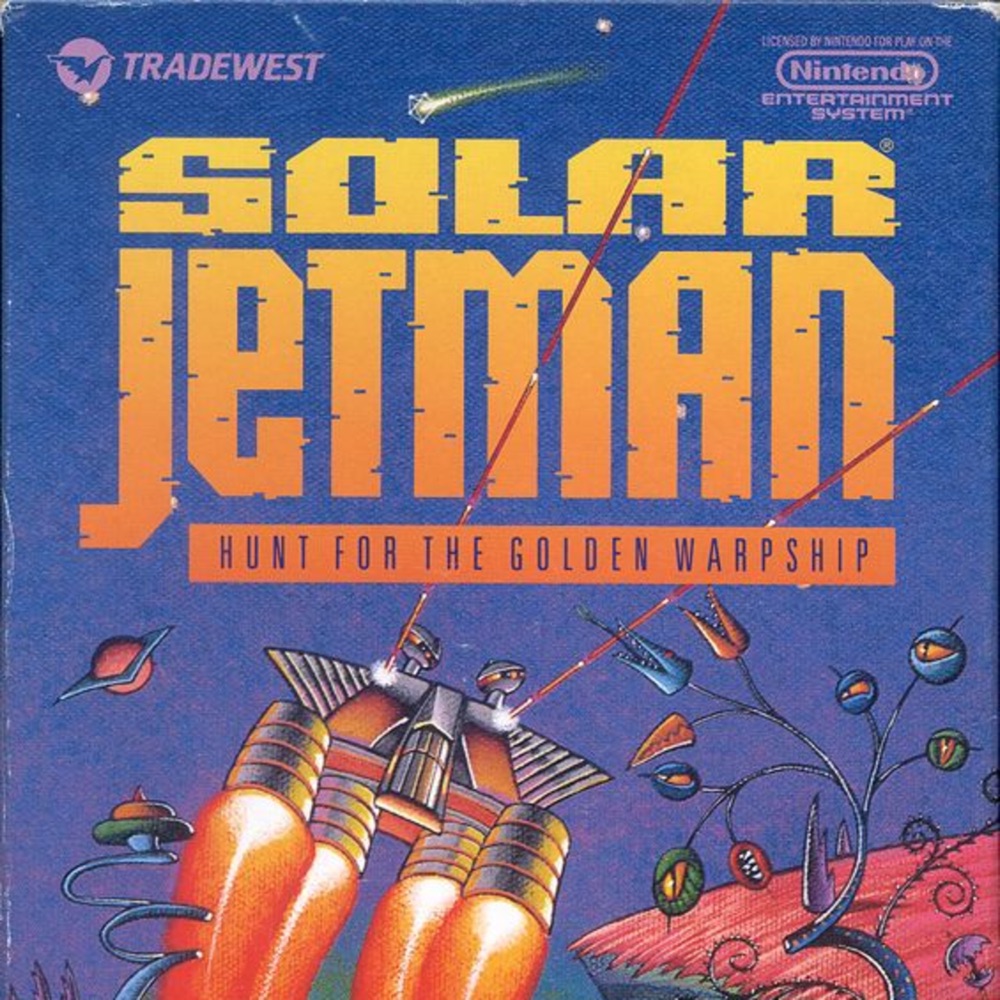
The golden warpship was once the most powerful ship in the galactic fleet. But the ship was captured by aliens, and its parts scattered throughout twelve different worlds. On each world deadly aliens, booby traps, black holes, and extreme gravitational forces guard the parts. It is now up to Solar Jetman to land on each of the worlds and retrieve all the parts so the golden warpship may be reassembled.
Solar Jetman is a Rare game, and the third in a Jetman series we had never heard of. It reads like a shooter and plays like a physics workshop. Mike, Sean and Joe came out almost entirely positive, so the Essential Games List was where we had to find our complaints.
What makes it work
- Physics as the whole game. Your pod has momentum and a thruster, and each planet pulls differently, so there's no learning it once and coasting. You can't push the throttle to a hundred without flying in the other direction.
- Cargo that fights back. You tow parts of the Golden Warpship, and other heavy objects, on a tractor beam that swings. Joe was impressed by how it changes everything: you wait for the load to straighten out, and stopping or turning abruptly sends it swinging the other way. It made us cautious.
- Upgrades that matter. Pickups can give you a force field or a super boost. Between planets, the Interstellar Marketing Company trading post sells weapons and equipment for the diamonds you collect, and everything but the piece and enough fuel is optional.
- Losing the ship isn't game over. The HUD has two life counters, and when the pod blows up you continue as the astronaut, jetting back to the mothership.
- A small field of view. You see just enough of the cave to guess at forks, and you build a map in your head. One grumble is an enemy sitting just off screen. A mapper upgrade sells a minimap, which is a decision, not a handout.
- No bosses until the end. Then it turns into a shmup in the finished Warpship, and the boss is the cave itself. Purple asteroid shapes open up with eyes, and you shoot them out. The pilot turns out to be the Space Loonies logo guy.
What holds it back
- Twelve planets of one loop. The caves narrow and the enemies get meaner, but the loop barely changes. A long play ran about three hours. Mike wondered whether one big Metroid-style world with fuel depots would have been tighter.
- The bonus round. Ten gems in ten seconds, after all that careful flying. It was brutal. A password system helps with the length.
Beyond the game
The earlier games are Jetpack, a single-screen shooter, and Lunar Jet Man, a moon rover side scroller. Every game in the series is a different genre.
The bottom line
Play it. Mike and Joe voted no on the Essential Games List. Mike said the game built around the physics isn't interesting enough to carry twelve planets, and Joe said he has nothing bad to say about it but that it doesn't clear the bar of an absolute must-play. Sean voted yes, as he's a sucker for physics-based mechanics, and compared it to Hardspace: Shipbreaker and REPO. One vote of three wasn't enough, so it stays off the list.
Written from our conversation in this episode.
- 🎮 Title/Overview:
Solar Jetman: Hunt for the Golden Warpship is the third game in the Jetman series, following Jetpac (1983) and Lunar Jetman (1984). It was released for the NES in 1990 (NA) and 1991 (EU), and later re-released on Nintendo Switch Online. - 🕹️ Core Objective:
- Navigate Jetman’s pod through caverns across 12 alien worlds to retrieve pieces of the Golden Warpship.
- Once all parts are assembled, players pilot the completed Warpship to the final showdown.
- 🚀 Pod Physics and Gravity:
- Movement is influenced by gravity, inertia, and momentum.
- Players must control thrust carefully to avoid crashing into terrain or enemies.
- Docking with the mothership to refuel and repair requires precision.
- 🛢️ Fuel and Resource Management:
- Fuel depletes gradually with thrust use, requiring frequent refills.
- Resources such as gems and fuel cells can be collected and sold for upgrades.
- 💥 Combat and Defense:
- Pods are equipped with basic weapons but can be upgraded.
- Shields offer protection but consume energy, creating a balance between offense and defense.
- ⚙️ Upgrades and Shop System:
- Earned resources can be spent on better engines, stronger shields, and specialized weapons.
- Upgrades improve maneuverability, fuel efficiency, and firepower.
- 🌌 Risk and Reward Balance:
- Later levels introduce more challenging gravitational forces and hostile enemies.
- Exploring distant areas yields high-value resources but increases risk.
- 🕹️ Development and Design:
Developed by Zippo Games and Rare, the game was influenced by Thrust (1986). It was planned for Amiga, Commodore 64, and Atari ST but these versions were canceled. - 🏆 Reception and Legacy:
The game received praise for its graphics and innovative gameplay but was criticized for its unforgiving mechanics. It gained a cult following over time and remains a notable entry in Rare’s history.
Auto-generated transcript. Each paragraph starts with its timestamp. Speakers are not identified.
Solar Jetman, Hunt for the Golden Warship.
And welcome to NEStalgia, a chronological exploration of every NES game released in North America. I'm Mike. I'm Sean. And I'm Joe. Solar Jetman is the third game in the Jetman series. Were you guys aware of the Jetman series? I learned this like 10 minutes ago. I just happened to come across it while looking for my regular YouTube video I have on. I thought that it was like, is Jetman related to Jumpman? No. Is this a Mega Man game? Judd, first off, Jumpman is a Mario thing, yeah. Well, I thought maybe there'd be a Jumpman in Mega Man at some point. Mega Man is Rockman.
But is there a Jumpman bad guy in Mega Man ever, in any of the Mega Men? Yeah, there's gotta be, right? Yeah. I would think so. Who was jumping Flash on PS1? I don't know. It's a trivia show today. I'm just dishing out trivia as we go along. I guess it doesn't really matter that this is the third game because we don't know the other two. But I also think it's funny that like, they didn't really make it a thing, right? This isn't Solar Jetman 3. It's a very casual sequel.
Right. Whereas like, we played Ultima 3 and they weren't like, we didn't put one and two on the NES. Like, no one's gonna know what's going on. Like, they trusted that people either like, knew of Ultima or played the other games elsewhere and now we're gonna pick up like an NES version. Yeah, but do you think now, like not thinking about it, did like games like Ultima or even like Final Fantasy, like, well I guess Final Fantasy did it right, but because they deleted some that didn't appear in the US. But like, was that dumb?
Should they, do they lose sales? Because people are like, well I didn't play Ultima 2, I can't play Ultima 3. Or do people just not think of video games like that back then? I'll tell you right now, my stupid ass, I wouldn't have bought any game that had a 3 in the title because I'd be like, well I didn't play the first 2. I mean, I definitely wouldn't now, but back then maybe I wouldn't have thought so much about it. I like the dumb voice that you apparently have in this alternate universe. It's not a dumb voice, it's a dumb voice I used to have. I feel like I used to talk like that.
Yeah, everybody did. Yeah, that's just a baby voice. But Solar Jetman sounds kind of like a regular game on its own. It doesn't, I have no, no indication that there was a solar Lunarman or lunar solar Jetman or stuff like that. Yeah, it's also not an, it's not an RPG. It's not telling a grand story. You can just hop in and get it, you know? So even if like, you know, bad example, but if it was like another version of Pac-Man, right? It's like, it's Pac-Man, you don't need to know how many versions came out before.
You're just playing the same idea, just done a little differently. Nobody cares like if it's Pac-Man or Ms. Pac-Man, right? Like nobody says, oh, if they would have called Ms. Pac-Man, Pac-Man 2, I never would have played it. Well, I don't know what happened in Madden 21. So I haven't played any of like Madden 22 or free. Right, right, right. Yeah, and that's why like I was reluctant to get the PS5 because I hadn't played the PS3 or 4.
Are you able to bring the character you create in Madden 20 whatever over to the next one? Or do you have to like remake them every time? I mean, you can bring in like players from the college game, I think, but at least. That's not what I asked at all. But no, you can't do that. Okay, see, so don't you think that would be fun? Like you always make Sean the Buffalo Bills quarterback, right? I mean, I did when I was a kid, but I'm not going to have a 34-year-old quarterback.
All right, all right. Solar Jetman, a little bit of a story here for you. The Golden Warship was once the most powerful spacecraft in Solar Jetman's galactic fleet. But that was before alien space pirates shipnapped. I love that. Shipnapped. That's like I've never heard that word before. It's immediately in my dictionary now. They shipnapped the vessel on its very last mission. What are the odds? The warship now lies disassembled and hidden throughout the galaxy. Why did they take it apart? This is like that thing in like Zelda where it's like, why is Ganon leaving the keys in various rooms, right? Shouldn't he just hold on to all the keys?
I mean, I think these are different situations. Like I think like, you know, Ganon... You think that the ship fell apart as they were like transporting it? No, I think that they're trying to hide so they can never be created again. Whereas I think Ganon is just very forgetful. Yeah, maybe like they don't want to destroy it in case they ever need it. But it's too dangerous to just leave fully built anywhere because it could be stolen back and then it's an enemy. So they gotta like, yeah, they gotta hide it throughout the galaxy where only they know where it is.
Like if I lose my wallet, like I know that I should just start scattering all of my credit cards and like driver's license and dollars. Yeah, rather than canceling them or anything. Yeah. Just scatter them. Make sure that they can't all be found at once. Yeah, well the numbers.
Each digit from your credit card number should be scattered throughout the country. I think my point stands though. You lost the credit card. It's now the person who found it scattered the credit cards. You know what I'm saying? That's what happened.
They're making it harder for you. They're like, you know? Which, okay, it's fine because now we get the idea of the game, right? You're gonna go to these various alien worlds and you're gonna try to retrieve the pieces of the golden warship using Jetman's... Jetman's spaceship, which is not the golden warship. It's just some regular old space pod.
The whole hook of the game though isn't just like fly around on these alien planets and you know, shoot enemies. It's not a shmup. Don't shoot up a bunch of enemies and try to like collect the piece and then bring it back to the mothership. The whole hook of the game is that this is a like physics and gravity 101 workshop on the NES where the whole thing movement is influenced by inertia and momentum and your thruster on your ship. So please, Joe, thoughts on that?
I mean, definitely a pretty unique experience from what we've played so far. It, I did boot this up thinking it was gonna be a shmup and it was pretty cool at first just to see the physics based movement. Like it really is about the, you know, every game has its own physics, but this feels like it's about the physics.
You have to think about the way the gravity reacts to your ship on the first planet, which is different than the second planet, which is different than the third planet, etc. So it is a, it is not like a game where you're like, Oh, I've played this kind of thing a million times and I just gotta get the hang. I just gotta like figure out what this one's hook is. Like this is a totally different experience than like a lot of other space based ship games.
Yeah. I think that the easiest way to describe this game would be like, uh, just an expanded version of asteroids. Uh, and that's great. Like I think of the very classic, very simple arcade games of, of your, that's probably my favorite in terms of just like the, the very basic, uh, structure and like the whole, the whole physics thing. Uh, so I, I had a lot of fun with this game.
I'm glad you brought up Asteroid, Sean, uh, cause I actually meant to do that before talking about the, you know, just kind of ground everybody. So I think that's a good point. One thing that's unique though, is like asteroids took place in space.
So your ship, once you like gave a boost, right, it just kind of traveled in that direction. And if you reach the end of the screen, it just kind of looped back to the other, uh, end of the screen. And that's cool. Cause it wasn't like a, it wasn't just a straight line. It was like, if you were going diagonal, you would wind up in the corresponding diagonal end of the other, uh, part of the screen. But for solar jet man, since you're exploring like this alien world, it's always like bringing you back down to the ground. And so you do kind of have this more like constant need to thrust, uh, you know, gently too.
You can't just give all your, you know, you can't just like send to a hundred cause then you're going to go flying in the other direction. You're always kind of like in need of pushing yourself, uh, both with and against where you want to go because you're not exploring in open sky. You're exploring, uh, like a cavern, a series of caves to try to find various items on, uh, these planets and the planets don't have the same, uh, gravity. So it's not like, Oh, I'm, I'm going to, you know, like use the first level to like learn it. It's like the next one might have looser or tougher physics. So I think all these things, uh, really spice up the gameplay, even if you already, uh, like, you know, got the gameplay loop on the first level.
Yeah. It's not entirely like gravity from whatever planet you're on doesn't really play that much of a, of a factor here, which you might think, but definitely your ship is, is not as agile as like, you know, the little triangle from asteroids. And that actually might be like whenever your ship blows up, which we'll get to, um, how you control your guy.
That might be a better analog for that, but it's not like just like trying to navigate these things with sort of like a heavy ship. Like you also are picking up objects that like via some kind of tractor beam, which are heavy as well. And not only are you then sort of fighting with that added weight, but you're also like trying to wrangle with the tension of the tractor beam. And if it's heavy enough, it may just start like pulling you.
And so it, it's fun trying to, uh, figure out like these, like it's a problem solving. It's, it's a much more methodical asteroids in that where it's kind of just like, how the hell do I get out of here with this thing? Yeah. And those things that you're towing as you pick it up, you know, like you said, they're different weights and everything. They're also swinging.
Yeah. And I was pretty impressed at like how, I mean, I don't know, I don't know how accurate it is. It feels accurate to me, but what do I know? But like, it, it feels like it makes a huge difference. Like when it's swinging in one direction, you got to like really correct and, and think about your speed when, you know, you're going to try and stop abruptly or change directions. And then the thing is going to swing in the other direction and pull you away. And it, it, it makes, it makes a big difference. And I would really love to see someone who is like the number one in the world at solar jet man, just like speed run this game, because I'm sure it looks really cool. But I feel like for most people playing this game, it's all about caution.
Yeah. Caution is a great point, Joe, because I think you try and, you try and go fast at first, right? The thruster is, uh, it does allow you to go pretty fast. So you do have to be careful once you enter the caves of like not, uh, hitting it too much or not throttling too much. But when you, with the swinging of whatever you're picking up, I didn't realize at first, like that the swinging, it almost makes it like impossible to move for a little bit. You know, it's, you have to wait for it to kind of become a straight line again, and then kind of force it in the direction you want to not, not moving around like too much, because then you'll start causing it to swing again.
And I, that extra piece of the momentum is essential to the challenge of the game because it's not enough to leave the mothership, go into the cave, find an item. Um, but then to bring it back to the mothership via this, um, you know, this rope system where you're kind of just taking it as cargo, that becomes like a whole new way of having to fight off enemies, get out of this cave, uh, not take too much damage. Because your ship has, uh, you know, a certain amount of damage it can take, but it also has like a certain amount of fuel too.
Yeah, I, I really, and not only are you sort of wrangling with all these things that we've been describing, but they're like, once you get off that first rock, uh, you've also got these sort of spheres that may be in a tractor or a repulsor.
And you have to, you have to deal with those. And at first I'm like, oh, I'm just screwed. Like I ran into one of these things and I can't even get away. And even I'm like trying to like wiggle back and forth and trying to get some momentum that way. And then I realized that like, oh, these things that you're picking up, like they're also sort of a progression system.
And like, as you're picking up parts of the ship or just, or just objects of, of use, um, you'll get like a, like a force field or you'll get, like a super boost, which is kind of necessary. And I really liked the way that that works. Like it's kind of, it's not so much binary of is my thruster on or off. Like you can also, uh, have, have a lot more thrust. Uh, and, and now it's even more like of a dance that you're trying to do. So I really liked that whole progression with each object that you pick up.
Yeah. I first, like, I, I kind of had the idea that like, oh, you're, I'll be able to upgrade my ship, but I wasn't really paying too much attention to it until I got to the second planet. I think it wasn't, there's actually an item that's too heavy for me or, or whether it's too heavy or if it's like somehow magnetizing itself to the ground.
Uh, either way I needed to upgrade that thruster in order, in order to, to get to it. And I thought that that was like, it does really feel like you're on an alien world exploring for parts. You know, it's like that. It's like, you feel like you're a scavenger on another planet and you're as, whenever you go away from your base, you're in danger.
You have to manage your fuel. You have to find parts to prepare your ship. And I don't know, it does, it does give you that sort of like that idea that like that, maybe that thing that we've all like played make believe as a kid of like a space ranger or something like, you know, lost on an alien planet. We all did that, right? Absolutely. Sure we did. You know, there's also a lot of optional stuff on each planet too. The only things you need to move on to the next planet is the piece of the golden space, a golden warship and, uh, the proper amount of fuel for the mother ship to, uh, be able to transport itself to the next planet.
Everything else is optional, but there's good stuff on there because you, you know, uh, whether it's like diamonds or whatever, like there's things that you can basically accumulate enough points to then in between, uh, purchase additional weapons or, uh, equipment. From the, um, I think it's in the manual, it's referred to as the interstellar marketing company trading post, which is cool. Uh, but you, you can do that stuff as well, but it's all optional. So it kind of becomes this, uh, you know, like how, how long do you want to stay on the planet?
It's up to you. And also how like risky do you want to be? Because I think as Sean alluded to, if your, uh, ship does run out, uh, it's not game over. Uh, you guys can tell me right now, but like, I actually thought it was going to be game over when, when the ship blew up. It was, it was a nice surprise to find out that solar jet man can then like, I guess via, uh, uh, jets in his own space, uh, suit can like continue to try to get back to the mother ship. Yeah. The first thing that alluded to this for me, I was like, Oh, something that I wonder what this is about is on the HUD.
There are two separate like life counters, one of which is your ship. And one of which is like an astronaut guy. And then I eventually, you know, blew up the ship as one does. And is the astronaut guy, not solar jet, man. That, I mean, I guess that's, that's the solar jet man.
So now was, was, was that exactly the, um, like the protagonist in like the first solar jet man game. And now he's in a ship and maybe like the next one, like the ship will be in a space station. He's just jet man. Yeah. Because I think the first one was just jet man. And then the other one is like lunar jet man. Yeah. The first one's just jet pack actually.
Oh, well that's stupid. Okay. So hear me out. First one, no suit. Second one. He's got a suit. Third one. He's in the suit. He's just naked out there. In a ship. Fourth one. He's in a suit in a ship in a space station. It's going to be like Russian dolls. We're just going to keep opening this thing. There's more things inside. It would be cool if he was in the golden warship inside his spaceship.
Yeah. And then the crew are just all in their own little ships talking to each other. Yeah. Drinking ship coffee. I don't know. Yeah. It's actually just like a space simulator in that sense. You're just trying to build like a little colony inside the golden warship. You've already taken out all the alien enemies.
What are we describing here? Speaking of the alien enemies, they're in every planet in the caves and just kind of like floating about. Are they what's difficult about the game? Or is it the like don't hit the walls of the caves? Like which part is more likely to do damage to your ship? It's symbiotic. Like they are there.
Nothing's difficult. But when there's enough like turrets or some weird like snake thing or a an orb that will open up and shoot you once in a while. Like these are all distractions that will make you either forget to sort of turn off your thruster while you aim to shoot at them. And then your whole situation is going to go crazy or you have to. It's just I like the way that that it plays off like the environmental and the enemy issues together.
Yeah. I guess what I was going to say is almost the same thing where I think that the harder part of this game is navigating the physics. But it is very hard to fight enemies while navigating the physics, you know, like. So, yeah, the physics make the enemies the enemies hard in between levels. There are also that bonus game where you have like a certain amount of time to collect to collect stuff just as solar jet man.
And I couldn't quite. They're diamonds. I don't think there's anything else, but I couldn't quite figure out at the end of that stage. Like, is that you're part of the Federation of Space Loonies? Yeah. I really I really like the world building here. The you got the Federation of Space Loonies. You got the market that they're doing. They're way ahead of time, way ahead of their time here. Yeah. But the Federation of Space Loonies like logo looks like it would be like it's like a beer company or something. Yeah. It's very. It does not look like a Federation of Space Loonies to me.
As far as that bonus level, I do just want to say, like, I might as well not even play it. Like, I just I don't know why I'm so bad at it, but like, I will never get all of those diamonds in the time limit. Yeah. It's not it's not a lot of time. I think that's the problem. There's 10 seconds, right? It's 10 seconds for 10 gems. Well, we've been playing this game like super methodical, trying to like adjust our vector of approach. And it's like now do it in 10 seconds. Yeah. Give me like a practice run first and then see if I can do it in 10 seconds. Yeah.
Now, the later levels, you know, the caves obviously start to become more narrow. The enemies become a little more aggressive. But ultimately, it's the same loop. I think the saving grace is that the scope of view that you can see at any given time in the game isn't very much. And so a lot of the game becomes exploration around these planets, you know, and they keep getting larger and narrower.
And like you kind of have to like build a map in your head. It does not require any graph paper. Like it's not that kind of game. But like you do have to build a map in your head to figure out where you're going. But it also feels like you don't know what you're going to see next because of the field of view.
And sometimes I complain about that when it's like either too zoomed in or too far out. I think Solar Jetman got it right in the sense that you can only basically see like if you're in a certain area, you might see like just enough of the cave to know that like, okay, this leads to another, you know, down another fork in the road or whatever. But you wouldn't know that like to your left, there's another area that you can explore as well unless you went over there. You know what I mean? Like if it was just a bit more zoomed out, there wouldn't be a lot of mystery.
Yeah, I think that you are intended to feel a little bit lost. Even if you're not lost, it's supposed to feel like you're, yeah, it's an alien planet. It's something you're not familiar with. And that kind of, I think the one part of it that I, that I, if I had to complain about it, the one thing is like, I don't love when there's an enemy just off screen, like literally just off screen.
I wish I could see it, but you can't, you know, you can't reconcile that with the fact that I do like not being able to see too far ahead of where I'm going. So it's like, you know, you got to pick one or the other. And I think that this was the right choice because it, yeah, it does feel a little bit like a maze or like, you know, like part of the thrill of the game. It's like, am I going to be able to get back to my ship? Do I even remember which way I came?
Yeah, that's why I don't have an issue with this. Like, I think, you know, they're also, while I wouldn't say that there are real points of interest on these maps, they are still like easy to create a mental map in your head. And actually, when you're at that market thing between levels, I did see that there was an upgrade, like a map, like a mapper. And I bought it and then I didn't really know how to use it because I would have expected like a mini map to show up. But that did not happen. I don't know if I just like forgot to do something simple like press start. Yes, exactly. Is that it? Yeah.
And then it does show a mini map with which is like funny because it's not using the entirety of the screen to show this map. But like there's nothing else of substance. Like, I guess they're trying to make it look like you're like looking at a HUD, looking at a map. So this way it's not, you know, but it's like it's the maps are already kind of small because it's such a large area that you're like, could you bring this in a little more? But yes, you can see basically the map as you're going once you once you get this mini map thing, which is like it's another great thing that you don't unlock like incredibly early in the game.
Or I guess I should say like right away, you know, it's not something you have. It's something you have to choose to want over other things. And it's not something that you can track in real time. Like you can't see the map and fly around, which I think helps as well of like a old, you know, like, wait, where are we going? And you break out the maps in the car. It's like, I don't know how we ever did that stuff. I remember I used to print out like MapQuest instructions step by step and and like follow them in the car. And I was like, that was probably worse than GPS. It definitely was worse than GPS. But I meant for like our safety. Yeah. Like it was good for a sense of direction. Hey, I got to the mall that day.
I'm I've I'm notoriously absolutely ruined by GPS. Like, I don't know. I don't know my hometown where I live my whole life. I don't know how to get around to like I just it's just bad. I need to I need to take take up a month. I just don't use my you need a digital detox. Yes. No podcasts.
Who's going to say and I'm Joe. No, he'll come in on like, you know, tape to tape reel. I'll record a hundred and I and I'm Joe's ahead of time. And then you could just use them whenever you want.
There's no boss fights in the game. The enemies do get tougher, but there's no boss fights in the game. Were you expecting that? Like at the end of each planet, like before the mothership takes off, you got to like fight a big alien or another big ship. I thought it was just about this. Yeah. Once I was like, I got the idea of what this is. I think I would have been more surprised if there were boss fights. Because, yeah, it feels like this is about. This is about finding your way. In life. This is about GPS.
Apparently, the game is very long. Twelve planets. It does take a lot to find everything. I don't know if I'm watching a 100% run here where they got everything in every planet, but it's three hours. And that's pretty long for an NES long play. Obviously, any game could take me longer than three hours to beat on the NES. But here we are. When you get to the end of the game and you collect all the pieces of the golden warship. Do you guys know what happens? No. Tell us. The game becomes a shmup.
Really? How funny is that? Is there a boss? Is there a boss at the very end? Yeah. So, basically, the reason the game becomes a shmup is now you're in the golden warship and it's auto-scrolling through a cave and everything. And there's no even alien enemies. You're shooting purple...
I don't even know how to describe it. Rocks. They're like asteroids. Yeah, like asteroids. They literally break apart like asteroids. Okay. No, no. Because here's why I said I didn't know how to describe it. But eventually, those purple asteroid-like things open up and have eyes. Ooh. So, we're getting right. Lovecraft. Oh, yeah. Right. And then it's revealed that actually this whole part of the cave is, yes, a final boss. Oh. There is one boss in the game. It is a cave itself. And you have to shoot all of its eyes out as it shoots asteroid projectiles at you.
You know what? I'm watching this as you're describing it. And I really like it. It's kind of... There's kind of a cool design element of like you've been putting together this ship and now that you have it, like, you're gonna go, like, you're gonna go fuck some shit up now. And you have to fight the very thing you've been traversing through. Like, that's cool. Yeah. It's pretty neat. I think more so you've been putting, like, a really small puzzle together that looks like the ship and now you've got the ship. I mean, you weren't, like, you know, you weren't, like, doing any kind of, like, mechanical work. Well, no, but you found the hidden pieces of the ship that were reasonably scattered throughout the universe.
Quite. The worst thing that could have happened is you find all the pieces and it just says, congratulations, you found all the pieces. Right? Like, it's amazing that they actually were like, and then you can drive the car.
Yeah. From Wheel of Fortune. Yeah. There you go. It is funny, though, that, like, as soon as you defeat the alien cave thing, there's no, like, death animation or anything, like a victory thing. It just immediately flashes to all white text on black. Congratulations, Jetman. You have completed your mission. Time to put your feet up and relax in the comfort of your luxury golden warship. The end. Oh, it's like a sports car, too. Yeah. And then you get to see him, though, and turns out, remember the Space Loonies guy? The guy on the logo for the beer company, the Space Loonies? Mm-hmm. Yeah, that's him. He is the Solar Jet Man. He has that long-ass jaw.
Well, I mean, I kind of assumed, you know, they all kind of look like that, yeah. But that's who you've been controlling? That's who you've been controlling is the guy who's the Space Loony. Well, he's one of the Space Loonies. Sure. He's probably more like him. Potato patata. This is a rare game, not in the sense that it's hard to find. It's made by rare. Yeah, it's cute. It's great. Apparently, as I mentioned, there are other entries. I didn't look into these at all. Sean, you seem to at least know of Jetpack and Lunar Jet Man. Did you check out what kind of game they were? No. Great. Who needs to?
Not this podcast. I thought when you said Lunar Jet Man before you were just joking because it was like the opposite of Solar Jet Man. I didn't know that was really what it was. No. Oh, yeah. I was pulling that from the Wikipedia. Yeah. Though I did accidentally say Lunar Man, like it was his last name. Okay. Now, the Russian doll theory is getting kind of scary because in Jetpack, there is no ship. He is just in the space suit and it's all on one screen and you're just kind of like shooting at asteroid projectiles, you know, just trying to stay alive. Wow. Yep. Huh. But Lunar Jet Man, okay, I think we all know where this is going. It's all on the moon.
So, no spaceship necessary. You're on a Land Rover. That's like with wheels? Yeah, with wheels. Yeah. I'm watching it right now. That's weird. No, no. This is great. So, like, if you did play the other games leading up to this, it's like, finally, we're in a spaceship.
Like, we're doing some space stuff. Like, it's kind of neat that they made this series where it's like, no, every game is going to be completely different. Like, it's going to be in the, it's going to be a sci-fi game and it's going to star our guy. But it's going to be a completely different kind of game. Jetpack is this, like, really arcade shooter game with the, you know, you're just, you're just in your space suit. Lunar Jet Man all takes place on the ground and you're, like, it's a side scroller. And now, all of a sudden, it's like, well, we have the technology thanks to the NES. Let's make a physics-based spaceship game.
Yeah, I think I've talked on the podcast about, like, I'm okay with there being a good formula for a game and then making a sequel that's just more of that, maybe a little improved. But in this case, I also like the idea that, like, yeah, let's just, we made that game, let's exercise our creative muscle and say, what would it be like now if this guy was on a ship on a different planet? What would it be like if he had to walk around on the moon and, like, just design their game around these scenarios? As long as you keep doing it well, that's kind of cool. Do we get a fourth? Not that I can see. Wow. That's weird, right? The multiverse. Time travel. Looter time traveler.
I think all of the Solar Jet Man games, though, or whatever this, what, the game, this game is called Solar Jet Man, so what's the franchise? The Jet, the Jet Chize. The Jet Chize, yeah. The Jetverse. Jetverse. I think everything in the Jetverse is playable on Rare Replay, that Xbox One thing where they were like, finally, you can play Banjo-Kazooie again. Like, they just keep throwing that in people's faces. Like, want to play Banjo-Kazooie again? Like, and these other games?
Not particularly. Yeah. I want to play Banjo-Kazooie again, but probably when my analog 3D comes in, in 2040. Oh, nice plug. Yep. Very cool. Yeah, plug for who? I don't, we don't get anything from them. That company, famously silent on anything. They will not tell you anything, and then one day- Are you sure it's not a scam? No, one day it'll just show up on your door. It's like, here you go. Here's the thing you paid for. You paid in advance. It's on your door. It's not even on your doorstep. They open it up, they put it on top. It actually goes through, it's like one of those, like, Bethesda glitches, where it's like, just floating in between the door. Anyway, anyway.
Legend has it, don't ask me, because I don't have a Nintendo Switch online subscription, but apparently you can play Solar Jetman there. So that's like another one where it's like, huh, rare a Nintendo these days. I mean, at least in the NES days, best friends, making games all the time. I think Rare has like the largest third-party developer for the NES at this rate. They're always releasing games. But lately, you know, now that they're owned by Microsoft, what's Rare's legacy? Is it the Microsoft side or is it the Nintendo side? It's the Kinect. There you go. Everybody wanted to play that game on Kinect with the animals where you just pet them. I like petting animals. Yeah. And then they got their lunch ate when every video game was like, wait a minute, if we show that you can pet the dog, you'll buy our game.
Have you seen that? Like, even in the latest Nintendo Switch 2 Direct, there was like one game that was like, it did a whole trailer. It had the title card. It had the, you know, date that it's going to be released and all the platforms it's going to be on. And they were like, wait, wait. They go back to the game and they just show him petting a dog and then they're done.
That was like the little button at the end of the trailer. Honestly, if you're going to have a game that has a, like a cat or a dog in it, like you better add an interact button to pet the sad cat or dog. Like it's just sort of, it's just common knowledge. I mean, I think that developers are like forcing this into their game because it's so important now because I'm pretty sure Hogwarts Legacy, if you go to a cat and you press pet, it cuts to black and then shows like a scene of you petting the cat. Cuts to black? Yeah, I swear. Like, unless I'm misremembering.
I'll double check and I'll get back to you next week. So we've been pretty high on Solar Jetman, but there's no dog or cat to pet. Automatic fail. It's pretty weird, right? I get that they're in space, but they must have figured out how to bring the pets to space. Pets in space sounds like a Wii shovelware title. I'm out of ideas. Let's do it. The Essential Games List.
Somehow we managed to go the entire episode talking very positively about the game. And I think maybe that's because the Essential Games List might be a time where we can air our grievances with the game. I don't have a problem with the physics or the gravity, the momentum-based controls. I think all that stuff is handled really nicely. I just wonder if, like, the game they built around it is actually interesting enough to hold your attention through 12 alien worlds.
I kind of wonder what would have happened if it was just one big alien world a la, you know, like a Metroid game or something where you're just in this one big alien world. And you've got to find all 12 golden pieces throughout the caves of this world. And you've got to manage your fuel and find new fuel depots inside the caves to almost like, you know, Sonic the Hedgehog style, like find the bubbles of air, like find the fuel. I'm redesigning the entire game, which is bad. I shouldn't do that. But that doesn't mean that I hated the game I played. I just don't think the game I played here was enough to push it over the edge for the Essential Games List vote from me. But I think this is a play it for sure.
Sean? Yeah, it's, I've been kind of, I've been kind of struggling with this one because I kind of don't have any issues with this game. Um, you can, I guess you can sort of criticize that there's a lot, but it's got like a password system. So you can, you can pick up and play whenever you want. So I'm not going to get a strike for that. I'm not going to say no to content.
Um, and yeah, I just really like the basic premise and every interaction feels important and I, so before, before I give like a final, uh, a final verdict here, I want to, I want to talk about two more modern games that kind of give me the same vibe here. So one is called hard space ship breaker. It's like one of those work games where you're just a guy that like literally break spaceships apart and like a space dry dock. And it's kind of got the same, like be very careful and methodical. And if you do a thing wrong, it's going to be a catastrophe and you'll probably blow up. It, it, it, I've spent a lot of time just sort of zoned out doing that.
And the second one is a more recent game. One might even call it a mean game called repo where you've got like these, these sort of tractor beams where you're trying to maneuver objects around a space. And then it ends up at certain points turning into like a, like a, a furniture moving simulator. When you get like three people trying to move a thing, it's, it, it sounds really boring when I describe it, but you know, it can be fun.
And that also has like enemies that are like distracting you from doing it well. So it's two very different games. And I think what I'm trying to get at here is I, these are, these are games that all kind of share similar mechanics. And I think I'm just a sucker for this kind of physics based mechanic. So I'm going to vote for this to be added to the essential games list.
Joe. I'm also of the, of the, uh, idea that like, I don't think there's really much that I can point to that I think is wrong with this game. I think that it's, it's really cool the way that, uh, the way that it works, the way that it makes you think differently. It is, and now it's definitely not as much in like my niche as, as what Sean's describing, but, uh, but it is something that I, you know, I find, I find fun to kind of like have, have this, this style once in a while.
Um, I think that, I think that this is a great game. I just don't know if it is, if it exceeds expectations enough to be like of that level. I feel like I've had votes like this before where I'm like, I don't really have anything bad to say about it. I just don't know if it's like, it's on my list of like, well, yeah, this is an absolute must play. I think some people would really like it. I think other people would just be like, meh, it's fine. But I think just overall, it's like a, it's a really good game for being on the NES.
And it, uh, I, I can't think of examples of more modern games that give me the same, the same thing. But like, if I had a modern game on like PS5, that was kind of like this kind of thing. I'd probably also really like it. But I also wouldn't say like, this is a must play. Everyone's got to play it. I mean, it's just, I don't think it reaches the level for me as some of our essential games. So I'm going to keep it off. But I do also think it's a, it's a definite play it.
Joe, I think I hear what you're saying. Like mechanically it all works. There's very little that's frustrating about it. And anything that is frustrating is part of like the, you know, the designed experience and something that you're designed to overcome. But it doesn't mean. I think it's well designed. Right. That doesn't mean that it sparks joy though, when you're playing. Sparks joy. I mean, I don't know if I'm saying that either. Cause it does, it does spark joy for me. I do enjoy it. It's just, I just don't think it's S tier for me, you know? Okay. Yeah. Okay. That's, I, that's kind of what I meant, but maybe sparks joy was too light and too Marie Kondo for the conversation.
Very much. Another, another, you know, just another point. And Sean, this isn't directed at you because. No, I know it's directed at me. No, no, this is, this part isn't directed at you, but like solitaire is a game I have no complaints about, but I don't know if I'm putting that on the windows 10 essential games list just because I have no complaints about it. Do you know what I mean? Well, my complaint for solitaire would be that it's kind of boring. No. That's why I wouldn't use it. Solitaire is timeless. There needs to be two players. I don't like solitaire. Solitaire is timeless. Sure. But it's not fun. If I just keep saying that, if I just keep saying that you're wrong and I'm right, as long as I say it, it doesn't matter what happens next.
know how we voted. Solitaire sucks. So solitaire wasn't going to make it on the essential games list because somebody who liked it wouldn't vote it for it. And somebody who doesn't like it also wouldn't have voted for it. Joe, just out of curiosity, would you have thrown solitaire on the essential games list? I mean, I'd have to I had to play solitaire again. But but no, I wouldn't. I wouldn't put solitaire on the essential games list. I used to play it on on Windows, but I don't think I ever actually knew how to play it. You know, I think I was just like, hey, click and see the shuffle happen. You just liked to watch the shuffle.
OK, then you must have last played it when you were six. It's not it's not a hard concept to grasp. Yeah. I mean, I think. OK, OK. I think I was pretty young. All right. Yeah. No, I love this conversation. What? I love this conversation because no, it's no big deal. Like, you're right. Solitaire. It's like when when I first got a computer, it was just cool to see shit happen on the computer. I totally I vibe with that. That's why I play all these NES games. That is a I think that's a great review for solitaire.
Yeah. So maybe solitaire goes on like the essential essential. No, essential Windows 95. No, solitaire sucks. Huh? How do you play solitaire? Solitaire. Let's use the rest of this episode for the rest of this episode. So basically all the cards, as you mentioned, are shuffled around, you know, and you have to reveal cards at the top that can stack with the proper sequence below them. I think we should just slowly fade out. Well, Mike is describing solitaire. Well, wait till we get to wait till we get to spider solitaire. Spider solitaire is solitaire, but you're in the forbidden woods. And then all of a sudden there's spiders everywhere. Yeah.