339 · Dungeon Magic: Sword of the Elements
Dungeon Magic is a first-person role-playing game similar to Dungeon Master and Might & Magic. As in the former, instead of the usual turn-based combat you fight your enemies in real time, parrying to avoid their blows and attacking physically or casting offensive magic to hurt them. As in the latter, you explore large outdoor areas, towns, and dungeons.
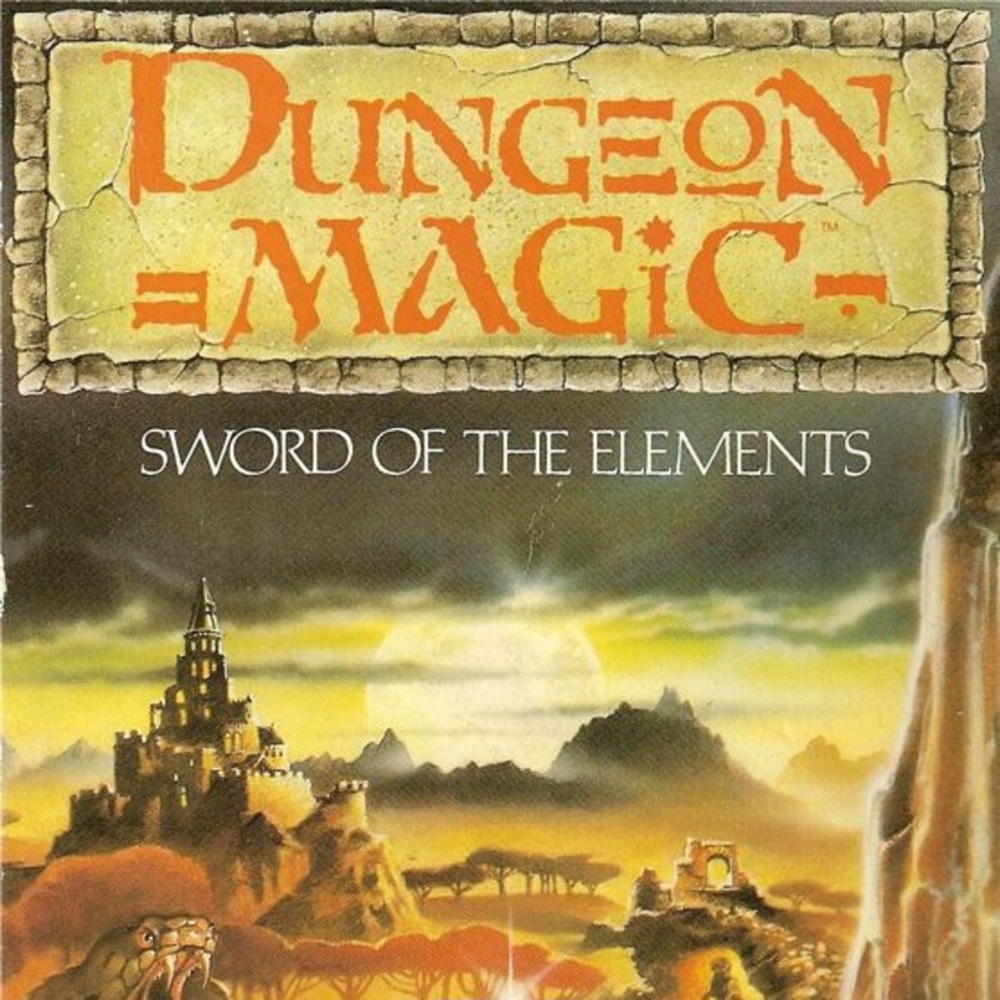
Taito's Dungeon Magic promises a real-time, first-person RPG on the NES, and the box art and typeface practically say Dungeons & Dragons. Only Mike and Sean were on this one.
What impresses
- The ambition. Where earlier games drop into first person only inside a dungeon, this does it for the whole world. A fast pitch sounds like Elder Scrolls Arena on an 8-bit console, and we admired that it even runs.
- The HUD. The view window sits top center, with hit points on the left, enemy health on the right, and your portrait, a quick inventory and a menu for everything below. It is all on one screen, so you never navigate away from what you're doing. The little window has more color and texture than the wireframe hallways of Golgo 13 or The Goonies II.
- Magic with ideas. There are five schools, fire, air, water, earth and fairy, with three runes each that combine into 243 spells. Fairy magic looked like the leftover element, yet its map and enemy-data spells are the ones strategy guides recommend. Leveling up means cashing in experience with a wise man of your school, which at least feels earned.
What sinks it
- Getting lost. The world is 16 sections, each a 16 by 16 grid, which is 256 steps of nothing in a direction. Bricks look alike, the towns have no labels on the inn or shops, and "every town is basically Silent Hill." Even the compass is missable.
- Boxed-in combat. You only see two squares ahead. Enemies attack from all four sides, and a boy in town will plant himself in front of you with no way around. We were reduced to dodging people, and damage lowers your own output, so you avoid fights you also need for grinding.
- No payoff. The manual ends with a mini walkthrough, and without it we wouldn't have known what to do. We called it a reverse Shadowgate: a big space with nothing interesting in it. There's no reason to explore, just go to the next dungeon. The plot is a generic 500-years-ago villain who is back.
- Odd choices. Spells drain HP, since there's no MP. You have to pick a school up front with no party to cover the others. And B confirms things, which we refuse to accept on any console, least of all while cobras are biting you.
Beyond the game
The 1994 Dungeon Magic is an isometric beat-em-up with nothing in common except the title. Famitsu ran a full-page ad in 1989 billing this one as a "VRPG," a visual role-playing game.
The bottom line
Skip it. We both voted no, so it stays off the Essential Games List. Our praise amounted to "cool, you did it," and it took 25 minutes to reach the first quest giver, even with no enemies in the castle. We think someone who loves hardcore dungeon crawlers might appreciate the restrictions,. As it stands, we wouldn't send anyone here.
Written from our conversation in this episode.
- A broken peace, a mystical prophecy
- NES Longplay
- Manual
- Probably no coincidence that the box art leans into the Dungeons and Dragons Aesthetic
- The demand is always there for taking the promise of D&D and making it so you can play it with an AI dungeon master
- 500 years ago, the Kingdom of Granville fought a terrible war with Darces the Dark Overlord. A great hero, the warrior "Magi", rose to challenge Darces. He owned six magical swords and a powerful suit of armor that was impervious to all but the most powerful of magic. Five of his six swords were Elemental blades, each created from the rarest metals on earth. The sixth blade, "Tores", used an even more powerful metal.
- Using his powers, Magi defeated Darces, and exiled him to a far away land. After defeating Darces, Magi grew old and died.
- Now, on a dark, stormy night in the Kingdom of Granville, Darces the Dark Overlord returns to the land.
- Real-time first-person RPG
- Ground-breaking doesn’t always mean good
- But its more than a dungeon crawler, its a whole game world crawler haha
- Menus
- B to confirm?!
- Weapons and Armor, Spells, Inventory, Use, and Camp
- Exploration/Navigation
- The game world is divided into 16 sections, each further divided into a 16x16 grid, resulting in 256 steps per section and 256 steps on each side of the overall map.
- Towns
- Combat
- The game allows attacks from four directions, but you can only see and attack in one direction.
- It's crucial to stay aware of your surroundings to avoid dangerous side attacks.
- Being hurt reduces your damage output and increases your vulnerability. Cure it as soon as possible to maintain combat effectiveness.
- Elemental Magic = Earth, Water, Air, Fire, Fairy
- Each element has three unique runes, which can be combined to cast 243 different spells.
- NO MP so some spells drained the player's hit points instead.
- Schools of Magic:
- Fire (F): Offensive spells, not commonly used by the writer. Runes: Square, Left Triangle, Right Triangle, Simple Triangle (F1, F2, F3).
- Air (A): Travel spells. Key spells include Return (A3, A3, Blank) and Exit (W3, W2, Blank). Runes: Chevrons (A1, A2, A3).
- Water (W): Defensive spells. Important spells: Physical Shield (W3, W3, W3) and Magic Shield (W2, W2, Blank). Runes: Vertical lines (W1, W2, W3).
- Earth (E): Curative spells. Key spells: Cure Poison (E2, E1, Blank), Cure Paralysis (E2, E2, Blank), Cure Hurt (E2, E3, Blank), Uncurse (E3, E2, Blank), Waterwalk (E3, E#, E#). Runes: Dots and circle (E1, E2, E3).
- Faerie (R): Utility spells. Useful spells: Terrain Map (R1, R1/R2, Blank), Full Map (R2, R2, Blank), Self Data (R2, R3, Blank), Enemy Data (R3, R1), Faerie Transport (R3, R2, Blank). Runes: Horizontal lines (R1, R2, R3).
- Levels can only be gained by visiting the "wise men" at the villages at the right number of experience points and receiving a baptism from them. You have to belong to the school of magic to level up with that wise man
- Sequels and Spinoffs
- Essential Games List Vote
- Next week
- NEStalgia Byte
Auto-generated transcript. Each paragraph starts with its timestamp. Speakers are not identified.
Dungeon Magic, Sword of the Elements, A Broken Piece, A Mystical Prophecy.
Nostalgia And welcome to NEStalgia, a chronological exploration of every NES game released in North America. I'm Mike. And I'm Sean. That's it today. Sean, probably no coincidence that the box art leans into the whole Dungeons & Dragons aesthetic, right? Well, I don't have the box art in front of me, Mike, but I can imagine it's very generically fantasy with swords and shields and maybe a dragon or something like that. Absolutely all true so far, but I feel like even the typeface is like, you know, whatever the font of Dungeons & Dragons is, is like also the font of Dungeon Magic. Like they, they were able to get away with it. So they did. Because even today, right?
Today, the promise of like, you know, oh, you can do, you know, we're making a video game and it's going to be like Dungeons & Dragons, but the computer's the Dungeon Master. Like that still has a lot of weight today. People want to play those kinds of games. Boulder's Gate 3 obviously was like, you know, a fast pitch of that game might be something like that. But especially when video games are like brand new or at least brand new to the, you know, mainstream, not just the computer audience.
You know, most people who just like hear about Dungeons & Dragons think it sounds like the coolest thing ever until they like, you know, actually start playing it and realize all the work that's involved and say, oh, if only somebody would do all this work for me. I feel like there's a little bit of bitterness when you say that because I remember you trying to DM a Dungeons & Dragons.
Everybody has tried at one point, whether they, whether they know it or not, everybody has been DMing some kind of form of Dungeons & Dragons as a side hustle. I still never tried it. I still liked it. I thought I could do it, but that's not, that's not why we're here. Right, but. We got, we got a, it's funny that you say Dungeons & Dragons and I guess like that is. Especially of the time, the main comparison here.
But I, like I think wizardry comes into the conversation here. Like that's, that's probably part of it. But I, when I look at this game or when I started playing this game, I'm like, oh, this must have been like what Elder Scrolls, Elder Scrolls Arena or like Daggerfell was like. Or if you were to put either of those games onto the NES, this is what would show up. Because it's a very unique kind of game.
I believe we were talking maybe at the end of last episode about how this is going to be a real time first person RPG. And that just sounds impossible on the NES, right? There are so many kinds of games that I thought didn't come around until at least the 64 bit era. But they're, they just seem to keep popping up on the NES, surprisingly, right? Like whether or not this game is good, we will get into when we do our essential games, let's vote at the end. But you just have to, at the very least, be surprised that it's even something you could have done on the NES.
Yeah, the ambition here is commendable. So the, the level at which it works is still surprising whether or not it does or not. Right. Go ahead. Sometimes, sometimes when a game is difficult because of the console itself, right? Like, oh, if this, if this could have just waited a little bit and, and, you know, had the right technology behind it, maybe it would have been a better game. In the past, we've been quick to, you know, jump right to the flaws and talk about what doesn't work. But you have to remember, especially when you're developing a game for the NES, a lot of thought has to go into what's actually possible and what's the best way to communicate that to the player.
And so to do it in real time here, rather than some kind of turn-based or overworld where then you go into the dungeon crawling thing. Because remember, it's not, this is like not a dungeon crawler. This is like a world crawler, right? The whole game is, is that dungeon crawling thing that we usually see where all of a sudden it switches to first person and you're just looking at a bunch of walls. They did that for the entire game with dungeon magic here. So the way that they did it with menuing and the UI itself, there's a lot to unpack here. So what do you want to start with? Do you want to start with the menus? Do you want to start with the HUD layout?
You know, you pick. Yeah, that's, that's a good question. I guess, you know, because it is literally half the screen. Yeah, let's just go with the HUD in general. So you, you have a window in the center top and that is your view of the world. And you can move around. You've got like, everything kind of works on a top, excuse me, a tile system with this sort of faux 3D. You, you walk forward, it populates what you can see now. Um, and that's just sort of how you look around. To your left is your, your hit points. To your right, maybe enemy hit points if there is an enemy.
Uh, below, you've got an image of yourself. You've got a, like a little, I guess, quick inventory of, of items that may be necessary at all times. You've got a bunch of other little stats and then you have this whole other menu for literally everything. And I think that the most surprising thing about this is if you were to tell me that there was going to be an equivalent of an Elder Scrolls game on the NES, I would have thought there'd be several levels of menu diving. And, again, whether or not it works or not, the fact that they were able to put everything on here, it's, it's, it's more or less seamless. That you never have to navigate away from seeing what you're doing. Um, that's, that's still impressive.
Yeah, and I think that's well put. Uh, I think you do have to, uh, describe how small that screen where the actual gameplay happens, though. Because we have had in the past, we have had games that, you know, to, to add more definition to the area, they kind of create a smaller screen with some menus around it in order to, uh, you know, maximize, uh, the graphics.
This one, uh, I don't know if it's just because of how much the game actually has to load, uh, in terms of, you know, what's actually, like, where enemies are and, and what's going on in the world, that this was the only screen real estate possible. But this is a really small screen to the point where, yeah. Go ahead. Yeah. I agree. But I'll, I think my counterpoint here, to the game's credit, is whether we're talking about Galgo 13 or, uh, Doonies 2 or whatever other games have done something like this, there's more detail in that little box than in any of those games. Like that, I mean, I'm not saying that this is beautiful graphics, but it's more than just basically a wireframe of a hallway.
At least there's color, there's texture, there's some semblance of it being a place instead of a, uh, a Windows 95's, uh, like, screen saver. Right. Uh, and you know, for a game that has a lot of, uh, details to it of just even learning how to play this kind of game, I mean, you think about, you know, not everybody was playing every single NES game that released in North America. Some were getting, like, Super Mario Brothers because it came with the console, and then Duck Hunt as well because it came with the console. And then it was like, oh, uh, you know, I'm, I'm into Wizards or whatever, I'm gonna just get Dungeon Magic as my next game.
It's like, that's a really hard jump to go from Super Mario Brothers platforming and, you know, using a zapper to, like, this kind of game. And, you know, we're not gonna be able to break it all down in the episode, but I think even the manual struggles a little bit with, like, just how much they should or should not get into.
And certain areas are, like, really detailed about, like, you know, what, you know, what's on your HUD and, like, status conditions and stuff like that. But it doesn't really get into even just, like, the combat, which is strange, right? Yeah. Because that's such a huge part of the game. I mean, it's simultaneously not very helpful and entirely necessary because it's not even just that some information could have been omitted or should have been added.
It's that. But also, you don't even know what to do in this game unless you have the manual in front of you. Like, there's a little, and thank God for this because it wouldn't have been playable otherwise. At the bottom of the manual, or, like, the last couple pages is sort of a mini walkthrough of the beginning of the game of, like, all right, go get some stuff. Then go see the king and queen over in the castle. All right, now come back and, like, swap some stuff. Like, it's weird that it's getting that detailed.
The only other time I've seen something like that is in, like, the PlayStation 1 release of Final Fantasy VII, which was just an ad for the Prima Guide. But the fact that it was necessary because this game doesn't have any real, like, contextual, like, at least in the beginning, contextual, like, this is what you should be doing. Or, like, go here.
It's weird that that manual is kind of a blessing and a curse. Yeah, yeah, but it's a necessary thing because, as you mentioned, the game lets you free to do whatever you choose, including getting completely lost and having to just try and start over and do something different because you just can't find your way around. Mm-hmm. It has a little bit of, you keep saying Elder Scrolls. For me, you know, I didn't really play Elder Scrolls games.
So for Fallout, too, like, leaving the vault and being able to go anywhere, it's like, yeah, most likely you're going to go to the nearest town because of whether the game guided you there or because it's something you see in the distance. But it's totally possible to just keep wandering the wasteland and just find, you know, like, really difficult enemies that you're not quite prepared for yet. And that's also possible here. It's totally possible to just walk until you face, and pretty early on, too, just enemies that you're just not tough enough for yet.
And I do think that's why they probably include that in the manual of just, like, some kind of guidance. I don't hate that they didn't put it in the game, though. Um, yeah. Like, in the actual game, you know what I mean? Like, I don't hate that there wasn't, like, a preamble about, like, you know, hey, go visit the four, the five wise men and all that stuff, you know? I think that if this was a game, okay, so this game is very, there's a lot of freedom.
You are able to do whatever you want, as you said, but there isn't really that much to do. Uh, aside from do these things that should be helping you on the critical path. And, like, if, I feel like if I went into this blind without the manual, and I was just walking around, like, I would get very, I mean, even with the manual, I still get kind of frustrated pretty quickly. But if I was a kid with a lot more patience, um, I would get very frustrated very quickly because, like, everything that exists in these towns is just a tool to progress the game. Um, and it's not, like, there's a lot of, like, people to talk to about fun things.
Uh, there isn't a lot of, like, there isn't a lot of, like, flavor going on. It's, it's a wide open world, but it's very shallow. Yeah, that's a good, that's a good point because, like, Fallout 1 and 2 are, you know, sometimes described now as archaic gameplay games. But a lot of interesting things can happen to you and, and the dialogue is available to you in towns and stuff like that. Here, there, there are towns and there are people to talk to and everything. But the interesting thing that happens in this game is, you know, it's up to the player to decide if it's interesting, but it's either, you know, explore a town that has basically the, you know, the same features in each town, but, you know, what the merchants sell is different.
Or run into enemies. There isn't any of the flavor of what makes a Fallout or Elder Scrolls, like, game interesting of, like, you know, world building and, uh, learning about, like, the town that you're in and the history of it. And then, like, using that information to then, like, find out cool secrets. Like, there, there isn't that in this game. Instead, it takes the frustrating part of other video games that we've played where, like, all of a sudden you go into the dungeon crawling part where it's this first person view in a game that was otherwise a traditional side scrolling platformer.
And you get lost in just a series of, you know, well, I turned left and I turned right, but the bricks look the same. So I don't even know where I am. It's like, now they just made that into a whole game. Yeah. And I've been really kind of trying to just stop myself from immediately going into rant mode because there's so many things about this game that are infuriating. And the, the whole disnavigation.
Walking around this game, like, this, this is where the hell am I, the game. And you get a compass right at the beginning. If you, if I think like, I think you, you might be able to miss it, but if you at least know where to look, you can get a compass. And that is, once again, like the manual, entirely necessary, but completely insufficient to be able to get around.
And it is missable, Sean. That's, that is funny. It is missable. I can't imagine playing without it. That's amazing. Uh, so, you know, talking about the navigation, the, the game world is divided into 16 sections. Uh, each of those 16 sections, then, uh, its own 16 by 16 grid. So, uh, there are 256 steps per, uh, section, and then 256 steps on each side of the overall map. Basically, whatever the math comes out to on that, uh, 256, 256, it's just a lot of ways to get lost.
You know what I mean? Like, that becomes the issue because you can't really do anything in the game. Like, the game isn't, even though you're free to do, to go where you want in the game, the game isn't structured as such of like a Breath of the Wild style. Like, yeah, it's cool. You can walk there and do the thing that you are going to do right there right now.
It's like, nah, it's, it's really not that kind of game. You know, you need to be doing the task at hand. And so, if you just can't keep track of where you are, uh, the, the navigation becomes the most frustrating part. Because you, just, just based on the way the graphics in the game work and the way movement works, you could just wander away from the town without realizing it and then have a hard time tracking back to the town.
So, getting lost and like saying that a game, oh, you're going to need to draw a map. That's a game, that's a game that we've played many times. Like, oh, you're going to need to keep track of where you are. You're going to take notes, get some pen and paper, draw a little grid.
We get, I get that. I know that that's a thing that people did in NES games and just games in general from this era. I can't do it. I don't have that kind of just patience anymore. But if you're in a dungeon, I understand that that's necessary. That's maybe even part of the enjoyment. But if you're in a town and you are just immediately getting lost at every step, because there's really no point of reference. You can see, like every town is basically Silent Hill, and that you can see maybe like 30 feet in front of you.
That kind of having to pay attention should not exist in very small towns. And it doesn't help that, like, there's a whole magic system that we didn't get into, but like you have your sort of teachers and they all have their little house. There's no labels for that. There's no labeling for the inn. There's no labeling for any of the shops. It's just you pick a door and maybe something's in there.
Yeah, and you're right. We didn't get to the magic yet, but I think it is worth at least talking about a little bit. Just the there are five schools of magic and the fairy magic, which is along with fire, air, water and earth. Fairy feels like a little like they ran out of an element.
So they just, you know, they're like, hey, here's some here's some other cool stuff. Yeah, but fairy magic winds up being some of the most useful because these are like utility spells where a lot of them are just either like map data or enemy data. Right. Where now it's like you can you can eventually learn fairy spells that just like show you the map or or transport you a map or transport you to to a place. So that's like incredibly useful and something that basically is recommended in every strategy guide and used fire.
Yeah, exactly. It's like, sure. And we were talking about this. What recently we were talking about this in another NES game we were playing about how like, yeah, usually you want the crystal. Yeah. Okay, good. You want the physical damage and everything. And like fire is that right. It's all basically offensive spells. But, you know, the air, you get some travel spells in the water. It's like defensive spells. So it's like not all of them are just like physical. And then there's very that happens to be like, you know, all these cool, like almost like things you wish the game just had, you know, like like a menu for these kinds of things.
I don't know why I need to cast data, a data spell to find out how much like health an enemy has or something. But we all cast sense. Yes. Yep. And, you know, we all have to equip the, you know, like a scanner of sorts in other games, like as an ability in order to be able to see like HP bars and stuff like that. So I'm fine with it.
I don't want to jump right to the magic, though, because I still want to stick on the navigation for a second. And it's not even about like getting lost or whatever. I think the real problem with navigation and you were touching on this a bit with just the the lack of like distinct features between like knowing where like what what room leads to what. But it's also just that like the world itself, because of the limitations of the NES, you know, it's no fault of their own. But it is very hard.
Even with pretend drawing a map and everything, you would still have to like count your spaces and follow along on that grid. There aren't the landmarks or visually interesting things in the distance to see. Like you were joking about the Silent Hill thing of like 30 feet, but sometimes like and it's probably just because of the real time nature of the game. But sometimes like you will take a step forward and now a person will just be in front of you. And it's like, oh, it's a person you can't even walk around. Right, right. It's like I should have been able to like see them a little bit in the distance.
It's it's so like again, like these are the kinds of things that when you it's like commendable and it's impressive. That they even tried and that they were able to get something functioning. But then something like this little boy will walk in front of you and on the tiny little screen that shows you the actual game world.
It just sort of looks like he's maybe 10 feet in front of you. You'd be able to walk around him and it's not going to be animated that you walk around him. But it's kind of accepted that you can just sort of walk past him. But no, that little boy is just going to stand there. And unless his travel path moves him out of your way, you are you kind of have to dodge everybody walking through a town. But that's sort of the biggest, most memorable experience from the early game in this game is just trying to dodge people. So it's so weird.
And so, you know, to to bring it back to Super Mario Brothers for a second, because we know, yeah, because we were talking about, you know, like maybe a kid plays Super Mario Brothers and then they wind up with this game. Right. Forget that, like, this is a harder game to, like, grasp.
Right. For for for a young kid, like it's going to take a lot more than, you know, guy jumps on Goomba and Goomba goes squash. Right. Like the problem is, is like, imagine even just from a understanding your surroundings, if Super Mario Brothers only gave you like just a just a little bit of what's in front of you and behind you, you know, and like otherwise you were just like in this little box and you just really saw Mario. And then like at any time an enemy or a pit of death, it was like only readily available to you in that moment. It's like that's what happens in this game over and over again in terms of the combat. Oh, yeah. Is enemies can attack in any of the four directions.
But you forget about attacking. You can only see in the one direction. So you don't even know if there's like a snake to your left or whatever until it attacks you. And then you have to turn and attack it. So the idea that like, oh, you know, like be aware of your surroundings and everything would be cool if you could be aware of your surroundings. It's impossible to do so. And so instead you just get these side attacks happening to you.
It's even like in the last game we played for Stylos, like we were talking about how the Game Boy port isn't as well regarded because you just can't see around you. And it's that this is that cranked up to 11 because not only do you have such a near field of view, only being able to see the basically, I think, two, two squares in front of you with no real peripheral vision.
Also removing any kind of I know this is you can't do this like you aren't there's there's really no way to animate this on the NES. But if you're going to also remove any kind of natural movement from one square to the other. Now you've got like this like cicadian eye movement thing going on where like your object permanence just goes out the window. Like that's why I was never very good at those maze type levels in Golgo and stuff like that because like there's there's just no way to ground yourself. And that it's I'm done ranting about walking.
So but the combat in general like should that have been. Yes. Yeah. Should that have been real time or should that have switched to some kind of, you know, dragon. I think it should have switched. I don't know if it should have switched to like a typical turn based thing, but maybe like another frame should go around the the worldview window at like maybe like a big red frame. And like now you're in combat mode and there's already so many things, the menus that like, oh, if you're not on a certain like sub menu, then you can't really fight.
Yada, yada. And then like the context of the games changes because, yeah, getting pincered or just getting flanked is like it makes sense that that should be something you have to worry about as a player. But with the way that they are able to design this game with the with the constraints they have, it just does not work. And everything that happens in combat like to you, like any any kind of damage or anything reduces your damage output and increases your vulnerability as well. So it's like this weird thing where you almost want to like avoid combat unless absolutely necessary. But of course, you can't because you need to.
You got to grind. Yeah, you got to grind to level up. And leveling up is another weird one because you don't like level up with the traditional experience points like as you're fighting. You you gain the experience and then you have to go back to the one of the five wise men that are each of each wise man is of the school of magic. So, again, fire, air, water, earth or fairy.
And when you visit them, you you get the you know, you basically redeem the experience points. Yeah. And then the only other thing that's tricky, though, is you have to belong to like that that wise man's like school of magic. Right. In order to level like you can't just go to like any of them. Yeah. It's members only. Yes. And I think you chose all I think they all exist in each of the towns. Right. I think they have to by nature. Yeah. So it's not like, oh, I pick water. I can't like I'd have to go to a different town to level up or whatever. Like you will be able to do that at the same pace. But it's again, going back to Elder Scrolls, like you had to rest like you had to go to sleep and then you could level up at least in oblivion.
Or Morrowind. I can't remember which. But I like that. I like that like little spin on the typical level up like or just just having it be more than just something popping up and saying you're level two. Like, OK, what does that do? It at least makes it feel a bit more like heavy and that you actually earned the level up. But again, like caught in this morass of navigation, we could have been thrown as many bones as possible.
Yeah, I feel like the ultimate answer to this game is just that as frustrating as it might be for you and I, there is also, you know, something something for the person who was looking for this level of immersion and detail in a game at that time, too. Like the sacrifices is that your game is being sold to all audiences, right? Like, I don't think Taito was making this game being like, yeah, we only want to sell it to like 30 people, right? Like they were trying to make a game for everybody.
Yeah. So you can't just cater to the people who want like an extremely immersive sim-like thing, which I'm not saying this is, but it's definitely more hardcore than most RPGs we play on. In the context of what we've been playing recently, this is as immersive as it gets. Right. Okay, cool. So I guess what I'm saying is, is like for that kind of player, like there is something here of substance, right? Like they're actually, they're laying down a lot of restrictive things, but that like, just because you and I didn't enjoy the other side of this, like if we had somebody on the podcast who did like this kind of, you know, hardcore mode,
I think that they would appreciate these kinds of things. So then it becomes like an issue of what, you know, you almost wish there was like some kind of toggle like there is in modern hardcore modes, right? You don't have to play Fallout where you have to like eat every meal or whatever, right? Like most people don't play that way, but it's there for the people who do.
I think the, and I know that this isn't an actual argument, like the developers weren't thinking of this then, but I think maybe they should have, like, that there is a, like, okay, you never saw a real-time strategy game on the PlayStation because it, the, the hardware did not lend itself to that kind of game. And developers knew that, so they didn't try. And yet here we are with a game that would work very well on a PC at the time because you have a mouse, you have a keyboard. I'm sorry, you probably have a mouse, but you definitely have a keyboard with several dozen buttons.
And there, you can fathom a playable with some quality of life version of this game. But I feel like Taito should have been thinking, like, will this work at all? And you know what, maybe, I guess it does because people, you're right, people do like this game.
Um, but I think that they like it despite themselves. Like, they have a little bit of masochist in them because the, just everything that we mentioned, everything that they're trying to do with two buttons, a D-pad, and start and select, I just don't think it works. Also, since you were talking about the button inputs and everything, it's worth mentioning that, uh, the most chaotic design decision in this entire game is that, uh, you press the B button to confirm things. Yeah. And that is just not okay with me in any, in any console for any reason whatsoever. A is shorthand for accept and B is shorthand for back. I shouldn't be confirming anything with the B button.
I agree. While you're being attacked. So if you want to go to magic and figure out that whole weird rune system, um, to try and destroy some cobras, uh, you're getting bitten several times.
And to get into the magic for a second. So you mentioned those runes. Each of the five schools of magic have three unique runes, which can be combined to cast a total of 243 unique spells. And that is, that's impressive on its own, right? Like forget that this whole game is trying to do like real time simulation and dungeon crawling and first person.
It's also got 243 different spells and they actually are somewhat, you know, quite different. Like, yeah, most of them are just like this cures poison, this amount, right? Like this cures paralysis, this amount, like forget about that. It is interesting that there's a bunch of spells to cast. There's a bit of a tough system behind it, but that going back to that earlier point about like fire is the offense spells. Air are the like travel spells.
Earth is the, you know, the healing spells to be able to have those different schools is really cool. But it does come at a cost when it's just one player or one party member. And I feel like this is something I tried to talk to on a previous episode. But I do think that it's really hard to say like belong to one of these schools at the start of the game and be locked off from the other ones that like in a, in a Final Fantasy like game, you would have one person be your offense. One person be your defense, one person be your healer. The system is more geared towards a party based setup, but there's no party.
Right. And so it's really hard to like, and you, you know, you wouldn't choose earth as your first, right? Because like, what's the point of just having healing spells if you can't do much damage anyway? Like you're going to be healing all the time. And, uh, side note, there is no MP in this game. Uh, spells are just spells drain your HP. So it's like, it comes at a price, which is kind of funny. Uh, not sure if they thought that went through, but.
You know, so basically you're either doing me or Sean, you're either like, you're reading the manual and you're saying like, okay, I'll use not the manual, the guide for the game. All right. Fairy magic seems pretty useful because I need to navigate a really complex map. So I might as well get some map spells or it's like, I don't want to spend a lot of time fighting these enemies. I'd rather just cast fire spells at them and do a lot of damage. That's fair. I just feel like for the, for what the game has to offer five schools of magic, 243 total spells.
It's sad that I didn't get to experience most of it just because of how large the game is and how much of it was gated off based on a personal decision early on in the game. A personal decision. Oh yeah. Between the shoes. Yeah. You choose which school of magic you want to be. And I feel like, you know, I could have just obviously reloaded. You were alluding to turning the game off early.
That's what we call, uh, yeah. Quitting is a, it's a personal decision. Yeah. Uh, and it's also weird because like the, the, the battle system simultaneously has more depth than I thought it did, but it's also very, very basic. And it's basically just like hammering the A button if you're just doing, uh, physical attacks. But then I watched a video of somebody else playing the game and they were describing it. There's a whole parry system. And I don't remember anything about this. Uh, did, were you able to parry anything?
No, but I'm sure it was just because I didn't, uh, I didn't have the right level or I wasn't doing the right thing. You know, like I was just, I, I was just basically either fleeing or, or fighting, fighting things I knew were weak and that I could take out easily. Yeah, brute forcing through those things. Yeah. Right. And just trying to like gain my experience that way. Otherwise I was just leaving because again, like taking damage has repercussions on top of just taking the damage. It also affects like how, how like well you fight.
So why bother, um, going into battle if you're not, uh, a hundred percent or close to it. And there are no sequels and spinoffs for dungeon magic as far as I could find. Uh, does that surprise you? It kind of does just because there's already a subtitle. Right. Sword of the elements.
Like I figured that would have been reserved for, Oh, there'll be another one. Yep. And what's interesting is like, I would have thought so too. There is a dungeon magic game in 1994 by Taito. So I guess that's technically like, they're not saying it's a sequel. It's a isometric beat them up. So I don't even know if it would be considered a spinoff because I, I doubt anything was in the same world.
Uh, but it's funny that they basically, has that ever happened before where somebody is just like, yeah, we'll use the title again. Like that was a sick title, but we won't take anything else. I guess final fantasy was kind of like that, right? It's like, there's other, yeah, there's other things. That's funny. Um, I'm sure that there's at least an Easter egg. So maybe that's a sequel or spinoff sequel or end or spinoff of, uh, the original dungeon magic. I'll buy it. They even dropped the subtitle. They were like, just drop the subtitle. It's cleaner. Drop the, the, and we're going to go, uh, drop, uh, the, the in essential games list.
We were pretty kind to this game. It is, it is rough. It's, it's as rough as you want it to be folks. I'll say that, uh, you could choose to, uh, take a blind eye to the systems and just try to play the game. And you're in for a really rough time, right? Like this is a game that requires you to learn it inside and out and really seek the guidance of the people who have been playing it for 30 years and wrote the guides on game FAQ or have a website dedicated to it. Uh, if anybody here watches, uh, the old streams from the Mexican runner, uh, this was a game that took him an incredibly long time to beat.
And I think that says something as, as the guy who beat every single NES game that like, even, even this game, like with its complicated navigation system, just took a lot of time for him to figure out. Now it's not even all that though. I think what actually wound up happening that, that made me so sour on this game so early wasn't the, um, the archaic first person perspective on the NES that I seem to be very opposed to. I think what it really was is this game became a reverse shadow gate.
And by that, I mean, shadow gate, you explore, you explore a, a castle, but in like a way where there's very little combat, but everything is interesting at all times. Like every room you enter has something that can happen to you or something that you can do, or, you know, poke here, poke there. Like there are secrets galore. And instead this game does the same thing with 256, uh, by 256 squares and inside nothing happens. Like nothing, nothing interesting happens. And we didn't even talk about like, the plot is very generic, you know, 500 years ago, yada, yada, evil guy, yada, yada was defeated by yada, yada.
And now he's back. Right? Like, okay. I, I, that could be so many different games, but that's not the problem because the real problem is that in between, the, the beats in this game of like defeating these dungeons, right? Using your magic in dungeon magic to defeat these things and move forward. Nothing interesting is happening in the game. It's just now it's time to go do the next dungeon. There's very little payoff for continuing to play the game other than getting the experience to, to say, you beat this game.
It'd be like, if I don't know, uh, mega man, if after every time you beat one of those bosses, you didn't unlock its power and now take it to the next stage with you. Right? If you just kept going, uh, from stage to stage, kind of just knocking them off. It's like, okay, I'm defeating the bosses and moving through the levels, but what's my ultimate goal here? I feel like that's where dungeon magic really screwed up is that, uh, you know, they took a premise that could have been really interesting and instead they made it where they removed all interesting things from the world. So it's a no for me, John.
Yeah. Like, well, going back to the very, very, very beginning, like this is, it's still mighty impressive that they tried. Uh, there's so much ambition here in just trying to create a first person action RPG.
Bravo. You put forth something that can be played on a console. Now, should they have? And I think that that's a resounding no. I don't think the technology is here yet. I feel like if they tried something like this on the Super NES and maybe they were able to do like the same sort of tile based movement system, but maybe you could see three tiles ahead of you. And maybe they had a couple different, uh, like pallets for things. And maybe some of the buildings look different than other buildings instead of them all looking the same. Um, and maybe the combat was a little cleaned up a bit like that might work. I don't know, but it took me like 25 minutes to get to the primary quest giver because even the castle with no enemies in it is a fucking slog.
Um, it, it, it just, I, my modern brain can't handle this game, I think. And I, I try not to do that, but I've succumbed to it here. So no, this is not an essential game, but like, cool, you did it.
So Sean, how far back can you go, uh, with this kind of first person, uh, style game and enjoy it today? Like you mentioned, uh, Elder Scrolls Arena. Like, can you play that game and enjoy it? Or is that still like too far back? So I've, I actually haven't played those games, but I've seen, like, I've watched speed runs. I've watched, like, some left plays of Daggerfall and I feel like I could if I had a lot of time on my hands.
Because at least, like, you, like, there's like a, an illusion of animated movement when you walk, when you move through that game. But I, I don't think I can do any of this sort of, uh, sort of tile-based movement, NES-style game. I, I don't think that my brain is wired to be able to parse. Got it. So you, you need it to at least be real 3D in the sense of, like, you can, uh, fully move in any direction to kind of simulate the head turning. I just need those, those, like, P-frames to, like, tell me, like, oh, we're moving, yeah.
Dungeon Magic, uh, as a title though, I was saying Dungeons & Dragons mostly because of the, uh, it looks like, it looks like, the box art looks like it would be the cover of some book for Dungeons & Dragons, so I went there. But there are, there's two games, uh, Dungeon Master and Might and Magic that, uh, this game borrows things from that I think is kind of interesting that, like, the words, the words of the game, of the total game are in those two, right? Dungeon and Magic. Dungeon Master, Might and Magic.
Dungeon Master, Might and Magic.
More accessible than, like, all of these games which demand, like, hours and hours to just learn them, you know, like, their unique game. I do wonder if you played Dungeon Master and Might and Magic beforehand if it was, like, you have a one-up on all this stuff because you're more familiar with these systems and, like, we just didn't play these kinds of games, so we're not there.
Does that make sense? I guess a bit. I mean, you have seen games like this in the past, though, like, we still have, like, a logical model of what the game is trying to convey in our brain. Sure. So, I don't think it's, like, we're literally just lost and without the tool set to actually parse what's going on. I just, I just don't think it, I, I get, maybe I'm giving myself too much credit here.
The last thing I wanted to mention because I just saw it is that in Famitsu issue 69, very nice, March 3rd, 1989, Dungeon Magic, Sword of the Elements had a full-page ad. And in the top left, in big white letters, it just says that this game, it says VRPG.
So, they didn't, they were already using, like, visual. Oh, visual. Visual role-playing game. I have never heard that before. But, you know, I think that that's an interesting way to describe it being a first-person game before, like, you know, we started thinking about first versus third-person. Oh, that's, that's another story that we'll get into. Yeah. At some point. All right. So, that feels like a good, a good way to end the episode. Let us know, obviously, we've all played ARPGs, but what's your favorite BRPG? Let us know on Twitter or, I think it's called X now. I don't know. We don't really post there anymore. Get on a TikTok. Throw us a TikTok. Yeah. Throw it on the, throw it on the Nostalgia TikTok.
Throw it on the. If you can find it. Yep. Or message us on the Nostalgia LinkedIn page. We're accepting applications for a. Yeah. Exactly. We're accepting applications for fans. And you can submit those applications, actually, to Patreon.com slash Nostalgia. Check out everything we have to offer over there.
B Thank you.