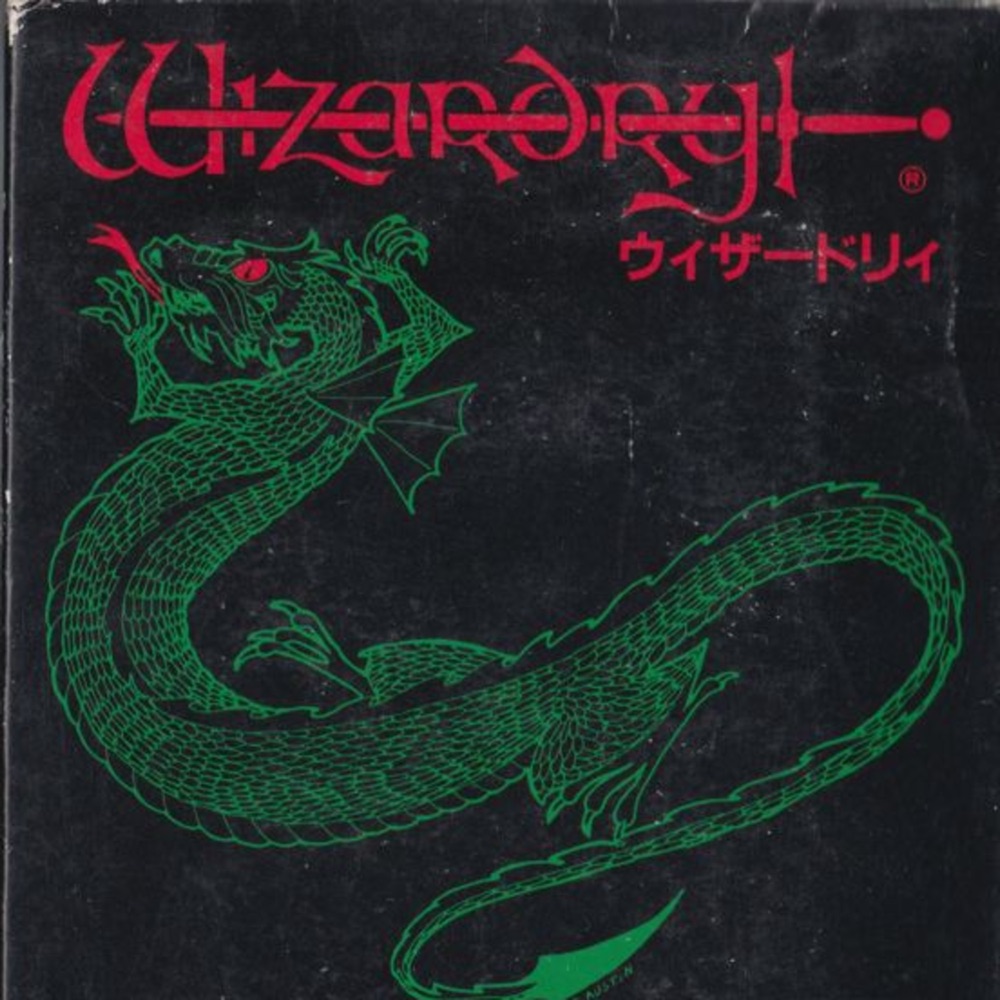
346 · Wizardry: Proving Grounds of the Mad Overlord
The Mad Overlord Trebor was once only power-mad, but went off the deep end after he acquired a magical amulet of immense power, only to have it stolen from him by his nemesis, the evil archmage Werdna. Werdna, not quite sure how to use the amulet properly, accidentally causes an earthquake which creates a ten-level dungeon beneath Trebor's castle. To avoid looking silly, Werdna declares the dungeon to be the new lair for him and his monster hordes. Trebor, not to be outdone, declares the labyrinth his new Proving Grounds where adventurers must prove themselves for membership in his elite honor guard, and incidentally retrieve his amulet in the process.
Only Mike and Sean this time, which is a problem for a game that wants a party of six. Wizardry began on the Apple II in 1981 with wireframe 3D dungeons and monsters you could actually see, and the NES port is nearly that same game, now with music and colored walls. It was a pioneer in 1981. In 1990 it feels like a museum piece.
What works
- No hand-holding at all. You start with no party. You go to the training grounds, name people, pick a race, roll stats, and the stats decide which classes you qualify for. We liked the character creator, even though it is just a menu.
- Permadeath without a game over. Dead characters stay in the dungeon, so you can make a new party, go back, and find the bodies. Reviving them at the Temple of Cant costs a lot and can fail. A save file turns into a pile of parties.
- More strategy than it first looks. Combat is mostly fight, fight, parry, parry, but spells are charge-based, so every fight raises the question of whether it deserves a heal or a big spell, or whether to retreat. Only the first three in line swing weapons. Stronger parties even scare enemies into running.
- We came around. Sean said the six people felt alive, which is more than the grand strategy games we have been wading through. Mike admitted he had been harsher than it deserved.
What doesn't
- No tutorial, no map. The manual is dense and mandatory, and the game never explains forming a party. Sean kept lowercase names for a while because he missed the capital letters. Mike refuses to draw maps. A YouTube player ran the NES game next to a Steam mapping app with live tracking, which tells you how complicated the dungeon gets.
- Mean surprises. A second group can appear behind the one you see. Chests are trapped, items need identifying, and the teleport spell lets you type coordinates and land inside a wall.
- Save only in town. We wanted save points in the dungeon, an armor overview screen, and an auto-battle option, since most turns are the same command.
Beyond the game
The Digital Eclipse remake from May 2024 keeps the same skeleton and adds the auto-map, 3D enemies and animation we missed. We both want to try it. We also ran through the series: Wizardry 2 on Famicom needed a save from the first game, in the fourth you play Werdna, and five games existed before this NES release.
The bottom line
Skip it. Neither vote on the Essential Games List went to it. We both found the design sound and enjoyed pushing through, but we liked it mostly because it dates from 1981, not because it works as a 1990 NES game. With a version that has the map built in out there, we would not point anyone at this one. If you try it anyway, bring graph paper.
Written from our conversation in this episode.
- May luck and good fortune be your companions
- Wizardry is a pioneering RPG created by Robert Woodhead and Andrew C. Greenberg, released in the early 1980s.Initially available on the Apple II, Wizardry stood out for its wire-frame, 3D graphics and static monster images, innovations that made it more visually engaging than other mostly text-based games of the time.
- The game’s story revolves around the evil wizard Werdna, who steals a powerful amulet. The overlord Trebor devises a dungeon to test adventurers' strength, challenging them to defeat Werdna and retrieve the amulet.
- No quality of life improvements for the NES version. The beginning of the game doesn’t even really tell you about forming a party
- What is the Gameplay Loop?
- Wizardry is a turn-based, first-person dungeon crawler, where players control a party of adventurers exploring a multi-level dungeon.
- The gameplay loop revolves around assembling and managing a party, navigating mazes, fighting monsters, and collecting treasure.
- Progression involves delving deeper into the dungeon, defeating enemies in random encounters, leveling up, and solving puzzles to advance.
- The ultimate goal is to defeat the evil wizard Werdna at the bottom of the dungeon, but players must balance exploration with returning to the town to heal, restock supplies, and save progress.
- Players can create and customize characters with different races, classes, and alignments, allowing for varied playstyles.
- Alignments:
- Classes have restrictions on which alignments they can hold.
- Party alignment influences gameplay, especially interactions with friendly NPCs.
- Good and evil characters can’t be in the same party; neutral characters can travel with anyone.
- Races and Starting Stats:
- Five races: Humans, Elves, Dwarfs, Gnomes, Hobbits, each with unique stats.
- Gnomes and Hobbits excel in specific classes like Thieves, while Humans are balanced but slightly weaker.
- Strength: Your strength enhances the amount of damage that your weapon does to an enemy.
- I.Q.: The higher your I.Q., the better you will be at casting mage spells, as well as avoiding the effects of mage spells that are cast on you.
- Piety: The more Pious you are, the more likely the gods will grant the prayers of clerics, and the more likely the gods will spare you from the effects of prayers against you.
- Vitality: Vitality affects how much damage you can sustain before dying. The better your vitality, the more likely it will be that you can be brought back from the dead.
- Agility: Higher agility makes you faster and harder to hit, giving you a better chance to dodge attacks or avoid traps.
- Luck: Your luck can influence any of the five other attributes in various ways over the course of your adventure. While it's not something that can be relied upon, those with higher luck generally do better throughout the game.
- Classes:
- Variety of classes including Fighters, Mages, Clerics, and hybrids like Samurai and Lords.
- Advanced classes like Ninja require very high stats and can’t be accessed at the start.
- Multi-classing allows for class changes but comes with penalties, such as reduced stats and increased age.
- Clerical and Mage Spells:
- Spells are divided into levels, with Cleric spells focusing on healing, protection, and reviving.
- Mage spells are more offensive, including fire, ice, and teleportation abilities.
- Certain powerful spells can result in different random effects, like summoning divine help.
- Cleric Spells
- Dios (Heal) - Level 1
- Effect: Restores 1-8 HP to a single target.
- Why it's useful: Essential for keeping your party members alive during and after battles without relying on limited healing items.
- Milwa (Light) - Level 1
- Effect: A bright light reveals hidden doors and lets you see further.
- Why it's useful: Helps in dungeon navigation, especially since there's no in-game map. It uncovers secret passages and extends your visibility.
- Calfo (X-Ray) - Level 2
- Effect: Lets you safely determine a trap with 95% accuracy.
- Why it's useful: Prevents disastrous outcomes from opening trapped chests, safeguarding your party from harm.
- Manifo (Statue) - Level 2
- Effect: Paralyzes a group of monsters.
- Why it's useful: Immobilizes enemies, making them easier to hit and reducing incoming damage. Paralyzed enemies take double damage from physical attacks.
- Bamatu (Prayer) - Level 3
- Effect: Reduces party's AC (Armor Class) by 4 points.
- Why it's useful: Enhances your party's defense, making them harder to hit.
- Mage Spells
- Halito (Little Fire) - Level 1
- Effect: Inflicts 1-8 fire damage to a single target.
- Why it's useful: Provides an offensive spell to eliminate weaker enemies quickly.
- Katino (Bad Air) - Level 1
- Effect: Puts a group of animal or humanoid monsters to sleep.
- Why it's useful: Disables multiple enemies at once, reducing the number of attacks your party takes. Sleeping enemies are easier to hit and take double damage from physical attacks.
- Dumapic (Clarity) - Level 1
- Effect: Tells you where the stairs are and what direction you're facing.
- Why it's useful: Assists with dungeon navigation, crucial in a game without an in-game map.
- Mogref (Body Iron) - Level 1
- Effect: Reduces the caster's AC by 2.
- Why it's useful: Provides the Mage with a bit more survivability in combat.
- Mahalito (Big Fire) - Level 3
- Effect: Inflicts 4-24 fire damage to a group of enemies.
- Why it's useful: A powerful area-of-effect spell that can turn the tide in battles against multiple foes.
- What Are Some Other Examples of Games Like Wizardry That Released in 1990?
- Might and Magic: Secret of the Inner Sanctum (NES, 1990): Another first-person RPG with a similar focus on dungeon crawling and party management, but with a larger open-world structure.
- Swords and Serpents (NES, 1990): A similar dungeon-crawling experience with first-person exploration and turn-based combat, though it’s more simplified compared to Wizardry.
- Final Fantasy (NES, 1990 in the US): Although it uses a top-down view instead of first-person, it’s a turn-based RPG that also focuses on party management, character progression, and dungeon exploration.
- Ultima: Exodus (NES, 1989): A predecessor to modern RPGs, offering a party-based experience with world exploration, turn-based combat, and dungeon crawling elements.
- What Makes It Unique/Different From Other NES RPG Games?
- The game has a high level of difficulty and complexity, requiring players to manage every aspect of their party, including food, spells, and inventory.
- It introduced a permanent death mechanic, adding tension and higher stakes to dungeon exploration since losing a party member could be devastating.
- Unlike most NES RPGs, Wizardry has minimal story elements beyond the dungeon-crawling experience, focusing heavily on gameplay mechanics and player-driven exploration.
- The party creation and customization system was far more detailed than most NES games, offering a wide range of character options.
- What Kind of Quality of Life Improvements Could Wizardry Have Added?
- Save points within the dungeon: In the NES version, players must return to the town to save progress. Adding save points in the dungeon itself would reduce the frustration of losing progress after lengthy exploration.
- Improved interface and menus: Navigating the game’s menus is clunky and slow, making party management and inventory handling cumbersome. Streamlining these systems would improve the flow.
- Better mapping system: The game doesn’t provide an in-game map, requiring players to manually track their position on graph paper. An automatic map could have made navigation more user-friendly.
- Balancing the difficulty curve: The early game can feel punishing, especially for new players. Smoothing out the difficulty ramp could make it more accessible without losing the challenge.
- Clearer guidance and tutorials: The game’s mechanics and objectives aren’t always clear, and a more in-depth tutorial or hints could help ease players into the complex systems.
- Auto-battle or faster combat: The turn-based combat system can be slow, especially when facing weaker enemies. Adding an auto-battle feature or speeding up combat would reduce downtime.
- General Tips
- Prioritize Healing and Protection: For Clerics, Dios and Bamatu are invaluable for keeping your party healthy and reducing damage taken.
- Crowd Control is Key: Mage spells like Katino and Cleric spells like Manifo help manage groups of enemies by disabling them.
- Enhance Navigation: Use Milwa and Dumapic early to aid in mapping the dungeon and avoiding getting lost.
- Trap Detection: Calfo is essential for safely opening treasure chests, a primary source of loot and gold.
- Offensive Spells: Don't underestimate the damage output of spells like Halito and Mahalito, which can quickly eliminate threats.
- Party Composition Tips:
- Traditional setup: 3 front-line fighters and 3 back-line casters.
- Suggested transitions, like moving a Thief to Ninja and using Fighters-turned-Samurai.
- Gameplay and Mechanics:
- Players need to map the game manually (no in-game map).
- You have the option of going through a maze that is filled in or just line-vector graphics (like the Apple or PC)
- the dungeon layouts are different for the NES version compared to all other versions
- Deceptive Dungeon Design and the Novice Experience:
- Wizardry’s dungeon is designed to mislead players with traps and difficult monsters. Veteran players can skillfully avoid many of these unnecessary challenges, while novices are more likely to stumble into these dangers, facing numerous hardships and setbacks.
- Item Identification: Always identify items before equipping them. Cursed items exist, and equipping one without knowing can cause issues. Using a Bishop’s identification ability can help here
- Trap Disarming: Rogue characters are essential for disarming traps on treasure chests. Pair this with a priest casting "CALFO" to check the trap type. If the results differ between the two, consider leaving the chest unopened
- Cheats:
- Pooling Gold: At the start, gold is limited, but you can get a boost by creating "dummy" characters. Pool their gold into one main character, then delete the extras and repeat the process. This allows you to afford better gear early on
- 1. Wizardry: Proving Grounds of the Mad Overlord
- Release: 1981 (Apple II)
- NES Version: Yes (1987 in Japan, 1990 in North America)
- Unique Features: First entry in the series, introduced classic dungeon-crawling RPG mechanics with turn-based combat and party management.
- Enhancements: As the original, it set the foundation for RPG mechanics that would be refined in later entries. This included party creation, tactical combat, and class/character management( StrategyWiki )( Wizardry Wiki ).
- 2. Wizardry II: The Knight of Diamonds
- Release: 1982 (Apple II)
- NES Version: Yes (Japan only, 1992)
- Unique Features: A direct sequel to the first game, required a save from the original to play.
- Enhancements: Added a stronger focus on story progression with a specific goal (finding a set of magical diamonds), slightly improved dungeon designs( StrategyWiki )( Wizardry Wiki ).
- 3. Wizardry III: Legacy of Llylgamyn
- Release: 1983 (Apple II)
- NES Version: Yes (Japan only, 1993)
- Unique Features: Introduced a generational story—new adventurers were descendants of characters from the first two games.
- Enhancements: First to feature multi-generational characters, focusing on carrying on the legacy, and improved difficulty balancing( Steam Community ).
- 4. Wizardry IV: The Return of Werdna
- Release: 1987 (Apple II)
- NES Version: No
- Unique Features: A significant departure from previous entries, players control the main antagonist, Werdna, in an attempt to escape a labyrinth.
- Enhancements: Focused on puzzle-solving rather than traditional combat, considered extremely difficult. Introduced the concept of controlling a villain, adding a unique twist( StrategyWiki )( Steam Community ).
- 5. Wizardry V: Heart of the Maelstrom
- Release: 1988 (Apple II)
- NES Version: Yes (Japan only, 1993)
- Unique Features: Returned to traditional gameplay but featured a much larger dungeon and more complex puzzles than previous entries.
- Enhancements: Improved graphical interface, more complex storyline, and larger dungeon environments. Expanded the magic system and introduced new classes( StrategyWiki )( Steam Community ).
- 6. Wizardry VI: Bane of the Cosmic Forge
- Release: 1990 (DOS)
- NES Version: No
- Unique Features: First of the Dark Savant trilogy. Introduced a more sophisticated narrative with multiple endings based on player choices.
- Enhancements: Significant graphical upgrade, larger world, deeper character customization, and more involved quest system. Introduced a branching storyline and multiple possible endings( Wizardry Wiki ).
- 7. Wizardry VII: Crusaders of the Dark Savant
- Release: 1992 (DOS)
- NES Version: No
- Unique Features: Continued the Dark Savant storyline, offering a complex world where factions and diplomacy played a role in the game.
- Enhancements: Expanded the narrative scope and added factions that the player could interact with, featuring multiple paths to victory. Major improvements in graphics, sound, and storytelling( Steam Community )( Wizardry Wiki ).
- 8. Wizardry 8
- Release: 2001 (Windows)
- NES Version: No
- Unique Features: Concluded the Dark Savant trilogy with fully 3D graphics and a blend of real-time and turn-based combat.
- Enhancements: Huge graphical upgrade, 3D world exploration, new combat mechanics combining real-time movement with tactical turn-based attacks. Stronger focus on narrative and role-playing( StrategyWiki )( Steam Community ).
Auto-generated transcript. Each paragraph starts with its timestamp. Speakers are not identified.
Wizardry, proving grounds of the Mad Overlord. May luck and good fortune be your companions.
And welcome to NEStalgia, a chronological exploration of every NES game released in North America. I'm Mike. And I'm Sean. Just the two of us today, but that is actually less than ideal. Usually in these dungeon-crawling RPGs, you want like a party of seven, right? Like, we're not going to make it through the whole maze. Yeah, I mean, this is also the kind of thing I think that Joe would really, like, jump on. You know, he'd talk about the backstory of all his characters and his party. What they were, yeah, what he named them, like, for a half hour.
So we're not going to have that, but we'll try and do our best to fill in. But I would say, though, even though Joe is the most enthusiastic from a storytelling point of view, you have the most RPG experience of the three of us, I feel like. I guess of the Western variety, probably. Yeah, and this is of the Western variety. True, true, true. This is of the early Western variety. This is like, Wizardry is a pioneer of the RPG video games in general. This game came out in, I believe, 81, created by mostly two dudes, but like maybe a total team tops of 15 people.
And while it was initially available on computers, when it came out in 81, it stood out because it had, get a load of this, wireframe 3D graphics, and you could actually see the monsters on screen. Yeah. Instead of having like text describe the monsters to you.
This is really cool in 1981 on computers, no doubt, especially when even most computers didn't have like the idea of Windows or a desktop, right? It was just like text commands and stuff like that. Like that stuff was only just beginning. So this is really cool, but it's a little late now, right? Like we're, we're in 1990 and we've only seen, uh, games that rely on their visual, uh, components to help like string together a, a gameplay loop. Uh, so Wizardry is losing a lot of that, even just when it releases on the NES. Now keep in mind, of course, Sean, the whole format of our show, we have to judge it in 2024.
Yeah. So, I mean, it's funny, like the, the games that we played and funnily enough, they end up being episodes that are just you and I, I wonder what, uh, the, the common thread is here, uh, of, of games that are reflective of very like mature, not, not mature in like content, but mature, uh, genres like a grand strategy, uh, that, that have had a lot of time to tweak and, and just get more complex. And then we've got this, uh, like dungeon crawler slash RPG, but lots. Okay. I guess the way we can like, just move all of these into one thing is games in which you,
you just navigate menus, you menu dive. Um, a lot, a lot of these games we're playing like the progenitors of games that we play now with a lot of like, uh, a lot of things that have the bells and whistles and the quality of life improvements. And we're just getting the, the very raw, uh, barely tweaked from the 1981 version, uh, versions of that here. And yeah, judging these in 2024, it's, it's rough, but you know, we'll get into that. I appreciate that you did say the barely tweaked version of the computer, uh, original, because that is true here on the NES.
There are, you know, I'm sure there are a few, but there are almost no quality of life improvements for the console version of this computer game. You are basically getting what they got on the Apple II with, I believe music now. Like, I don't think music was an option in the Apple II. So like, I guess that's quality of life. I think there's color now on the walls.
Right, right. But like, those are, those are the kinds of things. It's not like, um, you know, Hey, we know that this console is mostly for the, uh, you know, six to 14 year old variety. Uh, no, we're just gonna, we're going to keep our game as is. And so what does that mean? Well, that means that unless you are looking at the manual, the beginning of the game doesn't tell you about anything you should do, including forming a party. It doesn't even like explain that in the game. It doesn't start you with a roster of people. It has pre-generated characters that you can select to join your party, but that is something you must learn to do.
Uh, as you jump into the game, it is kind of wild. The idea that you don't even have like final fantasy, for instance, uh, we just covered that pretty recently. That is a game that makes you choose your four characters and doesn't tell you like, Hey, you know, you must have at least one fighter or one mage or whatever you get all freedom, but you start the game with your party. This game, you jump into it and you have to learn about forming a party. And so you have to really focus on the manual and any good RPG manual, in my opinion, always has an index, uh, that you can reference.
It's an alphabetically sorted indexed with like what pages those terms appear on. This is a very dense, but necessary. Okay. No, no points against it because it is required, especially because the game itself will not spell any of this out for you. Uh, it is required reading to have any sort of understanding of what you're going to experience in the game. Yeah. I, so have you played wizardry at all before?
This is my first for, I have read all about wizardry in the, um, bitmap books guide to role playing games, but I have, I have not played a single one. So this is, this is my first wizardry. I've, I've like dabbled in dungeon crawlers. Like I think I played maybe 15 minutes of Grimrock. Um, I, I'm interested. I, I, I'm curious about more. I, I haven't really played much wizardry. So this is also my first real exposure to the series and just the, the style.
And, um, what, what's weird about this, and this is especially coming off of Final Fantasy so recently. And I think like one of, we may have said offhand, we may not have like touched about it too much is just, is how much in Final Fantasy is kind of just left up to your own device. We like, no, we talked about that a lot. Like it's, it, there's a lot of like room for, uh, for interpretation and your characters aren't really characters. This is that cranked up to 11. Like you aren't playing as these characters. You are playing as the idea of these, of like, uh, of the party. Like you, you're, you were talking about forming your party. You don't have a party when you boot up the game.
You, you know, you, you, you can go into like a tavern and recruit people, or you can go to training grounds and create people. But like you said, you, you don't have that information unless you've read the manual, which you 100% need to do. Um, and it, what's, what's the weirdest part of this, the weirdest part of this coming from somebody that has, who, who only started fiddling around with RPGs in the late 90s. Uh, where, where, where, you know, the, like I said before, the stuff has, had matured. Um, is just how little flavor and how little cover, like color is, is given to these concepts. Like they call it the tavern. That's where you add, uh, party members.
But there, there's like, you, you don't walk into a, a darkly lit, like loud place. It's just a menu. That's just, it's a menu called the tavern. Uh, there's no, uh, there's no speaking roles. There's no like, uh, barkeep that yells out like that, that, like that this, uh, character is like, acts like this or that this character acts like that. It's just a menu. And I just think it's, it's a very strange thing to walk into with these games.
Yeah, that's a really good point that there, there is almost no story or world building from the dungeon master in this, in this game, in wizardry one, you are getting the dungeon master almost as just a narrator of what is happening to you in combat or, uh, you know, what you see visually. There is no flavor added, uh, to Sean's point about how like in, in a game like Final Fantasy or Dragon Warrior or any other, uh, JRPG that we've played, you know, you can talk to people to learn about the town or a secret or what to do next. At least walk up to a guard and say like, man, guarding the castle's hard. Like in this, it's just, there's nothing.
Yes, yeah, there's, there's none of that. It really is, and this is funny because, uh, now I'm going back to the Pictionary episode, which I thought I'd never bring up again. But Joe and I talked about the end automating Pictionary slash eventually Monopoly, right? Like, this is really just an experiment in automating Dungeons and Dragons, correct? Like, it is, it is really more of a proof of concept thing or a, like, a neat machine that they've been able to do of like,
wouldn't it be great if you didn't have to have the dungeon master and have to get together with a group of people? Couldn't you just do this from your computer? Like, it is, it is not, I'm not trying to say it's a demo because it is a full-fledged game that, you know, I feel like we're being maybe a little bit negative on it. I do want to say that, like, once you get over the extreme hurdles of understanding what's going on,
I think this is actually an incredibly rewarding game to those who are willing to make the time commitment. But what we have here is really just, like, the proof of concept of taking Dungeons and Dragons and bringing it to the computer so early. It's just so raw. And it's not quite Dungeons and Dragons. I think even back in, I don't even know what edition was active at this time. Maybe 2.0. Somebody older than me can probably correct me. But it really is just a, the computer's rolling the die for you. It's keeping track of all of the stats for you.
The hits are registering. You've got some art to at least, like, to show you where, like, what's happening. And the maps are generated for you so you don't have to go in there. Like, I could see, and I know this probably was rarely done because wizardry is its own thing.
I could see, though, some DM saying, like, all right, we're going to take care of all of the, like, the town stuff in person. Or, like, you know, as you would, like, a tabletop game. And then once we go into dungeons, we just boot up wizardry. And maybe that was an intention. Maybe it wasn't. But I could see that happening. But as a game in itself, it's weird to think that this was all that was asked for. Which is just that, like, this is sort of like the rules of a game. Not so much a game. Though I'm not using that. I'm not saying that that is how I view the series or I view the game. But, like, from first glance, like, this is just sort of like the skeleton of a battle system. Less so a fully-fledged RPG.
Getting into the gameplay loop here. As we mentioned, it's a first-person dungeon crawler with turn-based combat. Players control a party of up to six adventures at a time. You can create more characters than that, actually. But maximum party size of six when you enter the single multi-level dungeon that the game offers. The loop is essentially that you assemble and manage a party. Navigate the maze. Fight the monsters up until the point that you are willing to kind of no longer pressure luck. And exit the maze before certain death.
And, you know, upgrade your weapons and armor with the gold you've acquired. And, you know, cash in your experience points to potentially level up. That is how the progression works. So, essentially, you are starting off maybe a few squares into a dungeon. Fighting an encounter or two. Leaving. Leveling up. Going back down. Exploring the rest of that level. Leaving. Going down to the next floor. You are kind of constantly retreating from this large maze. The game even calls it a maze. I think that's a little strange that it's not referred to as, like, you know, a dungeon or the... I forget. It's Renda? Is it? Wordna? Is the wizard?
Redna, yeah. Yeah. Their castle or whatever. Like, just something to give it a little flavor. It is just, like, go to the maze. Okay. Guy lives in a maze. He must be evil. So, you know, you're constantly kind of playing this game of, like, how much further can I get into the dungeon this time around? With my party. Without risking anybody dying.
Because death is permanent for any character. And so, no matter how far you've progressed with them. No matter how attached you get to them. To bring up a modern or somewhat modern game. Because it had earlier entries that are now pretty retro. XCOM. Yeah. Or, you know, like, that kind of series. Your characters do risk death. And so, you do have to play a careful game. So, there is a balance there. The ultimate goal. You defeat the evil wizard, Wordna, at the bottom of the dungeon.
And, you know, kind of along the way, I guess, just continue to grow as a character. As a party. Or potentially kick people out of your party. For different classes that you may need. Or different alignments that work for you. Yeah. But, really, the game starts with the character creation. And I feel like, you know, Sean, you're a guy who lives by the character creation screen on any video game. Not even just RPGs. You just love playing around with the character creators. So, do you want to talk maybe a little bit about this system? There's so many things to dive into. I don't want to leave it all to you. But if you just want to, you know, get started. Yeah. So, it's an interesting system.
Where you'll go to the training grounds. Which is, you know, outside the castle walls. And you go into the create a character menu. And it takes literally a minute. You'll go in. You will create a... You'll give the person a name. Doesn't matter what or who they are yet. You'll give them a name. It took me a long time to realize you could find the capital letters. So, for a long time, I had a bunch of lowercase characters.
And once you've named them, you can give them a race. And from the... It's just the typical fantasy races. You got dwarves. You got elves. You got hobbits. Or halflings. Or whatever you want to call them. Gnomes. And gnomes. And humans. And they all have their pros and cons. Or neutrals. If it's humans. And then you move on to the stat selection. And it's interesting. Because when I play an RPG. Like, you know, a CRPG. A Western RPG. Where there are... Where is these class systems? Uh... I'm used to being given the option. Like, what class would you like this character to be? And you don't get that. You get the stats. And then depending on how you allocate these stats. It will show you what classes they can be.
Um... Which I think is a cool way to do it. Um... You can... There aren't too many classes. So there's not a lot of, like... You know... Experimentation going on here. Uh... And you're probably just gonna min-max. Because this is the kind of game that you min-max in. Uh... But I think it's an elegant character creator. There isn't really much going on in there. Oh yeah, you also choose their... Uh... You also choose their... Uh... Whether they're evil, good, or neutral. Which... Aside from the fact that good and evil characters can't be in the same party. It just... I think it's just there for flavor. The smallest... It's actually... No, it's weird. There's one other... There is one restriction.
Uh... And I... And I didn't, uh... Know this, but... Classes have restrictions on which alignment they can be. Oh yeah, you can't be a neutral cleric, right? Right. And you can't... You have to be... To like be a ninja, you have to be evil. I see. Okay. They must all be part of the Foot Clan or something. Yeah. Well yeah, it's pretty basic. Yeah, yeah. But there's a lot there, or at least the illusion of a lot there. Because you... You know, if you have to make six characters, you have to deliberately enter the alignments, the race choice, the stats of like, you know, okay, so now that I'm hoping to be...
Uh, you know, like I'm hoping to have two fighters, two mages, a cleric, and a thief. Uh, you know, how do you play around with those stats? For the average person, uh, aka me, you're really not gonna think much more of these other than moving the... Uh, the stats in a way that helps them get the class that you want them to be. Yeah. At least that was my experience.
So, I did have that loadout of, um, two fighters, uh, one mage, one cleric, um, and one thief. And, uh, the thief is almost like, they don't, they don't tell you this, but probably essential, uh, for the party. Because they're the only ones who can really... Yeah, if you have traps or anything, they're the only ones that can really interact with them. Right, and, and almost all the good treasure is behind, uh, chests that are locked or potentially trapped. So, you would want a thief to, uh, at least be in your party to explore that.
So, this isn't the kind of thing where you can make six fighters and just brute force your way through a dungeon. I'm sure it can be done. I'm sure it can be done with just, like... I'm sure there are crazy people out there who are just solo with a fighter, you know, through this, through this thing. Where they just constantly go a little bit further in the maze, leave, go a little bit further in the maze, leave.
Uh, but, ultimately, the, the party you make is, again, it's, it's, it's a very freeing experience. But only for the experienced. You know, I think if you, if you play this game for the first time and you don't, like,
understand how this works or just kind of build a party that seems fun to you, your mileage may vary on how far you get with this game as a result. This is the kind of game that requires, uh, some real knowledge of, not even just, like, the layouts of the maze, which we're gonna get into, but, like, it requires knowledge of, like, the kinds of things you will do in the maze. That, that, that's, that's what I was gonna get into, though. I think that while there isn't, I think the problem here is feedback. There, it just isn't a lot of feedback.
And, you know, you can, like, you've, you've got these spells and they just have odd names. You can reference the manual for those things. The, the thing about this game is that you, they're not, they don't really, there's no hand-holding. It's, it's really just, you, you're given the tools. You're not really told what the tools are, but you have them. Um, you have to make your way through it. I think that if you were a kid in 1990, uh, or 1981, if you had the computer,
uh, you could fumble your way, you could be just so entranced by this that you could fumble your way through it. Um, I, I think that, uh, if you were a lazy kid that was cool with all of the concepts, but didn't just want to, but didn't want to deal with drawing the maze, you would bounce right off of this. Cause that's sort of like what happened to me today or yesterday, the day prior, because I just, I'm not drawing maps. I'm, I, I don't do it. I've never done it. I'll never do it. I know you and Joe like to do it. Did you do it?
I, I did do it, but only because it was required of me. And I will, you know, like just to, just to like get some progress in this game. And I'll just say in these first person ones specifically, it even kind of like, I don't know. I kind of get like a little lost drawing them too from the first person look of things. Like you have to turn like in all four directions, confirm like that all the side, all the other sides, except this one have walls. It becomes very, it's so tedious.
I can't deal with it. Whereas making a maze in, uh, making a, uh, a grid of a map in Metroid was a little more fun because it was like, okay, this is like, this room is a square on a, uh, on a grid, you know, and you're just like constantly like saying like, and in this room there, you know, this, this was an item. And then like this way reached a dead end eventually. Like that's fine. When, when you actually see, and you're free to look these up, uh, the actual maze layouts of, of the, the one maze in the game, but of many floors, a lot of it is just like inconsequential,
but necessary in order to gain enough experience to keep going on. So you're mostly just running into encounters or traps, but they're necessary like events in order to have enough experience or gold to be able to move on. But the map is otherwise just kind of nonsensical or at least not very interesting. It's just stairs, a key and a bunch of rooms. The rooms are mostly with encounters or chests, but there's not like, I don't know. Yeah. I, that's a, that's another thing. This is kind of off topic, but I think when it comes to, uh, level design in general, I, I, the diegetic is not the correct word. I, I need it to be at least somewhat reflective of, of how a place would be lived in.
So games like this, where it's just a maze for a maze sake, there's no building that would be designed like this with one square rooms that don't really have anything in them. Uh, or, uh, hallways that just sort of spiral into itself until there's a dead end or like doom where I, I, I know that this may be sacrilege, but like, you know, the original doom, it was just a bunch of mazes that weren't just squares.
Um, I, I, they didn't feel like you were in like a space station. They felt like you were in a maze. Cause I just, I'm just not like a big fan of that stuff. So it, it, it, it's hard for me to work on that. And now I didn't fully understand how this YouTuber was doing this, but, um, there was a YouTuber at a let's play of wizardry and they were using a application called grid cartographer, uh, that is like a steam application.
But, uh, basically you can make your own maps in this and it's for, you know, your own like D and D adventures or whatever, but it also has like built in support for these older games. Oh. And so the person had like a really cool setup where basically they had a, a three windows screen of this app where on the left side was the NES game running. The right side was the map for the current stage. They were on tracking their location in the game, no less. And then the third one was an alternate more 3d view of like what they would be seeing based on the map that they provided or, or drew themselves, uh, of that NES game. So it was like a really in-depth enhancement.
All that. So wait a second. They're playing the emulated NES game, not the PC version. Not the PC version. They're playing the emulated NES game and it is tracking their location in real time in the map, uh, of on this, on this application grid cartographer. And like, yeah, it's all cool or whatever, but it also goes to explain like, that's how complicated exploring this dungeon can get. And you try as you will to not use a map or not use somebody else's map.
Getting lost in here is certain death, right? Like at a certain point, you're either just not going to be able to find your way back to the, um, cause you have to go, you know, you're going downstairs and keep going down levels. So it's not a castle. It's a dungeon.
Uh, but to find your way up enough sets of stairs to get back to the beginning, if you ever got lost without making your own map, it's a necessity to at least have somebody else's map. And, and I, I never, and the reason I, I kind of had the first level, I had the first maze kind of down, um, because I think that's more, there's no tutorial, but I feel like the first like floor of the maze is kind of the tutorial because it's, it's relatively, there's no landmarks, but you can kind of get a vibe for it. You're going to be in that area pretty often. Um, so I was able to get to the second level pretty often. Uh, but, but, but by then I just was just like, I'm just experiencing the game and letting my party die as I'm doing it.
Um, I don't know if you, if you got any further than that. Did you beat the game? No, no. Beating the game is, I don't know. That would, that would be like on my list of, that'd be on my video game resume. Yeah. If I beat this game. Um, I did, I did continue to play with the same party though.
And, um, once, once I ran into enemies that were like, basically I didn't leave the dungeon and when I should have. Yeah. And, uh, I ran into a group of enemies that were just significantly stronger than me and they killed both my mage and my cleric and were about to kill my thief. And as I mentioned, it's permanent, uh, that kind of like killed it for me. Well, is it permanent though? Because okay, here, I want to get into another like neat thing about this game. Uh, now I never did it because, uh, I, I just, I was playing on stupid mode, but the, this is kind of going back to where it's not so much about, uh, like, this is the story of this party or like you're playing as these characters.
You are like, this is almost like a, uh, I, I see a lot of foreshadowing to darkest dungeon in this. Cause you just are not these people. If there's no, there's no game over you. Correct. Yeah. You just go make some more characters. You go make some more guys. And if you make some more guys and you go back to where you died before, you will probably find some of the, like the dead bodies of your old party and you can bring them back.
You can like, if you have space in your party, you can add them to your party as dead characters, bring them back to the temple of cant or Gant or whatever. It's temple of can't. And have them revived for an obscene amount of money from what I can remember. But, uh, and I think like you, there's only a couple of times that you can do that. Or like, there's, there's like a time limit or an event limit or something along those lines.
Um, but like you can, you can either, you can even abandon your current run, leave them where they are, go make a new party and do another run while they're in there. Like you are just a bunch of parties and I think that's really cool. I don't really know why that's cool.
Um, well, what's cool about that too, though, is so to, to get really in the weeds is like you, you, you basically have one file where you can continue to do like dungeon raids in the sense of like, okay, the, these people completed it, but these people haven't. So we're all going to go in together and the stronger guys are going to help the like little guys level up so I can eventually run like a different party. But once you get to the end with the fight against, uh, Wordna, um, you receive like a, it's like a badge or something.
And that person who has the badge can no longer fight Wordna, but like there's no game over and Wordna stays there at the bottom of the dungeon. Yeah, you can just keep doing it. So you just keep doing it with other parties and such. And in the meantime, using the guys who did clear it out to kind of like help the other ones experience. So like I could imagine an awesome save file where like one of every kind of class or, uh, you know, uh, yeah, has a badge or something or different parties there.
There is that. Uh, I just want to get back to the temple of cant real quick because, uh, I feel like it's called the temple of cant for a reason and it's probably not this, but it's also possible that the clerics there cannot revive your party member. And in which case if they fail the job, uh, they, the character turns to ashes and it, and it's over. So it's not a sure thing. Yeah. It's not a sure thing. I see.
Uh, so, but, but it is possible to revive them. It is. Okay. Depends on the state. Yeah. I know that there's, they can definitely heal like paralyzation and petrification or whatever you want to call it. But I think they can even revive dead party members. Yeah. Just all, it's all down to luck.
Um, all right. So getting into the combat for a minute, you know, you're in the maze and you've got your party. Uh, the combat system is one that is pretty similar to most turn-based combat games we've played. There isn't like, you know, in Ultima we saw it became like this, uh, you know, this map of your characters where you have to, you know, move them around on the screen and position them and have them attack the other enemies on the screen. Like this is really just a true turn-based battle where you see, uh, the enemy that's in front of you and you choose to, uh, either attack or if you can attack parry or cast a spell. Uh, this is, this is arguably the most familiar part of the aim is the turn-based combat.
Yeah. So you've got, you've got your, however you've made up your party. I mean, there's, there's not too much, uh, flexibility in what can be recommended that you run because there's two lanes or not lanes. There's, there's two rows. You want your front row to be like, you know, tanks and fighters. You want to have them be able to do physical damage and then you got your back row, which is going to have your mages and maybe your thief and obviously your cleric. Um, and because the way they do it, only the first three people in your party can attack with a weapon and the back can cast spells, but they can't attack. If you have people in the front die, they get pushed up and then may have to fight physically.
Um, but that's, that's sort of the thing going on there. Uh, where, so you're not really seeing a formation, but you, in your mind's eye, you kind of need to see that formation and able to, uh, approach each fight, uh, strategically. Yeah. Like if you had your, uh, cleric as the first party member, uh, they would, that's a, they have a bad time. Yeah. They would be screwed. Uh, but there are spells that the, uh, the clerics and the mage can cast.
And it's a little like, it's a little tedious that the, the game explains none of them that you constantly have to be checking in with your, uh, manual to understand them because they're not even like, I'm sure. They don't even sound like it. Right. I'm sure that they are something, maybe it's Latin or something. Maybe, maybe, I don't know. I'm making that up, but like. It's some magic, it's a magic language.
Yeah. So we have, uh, you know, cleric spells like Dios, Milwa, Kalfo, Manifo, um, Bamatu. All these things are like, I'm, I'm going to remember Dios after I see what it does, right? Like it heals, uh, HP, which is incredibly important and can be done outside of battle. Uh, probably unfortunately only once the first time you have it. Another charge based magic system.
Yeah. Yeah, exactly. Um, and yeah, different levels to that. But like, that's not, that's not necessarily to complain. I think it's great that, uh, you can have a party that does so many different things to the point where like, yeah, most combat is just going to be, um, you know, fight, fight, fight, fight, parry, parry, parry. Yeah. Right. Um, that's what it's going to break down to, but there's a lot of like post decision about like, okay, well, do I use my cleric now? Do I try to take on another battle? Do I risk running into a trap? Like, uh, you know, do my mage has powerful spells?
Is it, is this a strong enough enemy that now it's time to use this? It is interesting that that's kind of how, you know, like this game is so, I don't want to say resource intensive, but like, you know, you really have to think about, oh, no, this is a resource management game for sure. Okay, cool. So like, you really have to think about like, when's the best time to do these things? Cause you really only get like one or two uses out of it.
Uh, as a result, I felt like this was a much more interesting system than it presented itself to be. You know, even though I said, it's mostly fight, fight, fight, parry, parry, parry. Uh, you know, that's because if you're fighting slime or skeletons, like that's, that's what the combat's going to be because it's just an ordinary encounter. And then you have these extraordinary encounters where all of a sudden it's an enemy you've never seen before. Uh, you, you know, you haven't encountered, you're not going to run into over and over again like you would in a JRPG. And you have to kind of just like figure it out or die.
Yeah. I think the one thing that I didn't appreciate about this system is that they're like, you can have your, you're going to run into people and it's going to show you, oh, you ran into these guys. And then it'll just like, oh, you, there's also these guys behind them. And you didn't know that when you first got into this encounter. So you could have like two, two groups of five, like, uh, what are they called? Uh, not brandishers.
Uh, basically bandits. And then you'd get like five kobolds behind them, but you only knew about the bandits and it can really, it feels like it's really mean. And I understand that like, you know, difficulty's fun, but it just, I would like more information. I think that if there was more information presented, uh, then I could, I could get down with the difficulty more. ...
... ...
Thank you. And another thing that's interesting about combat with these enemies is when you are more leveled up and a braver warrior, a lot of these enemies know they're outmatched. Yeah, they know they're outmatched. And we know that there's built-in systems for this stuff. We talked about a little bit on Final Fantasy that every enemy has a calculation that it runs to flee. But that doesn't happen as often as it does here. This really does feel like you kind of become a legend a little bit as you continue to level up. And they're genuinely scared of you, so you just continue to move along.
At least on the—again, I spent a lot of time on the first floor of this maze. So maybe this is just for, like, easy baby mode. No, no, no. I would just keep trying to disarm it, and then it would eventually get disarmed.
Well, no, I think you taught me something there because, see, I was reading it different. It said—basically, the screen pops up and it says, As a chest, you may—and then gives you the choice of inspect, calpho, disarm, open, leave alone. And let's ignore calpho for a second and pretend that you didn't know that it's a spell that your cleric can use to— Oh. It's a level two spell, though, so you won't have it right away. Yeah. I don't think so. I know, like, you can get certain good rolls or whatever, but I doubt that you would have that in your party.
And that will detect the trap on the chest. So calpho's great, but, like, you don't have that right away. But I read it as, like, it's a chest, and you may do, like, one of these things. And I thought that, like— That's the only one thing you can do? Right, right. Like, inspecting it while it has a trap on it would be a bad idea. Oh. And so you would move to disarm it first. But obviously, like— No, no, no, no. Yeah, now that you've explained it to me, I can see why that doesn't really even make sense. But, like, that's kind of the—that's what I made up in my head as the rules. So that's why I was like— And maybe on lower levels, like, the inspect doesn't work. So you might have to guess.
That's me guessing, though, because I never, you know, I never got to the part where—what's his name? The mad wizard leaves you a note that says that the king sucks or anything like that.
So maybe it gets harder and more random as the game goes on. But at least in the beginning, it's very easy. I think you just run the risk of if you use the wrong thing to disarm it, which can even happen apparently, you know, in the inspect column, you're, you know, whatever character you select, if they don't have maybe a high enough intelligence or something, they can select the wrong thing. You do run a chance that the thing that they choose to use to disarm it actually activates the trap and thus, like, poisons the entire party or deals damage to the character in front, you know, that kind of thing. So they're not without risk.
And I think that is actually just a huge thing in general for the game is that it's a very deceptive dungeon design. So I think that the game as a whole, we were talking about the map and how, like, it's mostly uninteresting or whatever.
I think it is purposefully designed that way to mislead players with traps and more difficult monsters than they're prepared for. I do think that they leave a lot of long hallways that you're like, oh, well, I wonder what's down this corridor. Like, I think they're trying to warn you to not necessarily be exploration focused and kind of stay on the path and go in there with a goal because otherwise they will punish you. Yeah. But I also think, like, you're not, you're not gonna, I mean, you're gonna have a map that you have drawn to your best extent.
But, you know, to go any further, you basically have to explore. So I think this is more just like, here, use this party, like, the party that you, that you boot up this game with, like, they're not gonna be the ones that complete the game. If you are coming into this game blind, they're gonna die. They're probably, maybe, maybe one or two will survive if you've been very careful with them. But I think you're supposed to kind of just, like, poke and prod and learn. And now you know, this is what I gotta do with this enemy. This is what I gotta do with this trap. This is what I gotta do on this level. And, oh, here's, this is where the, the secret wall door is.
And I think it is actually just saying, like, look, like, you know, there's no, there's no fail state. Like, you, you will fail a lot, but there's no end game because you game over.
So just, just keep prodding and you will eventually get through it. This is a game about, uh, about attrition. Right, right, right. And I think, I think we're saying the same thing. Maybe I'm just being a little harder on them. But I, I'm, I'm saying it's part of the gameplay experience. They are telling you, you know, like, keep poking around. But at the same time, every chest usually has a trap on it. Uh, every item requires you to identify it before using it because it might be a cursed item or something.
You know, uh, there, there's, there's just basically like a lot of things in the game that you potentially could see as a reward. Like a chest or an item that isn't actually beneficial to you. And, uh, just, you know, was it, was an event or experience in the game that, uh, just will, it's not like a one-off thing. It'll just continue to happen as you go further along in the maze. You, you'll continue to run into these kinds of things.
So there's not too much, uh, in the, in the way of like getting ahead in the game. You do kind of just have to experience the game and, and, and literally gain experience and level up and create and get stronger characters to, uh, bring up that armor class and raise their HP and eventually promote their classes. Uh, which is like an interesting thing because you can even get some of those promoted classes. If you're lucky enough on your roles, which are, um, they're not Nobunaga's ambition style roles where it's like a number that flashes around and you hit like stop and hope that you get a good one.
It's just generated for you. And then you get a few extra stats that you can pump into it, but you can just start off with like a samurai. If you get a lucky enough stat based on like, if you selected, uh, I forget what it was. It's like, if you picked a dwarf, uh, maybe it was a gnome. If you picked a dwarf and a, um, and you picked good, there's a chance you'll, you'll get a good enough role to start as a samurai. A dwarven samurai.
Right, right. The best, the best kind. Yeah. Um, it's just interesting that that can happen, but also you can just do it the traditional way too of eventually getting promoted to the class, which I think are some of the other ones like are just. Either they have like 1% odds or they're actually impossible. Like to be an evil ninja or something.
Right, right. Um, so all that in mind, there's very little way of getting ahead except for this one obvious exploit of, um, pooling and divvying the gold amongst your party. And did you play around with this at all, Sean? Do you know what I'm talking about? I mean, I, I, I know about pooling and divvying because I, you know, just, just to give a little bit of context here. When you recruit characters, like you're, you're starting, the, the, the, the starting characters, uh, have equipment already, but when you create characters, they have no equipment. You have to go buy some.
They, each character comes with some money, but if you want to really kid out one of them, uh, you will need to pool that money. Are you just saying that you recruited a bunch of characters, pulled the money, and then kept messing with your party to get all the money from like 20 characters and just outfit six?
Listen, okay. It's not, it's not the morally correct way to go about it, but just think of them as civilians who are helping a cause. No, they're, they're shareholders. If you get the amulet, then they get some of that 50th K, you know? I like that there is a, uh, a lore, uh, to the, to the story because it is, it is honestly, it helps everybody. Okay. It makes the game more interesting because you're able to do more interesting things early on. Trickle down, trickle down, down amuletomics.
There you go. Amuletnomics. Uh, but no, seriously, like when you created a party of six and, uh, divvy the gold evenly between everybody, you've got about enough money to give everybody the most basic weapon, the most basic shield, and the most basic armor to them. Or you can just make sure that, uh, you know, three guys have some pretty awesome armor and, uh, and just wreck through the first, uh, level with pretty, uh, significant eats. Now, I didn't do that. I only came to the conclusion that that's what you were doing as I was explaining how it worked.
Uh, but no, I, I credit you for that. Yeah, that, that, that, that's, that's a pretty good idea. Uh, it has nothing to do with me. It wasn't an idea of mine. Just something in the, uh, you know, game FAQs section where you're like, huh. Make 20 characters. This takes a long time, but.
When you're playing every NES game, you don't have all the time. So you gotta make do, you know? And I feel like that was better than just saying, like, I'm invincible on a cheat, you know? Like, on Game Genie or something. Like, that's not always the best way. I actually find, like, invincibility as a cheat in general to, to actually be very unsatisfying. Oh, very much so. And it's also not a way to really know how to talk about the game because you're not gonna know what's challenging about it. So, yeah. Yeah. I forget what, what game it, oh, it was Castlevania on the NES. And there's, um, I don't know if it's Game Genie, but in an emulator, you can make it so that you turn off the knockback.
Oh. And it's like, now where do, how do I feel about that? Because you're still taking the. Well, that's completely changing what the game even feels like. Right, right. But, but it, but it makes it so this way you're still taking the damage. Like, you can't just run into an enemy. But, now you can kind of run into an enemy, take the damage, and then just continue to run through them, too. Yeah. Because you're not experiencing the knockback. No, that's worse than invincibility with knockback. Oh, you think so? I think so. Because you can still die.
Like, you still have to, like, if you get knocked into, like, a pitfall, you're still dead. Well, it wasn't because of pitfalls, but it is just, well, I guess it kind of was, but, you know, then, yeah, it mostly was pitfalls, actually. You're right. But the only ever time, the only time I ever beat Castlevania on NES was with the no knockback. So, I'm going to have to think about what I've done. What have you done? Because Sean's, Sean's saying it's worse.
Keep in mind, it doesn't matter if you have knockback or not, you're fighting Dracula at the end. Does he not knock you back? No, he does, but, I mean, you're still, there's no pitfall, so you're just taking the damage. Oh, I see, I see. Yeah, in a couple points. Wait, why are we talking about Castlevania right now?
Oh, yeah, let's get, because this game doesn't have a castle. It has a dungeon. No, you have the, the castle's the home base, Mike. The castle is the home base, but you wouldn't, you wouldn't see it. It's just in text. Yeah, they've told you that you're in a castle. You're in a castle. So the map, the manual has a pretty nice castle laid out, though. In fact, it has every menu option laid out, so this way you know what they would have theoretically looked like. It has the edge of town, which is literally just the drawbridge. Just that place called edge of town. Yeah, you want to go to the edge of town? Dude, you mean the entrance?
The entrance of our town? We don't have that anymore. What town do you, actually, I could think of one city, and it's not a city really, but I could think of one place in the world that I've personally been to that had like an entrance to it, and that's pretty cool. Was it a walled city? It was Avignon, yes. A walled city. Okay. And you walked into this entrance, and then it was like- Welcome to Avignon. Yeah, if you'd like to leave, also go through this entrance. The entrance is the exit. I feel like that's song lyrics somewhere.
Probably. There's no doors in a cocoon. There you go. You got it out of your system. All right, so that's the gameplay loop. That's what you're doing. Sean, you get attached to your party at all, or you said kind of no, screw this? I mean, like, in a way, like, if you've named them, I mean, at a certain point, I feel like everybody's kind of like over- if you've gone through enough parties, you're probably just naming them letters, but no, I didn't play enough to get that jaded. I was giving them goofball names, but- so I get little attached to them, and then they die so unceremoniously. It felt a lot like XCOM, like, long war runs, but- Yeah. A little bit.
Yeah, it's- I think I said this maybe 30 minutes ago now, but it is impressive to me that with all of the complexity and just, like, obtuseness by today's standards, once you- once you take the time to learn this game, it's so much better than, like, the kinds of grand strategy games we've been playing on the NES that are still kind of just, like, undecipherable to me, especially in the combat sections. Like, oh, like, what am I doing? Like, each one of these guys represents a hundred guys.
Like, how much rice do they need? How much food do I need? Yeah, exactly. Yeah, right. Like, I don't think I fully understand that, whereas, like, in this game, even though, like, I'm managing a party of just six people, the six people feel very, like, alive and personalized, and they do feel like a party, and so this is the kind of game that certainly I could give a lot more time than I did for just this episode. I think that there's a lot more for me to learn from this game, but as I continued playing, it just kind of showed me that there was a lot more to it than just complexity, you know, just old age or whatever.
It still actually does, in a way, hold up today, because it still works. Was that your Essential Games list vote right there? No, absolutely not, but I'm saying, like, it's surprising that it still holds up because it still works, you know what I mean? Well, I said this earlier. I think maybe this was 40 minutes ago for me. I said that this is kind of like the skeleton of a battle system, and, you know, that was kind of reductive.
There's more going on here. It's very sparse with the other thing that's going on here, but no, I think that there's enough complexity here, and there's enough interesting choices as whoever decided that was what made a good strategy game. Was that Maxis guy? Who was that? It doesn't matter. There's enough interesting choices going on here that you do feel like you are not just fumbling around. You are developing strategy. You are learning. It's not completely opaque like Nobunaga or romance to us.
There's... I was harsher earlier than I should have been. Yeah, but then there's also, like, you know, I'm sorry, I can't decide how I feel about this game. There's just confusing things, too, though, like confusing decisions, like the teleport spell or whatever. I don't remember what it was called. The one with... You have to put in the coordinates. Yeah, and then you could just teleport into a wall and die. I love that. Yeah, it's very real, but it's also... I don't know. This game is very much not friendly. No. It is a cruel world in wizardry, and, you know, you will find that out firsthand as you play God of a few.
Yeah, like, you're not the God of the world, right? But you are the God to these people. You're the commander, yeah. Right, right. Well, but the commander, like, what is that? That means, like, you're in their brain. I feel like you're more than that. You created them. You gave life. Whoa. Yeah, and you don't necessarily, like... It's not... When you're in combat, you're not striking the sword. You're just kind of saying, like, fight, my son, you know?
True. Oh, yeah, that's weird. All those alignments and classes and things, and you couldn't even choose their gender, right? No, I think you can just, like, you know, imagine that. Name them, I guess. Yeah. Imagine that is a good way to put it, Sean. I like that. But what could Wizardry have done differently for the NES version? What kind of quality of life improvements? Maybe I'll save this for the Essential Games list vote because it's just... I don't know. Maybe there's too many? There's too many improvements just based on, like, 1999 tech? Like, a 1990 tech? Like, I'm not even talking about, like, what Wizardry, if it came out today, could be like. Just even thinking about the kinds of advancements we've already seen on the system.
It does leave a lot to be desired. I do think that the biggest one, though, was... The goddamn map? Yeah, the mapping system. Well, I mean, are we gonna go... Are we gonna go into the, uh, the sequels and spinoffs section yet? Oh, here we are, buddy. Okay. Welcome to the sequels and spinoffs section. All right. Yeah. So there is a game called Wizardry, Proving Grounds of the Mad Overlord that only came out in the last few years, or maybe in the last one year. I don't know. But it's a modern version that uses the... I think it uses the source code of this game, and it has everything that we asked for. It's got the map that it auto-maps in the corner.
It's, like, you know, the... It's actually, like, a 3D model. It's got... It's not just, like, a three-color picture of what it thinks you're fighting against. It's actually, like, actual enemies on the screen. It's got animations. But everything is the same. Like, you go to town. Now there's, you know, it's actually... You see the town now. It's... Um... And then it's got, like, a little cute thing in the bottom right corner. You can turn it on or off, I think. Of what the original Wizardry Proving Grounds looked like. Um... If you really wanted to go, like... And just make sure that they're not just making shit up. Um... I want to play that game now. I think I might buy it on Switch.
Yeah. You know, it's funny, Sean. It really did just come out, like, months ago. Was it months ago? Months ago. The official release date I'm seeing is May 23rd, 2024. And that's not even getting into all of the dozen Wizardry games that have come out in the interstitial period. Uh... But this is literally this game from the ground up.
Uh... Based on the same skeleton that I just said. Uh... Yeah. I... I think, like, if it's got all those quality of life things, I might... I might give it another shot. Yeah. And it's worth mentioning, uh... That this is Digital Eclipse.
Uh... Who have... They also recently did the Atari 50, uh... The Anniversary, uh... Video game where it's, like... Oh, who wants to play a bunch of these old Atari games? But, like, the presentation is just, like, so beautiful. And, like, this was another one that, like, I just had to get. Because I was like, yeah, I don't really enjoy, like, games that are that old or whatever. But, like, it was bundled in such a celebration of gaming history that I was like, I just need to get my hands on this. And they did a fantastic job with that. So, I kind of trust them with Wizardry here, too.
Uh... But, yes. Uh... Is that cheating? Because I feel like you jumped right to the end to, like, the... They improved it in every possible way. Whereas, like, you know, there's clearly, like, another Wizardry game that, believe it or not, Sean, we're... We're, uh... We potentially could play someday. Wizardry 2. The Night of Diamonds. Are you just... Do you mean that it releases on the NES? I believe it only comes out on the Famicom. I don't know if it comes out on the NES. Well, okay. So, I guess could is the operative word. Right, right. Because it's a Bytes game. Yeah. Which is patreon.com slash nostalgia. Check that out. $5 a month to get access to a whole other podcast.
But, yeah. This game, Wizardry 2, well, it came out on the Famicom in 1992. It came out 10 years prior on the Apple II in 1982. So many twos. And it is... It is a direct sequel to the first game to the point where... Are you ready for this? I'm ready. It required a save. From Wizardry? Yes. From Wizardry in order to play. Now, that's some smart shit. You know, why didn't The Last of Us Part 2 require a save from The Last of Us Part 1? We shouldn't even call it that. The Last of Us. In order to, like, you know, move on, right? Like, sorry. You have to buy both games if you want to experience this game. I think we're seeing a soft version of that now with Final Fantasy VII Reuters. Rebirth Reuters.
Where people just won't buy either of them. Right, right. Yeah, maybe when they were cheaper or maybe they can just get it as freeware. It was an easier ask. And Wizardry 2 has apparently more story in the game. Words are spoken? That's its main improvement. Okay, interesting. Then we have Wizardry 3, and this will just continue, by the way. They'll just continue to just number them, but then give them subtitles. That this one I'm having a hard time saying. Legacy of Lylagamion. Lylagamion. Let me help you out here. L-L-Y-L. Okay, who does that? How would you pronounce L-L-Y-L? Legacy of... Oh, Jesus.
Wizardry 3. Legacy of Lilgammon. Lilgammon. There he is. And this one... So the new adventures in this one were descendants of the characters that you played in Wizardry 1 and 2. That's the story, at least, that we are to believe. Okay. And just another year later. So that's like a trilogy. Trilogy. So I feel like the trilogy's done with Wizardry 4. The return of Werdna. Okay? But, um... So this one's interesting because it's the return of Werdna. So you're like, oh man, the guy from the first game, he's back. Yeah. And this time, you play as him. That's crazy. That's a fucking twist, right? So, like... Are you evil? You have to escape. You have to escape a dungeon in this one.
Okay. That's fun. And it's more of a focus on puzzle solving instead of traditional combat. Apparently, as a... It sounds like it didn't perform that well, then. Known for being extremely difficult. Well, okay. I feel like they all are, though. Tracks, yeah. Yeah.
Um... And, uh... Then we have Wizardry 5. Uh... We're in 1988 now. So still, by this time... By the time we got Wizardry on the NES, five Wizardry games came out. That's more than the Final Fantasy games. More than the Dragon Quest games. We've had five of these already. Wizardry 5. Heart of the Maelstrom. Uh... Released in 1988. Uh... It went back to the traditional, uh... Gameplay. But now... Okay? Much larger dungeon.
Larger? No. No, yeah. It's larger, but there's more than that, too. Uh... The graphical interface is, uh... More improved. There's a much more complex storyline. And, uh... The magic system has been expanded along with new classes. So... Okay. That's cute. You know, we're still... We're not getting, like, entire innovations to... Uh... To the game yet. Like, we're not at that stage. Even though we're on the fifth entry here. We're just getting, like... You know, especially because it's, like... Think about it. From... They did from 81 to 88. They did all that. Like, it's pretty... It's like a... It's like an RPG Madden at this point. Yeah, yeah. Exactly. Like, we gotta get one out every year. Uh... And they did. Wizardry 6 came out in 1990.
Uh... It's the first of a new trilogy. Uh... Called the Dark Savant Trilogy. And, uh... It has multiple endings. So that's interesting. Wow. How could it... How could the start of a trilogy have multiple endings?
I wonder if you have to have, like, a save... Ask Mass Effect. ...from each of the games. Yeah, right? Oh, yeah, yeah, yeah. That's what I'm saying. Do you need a save? Like, do you need to have your Wizardry 6 file for Wizardry 7? Maybe. Probably. Um... It's a... It's... At this point now, it's running on DOS instead of Apple II. So it has a significant graphical upgrade. A, um... A larger world. Not just, like, a singular dungeon. Um... And there's now a quest system. So, uh... You can accept quests from townspeople and do things other than just explore the dungeon. I like that. I like it expanding scope a bit. Uh... Because this is almost focused to a fault right now. What you... What I'm assuming the last five or six were, yeah.
Uh... Wizardry 7. Uh... Crusaders of the Dark Savant adds factions that the player can, uh... Join. And, um... Basically, it's like a game of diplomacy with these factions. So there are, again, multiple endings with multiple paths to victory depending on who you aligned with. Uh... So, that's cool. Again, they're... They're not... They're not not trying to make these games feel different even though they're releasing, like, almost every single year. Okay, yeah. I might get into, like, a Wizardry kick now. Because, again, like... This game was... This game was a lot, but you're... You're... You're selling me on the ideas. Well, Wizardry 8. Okay. Apparently, it didn't come out until 2001.
But it finished the Dark Savant trilogy. So maybe it was never intended to be a trilogy. Because that feels like way too long of a wait for the third entry. Like, did the second... Did the second entry really end on a cliffhanger that took them nine years to finish? Maybe. But Wizardry 8 is the closest to that remake that you were talking about. Because it is full 3D graphics. And it still has turn-based combat, but also adds in real-time combat as well. Whoa, whoa, whoa, whoa. That's weird. I feel like that's... Yeah. The definition of the entire series is the combat style. Right. So who knows how they did that real-time combat. I don't... I certainly don't. I don't... I didn't play every game. But those new combat mechanics...
Apparently, it's like... It's like a hybrid thing, though. It's not... They're not exclusive of one another. It's like real-time movement with turn-based attacks. Huh. So that could be kind of cool, because that could solve, like... A D&D issue as well, right? Because movement's such a huge part of combat in Dungeons & Dragons. But, you know, you're just moving a character on a grid. This is now, like, you're moving in real-time, but selecting... I don't know. Isn't, like... Isn't real-time combat with turn-based just, like... Doesn't it describe, like, Knights of the Old Republic? I guess that's, like, real-time with pause, but it's...
It's another... Yeah, you know what I mean, though, right? Like, in Knights of the Old Republic, like, you're moving... You're not moving around, but you are selecting, like, attacks that require time to, like, recharge and... Yeah, there's a lot of shit that you're not seeing happen that if you did, it wouldn't feel the same. I get what you're saying, yeah. But those are the eight wizardry games. There are some spinoffs that... I don't know. I just feel like I can't... We talked about this for so long. There's too much. There's too many wizardry games. We can't go over them all. Yeah, Wizardry Online was a free-to-play MMORPG. The was is crucial because it only lasted one year, 2013 to 2014.
Yeah, they kind of got into, like, a shovelware era, didn't they? Yeah, it feels like it. Tales of the Forsaken Land, a PlayStation 2 RPG. Labyrinth of the Lost Souls, a PlayStation 3 game. And Nemesis, the Wizardry Adventure on the Sega Saturn. What the hell's happening? Five CDs?
It says five CDs on the box, but I'm inclined to believe that there's no way that's for the Saturn, and instead it's for, like, some DOS version of the game or something. Oh, my God. There's no way. Five CDs is the most I've ever seen. Right? Wasn't it going to be, Final Fantasy VII was going to be, like, 148 cartridges on the N64?
148? Yeah, because, like, the cartridges could only hold, like, such small amount compared to a disc that, like, that's the joke of Final Fantasy VII if it ever came to the N64. Like, I remember seeing an image of that. Not anything real, but just, like, a fake thing. Oh, okay. All right, that's fun. Yeah, it's fun. You know what else is fun? What's that? Sticking to the format of the show and finishing this episode with the Essential Games List.
I had a good time on the episode, so thank you for that first, Sean. Not always having a good time on these episodes. No, no, I'm kind of over the podcast. Yeah. I just wanted to say. Right. And you would think, when you boot up a game like Wizardry,
you'll probably start, like, typing in, you know, at least my area code so that you can get closer to texting me so that you can be like, yeah, this is it. I got to tell Mike I'm not on the show anymore. But then you start playing a little more, and then you start liking it a little bit, and you're like, what's happening to me? Do I like retro games the more I play retro games? That's certainly happening. And I do think that's what's happening here with Wizardry, is that I am liking something that probably a lot of our listeners could like as well, but I don't think that the game actually holds up today enough. Enough. It's playable.
It's understandable. It's more digestible than most NES games. It's nothing like I thought it was going to be. Like, I actually thought we were going to play. I was going to say this was my headline when I first started playing this game. A game that's finally just as complex as Star Voyager. I don't know if you remember that, Sean. But, like, Star Voyager was a game that was, like, so cool that we ever got a chance to even have something like that on the NES, but it's completely undecipherable. But this game isn't that. This is an enjoyable experience that's probably not even best experienced on the NES by any means.
I think it's just something that, like, I enjoyed because I overcame the odds. I don't know if I enjoyed it because I truly like it. Now, this Digital Eclipse Wizardry remake, I mean, I'm going to at least check it out. So thank you for bringing that up, Sean. But, again, I wonder, this has its mostly positive reviews, but it only has 58 of those. So maybe this audience just isn't as large. Like, I got to do some more diving into the Wizardry series. But this first entry only impressed me because it's from 1981.
It doesn't impress me as a 1990 NES game. And it certainly could have used some of those quality of life improvements such as, okay, save points within the dungeon. Now, that sounds controversial. No, I think, like, an oasis or something would have been nice. Right. Just anything other than having to leave the town to save your progress.
The menus are mostly fine. I can't really think of a way on the NES that they would have improved those things. But maybe if it was, like, you just had an armor screen where, like, you saw all your characters and all your armor, that would be a lot easier than just, like, clicking on each character and equipping just the things that you had already given them. But we saw that on Final Fantasy, so I think it deserves a pass here if it got a pass there. The mapping system, obviously, the biggest thing. But you can. We all have the internet now. You can just look that up.
Uh, and I don't know. Like, for as difficult and lack of tutorials as it had, the manual did explain enough. And the difficulty curve is something that makes you play a little more cautiously, which is encouraged in a dungeon crawler game. What's the point of doing this if your party's just op and you can just steamroll every enemy? Like, there's a point to this being hard. So, the only other thing I'm going to add, and it's very controversial, but we've seen that games can have it, uh, even on the NES slash Famicom. I could have used, like, some kind of auto battle.
Not even just because, like, most things were fight, fight, fight, parry, parry, parry, that I didn't feel like I really even needed to be involved in those. Uh, so I'm not asking for, like, less combat. I'm asking for just the ability to auto battle my way through that or kind of macro assign, uh, what I want my classes to do. Especially if they're just going to die in the long run anyway. It's like, I shouldn't have to actively be playing as them all. Because, again, I'm just the god that created them. I'm not their brains.
So, it's not on the essential games list. I could think of a few improvements for sure. But it is an interesting quirk. So, uh, I'll give it a play it. What about you, Sean? Yeah, no, I kind of oscillated a lot while I was playing the game of just, like, oh, this is just too old. And, um, wow, this is actually, like, kind of, uh, parsable. Because, you know, it wasn't too long ago that we played, like, Dungeon Magic something of the elements.
And I know it's not, that wasn't a party-based game. That was closer to, like, a Bethesda RPG than this. Um, where you were just a guy walking around. But it was still the same, like, first person. Still the same heavy reliance on, uh, gear. And just as, like, punishing, basically. But I feel like this, this is just a cleaner design. And maybe it's because, you know, this is older than this current release. And maybe that Dungeon Magic game was taking more from Wizardry than, uh, we even knew back when we reviewed it.
Um, so, I, I think it is an elegant game. I don't think that this is the way that you should play this game. Um, I think that, uh, I, you know, I, I, I kind of, it kind of ruined it for me that I know that there is this perfect version of this game. I might hate it. I've never played it. But where there's everything that we kind of needed to make this game playable now.
Namely, the map. Um, knowing that that exists, I can't recommend this to anybody. Knowing that that exists, basically running the same engine, but just with that map thing built into it. And it's just prettier now. Uh, I, I can't say that this is an essential game. I, I will go with you and say, go ahead and play it. It is perfectly playable. Um, just know that you're gonna need some graph paper.
And, yeah, so, not an essential game. It is just worth mentioning, though, that, like, we just played, uh, what was that game? Dungeon Magic? Yeah, that was what I was talking about, yeah. Yeah, that was, that was a game, again, just you and I on that episode.
And we hated it. Yeah. Like, we were not kind to it at all. Uh, but it came out later. It, it had the ability to learn from wizardry. And instead, just basically became this nothing burger. It's, you know, there, there's mutations that, that help you in the long run. And there's mutations that'll give you cancer. And I think that in the, the DNA of the wizardry style dungeon crawler, uh, dungeon magic was the cancer kind. And, uh, uh, was not the, the cool iteration that it might have hoped to be.
Well, you know what I like to do after, uh, playing a long RPG like wizardry? I don't. Just break out the zapper and get ready for next week's episode. Uh, it's Barker Bill's trick shooting. Uh, do you, do you want to dust off the old NES zappers that we haven't seen for months now? Uh, why are we getting a zapper game again? I was kind of hoping this wouldn't happen, but, uh, all right, I guess I'm ready. Here we are. Barker Bill, which I, I guess we have to find out who he is. Uh, looking at Bob Barker.
Yeah. Bob Barker's trick shooting. They gave Bob Barker a gun, uh, to spay those animals. A man's風ing風ing風ing風ing風ing風ing風ing風ing風ing風ing風ing風ing風ing風ing風ing風ing風ing風ing風ing風ing風ing風ing風ing風ing風ing風ing風ing風ing風ing風ing風ing風ing風ing風ing風ing風ing風ing風ing風ing風ing風ing風ing風ing風ing風ing風ing風ing風ing風ing風ing風ing風ing風ing風ing風ing風ing風ing風ing風ing風ing風ing風ing風ing風ing風ing風ing風ing風ing風ing風ing風ing風ing風ing風ing風ing風ing風ing風ing風ing風ing風ing風ing風ing風ing風ing風ing風ing風ing風ing風ing風ing風ing風ing風ing風ing風ing風ing風ing風ing風ing風ing風ing風ing風ing風ing風ing風ing風ing風ing Thank you.