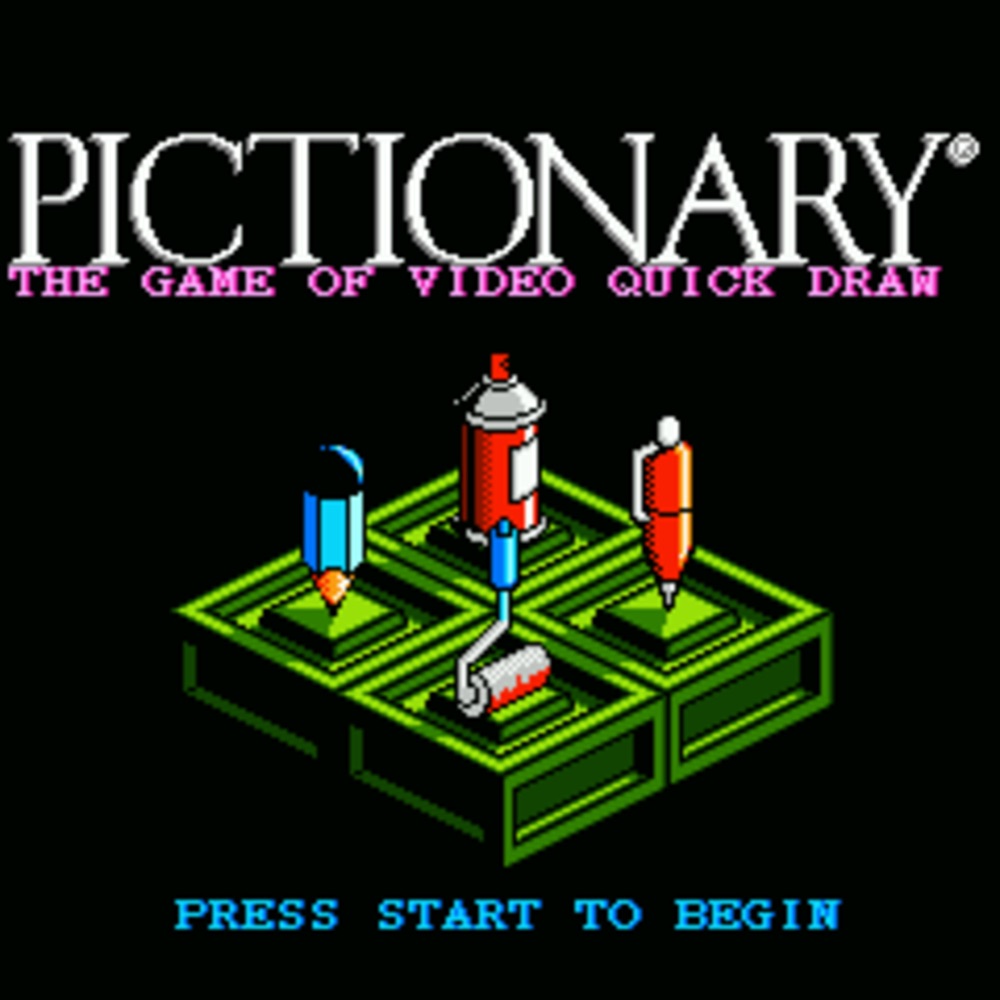
344 · Pictionary
Based on the board game, the object is to guess either a word or phrase based on a drawing. Each team starts on the same square on the board and the first team attempts to draw a picture based on a clue. If his team correctly guesses the clue, then this team gets to roll the dice and advance along the board. If the team fails to guess correctly, then the other team gets a chance to draw and guess. The game plays much in this way until a team reaches the final square on the board and successfully guesses the clue to win the game.
Pictionary arrived on the NES in 1990, early to the party-game craze, and the question we kept coming back to was why you'd need a cartridge for something that needs only a pad of paper. All three of us were here, and Joe took on the role of defender for most of the episode. He had played it with friends in a real party setting and went in as the pro-Pictionary voice. Mike and Sean were not convinced.
What works
- The music. Tim Follin wrote the soundtrack, and the theme that plays as the game boots is, in Joe's words, the hottest track ever to drop on the NES, guitar solo included. We all agreed it's the highlight, and it's why anyone remembers this cartridge. We joked that it's essential music in a bad game.
- Drawing badly together. Mode two is the pen-and-paper replacement. You steer a little vehicle around the screen with tank controls, hold A to leave a trail, and fight buttons that drop circles in by accident. Nobody could draw anything. In Joe's group, nobody ever guessed a single drawing, and after about 25 minutes the teams were still on the first square. They also had a great time. The laughs come from how hard it is, though that was not intentional.
- An unlockable. Beating the single-player run unlocks a spray can as a trophy. We thought it could have been a new drawing tool, though we'd have complained about locking it away.
What doesn't
- Mode one isn't Pictionary. Nobody draws. You play mini games on a timer, such as Paint Invaders, box delivery, space mission and fire rescue, and each one reveals squares of a computer-drawn picture. The boxes and the fire rescue are stuck with the same three-platform simplicity, and Paint Invaders is Space Invaders with the aliens coming upward. In fire rescue, people jump from two sides of the screen at once and you can't save them all, and not saving them costs you time. Half the picture can be uncovered and still look like nothing.
- The answer stays hidden. When you miss, the game doesn't tell you what it was.
- Prompts are murky. Joe remembers getting prompts in the two-player mode, including "density" and "sweat box." We checked a video and couldn't find where the game gives them out, so we aren't sure of that.
- The board does nothing. Landing on a space only gives you the next mini game. Dice and addition would do the same job.
The bottom line
Skip it. Joe voted it onto the Essential Games List, with the music and the laughs as his case, and Mike and Sean voted no, so it didn't make it. Compare it with Monopoly on PlayStation 5, where the computer handles the money, the banker and the pace and makes the game better. Here it only gives you a worse Pictionary, and we would pick pen and paper every time.
Written from our conversation in this episode.
- The Game of Video Quick Draw
- 1. Innovative Gameplay Concept:
- Unlike typical NES games that focused on action, adventure, or platforming, Pictionary incorporated a party game dynamic, translating the traditional drawing-and-guessing gameplay into a video game format. Players used a cursor to reveal parts of a picture, which others had to guess. This was a novel idea at the time, aiming to replicate the social aspect of the original board game.
- Source: Pictionary NES Review by Just Games Retro
- Game Overview:
- Based on the Pictionary board game.
- Players start on the same square, drawing clues for their team to guess.
- Correct guesses allow teams to roll dice and move forward.
- Game continues until a team reaches the final square and guesses the last clue correctly.
- Different colored squares on the board determine the minigame played.
- Modern Comparison: Jackbox Party Pack (2014–present)
- Comparison: Similar to Pictionary, the Jackbox Party Pack series focuses on party-style games that involve drawing, guessing, and creativity. Both games offer a social experience, translating the traditional board game dynamic into a video game format.
- Contrast: While Pictionary uses a cursor to reveal pre-drawn images, Jackbox games typically allow players to draw freely using their phones or tablets, integrating real-time participation and online connectivity. This offers a more interactive and immersive experience with greater creative freedom than the more limited mechanics of Pictionary.
- 2. Four Different Mini-Games for Clue Generation:
- The game stood out by offering variety through four different mini-games: "Attack of the Paint Zombies," "the Warehouse Shuffle," "Four Alarm Rescue," and "Leaping' Energy Capsules!" Each mini-game added a different challenge and provided clues for the main guessing game, making it more engaging and diverse than many other NES titles.
- Source: Pictionary Gameplay Overview on MobyGames
- Game Modes:
- Regular Mode:
- Play minigames against a timer to reveal parts of a drawing.
- Correct actions reveal drawing pieces; mistakes decrease the timer.
- Guess the clue based on the revealed drawing within 45 seconds.
- Alternative Mode:
- No minigames or given clues.
- Teams create and draw their own clues manually.
- Teams guess until the clue is guessed correctly or time runs out.
- Select the winning team to proceed.
- Drawing Practice:
- Practice drawing without time pressure or competition.
- Use simple controls to draw and erase.
- Paint Invaders:
- Similar to Space Invaders, but firing downwards at enemies.
- Use rapid fire and constant movement to avoid enemy shots.
- Box Delivery:
- Move boxes from left to right, avoiding green enemies.
- Avoid stacking more than three boxes to maintain speed and avoid losing boxes to enemies.
- Space Mission:
- Collect blue spheres from different locations while avoiding bouncing aliens.
- Fire Rescue:
- Control firemen with a net to catch people jumping from burning buildings.
- Prioritize saving multiple people over single jumpers.
- Modern Comparison: Super Mario Party (2018)
- Comparison: Both games incorporate multiple mini-games to keep gameplay engaging and provide variety. This helps in maintaining player interest by offering different types of challenges within a single session.
- Contrast: In Super Mario Party, mini-games are highly interactive and involve a wide range of activities, from racing to puzzle-solving, using modern graphics and motion controls. Pictionary, however, had simpler mini-games with limited control schemes and graphical capabilities due to NES hardware limitations.
- 3. Incorporation of Multiplayer Interaction:
- Pictionary for the NES supported multiplayer, allowing up to four players to take turns and interact. This multiplayer feature made it a fun and interactive game for family and friends, similar to how the board game functions. Such party-style, interactive gameplay was relatively rare for NES games, making it a social experience on a home console.
- Source: Pictionary NES Game Info on GameFAQs
- Modern Comparison: Among Us (2018)
- Comparison: Like Pictionary, Among Us emphasizes multiplayer interaction, where communication and social deduction play a crucial role in gameplay. Both games thrive in a social setting, engaging multiple players in collaborative or competitive activities.
- Contrast: Among Us leverages online multiplayer, allowing players from around the world to join games, unlike Pictionary, which was limited to local multiplayer. This advancement expands the social dynamics and replayability, introducing complex scenarios and strategies facilitated by real-time voice or text chat.
- 4. Use of Digital Art Tools:
- The game utilized a digital cursor to simulate drawing, which was quite advanced for its time. This tool allowed players to reveal images progressively, engaging them in an early form of digital art creation and interpretation. This kind of interaction was uncommon in NES games, which often focused more on direct action than on creative expression.
- Source: Pictionary NES Game Mechanics on Hardcore Gaming 101
- Modern Comparison: Splatoon 2 (2017)
- Comparison: Splatoon 2 uses digital art tools in a competitive context, similar to Pictionary. Players can create or uncover artwork during gameplay, making visual creativity an integral part of the experience.
- Contrast: While Pictionary is about revealing existing images to guess a word or phrase, Splatoon 2 involves using ink to create new patterns and mark territory in real-time. The latter's dynamic use of digital art is more interactive and immediate, thanks to advanced technology and more responsive controls.
- 5. Family-Friendly Appeal:
- Pictionary targeted a wide audience, including younger gamers and families, making it more inclusive compared to many action-oriented NES titles. The game’s simple premise and entertaining mini-games were designed to be easily understandable and enjoyed by all ages, broadening its appeal.
- Source: NES Party Games Discussion on US Gamer
- 6. Combination of Puzzle and Action Elements:
- The inclusion of action-oriented mini-games within a puzzle-solving framework helped blend different genres, making Pictionary unique. This combination required players to be both quick-thinking and adept at light platforming, offering a varied experience that wasn’t just about puzzle-solving or action but a mix of both.
- Source: Retro Gaming Magazine Feature on Pictionary
- Modern Comparison: Fall Guys: Ultimate Knockout (2020)
- Comparison: Like Pictionary, Fall Guys blends action and puzzle elements, requiring players to navigate obstacles and solve challenges in a dynamic environment. Both games aim to provide a lighthearted yet challenging experience.
- Contrast: Fall Guys uses real-time physics-based gameplay, creating a more fast-paced and chaotic environment. In contrast, Pictionary was more controlled, with turn-based mini-games that required strategy rather than quick reflexes. The physicality and unpredictability of Fall Guys make it more aligned with modern expectations for action-puzzle hybrids.
- Source: Fall Guys Game Overview on Mediatonic
- 7. Legacy and Influence on Party Games:
- Pictionary on NES set a precedent for how board games could be adapted into video games, influencing future titles and developers who aimed to bring traditional games to digital formats. Its success helped pave the way for future party games that combined digital and social experiences.
- Source: The Evolution of Party Games Article on Gamasutra
- Modern Comparison: Drawful 2 (2016)
- Comparison: Drawful 2 directly follows the legacy of Pictionary, focusing on drawing and guessing games. Both titles emphasize creativity, humor, and social interaction as core gameplay elements, influencing the development of modern digital party games.
- Contrast: Drawful 2 allows for real-time drawing on digital devices with modern interfaces, offering more intuitive and creative control. It also supports online play and streaming, making it accessible to a wider audience and more adaptable to modern gaming habits.
- 8. Graphics and Presentation:
- For its time, Pictionary featured colorful and clear graphics, which were essential for a game where visual interpretation was key. The game’s art style was clean and cartoon-like, making it visually appealing and easy to understand, which helped it stand out among other NES titles that often had more cluttered or complex visuals.
- Source: Pictionary NES Graphics Review on IGN
- Modern Comparison: Scribblenauts Unlimited (2012)
- Comparison: Both Pictionary and Scribblenauts Unlimited rely heavily on visual elements, requiring players to understand and interpret images to progress. Both games have a clean, cartoon-like art style that appeals to a wide range of players.
- Contrast: Scribblenauts takes graphical presentation further by allowing players to create and interact with objects in a highly detailed, open-ended environment. It supports more complex and dynamic interactions, whereas Pictionary was constrained by the limited color palette and processing power of the NES, resulting in simpler visuals.
- 9. Cultural Adaptation:
- The game successfully adapted the cultural phenomenon of the board game Pictionary into a digital format. By doing so, it introduced the concept of drawing-based guessing games to video game players who might not have been familiar with the board game, expanding its cultural reach.
- Source: Cultural Adaptations of Board Games to Video Games
- Modern Comparison: Tabletop Simulator (2015)
- Comparison: Similar to how Pictionary adapted a board game to a video game format, Tabletop Simulator brings various traditional games into a digital environment. Both aim to recreate the social experience of playing board games in a digital medium.
- Contrast: Tabletop Simulator provides a platform for a wide variety of board and card games, offering tools for customization and creation. It allows players to interact with the game pieces in a realistic 3D space, unlike Pictionary, which focused solely on its specific game mechanics within the constraints of 8-bit technology.
- Source: Tabletop Simulator Overview on Steam
- Here are some interesting conclusions that can be drawn from the list of answers for the Pictionary game:
- Simplicity of Words: The majority of answers are short, common, and easily recognizable words or phrases. Many answers are one or two words long, such as "DOG," "ARM," and "T-SHIRT." This reflects the game's focus on simplicity and accessibility, ensuring that players of various ages and skill levels can participate and enjoy the game.
- Visual Clarity: The answers consist mostly of objects or concepts that are straightforward to draw and visually distinct. Words like "CUP," "CAT," or "HOUSE" are easy to represent in a simple drawing, making them suitable for a quick-guessing game format. The list avoids complex or abstract concepts that might be difficult to draw quickly or recognize.
- Categorical Themes: The answers are grouped into common, everyday categories such as body parts ("ARM," "KNEE"), household items ("CUP," "CHAIR"), and familiar objects or animals ("DOG," "CAT," "SNAIL"). This suggests that the game designers chose themes that players would immediately understand and relate to, enhancing the game's intuitive playability.
- Use of Popular Culture and Everyday References: Some answers reference items or concepts from popular culture or common experiences, such as "BIG BEN," "TEDDY BEAR," and "CREDIT CARD." This inclusion of familiar cultural references makes the game more engaging and relatable to a wide audience.
- Variation in Complexity: While many answers are simple, there are also more complex phrases like "JACK IN THE BOX" and "HOT AIR BALLOON." These more complicated answers add variety to the game, challenging players' drawing and guessing skills. The range in difficulty helps maintain player interest and balances the gameplay experience.
Auto-generated transcript. Each paragraph starts with its timestamp. Speakers are not identified.
Pictionary, the game of video quickdraw.
And welcome to NEStalgia, a chronological exploration of every NES game released in North America. I'm Mike. I'm Sean. And I'm Joe. And unlike typical NES games, you know, that focus on action, adventure, platforming, Pictionary is that board game that everybody plays with amongst friends. But it's not the first, like, board game or tabletop-like game we've seen. I mean, if chess can get the video version, why can't Pictionary, why can't Monopoly, why can't Scrabble, right? It's all coming eventually. Pictionary is just a little early to the party, but really it is a party game. So, you know, is Pictionary really all that different of a release in 1990 as Jackbox Party Pack is now? I think it's a little different. Yes. Well, okay.
Probably on execution, which is what this whole episode will be. But I guess I meant like in its audience, right? Like people, there is an audience for this kind of thing of like, you know what would be better if I could play the thing that has all these different items and just have the computer do it for me, right? That's kind of like the promise of the video game versions of these. Yeah, I mean 100%. Yeah, I think that there's definitely always been a market for something like this, provided that it's executed properly. I would say though that Jackbox is unique in that they are designed for video play.
And Pictionary, this game is replacing something that you really just need a pad of paper for. Right. Yeah, it's kind of like when you play video Yahtzee, right? And all it's doing is just rolling the dice for you and doing the math. Yes. But at least there, there's like a calculator component being solved. I don't know if especially on 8-bit graphics, if anything is being solved here that couldn't have been done better on paper with a pen. Well, here's what it's doing. So this is not Pictionary.
There's two modes. There's mode one, which we'll get into. And there's mode two. Mode two is the replacement for the pad and paper. Because it's just like, here are your, create some teams. They ask you to create some teams.
And then they're just like, all right, here's the screen. Draw on the screen. They don't even give you prompts. Right, right. They don't give you the prompts, which is the strangest part in my opinion.
I guess you're just supposed to like, go on a system of your own choosing. But my point was, some people might argue that, well, now it's more of a challenge because you have to draw using the D-pad. But wouldn't you want the opposite of a challenge when you're trying to bring something that's not the point of Pictionary? It's not the point of Pictionary. Right? Like, the challenge, it's not supposed to be like, oh, it's going to be really hard to draw these things. It's supposed to be, it's really hard to draw these things in a totally different way. Not like, because of a technological problem. Not because I don't know how to hold a pen.
Yeah. Okay. So I agree with that. And I played with, I played with a few people. Um, actually played it like a party game. You always got these people that'll play this with you. I was, I was, I was actually in Salt Lake City this weekend for a wedding and, uh, stayed with a friend of mine. And, you know, I was there for like a whole week. So the last day of my trip when I was, you know, I was winding down and there were a couple other people that stayed with the same friend.
Um, there were five of us playing this game. We split into teams of two and three. And, uh, you know, I look, anything that you're going to criticize about this game, I will probably also criticize about this game, but I will probably also be one that is, finding some value in it. And I do find, and you know, even the people I was playing with don't necessarily agree with me on this, but I did find some value in drawing with that stupid apparatus you're trying to draw with where you're, you know, you're, and I've mentioned this on the podcast before because I had thought we played this on the podcast before, but, um, you draw with this pen that's like, you kind of have to drive around like with tank controls.
So that's really stupid and very, very impossible to actually draw what you're trying to do. But there is some value in the fact that both teams have to draw with this stupid pen and it's like you're drawing, you have to like, it does make for like, it does make for a good laugh while you're playing. And like, in that sense, there's some fun, fun guessing happening there. I thought this is again, me playing the devil's advocate because I, I, I experienced this like party atmosphere of it, but, uh, so this is one of the throw that out there. This is the Octodad of, uh, board game adaptations. Uh, I never played Octodad, but sounds like that would be, it's true.
Okay. So like the Pictionary board game, uh, there is a board component to it as well. Players start on the same square, you, uh, draw your clue and then correct guesses allow the teams to roll the dice. Uh, that's more true in the, uh, alternative mode or mode two, whatever. The one that's not the main attraction.
The one we've been talking about. Yeah. Right, right. The one you would think is it would be like the first thing you select because it's traditional Pictionary, but actually the first mode is just a like video gamified version of playing Pictionary where nobody draws. Instead, you play mini games, uh, against a timer to reveal parts of a drawing. And so you'll play these mini games, paint invaders, box delivery, space mission, fire rescue. You'll play these games.
And, uh, if you like, let's take, um, let's take box delivery as an example, right? So you pick up the boxes on the left side of the screen. You have to avoid these enemies and the number of boxes you deliver to the right side. Uh, that many squares reveal themselves, but the size of the squares and what can be revealed usually in my experience revealed almost nothing for like the first 25 to 50% of the picture. You could have 80% of, of the, of the board uncovered and you still won't know what the fuck it is because like, here's the thing. You've got, you've got a computer drawing for you and the computer decides to draw the most
asinine basic shit. And it's like, Oh, like it'll be like a rectangle with like maybe a smaller rectangle on the end. They'll be like, no, that's a parakeet. What are you talking about? Like, and, and it'll, it'll just like, it won't even accept. It won't even tell you what it was when you, when you can't get it right. Yeah. When you don't get something right and it doesn't tell you what it was, that drives me crazy. That, that, that ruins the fun of it for me because I want to at least know if I was close or whatever. I, my guess would be that they didn't have enough things programmed in and it tells you the answer to everything you get wrong. Then you just know everything.
But I didn't think that the computer's drawings, if you reveal enough or like hard to decipher most of the time. Well, the problem is that the pick, the, the computer is drawing with the same limitations that a player would have with the D pad when the computer could just reveal a little more intricate drawings than what, you know, than what a player could do in the same 60 seconds.
Okay. I mean, maybe I didn't get enough of these, but like, you know, like, you know, I'm looking at one right now. It's a, yeah, it's very, obviously very rudimentary, but it's also very obviously a fish, you know, like it's like child's drawing of a fish, but like I, I felt the opposite that not that the drawings were, were too hard. I felt that when you were giving a, given a prompt to draw in the other mode, that's when it was like, like my, my first prompt that I had to draw was density. Wait, so the game will give you the prompt?
Yeah. I, I was playing the, the, the second mode and it was just like, here you go, draw. No, it gives you like the, the prompt of what to, what to draw. And there were a bunch of, for me though, like for our group, they were all like, one of them was, oh, what was it? Like one of them was like two words that were together that I wouldn't even have thought were together. It was like, it was like foot box or something like that. I was like, no, who's going to guess that? Like, wait, wait, can you confirm? It was sweat box. Yeah. You, you do get, you do get the prompt.
Oh, okay. Well, that, that's not the main mode anyway. I'll have more to talk about this one. Um, but yeah, I, I guess when, cause, cause what we did is we played this two player, whatever mode two, whatever it was, and it had all these crazy things that like, you know, even if we could draw, how do you draw density? I mean, I guess I got to, I don't know. I can't even think of, even if I could just draw on a piece of paper. Or so what I ended up doing is just drawing like everything in the very middle. And like, I just kept drawing like more and more lines in one spot. I'm sure they were all very happy with that. Yeah. It was also the first time that anyone drew on it. So I was like still learning the controls.
But, um, but then after that we went on to the other mode with the mini games. And yes, I agree that a lot, a lot of the things you reveal are just empty spaces that give you no information. But once it, if by we ever revealed enough information, it was usually something where it was like, fair enough. Like we can guess this as long as we had enough of the lines revealed. Okay. As long as you never felt. Yeah. As long as you had enough of the lines revealed though. Right. Yeah.
It never felt like the drawing was like, because of the limitations, like the drawing didn't look like what it was trying to look like. Right. But these mini games aren't exactly reveal friendly. Uh, the fire rescue one for instance. Okay. Which is very graphic. Yeah. I'm sure.
Burning building. People are falling out of it. You have to kind of catch them. It's no different than that game and watch game. Uh, where you do that, but they're jumping out like in a way that I am certain. It's impossible. Yeah. Task players couldn't eat. Task bots couldn't even make it so that you could save everybody. So the timer is constantly going down. You're saving people that are revealing mostly nothing. I guess my point is, is that sure. In a perfect world, if you revealed 75% of the image, it should be obvious, right? Like you shouldn't, you should only need 50% of the image probably to know what it is.
I'm saying how much were you able to actually reveal from these mini games compared to the timer that you were given and how fast it drains based on like box delivery. Those, those enemies are going to take out. If you try to take like more than three boxes at a time, they're going to bound to be taken out at least one of them. I don't want to brag about me and my friends, but I feel like we revealed a lot of these with
things. But like, you know, I had a friend who was like a master at box delivery. Like when I did box delivery, I would do one box at a time. He would do like full stacks and not get hit by the green thing. I don't know how he did it. I was all, I was pretty good at the fire rescue one. Yes, there are some that absolutely are impossible to get, but I would, I think I revealed enough where we were able to guess correctly every time I played the fire rescue. And the other one where you're like jumping on the platforms, like I think we, we might be, we might be an elite team of Pictionary NES players.
I, I, I, I grant you that. I grant you that the, the, the games are impossible. That they're, they're designed to maybe not be fully revealed the, the, the pictures or whatever. But here's my problem with all this. This main mode where most I would imagine of the development man hours and money went is not Pictionary.
This is not like Pictionary is basically a communication game. Like you are trying to describe visually a thing and you're, you're, you're trying to like play to your audience. You're supposed to be like, you know, you know, your friends, they'll get it the way that you're drawing it. And it's never like, there's no fog of war for the piece of paper that you're playing. And I get that this is a unique way to at least make it so that you aren't drawing for a computer that can't guess.
Um, which I would imagine was the first like design question they had, uh, was how do we, how do we have like a single player version of this when there's nobody that can guess?
Um, but like, it's just, it's just not Pictionary. This is a game where you play little mini games to like kind of, to, to, to get like a, a Pictionary flavored side thing at the end. Yeah. Well, all right. I didn't expect this was going to happen, but I'm going to completely take on the role of Pictionary defender for the rest of this episode. Now, not what I went into this episode thinking I was going to do, but now I'm just going to, I'm just going to play into it now. So, but yeah, this is not Pictionary, but the other mode is Pictionary. So they gave you Pictionary and they gave you something else.
Yeah. They gave you like the earliest version of Mario party. Yeah. You know, like you're going on the board, you land on a space, you get a new mini game. And then that new mini game, I mean, look, I'll be honest. I think the problem is, is that I actually just didn't, I didn't like the mini games that were provided. They were almost either too simple, didn't have enough controls. Like for instance, the box one, right?
If my memory serves me correct, you can't jump in that to get over enemies. So you are just kind of at the mercy of like a little bit of stalling, no matter what happens to load the boxes at the right time, move them around. I don't want to focus too much on the box thing, but like take me. There's also the, the one where you're, you're platforming in the most basic three platform room. Right, right, right. Nothing ever changes. It's like, that would be what would be so bad about Mario party is if that like, instead,
like as you were going across the board, everything just took you into like a smaller super Mario brothers, one style level. And that was the game. It's like the variety, the depth of those mini games, the excitement of those is what makes that game sell well. I feel like once I get to my fifth round of paint invaders, which is really just space invaders, but I guess Taito has like a patent on like them coming down on the screen. So now they come upwards on the screen to avoid any kind of lawsuits.
That's really the only difference between that and space invaders. And it's just not that, not that fun as like a small little bite size thing. They definitely could have tackled this mini game thing in a way that like the fire rescue one, for instance, if every person could be saved in those, and I'm not talking about
like, you know, making it super easy. I'm talking about like realistically, like those people are just dropping out of those windows at like the same time. And they're on two separate sides of the screen. You have to choose. And chances are you will do like the dark night dilemma where you want to save the one person and try to go there, but you're going to the other person instead. And now nobody wins because the other thing that you, that we haven't mentioned either
is in all of these games, but like the, for the jumping out of the window one, saving the people jumping out the window, the, there's always something that, that gives you a time penalty. And in this game, not saving someone gives you a time penalty. So it's not even like, oh, I didn't reveal something. No, now I lose time also for not saving someone that I couldn't have saved. And I agree that that is a design flaw. Oh, I also want to mention that you, you said that they didn't want to get copyright striked or whatever, but do you listen to the music during some of these?
Well, the music is the main attraction of the game, Joe. So it's, if we're ready to talk about it. Not even talking about like the, the, the masterpiece that is the menu music, but the music during the, uh, like the, the jumping out of the window one is 100% with no doubt. Another one bites the dust. Yeah, probably. No, like, like, like, listen to it. Can you play it right here? It's another one bites the dust.
Well then, wait. We might get a strike, but go ahead. I have no, I have no shame at this point. I've been playing the NES music every episode. Uh, yeah. I mean, the music though is this, for me, the highlight of the game. It's like, that's what people, people still, there is the theme song. Sure. But I do think just the music throughout is, is also pretty, pretty good. Uh, I do think that that's like what makes this game, uh, remembered, you know, I don't think anybody was ever going to like have this, uh, you know, Oh, remember Pictionary on the NES without that theme song. And it is Tim Fallon. And it is, we, we've had his tracks before and we'll have more of them. And it is pretty legendary.
But I, I still think like, even if you know it's coming, if you don't know it's coming, it's even better, right? You're like, okay. I can't remember this song. I didn't, I, and we just had this conversation about playing games on mute. I don't remember this at all. You don't remember the song for Pictionary? No. Oh my God. Sean. I feel like we've talked about it like in real life several times. Yeah. Sean, it's the hottest track that ever dropped on the NES of all time. There's a guitar solo in it somehow.
It is, it is unreal. Uh, so please check it out. Is it just at the main menu? Yeah. It's just as the game boots up even. You can't even hit, don't press start or anything. Well, that's why. Yeah. You wanted to get right to the action. Uh, no, I think it's actually also plays like in between, like when you're on the board, it plays sometime during the game also. I remember hearing it a bunch of times. I don't remember when. Well, that may, that's probably when I went into mute mode.
Uh, but as I'm saying, even if you know it's coming, it still blows you away. Like just why doesn't like so many other games and we've always played the soundtracks during the episodes. Some of the other games have some of the most annoying music you've ever heard in your life. And you just like, we don't talk about it on the episode because it's like, I don't really have much to say about it. I'm not here to grade the games based on their music. But why can't they all sound like this?
Is it��ckous?
Is��ckous? Do we want to talk any more about the drawing stuff, your attempt at drawing things? Joe, since you had a bunch of friends, were you guys able to mostly guess what each other were drawing, or was that harder? Nobody guessed one thing that someone tried to draw ever. Yeah, we played for like 25 minutes. We were still all on this first spot of the board. Nobody moved. Yeah, it's impossible to draw. You just said they gave you Pictionary. It's Pictionary, though. You couldn't fucking play Pictionary.
It's Pictionary. It's like really, really hard Pictionary. And if we had given it more time, we maybe would have gotten some. But yeah, it's like, I'm not even really in reality saying that it would be fun to play through a whole game of Pictionary like this. You are in reality saying that. No, I'm playing a part right now. I saw you guys were very against it. We needed a role of someone to be pro-Pictionary. But I did have fun in those times because it was so hard and so impossible.
It's just that party mode atmosphere where it's like everybody's laughing and you can't, you know, it's really hard to draw. Now, we also all, we went around maybe twice. Everybody drew twice. But I think you need to practice on this for like several times before you can even realistically draw something. But yeah, it's very, very hard.
And I don't know if we want to like talk more about like exactly what is happening when you're drawing. But you literally are this little vehicle that you drive around the screen and you have to hold down A if you want it to start like leaving a trail of drawing behind it as you're driving. And then another button to stop doing that. And then there's another button that makes perfect circles that you hit all the time accidentally. And then, so there's just circles all over your drawings. Like then there's like the down button means one thing and then the left and right button adds circles and then one adds a bigger circle and then something deletes things. So it's just like, you're just always messing up.
It's quite a mess. But it is, it's definitely Pictionary hard mode. Joe, I don't think I'm being so hard on the game. So far I've compared it to Jackbox Party Pack, Super Mario Party. I could go on. I could talk about. Yeah, true. You know, yeah. It's like Among Us, right? I confuse you and Sean a lot. Among Us. Yeah, it's like Among Us. Come on, think about the multiplayer communication aspect. All right, they both have, they both share that. Now you're just being, now you're just being mean.
Look, let me put it this way. If we're all sitting in a room together, I might suggest we play Pictionary in the NES. This is the last thing I want to do with you. I know, maybe the two of you, not anymore because I know you wouldn't be into it. But like, it wasn't a bad time. I'm not saying that makes it a good game, but it wasn't a bad time to play this terrible game with my friends. So I took a look at every possible prompt you could get.
And I pulled all that into a list and submitted that list to AI. Indexed it, you know, what conclusions can you draw based on the large list of possible clues you could get? And the number one thing it recognized was the simplicity of every word and that the majority of answers are short, common, and easily recognizable words. Many answers are one to two words long, like dog, arm, t-shirt. You fed this to share GPT. Yes, exactly. Just to see if there was any, what could it find? Was there a bias on certain things? And the funny thing is, is that it mostly just talks about how,
how like childish that all the choices are. But then Joe brings up that density one, you know, like up here, I've got just random picking right now. Okay. Dog, arm, cup, cat, house, snail, arm, knee. Like those all are things that like, if you gave them to me in the actual Pictionary, I could draw those. Sure. Like I could draw my attempt at them. You know, like that's the fun of it, right? Like I'll give you my version of a cat. No problem. I don't know about the NES version. I think I'd give it a good shot with cat or with arm. But the density one, like that's, that's insane. Yeah. I know how I would draw density.
How? You have a bunch of little dots far apart on one side and then you have a bunch of little dots close together on the other. And you put like, Yeah. Like a different sign or something. It's simple. Yeah. Not terrible, but try it on the NES. Well, I would, I'm saying how I would draw it on a piece of paper, the way you're supposed to play Pictionary.
It's dignity. Don't you know dignity when you're looking at it? But the, um, I'm surprised now I'm looking at them too. I'm surprised how many of them are pretty simple because the ones that stand out to me are density and sweat box, which I don't know what, what is a sweat box? Like a sauna? Yeah. I don't know. I drew a box and I tried to put like beads of sweat on the outside of it, but nobody got it because nobody puts those words together like ever.
Um, but there were, there were a couple others that I remember being like, yeah, how are you going to draw that? But maybe I was thinking, how are you going to draw that on here for some of them? Here's another modern game, uh, to compare it to. Scribblenauts. Okay. Scribblenauts is a game where you draw anything or, uh, you, you write anything and then it turns into an object in the game.
Maybe that could have been applied to the minigame side of this, where the drawing part, like you were drawing to, just to create clues or something in the larger game so that that was the minigame component is like whatever you were, uh, like, let's say you had to play pong or something, but you can draw your pong stick. I don't know where I'm going with this, but I'm trying my hardest to, to help Joe out here with the defense.
There, there are definitely some merits here though. Uh, I just think that like, okay, so now we have, here's another one. Tabletop Simulator. Okay. That's a game that can just simulate any kind of tabletop board game and, uh, people can make any kind of mod they want for it. Does a Pictionary mod exist for Tabletop Simulator? Probably not. Probably. You think there, you think so? You think there's a demand for this? I don't think there's a demand for it. I think that, but somebody probably exists. Yeah. Have you seen mods? Have you met mods? So there is, there is a Pictionary.
For Tabletop Simulator, we're doing live, uh, follow up here. And honestly, it looks like a great game compared to the one we got on the NES. Well, I'm sure it's also being done in like VR, which is funny in its own right. Uh, and it has 1200 clues and, oh, 1200 adult clues and 800 junior clues so that everyone can play. Well, you know, that's like, so they always phrase them like that too. Like I had a Disney trivia game that had like a thousand adult clues and then like a hundred.
Yeah. Right. And then like a hundred kids clues, but it's like, who's the Disney trivia thing really for? But the adult clues were so hard. It was like, I still can't get them today. Like it was for like true diehard Disney fans. And I just couldn't believe that that was the majority of the clues in that board game. And then there was this small kids version that's like, uh, what's the name of, um, Aladdin's, you know, pet monkey. And it's like, is that his pet or his friend?
That's the answer. It was a trick question. Yeah. Uh, okay. Um, should we go back to the music? No. Um, here's a question, Joe. So you play with your friends. Yeah. Did you get to the end? We did on single player. We definitely not. Well, we were playing like actually a game against each other, but on single player, we got to the end and we unlocked the spray can or something. You unlocked the, that's an item. You, you like get, you know, there's like the four pieces that you can be, you like get it as like a trophy at the end. And it's like, wow. That's spray can. Is this the first like instance of, uh, of like an unlockable?
Yeah. And maybe it could be. I'm telling you game was ahead of its time. We're not even at its time yet. What would be cool there though, is if you unlocked the spray can as like, now you can draw with like this spreading. That's what I thought you meant. That would have been neat. See, and each one of them could have been a different tool. Like one, one's a paintbrush, one's a spray can. And so you're, you know, actively working to like unlock the next one.
That would have been really cool. It also would have been annoying. No, I'm sure we would have complained about it too. That like, why aren't these things just included in the game from the beginning? There's different drawing modes. Yeah. See, I'm watching. So I've been watching a video and I'm watching somebody play the alternate mode and I still don't see where they're telling you the prompt.
Maybe we're talking about different modes because it was like a whole screen. It was like, tell everybody to look away. Here's your prompt. When you're ready, press a, you can look at it for as long as you want. So maybe that's not the same as mode two.
Maybe that's just multiplayer. Oh, there's only three modes total. And the third one's just practice draw. Yeah. So mode one is the mini games. Yes. What are you getting for mode two then? Maybe you need to be in multiplayer to get prompts, which would be dumb, but yeah, I don't know. I guess. Oh, that's an interesting thing. Maybe if you, this guy's got multiplayer and it's still not showing that stuff. If you played solo, maybe it was, maybe it knew you had nobody around. So it just was like, all right, we're turning this into a practice mode. Draw whatever you like. I don't think that's the case, but I, you know what? I have to believe that Joe's not making all of this up.
Maybe I just remember what I'm doing. The prompts. I'm misremembering. No, I remember density. The game comes with like 500 fortune cookie, like a pieces of paper. And you're supposed to put those in a hat and draw the clues before you draw. I thought they were trying to get me. You got to go. It comes with a pad of paper. It comes with a pad of paper and pencil and you could play it on there. And the cartridge just goes in and you play the Tim Follins music while you're playing Pictionary.
So here. Okay. Not that this was supposed to become an interview with Joe. So I'll ask both of you this question, but we know our, we know Sean's answer. If you're given the chance to play Pictionary ever again, not for the NES, just the concept of Pictionary. Would you say, Hey, you know, I do have this NES cartridge of Pictionary that we could play. Or would you just say like, eh, pen and paper is fine.
No, absolutely. Pen and paper is what you're going to go with. Like, okay. So yes, this is not a good substitute for Pictionary to Sean's point earlier. It's a good Pictionary like party game. That is like the fun of it is that like, you can't draw properly. You know, it's, it is kind of in that sense, I think like one of those Jackbox games where it's like, yeah, the, the point, you know, this wasn't deliberate, but like the point of playing it for me is like, look how bad our drawings are now. Look how hard it is to actually draw. Like, that's what's funny about it. That's what made it like enjoyable to me. And so it's like that trombone game.
Yes. I think I know what you're talking about. It's like a trombone. We're like guitar hero. Yeah. But it always sounds like shit. Yeah. But the appeal in Jackbox is like draw full games is just about the same, right? Like sometimes it is just so funny how bad people draw on their cell phones when they, you know, when they show up on the TV. Right. So, you know, there, there is still like technology or just skill like limits people in the field of Pictionary and drawing games. Yes. Yeah.
And like, and in no, in no world do I believe that this was intentional on the developers part, but that's, you know, in, in 2024, that's like, that's what it felt like. It just felt like this is hilarious, you know? And, and I'm here talking so much about that mode. And I do think that like the, the mode with more merit is the mini game mode, not as a Pictionary replacement, but just like, that's an interesting type of game where you have to reveal this picture by playing the mini game. But the mini games suck.
Yeah. I mean, I do wish the mini games are better. Yeah. Uh, I think we did the essential games list. Yeah. That sounds like it. Wait, what, what was my vote? You voted essential. Yeah. That's what I was afraid people would think. Let's get those votes in right now on the essential games list.
That's going to be a no for me, Joe. It's a no. It's obviously a no, but I, I just got to say like, you know, when it's not, not worth playing to have a, to have a laugh, you know, that's all, but it's obviously bad game, but essential music. Sean, it is not essential, man. You guys are curmudgeons about this game. I hate this game. You know, Joe and I recently got together and played a version of video game monopoly, not on the NES. I think that's coming, but, uh, on, uh,
PlayStation five, we played a game of monopoly on PlayStation five. And I actually felt like that did so much more for me than an actual board game version of monopoly would, because we were able to play so much faster, so much longer. Everything was handled for us. We just had to do the, the thinking, you know, we just had to say like, yeah, do I want to buy this property? Do I want to, um, what do I want to mortgage? Like you don't have to actually deal with the money and the paper and who owns what and somebody being the banker and stealing 20 bucks. Like all that is put aside and you just have the best version of this game that people have been playing since the thirties.
Pictionary is not doing that here. Pictionary has provided only in my opinion, and I'm sorry to say this, Joe, it's only provided a worse experience than the actual board, uh, board game because the mini game suck. The drawing sucks. And, uh, the only thing saving this is a ridiculous title theme song.
Yeah. I mean, where monopoly made things faster and you need a board, you literally need a board to play monopoly. Um, whereas you don't need anything like the board in Pictionary. There's no, there's nothing happens on these spaces. You could literally just roll dice and add up numbers. It does the same thing. You don't even need to buy Pictionary to play Pictionary, but you need a board for monopoly or the game of life, which I really liked on PlayStation one. Oh yeah. So that, yeah, this, this game does not deserve to exist. Damn. Damn.