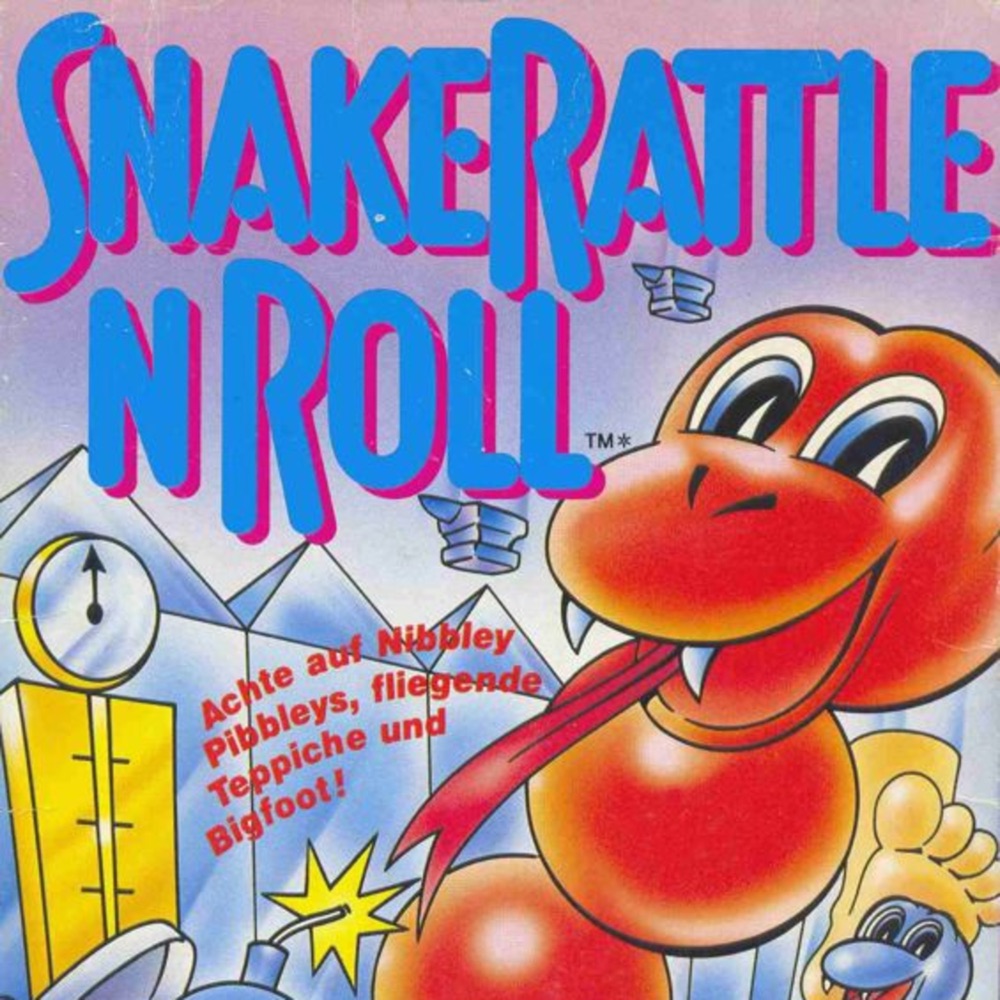
345 · Snake Rattle N Roll
It's a race to the moon for the two snakes, Rattle and Roll! Play alone or simultaneously with a friend as you out-score and out-eat your opponent - then weigh yourself on the scales and make for the exit!
Rare's isometric snake platformer snuck up on us. Mike, Sean and Joe expected a title that "just doesn't really stand out" on a list, and found a polished, charming game with an awkward camera. We also spent the opening minutes debating whether Rattle and Roll have last names, which tells you how much lore the manual provides.
Why it won us over
- Eat, grow, weigh in. You start as a snake head, swallow nibbly pibblies until you are long enough, and hit the scale to open the exit. Ten stages and a Bigfoot boss keep changing the loop so it never goes stale.
- A gentle start. Early stages let you learn the jumping without much punishment, and a hit costs you part of your tail, like losing rings in Sonic. There is no health bar.
- The shadow. A crisp circle under you eases the height problem every isometric game has. It never saved a first jump, but it taught us what we could land on afterward.
- The attitude. Toilet seats (we first took them for clams), stomping feet, bodybuilders, and a shark whose music ramps up the second you hit water. Mike had a Banjo-Kazooie flashback.
- Two players. Joe played co-op and loved it: you combine your weight on the scale, and you shout at your partner to go eat more before you can climb.
- Controls that click. Pressing down sends you down and to the right, which takes a while to rewire. We all ended up tilting the controller. After that it felt smooth, close to Marble Madness, and ahead of its time.
What gets in the way
- Depth perception. Some stretches look squishy, and you can't tell whether you missed a jump or it was impossible.
- Hidden fall deaths. A set drop distance kills you, and it is shorter than it looks.
- The fake power-up. It reverses your controls. We mostly set the controller down until it wore off, and it takes a minute afterward to trust that things are normal.
Beyond the game
The final stage goes gray, so we assumed it was the moon, where a Bigfoot with a flag tries to claim it. A UFO then takes you to a "Snakes in Space" title card. That sequel never happened, and the Game Boy follow-up was Sneaky Snakes. We kept coming back to wasted branding: cute characters and nothing built around them.
The bottom line
Essential. Mike was conflicted, said his heart said no, then talked himself into a yes: a fun, short-lived, harmless catalog entry that still stands out. Sean voted yes because it is unique and polished, and he had less to complain about than usual. Joe said it was a close call but he could not vote against something he loved. We all voted it onto the Essential Games List. Give the controls real time before you judge them.
Written from our conversation in this episode.
- Snake Rattle 'n' Roll is a platform video game developed by Rare and published by Nintendo, released for the Nintendo Entertainment System (NES) in North America in July 1990 and in Europe on March 27, 1991.
- A Sega Mega Drive version was released in June 1993, featuring an additional twelfth level set in space.
- The game is included in the 2015 Rare Replay compilation for Xbox One.
- It was re-released on the Nintendo Switch Online service on February 21, 2024.
- Gameplay Mechanics:
- The game features two snakes, Rattle and Roll, navigating through eleven 3D isometric levels filled with various enemies, obstacles, and items.
- The objective is to eat enough "Nibbley Pibbleys" to grow the snake to the required size to ring a weigh-in bell, which opens the exit to the next level.
- Players use the control pad to maneuver the snakes, using their tongues to eat "Nibbley Pibbleys" and attack enemies. The snakes grow more when eating "Nibbley Pibbleys" of their own color and the most when consuming yellow ones.
- Players must avoid hazards, including bombs, water sharks, and falling from heights. They lose a life if their snake runs out of segments or if other fatal events occur.
- The game can be played in single-player or two-player simultaneous mode, where both players cooperate to complete levels.
- Various items can be collected to help the player, such as extending the snakes' tongues, adding extra lives, providing time bonuses, granting invisibility, speeding up movement, or reversing controls.
- Level Design and Challenges:
- Levels contain manhole covers that hide items, Nibbley Pibbleys, extra lives, bonus level entrances, and sometimes enemies.
- Players can uncover hidden warps that allow them to skip levels.
- The game includes a variety of enemy types and environmental hazards, which require strategic navigation and timing to overcome.
- Development and Influences:
- Snake Rattle 'n' Roll was developed by Rare members Tim Stamper and Mark Betteridge, with Betteridge focusing on compact file sizes and innovative control mechanics.
- The game’s 3D isometric view was influenced by Marble Madness, which Rare had ported to the NES in 1989, utilizing similar high-speed scrolling techniques.
- Gregg Mayles, Rare's future creative director, began his career testing this game and noted the responsiveness of its controls.
- The soundtrack, composed by David Wise, was inspired by 1950s rock-'n'-roll, notably "Shake, Rattle, and Roll." It includes a reference to the Jaws theme when the snake is in danger in water.
- Critical Reception:
- The game was well-received for its innovative isometric graphics, challenging gameplay, and humorous elements, with a 94% rating from Mean Machines and a 91% rating from Retro Gamer.
- It received the Game Player's NES Excellence Award in 1990 and was praised in various gaming magazines for its originality and fun factor.
- Retrospectively, it has been regarded as one of the best NES games and a standout title from Rare, ranking #32 in IGN’s "Top 100 NES Games."
- Legacy and Follow-up:
- A Game Boy sequel, Sneaky Snakes, was released in 1991, featuring similar gameplay in a 2D side-scrolling format.
- Although Snake Rattle 'n' Roll hinted at a sequel titled Snakes in Space, it was never developed.
- The game's blend of puzzle and action elements, along with its iconic isometric design, has ensured its place as a cult classic in the gaming community.
- Fun Facts:
- In level 7 of the NES version, the landscape spells out "NINTENDO GAME BOY," while the Sega version spells "SNAKE R+R GO SEGA."
- The sound effect played when a snake enters water and is pursued by a shark mimics the famous two-note theme from Jaws.
Found automatically from the transcript and checked, but it can miss things or pick the wrong page. Spot a mistake? Tell us.
Games
- Snake Rattle 'n' Roll mentioned at
The episode's game: Rare's 1990 isometric platformer where two snakes eat nibbly pibblies to grow and weigh in.
- Banjo-Kazooie mentioned at
Rare's later N64 platformer, whose lack of last names and shark scare the hosts compare to this game.
- Snake mentioned at
The Nokia phone game the snake-head gameplay recalls.
- Crash Bandicoot mentioned at
Full 3D PlayStation platformer mentioned for its shadows that help judge jumps.
- Sonic the Hedgehog mentioned at
Game compared to the snakes losing part of their tail instead of health.
- Marble Madness mentioned at
Isometric NES game ported by Rare, compared for its smooth movement and perspective.
- Solstice mentioned at
The earlier isometric NES puzzle game whose controls didn't work for one host.
- Wizardry: Proving Grounds of the Mad Overlord mentioned at
Next week's game, the early text-menu dungeon crawler RPG.
- Splatterhouse mentioned at
The horror game the hosts will play in its cute Famicom version for the Patreon bonus show.
Hardware
- Game Boy mentioned at
Nintendo handheld that got Sneaky Snakes and that level seven's stage layout spells out.
- Sega Genesis mentioned at
Console version in which the level's layout was changed to say Go Sega.
- Atari 2600 mentioned at
Console joked about as having poor controls that would make an essential list hard.
Companies
- Rare mentioned at
The British developer of Snake Rattle 'n' Roll, later known for Banjo-Kazooie.
- Pixar mentioned at
Animation studio the hosts imagine making a modern Rattle and Roll movie.
- Nokia mentioned at
Phone maker whose phones popularized the game Snake.
Film, TV and music
- Super Mario Bros. (film) mentioned at
The 1993 live-action movie where Mario and Luigi both have the last name Mario.
- Shake, Rattle and Roll mentioned at
The 1950s rock song the game's title and music play on.
- Jaws mentioned at
The shark movie whose theme the in-game shark music resembles.
Terms and events
- Isometric video game graphics mentioned at
The angled 3D-looking perspective that makes the D-pad controls tricky.
Other
- Donkey Kong mentioned at
Nintendo series whose characters, like Diddy Kong, share a last name, in a joke about snake surnames.
- Bigfoot mentioned at
The cryptid and the giant foot enemy and final boss in the game.
- NEStalgia Essential Games List mentioned at
The show's list of NES games that define the system; Snake Rattle 'n' Roll was voted in.
Auto-generated transcript. Each paragraph starts with its timestamp. Speakers are not identified.
Snake, Rattle and Roll, brilliant 3D graphics and a colorful new duo, Rattle and Roll.
And welcome to NEStalgia, a chronological exploration of every NES game released in North America. I'm Mike. I'm Sean. And I'm Joe. And honestly, if you didn't read the back of the box, or you just didn't read the manual, or you didn't read anything online, you wouldn't assume automatically that the snakes names were Rattle and Roll.
I certainly didn't. I just thought it was a cute play on words. But are they like, is snake their last name? Is it like Rattlesnake and Roll Snake? Are they brothers? Oh no, they're just snakes, Mike. So, oh, so snakes only get first names, right? Right. Yeah, actually that's true, right? Like, my dog, whose name is Phoebe, I do call her at the vet Phoebe Esposito. So I guess Rattle does, is owed some kind, like he would be Rattle Esposito though, right? Well, maybe for you. Maybe for you. Because that's my last name.
So he would be my pet. But what about if I played the game? If you played the game. Oh, I see. So during the game, because. So it would still be Rattle Esposito? Yeah, you know, and it's true, because this is a rare game, so just bring in some rare logic. Like Banjo and Kazooie don't have last names, but Donkey and Diddy do. They're both Kong.
Hmm. But that's like more Nintendo rules than anything. I'm sure they would have liked to have just called him Diddy instead of Diddy Kong. It's gotta be like the Mario, the first Mario movie where like one of their first names is also both of their last names. That's like Rattle, Rattle, and Roll Rattle. Yeah. So Mario was the last name? Yeah, Mario, Mario, and Luigi Mario.
Hmm. They thought that was so funny in the movie. Like they thought like, oh, we've really got something clever here. That's why they're called the Super Mario Brothers. Are we talking about? Because their last name is Mario. The live action? Are we talking about? The live action. Yeah. Oh, okay. The only one worth talking about. Yeah. The other one is like, you know, sure, it was big at the box office, but it's not worth talking about. Now, what if they made a modern Pixar style Rattle, Snake, Roll game? It would be called Snake, Rattle, and Roll for sure for just brand recognition. But yeah, what we would have is hopefully a great isometric Pixar movie.
Because that's what we were promised here in this video game. We are playing as, I'll just say it, you're probably only playing as Rattle unless you're playing with two players, in which case you unlock Roll.
And you are in these isometric 3D worlds where you are starting off just as, you're not a full snake. You're just the snake head. And I think that leans a little bit into the game Snake, right? That we all played on our Nokia phones before cell phones. I would say that that would be the thing you think about. Right? So you're like a little snake head. You don't really think about the horror of just being a snake head. Right, right. They don't look horrified.
You eat some of those nibbly pibblies and you grow into a larger snake. A snake that the size demands you to be to complete a particular level. You can't just be a snake with just a head. That's not acceptable. The course will not let you out. The only way to get out is to ring a weigh-in bell. So is it because you need to be long enough to hit the top of the bell? Or you need to be long enough which makes you heavy enough to weigh in? Yeah, I think it's about your weight.
Yeah. I like the idea that it's just being long enough to touch the top and kind of like ring it yourself. Yeah, but he doesn't do that. He doesn't. He just sits on the scale. He doesn't do that, but that's what it's making up. You think about it. The whole thing is that you're getting longer.
So now I'm just getting fatter? It's longer? I mean... No, you're getting longer. It makes sense. It still adds weight to you. Yeah, there's still mass. Okay. I mean, you go on a scale at the end and one of those little things on a carnival when you hit the hammer, I guess, thing goes up and rings the bell, right? Yeah. Yeah, but I think it would be more fun if he rang the bell. Okay. I have notes. I have notes for the developer. That's good to know. We'll keep that in mind. Here's another note. When you're starting the game and it has one player or two players on the options menu,
it's not entirely clear that that little sparkly thing to the left of that is your selection. It's a different kind of graphic than I'm used to. Oh, I don't... It looks like it's just part of the background. I know what you're talking about. On the menu screen? Yeah, on the menu screen, that is like... It's sparkling, right? But technically, all of one player should just be sparkling. So this way you know that that's the option you're highlighted on, but instead it's just to the left of it in the black void. So it's not entirely clear that that's me, the cursor, choosing one player. It's fine because it starts you on that and you're just going to hit A anyway. But when it moved, I was startled.
Do you see yourself as the cursor? Do you have a first-person feeling as a cursor? As a cursor, I feel like I... Yeah, when I'm holding a mouse and a keyboard at the same time, and I'm moving the mouse... You get motion sick. Yeah. I'm moving the mouse on the computer. I do follow that mouse around as if it's my body, as if it's my hand. Okay. That's cute.
Okay, back to the game. So let's talk about the controls, because that's probably going to be the thing that's going to be the most interesting thing to talk about here. You, as I mentioned, it's an isometric game. So we've played some pretty recent examples of this where we've been like sometimes hot, but for the most times not too hot on the free 3D controls on the NES. How does, especially Snake Round and Roll, as a platforming game, how does it handle?
So, like any isometric game with a D-pad, they have a very important question to answer, very important decision to make, and that's what's going to happen when you press down. And then there's also, like, what's going to happen when you press left. Like, they have to skew it in one direction or another, and I don't think there's, like, a true correct answer here as to whether down means down right or down left, because that's what isometric does, or if it's just completely, like, down means down on the screen, and you kind of have to always be pressing diagonals if you want to go in the isometric north, east, west, south.
And they chose. I think down makes you go down and to the right on the screen. Correct me if I'm wrong. And that can be kind of confusing for a while, but then after some time you kind of get used to it, especially because I think that the platforming in this game,
it's kind of squishy enough, it's a little forgiving, but it's definitely the brain buster for a little while. Yeah, I'm that way with any isometric game like this. It takes me a while to get used to it, but I do always end up tilting the controller in the way, and it works for me in a way so that, you know, up will be pointing upright or whatever direction up means in this game. And that does make it a lot easier for me over time. But, yeah, it's like this unfortunate limitation to this kind of game on the NES, because if there was a joystick or something, it would be no problem. But obviously there is not. So that is like definitely the first thing anyone notices about this game, I would think.
And the snakes are a bit floaty in their movement and their jumps. And this is a, you know, it's a vertical platformer in the sense that you will continue to, you know, kind of climb up things with the repercussions of falling down and such. Does it become a thing where, you know, maybe the floatiness is a skill thing? Or does it become like a frustration point where the floatiness at times, especially on more precise platforming, just winds up being something that can easily be a trap for the player? Yeah, I don't think that the floatiness of the controls is really where any frustration is born out of. I think it's a combination of that shift
from like a straight on D-pad to kind of having to go diagonal. And with the perspective itself, like, and how that visually looks. Because isometric, you really, you're kind of removing some important parts of how you're perceiving three dimensions. If they've shown, like, they'll have,
they'll have like sections of the screen that maybe they aren't as clearly defined as like one square and then a wall and then squares above that. It'll be sort of like a little, it'll be a little like squishy looking on the screen. And you can't really tell what side is higher than the other. And then you end up trying to make a jump and you can't tell if you're just missing the jump or if that's actually an impossible jump. I don't know if you guys are picking up what I'm putting down here. Yeah, I know exactly what you mean. But I did appreciate that they added a very clear, crisp shadow,
which does at least help to alleviate some of that issue. I mean, it's something that they did even 3D, like I know Crash Bandicoot, which is a full 3D game, but like people weren't used to that. And it is a little weird when you're trying to precisely land on something,
having like that crisp circle below you. And that did help me. Granted, it never really helped me like the first time I tried to jump onto something and then I fall to my death, but I would see my shadow afterwards and it would tell me, oh, I could land on that or I couldn't if like, or that's not what I was looking at, but at least it was some indication. Yeah, I just always had some trouble gauging height. Yeah, especially thinking like, oh, there's certain jumps maybe, you know, that you can't make next to other jumps that you can. And I will say that, you know,
kudos to Rare here, they did create early on environments that kind of welcome you to master being rattle or roll and jumping around without consequence. Like, yeah, you might hit an enemy and lose, you know, part of your tail or something. That's another interesting thing that like, you know, you, that's what you, you almost like Sonic the Hedgehog in that way. You lose all your coins. Like you just lose a piece of your tail. You don't have like a health bar per se.
So you have, you have a lot of like, it's not a sandbox necessarily, but the early, earlier levels do allow you to just kind of get your bearings and figure all this out before it just becomes like, you know, more strict challenge of platforming. Like, I feel like if it went into like pitfalls and spike deaths and, you know, wading tides and stuff early on, it would be like a, too tough a game. But because I was able to spend some time just getting my bearings with the, the jump itself, because the whole game basically is you're a floating snakehead jumping around and trying to reach, again, it's vertical. So you're trying to like reach the next part of these mountainous stages.
I do think, ultimately, the level designs communicate pretty clearly where you have to go next, what you have to do. It's mostly an inviting experience. It's not necessarily hardcore by any means. The hardcore part probably comes in to the challenge of the platforming itself and being able to navigate these terrains once they start filling them with enemies and pits and death traps, you know? Yeah, I think the inviting nature of it is just in how goofy the, like, the character design is and, you know, it's got like a nice soothing color palette and it just does look nice. But I, I think like there, there is still,
like, there's a lot of, like, spiky stuff, but like, they're not, they're not like hardcore spiky. So yeah, I get what you're saying. Yeah, they're not in the, they're not in the stage yet. Like, they're like off to the side. They're kind of like introducing these elements to you. But, you know, the game will get hard, but I think it like, it progresses nicely. Yeah, there's feet. And you mentioned, you know, the fun design of it all. I do think even the enemies are fun. Am I clocking a toilet seat?
Did you guys see that? It looks like it's like, toilet seat. Well, I don't know if it is a toilet seat because I didn't refer to the manual, but there are these, it's early on too, so you would know. It's like, the third or fourth stage. But there's like, are you sure it's, oh, you know what? I do know what you're talking about. I thought those were clams, but now that I see it again, it's definitely a toilet seat. Oh, yeah. I know what you're talking about too. I'm not looking at one, but I thought those were like, yes, seashells or something too, but. It's like, what are they doing here? Like, what's the mission for them?
no, this game's definitely having fun though, you know, the whole time. You know, there's like the foot that's stomping around. There's like, there's like weights and stuff because you're trying to weigh in. And there's, there's a lot of bodybuilders. Do we know the story? I didn't read the manual. Yeah. The story is very short. Uh, the story is snake rattle and roll takes you into the fun filled world of two of the hippest snakes around. Rattle and roll. Like they really want you to understand
that those are their names. Um, goes really in. It's very important actually. Like it's, it feels like almost, they're setting up a franchise here of like, you know, first we start with this video game. Then we get our hip hop album and then the movie, you know, like it's just like, work your way up boys. Uh, does you have to work your way through 11 levels of wacky landscapes and wild enemies in each level? You need to consume enough nibbly pibblies to activate the scale that will open the door to the next area. That's not a story. Right? Exactly. That's not a, that's the objective of the game.
They're like, so here's the deal. All right. Like what's their story? They don't have a story. Okay. They just came to be. It's funny though, because of how much it, and I guess this is a point, like there's a lot of character going on. And even in just the way that, like after you eat any nibbly pibbly, he then, like there's like an actual, uh, there's, there's like a cool down, uh, because you have to spit out the legs. It's actually pretty hardcore.
And in a way, this does, like, knowing what Rare will eventually do on Super Nintendo and N64, I do get those, like, platforming vibes that will come later in games like Banjo and Kazooie. I get them here, even though it is just, like, straight levels. For some reason, I feel it. And maybe it's because I know it's rare. But I feel it here. And specifically, since I mentioned Banjo-Kazooie, I just wanted to throw out that, like, I only know this in reverse, but I'm sure some people know it the other way, where they played Snake Rattle and Roll first and then Banjo-Kazooie. But it is funny that in Banjo-Kazooie, in the water levels, if you swim out too far,
eventually a shark will just appear and his character speech bubble will also pop up first before you really see him. And he'll just be, like, saying that he's coming to get you and everything and this dramatic music will happen. And it scared me to the point where I would have to just drop the controller and run upstairs. I couldn't face the shark, but I couldn't swim back to shore.
I just was paralyzed with fear. But that's what's happening in this game. So did you have some flashbacks? Like, yeah, I did. I did. But in this game, the second you land in the water, the shark's like, here I come. You know, the music starts ramping up, which is a blatant like... This game was you finally facing your fears. Yeah. I mean, because it was a lot easier. You knew he was always coming.
And you saw him early on. Like, there was no, like, I'm going to get you a text bubble. Like, come on, that's pretty frightening stuff. It is frightening. And also, I appreciate that it's sort of a...
It's a more forgiving situation than just, like, a pitfall and then falling to your death. And I would say that, like, oh, this game, like, you know, it lets you fail. But then this game also does have pitfalls that make you fall to your death in weird ways. Like, even when... Because we're talking about the verticality of the level, there will be situations where you think that you can jump down. And you actually can't. You will die from falling before you reach the bottom in, like, in lengths that you wouldn't really think. So you definitely have to sort of relearn what your range is as well.
Yeah. And what I had gathered, I don't know how true this was, but, yeah, that there is a specific distance that will just cause fall death. And I did, like, test it enough times where I was like, okay, I do know now, like, not to try anything that doesn't look really obviously like I could land on it. Because I feel like any time I was like, can I land on that? I would jump and I would just fall by death.
It's not, like, it's not egregious, though. Like, you eventually do learn that. Right. Another notable 3D isometric game on the NES is Marble Madness. And that was originally in the arcades but ported to the NES by Rare. So it's kind of interesting to think that they maybe had this system down. And Marble Madness is a game where, admittedly not a platformer, but you control a marble going through vertical isometric stages from top to bottom. And now they've made a game where you basically have to try to platform your way from bottom to top. Do you see any other similarities maybe between Marble Madness and Snake Rattle and Roll?
Well, it's not exactly the same because Marble Madness is obviously, like, a lot more about this, like, momentum and speed. But it is one of the smoother feeling movements on an NES game that, like, I remember playing.
And I think that that works, like, really well with what this game is trying to do. Like, I don't know, something about the movement and the graphical style, maybe because it's isometric and makes it easier to do this. But it's all just very clean. You know, it does feel... Now, despite the fact that there's the weird isometric controls and that makes it, like, a little tough, it otherwise feels ahead of its time in the controls. Like, if only the D-pad lined up with the directions you would go, then this would feel great. You know what I mean?
I think that there was a little bit of just... I mean, obviously, they knew that it was going to feel weird just by the perspective. So they threw in what looks like a power-up, but is actually the thing you really don't want to pick up. Yeah. Which is, in addition to asymmetric controls, in addition to maybe not having a great grasp on height and depth, now your controls are reversed.
And I remember seeing it for the first time. I was like, oh, that looks like a cool little power-up. And no, now if I press right, I'm going left, but also not really left. It's not really right. So I was like, oh, God, this is hurting. This hurts. Yeah. I considered that just a time penalty because as soon as I got that, I'm just putting the controller down until it wears off. Because I'm not even going to try and move. But the first time I did it, I was trying to... You know, when I realized I was reversed, even when it went back, it still took me a couple minutes to be like, is it back? Because it's still a little weird, even when it's normal.
Your brain can't tell if it's adjusting to something or not. Yeah. And the whole time the game is obviously asking the question, just what are these snakes climbing to? You know, we're constantly going up this mountain. What is the end goal for these brothers or alleged brothers or people, snakes without names? Are they getting on a plane? They are going to the moon. Oh, I didn't gather that. That's how high this mountain was. It goes all the way to the moon. The last stage, everything shifts to this gray color. So I guess you're on the moon by that point.
And eventually, when you get to... There's 10 stages. After the 10th stage, there's like a boss fight with that... I'm just realizing this now. Big foot. Is that a joke? Right? Like that big foot. Maybe. Yeah. So big foot's in the game, confirmed. Is it just the big foot though, right? Yeah, it's just a big foot. But there's like so many other big feet just stomping around the rest of the game. Those are little feet. No, no. This is the same size. Yeah, it's the same size. Oh. This guy's got a flag sticking out of it. Like that's the only difference. Yeah, but he's trying to claim the moon, which is made out of cheese in the final level.
In the boss battle, at least. He's trying to claim the moon. Yeah, yeah. No, it does. I think the whole game has charm. But I'm saying he's no bigger in foot. Yeah. But I'm realizing that they're all probably just the Bigfoot clan, you know? There needs to be more lore. Yeah, there needs to be more lore because the story in the manual was lackluster. But there is some interesting thing here, Sean. So you kill Bigfoot. He does take more hits than your usual foot. Then a UFO comes down. And you get inside that UFO. And then it says snakes in space on screen. But it's trademarked. It says snakes in space TM. But that wasn't the name of the game.
Is it a tease for an unreleased game? Right. Is this like a sequel of sorts that they've announced inside the game? Like have you ever seen that before? Like Super Mario Brothers will be back in Super Mario Brothers 2. Yeah, I was going to say this is like the end of like a Nomura. Like this is like a Kingdom Hearts ending where it's like it all began with snakes in space. Yeah, this is what are these snakes up to next? And what would snakes in space actually could be really fun. It's kind of interesting that the 10th level, the moon level, and I don't really know if we're on the moon. I'm just saying because it's all gray. I assume we're on the moon at this point.
It would be interesting if like now there was even more of a physics change, right? And you could jump really high and that made it really hard to land where you want to. It would probably just make it really easy actually. But that's for the developer to figure out. It's kind of surprising that they didn't go there. But they could have went like full physics sandbox in the next one if it was snakes in space. Yeah. I mean they had a underwater level in this one. They did. I didn't get to it so I don't know exactly how it controls but I saw it in the video. You saw it in the video.
And it's like 20 minutes into the 30 minute like full playthrough so it's pretty far into the game. Well, it does control completely different because now you have the ability to kind of like swim up and fall back down.
You're basically flying instead of swimming. It's the most different level I think in terms of like it's most uniquely it's the most unique feeling level. Yeah. But so there was no snakes in space but there was a Game Boy sequel titled, you guessed it, Sneaky Snakes. Oh. That is what we guessed. Yeah. Of course. Everybody knew that. What would you have called?
This just feels like such a wasted potential for IP. Like you got these like actually, you know, they're simple but they are cute like characters and you've already got a goofy naming convention and you've already got weird theming with toilets and feet and a bunch of like, you know, kind of poop and fart stuff. You'd think that there would be like, you know, if not a story for this one game, you'd think that there'd be like some kind of design. It just seems like this was a prototype that they just had to think of some characters to put into it. In level seven of the NES version, the stage as a whole like spells out Nintendo Game Boy. But the snake rattle and roll also never came out on Game Boy. Sneaky Snakes did, not Snakes in Space.
A little all over the place. This game is just all about like misinformation. Yeah. And they actually took the time to, I think they had a Sega Genesis version. They took the time to replace that and it spells Snake R plus R Go Sega. So maybe it was like Snake Rattle and Roll are now Sega's, you know, main squeeze, not Nintendo's. Yeah, they go Sega, you know. That means something. I think they're trying to like hide a lot of like information or like advertising into their games. Is that like Freemasonry? Yeah, they have the results of the 1992 presidential election stored in the game files. No, they don't. They have the 1996 election. Oh, I thought it was about like Dukakis or something. Yeah. What else? That's... Oh, um...
Uh... No, you had something. I did. I did have something. Um... I'm pretty sure... I don't have anything, guys. You don't have anything. Oh, you didn't have anything. No, no, no. I really did think that I did for a second and I feel very sad that I don't. Um... But the game... It's actually a very simple game. There's not much to talk about. Which is weird because it's a lot of fun. Yeah, I actually really like the game. It's just... That's the game. That's what it is. All right, all right. Hold on. If you like the game and there's not too much to talk about left, then we might as well talk about what remains on the Essential Games List.
Snake, Rattle, and Roll, in which you play as Snake, Rattle, or the other Snake, Roll. Uh... I don't know why I'm harping on that feature so much or that call out. I like that their names are Rattle and Roll, to be honest. I like that the whole thing is a little, like, play on that 50s rock song Shake, Rattle, and Roll, uh... Or at least the music a little bit inspired by it, except for the shark that seems to be Jaws ripped off a little.
Uh... Maybe a little faster. Maybe if you like slowed it down, it would be Jaws theme. I'm rambling because a part of me feels a little conflicted about voting no. But my heart right now says that's right. Uh... We got a fun game here. So it hurts to say that, like, oh, a fun game that people who like the NES might enjoy. Like, shouldn't that be what fits on the Essential Games list? But I don't know if there's... Hmm? Maybe there is enough here.
Maybe I'm gonna just throw it on and let you two decide what happens next. I think I am gonna give Snake, Rattle, and Roll a little Essential Games list push here. And here's why. This game was the kind of game that, um, feels funny to control at first.
And I think as you spend time with it... And I mean that. Spend time with it. Don't spend five minutes. You gotta spend some time. I think that the controls of the snakes only feel better as time goes on. They don't become more frustrating by any means. And once you get those controls down, what you have is a pretty standard 10-level game with some, you know, changes here and there so that the gameplay loop never gets too stale. But ultimately, it's a pretty fun, short-lived experience. It's harmless, uh, as a catalog entry. But it also kind of stands out. So, I think I am gonna put this on the Essential Games list. What about you, Sean?
So, yeah. This is kind of a, uh, an odd game. Because one, it kind of came out of nowhere. At least from my perspective. Not really knowing anything about these games. And it had a pretty, like... When you see snake rattle and roll on a list of titles, it just doesn't really stand out. Um, aside from like, oh, that's probably gonna be pretty bad. Um, and then to find a really polished, really unique, uh, charming, uh, platformer with a weird perspective. With lots of missed opportunities and branding.
Um, it's just, it's just weird. It's just a very strange feeling playing this game. Uh, because I feel like I should have heard of this. And, you know, despite the complaints that I have with the, with the, like, learning the controls. And, uh, the weird decisions that...
I just feel like this should have been bigger. Uh, so yeah. I, I think I, just by virtue of it being unique. And I don't know why, like, it felt like I was struggling to find things to talk about. I think that's just because it's a really polished game. That, like, I, I usually just complain. And I did complain. But I did, I had less to complain about in this game. So, uh, yeah, I'm gonna vote essential too.
All right, Joe, you can't stop us. But you could join us. What's your vote? I wouldn't want to stop you. I'm actually very happy I didn't, I didn't... Well, first of all, it was very exciting to hear your, um, your live change of your vote, Mike. Oh, I'm glad to, uh, impress. I will say that I, I was, I do think that this is a... Two out of three essential game.
But I can't not vote essential. I loved it. I had a great time. So I guess we're gonna, it's gonna be another one of our unanimous essential games. Um, I also played multiplayer on this, which I didn't mention, which is double the fun. And also, uh, you both, you combine your weight to weigh in at the end of the level. Which is fun and adds to, like, this conversation. Like, I'm up here, I can't get back up here. Like, don't worry, I'll go eat a few more things before I gum up so we can weigh enough. You know, things like that.
Um, so yeah, it, it was cool. We, with, of course, the, the isometric thing, uh, being a little bit of a challenge. But that's the case with a lot of isometric games. I mean, Marble Madness, we voted that essential, right?
No. Um, but yeah, I'm, I'm, I'm adding my vote. Essential. Uh, and it's funny because I'm sure people will remember that, uh, what did we recently play? Um, Solstice, right? That was an isometric game. But I was not kind to that one because I never, like, I just didn't, the controls, they didn't stick with me. You know? Uh, it wasn't necessarily that the game was overwhelmingly bad or anything. It was that the controls didn't land there. And I think not that, you know, Solstice is a totally different kind of game. It's a puzzle game where, uh, Snake Rattle and Roll is a, uh, platformer. But if it would have had the kind of isometric rules that Snake Rattle and Roll sets up, I think I would have enjoyed it more.
So, uh, sometimes it really is all the difference in these older games on how they control, which is basically why, uh, every, like, Atari 2600 game, like, there's a, there is probably an Atari 2600 essential games list today, but most of them are going to fail because there's just not enough to, like, the controls suck because the controller sucks because it's just not fun to play anymore. I don't ever think of a graphical limitation, you know?
Even, these isometric games certainly leave room to be desired, but they are doing something pretty impressive on the NES. And I think, uh, for me, it's not really what I, that's not in my consideration of like, oh, what, what, how does the game look? How does the, it's all about how the game feels. Also, real quick addition here between, uh, the difference between, uh, Snake Rattle and Roll and Solstice is, in Solstice you didn't have an attack that was you just licking your opponent like a snake.
Yes, yeah. Right, you needed that. Uh, just like you need more episodes of this show, uh, because they're still coming every Friday, believe it or not. Next week, uh, Wizardry. Jeez. Oh, boy. Do we know about that? That's gonna take a long time. No. Wizardry? Oh, no. It's a, uh, RPG, uh, Wizardry Proving Grounds of the Mad Overlord. That's pretty cool. Uh. What, what, what is, I've never heard of this. Why, why this reaction?
Because it came out in 1980, uh, or 81, like really early and, um, was mostly like menuing with text and stuff. So I don't know how they're gonna update this, but yeah, I'm kind of excited to see how they're gonna do that. But see, you're gonna see it in real time too. I'm sure we have people on here, uh, who listen to us who love Wizardry as a series. This is gonna be my first Wizardry entry. How about you guys? I've played, there's like so many of them. I, I played one of the, the ones around like the PlayStation era. Uh, it's a, it's a vibe.
This is my first time ever hearing about it. So definitely my first, uh, Wizardry entry. And we will be entering, uh, the spooky month pretty soon. And for our Nostalgia Bites show, which is us playing the Famicom games, uh, you can join at patreon.com slash nostalgia to get all those episodes. That, uh, that month for spooky month, we are gonna play Splatterhouse. But, uh, not the original Splatterhouse, the Famicom version of Splatterhouse, which has like a little bit of a, uh, cutesy style to an otherwise, uh, horror filled game. It should be, should be an interesting crossover. Looking forward to it.
versversversversversversversversversversversversversversversversversversversversversversversversversversversversversversversversversversversversversversversversversversversversversversversversversversversversversversversversversversversversversversversversversversversversversversversversversversversversversversversversversversversversversversversversversversversversversversversversversversversversversversversversversversversversversversversversversversversversversversversversversversversversversversversversversversversversversversversversversversversversversversversversversversversversversversversversversversversversversversversversversversversversversversversversversversversversversversversversversversversversversversversversversversversversversversversversversversversversversversversversversversversversversversversversversversversversversversversversversversversversvers Thank you.