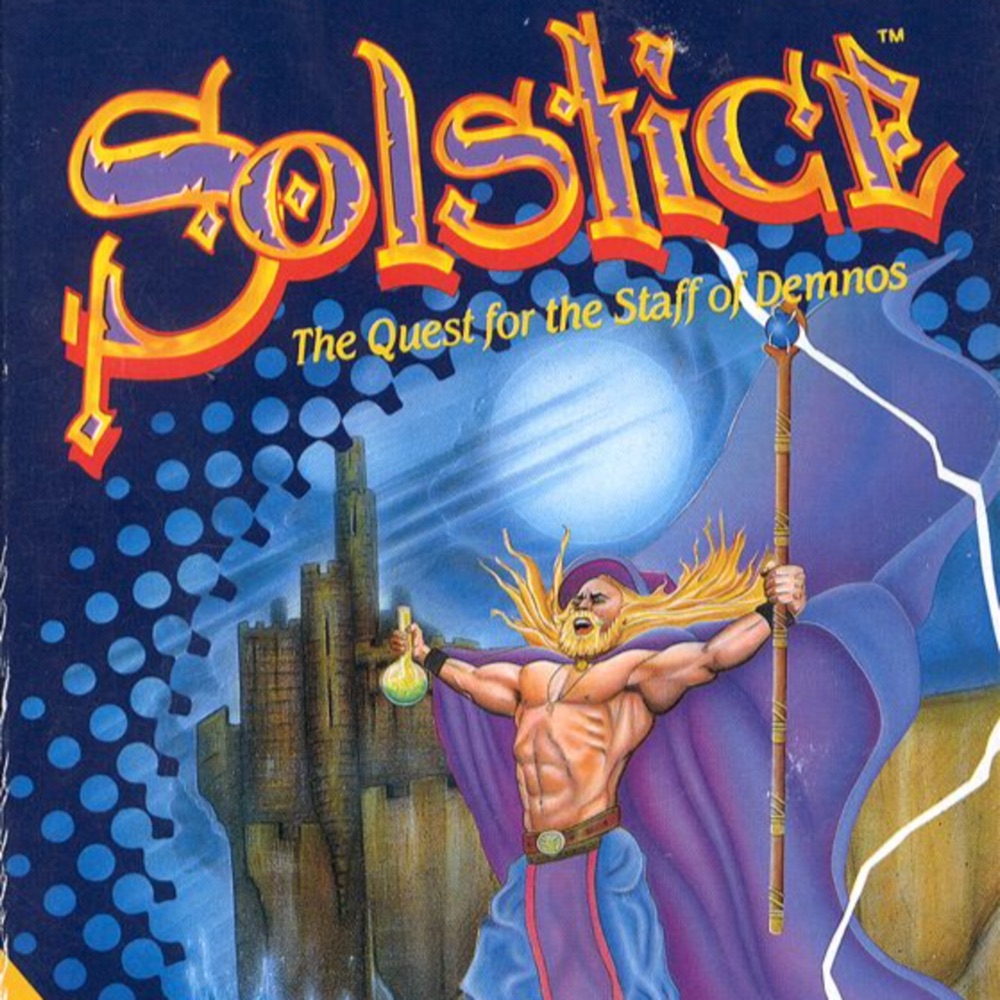
332 · Solstice
The Princess Eleanor has been captured by the evil mage Morbius and is somewhere in the fortress of Kastlerock. You play the part of Shadax, who must now rescue the Princess by searching the fortress for the six pieces of the magical Staff of Demnos and use it to defeat Morbius.
Solstice is an isometric puzzle-platformer about a wizard, Shadax, hunting six pieces of a staff through a 250-room castle. Mike, Sean and Joe were on this one. It sits at number 33 on MobyGames' NES list, and we came away thinking that is fair: a little cold, but clever, and we split on it.
What works
- Small rooms, no maze. 250 rooms sounded like Deadly Towers, but these are small and each one is different, with landmarks you can remember. Getting lost and then finding your way is satisfying.
- Self-contained puzzles. Whatever you need is in the room, apart from a potion or item you carry in. You can see the answer, and with the skill you can clear a room quickly. If one stumps you, something else is usually nearby to try.
- Few verbs, lots of tricks. Shadax jumps and picks things up. But you can drop a box mid-jump and leap off it for height, or drop it on an enemy's head and ride around. Every ability works anywhere, not only in the room that teaches it.
- Potions with a catch. Four beakers, and each effect lasts only while you stay in that room: invincibility, time stop, seeing invisible things, destroying every object. Waste one and you hunt for another.
- The music. We told listeners to hear the soundtrack even if they skip the game. It's from the composer of Target Renegade.
- Generous lives. Failing a room means coming back with a better idea, and you learn the castle as you go.
What doesn't
- Free roaming on an isometric grid. Up on the D-pad moves you diagonally, so we tilted the controller to get our bearings. It becomes smooth, but Mike never settled in and wished it locked to a grid.
- Potions that feel mandatory. We argued over whether time stop and the rest should ever be required rather than a bonus for stuck players. There is no potionless speedrun category, so they are required somewhere.
- Dry. Mike wasn't dying to keep playing and called it a dry experience.
Beyond the game
Designer Mark Wilson drew the whole castle on graph paper and called the publisher's manual drivel, even though we liked it, one long scroll that also explains the potions. We gave him strikes for that and for claiming no isometric NES game existed. He also says the studio head, Web, once presented a map of 255 random empty rooms made by his girlfriend, and Wilson still credited Web as co-designer. That is only Wilson's side, so we called it three strikes and gave Web the game. Equinox followed on the SNES in 1993, with 450 rooms in eight dungeons.
The bottom line
Play it. Joe voted yes on the Essential Games List, loving the exploring and the return trips with new potions or boots. Mike voted no. Sean said it has the caliber of an essential game and he likes it, but it didn't connect enough for him to vote for it, so it stays off. We joked that we might both flip by the Best of and still be at a stalemate.
Written from our conversation in this episode.
- From out of darkness…shall arise a challenge to your wisdom
- NES Longplay
- Manual
- #33 NES game on Mobygames. Which regardless of where we land says a lot about Mobygames.
- You have to collect the six pieces of the Staff of Demnos hidden within the fortress of Kâstleröck. The six pieces are spread across 250 rooms.
- Why is it always split in pieces?
- The entire manual is laid out like a never ending scroll. So much text, not just for story, but for every feature.
- Creator Mark Wilson referred to the manual by the publisher as “a mass of illiterate and asinine drivel”
- puzzle-solving Isometric POV
- Mark Wilson thought it sensible to create an isometric title as the company's first original work, as no such format had previously been attempted on the NES, but that’s not true. We’ve seen a lot of isometric games on NES.
- Main abilities are jumping and picking up objects
- The isometric despite being displayed like a grid is not rigid. You kinda free roam around the squares
- The 250 rooms are NOT individual puzzles. Not an arcade like game. It’s just a castle with 250 rooms to navigate through
- 4 beakers can store various potions that once crafted can apply bonus abilities to help solve puzzles
- temporary invincibility, destroy all moving objects in a room, freeze time, or make invisible objects visible.
- Potions only work within the room and they are not permanent to that room.
- The quality of the puzzles
- ITS A BIG GAME
- More Tim Follin music
- named the game's title track as his favorite among his compositions
- Solstice is the first original game to be developed by Software Creations
- All the game's item positions and events were placed on a "master map" hand-drawn on a very large sheet of graph paper, and were based on Wilson's understanding of what the player might think or need at any particular point. This detailed approach put Wilson at odds with Webb, who failed to see why such an amount of time would be taken to design a game as opposed to expediently inserting rooms into a map at random. At one point, Webb presented Wilson with an alternate map created by his girlfriend the previous night, which consisted of 255 randomly-connected empty rooms. Out of guilt for their furious arguments and pleasure with the final product, Wilson would ultimately give Webb a co-designer credit in the game's attract mode screens. Wilson would later regret this action; during a subsequent interview with Wilson at MicroProse, one of the interviewers falsely identified Webb as the game's sole designer.
- The first 5,000 customers to order Solstice from CSG Imagesoft received a free "Player's Pak", consisting of an 8 mm video tape on the making of Solstice, a player's score card, trading cards and colored stickers.
- Nintendo Published this in Europe so they clearly liked the game
- Sequels and spinoffs
- A sequel, titled Equinox, was released for the Super NES in 1993.
- The game consists of 450 rooms split between eight dungeons, and also features an isometric perspective, but includes a rotatable camera that incorporates Mode 7 effects
- The game is credited with giving inspo to the isometric look of Tactics Ogre on SNES.
- A sequel, titled Equinox, was released for the Super NES in 1993.
- EGL
- Next week
- NEStalgia Byte
Auto-generated transcript. Each paragraph starts with its timestamp. Speakers are not identified.
Solstice, the quest for the staff of Denmos. From out of darkness shall arise a challenge to your wisdom.
And welcome to NEStalgia, a chronological exploration of every NES game released in North America. I'm Mike. I'm Sean. And I'm Joe. Would you guys believe me if I told you that this is the number 33 rated NES game on MobyGames.com, which regardless of where we land in the essential games list says a lot one way or the other about MobyGames.com? I honestly haven't thought of that company in a very long time. Well, what do you think of when you think of Moby Games? I just, well, thanks for calling me out. I don't actually know what they do.
Are they, do they make like strategy guides? They make, they're like a video game database. They have every video game ever and screenshots of all the games. And it's really, it's a very informative site for someone like me. Uh, someone like you who forgets about the games the second after we play them should never check out MobyGames. I think that that's probably for the best.
Uh, so Solstice, the quest for the staff of Demnos. I'm not going to say that full title anymore. We'll just refer to it as Solstice. Are we all, uh, cool with that? That works for me. I think more like staff of Demnos is more like indicative. Right. Cause you have to collect the six pieces of the staff of Demnos. Uh, or just like SOD.
Oh, SOD. Okay. Um, but you think, you think staff of Demnos is more the title than Solstice? Absolutely. It's not anywhere on the, the, the title screen. The staff of Demnos is what your, uh, is like at least your goal, right? Like is Solstice one of the characters or something? Like, is that you? I don't, I think it's just the day that it happens. Oh, it happens on the winter solstice. Yeah. Gotcha. The manual, if you read that, uh, novella, uh, it mentions this.
Yeah. It's, the whole thing is one long scroll. Yeah. But it's for everything. Not just like, oh, here's a scroll that tells you the story and they're trying to be cute about like presenting the story in that way. It's like, nope, here's also how the potions work and how the map works.
And yeah, it's really crazy, uh, that they committed to that because it's it's more text in, in, in a manual than I have seen that I'm used to, you know, usually you're used to big pictures and then like some kind of guide of like, and this icon in the game means this and this icon means that. And I for one appreciate the, uh, the, the, the amount of effort that they put into the, the manual instead of just like a block of sans serif text describing the story. And then like, yeah, I liked it.
I agree. And totally, obviously this is not the intention, but the, what you just said about like there being so much text and not as many pictures kind of mirrors how this game feels to me where most games where your goal is to save a princess is very high octane action based. And this is much more cerebral than other games like that. I feel like the whole thing is like, Oh, you're playing as a wizard. You're going to feel like you have to like think.
As I was trying to mention earlier, uh, you're collecting the six pieces of the staff of Demnos without the hidden, uh, for, uh, no, they're hidden within the fortress of castle rock, which, uh, is, it sounds boring, but is, uh, starts with a K castle rock like that. So it's really, uh, definitely not boring. Yeah, exactly.
Um, however, those six pieces are hidden across 250 rooms. So this castle is, uh, is very large and those rooms are actually very small. When I heard 250 rooms before playing the game, I was like, Oh, this is going to be, uh, you know what, one of the, one of those games where you just get lost and, and you have to, uh, you have to like refer to a guide and everything, but the rooms are like, okay, here's like one or two things going on in this room. And then there's directions to other rooms and like, you'll still get lost, but it's not a labyrinth. Like, um, what was that game that we all really hate?
Oh, um, deadly towers, deadly towers. Yeah. So it's not like that. We, I, I, I, I think that that's fair. Yeah, absolutely. And I think that was deadly towers isometric like this. It was, right? It was like a really bad drawing of an isometric environment. Um, whereas this like it, so the thing about the isometricness, like it, it makes it a little, you need to take some getting used to of what the controls actually do, which I think also existed in deadly towers.
Um, but because this is true isometric, uh, you eventually get the hang of it and it'll make, make sense. Um, and I, it also like looks nice like that, all that isometricness it's, it's all very clean. It's, uh, it's kind of toy like, which I think, uh, bodes well for the actual, like what you're doing, you know? Yeah.
And it, while the wonkiness of it being isometric and obviously like, you know, what, what we mean by that is like pressing up on the D pad moves you upright. Like there are four directions in this game, upright, up left, down, right, and down left. So I literally started just tilting my controller a little bit and that helped my brain get around like where I was going. But, uh, once I get around that, um, it actually controls very smoothly. It does not look like at first glance, maybe just based on like other things that we've played at first glance, it looks like it's going to control poorly, but, uh, it's, I think pretty incredibly smooth and like intuitive.
I will put, uh, on trial for this whole episode probably because I'm going to keep referencing him. Uh, the creator of this game, Mark Wilson, who, um, since we're talking about the isometric, uh, design, uh, he's quoted as saying that he created, he thought that it would be smart for the company to make an isometric game as their first game for the NES because, um, no such format had previously been attempted on the console, but that's not true. We've seen a lot of isometric games on the NES even, uh, pretty recently.
So, uh, that's one strike against Mark Wilson. Mike, Mike, this was a long time ago. Like, you know, discoveries were made separate of one another and they had no idea. There was no means of communication. You mean to tell me he wasn't playing the games chronologically?
He only had the games that were released like in his state probably. Yeah. And his local Toys R Us. It took so long for information to travel back then. Well, if that's a strike against him, I will give him, um, a point in his corner as well because going back to the manual, he referred to the manual, which was written by the publishers, not him, as a mass of illiterate and asnine drivel.
Wait, wait, who said this? The creator of the game. Oh, okay. You know, you know how it works, right? Like, you develop something, you make it, and then it gets over to the publishing side and it's like, you know, oh, well, we got to market this game. And so they wrote up all that stuff in that manual.
And he was like, I guess to the point that, you know, we were coming to earlier too. It was like, do you need all of this text to understand how to play this game? Like, I'm sure I took one look at the manual and just said, eh, let me try it instead. So I just went in there and I learned how to play the game without looking at the manual. But I'm also going to say that, yeah, it's not Shakespeare, but I think he's getting a little too, like, hoity-toity for his britches, you know? Oh, so is this another point against? It's nice to have a story in the manual.
Yeah, like, what sort of story was he trying to tell where something as, like, mundane and, like, inoffensive as what was written in the manual is, requires that insane of a reaction.
That's two strikes, Mark. Watch out. Okay, moving on to some stuff about the actual game. You know, I said it was 250 rooms, this castle, and that you're looking for those six pieces of the staff between them. But it's not 250 individual puzzles. It's not an arcade-like game in that regard where, you know, every single room you have to solve something. You're free to explore most of the rooms and kind of, like, figure out which direction you head in until you hit some kind of dead end and then maybe go back and re-roam to try to find your navigation. So let's talk first just about navigating the castle. Did it feel like it had a clear outline or was it something where if you go in a direction, you might just get screwed and wind up doing nothing?
I think that the map is, the map at least gives you a little bit of a break because you can kind of see what's around you. And I'm not going to say that it was perfect, though, because you can only see so far away from yourself. And all the rooms kind of look the same, so you still need to have a pretty good mental map of the space. And the amount of featureless rooms where, again, like you mentioned, there are no puzzles and are there just to connect to other puzzles or be sort of labyrinthine on their own.
It does make it difficult to navigate, but I think that's sort of part of the game. Yeah, it always feels like you can get lost and it was designed to get you lost and it never feels like Deadly Towers where it's like, where am I supposed to go? What is going on here? Like, usually I'm lost and I can get my bearings and it's actually kind of satisfying to get my bearings in this.
Because as much as the rooms do look samey, they are all unique. Like, as far as I've seen, I didn't beat the game, but as far as I've seen, every single one of them is unique and has, like, stuff for the most part that you can commit to memory. Like, okay, this is the one where there's that high up green platform floating back and forth. Granted, there's a lot of green platforms floating back and forth, but, like, there are times where, like, I'll run into something, oh, okay, I'm back here. This must be a loop. You know, that kind of thing. That helps. There was a section that sort of had that, like, featureless labyrinth where you go from one featureless room to another. And it kind of has that, but it's not the only part of the game.
And there, yeah, there are enough landmarks where you can kind of get your bearings. But I guess, like, what I wanted to say about the gameplay itself was the fact that, you know, when you have these more set piece rooms, one thing that I would have hated is if all of them were so interconnected that you would have to, like, go grab this thing from three rooms over and then bring it over to this room. And you don't know which thing to take and, like, whether that would break another puzzle.
What I like is that each of these puzzle rooms are self-contained. And, yes, you might need to, like, get a piece of maybe equipment or maybe refill a potion somewhere else. But otherwise, everything you need is in that puzzle room. So the only thing that could be the solution would be in that puzzle room. So I at least appreciated that part of it.
Yeah, and they're all very small puzzles. It's not like Adventures of Lolo, even, where, like, there's a few things you have to do. Like, I shouldn't even say that. Of course, there are puzzles in here where there's a few things you have to do. But, like, it's all usually, if you can solve the puzzle, it's all right there in front of you. You can see what it is. And it's like, okay, I just got to get this, this, and this. And some of the difficulty comes in the platforming and stuff. But it never, it's like a bunch of tiny puzzles. It's like a lot of tiny puzzles rather than, like, a good amount of, like, puzzles. Like, once you know how to solve a puzzle, I guess what I'm trying to do is you can solve it very quickly. Like in Kalos Principle.
Yeah, if you have the skill, you can solve it very quickly. And I kind of like that about it where it doesn't feel like, okay, on to the next puzzle. It just feels like on to the next room and I got to, like, navigate my way through this entire castle. The whole castle is a bunch of little tricks that you have to figure out. I don't know if that made any sense. No, I think that makes a lot of sense because given the size of the rooms themselves and the number of rooms,
it's better to have these, you know, short bursts of gameplay rather than truly, like, sitting there or having to constantly backtrack and be like, okay, yeah, what I needed was actually in another room and you have to go back several rooms, find something, bring it back, only to realize that you still don't have everything you need so you go to another. Like, there wasn't anything too grand like that. And I think given the number of puzzles that there are in the game, it's up to the player to decide if that becomes, like, tedious, fast-solving action stuff or if it's just like, you know, oh, this is exactly the right amount and I would have hated if this game would have, you know, required constant backtracking through a castle this large.
Yeah, yeah, because even if you get lost or if you go somewhere and you're like, well, I don't know how to solve this puzzle. Like, I can't figure out the trick to this room. And then you back up, like, yeah, there's other rooms near you that, like, there always seems to be, like, something else you can do in the meantime before the trick comes to you.
And so knowing that the main abilities of, I believe I found his name in the manual as Shadaxe, that's who we're playing as. That sounds pretty cool. Shadaxe. Or Shadaxe. Shadaxe. How you doing, buddy?
His main abilities are jumping and picking up objects. And picking up objects is a rather, sounds boring and lame when you say it like that, but, you know, the objects you can pick up can change what is possible. So knowing that those are, like, making it a little bit more of a platforming isometric puzzler,
how often does the gameplay remain fresh and different versus, like, well, I solved a puzzle like this before, so I know how to do this now, and I just wind up doing this a lot? I think that there's enough going on here between the kinds of things you can pick up and then everything that you can do with your potions. Like, I won't go so far as to say that this is as, like, outside the box as, like, a portal. Like, that's kind of a goofy thing to say about this game, but the time stop stuff, the hidden features that you can open up with the whatever color potion,
like, the things that you can end up doing combining all of the kinds of items and the kinds of platforms and, like, it's... I think that they all kind of have their own vibe to them. Each puzzle, it's not... They're not all exactly the same. Like, you can... There's a lot of, like, verticality to these puzzles and having to, you know, jump, release the thing you're holding, stop time, then jump, release the thing, release another thing, stop time again, and then get onto an enemy's head and get kind of taken for a ride, like... There's a lot... There's a lot of, like, clever stuff.
Yeah, and what kind of tipped me off right away was the ability to pick something up, jump in the air, drop what you picked up, and jump off of it while it's in the air to get yourself more height and the necessity to do that.
That made me realize how much, like, this game relies on... You know, there's maybe what? Like, actually, there's maybe, like, six things you can do. But each of those things are fluid enough that you can, like, really play with them and make them have these different results all the time. Like, you know, you can drop one of these boxes that you've picked up onto the head of an enemy, and it'll stay on the enemy's head, and you can ride the enemy around. You know, it's like that kind of thing, where it's like, think outside the box a little bit, and, like, you...
Even though there's only a few actions you can do, there's a lot of, like, clever things you can do with that. Granted, the game is obviously designed to get you to do those clever things, so, like, the question becomes, who's actually being clever, the player or the developer? But, like, it feels satisfying to figure some of these things out. The one thing that I appreciate the most about, like, yeah, all those little things that you can do, all those verb buttons,
is it's unlike a lot of the puzzles, quote-unquote, that we've played in other games that may or may not be actual puzzle games, where, like, oh, you... I guess it's more of a Metroidvania thing, where it's like, oh, you get this...
You get this ability that is only to be used in these very specific instances that are telegraphed. Like, all of the abilities that you use can be used at any point, and it may or may not be all that useful to you, but they can still be used outside the context of the puzzle in which it was designed for, if that makes any sense. Yeah, I think it does, and keeping in mind, too, with the potions we've been talking about, so you have four empty beakers, and you can store various potions in there that, basically, as long as you're within the room... This is an interesting solve. It's not a timer-based thing. It's not like drink the potion, and you're good for five minutes or something like that.
Five minutes is way too long. I don't know why I suggested that. 30 seconds, right? Instead, it's like, as long as you're in the room you're in, and you drank the potion there, you are able to acquire that ability throughout the duration that you're in that room. The second you leave that room and go back to it, it doesn't matter anymore. You no longer have that ability. So it does require some thought, or at least some trial and error and some risk involved of like, oh, well, maybe I need invincibility or something, or maybe I want to freeze the objects in their place, right? It's like those kinds of things.
If you don't do them correctly, you've wasted the potion and now have to go either track down another one or try to solve the puzzle without it. But I think the strongest point to say that this was a well-designed game is that the potions aren't necessarily required
for the puzzle solving. At least most of the puzzles I encountered didn't require like, oh, if you don't have invincibility, you won't be able to walk over these spikes, and therefore you won't be able to get this key. That didn't happen. I thought that there were some, but I don't know. I might just have not known the actual way to solve it. The time-stopping one particularly. Time-stop is definitely necessary in at least a couple of them because you can't get enough height unless you drop something and not let it drop.
But I can see, yeah, invincibility be just more of like a go-easy-on-me button. I don't know. Yeah, I think that kind of stinks though, right? Like, now I'm guessing my praise for it because it's like, well, in that case, then the potion shouldn't be like limited to the player in that regard. Not that they're limited. Like, you can always get them, but I don't know. I feel like the fact that some... Is this an argument pro...
The pro potions are necessary or anti-potions are necessary? I'm against it. Yeah, I think they shouldn't be necessary. Interesting. I think, like, especially because it's just like it's a limited number of things that they do and everything, like, it should just be like a bonus to the player that's stuck, not necessarily a requirement. I think at that point, it's just like a platformer then. Right. I see where you're coming from, but I do think that it's the intention is to make... It's like you have to... Part of the puzzle is like, don't use this in the wrong place. Like, and if you do, you're gonna have to go find more somewhere.
Um, I like the idea because I think that that helps the puzzles have more depth where it's like, there's these other four tools that might need to be used in these puzzles too. And you have to figure out, like, if I can't figure it out, then I do have to, like Sean was saying a minute ago, think, okay, wait, maybe if I stop time or maybe if I, whatever, destroy all the objects on the screen or I don't remember what the fourth one does, but... I think it's invincible, stop time,
see invisible stuff. Oh, see, yeah, see the invisible stuff. Yeah, and destroy all objects, yeah. Yeah.ныеныеныеныеныеныеныеныеныеныеныеныеныеныеныеныеныеныеныеныеныеныеныеныеныеныеныеныеныеныеныеныеныеныеныеныеныеныеныеныеныеныеныеныеныеныеныеныеныеныеныеныеныеныеныеныеныеныеныеныеныеныеныеныеныеныеныеныеныеныеныеныеныеныеныеныеныеныеныеныеныеныеныеныеныеныеныеныеныеныеныеныеныеныеныеныеныеныеныеныеныеныеныеныеныеныеныеныеныеныеныеныеныеныеныеныеныеныеныеныеныеныеныеныеныеныеныеныеныеныеныеныеныеныеныеныеныеныеныеныеныеныеныеныеныеныеныеныеныеныеныеныеныеныеныеныеныеныеныеныеныеныеныеныеныеныеныеныеныеныеныеныеныеныеныеныеныеныеныеныеныеныеныеныеныеныеныеныеныеныеныеныеныеныеныеныеныеныеныеныеныеныеныеныеныеныеныеныеныеныеныеныеныеныеныеныеныеныеныеныеные
And I can confirm that there isn't a potionless run of the game, at least in the speedrun category. So there must be a requirement at some point or another that a room can't be solved unless you use a specific potion. Moving on, we'll talk about something we don't usually talk about when we talk about our NES games, and that is the music. And it's not because we hate the music in other games, but I really feel like I felt very strongly upon booting this game up that I must make a bullet point of like, we have to at least let people know.
In case you didn't play Solstice, you might want to listen to the soundtrack. Yeah, you got to play the main music right here because that is like mind blowing. It's good. And it's all Tim Fallon, that guy. No, no, it's Timothy Fallon. Oh, okay. On the menu screen of this game only.
Yeah, he wants to be known as Timothy during those few months. It sounds more wizardly. Do we know him from other things? We do. Tim Fallon, what else? He did one that we've already done, but no, Pictionary we didn't play. I know, I know. But I talked about it as if we did. Yeah, that's the one, but no, I don't know. I can't remember which game of his we already played, but he's just known for making like out of this world music and all the games. He's going to do a lot more other than Pictionary though, too. Like he also did Silver Surfer. Thank God. What else did he do?
On the NES at least. Oh, Target Renegade was the one that we already played. You remember that? That was a good game. Yeah. I like Target Renegade. Anything else he did that we played already? Oh, he did Magic Johnson's Fast Break. I don't remember us saying anything good about that.
I just remember Magic Johnson's head appearing as a jump scare. Yeah. At the most inopportune moments. Yep. All right. So that's a shout out for him. And while we're on the subject of talking to people, should we get back to our friend Mark Wilson? He's a lot of strikes. If you have some problems. Yep. He can't afford a third strike because according to the rules of Major League Baseball, three strikes and you're out. So I looked into the development of the game and I've done that from time to time. I try not to get like too in the weeds because I don't want to paint a picture of something that we're supposed to be reviewing in 2024. Do you have like a huge coke habit?
It's no, it's just like it was so lengthy for a game. Like, you know, the gameplay section on Wikipedia was so small compared to the development thing. And I was like, all right, all right, let me read this. What's going on? So he put all of the like he mapped out everything, right? Like hand drawn on graph paper and put like where everything would be before programmers like put it into the game. Right. So this way there's like everything is thought of. Everything is carefully planned out. It's what we like to see in our video game. We both are. We're all three of us on the same page on that.
No, I think you should just wing it. Well, then you sound like the head of the studio who I feel like I had his name somewhere at one point. But right now I just have the last name Web. You sound like this guy Web because he says, I don't understand why we would spend that amount of time to design this game. And he presented an alternate map created by his girlfriend that she did one night before consisting of 255 randomly connected empty rooms.
And which one did they use? So out of obviously that led to a bad argument. Right. And they did wind up using Wilson's. But here's the kicker. He gives Web the co-designer credit. Well, I feel like that's a political thing, you know? Yeah, but he used his own map and everything. And he gives Web the credit. So Wilson goes on record saying, I regret this action. But this is all after the fact. None of this information came out at the time. And we're only getting Wilson's side of the story. So you have to wonder. With a guy with two strikes. Yeah. Is that story true? I mean, I don't. I find it hard to believe that. It was something as like.
As dumb as like. Nah, she can do it in a night. All 250 rooms. Like that sounds dumb. So I don't think I believe him on that. Like on that remark. I would tend to believe that maybe he was taking it more seriously than this person. But considering how he spoke about like how offended he got just from somebody trying to fill a blurb to add some like some flavor to the game. His girlfriend wrote that. Yeah. The night before. He just sounds like somebody I wouldn't get along with.
So this is not an investigative podcast. And none of us have degrees in journalism. This is all vibe checks. I'm just going to vibe check it further then, Sean, if you don't mind. Because so maybe this this should have been mentioned earlier. But it comes now as a grand reveal. While working at Microprose after his time making this game. One of the he did like an interview for a game. And one of the interviewers falsely identified Web as the game's sole designer. Solstice. So maybe that is what caused him to kind of, you know, years later provide an interview with some color of like, you know, I did this game on graph paper all by myself and accidentally gave a credit because of guilt.
I'm starting to think that maybe he's I forgot the guy's name, but like the stapler guy from Office Space where he's just kind of a pushover. And Milton only has. Yeah, Milton. And only has like a lot of vengeance to himself until after the fact. So is that a strike or not? It can't be determined, I think.
Okay, three strikes. He's out of here. Web created the game. I agree. Web created this game. I hope I hope you're not around to hear. Good job, Web. Yeah, it's funny. I didn't I never took the time to write down his first name as I continue to look through my notes. I'm just like, yeah, Web.
Anyway, the here's something you don't hear often, but used to be a thing like I feel like during our time of playing games, like in magazines and stuff. Or if you went to like Blockbuster, the the first 5000 customers to order Solstice direct from CSG image soft. The publisher received a free players pack consisting of an eight millimeter videotape of the making of Solstice, a player card, trading cards and colored stickers. Now, obviously, the stuff I was talking about, we didn't get that much. But like you get a VHS tape to your house. You guys ever get those VHS tapes?
Not about video games. To my house? Yeah, I would get like from Nintendo Power. Like, here's a VHS tape all about like Banjo Kazooie. No, I wish I had gotten that. No. I mean, maybe it wasn't Nintendo Power. Maybe it was like something else. But like, yeah, I got I have a lot of those and I still have those VHS tapes. I wonder if they're worth anything. It's kind of cool. Is in the making of like, does it show him making the design the game or this other person?
That's a funny thing. We should really try to dig that up because I didn't think to look for that. But that might be all the evidence we need. We might need a part two of this podcast. I think we can. Yeah, let's let's do that. Let's track that down. Well, you know, Nintendo published this game in Europe, so they clearly liked it on there. Like, that's high praise, right? To be to be published by Nintendo.
It's not it's not just like it's not something they just hand out to people. So it's not a pity thing. It's not like, oh, you can't find a publisher in Europe. We'll publish you. It's like, no, it feels like a pretty like a good marketing push. I mean, you're not getting into that. Not getting into like whether, you know, whether you like the gameplay or whether you think it's like well designed. And gameplay wise, this game earned a seal of quality. You know, it's a quality. It's got it's got, you know, it's a clean game.
It controls well. It's got great music. I think that like I think that Nintendo would be fine putting their name on this and being like, yeah, this is a polished experience. We've all we've played. I think every game that we've played has the Nintendo seal of quality. We've played some real. That's why I was laughing. Yeah. In fact, because of the rules of the podcast, every NES game released in North America, we we are only playing games. Right. The seal of quality. But not all of them, I would say, earned it.
Oh, so there's like a Joe seal next to the Nintendo seal. Yeah, I think that like, you know, they're giving them out willy nilly, but I think that there's some that like, you know, OK, this one deserves a seal of quality. Got it. Well, we will find out if this one deserves a seal of quality on the essential games list.
In our conversation so far about Solstice, we've talked about the features and kind of did like a checklist of things like, yeah, it's an isometric POV game. It's it's 250 rooms. You got to find you got to solve puzzles. The controls are like, even though it's displayed like a grid, it's not rigid. You kind of like free roam around the squares and that takes some getting used to. But then it gets fine. I think like the way we treated the game on the show and how I played it felt like the same kind of thing. I was doing all this for the podcast, including playing the game. I don't know how to put my finger on it, but I wasn't like I wasn't dying to continue playing. I was playing out of necessity to talk about it on the show.
And I think it boils down to even though, you know, you guys kind of said the controls are all right. I think I just didn't like the free roaming thing and I would have preferred to be locked in on a grid where like when you move in a direction, you own like you move kind of like.
I don't know. Maybe that would have helped with the puzzle solving more. Maybe it would have made the puzzles more, you know, less interesting, more boring, because now it's like you just think about it on a square by square basis. But I just couldn't really adapt to the kind of game that they were putting down here in the sense of like something that was keeping me stimulated. It was it was a rather dry experience in my books. And so I can't put it on the essential games list for that reason. Joe? Yeah, I see what you're saying about the like the grid thing. And I think we've talked about this in I think was it also Lolo?
Or maybe Solomon's Key or something like that. We've talked about that kind of thing. I think. I get that in this game, I felt that I get the vibe that they're trying. It almost feels more like a 3D platformer. We didn't really talk too much about the platforming, but it's like almost as much a part of this game as the puzzle solving, if not as much. And it's hard. It's hard to land on what you're trying to land on. It's hard to get your head around it at first. But it does. Once you kind of get used to it, I did start to appreciate the platforminess of it. But outside of that, I really like this game. I think I'm alone here. But maybe not. I don't know. We'll see what Sean says. But I like this game a lot.
I won't give it away. But just before we started recording, one of you said something that I was like, oh no. I'm going to be the only one who really liked this game. And I am going to put a vote on the essential games list. I get why this is number 30 on whatever list we were talking about at the beginning of this game. I felt like I loved exploring and solving each of these little things. Coming back to rooms later once I had more potions or I had the extra boots or some other piece of information to try.
And I kind of liked that even if I were to... And the game is pretty forgiving with lives. You get a lot of lives. There's a lot of extra lives. But even if I were to fail and start over, I liked that I kind of like, okay, well now I have an idea of what to do. I can get through these rooms pretty quick. I'm learning this castle as I go. And I appreciated that. And then that coupled with just the... Even though there's only one track playing through the whole thing, it's a great track.
It's good music in this game altogether. But yeah, we'll see if I'm still as high on it when we get to the best of. But right now, I'm pretty high on it. All right, Sean? All right. So as much shit as I'd like to talk to the main developer of this game, who was... I forgot his name. Mark Wilson. Oh, you mean Webb. You said the main developer. Yeah. Yeah, whoever that is. Mitchell or Webb. I'd say that I also do like this game a lot. However, there is something... It's not like... It's not the thing that Mike said where it's just like, oh, I just don't like the game.
To me, there is just some... There is just some Genesee quad going on. I'll say that this is of the caliber of an essential game. But it just didn't connect with me as much as to say that it is essential. So I... Joe, I don't think you're crazy for putting the... For voting for this. I just think that as much as I objectively appreciate what it's doing, I don't like emotionally have it in me to also vote for it right now. But who knows? Because maybe my opinion will change by the best of 1999. Yeah, with our luck, though, we'll both change our opinion and we'll still be at a stalemate.
Well, fans of Solstice, like Sean and Joe, will be somewhat relieved to know that there was a sequel. Can you guess what the title is? Is it called Equinox? It is! Oh, it is? It is. I saw something else that looked like a sequel just before we started recording and it was not Equinox. It was like so-and-so's revenge or something. Oh, interesting. I don't have anything like that in my notes, but Equinox is definitely a sequel released for the Super Nintendo in 1993.
The big difference, of course, is the number of rooms. Now there's 450 of them. That's the only room. That's the only difference. That's the only difference, right? No, of course, I'm joking. But there's 450 of those rooms now. Here's the kicker. They're split between eight dungeons. So instead of one giant castle, it's now eight different ones. So hopefully they spice it up a little bit on that regard, too. And it also has, of course, as all Super Nintendo games were practically required to. This is a joke. They had Mode 7 effects to really sell home the next level features of the Super Nintendo.
The game is also credited with giving inspiration to the isometric take on tactic ogres on Super Nintendo. I thought that was kind of interesting. I'm like, wow, that's a Japanese developed game. And yet I don't know anything about that game. Tactical or I think it just got like a remake on on switch or something like that, like maybe a year or two ago. Those are good games. Those are like based off the foundation of or not based off of that. Later, they inspired Final Fantasy tactics game. Ah, yeah, they play very similar.
And we play very similar games all the time because we are doing a chronological exploration of every NES game released in North America. And our next game is Starship Hector. I don't know if Hector is piloting the ship. Yeah, Hector like a name. I don't know if Hector is piloting the ship or if the ship is just named after a person. It's kind of like when you name a dog after a human and then you tell people like, oh, what's your dog's name? And then you say and they're like, that's my name, which is weird. And then you never look at your dog the same way again. Battlestar Mikey. Yep. You'll never look at this podcast the same way again as we next week record Starship Hector. Join us. We'll see you next week. ные!!ныеныеныеныеные!