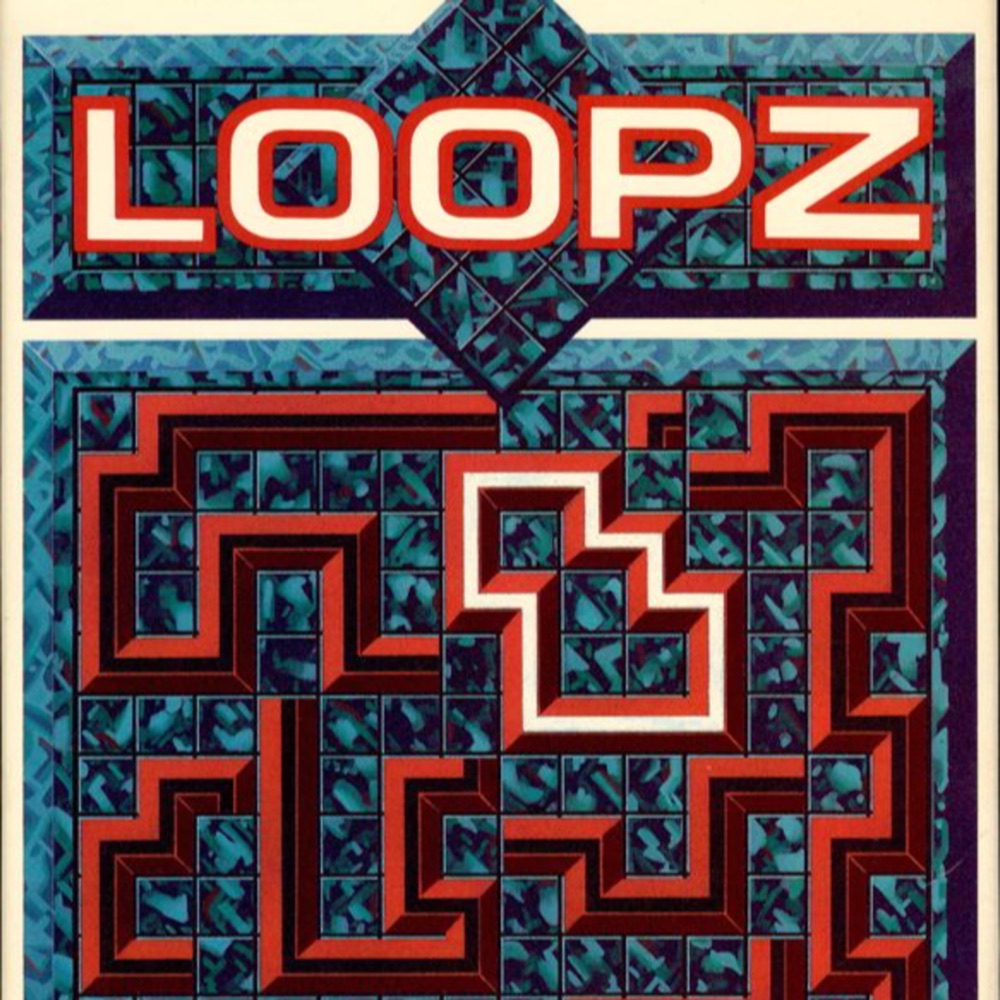
383 · Loopz
A puzzle game where the main goal is to make loops! Random pieces are presented over a board, including simple lines and corners as well as S bends and other warped shapes, of varying sizes. It is up to the player to link them up in a loop form, then moving on to the next level. Pieces can be placed on any empty space on the grid, and rotated into one of the four main compass directions.
Loopz arrives right after Pipe Dream, which made the pipe jokes inevitable, and we got them out in the first minute. It is not about pipes. You drop pieces onto a confined, top-down board and close them into loops, which then vanish and score. It started on the Amiga and Atari ST, and the NES version is a direct adaptation. Mike, Sean and Joe were on this one.
What works
- Closing a loop feels good. Finish one and it disappears, scores and frees space. Sometimes we had to build junk off our plan and still managed to loop it, turning a mistake into a small victory.
- It's a system you master. There are no set solutions, only a tangle you can learn to untangle. We liked that, and it's less frantic than Tetris, since you aren't watching a piece fall toward the floor.
- The delete piece. The gear icon lets you click an unfinished loop and wipe it, which is a nice escape hatch.
What doesn't
- No next-piece preview. This was our biggest complaint. Without it you only avoid boxing yourself in, and plans keep shrinking: we start by planning one huge loop, then two, then five tiny ones for a few points each.
- Fuzzy rules. Sometimes a piece we placed was a loop and we didn't know why, and sometimes we thought we'd closed one and hadn't. We suspect we missed the rules, and five pages of manual text with no pictures didn't help.
- No ramp. You pick a difficulty and stay there. Level three felt like a challenge, and by seven or eight we couldn't always get the piece across the board before the timer ran out. We wanted a mode that starts slow and speeds up. On easy levels you can go forever, and interest drains.
- Memory mode. Game C shows you a loop, removes it piece by piece, and has you rebuild it, and since the pattern is symmetrical it's hard to get wrong. We wanted it to hide the shape and give you hints about what connects to what, so it felt like a puzzle.
- Dry presentation. The pieces are a single color on a camouflage green and beige board, the UI is a score, a timer bar and a loop count, and the music is quiet enough that we asked what music. Compare Pipe Dream's flowing water or Tetris's colors. It felt like a mobile game on a Motorola flip phone. We daydreamed a circuit-board theme.
Beyond the game
The box art gives the board far more room than the real game does. We wandered off into mobile ads and fake streamers, and decided a re-release wouldn't be a sleeper hit, since people want daily quests. The Z in the title was almost what swayed Joe.
The bottom line
Skip it. All three of us voted against it. Joe said it was definitely not essential and not worth playing, and Sean said it's a system for a game that shouldn't exist, with very little onboarding. Mike said right away that it clearly isn't essential. It's a competent puzzler without the cast, color or music that make these games stick.
Written from our conversation in this episode.
- It will tie you up in knots
- Manual
- Longplay
- Core Gameplay Concept
- Primary Objective:
- Fit puzzle pieces to create closed loops — hence the title “Loopz.”
- Pieces include straight segments, corners, and T-junctions.
- Gameplay Loop (pun intended):
- Place randomly given pieces on the grid to form complete loops.
- Once a loop is closed, it disappears, earning points and freeing space.
- Game Modes:
- Game A: Standard mode where players continuously place pieces to form loops. The game ends when the grid is full or no valid moves remain.
- Game B: Challenge mode with increased difficulty and faster piece drops. Players aim for higher scores under pressure.
- Game C: Memory mode where a complete loop is shown briefly, then parts are removed. Players must reconstruct the original loop from memory.
- Two-Player Mode: Players take turns or play simultaneously (depending on the mode) to create loops on the same grid, competing for higher scores.
- 🕹️ Controls & User Experience
- Controls:
- Simple directional movement to place and rotate pieces.
- Controls are responsive but can feel slow in later levels due to pressure.
- Interface:
- Sparse UI — basic grid with score and next piece.
- No real tutorial or onboarding — must learn by experimentation.
- Pacing:
- Starts slow and cerebral.
- Becomes progressively harder as the board fills and loop complexity increases.
- 🎨 Graphics & Audio
- Visual Design:
- Functional rather than flashy — monochromatic loop pieces with minimal flair.
- Basic grid and background — intentionally austere for focus.
- Animation:
- Very limited — mostly blinking segments and loop removal animations.
- Hard to tell what some pieces are
- Covers the screen when you pause
- Soundtrack:
- Sparse and repetitive — one or two main tracks.
- Sound effects are basic but functional for rotation, placement, and loop completion.
- 🧠 Strategy & Skill
- Planning Ahead:
- Anticipating future pieces is essential — similar to Tetris.
- Spatial awareness and forward-thinking are rewarded.
- Common Pitfalls:
- Creating too many open-ended paths that are hard to close.
- Running out of space due to poor placement.
- Mastery Curve:
- Easy to grasp, hard to master.
- Discussion around “flow state” — game encourages a zen-like focus when played optimally.
- Points: Awarded based on the size and complexity of the loops formed. Larger loops yield higher points.
- Bonus Loops: Completing particularly large or complex loops can restore lost lives and grant additional points.
- 👯 Multiplayer & Replayability
- Two-Player Mode:
- Rare example of a competitive puzzle game on NES.
- Alternating turns, each player tries to outlast or outscore the other.
- High Score Chasing:
- Emphasis on longevity and survival — no narrative or end state.
- Replay value comes from self-improvement or beating friends’ scores.
- 📚 Presentation & Packaging
- Cover Art & Marketing:
- Abstract, techy box art — does little to explain what the game is.
- 🧮 Comparison to Other Puzzle Games
- Vs. Tetris:
- less frantic
- No piece acceleration — slower pacing overall.
- Vs. Pipe Dream:
- Similar in visual logic — building connections and completing circuits.
- Loopz requires self-initiated completion, while Pipe Dream gives a fixed start and flow path.
- Vs. Other NES Puzzle Games:
- Lacks visual flair or character branding, which may have hurt its popularity.
- 🧳 Legacy & Port History
- Multi-Platform Origins:
- Originally developed for home computers (Amiga, Atari ST, etc.).
- NES version is a direct adaptation, with minimal changes.
- Cult Appeal:
- Appeals to players who enjoy relaxing, meditative puzzle challenges.
- ❓ Discussion Points / Podcast Prompts
- Is Loopz too quiet and abstract for the NES demographic at the time?
- Does the lack of theme or character hurt the game’s ability to engage?
- In a sea of action games, did Loopz actually provide a refreshing change of pace?
- Could a modern mobile re-release make Loopz a sleeper hit today?
- Would Loopz have benefited from a clearer visual metaphor or story wrapper (cyberpunk grid, plumbing, circuitry)?
Auto-generated transcript. Each paragraph starts with its timestamp. Speakers are not identified.
Loops! It will tie you up in knots!
And welcome to NEStalgia, a chronological exploration of every NES game released in North America. I'm Mike. I'm Sean. And I'm Joe. Loops is another one of those puzzle-based NES video games. And I say another one of those, but we don't get these too often, but we just kinda got one with Pipe Dream. And this isn't like that far off. It's just weird. They're made by two separate companies, so it's just like bad timing, I guess, for one or the other, right? This is definitely pipe adjacent, if not straight up pipe. Yeah, they look kinda like we're laying pipe. I was worried that we were gonna get there again. I was worried that we weren't. So we got it out of the way in the first minute.
Loops has nothing to do with pipes. It's actually just creating, hence the title, loops, as you fit puzzle pieces to make closed loops on a kind of like confined claustrophobic screen. They don't really give you a full space. And it's not like, you know how Tetris is like a rectangle, but it's like a height-heavy rectangle? This is a like... Height-heavy rectangle. You know what I mean, right? Like, the pieces are falling down on a rectangle that is standing upright like a monolith, whereas this rectangle... We're looking down on a board now. Yes, this rectangle is like you're looking into a room or something from the top down.
So it's not the way I'm used to looking at rectangles on my NES. And so everything just feels a bit closed in and narrow here as you... You know, the goal of the game is that they give you different pieces. You got straight pieces, corners, little like squiggly lines.
I guess they're like S's or whatever. Yeah, there really isn't a... I feel like Tetris had a cast. Yeah. And this game doesn't really have a cast. It's just like whatever they want you to look at. I feel like it's a less recognizable cast, but there definitely are like repeats that I get a lot. Like the one that looks like an unfolded staple. Sure, sure, but there's no Joey. I get that all the time at the worst times. There's no what? Joey? There's no Joey. Joey from Tetris? Yeah, Joey, the long red line. That's what I was saying, yeah. Yeah. The red line is not the long one. That's blue. Oh, I don't know. But you knew about Joey.
Joey takes many forms. So you're given these pieces and you got to kind of just place them at what might seem like randomly, right? Like it's not like pipe dream where you had to connect from one source to make a closed loop. This is like just place them where you want and then make sure that you close them up on the way out. So you can have a bunch of like half thought out ideas that like will eventually connect. You can kind of like start something and be like, nah, you know what? This one's getting out of control. I'm not going to finish it. I'm going to go work on something else and hope I can finish this later.
But once a loop is closed, it disappears, gives you points and frees up that space. So now you have more space to work on your other things because you're not getting the pieces in the order you necessarily want. And again, this is all like standard stuff for these puzzle games. But I ask you guys straight off the bat is loops different enough from these other puzzle games to keep you intrigued.
Uh, it's different enough to at least to get me intrigued, keeping me intrigued. Uh, I don't know. Jury's out. We'll say because I, I guess, you know, I guess this is maybe like a little bit of a spoiler, but like, I guess, no, like I wasn't intrigued from, for super long.
Um, I think part of it is that it, you sort of are playing against yourself a lot here where there's not like, as long as you're putting pieces down, like the time never runs out. Like you, the only way to lose is to lose. And you know, I, I'm never, I've never, I don't think I've ever on this podcast advocated for a timer or like a time limit, but I do feel like this game should end. Now, when I'm playing on like the, the easiest level, I could go forever. And then when I'm playing on the hardest level, yes, it is. It does go very quickly, but I think something about it just being like indefinite makes me kind of like lose interest after a while. It's like, all right, I'm just doing this. I don't know if that makes any sense.
Uh, yeah. Yeah. I, I, okay. So first of all, I would say that this game does have a timer. Like it's not the, but it is just a timer in which to place something. Right. And after a long enough timeframe, like placing something does mean kind of breaking whatever you're working towards. So I, I, I will grant it that. Um, I think what this game, what, what this puzzle and not, not so much the game, uh, is, is lacking is some amount of information. Like there's definitely a lot of randomness that gets jumped in here and it, it probably would work out better if there was a little bit more player information.
I feel like it needs to tell you what piece is coming next. That is exactly what I'm, I'm, I was talking about and yeah, you're right. Like that, that is what it needed. Like there needed to be some kind of Tetris. Like this is the next piece. And then you can work off that. Otherwise you're just mostly trying not, you're only focused on not boxing yourself out. And that really isn't conducive to feeling like you have laid a grand, a grand plan.
Yeah. More often than not, my plans are like, I have, I have one thing in one corner, another thing in another corner. And I'm always just like, all right, as soon as I get this piece, whenever that may be, I'll put it here. But yeah, after over time, it's like, well, now I'm running out of places to put all these other pieces I'm getting that aren't the piece I need. So it would be, yeah, it would be nice to be able to plan like one step ahead.
And then that makes it more like, yeah, it gives you more agency in that way. And I do think that the game achieves this idea of, you know, oh, this is, if you play on the very first level, like Joe was saying, like, oh, this is a very easy game. I'm, I'm, I'm in complete control. And I just, as long as I don't make a, play something where it shouldn't be, I'll always make loops.
And then it like, as it gets faster or as you have less time to choose where the loops go, or you get too many pieces that are, aren't completed loops on the board. Suddenly it's like, well, shit, I did screw up after all. Like, it's kind of like, um, like any good puzzle game. It's something that, uh, if you, if you're not staying on top of it, you're not constantly closing loops. Uh, you are going to be in trouble.
Yeah. When you get to the point where you're just finding a place to put something and it has nothing to do with what your actual goal is. I think like you're kind of cooked, but it, I mean that it kind of works out. It kind of feels like the game has at least set a standard for what you should be working towards. And you know that you have not met that standard.
And, uh, you now know, you now have something to, to, to kind of work towards. And maybe that doesn't make a lot of sense, but it, it does in my brain at the moment. Yeah. Well, yeah. And sometimes I do have like, I find satisfaction that I wasn't looking for when I end up having to make a bunch of random junk on, you know, off of my plan. And then I loop that. And I'm like, okay, well not. So like it, there is, I do like the satisfaction of like taking this negative thing and turning it into like a victory.
Um, when you can, when you can pull that off, it's, it adds a little something to it. And then there's also plenty of times where I'm pretty much white, like every time I play, I'm like, I'm going to make the biggest, most convoluted loop. I have it in my head exactly what I'm going to make. And then after like, after like a few, you know, placements, I'm like, okay, I'll make two big loops. And then after a while I'm like, okay, I'm making five tiny loops that'll give me like a few points each. So like every single time that's kind of like process. So it does kind of throw you for a loop, uh, depending on what you're planning.
And the whole game presentationally is, is, is going for functional rather than flashy. Uh, you know, there's the monochromatic loop pieces, which are, you know, could use like, I feel like it wouldn't hurt if it had the Tetris thing of like, you know, some pieces are blue, some pieces are red, some pieces are purple. And it just like helps differentiate and make the, you know, add some color to the game. But even the, you know, the grid background is like, it's all solid green with like, you know, it's got something, it's got some kind of texture thing going on, but it's like designed to keep you like focused in on your loops or whatever.
The UI is basically non-existent. And I, you know, there's a score on one side, a timer in the middle, a timer bar rather. And, um, what's that? Like how many pieces you've laid down on the left side? Yeah. It's how many loops you've created, how many loops you've created. Yeah. So it's like, you know, it could have, I feel like they could have jazzed this game up a little more because that's one thing that like pipe dream had over this is like pipe dream had like the concept of like, uh, you know, the, um, the running water flues, uh, going from one end to the other.
Right. It had like a motif behind it. Tetris doesn't have a motif, but it also has like color and fun music. This game is missing like something fun about it. And, and is more of like, uh, I don't know, like something I feel like I would experience on like a, like a PC as a built in game. I almost feel like, cause we often like compare things to like a PC game or old PC game, or even like a, like a mobile game. To me, this feels even like maybe a step, a step away from that, where this feels like a mobile game on like a Motorola flip phone.
Doesn't it sound like it kind of feels like a mobile game? No, I get it. I get it. But I think it might, it might illuminate the same answers. Like, do you think that this game would be more fun if it had like Tetris effect level, like particle shit going on? One, every time you let you lay down a weird piece, like is, is, are we just looking for feedback that, yeah, that kind of weird feedback? Or are you looking for something that, uh, will, will give you, uh, the maximum puzzle happiness?
I think, I mean, I, I think a little bit of both. I think before Mike said his piece, I was thinking more of, um, yeah, like a little more, a little maximum puzzle happiness as you put it. But, but I, I think I do agree with Mike too, that like, yeah, they could be, they could be spiced up visually. I mean, there's not much going on in this game. So I feel like, you know, maybe you can put a little more resources into making it look nice, you know? Um, because I mean, just visually it's like, yeah, it's like, it's like camouflage green and like a brownish beige.
Like, that's just like not like a bright fun thing for a game where you're just placing lines. It's like already kind of like boring on paper. Eh, spice it up a little bit, you know, give me some color, give me some, some sound effects and stuff. And if the, um, game A is the standard mode where you're just, uh, dropped in and forming loops and whatever game B and game C try to like keep the same mechanics. They don't change anything about it, but now they've introduced, uh, you know, uh, game C has the memory mode where they show you a complete loop, take it away. And then you have to reconstruct it exactly the same pieces.
That's not really a game. That's not fun at all. It is so obvious. Yeah. It's literally, you, you know how the, how this game is being solved and you just remember where the pieces went because they're only giving you enough turns as, because they show you every moment that they remove a piece. And I'm not saying that it's like, that it's super, like it's super simple or it's super obvious, but like you, you can use your big boy pants to figure out like, oh, they took, they took this kind of piece away. And there's a, there's enough, uh, uh, like pattern. Uh, uh, what do you call it when it's, it's the same on the same side. It's the same on each side. Symmetrical. Symmetry. Symmetry is the word I'm looking at.
There's enough symmetry that it's like kind of hard to fuck this up. Yeah. So I just don't think that it's that great of a, of a mode. The primary mode is much better than that.
What's lacking with this mode for me, because I think this mode has more, maybe not more potential, but it has potential. I think what's lacking to me is that is, I guess the fact that it is such a memory game kind of trivializes the puzzle element of it where I wish that they did something similar to this, but like, could they do this where you start where you don't see the full thing? And maybe there's an, in some, some indication, maybe the same color somewhere.
So it's like, this end has to connect to this thing over here somehow while this has to connect. So it doesn't show you what the shape looks like. You have to, you have to figure out like, how can I get this over there? You know? Yeah. And then that, then, then it feels like I'm solving a puzzle rather than trying to just remember exactly what piece was where.
And then game B is like similar to game A where you are given pieces and you have to make loops, but the loops don't go away. Yeah. I wasn't entirely sure what the difference was here. I think it's like, you have to, you have to create as many loops as possible. And then once you can't make any more, then it, um, then it like calculates your score because I was making complete loops and I was like, is it looking for a specific shape? Cause they weren't going away. But then only once you, once you like think that it's game over, that's when it starts scoring off all your loops.
Huh? Yeah. That's interesting. Yeah. When I, when I was playing this one, I was like, I have no idea what the difference is. Well, with what we were doing before and it just seemed to be scoring differently and, uh, just, just let it do its thing. So I'm going to just trust your judgment on this one.
Bye.
You know, there's one thing we haven't talked about when it comes to laying down the pieces. And that is that laying down the pieces. These are blocks. That is the ability to actually delete some, too. Granted, you need a specific, you need the gear icon one for that. But you can delete an uncompleted loop that maybe you made like really long or something on purpose. So this way you can delete all of it because you can't choose what you want to delete. You don't draw over the area you want to delete. You just click on the line and it says, OK, that's all gone. It's nice. It's a good feature.
Again, it's just one of those things, though, too, where it's like that's another piece that you have to kind of like bank on getting. And there's no information on if it's coming. I feel like you should just get like one or two of those per game. And you just press, you know, like the select button or something. And that brings it up instead. So now you have that. But it's like, be careful because now you're out of those, you know. And just just to clarify, because I don't think that I'm the smartest like puzzle person.
I will say that there were moments where I thought I was just dumping a piece. And just like, oh, I find a place for this piece fits. And then it would just complete a loop. And I did not know how I succeeded there. And I think that that's like that's like a really bad thing. If that happens. Like, did that happen to you guys at all? It's just like, oh, I thought I was just putting this where it fit. I feel like the reverse happened to me.
I thought I was completing a loop and it did. It did not happen. OK. So I don't really know what this is a reflection of. If it's just us being dumb or us not understanding the rules. It's almost definitely us not understanding the rules. But let's just pretend it isn't. Go on. If I'm understanding what you're saying, you put it somewhere not realizing that it does complete a loop.
Yeah, because I have a very specific like concept of what's a loop. And it would just be like, oh, this is kind of like a line that might intersect itself. Oh, OK. So it's not. I thought you were saying like you put it somewhere. You just didn't notice that it was going to be. No, no, no, no. That was a loop. So you just don't know what is what it's defining as a loop. At certain points.
Like even now, like, you know, as we usually watch a playthrough of of the game. And I can recall a situation where I was doing this as well. Like there are certain situations where it is obviously like loop segments. Like if you were trying to if you were trying to create a circle. These are just like these are just circle segments and not actual circles that are that are actually completing these loops. And I just I'm not really sure what the actual point of the game is at this point. If that's if that like fits the criteria for the game to delete a piece that you're putting there.
Yeah. I have no idea. That's so weird. I don't know if I have an example of that. But, you know, sometimes you need a little mystery in your games, too. Right. With the way that the game works. Not a game like this.
The cover art for the game is is really just like the, you know, a picture of the video game being played. But it's it's also like it gave it more room. Like they knew they gave more space on the box art for like potential loops to be drawn than like the confined space in the game. So they even knew in the in the marketing, they were like, we didn't give these guys enough space. We got to make it look like you have more room and have a bigger.
That's really a bigger area to work off of. But this is also a really inefficient player because look at all those. Look at all those uncompleted loops that. No, those are those are loops. Loops. We just we just are defining it right differently than they are. They're going to be loops. Those are those are candidates.
Now, if you're taking the comparison to the other puzzle games, we already talked about like, you know, with Tetris having colors and everything. But I also think loops is a little less frantic than Tetris. Tetris shows you the piece falling and you are like scared because it's it's eventually going to touch the bottom. The bar running out of time and then just making it place the the current block that you have down on loops doesn't have that same like, you know, there's just a slower pace overall to this game when compared with Tetris.
And yeah, that's I mean, that's in Tetris's favor for sure. But like the just the perspectives will make that happen. But like could loops have done anything to add more pressure or is the bar is the bar the bar for what you can express in this game? Well, here's my my thought is I think it is a lot slower than Tetris, depending on what you know, obviously what level you play on when I first played on like level zero or level one very slow.
I think like level three was really about like as far as I really want to ever go in this game, because that's what I'm like. OK, this is like a decent, you know, challenge with the time limit. But then I played like not even level nine. I think I played like level seven or eight and I was like, OK, this is ridiculous. Sometimes I can't even get the piece across the board in time before the thing runs out. I can't even imagine level nine like it's not not that it doesn't give you enough time to think. It doesn't give you enough time to move your piece unless you're like starting moving it exactly as it appears.
That could just be, you know, poor reflexes on my part. But I kind of wish that there was a mode in this game that starts you at level zero and gradually ups the speed to level one, level two as you're going. And then you can slowly start to feel that pressure ramp up. And I feel like that would be like, OK, now I can play this game, but I don't have to play it forever. Like it will start to get harder as I'm in the middle because you pick a difficulty and you're locked at that difficulty.
I'll see me like Tetris. Yeah, exactly. Yeah, I get it. I get it. And then I said, you know, already with Pipe Dream, Pipe Dream requires or gives you a fixed start and you have to just change the flow path. Whereas Loops is a self-initiated loop that you have to create on your own. But if you're thinking about just other puzzle games on the NES, a lot of them don't have like the Tetris or Pipe Dream thing. A lot of them are like instead it's a puzzle game and it's the Adventures of Lolo, right? Or Kickle Cubicle where it's like, you know, there's a lot of character branding and visual flair.
And I just wonder, like, is Loop something that an eight-year-old wants? Or is this something that like an eight-year-old's dad somehow says like, oh, video games are for me too? Like there's no way, right? Like Tecmo Super Bowl is what an eight-year-old's dad says. Oh, video games might be for me. Yeah, I mean, it depends on, you know, I think it comes down to the how it's executed. Because the idea, the type of game that Loops is, like any complaint I have about like, you know, like Adventures of Lolo has like, they add more elements to these puzzles and more things like it grow and evolve and Loops doesn't. But neither does Tetris.
I think execution really makes the difference. But I do think that there's like a desire, at least at the time, for like this type of puzzle game from adults. Yeah. It's because of Tetris. Like Tetris proves that. Yes, but Loops is too quiet.
What is music? No, no, I know that. I know, I'm just kidding. I guess like one thing that I would say about this game that I appreciate is that it is the equivalent of like procedural, which gives it the idea that this is entirely like you're mastering a system. Like you're mastering, like this is how the, this is just how like this puzzle is going to generate itself.
And at any point, like you can master it and you can, you can untangle any crazy knot that you, you've put into the game space. Like it's not just a bunch of puzzle levels that have a set solution. Like this is just what you can do with it. And so I get that and I appreciate that. And, but I think that if, if that was what they were going for, they would have added a, this is the one coming next.
Um, like, I don't know. I feel like there's a lot of, there's a lot going on here that could have been different. That would have made it a better game for what we were expecting, uh, coming from there. I don't know. Am I, am I making any sense here? Yeah. I think just like a theme or a motif would have helped. And you know, if, uh, if pipe dream was plumbing loops could be like closed circuits, right? Like you, you have to, um, uh, you have like a computer chip that you have to close the circuits on to gain power. And then that power gets added to like some voltage thing. And once you have enough voltage, you clear the level, right? Like I'm making that up on the fly. And that sounds pretty fucking cool.
But it sounds like something that doesn't need to be bespoke. It doesn't need to be adventures of Lolo. And it could just be something that happens while you play. Yeah. And that's, that is what's happening here. But like, you still need to have at least like some semblance of planning. Like planning is part of puzzles.
Yes. Yeah. And we're playing so many, you know, action RPG shmup video games on this podcast that maybe it's just natural for me to rather than like enjoy the change of pace that loops is offering and like being, getting a break from a shmup. I'm kind of like, you know, where's the, where's the fucking characters? Where's the, where's the theme? Where's the atmosphere? Where's Ms. Pac-Man? Could a modern mobile re-release make loops a sleeper hit on the app store? Oh, wow. I don't know. I think I'm pretty out of touch with what people play on mobile.
Like. If it's anything based off the YouTube ads I'm seeing, it's always like some kind of tower defense thing. Those games aren't real, right? They're not real, right? What's that game on the bridge about?
The game on the bridge? Oh, I know what you're talking about. Yeah. When there's like all the things come like running across. Yeah. You're the blue guys and they're the red guys. It's like, apparently that's not a real game. But that's like every one of those types of games is like, this number is higher than that number. And everything you eat makes your number higher. And that means you'll beat this thing. I see that so many. Right. And it's called like Sushi Clan, you know?
Yeah. It'll just be like, yeah, you have one. Or, you know, you have a guy with a two on him and someone else is one. You beat him and now you have a three. And now you beat a three and now you have a six. And you have to like always pick. It's like always looks so easy, but also it's clearly not a real game.
It's like, but why isn't it a real game? Yeah. You'll have me shook right now. Okay. Well, I don't want to confuse Sean too much. So let me just break it down for you. There are apparently targeted ads on YouTube for games that they show a game that could totally exist. It's not like, it's not Grand Theft Auto 6. It's not open world. It's not crazy dragon that you're going to like, you know? Yeah. It's just, it's just like a tower defense game.
And all of a sudden you, you know, you're like told to download the app or whatever. And I've never downloaded one, but from everything I can tell, apparently the actual game is like half of what that game in the preview was. And everybody's getting upset about this lately, but like, why isn't the obvious and impossible? Sean, real. You're saying that the, uh, that the marketing atmosphere for, uh, for mobile gaming is just 100% bullshots.
Yeah. A lot of it. Yeah. Sean, have you never seen like the ad of like, there's, there's like a little guy in a box and there's a barrier like blocking lava. And you have to like pull a pin. Oh, wow. Years ago. Like, those aren't real either. Like, I'm sure there is something real like that now, but like. The one that I get, I know that we're in a completely different sphere right now and we're just bullshitting.
I love this. I love it. Um, but. The one that I get is that there's a game that is being marketed right now where it's like, you can either shoot at a thing and get like a very linear, uh, reaction.
Um, vis-a-vis, uh, if you shoot into this area, you get plus one something or other. But if you shoot into this area with less, you get times three X, Y, Z. And then. That's the bridge game. Is that the bridge game? That's the bridge game. Yeah. Okay. So what I've, what I've, what I noticed with that is that they keep like shouting at me. It's like, wow, the game finally exists. It's real now. And I'm like, what do you mean? Like, like, was it hard to do this before?
Like. Right. It wasn't. It was just, but there is a game on steam called, and I quote, yeah, you want those games, right? So here you go. Now let's see, are you clear? Let's see you clear them. And it is like somebody made all those games because they're all so easy to make and just put them in one giant collection.
Wow. That sounds great. God bless him. All I know is that there's another trend going on, and this is all going to go back to the actual question. So it's fine that we're rambling everything, but there's another trend I'm noticing where they purposefully pick a, um, like a fake streamer. You know, like somebody who's not actually, doesn't have a Twitch profile. Is it well known?
Right. A streamer who, who is purposefully annoying and over explaining and doing like the E3 press conference style of like playing the game where like they were like, nobody's fucking talking like that when they're playing video games, but they're doing it. And I gotta be honest. It's kind of working. Like I'm still hitting skip as soon as YouTube lets me skip. Oh yeah. For those five seconds, I'm like, who the fuck is this guy? Why can't he play this game? It's easy. You know what it was? It was, it was when they, when they, uh, they, they somehow recruited the guy that plays Homelander to do this shit.
Does this make any sense? Oh my God. You're right. That's the one. That's the one where he's like, he's like, yeah, they made this a game now. It's not fake anymore. And I'm like, what? Are you fucking kidding me? Like they, they made, they made Homelander do this. It's crazy.
Go on. Anyway. So the way it gets back to, uh, the original question of would loops be a sleeper head on the app store now is no, of course not. People want, people want, people want gotcha games where numbers go up and they have to open up things daily and they have to complete quests and they have to log into the app every hour. And this is something that people don't want to hear, but all these apps have really shitty UI and are, and perform slowly on your phones on purpose because it then takes you longer to do the things that you want to do.
And they're using your phone to, to, to take Bitcoin that they're farming Bitcoin on your phone. Listen to me. You know what I'm saying? I think that's actually happening though. On some, I'm not lying. Yeah. Something's happening with that.
Somebody's mining Bitcoin with some server and I'm wouldn't be surprised if that's like a Denuvo thing or something. You know, that's what they're doing to stop piracy. They're mining Bitcoin on your phone. Oh my God. They're like making the profit that way. They're like, yeah, people are going to pirate this game anyway. So let's mine from the people who buy it legally. Hell yeah, bro. And if it ever feels like loops was a computer game, that's cause it was, uh, it started there with the Amiga Atari ST, all that bullshit. And, uh, the NES version is basically a direct adaptation. There's no changes other than necessary changes to get it over to the NES.
Uh, there is no loop sirs or, or loops too, or loops with a regular S. I should mention this game is spelled L O C. Yeah. Cause it's cool to make these loops on like regular loops. Uh, 90s loops. Yeah. Maybe loops could have been like a different game with an S, you know, it could have been like, um, like a skateboarding game or something, your bicycle game, you go around in loops. Uh, if this is loops with a Z, I don't want to play loops with an S. Yeah. I can't even imagine how much less colorful and exciting they could make it. You're saying to play loops. Loops.
That, that, that trend isn't like dead. Like I feel like anybody can add a Z to something and it's cool, but it's definitely like less prominent now. We're not throwing Zs on everything. Yeah. It's not 1998. This is 1990, but sure. I know what you're saying. I hear you loud and clear and, uh, our listeners are about to hear us on the essential games list. Yeah. I mean, it's got out of hand quickly, right? So clearly loops isn't essential. I actually asked that question like five minutes into the episode and Joe answered it. So, uh, I'm going to try and not do that next week. I'm going to try and, uh, just talk about the gameplay maybe for a little more before I start asking for, uh, opinions.
But since Joe gave his, Joe, would you like to give it again? Well, I did have a whole thing to say about the Z and how that was like maybe going to be the one thing that, that pushed it over for me to being essential, but, but we already crossed that bridge too. So I'll just, I'll just leave my vote as, uh, definitely not essential. Don't play it. Sean. Uh, yeah, I feel like we got a little in the weeds here, but, um, I, I feel like they,
what they did here was very much just a, they created a system for a game that shouldn't exist. So not into it, not essential. A system being the NES? Like they created the NES for this game? No, I mean like, basically like they, they, they put up, they put a bunch of like, it's literally just like a gameplay loop, but like they didn't really tell us how to interact with it. I, I don't know. Yeah. There's very little onboarding. You're right. The manual, the manual, the manual, the onboarding, but it's like, you don't need to, you don't need to say how corporate we are every episode.
It's so dry though. The manual has no pictures of the game. It's just, uh, one, two, three, four, five, five pages of text. Yeah. That's not good. That can't be good. The manual could have been a fun section to have the circuitry stuff. I got an idea to bring loops back with, uh, computer chips. Maybe you're like tying it into like the Nvidia GPU shortages. And you're like, you know, the, in this game, you, you're making new graphics cards and the graphics get better every time you complete a level. Cause you're upgrading your graphics card.
Wow. This is some next level shit right now. This is what I can do with no thoughts. Imagine what I could do with time. It's like, it's like Batman with prep time. Imagine me making a video game with prep time.
Bye.
Bye!! Bye!! Bye!!! Thank you.