386 · Orb-3D
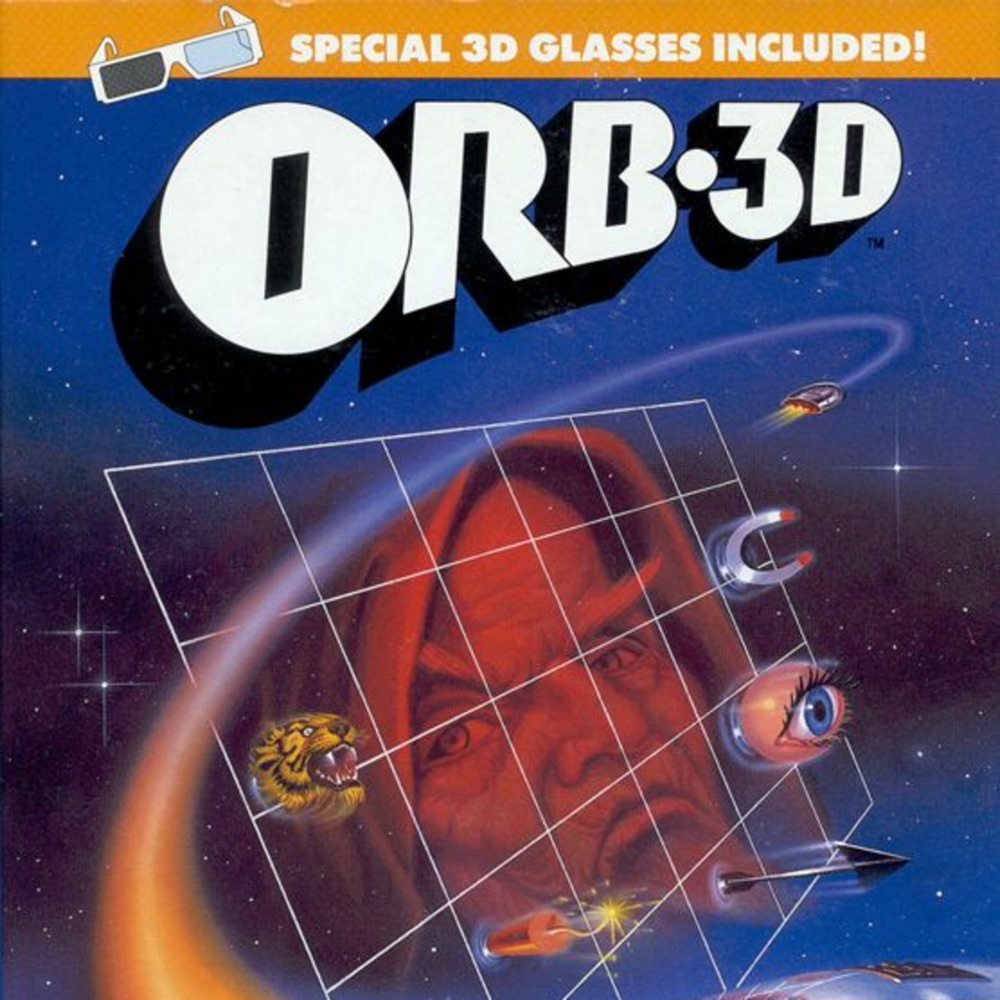
The evil space wizard Krohn has mastered the power to control a black hole, and plans on using this power to control the universe. You are an explorer on assignment in a remote corner of the universe. You have just been reassigned to fight Krohn since your ship, the Millennium Orb, is the only space craft cabable of withstanding Krohn's black hole. To defeat Krohn, you must get past 30 different chambers blocking the path.
Mike and Sean did this one without Joe. Orb 3D shipped with its own 3D glasses, and we agreed they are probably the most valuable thing about it. It began as Beyond the Black Hole from Software Toolworks, the people behind Chessmaster, Cribbage King and Mavis Beacon. You play a space pilot out to stop an evil wizard named Kron by clearing 30 "fields" first, and nobody could explain why a sci-fi game has a wizard in it.
What's clever
- Every level is a new puzzle. Level one has you pulling an orb through hoops. Level two is a pinball alley with ten pins and two shots at them, and if you miss, the pins reset. Others use switches, warp holes, ducks, a bingo card, and dice you have to hit in the right order. The controls stay the same while the rules change, which reminded us of WarioWare, though it's slower to read.
- The paddles. Paddles at the edges of the screen pull the orb toward them with a kind of gravity, and you steer it in a top-down view. Once you think about ellipses and bending the orb back toward you before it reaches a target, it starts to make sense.
- The fuel bar. It drains steadily and drops faster when you miss the orb, and spiky things released by targets cost you a lot. We agreed it's necessary: otherwise it's a war of attrition over who gets bored first.
- Vern's. Press select and you reach a gas station where you thread the orb into fueling bays to refill. It is harder than the game itself, and the dollar sign that opens the bays makes no sense when you never collect money.
What isn't
- Depth is the problem. The orb shrinks as it moves away, but judging where it is in space is hard, and we couldn't see how the glasses would help. We thought it would have been at home on the Virtual Boy, where Mario Tennis gets depth right.
- Hard to explain, easy to read. Describing it took us far longer than any game so far, and we still doubted a listener could picture it. On screen it's clear enough that you don't need the manual.
- Respect without fun. Mike felt like he was doing QA for nobody, confirming it works. It is unique, he said, but not memorable.
The bottom line
Skip it. Mike voted no and Sean said it isn't essential, though he thought the developers were "super clever" to build a new idea into every level. With just Mike and Sean on the episode, it did not go on the Essential Games List. We'd happily play a neon-ducks Miami synthwave remake.
Written from our conversation in this episode.
- The Fate of the Universe is in your Hands
- 🕹️ General Overview
- Released in 1990 for NES by Hi-Tech Expressions.
- Originally developed as a 3D PC game by Software Toolworks, known for The Chessmaster and other educational tool/games
- You control a bouncing energy orb in first-person, ricocheting it through space mazes and puzzles.
- One of the earliest NES games to simulate 3D space… kinda.
- Notably includes a 3D depth illusion and cursor-based paddle control.
- 👾 Story & Objective
- You're a space pilot tasked with destroying the evil wizard Krohn, who rules the galaxy from the fortress ORBS-A-ZERK.
- To do so, you must conquer 30+ "spheres," each a puzzle-filled room floating in space.
- The ultimate goal is to defeat Krohn and restore peace to the galaxy…
- 🌀 Gameplay Mechanics
- Third person POV of the orb and the targets with the paddle on the screen's edges
- You bounce the orb into targets on the screen—sort of like 3D Breakout meets pinball.
- Use the D-pad to curve, angle, and deflect the orb, adjusting depth and trajectory.
- Each room has different puzzle elements: targets, switches, warp holes, energy drains.
- You have limited energy—if it runs out, it’s game over.
- “Did this feel like a 3D game—or just a 3D vibe?”
- “If this game were ported to VR, would it finally make sense?”
- 🎯 Game Design & Strategy
- “Did you feel like you had control of the orb—or were you just watching chaos happen?”
- “How long did it take you to realize how to aim in 3D space with just a D-pad?”
- “Which room stumped you the most?”
- “Does the energy system add tension, or just make the game feel punishing?”
- 🎨 Graphics & Sound
- Uses forced perspective and shading to create a pseudo-3D look on NES hardware.
- Minimal but functional UI, emphasizing clarity over flair.
- Music and sound effects are sparse, with bleeps and sci-fi stings.
- ❓ Fun Podcast Questions – Orb-3D
- 🧪 Speculative & Legacy
- “Would this game have done better as a PC game or educational tool?”
- “Is this the kind of weird experiment the NES needs more of?”
- 🌌 Sci-Fi Spin
- “Would you trust the galaxy to be saved by a bouncing ball?”
- 🤯 Mind-Bending Mechanics
- “Is this secretly a zen game disguised as an action-puzzler?”
- “When the ball curves around and bounces just right…”
- 🧠 Meta & Commentary
- “Do you think kids renting this in 1990 were like, ‘Yeah this is exactly what I wanted from a space game’?”
- “If this game came out now as an indie title on Steam with neon colors and a synthwave soundtrack, would it be a cult hit?”
Auto-generated transcript. Each paragraph starts with its timestamp. Speakers are not identified.
Orb 3D, the fate of the universe is in your hands.
And welcome to NEStalgia, a chronological exploration of every NES game released in North America. I'm Mike. And I'm Sean. Sean, Orb 3D, are you ready for a 3D video game on the NES? I'm ready to ponder some orbs. We actually have had 3D video games on the NES already. And we've also had 3D video games on the NES that actually had 3D technology in them. So Orb 3D is coming a little late to the party. It's not introducing anything new here. But it did come with its own set of 3D glasses. And I feel like those 3D glasses, if you still have them, have to be the most valuable thing about this game.
Yeah, I was, when I was reading the manual, because this looked high concept enough to warrant it, and it described the glasses you were supposed to get. I was kind of worried that like, oh, am I going to be able to play this game? Like, is it going to be in stereoscopic, like red and blue stuff? And then they're like, oh, if you don't have it, you can still play it. I'm like, okay. And then I played the game, and I'm like, I don't even know how the glasses would work. Cool. Yeah, I had the same thoughts, because I'm looking at it, and first off, the glasses are referred to as Greenovision glasses. Yeah. With like, capital G, capital V.
So clearly, somebody trademarked this thing, and like, was ready to put it. But it looks to me like it was just those normal red and blue glasses or whatever. But the game doesn't play like that, so I couldn't find an actual picture of Greenovision glasses, because it doesn't have any strobing or red and blue effect on it.
So the way that it describes in the manual was that you just have to like, look past the screen, and you will see objects that move, you know, like, is it like 3DS technology, where like, it makes it look like? Yeah, that's what it sounded like, yeah. Like, there's no way, though, right? But now I'm starting to think that it's kind of just bullshit, and you were supposed to put the glasses on, and then you would just get some placebo effect, because there's different colors.
Yeah, yeah, yeah, sure, sure. Like, you put, you know, you put the glasses on, put your hand over your face, and then someone smacks your face. And then I can't believe you thought that was going to work.
Yes, yes. That's kind of what's going on here. This game originally released as, what was the name, Beyond the Black Hole, and it was made by the Software Toolworks, which sounds incredibly boring, because they made mostly incredibly boring games, like Chess Master and Cribbage King. Ooh, Cribbage King. Yeah, Cribbage King. They did the whole Chess Master series, though. If you recall, we did play Chess Master on the NES. That was also them. Indeed. But, like, Mavis Beacon teaches typing. That's them.
They made some Mario fun games, like Mario's Fun with Numbers and Mario's Preschool Fun. These are just, like, educational games. So they make educational games. Is Orb 3D educational at all? Like, is it teaching you about 3D? That's not something you need to learn, right? It is not educational, but I think it still sort of fits into this mold that you kind of, the picture you painted of them as more of, like, interested in the tech of video entertainment more so than video games.
And I think that tracks with what we got here. And in Orb 3D, you control a floating orb. You control pong paddles. Oh, yeah. Sorry, sorry. You are trying to get a floating orb to hit objects, collide with them, so that you can destroy all objects on the screen and progress to the next stage. You have these little paddles on the side of the screen that you, you know, that's what you really control.
And they kind of direct the movement of the orb in, like, some kind of gravity fashion where, like, they pull the direction of the orb towards them. They kind of act like the paddles in Breakout where, like, you want to hit the, you want to have the paddle hit the ball on a specific curve, so this way it hits a specific area of the other part of the screen that it's flying towards.
That's very confusing to explain. We're going to do our best over the course of the next three hours to explain how Orb 3D works to you all. But that's really all you need, right, Sean? Like, you just need the concept of a floating orb has to hit objects, and you have these magnetic paddles on the side that kind of help guide the ball. You don't need a story, but the game decides to give you one anyway.
Yeah, and I don't get it. I don't understand why. It's about wizards and stuff, but everything else about, like, the visual language of this game is very sci-fi or at least futuristic in some way. So, yeah, I don't understand, but we got it. Do you know the story? You're a space pilot who's been tasked with destroying, as Sean mentioned, an evil wizard named Kron who rules the galaxy from the Ortris Orbza Zerk.
Ah, yes, Orbza Zerk. Orbza Zerk. In order to defeat the wizard, though, you can't just merely get to his fortress. You have to get through 30 other, I don't know, like, are we treating these like they're solar systems or something? Like, they're, what are they? Like, fields? Like, 30 space fields? They're just fields. They're fields, yes. Okay, which is actually each, like, a room, you know, a level of itself that is a puzzle. You know, the first stage you can kind of just hit the objects in any particular order and clear it, but as it's made abundantly clear in the second level and, you know, really turns the game on its head,
every stage is kind of unique in how you clear the objects and you can't just say, oh, well, I just have to hit everything on the screen and then they'll all disappear and I'll get a new level. That's not how it works.
I will, I guess, set it up with the second level because I think that's the most interesting one to get across the idea of, like, how these puzzles can be different. In the first stage, you are, you know, literally just dragging this orb through the power of your paddles to hit objects across a 3D space. Yeah, get it through some hoops. Yeah, exactly. In the second puzzle, it's now pins from a pinball alley and you only get, yeah, you only get the two chances to knock down all 10 pins. If you don't, the frame resets and you have all 10 pins again and you must knock down all 10.
Fine, I'll just keep trying over and over again, right? Well, you have limited energy. There is a fuel system on the right-hand side of the screen that's just a bar and it's completely filled at the beginning of a level and it slowly ticks down. If you manage to not catch your orbs with the paddles that are on the side of the screen, then that caused extra fuel.
And once you run out of fuel, it's game over. So, unlike any NES game that I've talked about so far, I am going through great lengths to explain the concept of this game. And I still feel like anybody who's listening would have no idea what to picture in their head. If they didn't play the game. Do you get that feeling? No, yeah, I get that feeling. I'm trying to think of... It's kind of like WarioWare.
Except you're kind of doing the same thing in every one. Like, the rules of the game change in every level. But the way that you're interacting with it stays the same. Like, you're always just sort of hitting this orb back and forth between the two paddles with the other, like, actual control method being, like, sort of calling it back to you through, like, Z-space.
And everything else is just... It's a new game, different rules. But, yeah, you're just using those same methods of control. So, here's a take-two, more concise read on everything I've said so far. It's a top-down point of view of the space field where you can see the orb, the targets, and the paddles, which are on the screen's edges. You bounce the orb into the targets on the screen, sort of like, you know, breakout meets pinball or something. Because you want to hit the bumpers. You use the D-pad to control the paddles to curve, angle, deflect, whatever. Adjust the depth and trajectory of the orb because you can make it, like, swing around because it's kind of constantly moving.
And each room has a different thing. Like, one is... One's targets. One's switches. One's warp holes. One's pins. One's ducks. You never know. One's a bingo card. One's, uh, you're trying to play, like, a golf like you would with, uh, with, like, throwing darts. But instead, it's, like, you're rolling dice and you have to hit the dice on the right number. And, yeah, everything is different.
It's really weird. So, how long did it take you to realize how to aim in 3D space? Like, obviously, you, you know, you play around with the D-pad, you understand what does what. But how long did it take you to get good at hitting objects? I wouldn't say that I was ever very good. But it only took me a few back and forths to understand what I was supposed to do. Like, you can kind of loop it around in the middle of the field for a while. You could play this game and not really end up using your paddles all that much if you know what you're doing. But I didn't always know what I was doing because maybe I needed those 3D glasses because your depth perception is very important here.
Yeah. If this game was ported to, you know, like, VR or something, like, would it finally make sense? Like, would it click better of, like, where you are in space with the orb and the objects? Or is it more just, like, a controls issue? I think it's more so just your perspective. Like, and just to bring it back to a more period-appropriate piece of hardware. Because I think if you ported this to, like, modern VR, it would be, like, who would want to play that? But if it was a Virtual Boy game, maybe? Like, I think that that actually would be what this game would be best on.
I don't know if you agreed. Yeah, I would agree with that because, if you recall, when we played on the Virtual Boy, we played Mario Tennis. And that got the depth of a tennis ball pretty well. It was a little hard to know when to swing, but we were able to understand, like, hey, that tennis ball is pretty far away. And now it's coming at me. I think that's what the orb is missing here. Like, yes, pixel-wise, it gets smaller when it's behind all the objects. And it then, you know, grows in size as it wraps around. But it's a little, like, if you gamify it a little bit, like, if you get good at this game, you almost have to start bending it, you know, bending it inwards, right? To angle it back, to come back closer to the player.
The orb, to do that, you want to do it before it approaches the object that you want to hit. So, you have to think about it like a giant oval, and as you're pulling the gravity back in, you want to get it right before it hits that object, not while it's under that object. Yeah, you've got to start thinking about, like, vectors and ellipses and lots of mechanics like that, which are a lot more intuitive than how we're describing it. Just because, again, this is a very, we've never had to talk about this kind of mechanic before.
Does the energy system, you know, like the fuel, or whatever you want to call it, I guess it must be fuel. It is fuel. Does that add tension or just make the game feel more punishing?
I think it does, and I think it's necessary. Um, because one thing that we didn't mention before is that after certain targets are hit, they will release, uh, this kind of, like, thing you don't want to interact with with your ball. It's like a spiky thing, and if it touches your ball, you lose a lot of fuel. So I think it did need something to, like, not just have this be a, you have unlimited time. I think it would be a lot more boring, uh, and you would just have to, it would just be a war of attrition with this game of just, like, would you get bored before you beat it?
Right, right. Yeah, because also then think about it, if they didn't have the fuel system, the other thing they could have done was treat it like breakout, where you only have, like, three orbs, and if you miss the orb with the paddles, you get two more chances, but once you miss three, then you're out. And that's, like, that's not, like, at least the fuel thing is, like, well, you're gonna lose a little more fuel now if you bounce out, but you're not, like, out of it. And if they didn't contextualize it with fuel, how would we get, um, the iconic, like, what did they call it? There's, like, a gas station that you can go to when you press select.
Oh, yeah, that's right. And then that's almost, like, its own level. Yeah, it's a very, it's much more difficult than, uh, than the game itself. Like, you have to be pixel perfect, threading the needle into these little holes, and every time you get the ball into the hole, you get an amount of fuel back. And then if you press select again, you can go back to the actual game. And I really don't know. Like, it's a very strange mechanic, especially because for some people, it could just be completely hidden. Yes, that's true, right. It is hidden behind, uh, you know, uh, go, pressing that specific button, but also, so the gas station was named, uh, Vern's.
Vern's, yeah. It's not iconic, but it's like, all right, that's interesting. No, it's iconic to us. Yeah, sure. It's weird that they named it at all. Uh, but also what's weird is, like, you have to go to one of the, um, fueling bays in order to get new fuel. But, like, there's a chance that none of them are open, and so you have to hit the, um, the dollar sign icon, uh, at the bottom of Vern's service station to open up the fueling bays. But it's like, you don't collect money in the game.
Well, there's also, like, bathroom signs. So, I don't think there's a lot of rules with the visual language here. And if you hit the bathroom sign, your orb gets flushed down the toilet. Is that true? No, that's not true. Oh, okay. Okay. So, obviously, you know, the UI, it's minimal, um, but it's... Yeah, but it's functional. Sure. Everything that's on screen, like, let me put it this way. You don't need to read the manual to understand this game. Maybe if you're, like, a little slow, you would not be able to understand why the pins, like, keep resetting. You might be like, well, what do I have to do? It's a little slow.
You know what I mean, though? It's like, the concept of the game is... It's all communicated clearly. Oh, yeah. It's all intuitive tasks. Like, when you get numbers that are jumbled up, it is clear that your task is to put them in order.
Like, it's, again, like WarioWare in that way, where you take half a second to internalize the concept that they're playing with in this level, and then you just do it, it's just not quite as, uh, not quite as easy as WarioWare. And if we're being honest, this is the kind of weird experiment on the NES that we're usually here for on the podcast, right? Absolutely. It's just that that's what makes the show interesting, is when we play weird games, but that doesn't mean that, like, we're gonna like them. Yeah, I think, like, I did... I did... I did think it was neat, um, but I don't think that weird is shorthand for I'm gonna love it.
And would you really trust the galaxy to be saved by a bouncing ball? Especially not if it's a bouncing ball they're using to take down an intergalactic wizard. Right, what's going on here? Like, did the, did the civilization or whatever that came up with this, like, plan, did they not figure out space travel, but they figured out, like, traveling by paddles? Maybe, maybe this is all just in your, like, in your computer heads-up display, like, this is how you navigate, uh, interstellar space. Could this be a... We don't know. We don't.
Could this be a zen game? A zen game. You know, like, if you're good at it, like, could you reach, like, uh, a zen-like state of just, uh, you know, this is actually, this game actually calms me down when I play it. I, I guess. I mean, I think that there's a high enough skill ceiling in just being able to manipulate the ball, like, perfectly.
Right, when the ball curves just right. Yeah, like, maybe it could get to that point. I was, I would have never thought of that. That's an interesting question. So you don't think kids in the 90s were renting this at Blockbuster and being like, yeah, this is exactly what I wanted out of a space game. Oh, wow. I guess maybe it is, like, the, the cover, I know it, I don't, I wouldn't say it looks like a space game, but it definitely looks like a sci-fi game. I guess I don't know if I would have thought it was a space game. Right, you know, like, you might have thought you were getting another, uh, shmup, but a 3D shmup this time. And instead you get 3D Breakout.
And last but not least, Sean, if this game came out now on Steam, cute little indie title with neon colors and a synthwave soundtrack, would it be a cult hit? Oh, if it has synthwave soundtrack? And neon colors everywhere and, like, future retro? You could, like, move ducks around.
But it would be like, yeah, but it would be like, um, you know, Mazda Miatas instead. No, it would have to be ducks. I think I would want a duck. Okay, they're ducks, but they're, like, neon ducks. Oh, yeah, for sure. I love neon ducks. Yeah, and it's like, it's all, like, secretly takes place in, like, the back rooms of a Miami bar. Okay, for sure. No, I'd be, I'd be down for that.
Great. So, uh, that's what you guys need to do. Anybody out there making a video game right now, cancel that game. It's probably too expensive anyway. And make Orb 3D 2. Orb 2D. Make Orb 2D. Miami Vice Edition. Isn't it weird they went right to 3D? We didn't even get Orb 2D. We didn't even get Orb 1D, dude. I'm still impressed you played Expedition 33 without playing the first 32 entries. Shut the fuck up. I might shut up, but not before we do the Essential Games list.
The funny thing about Orb 3D is that I respect it. I didn't enjoy it when I was playing it, and it does make it feel, like, I do a few times on this podcast. It makes it feel like I'm just doing, like, QA testing for nobody. Like, when I play some of these games, it's like, I'm just making sure that they work. And, like, yep, that's the game. And, like, cool. Time to go review it on a podcast. Like, that's what wound up happening here with Orb 3D. I just felt like I was reporting into nobody to report that, yep, this game can release. And it did. And people bought it numerous times because it's ported onto a bunch of different things. But it's not the kind of game that I'm ever going to seek out again.
Or probably this could be one that I wind up forgetting, too. Because while it is something unique, it's not necessarily memorable. So Orb 3D is getting a no from me. What about you, Sean? Yeah, it's not essential. But I will say that I think that the developers of this game are super clever. Like, the fact that each level is its own idea. And the mechanics kind of, the mechanics stay the same. But the rules change every time you boot it up, basically.
I think that's really cool. I think maybe, I do wonder what they made later. If we're going to play another game by them that maybe isn't as super high concept. But still allowed this kind of creativity again. But as of right now, it's just not super fun. But it's impressive. I welcome, you know, like, Orb 4D. Which probably came out on, like, Atari Jaguar or something. You know, like, just something where it's like, yeah, we don't have 4D. Just hypercubes everywhere. Yeah, but we just don't have it.
We're just going to shamelessly call it 4D. But nobody really cares if it is or isn't. Because Orb 4D, you know, I'm not up to date on the latest, like, what dimensions or what. But, like, that would be, like, you would just see everywhere the Orb ever was and will be.
I think... Because it's time, right? And sometimes people say that it's time. But it could also be, like, a spatial dimension. And that's where you get hypercubes from. Oh, right. The hypercube. Yeah, yeah, yeah. Yeah. I'm not a quantum mechanist. I'm not a quantum machinist. I'm not a quantum mechanist.