387 · Sesame Street Big Bird's Hide & Speak
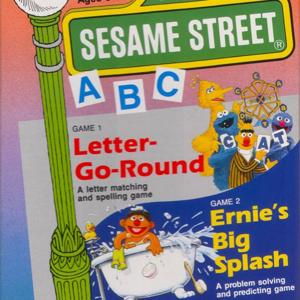
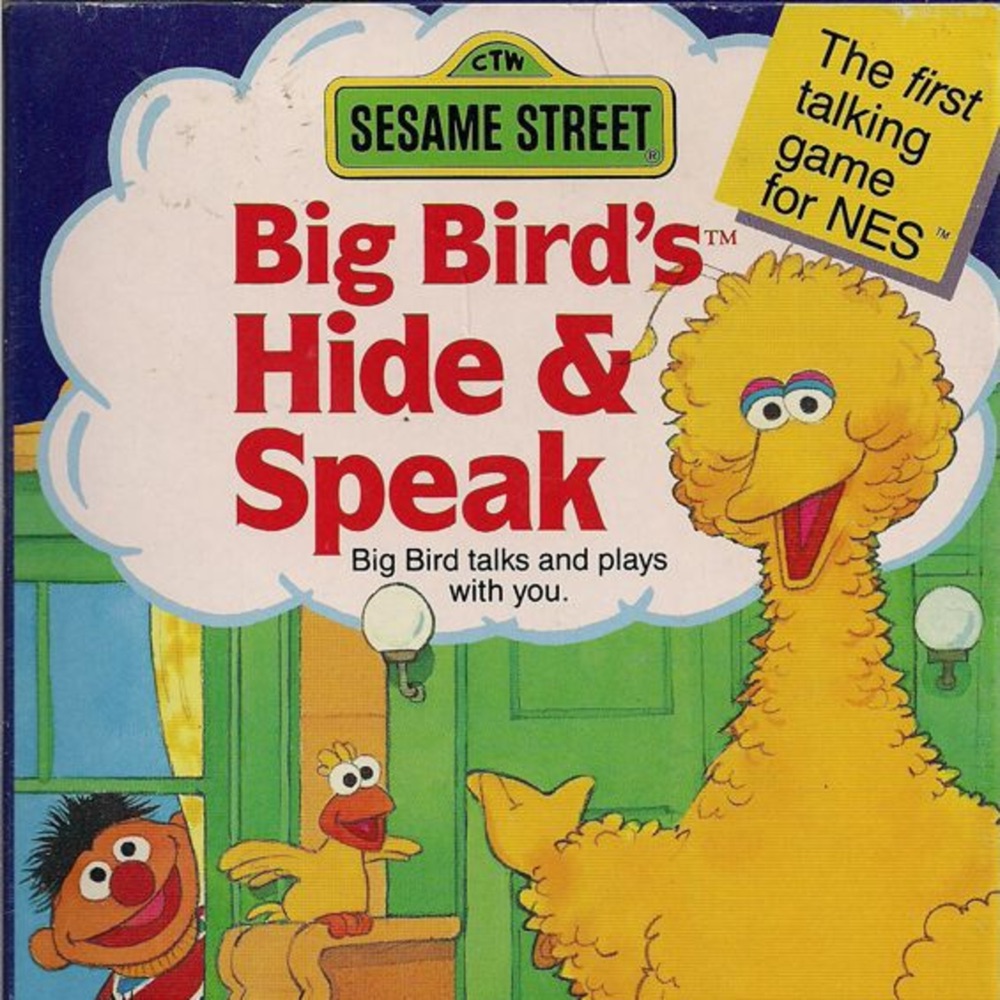
Big Bird's Hide and Speak is an edutainment title for based on the Sesame Street license. It is designed to teach early recognition, memorization and reading skills to young children. It is one of the few NES games to use digitized speech thanks to a special chip included in the cartridge.
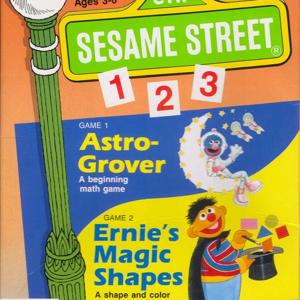
Mike, Sean and Joe were all here, back on Sesame Street for the third licensed game after the alphabet and numbers ones. It comes from the same makers, is approved by the Children's Television Workshop, and is aimed squarely at preschoolers. It's hard to have an entertaining conversation about a game built for babies, and nobody at the table is a parent.
What it does well
- Big Bird's voice. The box oversells it as a first, and it isn't the first NES game with digitized speech. But it has far more speech than we'd heard before, it's clear, and it sounds like Big Bird himself, voiced by Carroll Spinney. Next to "touchdown" in a sports game, that's a leap.
- A sensible climb. There are six modes. You find the character Big Bird names, then do it from memory once the windows close, then repeat the idea with letters, then three-letter words like bat and cat, ending in a time trial. That's a decent curve for a small child.
- The rewards. Finish a mode and a character comes outside: Elmo blows a bubble that lifts him in the air and drops him, Bert jumps rope, and Ernie skateboards. We argued over whether the pacing was Bert's, then learned it was a skateboard.
- It knows what it is. Unlike Donkey Kong Jr. Math, which makes you pilot a platformer just to answer sums, it doesn't pretend to be an arcade game. You press a window, hear a word, see a face.
What drags it down
- The bird cursor. A little bird flies from window to window to make your selection, and the d-pad only steps through the options in a circle, so you watch it fly and sometimes press four times. Going across the top takes a second and going down takes about four. In the spelling time trial, most of your time goes to watching the bird. Mike called it "completely unforgivable."
- Thin on "hide." The windows close in only some of the modes, so the title is generous. We offered "Hide, Speak and Spell."
- Doubtful teaching. It's recognition and memory practice, with some listening, and a way to introduce kids to the characters while they're at it.
The bottom line
Skip it. Joe said that if he voted normally it was definitely not essential, though he'd have used the rare "not applicable" vote and thought we were giving it too little credit for letting kids practice letters and spelling. We landed on not essential, and it did not go on the Essential Games List. It probably did what parents bought it for, keeping a kid busy while they did something else.
Written from our conversation in this episode.
- Released in 1990 by Hi-Tech Expressions, developed by Riedel Software Productions.
- Officially licensed by Children’s Television Workshop.
- feature digitized speech — and it's Big Bird's! Even says Starring Caroll Spinney
- Aimed squarely at preschoolers, it’s part edutainment, part memory game.
- 👤 Story & Objective
- You play as a friend of Big Bird, helping him find Elmo and friends (like Ernie, The Count, and Grover) hiding behind windows.
- There’s no real "story," just a friendly set of increasingly tricky mini-games designed to teach basic word recognition, memory, and listening skills.
- You guys probably won’t admit you’re wrong, and that’s fine, but this game proves my point about the dpad menu in the other Sesame Street games and.
- 🎮 Gameplay Mechanics
- Controlled entirely with the D-Pad and A button — no reading required.
- The game has six modes:
- Find the character Big Bird names.
- Find the character by memorizing where they were
- Find the letter Big Bird names
- Find the letter by memorizing where they were
- Find the word Big Bird names
- Find the word by memorizing where they were
- Players select windows to reveal characters or words.
- After completing each mode one of the characters goes outside and does something. Elmo blows gum that lifts him in the air, Bert plays jump rope, and Ernie paces back and forth
- 🎨 Graphics & Sound
- Bold, colorful characters faithful to the Sesame Street aesthetic.
- Sprites are large, friendly, and recognizable — perfect for young kids.
- Does the looping music avoid distraction or overstimulation.
- 📎 Fun Facts – Did You Know?
- 🧠 By the Creators of Mavis Beacon!: Developer Riedel Software Productions also worked on Mavis Beacon Teaches Typing, bringing their edutainment chops to consoles.
→ [Source: MobyGames] - 💾 Uses a Rare Speech Chip: The cartridge included special ROM mapping to handle speech playback, one of the few NES carts to do so without a licensed chip like the VRC6 or MMC5.
→ [Source: NESDev.org] - 📺 Elmo Was New at the Time: Elmo had only just become a breakout character on Sesame Street in the late '80s. His inclusion here shows how quickly he was rising in popularity.
→ [Source: Sesame Workshop history] - Big Bird’s Hide & Speak vs. Donkey Kong Jr. Math
- 🎮 Gameplay Design
- Big Bird: Very simple — press a window, hear a word, see a face. Six gradually more complex variations of that idea.
- DK Jr. Math: Based on Donkey Kong Jr.’s platforming engine, but math slows the game down. Only two game modes, both clunky.
- ✅ Winner: Big Bird — It may be basic, but it’s built for preschoolers. DK Jr. Math is frustrating for everyone.
- 🕰️ Replay Value
- Big Bird: Low, unless you’re a literal toddler. But for that group, it’s perfect.
- DK Jr. Math: Also low, because it’s clunky and not particularly fun or rewarding.
- 🟥 Loser: Everyone — but Big Bird at least knows it’s a babysitter, not an arcade hit.
- ❓ Podcast Questions – Big Bird’s Hide & Speak
- 🧠 Game Design & History
- “Was this genuinely a good use of NES tech for its time — or just a gimmick?”
- “Would more NES games have benefited from digitized speech if memory allowed it?”
- “Does this count as a game, or is it more like interactive flashcards?”
- 🧒 Childhood Nostalgia / Replayability
- “Who was this made for—and did it work for that audience?”
- “Would you hand this to a 3-year-old now and expect them to get anything from it?”
Auto-generated transcript. Each paragraph starts with its timestamp. Speakers are not identified.
Sesame Street, Big Bird's Hide and Speak. Big Bird talks and plays with you.
Nostalgia And welcome to NEStalgia, a chronological exploration of every NES game released in North America. I'm Mike. I'm Sean. And I'm Joe. We're back. It's a sunny day. Everything's A-OK. And we're making our way back to Sesame Street. If you guys could just tell me how to get there. I don't know. I've never considered. I've always heard the song asking me to tell them how to get there. And I've never been able to. Yeah, they don't give the directions in the song, do they? Well, they don't want a lot of people going there bugging the actors and everything. And you know, Big Bird, you know, tries to live a private life. Actors? I mean, the real people.
Yeah. Bird. Yeah, sorry. The people really do live there. The Muppets go home. Oh, I see. I don't realize this. Where do they live? I don't know where they live. I think they live in like gigantic condos like facing Central Park. Even Grover?
Grover lives... Grover's homeless. Yeah, I don't know why I was gonna say Grover lives in Dover or like something stupid like that. But I'm glad that I didn't say that. That's such a stupid joke. Grover's a stray. He wanders. What is Grover anyway? He's like human, right? He's a purple. He's a dog. He's a dog? Is he not? His name's Grover. I know, but are you sure though? So was a president. He doesn't look like a dog.
Yeah, he was a dog too. Oh. First dog president. That's true. He did have that dog in him. He's like an air butt of the 1800s. Or is Grover just like a monster? I guess what we're all saying is there should be another NES game, Sesame Street Big Bird Teaches You Directions. Where he's like, you know, you learn about North, South, East, and West, and never eat soggy watermelons. And, you know, that's how you find out how to get to Sesame Street. What was that about watermelon? That's how you remember North, East, South, West, like in that order. The acronym, never eat soggy watermelons. NESW. Ah, I've never needed that. Did you know that NES is in the compass? That's like a little bit of an Easter egg.
What's the, why'd they get rid of W? Uh, because it's a JRPG. Ah, yes. Okay. Not a WRPG. Yeah. We're striking out here. I'm really just flying by here. Yeah. Let me get into the game. Uh, this one comes after the other two, which taught us about the alphabet and the numbers. Canonically. Yeah. It's very important that you know the alphabet and the numbers before you try and speak to Big Bird, right? That's true. If you don't know any letters, I'm going to talk. Well, you do need to know the alphabet before this game. Right. So that, that checks out.
And, uh, so this game, I think comes by the same people, high tech expressions and Rydell software productions. But, uh, more importantly, this is an officially licensed Sesame Street thing and it is, uh, licensed by the children's television workshops. So like Sesame Street actually has a role in like the educational part of this game, which you have to imagine is a big sell for parents. If they're trusting, uh, kids to watch it on television and teach them that way, they're probably also trusting them to teach them at home rather than go to grade school.
Right? It's just like, all right, uh, you're homeschooled now, boot up the NES and start playing Sesame Sesame Street, big birds hide and speak and big bird is in the game, but more than just as a sprite, it features his digitized speech, uh, by the actual actor of big bird, Carol Spinney. I think it's Spinney. I'm going to go with that for the rest of the episode. And that seems like a big deal.
And it is a lot of digitized speech, but, uh, I just want to set the record straight because Sesame Street is lying to us on the box of the game, but this is not the first, and we know this, it's not the first NES game with digitized speech. It's, it's not the first certainly, but is it the best? I feel like- It has really clear visual speech. It has such a wide, like, it's so much more than everything we've heard before instead of just like a, uh, in a sports game, uh, whatever, like- Right, Tech Mobile had like, you know, first down, touchdown, you know? Yeah. But like, not only is it all very clear, but it's very clearly big birds voice. And that's kind of impressive to me on the NES.
Yeah. So maybe that is actually like the deal though, right? Is that there's some voice acting behind it. Yeah. That's what they, they didn't have the terminology back then for it. Like what they mean by digitized speech is really like, you know, they didn't just like teach, uh, you know, a computer to, you know, manipulate the synth wave or whatever to make the sounds. It was actual Carol Spinney saying these things and then recorded because I believe, uh, I have this somewhere down later in my notes. I believe that there is a special like chip. It uses a speech chip, uh, the VRC6, uh, to, to actually have all that extra speech playback.
Otherwise, um, you couldn't do this on just like a, a normal NES cartridge. It also must've been like so much data compared to what else, what everything else that the game is.
Yeah. And the game is aimed squarely at preschoolers. It's, uh, it's an edutainment game. It's a memory game is memory or memory games like part of edutainment or is this like, like, can, can, do you learn anything from that? I feel like you do.
I don't, I don't really, it trains your brain in some way. Yeah. I think one, one might think so. I mean, I guess like if you're going towards a preschool market, then you can't really teach anything. And this is more so just like, uh, make sure that they have object permanence.
Right. And in the game you play, um, I really as yourself, but I guess it's like a friend of Big Bird. Like you're like, you're like visiting Big Bird and, uh, you roll up to a house on Sesame street and you have to help him find, uh, Elmo, Ernie, the count Grover, who are, um, in the, uh, I guess it's like, what is that? Like a, is that a co-op? Is that an apartment complex? That's like the Sesame street house, isn't it? Right. But I mean, like, do they all live there? Like, is it a, is it a boarding house? Like, do they all have like their own bedrooms or do they all have like their own floors? How does that work? It's a tenement. Cool. You said that pretty definitively. So that's Sesame street lore. Yeah. They live in a tenement.
Uh, and there's no real story. It's just a, you know, uh, set of increasingly tricky mini games designed to teach. Uh, well they do. I mean, okay, we'll get into that, but I think there's actually, uh, this gets hard kind of fast for the audience. It's aimed at, but, uh, it's really just teaching basic word recognition, uh, the memory skills that I mentioned above with the memory games. And I guess also it's teaching like listening skills, right? Like you're being told by big bird, find me Ernie. And so you have to, you know, also not only understand like the later things where it's like, you know, who has the, who had the word bat, but also like who is Ernie?
Yeah. So it's like, it's like simultaneously trying to teach kids, but also like sneakily trying to indoctrinate them into becoming Sesame street fans. Like they're just going to, while they learn their letters, they're also going to understand our IP. Very important, uh, distinction there, Joe. Cause you're right. They never, there's no like rolling opening credits where they're like, this is Ernie. This is Elmo. This is Bert. Maybe not. There is. Maybe not like at the very beginning, but in the game, they, they say, here's Ernie.
Here's the count. Here's Grover. Like the, the, the very first mode they do an introduction and then they basically, it's just like, do you remember their face? Can you, can your brain process a face? And so, yeah, I found this really great.
Yeah. As long as you've played an order, it introduces you, um, at least, well, I guess it doesn't introduce you to everyone. Cause in mode one, it swaps out. There's like a rotating cast member. So like in a mode one, you've got like Ernie's not in it, but Elmo is, I think it's kind of random. I think, yeah, I think Ernie could be in it. Okay. So then either way though, mode one, if you're just playing one game at a time, mode one teaches you four of their names and then you move on to mode two and it could be a different combination of four people. Yes.
Which doesn't help. I agree. Uh, but more importantly, before we get into any of the mini games and modes and everything, uh, you guys probably won't admit that you're wrong. And to be honest, that's fine. But this game resurrects and definitely proves my point about the D pad menu system in the other Sesame street games and blows it up so hard that like, there's no, I would love to hear the devil's advocate, but now they have made it even worse because the, the, the time
it takes to watch the bird. So just, just for what it's worth, the way it works is no matter what in the other Sesame street games, no matter what you did, if you hit the up arrow, the down arrow, the left arrow, didn't matter. Whatever you hit, it was just going to do the next thing, the next option below it until it hit the bottom of the screen. And then it would go in reverse clockwise. So now it's going counterclockwise and going counting back up.
And you know, we had some debate about it, whether that was smart or not for kids, because apparently it's supposed to teach them something, but it can't teach them about the how the actual controller works. God forbid. Now the game says, well, hold on a minute. What if we made it cute? And we have this bird, uh, that, you know, is like a, I don't know, one of big birds, like little friends or whatever.
And he flies from window to window to select your choice. Cause remember you, you have to say who Ernie is. And so you see Ernie out of one of these four windows, but you can't just, you know, if he's in the, if your cursor's on the top left and he's in the bottom, right, you can't just press right on the D pad and down on the D pad. Cause that will only select the next possible option for the bird, but it won't even do that in a particular order. That makes sense. It goes left, right? Yeah. Well, sure. But like, it's not, I guess, I guess it really didn't matter at this point because they botched it so bad, but you have to watch the bird fly to the destination.
As you've selected things, you are forced to wait at least a second, maybe more between these options. And then if you don't want that one, it'd say that, you know, it's the fourth option. You must press the D pad four times to get the bird to hit the correct screen.
What's going on here, fellas? So what you, you said, what you, you know, and I agree with you, this is much worse than it was in the other Sesame street game because the other Sesame street game was just the menu and it was a straight line and there wasn't some weird animation for it. Yes, exactly. Those are the three things that make me agree that this is bad, but without those three things, it wasn't that bad in the other ones. So it's, it's in this, it's definitely bad, especially in the main gameplay and it being this weird circle, not a straight line and it be having an animation.
The other one, it was just completely like, it was un, unintrusive to me. It was just like, it was just a thing that it is. It doesn't bother me. It's fine. I agree on every count. All right. And we're not going to, we're not talking about the other games, so we're not going to open up that can of worms again. But you brought up the, yeah, you brought it up. We're not going to talk about it. We're going to re-litigate it.
I don't really want to do that though. Cause I actually have a lot to say about big birds hide and speak. Usually I would do that on a filler episode. Sure. No problem. But we haven't even gotten into the six game modes of which it's like, I guess the idea is that one is the potentially easiest mode and six would be the hardest, but they change it up. So it's mostly one is introducing a concept. And then the second one introduces like the memory element of that concept. So first you have to find the character that big bird names.
And in mode two, you have to find the character by memorizing where they were after big bird says their name. Or in the following two modes, you have to find the letter that big bird says. And then in the next stage, you have to find the letter by memorizing where the letter was after it disappears. Then you have to find the full word. So not just a letter, but an actual word, usually like bat, cat, easy words like that.
And then obviously in the toughest iteration of that, you are once again, just memorizing where they are before they vanish from the screen. I just want to, I don't want to talk about the, I don't want to talk about the like individual
modes versus one about that concept of like, first you have the mode where it like the easy mode, right? Where it says like, you know, where's Ernie? And it shows you Ernie out of the four potential options. And then in the other mode, it says, where's Ernie? But you just see four closed windows and you have to remember where Ernie was before the windows closed. What do we think about that? I think that basically like it's games like these that I really have to self reflect about like what we do this podcast for, that we are actually playing a game meant for babies
and trying to have a conversation about it. And it's really hard to speak in an entertaining way about something this very basic. And yeah, I mean, I guess like to answer your question, I think it is, it's a good like difficulty curve for a baby to go from just burn recognize this face to like, here are some letters to
here's a time trial and spell as many three letter words as you can. And like, I think that if given the constraints of the game, like it, it seems to be a pretty good system. Yeah. I mean, I think it's also even tougher because none of us are parents. I feel like it'd be easier to review this game if we were parents where it's like, oh, yeah, I could see, I could see a parent in the nineties being, you know, giving this to their kid and being like, oh, okay, this is going to teach you stuff. I feel like nowadays this is, you know, obviously would be buried by the fact that everywhere you look, there's something that can do this. And there's probably a lot more like developmental data backing it all up.
But yeah, I think that I think right now the, just how educational this could be, like, I think it's dubious, uh, that, you know, they really didn't know if this was going to be helpful or not to kids.
Yeah. I think what they know is that it could work for kids, not necessarily teach them, but it could be played by kids, you know? Yes. And after you complete any of the modes by successfully revealing all four characters or letters or words, usually what happens is one of the characters that was featured in that particular game goes outside and does something. So Elmo, uh, puts in a stick of gum and blows a bubble that lifts him up in the air.
Bert, uh, takes out a jump rope and starts doing jump rope and Ernie paces back and forth before going back inside. What was that about? That's all he does. Wait, he just kind of like walked from left to right. No, he's got a, he's got a skateboard. He's got a skateboard. Okay. It's easy to miss because it just appears out of nowhere, but he's skateboarding from back to back. Kind of always like not, he's kind of upset most of the time. That's Bert. No, that's Bert. Well, that's the same thing. Yeah. Ernie is the happy one. I see. Happy.
That's all I'm going to say. But what does Bert do? Bert does the jump rope. Oh, yeah, yeah, yeah. I guess the pacing back and forth was more, uh, the character I would have imagined. Yeah, but, you know, um, now that I know it's a skateboard, uh, that's fine. But I, I like my joke better. Uh, did, did, uh, did you guys know that Elmo was like new at the time? Kind of like interesting to see him show up here as he's already popular. But like he was, he was like a late 80s addition to the cast where most of the cast is from, uh, the early 70s. So he looks a little different, right? He looks like a little lankier. Taller. Yeah.
Also his thing, like blowing the bubble and floating up into the air. His is kind of like a little scarier than the others. He just starts like floating away and then he falls banging into the walls on the whole way down. You know, it's a, and then he just trots away with his lanky, with his lanky weird self. I think the weirdest part about all these is I, I don't, I, from what I remember of the show, I just don't remember them being able to like walk around like support in a way that looks like they're supporting their own weight because they're puppets. Yeah, you're right. You never see like their feet. That's why they all look so weird. And it's just, it is a little disconcerting. You do see their feet if you go to Sesame Place though.
Oh, okay. I've never been to Sesame Place. Isn't that weird? Why can't they just fucking call the amusement park Sesame Street? It has to be a whole place. Like it just feels like bad brand recognition.
One other thing of these animations that bothers me, this, this bothers me on all kinds of animation. And I feel like I've seen a video about why this happens, but the count when he juggles, that's not the way juggling looks. He juggles and the balls all go in a circle. And I see that in cartoons. I see that that's just not the way juggling looks. The balls don't just go in one big circle. Is that like, why don't they juggle where the balls cross each other? Are you a juggler? Juggling three balls. I can't. I mean, I have juggled. Because I feel like a professional juggler, juggler, juggler could make them go in a circle. But that's, you can't go lower than your hands and have them still come up. Like, I don't know.
Look up a video of someone juggling and see if, you know, like, you'll see what I mean. They don't go in a circle. They crisscross each other. I feel like going in a circle is easier than juggling. You just hand one over to your other hand over and over again. Is a professional juggler a juggalo? Yes, definitively. That is the professional term, yes. You just hand two over and over again. You just hand two over and over again. You just hand two over and over again. You just hand two over and over again. You just hand two over and over again.
And while Sean debated whether Sesame Street's Big Bird hide and speak, which is a fantastic title, by the way. I don't want to blow by that. Hide and speak is really cute.
The hiding is only a part of one of the six, though. Three of the six, really, if you think about it. The letters are hiding. The words are hiding. I mean, the words are hiding within the letters that you have in front of you at all times. So I don't know. The letters are in front of you at all times? I played all of them, and I'm pretty sure the only ones that the window closes... Okay, maybe there's two where the windows close. I thought it was every other one, the windows close. No, because the last one, the windows are always open, and you're just trying to make a bunch of words.
Yeah. Yeah, yeah, sorry. So hiding is maybe a third of the game. Yeah, I feel like hiding is like, it's a stretch. Or, you know, they're being very liberal with the term hiding, where it's like, yeah, hide and seek, but you can see them all. You just got to figure out which one is which. If they wanted to be... So it's kind of like you're finding them. Yeah, if they wanted to be more reflective of the content, it should be Sesame Street, big birds hide and speak and spell. But I guess they might run into some issues with speak and spell in there. Yeah. But the same people, Rydell's Software Productions, also made Mavis Beacon Teaches Typing, and we've all used that. So, right? Did you guys use that in school? No. Mavis Beacon?
I did not. It doesn't sound familiar. Wow. Okay, so Buffalo just didn't... Did you guys have keyboarding class? Yes. I had a keyboarding class in middle school, and honestly, it was probably like the most frustrating class I ever took. I hated it. Because they tried to teach you how to use your fingers in a way that it was like, well, I can just do it faster this way.
Yeah, right. Well, I remember there was a program. There was a program that we used that if you typed the wrong key at any point, it would delete your whole sentence. And that was the most frustrating, because then you were timed. So you had to go as fast as you can, and you type the wrong key, it deletes your whole sentence. And I would be so pissed off all the time. That's a lot of stick and not a lot of carrot.
Mm-hmm. Now, let's bring up another great edutainment game, Donkey Kong Jr. Math. Great. Phenomenal. Yeah, well, of course it's great. On the gameplay side, big birds hide and speak, right? Very simple. You press a window, you hear a word, you see a face. I guess the idea gets more complex, but that's the general idea. Donkey Kong Jr. Math, it's based on Donkey Kong Jr.'s platforming mechanics. But then the math, you want to be able to do it faster, but you have to control Donkey Kong Jr. the way he controls in Donkey Kong Jr.
So it's like, I guess Big Bird is like, by process of having less permutations, and even though the bird takes forever to get across the screen, just less controls, you could learn faster in big birds hide and speak than finding out even if you got the math right in Donkey Kong Jr. Math. Yeah, I guess just to clarify, the little bird that is sort of hanging out around the building is basically your cursor.
And I think that especially in, and I keep going back to this sixth level, which is that time trial, like it actually kneecaps you, because, and going back also to being able to move in one direction, you have to sometimes like go through like three or four rotations around the windows with this goddamn bird to be able to actually spell this three-letter word that, you know, I don't even know how many words you could spell in the allotted time, because most of your time is going to be spent watching the goddamn bird fly.
Yeah, and it bugs me. I know it doesn't make any difference, but it bugs me that to go from like the top left to the top right takes like a second, but then to go from the top right to the bottom right takes like four seconds. Uh-huh. I'm just like, why is it longer? I mean, it's more distance, but it's just poorly designed.
And then on the replay value side, right? Like big birds hide and speak, probably low replay value unless you're an actual toddler. Uh, but like for Donkey Kong Jr. Math, it's also low, but maybe because it's also like just the, the time it takes to get into the game. Like again, being Donkey Kong Jr. It's like on the replay side, I guess everyone is the loser, but, but big bird like seems to know that it's a babysitting game and not really like an arcade hit. Like did, it's almost like if Pac-Man had like, you know, oh, this is the Pac-Man control
and you got to move them around the maze, but you're just eating like the letters to spell things out that, that, that it wants, you know, like spell tent. And then you have to go collect the T, the E, the N, and the T in that order around the maze. It's like, I'd rather just have the keyboard and press the T, E, and T buttons than be Pac-Man doing it. Uh, yeah, I guess that's, I guess that's also a part of it. Uh, you know, a part of why I think a lot of these early edutainment games are more so just an excuse, uh, like a, a, like a PR campaign to say like, see, this isn't just brain rot.
Right. Yeah. Well, for the record, when I play regular Pac-Man, I usually wish I just have a keyboard and I just hit the period like 140 times. Ah, yes. Just type in a high score. Yeah. So was this game a genuinely like a good use of NES tech for edutainment or is it a gimmick?
It's so hard with these cause it's like, and it's, it's just so outside of what we're looking for. It's that we're obviously not the demographic in the sense that we're not toddlers or parents and we're not in the nineties. I just, I mean, I guess, I don't know. It depends on how well it's sold. I don't know. I don't, I don't think anyone's going to be able to do that. You're like, this is amazing, but it's like, Oh, did, is it a product that you bought for your kid? And it worked in that sense?
Then maybe. Yeah. I think that it's stated intention is not, it is not fully honest, but it's the actual reason that a parent would be able to distract a child while you do something else because it can say words and names. It probably did its job. Right. So does this count as a video game or is it more like interactive flashcards?
I think it's still a video game. I think it's a pretty wide, I think that it's a pretty big umbrella term. And obviously more NES games would have benefited from the, uh, the special chip, the VRC six. Um, but like, could you, could you think of one that like, if it had digitized speech with voice acting, that would have been metal gear.
Why not? Great, great answer. Sean. I think if you just had like a bunch of those chips, like stacked on top of each other, like you could have done like some of the, you know, the, the long RPGs, like with full voice acting, uh, a good, like 20 years before that became really popular. Like that'd be pretty cool. And obviously this whole podcast uses the VRC six chip to, uh, to present any of the audio. We are without that chip. You wouldn't be able to hear our voices right now. It's true. And you wouldn't be able to hear me say that it's time for the essential games list.
I don't know where big birds hide and speak even like, I don't even know where it lands on the Sesame street, NES video games, which is interesting. But like, I guess what I was laying down with the Duncan young junior math argument is just that like, at least big birds hide and speak isn't pretending to be an arcade game that, that adds extra steps to the learning.
And it just makes it about learning, which is like to everybody's point here on the podcast, annoying for us to do an episode like this, but for the actual audience that it's intended for, at least at the time, do I think like this, like anybody like owes their education to big birds hide and speak? And like, it helped them with something. No, probably not. But it at least set out like with like exactly what it wanted to do. It did it with minimal conflict other than the stupid bird cursor.
But the bird cursor is completely unforgivable. So it's not essential. Joe? Yeah, I mean, I guess I'm going to lean towards that like rare, not applicable vote that we put out there once in a while. I mean, if I did just vote it normally, yeah, definitely not essential.
I do think we're giving it like too little credit, like nobody learns anything from this game. I mean, it does, you know, it does let kids practice spelling and, you know, recognizing their letters and whatnot. So like spelling, that's still something. There's still like, you know, whether or not like they're actually like learning how to spell from this game. No, but like it's always helpful for a little kid to sit down and practice a few years, you know, get four letters and they got to make a three letter word out of the three letters that match. Like I got to imagine that's a good exercise for a kid.
But like, that's really, I think that's the only part of this game that, that, that does something like that. The rest is only simpler. And I think it is largely just a distraction for kids, which nothing wrong with that. But yeah, this is just hard to vote on other than the sense that like, obviously this is not essential. So I'll stick with that. Sean? Sundry or, or, or being productive. Uh, cause nothing of note was going to happen in this section.
Well, we can come back into the normal sections where we just shoot the shit. And I'll let you know that, um, there is one more NES, um, Sesame Street game, uh, available to us. And it is Sesame Street Countdown. Wow. A DDR-like where you play as the Count, no. Uh, but Countdown's a good, I, again, very cute names. Obviously these people are the masters of wordplay anyway, and that's how they keep learning interactive. But like, you gotta, you gotta hand it to them. Hide and speak. Countdown.
Countdown is definitely the most, like, cool sounding of these Sesame Street games. Sesame Street Countdown? It sounds like Sesame Street Reckoning or something. You know, like, it's just like a crazy, like, 15th sequel. Cool. The, uh, so I'm imagining that this is, uh, uh, a, a, the Count special in which math is the majority of the game. Oh, most definitely. Okay, cool, cool. So, so it's like kind of, we already had one, two, three. Yeah, we already had counting. Yeah, but the Count, though, that is, this is his time to shine. My second favorite character. Can we get, like, a Sesame Street, like, Civics Edition?
Right. Well, I mean, I feel like they. Economics. Yeah, that's like the hidden thing in all the episodes, right? Sesame Street's, like, super woke and teaches people things, like, without realizing that they've taught them anything at all. Is that in this game? I think it's actually in the credits, um, that it's like, oh, this is, uh, 90s woke. It is, yeah, it is kind of 90s woke, right? Because people are living in the city, and I was told that New York City is very violent.
What the hell? What the hell?