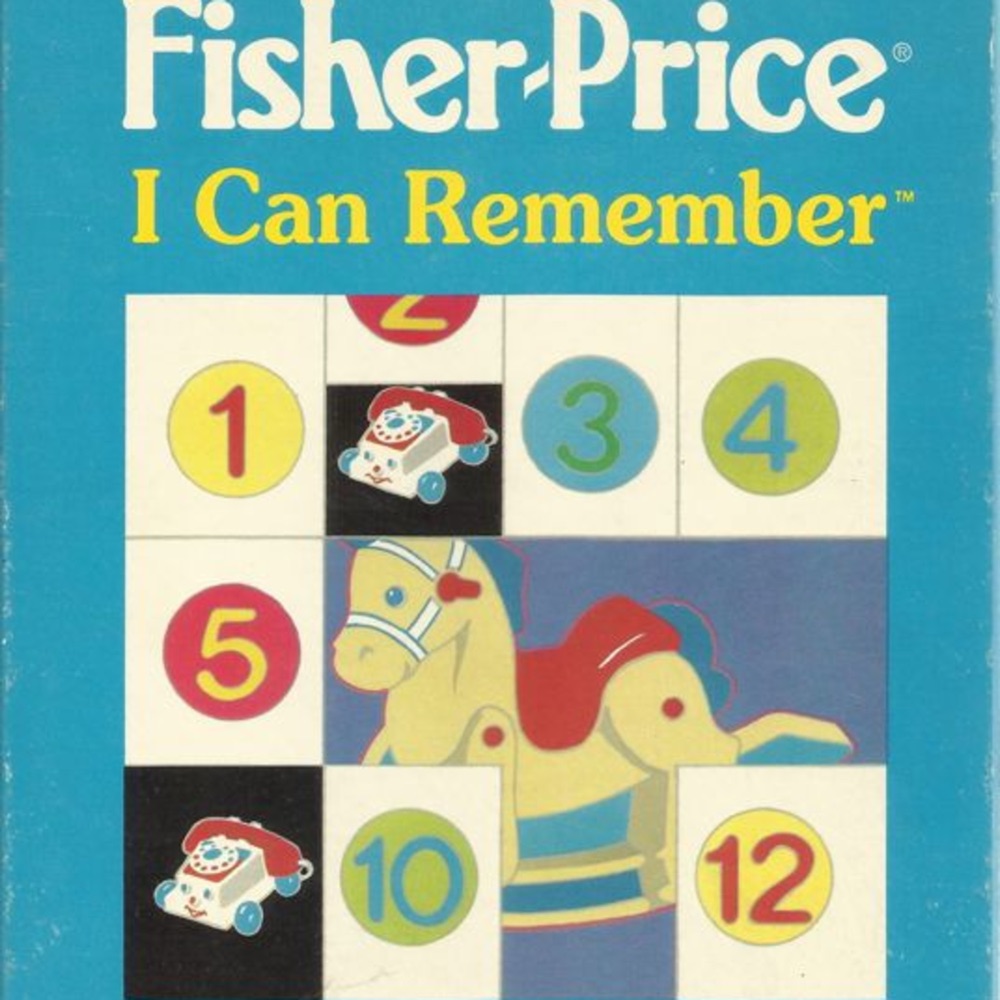
284 · Fisher Price I Can Remember
Transcript
Auto-generated transcript. Each paragraph starts with its timestamp. Speakers are not identified.
Fisher Price, I can remember! You have to concentrate! Can you remember what you see? Can you remember where you saw it? Choose a number and look at the picture that's revealed underneath. Then, choose another number and look at that picture. Do they match? If they do, they'll stay turned up. If they don't, they'll get... uh... yeah, okay, you guys get the idea.
Nostalgia, a chronological exploration of... Guys, what is it? What is what? The, um, you know, the thing I say at the front of every episode. It's a chronological exploration of...
Um, and I'm Joe. No, wait. No, I see that. I'm certain I can figure this out. It's just that if only there was like a game on the NES that could help us remember these kinds of things. A utility for specifically keeping a log of things that happened and episodic continuity for what you then do. Well, you know, it's funny. They didn't make a tool like that on the NES for podcasters, but they did make it for toddlers. And it's called Fisher Price I Can Remember. And it's the game we're supposed to be talking about this week. Did you guys remember to play it? I'm just watching it right now.
I forgot what we were doing. I did remember to play it. And luckily so because it was before the game taught me to remember. Yeah, that's a good skill to have. And if there's one thing that's great for all toddlers that are going to learn, you know, their matching skills and beat them up and everything. It's the very first thing they should be greeted with is a giant copyright screen filled with lots of text about Fisher Price. And even even I Can Remember is trademarked. It's like, wow. Is that like its own toy on top of Fisher Price? Like, is it a product outside of the NES? Well, you've noticed that like in movies and music, like there's you never hear those three words together. Like, I can remember.
Like, can you think of a line in a movie that says that? It's because Fisher Price trademarked it. I can't think of any movies right now off the top of my head. Yeah, I noticed that about myself too. It's funny because I had a thought for the segue, but I kind of forgot it.
So I guess we'll just go into, you know, the game itself. It's a match game. And what that means to the listener at home is that essentially there are, you know, you or the computer or you playing alone. That's an option too. Or you with a friend will be given a series of cards across the screen numbered one through, let's say, 20. And then you pick one of those cards and it shows you an image. And then you pick another number and you get another image. And if the images match, then they form a bigger image, a piece of the bigger image, if you will. But if they don't match, it is the other player's turn. Or if you're playing alone, it's just your turn again to match these images. And essentially that's all it is, is it's a match game.
And there's a, there, maybe there's strategy to this? Is there, is there some strategy to match game? I think that there's a little bit of strategy. I mean, I used to play this when I was a kid with like a deck of playing cards all the time. And I would always like, I mean, I think it's just your personal strategy based on like how your brain works. But I would always like start with the corners because it was easier to remember.
Like, okay, there's an eight in the top corner rather than like there's an eight, you know, six in and three down or whatever. So I guess I started the corners and like always keep like a landmark of, of, you know, like, oh, the one next to that blank spot is a king or whatever. I don't, I've never had that much thought for one of these matching games.
Um, that's very impressive. I mean, this is, it's sort of like a sequel to, to Mario, right? Where, cause that there was this match game in that Mario. But I like this one because the objects that you're matching are like household objects. Like that you may or may not recognize. They're Fisher Price toys. Well, I mean, does Fisher Price make a, like, uh, like a, a cake mixer? I don't, I don't think so. Yeah, I, I, doesn't like the Easy Bake come with like a cake mixer or something? Is the Easy Bake Fisher Price? I assume. Oh, okay. I don't know if that's true. It wasn't. I can't, I can't remember if that's true or not. Does Fisher Price make cassette tapes?
Sure. Yeah. Of course. I mean, it says like you're, you're, you're revealing Fisher Price toys somewhere. Yeah. I mean, at one point you got that phone that has the face and the wheels. Yeah. He made an appearance in Toy Story 3. Then there's just like an airplane.
No, but the airplane has like a head attached to it. And from the pixel art, it's unclear if it's just like a, you know, like an action figure's head, like glued onto a plane or not.
Like, obviously I'm sure the real toy is like, you know, oh, it's a, it's a plane and with an action figure pilot that you put in the cockpit and everything. But from the pixel art, I don't know. Like there's something to be said about that. This game is just matching pictures and the pictures aren't really that great in quality. No, they're not. Like, I think, I think I've seen better drawn, um, you know, objects here in games that have so much more going on than just, you know, pixelating objects. So I'm a little confused about why, uh, especially when it reveals the picture underneath afterwards, that's when things start to actually get a little confusing because the backgrounds are blending with the backgrounds of the images.
So it's, it's like trying to show you like the motorcycle in the background, but it's also obscuring it in a weird, uh, you know, like, uh, optical illusion way. Yeah. And I think like the picture underneath, which is way bigger is actually sometimes harder to make out what the heck it's supposed to be than the tiny little, little like icons. Like there's one that's like, I think it's like a camcorder, but then there's another one that's like, I don't know if it's like a flute or something.
Yeah. Right. Didn't look like it, but there's another one that's like, it's got like musical notes above it. Like, like, cause the picture of whatever it is, wasn't clear enough that like it was something music related, but it looks like it's like, I don't know, a flute or something. I feel like this is like for like it, they thought that like everyone playing this game would be like Fisher price, super fans. And they'd be like, Oh, the flute. Like, I love that flute. Well, I mean, kids might recognize their kids might, but especially back then if it was like like the issue with the background images is that they are at the same level of fidelity and lack of thought for perspective and, and scale.
They're at the same level of detail as the little images. And you'd think, you know, they have this big canvas that they'd, they'd make something beautiful. Like I thought I would maybe see starry night behind these images and they did not do that. It's just planes that aren't aerodynamic. But the cards you reveal, like say you pick three and eight and they wind up being different images. When they slide away, they're the same solid blue background as the larger image behind them. And that's like what I'm talking about with the, just, you know, like at the very least they could have chosen a more interesting border background to clearly define what is the card and what is the background image.
Yeah. Or like, you know, Sean, you mentioned Super Mario Brothers three already. Super Mario Brothers three had a card flip animation and that was just for like a mini game that barely ever shows up. This is the whole game. Couldn't they just make the card flip over and then it's like not confusing? Not that it's like that confusing. That would be good. Uh, but that's, that's not what we got here. What we got here.
Um, you know, we, we've been complaining about the, the, the visual design. I think that the audio design in this game is, it's so abrasive that I can't believe that their target was children. Like if you get something wrong, you will remember, you will remember for a very long time that you failed. Yeah. It's, it's the audio equivalent of getting jolted with electricity. Yeah. There's nails on a chalkboard, jolting with electricity all at the same time. It's, it's very, I would cry. I think if I was a child playing this game, I might cry.
What do you think you learned first as a kid? Um, matching like images or how to spell your name? Cause you have to know how to spell your name in order to play the match.
I want to say the matching like images because that's a bit more intuitive than, you know, language. Yeah, I would, I would agree. It just feels weird to give yourself a name in a game like this that, uh, is just, you know, it's just in kind of like, there's no, there's no save feature. There's no high score necessarily. You are competing, I guess, against the computer, but the points are kind of just arbitrary. Either you match the items or you didn't.
So the name thing is just funny because I could just imagine like a kid, uh, or sorry, a really young kid, right? Like the kid has contra, right? But his younger brother, who's always like playing in the second controller that isn't actually plugged in, finally gets this game from his parents. And he's like, cool, finally my own game. And then he's greeted with the spell your name screen. And he just thinks he's failed.
Yeah, well, I was, you know, I was wondering if you would think that like this was better, like the, the opening of this game, the getting into the game was better or worse than, um,
the Sesame Street games. I think it's a little better and I'd be happy to explain why. Okay. It's bad. I'll have, I'll have a thought afterwards. Sure. Let me know. It's bad because of the copyright information that should just be hidden away in like an option in the credits, you know, like there should be a selection for that for people who need to see that. But once you're, uh, like, you know, you're, you're, first off, you're greeted to a very, uh, nice image of the match cards pulling away and the, I can remember title screen. And then it tells you press any button to continue. That's a pretty clear direction. Any button will work.
Okay. And then you can actually choose between up and down and up only goes up and down only goes down. I, I, I don't know if this is where you were going to go with it. In fact, I have no idea where you're going to go with it, but the instructions are crazy. The instructions screen is just more information than anybody actually needs than to know how to play this game. Like it's clearly too, so this isn't where I was going to go, but I have to interrupt because it's clearly so complicated. Like just for an adult, I'm like, this doesn't need to be like, I get it. You match the cards. Why are there six pages of instructions?
Like, and like, it's obviously not intended for the kid to read. No, it's not. So like an adult would be able to understand this game in one sentence. So like, why is there so much literature on it in the game? I think they, they didn't understand that, you know, one thing really precludes the other. Like if you have an adult there to supervise this child playing this game, they, they were still trying to work on the, the contingency for the child that is still struggling with matching. Being able to understand.
Like they forgot that the child like doesn't know how to read. So they're like, oh, this kid, kid doesn't know how to read. We got to really explain this a lot. And then they just put like a ton of text. Yeah. Or they're dealing with kids that are, you know, they're, they're wonder kids, wonder, wonder kids, uh, with the actual, you know, language, but they're still struggling with object permanence. Um, which I think still exists, you know? Yeah, sure. But the other thing I was going to say where I, like, I, I don't think that it's that difficult for the kids to get into the game, but once you've finished a game and you're deciding if you want to play another game, you have two options and the options are as follows.
Same player, same level, new game, new players, new level, new game. Like with the same players, comma, same level, comma, new game is one option. It's pretty, it's pretty impressive. New players, new level, new game, one option. Why can't I do same players, new level, new game? If you're going to do the same, same players, you can, you can never switch levels. The only way to switch levels is new players, new level, new game. Don't you think one round of this is enough?
Yeah. So why, but so, unless you want to do another round and you want to change the level, like that seems like the natural progression is like, I want to use the same player because I'm still the same person I was and I want to now go to level three, but it doesn't let you do that. It's like if you've chosen level one and now that is where you, that's, that's who you are now. I think, um, basically I, were you going to say something? I can't remember.
Um, and I know we're trying to kick that, that horse as, as much as possible, but I truly can't remember what I was going to say. I actually forgot we were trying to do that. Uh, here, here's the thing with, um, Fisher Price I can remember is that, you know, you name yourself and presumably, you know, you're a child. You're just going to say like, my, you know, my name's John. I'm going to put in John, right?
The computer is named Electro. And I, I just feel like, couldn't they have made it like that is a villain from Spider-Man, but also just like not a very friendly name for a computer in general, even if you don't know the comic book. I just think like, couldn't they have done something like, it could have been as boring as CPU, right? If they really wanted to get across, they was a computer. It's, it was supposed to be electronic friend, but they ran out of room. I mean, they ran out of a lot of room because only electro is shown.
Yeah. Couldn't it just be friend? No. Then how, do you think it's a real person playing against you? Yeah. Then like children will not understand the difference between humans and technology. Electronic friend. Yeah. Um, did you, any of you guys play with friends? No. I, I did. I played with two other people. Two. We had a little tournament. I played with a friend of the show, Mark Pasqualato and, uh, our other friend, Matt, who I haven't asked him about revealing his last name on the podcast, so I won't. But, um, we, uh, we played together and, uh, I'm first of all, the undisputed champion of Fisher Price I can remember.
Uh, we played three rounds, uh, among three different people. I had two different opponents and I switched my name every time. I always, I always made a new player every time. Number one, number two, number three on the leaderboard. All my people. Wow. Don't want to brag or anything, but I can remember. So the score was really for you.
This, this is the first game where you're, um, I'm caring about the score. Appreciating the score. Yeah. Now I'm going to go back to all those other games and look at the scores. Now I'm going to be focused on that. Given that you, um, noticed, uh, that you have the top three high scores and everything. Do you have a comment on the scoring system and the way that they reward those who match first versus those who match 10th?
Yeah. It's a, it's a little, uh, so I didn't notice. It's all I noticed was that the person who matches first gets like a bonus and then the person who is like a sliding scale. Yeah, exactly. The, the, it's, it's worth less. Yeah. As you, the more, the more, uh, choices there are on the screen, the more points it's worth. Right. And so, okay. I only noticed that for the first one. I didn't, and then I kind of stopped paying attention like until the end.
So I didn't realize that, but yeah, cause it's, it's obviously, I think that that makes more sense than I was thinking with my thought because, uh, it, it's, um, I forgot. No, it's, um, it gets, it gets easier. Obviously it gets easier when there's fewer options on the board. You just have better odds.
Plus you've seen more things. So like, yeah, by the end, I feel like someone can easily go on a run and just get like five in a row. There are three levels in the game and all that means is the number of cards on the, um, on the playing field, but they, they don't change anything, uh, from the other levels. So in level one, all 20 cards are there. They just only name the, you know, the few that they want you to choose from to eliminate more choices, but those, those boxes are still there. So that's a complaint on its own. And I'll get to that again if I want to, but the, the levels themselves are only changing in the sense of the number of cards they give you, not even like, and there's only so much
you can do, I guess, in a match game where you're just matching two images, but couldn't they have changed like what you're matching or, um, or like what happens if you get it wrong? Like if there's like an additional penalty on the player, I just wonder, they didn't really gamify this any further than, you know, than, than the very first time you experienced the game. The very first time you played this game, you've played the game in its entirety.
And realistically, other than a new image being revealed to you after you've, you know, selected and matched all the cards, there's nothing else exciting that can possibly happen in this game other than seeing a new image in the background, which just isn't enough because you've already been greeted with a potential 10, uh, smaller images that are just as equally as exciting. You know what I think that they should have done for the different like difficulty levels is, um, like they should have themed the pictures that you're matching with, uh, with things that you would use as you get older.
Like, you know, the first level, it's just like a rattle. And then the second level, there's like a video game controller. And then, then like the third level, there's like a lighter. Um, and then between each difficulty level, it would actually, uh, show a little like Pac-Man esque cut scene of like a, a milestone in a child's life, such as playing with a rattle or holding a video game controller or, uh, lighting a cigarette, something along those lines. And I think that would give a lot more of like, uh, it would feel a lot more alive.
Yeah. Plus it would give kids more street smarts too. Yeah. Rather than just book smarts. You could also, uh, you could also match these things to, uh, like some similar image where it's like, oh, the rollerblades match with the helmet or like the, okay. Yeah. The cassette matches with a cassette player. Like that can be like, now you got to do a little bit of critical thinking while you're doing the match game. That could be like the fourth level of difficulty before we get to the, uh, the cigarette level of difficulty. Like it could be between.
We've jokingly, maybe, maybe not have had trouble remembering certain things during this episode, but is this game really teaching you anything about memory other than just identifying like objects and storing maybe at best? Like, isn't Simon the game with the, you know, the four different colors that make different sounds and you memorize both the sounds and the colors in the, in the correct order. I think isn't that offering a little more of a memory experience than what I can remember is offering from an educational standpoint. Like as a parent, wouldn't you be a little disappointed with this watching your kid play this? I don't know.
I mean, I think it's, it's, it's like a, some sort of like, you know, maybe it's not teaching you like specifically like a memory about memory or like, or how to remember, but like feel like it is maybe like at, depending on the age of the child, you know, helping with brain function in some way, like an exercise, you know? Yeah, but you pit this game against the Sesame Street games that we played so far. And I think we learned more about numbers and letters in Sesame Street than I did about
matching in this game. Like in, I guess I don't understand that. Like, what are you trying to, what is there to learn about matching? It's just like practicing your, letting your brain practice matching. That's true. I guess maybe on top of it, they could have told you like in text, like when you revealed the, you know, the plane, it says plane next to it. So you're also like getting accustomed to the titles of objects.
I think you would be a great child game designer. No, I think I have anything. I'd design a very, I designed a game that's too challenging for kids. Well, no, you're just giving them extra information after they did a good thing. You know, it is a plane.
Yeah, that's the reward. The reward is more learning. Yes. The greatest child teaching games already exist. They're called Jumpstart First Grade and Howie's Great Math Adventure. So play both of those if you haven't. I actually don't know how Jumpstart First Grade would hold up today, but man, it held up great for me beyond first grade. I was playing that game in second, third, probably stopped there, but that's how, that's how I got nostalgic for that game while I was still a kid. I thought they were telling you, like, you should keep playing this game. Yeah, no, no, no. That could have happened too. I wouldn't remember if they told me that or not. Because you never played this game. Exactly. That's the problem.
There's another segment we do on this show. But I, do you guys remember what it's called? Wait, are you guys recording? You forgot to record? I am recording. I just didn't realize that we were supposed to, I guess that we have done that in the past. I wasn't thinking. Wait, check, check, are there numbers going up on your computer screen, Joe? Uh, which one are numbers again? It's like A, A and L and F?
They're like that. I don't know why I spelled Elf, but it was just a Freudian, I guess. You always have Elf on the mind. It sounds true. It sounds like you are recording. I think I can hear the tape. Okay, yeah, yeah, okay. All right, cool. I thought I was turning my light off before I was hitting the record button. So we can continue. Well, what are we recording?
Um... Okay, I'll stop. No, no, not what are we recording for. What are we recording? Wow. Well, we'll just go with it, and then if we think of it after we do it, then we can, you know what I mean? Yeah, but is this like FM radio or AM radio or Sirius XM? We are live right now. What's up? We're taking our next caller.
Trey from Wisconsin. You're on the line. All right. That was Trey from Wisconsin. Oh, that's right, Trey. It's the Essential Games List. That's what we do. This is a podcast where we explore every NES game, for whatever reason, specifically released in North America. And we have to do the Essential Games List, and so I'm going to play that little song that we always play before we do that segment.
In a way, I can remember is a lot like Super Mario Bros. 3. It has most of the same elements. It's just missing the platforming adventure across multiple worlds and levels. It's missing... Oh, that's right. It's missing most of what a video game is. Instead, we have gotten the equivalent of now in 2023 just resembles something that you could probably load up on any Google page and do a match game.
But at the time, I still don't think this is that impressive of a thing to offer to a child. I really don't think that I can remember is both... It doesn't fall into that, like, educational category. And so it doesn't really fall into the platforming category. And it doesn't fall into the action category. And so this game, ultimately, just winds up being something that you play once or twice.
Or you're forced to play more times because your parents bought it. There's very little reason for replay in here. And I can safely say that I wrote my entire document in, you know, one playthrough of this game and just decided, screw it, let's record the rest, and I'm sure it'll come to me. That's how much I remember of I Can Remember by Fisher-Price. Sam? Yeah, that's me. I'll say that, as you can probably tell by how much we're milking the not remember thing, we don't even have a lot to talk about with this game because there's not a lot going on in this game. I mean, it's very, very simple. There's one simple thing to it, which is fine. I mean, it's a kid's game.
I do, like, honestly enjoy, like, that matching game with cards. If I'm just, like, bored with a deck of cards with a friend or whatever, like, that's a fun little game.
You can just play it with a deck of cards or, like, anything. Like, I feel like the game is unnecessary even for kids. Like, I think that that's, like, it's a fine educational thing for kids, again, because I think it just helps develop, like, that skill. But it's, like, you probably just have a deck of cards in your junk drawer. You don't need to buy a video game that simulates it. But I guess the one thing that this would maybe have going for it is that, like,
if the older brother is playing a video game, you know, the younger brother or sister would be like, oh, I want to play one too. And it's like, okay, here's one that's up to their speed, and they could feel like they're playing a video game and still be doing this other thing. But, like, yeah, definitely this is not an essential game. It's just another, in my opinion, not applicable, which has been maybe one of the rarer forms of vote that I've had in the past. But we're adding one to the list. David. All right.
I'd like to apologize to our listeners for what they've listened to today. You know, there wasn't a lot of content, and we still stretched it pretty far. So let me give you a little, maybe some interesting information. So Fisher Price, they're actually headquartered outside of my hometown. They're in East Aurora in New York. It's a small little hamlet outside of Buffalo.
It's very strange. It was always very strange, like, driving by it and being like, oh, that's where that, like, that big toy company, like, is based out of. It was very, very weird. Weird. They were founded in the, like, the Great Depression by, you know, somebody named Fisher or somebody named Price. And then, like, the Quaker Oat Company owned them at one point. It was very, very weird. Very weird. But during that time, they came up with those stupid, like, they don't even look like people. It's just, like, wooden dowels that are painted to look like people. Those guys got a bowling game.
Yeah. Oh, do we have to play that? No, I don't think we have to play that on the NES, but it did come out. It did come out as a video game, not just, like, they didn't just get, like, a bowling movie or something. It was a video game. A licensed movie. It's like the emoji movie. It's like the wooden dowel. I mean, you just wait because, you know, at a certain point, they became independent again. But then they got bought by Mattel.
So, you know, Mattel's going hog wild on all these movies. You know, we got Barbie out. Maybe at this point. I can't remember if it's supposed to be out by now. But you just wait. Maybe there'll be an I Can Remember video game. I'm sorry. I Can Remember movie. You should remember if there was an I Can Remember video game or not. We just played it. There might be one of the video games for this IP by the end of the year. So, it's not essential. It's not essential.
All right. And two out of three means that it's on the Essential Games list, no matter what Sean says. So, we'll see if Fisher Price can keep the streak going next week when we play Fisher Price Perfect Fit.
Sounds like, you know, just what this podcast needed. Sounds like a perfect fit for an episode of Nostalgia. And you, the listener, can be a perfect fit for Nostalgia as well by joining our patreon.com slash nostalgia. And for $5 a month, you get access to episodes that aren't just about NES games released in North America. Instead, you get access to games that came out in other countries. And that's pretty cool. Not specifically anywhere in particular, but just, you know, countries outside of America. I mean, who knows? Maybe we'll start flipping that too and they'll start being games that came out in America. No. No