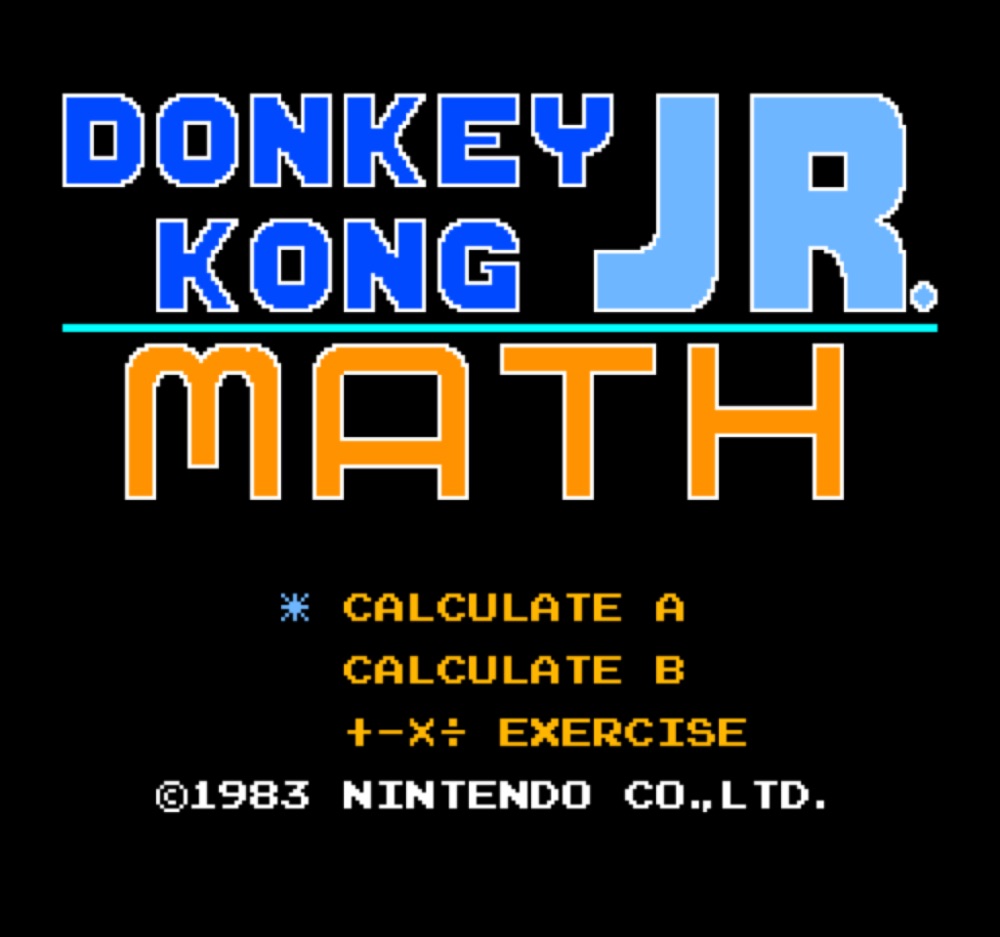
021 · DONKEY KONG JR. MATH
It's the first (and last) game in the EDUCATION SERIES for NEStalgia. For links to EVERYTHING we talked about here, check out the shownotes on www.NEStalgiacast.com
Donkey Kong Jr. Math wraps up our Donkey Kong month, and it is the one we had the least patience for. Donkey Kong holds up a target number, and Junior climbs vines to pick digits and an operation to hit it. Mike and Sean recorded the main show, and Joe, who had a very different opinion, added his vote in a separate session.
What it gets right
- The two-player game. Joe's case, which he admitted was deliberately overhyped to balance us out, is that two players change everything. The numbers are not all on your side, so you steal digits and operators from each other and rework your plan on the fly. His example: you are building 16 with five plus five and need a six, your opponent is chasing two times eight, you grab his eight, and then he takes the minus two from you. His sister, whom he played it with, asked to play again that night. He called it better than Stack Up.
- The puzzle-type mode. The mode where you pick the kind of problem (a two-digit number times a two-digit number, say) was the one we liked, and climbing a vine to peek at the answer was a neat shortcut.
Where it falls apart
- The laziest game so far. There are no enemies, no points, no scores, so you can't tell if you are doing well. Stack Up at least was designed around an honor system. Here the assets come straight from the arcade Donkey Kong Jr., and Mario's sprites are in the data even though he never appears.
- One player isn't a game. The title screen shows two Juniors, two scores and a win column, and the loser plays the death animation. Alone, the second Junior stands there like a catatonic brother, you cannot lose, and you can only win or quit, like homework. Modes A and B, with goals like "get to 77" or "negative 762," we called garbage.
- A slow calculator. Calculators existed in 1986, and climbing vines to enter numbers takes forever.
- No depth. We wanted something with the heft of Oregon Trail or Carmen Sandiego. Even reusing Junior's platforming stages for one player would have made more sense for what is basically a ROM hack of the arcade game.
Beyond the game
This is the only education game in the black box series. We figured Nintendo planned more but dropped the idea because it sold terribly, and the box is now rare and sought by collectors. You could also buy it for $5 on the Wii and Wii U. At the top of the episode we covered the Donkey Kong Arcade Archives announcement at E3 and a Nintendo of America employee's story that Mario was named after their landlord and Pauline after his girlfriend.
The bottom line
Skip it. Joe said up front it is absolutely not essential, just better than we gave it credit for when you play against someone. Sean said no too, since a single-player mode with a lifeless opponent is just a calculator, and a TI-84 is more fun. Nobody put it on the Essential Games List. We are still open to playing it head to head to see what Joe sees.
Written from our conversation in this episode.
Auto-generated transcript. Each paragraph starts with its timestamp. Speakers are not identified.
Donkey Kong Jr. Math. Learning is fun when you make a game of it.
Alright, it's probably pretty weird that you guys haven't heard the, and welcome to nostalgia yet, but we actually managed to be incredibly relevant for once. Out of sheer luck. It really was like a happenstance thing, but as you guys know, we're kind of wrapping up the Donkey Kong series here with Donkey Kong Jr. Math, and Nintendo today actually just announced that Donkey Kong Arcade Archives is coming to Nintendo Switch.
That's pretty crazy. It's probably because of all the buzz Donkey Kong's been getting from the nostalgia episodes. Yeah, I saw like there was a massive campaign on Twitter to get that cement factory level finally playable. People were like, I want that, I want that. Hashtag cement us. Wow, you just came up with that? Right now. That's really good, Sean. Get that trending. We gotta get you into like Washington D.C. or something, run some campaigns.
Oh. Or, you know, Nintendo of America, run some campaigns over there. Will do. So it's E3 and they're announcing like a ton of stuff and obviously like, you know, you guys know we love Smash, so we're super excited about that. But that's not what we're here to talk about. I just briefly wanted to talk about this Donkey Kong Arcade Archives thing because I think it's really cool, even if it's not necessarily the NES version of the game because it's never been available before.
It's pretty amazing that like this is the first time that we're seeing a lot of the original portions of the game that were cut out of the NES or just home console version of this game. Like the stacking of the Donkey Kongs to measure your progress and all that stuff. The how high can you get is actually in there.
And interestingly enough in the, sorry for the, for this release, you get the original version, which has all like the crazy bugs. You get the Japanese release version, which is like, I guess like a less than stable version than the international release was. And the international release, which is of course, what we all know is Donkey Kong when you got like, you know, there's a kill screen coming up and like Billy Mitchell and that other guy. Like that's what we think about.
So interestingly enough in the Japanese version, it's how high can you try not how high can you get. And we thought that when we saw that it was just them censoring themselves for the, for the modern era. But no, I guess that's just how it was. One other interesting tidbit that came up during this reveal was they actually brought in one of the guys who has been working at Nintendo of America for 36 years now. It's like, he's just been there through it all. He's probably seen every single Nintendo game get released. And he was talking about how they had never even seen their landlord Mario before they named the character Mario. They hadn't seen him.
They just, they just thought it was funny. They were like, it was just a funny name. Yeah. They needed a name. They didn't like Donkey Kong as the title of the game, but they also need a name for the character. And Nintendo suggested, well, would you like to call it Jump Man? And they were like, no, um, you know, like let's think about our options. How about our landlord that we haven't seen ever? His name's Mario and this guy's got a mustache. So it's kind of weird to think that they made the Italian plumber lore for Mario Nintendo of America. Just out of a joke because we've never seen our landlord. Yeah. What did that have, did that tie into him being a plumber? I'm just saying like, do you have the whole like Italian persona?
You know? They were just being racist is all. Right. Yeah. Because he's got a mustache and the Italians have mustaches. And now Sean has a mustache too, but you guys can't see it. You can hear it though. You can kind of hear it though. Yeah. Uh, so one other cool thing, the, besides that tid, tid, tidbit about, um, the Mario name, he also revealed that Pauline got her name because that was his girlfriend at the time. That was, that was the landlord's girlfriend? No, no, no. The dude at Nintendo America, the dude of Nintendo America who like was providing all these facts about Donkey Kong at the E3 Nintendo tree house showing was like, yeah, and we needed a name for the girl. So I just said Pauline because that was my girlfriend.
Wow. So like, that's sort of like the regrettable tattoo of Nintendo. I just feel like we never knew this before. I've never seen this in a document. And I just feel like that's crazy that we just did a whole retrospective on Donkey Kong. And then immediately following like two weeks later, we learn all this new information. I love it. So the game lets you do all kinds of crazy stuff too. Like you can, uh, pretty much do like save states, change all different kinds of display settings,
even display the game vertically, which I think is cool. And it even has an online leaderboard, which, uh, you know, I'm sure I would never even get close to. Yeah, I think I can't even get a hundred thousand on this game. And I think like the high score right now is like a million, two hundred thousand or something like that. So forget about it. Anyway, just wanted to provide you guys with this info and, uh, let's get back to Donkey Kong Jr. Math. I'll see you guys at the end of the episode.
And welcome to NEStalgia, a chronological exploration of every NES game released in North America. That means Donkey Kong Jr. Math. I'm Mike. I'm Sean. And today we're going to get educational. Very, uh, very educational. Uh oh. Sean, I detect, um, a sigh in your voice. I don't think there's any way for you to think that about me. Sounds to me like I'm detecting, uh, that someone didn't enjoy Donkey Kong Jr. Math. You know, Mike, I didn't. I didn't enjoy it. It's a- You want to talk about that? I guess so. Um, this is the laziest game we've played so far. Wow. Then Stack Up? Stack Up was a- I mean, I- but they were- they were-
No, I'm going to cut you off right there, Sean. I know what you're going to say, and I'm going to add it for you. Stack Up is a game. Okay? It's a game that's based on an honor system, but it's still a game. And they did design something around it. Yeah. Donkey Kong Jr. Math is just doing math. While also moving around your analog stick. Here, there's no enemies in the way. There's no like, you know, like, oh, they gotta figure out how to do this. There's no, uh, there's no way to do like, for the bigger puzzles. Okay, so let's just, let's do it. Let's go all in. What is the objective of the game? Donkey Kong decides that he has to teach Donkey Kong Jr.
how to do math. And so he raises up a number. And then you have to climb the vines where it's labeled out one through nine. Select your number. And then pick addition, subtraction, multiplication, or division. You have to get to that sum that he's holding. Yeah. And then you have to do it all over again. Crazy part is, is that- He's got a clone. What? Yeah, he's got a clone too of Donkey Kong Jr.
Regardless, like if you're playing the one player mode or the two player mode, it's two player mode. Mm-hmm. You'll always see the other player, just, they don't move. Just you solving the things. There are no points. And your catatonic brother. There are no scores. No way to know if you're doing a good job or not. And the crazy part is, is that in game A, there's things like, get to 77. Okay, not that bad. No. In game B- Get to negative 762. Using just the digits between one and nine. Yes, yeah. Can you use zero? I don't think you can use zero. Because you can't do ten. Right. So yeah, it's, it's just frustrating a lot. Like, it's not that it's frustrating, it's just boring.
I, I have to think of it like this, okay? At the time of this game, calculators exist. They were expensive. But they exist too, you know? Like, like, like Casio made calculators that were probably pretty dang good. Yeah. You could push the buttons on the calculator and get to numbers faster. You could spell out boobies on your, on your calculator. And that's a game. You know? Here, what do you do?
You, it takes so long. It's so tedious. It's almost like if you had two, if you were a rich kid in 86, you should have had two CRTs, one running stack up, and one running, and one running, and one running junior math. And see who solves the puzzle first, Rob or the junior math puzzle. Because it takes so long to put your inputs in, that I can't imagine that Nintendo couldn't have figured out a better way to program a calculator into an NES game.
Well, okay. Here's where I think there might be, I think there might be some extra depth to this. If you are playing against somebody, I don't know who would agree to play this game with you. But if somebody, if that person existed, it's not that, like, you, there are two sides of the stage. One is, like, supposedly for one person, one is for the other. But it's not always, it's not always one through nine that's listed on each side. Yeah, you do have to go over to the other side. Sometimes you have to go to the other side. So you can be fighting over a certain number, or you can be fighting over even an operation.
So maybe it's not like, it's not that it's trying to make a calculator in the game. It's trying to gamify the calculator. But you say combat as if there is some awesome combat. I didn't say combat. I thought you said combat. But you are fighting against them. Yeah, yeah, yeah. Trying to find, like, but it's not fine. But there's no element. Yeah, yeah, yeah, exactly. It's just like, oh, it's a, I'm better at pushing the left D-bad button.
Like, yeah. Yeah. It's, it's rough. It's rough here. And, and the only, uh, those modes to me are garbage. Game A and game B. The only one that's cool is the one where you like, pick your, um, like you pick which kind of puzzle you want. So it'll tell you like, hey, this is going to be a two digit thing multiplied by a two digit thing, you know? Yeah. And then you have to go and like climb the ropes to generate the numbers. Uh huh. Which is very backwards. Like another thing that like you don't need to do, just grab a calculator and do it.
But, uh, you could just also just go up the key to get the answer. I thought that was pretty neat as like a way to like, you can climb up the vines. It's, it's Dunggung Jr. For those that don't know, it is, it is just another program. It looks like a mod for Dunggung Jr. But it, but it is actually just like the arcade port of Dunggung Jr. And then modified to, uh, to play Dunggung Jr. Yeah. Oh. Yeah. Like you can find the assets for Mario in Dunggung Jr. Math. Even though he's not in the game.
Wow. You just have them there. So this is, it was lazy. Yeah. It was, it was pretty dang lazy, but this was like a thing that Nintendo must have wanted to do because, um, they, it's a black box game. Uh, one of like, you know, they're now like pretty sought after these black box games and it is the only one of the black box games. So if you think like, uh, Duck Hunt and Wild Gunman and Hogan's Alley, those are in the Zapper category. Yeah. And they have like a nice little Zapper logo on the front. This is the only game on the black box series that's part of the education series. Series. One game series. One game. They never, they must've planned to make others, but they, Dunggung Jr. Math sold terribly
and they abandoned it. Well, it's, it seems like. It's now rare. People, people who, people who are collectors want that black box. Just for the sake of. Just for the sake of it. And that's like crazy to me. Do not do that. Unless you're, unless you're a, like a video game preservation person, like don't collect bad video games.
Like, you know, who are you trying to impress? Sally? She's not impressed. Well, I mean, Sally could also be a collector. Well then she'd probably be pretty dang impressed. Cause that black box is rare. But what's crazy is as rare as the NES game is, this game found life on the virtual console. You serious right now? They, no, I'm not saying life in the sense that like it found a new audience. No, but like they made it for it. Nintendo sold it for $5 on the Wii and Wii U. You can play Dung Yung Jr. Math on a Wii U for five bucks.
Who was tricked into buying that? I don't know. I, I honestly don't know. I feel, I feel bad. How many people could have bought that? I mean like. If that was like your version of the tech demo? Then like, you know, like, hey, I just want to see what Dung Yung Jr. Math's all about. Is it essential? Well, you should have waited for us to make this episode.
We would have told you if it was essential, but if you spend $5 on it. It's your own fault. Yeah. Uh, you have a very cool calculator on your, uh, on your Wii U. We're starring Dung Yung Jr. I mean, do you have anything else to say about this game? Well, one thing I just want to say is that you, you could say like, oh, but it's an education game, Mike. Right? It's just teaching kids how to do math. It's not a video game, right? Look, we've had, there have been good educational games. Have you heard of Carmen Sandiego? Yeah. Have you heard of the Oregon Trail? Oregon Trail came out in 1971.
And think of everything that it does. Like that's a, that's, that's the pinnacle of education games. I think if you're even going to make like, they didn't have to make it a math game. Like it could have been a cool educational game that you were doing more complex tasks than just adding numbers and subtracting and all that. Like there could have been, it could have been something with as much depth as Oregon Trail that even has math in it of like, oh, I should save this amount of money for, in case I get dysentery. But like, but no. A little more depth would have been nice.
Yeah. Like this is just add numbers together or multiply them or whatever you gotta do to get that number. This is just a, like, we need something that says that we're not just for fun. That we, that a parent would buy this game saying like, you can have an NES, but you better be doing your homework on it. Yeah. Like, like you love Donkey Kong. Well, get a little Donkey Kong Jr. and his math. Math. And it's like, oh, all right, we'll get this for Toby. Toby. Um, that's it though. That's it. That's it for me. Uh, let's, let's just dive right into that essential games list.
All right. It's time for the essential games list, but this time it's a little funky, right, Sean? Yeah. Funky because of Funky Kong, which wouldn't show up until, uh, Donkey Kong Country. Jesus. So that's not, and also very weird in the Donkey Kong Country TV show, since we can't get enough of these Donkey Kong TV shows. Yeah. But the reason why it's funky is because Joe's here now. Surprise! Yeah.
Wow. Uh, and so we recorded this at a different time because, funny enough, when we did the essential games list the first time, Joe had a completely different opinion than us. Yeah, it was really, it was very strange to learn, and we kind of ripped it apart at the time. And I think we just need to like, we need to slow it down. I need to understand. We need to open our minds. Now that I, now that I know how different your opinion was, I do want to explain my opinion.
I'm down for that. Um, so this is my essential vote, but I, but I will say this is going to be a lot longer than a regular essential vote because I want to explain all that. Well, yeah, don't even think of it like an essential vote. Just walk us through like the alternative opinion of Donkey Kong Jr. Math. Well, I, so I had expected this game to be terrible because it has the word math in it. And when I played it, I was kind of surprised that it was pretty fun. It wasn't, it wasn't amazing, but it was way more fun than I thought it was going to be. So I will confess, first off, I only played modes A and B.
You did, you just didn't see the other mode? I somehow just missed the other mode completely. Okay. But you showed me a screenshot of it with like division. Yeah, to me that's the, that's the truest mode I guess of this game. So, so from what you guys have told me a little bit about your opinions, I'm guessing you only played one player.
Yeah. Okay. So, and I know there are like a lot of games where I'm like, oh, it's better to play two player because it's more fun with another person. But I think that this game only works as a two player game. I didn't even know it was a one player game until you told me that. And I was honestly, when you told me that I doubted it. I looked it up and I was, and they do say it's a one player game, but let me just like illustrate what I saw for the listeners.
So when you first turn it on, there's two Donkey Kong Jr. sprites, one on the left, one on the right. Well, that's his crazy clone. Yeah. There's two scores at the top. There's a win column. And when you, when you win, your sprite goes to the win column and the other sprite visibly like loses like the Donkey Kong Jr.
death animation. Right, right. So I didn't even occur to me that this could be a one player game. And when you look, when I look in the manual, it says, oh, this could be played as one player or two player. But I really feels like they like threw in one player afterwards because with one player, it doesn't work. There's no opponent. Yeah. I mean, I think I would have loved to have one player be almost like the Donkey Kong Jr.
platforming levels, but you had to collect the math symbols that way to solve the answer or something like something, something more interesting and platformy than just going up and down these vines with all the numbers stacked like a number. Yeah. And it would still like, it would still be in line with like the reason why this game exists of just we're reusing Donkey Kong Jr. assets. Right. You can still use, you can still create a viable single player game. In fact, since it was like a glorified ROM hack of Donkey Kong Jr., it's kind of interesting that they didn't choose to include the other levels and stuff. So I will say that I agree with you that the one player mode is not a game.
Mm-hmm. That's exactly what you cannot lose. Yeah. The only way to end this game in one player is to win or to quit. Like homework. Exactly. Like homework. Yeah. Right. So when playing a friend of the game, I think it stops being just about like, just see if you can build this math problem. And instead it becomes like, try and make the problem faster than your friend while stealing numbers from them, making them completely reroute their strategy. Honestly, what made it interesting to me was that it was a two-player game that made me think in a way that no other two-player game has ever made me think. Ever. In any game in the history of video games.
Yes. Okay. I love it. The hype is unreal. So I am overhyping it to counter the other opinions. But yeah, I didn't, I, honestly, this might not be a popular opinion, but all four Donkey Kong games, wasn't crazy about any of them. I think they're all kind of, there's not much to any of them. I know they were probably something in their time, but, but let me give you an example of a game. And I'm, I'm making up these numbers, but because I don't remember the exact numbers of this match. But, so let's say the goal was to get 16.
So I see two fives right near me. So I, I'm running over to those, uh, five plus five and I'm going to grab the plus six. But I see that my opponent is going for two times eight. He's already got the two. Let me just interrupt you real quick. It helps listener if you close your eyes right now. Okay. So my opponent's already got the two in the multiplication. So I jump in and steal the eight from him. So now I have to change my strategy. I have to find a minus two, which is on his side of the board. So then he steals it from me. And now I got to switch my strategy again. But now he also has to switch his strategy. It's all about like predicting what your opponent is going to do.
And, and I'm not refuting that, Joe. I think what I'm asking is, was that actually fun? Or was it just a way to make it more competitive than just collecting the numbers on your own? I thought it was fun. Okay. I really did. I'm just, to me that doesn't sound like fun. But after I texted you my, my opinion and you said that you guys both had a very different opinion, I played it again, uh, with my sister just to, just to play it again and see if I had a different opinion. And later that night, my sister who didn't know anything about this was just randomly was like, Hey, do you want to play that math game again? I swear to you.
So I was like, it's not just me. But then, you know, later on, I start getting into like, when you start realizing that your opponent and you are like, can predict each other's problems, you start going like, Oh, maybe I'll just focus on stealing, stealing their numbers until I go way over to a number I can divide to it. You start thinking of like crazy strategies like that. New meta. Yeah. So yeah, that's, that's why I thought it was, I was, I was very high in this game because of one, how bad I thought it was going to be.
And in contrast to that, how it was actually, I don't want to say it was great, but it was actually, I thought it was fun. Yeah. So I'm ready for Duncan Young Jr. Matt, the e-sports lead. Yeah. Because you know what? I will say this, the, the perspective of the two player makes sense to me. I just, I, the problem I'm having is I'm not convinced that it's actually fun because I hated like,
Yeah. Trying to come up with those numbers and going over and longer and stuff like that. Like, like I get that it, it is challenging with the introduction of a second player and it would be challenging with the introduction of two extra players too. You know, like, like the more players, the more madness. But I don't, I still don't think that the idea of like adding and subtracting and multiplying and stuff like that is fun.
Well, that's also why I'm open to playing this game with you. I would like to figure out, like, I want to taste the magic. Right. I was going to say you guys should try and play each other just to see that like. I think Sean wants to play you specifically. Well, that's fine too. I'll play you. You hooked your sister on this game, so anything's possible. I'll play you both. But I, but I do notice that you two get competitive with each other sometimes. That's true. So I want to see if like, if that competition, because it really does, part of it too feels more competitive than all other games. Cause I'm like, shit, like if I lose this, that means they're better at math.
And it makes me feel like shit. Like I really am on the edge in my seat. That's what kids used to do in 1986. They were challenging their teachers to Donkey Kong Jr. math. And of course it doesn't actually mean one person's better at math because it also has to do with which side of the board you're on and the route you take and you steal numbers from the other person and whatnot. Spatial awareness and all that. So Joe, all this said, where do you, uh, you know, where do you fall on this essential games list? Okay. So when I, you won't hear it on the podcast, but when I sent my original thing, the first thing I said was, this is absolutely not essential.
I wanted to get that out of the way because I knew it was going to sound like I'm really high on it. Uh, it's not essential. It's an okay game. It's just way more okay in my opinion than you guys seem to think, which is why it seems like I'm really talking it up. If there's anything I'll take back, it's that this game is worse than stack up. This game is now better than stack. That was my biggest. I was, yeah. That was my biggest thing. I was a little, uh, taken aback by that. It was just, I don't know. It's the idea of homework and video games should never be together.
But if you, not to keep harping on this, but if you just forget about it for a second that it's math, like it's a fun game. I mean, even if, I mean, even if it was just, you have to steal certain colors of things, but you're stealing them from each other. That's kind of a fun idea. And then when you add the math, it kind of adds another level of it.
And I'm only saying this to be funny, but if you forget the idea that you're in school and pretend like you're at the mall, the school is a lot better. You know, it's like, I'm just, I'm just throwing it out there. No, no. I'm saying, I'm saying that if you forget that it's math. No, I know that there is a game component to it. Yes. Makes it better. And also I do know, I didn't know at the time, but I do know now that this game has been reviewed terribly.
And I think that, I think that there's merit in that because there are, I mean, really there are what? Five modes of math game. There are, there's, there's three modes. Oh, there's three modes. Yeah. Three modes, but you count the difference between single and multiplayer. If single player and multiplayer, there's five modes. Yeah. So single player mode A, single player mode B. I don't know about mode C. I'm assuming it's not great. It's just, it's less, you're just calculating. So mode, single player mode A, single player mode B and mode C are not good. Multiplayer mode A, multiplayer mode B are okay. So I don't understand why it gets bad reviews. I just couldn't get behind also it being compared to stack up, which actually isn't a game.
Very good point. So Joe is a no, but pretty positive. No. Sean. So, I mean, I'm, I'm, I hear you, Joe. And I am, I think the actual, the, the, the bulk of this podcast before the essential games list is just us trashing this game for, for several minutes. Um, but again, I'm willing to play either one of you in this game. I want to, I want to have fun with this game, but you cannot release a game, call it a single player mode and have it just be the multiplayer game against a, a lifeless opponent. I agree. Like that is not fun.
This is, you're, you're just playing a calculator with, with the, with the messed up, uh, array of numbers, um, without it. So yeah, it's not essential. All right. And I'm a no and I'll leave it at that. Uh, I don't really think that anything else can be said. Uh, obviously I'm just disappointed in the game, but that doesn't factor into my essential games list vote. My essential games list vote is just because like your TI-84 is more fun than this. Yeah. You know, like, like that's essential math games. Yeah. I think you can play Grand Theft Auto on those things.
And that's all the time we have for this episode of Nostalgia. Join us next time for Mario Brothers and be sure to play it yourself if you can. For more Nostalgia, please subscribe to our podcast wherever you listen and be sure to check out NostalgiaCast.com. That's N-E-S-T-A-L-G-I-A-Cast.com. There you'll find links to the show and show notes as well as our other platforms such as Twitch, YouTube, Twitter, and Facebook. Thank you so much for your support of Nostalgia. We thank you for spending time with us. I'm Michael Esposito. You can find me on at Esposito Film on Twitter, and I'll talk to you soon.
I'll talk to you soon. Thank you.