013 · STACK-UP
In this episode of NEStalgia we're going off the honor system and pretending like podcasts matter. It's STACK-UP!
Stack-Up is the second R.O.B. game after Gyromite, and it is barely a video game at all. The NES just feeds commands to a toy robot that shuffles five colored discs, and the game never learns whether Rob did anything. We don't have a Rob, so we played it the way nobody was meant to, with a screen and nothing on the other end. The game is built so that you can.
What the game actually is
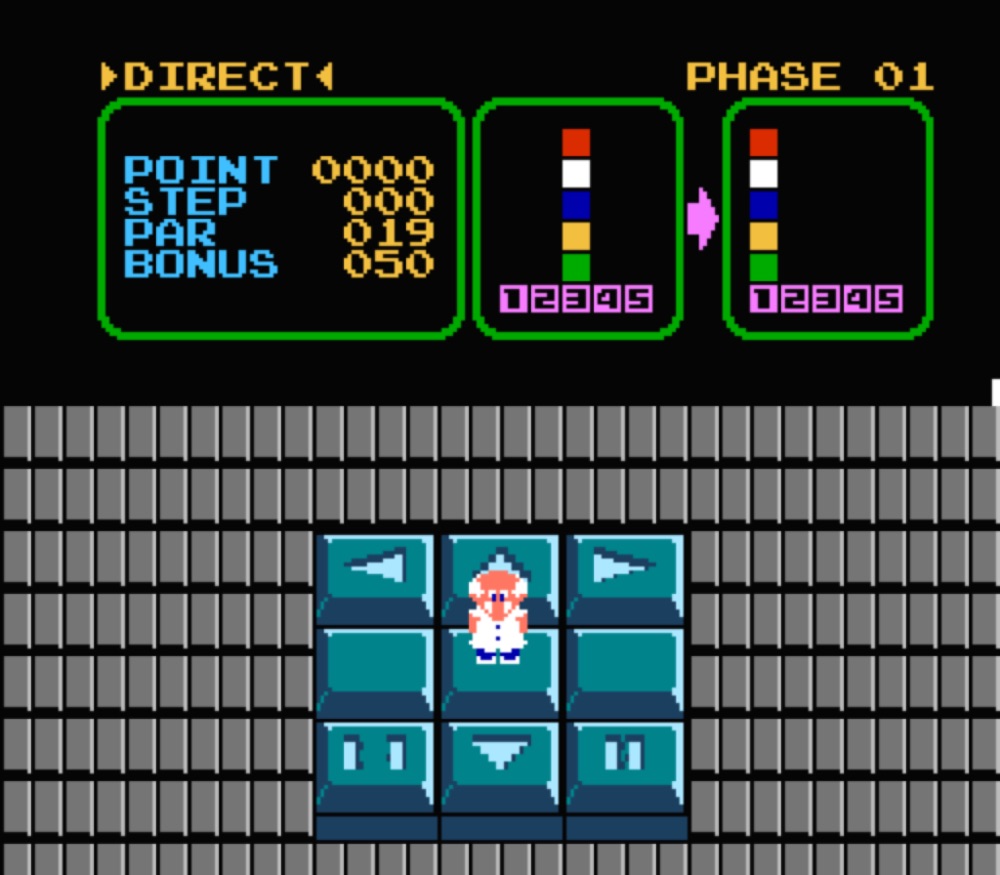
- Direct mode. The screen gives you a target arrangement for the discs, and you hop a little character around an on-screen controller to enter the moves. Rob is supposed to carry them out, with the game calling "down, down, down" in a sampled voice that impressed us. He can't report back, so you press Start on the honor system when you've won. Any kid could just press Start. A score you can't prove to anyone, short of a VHS tape, means nothing.
- Memory mode. The best of the three. You program a whole sequence, set a speed and let it run, a bit like Simon crossed with a CNC machine from engineering class. It does make you look many steps ahead, and it works on graph paper, which we tried. That also raises the question of why you need Rob or the game.
- Bingo mode. Not bingo. It is direct mode again, but moving Rob down one spot takes a full row of five inputs, while enemies hop around cancelling the buttons you press. It is the closest thing to a video game, since the screen at least pushes back. Two players share one Rob and fight over which way he goes, which sounded endless.
Where it falls apart
- The middleman. Why steer a guy on screen who steers a controller that steers Rob? Joe's point was that it should be either direct control of Rob or digital blocks. It felt rushed, a reason to put a screen on a toy.
- A hard reset. Each phase builds on the last, so one mistake means rebuilding the whole setup. That is more work than hitting reset on the console, and it tests the attention span of the kids it was sold to.
- Rob is slow and dull. Videos of him at work show something that looks cool and performs poorly.
Beyond the game
The cart is a Famicom cartridge in an NES shell (a reason the title differs, and why these carts were once a homebrew way to run Famicom games), and Rob was pitched as a toy because retailers had stopped taking video game consoles. Stack-Up shipped with plastic pieces that go missing, which is what makes a complete copy expensive, with a full setup quoted at upwards of $400. We also dreamed up sequels, like racing Rob as he stacks or an AR game where blocks are all that stand between you and Rob.
The bottom line
Skip it. It was four no's on the Essential Games List, and Gyromite got three the week Sam was out. Our comparisons were not kind: Twister with no spinner and no one calling moves, a plastic magnet fishing game that is better every time, and Mike's childhood game of Stack the Blocks in Color-Coded Order While I Knock Them Down. Stack-Up is a neat piece of history, and a gimmick that Nintendo could ill afford as a core piece of its 1985 launch.
Written from our conversation in this episode.
Auto-generated transcript. Each paragraph starts with its timestamp. Speakers are not identified.
Stack Up. Here's a high-tech, high-strategy juggling act that's loads of fun.
And welcome to NEStalgia, the only podcast playing every NES game in chronological order. I'm Mike. I'm Joe. I'm Sean. And I'm Sam. And welcome to another episode of Nostalgia. Today, we're talking about Stack Up. Oh, no. Yeah. Oh, no. How are we feeling? Well, the objective is in the name.
To stack things up. I never really thought about that. Yeah. No, of course I thought about that. It's not as ominous as Gyromite. Right. Yeah. Well, it's also called Robot Block, apparently.
Just like Gyromite. You brought that up, and I just want to talk about this real fast. The reason why those things have those names is because they had to ship these things out so fast that they just wound up using the Famicom carts in them. So what's funny is it actually backfired for Nintendo in a way because these, for the longest time, were like a homebrew kind of way to play Famicom games. Like you would, because it had the loader inside of it. So if you could just put the, like whatever Famicom game you wanted inside that NES cart and plop it down, it would be able to read that Famicom cart. And I think that's the only reason that it has any relevance whatsoever today.
And I think it's also one of the reasons why those games still fetch some kind of value. It's interesting if they were going to use the Famicom cart that they wouldn't just name it Robot Block so it's consistent as to what's on the title of it. Well, Robot Block sounds very foreign. You know, I think like one thing they were trying to do with these games, specifically, and this is good for a Rob recap right here,
Rob was sold, you know, as like an American accessory. Like basically Toys R Us and other retailers were just like, no, we're not taking on any more video game consoles. So they were like, oh, this thing's also like an entertainment system and it has toys and look at this thing. So they were able to like sell it that way. But Gyromite still sounds pretty foreign to me, but I think Stack Up is like a more, you know, it's an English American sounding thing. It makes me think of stacking up some burgers.
Yeah? Yeah. Just good old American pastime of just stacking up some burgers on the grill. Yeah, exactly. Yeah. It makes me want to buy toys and stack burgers. Are you saying Stack Up's like a sequel to Burger Time? Yes. Great.
Yeah. So let's get a little bit into this. So Stack Up is one of the two games that came with Rob, or at least. Didn't come with Rob. Interestingly enough. Was for Rob. Yeah. This one's for Rob. But interestingly enough, this one came with like the pieces too for Stack Up. Like they didn't come with Rob himself. So this game fetches a pretty big value if it's complete, because it's the only way you're going to get all those little plastic pieces. If for some reason you want them. Did this game go for standard NES price when it came out? When it came out? That's a good question.
Yeah. I imagine it was probably like one of those things where it's like standard price plus $10 or something like that. But these are like little plastic pieces. Was there a standard price for the card? Well, there wasn't, but there was. So I think the generally agreed price is that these things were around like $35, $40 when they came out first. But some people have also said they went as high as $60 back then. And I know that like even in the Super Nintendo days, sometimes it was like the length or quality of a game also meant how much it was going to cost. Like I remember Final Fantasy VI being like $70.
Yeah. And I was just like, this is a long game. Mm-hmm. So we've got Gyromite, which is a game that you play with Rob. Yes. He's your wingman. But then now we have Stack Up, in which you're not playing anything with Rob. You're using this game as just software to control Rob. It's almost, yeah, you're like mind controlling Rob. Right, well the games aren't really, I mean the games are like suggested in kind of in the programming, but they're not, they don't recognize that you've done anything in the game.
Exactly, because like you needed Rob to play Gyromite, but there's nothing, Rob isn't interacting with Stack Up. He's not touching a controller this time. In the other one he was touching a controller. Yeah, this is just using the game to interface with Rob. So what is Rob doing?
Essentially, he's picking up these, I mean, let me set this up a little more, there's five discs, all different very nice pretty colors, and there's five discs, and Rob is able to pick which one he wants to grab, whether it's the bottom most one or the top, grab that, and shift it amongst five other tiles that he has kind of floating around him, and then he drops down those discs, and it's not pretty, he had just like dropped them. You have to actually keep saying down, down, down, down, and then he's... And they say it in the game. Yeah, down. They just had some pretty good, uh... Some crazy, I was pretty, uh... Yeah, I was pretty surprised with that they were able to sample voices.
I thought it was surprising when we saw that in Kung Fu, like, and this has a lot better voice emphasis over it. Yeah, it's probably like double the bit rate, I don't know. Yeah. Well, I heard, I heard the, uh, like, this is kind of a tangent, but when you boot up Sega, or when you boot up Sonic, the Sega, that thing, is like, apparently that's like a ton of the memory in the game. Yes. That voice.
Yeah, just to get it to sound so crisp and clear too. Yeah. So, I've heard that too, and there's a whole thing too, uh, with Sonic, where basically one of the guys who worked on Sonic 3D Blast, basically one of the developers decided, I'm gonna make a whole YouTube channel where I just break down how I did Sonic 3D Blast. And it's a really good read, uh, I'll throw that, not read, watch, I'll throw that in the show notes for sure, because that's just interesting too about, since you were talking memory and stuff like that. Essentially, he takes a 3D game and shrinks the intro video, which is CG, down to like 512 kilobytes or something like that.
Okay, so let's start talking about Stack Up here for a minute. Can we just do, like, first impressions really fast? I know we kind of jumped into it right away, but Joe, you want to take us through your initial impression upon booting up the game? I mean, I think the first thing, aside from, again, the name being different than what's on the cart, the first thing that I noticed was that, kind of what Sean was saying, is that you're not actually, the game is not actually, like, programmed to register if you're playing the game. Like, you're using the game to control Rob and, like, do what it says, but you don't have to do that. You can do whatever you want, and you can just say you won.
Yeah, this game right now, I mean, I don't think any of us play it the correct way, because, again, just like back with Jyramite, we don't have Rob. And I don't really want him. I don't want Rob, after what I'm seeing with Stack Up. I mean, yeah, I've educated myself. I've watched videos of Rob doing this, like, doing the stacking of the up. Yeah, and I'll link to that in the show notes, too, because I think that's worthwhile. I think watching Rob in action just kind of shows how something so cool can look so poor, can actually perform so poor.
Exactly. So, yeah, no, it's fascinating just to watch, like, this was a thing that was a selling point for a system at some point. And, I mean, robots were big in the 80s and stuff like that. Of course. I think just, like, coming off of Star Wars and, you know, Star Trek on TV and stuff like that, it's like the idea of, you know, those droids and then, like, you know, now robots and stuff like that. It's like, I think that was huge. It was kind of like a reawakening era from, like, the 50s kind of sci-fi. Now it's back in the 80s. So I thought Rob is definitely an interesting thing to sell. It's just that when you see him actually do stuff, it's boring.
So the unfortunate thing is that we can't actually give a first impression on our firsthand account with this game because there's no way for us to truly play the game. Yeah. I mean, my first impression was that I thought the music was really great when I booted it up. You know, I think that's one of the strong points. But then I kind of jumped into the game and every time you land on something, your screen kind of, like, it kind of shifts green for a frame or something like that. It's giving instructions to Rob and I thought something was wrong with it at first. So that was kind of my first impression. I thought that it was broken. It's the same mode of communication that was used in Gyromite, but unfortunately Sam wasn't with us for that game.
Yeah, it is a little different from Gyromite in the sense that you're using the controller to control someone on screen to use, like, a digital controller. And I was just thinking, like, why have that middleman? Well, if you look at the controller, it's got something like nine buttons. Well, no, it has open, close, up, down, left, right. Up, down, left, right, A, B. You can use the same thing. Oh, you're right. It's true. And start for the end.
Right. And my only thought was that if you are just controlling Rob, it feels like you're just controlling Rob. But if you're controlling this character and he's giving Rob these commands, it feels like, oh, there's a partnership between Rob and this character. I mean, as kind of silly as that is, I mean, that's the only thought process I can think of that would make them do that. Yeah. And so I think what's weird here is that you have, you know, essentially in this game, like we said, you're moving these disks across different patterns that the game is telling you.
So the game is basically saying out of these five blocks, take the three blocks on the top and move them to column two if you're in column three or something like that. So you basically just have to hop around on the input screen to give those codes. I think what Joe is getting at to here is why have the NES at all? Why not Rob just have a controller that's hooked up to him and you just have those buttons exactly how they look like it's like a nine dial thing or whatever. And you just push those buttons and Rob moves around.
It's like, do we really need a screen that shows us this? It just seems I think it seems very rushed. I think that's kind of why there's that whole move the person on the screen element to it. It's like, look, no, it's a game. You see, you got to move the little guy. That's the game. And if you're going to play the game and there's a whole separate game with Rob, you know.
Right. Well, this is also we're talking about one mode right now. This is direct mode, correct? But I don't feel like the other two modes. No, not direct mode. This is not direct mode. Yeah, this is direct, right? Oh, OK. It is direct. Yeah, sorry. I'm thinking of memory as well. But memory is kind of the same. You're still, you know, like you're not putting it in as a controller input, but you're still telling it what to do next.
I guess the other thought process could be like, you know, they need the screen to tell you what they want, what your next goal is to have, you know, to change it. So this color is on top or to change it. So these blocks are over here. So the screen tells you the next thing you have to do. And then they probably thought, like, well, there's not enough happening on the screen. So they needed needed this guy jumping around on a controller.
And the only way to get any satisfaction to get that Pavlovian response. If I did something is to you're on the honor system with this game. You have to tell it, I beat the level. So you press start. So you could you could just press start immediately and say, hey, I beat this level. Right. Yeah. And if you if you fail what and you and you and you are an honorable person and you don't press start, that's it. Right. You're just done. You have to press select to go back to. Yeah. You're like, oh, I screwed up. Yeah. So, I mean, I feel like most kids would probably just press start again and be like, yeah, I won.
Yeah. I feel like it's also the kind of thing where your score, because it's on the honor system, your score kind of has less merit. And you can't show off your score to anyone because they won't believe you. You have to record yourself on VHS. Yeah. So the direct system, besides working on the honor system, it has a couple of other things going for it. I guess it has that par for the course kind of thing where it's like, hey, it should take this many steps to get to get things done. And that's like a cool way, I guess, in terms of like, instead of a high score, even though it gives you a score, it's more competitive, I guess, to say like, well, I should try and do this under this certain amount of steps.
But I do think we just we can just gloss over that honor system just by saying that it exists. It completely breaks this game because to Joe's point, if you fail, yes, you could be honorable and hit select and be like, I'm just going to start over again. But it just kind of like it breaks up the whole pattern of the game. When you move from phase one to phase two, it takes the pattern that you made in phase one and then says, OK, now change it into this. So if you move three of the top disks over to column two, the next phase is going to say, OK, now take like one of those disks from column two and put it in column five.
But if you didn't do that correctly, it's like now you have to reset up Rob all over again just to put in inputs from the first phase. It's a little flawed in even the terms of like if you don't go by the honor system, if you just mess up, it's basically like a harder reset than just hitting the reset button on the NES. At least if I screw up in like Kung Fu, I just hit the reset button and start the whole game over again. This is like now I got to set everything back up. I got to do this. I got to it's too much trouble for what it's paying. Exactly. I think it's really testing the attention span of the kids that this is marketed towards as well.
Yeah, that's a great point. And I think like, sure, this is this is early in the NES's lifespan. And again, it's another Rob game. So we weren't expecting much. It's kind of sad when you look at Rob and you see that this is these are the two games and that's all he has. And it's just like to see these two games. It's like, what else could they have done?
I'm not asking that. I'm not asking for any designers here because I think Rob, just based on his functionality of turning left, turning right, picking up things like there wasn't much else he could have done. Yeah, I think also just the fact that Rob doesn't communicate back to the NES really limits you. I mean, I think there would be a lot of games that would have this honor system if they were to do other games with with Rob.
All right. So that's pretty much the direct mode. Let's talk a little bit about memory, which I think if you're playing with Rob correctly and you are an honorable person, this offers something a little better than the direct mode because it's kind of like a mixture of stack up and Simon says or the Simon, the Simon game where you have to memorize your patterns.
It kind of feels a bit like, I don't know if you guys were ever in, you ever took like an engineering class, but like there was a CNC machine and you have to give very specific instructions of what this machine is going to do for it to, it would basically like carve a shape in some plastic. So you had to give it instructions of like move it this amount of millimeters up and then to the left and then to the right. So it had it almost feels like very basic programming.
Right. Because you're just writing the code per se and then it is is executing that once you press end. That's an interesting way to look at it. Yeah. Because it's definitely like testing your ability to see to see so many steps ahead. Exactly. And still understand what your results are going to be. But and so I think, you know, a lot of people might be wondering, well, how would you play a game like memory if you're not playing with Rob?
And the answer is it's very easy. It's actually insane that all you have to do is just you have a sheet of paper or even like some graph paper and just sketch it out. And that's what I did. I just was sketching out each turn and seeing. And I mean, that sounds pretty tedious, but I don't see how that's less tedious than just watching Rob do it. I did that, too, actually. I wrote I wrote it out. And that kind of made me think that, like, you know, Rob kind of just gets in the way of what could be like an interesting puzzle game. But here's the thing, though. You wrote it all out. You didn't need to. You didn't even need the game.
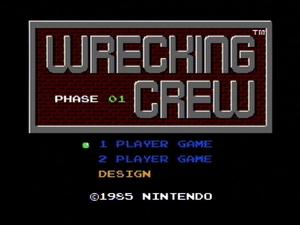
Yeah. You didn't write it all out right now in the studio. Right. The game is what tells you your objective. No, but the game tells me. But I could just have my friend come over and say, hey, can you just make it so that, you know, the five that you have in the middle, can you make them so that two go over to the left? That's the case with a lot of puzzle games. If you can come up, you can, you know, do something similar. You have someone. OK, but I beg to differ a little bit on that just because a future game will be talking about Wrecking Crew.
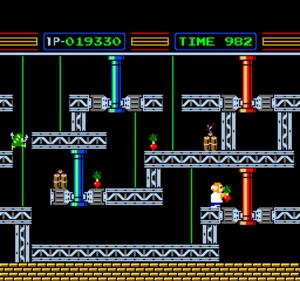
I don't think I could just make up a Wrecking Crew puzzle on the fly on a piece of paper and then say solve it. And you would be able to, you know, like that requires inputs and movement. This doesn't really require that. This requires me to say, OK, down, down, grab, up, left, left, down, down, down, down. So I think you need Rob to be there for this to mean anything.
Right. And of course you can solve it. But even with Rob there, I feel like it's just more, it would be more fun if those were on the screen and I could just see the input happen and it could tell me I won and tell me I lost.
And then there's this other weird mode, which I can only imagine is trying to get catered to that American audience of bingo. But it's really not bingo at all. I actually thought I was going to be playing like a game of bingo with Rob and I should have read the manual. But boy, was it just direct mode again. Only now the inputs are five times as tedious. This is the closest we get to a video game now.
Because there's enemies on the screen? Because anything that you're doing there, at least the game has an effect on it. Everything else that we're doing with this game is just using it as a controller. Right. It's almost like playing with a calculator in all the other games. And now it's like, imagine if your calculator had two things on it that were also hitting the C button to delete all your work.
Well, so this one is the only one that I thought could be interesting. I didn't get to play this way, but if you play two player, I mean, you're fighting. You're fighting over blocks. With Professor Vector. But you're fighting with a second player. Yeah, no, well, yeah. There's Professor Hector, who you always are. Sorry, if you're playing the one player mode, you're always Professor Hector. And then the two player guy is Professor Vector.
And those are the same two guys from Gyromite. So that's the only reason why I know that. They're the only people that ever associate with Rob. How does the two player work then? So basically, the one player bingo, it's basically the one player bingo. There's two enemies on the screen that you have to avoid. And you have to create a vertical or a horizontal row to select up. You know, one row is up and one row is down.
But then there's two players on there. One of them is trying to get all the blocks to one side while the other one is trying to get all the blocks to the other side. But you're both controlling the same Rob. So, I mean, I imagine this probably takes like hours if either of you are any good at it. Because every input, you're just competing for which direction he's going to go. I used to play a game like this with my brother.
And it's actually just surprising how I just thought about this. But basically, my brother's only a year younger than me. But when you're very little, that makes all the difference in the world. So I think I was five. He was probably four. And we used to play this game that I came up with called Stack the Blocks in Color-Coded Order While I Knock Them Down. And essentially, my brother would go around the room, stack up these big, and they were pretty big blocks. Yellow, red, and blue. That was all the colors. But you had to take all the blocks around the room, stack them up. And I would just go around and kick them.
And if he was able to get them all stacked up in Color-Coded Order before I knocked them all down. That's an unwinnable game. Right, an unwinnable game for sure. That sounds like a great game for you. Kind of sounds like bingo two-player. Exactly. It's unwinnable and unlosable. It just goes on forever. I never, you know, I didn't even think about how much Stack-Up applies to my life until this moment. Wow. But just to be real clear about what bingo mode is, just in case we weren't being clear enough. It is the direct mode, again, only instead of hitting up to, or down rather, you know, because you have to move Rob down, down, down to select the disks. You have to complete a whole row of five inputs just to get him to go down one.
And then he'll, like, you know, he'll do that input on the actual Rob. All while there are these things jumping around the screen, canceling out the buttons you've already pressed. Right. And if you jump back over a button you pressed, you un-press it, so you've got to make sure your straight lines are always... It's un-mess. I'm actually glad that, I mean, like, I tested the mode, but I didn't play this one with pen and paper, because that would have been crazy. But I'm also glad I didn't have to, like, sit through, you know, 45 minutes of Rob doing this, too. And I mean, like, 45 minutes is an exaggeration. I don't think it's actually going to take you 45 minutes. I think it will feel like 45 minutes.
And that's actually something we didn't talk about when we were talking about memory mode. Because when you, after you select your input, it takes you to a screen where you select the speed, which I'd imagine would always be the same speed that you need Rob to move. But that'd be something you'd have to kind of figure out, because if the input comes in too soon before Rob's finished... Maybe we really want to, like, just take it all in when he's doing it. Do it as slow as possible.
Wow, it's so futuristic. Yeah. So, any stray thoughts? I have one, if I may start the floor. Please. One of my stray thoughts here, and this is just something I noticed when I was... Because I was like, oh, maybe, you know, it's not so bad. I'll just get Rob and see how this goes, right? Well, look, it's not that I'm not invested in this podcast, but I can't justify for something I talk about so poorly on this podcast, to spend upwards of $400 on this thing.
Rob is $400? Rob is expensive and not that expensive on his own. The thing that makes him so expensive are these small plastic parts in stack-up. Because, again, they didn't come with normal Rob. This game didn't sell as many copies as Gyromite, which came with Rob. This was an additional standalone game.
So those plastic pieces just kind of went missing over time, you know? It's like, think about all the action figures you had as a kid. You could probably find the figure, but can you find his gun? Like, it's very hard. It's very easy to lose those small pieces. And so stack-up is actually, like, it's one of those high-fetching, you know? Like, if you want the complete thing. I mean, some people just collect the carts, and that's enough for them. And the cart could probably go for less than you would. You know, it's still expensive in the realm of cheap NES games. But it's the little plastic pieces that make this game so expensive. Which is ridiculous. Why can't somebody just 3D print them?
Maybe that shouldn't be said. No, no, that is to be said, you know? But that's like alternative pirating. That's like the new form of pirating. Can't somebody just 3D print that? Do you think Nintendo would go after you? Preparation, cease and desist on it.
That was a question that wasn't meant to be taken literally. Okay. I got some straight thoughts. I think that, like, you have Rob. You have this ability to move things. You know, which is, like, on its own, like, maybe cool.
But, like, why? I feel like they could have taken it just one step further. You know, like, you're assembling something instead of just, like, stacking them in order or something. You know, or you have to, like, race Rob as he stacks something in real time and you do it in the game or something. I don't know. That would be a great idea. That would be a lot better. And I think that can be done if you do it the same way that, you know, like, similar to how you did it in Gyromite. By flashing in the screen, he would know which kind of, like, input to do.
Whether it was opening or closing the gates. I think you could do something like that. The problem probably was that there wasn't enough, like, because there was nine options here. I think we were agreeing on, like, six or something like that. Something like that. And I think that's too much to program into, like, Rob's visual eyes reading.
But that would have been a lot better. Yeah. To have to race against Rob. But I think if you had to race against Rob, you would need, like, 500-pound weights on each arm in order to, like, to be to the point where you're not going to beat Rob very easily. This is the ideal game, remember? This is the... Right, right. This is the fast Rob. This is Duck Hunt 2. This is... Bring them up. And you're like, no, no, bring them back. I think that would be kind of interesting.
I think that it needed to be just you and Rob in direct mode. Because whenever I think about this game, and just Rob in general, it's all just about the novelty of it. Like, just, like, the fact that some 8-year-old, 9-year-old, 10-year-old, I don't know how old people are when they play this game, kid, is actually interacting with a robot through a computer, which is so 80s cool. Right. Like, they need that pure experience to just, like, yeah, this is the future.
I think that the enemies deserve to be in the stupid bingo mode, because then you can mess about. I think Direct Mode needed to be pure. Okay. So, here's what I'm thinking. I know we've done this before, which is the 2018 or the future sequel. Yes. I got some ideas. But are you using the original hardware, Rob, or are you digging a new, brand new Rob? This is a new approach. Okay, I love it. Rob 2.0. Let me hear it. So, this is either an AR game or a VR game.
I'm not exactly sure which one, but basically, there is a stack of blocks in front of you, and behind that stack of blocks is Rob, and he's gonna come get you and kill you. Right? And so, you have to make sure that you can, like, stack the blocks. The game will play a little bit different, but you have to make sure that you can build the blocks faster than Rob can take them down. Because then he'll get to you. So, the blocks are the only thing in the way of you being murdered by Rob the Robot, buddy. Yeah. Okay. Well, that and, like, little enemies that are also trying to, like, mess with you. Okay. See?
Forget Rob as a toy and take the 2018 version. It's kind of amazing that Nintendo doesn't just make their own version of, like, a Minecraft. Yeah. With, like, Rob. And, like, you know, it takes place in his world or whatever. Rob is this creeper. I don't know. Or, rather, you play as Rob in this game, taking the blocks, moving them around, building your own block world. In fact, get Roblox on the phone and have Nintendo work out a deal with them to get Rob in that. Are we talking about a crossover episode right now? Whenever we get to Roblox, that's when I'm quitting the show.
I think that's enough. I think we've talked about this game at length. I mean, can't wait to get to our closing thoughts here because it's time for the Essential Games List.
All right. It's time for the Essential Games List. And if you don't know what that is, basically, you got a PS4, you got a Nintendo Switch, you got your PC, all these great systems in 2018. You're playing on your VTech, which was an educational learning system in the 2000s. And you're like, I wonder what other kind of weird, archaic, robotic games I can play since the creation of video games. And it's like, oh, Rob, that guy from Star Fox 64.
He's got his own NES games, and one of them happens to be Stack Up. Is that any good? Well, you finally stumbled onto the part of the episode where we tell you if it's any good. Joe? Yeah, I think it'll come as no surprise that I will not be voting for this to go on the Essential Games List. It maybe had potential to have some interesting puzzles in it, but it just didn't have interesting puzzles. And it still suffers from that whole middleman thing. I don't know why I'm inputting onto a controller to have a guy on screen input onto a controller on screen to control Rob. I think it should have either been me controlling Rob directly or me controlling digital blocks.
And I understand what Sean says about you need the Rob for the nostalgia factor. But I think that just, in the end, they probably accomplished what they wanted to accomplish with selling it. But it does prevent it from being a good game. Maybe that's not the other thing. Okay. Yeah, no, this game doesn't deserve to exist.
Yeah, you need Rob for this to mean anything. Like, for it to be a controller, like a digital controller for anything. But, like, this game isn't a game. It is just a designated middleman for you to interact with your toy. It's great. It's a great little piece of history. But it's garbage. You guys know that little plastic fishing game where you have a little fishing pole that has a magnet on it and all the fish have little magnets in their mouth? And when you wind it up, they open their mouths? That game is so much better than this game.
You can play that game 50 times and each time it would be better than this game. It is a cool experience. I'll give it that. And I can only imagine how weird this would have been in the 80s. But nowadays, just nah. Can I have one more thing? Yeah. I want to add one more thing. I would rather play Mike's version of put the cubes in order as his little brother. Stack the color-coded blocks while I knock them down. As his little brother, then play stack up.
All right. So I was going to be funny as well, but I'll save my funny thought. I'll save my funny thought for the end, okay? All right. Here's the problem. So we've all talked about how this game is playable without Rob. That's the problem. Okay? That is a problem. And I get that, you know, oh, you need Rob to really fully experience it. The fact that you can play it without the thing that is genuinely required for it is a big flaw. The fact that it's based on the honor system is a big flaw because who cares about honor in winning?
Against yourself. Yeah, against yourself, too. There's no competitiveness there. Another big problem, and this is, in my opinion, the biggest one, is this is a novelty. This is a gimmick. It's not fun anymore. It barely held up probably the year after Rob came out. And that's dangerous for Nintendo at this point in their company's development. It's 1985.
Your console just launched. You're trying to convince people that your system isn't like everything else that crashed before it, that this is new, that we have quality control, that we're capable of being above what people think of video games. And yet you're releasing, as one of your core games, and part of your brand, Rob, and these two pretty genuinely bad games. Now, I've met that Gyromite is a video game, whereas Stack Up is only a video game in the sense that it's video on screen, and you're playing a game, I guess. But the game is off screen. Yeah, but the game is off screen.
So to get to my joke, this game is essentially like having like Twister, you know, the board game. But you don't spin the dial, and nobody calls out, because you're not playing with anybody else. Nobody calls out anything, like, you know, left foot red. You're just doing it. You're just saying, oh, I'm going to put my left foot on red now. And like, I'm going to put my right hand on green. And it's like, it just, it's not fun. You need something to tell you to do something hard, and you need someone to be watching you. Yeah, it's almost like saying that, like, oh, yeah, yeah, I've got a PlayStation. But like, then that person that you're telling that comes over to your house, and you just have like an old controller.
And you don't press the X-Men, and you move a block. We have to act it out. Yeah. I don't have a PlayStation. I just have like, this is where I play. This is a PlayStation. This is my PlayStation. This is the eat station, and it's the sit station. That would be like the equivalent of like naming your like after school daycare PlayStation. You know, the kids would just be like, well, we're going to PlayStation. And it's like, yeah, we're going to PlayStation. And you go there, and it's like, you know, there's a couple of, there's a couple blocks. And the teacher's like, we're going to play stack the blocks in color-coded order while I knock them down.
All right. It's four resounding no's. No surprise. Gyromite also got three resounding no's. It's because Sam wasn't here, unfortunately. So you can really tell that Rob is a must-buy.
And that's all the time we have for this episode of Nostalgia. Join us next time for Super Mario Brothers. And be sure to play it yourself if you can, and you totally should have by this point in your life. For more Nostalgia, please subscribe to our podcast wherever you listen. And be sure to check out NostalgiaCast.com. That's N-E-S-T-A-L-G-I-A-Cast.com. There, you'll find links to the show and show notes, as well as our other platforms, such as Twitch, YouTube, Twitter, and Facebook. Thank you so much for your support of Nostalgia. We thank you for spending time with us. I'm Michael Esposito. You can find me on atEspositoFilm on Twitter, and I'll talk to you soon.
NostalgiaCast.com