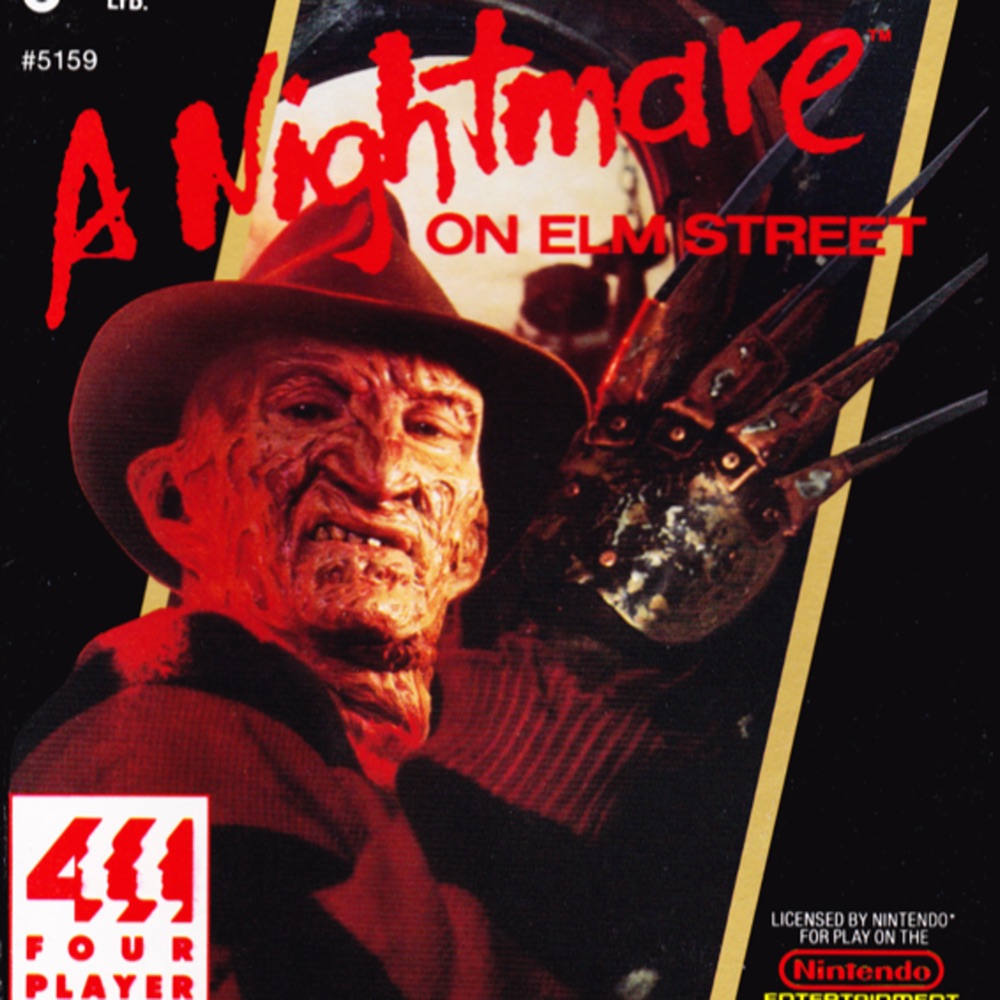
385 · A Nightmare on Elm Street
Nightmare has two worlds. In the red-tinted "real world," players fight snakes and spiders while navigating standard platform challenges. The players here have a "sleep meter" that depletes with every hit taken. If the player's sleep meter drops to empty, the game transitions into the blue-tinted "dream world," where enemies take on the appearance of skeletons and ghosts. An invisible timer also starts, counting down until Freddy appears and forces the player into a brief boss battle. The sleep meter becomes a standard life gauge in the dream world, and deducts a life from the player if drained.
Joe was missing, so Mike and Sean took this one on their own and blamed the dream demons. Rare developed it and LJN published it, a pairing that left us unsure what we were about to get. It is loosely based on the third movie, Dream Warriors, and you collect Freddy Krueger's scattered bones while a sleep meter ticks down. Up to four players can join with the Four Score.
What works
- A good idea on paper. Like Castlevania II and Dr. Jekyll and Mr. Hyde, it has a waking world and a dream world. Fall asleep and you can become an acrobat, a shadow warrior (a ninja) or a necromancer, each with a projectile or special move. The javelin acrobat was a favorite.
- "Freddy's coming." Linger in the dream world and the title card appears, followed by a full-size Freddy. That has real tension, and we could see it scaring a kid.
- It's competent. Everything works and the controls are tight. We just didn't enjoy it much.
What doesn't
- The two worlds fight each other. The dream world is more fun and more powerful, yet you're meant to want to stay awake. Doors are locked while you sleep and the power-up icons only appear in the waking world, which at least gives you a reason to be up. Standing still makes the meter run faster, so doing nothing is a legitimate shortcut.
- Odd enemies. The game opens with a snake already crawling toward you, nearly as big as your teenager. Giant spiders and Frankensteins in the waking world have nothing to do with Elm Street.
- Freddy is a letdown. The stage bosses are chain-chomp versions of him made of beads, with a head or claws. The full-size fight has him waving a claw around. He shapeshifts in the movies, and the game uses none of that.
- Not scary. Nightmares make you weak, and you can't even throw a punch. Here you get a projectile and a better jump, not much more. Falling asleep mid-jump makes you feel like a narcoleptic.
- Four players is a mess. The HUD shows four slots no matter what, and the Angry Video Game Nerd footage Mike found looked like a "clusterfuck": stuck screens, stuck players, and everybody falling asleep when one person does.
Beyond the game
An early concept had you playing as Freddy, which we both wanted. We also pitched a modern version where you start weak and unlock dream powers through a skill tree.
The bottom line
Skip it. Mike said no because the game leaves you with a list of wants it never meets. Sean voted no because it feels like a franchise's coat of paint on a serviceable action platformer, with mechanics that seem tacked on. With just Mike and Sean on the episode, neither put it on the Essential Games List.
Written from our conversation in this episode.
- It’s a horrible nightmare come true!
- 🕹️ General Overview
- Released: 1990 (North America)
- Developer: Rare
- Publisher: LJN
- Based on: The Nightmare on Elm Street film series (primarily the first few films)
- Genre: Platformer, Action
- Players: 1–4 player support with NES Four Score
- Notable: One of the rare NES games to support 4-player simultaneous gameplay.
- 👻 Story & Objective
- You’re a teenager in Springwood trying to stop Freddy Krueger once and for all.
- Collect the bones of Freddy scattered across various locations and burn them in the boiler room.
- Freddy appears at random to attack—especially if you fall asleep!
- 🧠 Gameplay Mechanics
- Platforming action with light combat against dream creatures and zombies.
- Game takes place across Elm Street locations: junkyard, cemetery, school, Freddy’s house, etc.
- Each level has bones to collect (necessary to complete the stage).
- Sleep Meter: If you stay inactive too long or get hit, your character falls asleep.
- Once asleep, enemies become harder, but you gain dream warrior powers.
- Was falling asleep more of a benefit or a punishment?
- ☕ Sleep Mechanic Adds Strategic Depth
- The game features a sleep meter that depletes over time or when you take damage. When it runs out, you fall asleep and enter the dream world, facing tougher enemies but gaining dream powers.
- You can wake yourself up with coffee cups or a boombox. This system adds a clever layer of strategy to platforming.
- 🌙 Awake vs. Dream World
- In the real world, enemies are basic (zombies, bats).
- In the dream world, enemies are more intense, with unique sprites.
- Players get special powers in dream state:
- Ninja (shurikens, wall jump)
- Acrobat (flying kick)
- Necromancer (magic projectile)
- Can be awakened by collecting coffee cups or a boombox item.
- “Which Dream Warrior was the most fun—or most broken?”
- This mechanic is a nod to the movie A Nightmare on Elm Street 3: Dream Warriors, where kids had powers in their dreams.
- 🕷️ Enemies & Bosses
- 👻 Freddy Factor
- What’s the scariest Freddy transformation in the game?
- Does Freddy's random appearance still hold tension today?
- Freddy forms include:
- Freddy Snake
- Freddy’s ghost form
- Freddy’s head
- Full Freddy
- Regular enemies are fairly generic monsters.
- Boss battles are frequent and typically occur after collecting all bones in a stage.
- 🧤 1. You Were Originally Going to Play as Freddy
- In the game’s early concept, players would control Freddy Krueger himself, hunting down teenagers trying to collect his bones.
- Nintendo, wary of the optics of letting players embody a supernatural child murderer, rejected the idea, prompting Rare to flip the design and cast Freddy as the antagonist instead.
- Source: Nintendo Power
Also noted on MobyGames and VGMPF - 🎨 Graphics & Sound
- Visuals:
- Dark, atmospheric palette with occasional vibrant sprites.
- Enemies and Freddy are nicely detailed, given NES limitations.
- Sound:
- Music by David Wise (Donkey Kong Country fame).
- Theme is eerie and repetitive—adds to the tension.
- Freddy’s entrance is punctuated by an iconic “Freddy’s coming!” audio cue.
- 🤝 Multiplayer
- Supports 1–4 players via NES Four Score.
- All players are identical teenagers, but dream powers vary.
- Coordination is key when collecting bones—if one player dies, everyone restarts.
- 🧩 Controls & Design Quirks
- Controls are serviceable but can feel stiff or floaty.
- Hit detection is spotty—common issue in LJN games.
- Bone collection can be tedious—easy to miss one and get stuck.
- Design is nonlinear in some areas, but progression is mostly stage-to-stage.
- 🎤 Podcast Questions & Talking Points
- 🎙️ General Thoughts
- Did this game surprise you for being an LJN title?
- How well does it capture the feel of A Nightmare on Elm Street?
- 🧠 Big Picture
- How does this stack up against Friday the 13th or other horror NES titles?
- Do you think A Nightmare on Elm Street could work as a modern indie remake?
- 💀 Theme & Atmosphere
- “Does this game actually feel scary, or just weird?”
- “Did the sleep/dream mechanic change how you played or felt tension?”
- “Was there a moment when you felt truly ‘in a nightmare’ while playing?”
- 🎬 Movie Tie-In Comparison
- “Which movie moment would’ve made a great level or boss fight that wasn’t included?”
- 🛌 Weird Sleep Mechanics
- “Would you play other NES games if they had this sleep/dream system (like Mario or Zelda)?”
- “Any other horror games that toy with the dream state like this one did?”
- 🧠 Speculative & Hypothetical
- “What’s scarier: the dream world, or the real-world street punks who uppercut you to death?”
- 😂 Just for Laughs
- “Is this secretly a beat-’em-up disguised as a horror game?”
- “Would Freddy have been OP as a Smash Bros character?”
Auto-generated transcript. Each paragraph starts with its timestamp. Speakers are not identified.
A nightmare on Elm Street. It's a horrible nightmare come true.
And welcome to NEStalgia, a chronological exploration of every NES game released in North America. I'm Mike. And I'm Sean. That's it today. Maybe Joe was captured by Freddy Krueger because he's not here. It's true. Whenever somebody that I expect to be somewhere isn't somewhere, I blame the dream demons.
The dream demons or the dream warriors? Because they could have saved Joe. Well, no, I mean, yeah, those are the good guys, right? I never saw that one, Joe. I'm not sure if they're the good guys, the dream warriors, but I'm saying technically, if somebody gets captured in the dream, then they just didn't do their job.
I saw the, what I think is considered the like fan canon, which is you, you watch the first one is you watch nightmare on Elm Street, and then you watch Freddy versus Jason. And then he stopped. Interesting. Okay. I see. Now I feel like the first, I want to say the first three Friday, the 13th, which go the third is the dream warrior. But even the second one is like, you know, it's campy, but it's, it's whatever. Like, Uh-huh. Freddie Krueger, Jason, Michael Myers. Yeah. Is Freddie the scariest of the three?
I'd just be like, either, I'd either be intimidated because he has knives for fingers, or I would, I would just be like, why is this guy calling me a bitch? Like, what did I do? Right, right. But I think I was going more on the appearances, you know, like the other two hide behind a mask. Yeah, I guess. Freddie, like you can't hide behind that, that burnt skin. But he's got such a silly, he's got such a silly outfit, like the, the striped shirt and the stupid hat. Right. Yeah, okay. It's kind of, it's kind of goofy. You're saying janitors are stupid?
I'm saying that if a janitor dressed with the intent of scaring me, I would say you're doing it wrong. Got it. Okay, fair enough. The video game, A Nightmare on Elm Street, is not really based on the first game. It's, it's more closely based on the third one, the Dream Warriors, which is, you know, uh, you know, I, I think in the fan canon, that is one you include. So, um, this game was developed by Rare and published by LJN. That's a weird combo. Haven't we seen this before? Rare and LJN? Like together? So, wasn't like Friday the 13th, that wasn't Rare?
I don't think so, but it was LJN. It was LJN, and it just feels like there's enough, like, shared between these that I would have expected Rare to be involved too, if they were involved with the other one. But if they weren't, then this makes me feel very confused. I looked it up for you, because I don't want you to, you know, have to be confused. Nobody wants to be confused in life. And Friday the 13th, oddly enough, was by Atlas. Atlas. Oh, wow. Okay. LJN still, but Atlas.
Yeah, yeah. So, you can't escape the LJN factor, but as we know, they're just the publisher. They don't have, like, a hand in this stuff. So, with Rare developing, well, as we've learned, Rare had a strong start on this chronology, but, you know, they're also likely to put out some garbage as well. They gotta pay the bills. Yeah, you gotta, yeah, exactly. Turn the lights on. A couple of Jeopardy games won't hurt anybody.
A couple board games here and there. It's all fine. All I'm saying is that when I'm coming into this game and I see Rare and LJN, I really don't know what I'm gonna get. And what we wound up getting is, you know, you play as the Dream Warriors, one of the four. You can play, actually, up to four players if you have the Rare NES four score accessory. Four players at once does sound really cool, especially with a Nightmare on Elm Street theme. Like, what's that game?
Maybe it is just Friday the 13th, that PC game where, like, you know, you play as the... Yeah, you play as the... Yeah, it would be Dead by Daylight or Friday the 13th or any of the ones that are of that mold. Yeah. I get what you're thinking. Yeah. So, yeah, you get to be one of those teenagers, you know, with their Dream Warrior powers as well. And you have to collect the bones of Freddy Krueger scattered across various locations. Because the bones are their money. Yeah, that's how they... The bones are essentially, like, the keys to Freddy Krueger, right?
He died in a fire, but with the bones still being around, he's powerful. It's true. You have to... Once you get the bones, then you can get the stones. Yeah. And Freddy will show up in the game, too, though, so that's, like, a little confusing, right? It's, like, all right, I'm collecting his bones, but he's in the game. But, of course, that happens because, just like Castlevania, Simon's Quest, and Dr.
Jekyll and Mr. Hyde, this game has, like, a day and night cycle with the real world and the dream world. And anything that you do in the game counts down a clock to eventually falling asleep. And then you're in the dream world where things change just a little bit. But more importantly, because you're a dream warrior, in the dream world, you're also more powerful, not just the enemies. And so you'll be able to use your dream warrior abilities. Sean, sounds like a pretty cool idea for a video game.
Sean, yes, it does sound cool. I will say that. Now, do you think that the dream, going with the dream warrior's route, that the whole game should have just been you're asleep? Or is there, like, is there something to this staying up mechanic? Because I actually can't figure, I feel like staying up is a punishment. I can't figure, I know.
We say that because we played the game. No, no, yeah, but I know that, like, you have to be awake to get inside the new areas, if I recall correctly. You can't be asleep. Oh, okay. The doors will be closed. So I know that that's why you have to be, but there's no, like, benefit to being awake. And I feel like in the movies, it's the reverse. You only want to be awake. You never want to fall asleep.
Yeah, so we're looking at this from several different angles. And I think even the developers were thinking about this very separate from each other. And this is all just me guessing. But I think first principles of this, of, like, the game development process here was like, oh, well, being awake and sleeping has to play into it, right? And I think that they got into this whole, like, system of the waking world and the dream world basically being mirrors of each other.
And then, you know, I guess one might expect that after that kind of decision, you would get to, well, the dream world has to be, like, higher stakes. And that means that, you know, you've got these more intense enemies. And now you can be a dream warrior. And now you get all these other things you can do. And, oh, no, we made it more fun to play in the dream world than in the waking world, which you ostensibly want to stay in.
So, yeah, I think this is just kind of a paradoxical development decision here. And very few video games are based in reality. But when you start this game, at the very start of this game, and maybe this is more just, like, a mechanics question than a design philosophy thing. But, like, as soon as you start this game, it just puts you right into it. You're now controlling your teenage dream warrior.
And a snake is coming right at you. I don't like that at the start of any game. All of a sudden it starts and there's already, like, an enemy, you know, scrolling in the opposite. Like, so you're supposed to go to the right. He's coming to you at the left. It's like Super Mario Brothers never starts with, like, a Goomba coming directly at you. I mean, almost.
Yeah, but you have to, like, you have to be ready to, like, you have to confirm that you're ready to walk in the game. Yeah, you have to walk over there. Yeah, yeah, yeah. The snake is just already approaching you. And then here's another problem I have.
Like, I get it. It's a video game or whatever. But, like, the snakes are about the size of the guy. We're awake right now, so this isn't the dream world. And, like, snakes don't feel like they need to be the enemy of this game. You know, I feel like the dream world stuff is, like, let it be whatever. Let it be snakes with three snake heads. Like, sure. But the real world stuff is, like, just odd.
Yeah, I feel like if they wanted to be more thematically coherent, like, the whole game wouldn't have been a side-scroller. And this would have been closer to, like, I don't know, like an adventure game in the waking world where you're just sort of doing real-world shit. And you only get into this side-scroller action portion when you're in the dream world. And it's all just, like, nightmarish Halloween stuff.
I don't think I would want to play that game. I think that's just more like a non-paper sort of thought. But, yeah, I mean, it is silly. It's weird that you immediately are fighting giant spiders and snakes and, I guess, Frankensteins when you shouldn't be in any danger in the waking world. Yep, yep.
And funny enough, if you want to fall asleep, if you do nothing, time does pass by faster on the meter to put you to sleep. So you could just stand there for a little bit and get to the dream world because that's where you get your special powers. So you can be an acrobat or a – they call it a shadow warrior. That's a ninja. Yeah. Like, you know, and then the same thing, the necromancer, but, like, that's a wizard. Like, you know. Necromancer. I'm sorry. You know my words. Yeah. That sounded like something else. Yeah, yeah. Well, that's what I thought maybe they were saying this person does. I was like, I think she's kind of young for that.
Yeah. So I guess the one other thing that they sort of – I haven't seen it in the dream world, so maybe I'm wrong, but from my experience, you cannot find, like, the pickups that allow you to become these dream warriors in the dream world. Like, you have to be awake for that. So there at least is something keeping you there in addition to, like, I think, as you mentioned, like, the locks – the doors being locked, that you at least utilitarian-wise need to be awake some of the time, and it's not all just fun and dream games. Yeah, that's a good point. That's another reason to have two different worlds.
Do you think they should have went even further, though, and made, like, when you fall asleep, even the platforming sections, like, more difficult or trippy or, you know, like, maybe there could have been more motion to them? Like, in the real world, there's stairs, but in the dream world, now they're, like, you know, floating blocks that move around, so you have to, like, be more precise?
I think that if you go any further with this, it's not really going to feel like the same level, or, like, it's going to feel less like, oh, I'm in a different level of reality of the same place, and more like, oh, I'm just in a different level. So I think it's a balancing act with that. Should you fall asleep and wish to wake up, there are coffee cups and boombox items that you can just touch, and those will wake you up. Yeah, the boombox will wake you up. The coffee only exists in the waking world, though. That keeps you from falling asleep. Oh, my bad, yes.
But both those items can kind of be, like, they can be a positive, but they can also be seen as a negative. Like, the boombox, if you are, if you did collect the icon and you are the dream warrior, the boombox is almost like a poison mushroom. You don't want to touch that, and, you know, sometimes it's placed in a bad spot where you're like, how am I going to jump over this but not land on the boombox? Well, that's just sort of how this entire game is, like, in terms of just enemy placement. Like, there are times that if you don't have a, if you don't have a power-up that allows you to shoot projectiles, like, you are just guaranteed damage at times in this game. So which dream warrior was the most fun, or maybe the most broken?
I mean, I like the javelin guy, even though his jump kind of sucked, but you could just switch back to normal you to make those jumps. I know that the necromancer, or not the necromancer, I know that the magician, right? Is it the same thing? It is the necromancer is what they're calling it. I was saying it looks like a, you know, they got the wizard hat and everything, like a wizard,
but yes. He can levitate, and I guess that's more useful in platforming, but I think, like, the bigger hurdle here is just so many enemies on the screen that I just needed to take them out from a distance. Yeah. And they all get the projectile of their choice. So, like, the ninja has the shroyuken, and the acrobat has the javelin, and the necromancer has the fire spell.
But the hover thing, you know, those are different, you know, because, like, the ninja has, like, an attack animation for it. It does, like, a flying kick. Ah, yes, yes. Whereas the acrobat has, like, this somersault that goes a lot higher. So, I think that there is some, like, there's some good use for the acrobat, even if he seems like it's, like, isn't that guy just, like, couldn't he exist in the real world?
Ninjas and wizards could also exist in the real world, but, like, can they really? No, but even, like, ninjas. Like, ninjas, there's, like, a difference between, like, what a ninja could be in the real world and, like, what a ninja is in, like, fantasy novels, right? Right. I mean, I think that, you know, a ninja, if they have a smoke bomb, then they can just
turn into dust. But can't ninjas also, like, clone themselves and do other things? Like, I don't know. Isn't, like, Naruto a ninja? Like, doesn't he have, like, those kinds of powers? I don't know anything about Naruto, but I thought that that was just, like, an animation thing, you know? Yeah, I'm pretty sure, like, I'm pretty sure, like, ninjas have more powers than just, like, being someone who's stealthy.
Okay, I mean, I guess I have to believe you. Yeah, thank you. I mean, I'm making it up, so who knows? He's taking this question. He's taking this question question.
you were talking about the enemies and stuff but uh let's get into you know the real reason anyone's playing this game and that's the freddy factor freddy krueger uh it's a little like it's a little weird right it's almost like a little disappointing uh i don't want to like i don't want to say it's outright bad but it's just disappointing that the only way to like encounter freddy is like at the end of each stage after you've collected all of his bones you fight like just a small part of him that's like a chain chomp version of his whatever yeah
it's all chain chomps yeah it's just like a bunch of beads connected together and then like either his head or his um his claws yeah i think that is very weird uh but the you know the actual fighting freddy happens i think when you spend too much time in the dream world and then the the screen just changes to the title freddy's coming and then that kind of you know either hypes you up or allows you to feel some dread um and then you have the full sized or like you know human sized
freddy fight where he doesn't really do much um i think he just sort of he just sort of like waves his claw around he's like i'm here yeah i i got you i got you but that's kind of what he does in the movie though too right like he kind of fucks with the people in the game too sure sure makes sense and he could kill you that is a freddy fight that can happen multiple times yeah but that's not like what you what it's building up to right like no you're collecting the bones and then you fight timer yeah exactly so um i guess i appreciate more the you know the freddy's coming thing like has some tension to it you know like that is kind of spooky and i could imagine being a kid and being
scared by that kind of messaging you know if you remember in this is the first this is uh yeah this is friday the 13th this is mr x this is nemesis yeah friday the 13th was like you know at any moment jason is somewhere in the game and like you could run into him and i guess that this has like a has like an even more fear factor thing to it because you know that like it you know like it's just a matter of time now like you screwed up kid uh i just feel like it didn't it didn't need to get into like horror game territory like it's clearly trying to be uh at least give the kids like some kind of you know in in friday the 13th you were powerless right like you were trying to avoid jason until
you were ready to take him on you're not necessarily like unequipped to fight freddy at any particular point and and i know eventually you do fight the full freddy after you've gone through everything else in a disappointing like boss rush thing where you have to fight every other boss again just to get to him but like i think that's his name though too it's the full freddy the full freddy yeah yeah uh frederick actually fred yeah fred frederick oh i didn't realize uh he was
french he's got a little bit of french canadian in him huh who knew uh the regular enemies on the other hand i don't know i i think i said what i had to say about the snakes and stuff like that and the bats and whatever it's just it's all just fine i i don't know maybe you didn't even need that many maybe it was more of like just a game where you're just trying to track down the bones and be good at
platforming i guess they didn't really have any other like they only have freddy like and then you just have to dip into the the typical generic horror catalog for other enemies if you're gonna have it's just weird to punch a snake in the face like nobody's doing that are there just situations where you fight like stereotypical cartoon ghosts in the movies does that happen in the movies like absolutely not are are there evil spiders with freddy's face maybe actually oh yeah no that's a
that is a thing yeah okay so at least i got that the most important thing about freddy i think that was lost here is like i guess they were trying to do it with i was talking about the chain chomp thing like maybe that's like you know um freddy's head but he's like on the body of a snake it just didn't look that it didn't look that like that it looked more like just a bunch of beads connected together in the movies like he can be anything like he can he can shapeshift like you don't know
you know like it's almost like it a little bit right yeah yeah clown but i don't know i guess like they didn't go for that here like it would have been interesting to see more forms yeah uh yeah i don't have i don't have a response to that well on a couple different notes um mostly in nintendo power but also according to moby games uh the website where i get all the back of the boxes uh it a little trivia here in the game's early concept uh was to have players control freddy krueger instead see
that's what i want that's what i thought was gonna happen but i guess maybe we're not ready to play the villain uh because like that's where that's where like i'd get excited right you imagine now you are hunting the the teenage the dream warriors or maybe not even maybe you're just like regular teens that you're like fighting against and you're collecting to get your bones back to return to the
real world maybe you don't need the bones yeah well i mean if they're your money then you want to save them at least yeah i mean your whole life is in those bones yeah i i just think like you would be pretty upset if somebody took all your bones i would be very upset but even taking away the whole like playing as a villain sort of thing like in this franchise who's the one with the actual powers
and not just from the one movie that this name this game isn't even named after like the the one with all the powers that would translate to a video game is freddy so it would only make sense to play as freddy i think that that makes sense yeah and again with the with the whole shape-shifting or different forms or whatever like they could have had fun with that and like maybe freddy could have even went across genres right like a little meta and like one one level's a shmup and then the other one
a platformer and then the other one's like a contra style game like i could have seen it tetris freddy why not so how does it capture the feel of a nightmare on elm street like is this game on any level scary was there a moment where you felt truly in a nightmare while playing i don't think that there's been an nes game that has made me feel that way sweet home i mean even then like it's an rpg uh like a turn-based rpg it's too uh it's too deep in the mechanical weeds to truly be scary um and you know it's not like you're i also think that part of horror is just you should feel really weak and you actually have a lot more agency and like tighter controls in this game than i think it would
make sense uh but no that i was never really afraid for of the the frankensteins walking around or freddy i guess it's a little unnerving when you see that freddy's coming but i don't think there was ever like a clarion call like uh like like oh shit freddy's here it was just freddy would show up and then you'd be like spooked yeah yeah now you you play a lot of horror video games i actually don't
touch that many i remember famously like the first time i was like i'm gonna finally try a horror game was resident evil 7 so like it just shows you how long it took me to get on board with this kind of stuff but even that i like noped out of pretty fast uh when uh actually not too fast though because i got to the part where like the the woman starts chasing you around the house that's pretty early
no not the guy with the chainsaw though no that's pretty early all right never mind i thought i i thought i did a pretty good job no you got you got like maybe five or six hours into the game okay cool uh so you play more of these horror games are there any other horror games that toy with a a dream state you know not necessarily like how a nightmare on elm street did it but just like a game that has like a real world and a sleeping world um for sure i don't think it's as uh centered
as in this game um where i mean like there's there's like modern uh indie games i think like little nightmares might be the the like the most obvious example uh but that and that's also a a side scroller i think is it or is it like more 2.5 d i can't quite remember but um yeah there are games that that that that use dreams and like you know obviously psychonauts is kind of in there too
but that's not a horror game i would say that a good horror game isn't particularly making it a mechanic whether you are in a dream state or the real world like i think the ambiguity plays a big part as to whether that's spooky or not now i get that the dream warriors figure out how to fight back against freddie and that's like a cool thing that happens in the movie and it's a neat idea to change
up the nightmare on elm street formula but did they undercut what it's like to be in a nightmare too much by making it like so that the the falling asleep part isn't scarier or you know because like if i think of like my nightmares i usually can't even throw a punch right like you try to throw oh yeah no and you suck and like should that have been the idea that like you have to spend time in the dream world to like build up experience points to get strong should you have started really weak i guess what i keep saying i guess what i find the weirdest about this whole uh you just you're fighting against
you're fighting against your urge to sleep and then you fall asleep in the level and now the level is different is like you are an actual narcoleptic like you will be mid-jump and and fall asleep and now you are now you're in the dream world i guess if we're trying to to to use this as not even just a believable mechanic but like a believable a mechanic based at all in what one would expect about like going into a nightmare i would have thought that you'd play a waking world level and then like you'd finish that level and now you you have to play another level that is you dreaming because you
went to bed whereas this is like more of like what you mentioned like a day night cycle where it just you just have to you end up sleeping wherever you were at that moment i don't know if that answers your question i think it does i think it does yeah it's because if the game was based off the first movie then like would there have been a a bathtub level or a uh a level where like there's a mattress that tries to swallow you you know i'm just telling you about like iconic moments from the first movie yeah like i guess i guess the dream warriors really is the right approach to go but then just call the game that just call the game a nightmare on elm street the dream warriors like make it
clear like it's a little confusing right i i don't know enough about this uh this franchise to know whether it was like maybe it's just a marketing decision like oh it's like freddie's freddie and not that many people even saw that one and it didn't perform that well i don't know about i never saw the third uh friday about friday the 13th uh nightmare on elm street i don't know what it is i've got friday the 13th on the mind as well but you have seen the first one there's no shame i have
no i have seen the first one but i was probably 13 years old okay because i feel like the first one uh while while now silly was probably very scary back in the day had a has a great hook obviously that like yeah you know don't fall asleep that's where he can hurt you um but like i enjoy that movie even today even with all the the silliness or whatever like i still think there's a lot of blood yeah a lot of blood a lot of great tension very good looking young johnny depp i'm here for all of it
that's true that's true so knowing that freddie krueger is in uh a nintendo game what's taking so long to get him in smash wow yeah i mean i'm pretty sure that the smash brothers for horror which i mentioned before would be dead by daylight i think he's in that i think any any character from a horror franchise that's never existed has been in that game um so that's a kind of smash i'm trying to like just see just who's in this uh i i guess i never really like touched dead by daylight but uh yeah even
even the fucking bear from five nights of freddie's in the game yeah uh there's like silent hill stuff there's there's resident evil stuff there's uh nemesis is in the game yeah i so i just confirmed that he's in it um i've played it maybe three or four times it's it's it's an all right game it's fun with friends it's actually the only way you can really play it unless you play as the monster um but uh
yeah i haven't i don't have too much experience with it i hate when you like look at something and then you're like but what are they from you know like like i i recognize like i think there's a there's a few there's a good amount of like those are just the guys from dead by daylight characters
caleb quinn caleb quinn the death slinger yeah i don't know yeah i don't know i don't know you know what he kind of are you do you have a reference in your head for this guy right now like are you looking like on google caleb quinn oh yeah no i think that's just from dead by daylight no i mean until i looked at this i did not know what he looked like all right well i'm sorry to do this in front of everybody because because you'll just look look up caleb quinn right now and if you're familiar sean this looks like the guy um who's the first hunter in bloodborne that you fight at the end of the game i guess a little bit yeah he's got the hat he's got the eyes he's old
yeah he's got the i'm glad that bloodborne is on your mind like that though i know it's just now i'm just part of the cult we did mention at one point early on that this is a four-player game but like that's kind of nuts right like this this is not one that needed to be four players but i guess if you can yeah i know that uh joe would usually be our multiplayer guy i obviously didn't actually play it but i at least tried to find footage to watch four people play this because it's confusing right you would think like how does that work so strange yeah yes and and it's even stranger that
this the ui or like the heads-up display of this game whether you're playing it single player or four player is the same that there's always the four player setup on your screen so it has to be pretty like important to the game right so i watched uh the the only footage i could find was like the angry video game nerd and his friends uh playing it and it is a clusterfuck
and maybe that's just them but from the the points that i saw them get stuck on and there's the classic like multiplayer like uh the hang-ups that you'll get in like oh you can't move the screen unless everyone is moving at once which you know it's hard enough with two players it's kind of a pain in the ass before but then like it seems that the physics of the game start to break down and they get stuck in holes and you can't jump high enough to get to certain things and i don't know if that's like a hardware thing or if they just ran into this it seems like the game is a lot less like uh
stable when you have four players it's just messier though too like i really i don't think that you need three other players to get through a lot of this game i'm not saying it was easy but it's also not like it's not the most challenging thing and if anything adding more players just makes it like more likely that someone's gonna die or fall asleep when you don't want them to you know because if one person falls asleep everybody goes to the dream world and there's only so many of those pickups like you're not gonna be able to keep everybody like topped up on sleep juice good old sleep juice uh the first thing i drink before i go to bed yeah and the last thing i do on every podcast is the essential games list
a nightmare on elm street is a very competent nes action platformer it's just not necessarily like a fun one just because you can play the game and and make progress and say yeah everything's working doesn't mean that everything's actually working for the best i don't think that the dream warrior mechanic um you know it either should have been like a lot more powerful or a lot less powerful like nightmares should be scary and you should want to stay awake or you know you should be like way more up in the in the dream warrior phase you're not really that much stronger you just like have a
projectile now and a somewhat better jump so the game doesn't necessarily feel uh too different and i think that's the mistake is like it should have been too it should have been like dr jackal and mr hyde even though we hated that game like it should have been something where like when you enter this next phase uh you know or castlevania 2 simon's quest right like when you enter that other phase it's like all new enemies sure but like also different things happen like different things should have
happened and that's not what this game becomes so it's kind of like the idea is there but when you play the game i think you ultimately come up with a list of a lot more wants than what the game gives you so it's a no for me what about you sean i i think that i would appreciate this game a lot more if if it just tried to be more elm street and and i know that they did the whole like uh waking dream cycle thing and like freddy is in the game but this is closer to more of like a game with a franchise's coat of
paint on it instead of trying to gamify the movie so i like in the whole realm of video game movie adaptations or i guess movie video game adaptations like i think i respect like ghostbusters more than i like that i respect this game in terms of like what it was trying to do or like jaws where it tried to create mechanics out of the out of the movie that made it unique in that regard and and and or like it's just the the the franchises that lend itself so well to a video game like batman or something that
it just it just flows whereas this doesn't really flow like the mechanics that try to make it more elm street are kind of jank and just feel kind of tacked on and otherwise it could just be any other as mike described it serviceable plat like action platformer so this is yeah not essential uh lots of things probably could have been done differently here a nightmare on elm street game though where you
uh aren't aware that you've entered the dream world until like freddy shows up or something happens could be really interesting though like yeah as a modern take yeah i i'd say so it doesn't even have to be like a horror game it could wind up being something where like you know again you start off as like a severely weak you're in a nightmare can't even throw a punch thing but like then
throughout the game like you gain you know through the powers of uh what every single video game seems to have now a skill tree uh you gain the ability to like you know have new powers in the dreams to eventually like you can beat you like that's the whole cell right that's another thing that happens in video games all the time now it's like you can go right to the end of the game and fight the boss right like you can go right to the dream world and fight freddy but like you're gonna have a really
tough time winning that fight without any of the powers but like then you know throughout the game you would be able to uh eventually take him down and then like i don't know depending on like the completion of like what you learned in the dream uh would dictate like what kind of ending you got right so this way there's still incentive to like 100 and learn i am now looking forward to a nightmare on elm street breath of the wild edition
exactly uh and i'm looking forward to our next episode orb dash 3d do i have to say the dash i think you just say orb 3d orb 3d sure sounds orby it's gonna be orberific or it's gonna be orrible oh so