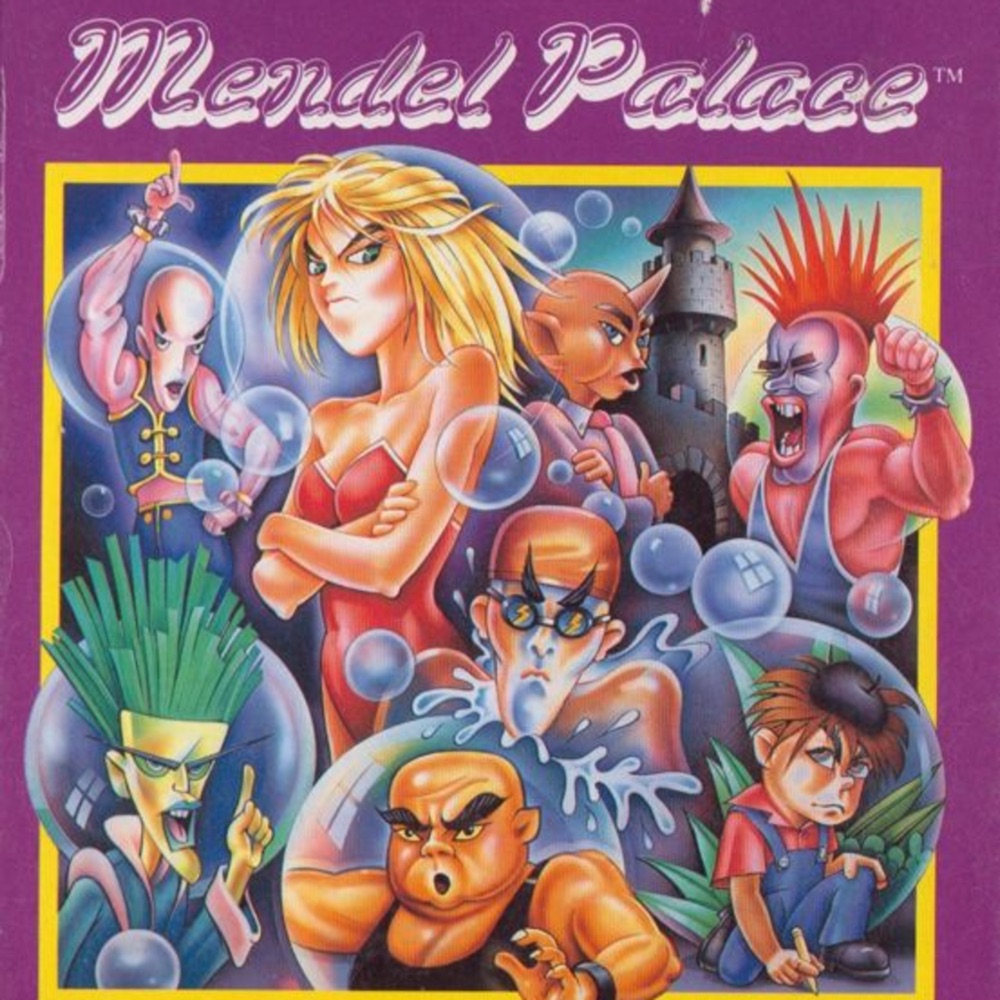
384 · Mendel Palace
In Mendel Palace, you are Bon-Bon and you have to rescue your girlfriend Candy, who has fallen asleep and is now trapped in her dream. To progress, you have to go through various areas that feature dolls as enemies. Games are played on a board of 7x5 sliding tiles, using an overhead view. By sliding floor tiles, you'll be able to put them off balance and make them crash in the wall, leading to their destruction.
Mendel Palace is Game Freak's debut, and the Pokemon fingerprints are everywhere: Satoshi Tajiri directed, and the artist and composer both went on to the Pokemon games. You play Bon Bon, rescuing your girlfriend Candy from her own dream. You can play ten levels without noticing there's a story. In Japan it was called Quinty, with a different story and the same game. Mike, Sean and Joe were on this one.
What we liked
- One rule, many twists. Every room is a five by seven grid, and the only way to finish off an enemy is to slide a tile or send a ripple so they hit a wall. Each world has ten rooms and new enemy behavior: stompers who shove a whole row of tiles, dancers who spin around, dolls who draw copies of themselves. Each world almost feels like its own little game, and you can go to any of them in any order.
- Action first, puzzle second. On a first visit to a level it plays like an action game, because the enemies never stop moving. Once you know the answer it reads more like a puzzle. We didn't agree on which it is, and the mix worked.
- Hidden surprises. Star panels give points and a speed boost, and a cross panel scatters a whole row. One cross panel also triggered an enemy spawner, a creative trap.
- Cute and fine with it. We didn't understand the complaints we read about the game being too cute. It's from the Pokemon people, and it reminded us of that.
What held it back
- Guesswork. You can't tell what's under a tile. After Loopz, we felt this was incomplete information again, and Slay the Spire and Into the Breach, where the puzzle tells you what's coming, came up as the modern contrast.
- Fuzzy movement. The room is a grid but you aren't, so you and several enemies can share part of one tile. "Flipping" tiles looks more like sliding them under their neighbors.
- Uneven bosses. One world's boss turns you into a stomper and you win with a single button press, another has just a cut scene, and the candy, dream and doll themes never come together. There is also a hidden timer, with five-second pickups the game never explains.
Beyond the game
The game gave Tajiri the credibility to pitch Pokemon for Game Boy and the link cable, and it took six years, 1990 to 1996. We thought the Wikipedia article oversold it as an inspiration. Two players cooperate, and we daydreamed a Bomberman-style versus mode, though the random tiles make that awkward.
The bottom line
Play it. Joe came around once the worlds started to differ, calling it a great game he isn't mind-blown by, so he voted play it. Sean was never going to vote essential, since it's too unfocused about its mechanics, and Mike wasn't convinced enough to add it. So it stays off the Essential Games List, still fun and still weird.
Written from our conversation in this episode.
- Candy needs your help!
- Manual
- Longplay
- 🕹️ General Overview
- Title: Mendel Palace (Japan: Quinty)
- Platform: Nintendo Entertainment System (NES)
- Genre: Action, Puzzle
- Modes: Single-player, Multiplayer
- Developed by: Game Freak (their debut game)
- Published by:
- Japan: Namco (June 27, 1989)
- North America: Hudson Soft (October 1990)
- Key Staff:
- Director/Producer/Designer: Satoshi Tajiri
- Programmer: Yuji Shingai
- Artist: Ken Sugimori
- Composer: Junichi Masuda
- 👤 Story & Objective
- Plot Summary:
- In the American version, you play as Bon-Bon, aiming to rescue his girlfriend Candy, who is trapped in her own dream.
- In the Japanese version, the protagonist is Carton, whose girlfriend Jenny has been kidnapped by his jealous younger sister, Quinty.
- Objective: Navigate through various palaces to defeat enemy dolls and rescue the protagonist's girlfriend.
- 🎮 Gameplay Mechanics
- Level Design:
- Each level is a single room with a 5x7 grid of floor tiles.
- Surrounded by boundary walls.
- Player Actions:
- Flip adjacent floor tiles to propel enemy dolls away.
- Revealing new floor tiles underneath.
- Enemies:
- Various enemy dolls with distinct behaviors per palace.
- Defeated by flipping them into walls or impassable blocks.
- Winning Conditions:
- Destroy all enemy dolls.
- In some cases, create a "stalemate" where all tiles are unflippable.
- Multiplayer:
- Supports two-player cooperative mode.
- 🧠 Puzzle & Strategy Elements
- Did it feel more like a puzzle game or an action game to you?
- Enemy Behaviors:
- Each palace introduces dolls with unique actions, such as:
- Basic walking.
- Swimming.
- Aggressive tile flipping.
- Each palace introduces dolls with unique actions, such as:
- Strategic Play:
- Recognize patterns and behaviors to effectively eliminate enemies.
- Utilize tile flipping to control enemy movements and create advantageous positions.
- Did the grid-based movement ever limit your sense of control?
- 🧸 Enemy Doll Types
- Variety of Dolls:
- Each palace features a specific type of doll with unique behaviors.
- Examples include:
- Dolls that flip tiles randomly.
- Dolls that move in specific patterns.
- Dolls that can swim across certain tiles.
- Boss Levels:
- Each world culminates in a boss level with more challenging enemy configurations.
- 🎨 Graphics & Sound
- Visuals:
- Bright, colorful, and cheerful graphics with chibi-style sprites.
- Clear and readable grid layout enhances strategic gameplay.
- Did the game’s dreamlike or surreal theme come through in the design?
- Audio:
- Energetic and catchy music composed by Junichi Masuda.
- Whimsical sound effects complement the game's playful aesthetic.
- 🤝 Multiplayer
- Cooperative Play:
- Two players can play simultaneously.
- Adds an element of teamwork and coordination.
- Potential for unintentional sabotage if players are not synchronized.
- Could the game have worked as a competitive mode, like Bomberman?
- 🌟 Unique Features & Legacy
- Game Freak's Debut:
- First game developed by Game Freak, founded by Satoshi Tajiri.
- Success of Mendel Palace inspired Tajiri to create the Pokémon series.
- Did you know this was Game Freak’s first game? Can you see any Pokémon DNA in it?
- Cancelled Remake:
- A remake for the Super Nintendo Entertainment System (SNES) was planned for Japanese distribution via the Nintendo Power service but was never released.
- Legacy:
- Recognized as a hidden gem on the NES.
- Noted for its unique blend of action and puzzle mechanics.
- 💭 Fun & Speculative
- Which doll should be a Pokemon?
- If you had to design your own palace with a custom doll type, what would it be?
Auto-generated transcript. Each paragraph starts with its timestamp. Speakers are not identified.
Mendel Palace, Candy needs your help.
And welcome to NEStalgia, a chronological exploration of every NES game released in North America. I'm Mike. I'm Sean. And I'm Joe. Mendel Palace, developed by a little company known as Game Freak. You guys know Game Freak? Never heard of them. Familiar, familiar. This is their debut game. This is their very first game. And it's not even just like, oh, well, who even was Game Freak back then. This is the Pokemon guys. This is the director of the game is Satoshi Tajiri. Yeah, Satoshi Tajiri is the director. He's the one who goes on to like, create Pokemon.
And then you have Ken Shigemori is the artist who also does all the original art for the 151. I'm sure many of the Pokemon after that. Who can forget Shigs, right? Yeah. No, we call, that's what we call Shigeru Miyamoto. We call him Shiggy. I didn't say Shiggy. That's not what he said. Oh, what'd you say? Shug? Shigs. Shigs, okay. Shiggy. Yeah, sure. That's the same thing, I think. I think we're having a semantics battle here.
And then the composer, also Junuchi Masuda, who does all the music for the Pokemon games. So really, this is a Pokemon game, right? It's the prequel. It seems to be. I mean, I can see it. Yeah, not even kidding. I think a lot of the sprites evoke Pokemon sprite work to me. Which makes sense, right? That's why we're saying that this is the team. And I like that it's the team, not just in name only, but also with the crew.
So Mendo Pals, real fast, just want to get this out of the way, because I think it'll be easier to explain now than in like a sequels and spinoff section. Mendo Pals originally came out in Japan as a game called Quinty.
And they're basically the same game, like in game, everything's the same. The only thing different is the story. So while I'm explaining the American version, I might as well explain the Japanese version. The American version you play as the Bon Bon. Bon Bon, right? Not Bon Bon. Bon Bon, who has to rescue his girlfriend Candy, who is trapped in her own dream. What? Is that last part necessary? No, no, that's like a typical, that's like 100% like just a normal video game. It's Sleeping Beauty. Yeah, I guess so. Like, right, the Candy part is like, you know, that's her name and whatever. But like the rest of it, too ridiculous.
I mean, I'll be honest, I played a significant amount of this game. I know absolutely nothing about any of this story. So I don't have much to add here. You can play this game for 10 levels and not know that there is a story. Yeah, that's true. Actually, yeah, you just, you do get just thrown into it. The Japanese version, the protagonist name is not Bon Bon. It is Carden. His girlfriend is Jenny. And she has been kidnapped by Carden's jealous younger sister, Quinty. That is very important to say. Um, uh, the one thing that I kept like running into when I was at least reading about this game, because I'm not gonna, you know, get firsthand sources. It's all secondhand for me, was like just how annoyed everyone was with how cute the game was.
Is it, were you running into this too? I wasn't. Uh, I was, I was very pleased with how cute the game was. Oh, no, no, no. Like, I was. No, I know, I know. But I just, I'm surprised that that was the, uh. Yeah, but it's just funny that like everything I was reading was just like, yeah, yeah, yeah. But can you cut out all the cute stuff? And it sounds like the story is really leaning into that cute stuff in a way that we wouldn't think about it otherwise.
I don't know. It's funny because like, I can, I can understand that if it's like an existing property that it's like, oh, it's gotten really cute now. It's like, oh yeah, it's like, uh, Pokemon now. They're too cute. They used to be like fierce or whatever. I get that if someone, you know, I don't think that's true. But like, if someone had, if that's the direction that they went with this is like, this is just a cute game. Like, like that's what they made.
They'd be like, ah, I don't make this cute. It's like, that's what it is. It's like already is. It's like saying like, ah, Kirby should be edgier. Well, he is in, uh, in Japan. He doesn't smile on any of the box arts. Do you know about that? I didn't know it. If you look up any Kirby video games box art in the North American box, he's smiling. And in the Japanese ones, he's not. Wow. Are you serious?
Yeah. It's a, it's just a thing. It's been a, it's been a thing for as long as Kirby's been around. And I don't know the reasoning. So Kirby's a thug in, in Japan. Yeah, I guess so. Yeah. I hope I don't have them flipped, but, but still apply. Definitely like a thing. I just don't know who's, and now I'm thinking about like, well, why would he smile if he's in America? I was going to say, I feel like it's more, I would be less surprised if it was the American version. Cause I just feel like that there's like that whole thing with Pokemon too, where it's like the, in America, like Charizard was, was like marketed heavier because like they thought Americans wouldn't like the cute Pokemon. Which is just so wrong.
And they were right. Everyone is more like, um, adventures of Lolo or, um, I don't know, games of that style. Each level is a single five by seven grid room. Uh, each of those, uh, grids has a, is like a floor tile that you can flip, uh, to propel, uh, enemies or reveal other floor tiles underneath them. Uh, it's very unclear what's going to be under the floor tile. So you might as well just flip things around as long as you're out of harm's way.
Uh, there are boundary, uh, walls along the, uh, perimeter of each room. And there are also other ways to create these walls inside the room. But that is how you take out enemies. You, uh, flip the tiles or create, um, you know, like flipping some tiles or stepping on some tiles, create seismic waves throughout the room that ripple and hit the enemies as well. All these things cause the enemies to hit into the walls where they, uh, get knocked out. That is the only way to finish off an enemy. There isn't a projectile or melee attack. It's just simply hit them into a boundary and they will, um, uh, they will be moved. Yeah, they'll be, yeah, they'll be, I was going to say removed, but sure they'll explode.
And, uh, that's it. Uh, the, all the enemies for each like stage, uh, or area behave differently, uh, or have like distinct, uh, movement patterns, uh, to them or things that abilities that they have locked off in just that specific area.
So the goal remains constant, no matter which area you're in, destroy all the enemy dolls in the room and you will proceed to the next room. There are 10 rooms in each world. Uh, you're free to go to any of the worlds at any time though. Correct? Yeah. I only ever went to the right. So maybe I, I kinda, I kinda jumped around a little bit. I left, uh, I, I, I got the top left, the bottom left and the top right, all, you know, whatever those, all, all of those, I think there's like two in the bottom right corner that I never finished. Um, but I just went in all different order. And, uh, I don't know if, uh, if there's an intended order.
Yeah. Cause I would actually say, I don't know if there's an intended order because so the first one is very easy. The, the one that it starts you on with the green guys, those, that's a very easy, like here's the basics, uh, of the game and everything. But if you move to the right and start facing off against those guys who wear the onesies with the Mohawks and they're pretty hard.
Yeah. That's like, well, where's this coming from? This wasn't the same game I was just playing. I think that I've kind of gathered, and this is, this is only true to an extent, but that each world does kind of feel like it could be level one. Now, like in the sense that like level one of each world, I'm calling them worlds, whatever they are. Level one of each world is pretty easy on each of them.
Level two. Like, I feel you would start at any of them and like, okay, I get the idea of this game. And then you go to the next room and you're like, oh, they changed it up a little bit because these enemies move differently.
Um, yeah. Yeah. But I think like the, the, and, and again, this is somebody that has only played the first three worlds because I felt like I, I got my fill. Um, but I, I think that the complexity, not, not the complexity, but just like how much is going on that you have to keep track of is it's pretty simple, uh, in those, like, it starts out simpler than it ends up being as, as you keep moving. And, and like, even just who we're talking about, like these characters that you're not, they're not always susceptible to your attack because they are kind of jumping at this relative,
like rhythmic speed. Like a lot of that is like, you're going to, you're basing everything on top of what you've learned prior. Yeah. And, and to your point there too, like stage one or level one within a world is like, okay, I see what these enemies do. Level two, level three, but like by level four, like the enemies start doing maybe like one more variation of what they're doing. So like by level 10 of each world, it's like each world almost feels like its own little game,
you know, where, where you feel the progression of the enemies. Yes. You feel the progression of the enemies, but the, the objective remains the same. Right. Yeah. No matter what area or level you're in. Smash them into wall. The objective remains the same, but it's, it's the behavior of the enemies that makes the gameplay different. Like you're doing the same stuff, but the environment does go a long way into making it, making you have to do different things.
Yes. So did it play more like a puzzle game or an action game to you guys? Interesting. I don't know. I mean, I guess more like an action game, but it's like an action game with a decent, like a decent puzzle element, but it's, it's never like I'm sitting there thinking like I've got to solve this. Oh yeah. Cause it's happening. It's, it's a, it's a game where the enemies are constantly moving. Yeah. There's a lot, you know, the tile flipping is something that you do have to be, especially in later levels, like mindful about.
Yeah. So I guess that the action is front of mind for me. And then like puzzle element is, is almost secondary where it's like my primary goal is to like keep things at bay right now. And then I'll like slowly as I'm doing that figure out, okay, what's my game plan? But yeah, it never gets like crazy, uh, complex with like, what do I have to, what do I have to figure out here?
I would almost like give the opposite answer because I think that like, uh, if you know what the concept is for a certain level, like you can figure it out, you can clear it pretty quickly. And the, the kind of twitch reflexes that the action portion of it are forcing you to do if you get yourself in the corner are, are kind of secondary to, um, what the game wants you to do, which is just to figure out how to clear them as fast as possible.
And each level is kind of setting you up for a certain, a certain, uh, uh, like you have a different solve. So I, I would say like, yeah, you end up, if you don't know the answer, which I think most people will be as they play this the first time, if you don't know the answer to the question of that level, it's going to be, it's going to feel more like an action game because a lot more twitch reflexes going into it. But if you know the puzzle element, you're not going to think of it as much as a, as a puzzle game because you just know.
Yeah. That's true. There's a, there's a decent balance, uh, between the two. Especially, I don't know if you got to the level where, well, I think there's a couple like this, but there's a level where, um, the enemies, like they all, they all kind of, their whole thing is that they draw versions of themselves that then like duplicate. Oh yeah. And that, that one, I think there's a couple like that.
One of the worlds where they are duplicating, I was just like, I mean, there was one point like towards the end, it was like level nine in that world where I was like my, I'm just trying to like keep my head above water right now. Like there's just like, I cannot keep up with how many of these things there are. So I guess it is a little bit of both in that where it's like, yeah, I just got to constantly be like running around and like protecting the board from being overrun. But then also I've got to like, if I don't figure this out, nothing's going to change at all ever. You know?
So, so it's like, you kind of have to do both. So describing the, the floor panels a little more there. Usually when you enter a room, there's just whatever the, the generic floor design for that specific world is usually changes colors too. But like, there's that generic pattern. And then there's usually like some star panels, uh, as well that like, if you walk on the stars, uh, you'll, uh, collect, uh, you know, points.
So it's kind of like, great. Uh, what are the points? But if you don't notice, actually, it does increase your speed as well. So there is like an in game thing reason to, to like collect those stars. I thought it was just for points. They do also increase your speed, which will help because the enemies are slightly faster than you. So to kind of gain that advantage back is nice, but there's also a lot of invisible tiles
that is tiles that when you do flip the floor and I do, I do want to like try and think about what this visual actually is. Like, what is this guy actually doing? Like, I, yeah, I was going to, I was going to say this too, because it bothers me that the game says you're flipping the tiles and that we say it and that everything online says this is a game about flipping tiles. When I, I'd say you're more sliding these tiles.
Yeah. It's definitely that. Kicking them. But yeah, you slide a tile, but it doesn't go into the next tile. It goes like underneath it. Yeah. There's like little, there's little places that you can slip a tile under. Right. And it, it, it's so weird because it's so much a game feel thing that, uh, ends up being, more important than you think it will be.
Yeah. And there's, there's too much of it. There's too much of it to actually understand like what the, like what, what the actual physical thing you're doing is. Yeah. And you're also just like, you're sometimes you're flipping tiles and nothing happens. And then one time you'll get like, um, the, Oh, this is 10,000 points. Or something important to cross panel one, which makes it so that like it shuffles a whole row of panels and sends everybody flying.
And that's like, Whoa, I wish that thing, I wish I would've known that was there. I guess it wants you to experiment, but, uh, it reveals a lot, uh, you know, cause even those cross panel ones, cause they flip so many, it will also reveal some other tiles that, that previously had stars and stuff. And then there's one level I think of specifically that I thought was fun where like you find out about the cross panel thing in a previous level.
So you're like, Oh, this thing is great. I should use this all the time. Make sure the enemies are lined up with that row and I'll just send them all flying. And I used it and it triggered one of those enemy panels as well. So it started spawning. Yeah. And it was like, Oh, that was a trap. Like this game is creative.
I guess like a part of this is kind of building off of loops from last week where we were kind of complaining that there wasn't enough information. And when I think about puzzle games today, I'm thinking about complete information and trying to deal with complete information to end up with the best possible, uh, like the best possible,
uh, way forward with that. And between loops and this, it's like, it's completely incomplete information. And you're just, you just have to do trial and error to find a way like, uh, and this is just me guessing because I didn't play enough of this game to confirm, but like is like when, when you play each level, like, are there like hidden tiles that always give you that like omni-directional push or is it okay? If that's the case, then sure.
Then there is complete information just to find it. I still don't think that that's entirely like, like Ludo narratively, like fun. I would prefer there to be like, you can intuit this shit, but I guess it's just between these, these past two games, it's like, you just have to play it enough to understand how the puzzle works. Uh, whereas in my more modern games, you will, you will, you kind of know how each puzzle works and it's just finding a way to execute it properly.
And maybe I'm rambling, but like, is this sort of what you guys feel right now? I don't know. I feel like, I mean, as far as the, the, the hidden tiles, especially like that, that sun one or whatever it is that, that fires every direction. I don't mind that being kind of like in a random spot. Cause it feels like, like a little, like a nice bonus. It doesn't, it's never been what I'm looking for in any of the puzzles.
It's always like, it's a bonus when I come across it, but like, I'm usually just trying to solve the puzzle. It feels like it's a, yeah, like a little power up that I wasn't expecting, you know? Whereas the, the rest of the way that the puzzle is solved, there is a, a little bit of fun to like the figuring it out element to, you know, the, the like, okay, what are these guys?
Like I get the level with the, the big heavy guys that like stomp and like, you know, they've got kind of their own, you got to think about it totally differently because they can stomp and they'll slide a whole parallel or a whole, um, like horizontal row of tiles, like all the way across. And if you're on it, they're going to slide you away too. You got to think differently and they're, they're heavier. So they're, they don't move as far. And you got to think about like, how can I deal with these guys in a different way than I would deal with like the dancers who move really fast and spin around and everything.
So it's just, I kind of, I don't hate the, uh, like going into it blind and level one being very easy with these new rules and you kind of experiment to figure out the rules. That was kind of charming to me. I guess I'm just too, like, I guess I just think too, uh, closed off in a way of like, I'll play slay the spire and all of those enemies tell you what they're going to do. And you have to like, the puzzle is figuring out how to, uh, create your deck in a way that sort of preamps that. Or, um, another example would be, uh, into the breach where each, each, uh, turn, you know, exactly what's going to happen and you have to figure out a way to counter that.
And I know that we're like, I know that this is like 30, 40 years later in certain circumstances, but like, I guess like the concept of a puzzle game is just different now that I feel annoyed by these things. And maybe you guys aren't.
Yeah. I mean, I think it's just for me, I feel like there's, I have, there's a place for both of those to me, you know, like I, I, I wouldn't want, I've never played slay the spire, but I imagine if I played it, I would, that sounds like a type of puzzle I would enjoy too. It just sounds like a scratching a different itch for me. Uh, I think I have a hot take that I don't even know if I would stand by if I got a chance to experience the game like it, but it was a thought that I had that I was like, yeah, I'd like to see this version of the game too.
And that is that I described the game at the beginning as a, uh, five by seven grid. And that is true. Like there are, there are that many tiles in every single room, but the game does not move in a grid, uh, itself. Like there is like a, like sub grid within that, that you can take like multiple steps within a tile and even dodge enemies that way. And I think this would make the game extremely challenging, but also, you know, some, somewhat like in a weird way, easier to control too.
Like sometimes this made it, we made it weird for me as well that like, I wasn't on a specific tile. I was on like a portion of a tile. I feel like I would like to see a version of this game that made it so that like, no, you're on that tile and no other enemy can also be on that tile or else you'll be out, but they can also only stand on one individual tile at a time as well. Because what you really have in this game is you could have you and three other enemies all on a tile, but as long as you're all on different parts of the tile, nobody's colliding with anybody.
It's super weird too. Yeah. Like it's almost like you are an analog character within a digital plane, but that also isn't the case because like a lot of these enemies like will also be on the tile that you're trying to shift and whether they're jumping or if there's some other, there's some other thing going on with them, like they may not be affected about what you do.
So, uh, it, it might be, I might be lying a bit here, but it's, it's, it's just a weird combination where you're affecting things in kind of a digital space, but you're a little bit more analog than you think you should be. It's, uh, yeah, I, I think that I have this when it comes to like arcade games, there's a lot of the, the games that I classify as arcadey. I often don't love, they're not my favorite.
Um, and I think that like part of what makes me like, I think that one of the elements that like often makes me like less interested is that like grid snappiness. I don't know. It just, it just doesn't feel as good to me. I, I understand that it might like be actually like more conducive to a certain type of gameplay, but something about moving that way never feels as good to me. So I think I would keep it the way it is just for me personally. At the end of each world, uh, as you're continuing to learn the enemies and they make it increasingly harder at the end, there is like a, uh, boss level with a more challenging, um, enemy or configuration of enemies.
Uh, not asking if that pays off in any regard, but like, did the game, did the game need like bigger bosses? Like, did it need like a more action oriented stage for the finale of each level? Or was it like fine that it was like, well, it's still like, it's this game, but now there's just like a tougher enemy. It's weird because
I can't decide, like, I feel like every and every level like had kind of just like a random level of difficulty boss at the end. Some were hard, some were like trivial, you know, there was one that took me like a few, you know, a few tries to beat. And then the next one, like one of the later ones, which, which looks like it would be one of the later ones. It was further away from the starting area. So it seems like it should be a harder one. I remember it was like, uh, it was like a boss that like waved a magic wand and I was like dodging it for a while. But then like, when I ran into the magic wand, it turned me into one of the big guys and then I could stomp and just kill her. And then that was it. Like I just had to hit one button and I won.
Like, and that was kind of weird to me after like fighting and like the first one, there isn't even a battle. You just like see a little cut scene. Yeah. Yeah. I don't know. It felt like it was not, uh, coherent or not, uh, cohesive. And did the games, uh, I, I guess it's supposed to be a dream, but even just the surrealness of it, like did that, did that surreal theme come through in the design here? Like is there's obviously like between Bon Bon and, and your girlfriend candy, like there's some kind of candy motif too, but like, I don't think that really comes through in the actual gameplay.
The stars and the suns and icons and stuff like that are like a different competing thing. I guess it's like, it's fine. Cause it's all like we were talking about it early on. It's all very cute. And so it's fine. But I guess if you really think about it, there is like a little like lack of cohesiveness across the like various things that it's throwing at you between the candy theme, the dream theme, the, um, I don't know, like the doll theme. Like there's, there's just like a lot of different things going on. Yeah. I didn't even know there was a candy theme.
I think something that I associate with more modern puzzle games. And obviously every time we talk about something, I'm going to talk about portal, uh, is that there is an escalation. There is, you're using every skill that you learned
in the past, uh, few episodes or like you're going to use the, uh, the momentum that you used in portal one. And then this kind of paint in portal two, and you're kind of building on everything. And it just seems that this is not a thing in, in, in this kind of game. Like it's just every, like every section is building on a concept, but every section seems to be very like different. It's, it, it's not built on everything before it's just working off of the one thing.
And I, I, and I don't, I still think that like really resonates nowadays. It just feels kind of, uh, kind of like you're playing a different level too, every time. Yeah. To me, honestly, it feels like that way. Yeah. It feels like every section does what you're describing that normally entire games do. It's like every section is its own like mini game that like, yeah, you build on like a couple of little things that you learn in this section. Then you move on to the next section. It's like, forget all that. Here's a bunch of new stuff.
I think you're giving it a very charitable reading there. Cause I think that that's giving it like, uh, Oh, every section is its own game. It's its own puzzle game. Whereas I think it's like every section is its own like little spin on a puzzle game that isn't really, it's not like you never get a combo where you're using different concepts from different sections of the game to find new solutions. It's just, you're, you're finding the same way to solve a problem eight times in a game. Yeah.
I'm not, I'm not claiming that each section is as full as an actual full game, but I'm just saying there there's evolution in your right. It doesn't, it doesn't necessarily like take one small element and then get introduced in another element level two. And then in level three, you got to do both of those elements at once that I can think of, but it does, they do evolve within those things. But yeah, I'm not claiming that like each of those are, yeah, this is 10 games, but maybe you are. Hmm. Who could know who could know for sure?
Should any of these doll enemies or anything in this game be like inspiration for a Pokemon design in the future? Oh, absolutely. Brock is like in level two.
That's a dude. That's not a Pokemon. It's okay. Yeah. There's a dude that looks like Brock. Can you catch a Brock? Uh, no, sure. I mean, no one's ever tried to throw a Pokeball at a human. Why were we both so like stunned by that question? We both were like flabbergasted for a minute. Yeah. I guess Sean wants to capture humans in Pokeballs. That's weird.
But even you haven't thought about it. Maybe it's because I already knew this is a game freak, but I swear your guy, even though he's got a little like soul patch or something kind of looks like, you know, it's kind of designed with red. It's the eyes. It's the eyes and the hat. And, and a lot of the people that you fight against look like random Pokemon trainers. So I get it. Yeah. I think the, you know, we were talking about the dolls that draw the other enemies that then come on the screen and stuff. I feel like that's a neat Pokemon design. Like obviously you can't have a human be a Pokemon. So I'm not saying the human part, but I'm saying like a Pokemon. Normalized human Pokemon.
I guess I'm describing Smeargle with the like Smeargle's sketchability and everything. All right. Hold on. Hold on. Let me look this up. How do you spell that? Smeargle? Smeargle. It's exactly how it sounds. Pokemon. Yeah. Because does he, he, he sketches like other Pokemon's moves, right? It's just a dog with like a brush. A dog? Yeah. It's a dog with a brush. Look up Houndoom. Okay. That's a dog. It's a dog.
Anyway. Yeah. I thought that was just a fun question because as we, you know, as we stated, this is a game free game and you know, I tried looking into a, it basically just sends you down the world's largest rabbit hole. If you start looking into like the beginning of the Pokemon stuff and everything. So to the best of my knowledge, what I was able to get to, cause we're not going to do, we're not going to make this into a Pokemon episode is that
Satoshi Tajiri, who was the director of this game, it took a lot for him to get this game made to convince people specifically Nintendo and the like to publish it. And the success of this game allows him to create the Pokemon series. It's not that Mendel Palace inspires. And then he's like, oh, because of Mendel Palace, I created Pokemon. It's like, it really just gives him the freedom to be able to then go to Nintendo and say like, you know, this is 1990. And he's saying, I've got this idea for Pokemon and it's going to be on the game boy. And you can use the link cable to trade with your friends and everything. And they're like, great, here's some money, make the game. And it takes them six years, like from 1990 to 1996, they're making Pokemon.
So, uh, I think that that's, I think that that's like pretty interesting, but that's like where it stops for like what you can talk about between Mendel Palace and Pokemon, right? Yeah. I would, I felt like there was an oversell on the Wikipedia article of just like, oh yeah. And it kind of, it kind of led to Pokemon. I think it was just more like it just led to the real life situation where like he could do that because now he had industry connections and it was a lot less poetic. Uh, so yeah, I get that. Time had to pass before the time that they made Pokemon could have become.
Right. Yes. Good, good call. And there was a remake for the Super Nintendo, uh, or there was a remake planned, uh, but it never came out. And oddly enough, it was going to be for, this is confusing to say, but it was going to be for the Japanese distribution system, Nintendo Power, which has nothing to do with the magazine. What the hell does that have to do with anything? Super Nintendo, Nintendo Power was a thing that like would allow you to connect your Super Nintendo to the internet to download games. Whoa, dude.
Insane, right? To the internet? Yeah. The internet back in 1994. The Super Highway. Yep. Um, but maybe that's the Satella View, right? That's the Satella View. I thought that's what you would be talking about at this point. Yeah. But the Nintendo Power is also a cartridge, so maybe the Nintendo Power was the one that allowed you to like, you go to a store and they would flash the image onto it for you. Yeah. We should probably figure this out before we like start talking about it. No, no, I'm just, I know, I know this stuff. I know this stuff. It feels like we're doing like a mad lib of like video game terminology. Like Nintendo Power is not a cartridge.
No. Was Nintendo Power a cartridge? I guess so. It was a cartridge in Japan. I know all this, but yes, I'm pretty sure that that was the difference. The Satella View, which has the really weird remake of the original Legend of Zelda game, but using the Link to the Past graphics, that was available via the internet download system. And the Nintendo Power was like, you bought this one cart and you were able to essentially get, you know, you could flash memory or ROMs onto it in order to play those games. All right. All right. All right. All right. Well, let me ask you a quick question that may
make some of our listeners feel like, oh, Sean's just a fucking idiot. Sure. Satella View. That implies satellite, right? Yep. So let's say you have your Nintendo in a fully enclosed room. Okay. Did you have to like bring it out and like put it into the, like, did you have to like connect it to a satellite dish? It's a great question. I want you to know that you were probably a little misled on what you, no, just on what you think the Satella View is. The Satella View isn't just a cartridge.
Sure. So, so it's not a cartridge that connects to a satellite. You don't set it. Satella View also had some, had like a, a, a hardware component that you had to connect to your Super Nintendo that basically acted like the modem. Okay. But did it have to have a clear view of the Southern Sky to work? No, it did not. It just needed connection to the internet. Okay. Good to know. Good to know. All right.
Thanks guys. Thanks for dealing with that. No problem. I didn't even know any of that. Like that's, that's how you implied satellite even. So you're good. Are you sure the Sega Genesis also had internet? Like this isn't, this isn't crazy stuff. Satenagis. Yeah, that's what they call it. Satenagis does what, Satellag does. I don't like that. What else? If you had to design your own doll, what would that, well, in this game, of course,
what would that design or attack pattern be? I can go first if you guys want a little time. Yes, please. Okay. I was thinking, finally, let's get the doll that is basically like, you know, they're like shadows. So they're like you, maybe they're like heartless Joe. And they can also flip tiles and they fight back. But we have those, don't we?
Do we? I swear. Like ones that behave exactly like you. Well, so there's one that I didn't play towards the end. I think when you flip a tile, they flip a tile. They're your shadows. Oh, so it's a literal. Oh, like at the same time as you. Yeah, yeah. So like it's almost like this would help me, but it might also hurt me because they might flip tiles that reveal like enemy spawn points or cross panels or take away cross panels. So like you pressing the flip tile button causes all the enemies to flip a tile. Yes. That's cool. Yeah, good job. Yeah, well, thank you. I did think of that on the fly again. Just want to throw that out there to any, you know,
developers in Nintendo. I got one. This is maybe a little simpler, but what about just enemies that they can draw tiles towards, they flip tiles towards them from across the room. Kind of like the reverse of the big guys that stomp and send tiles away from them. They draw all the tiles towards them. Oh, interesting. So like they're magnets. They're magnets. Yeah, yeah. How do they work? I don't know what, you know, if I'm trying to think of like if that would hinder you, if you got drawn towards this enemy, I guess it could. They could draw you away from other enemies or whatever. I don't know. It's very, very early development idea. Minutes into development. All right. So my answer would be, so there's like these carrot looking enemies that kind of crawl at you and I find them very disconcerting.
And I guess I would just make like a whole level about different kinds of enemies that like move towards you in really upsetting ways. I think that would just be more like a psychological element, whereas everything else is kind of a, this is a game mechanic that you have to overcome and just have them move in ways that make you upset. This is the creepypasta version of the game. Yeah, yeah. This is the Godzilla.
It made me kill my brother version. Yeah. It's the, it's the cartridge you get at like a garage sale that's not there the next day. Can't believe you remember the Godzilla creepypasta. Hell yeah. Let's fucking go.
I don't want to leave this out, but there, you know, we'll see how much we can talk about it. There's a multiplayer mode in this game, but it's not competitive. It's cooperative. Two players play at the same time. So there's a, there's a bit of teamwork and coordination there, but there's also, you know, potential for some unintentional, maybe intentional sabotaging. If you're not synchronized, where like, you know, you're flipping tiles and then another one's undoing your work or you guys are getting in the way of each other.
I think that that's a great idea. And I'd love to hear if anybody played that mode, but I also wonder like, couldn't a competitive motive worked as well? Like a bomber man style thing where like, maybe the enemies are also on the screen, but you guys are also trying to like flip each other and send each other flying and stuff. Like, I feel like, I feel like that's the mode I would have wanted to see. I think that like with bomber man, like it's almost built into the mechanic. It's almost built into like the, the, the, the most obvious way that you interact with the game, that this could be used against other people.
Whereas I think like, just by virtue of the fact that you have no idea what if, so each level can have built in features, but when you're just messing with each tile, it could be anything that you reveal. Uh, I think just the randomness of it kind of doesn't really, it doesn't really put it in a place where PVP makes sense because everything you do is kind of fucking random.
Yeah. I think it's weird to do PVP, but one, one way I would like to experiment with is if they were, if they had, you know, maybe there, I mentioned that enemy that can like turn you into other enemies that turned me into the big guy, but I think it can turn you into like any of those enemies.
What if you're playing, you know, it's, it's, it's you versus your friend and you each pick secretly one of those enemies to be. So it's almost like a little, like there's a rock, paper, scissors thing to it where it's like, Oh, the stompy guys, uh, we got some asymmetric multiplayer going here. Yeah. Like the jumpy guys might be pretty good against the stompy guys because they're always in the air, but then like the people that draw new, new people like might be good against the stompy guys. Cause they're too slow. Everyone's good against the stompy guys. They suck. And the one thing that doesn't suck about this podcast is that we always end it the same way with the essential games list.
That's just the one thing that doesn't suck about this podcast. There's a lot of things that do suck, but this isn't one of them. And you know what, to be honest, this game doesn't suck either. Uh, you'll notice that we haven't really, um, you know, we've, we've commented on some things, but we haven't really complained about the game. And I think we got a pretty competent game here, folks. I think we have something that, um, you know, really just depends on the player themselves to figure out if they're going to like it or not. I was surprised to read that stuff about the cuteness thing as well, but like, I don't know, like that, that was back then. And this is now, and I think it's fine that it's so cute. Uh, kind of like that. It's so cute.
And I liked it. It reminds me of Pokemon. I liked it. It was made by Pokemon people. And I liked that. It's, um, like it's like a, it's like a puzzle game, but it's also a, you know, just like a fun video game. Like it's just, it's just video games. It's not like I have to think hard about anything. It's like, if I figure out the solution to shore, but otherwise I can just kind of fight my way out of this.
That's great. There's this one weird thing where there's like a timer in the stages too, but there's no, you can't see it though. Yeah. Yeah. There's no communication. You keep getting five second pickups, but you don't know what the fuck it's doing. Maybe. Yeah. Sorry. We didn't talk about that. I forgot about that too. I don't bring it up now. That's what you do for, um, you know, so there, there's all that stuff.
I'm just going to say though, like for me personally, I don't think it's like an essential game. I don't think like when I'm thinking about like games, you must play on the NES. I'm throwing this on the list. And I don't know if that's like, I don't know what reason that is. I don't know if it's, it has to do with like the simplicity because that doesn't matter to me because it's fun or if it has to do with just like the, uh, you know, like the, the, the repeating concept every 10 stages and being too many stages, but there's nothing wrong with it being plentiful. So I think I just need, I just don't think I'm convinced yet is my problem. I'm not, I'm not entirely sold on it. And so I'd rather be hesitant
than, um, haphazardly add it to the list without hearing from the guys. So Joe, what is your vote? So at first, as I played a world one, whatever you want to call that the first 10 levels, I was kind of like, Oh, okay. Like this is it. This is like the game freak game kind of, you know, it was a little lackluster to me, but it wasn't until I started playing other worlds and maybe I am overselling this element to it a little bit, but like, I really liked the, um, I really liked the, just the differences in the different worlds.
And that's where it started to get its hooks into me a little more where I, I, I enjoy the, the way that just changing the enemies really changes the way the game works and really changes the, the, the gameplay in general. And, and I, I, as the more I played, the more I saw the charm each level. I was like, okay, this is interesting. It kept me thinking it, it kept me enjoying it.
Um, I think this is a great game. I, I do think that maybe it's not really, I don't think it's the master of what it does. If that makes any sense. Like where I feel like it's really, it's really cool, but I'm not like, I'm not mind blown enough by it in, in a way that I feel like I need to be to vote as essential. So I, I think it's a play it. I, I definitely still don't, uh, think it's essential. So I'm going to stick with, with play it. Sean. Yeah, I, um, I was never going to vote this essential. I think, I think it's got a lot going for it. I think it's a very well put together game, but I think like for me, at least maybe this is very much colored by more, uh, modern versions of the puzzle game. Uh, puzzle games are more about like distillation
of mechanics and like, how do you, how do you make this into the whole goddamn thing? And I think this game is a little too unfocused to be about it. And I know that's that every level is about flipping tiles, but like, if you don't know what the tiles are going to flip to, what does that mean about your knowledge of the world? And if you're not going to be knowledgeable at the world, then are you a master of the world? And if you're not the master of the world, do you truly know everything about the puzzles in this game?
So, uh, not essential, still fun, still weird, very weird, mostly weird, mostly weird game. All right. And that has it. So thanks guys for, um, not making me look like a fool there. And, um, hopefully I don't look like a fool on every episode, but there's nothing you can do to stop that. I just have to, you have to wing it. You have to go with it and you just have to believe in what you say. So, uh, do you guys believe me when I say that wholeheartedly? It only matters if you believe you. Uh-oh. Thank you.