133 · SUPER MARIO BROS. 2
Ranked #1 in our Top 10 NES Games of 1988 →
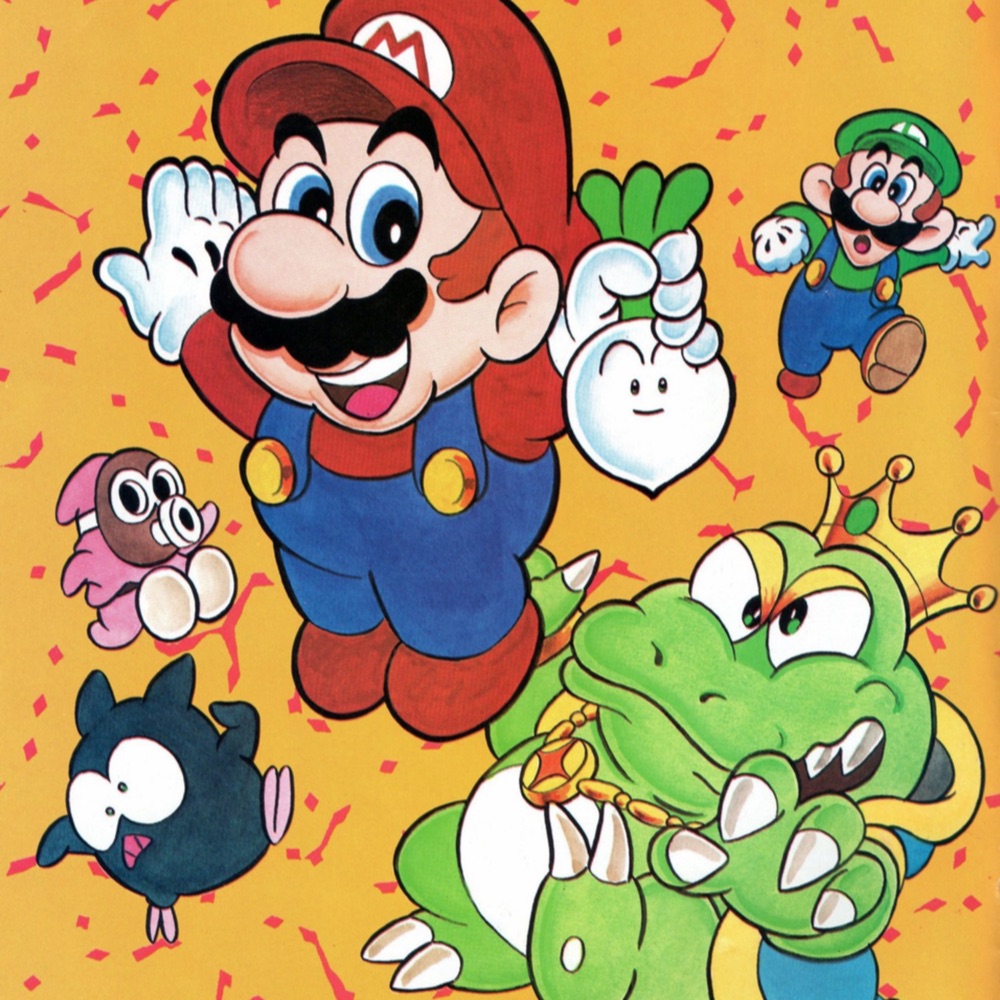
This time it's a fierce action-packed battle to free the land of Subcon from the curse of the evil Wart. It's up to you, along with Mario, Luigi, Toad and the Princess, to fight your way through bizarre multi-level worlds and find him! This time you've got a brand new kind of power - plucking power - and now anything you find can be a weapon. But beware! You've never seen creatures like these! Shyguys and Tweeters! Ninji and Beezos! And you've never had an adventure like this! Only cunning and speed can save you now...
SHOW NOTES
Super Mario Bros. 2 Gameplay
Doki Doki Panic
Super Mario Bros. 2 Japan
Super Mario All-Stars (SMB2)
BS Super Mario USA Power Challenge
Super Mario Advance
Super Mario Bros. Super Show (Mouser Clip)
The Story of Super Mario Bros. 2
This is not the Super Mario Bros. 2 Japan got, which is a harder Super Mario Bros. 1. Ours is Doki Doki Panic in a Mario coat of paint, known in Japan as Super Mario USA. Sam was back, so all four of us were here, and the question was whether a sequel that barely resembles its predecessor can still be great. It can.
What makes it essential
- It starts over. You fall out of a door in the sky and drop straight down. Pits are no longer just pits, and the game scrolls up and down as well as sideways.
- Four characters, no wrong pick. Mario jumps farthest, Luigi jumps high but slides, Peach floats, Toad is quickest. Sam stuck with Peach to cover for his platforming, and we split on whether Luigi or Mario was the better pick. No level punishes a choice.
- Levels you think about. The screen scrolls like Mega Man's, so you see every enemy before you reach it and can plan. Digging down through sand around Shy Guys became a routing puzzle.
- It hides lessons in plain sight. Birdo's eggs are more than ammo, you can ride one across a level. The birds in World 5 are your way back when the path ends in nothing.
- Movement without momentum. You stop on a dime, and the jump still feels right.
- A fairer game over. Two continues, no score, and a coin bonus game that tempts you into farming extra lives.
- The music. Better than Super Mario Bros. 1, we agreed: less iconic, more energetic.
What works against it
- Secrets with no clues. Warp zones need a specific vase in a specific level, and nobody could work out how the Dark Realm mushrooms were placed.
- Some sag. Mike thought the middle worlds were less exciting than the opening and the end.
- It is a transplant. Wart appears out of nowhere, and you can only hit him while he fires.
- It is a haunted house. The masks chasing you when you hold the key, and the eagle head you enter for the exit that turns into the last boss, are unsettling.
Beyond the game
Miyamoto's team first prototyped a co-op Mario and Luigi game about lifting and throwing each other, which became picking up vegetables instead. Nintendo of America pushed for the Mario version. It sold over 7 million copies and earned the best Nintendo Power scores of any Mario game so far: three perfect fives and a 4.0.
The bottom line
Essential. We voted under the majority rule, where three votes are needed, and it got all four. Sam went first and said it plays perfectly even if it is not what you expect. Joe had dismissed it as a kid because he wanted Super Mario Bros. 3, and now put it in the S tier. Sean teased us with last week's Spy vs. Spy, then voted yes. Mike prefers it to Super Mario Bros. 1. Nintendo R&D4 now has three games, and all three are essential.
Written from our conversation in this episode.
- Mario’s Back! Bigger and Badder than ever before!
- Introductions
- Let’s get it all out of the way
- Super Mario Bros 2 JAPAN is pretty much just a harder SMB 1...and we may eventually play that for the show. BUT NOT TODAY
- Today we’re playing Doki Doki Panic...okay but not really
- Gameplay
- The Characters
- Mario - Jump Farthest
- Luigi - High Jump
- Peach - Float
- Toad - Fast
- Many characters of Super Mario Bros. 2 have been assimilated into the greater Mario universe as well, such as Birdo, Pokeys, Bob-ombs, and Shy Guys.
- The Jump
- Holding down for a super jump?
- No more squash, fight by throwing
- Backtracking allowed
- Vertical Emphasis - Subcon
- Strange Moments
- The Key with the masks
- The door to the other side
- The eagle head that opens up after you defeat birdo (WHICH ATTACKS IN THE FINAL LEVEL)
- WARPS
- Game Over but you can Continue
- Birdo
- Boss Fights
- But does it feel like a Mario game?
- POW blocks from Mario Bros
- Sparks from DK Jr
- The crab guy acts like DK?
- The Characters
- It was all a dream...Maybe?
- The Music is GREAT! Better than SMB 1...I said it
- Development
- The sequel prototype is based on two cooperative players lifting and throwing each other, lifting and stacking objects, and scrolling the screen upward — a design too complex for the Famicom hardware and with dissatisfying gameplay.
- This then became Doki Doki Panic
- Which then became SMB 2 in the USA
- Sequels and Spinoffs
- Eventually released in Japan as the remastered Super Mario USA for All-Stars
- BS Super Mario USA Power Challenge
- Satellaview, mostly the same. Only start with Mario and some voice dialogue
- Super Mario Advance
- First GBA game!
- The Super Mario Advance version of Super Mario Bros. 2 includes several new features such the addition of the enemy Robirdo, a robotic Birdo, replacing Mouser as the boss of World 3; the addition of the Yoshi Challenge, in which players may revisit stages to search for Yoshi Eggs; and a new point-scoring system, similar to that used in the aforementioned BS Super Mario USA Power Challenge.
- Reception
- over seven million copies sold and is the fourth highest-selling game ever released on the Nintendo Entertainment System.
- EGL
- Next week -
Found automatically from the transcript and checked, but it can miss things or pick the wrong page. Spot a mistake? Tell us.
Games
- Super Mario Bros. 2 mentioned at
The episode's game: the American Super Mario Bros. 2, a reskinned Doki Doki Panic.
- Super Mario Bros. 2 (Japan) mentioned at
The harder Japanese sequel, released in the West as The Lost Levels, with a poison mushroom.
- Super Mario Bros. mentioned at
The first game in the series, a launch title the hosts compare everything to.
- Super Mario Bros. 3 mentioned at
The next NES Mario game, compared for graphics and adventure feel.
- Super Mario All-Stars mentioned at
SNES compilation where several hosts first played the game.
- Mario Bros. mentioned at
Arcade game that the POW Blocks come from.
- Donkey Kong Jr. mentioned at
Arcade game that the Sparks come from, and a sequel with a mixed record.
- Donkey Kong mentioned at
Arcade game that the crab boss fight is compared to.
- The Legend of Zelda: Link's Awakening mentioned at
Game where Wart's sprite reappears as a dream-related enemy.
- Mario & Luigi: Superstar Saga mentioned at
RPG where Mario and Luigi use paired A and B button actions.
- Super Mario Advance mentioned at
Game Boy Advance version of this game, with Roberto and the Yoshi Challenge.
- Spy vs. Spy (NES) mentioned at
Previous episode's game, used for comparison in the vote.
- Zelda II: The Adventure of Link mentioned at
Next game on the show's list for 1988.
- Castlevania II: Simon's Quest mentioned at
Another weird sequel coming up on the show.
Hardware
- Famicom Disk System mentioned at
Add-on that Nintendo moved to, mentioned in the game's design history.
- Satellaview mentioned at
SNES add-on service in Japan used to download BS Super Mario USA Power Challenge.
Companies
- Nintendo Research & Development 4 mentioned at
Nintendo team behind the first two Mario games and Zelda.
People
- Christopher Nolan mentioned at
Director jokingly credited with the game, as a reference to dream-layer movies.
Film, TV and music
- Super Mario Bros. Super Show! mentioned at
Animated and live-action TV series that used Mouser and elements of this game.
- Super Mario Bros. (film) mentioned at
1993 live-action movie where the hosts first saw Bob-ombs.
Articles, videos and sites
- Nintendo Power mentioned at
Nintendo's magazine; it gave this game top scores and its first issue featured it.
Other
- Luigi mentioned at
Playable character with a high jump and slippery movement.
- Princess Peach mentioned at
Playable character who can float; rescued in the first game.
- Toad mentioned at
Playable character who picks things up fastest.
- Mega Man mentioned at
Platformer series a host felt similar for its screen scrolling.
- Birdo mentioned at
Egg-spitting boss and character; her fights involve throwing eggs back.
- Goomba mentioned at
Classic Mario enemy that is missing from this game.
- Koopa Troopa mentioned at
Turtle enemy; only its shells appear in this game.
- Bowser mentioned at
The usual Mario villain, who is absent from this game.
- Yoshi mentioned at
Dinosaur character compared to Birdo and tied to the Advance version's challenge.
- NEStalgia Essential Games List mentioned at
The show's list of essential NES games; this game earned a spot.
Auto-generated transcript. Each paragraph starts with its timestamp. Speakers are not identified.
Super Mario Brothers 2! Mario's back, bigger and badder than ever!
And welcome to NEStalgia, a chronological exploration of every NES game released in North America. I'm Mike. I'm Sean. I'm Joe. And I'm Sam. Welcome back, Sam! Hey, it's good to be back. I thought you died in the war. I respawned.
As everybody does. I think we have something that we have to get out of the way here, though, and it has nothing to do with Sam, unfortunately. It just has to do with this whole Super Mario Brothers 2 conversation. And that is that there is a Super Mario Brothers 2, but it's not quite the one we're playing today. It was released in Japan, and it's just a much harder version of Super Mario Brothers 1 with, I think, like a poison mushroom power-up as well and stuff like that.
And, you know, we may eventually play that for the show, but not today. Today, we're playing Doki Doki Panic. Okay, but not really either. We're playing a, you know, like a remixed version of Doki Doki Panic, which came out on the Famicom, and it came out as Super Mario Brothers 2, referred to as Super Mario Brothers USA in Japan. And that is the game we will be playing today. Everybody got that? Okay, okay. So Doki Doki Literature Club was also an expansion pack for Super Mario Brothers 1. I got it. Yeah, the references, if you pick up on them, they're subtle, but you can definitely see how Doki Doki Literature Club and Super Mario Brothers share like an extended universe.
So, you know, guys, I think we have to talk a little bit about the first game in this series, Super Mario Brothers, since that was a huge episode for us. It was an early episode. It was one of the original launch games on the system.
And, you know, we pretty much reference every single platformer. We talk about the game again. So can you guys just briefly go around and remind me why you liked the game so much? You want to start with you, Joe? Sure. Well, first of all, I think for all of the other games that we talk about where we reference Super Mario Brothers, I don't think that anything has really reached that level of platformer that Super Mario Brothers, you know, kind of introduced us to. Like, I don't think anything has felt as clean or as polished yet as Super Mario Brothers. And if that's not entirely true, if there is an exception, it's in a totally different way that it's polished.
There's just something about the feel of Super Mario Brothers, the feel of the jump and the feel of the level design that kind of makes it harder for other platforms to be judged properly or to be judged in a good light because it's so well done. What about you, Sam? Yeah, I'd also add that it's the way that enemies spawn and the way that levels are laid out hasn't really been matched. And in that capacity of the first one where each enemy is placed so that you can jump on them a very specific way. And it seems like the whole game is just expertly planned. Yeah. And Sean? I mean, I'm just going to echo what Dave said for the most part. It has a level of artisanship that it's really hard to fully describe.
That, again, just can't, it hasn't been replicated since. There's been games that I've been more excited about because they still have that air of novelty. But Super Mario Brothers was just so much of a classic and it hasn't really been lived up to since. Yeah, I think one thing that we said a lot in between these like 100 plus episodes between the two games is that a lot of these games feel like they're inspired by Super Mario Brothers, but they add an extra element or try to add in an additional genre working its way into the platformer. And it always just complicates things. I think of that game, like Mighty Bomb Jack. Was that the name of the game?
And that one was just like, yeah, it was just so bizarre because it was clearly Mario influenced, but it added in like Bomberman like tropes too. And it just didn't sell the idea enough. And I think that's the game. That's the problem with a lot of these games. You can't just be Super Mario Brothers one because then you're just trying to, you know, recreate a perfect game already. And that's going to be a problem for Super Mario Brothers two though, right? I mean, like it can't be just Super Mario Brothers one again. Nintendo of America already said they won't take the official Japanese Super Mario Brothers two. So we get this game, which isn't quite the same thing as Super Mario Brothers one.
Yeah. It's interesting that you mentioned that so many games are trying to, trying to, you know, are inspired by Super Mario Brothers one. And then all of a sudden Super Mario Brothers two feels like it's almost not inspired by Super Mario Brothers one other than some like little design elements and stuff. It feels like they kind of opened the, you know, they started over with their like basic rules of the game. Yeah. I think the most important thing to note is just even the way the game starts.
You start after you choose your character, of course. You start and you just fall from a door in the sky and it drops you vertically. The idea that falling pits might not be pits anymore and that you are now like able to traverse both up and down as well as left and right. I think that's like an immediate thing that just, again, it's a Nintendo design philosophy thing, but it's the first way to let you know this is not Super Mario Brothers one. This ain't your daddy's Super Mario.
So let's talk about the characters because we have, we have other than Mario this time. I mean, in the other game, you were able to be Luigi, but it was really just Mario. In this game, they actually give different character traits for Mario. He can jump the furthest. Luigi has like a high jump. Peach can float for a little bit. And Toad, as far as I understand, he can pull the vegetables out the fastest, but he's also just also the fastest character in terms of run speed. So what did you guys think of the characters?
Sam, you want to tell me about them? Sure. Uh, I went for Toad at first because I thought it was cool. You could be Toad in a game, which I wouldn't really think of being except for Mario Kart. But, and I didn't, I couldn't really immediately tell what the differences were between Toad and Mario, for example. But then I tried Luigi out and he was just way, way too slippery for me.
And I'm not great at platformers in the first place. So I'm mostly stuck with Peach because of the ability to fly and or glide. And I, I looked it up and there are some, like she, she picks up things the slowest, which I never really noticed because I mostly stuck with her because she can correct for my bad platforming. So that was my experience with it. I mean, I stuck mostly with Mario.
Uh, I, I did like to, uh, I do like the feel of Peach for every level once in a while. Um, but, uh, I, I thought that Luigi was a little too floaty, so I, I, I stuck with the OG. It's interesting because, uh, I, I, you know, I've played this game very, very little when I was, when I was a kid because I didn't have it. But I remember like playing it at friends' houses and stuff. Um, and I always, just in my head, I was always like, well, Peach is the best character because, because of the ability to kind of hover. And like you said, Sam, it corrects for my platforming. But then when I tried Luigi, I actually found that I liked him better a little bit.
I, I, I liked something about the, I can't really put my finger on it, but something about the floating with Peach kind of often like made me run into things more. And with Luigi, where it's just felt like a slower jump, I felt like I had a little more of that like reaction time control over it. Yeah, I was just gonna say, I played with Luigi for most of the game.
And then by the end, I switched to Mario for a while and actually found a lot of advantages to Mario as well. Yeah, I think the thing about Luigi with that high jump is because of the vertical nature of the game too. A lot of times it helps to just be able to like jump over obstacles or, or go to another part that maybe Mario or Peach or Toad wouldn't be able to reach. But Luigi can with ease.
Uh, but you know, there's a case for every single character here. And I think that's also something really cool because you can't design like a game around all four of those characters, but there's never really like a level that's like, oh, well, if you pick Toad, you're screwed on this level. Right. I would love to hear the, the, the case for Toad though.
Uh, not, not saying that sarcastically. I, I just didn't play with him enough, but the one time I tried, I just felt like his, his biggest advantage was like he can jump just as high with or without holding something. But that's just not very high. I don't know. That's all I noticed. I do really like that though. That the, like I could just see that printed in like Times New Roman in like a, a game's journal. It's just the case for Toad.
Abstract. I would say, I would say for Toad, because he can grab things and move around with them so easily. Maybe Toad is more of like the boss fighter character. You know, when you have to jump on Birdo's egg. I like that. And toss it back. Then Toad can, I guess in theory Toad does that the easiest. I guess that would make sense. Cause that's what I found after playing almost the whole game with Luigi. Once I switched to Mario, I was like, wow, boss fights are way easier with Mario. So I guess with Toad, it might even push that further in that direction.
Right. And this is a new look for a lot of these characters too. Even Mario looks more like how present day Mario looks than anything we saw in Super Mario Brothers 1. So in a lot of ways, I know Sam, you were saying it's just interesting to be playing as Toad at all. But in a lot of ways, this is the game that really introduces this Mario like universe and canon. And a lot of things that we remember for these characters doing happened in this game more so than in Super Mario Brothers 1.
For sure. Yeah. I mean, since I grew up with the Super NES, I always knew Mario as this much more like flourished character, I guess. Like it looks a bit more cartoony than it does pixelated. And they really softened a lot of the blockiness that the Super Mario Brothers 1 model had. And just across the board, the game looks a lot softer on the eyes, I would say.
Yeah, I'd say they look close to Super Mario Brothers 3 character models. Which, I mean, I know that that's just like one of the most popular games out there. And that's the one that, you know, introduced me to the series. And that's like, I think this game, even though it's very different than, you know, the gameplay style of Super Mario Brothers 1 and 3. It feels like it's, even though I know it was designed as a different game, it does feel like it's moving some elements in the direction of Super Mario Brothers 3, which is, you know, in the sense that it's, there's so many more secrets and, you know, there's the design element that looks a little more like it and a little more of that, like,
adventure feel to it rather than just the platform feel to it. Not that the first game only had a platform feel, but I just feel like it's moving closer to that adventure feel. I think a lot of the levels feel like puzzles instead of just random platforming. Yeah, I agree. We get more of that in Super Mario Brothers 3, too. Definitely. But I do think that in this game, it's, even if I, if I wouldn't say that it gets more necessarily puzzly, just the game, the design of the game makes it more, it's less about, like, reaction time and more about, like, thinking about what your next move is than I think, I mean,
other than Super Mario Brothers 3, I'm not the biggest Mario fan. I mean, I was obsessed with Super Mario Brothers 3 itself. But from, so from my perspective, it does that more so than any of the other main Mario games. And, you know, I think that has a lot to do with the fact that in this version of, in Super Mario Brothers 2, you're able to go back as well. In Super Mario Brothers 1, once you hit a far enough point in the screen,
you couldn't turn back and explore whatever you had, you know, even the block that you had just passed. Like, now that's off limits. And so this game has more of an adventure vibe because you are able to just, at any particular moment, slow down, take everything in. You're going to different worlds. You know, you start off in a grassy land and then next thing you know, you're in a desert.
And nothing else really comes to mind right now. But I think, like, just the idea that each world is different is better than how Super Mario Brothers 1 handled everything just being in, like, an overworld of the Mushroom Kingdom with the same looks over and over again. I think it also plays a part that there are times that you have to go back. Like, if you're going to retrieve a key or something, you have to get back to where that key is used. And while there sometimes would be another exit, sometimes you'd have to backtrack through a screen. And that just wasn't part of the vocabulary of Super Mario Brothers 1.
Yeah, that was a really interesting, like, element of the design, too, is that, like, the levels aren't necessarily always linear. Like, there's, like, something, a lot of times there's a level where there's something you have to go figure out on, like, how to progress. And even the fact that sometimes that includes using elements that have always, up until this point, been for other purposes.
I know there were a couple of them. I was actually, before we recorded, I was trying to scrub through videos of this to remember some of the times that I noted it. And the only one I remember off the top of my head is there's one level where there's just a random Birdo. Not a boss fight. Just Birdo is just there.
And you realize that for the first time, you need to jump on its whatever, the eggs or whatever it is that it spits out. Not to pick up the egg and throw it back at him, but to jump on it and ride it across the level. And I thought that was really cool where it's like, oh, I just haven't, I've been programmed by the game to think about this one way where if I stop and think about, like, what it's actually doing, I can utilize that for other purposes. And the game did that a few times. I wish I could think of the other examples that I, you know, noticed. There was one, there's vulture-y looking birds.
There were a couple levels where, there's one level in particular where you basically just have to ride the bird for the entire time. That's right, yeah. And you ride it back, right? Yeah. Well, yeah. And you have to jump to, like, jump onto things while you're riding it and then jump back onto it. And then jump to a different bird at one point. And there, I think there was a different level where you get to the end of the level and then there's nothing over there. But then a bird spawns going the other way and you have, you realize you have to jump back on it and go back to where you came from at the beginning of the level and you can jump over some barrier that was there.
Yeah, I think that was in World 5, Sam. And I remembered that, too. And I thought that was just, like, a great way to communicate that because you're seeing them the whole time flying overhead. And, you know, you think of them as just an enemy. But it's not until you traverse the entirety of the map and get to the other side and there's just nothing there that you start to think, like,
okay, did I miss a door or something? Like, did I do something wrong? And it's just kind of because of how frequently they occur and you see them moving against you in the opposite direction, it just kind of subtly communicates that in a way that you understand, like,
I probably should take this thing for a ride. Yeah. Did anyone get, like, a Mega Man vibe from Mario Bros. 2? Like, that it had some inspiration in terms of just the way that the levels are laid out? And I don't know if that's just because in Mega Man you were able to also go up and down and left and right as you choose and you weren't, like, locked behind anything. But I had this just feeling of this space. And maybe it had to do with also throwing projectiles that it felt like a Mega Man game in some ways. I can just see what you mean. I never felt that. But now that you say it, I think a lot of, there are some cosmetic things that could allude to Mega Man. I think the big one is just the way that the screen scrolls when you've hit the edge.
That's the only part for me that was super Mega Man-y. Yeah, that's what I was going to say, too. The way the screen scrolls, which I thought was another thing that made it, made the way you approach the game feel differently. Because it's not all about speed and precision. The way the screen scrolls, but also the fact that, like, you know, then you see all of the enemies present on the screen. There's no, like, surprise, you know, again, to that point of now you have time to just kind of breathe and think about, well, who do I really have to take out? Can I just jump over everybody? Do I have the right character to handle this thing that if I would do it a different way with Toad than I would with Mario?
I think a lot of that is just in the stage-by-stage design philosophy. That's kind of what I was thinking, where you really have to think about each encounter that you have and what the best way of approaching it is. Like, even when you're in those jars and you have to dig down what the best way of avoiding the Shy Guys is and, like, how you zigzag around them and stuff and planning your route back up. It kind of gives it a little bit more, like, a little bit more thought to the encounters than Super Mario 1 did.
Are you referring to when you're sort of digging through the sand? Yeah. No, that – I never really – because I used to own this on, like, in the All-Star, like, cart. Yeah. And I never really knew what to do with that, but it just clicked now that I'm, you know, an adult and have problem-solving abilities.
But I really enjoyed those because there was – I mean, it's not like it was super hard, but you were still engaged in, like, oh, what is the best – what is the optimal route here? For sure. Dan, you know, we've been talking a lot about the characters that we play as, but, Sam, you're talking about the Shy Guys. I mean, those are now an iconic thing in the Mario universe, but they weren't in the first game. But then there's also enemies that were in the first game, like Goombas. I mean, Goombas were the very first Mario – Super Mario anime, and they're nowhere to be found in this game.
I think there's Koopa Troopa shells, but no actual Koopa Troopas. Yeah, it's just the shells. It's very strange. What did you guys think about this mix mash of, like, you know, new characters, familiar Mario tropes? Like, did – I would imagine it would be welcomed. That it might feel like you're rehashing too much of the first game, you know, if you played this originally in 1988. I would say – so, just kind of off track here, going back to me owning this in the All-Star collection.
I played this as a very small child, like, you know, 7 or 8, 6, 7, 8. And I remember playing through Super Mario, Super Mario 2, Super Mario 3, and just feeling like 2 was the weirdest. And that 2 almost felt like some kind of fever dream. And I – just because, like, everything that is familiar to you, aside from the characters, is pretty much gone. And the things that would work a certain way don't work that way anymore. And I didn't know at the time that this was a, like, a reskin, pretty much. But I guess, like, sort of in my mental space, I still sort of recognize the patterns of that. But – and so, I mean, looking back at it now, like, even now that I have the explanation in my head of why these things are different.
So, it does still – it does still have this weird, like, it's not really Mario, but it is Mario feel to it. I don't know if that makes any sense. No, 100% it does because, you know, if you look at the three games in the collection, the way you played it as a kid and the way – I remember playing it for the most part. I did play the NES ones too, but I just remember from the All-Star collection.
When you play them like that, 3 is almost, like, learns nothing from 2 and goes back to the idea of just Mario being the main character that you play as. And, you know, there's emphasis on a vertical in a small way with the raccoon tail and stuff like that. But for the most part, you are just playing Super Mario Bros. 1, you know, with additional power-ups and a sprawling world. And obviously, it's a lot more complicated than that. But that's a time for another episode.
Super Mario Bros. 2 has this whole, like, picking up vegetables and throwing them at enemies thing that we're just not going to see again. Yeah. Yeah, there's something – because, you know, I think that now, looking at it – like Sean said, looking at it now with the knowledge that this was Doki Doki Panic and it was reskinned to be a Mario game and it was actually made as a totally different game, just happened to be by – Miyamoto made this still, right? So it's still by the same guy. It's still in his – it's in his development team, yes.
Gotcha. But that, you know, it was – now looking at it, like, knowing, like, okay, this isn't going to be a traditional Mario game. I think it's a lot easier to appreciate how good this game is. And I think if I were – if I bought this, you know, when it came out, expecting Super Mario Bros. 2, I might have just had this biased disappointment towards it. Kind of in the same way that if I, you know, if when – you know, if I was obsessed with Pokemon Red and Blue and then Pokemon Gold and Silver came out and it was just, like, a puzzle game or something.
And it could have been the best, coolest puzzle game in the world. I'd still have been like, well, this isn't what I was looking for. So, like, I get why this one, you know, had a little bit of a reputation of being regarded as the weird one. But I think then if you separate that and you look at it independently, you can really realize, like, oh, this is also, like, another really good game. It just happens to be very different than its original. So it's like I have a mixed feeling about it because I do think when you do a sequel there should be a little more recognizable from the original game generally.
I'll see you later.
Well, why do you think they got rid of – and obviously, like, let's pretend that they can change these things from Doki Doki Panic. Because if they really want to – I mean, this is their big flagship franchise. If they wanted to, I'm sure they could go into the game's code and change some things. Why didn't they make it so that when your character, be it Mario or anybody else, when you jump on an enemy, it squashes them?
Like, that was the whole gameplay mechanic behind Super Mario Bros. 1. And I get that in Doki Doki Panic it doesn't happen. But it's a little strange that you jump on top of these enemies and then you have to, like, just pick them up. That's really tricky. I think that if – because if you change the skeleton – I mean, so you're working with the skeleton of a game and you decide to change, like, a pretty significant feature.
You've pretty much ruined the entire thing. I don't think that this would work if they changed that line of code and got rid of the picking up of enemies. I don't think this would work at all. So I think it's just they – like, they took a holistic approach. They kept pretty much every part of the gameplay as it was. And, like, they changed a couple of the items to look like Mario items. I think another question that could be posed, though, is why didn't they maybe take some of the sprites from some of the enemies that are new? Maybe not the Shy Guys because those are cute. But – and change those into Goombas. So I'm not really sure what the answer to that would be. But I don't know. I guess it's worth discussing.
I would say that I think it makes total sense that nothing looks like it did in the previous game because nothing plays like it did in the previous game. And that you'll want to do – you'll want to approach situations with a certain mindset that you're used to from the first game. And if you see things that kind of remind you of that, then you'll go back into that. That makes sense. Super Mario 1 platformer mindset and kind of lose this. Like, all right, I have to pick up this guy so that I can throw him over here. And then that will do this. And that will do this. You know, it changes the way that you approach situations, I think.
Yeah, I see that for sure. And I think that, like, now with my 2020 hindsight on this, I think it was cool that everything looks pretty much, for the most part, different. It's a whole – you know, it's supposed to be a dream. It's supposed to be a different world. It introduced all these new characters. I think it's really cool. But I would – I mean, I can't see myself, if I were developing this, being brave enough to go away from what – from these enemies that were, like, so recognizable and successful and just that branding.
So, like, you know, kudos on them for sticking with that, even if that wasn't the reason. I mean, maybe it was just easier to do it this way. But kudos on them anyways because I think that they made the right call when it probably could have been seen as, like, the safer move to just make everything look like it did in the original game. Yeah, now that I think about it, if I were to step on a Goomba – if I jumped on a Goomba and it didn't crush, I would probably go insane.
Yeah, you'd be very dissatisfied. Yeah. You know, there are some Mario universe elements, though, in the game. There's the – we talked about the Koopa Troopa shells. There's the Pal Blocks from Mario Brothers. There's the Sparks from Donkey Kong Jr. and then there's the boss crab fight that kind of acts like Donkey Kong. So it's, like, none of those games are quite Super Mario Brothers 1, but they're still in this Mario universe and those things are added.
So, you know, this stuff happens, but it doesn't quite feel like any other Mario game. Right. But I felt like, you know, as far as the Koopa Troopa shells and the Power Box, the Koopa Troopa shells, I don't know. I imagine in Doki Doki Panic they were just something else and they were like, oh, let's make those couple of times you pull this thing out. Let's make it be something recognizable, like, easy enough. And the Pal Blocks, I mean, maybe there weren't Pal Blocks in the original game, but that's also something that's, like, not necessarily gameplay breaking because you could put them wherever you want. And it's – I didn't – they didn't think they were too frequent. The last thing you said, the crab thing, was that similar to Donkey Kong?
Just in the sense of the layout of it, and I believe – I don't think he was throwing barrels, but whatever he was throwing acted like how the barrels acted. I guess that's true, but that's different than adding, like, an element like the Pal Blocks or the Koopa Troopa. It's just more like – it just felt like an homage to me. Gotcha. But we also have cool new characters. You know, the Shy Guys are awesome, but we also have the Bab-Oms and Pokies, those cactus characters, and Birdo, you know? Yeah, Birdo still has some really weird, like, kind of nightmarish qualities to her. I don't know if you guys were ever kind of, like, put off by Birdo before. I guess I can't really explain it, but – Just a big hole in your face will do that, I guess.
Also, what is the thing that you pick up after you defeat Birdo? Is it Birdo's stomach? It's their soul. That's just the orb. Yeah, that's just part of Birdo? Well, no, it's the eagle's orb, right? Like, what is that eagle thing? You've got to get swallowed by the eagle. Yeah, it's a contextless, like – it's a contextless change that I don't even know if it makes sense in Doki Doki. It probably does, but I – it just – it feels so much like a childhood nightmare.
It's funny to think of, like, Super Mario Bros. 1 and then, like, afterwards the developers are like, oh, let's make the next one, like, a fever dream. Well, the first one was already pretty weird. You, like, went – like, you made it, like, a fever dream within the world that's already a fever dream. I like how in Super Mario Bros. 1 the little end-of-level minigame is how high can you jump on the flagpole? And this one's like, feed the bird. Feed the bird with yourself.
Yeah. There's just some strange moments in subcom, like, all over the place, right? Because, you know, we talked about the key, but we didn't talk about the fact that there are these masks that will then, like, chase you throughout the remainder of the stage. Yeah. It was also terrifying. I think that's the – yeah, the terrifying thing for me. Until you realize that they're actually pretty easy to keep under control. You just got to keep throwing the key away from you, and then they go away. And I talked about the door that starts the whole game, you know, that you just, like, open up this door and you just fall.
But, yeah, that's just so strange, right? Oh, yeah, that door, too. That's a good one, Sean. We should talk about that door. That's very strange. Yeah. Like, I always felt like I was in a place I shouldn't be. Again, this is seven-year-old me. It has a lot of weird subconscious effects on me that probably don't affect everybody.
But this game just feels haunted. It feels more haunted than baseball. And whenever you went to the Dark Realm, it kind of freaked me out as a kid. Isn't the Dark Realm the only place where, like, regular Super Mario Bros. music plays? Yeah, pretty much.
Wait, that is the Dark Realm? I guess I'm missing what we're talking about. Okay, remember when you pick up the chemicals and you just throw them on the ground and then a door opens up. Then you go through that door and it's a shadow opposite version of the place where you just were, wherever you were. And keep in mind that if you didn't pull any vegetables or anything, those things are still there. And now they turn into red coins, also, I guess, from Mario Bros.? That's right, yeah. I don't know why I was confused about what the Dark Realm is. There's only one thing that could possibly be Dark Realm.
You know, so I thought that was very strange. And I didn't quite understand that other than the mushroom that you can lift up to then get, like, an extra bar of health. Yeah. But how did that appear? What are the rules for that? I don't know. Maybe if you didn't disturb anything except for the plant that has the chemicals in it. I thought that they were actually planted in certain places in the level. Like, if you threw the door in the right place, every time the mushroom would be in that spot. Yeah, because I have thrown the door at a place that the mushroom was also occupying that space. I just couldn't pick up the mushroom.
Huh. Okay. You know, there's also the doors with the chemicals. You can put those on certain vases, and that creates warp zones. Did you guys know there were warp zones in this game? See, I didn't know that. I knew that there were, but I didn't know how to access them, or didn't really want to either, but... I didn't even want to access the warper. You didn't even want to go into the warper's scary places.
So you put it on the vase, and then... So you can't just put it on any vase. You know, you can't just be like, oh, this is a vase, so I'm just going to put the door on top of that. It has to be on specific ones in specific levels. On a specific vase. If you put it, yeah, if you put it there, sure. If you put it there, and then go down, you'll warp. It'll just jump to the next thing. It'll be like, welcome to World 5.1. And it doesn't, you know, like, that's it. You're just in there now. Spooky.
I just think that, like, things like that are, you know, it's great that the warp zone continues, but you just got to wonder, like, how would you know which vase to go through? Yeah, it's a little bit more ambiguous than Super Mario Bros. It was like, even as a kid, I knew, like, oh, I kind of want to get above the level. So you're sort of drawn to that if it looks like you're able to.
Whereas in this, it's kind of like a random trial and error, like, very secret thing. Yeah, and not even random because it's like the opposite of that because you put the door down, and your first instinct is usually, I want to go through the door, but this is deciding not to go through the door and losing it instead. Yeah. To try something else out, which I wouldn't think of normally. No. And we joked about the eagle head, and I think that that is very strange and just another endless layer of the strangeness of this game. Don't you think it's even stranger, though, in the final level when you have to, like, it becomes a boss?
Yeah, that's very unsettling because at this point it's become something that you've finally grown to trust. Okay, I'll let you eat me, you know. Every time I'll just climb into this bird's mouth, and then suddenly it's like, no, I am your enemy.
You know, I actually never, I haven't beaten the game. I think I got to World 5. Oh, gotcha, okay, yeah. No, this is legit, like, the last stage of the game. Yeah, it's like right after you beat a bird, oh, right? Yes. And then all of a sudden you're like, all right, I know what to do, I've done it every time, and then, like, the thing on the wall, the disembodied head of a bird, just, like, blinks to life and starts flying around at you. You'd hate it. I'm sure I would. I'm sure I'd have actual nightmares about it if I actually beat this game as a kid.
I'm sure I'd have actual nightmares about it.
We probably should also talk about Birdo. I mean, you know, we haven't really described what that boss fight is like, and it happens so often. Joe, do you want to walk me through it? Sure. I mean, in complete, like, contrast to Super Mario Bros. bosses or Super Mario Bros. 3 bosses, this, you're not directly, you know, you're not jumping on Birdo as many times as you can. You actually have to jump on the projectiles that Birdo shoots out. So these, like, white eggs that come out, you jump on them and then pick them up like you would a turnip or whatever other things in this game and throw it back, you know.
So it definitely is like a totally different way of approaching a boss fight than, like, really any other Mario game that I remember. Yeah, and Birdo's now, like, you know, in the Mario universe, it's a strange relationship of Birdo that only shows up in, like, party games, really, and is linked to Yoshi in some ways. Like, they're always kind of paired up together.
I never thought of the idea that, you know, Birdo was an unsuccessful dinosaur in the Mario universe and Yoshi comes around and everybody loves him, you know? Yeah, I mean, he looks like Yoshi. It's actually, this is the first time I've ever really thought about the fact that Birdo came first, right? Yeah. Oh, weird. Yeah, that's so weird because I always thought, like, oh, it's, like, such a weird, like, you know, it's like a bizarro Yoshi, but it's just not Yoshi. Birdo came first. If you're discussing, like, why we like one more than the other, like, Yoshi looks like a real, like, animal. It looks like an animal. It's cute. It's got a mouth. It has, it probably has teeth. It's got a tongue. And Birdo has a gaping maw.
So, I'm pretty sure that's why we like Yoshi better. Have you seen, Sean, the, uh, from the Nintendo beta leaks, the original Yoshi? I did. That, that's, that's pretty funny. It looks like a bad kid drawing. Yeah. And, and that would actually scare probably a lot of people.
While we're talking about boss fights, though, we don't have to really explain what they are, but I just kind of wanted to get your guys' feel on these characters. I love Mauser, the mouse that throws the bombs that's, like, the first real boss you fight. Oh, yeah. That's a sick boss. He shows up in Super Mario Bros. Super Show a lot, and he is, like, he talks like a gangster, like, with an Italian accent and everything. That's so funny. I like that. Yeah, he kind of looks like he, he would be, uh, like a criminal.
And not, and not just like, and not just like a, uh, um, like, you know, just an enemy. He looks like an actual, uh, guy with connections in the underworld. He's got a whole side hustle. Yeah. What's going on? Do you think Mauser will show up in Cyberpunk 2077? I think, you know what? It's, it's the sunglasses. That's what it is.
I think he will be, but the sunglasses will be, will be built into his head. Whereas Fry Guy is just a cool looking guy. Like, I wouldn't necessarily think that, you know, he would be a boss. I'd hang out with that guy on any given day. I think, I think he looks anything but cool. Oh, well, yeah. Sure. Which one's Fry Guy? He's the sun. He's like the ball of flame. I'm thinking like, like a French fire or something. Yeah, yeah, yeah. No, no. He is not the sun. He is just a ball of fire, if you will. But like, I still think that, that, you know, this is, this guy is better than the angry sun in Super Mario Brothers 3.
Which I guess we're not allowed to talk about yet. Can't talk about it. Yeah, just move on. Move on. Look at Fry Guy. He kind of looks like Captain Falcon a little bit. Fry Guy and Captain Falcon? All right. Sure. You gotta look it up. Yeah, I have it right in front of me.
I don't know if you're looking at the right thing. It looks just like him. No, I'm just. Yeah, if you look at the manual, it's like so different. Yeah. He's just like a ball of flame. I see what you're talking about, Sam. I see it. Thank you. He's got a little mask on. Yeah. I actually. Sorry. Go ahead. I don't know when we're done talking about this. I don't want to be. I'm sorry if I'm interrupting this.
But I don't want to move on from the sun from Super Mario Brothers because I thought of something. I thought of something to say about it where I think that the guys, the mask guys that go after the keys reminded me a lot of the way like I feel when the sun from Super Mario is after you. Oh, yeah. Yeah. Like they're very, very similar because it's just swooping down at you. You feel like there's like not much you can do, but like kind of try and jump out of the way until you realize you can throw the key.
So maybe that was, you know, maybe that was some inspiration for the sun. And, you know, we can talk about the three headed snake if you want, but like I didn't find anything too interesting there. We have to talk about Wart though. Was anybody expecting Wart? No, I wasn't. I mean, I guess again, this is another symptom of this being a holdover from the original version of the game. But it does. It does feel very wrong for it not to culminate with Bowser. But you already have Peach though.
She's already safe. Yeah. But like maybe he's just, you know, going to try and take her again. You know, Sam, I never thought about that, Sam, that like you saved Peach in Super Mario Brothers 1. So now she's a playable character with you in 2. Like that's kind of wholesome. Yeah. She didn't get kidnapped. She didn't just get kidnapped, you know? Like I like that. It also implies that Mario and Bowser never have any beef unless it's over a woman. Which I think is the big problem in Super Mario Odyssey though, if you've ever beat that game. At the end, Peach is just kind of like, you guys both suck. You only care about me when I'm like in possession of one of you.
I don't think that's a problem. I think that that's an evolution. Yes. You know, also one thing about Wart, other than the fact that I love Wart as a character and I can't wait for his return to the Super Mario universe. There's something about the boss fight though that, I don't know, it's just like it feels transplanted from a game that already feels like a transplant of a Super Mario Brothers game. Like it didn't feel like the rest of the game. It didn't look like the rest of the game. Did you guys think that was weird with his whole like dream machine thing?
Yeah. I think that the weirdest thing to me was that the whole game, there was never another instance where like you just can't hit Wart unless he's shooting things like firing projectiles. And there's really not an indication that that would be the case, which I just felt like was weird because I thought the rest of the boss battles were pretty like, they made it pretty clear what you should do. And also like feeding him vegetables is how he dies. Well, it does say in the manual that he hates vegetables. Ooh, that's an undercover tip right there.
And if this is all a dream, then that means that this is really just Mario exploring his fear of eating vegetables, you know, and getting over it at the end of the dream. He is holding a turnip in the art though. He is the most mischievous of all in the world of dreams. He created monsters by playing with the dream machine. That's what the manual says about Wart. So talking about that though, like, so I actually, after I played the game, I finally read the story in the manual and it got me thinking because, you know, even before, like just from, you know, just my basic knowledge that you, you know, of this game before I played it, I knew that it was supposed to be a dream.
And, you know, now after reading it, do we think that is a, this all took place in an actual fictional dream inside Mario's brain? Or was there something where it's like, oh, the dream, there's actually a dream world in Mario head. Cause they say like he was, there's something in there where it's like his curse, the curse Wart put on you in the real world won't have effect on you while you're asleep.
Like as if like, oh, you have to be dreaming to take on Wart. But he is an actual threat in like this world of dreams. He's like Freddy Krueger. He's like, yeah, exactly. Like, so then I was like, oh, is it supposed to be like, oh, it was a dream, but it was also like significant and real. Or is it supposed to be like the whole thing, even that part of the story was the dream?
Yeah, I guess that's a good question, but I have to like, just imagine that the Wart side of things is like, he's not just limited to Mario's dreams, you know, because he shows up in Link's Awakening as well, not named Wart, but it's the same sprite. Right. And so I have to imagine that Wart is just kind of like this dream troublemaker who shows up in people's dreams or plays a role in people's dreams. But that, you know, for all intents and purposes of the story, there is like a living, breathing dream world that Mario and friends can get to. It seems that like, you know, before the game actually starts, Mario has been experimenting with shared dream spaces and has accidentally gone too many layers deep and has fallen into dream limbo.
And like, in order to come out of this limbo, he has to get a kick. And that kick is that like that bottle that he opens at the end, you know? Yeah, yeah. And he needs to get back into the United States to see his kids.
You know, also, this whole thing apparently takes place in a world called Dreamland. Is that the same Dreamland that Kirby belongs to? They're all just different names for limbo, Mike. Gotcha. All right. I didn't know that this game was produced by Miyamoto, but directed by Christopher Nolan. Christopher Nolan, that's right. Yeah. The same director as The Dark Knight, one of the greatest movies of all time. Well, then he must have done the Super Mario Brothers film, right? Yeah. I think he had the, that was in the contract.
What else do I have? But, okay, a little aside, a little aside on the Super Mario Brothers film is that, so were Bob-omb's invented in this game? Yes. So the Super Mario Brothers movie came out after this game. I guess I just had no concept of when that movie came out. Yes. After this game. Okay. Because that's where I first heard of Bob-omb's was in the Super Mario Brothers movie. It's probably the only time you also heard of Fungus Among Us.
But wait a minute. What are the bombs with eyes and legs? Oh, wait. I'm sorry. I'm thinking of Super Mario Brothers 3, not the original. You're silly. I forgot that 3 comes after 2, in fact. It does. Numerically. Confirming that for you. Although, not in the case of Japan, though, because in that case, they didn't get R2 until after 3. Woof. But we didn't get their Final Fantasy 6. We got 3. Right. It's all connected.
Right. And their 3 was on a totally different console. Very interesting. We were kind of down on the game over system in the original Super Mario Brothers 1. And in this one, you get a game over screen, but you can continue, I believe, twice. Nice. So that seems like an improvement. It is. And also, there doesn't seem to be any score here. So it feels like it's not trying to punish you with a made-up system.
So it's just giving you a series of attempts. It's a little bit more clear, because it continues with scores. It's like, oh, now you're set to zero if you actually care about that. But this one is just giving you a few more attempts. Yeah, and I'm usually against the idea of having a complete actual game over. Like, all right, you've gotten to World 7, but you lost your last life with no continues.
Start over. And I still generally lean that way. But, you know, while playing, I did see some of the merit in that, that I was really thinking every move through about, like, not just, like, oh, I can't die here because that's, you know, there's big consequences to every time I die. Because that brings me one step closer to just being done with the game.
But also that I was thinking a lot about, like, okay, how do I farm coins so I can have more chances to have more extra lives? And, like, it encouraged me to do those extra things rather than just get to the end of the level. Oh, man. I still, if I were to really, like, come up with my actual opinion, I still think that as much as I think that punishment nowadays in games is just too nonexistent, there needs to be more punishment for failing.
But I think that unless you're trying to do some sort of crazy, like, Nuzlocke challenge or your game is based around something like that, I think that, like, having a full game over where you're several hour experience now, you just, you have to start from the beginning of the game and do everything over again. Just, it is not ideal. Yeah, I also think, just going back to the way you phrased the bonus stage, I mean, it's not really a stage, just, yeah, getting the coins for the bonus piece of the game.
And you said farming. And when I think of farming for anything in a video game, that just completely removes any kind of joy out of it. So that really kind of hurt my view of that going back now.
Yeah, but I guess it's not farming in the sense that, like, a lot of other games are, like, just dull. Because there is, like, still gameplay to it. Yeah. You have to think about it. But you could also, to your point, you could also, which I did do this, like, get into, like, a, all right, I found a good spot to get coins. You know, I'll keep getting coins here and I'll keep doing that. Like, you know, it did get a little tedious the way I was doing it at some points. But then that paid off in dividends later when I didn't have to start the entire game over.
Just work. You know, two thoughts on movement here, since we were always talking about how the movement felt in Super Mario Bros. 1. There's no weight to the characters like there was for Mario in Super Mario Bros. 1. They do kind of stop on a dime in this one, but I didn't really notice myself being thrown off by that. Yeah, I think that, I think Luigi has a little bit more, has a little bit more slipperiness to him.
And I think that that was sort of what put me off of playing as him. So they didn't completely get rid of it. And I think that since this is based on a non-Mario game, it probably didn't have the same physics going into it. But it's still, it's still, like, a good, it's still a good system in that it still felt right. Oh, yeah, the jump is great for everybody, too. It feels, you know, it feels natural. It's not, it's not a jump that forces you into a direction that you can't change on the fly. I like that. Yeah, this is actually making me kind of realize, too, like, we talked before about how, the original game was a lot more about, like, run, jump, be precise.
You know, it was a lot more about the motion, exactly. You know, I don't know if I'm articulating that perfectly. It was more momentum-based. Yeah, exactly. Thank you. Where this one doesn't need it, doesn't feel like it needs that as much because it's not as momentum-based. But this also made me realize, like, really for the first time that I, this is the first time I've seen something that didn't use that kind of momentum that I think still feels equally as good in a different way.
Like, up until now, I've kind of always felt like you sort of need that momentum in a platformer to make it feel weighty and to make it feel good. Yeah. Whereas this kind of proved to me, like, I guess, well, if you're, if it's a different kind, if you design the game kind of differently, it can still feel... It's not precise, but it's not. You can still feel right the way that you move.
But that's because it's a different kind of game. And not just because of the momentum. Exactly. Yeah, did anyone notice, too, that in Super Mario Bros. 1 and 3, I tend to, you know, for the most part, hold down the run button as I'm going across the game because the whole idea is just to get to the end of the screen, which is always on the right side of the screen. So I'm always just trying to get there the fastest and deal with things as they come.
In this game, I didn't really hold down the run button all that much. And that was because it wasn't really like a get to the other side as fast as you can game. Yeah, you've got to find where you're trying to go for the most part. Yeah, I only used run really to jump higher when I didn't feel like doing the, like, or couldn't do the, like, duck and charge thing that makes you jump higher. Well, yeah, I kind of forgot about that element.
Yes. Also, that's a thing that we haven't talked about yet. Yeah, you can use that to, like, just skip over parts of levels. You know, if you jump with Luigi on, like, holding that down, you can get to platforms that you were supposed to, like, go all the way to the right, jump up, get to the left. Like, I use that a lot, I'm not ashamed to admit. And you shouldn't because it's built into the game. There you go. Legal. It's legal. Very cool.
The music in this game is better than Super Mario Brothers 1. There, I said it. I've got it off my chest. I love this. I love all the music in this game. I won't argue that. I think it's more energetic also. Yeah, I won't either, actually. I think it's less iconic, but that's not the same as worse.
Right, right. Yeah, I would agree with energetic for sure. I think even just the overworld theme, whatever you want to call that, is very playful. You know? Not that the other song doesn't make you just want to sing, you know, in Super Mario Brothers 1, you just want to sing along to it. I think in this one, there's something that would be, like, fun to hearing that played on a, you know, real-life piano or something.
Yeah. Like, a hokeyness to it. I think that, like, in classical music circles and just in music theory, the term we're looking for is, it's more hype. There you go. Yeah, it's more hype. I always said that Super Mario Brothers 1 is like a water bender and Super Mario Brothers 2 is an earth bender. Huh. Yeah. I wouldn't say that. Because it's a little all over the place. Yeah, I would probably go closer to air also. Have you never seen the Super Mario Brothers show? I don't really know what I'm basing that on. Yeah, I've never watched the show.
Yeah. But, uh, yeah. Yeah. Which one? There was no one based off of Super Mario Brothers 2, but you could argue that's Super Mario Brothers Super Show because they, uh, they use a lot of the elements and sounds and songs from Super Mario Brothers 2. And meanwhile, there's also the Super Mario Brothers 3 show and the Super Mario World Show. That'd be sick. There was also a Legend of Zelda show and surprisingly, no Metroid show.
Really should have been a Metroid show. No. I'd still take a Metroid show. Like an R-rated Metroid with, like, parasitic monsters. It's gonna be on Disney+. Give me that. That's not fun. I don't see any reason for that. Yeah, yeah, I guess. But, you know, episodic. Do you just wanna watch Alien? Ooh, that'd be good. But, and give me Brie Larson as Samus. Yeah, isn't that happening or something? She wants it to be.
Oh, okay. Yeah. I say it like I'm like, she wishes. Yeah, that's how I took it. That's how, like, those people who were against Captain Marvel, that's how they say it. Yeah, she wishes she was Captain Marvel. Yeah. This one is actually one that I probably would have brought up even if I didn't make a habit of bringing up pause sounds weird anecdotes.
But, uh, when you pause this game with the music, I mean, Sam, you could probably describe this better than I could, but it takes out, like, it's, the music continues playing, but, like, it's just, like, the base elements of it. Is that what it is? Yeah. I mean, I, I thought that was kind of interesting that it, that was a decision that they made. Yeah. It's like, uh, you know, the, you're, the, the game is still on, uh, you're, you're still where you were, uh, but we're just taking a break. And the guy that, that plays the, the high MIDI keyboard is, uh, is, uh, is taking a little nap. Yeah.
It's funny. Cause it just, it makes you feel like, yeah, it's like it feels paused because like the, the stuff that feels more actiony is not going. Right. It still feels alive.
There was an alternate history where Super Mario Brothers 2 was not just a harder Super Mario Brothers 1, but might've been its own game that felt more like Super Mario Brothers 1. Let, let me explain. This is, this is our development section. If you will. There was a sequel prototype, uh, built by Miyamoto and his team, uh, that didn't have, I don't think it had the Mario sprites in there or whatever, but it was working on the idea of Mario and Luigi playing cooperatively and they have to lift each other up and throw each other, uh, stacking objects and stuff and scrolling the screen upward.
The design became a little too complex for the Famicom hardware. You have to remember they eventually phased that out and went to the Famicom disk system. So they didn't like how that gameplay system worked out and they moved away from it, but there was an opportunity. And I think we see a lot of Super Mario Brothers 2's, uh, you know, lifting and stacking stuff still in there. Uh, so it's kind of neat to think that they were always thinking about making a game with that concept in mind. Yeah. So did they ever like, I mean, I know that this game is pretty much that and that, uh,
um, that element made its way into it, but did they ever like fully do that? I haven't played many of the, uh, more, more recent Mario games. So, you know, it's funny because the closest thing I can think of, I don't know if anybody has played it, but in the Mario RPG, uh, franchise, I think this, I think it was either Superstar Saga or, uh, Dream Team, one of them uses the idea of like picking up the other character and like A button does one thing for Mario and B button does something for Luigi and doing stuff like that. But it doesn't have anything to do with a vertical emphasis or anything. It just has to do with interaction.
But I wonder if they just like have a list of unused ideas that when they go to Mario games, they just say like, Oh, let's use that. Yeah, I'm sure. But of course the game that, that this was eventually they just wound up making it into Doki Doki Panic. And instead of lifting other players and playing cooperatively, you just pick up vegetables and stack enemies and stuff. Cause there's definitely times for that. So to get my, my history straight here.
So then they, they started developing this Super Mario Brothers 2, scrapped it and said, okay, this isn't working. Let's make this, but let's use some of these elements and make Doki Doki Panic. And then they made what came out in Japan as Super Mario Brothers 2. And then they took Doki Doki Panic and then re-skinned it as Super Mario Brothers 2, which is what it was originally going to be. Correct. That's crazy. I never knew that.
And I think, you know, one thing to note there is that Super Mario Brothers 2, Doki Doki Panic, that was never like a Nintendo of Japan idea. They didn't really like give too much stock to this. It was really Nintendo of America who pushed for the idea of like, you don't understand. We just had a video game crash over here in 1983 because of games looking all too the same and, you know, no way to like get good quality. Your whole thing is this Nintendo seal of quality.
And then you're releasing a game that is basically the same thing as the first one, you know, cause there's really no graphic differences. So they had, they played their hand, you know? And going back, like, it's not that they were like failures by any means, but, uh, the Nintendo didn't really have that great of a track record for sequels up to this point. Like, yeah, like, uh, uh, Donkey Kong Jr.
was, was good, but then it just really went off the rails near the end there. So there wasn't that guarantee that like, if there's a new Mario game, it's going to be great. Yeah. I totally agree with that assessment because I mean, also just the idea of Mario being your flagship character, any game you put out with him as a risk, you know, we talk about how Disney doesn't use Mickey Mouse as like a character for films anymore because it would probably hurt if the movie sucked, you know, like it would hurt Mickey Mouse's image. Which, uh, Nintendo has to constantly take on that risk with Mario, but I wonder when does that like not become true anymore?
I'm not sure. I don't know. Cause I mean, you look at Zelda or something and a lot of people didn't like Skyward Sword, but then Breath of the Wild came out. So I feel like it's as strong as you make it. Yeah. I think that's true too of like, and also I think the big thing there, Sam, more than anything was that those two games could not be more opposite.
And there are definitely people that still like Skyward Sword, but it says a lot about a company willing to listen to the critical reception and be like, oh, they don't like it when we hold their hands. So let's just do nothing in this next game.
You know, if, if there is a sequels and spinoff section, this is it because, uh, this game, uh, as I mentioned, already came out in Japan as a remastered Super Mario USA. And then eventually that was released as Super Mario USA in the, um, no, sorry. It was released to Mario USA in the all-stars collection in Japan, but I think it still gets the Super Mario brothers two title in the all-stars collection in the U S and their Super Mario brothers two becomes the lost levels. Yes. Now that's, that's a bit of like possibly the first ever remaster seeing this on like, uh,
the Super Nintendo and seeing Super Mario brothers two and one and three with like these new graphics and stuff. But for the most part, other than like a few glitch fixes, the game is still the same. Yeah. I've heard, uh, people say that the games are somewhat easier and I don't know in what way they're easier. Uh, I mean, just the fact you can save probably, right? I, I, I guess that's, that could be part of it.
Um, I thought maybe it was a more mechanically, uh, uh, mechanically involved version of, of difficulty, but, um, no, I mean, from what I've seen there, it's just a, it's just a fresh cone of paint. And then, uh, and I'm not making this up, BS Super Mario USA Power Challenge came out on the Satella view. It's mostly the same, except for you only start with Mario and then you unlock the other characters, uh, as time goes by. And there's also some voice dialogue added to the game. And that's the internet surface, right?
Yes. The Satella view was the Super Nintendo internet service. You had to, uh, like at six o'clock at night in Japan, you had to like go on the Satella view and download the BS Super Mario USA Power Challenge. And then you'd be able to play it for a limited time.
So weird. I mean, what do you think about unlocking the characters though, instead of having them all at the start? I don't really care about it. I don't think it's good. It's fine. I, I, I just, the whole concept of, of the Satella view, we haven't, we have, we've spoken about it, but it's, it's still always tickles me. I think that having different characters be unlockable would make a lot more sense if there were drastic alternate routes that you could take with each one, but. Like you had to find them?
Well, like you, let's say in the first level, you see this path that goes somewhere, but you can't reach it because you don't have Luigi yet, but it goes to, it's like a whole new part of the first level. If that was the case and it would increase replayability, then I think that having unlocking characters make sense, but if it's not that big of a difference, then I don't really see why there should be a need to. Yeah. Cause right now I think it's like, it's made to be like a preference. Like what's your preference of the way you want to play?
Where I remember thinking while I was playing it that like, if they wanted it to be like, well, you know, you, you could do certain, certain fights, like better with Mario, which I think you can, at least I had an easier time with like boss fights with Mario and certain other things are better with Luigi. Luigi, they would need to have some way that you would know what's coming when you select your character. Like, it's not like I can, in the middle of the level back out and change my character because I realized there's something that's better with Mario.
So at that point, it's just like, well, you're just picking your preference and not like doing what Sam was just describing where you're picking your route or your way you're going to tackle each level. For sure. Yeah. It's almost like you have to make Super Mario Brothers 2 into a Metroidvania at that point. And then we have, yeah, then we have Super Mario Advance, which is the first Game Boy Advance game. And it also gets its very own like Nintendo Power Advance issue, which I think is cool because Nintendo Power's first issue was Super Mario Brothers 2, so that Super Mario Advance gets its own issue.
The Super Mario Advance version of Super Mario Brothers 2, which is kind of confusing that it's called like Super Mario Advance, Super Mario Brothers 2, but it includes several new features that I'm interested to hear you guys' opinions on. The addition of the enemy Roberto, which is a robotic Birdo.
I think Mauser is just gone from the game or he, no, no, no. Mauser is gone in World 3 and Roberto fits in for him there. So instead of fighting Mauser twice. It could probably for me be a little bit more nightmare fuel, but I think by the time I had a Game Boy Advance, I would have been able to take that.
But like weirdly, and I had a Game Boy Advance that I played a lot of stuff on, I never owned it. And it also had the Yoshi Challenge, in which players revisit stages to search for Yoshi eggs. That's kind of like... That's cool. Do you get something? Is that what you're actually on? Do you get to ride him? You don't get to ride Yoshi. Yoshi. That's kind of like the Game Boy version, right? The deluxe? Yeah, with the red coins, right? Well, there's a Yoshi egg in each level too.
Oh, okay. Yeah, I guess I didn't remember that part, but I remember they also include like 10 red coins that you have to collect, right? Yeah. There's 10 red coins and there's a hidden Yoshi block that you have to hit, but you don't know where it is. That's awesome. Yeah, I like things like this. The last one though, I think is gonna... I was gonna say it earlier, but I had to save it for our sequels and spinoff section. And Sean, they added a point scoring system back. God damn it. Is there any reason for that? I don't know.
It's injecting an antique into something a little less antique. You know, I don't like it either, but it also doesn't hurt. Like, I'm like, oh, if people like it, let it be there. I can ignore it. That takes up UI space. I don't know. Sure, sure. I'm just glad that they didn't add level time limits, which I don't think have ever really bothered me in Mario for the most part. Once in a while, one might get a little annoying, but like, I've always kind of thought like, I don't need this in a Mario game.
So I liked that there were in this game. So I'm glad that they, as far as I know, didn't add it to the advanced version. Yeah, I don't understand time limits either, Joe. So I'm with you on that. Oh, and there was also a voice dialogue too. I think some very annoying voice dialogue, if memory serves correct. I think Toad says something. I'm sorry that I can't remember exactly what he says, but he says it like every time he picks up a vegetable and it drives people crazy. So I don't know.
Maybe they just did play test with Toad and think like, wow, this could get annoying, but maybe they liked it. Who knows? Maybe Toad's supposed to be annoying. I think he is. Who decided that Toad was going to have a, like a smoker's voice?
He does. Yeah, he does kind of, right? He's like a kid that started smoking. Yeah, like a raspy, high pitch. Hey Mario, how are you? That is actually how he sounds on the Super Show. I don't know if you've ever watched it, but that is how he sounds. You got any cigarettes?
I swear he might have said that exact line. Were you the voice actor for Toad? You got me. And then last, before we get into the Essential Games list, I have to just mention that the reception for this game was very high. Over 7 million copies sold for the Nintendo Entertainment System, making it the fourth highest selling game on the system. Wow. It also got the highest scores from Nintendo Power for a Super Mario Bros. game, beating both Super Mario Bros. 1 and Super Mario Bros. 3. It got three perfect fives and a 4.0.
That's, uh, I mean, I'm glad that you saw that. It's very, you know, it is kind of controversial, isn't it? It is. Uh, you know, there's also, I'm just looking at the box art here for a second, something that we didn't bring up, but does anyone think that this game might actually be called Super Mario Bros. 2 Mario Madness? Oh, Mario Madness, yeah. Yeah. It's like on the label, but maybe that's just like a Pac-Man fever kind of thing and not like a subtitle. Yeah, I remember seeing that. I don't remember, I don't know why it's there. I think it's cute, but I don't know why it's there. It's like a little catchphrase, just like on there. It's exciting. I thought it was called Super Mario Bros. 2 Instruction Booklet.
I can see how you would make a mistake like that. It does look like a title, though, the way it's put there. Yeah. What's weird is that you can also, uh, yeah, it does look like a title, and then you can also get the version that just says Revision A on it as well, so it could be Super Mario Bros. 2 Revision A Mario Madness Nintendo Entertainment System. It's a lot, it's a big, it's a mouthful. But we're going to vote right now on whether Super Mario Bros. 2 Revision A Mario Madness
Nintendo Entertainment System copyright Nintendo 1988 is an essential game on our essential games list. Sam, it's your first episode back in a long time, so I'm going to let you have the very first vote for the essential games. Just a reminder for you that it always has to be a majority, so two votes doesn't get it in this time. Uh, you need three essential votes or more to make it an essential game. Okay. This is a weird game.
This is a really weird game. I, I don't know, um, I, I haven't played this game before until now, and I didn't really know what to expect, but it wasn't this. But it's so interesting the way each level breaks down, and I feel like I like playing this game maybe more than a usual Mario game, just because there's this kind of, this puzzle aspect to it that isn't there in the first one. And it's a very, very different game.
And I think that if you were going to pick between the two, between the first one and the second one, we're talking about completely different games. And so I think that this fits on the essential games list just fine. All right. That's our very first vote, and Sam making a power move with his return. Uh, Sam, can we expect that every single time you come back, you'll just vote whatever game we're playing essential? Absolutely.
All right. And, uh, you know what, Joe, just give it to me. All right. Um, so I, I had played this game when I was a kid, and I didn't care for it. And I think it was because what we talked about earlier, I was, I was a big fan of Super Mario Brothers 3, and I was expecting another game like Super Mario Brothers 3. And I, I always was like fascinated by it. I always wanted to play it. And then like, whenever the rare times I did, I was like, oh yeah, like I'd rather just play the other game. But now looking at it through the lens of like knowing this is different than, than a Mario game. I, I really, really appreciate the design in this game and the, the game design and the aesthetic design.
And I think that we've, we've got a lot of essential games on the list and there's still only a few where I would, you know, I would say Super Mario Brothers, uh, maybe The Legend of Zelda and, uh, and maybe Duck Hunt even that I, that I feel like I'm not judging it as an NES game. Like it just feels up to standard with a game I would play right now. And this, this is one of those, like, this is the first game in a long time that I feel like I'm, I, I'm putting absolutely no filters on my opinion of like, well, it was on the NES. This game like is just well-designed. It, it plays perfectly, even if it's not how you expected it to be.
Um, so for that, I mean, I think it, it has to be essential. I mean, there, there's, there was very little, uh, question in what my, uh, vote was going to be for that. All right. Uh, you know, Sean, you have a chance here to play hero or villain. So give us your vote.
All right. Well, we've heaped, we've heaped a lot of praise on this game and I did enjoy playing it. I really did. But I don't know if it lives up to the precedent that was set last week with Mad Magazine, Spy vs. Spy.
Um, no, obviously this game is essential. Uh, like I didn't really, I, if I could, if I could appreciate it as much as, as I do now, um, earlier in my life when I was too busy being terrified of Birdo, uh, or, or the Hawk mouths, like I would have been playing this throughout my life. Uh, this is a great game and it, it, it deserves to be in the S tier of the essential games list. Oh, I like that. You know, Joe, Joe has his like golden play it. So whatever, you now have the S tier of essentials and Sam, don't forget you have your, uh, jank folder. Oh, I haven't forgotten another jank folder.
Yeah. Uh, there's probably quite a few games that we played recently that you would have put on your jank folder. Oh yeah. Oh, cool. Uh, okay. So, you know, it's essential. I think that's great. I am going to tell you right now that I'm not going to hide my vote. It is essential as well.
And, you know, for me, I would say that I like Super Mario Brothers two more than Super Mario Brothers one. Uh, I, I know that it's different. I know that it's not even really a Mario game. I don't think that really matters, uh, when we're looking at it via the chronological exploration that we do on the show or it, you know, the fact that we're playing it in 2020 where things are terrible. This game is not terrible. It's, it's a great time. It's odd. It's interesting.
There are definitely some things working against it. I don't think that the enemy placement was like as awesome as it was in Super Mario Brothers one. And I think some of the, uh, mid worlds weren't as fun as it were exciting as the beginning and end of the game. Uh, but you know, Super Mario Brothers one was kind of repetitive in a way too. And I never felt like that held it back in terms of my essential game votes. I don't think that's going to do it for Super Mario Brothers two either. There's just comes to be a time now where you look at Nintendo R and D four who continues
to just make strictly essential games. If we're really looking at it, I think, uh, what do we have from them? We have three games and they're all three are essential. You're looking at Super Mario Brothers, Super Mario Brothers two and the legend of Zelda. I mean, how can you beat a track record like that? I don't think you can, Mike. I wonder what the next game we're going to see from them is. And I just checked it out. It happens to be Zelda two, the adventure of Link, our very last game of 1988.
Oh, I can't wait. Yeah. That one, you know, it's interesting because that there is some talk of that now, like getting a resurgence and being a good game. Well, I've never played it. I mean, I've had, I've had exposure to it, so we'll see. I've also never played it, so I'm looking forward to it. Nor have I. But I find it interesting that it's, uh, it kind of has a similar, like, uh, history with, like, the fan base as Super Mario Brothers two. The second installment, people think is, like, different and weird. Yeah, I mean, we're about to enter the golden age of sequels that are weird because we also have Castlevania II Simon's Quest, uh, coming up in between, uh, Super Mario Brothers two and Zelda two.
So there's just going to be this idea of, well, you can't quite, uh, you know, do a sequel the same way as the original game. Anyway, that's all the time we have for this episode of Nostalgia. I hope you were doing the Mario for most of the show. Uh, remember that you can always follow Nostalgia at NostalgiaCast on Twitter.
Uh, every day one person follows us. So it's your duty to, if you're not that person today, you should do that just to restore some balance in the world. I heard it does great things for karma and stuff like that. So definitely look into it. I don't know. Many people are saying it. Anyway. Set a reminder in your phone when it's your day.
Yes, when it's your day. Uh, uh, that would mean that, uh, for Christopher, you have, uh, next Tuesday is your day to follow. And, you know, uh, another thing, usually I tell you guys what the game is next week that we'll be doing so you know how to prepare. But I think this time I'm just going to leave all of the listeners in anticipation of our next game. There's no way of finding out either. Yes, uh, that's true. I'm Michael Esposito. You can find me at Esposito Film on Twitter. And I'll talk to you soon.
I'll talk to you soon.