132 · SPY VS SPY
Ranked #9 in our Top 10 NES Games of 1988 →
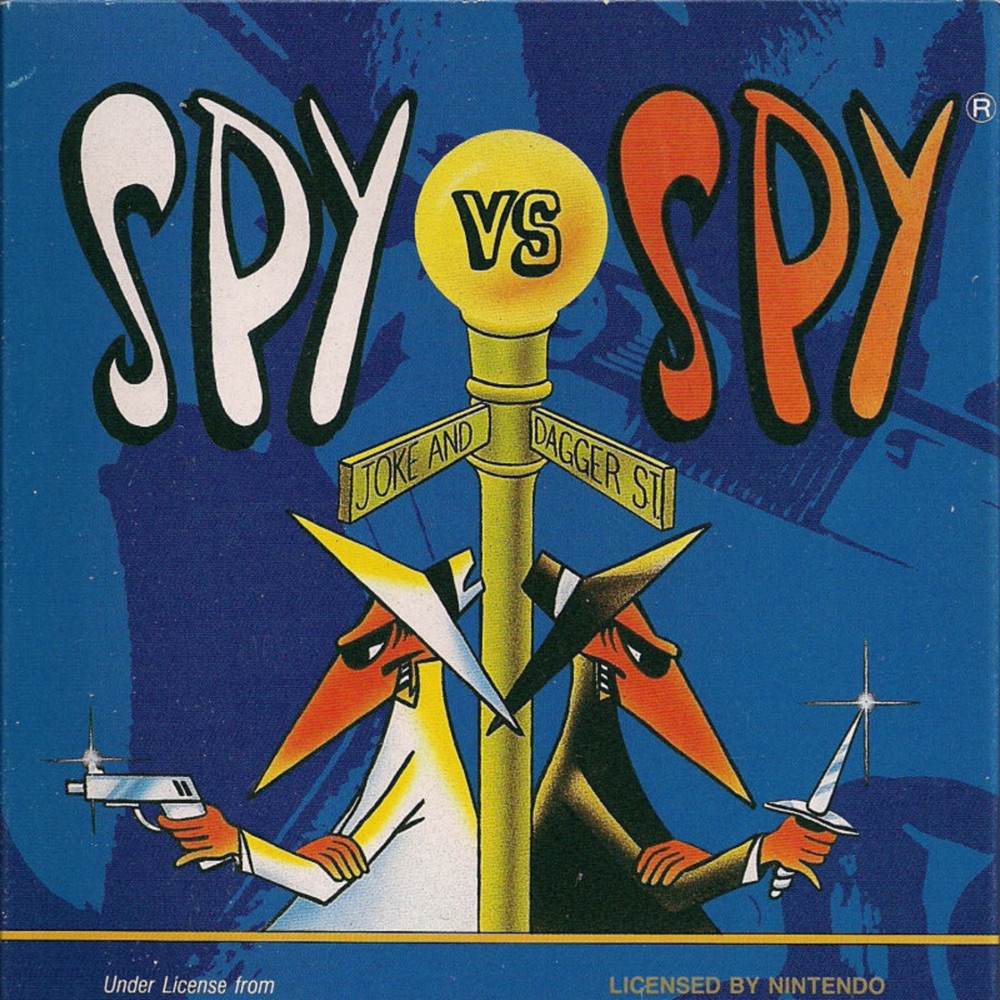
The black spy and the white spy are out to outsmart each other before the time bell rings. Find the needed objects (money, passport, secret plans and airport door key) by searching rooms in the embassy, which include desks, file cabinets and other furniture. Foil your opponent by setting creative booby traps in the various rooms (a bomb in a dresser drawer, for instance). Traps can be disarmed with objects found in rooms (a water bucket from a firebox on the wall will disarm the bomb in the prior example). When all the items are together in the secret briefcase, head for the airport door.
SHOW NOTES
Spy VS Spy Longplay
Spy vs Spy II: The Island Caper
Spy vs. Spy III: Arctic Antics
Spy vs Spy (2005)
Mountain Dew Commercial
Spy vs Spy (TV Show)
Mad Magazine #60 (First appearance of Spy vs Spy)
The back of the box calls Spy vs. Spy "Mad Magazine's first official computer game," which started an argument about whether the NES is a computer or a "control deck." The game started on the Commodore 64 in 1984, reached the Famicom in 1986, and got to us in 1988 from Chemco, a company we had never heard of. We could not play with a second person, which we felt was the real way to play it.
How it plays
You are the white or black spy in a base of colored rooms, on a split screen where you can watch your rival the whole time. Hunt through furniture for four essential items plus a briefcase to carry them, then escape before the other spy does or your clock runs out. Each death takes 30 seconds off the loser's clock. Bigger difficulty settings mean bigger buildings, up to a second floor.
What works
- Watching is the game. Peeking at the bottom of the screen shows where traps go. We had called it luck until we learned to split our attention.
- Depth from simple parts. Bombs, water buckets that disarm them, time bombs, doors you can block. We kept finding new plans: trap and kill early to drain the clock, or grab the items before any traps exist. One run ended with a chase through the rooms while holding three of four items on low health.
- Distinct rooms. Different colors and furniture, plus doors that do not sit on every side, make it easy to remember where a bomb is. Compared to Deadly Towers, it is a relief.
- Combat as a decision. It is baton-mashing, but it takes enough hits that you must choose whether to fight, flee, or split up. We felt that better combat would swamp the cat and mouse.
What doesn't
- Controls. Checking the map takes five presses of B, and doing so drops whatever you hold into the room's furniture. We wished it were on Select.
- Repetition alone. Without a second player, you are mostly searching every container. The computer spy avoids fights and just collects items, so the traps matter less.
- Odd split-screen rule. When two spies share a room, one of them jumps to the other's half of the screen. We could not agree whether this was a hardware limit or a design choice.
Beyond the game
Spy vs. Spy ran in Mad Magazine. We compared it to two Wile E. Coyotes with Road Runner brains. The sequels never reached the NES: Island Caper, a Famicom game with scrolling and crafted traps, and Arctic Antics, with a body heat bar and snowballs. We also remembered the Mountain Dew commercials.
The bottom line
Essential. Joe voted it first after saying it got better the more he played, and Sean followed, calling it the most unique game in many episodes. Two votes put it on the Essential Games List, our first addition since Life Force. Mike voted Play it, saying it felt archaic and he was playing for the show more than for fun, though he agreed to give it another try and expected the second player to be part of the experience.
Written from our conversation in this episode.
- Developed from the popular cartoon series, Spy vs Spy, is Mad Magazine’s first official computer game
- Introductions
- Is it wrong to call this a computer game?
- Mad Magazine
- Spy vs Spy
- Overview
- The object of the game is to collect various secret items in a briefcase and exit the building through a door to the airport, either before the opposing player exits or before the timer runs out. While searching for the items, traps can be laid to take out the opponent (or the player himself, if careless). Each spy has a personal countdown timer which depletes by 30 seconds upon each death.
- Gameplay
- Simulplay
- Traps and Finding items
- Trap em up
- Difficulty
- Escape the Room
- Combat
- Development
- Kemco brings this 1984 port mover. We never heard from them before, but it’s probably not a coincidence people are jumping on porting old games.
- Sequels and Spinoffs
- Spy vs. Spy II: The Island Caper
- adds a side-scrolling play area. Spies no longer start with a fixed number of traps but must collect the raw materials to build them
- Spy vs. Spy III: Arctic Antics
- switches the location from a tropical island to the arctic. The spies fight by throwing snowballs at each other and setting traps, which decreases their body heat bar. Tools include a saw to cut holes in the ice for the second player to fall into. Lost body heat can be restored by moving into a heated igloo.
- Spy vs Spy (2005)
- Finally a story mode
- Spy vs. Spy II: The Island Caper
- EGL
- Next week - SUPER MARIO BROS 2
Found automatically from the transcript and checked, but it can miss things or pick the wrong page. Spot a mistake? Tell us.
Games
- Spy vs. Spy (NES) mentioned at
The episode's game: a split-screen, two-spy race to collect items and escape, based on the Mad Magazine strip.
- Tom Clancy's Rainbow Six Siege mentioned at
A modern shooter with a trap-setting and fortifying phase, compared to the game.
- Deadly Towers mentioned at
An infamously bad NES game with a huge maze of near-identical rooms.
- Pac-Man mentioned at
Another older arcade game ported to the NES around 1988.
- Xevious mentioned at
Older arcade game ported to the NES, mentioned as part of the porting trend.
- Spy vs. Spy II: The Island Caper mentioned at
Sequel with a tropical island, scrolling play area and trap crafting; Famicom only.
- Spy vs. Spy III: Arctic Antics mentioned at
Second sequel set in the Arctic with snowballs and a body heat bar.
- Final Fantasy VII mentioned at
Game joked to have used a body heat bar long after Arctic Antics.
- Spy vs. Spy (2005 video game) mentioned at
The PlayStation 2 and Xbox game with a story mode.
- Sneak King mentioned at
Burger King promotional stealth game, joked about as the game we got instead.
- Checkers mentioned at
Board game used as a comparison for repeatable competitive play.
- GoldenEye 007 mentioned at
Nintendo 64 shooter compared to the game's hunt-and-peek multiplayer feel.
- Ghostbusters (NES) mentioned at
Earlier NES episode game that surprised the hosts negatively.
- Life Force mentioned at
The previous game to join the Essential Games List.
- Racket Attack mentioned at
Earlier NES episode game with a switch between serving and play views.
- Super Mario Bros. 2 mentioned at
Next week's episode game.
- Super Mario All-Stars mentioned at
Compilation where one host first played Super Mario Bros. 2.
Hardware
- Commodore 64 mentioned at
The home computer the game first appeared on before the NES version.
- Nintendo Entertainment System mentioned at
Nintendo's console, which the box art loosely calls a computer but Nintendo calls a control deck.
- Nintendo Switch mentioned at
Modern Nintendo console that also re-releases older games.
- Famiclone mentioned at
Cheap clone consoles that play Famicom games on HDTVs.
Companies
- Kemco mentioned at
The company that published the NES version of the game.
- Burger King mentioned at
Fast food chain that published Sneak King.
People
- John F. Kennedy mentioned at
Candidate in the 1960 election issue of Mad where Spy vs. Spy debuted.
- Richard Nixon mentioned at
Other candidate in the reversible 1960 election cover of Mad.
Film, TV and music
- Howdy Doody mentioned at
The puppet show character the Mad mascot was compared to.
- Pink Panther mentioned at
Cartoon series compared to the spies' mainstream presence.
- Wile E. Coyote and the Road Runner mentioned at
Looney Tunes cartoon duo compared to the spies' gags.
- Looney Tunes mentioned at
Classic cartoon franchise the spies were compared to.
- Moonraker mentioned at
James Bond movie that goes to space, joked about as a spy on the moon.
Terms and events
- Split-screen mentioned at
The shared two-player display where each spy can watch the other.
- Escape room mentioned at
Real-world puzzle activity the game was compared to.
Articles, videos and sites
- Nickelodeon Magazine mentioned at
A kid-friendly gag-and-games magazine compared to Mad.
Other
- Mad mentioned at
The satirical humor magazine where the Spy vs. Spy comic strip ran.
- Alfred E. Neuman mentioned at
The gap-toothed mascot who appears on nearly every Mad cover.
- Mountain Dew mentioned at
Soft drink brand whose 2000s commercials featured the spies fighting.
- NEStalgia Essential Games List mentioned at
The show's list of essential NES games; this game earned a spot.
- Bomberman mentioned at
Bomb-placing series imagined as an alternative take on the game.
Auto-generated transcript. Each paragraph starts with its timestamp. Speakers are not identified.
Developed from the popular cartoon series, Spy vs. Spy is Mad Magazine's first official computer game.
And welcome to NEStalgia, chronological exploration of every NES game released in North America. I'm Mike. I'm Sean. And I'm Joe. Guys, is it wrong to call this a computer game?
Well, Mike, this was actually a game for the Commodore 64 before it came to the Nintendo Entertainment System. And that's true, and you know I know that because I always have the sequels and spinoffs section towards the end of the show.
But I guess what I mean is, I'm just reading the back of the NES boxes. So do you think they just got lazy and didn't change what they were talking about when they put it on the back of the NES? I think if you want to get like really technical, you can say it's a computer game. Like it's like something like my grandparents would call an NES game, but like they're not wrong. I mean, the NES is a computer technically. So like, I feel like, yeah, they're not wrong, but they probably also were just like didn't change the description from the from the other version. Yeah. And Nintendo doesn't refer to it as a computer, the NES. They refer to it as the control deck. So this is Mad Magazine's first official control deck game.
Is that is that how we're going to go about it? I think that we were only we only saw control deck referenced in one manual, right? Yeah. You know, control deck that I don't know. I feel like I have seen that elsewhere. But yeah, it's it's strictly a technical term. It's not going to go anywhere. Anyway, this whole conversation has been silly. And you know what else is silly? Mad Magazine. Oh, did you guys read Mad Magazine? Yeah, I never read it. I never read it. So, Sean, how about you? I think I had, you know, to get them at the library, because I had a really, a really big old magazine section.
And they were fun. They were just like, you know, little satirical things, mostly, you know, insensitive humor about a lot of things that probably wouldn't fly now. But apparently it's still running. So I'd like to take a look at a more recent copy. Yeah. You know, what's interesting is, like, I looked at just the issue that Spy vs Spy premiered in just to see, like, oh, what is what is a Mad Magazine? And what is Spy vs Spy in a cartoon format? And what was weird about that particular issue was, one, it was very political because it happened to be the election issue for John F. Kennedy and Nixon.
So I thought that was interesting. But then, like, it also had this thing where if you read it one way, it acts as if Richard Nixon won the election. But if you read it backwards, John F. Kennedy won the election. Well, they were, they were clever like that. I always, I always thought that they had some really funny, like, gimmicks in their, in their magazines. And they never really dropped the political part. Like, I remember seeing one about the 2000 election. So that, yeah, that's just sort of their bag. I guess I didn't realize that it was that long running.
I didn't know it was, it was, you know, from what, the 60s? Yeah, I've only seen, I've only read copies from like the 90s, like late 90s and early 2000s. But, yeah, I mean, I'm looking at all the covers from across the history. And, yeah, there's a lot of them. I mean, even just to prove how little research I did for mad, doesn't that kid have a name? The kid who's on every cover? Yeah, that's Alfred E. Newman. Why did I think it was like Howdy Doody?
Because it kind of looks like a Howdy Doody. Okay. You see, I grew up with Nickelodeon Magazine. And I feel like that's probably on some respect similar or like an offshoot of Mad Magazine. Like that's where they got their influence from. Because that whole thing was filled with mostly just gags and like games to play, like crossword puzzles and other like pranks you can pull on your friends and stuff like that. So I imagine, you know, I got the general gist of what it was like to grow up with Mad Magazine via Nick Magazine. Yeah, it's just a much more youth friendly version. Right. I remember in Nickelodeon Magazine that they would have little sections that they had to designate as real.
Nickelodeon Magazine was the first time I actually found out that bed bugs were real. Like I thought they were just pulling my leg with that don't let the bed bugs bite. But then Nick Magazine did a whole special on it and like what bed bugs are and what they look like. And I was like, what are you kidding me? Like these things are real?
And I read that at a dentist office. So that's where most people read their magazines, right? Nobody actually gets these things delivered to their house. Yeah, I feel like, you know, if I ever picked up a Mad Magazine, it would have been at a dentist or a doctor's office. I don't know if I, I never, definitely never had that to my house. I can't say that about Mad Magazine, but I definitely got Nick Magazine delivered to my house. And I don't know why you're trying to shame me for it. I think that's just very bougie.
Also, Mike, you sort of made it sound like you got Nick Magazine to your house. You said you used to read, you used to go to the dentist like a lot. He went to the dentist a lot. He had cavities in every molar. I had braces for six years. No cavities. But braces for six years will give you a lot of visits to the dentist to read up on every issue of Nick Magazine.
Anyway, you guys want to talk about Spy vs. Spy? Yeah. But not the game? I'd like to talk about Spy vs. Spy, but not the game. Good, because I don't want to talk about the game just yet. I just feel like, you know, these characters are like D-level Looney Tunes characters that like you're just aware of their existence, but they were never quite funny. And they never really like were in the mainstream, but you're just aware of their existence. Does that feel right? You're dealing with the disrespect.
No, I kind of feel the same way though. I never, I never like experienced a Spy vs. Spy story. And you know, I kind of feel the same way. These remind me of any character in the Pink Panther cartoons that's not the Pink Panther are giving me the same kind of feeling. Oh, yeah. Like there's like the bad, bad guy that like I see and I'm like, who's that guy again? These guys, I'm like, yeah, I've always seen these guys around, but I never really experienced a story. This is my first Spy vs. Spy story I've experienced.
Yeah. Pink Panther I always found boring, but you know, Spy vs. Spy, like the only reason that it's associated with, like we've been talking about, we've talked about Mad magazines because Spy vs. Spy ran a Mad magazine. I don't know if we've clarified that yet. That's important. Yeah.
Um, but no, I mean, they're like one page and they're, they're quick and they're self-contained and they usually have some cartoonish gore and violence. So I always found them funny. Like, you know, some of the, the, the gags that they had were good. I mean, I can't say that every single one was great, but I'm also not the authority on Spy vs. Spy. I thought that was our whole thing is that we're not the authority on anything. Like we know so little about everything that that makes us qualified to talk about it. That's true. Well, for me, Spy vs. Spy is kind of like Wile E. Coyote and Roadrunner, except for it's like two Wile E. Coyotes, but with Roadrunner brains. Like, does that make sense? Like, yeah, that kind of makes sense.
Uh, you know, and so that, that could be amusing. I just never found it to be. That's too bad. Anyway, it's time we talk about the game. Uh, cause it's a, it's a little different and it's a, it's a little hard to describe. So I'm going to start off talking about what I think an overview of this game is. And then you guys will tell me how this game really is. Sound fair? Sounds great.
All right. So in my opinion, the object of the game, you got to collect like various items throughout the, uh, you're in like this base. Let's say, you know, and it's a bunch of different rooms and you're going through, uh, the dressers and the closets and all that to try to find things.
And you might find like a briefcase or a key or a bomb. Uh, and meanwhile, uh, the other spy, let's say you're the white spy. Then the black spy, uh, is also in real time as you going throughout these same rooms and looking for clues and also setting up traps. The idea is, is that before, um, before the opposing player finds the key and the briefcase. And I think there's maybe one other thing they need, but before they find those objects and escape the room, you have to escape the room by doing those same things faster.
Uh, I think that's about as much as I have, except for that. There's also like a time limit and that the size of the buildings are dependent on the difficulty you're playing on. What do you guys think? Yeah, I can, I'll, I think that was pretty accurate. I'd like to expound on it a little bit here though.
Uh, that one thing that I thought was interesting is that the game encourages you because it's a split screen the whole time. So you, whether you're playing another, another real person or you're playing the computer, you can see the other character and the game encourages you to like screen peak. Like you're supposed to watch the other character to see where they're planting traps. And then, yeah, you're trying to get these, these four essential items and the briefcase to carry them in before the other guy gets them.
Um, so I just thought that was an interesting thing. First of all, that it's, it's really the first, like, is it the first split screen game we've played? I want to say yes. And then as an early split screen game, it's, it's like, it's not even a, it doesn't even have the idea of like, well, you're not supposed to look at the other player's screen. It's just like, nope, they're both on the screen. Part of the game is watching the other player.
Yeah. I like also to clarify that there's only one of each of the items that you need that like, yeah, there's a briefcase. There's a, there's a bag of money. There's, uh, like a document and one other thing, I think a key. Yeah. And you have to get, there's only one of each.
You have to gather all of them before you can leave. So it encourages you to, uh, either, uh, spring a trap on the other spy or to just beat them up. Uh, if you find yourselves in the same room, uh, to take, to take the stuff so that you can get out. So, and, and yeah, like that, that whole split screen thing, uh, really adds like, especially if you're playing with another person, cause I don't really know how the AI takes into account, whether it sees you planting a trap or not.
Um, but it's, it's a really unique, uh, it's got a lot of unique gameplay mechanics in this thing. You know, I think we should talk about that simulplay a little more because, you know, this is something we haven't seen in any of the NES games so far. And it's probably, you know, still an interesting feature today to see in an NES game where the things that you do on the screen affect the other computer and other player, no matter where they are in the same building. You know, like Sean said, there's limited resources.
If you're in the same room, you have to fight. If you plant traps, you have to remember where those traps are planted for yourself, but also for the other spy, if you watch them plant something. So there's a lot going on there, but how did you guys feel about the execution of that simulplay? Uh, initially I was a little, I was a little frustrated because it did feel like some of, it did feel like some of where the traps are and stuff was a little luck based. Cause like, you know, you know that there's a trap in a room, but you can't tell which piece of furniture it's in. And you also know there's an item you need in there. Cause your map has indicators on where the items you need are.
So you kind of just got to guess one. But the more I played it, the more I kind of got the hang of like trying to keep an eye on where the player at the bottom of the screen was planting his bombs, remembering where things are. And I kind of developed a strategy to like get to the essential items as quickly as possible before there was time to plant bombs. And I, so the more I played it, the more I realized that that's kind of part of the game. I mean, the part of the game is that it is going to be luck based unless you can split your attention and pay attention to the, to the character below.
Yeah. And, and as I started to kind of get the hang of that, I started to like it a lot more. Yeah. Cause it really is. I mean, there are some bombs that are like pre planted, I think, uh, both throughout the levels. But if you're paying attention, nothing is luck based besides that. Uh, because you should be able to, uh, play and watch at the same time.
Um, I think it like some of the, but in terms of how in, in execution, these, uh, these elements come together, I think it's a, it's a much better idea on paper. Um, I, I still, I still enjoyed it, but I think that it's, it sounds quite a bit more, uh, engaging when it's described to you than when you're actually doing it.
Um, because like, if there were, if there was any more context to like, well, I should check behind this thing or I should look here because it makes sense in the game. Uh, what you're actually doing is you're just, you're almost mindlessly, excuse me. You're almost mindlessly just checking everything. It like, it doesn't really matter if, if where you're looking is a place that you, you would look in that situation. It's just that like the, they, there are obviously things where documents or keys could be hidden. So, uh, it, it does get a little, uh, it does get a little repetitive after a while, but the, the dynamic, if you're playing with another person, I think that the dynamic would, would be a lot more engaging.
If that makes any sense. I imagined just due to the state of the world right now, none of us were able to play with another person. Um, but, but I was the whole time kind of thinking that this would be, that would be the ideal way to play it. There were even sometimes there was one time where, you know, my strategy was to kind of collect every, collect everything, set them down in places. I would remember until I found the suitcase, go grab everything and we knew whatever I had everything in the suitcase except for one last item. And then I ran into the other spy and he starts chasing me. And in my head, I'm like, Oh, he's chasing me. Cause he knows I have all three of the four items.
And now he's going to let me do all the work, kill me. Cause I had low health. And then, you know, and I, and that was kind of really exciting. And I was finding the thing he was running after me. I was running through the rooms and then he just sort of like stopped chasing me because the, you know, NES, AI, whatever is, it was only so good. But then I was thinking if I were playing against another human, our strategies would be totally different. I mean, I would have the option to just watch the other person, let them collect everything while I go look for weapons. And then once they have everything, go kill them. You know, like there's different strategies, different ways to play.
Wait in the room that has the exit door. Exactly. Well, I think that that's like a, you know, that weird. The weird thing here is that they chose, and I get that this is probably in context of the, how the spies fight each other in the comic or whatever, but that they both chose the role of escaping the room where I feel like a better game would have been, you know, the white spy is determined on like getting out to the airport. And then the black spies job is to try to make sure that they don't escape. It's kind of weird that they both have the same objective.
I don't know, though. Because then it becomes like kind of like asymmetric in a way that I don't know that it's, I don't know. I kind of like the quality of it of just like you're both trying to escape with the items. So then there's no, there's like a balance in the gameplay. Yeah, you're speaking like a true, like spy versus spy amateur right now, Mike.
You just don't understand the deep lore and how it should be. It has to be, it has to be symmetric because they lose and win equally throughout, throughout the series. Yes. And I think more importantly, too, it would, it wouldn't help that much in the simulplay world. I guess I imagine a different game where like one spy sets up all the traps while the other person's in another room and then it's up to the other, you know, then you switch controllers or whatever.
And now it's that person's job to try to escape that room with all the traps that were previously planted. I don't know if that could work in real time, but I will take Joe's point of that, you know, it's a little more less, it's not asymmetrical to use Joe's words. It's not asymmetrical if both of them have the same objective. I just felt like to go back to a point Sean was making a long time ago, the fact that pretty much whenever you enter any room, the objects could be hidden in any particular
thing that you just have to like mindlessly check through things. And you kind of have to have like this game of memorization with yourself of what was planted where by the other person. So I don't check those things, but I do grab these things. But to be clear though, sorry to interrupt, but I just want to be clear that it's not, it's not whenever you enter any, you know, yes, when you enter a room that has an essential item in it, then it becomes like a little bit of a guessing game. But there's only like two or three things per room, if that.
But on your map, you still, it still does tell you where all the essential things are. So you can kind of make a route to go there and just try and keep an eye on if, if your opponent gets there, then you just, you only have to watch where they plant things if they're in one of the rooms. That's true. So, so like a lot of the other stuff is like a distraction.
Yeah. It's probably just something I didn't understand about the game to begin with. Cause I, I was not referring myself to the map, knowing that those things were telling me that these are where the essential items are. So I was going into every room, just kind of searching for whatever was next.
Yeah. It actually took me a bit to kind of figure that out too. This game takes some time to like really get your head around. But once you do, I think it's, it's a lot more fun.
Yeah. And I think a lot of the issues that can come into play when playing this game is that like you, you understand the concepts, but the way that they are executed are kind of strange because this game is actually taking advantage or is actually getting a little too ambitious with the amount of input that it can take from the player. Whereas if you want to check that map that Joe's talking about, you have to press like the B button five times.
And a lot, a lot of things are just unintuitive like that. Like in this, in the same, in the same vein, like another negative is that in order to check your map, you will inadvertently hide all of the stuff that you're holding in some container in that room. And if you're not, if you're not aware that that's a mechanic, then you'll just end up like missing everything and not knowing what, where it went. You know what I mean? Yeah.
And another, another issue I have with that element of like, in order to check your map, you have to drop whatever you're holding and it becomes hidden in something in that room. Is that if I'm trying to check the room I am in to see if there's an essential item by checking the map, I'm putting the item that was in my hand in the room. So I still don't know if there's another essential item in there. So you have to go like put the item in a different room somewhere else, come back into this room and then check, which, which is a little, I don't know why they couldn't have just made the select button to check your map. And then you wouldn't have to use the same button that is to change the item you're holding, you know, in order to check your map.
This might change if you don't, if you do have the briefcase, but before you have the briefcase, when you enter combat with the other spy, if you guys happen to be in the same room, something else also happens to your item too. Is it the same thing where the item just gets randomly placed in the room again?
Yeah. And then it's up to the winner to like find it in that. So like, then I guess the winner just gets to like kind of loot whatever you were holding. And whatever, whatever else may be in the room when you get there. Right. Got it. But like, does the briefcase protect you from losing all of your items in a combat fight or? No. No, I think then you just lose them all in the briefcase and then the other spy can get them all. So the risk versus reward.
Yes. Well, the only use for the briefcase is it gives you the ability to hold more than one item because otherwise if you find an item and you're already holding one, you'll just be swapping it.
So you do need the briefcase. Until you get the briefcase, you have to be playing that game of like, well, I'm going to hide this here so I know where it is and hope that if a player didn't see me put it here and all that sort of fun stuff. Yeah. And that's an element I actually also kind of really liked of like, especially getting to some of the later levels where the maps are a lot more complicated where you have to like, I put things in an order that you'll remember them or that you think you'll be able to get them all quickly. So then once you find the briefcase, you can get back to them all quickly and find them. So you have to really think about like, well, where's the other guy on the map?
How, you know, can I set traps to stop him from getting to this room? You can maybe block a door or something. And then will I have time to find the briefcase and get back to my items? There was just a, I was surprised at just how much there is to think about while playing this. I saw the game in on one particular website described as a trap.
I'm up. And I think that's hysterical, but just that idea of setting the traps too is something we haven't talked about yet. What did you guys think about, you know, both the, the traps that you set and the methods of like disarming those traps, if you want to get around them, uh, was that, I mean, like, I think it's actually enough for one time. I'm actually satisfied. I wouldn't be like, oh, well you need more options because games can be silly. It's like, I think this is the perfect amount of traps to have set. And that the fact that a lot of the things that you get disarmed are just available to you within these, uh, bases is really cool.
I agree. I think, um, it's a little bit of a stretch, but what this game kind of reminded me of is, uh, actually it's a lot, a bit of a, of a stretch, uh, but a more recent game, rainbow six siege.
There is an entire, uh, like segment of, of the match when you're playing where you're just supposed to like fortify. And that can include setting traps. Uh, and then the rest of the match is sort of, uh, based around, uh, getting, getting around the traps that are set and, uh, uh, kind of changing your game plan depending on how that was done. And while this is all happening at the same time in, in a spy versus spy, it still does. Uh, it still does have that, uh, amount of like you are, you are literally changing the game environment as you're playing. And that affects more than just you.
Uh, so I, I really enjoy the, like this game could still operate if it's just like find the things and don't let the other guy find the things. But the fact that you get to set these traps and, and, and change the environment in that way, uh, really does add to it. Yeah, I, I agree. And this is another thing that I think I would have, I would have appreciated even more in multiplayer because I actually, I use the traps a lot, but I pretty much just used the bombs because I figured with the AI, it didn't really make too much of a difference. What I planted, I could put a bomb up, but you can put a bomb anywhere.
So except for a door. So I would just put bombs everywhere. It was the easiest one to access and whatnot. But there is something to the, the, like there's the bucket of water that you can only put in a door and there's the time bomb that you can put anywhere that has a different effect that I think would be more useful to use against another like human brain rather than just the simple AI. I mean, you can block off an entire section of the map if you just put buckets of water in places. Right, right.
And then I started using the, uh, you know, the, the, the disarming buckets of water just whenever I knew that there was an essential item and probably a trap in the same room, I would just have one of those buckets of water in case it was a bomb, which I felt like it was most likely to be a bomb if, if there was any trap. So that helped me kind of like with my guessing, I would at least have a protection against the most common trap.
Joe, you had me curious. So I've, I kind of looked into the AI first five or spy just to see how they programmed the computer to play. And while this is by no means definitive, it seems like that the, uh, you know, the computer spy is less concerned on fighting you whenever possible and would, would rather try to collect the items as efficiently as possible and leave without ever making contact with you. If it does come into contact with you, it will fight, but that it actually tries to avoid fighting and, and just kind of clean up as fast as it can.
Yeah. They're kind of too, it's kind of like when you're playing against a computer, there's a completely different, uh, meta game going on. Like when you're playing against another person, you're probably going to be equally be trying to trap each other and maybe trying to get into direct engagement. But, um, the, the fact that it's, it's trying to get items so that you will have to go and find it. Um, uh, like it's, it's more acting like you're going to have to come and get me sort of thing. Like, I think that that's like a completely different kind of way to play the game.
Yeah. It's, it's interesting how the, the, all the different elements kind of come together and give you a lot of options of how to approach it. And I didn't know that about the AI, but that, that probably would make me think differently about the way I'm approaching it. But, but just for example, when I, when I started playing the game, my strategy was to trap or kill the, the opponent as many times as I could, because every time your opponent dies,
they get 30 seconds taken off of their clock. And once their clock runs out, you just have like free rent. You can just run around the map yourself and collect everything. That was my initial strategy. And after a while, that strategy kind of evolved to, instead of setting traps and hunting the guy down at the beginning, just once I kind of like learned to use the map, just kind of finding where the essential items are as quickly as possible before he could set any traps. So like, and I think those are just, those are like two ends of the spectrum of like,
of a number of different strategies you could use, which is just, I don't know, just keeps impressing me that this, this simple game kind of ended up just organically having so much depth. Well, that probably has to do with just the number of, you know, options available to you. You know, we were talking about the traps and the fact that there are traps to set, ways to disarm them for different items to collect. And, you know, there's this hand on combat too. I think, and also the number of rooms, you know, like, cause that increases as you scale up the difficulty too, to the fact that I think when you get up to a certain high difficulty, it adds like another floor, right?
Yes. So I think like, yeah, having like options for that kind of stuff is really cool. And, you know, just like kind of creates permutations of what's available to you. So in a way, I highly doubt that playing this game once, even with the AI computer would, you would play it the same way the next time.
Yeah, definitely. And something to mention about the maps and the second floor and everything too, is that you see the map and it's just a shape, you know, a shape on the screen, but there's not doors in every direction. So you might think, oh, I've got to go three rooms to the right. But once you get two rooms to the right, you got a dead end, you got to go around in some, so you have to also sort of memorize the door layouts.
And there are even some times where the second story, you climb up your ladder to get to the second floor and there's, there's only three rooms there. And you look at your map and there's eight rooms. Turns out there's another ladder somewhere you have to find on the first floor. So there's like, it's a little bit of a labyrinth too.
And I think it does make it, it is done in a much better way than, was it, was it the towers game, the deadly towers where there was a huge labyrinth of square rooms? And because these are smaller maps, it's much more digestible, but I think that they also do a better job of differentiating where you are on the map in a much more, more useful map layout as well. I think that just has to also do with the fact that deadly towers had like possibly as large
of a grid as like 10 by 10, which is very easy to get lost in. And especially when everything looks the same, I think, you know, to your point though, they did, you know, I'm not saying they made sense of like the architecture of a base or something, but like, you know, the fact that it isn't just four doors on every single side for every single room helps too, to like establish a sense of place in where you are.
Like this is the purple TV room and maybe there's another TV room, but it may be a different color and there may be a different piece of furniture in there as well. So yeah, the use of very distinctly different colored rooms really helped me to figure out like, okay, that guy's in the, you know, in the white room with a, with a shelf in the corner, but like made it a lot easier for me to remember where some bombs were placed and stuff. Yeah.
Which you've got to believe is just good play testing that like at some point there weren't different colored rooms and somebody can, you know, maybe the creator just complained about like, I can't tell where I'm going and it all goes the same, you know, I, I think that's the difference between a game like this and deadly towers is that deadly towers color palette was also, I think at that point, like, you know, we're really beating over the head how bad of a game deadly towers was like, you know, it was awful. So there's so much, it's not, yeah, exactly. It's not just bad level design. I mean, a bad temple design though.
That was just like a game that had a lot already terrible going for it. So it wasn't surprising. I think in Spy vs. Spy, it would actually be a bigger letdown if the rooms weren't established differently. Like if every room kind of looked the same, but like, oh, this one, the closet's a little over to the right, you know, like that wouldn't sell as well. So I'm glad that they took the time to make them look different. And I do think that once every 30 to 40 episodes, we just need to remind everybody how bad that game is. Yeah. I'm glad we stuck that in here.
You know, we didn't talk about combat yet. And that was kind of something that I really didn't like because especially knowing how like the trap situation works, I was a little surprised to find that it's just kind of you versus the other spy in like a police baton brutality face off. So, I mean, yeah, there's very little depth to the combat itself, but I think it's actually doing and I may be giving too much credit to the game is like, yeah, you're just button
mashing. But because you can't like clip through, you can't clip through the other person. And because it takes so many hits when you're unarmed to kill the other person, it's sort of like you have a little bit of time to make that decision of whether you think you can take care of this and just kill them right here and there. Or if you want to flee and think of a different way to dispatch your foe.
So, I mean, the combat itself isn't very fun, but I think the way that it's designed allows you to make different decisions of how you want to go about it. Yeah, I completely agree with this. And actually, I think, Mike, you kind of said something about this earlier about it being like a risk versus reward thing. Like there were a lot of times where I'm just trying to make my opponent's timer run out quicker. So I'm like, oh, I'm going to fight him. And maybe I have a weapon and he doesn't. So I'm like, OK, this is going to be easy.
But then there are some times where I have some essential items and I run in and yeah, you have that split second to like, OK, do I fight him? How's my health? How's his health? And like sometimes you would both just go your separate ways. It was just like this like weird standoff where it's like, yeah, neither of us find it worth it to fight each other. So we go your separate ways. Sometimes you get chased.
Sometimes you do the chasing. It was I thought, yeah, like you said, it's not not the combat itself that's good, but it's what the combat means for like your strategy and the rest of the game. And and this is me being a little picky here. But in a wishlist scenario, you would hope that if you enter the same room, it almost like the screen view changes to become like one giant screen where maybe, you know, the animation is a little more detailed or something. And you have more, you know, it's not the same restrictions and layout as the rest of the game. It's this unique scenario where you're both now registered in the same room.
And I'm thinking like, you know, because we just played racket attack that switch between serving and the rest of the game. You know, it's like you kind of hope that like it would just make that jump to open up a few more opportunities.
Not that you guys haven't sold me on your argument for why the combat being simple is fine. I just think like that was a moment for something a little extra in the in the cartoony department to, you know, like that is such a cartoony thing that you I guess like maybe there is something slapstick about just two spies beating each other over the head, like popping each other. Maybe that is funny, but I would have expected something else.
Yeah, I do think that and I don't know if I'd ever if I'd make this argument in any other context. But if you make the combat in this game too good, you're undercutting everything else. Like if that were the case and you're playing with another person and you thought that the combat was more fun than this cat and mouse thing that you're doing, you would just you just rush at each other and kind of ignore trapping and ignore everything else.
I think that if you made the combat too good, it wouldn't it would be a completely different game. I think that's a great point. I want to mention something interesting about the about the combat, though. The it's not a complaint or a praise. It's just it's just weird that, you know, if you're if you're playing on the top half of the screen and your opponents on the bottom half, when you end up in the same room together, one of you will move to their screen.
Yes, like you won't both be but the room won't be displayed on both sides of the screen. You'll just whoever was in the room first will stay on their side of the screen. And if I'm on the top of the screen and I go into a room that you're in, I'll appear on the bottom screen and there'll be nobody in the top screen for a second. I thought that was interesting and I don't know if that was a technical limitation or if that was a creative decision. I think it's I think it's sort of and I don't don't quote me on this, but I think it's also supposed to just hide what your inventory is like you kind of have the jump on this person so you can see what he has.
But he doesn't see how like what what key items you have. And I don't know why that that only is a thing when you're in the same room fighting. But there was some reason in the manual. I just don't remember. But you can't you wouldn't be able to see what item they have because as soon as you end up in the same room together, all of your items vanish and go in and get hidden into one of the rooms. Right. True. That's true. You got to imagine that it's more likely a technical limitation because to to draw,
you know, the same two characters that you're controlling as mirror inputs, you know, at the same time. So like having four of your total characters of things that aren't like pre render, not rendered, but like pre background stuff that's just fixed locations like to actually have input command that stuff. I feel like if that was the case, it would slow down the game dramatically to have that.
I don't know. I mean, like when you're in different rooms, there's there's more there. There are more unique sprites on the screen and it's it's handling input just fine. And we've played games that have more going on on the screen when there's only one one field to take care of. So I just I guess I can't really see it being a technical issue, but there would have to be a reason. I'm not talking about sprite limit, though, either. I'm not talking about like the amount of sprites. I guess what I'm saying is, is like to mirror the input movements that you do across both screens for both players at the same time. It just feels like, you know, that's some very cutting edge NES technology.
You know, I kind of agree with you, Mike. Even if it's not like a technical limitation that they couldn't have done and maybe they just thought it wasn't worth making, you know, yeah, both screens have to have to accept inputs from both players at the same time. Maybe they just decided like, well, it's just easier to do it this way. I guess so. Yeah, this is you know, this is a popular trend now for like the last five years. But this felt like an early escape the room style thing. Joe, you do a lot of those escape the rooms and you can tell me why this isn't an escape the room. But in a way, it kind of is right. I mean, I guess it literally is. And it has maybe the feel of it where it feels puzzly. It's never really like a puzzle.
You know, it's more of just like, I mean, I guess I guess it is a puzzle in like the in the actual definition of what a puzzle would be, but it's not the same kind of puzzle. But yeah, I can see what you're saying. It's like a very basic version of it where it's all about memorization and, you know, strategy and you're literally escaping a room. But otherwise, yeah, I think it's it's a much more basic.
The strategy isn't like, oh, you're going to solve the puzzles to get these items. It's just get these items. And the only the only antagonist to that is the other person. If the antagonist was the room itself, maybe. Yeah, I guess it's more just that like you have to come up with a way of thinking. It's just a cognitive way that you have to escape a room. Otherwise, it's not the same.
So Sean mentioned very early on in the episode that this was originally on the Commodore 64. It was on a bunch of computers, actually. I guess like that was the move for a game like this at the time. But that was back in 1984.
So Chemco didn't bring this game to any kind of console until the Famicom in 86. But we finally get it now in 88. And even though we've never heard of Chemco before this, like they haven't released any other NES games. It's probably not a coincidence that people, companies in general, are just jumping on porting these older games. All in this like one year of 1988. This has to be a result of the NES as a console just selling well in America. And now everybody rushing to port older games that are, you know, this way they don't have to program new games. Just get those into the hands of players faster, right? I suppose so.
So why do you think this is any different than any other game, I guess? No, I'm saying right now we're seeing a trend in 1988 of older games. You know, we possibly bring up like this game came out in 82. This game came out in 84. True, true. I'm sorry. You know, yeah, they don't all show their age, but it's like, you know, it's definitely not a coincidence at this point. This is definitely like a trend of the NES is now selling really well in 1988. And everybody just wants to get these older games ported over to the NES.
So this way they don't have to like invest the time to program new games. I mean, that's going to happen eventually, right? You're going to have to make new games. But for the time being, especially right now in this area that we're in where we've seen games like Pac-Man and Galaxian and stuff like that, where we've seen not Galaxian. I always say Galaxian, but I'm talking about Xevious. I don't know why I do this. This is every episode. I feel like the last five episodes.
I think, yeah, maybe it's a very Nintendo thing because it's sort of what they've been doing with the Switch for the past three years. Yeah, that's true. I think that's just a sound strategy, though, too, right? I mean, people who bought it aren't resistant to buying it again. And people who never bought it are probably going to buy it again, buy it now, you know, for the first time.
I agree. So other sequels and spinoffs, though, that are interesting to note is that there are two other Spy vs. Spy games in this series of Spy vs. Spy games. The second one being Spy vs. Spy 2, The Island Caper. And this one only came to the Famicom, so it is possible to play it on Nintendo hardware, just not the NES itself. And the Island Caper, as you can imagine, adds it to a tropical theme on a deserted island and adds a side-scrolling play area so you're not just in a fixed room. Your screen actually scrolls from left to right and up and down as you navigate the island. Spies no longer start with a fixed number of traps but must collect the raw materials to build them.
Ooh, survival. It makes sense, right? It was a crafting system. Yeah, so I actually found that interesting, right? A crafting system. Like, you know, now it's like this is one step away from being a Zelda game if the items break. You know, if the traps break, it's a Zelda game now.
Yep. So where do you go after the islands, though? Like, where do you set Spy vs. Spy 3 in? The moon. Oh, okay. There you go. The moon is always a great location, but this is not a fantasy game, so it would never be on the moon. I feel like some spies go to the moon. No? I've seen James Bond break the moon. Yeah, Moonraker. The James Bond movie. That's true. No, how about the Streets of New York? Streets of New York is a good one, too. Unfortunately, instead, it's Spy vs. Spy 3 Arctic Antics. Ah. Alright, so now you're in the Arctic.
And same thing as Spy vs. Spy 2, except for now, the spies fight by throwing snowballs at each other. And the traps that they set and the snowballs that they throw decrease the body heat bar of the other spies. I was going to make a joke about body heat, but you're being serious. I'm being serious. Yep. A long time before Final Fantasy 7 did it, there was a body heat bar in Spy vs. Spy 3. That's great. There are new tools that include a saw to cut holes in the ice for a second player to fall into. That's very cartoonish. I like it. And lost body heat can be restored by moving into a heated igloo.
Ooh. I like that the igloo has heat. Does the body heat just act as a health bar, or does it actually just, like, is it acting like a timer? It feels like a timer, right? Because you're constantly losing body heat, and then there's all these other things that make it go even faster, like getting a snowball thrown at you or falling in the ice.
Gotcha. So it's almost like they got rid of the mechanic of a timer and a health bar and just said just combine the two. And that's the, obviously, it's always going to be body heat. I like it. It's great. Yeah. But Spy vs. Spy 2005, which I thought was on the GameCube, but then I found this whole, like, reason it got canceled and stuff like that. But it did come out on the PlayStation 2. So there is a game, Spy vs. Spy, PlayStation 2. Finally, a story mode in a Spy vs. Spy game. So that's all you really wanted to know about that one anyway, right?
As long as there's no actual, like, dialogue, I'm okay with it. You know, that's a good question. I should look at the cutscenes. I'm sure there are cutscenes. You know, one thing that we didn't talk about because it's not really a sequel and spinoff, but just where I actually now think of the spies more than anything, is I associate them with Mountain Dew. Mountain Dew. They had, like, a series of commercials throughout the entire, like, 2000s, from 2000 to 2010, of, like, Mountain Dew commercials.
Wow, I gotta look this up right now. Yeah, they were, like, fighting each other over the Mountain Dew. It was genius stuff, Sean. Very good. Yeah, I don't remember those, but that's quite possibly, like, where my subconscious memory of these guys comes from.
And, you know, I'm sure there was room for a Mountain Dew-sponsored Spy vs. Spy video game, but we never got it. Instead, we got Sneak King from Burger King. True. Oh, you know, I meant to ask, sorry, the Arctic Antics game, did that come to the NES?
It didn't. So we won't be playing any of these on the NES, but I would encourage people who are fans of this one, because it's so different from other NES games, that you might not, we might not play another one like this, that if you like something like this, try to get the Spy vs. Spy 2 Famicom version, because I know, like, a lot of people nowadays don't play on original NES hardware. They play on those, I think they're called Famiclones, this, like, series of, you know,
spinoff consoles that you can buy on the cheap that work with HDTVs, and they allow you to play Famicom games. So that's an easy way to play, and you definitely probably don't have to know English. Definitely, probably don't have to know Japanese, is what I meant. Definitely, probably. Anyway, we're definitely, probably about to do the Essential Games List.
Well, I'm going to start with the least surprising candidate, and that is Joe. Joe, you've been pretty hype about this game, so keep the momentum going and tell us your vote. Alright, so, first, I've been very positive about it, so I want to just get a couple of the, like, little negatives out of the way here, where one is that some of the inputs are kind of weird, strange decisions,
and are definitely not, like, the ideal gameplay inputs. And the other is that playing alone, it can get repetitive. I mean, eventually you're just kind of doing the same thing over and over again, granted there's strategy to it, but I do think that even with that repetitiveness, it has a way of kind of keeping itself somewhat fresh. And playing with a second player, I think, would completely get rid of the feeling of repetitiveness. It would be repetitive in the same way that, like, checkers is repetitive, where, yeah, it's just a competition. So it's, you know, it's the same thing, but you're trying different things, and you're trying to, you know, beat your opponent.
So for a while, while I was playing it, I was playing around with this, my patented golden play it idea, but the more I got into it, like, honestly, this game got better and better as I played it. So I think I'm going to give it an essential vote. All right, and that's one, so it just needs one more. Sean, will you please give your essential vote? Yeah, so I'm always very happy to see unique game mechanics in games. And this was the most unique game that we've played in many episodes. And while there is some jank, there's certainly some jank, and apparently you can play games like this on other retro systems. I think that it's enough of a fresh take on a lot of things.
And it's not like this hide-and-seek cat-and-mouse thing you don't really get anywhere else. I'll have to agree with Joe and actually give this an essential vote. All right, and with two votes, that automatically puts it on the essential games list. So this is our first one since Life Force to make it on the essential games list. That's an unlikely source. I know. I will still vote here just to break up the essential votes and make this one not all essential.
You know, I think I totally understand you guys' reasoning here, and it's cool that you can get a game like this that does things different and work out, because we've had games recently like Ghostbusters, where it's like, huh, that's not where I expect them to take that. And then it sucks, you know? So it's like, I wish they would have tried the males. Here it's like, oh, I could have seen this just being some stupid, like,
you and another spy on, like, a, you know, a giant grid-like system, and you're just hopping around setting up bombs in specific places, and, you know, almost like Bomberman, almost, like that kind of style. I could see them going that approach.
And they didn't do that. So there's a lot here that I like about it. But to be honest, you know, this game personally didn't click a lot for me. And I think in today's terms, it doesn't have enough... It's a little archaic to learn the systems and stuff like that. And I won't say that it's not satisfying once you get it down. It's just that in order to have a good time with it, you might be forcing yourself to play this game for a little bit. And I felt like I was doing this for the show and not out of fun. So I'm giving it a play it, but not a essential vote.
And Mike, I would... Because I felt that way when I first started playing it, I would still recommend you give it another chance. Because I feel like it just takes a long time to really get into it. And it just strikes me as something you would like if you really got into the weeds of it. And I think I definitely will try it again. You know, hey, we're going to be playing these essential games for a lot longer, right? True. Exactly. And me and Joe are going to play as soon as we see each other in real life again. Yeah, in three years.
Yeah, I think that's the part I'm also curious of, like, probably why I'm holding out is just to, like, to play with other people. That's probably part of the essential experience, you know? Yeah, I think it probably is, too. Is it weird for me to say that I almost feel this is... This is maybe a little out there, but I feel like this almost scratches the same kind of itch that, like, 007 Golden Eye scratches. There's just something about, like, going through these rooms, knowing your opponent is somewhere, trying to, like... And also screen-looking, because we all know you did that, too.
I would agree with that if only for the same reasons that you don't play Golden Eye today. It's that the game is now very archaic and not all that fun. Like, you know, you remember it a certain way, and that's it. Like, we have no nostalgia for these games. I should say my memory of Golden Eye... Granted, yes, there are control issues and stuff with Golden Eye, but just the core of the way I remember playing Golden Eye is just, like, the way I would play a more modern... Sure. It's just, for me, both this and Golden Eye, like, the way that they play out today,
you know, leave... Like, on paper, they're great games, and in the past, they were probably great games, but the systems have evolved beyond them, you know? It's like, if we never moved up from using the four C buttons to control directional movement on controllers, then Golden Eye would still hold up, but now we have, like, you know, a second analog camera that acts as the camera, so, you know, it makes it harder to play it today. Yeah, but I do think that the, like, things that went... that look worse now about Golden Eye
would, like, today feel a lot worse than the things that are bad about Spy vs. Spy, where it's, like, little input things that are weird, but, like, once you get the hang of it, it doesn't feel, like, counter to the way you've been playing video games for the past 10 years. Or, granted, I haven't played Golden Eye in a long time, but I imagine if I picked that up, I'd be like, what the heck are these controls? Like, that's so different. Since Spy vs. Spy is just something that's, like, I've never played anything else like it to, like, train me into thinking a new way about playing it like I have with first-person shooters,
I don't think it's quite as much of a... It doesn't hurt as much to, like, have to relearn that. All right. I mean, you guys have sold probably a good chunk of our audience on retrying this game. You know, I would say that Spy vs. Spy is not a game you hear often in the conversation. So if our listeners have any thoughts about Spy vs. Spy, or if you were remembering Spy vs. Spy from your childhood and now you want to go out and play it again, I think this is a good opportunity to revisit that if you didn't in the week leading up to this episode. Of course, you can always let the NostalgiaCast know how you're feeling about the show and all of the games that we play by tweeting at us at NostalgiaCast on Twitter.
And next week, we have another pretty big game coming up with Super Mario Bros. 2. Is that a sequel to the Super Mario game that we played, like, a long time ago? It actually is. It is in the sense of if you try hard enough to imagine it as a sequel to that other game. Yeah.
Okay. I'm looking forward to it. I mean, it's... I will say that I'm cheating here because I actually owned this game way before this and I love this game from Super Mario All-Stars. So, like, this is the cat's pajamas in terms of underrated Super Mario Bros. games, for sure. Not to color anyone's opinion. I can't wait to get colored. Okay. That's great, too. I'm Michael Esposito. You can find me at Esposito Film on Twitter. Please join us again next Friday for Super Mario Bros. 2. Hope you enjoyed the Spy vs. Spy episode and the 131-plus episodes that came before it. Talk to you later. Bye. Bye!! Haz! Thank you.