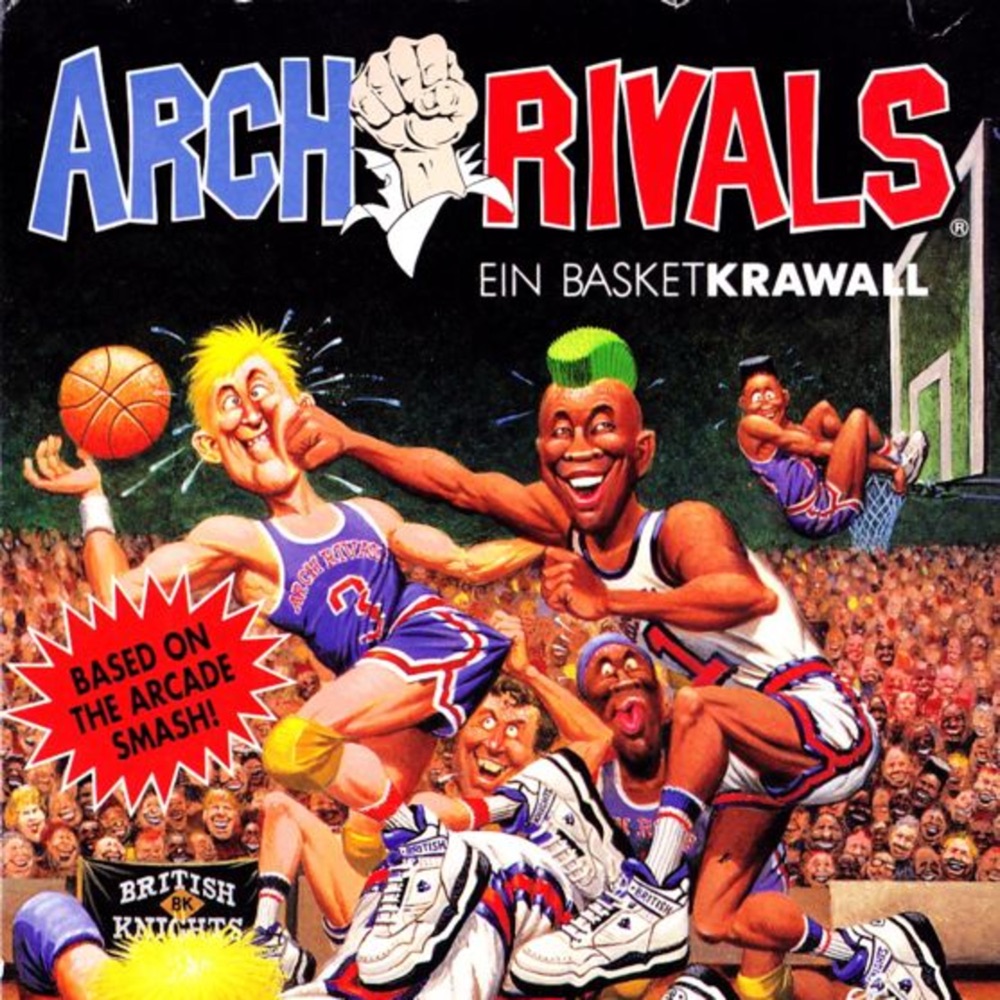
390 · Arch Rivals
Arch Rivals is a 2-on-2 basketball game that stands out from the crowd for its "no rules" approach. Fouling out other players is more than accepted, it's encouraged. Choose from twelve different teams and eight players, each with their own traits and personalities.
Arch Rivals is Midway's two-on-two arcade basketball game, out in arcades in 1989 and on the NES in November 1990. Punching, tackling and bumping the ref are all legal, and it works as a prototype for NBA Jam. Only Mike and Sean were on this one. We had a good time with it and still don't think you need to seek it out. Our verdict is Skip it.
What works
- The comedy. Nobody is hitting anyone Street Fighter hard. It's a pratfall routine: you poke a guy, he drops the ball, the tiny ref is in the way. Every basket triggers a short cutaway (a cheerleader, a yelling coach, a crowd that doesn't seem very into it), and the ball bounces out of the rim in extravagant ways.
- Dunks that leave a mark. Shatter the backboard and it stays shattered, which we preferred, the way a Rampage building stays down.
- Chaos you can read. Fans throw soda cans, but you can see where the debris lands and walk around it. The ref is a real obstacle you can trip over, and he enforces the one rule: a shot clock that drops to 10 seconds if you stall.
- Simple defense. After a pile of NES basketball games where we never learned what the steal button did, walking up and punching the guy was a relief.
- A good pace. Four three-minute quarters by default, and overtime on a tie.
What doesn't
- The scrolling court. Mike felt the other two players kept vanishing off screen, and that a tighter view would have made for a faster, more aggressive game. Sean thought this was already as zoomed out as basketball should go.
- Punching air. A lot of the time we swung and hoped. A miss locks you in place for a beat, and we never once grabbed a rebound ourselves, which made us suspect a bug.
- Eight players who play alike. Tyrone, Vinny, Lewis, Mohawk, Hammer and the rest have manual bios that hint at different skills, but we couldn't feel any difference.
- It plays its hand early. Within a couple of minutes you've seen the tricks. The halftime report mostly repeats the controls, which felt like a missed chance for jokes.
- Better with a friend. Against the computer it isn't as fun. A person is more likely to mess up as much as you do, and that's half the fun.
Beyond the game
The sneaker billboards are British Knights, a Brooklyn brand that signed hip-hop endorsers, including Cool Moe Dee and MC Hammer. Tyrone later turned up in the Power Team cartoon segments of Video Power, next to Bigfoot the monster truck. This was only Midway's second basketball game, after 1974's TV Basketball.
The bottom line
Skip it. Neither Mike nor Sean voted it onto the Essential Games List. Sean called it the best 8-bit basketball game we've played, and Mike enjoyed nearly everything about it. But it isn't full enough, and it doesn't have the depth of Tecmo Bowl, which we did vote Essential. Fun as a party game, and one you can pass on.
Written from our conversation in this episode.
- Introduction
- Hosts: Mike (keeps focus), Sean (cynical historian)
- What it is: 2-on-2 “basket brawl” arcade basketball, arcade by Midway in 1989, NES port in Nov 1990 by Rare for Acclaim. Known for legal hitting, slapstick hazards, and fast breaks. Wikipedia
- Why it matters: Prototype for Midway’s later arcade style that led to NBA Jam in 1993. WikipediaRetronauts
- General Overview
- Origins
- Arcade design and art: Jeff Nauman and Brian Colin, music by Dan Forden. WikipediaMobyGames
- NES conversion: Developed by Rare, music by David Wise, published by Acclaim. Wikipedia
- Release & Platforms
- Arcade 1989, NES 1990, Genesis and Game Gear in 1992 (Arc Developments, Flying Edge brand on Sega). WikipediaSega Retro
- Modes, Objective, Flow
- Four quarters, NES defaults to 3 minutes each. Overtime is sudden death if tied.
- Ideal quarter length for best couch play—default or shorter/longer?
- Single player or two player head-to-head. On NES, partner AI runs with you, you can call for passes or shots. digitpress.com
- Gameplay Mechanics (Deep Dive)
- Controls (NES)
- Offense: A = shoot or ask teammate to shoot, B = pass or ask teammate to pass. Defense: A = steal or punch, B = jump. D-pad to move. digitpress.com
- Legal Violence
- Punches and tackles steal possession without fouls; ref only calls shot clock. “Flying leap” tackle can send you rolling if you miss.
- Does the shot clock being the only real penalty push the game toward constant pressure?
- In arcades, the leap could pull an opponent’s shorts down, gag not present in home play. Wikipedia
- How does the legal punching/tackling change your approach to offense and defense?
- Is there meaningful risk/reward to jumping vs. punching on defense?
- Mix punch, steal, and jump to bait turnovers. The shot clock is your only real penalty, so press constantly. Wikipedia
- Punches and tackles steal possession without fouls; ref only calls shot clock. “Flying leap” tackle can send you rolling if you miss.
- On-court Hazards
- Floor litter like soda cans and candy wrappers trips ballhandlers. You can also collide with the ref. Wikipedia
- Players & Traits
- Eight selectable personas with flavor traits (Tyrone defensive giant, Vinnie great player, Hammer rebound king, Moose real champ, Lewis top shooter, Blade crowd-pleaser, Mohawk tough and mean, Reggie All-American).
- Traits are mostly guidance rather than hard stats on NES. digitpress.comdigitpress.comGiant Bomb
- Teams & Presentation
- Teams are non-NBA. Arcade ops could rename colors and teams via “Hometown Heroes,” a local branding feature that let operators mirror real cities. Wikipedia
- Broadcast-style Flair
- NES includes between-quarter “Coaches Corner” segments and halftime cheerleaders, with visible British Knights signage, a snapshot of late-80s sportswear marketing in games. digitpress.com
- How smart is the AI teammate—when do you trust it to cut or take a shot?
- Where does Arch Rivals sit in the arc of late-80s/early-90s sports-game “attitude”?
- Development & Port Differences
- Arcade DNA
- Second Midway basketball title after TV Basketball (1974). Wikipedia
- Beyond the Game: Culture, Ads, and Media
- Sportswear Tie-ins
- British Knights brand appears in NES presentation segments. Good springboard to discuss sneaker wars and TV sports branding circa 1988–1992. digitpress.com
- British Knights was one of the first brands to use hip hop artists as endorsers, enlisting Kool Moe Dee for the brand's introduction to TV. “How Ya Like Me Now” was broadcast on the worldwide music channel MTV.
- In 1990, British Knights launched their most ambitious marketing campaign by signing rapper MC Hammer. The brand sponsored his tour, held in-store events and contests, and even featured him in a British Knights–branded anti-drug TV campaign.
- British Knights brand appears in NES presentation segments. Good springboard to discuss sneaker wars and TV sports branding circa 1988–1992. digitpress.com
- Cartoon Crossover
- “Tyrone” appears as a character in The Power Team segments of the Video Power TV show, one of the first multi-game brand crossovers on kids’ TV. Wikipedia
- TV show hosted by Johnny Arcade
- The cartoon was an adventure featuring Johnny Arcade and a team of heroes from different NES games and a Game Boy game published by Acclaim: Max Force, a policeman from NARC; Kuros, the knight from Wizards and Warriors; Tyrone, a basketball player from Arch Rivals; Kwirk, a tomato from the game of the same name; and Bigfoot, a monster truck that had its own video game.
- “Tyrone” appears as a character in The Power Team segments of the Video Power TV show, one of the first multi-game brand crossovers on kids’ TV. Wikipedia
- Arcade to Jam
- Arch Rivals established the blueprint for contact-heavy, high-pace, 2-on-2 arcade basketball that NBA Jam refined with an NBA license and digitized players. RetronautsWikipedia
- Versions & Comparisons
- Arcade vs. NES
- Arcade has more animation gags and operator customization. NES adds helpful UI cues like off-screen arrows, simple team stats screens, and quick halftime interludes. digitpress.comdigitpress.com
- Genesis/Game Gear
- Arc Developments handled the Sega versions, published as Flying Edge. Faster pace and slightly different camera feel compared to NES. Sega Retro
- Re-releases
- Arcade version later bundled in Midway Arcade Treasures collections. Useful for listeners who want to compare original arcade timing. Wikipedia
- Legacy & Reception
- Seen as a forerunner that made contact basketball fun and readable, paving the way for NBA Jam’s mainstream breakout. RetronautsWikipedia
- Trivia & Quick Hits
- The manual openly jokes “there are no rules,” then teaches you to exploit fast breaks and desperation shots. Good passage to read verbatim for comedic contrast. digitpress.com
- Post-game statistics screen on NES lets you recap scoring, rebounds, and team averages on-air, which is handy for post-match banter. digitpress.com .
Auto-generated transcript. Each paragraph starts with its timestamp. Speakers are not identified.
Arch Rivals, it's not just basketball, it's a basket brawl!
And welcome to NEStalgia, a chronological exploration of every NES game released in North America. I'm Mike. And I'm Sean. It's a basket brawl. Sean, they coined the term. No one's ever heard that. I'm sure, yeah, no one's ever said that before. I mean, maybe, is this like basketball?
Is basketball actually like anywhere near the level of cleverness as basket brawl, I ask you? I guess it really depends on who you ask. And you could do this with everything, right? Base brawl, foot brawl. Like, where's the, where's like the VHS copy of foot brawl? That's just like fights breaking out in football games in like the 70s and 80s. Someone has to own that. Yeah, they're probably a bunch of like, they're actually just like the old school kind of like VHS remix. Like they're not, they're just some guy like timing the record button on his VCR. Yeah. And it's funny that like, I feel like that stuff, like as clips has made it to YouTube,
but we need that's like, we need that full program like uploaded, right? There used to be like a collection of like baseball bloopers, right? Yeah. Hockey fights, right? It's like, just upload the whole 60 minutes, guys. Like we don't need to break this thing up. It was enjoyable back then. It's enjoyable now. And I guess, you know, for arch rivals sake, it's trying to at least separate itself from the other basketball games of which there are a shocking amount of on the NES because most of them are already doing like, okay, this is, this is five on five. This is two V two. This is street basketball. Like everybody's already kind of carving out a niche. So arch rivals, which is a interesting name, probably should have just been called basketball.
Uh, but arch rivals, maybe there's a joke about like, you know, you, how you shoot at the, at the tip of the arch or whatever. No. Okay. I think it's, I don't think it means anything. I think you're right. That is terrible. It's a terrible name. Yeah. So it's a two on two basketball, arcade basketball by Midway. Uh, first in the arcades in 1989, the NES port comes to us in November of 1990, which means we're almost done with 1990, Sean. Yeah. I'm still kind of counting down the days until I can say I was finally born during this movie. I'm sorry. During this game. Yeah. This has just been a movie guys. Everybody's been following the plot of the show, right?
Uh, but no, we, we, we, we keep, we keep inching closer and never, never quite getting there. And while the game is known for, um, making, uh, fighting and hitting and slapping, uh, legal, uh, I guess it's also like, it matters a bit because it's the prototype for Midway's, uh, you know, soon to be arcade game in 1993 and Charles Barkley shut up and jam.
Oh yeah. There's jam in the title. So I understand how you got confused, but it's not Charles Barkley shut up and jam or Charles Barkley shut up and jam Gaten, uh, which is everybody should check that out. Yeah. What I was referencing, um, the, yeah, it's very, uh, not obvious, but like, it's very close to what would become jam. I mean, I think like, it's kind of crazy that this game is basically like NFL blitz or NHL hits or yada yada.
And then they kind of toned it down for NBA jam. Uh, I would have thought usually it's like these things get more intense as, uh, as time goes on. Um, but yeah, you can definitely feel the, the lineage in here.
Yeah. That, that is a good point that, uh, especially once blitz hit the market that like everyone followed that with hits and slug fest and, you know, it got way more extreme than you have the street games. Uh, but I feel like even here, uh, it's, uh, you know, like, like the hitting and the bumping into the ref and everything. Like it is a, it is an interesting approach at like comedy as a whole, right? Like you're not hitting like street fighter hard, right? It's not like a beat them up style thing. It's like, you know, you're just kind of like, you're poking this guy and then you got the ball and he's on the ground and then you try to get out through, but then the ref's in the way. And he's tiny.
Right. It's just like, it, it, it's a little like silly, but in a way that like makes you again, like that comedy thing. And like, it doesn't make you like laugh out loud or anything, but I don't know. Like there was a lot of charm in this one. Absolutely. It's kind of all just a big pratfall routine. I mean, and like the, I wouldn't call them cut scenes, but like they maybe overdo that, but like each, each time you score a bucket of any kind, you get some weird image and like just the, the way that the ball goes in the net can be in that same like goofball vein. Like it just does the like really extravagant bounce outs or a really quick like rotation around the rim. And then this proceeds jam and how you can break the glass.
So all of it is kind of serving that, like, we're not taking this sport all that seriously. Yeah. And there are, there are four quarters to the game. The NES version defaults to three minutes for each quarter. If you're tied after that, you go to overtime.
What is the ideal like amount of time in it? Not even just in basketball games, but just in like, like, like time in your head of how long a quarter or a, um, you know, uh, a half or whatever in any of these games should be. Is it like, is three minutes of real time a good amount? Is that too long? Should this be like so fast that you could pick up and play a full game in five minutes and then you just run it back? Like what, what's your thoughts there?
Um, well, I think it's four minutes. Uh, okay. So I think that's actually pretty good for like the pace of this game. It is pretty fast and there is a lot of stoppages. Like when, again, it has to cut to a two second image, uh, every time you score. So that time is also kind of getting inflated. You might, you might end up finishing a game in like a half hour of real time, um, at the, at this rate. So I, I think it's a pretty good pace.
Um, I, you know, when I would play sports games in my youth would try and go for realism and, uh, that would end up being very long games, especially when like the default is like a five minute period in hockey or something like that. Uh, and that can, that can sometimes like expose how unbalanced the game is because you end up scoring like 15 goals. If you're, if you're trying to, if you're trying to score a lot, I guess. I don't know. It feels all right.
It depends on the game though too. But I, like I was a huge, uh, Wayne Gretzky's 3d hockey fan on the N64. And like, if you were to somehow like set that to be an actual, um, you know, hockey period length, I don't know what the final score would be. Probably be like 99 to 91, you know, like just, just everybody's always scoring in that game and it's meant to be fast. But I also feel like in, you know, NHL, you know, 25, like it's not the right call to play a full match there either. Like it's almost never the right call to play the same length as, as an actual game is like, even if you're playing MLB, like when you play the full nine innings, it should never feel like you committed three hours, uh, of your time.
That's what I wanted. I wanted 20 minute periods of hockey and I wanted it to feel like, uh, it would like most games would end like three, two, four, three. And I could never find like the perfect sliders and settings to get there. There would always be like nine to seven or I would just get blown out seven to nothing.
But, uh, I was always searching for like the perfect simulation. So I was, I was always trying to, to, to get there. Now we can talk about the mechanics of the game and specifically the, I guess the basketball part, because there's the, you know, there's the violent part and then there's the basketball part. But rather than, you know, talk about the controls or the characters, I just wanted to start with that. The way that the game presents itself, as we said, is very, um, it's charming. It's silly. It has great presentation between the, uh, the cutaways and, uh, the breaks between, uh, the quarters. But the actual like presentation of the basketball, I don't know if you felt this way, but the court
I don't know. This feels very, this feels like NBA jam. Like it feels like that long. But for some reason, like, I don't know if it's the way that it scrolls, uh, from one side to the other, but it created a lot of situations where like, you just don't see the other two. And that creates like very confusing, like setups for, for both like to take down the opponents and also to like know where like you are in relation to your, uh, you know, if you're playing solo with your AI or with your friend, just knowing where you are on screen.
Like, I just felt like if everything was just kind of condensed to fit on like most of one single screen, this game would have been a lot faster. You would have scored a lot more and you would have been able to be more aggressive with your, with your punches and stuff. Because a lot of times, like I just would be hope that I, my punches would connect with the, uh, with the opponent. And instead the computers mostly were just like, you know, when, once the screen scrolled to reveal itself, it was like, oh, I'm left in the dust.
Uh, yeah, I think there's a balance here because I think that this is as zoomed out as I'd ever want a basketball game to be. I think if you go any further than you get like just really tiny sprites and the ball would be, we would be complaining about how small the ball is or, um, I, I felt that the characters off screen were as like, as like difficult to track as in most games that we've played.
So I thought that it was the right call to, because like, again, you only have to keep track of the two and I wasn't doing a lot of like blind passes ahead of me. I would usually carry it myself over the, over the half court line. And at that point, then you see everybody. So maybe it was just my, maybe it was just your, uh, your strategy. That's true. Because if you're, if you're being too aggressive, uh, which I guess I was trying to do for a large part of the game, like just constantly make sure that my opponent didn't score by stealing the ball from them, maybe it would have been better to just be more protective,
uh, in, in defense and, and hope that they missed their shot to be able to pick up the rebound. Because that was another thing that was a little challenging is once, you know, if they make an unsuccessful shot, uh, tracking where the ball is for me to pick it up, maybe I'm just Oh yeah. Trouble. I think there's a bug. I think there's a bug in the game. Cause I didn't get a single rebound on my own. Like it, I had to just hope that I would be lined up to punch them after the computer got the rebound. There's another interesting decision, uh, with the mechanics of the game that like, it doesn't matter how far away you are from the net.
You can take a shot and the ball must touch the net. There's no such thing as like air balls. Like it won't, it won't go in most likely. It probably has like a near 0% chance of going in from, uh, from beyond half court. But it's funny that it will just like, it's almost like a glitch to like pass the ball to your side of the, uh, the, uh, court to make sure that the opponent doesn't like quickly
steal it and then take another shot. It's definitely a cheese tactic that I was doing when I could tell that they were coming at me for like, I just inbounded and they're already pushing up. I'm like, I'm just going to make sure you don't get this or I'm going to delay you by five seconds to have to drive up the full court again. Um, but yeah, I, I did notice that a lot of it had more to do with your distance from
another, like it's even outlined. Like there is kind of like a mini instruction booklet in the game itself, uh, that like how far away you are from, uh, your opponent, like will determine the pressure on you, which has some effect on your accuracy. But I feel like there was more focus on that than there was like, this is from just beyond the three point line to this is at half court.
Yeah. So like, was it mostly, you know, for me, NBA jam is mostly a game where like, when I have the ball, I just try and like, you know, rush it and, uh, get a fast break and then just like, you know, do a cool dunk and score. And then like, hopefully, you know, regain possession. Is this more of a offensive game than a defensive game or do real players know that it's a balance and you, and you have to kind of play both sides?
Well, it's definitely more aggressive game because I think in most basketball games, I don't even know what the steel button is really doing. Like between the animation of just like some weird little, like, like spastic move. And I'd never know the positioning you're supposed to have during a steel.
Um, so I, I was always very confused when playing defense on these like NES basketball games. Whereas with this, it's a lot simpler. Like you just go up and punch the guy. And usually if you're on the same, like, I guess like Z axis and facing the right direction, he's going to get punched. And it feels very satisfying when you punch the guy and, uh, and he does drop the ball. So I, I wouldn't say that it's like, uh, a more defensive game, but I would say it's a much more aggressive game. Um, like whether you're playing defense or offense, you do have to kind of do what you were doing and just get up in there, whether you're just going to punch or if you're going to try and tackle them.
So tackling, I, I could never tell when a tackle actually was better than a punch. Maybe if you're chasing them or something, but yeah, maybe if you're like from behind. Yeah. Um, but I, I think that it's, you definitely need to get your shots off quick because the computer will punch you.
Yeah. Definitely more offensive focus. Yeah. It's funny. The manual mentions, uh, in the tips from the coach section, uh, follow the control movements given to you in, in these instructions, then experiment on your own. You might surprise yourself and your opponent with what you come up with. It's all in hitting the right combination of buttons at the right time. That makes it seem that there's like mortal combat level fatalities. Yeah. If you, but it, but it's not really that right.
Like I never saw any like fun animations. If I like the tackle is kind of like a lunge and that's silly in itself. But like, I didn't see any like creative animations other than punches and tackles. No, I, I, I guess there's a little bit of context based like adjustments. Like if you completely whiff you'll, uh, your tackle, you'll just sort of keep rolling, which I guess is cool. And depending on where you take a shot, um, you'll either do a jump shot or a not so flagrant,
um, dunk, uh, but, and then sometimes you'll do a really weird, like princess peach in Mario, Mario party, super Mario, uh, two, uh, where you'll just jump to the rim height and then very slowly get closer to the rim to dunk. Uh, which I thought was pretty funny, but I don't think any of those have like actual effects on the game. It's just different animations.
Yeah. Which maybe is what they were implying. Um, in the arcade version, uh, doing like a, a, a lunge towards the opponent could trigger an animation, uh, where you pull the opponent's shorts down.
Uh, that we needed that. We needed that. We needed more. Um, we just needed more, I guess, like flavor to the kinds of things. Cause I feel like we were exposed to very early on. You find these things out right away and you think like, oh, the whole game is going to be like this, but it kind of like plays its whole hand in two minutes. And then it just becomes, okay, now, you know, the systems and everything and what, and kind of like what to avoid. And now you just have to play basketball again. Like eventually with you, even with your friends, it eventually just becomes a game of, uh, basketball where you just like, instead of, instead of someone stealing the ball, they punch the ball, you know, they punch you. Like it's still the same thing.
Sure. But I think there's, you can get a lot out of that. I think that like, you know, if, if you can enjoy just a regular basketball game, then adding a couple weird twists makes it just as like, I could still play a full game or two with this. I didn't feel bored after learning that that was all I could do. I agree with that. I agree with that.
And, but is there any like meaningful risk reward, uh, to like, to the jumping or the punching as opposed to like, just letting them take the shot, rebounding, and then trying to take your shot. Do you, do you know what I mean? I think the jump. Yeah. I think that there's only risk with the jump because again, it never worked for me.
Uh, so I would, uh, near the end of, of like the first game, I just learned to just stand next to them. Uh, if it looked like they were going to take a shot, because at least I would apply some kind of pressure, like the game calls it and maybe they'd miss. Uh, but then you'd have to get in there and just start punching so that they don't get the rebound because I can't get rebounds. So there was also some like, you know, annoyance there.
Uh, and yeah, if you, if you do miss a punch, like if they're on the break and you think you can just step in front of them and punch them, if you miss, like you're kind of locked to that position for a split second and they can cover a bit of ground. Um, if you miss. So, uh, yeah, there's definitely risk reward. And I, this didn't happen in my playthroughs, but it does happen in the arcade, uh, game, which I didn't play. I only watched, uh, but like the fans even get involved by like throwing soda cans onto.
Oh yeah. That did happen on my game. Okay, great. So it, it, it does come to this port. And I think that that is like another thing that is like great to see, like a little bit of randomness. I know people hate like the tripping in super smash brothers brawl, but like, I don't know here. It's kind of fun. This is supposed to be like first and foremost, a party game. So I feel like things happening to chance again, like sometimes you take the shot and, um, the ball like really like rides around the rim for a little bit. Like these are all like positives to me in a game that otherwise should be like skill based.
And I think that it's not even as annoying as tripping in smash brothers, because you do see where on the court the, like this debris is and you can, you can walk around it. It's sort of like, like I also appreciate that the ref isn't just some kind of ghost, um, on the screen, like in any other game that has a ref, like you will trip over him if you go too close to the ref.
Um, so these are things just to keep you keep in mind and try to adjust your play style around. Um, so it's not, it never feels unfair when that happened. And as for the characters, there are eight, uh, different players that you can choose from. Uh, they're not like, they're not like fully fleshed out characters in the game. They, they just have, you know, like their names are Tyrone, Vinny, Lewis. Occasionally there's some fun ones. There's Mohawk and yep, he has a Mohawk. Uh, there's a guy named Hammer.
Sure. I'm sure you're going to drop the hammer. But one thing that was confusing for me is if you recall, I believe it was last week's episode. Um, we had a game where like characters didn't have, uh, no, actually, sorry, it was, it was last week we recorded the Bytes episode for Micro Machines. And if you're not familiar with Bytes, it's a, uh, another podcast we do, uh, for our Patreon subscribers only. So consider checking that out on patreon.com slash nostalgia.
Anyway, in that game, there were character bios that some of the characters had, uh, like hidden stats that like weren't revealed to you in the game. This manual does something similar where like, it does imply that like they all offer different skills and abilities, but then doesn't proceed to like give stats. It just kind of gives like a little bio where like for Tyrone, when this guy blocks the lane, he really blocks the lane. They put that in quotation marks both times. Not sure why. Uh, no one gets by Tyrone without first receiving an elbow or fist in the face. So I guess I could assume based on that bio that he is like more offensive and like his punches might have like a bigger hitbox or land harder or something.
But I don't know. It doesn't, it's not like a dead giveaway. Like, because like they all look, the punches all look the same. Yeah, exactly. Like, it's not like he has a, he throws an elbow instead that has more, uh, like a larger hitbox or something. You have Reggie. Reggie was an all-stars all-star at one time, but that was 10 years ago. He still has the quote unquote touch though, and could probably sink him with his eyes closed. And it sometimes looks like he tries.
Well, that just sounds like he's shit. That just sounds like he's washed up dog shit. Like, I guess what I'm getting from that is maybe he's better at three pointers. But again, I didn't, I definitely, I played as a couple different characters, but I didn't notice any qualitative difference in how they played.
Maybe if I played a lot, I would. But that seems to be the sort of half-assed guess that we have anytime we run into this kind of thing. When you shatter the glass on a dunk, which is really cool, the glass stays shattered. Yes. Should it have been fixed so you could break it again? No, I prefer to have, uh, uh, the consequence. Yeah, continuity in your basketball game. It would feel stupid if you don't get to see, you know, the, it would be like if you, if you're like playing Rampage, and then every time you took down, uh, you took down a building, like a new one would just sort of appear out of thin air.
Like, I want to see my destruction. If there are no rules, what is the ref doing on the court? Uh, to enforce the shot clock. Okay, great. Great. So he enforces the shot clock. The one rule, right? The one thing to make sure that you don't just hold the ball for four minutes.
Uh, which is hard. Which would be a really impressive feat on its own. Yeah, exactly. Like, I, I did, I did just like near the end of a game, just see how long I could hold onto it because that was, I guess, kind of what the game did. And at a certain point, like the time left in the quarter does change to 10 seconds left on a shot clock. So it does exist. And while the fans, uh, may throw objects onto the court, they're not a particularly,
like, rowdy or colorful bunch otherwise. I mean, yeah, they're colorful in the sense that they are red, green, and blue, uh, shirts of varying colors. Um, but they, you know, I feel like they could have been doing more. I feel like you could have saw more going on in the background. The interesting things to, to catch your eye. I think one of my favorite things about the crowd is that, you know, once again, I have to make it clear that every time you score a basket, there is some really mundane little cut scene that happens. Whether it's a cheerleader or a coach yelling, or my favorite is just a really strangely composed shot of the crowd that they don't seem all that into it.
Um, and it's kind of sparse. And I don't know why that was also part of the, like, the roster of weird, like, cut scenes. But it is funny. Like, yeah, the crowd, it seems like they're really nonplussed to be there. Right, right. Nonplussed.
And then, um, there is, like, the little report in between, uh, the quarters and everything. Is that, like, is that the right kind of flavor? I mean, there's a whole, there's a whole product placement thing that I'm sure we'll get into later on. But, like, is, is that in the right direction? Or does that, like, bring it too serious with, like, some stats and stuff? What's your thoughts there? Is British Knights a real company? Oh, yeah. Yeah. British Knights, uh, the, it's funny because I'd never heard of them either. And so this will maybe show our age here. But they were a, um, a sneaker company, uh, from, like, I think they started in, like, 88. So they were just getting big or whatever.
But British Knights, uh, has, like, the logo with the BK. And they are from Brooklyn. So, like, but why choose the name British Knights? Like, I would have assumed it was some fancy London sneaker streetwear thing. You know? Like, you don't belong here. But it was a Brooklyn-based, uh, brand. And they, uh, were trying to, I guess, like, get all over the place in terms of advertising and catching people's attention. Because it wasn't just this NES game that, like, they paid out of pocket to, like, get, you know, they were hoping all eyes on this. They actually spent a lot more money by, like, signing hip-hop artists.
You know? Like, to be their endorsers. So, uh, They still exist. I didn't know that this was a thing. Yeah. And, uh, apparently they had, uh, Cool Moe D, uh, the How You Like Me Now. How You Like Me Now. Uh, he, he was, uh, in, he was one of their endorsers. And it was, uh, it was, like, a huge thing with them and MTV where, like, that song came on and it was all about with the British Knights brand.
And then in 1990, they go even a step further and they get MC Hammer. So, like, they were definitely aware of this whole, like, hip-hop and sneakers thing before, like, what it is today. Now it's like a whole, you know, the sneaker thing is almost like a collectibles industry. No, it is. And I guess this is how you can tell that I'm not a sneakerhead. Uh, that I didn't even know that this brand existed.
Uh, but that's interesting. Uh, but, okay, to go off of your original question, which is the, uh, mid-quarter, like, or the, the halftime show, I, I like that kind of stuff. Like, we've talked about present, like, all the, I don't know about in this game. Like, usually if it's going for, like, a sim, like, having better presence, have more realistic presentation, I'm usually a fan of. Um, especially because they really only use it during the game to give you, uh, like, the instruction manual again.
Of, like, oh, this is how you pass, this is how you shoot. Just a reminder, you're about to go in the other direction, uh, in the second half. Uh, I thought if it was, like, more comedic, or, like, it would just, like, make fun of the team that was losing, or, uh, maybe single out a player that threw the most punches or something, like, that would be cool, but it's not really using the weird sportscaster trope all that uniquely.
Um, but, I don't know, I don't hate it. Just, it, there's a lot of, there's a lot of potential. Yeah, I think, I think it would be odd, though, if, like, a game with this kind of presentation just, like, went to the next quarter. You know, just, like, okay, here's the score, like, it just shows you, like, a scoreboard or something, and then just goes in, like, it needed a little something. Yeah. To keep up with the whole, like, yeah, go for it. At least it didn't, like, just do the, like, oh, and here's the cheerleaders, like, every other game that we've played. But it does do, and here's the cheerleaders a lot throughout the game.
Yeah, that's one of the frickin' two-point shot things or whatever. Yeah, yeah, which is nice that it's not just the ref, but, like, it shows you a lot of different visuals as you score.
And, you know, I think all those things help keep this game fresh. I didn't mean to imply that you discover everything in the game in two minutes. I guess I just meant in terms of, like, what we later get with the Blitz games and Slugfest and all those. It does, you know, like, those kinds of games, it's like, you could play for hours and hours before you figure out about, like, you could put horse heads on them. You know what I mean? Yeah. There's definitely a lot of, man, I really just want a new Blitz game.
Would be interesting with all the CTE talk to play a Blitz game, right? I'm pretty sure that that's why they stopped. Yeah, right. Or, I guess, just, you know, typical image. That's why Blitz the League happened, and we haven't gotten a Blitz the League game in forever, so just have, like, fake teams do this stuff. There we go.
That's always the solution. Yeah. Because they did it here, too. They removed any sort of basketball likeliness and everything, and it was also removed in the arcade game. However, the arcade one has an interesting thing where, like, not in the menus itself of the game where, like, you could do it, but apparently there was a way for arcade operators to, like, choose the colors of the jerseys for the team that the player chooses to play as, so that they could represent the colors of the city that the machine was based in. So, I guess, like, whatever, you know? Like, that's neat.
I couldn't find an actual, like, working example of that or how that would work. But, again, it's just going to be the colors. So, like, is that even enough? Like, would you even notice? Would you even be, like, you know? Because, like, most teams have at least two colors. I think that if maybe, I guess I've only been looking at footage of the NES game, which I imagine does not look quite as good as the arcade version.
But if it also says, like, you know, if it's orange and blue and it says New York, I'm going to assume that that's the mix. So, I would, I think that if I was here in 1990 playing in our Trivals cabinet and that happened, I would buy it. All right. There you go. I don't think you can say New York. Not by the cab. Yeah, yeah. But. I don't think you can say New York.
I think you can only just add the, the, the dilemma I'm having is, can you even add two colors, right? Like, so, to your point, with the Knicks, right? It's like orange and blue. You would need to know it was Knicks or, you know, I guess, like, the Celtics you can get away with just green. You would think that that's the Celtics. So, it's not like, it's not one shoe fits all. But, like, if you can only just do orange, I wouldn't assume if I'm playing the cab in New York City that it's like, yeah, those are my Knicks. Like, just think it's like, oh, these are just, that's Tyrone.
That's Clemson. That's the same shoes. Now, what's funny about Tyrone is I've mentioned in the game there is the product placement of the British Knight sneaker. But Tyrone appears outside of this game as a character in the Power Team segments of the Video Power TV show, which I have never heard of. I don't even know what you're talking about. Yeah. Right. None of this makes any sense. But the Video Power TV show, the TV show hosted by Johnny Arcade. Hello. Sean's still not ringing any bells. Johnny Arcade. David Arquette. I have no idea. The cartoon show inside of the show, which was called The Power Team.
It was a cartoon adventure featuring Johnny Arcade himself as a cartoon and a team of heroes from different NES games published by the publisher of this game, Acclaim. So, you had Max Force from Nark, Kuros from Wizards and Warriors, Quirk from a tomato from the game of the same name. I don't think we played Quirk. I don't think that any of this, like, there's absolutely no, like, name recognition in any of this. Well, you're not going to believe who I left out, though. Obviously, so Tyrone's in the game, in the show, too. So, you have Tyrone, a basketball player, Quirk, a tomato, Max Force, a policeman, Kuros, a knight, and get ready for the big reveal.
Bigfoot, that monster truck that we didn't know. It was a character? Yeah, yeah, exactly. Bigfoot was a character on the show, which is, like, another form of product placement because Bigfoot was also, as we learned from Angry Fan Mail, that was a real monster truck that toured the United States. So, it seems like... I think, hold on. I would just like to clarify that I think that, like, we searched mid-episode and confirmed that it was a real monster truck. But, like, we just didn't know that at the beginning of the record. That's just how fast the fan mail gets to us, Sean.
But, I need a clarification here. Was it the, like, was it the vehicle itself that was a character, or was the driver involved? Oh, yeah. Okay. It's the truck. So, it's a car, like, it's a car-style, sentient vehicle was a character on the show. I'm not saying it talked. I'm saying it's on the show.
Okay. Just checking. But that's kind of weird, right, Tyrone? Like, is that even, like, an established character? I could understand Max Force. We said that that is such a great name on that episode. But, like, Tyrone? No last name Tyrone from Arch Rivals? Like, no way he's big enough to be in a cartoon with Bigfoot. I would try to think of another, like, analogy, but just by virtue of it being a nondescript, like, stand-in for any other professional basketball player, I can't think of another, like, generic character like that that would make it sound more ridiculous. So, yeah, no, it's strange. Who was the cool kid that we all played as in Micro Machines?
Oh, yeah. What was his name? He had a cool name. Yeah, it was like Spike or something. Not Spike. Spider, Spider. Spider. It would be like if Spider had, like, a TV show. I don't know. Spider should be on a TV show. And I think Spider looks, and bear with me here, people, Spider does look like that guy who shows up in that one episode of Rugrats who's, like, really cool at DD's school. Yeah, he's just a greaser guy on a motorcycle, and he gives Tommy, like, a motorcycle helmet. Pretty cool. There's not much else. I think we covered a lot here. This is a good episode for just two people. 38 minutes? Yeah, it's definitely a good idea to just say that it's a good episode.
Yeah, that reinforces it in people's heads. They go, like, oh, yeah, this actually was a good episode. That was a good episode. I was really not enjoying it. Right, exactly. And then they realize, oh, I was enjoying it. Would you believe that this is only Midway's second ever basketball game? I'm surprised that it's not their first. Interesting. Their first was way back, way, way back in 1974 with the aptly titled TV Basketball. Well, it seems like they definitely took their time.
Learning the ropes, yeah. But right after that, like, you know, again, like, we kind of mentioned this in the beginning, but this is not far away from NBA Jam, so they're getting very close to perfecting the formula here. Yeah, and basketball in 1974 anyway, like, not in real life, but, like, in a video game, it's like, what was that? I imagine that you had to put, like, a little cellophane thing over your TV. Right, to see the court, you know, lines. And to be fair, like, sometimes that's charming, but, like, I don't think I, like, I'm having a hard enough time with the sports games on the NES. I don't think I ever want to find out. Like, Pong? Great. That's every sports game to me before 1985. Every sports game before 1985 is just Pong.
Okay, so we covered the show. We already said it was a great episode, so nobody can object to that. Are there any other, like, definitive statements you'd like to make? The only definitive statement that I would like to make is that it's time for the Essential Games list.
Well, there's a first time for everything, and by that I mean that's the first time Sean's ever called for the Essential Games list. Because it's the only way we can end the show, right? So I guess we have to wrap things up here, and I just want to say Arch Rivals should have been called Basket Brawl, first and foremost.
Great little game here. One of the more fun basketball games that we've had. Not entirely sold on the, like, experience playing against computers. Not that the computers are, like, cheap or anything, but just it doesn't feel as fun as playing with another person. Another person's more likely to also just, like, accidentally fuck up as much as you do, and that's half the fun. I really do think that before this is a sports game, it's really a party game. It's not meant to be taken seriously.
I enjoyed almost everything about the game, so I don't have too many complaints here. But it also just isn't full enough. And I think that's going to be a problem because, like, what does it mean to be full enough? But, like, Tecmo Bowl, which we did vote Essential, had, like, a lot going on. You know, granted, it was also just emulating football, right? Like, you would have to pick plays. You don't have to pick plays in basketball. But it just felt more complex and in-depth than what this is offering.
I don't like a game where it's, like, most of the time I'm punching the air and just hoping it connects with my opponent. It is fun when it does connect, but it's not fun when it's not connecting. It is fun when I shatter the glass by doing an awesome dunk. It's not as much fun when I don't catch a rebound. The whole game is just kind of like an ebb and flow of, like, me deciding if I'm having enough fun. So that doesn't sound like fun. But it was fun. But it's not essential. Sean? Yeah.
I'd say that in the roster of basketball games that we've played thus far, I think that this one at least has, like, the highest... I mean, not that you would genuinely or generally, like, think about, like, oh, what's the highest concept basketball game that we've played?
This is the highest concept basketball game that we've played, I think. Like, we've had ones that are, like, half court. We've had ones that are five on five. We've had ones that are just literally two specific players playing against each other. Um, and I think that this is the one that if I had to play an 8-bit basketball game, I would choose to play this one.
Um, that's not to say that this is essential, because it's not. But I think that this at least has enough unique qualities that it's the best one that we've played so far. Uh, and my historically terrible memory with video games that we've played on this show will at least keep this, uh, as something that I will remember. Maybe the title probably will make it hard. Like, what the hell does Arch Rivals mean? Right, right. But it's still a good game.
Not essential, but, uh, one of the better sports games we've played so far. Uh, not that I disagree with your take on the whole, like, you know, best of basketball and everything. But I think, you know, listeners would, like, would, uh, most likely add in double dribble to that conversation. A game that, um, is beloved by many, uh, people who grew up with the NES. But it is also just sort of basketball.
No, I agree. I guess I'm saying, like, I'm not siding with them. I'm siding with you. I'm saying, like, I actually do think Arch Rivals is more memorable at the end of the day. Double dribble is a competent basketball game on the NES, but I'd very quickly take 3D basketball over double dribble. Yeah, I agree. You know what I mean? I agree. That is exactly what I mean here. Right. Okay, cool.
Uh, and, you know, would I say the same for almost any sports game? Yeah, sure. Like, I, I don't think, uh, even the great ones here, uh, RBI baseball, baseball stars, I don't think I'm ever picking those over the ones I grew up on. So I think there is always going to be, like, a nostalgia bias with sports games of, of toleration. You know what you tolerate.
Toleration, yeah. Because, you know what I'm saying? Because you grew up with them. So it's like, yeah, I know the ins and outs of these. So I understand that, like, yeah, double dribble is way better than that, uh, Jordan vs. Bird game. Like, no one's, no one's denying that. But, like, it doesn't necessarily, like, deserve an essential title more than, like, Arch Rivals does. And neither one got it. So who really cares? Yeah, nothing matters. Uh, yeah. Do what you want, because it doesn't matter what you do. Do what you want, because it doesn't matter what you do.