393 · The Immortal
Your old mentor Mordamir has disappeared - probably kidnapped. You're not too sure where he might be, but a dungeon is always a good place to look, so you seek out the nearest one and plunge into its depths. Beware: eight levels of traps and deadly enemies await. Support NEStalgia directly by becoming a member of our Patreon at https://www.patreon.com/Nestalgia Members at the $5 and above level get access to our brand new show NEStalgia Bytes. A look at the famicom games you can play without any Japanese knowledge! For More NEStalgia, visit www.NEStalgiacast.com
The Immortal, "Will Harvey's computer classic," puts you in the shoes of an unnamed old wizard sent into a trap-filled dungeon after his master, Mortimer. It's an isometric, real-time action adventure that looks like Shadowgate and plays nothing like it. Mike, Sean and Joe were all on this one. We admired it more than we enjoyed it, and our verdict is Play it.
What works
- It looks incredible. We called it the best isometric work on the NES: textured and detailed, with a raft ride that sold us on the current, and a glug-glug sprite so smooth we figured the game runs at 60 frames per second.
- An old hero. Most heroes are in their prime. The box art alone would make us look in a store, and the letter telling you your name is not Dunrick is the best writing we'd seen on the NES.
- Puzzles with more than one answer. There's nothing you shouldn't pick up. A merchant haggles his slime potion down from 100 gold to 80, which is every coin from level one. Give the Goblin King water and he's easier on you later. You can also run past the green slime without the potion, just the hard way.
- Charm. In one room, developers in everyday clothes ask for coffee. Bring them a cup and your body odor knocks out every enemy. When a puzzle clicked, Mike was ready for the next annoying one.
What doesn't
- Traps you can't see. You can die five different ways in the first five minutes, and a lot of it is invisible: spikes one tile off from each other, a floor pattern that breaks just as you trust it. Joe called it cheap.
- The manual is half the game. It comes as two booklets, and the Codex of the Serpent holds the whole game in hints. We wondered if it was a kind of DRM. The first level's amulet puzzle (hold it to the light, but don't read the inscription) had Joe on GameFAQs, and the beam of light looked like a staff.
- The duels. Goblin fights become a Rock 'Em Sock 'Em exchange of attacks and ducks, with ducking and attacking both on the D-pad. The goblins get smarter with each fight, and button-mashing stops working after level one.
- Loose controls. Isometric movement takes getting used to, the fireball is hard to aim, and the bats gave us no time to think.
- The finale. A dragon fight, then Mordemir, demands exact timing on six blinks, a fire protection spell for the double breath, and the amulet one more time. It's clever, but it's on rails, and those spells are never taught earlier.
The bottom line
Play it. We all passed on the Essential Games List. Mike loved it in hindsight and would buy it secondhand, but it's better remembered than played moment to moment. Sean liked the humor and the look, and felt the frustration outweighed the fun. Joe wanted to like it more, hoping for Shadowgate crossed with Solstice, and found the action and puzzles got in each other's way.
Written from our conversation in this episode.
- Introduction
- What it is: An isometric, trap‑heavy action‑adventure where a nameless wizard descends a labyrinth to find his mentor Mordamir. NES port of Will Harvey’s computer classic; published by Electronic Arts.
- Why it matters: A rare NES title that blends adventure‑game logic, 1v1 dueling, and environmental puzzle‑solving. The NES version is 1 level shorter than the computer/Genesis versions yet retains the series’ signature set‑pieces and many infamous deaths.
- General Overview
- Release & Lineage
- Originally a 1990 Apple IIgs/Amiga/Atari ST title; NES version released in North America the same year.
- Designer: Will Harvey (of Zany Golf, Music Construction Set) [BOX SAYS WILL HARVEY PRESENTS]. NES developer credits: Sandcastle/EA.
- Premise
- You follow messages from Mordamir through a dungeon of traps, warring goblins and trolls, opportunistic merchants, and cryptic NPCs.
- Sleep on straw pallets between gauntlets to replenish and receive dream hints about the world’s backstory (dragons, the city of Erinoch, and the source of the labyrinth’s curse).
- Story & Objective (Spoiler‑lite beats for on‑air narration)
- Hook: A note meant for Dunric begs for rescue—why did you receive it? (Mystery seed.)
- Midgame: Navigating the goblin–troll war; choosing to spare or slay key enemies affects dialogue and route friction.
- Endgame: The truth behind Mordamir, Dunric, and the dragons; moral weight behind the final confrontation.
- Gameplay Mechanics (Deep Dive)
- Two Modes of Play
- Isometric exploration: Tile‑by‑tile movement through traps, switches, pits, and environmental hazards. Real‑time projectiles (e.g., fireballs) can clear pests and light torches.
- Close‑up duels: Contact with major enemies transitions to a combat screen with jab, forehand/backhand slashes, and ducking left/right. Success is timing, stamina management, and varying attacks.
- Core Systems
- Vitality & Lives: A vitality bar for chip damage (bats, hazards) plus three lives per level. Losing all restarts the level.
- Inventory (“Wizard’s Pack”): Keys, gold, scrolls, rings, and situational items. Some items are single‑use or lethal when misused; others must be set down to activate.
- Spells & Tools: Fireball is the early workhorse (lights torches, counters flyers). Later set‑pieces introduce mobility aids (levitation, vehicles/rideables) and specialty magic.
- Sleep & Dreams: Stand on straw to sleep; dreams provide lore and puzzle nudges.
- Certificates (Passwords): End‑of‑level codes to resume progress.
- Teaching Puzzles (early examples)
- Shades & Torches: Dark rooms conceal shades; lighting wall torches reveals their positions so you can route safely.
- Oil/Slime Rooms: Floor goo slows/locks movement unless prepped—often solved by sourcing a light or burn.
- Merchant Encounters: Pay for heals, potions, or niche items; limited gold means deliberate shopping.
- Combat Micro
- Vary attacks: Repeating one strike gets countered; alternate jab ↔ slash and bait with ducks.
- Read tells: Animations telegraph mace swings, spear thrusts, and bite ranges; duck away from the blow.
- Prologue
- Trap: two hollow floor tile clusters trigger a giant worm. Heed “move” or die.
- Candle: smoke message from Mordamir calls you “Dunric” even though you are not. Only exit is the door.
- Level 1
- Hazards: floor flame jets kill, wall fireballs only hurt. Bats nibble.
- Key pickups: chest with gold, bait, spores; later chest with bottle and a Will-o’-the-Wisp charm scroll.
- Arrow corridor puzzle: Wrong path fires lethal arrows.
- Shades: invisible in darkness. Light wall torches to see their shadows; dodge or flee.
- Reflective amulet room: hold the amulet in the light beam to reveal an invisible ladder between two wall shooters. Do not read the incantation or you vaporize the room and yourself.
- One straw bed heal per level.
- Level 2
- Green blobs: instant death on contact. Merchant sells temporary resist potion. He offers it for 100 gold which is impossible to have. You have to refuse for him to come down to 80 (you can only have that if you collected every gold so far)
- Will-o’-the-Wisps: chase them together, cast charm to pacify, cast again to sic them on enemies.
- Goblin drop: Dust of Compliance. Save it.
- Dwarf puzzle: use Dust of Compliance to make him hand over a red gem.
- Goblin King setup: plant spores on the dirt patch to grow poisonous fungus, leave, return, give him the water from Level 1. He gives a clue and a key.
- Granite Rock trick: lure a blob over the rock to dissolve it and get another red gem.
- Three-symbol gate: place the three red gems in order right, left, center to open the floor ladder.
- Level 3
- Protean Ring: lets you look like a goblin. You cannot cast or climb while wearing it; taking it off reveals you.
- Door opener: in the south room, keep the goblin alive so he unlocks the door.
- Goblin King courtesy: if you gave water earlier, he lets you pass and warns of trolls.
- Teleporter pillar: the central beam cycles red to green. When green, stand in it and drop a red gem to teleport across the opening chasm.
- Level 4
- Timed magic carpet gauntlets: worm fields plus flame traps. Mount a few tiles early, never step off over worm tiles, bump walls to pivot fast.
- Ring find: Dunric’s ring lies in the first carpet maze.
- Ana: return the ring to her to receive another ring and the clue “clockwise, three rings around the triangle.”
- Triangle floor glyph: run three clockwise laps to reveal a ladder.
- Level 5
- Goblin alliance: plan to flush the Norlac via a sluice and whirlpool.
- Merchant: buy shrinking potion, then crawl the crack. The potion drains health until you drink water from the chest.
- Chest rewards: gold, bottle, and a worm-sensor device listing the only safe route through the red worm room.
- Red worm room path: follow the device’s left/down/right sequence exactly; the sensor beeps faster near danger.
- Dev room easter egg: if you bring coffee, the designers give you overpowering BO that knocks out all enemies
- Egg and bait plate: hatch the egg into a flying lizard, drop bait on the round floor sigil to hold the lizard there and trigger a trap door ladder.
- Level 6
- Dunric chained: give him his ring to gain Statue of Gold and Magnetic Hands spells.
- Norlac boss in the channel:
- Barrel steering. Tease the black beast near the sluice until music changes, then flee.
- Enter the whirlpool center, wait until the wake is close, then dive so the Norlac follows and drowns.
- Level 7
- Dragon trial after a pit trap:
- Time Blink casts to dodge the first six flame blasts. Cast just after the dragon lifts its head.
- Use Fire Protection for the seventh, “double-breath” super blast. Open inventory on the second inhale and fire it late so it lasts through the blast.
- Amulet standoff:
- Lift the amulet to the light but do not read. Mordramir appears and taunts.
- Time Statue of Gold to block his lightning once the dragon’s head starts turning toward you.
- Cast Magnetic Hands to yank the amulet from Mordramir. The dragon instantly roasts him. Rope descends and you escape.
- Misc secrets and instant-death notes
- Reading the amulet incantation nukes the room. Planting spores anywhere but the intended dirt patch kills you. Using bait on open ground summons a worm under you.
- Wearing the Protean Ring while “meeting” the Goblin King gets you killed
- You can only fully rest once per level. Save it for after the long gauntlets or before bosses.
- Graphics & Sound
- Visuals: Crisp, readable isometric tiles; heavy use of light/dark contrast; impact frames in duels sell hits despite NES limits.
- Audio: Menacing dungeon drones; stingy SFX that keep you on edge (bat screes, trap clicks). Battle stings punctuate successful counters and finishers.
- Ports & Differences (Quick Compare)
- Computers/Genesis: Longer campaign (8 levels) with an extra spider lair set‑piece; more elaborate death vignettes and finishing moves.
- NES: Tighter pacing, smaller sprites, reduced gore, and some altered encounters; still notorious for instant‑death traps and cruel puzzles.
- Difficulty & Mastery (On‑air Tips)
- Slow feet win: Advance one tile at a time in new rooms; pause to read environmental “tells.”
- Light first: Dark areas are solvable once you find a light source—don’t brute‑force them.
- Merchant math: Buy heals only when a long gauntlet is ahead; hoard gold for single‑solution items.
- Duel discipline: Mix your attack types and duck away from the swing; don’t mash.
- Sleep smart: If you’re near a straw pallet after a big win, sleep to bank vitality and snag a dream hint.
- Beyond the Game (Culture & Context)
- Design lineage: Will Harvey’s background (music tools, physics‑toy sensibility) shows up in Immortal’s “systems first” puzzle design.
- Nintendo era tone: An unusual example of a grim, violent adventure that still cleared Nintendo’s content standards—memorable for kids who found it after bedtime.
- Magazine presence: Contemporary coverage (strategy pages, maps, warnings about trap density) framed it as a “think fast or die” curio versus straight RPG.
- Discussion Questions
- What single room best teaches the game’s logic without text? (Torch/shade? Mushrooms?)
- Did you value combat mastery or environmental knowledge more by the end?
- Which merchant purchase felt absolutely required—and which felt like a trap?
- Is the NES cut (7 levels) better paced, or do you miss the longer, nastier computer/Genesis campaign?
- What’s the fairest death in the game—and what’s the most “gotcha”?
- If you remade The Immortal today, what two systems do you deepen without losing the bite?
- Listener Prompts
- Share your first brutal death story and the room where it happened.
- Wrap‑Up
- Where does The Immortal (NES) rank among NES “adventure‑adjacent” titles (e.g., Shadowgate, Solstice)?
- Tease next episode.
Auto-generated transcript. Each paragraph starts with its timestamp. Speakers are not identified.
The Immortal. When nightmares come to life, you find out you're not immortal!
And welcome to NEStalgia, a chronological exploration of every NES game released in North America. I'm Mike. I'm Sean. And I'm Joe. So are you immortal? Are you not immortal? That was a confusing box, right? I can confirm that you are certainly not immortal in this game. In fact, I feel like you're more mortal than I am in real life in this game. Yeah, he had glass bones and paper skin. Yes. Uh, this is a, uh, well, rather than talk about what it is first, uh, anybody ever heard of what it isn't? No, but anybody ever heard of the Immortal before? I certainly didn't hear about this game. I didn't know anything about it going into it. No. Yeah, I hadn't either.
And I don't think it's, like, a big thing, but it's another one of those games where, like, someone gets to put their name in front of it. Like, Will Harvey's computer classic, The Immortal. And it's like, remember we, somebody else did that, and we were like, isn't that like a Sid Meier thing? But, like, apparently this was just a trend back then. Because, like, I don't know Will Harvey either, but I looked up on Wikipedia, this is his last game.
So, uh, Well, I know, I, I know that EA back in the day was like, uh, oh, like, you know, art, like, video games are art, artists should be credited. And, like, even in the, like, even in the instruction booklet for this, they have, like, like high school photos in there of the people that made the game and just like, okay, guys, calm down.
But yeah, but I mean, that's the exact opposite of what they are today. So it's like, yeah, but I guess that makes sense. Electronic arts, artists, um, maybe that's, maybe that was what they were going for. But yeah, I'm not ragging on this guy. He, he, he made a pretty cool game here and he had a couple of other interesting things. He had a lot of, like, internet stuff after this, where he, like, founded a company that
was just like, first it was about network latency problems. Then it was about instant messaging. Then it was about 3d worlds for socializing, but, you know, obviously not like second, uh, second life or something like that. It was just more for, I guess, I don't know, businesses or something like he just kept trying new things with computers.
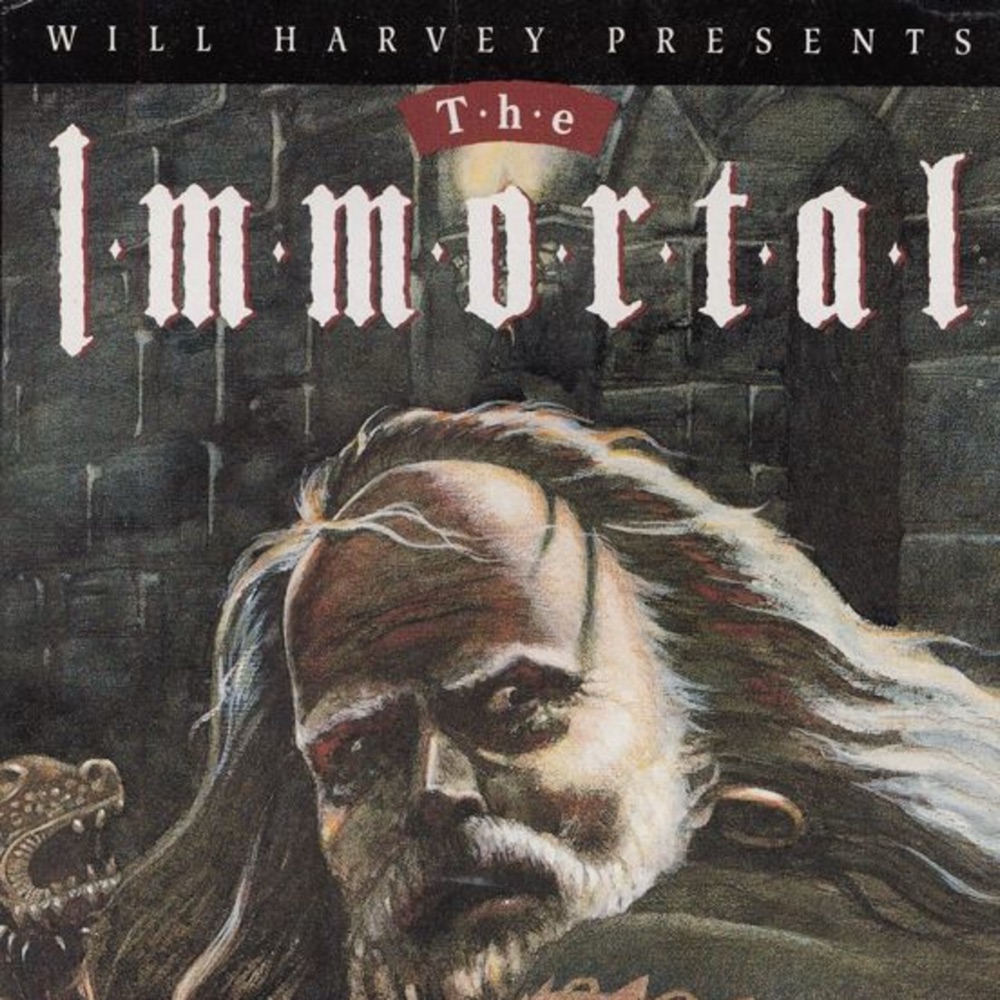
Uh, I don't know if any of those things were successes or not, but I think it's just interesting that like, you know, now exploring this podcast, we're seeing so many people who get the, uh, the moniker in front of the title of these games. Uh, the immortal is a pretty cool title though. I think this is one that would just based on the box art, like make me at least look at it in the store. I think the, the box art is pretty cool like that. It's, it's not very, it's not as cartoony as everything else. And it's got intrigue. And how many games do you play as like a really old person? Yeah. You're so old. He was like an old man. You're like old.
I don't know. I thought that was interesting. Like I, I actually feel like every game that we play as you are like in your prime, like either a kid or, or an adult who is, you know, like setting out on a grand adventure that only this person's equipped for. This is like the exact opposite. You are, uh, you know, a really old unnamed, yeah.
Unnamed, um, wizard who, or, or apprenticed to a wizard who enters, um, a dungeon, uh, of sorts, a cave, I guess, uh, because they're trying to follow, uh, I guess messages that they were tracking down from, uh, their master Mortimer and, um, Mortimer like sets them out on this journey, but like, we don't have much information about this guy. And all we have the ability to do is like shoot fireballs and fight. But we learned that we're in like some kind of isometric trap heavy action adventure game where there are as many ways to die as there were in shadow gate.
Yeah. Um, but it's, it's interesting cause it's so differently, it feels so much like shadow gate, but it plays so different. It kind of really threw me for a loop being like this action adventure shadow gate. Like it just didn't, it took me a while to adjust to that. I don't know about you guys. Yeah. I thought it was in like shadow run for a second, just with all the, I mean, it's really just the isometric viewpoint and, uh, the, the, the vibe is more like, I guess mature is feels like a more like between the marketing materials and, and just sort of the first few
moments of, of exposition and gameplay. It's like, Oh, this is a, this is a different vibe than usual. Yeah. And I guess in shadow gate, like you have all these ways to die that are based on choices you made, which sometimes can feel, you know, crazy that like, Oh, that led to this or whatever. But in this, it's like, there's a lot of ways to dies die. And sometimes it's because of choices and sometimes it's cause you just, you're playing the game.
Yeah. You just walked in the wrong direction and you could have, you know what I mean? It feels a little cheaper to me in this game that the shadow gate like elements in this game feels cheaper to me than it does in something like shadow gate. I think that in both this game and in shadow gate, it becomes pretty apparent very quickly
that they're going to try and kill you in as many ways as possible. And I think, yeah, in the first five minutes of this game, you will die in five different ways. Yeah. Um, so you just kind of take that into account. Sure. But I guess what I'm saying is that like shadow gate, I'm like, all right, I know that like, if I do this, that might be some kind of trap or if I do that, it might be like, I'm going to try it and let, Oh shit, it was a trap. But like, this is just like, all right, I wonder what's over. Oh, there's a trap. I couldn't have possibly seen it. There's no way I could have known it was there.
Joe, isn't that because shadow gate is kind, you know, obviously it's a point and click game, but if it's more turn based in nature, whereas, uh, the immortal is real time adventure game, uh, where you are experiencing these same puzzle mechanics of like using things from your inventory and applying them to the environment. Yeah. But because it's happening in real time, there's also just like, like you said, you're just walking and then you die, you know?
Yeah. Right. Like so many things were invisible that it felt like it just felt like the game was attacking me, you know? And like, I, I didn't even really have time to adjust for it. Like why make it invisible? I guess that's maybe I'm getting like into much deeper things that we're trying to get into right now, but like, it just felt cheap, cheaper to me a lot of the times the way you die.
And so there's two modes of the game, if you will, the, the game starts in the isometric viewpoint. And, uh, that is where you're just kind of navigating through the actual, um, cave or dungeon. Uh, there are traps, switches, pits, all kinds of environmental hazards. There's also, um, like other, like, so there's two different forms of enemies. There's enemies like goblins that will, um, approach you and force you to go into the second mode of play, which are these one V one closeup duels, uh, that we'll get into in a bit. Cause I think that deserves its own section, but then there's also these bats and, uh, other, uh, like, mostly bats.
Yeah, mostly bats, but like, I think you're actually like, they're described as vampire bats. So like, could they turn into just Dracula's as well? Or like, why are they, you know what I mean? Like, it's like, would they, would they wear the cape and everything too? Or are they just like, I don't think they do that assistance to vamp to Dracula? Like I think like, you know, you could use, I think vampire bats are also a colloquial term for like some regular bats in real life.
Yeah. I think there's actually like a species of bat that's called a vampire bat and they, and they just attack people as frequently as this wizard gets attacked. Yeah, but they do, they do have capes and they do have weird Eastern European accents. Got it. Great. Because the bats in this game, uh, they don't trigger a one V one combat. They just are in the, uh, isometric view. They just, yeah, they just kind of, once they, once they fly around the room, but once they latch onto you, they're on you and you must, um, shoot off your, uh, your second means of attack other than in the one V one duels, you have this fireball projectile, which is not great.
Uh, it, it's, it's tough for, it was tough for me to really aim this thing. Uh, and I don't know if that's because of the isometric or because of how enemies move around and such, but the bats became a nuisance because the bats feel like at least on some level, they are a, uh, a don't stand there and, and wait, uh, like timer thing where it's like, you know, Hey, Hey, you got to keep moving. You got to stay active.
Right. We don't want you to just sit in here. But at the same time, it's like, okay, well now there's bats here and it's likely to take off just as much of my health as a fight with a goblin. And like, that doesn't feel equal. Yeah. I think it's good because in the beginning I thought that this was just going to be a thing that was going to pester me the entire time. And I did not know that I could kill it with the fireball. Um, so I would just, I would just get destroyed by these things. Um, until I realized like, Oh, I could shoot it.
And I think once you realize that you can just shoot it and yes, it's a little harder to aim, but it's not as big of a deal as like the first impression of like, why is this thing always nagging me? And the majority of the game happens in this isometric view where you are, you know, where you're doing the puzzle solving. This isn't something where you're, uh, prompted by texts and such. You, you go into your inventory to find specific things and use them in specific locations, but you have to be in the right spot, uh, triggering the correct events.
And some of them are, are very, uh, you know, I don't want to say complicated or anything, but they're very, uh, nuanced puzzles that aren't just like, okay, I'm here and I pulled this item out of my inventory. You do need to know a little bit, uh, that I feel like in some ways can only be found out through the very detailed manual. There is a manual here that, uh, looks like it was two separate, uh, booklets.
So there was like the instructions booklet, uh, for the game that explains like the, just the basic controls and how to do stuff and includes a complete walkthrough. Like you would have in a strategy guide for the very first level of the game, just to kind of tell you, you know, go through this door, open this chest, fight these two goblins, like just literally explaining all the various scenarios you can get into because the first level of the game is kind of a tutorial of sorts of the kinds of things you'll encounter in the game.
But then there's like this second book, the codex of the serpent is what it's called. And it sounds very epic, but it's the entire game, including that first level again, in the form of hints that I feel like if you don't have this book, a lot of the puzzles are going to go over your head or you're just not going to think to be like, well, how was I supposed to know? I need to stand on this square and pull out this thing. I wonder if this was almost like a DRM of sorts. Absolutely. Right.
Because there's enough text in the game already between like, which also give you hints, like being in, having your dreams read out when you rest and, uh, just the, each moment of, of dialogue between different characters. There's a lot of text here. So they could have put all this stuff in the game, I feel like, but yeah. Yeah. This other book that you're talking about, this, this came with the game? Yeah. Oh yeah. Yeah. Not a separate strategy guide you buy. This is like another booklet.
Um, similar to how like, you know, some games come with maps and such. Like the Final Fantasy, uh, that always came with like a little, uh, first dungeon walkthrough. Yeah. But that I think was in the instructions manual. I don't quote me on that. I don't have a boxed copy. Yeah. That was the same, that was the same booklet. Yeah. Yeah. But this, this is like, um, Joe, since it doesn't seem like you got a chance to look at it, uh, which is fine because game FAQs. I'm looking at it now. But yeah. Game FAQs nowadays will have all the information that you would have needed anyway.
But for players, it's interesting because it has like, uh, one thing that I thought was a neat addition in the, um, in the early levels is those will the wisps that attack you. And I was reading the strategy guide and, uh, you can control these will the wisps. Like instead of them attacking you, you can cast a spell so that they basically, uh, you know, uh, surround you and create, uh, like a force
field before you take damage, they'll attack and they won't last the entire game of course. But it's a neat little thing of like, not necessarily a mandatory puzzle, but rather than being attacked by these things, you could turn them on your side. So it goes through this whole like text of legends have told of wayfarers being attacked by will the wisps. I reckon such stories were the products of childish imaginations. And this goes on for like a full paragraph.
But then at the end, it's just like, maybe I can devise a spell to bring them under my control. It's like, it doesn't really leave much to, it's like, you know, you'd only have so many things in your inventory at that point. It basically held your hand there at the end.
However, uh, you do still have to make the connection of what a will of the wisp is because I would have thought they were just fireballs. That's true. That's true. But I think like, that's a recurring thing with every single one of these, uh, things in this, in this guidebook is it's like, if you just read enough into it, you will know what exactly to do in that exact circumstance, provided that you have all the stuff in your inventory. Because an interesting part of this game is that like, there's nothing,
like, there's nothing you shouldn't pick up, right? There's nothing that like, uh, you know, I'll leave that behind because I think my inventory is getting kind of full. Like, no, you should pick up every single thing. I think the manual tells you that too, of just like, there's no such thing as a bad thing in this game. But like, for instance, in level two, there are these, uh, uh, green slimes on the ground that, uh, you know, if you touch them,
you'd, uh, you know, it's instant death. There is a merchant that sells a, uh, a potion for it. That's going to help because there is one particular room that I'm sure speed runners figure out an exact way to skip over it. But most likely this green blob would touch you if you, um, if you didn't have this potion, he offers it for 100 gold, which is impossible to have.
So you have to refuse his offer so that he, you know, as like your way of bartering, you just like, no, but he goes, Oh, okay. Okay. Have it for 80 then. And 80 is all of the gold that you could have collected at that point in the game. So if you missed any gold, you still can't afford it, but you needed to pick up every single piece of gold in the first level in order to afford this thing in the second level. Now, could you refuse him again?
No, he won't. I mean, yeah, that we won't lower it. Continue playing the game. Yeah. Cause that would be an interesting way to teach you a mechanic is like, you have to refuse cause you can't afford it. Now, you know, you can refuse and then you can do it more or something. But I, I want to test this, uh, that, you know, this way that like the game maybe held your hand with that. I didn't get because I didn't read the manual, but the first part where I got really stuck and I had to look up, uh, in game, uh, FAQs is at the end of level one, you have to go to this room with like a staff and you have to, you have to, you have to pick up the, the amulet. You have to hold it up to the light. It asks you, do you want to hold up to light? Yes or no? Yes.
Then you have to read the inscription, but you don't read the inscription. You say no to that. Yeah. You do say no to that. Yeah. Those things in that order is the only way that I could found to open the door to move on. Was there something that taught you that? The thing that teaches you that is that you burn and are incinerated when you read the, uh, when you read the inscription. And that happens at any point, any point in the game.
So that happened to me and I thought, okay, so this is not the point where I'm supposed to use this amulet because I died. I didn't think like, oh, I have to still hold it up to the light, but not read it. I don't know. I, maybe that was just me not trying every possible thing, but I was like, okay, this is not the point for it because it's letting me read it. And when I do, I die. I guess what my point, my counterpoint to this would be is that each of these levels is pretty self-contained.
And like, like Mike said before, like you have a very limited inventory. So there's only so many things that you can do. And also when you die, because you were burnt to a crisp, I read the amulet, uh, inscription, you are respawned, not too far away from where this happened. And even if you were to lose all your lives, you're just going to have to, you're not really losing that much progress.
Yeah. I don't know. I'm not, I'm not sure. I, I'm not sure. I agree only because of all the, you have to take this amulet. You have to stand by the staff. You need to, which, why would you know that? It's not, you need to hold it up to the light. It's not a staff though, right? It's, oh yeah, I know what you're saying. I'm sorry. Yeah. Okay. Keep going. The staff leaning against the wall. You have to stand by this staff that there's no indication, unless it's in the manual or something, like the staff gives off light that reflects off an amulet or something like that.
Then I, then corrected, but like you have to do that. You have to hold it up to the light. If you read the inscription, you die, which does encourage me to think, okay, the amulet's not it. You know what I mean? Why would it ask you, why would it ask you to those two things? Do you want to hold the, the amulet up to the light? So I get the amulet. Then why would it then ask you the second one? I, I get the amulet. I hold it up to the light. This is exactly what happened to me. I get the amulet. I hold it up to the light.
It asks me, do you want to read the inscription? I do. I die. Okay. Okay. Let me try not holding up. I get the amulet again. I hold it up to the light. I don't read the description. Nothing happens because I'm not in that room at that staff. There's, there's too many layers there. Like, I just don't know how to get all those things together. Why would I know to go to the staff and do those things in that order? Because it's in the manual. Well, why did you use, why did you use the amulet at the staff in the first place? I didn't. I Googled it. I looked it up on F game. I used the amulet just when I got the amulet. I was like, what does this do?
And then I, I mean, I did that too, but I didn't know to do it at the staff, you know? I see. Can we go back to the staff for a second? Cause I, I don't have that part of the gameplay in front of me and I don't, what is the staff? Are you guys talking about the, the light that's shining through the room? Is there, there's a staff? Is that what that is? That's a light from the, that's the sun.
Yeah. That it's leaning against a wall. It's a, no, that's a beam of light. If it's a beam of light, then I get what they were going for. And that would make more sense because you're holding up to the light. That did not read like a beam of light to me. It looked like Gandalf staff. Okay, good. So, so I, I thought you were attaching the, I thought you were attaching the amulet to the staff. That is that may or may not be in a shaft of light. No, there is a hole in the wall that is causing the sun to peek through that part at once.
Only one time in a millennium does it happen. And you just happen to be here. Uh, and now you, it says, uh, this mechanism, uh, can be tripped every thousand years by light. Use something shiny, dot, dot, dot. So it's telling you to use the amulet. And when you put the amulet up there. That makes sense. But then it's still, it just, it hit me because that did not read as light to me. It read as a stick, you know?
Yeah, I know. I hear you. It doesn't, it doesn't look great. I know what you mean. Um, but okay. Now that we solved that, I agree with you that, uh, it sucks that the amulet, uh, that reading it causes basically, it's like everything. And does it like everything in the room just goes up in flames or something? Like, what is the idea? Like you die by reading it? But then like this sort of ties into the end of the game though. Oh yeah, absolutely. Yeah. Yeah. And you having tested that and dying like tells you that you should not do that at the end of the game. I don't know. Yeah. It also tells you that you shouldn't do it again. You know, to your point, Sean, that like,
uh, Joe, if you do it once and it says like, okay, hold it up to the light next time, just don't read it, but hold it up to the light. And you would have seen that the trap door opens to reveal the ladder. But that, that's, that is what I did. Just not realizing that that staff was the light that I need. You know what I mean? I was like, where's this light that I need to, you know,
I understand. Also full disclosure, I've not, I did not beat the game. So I don't know, you know, if this comes back and it's important at the end of the game, that's also something that I did not. It's, it's very important, but, but we have to talk about the end of the game towards the end of the episode, just because it's so nuanced. And I feel like we need to get through a few other things as well. So like, I'm glad that we were able to dissect a puzzle on that level. I don't think we can do that for every puzzle in the game, but you know, just, just to stay.
I'm going to go and do it. Yeah, sure. Go for it. If you just stay on this exploration aspect of it, right. You don't have to like go to the next puzzle after that or anything, but there does become this thing with the goblins, uh, where at first they are just like a brute force enemy that you should be attacking, right? Like they, they are, they are on the offensive. They tell you to stay away from them. If you approach them, then you have to fight them.
I need, I need to chime in real quick about the goblin thing. So at, at no point in this game are the goblins, uh, are the goblins like on the offensive. You are in, you are an infiltrator. You are invading their space. They're in their own little fight that you are not a part of. And yet you massacre them in the first couple levels. And so you are never in the right. They were going to kill that, um, that other guy who gives you the key in the first level.
You don't, you don't know who that guy is. Like, that's just some guy. Like they're always like warning you that like, Hey, don't take a step forward. Like, Hey, don't, don't come near me. And yet there you go. You're coming near him. Like, of course you're going to get into a fight. Yes. I agree with you. The goblins weren't asking for it. They were not. That's just those, the fantasy world rules where it's just like, yeah, if it, if it looks human, but isn't like, we're just allowed to kill them in math and we're still the good guys.
And of course the goblins evolved through the levels to be something that like, well, there's this role, there's this war that they're having with the trolls and you don't have to necessarily fight the goblins. In fact, there are some that like, you're just going to be in for a world of hurt if you try to, but the goblins are the introduction to the other part of the game, which is this, you know, one-on-one combat system that, uh, is nothing. It's not a real time isometric thing. It is, uh, it's more like you're, you know, uh, rock them, sock them robots kind of thing where like you have, that's a perfect description.
Yeah. You have specific positions that you can be standing in, uh, either attacking or ducking. And depending on where the enemy is attacking or ducking and where you are, that, that will register as a hit, a miss, or a hit in their favor, uh, towards you. Because even when you try to duck, if you are not ducking in the, uh, opposite direction of their, of the enemy's swing, you will just be hit by their club or whatever they're attacking you with. And so as a result, it's a very
involved combat system that happens incredibly fast, uh, at, at the beginning of the game. Like, like with no warning, you are brought into a fight that you just don't have the muscle memory for the controls yet. And so I don't know about you guys, but for me, this wasn't, you know, easily my earliest death was just dying to a goblin in a fight. Yeah. It took me a while to kind of get the feel of these fights. And even then it's... I just button mashed. And I was, at least for the first couple, I was okay just button mashing. I mean, I could button mash and get through one or two battles, but that would lose some effect that by the third battle I'm dead.
Yeah. And I think I read this somewhere, but I, I don't have it in front of me on my notes, but I believe I read that it's not just as the encounters go on, but based on like the amount of fights that you have each fight, the goblin, like AI is more intelligent than like the previous one. So if you skipped the first two, the third fight you would have had will be like the first fight of the game.
If that makes sense. It was kind of counting up based on your encounters that they get smarter and smarter. That's an interesting system in itself too. Smarter and smarter. What could they possibly, is it just like reading your inputs better? I don't know if it's reading your inputs better, but I can tell you with certainty that button mashing will not work beyond the first level. Oh, I know it didn't, but I, I, I'm saying that my first death was dying from a worm.
Uh, okay. And that like the, my first fights were, were pretty, were pretty survivable. That's all I'm saying. Got it. I guess I was just trying to play the game system. And as a result, it was like, I, every time I tried to duck, it was not in the right direction. It was like, Oh, I finally pulled off the duck, but I'm leaning into his attack instead of pulling away from, uh, it reminds me of in final fantasy seven rebirth. There is a like boxing mini game that you have to do this exact thing in where you have to kind of like pull away from the punches, but you have to know what punch they're going to throw based on this like small,
slight tell that they have. And every enemy has a different tell. It was like that level of frustration where I'm like, ah, I, I, I just pushed the wrong buttons. Like, because the way that you duck and the way that you attack are somewhat similar because they're D pad pulls plus, uh, the correct button input. So sometimes my brain would just screw them up. And what I meant to be a duck would go for an attack, but I already knew that the enemy was attacking.
It created a lot of awkward, um, encounters for me where I wasn't, I was losing a lot of health often because of how bad I was at these combat encounters. Maybe the avoiding the system kind of saved me at, at certain times then, because I, I was just not really thinking about it as hard. And because like you could just
like kind of brute force it for a while. Um, I don't know. No, I hear you. I think I was in my own head too much. If I, you know, if I'm being honest, I think it was one of those situations where I'm trying to use the game systems and I just can't even, I can't think like that. I can't think about, uh, ducking versus attacking, uh, correctly enough that I'm playing its rhythm style mechanic game. I also think that the, the mechanics or, or the, the game systems that you're trying to play with are just unclear, uh, like what, what you're exactly supposed to be ducking. And so yeah, I just didn't really get it.
Uh, yeah, I'm, I'm, I'm guessing, and that's something that I just, I just decidedly didn't look at the manual for, but I, I'm assuming that's in there. I mean, is it clear if you read the manual? Yeah. Yeah. But I didn't. I was like, I'll figure this out. And I sort of did.
And that combat system remains throughout the game. So the rest of any combat happens in the real time space where you're just firing off your projectiles. Um, you know, eventually you can do other cool stuff like ride a magic carpet and, uh, um, use items in your inventory to cast specific spells or, uh, turn enemies against each other. These are all part of the puzzle mechanic more than intended, like, uh, consistent combat solutions. It's not, it's not like, yeah, they're not systems. They're just, they're not systems puzzle, uh, like features.
So
so
But the first level, if we go back to that, just because I think it's an easy, like, it's easy things to talk about.
The room with the arrows that shoot out if you don't walk in the intended path, would you have ever even thought that there was an intended path not to trip off the arrows? Like, they're pretty easily dodged, and it just kind of, like, it happens, so I just thought, like, oh, this is that room where, like, it motion detects that I'm walking through it. I'm going to assume that Joe didn't know that there was an intended path, because that's, like, we saw that in the manual. Yeah, you're exactly right. I had no idea until this moment.
I just thought, yeah, this is the arrow room, you know? Yeah. Okay, so, Joe, here's a solution that you definitely knew about because it's communicated to you in-game, which is weird, right, that there are certain things communicated in-game and others that aren't. There should have been at least a hint for everything, I suppose, but the shade enemies that appear in the dark rooms, right? You're warned about that, so surely you lit those torches in that room using your fireballs, so this way you can see those shadows. Yeah, well, because you get that note, right? Yes, yes. Yeah, that dead guy is, yeah, yeah. So do you think the game would have been better if it was more, like, you know,
exploring to find notes that almost, like, Elden Ring style, like, players left behind, you know, these things that, like, give vague hints about, like, what's coming in the room ahead? Should that have been a constant thing instead of just, like, randomly giving off? I mean, I don't know if it has to be notes, but yeah, like,
maybe if I had read the manual I would have been a little higher on a lot of this stuff, but, like, it's not just the puzzles for me, it's the traps that really frustrated me. Where I'd just be, like, I'm just dead. Like, I'm just dead all the time for things I can't see, and sometimes it is like, oh, I can see it, and I can sit here and figure it out, and then I can move. But doing that for, like, every, you know, what felt like every room, every couple steps I gotta figure out what's next, it wore on me, I'm not gonna lie.
Yeah, I agree. I think that the, a lot of the sort of adventure game logic stuff is front-loaded, and once you've tried to use bait in a random area and get eaten by a worm or get incinerated by an amulet, you're kind of desensitized to that, and, and it, like, when the future puzzle logic stuff, like,
running into a goblin that says that he'll never give you a thing, and it's all his, and I'll never give this to you, literally in the room before that, you find, or, like, maybe two rooms before that, you find a ring called, like, the Ring of Complacence or something. Yeah, yeah. Compliance. And it's like, oh, I should probably use this here. And then you use it, and he gives you the thing. It's not really that big of a logical jump, but when you're just walking across a floor that has spikes coming out of it randomly, and then you think you see a pattern, and then spikes just break that pattern and kill you, like, that's annoying. And that just means that you're supposed to die enough and memorize the floor.
Yeah, and I, I do not think, uh, it's praiseworthy, but it's certainly intended, right? The game, the game was even promoted as such as, like, uh, you know, you will die a lot, you know? So it's definitely intended by the developer to, like, oh, you know, like, they went through the trouble of animating a lot of these, too. So it's like, look at all these crazy deaths, and they were toned back in the NES version compared to the computer game. But, like, I, I don't know how I feel about that, because I agree that it's frustrating almost to a point, uh,
that makes you want to quit the game. But it's not so punishing that, like, when you die, uh, provided you have lives remaining, that, like, you lost so much progress. Like, this could have been a much worse game if you only had one life, or if you, like, uh, start at the beginning of, of the level if you died. Like, I, I feel like there's something, there's something about the way that they handle the fact that you will die often that makes it, like, known between the player and the game that, like, oh, this is intended, I'm supposed to be dying often. Like, I, I, I registered that right away. And I think it's, like, I, I feel like it might be this kind of
forgotten style of gameplay that comes out of the, the, the world where people had only one game to memorize and stuff like that. Then there, there probably is more of an audience for, you know, people who, who want to, I don't want to say memorize a game, but, like, want to get so good at a game that, like, they know the levels inside out. And, like, that was, like, such a bigger thing of, like, really knowing, oh, like, this is where you got, you got to do this, this, and this, and, like, you got to, like, figure it out. People, people would spend a lot more time in this game to learn it and then show off to their friends, like, I can get through this.
And I feel like that's kind of lost on me these days because it's just so removed from the way I play games now. I'm going to grant both points that, like, yes, I even went into it earlier in the episode that, like, when you die, it's never, you're never losing that much progress. But that doesn't make the frustrating moments less frustrating. Yeah. To get into some of the later puzzles and such, or not even that much later, the Goblin King, when you run into him, it's not an encounter you should take on. And, in fact, if you wind up wearing, you get a ring from one of the trolls that lets you look like a goblin. If you wind up wearing that and talking to him, that's an instant death as well, so you can't fool him by trying to be one of the goblins.
But you have to do this thing where you plant, you plant these spores on a dirt patch in the room, leave the room, come back into the room with the Goblin King, give him the water that you found, and then, you know, for saving his life, he gives you both a clue and a key. But then, in the following level, if you gave him the water, he lets you pass easier and warns of the trolls that are coming ahead. So, there is some payoff here between, like, choices you make, that, like, you, you know, there technically isn't just, like, one solution to this game. Like we said, you could try to outrun those green blobs rather than use the resist potion. There are other paths. It just makes the game that much more hard. Yeah, I think it's funny that
just going off of your amoral nature and how you're breaking into this conflict that does not concern you, that you then trick the king into thinking that you saved him and you had nothing to do with him being poisoned by spores. Even though you were in the room just a second ago. No, yeah, I mean, it's partially his fault. He probably should know better, but you also didn't correct him. It's true. In, I think it's level five, it might have been level four, there is maybe, like, the first instance that we have on this show of, like, meeting the developers inside the video game.
Did you guys know about this? I didn't. I, at this point, I was just trying to get through it and I did not finish the game, but I did watch a later run of this whole coffee thing happen. Yes, so there, it seems like, you know, you can find the room and see the developers who are in normal clothes, mind you. They're not dressed up like wizards or anything.
And they request a cup of coffee. And if you don't have the coffee pop beforehand, you know, and the ability to make the coffee, like, you just would think, like, oh, they're just like, that's a funny joke about how developers are overworked and they need caffeine to stay awake or whatever. But you can actually bring a cup of coffee to them. And by doing so, they give you overpowering body odor that knocks out every single enemy in the game
because you smell so much, which is also probably a commentary about gamers on some level. So, like, the devs really got in there and made this. I don't know about yet. It's so funny, though, don't you? Well, I think the basement dwelling computer thing was there right from the beginning, Sean. Okay, all right, all right.
But that is, like, that is just such an interesting inclusion that, again, totally optional. You don't need to find this little Easter egg. Obviously, it will kind of break the game. You still have to solve the puzzles, but no more enemies to deal with.
And it's just one of those things that, like, you know, again, even though these puzzles are a little, like, use this exact thing at this exact spot, there is a charm overall to the game once you, like, once you've figured it out that I think makes you want to keep going. You solve the puzzle that was kind of annoying and you're like, I kind of can't wait for the next annoying puzzle. I wonder what that says about you, Mike. Yeah. Maybe it only says that about me. I don't think you guys were agreeing. Well, here's the thing. What you're saying in the game you're describing, I'm, like, really excited about. I want to play this game. And I'm not saying this game wasn't that. I'm saying I don't think I gave it the chance to be that.
And, like, when I started, as I was playing it, I was like, this is, like, I'm really intrigued and I really want to get further in this. But I just wasn't enjoying the moment-to-moment gameplay. And, like, I almost feel like the way you're describing it, I want to go back and play it with that in mind. Because I kind of did want this to be, like, what Shadowgate was for me, but in a more action setting. And I think I was just more disappointed. But, like, everything you're saying, like, hits the kind of thing that I want to do, but I just was not. I was just getting all frustration and, like, none of that satisfaction.
And, Joe, I think that's because it's worth... Don't you think it's worth mentioning that, like, the actual controls of the game aren't all that tight and that that creates probably this experience that you had where you weren't exactly feeling it? And, you know, like, I think, like, I'm describing the fun parts of the game, but it's worth mentioning that it's not exactly the tightest controls we've ever seen. And the isometric isn't, you know, is doing it favors from a graphics department, surely. Like, this game looks amazing for an NES game. Yeah, it's a beautiful game, yeah. Yeah, completely. But, like, I don't think
everything is pulled off as easily as saying it in this podcast. Yeah, definitely. And with the movement and with the, like, the goblin combat, you know? Yeah. The movement I eventually got used to, but isometric's always a little weird to get the hang of. But, like, even once I was used to it, like, having movement that doesn't... that isn't perfect
and having traps that are, like, one tile off from each other that'll kill you, that's a recipe for a little bit of frustration, too. I think that the puzzle design has highs and lows, um, and you can really start focusing on the lows when you get speared from the floor 15 times in a row. So, I kind of agree with both of you here. It's funny, Sean is, like, taking my position, my normal position, where I'm, like, I'm always, like, on the fence.
I did... This was a very charming game to me, and it's kind of up my alley in a lot of ways, but I also, like, I also don't like those little, like, it's not just, like, oh, I can't master this, it's just, oh, I have to memorize this. So, I get where you're coming from. Yeah.
At the beginning of the game, as we mentioned, you don't have a name. You see a letter addressed to a man named Dunrick, but it says to you in the game, your name is not Dunrick, so that's interesting, right? That is the best piece of writing we've seen in a frickin' NES game in the entirety of this podcast. I swear to God. It was an intrigue, and you will eventually meet Dunrick, who, surprise, surprise, has been chained
in, I think it's level six or whatever, you have to give him a ring in order to gain some additional inventory stuff that you'll need later. So there is this thing where, like, you're meeting characters, you even meet his daughter, right? His daughter is Anna, the one that... That is Anna. Yeah. Okay, so basically, you're meeting these people, and you are trading
inventory for inventory or using inventory stuff to acquire new stuff. So, like, you always have, as long as you picked up everything, you always have what you need. But the reason why I wanted to save the ending, Joe, for the end, is because you need basically exactly everything and need to know exactly how to use it all for the final fight in order to... Yeah. ...in order to win the game because there is no other way other than by finding out that you don't have the necessary item to complete the checkpoint in the boss fight because the boss fight is not a 1v1 duel like we saw with the other enemies in the game is in the isometric viewpoint a giant dragon, you, and surprise, the guy who you thought was your master turns out he lords you in here.
He shows up as well, but he only shows up after a certain point in the boss fight too, so you have to kind of figure all these things out of like, okay, now the dragon's going to blow fire, so I need to cast blink exactly, or you only have to cast blink once, but you only get six exact uses of blink, so if you can't, if you don't use it for each of those six fire breaths or you find out that you don't have seven of them, you will die at any one of those, so you have to time those exactly correct. On the seventh fire
breath, he does like a double fire breath, so you have to use fire protection for that in order to make sure that you, you know, just basically don't have to, you don't have to use time the input anymore, you just absorb the fire for both those blasts. Do I mention that the dragon also fakes you out on the sixth blast where he does like a, he has like this huff motion and he goes back for the huff, but then he goes forward without doing the flame blast, and then he blasts the flame as if to taunt you, saying like, even if you figured out the timing, I can still change it at any minute. It's all crazy stuff. Then, um,
uh, what is the guy's name? It's, it's, it's long. Just call him Mordecai. Mordecai, all right, but that's not his name. But it is with an M. Yeah, it's Mordemir. Something like that. Yeah. Yeah, Mordemir, Mordecai. Yeah. Mordemir shows up, he tells you that this has been his plan all along. The game is called The Immortal because this has the fountain of youth or whatever that he's been using for like a thousand years to stay alive,
and he needs, uh, these dragons like guarded or whatever but this dragon got free but now it's back. He needs you to kill the dragon. I wasn't really following here and I'm sure you said it more elegantly but like, I did, it did feel like it wasn't a problem. Like, the dragon apparently like burned his hometown or whatever but like, dude, this sounds like an issue between you and the dragon. Keep me out of it.
So, he needed you because you were going to, uh, you were going to, no, I'm sorry, you, you continue. Yeah, he cast the, um, he cast thunder which you also have to time, uh, your dodges for that as well using a totally different spell but again, you, you have only these things left, you know, it's kind of like process of elimination but again, how would you know that he's about to cast thunder? He doesn't say, and now get ready for my lightning attack, right? He just does it. Like, you're gonna die. You're gonna die. You're gonna be like, ah, shoot, I should have used that spell but you have to figure that out so this is a very long fight where everything has to go exactly right
and requires, you know, your own, uh, timing mechanics. It's not just about having the stuff in your inventory. He then takes the amulet from you and reveals that the dragon will not kill, um, the person who holds the amulet, the thing you've been holding on to the whole time and you have your last spell which is some, uh, magnetic hands or magnetic power and you, uh, in, you know, right before the dragon's about to blow fire at you, you grab the amulet back, it blows fire directly on him, killing him, and you are now, uh, able to drink from the fountain of the youth and you are young again and you get to, uh, and you're with Anna.
And now, I understand where the title The Immortal comes from. Exactly, right? But how cool is that? You're an old man who turns young. Yeah, but hold on. Okay. The amulet thing, I don't, does, from what I saw, because I did not get to this part of the game, but from what I saw, you have, once you, like, tank that final fire breath, that's when you use the amulet, right? And then, you, once again, you don't read the inscription because you remember dying doing that earlier in the game when you were just encountering with your inventory and that's when
Mortimer Mordecai comes down and is like, you fool, you had to do that, we were supposed to do that, right? Yes, that's true. Okay, so, that's, that's the, that's looping it, looping it back in to the beginning and I think it's just a little weird that, you know, you're like an 80 year old dude and, uh,
you know. Yeah, now you're getting, Anna wasn't old. She's not old. Uh, that is also the good ending. There is a bad ending when you don't help her, but, and that just means that like, huh, I guess it was weird that my master who, also, just another sidebar, you're pretty old yourself and you're still this dude's like, apprentice? Well, yeah, when does the apprentice become the master? Yeah, but like, you're pretty old, but like, you're not a thousand.
I don't think this guy ever revealed to you he was a thousand. Yeah, I don't think you know he's a thousand. But I'm saying, him being a thousand, he's probably skilled enough to still have way more magical knowledge than you do and you're like, well, I still got more to learn from this guy, whether you know how old he is or not. I think at a certain point in your 30s or 40s you're gonna go off on your own, you know? Like, even if you don't, oh, he's still better than me, but I could probably wizard myself, you know? I just assumed that that was like a part of the culture of like, yeah, like wizardry, you're never done learning until like, you know.
But man, what, what a convoluted final fight that like, must be amazing for the one guy who figured it out and then everybody else who read the FAQ because they were tired of getting all the way to the end and dying. Obviously more than one person. Obviously it's a skill issue for me, but I do think like, I'm so conflicted about just how awesome it is to have everything in your inventory and just figuring out the correct sequence of events, but it is, other than like some minor timing stuff, it is just saying like,
uh, aha, but I thought of that and I have this. Oh, well that doesn't matter because I have this. No, I have this. It's like, it winds up becoming an anime fight almost. I think the framing specifically, and I think at a wider, in a wider sense, like if there was any other time that you used magnetism or if there was any other time that you used like the statue thing and it was just a part of systems and then it's just sort of emergent that it would all happen in the boss battle, that would, I'd probably grant it a lot more credit here. And even just a smaller tweak, if it was just framed that you now had the ability
to blink, not specifically six charges of blink, but that you just had the ability to blink, I think that this would go down a lot, like this would feel a lot less contrived than like once you pick up the blink spell and says, don't use it six times. If you, like after that, it's, you know what I mean? Oh, totally. That adds a lot to it. I agree that it's a shame that all of these awesome spells have to be saved for the end and never taught to the player ahead of time or that there aren't like more open-ended solutions to this other than just doing exactly what the game intended through 45 inputs. Yeah. You know, it's like at least in like, okay, so say like,
all right, we got Mega Man 3 coming up. So say if any Mega Man game, right, like the final boss fight, you know, at least you have like the freedom of movement to like, no one play would look exactly the same as another, right? There's like obviously like better weapons to use against certain enemies and everything, but like the actual gameplay is unique. Here you have the ability to have movement in this fight because you've been doing it the entire game, but they lock you to this like little cliff
or island, if you will, and like everybody just has to stand in their positions and act out the part. Yeah. It's all on rails from here. But to talk about the presentation and not just the presentation of the final boss fight, but just in general of the game, we, you know, we briefly said that the graphics are awesome and I agree with that, but even just like the little touches throughout of like
how realistic isn't the right word, but how it's trying to go for something like that with like how when a ladder reveals itself, you can only enter from that side where the ladder is if you try just to go to the other part. Yeah, you just fall down. it's another reason to die. Yeah. Yeah, but like, you know, it's a thoughtful touch.
There's that one part where you're in the raft and you're, you know, with the current and everything and it's like, you know, I'm not saying they did a water level or, you know, like, you know, like look at those graphics, but like I did believe that I was rowing that raft and that there was like a current and stuff. Like, I think that, that glug glug sprite that you, when they, when the thing, I forgot the name of the enemy, but when that's chasing you, that glug glug sprite is like, that's gotta be 60 frames a second. It's, it's so smooth. Yeah, the whole game does run at 60. It's worth saying.
I'm sure there are slowdowns if you cast enough fireballs or had like a turbo or something, but I would just say that like presentation this game is on another level and that makes me appreciate this Will Harvey guy because, um, while I don't think he did the NES port, which is impressive in its own right,
um, the original game like clearly is doing something a lot earlier than, um, you know, than what I would have expected could be done for this kind of hardware. Yeah, I do think that like the isometric style on the NES is kind of unmatched as far as like detail and, I mean, like, what's this, it's like the, was it like the last level? Yeah, that's what you're talking about with the water, right? It's like the, not just the rafts, but like the actual vortex look,
like the, the shimmeriness of it all and everything. I mean, I think it, it being this pulled out, everything's kind of smaller, like it gives it the ability to look like, it's the closest to like, oh, I'm in this environment that you can be, you know, because it's not side-scrolling and it's not like top-down like a Zelda where it's a lot more cartoony, you know, there's, there's just that, there's a texture to it all. Absolutely. Oh, jinx. I hope it actually matches up in the audio recording. It probably won't. It'll look like I said it first because I already have the, no, I'll edit it that way.
Is there a, you know, maybe, you know, I'm actually going to skip these questions for a second, but for the, for the listeners, you know, are, is there like a, is there anything that when you played this game back in the day, right, how many of you did persevere? I, I would be interested to know how many people picked this game up, whether it was at Blockbuster on a rental or got it as a gift or bought it themselves when they thought, saw the box was cool.
And because of like the kid in me, like I would have died early on and I would have given up. I would have been like, man, this game is really hard and I'm not going to get anywhere. I did not like really spend time with games. I would just go back to the classics that I already knew I could beat inside and out. I do wonder how many of you, when you were young, uh, beat this game. Uh, because there are a lot of times where like we say, how did we beat these games when we were kids? I think it'd be more impressive if you beat this game as a kid than as an adult.
Yeah. I'm trying to think of what, like what I would be, I had a game shark growing up, so there, right. You would have used the game genie in this case. Yeah. I, I had a game genie too, but I definitely use the game shark more often in that, in that generation of, of, of games. But, uh, I probably would have cheated or, or tried to cheat and realize that like it just didn't work that way. Um, maybe that says something about us as a generation. Yeah. I mean, I remember so many times, you know, cause my first console was the NES and I played a lot of Super Mario Brothers 3
and, uh, you know, a little bit of Mega Man and a little bit of Teenage Mutant Ninja Turtles. And then I would just play like minutes of every other game and be like, I don't get this. Like, this is, this doesn't work. And I would just go back to my three games. And looking back, I really wish I had given more of these games a chance because I feel like a lot of them had what I was looking for. I just didn't, I just didn't know I had to like, you know, as a kid, I didn't know I had to get past some, like, some thing. You didn't believe in yourself, Joe. Yeah. That's what it was. We're talking about a 33 page manual for this game. I think that alone, like, ain't no way I'm reading that, you know? Like, that's the problem is, like, I remember
for the N64, we got Quest 64, which was like one of the only RPGs on the console. And it was my first, like, ever RPG, other than, like, I don't consider Pokemon an RPG.
But we got the strategy guide with it. They probably told us, like, well, I didn't mean, like, Pokemon in that regard, like, not in the same, it's not in the same difficulty class. I know what you mean. But, like, I'm sure, like, the Toys R Us salesperson was like, yeah, you got this game, like, you're probably gonna want this guide, because, like, we didn't own guides for many games, but we had it for Quest 64. And I still never learned what I was doing, because I never read that guide. It just wasn't going to happen. That's crazy. I wasn't gonna read books. I read, I read strategy guides and instruction manuals for fun. Like, just without, I don't know.
I did too. I used to love that, but everything I had on the NES, I got from garage sales, you know, so there were no manuals, there were no cases, there was nothing. But PlayStation stuff, you read that stuff. PlayStation stuff, I read the manuals, but you didn't need to by then. Yeah. By then, the game told you how to play. I just read the manual because I liked to, like,
I read the manual because I was on my way home from Blockbuster and was too excited and I had to, I had to consume part of the game in some way, you know. And I just want to say, I did have strategy guides that I read where I read them so much that the pages fell off and I still have those strategy guides downstairs in my basement with like, isn't this a 100-page strategy guide? Yeah, but I only have 17 pages. And that's for, unfortunately, games that I was, good at anyway, like Pokemon Red and Blue or Ocarina of Time. Like, I just loved
revisiting the parts of the game that like, I couldn't get to again without replaying the whole game. So I would just look at them in the strategy guide and stuff. It was like, I wasn't going to learn anything. I just wanted to, I like the pictures. And I also like when we get near the end of the episodes to do a little thing called The Essential Games List.
The Immortal There's no doubt that The Immortal is an incredibly challenging game and at sometimes a very, at some places a very frustrating game. The controls leave a lot to be desired and yet I like really enjoyed this one on a level that like I usually don't when we like are, you know, like we don't have that much time to spend with these games and as I was playing The Immortal I was like, I know I'm not good at this right now but I want to see if I could get better at it. Long story short was I didn't get much better at it but I did keep getting further and further as I kept playing
and while I really like this game and probably like I'm putting it on my like, man, if I see this in like a secondhand shop I'm going to buy this game because I'd love to spend more time with it. I don't think I can actually recommend it as an essential game. I'm definitely recommending it to people who are listening to this podcast and finding any part of it interesting because I'm not putting it on the essential games list because the controls aren't really the greatest.
I do think that the moment-to-moment gameplay isn't nearly as exciting as kind of like the rush you get in your head when you do make forward progress. This is the kind of game that like is much better looking back on than while you're actually playing it and so to me that doesn't fit the essential games list dialogue box where like other other RPGs are maybe more repetitive easier
and you know not as challenging in their like puzzle solutions and such but like those games feel more satisfying in the moment-to-moment because you get you learn them quickly you get better at them and eventually master them. I'm not at the master part yet and I think a lot of people who have even beat this game wouldn't say that they were masters at it so much as they were masters at reading either the included manual or some game FAQ's guide.
So while I think it's an amazing game that is very unique on the system and I totally recommend it to listeners of this show I don't think it belongs on our list of the best games for this system. Sean? Yeah. I really dig the aesthetic of this game. I think it's got a great sense of humor. I think it's a very good looking game.
It and you know it is very frustrating and that's even with the the very generous like continue system and the and even something we didn't mention that if you do fall down a hole a specific kind of hole you can sort of save yourself by getting another rhythm game right and sort of swinging yourself back out of the hole. I just wanted to get that out there that that's another little bone that they're tossing us but I think that the the general
frustration outweighs a lot of the moment to moment fun stuff and I am also just yeah I'm kind of on the fence between really my my opinion and whether like I just have annoyed moments or like oh that's neat moments in my memory so I'm gonna say it's also like definitely a play it just to kind of get a vibe for it but not an essential game. Joe?
Yeah I really do want to like this more than I did and when I booted it up I was like oh I'm excited like I'm in for for like an adventure and you know that's always what I love about a game is just like if it's a long satisfying adventure I think that just it felt like the game was getting in the way of itself a lot like there's it seems like there's a lot of cool stuff going on but it was stopping me from experiencing it in a way that I wanted to now maybe I do need to go back and like rewire my my expectations a little bit as like this is like about
figuring out each puzzle and solving it like remembering them and getting back to this point and all that but as as I played it I I really didn't love it I really was was disappointed with it so I definitely can't vote at essential we briefly talked about shadow gate at the beginning of this episode and before we started Joe you had mentioned that you recently picked up a copy of solstice those are two games that I had on here in my notes section of just like if there was some way to bring them up I feel like here in the wrap up section would be the best
not necessarily like ranking these against the immortal or whatever but are these games complimentary are they like you know well I could see why I like shadow gate more than the immortal like do how do you feel about these three games if you can what it feels like to me is maybe this is where subconsciously I was thinking when I booted it up was that this seems like it's going to be shadow gate combined with what's it called with solstice and maybe it is but I think that like shadow gate has that that like story puzzle-y
element with a lot of like ways to die and figuring out how to not die kind of thing and I like that about it whereas solstice has the like yeah it's a little it's it's a action adventure quote unquote asymmetric game that's like more cerebral and I feel like I'm I'm instead of being an action-y person I'm being more like I have to think and puzzle solve and stuff and I love both of those things I just feel like this did not put them together if you're asking me like how where I would place these I'd have
to play them all again to get a a one two three but this is my three I know that I just don't know which is my one and which is my two I would suspect that shadowgate is my number one based on remembering how much I remember liking that I don't know did we all vote solstice essential I got to imagine I did but I don't remember I remember really liking it though I don't think it got there yeah well one thing that I'm gonna throw a fourth game in here just as just as a bit of a comparison
in this game there is actually like a portal puzzle where you have to put weight on a platform to open a door and that made me start thinking of like why why is portal so like there's so many reasons why portals fun or whatever but it's not a twitch shooter or like a twitch action game and a cerebral like puzzle game you have time to think and when you are trying to get time to think in this game you've got bats coming at you so I just think it's like these features don't really mix that well
when you're kind of always on your feet trying to like swat bats basically and also like oh how am I supposed to get the spores into the king's room and get out fast enough like I just I don't think it really meshes well all together with those two different aspects of things I really hate those bats yeah haha haha!!!!!!!!!!!! Thank you.