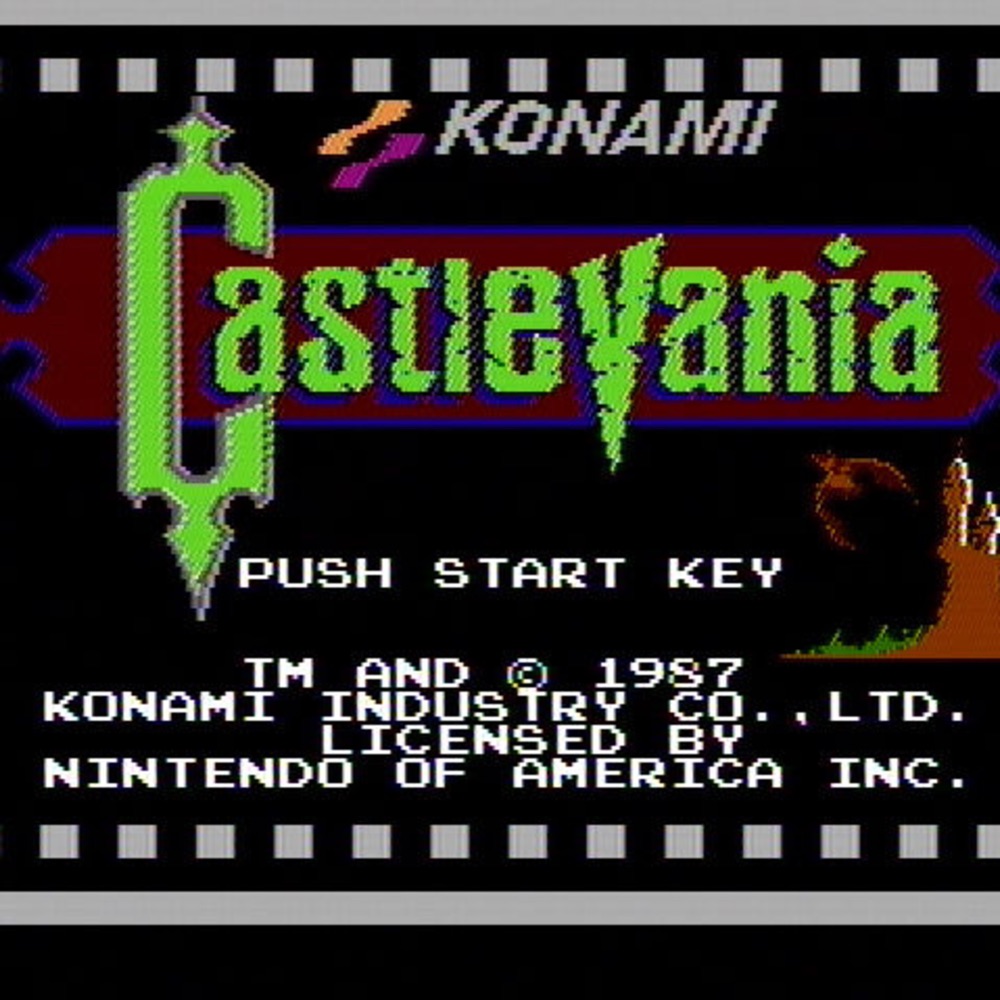
044 · CASTLEVANIA
Ranked #3 in our Top 10 NES Games of 1987 →
Dracula awaits in a massive castle that is just one bad knock back away from plummeting to your death. Are you the vampire killer? For more NEStalgia as well as show notes, articles, and more check out www.NEStalgiacast.com
Castlevania was the first game in this run that made us feel like we were on a real adventure since Super Mario Bros. We went in expecting a stiff early attempt that people only remember fondly, and we came out calling it a complete game that feels good to play today. We also called it the version of Ghosts 'n Goblins we'd been waiting for: just as hard, but with a health bar and none of the frustrating parts. All four of us voted it onto the Essential Games List.
What makes it essential
- It teaches you without a tutorial. The huge torches at the castle gate stand out from the background, so you whip them and they pay off right away with a longer whip. Then you start hitting the candles, and eventually the walls, where you find the pork chops. A kid who smashes a wall by accident and finds dinner will smash every wall after that.
- Weapons, and the right one at the right time. The dagger, holy water, boomerang, axe and stopwatch each have their uses. The axe arcs over your head for the Phantom Bat, the stopwatch freezes Medusa in place, the daggers keep the two mummies apart, and holy water walks you through Dracula's last form. Your main weapon upgrades too, and when you die the game puts the whip torches back so you can rebuild it. The game seems to hand you the weapon you need just before the boss that needs it, which is good design.
- Enemies with behavior. Axe Knights back you into corners and retreat as you approach, Medusa heads follow a pattern you can learn, and skeletons shift to block the stairs but let you get past. The level design assumes you will walk right and attack everything, then punishes you for it, which asks you to slow down and think. It is the first time we've seen a side-scroller built like this, and the game comes out feeling made for the console, since unlike Trojan and Ghosts 'n Goblins it didn't start out in the arcade.
- Game feel. The whip has a short wind-up, so each swing has weight and timing. That felt like a real whip to us, even when it was frustrating.
- Atmosphere. The castle has real places in it, with a hall, a lab, catacombs, a dungeon and a clock tower, and a little map that shows how the sublevels connect. It is a Universal Studios monster gauntlet: mummies, Frankenstein, a creature that looks like the one from the Black Lagoon, Medusa, a Grim Reaper and Dracula himself. The ending reveals it was all a movie, with a cast of names that are one letter off from the classic horror actors.
- Secrets everywhere. You can find money bags by standing in certain spots, treasure chests and crowns, and on the second, harder loop, Moai heads from Gradius. The game rewards curiosity.
- The music. It's Yamashita's first soundtrack, and it blends spooky with jazz-funk. "Vampire Killer" is the one you'll hum afterward. Every stage gets its own track, and the game makes you want to keep listening.
Where it's rough
- Knockback. Getting hit sends Simon flying backward, often into a pit, and for some players this ends the game. In the Japanese cartridge's easy mode there's none, and after playing it we think the knockback was a mistake, although speedrunners rely on it.
- Stiff controls. You can't change direction mid-jump, so every leap is committed in advance. The stairs lock you in place, and the sub-weapon needs Up plus the button, which we kept triggering by accident.
- The gauntlet before Death. The Axe Knight and Medusa head section ahead of the Grim Reaper is brutal, and it's where we gave up. The Grim Reaper himself throws out more scythes than seems fair, and you have to repeat that stretch if you fall.
- The late game. Hunchbacks coming from both sides, bats, and the clock tower with its stairs that go nowhere feel more like spam than design. Dracula is hard too. We struggled to get past him, and ended up watching videos for the transformation fight.
- No save. In North America you have to leave the game on to finish it, and the harder second loop makes that worse.
Beyond the game
The Famicom Disk System version came out first in 1986, with a save function. The Japanese cartridge release later added an easy mode with 30 hearts, nine lives, less damage and no knockback. The game is called Akumajou Dracula in Japan, and the hero is Simon Belmondo there, which is also why the credits use that name. It was followed by Castlevania II, Castlevania III and the Super Castlevania IV remake, and there is now a Netflix series and a lot of pachinko.
The bottom line
Essential. It's hard but rarely cheap, it rewards you for exploring, it sounds amazing, and it holds up well enough that Mike kept picking it over a brand new RPG while preparing for the episode. All four of us voted it onto the Essential Games List.
Written from our conversation in this episode.
- "During the middle ages, there was once a peaceful country named Transylvania in Europe. A country which is associated with the legend of
- Dracula.
- 'Once in a hundred, the power of Christ is weakened by man filled with evil in their hearts, praying for the ressurection of Dracula, the prince
- of darkness. And with each ressurection, he becomes more powerful than ever'
- The last time Dracula was brought back into this world, the entire world was covered in darkness. With world of darkness now controlled by
- Dracula's ambitions, a hero named Christopher Belmont set out to defeat him. Christopher defeated Dracula and peace returned to the
- countryside of Transylvania, at least for another hundred years.
- One easter night, the village was celebrating the ressurection of Christ with a grand carnival. Meanwhile, outside the village, at the abandoned
- ruins of a monastery, a group of paganists were conducting a black mass, a ritual where human blood is poured into the remains of Count
- Dracula in order to bring him back to life. A dark thunderstorm covered the entire village and the monastery was strucked by lightning. Dracula,
- the prince of darkness has returned!
- A young man named Simon, the descendant of the Belmont clan, has come forth to help out in this crisis. Armed with a whip possesed with
- mysterious powers, passed down to him from his father, he sets out to Dracula's castle on his own..."
- Different Versions
- Known as Akumajou Dracula in Japan. Famicom Disk Version had saving
- Famicom cartridge version had an easy mode - 30 hearts, 9 lives, less damage, no knock back, double and triple shot retain when picking up different sub weapons
- Belmondo instead of Belmont in Japan
- Gameplay
- Vampire Killer Whip
- Longer whip available right at the start
- Double and Triple Shot
- Dagger - Holy Water - Boomerang - Axe - Stopwatch
- 
- Phantom Bat - Queen Medusa - Mummy Men - Frankenstein & Igor - Grim Reaper - The Count - THE BEAST
- Knockback
- Hearts aren’t health they are power?
- It was all a movie?
- MUSIC
- The very first soundtrack in the series was composed by Kinuyo Yamashita
- Sequels
- Castlevania II Simon’s Quest -
- Castlevania Chronicles - enhanced remake
- Super Castlevania IV - Remake
Found automatically from the transcript and checked, but it can miss things or pick the wrong page. Spot a mistake? Tell us.
Games
- Castlevania mentioned at
The episode's game: Konami's 1986 gothic action-platformer starring Simon Belmont against Dracula.
- Castlevania: Symphony of the Night mentioned at
The later PlayStation Castlevania whose save file a Metal Gear Solid boss comments on.
- Metal Gear Solid mentioned at
The PlayStation game where Psycho Mantis reads your memory card and reacts to Castlevania saves.
- Trojan mentioned at
An earlier arcade-first side-scroller covered on the show, compared with Castlevania.
- Ghosts 'n Goblins mentioned at
Capcom's earlier, much harder arcade-first platformer, compared with Castlevania.
- Super Mario Bros. mentioned at
Used as the comparison for pacing, power-ups and story throughout the episode.
- Mega Man mentioned at
Compared for its enemy-specific weapons, early in the sub-weapon discussion.
- 10-Yard Fight mentioned at
An earlier NES football game the hosts keep joking about when talking about knockback.
- The Legend of Zelda mentioned at
The next episode's game, where hearts are also not health.
- Ice Climber mentioned at
Source of the condor the hosts compare to Castlevania's big pink birds.
- Super Smash Bros. Ultimate mentioned at
The Smash game whose trailer showed the Grim Reaper and which uses Castlevania music.
- Mach Rider mentioned at
An earlier Nintendo game whose music the hosts compare to Castlevania's.
- Castlevania II: Simon's Quest mentioned at
The NES sequel the hosts say is coming up.
- Castlevania III: Dracula's Curse mentioned at
The third NES Castlevania, mentioned with the sequels.
- Castlevania (Nintendo 64) mentioned at
The N64 Castlevania games the hosts would rather not discuss.
- Banjo-Kazooie mentioned at
N64 game with a shark that made one host throw the controller.
- Super Castlevania IV mentioned at
The Super Nintendo remake of the first game, with diagonal whipping.
- Akumajo Dracula (Japanese releases) mentioned at
The Japanese Famicom Disk System and cartridge versions, which add saving and an easy mode.
- Octopath Traveler mentioned at
The RPG one host was playing alongside Castlevania.
- Ikari Warriors mentioned at
The next episode's game.
Hardware
- Famicom Disk System mentioned at
Nintendo's Japanese disk add-on, where Castlevania first appeared with saving.
- Virtual Console mentioned at
Nintendo's download service where Castlevania was re-released.
Companies
- Konami mentioned at
Publisher and developer of Castlevania, Gradius and Ghosts 'n Goblins' fellow-era hits.
People
- Egoraptor mentioned at
Arin Hanson, whose Sequelitis video on Castlevania's enemy placement is cited.
- Christopher Lee mentioned at
Actor the credit joke 'Christopher B.' is a play on, famous for playing Dracula.
- Bela Lugosi mentioned at
Actor famous for playing Dracula, punned on in the end-credit cast.
- Boris Karloff mentioned at
Actor famous for playing Frankenstein's monster, punned on in the end-credit cast.
- Kinuyo Yamashita mentioned at
Composer of the Castlevania soundtrack, her first.
Film, TV and music
- Universal Classic Monsters mentioned at
The 1930s Universal horror films whose monsters populate the castle.
- The Great Train Robbery mentioned at
1903 film cited in a tangent about early audiences being frightened by movies.
- Castlevania (Netflix series) mentioned at
Animated Netflix series about Trevor Belmont, Alucard and Dracula.
- Creature from the Black Lagoon mentioned at
1954 monster movie the fishmen resemble.
Articles, videos and sites
- Sequelitis mentioned at
Egoraptor's video series analyzing game design, including a Castlevania episode.
- Game Grumps mentioned at
YouTube gaming show whose Castlevania playthrough shows holy water beating the Grim Reaper.
- Angry Video Game Nerd mentioned at
Web series cited for a joke about the credits' near-miss names.
- Nintendo Power mentioned at
Magazine whose cover with Castlevania was one host's first issue.
- NEStalgia Essential Games List mentioned at
The show's running list of NES games still worth playing, voted on at episode end.
Other
- Gradius mentioned at
Konami's earlier shooter covered on the show, also known for its power-up system and Moai heads.
- Simon Belmont mentioned at
The whip-wielding hero of Castlevania, called Simon Belmondo in Japan and the movie credits.
- Dracula mentioned at
The vampire lord resurrected every hundred years, and the game's final boss.
- Frankenstein's monster mentioned at
The monster boss, paired with Igor, and the hosts' name mix-up between creator and creation.
- The Hunchback of Notre-Dame mentioned at
Joked about when naming the hunchback enemies.
- The Raven mentioned at
Edgar Allan Poe poem the ravens are compared to.
Auto-generated transcript. Each paragraph starts with its timestamp. Speakers are not identified.
Castlevania, enter at your own risk.
And welcome to NEStalgia, a chronological exploration of every NES game released in North America. I'm Mike. I'm Sean. I'm Joe. And I'm Sam. Guys, I can't help but feel a little underwhelmed at that back of the box for Castlevania. I really wanted to like hype it up or like, you know, you know, I guess like enter if you dare would have. I guess this wouldn't have been true at the launch, but eventually it's like it speaks for itself. Like now.
Yeah. Like Castlevania alone. Just say that. Yeah. It's just the front of the box. Sean, you say a good Castlevania. You like to play Castlevania. Yeah. Do you have like an origin for that? Because I've heard you say that a lot and I'm not sure what it's from. I'm paraphrasing, but I'm just I'm just going off of Psycho Mantis from Metal Gear Solid.
Oh, OK. He would read your memory card. And if you have a save from Symphony of the Night, he would say that. Which makes sense because they're both Konami games. And this is a Konami game. Yeah. Welcome to Konami, everybody. We had another Konami game, though, that we loved. Welcome back. Yeah. We loved. Everybody remember Gradius? Yes. That was a good one. That was a great game. Or Gradius. Who knows anymore? I like to think it's Gradius. It sounds more. It is. Gradius.
Gradius sounds very official. Yeah. Gradius sounds like the rich people's way of playing that game. Oh, yes. I play Gradius. Yeah. Exactly. Don't change your voice like that. People don't know on a podcast. That wasn't me. That was Bill. That was my rich neighbor. Yeah, people came here for Castlevania, so let's give it to them.
Guys, I don't even know how to really start this one. This is a big endeavor, so maybe just give me your first impressions, because I think for a couple of you guys, this was your first time? Yeah. Sean, let me hear it. This was my first time playing Castlevania, pretty much any Castlevania for the most part. I think I may have touched Symphotie in the Night for a few minutes before, but this is my true introduction. And I was just sort of blown away just by the scope of this game, like the fact that it's a coherent adventure.
The context, like this is the first game that we played that it feels like there's context to what you're doing throughout. I'd agree with that. Yeah. You have to do a little digging through the manual and back of the box and stuff like that to get a little extra backstory, which is nice that that's included, but there's also enough in the game to understand what's going on. This is past just World 1.
You know what I mean? Yeah, better story than Super Mario Bros. Yeah. So that's my first impression. Joe? So this wasn't my first time playing this game. This is one of the few games when I was a kid, when I was a little kid, that I played a lot, actually. So I have a little bit of nostalgia glasses going on, but playing it again now has made me... I mean, I loved it when I was a kid. I never got very far because I was just bad at video games. Okay. No shame. Judgment-free zone. So this is the first time I was able to look at it and really realize how well it's designed well and it's...
Little things I didn't notice when I was a kid, like you get the weapon you need right before you need it or you have the option to get the weapon you need right before you need it. Things like that were very satisfying to me. Also, I just feel like this is one of the... It's trying to tell a story, but it's also one of the more serious ones. It doesn't feel too silly. Okay. At least in comparison to some other games. Well, you played this game as a kid, so were you ever scared of it as a kid? I don't think so. I guess it doesn't get like... Not enough to be frightening, but just... This is going beyond my initial impression now, but... It has an air to it, though. Yeah. Like one specific thing was there's the invincibility...
Potion. Potion, whatever you call it. Yeah, it looks like a potion. Instead of having like a goofy or like a jingle or a sound effect, it has like a kind of like just a cool, like mystical sound to it, which I feel like in any other game we've played, that would have been like a... Yeah, it would have been... Or an entire music track and just like really upbeat stuff. Anyway, that went a little beyond the initial impression. Sam, what do you got? So, when I first played in this game, I mean, we've been playing adventure side-scroller platformers, I guess you'd call them.
Before this, we played Trojan, we played Ghosts and Goblins, and playing this one, it was like, oh, okay, this is what all those are supposed to be like. You know, like this is the one that does it right.
And I think part of that is just because Trojan, Ghosts and Goblins, those games were arcade first. First, Castlevania just slams right onto the Famicom Disk System as like its original, you know, version. And so it's like designed for a console experience. And the other, I think one of the first things I noticed also was destructible background objects, which is the first time I feel like we've seen that in a game. Okay. Like, you don't really interact with them except if you're breaking them.
You know, the candles and everything? Yeah, yeah, yeah. I don't know, I just thought that was really cool. The candles, the walls, you just slap whatever you want in this game. It actually took me a while to realize that you could destroy the candles, even though they're everywhere. Yeah. Because I just assumed that's the background. Well, you know what's funny? Not to get all first impressions for a second, but Sam was making me think that, is like, I remember just instinctively hitting the candles.
But then, like, later on in the game, I was like, when did they ever tell you to do this? Like, you know, I was like... They train you. I mean, in the beginning, it's actually very interesting. It's sort of like the game is the tutorial sort of thing. Um, when you are walking into the mansion... Yes, I love that you're bringing this up. Go on. Um, they have these huge, uh, like lanterns. Yep. Or whatever we want to call them. Yeah, they're like torches, yeah. Yeah, they're huge torches, so they pop. They pop way more than the candles.
Mm-hmm. And naturally, you see something that pops out of the background, you're going to interact with it. And the only thing you can do to interact with it is to whip your whip at it, or crack your whip at it. And, um, that teaches you that if it's a thing on fire, you should probably hit it with your whip. Yeah. And not only that, it rewards you pretty instantly with a longer whip.
Mm-hmm. Uh, I found that to be, like, the best method of just, like, starting the game off with the longest whip. Um, you know, just hitting both of those things, then you enter into the castle and you have the longest whip already. Mm-hmm. So that was really cool. I just thought that was funny. I was, like, halfway through the game and I was like, what made me think to hit candle lights? But why not, right? I mean, it gets, the game gets really weird as it goes on. Uh, you can, you can even, uh, hit the walls to reveal, like, fully cooked dinners.
Mm-hmm. That they're your only source of health throughout the game. But we'll get there in a minute. I just want to really quick give my first impressions, because I've played this game before, but never,
like, I don't think I ever gave it really a chance, especially knowing that there's a Castlevania 2 and 3. I always just saw this as, like, a, like, an entry thing that you just, oh, yeah, this was their first attempt at making this, and it's pretty hard and not that fun and kind of rigid. But boy, was I wrong going back this time, because, and this is what I love about nostalgia and us and hopefully the listeners playing along, is that when you go through it chronologically and you come across a game like this, this game is the first time I can remember being this excited since, like, Super Mario Brothers. Like, this is a, this is a complete game that feels good, that plays well, and is just, like,
has everything going on for it. And compared to what we've been playing, I'm like, oh, wow, no, this is a game that still holds up. Like, we've been talking about some other games being like, yeah, you can still play them today. It's like, it's like, no, no, no, this, this is cool.
So that was my initial impression right off the bat. Sounds like you're giving away your vote for the end. I never said that. But, you know, maybe I did. Hey, some of the listeners might not even know what an essential games list is yet. So, uh, real quick, I'm going to get into the objective of the game. Uh, not going to bore anybody with, like, a long plot synopsis, but just to keep it interesting, the Japanese manual gives a little, like, clue as to what the game is really about. It takes place in 1691.
Good year. And every hundred years, I don't know why they chose 1691 anyway, but did you get a feel for 1691 in this game? I did not get a specifically 1691, but maybe they were trying to make you think that, oh, no, 1991's only a few years away. Oh, that's kind of cool, yeah.
So every hundred years, Dracula is resurrected and comes back stronger than ever, and it turns out that, um, I don't know if it's your dad or your grandfather, but Christopher Belmont was the last one to take care of, so I guess it would be your grandfather. Christopher Belmont was the last one to take care of Dracula, and now he's been resurrected by a group of paganists, uh, on Easter Sunday.
Dirty pagans. On Easter Sunday, no less, and, um, Dracula has come back, and now Simon's like, well, I guess, uh, it's only up to me because us Belmonts are the only one who can take care of this situation. So, uh, now you as Simon Belmont must, uh, go into, uh, I guess Castlevania, or just... The castle in Transylvania? Yeah, the castle in Transylvania, and, uh, raid it, essentially, and get to the top to
fight Dracula, and along the way you'll go on a Universal Studios tour through all of the various, uh, monsters from the 30s. Are we sure it's bad? Like, isn't it just Universal Studios Florida? Yeah, I mean, it could be, and actually, it's kind of crazy that they never thought to turn that into a ride, right?
Like, at Universal Studios, it's like, everybody gets a whip, and you just go around, and it's like the reverse of those haunted houses around Halloween time, where it's like, you don't... You just berate all the people. Yeah, you, this time, you just attack the people instead of them attacking you. That's an idea. That'd be cool. So that's really all I have to say about the plot. Let's get into the nitty-gritty of it, guys, and talk about gameplay.
All right. I have one, I have one, this might be like, I don't have a lot negative to say about it, but one thing that I, that I did notice right away is that the controls, while they're very precise, they're a little stiff. Oh, yeah. The jumping especially. I think that's my biggest complaint. No doubt they're stiff. Uh, give us some examples. So, I mean, just when you're jumping in general, I guess there's a lot of, a lot of precise dodging and avoiding that you have to do, or even, even when you're cracking your whip, you have to be very, you have to time it very well.
An enemy can be pretty close to you, but still have some distance that you go to crack your whip, but the amount of time, like, it takes for your arm to go back and come forward, like, the enemy's, like, through you already. Well, I want to...
Which, after a while, once you start to get the hang of it, it actually just kind of adds some challenge to it, like, your timing. But at first, it's a little, it's a little jarring. See, I want to go into that and, and talk about the feel of the whip as a pro, because most of the games that we've played, when you press the action button, it just, whatever that action seems to be, it just happens. Like, there's no real, like, feel for what's happening. It just, like, feels like a switch or a lever, and it's just one-to-one. This is the first time, I think, or maybe I haven't forgotten. No one's going to hold it against you if you forgot.
That there is, that your action actually has some weight to it because of that split-second delay. Yeah, that's a good point. There's actually, like, an animation to it. It's not like you just hit the, hit the button and your whip is fully extended.
Yeah, I enjoyed that, I gotta say. Yeah, it's game feel. Like, it feels like a whip. Yeah. I guess, for me, it was more, it was more so, the whip did at first throw me off, maybe because I just wasn't used to it, but more so, like, the jumping in general. Like, when you're dodging something, it felt, I don't really have another way of describing other than, like, it felt stiff. No, because it's rigid, too, because here's the thing, is, like, sometimes in this game, you're tasked with jumping over, like, fireballs or other enemies, and, you know, even just
the idea of jumping in directions is kind of like something that has to be premeditated. It's not like you can jump and then choose where you want to land. If you hit the jump button, but without a direction, you're going straight up, and, like, I don't know if gravity is tougher or something, but you just come right back down, you can't move at all, like, you just fall right back down again. And so that's my complaint about the jumping, I guess, but I don't really have a big complaint about the jumping, because they managed to map it to the right button.
They mapped it to a button instead of the up arrow. I can't imagine how I would feel about this game if it was the up arrow instead, because that would kind of kill me. It'd be impossible. Yeah. Well, yeah. Not impossible, but I have to feel, like, right and up at the same time. Right, but you could see why they might do it, because you could put the action button to be your sub-weapon, you know, instead. So you could have the whip and then the sub-weapon and then the jumpy up arrow. So they sort of had a trade-off there, because just using your sub-weapon is a little fickle, like, because you have to do up and the button. I definitely used it by accident more than a few times.
So let's talk about the fact that there are sub-weapons. Yeah, okay, cool. So, I mean, your sub-weapons that are available to you, you have the dagger, holy water, boomerang, axe, and stopwatch. So I guess we can just kind of go through each of these, but first let's just talk about the mechanic in general, because I wanted to talk about Sean's point there, where I agree that it was a little weird that you have to, you know, press the up button to throw your
sub-weapon, but I also kind of understood it. Yeah. Like, you're going to have to use that stuff, like, to throw a dagger, you're not going to be able to just be, like, walking and throwing daggers or, like, using the stopwatch and not, like, thinking about how I'm supposed to be using those things. So I gave them a pass on that. I didn't mind it. It's just another constraint of having a small controller. But the sub-weapons themselves are pretty good.
I mostly opted for the boomerang, where I could, because if you do it right, you can kind of get two hits off of the character, because it does kind of extend out further than just hitting the person. It's kind of weird that it doesn't, like, lodge inside of them or something. It just goes past them and then comes back around. I found it the most effective, for me at least. Yeah. I saw, I watched a speed run of it also, because I was curious, and I saw that guy doing stuff with holy water that was really cool, where he'd throw it down and then have an enemy, like, chase him. But he would throw it and then walk through it, and the enemy chasing him would just die before it got to him.
Okay. By walking into the fire. By walking into it. Yeah. So I think there's a lot of cool stuff that you can do with all the weapons. And so I think it's cool that they each have their own. Yeah. I mean, even just, like, you know. Not to jump around too much. Yeah, talking about, like, the axe even, which I thought was real funny. I thought that was, like, a late game item, because the first time I played this game, it didn't show up for me until the Grim Reaper stage, where those axe knights are. Yeah, yeah. So I was like, oh, wow, finally, like, the axe, I can combat them with the axe thing.
And I thought it was, like, a really good weapon. I wasn't too crazy about it. But one thing I liked about it, just to talk about details, is that if you throw the axe at the axe knights, and it goes beyond the shield and kind of clips them in the head, it does extra damage. It doesn't require, it only requires two to three hits, depending on where it hit them, as long as it hits them on the back of the head.
Wow, I didn't know that they had sweet spots. Right, that it matters, yeah. A lot of the enemies in the game have, yeah, have a sweet spot to them, or a specific sub-weapon that would work on them. So, like, early Mega Man mechanics, in a way. Well, that, because now I'm curious as to whether or not this is true, but do you guys know, are some of these weapons fixed, like, in a spot where you find them? Or, like, when I played through another?
Some are. Because I felt like I would always, or frequently, end up with the weapon that was the most useful against the boss I was coming up to. And I thought that was just good game design. Yeah, I don't know if it's good game design or not. I will say that, like, yeah, there are definitely some that are planted. For instance, at the very end, the holy water is always available for you to fight off Dracula.
But, like, I can't say with certainty that, like, every single candle is going to have, like, that specific sub-weapon behind it. You mentioned that you didn't get the axe until the end, which is what made me... Just on my first playthrough, though. I did wind up getting it on another playthrough, like, in the first level. And I was like, oh, this is great, too, because the phantom bat is a good way to take on the axe. I got the axe for the bat, the cloak, or the clock?
The clock. I'm reading my notes and I read cloak. The clock for Medusa, which was perfect. Which is perfect, yeah. Because it stops the head in its tracks. And then the throwing knife for the mummy, which was perfect, because there's two mummies. So I could throw back and forth and stay between them. Well, I mean, I don't want to get... We won't get into the bosses too much right now. But the stopwatch is interesting, because the stopwatch actually stops time, but requires more hearts.
Yeah. Right. So it's like a good trade-off. I was wondering why I wouldn't work with one heart. Yeah. It was something I thought was, like, you know, I was like, oh, this might be kind of broken. Like, you know, I could just stop time whenever I want, but then you quickly run out of those hearts. Yeah. One thing I will say about going back to just placement of these items and where they drop,
I do know just because I looked at a couple strategy guides that there are some that will always drop the dagger or will always drop some other specific item. Well, then that's good game design. Yeah, that's good game design. Another thing is that if you have died and, like, if you come into a level pretty, like, powered up, like you've gotten your whip upgrades, there will be some of those missing. There will be some torches missing that when you die and come back, there will be more torches so that you can get your whip back up to shape.
Oh, interesting. That's cool. That's interesting. I didn't notice that there were candles missing, but I will say that a huge improvement in this game with power-ups is that when you die, you get the ability to kind of get your whip back up to, you know, to final form real fast. You know, it's usually, like, you'll find the first one kind of, like, right away in your first couple candle hits, and then maybe if you make it to, like, the next room, you'll be able to get the final form of the whip. And I like that because if you look at another Konami game like Gradius, it was like,
hey, try and build all this stuff up again before it's too late. Oh, wait, here's the boss from the end of the stage. It's like, no, that's not how I want to do this. Yeah, I do think it's cool. We didn't talk about this, but I think it's cool that your main weapon is upgrade. Like, you can upgrade your main weapon. Yeah. I think that's, like, a really interesting thing. The vampire killer. Oh, that's what it's called. That's what it's called. The whip is called the vampire killer. And then for some reason, I don't know why it does it like this, but the final form is called the morning star.
That's what I was able to find online. Is that the name of the, like, ball at the end of it? I think that is what it is. Okay. But, yeah, I just thought that was cool that your main weapon can be upgraded. Yeah, and it's cool because I don't think we've seen that before. Yeah, the original weapon is just, like, a leather whip, and the ball doesn't come until afterwards. It looks really wimpy in the first form. Yeah, it's actually. The first form, actually, because I lost it one time, and it was before I knew about the candles, so I couldn't find a way to get the whip back. And it was, like, tough to use the real whip.
Yeah, and to Sean's point, it's pathetic, too. It's, like, weird that this is, like, this is the great Belmont whip that has been killing vampires for hundreds of years. Like, I beg to differ. Does the, like, the basic, basic whip, does that do less damage, or is it just less reach? No, it's just less reach. It doesn't do less damage.
Okay, so I think we can talk about bosses a little bit, and, you know, from there we can talk about stages, too. So let's just go through stage one. Which is the Phantom Bat Boss. What I really like about this level is that you start outside the castle, you enter your way in, and then you're just kind of, like, walking through the main hall, but there's already, like, some little things here and there that give you the idea that, like, they put some thought into where enemies were going to be and how you would traverse the level. I really like that you have to go underground because you can't reach the next set of platforms, so you have to go under, not underground, but to the next level of the basement,
and then venture through to get back up and go over to the next side of the castle. Like, it's not just a straightforward path. You mean via, are you talking about just within the first level? Within the first level, yeah. Okay. Not when you get to the catacombs. That's cool, but we'll get there. Yeah, but even that kind of set the precedent for the rest of the game where it's, like, it's side-scrolling, but it's not just, like, it's not like Mario where you're just going straight from left to right.
Right. There's a lot of lateral movement and a lot of, like, a little bit of backtracking, and I can't remember if there's much backtracking in the first level, but it kind of, like, sets up the idea, like, this is what the game's going to be like. Well, one thing that I wanted to mention, since you mentioned enemy placement,
and I'm sort of going to crib this point from an old Egoraptor video from, like, seven years ago. Okay. The way he described it was because of how we have played these side-scrolling action games in the past, we just sort of just go right. Go right and, like, hit attack when you see something, and the enemies are placed in this game so that if you do that, you will just keep dying.
And I love that because I think, you know, one mistake I used to make playing this game was just trying to rush through the level, attack what comes at me, and it's like, that's not going to work here, especially in the later levels. This is a game that wants you to take your time, take a moment, and think about what you're going to do. So I really like that about this game.
Yeah, and I also like, you know, I'm not going to say that the enemies are like, it's not like Super Mario Bros., where it's designed mechanically to come in on a certain way when you enter the stage, but I did appreciate that it wasn't like Kung Fu or Trojan style, where things just keep continuing to appear and rush into the stage. I'm glad it's a Medusa head. Yeah. Well, but the Medusa heads do have a method to them, too. It's just like where you are. Right. But I did notice that sometimes if you defeat something and you go back, it'll be right there again. Yeah. If you scroll. Yeah, I guess that's what I'm saying. It's not like, it's not that polished. But it is kind of cool. You know, Super Mario Bros. wouldn't let you do that.
That's because you can't go back. Yeah. Right, right. That's what I'm saying. So that's the main hall. And then you fall into like that. What I was trying to say is when you go down to the basement, it's like that where the fishmen come out. Oh, I love that part. You know what I'm talking about? Those little like. Yeah. Now that you mentioned, that's like the only instance of them, right? Yeah. That's the only instance of them. And at first, I thought they were like incredibly annoying. But then I realized like, no, just kill them before they ever even like touch ground.
Yeah. And they shoot like little bubbles and stuff like that. But it's really nothing to worry about. And you can duck on those. So I like that. They are, I think, the scariest like designed monster, though. Do you think they're the scariest? I think so. Not the skeletons that blow their own bones?
I would say that the fish seem scarier to me than the skeletons. Skeletons at this point. I like the fish. I think that the, maybe not scary, but just the most annoying one where there's a little, what's called the flea guy or something? Yeah, you want to talk about those guys. Oh, I hate those guys. And they're not fleas. No, no, no. I was watching the speedrunner. He called them flea something. But they're like frogs, right? Yeah, they're little monkey guys. They're hunchbacks. Yeah, I forget what they're called. They're all of these things. But that's like, that's stage three. So let's keep going on with stage one here. So you get through the fishermen and then the fishermen. You get through those fish head guys.
And then you get back up to the main hall again. And there's the phantom bat who I thought was just like Dracula in bat form. Right? Because that's a thing that Dracula does in certain lores that he turns into a bat. So I was like, oh, right off the bat. Like you're fighting right off the bat. You're fighting Dracula. Oh. And I thought that was like a cool thing where it's like maybe like Super Mario Brothers where it's like World 1-1, World 1-4.
And you're fighting Koopa automatically. So I presumed it was Dracula. Apparently it's not. It's just a regular bat. But Joe, you said that the axe worked out well for you here. Yeah, well, it's just because the nature of the bat is flying above your head a lot. And you otherwise have to kind of wait for it to get on your level or jump up to it. But the axe, you throw in an arc. You throw an arc up above your head so you can kind of just keep throwing them up at him. And I thought like, oh, the game planned that.
Yeah. Which is nice. The stopwatch also works on the phantom bat. That's how I do. It's a great method because he'll just freeze up. And then you can almost whip him and kill him before he unfreezes. Wicks back up, yeah. But even if you didn't manage to do that, you just freeze him again and do it all over. But I agree that if you don't have the stopwatch at your disposal, the axe is great. I don't think that the dagger or the holy water will really help you here. Because the holy water definitely won't do it.
But the phantom bat was cool. I liked how it did also when it gets like really close to you. If it knows you're in proximity, it kind of does like this psych out charge towards you. Where it's not like it's regular movement. It moves faster and comes down at you. And I thought that was like, wow, it's pretty cool programming that they knew to account for that stuff. Yeah, the AI in the game is pretty good. For the bosses, I'd say. Yeah? Yeah, I don't think the AI for the other enemies has been kind of wonky. It's wonky, but I think it's like good enough. What's the answer?
And we can talk about this because now we're moving on to stage two, the torture lab. Oh, I didn't know that's what it was called. That's what it is. And you can kind of see that a little bit, I guess. Like there's some skeletal remains and stuff like that. But in stage two, that's when you finally meet our skeleton friends who throw their bones. And one thing that I like about the AI with them is that at first I was like, no, he's locking himself in a position on the stairs where I can't come up the stairs. And now he's just going to be, you know, I'm going to be soft locked out of this. But if you move around, they'll move around, too. And there's a, you know, like so there's a way to get around it.
And I like that, like the AI thought they thought about that part, too, of just practical ways to continue the game. I think the good AI doesn't have to be like intelligent. It just has to be like you have it has to be consistent, you know, and you have you sort of like manipulating it is good AI. And so I think that that's what's good about it in this game. Cool. So you're going to the torture lab and also this is where the Medusa heads show up. And I know that this is everybody's like least favorite enemy, probably. Not least. But it's down there. Okay. It's my least. Here's the thing with the Medusa heads.
I'm good at them. And at the same time, I am awful at them. Because what's funny is I'm my own worst enemy with this, where if I just stood in my place, I'd be fine. They would just go right over me. You know, like that's how I felt like 90% of the time. But then I'll like get excited and jump or something. Or like move forward and run into them. You can hit them quicker or something. I do think they spawn in such a way that if you are standing in the same spot at the same time that they spawned, it will hit you. Okay. But if you move from that spot after they spawn, then you can avoid it. And they always follow the exact same path as the last one. So you just stand in that one spot that you find and it won't change.
Interesting. Yeah. Okay. I remember in the speed running video I saw, there were some parts where he would just run and just, they would just go right underneath them perfectly. So there's like a timing aspect to it that you can just get if you know it, if you know the game that well. Sure. And just like skip all of them as you're moving forward.
It definitely depends on where you're, you know, where you are in relation to the spawning though. Cause I've noticed even if I'm jumping, like just if I'm in the middle of the air before Medusa head has spawned and now it's about to spawn, it will start up on the screen higher than on the lower parts. Really? And will they all keep coming on that higher track? No, no, no, no. Cause then if you're back down on the lower one, the next one will come on the lower one. It turns out to be an effective strategy later on at the last level, which has a very infamous Medusa head moment. But I, you know, I just think that it's cool that they're programming all these different ways for the enemies to respond to you, including even the bone throwing skeleton.
Yeah. I felt like the Medusa heads weren't too bad as long as there wasn't something else you had to deal with at the same time, which happens. Yeah. Over time. And that, in that point, like the Medusa head combined with something, with anything else is the, is almost the worst. But the Medusa heads are unfortunately the entry level, um, or rather the exit level for some people where it's like, nope, I hate this game. I'm not playing this anymore because it makes very obvious, uh, the power of knockback in this game.
Yeah. Like when you're platforming and they knock you off the edge. Yeah. You're trying, especially in that part with the Medusa heads, you're trying to go over, you know, pitfalls and other areas. And the Medusa head could hit you in a wrong spot, knock you back. Like you wouldn't believe you're like, but it was just a head. But no, you're going back a couple of feet and then you fall perfectly into that pit.
So yeah, like heads are dense. Like if you get hit by a head that's flying through the air, you're probably going to get the wind knocked out of you. I think 10 yard fight would have went a different way if those collisions would have played out anything like Castlevania.
Always throwing back the 10 yard fight. You know, why not? Game number one. And so you may, you know, if you make it through the knockback thing, which is incredibly annoying. I just want to like, you know, validate some listeners feelings. They're like, you know, there's probably someone out there who's like, are they really just going to gloss over knockback like that?
Like, no, it's a game breaking thing in this, in this version of the game, because some people will never be able to overcome the knockback into the pit before all their lives are exhausted. I get that. Can you add some reverb to this in post? Sure. Knockback is the worst part of this game. Great. And that could just be a bite that we use going forward for other knockback versions of the game of other games.
So you get to the Medusa head. And Joe, I know you said that the stopwatch is perfect for this one. I agree because it just makes the whole fight like meaningless. Because the Medusa head just flies around. Did anybody try anything else? No, I just did the time thing. I don't remember what I did on this one. Great. I don't think I have the stopwatch. I think I just hit it with stuff and ran around. Yeah, I mean, it's not a terribly difficult boss fight. It's your first kind of juggling act where there's, you know, what is that? What is it that she has? Is it like a red ball or something?
There's something else that appears on the screen. Oh, the snakes. Right. The red ball. I'm thinking of the red ball that you get at the end. It's like your ticket out of the level. Yeah, for all of the bosses. Yeah, exactly. Here's your health back. The only time you'll probably get your health other than smashing open the walls to reveal a pork chop. Pork chop. That's what it is. It's a pork chop. What's that doing in an ancient castle?
And also, who does that? Who smacks the walls of their food? None of them need to eat to live. And they're like, eh, we'll just keep this around in this wall. Dracula must have been talking to Koopa because, you know, it's just all these things about, like, designing your dungeons around things that will help the player is crazy. You know, who's hiding hearts in the candles?
Also, can we take a side note here about how the hearts aren't hearts? Like, the hearts are power-up currency. It's courage. I think we've been colored by future releases because I don't remember playing a game before this where hearts were health. That's true. Yeah, you know. Is Legend of Zelda the first one? I know, I won't spoil it for everyone, but I know there's a game coming up where hearts are also not health. Interesting, okay. Maybe next week. Yeah, I think you're right there, Sean, where it's like, we haven't had an instant yet and the hearts are health.
Is your mind blown? Yeah, I guess, like, you know, this is the thing, though. You have to take yourself back to that time because it's impossible for us to know that. But now that we think about it, yeah, it's true. I do want to go back one more time and say, so we just sort of glossed over the fact that the fact that you hit a torch and hearts come out is goofy. But if this was a worse game, if this was a bad game, we would have been going off on that for, like, a minute and a half. Right, right, right. I'm talking about how, like, why does that even make sense? Like, this doesn't make any sense.
Yeah, instead of like, oh, Castlevania, like you. I just, yeah, exactly. I barely even cared about the food being fully cooked in the walls. I'm like, all right, great. I need this health. There was obviously a stone oven, so, like, you know. The health is so limited throughout each stage that it's like, when I see a full cooked dinner, you better believe I'm going to eat it. Like, I'm low on health as it is, and this is my only chance to get it back. Exactly. So, probably by now you've at least gotten one of those Roman numeral things, the Roman numeral two, or if you're lucky, three at this point. Anybody want to explain what that does?
That allows you to have two instances of your special ability on the screen at once. Or three. But not if you collect another subweapon. Yeah, don't do that. It's kind of crazy, though. It's like, you know, if I need this subweapon, now I lose all my Roman numeral power? I mean, accidentally collecting a different subweapon is pretty infuriating, and it happens. But also possible to avoid, unlike Ghost and Goblins, where it's like, now that this thing is here, I'm forced to collect it.
I like that you can jump over the dagger should you choose to not want it. Yeah, you can also wait for it to just leave existence. Despawn, yeah. I've had a couple times where I was deciding, do I want that? And then it was gone. I was like, I guess I won't take it. Well, you waited too long. I waited too long. I mostly just went for everything I saw. I was like, okay, they put this here, I'll try it. You're not going to question when a bag of money falls out of a can. You're going to take that stuff. I mean, yeah. I have a good weapon. Do I want to switch to a different weapon? Especially when we're using, you know, dollars, like US dollars in Transylvania.
In 1691. You wouldn't believe the exchange rate. Yeah. Joe, to go back to your point, I felt like I wanted to do that, but I just would get like sub-weapon greedy and be like, ooh, new sub-weapon and just grab it.
You're like trained to do that. Yeah. Just like, oh, new power-up. Like, you know, in some ways, Super Mario Brothers protects you because it's like you don't get the fire flower and then accidentally a mushroom appears and now you just go back to regular Super Mario. It's like, no, you'll just always get fire flowers going forward. But there's no optimal sub-weapon, I guess. I mean, we're really not talking about the dagger, so I'm just going to take a solid guess that everybody thinks that's not so great. It's like, it's okay. It's cool to be able to shoot things from a distance, but that is obviously just like,
oh, here's what sub-weapons are like. And then use something else from there. It helped me at one point. Are we on level three right now? We're talking about level three? We're about to talk about level three. Yes. The castle ruins, which is weird because I thought the whole castle looks ruined to me.
Oh, dragon is not going to like that. It's got moss. Yeah, there's moss on it. And funny enough, too, this is also where you start to see like staircases that lead to nothing. Like, you can't even access them. They're just like broken staircases. Yeah, I tried to jump to those and I just kept pulling. Oh, can we talk about staircases? I didn't realize that those were broken. I thought I just couldn't get to them. I thought I couldn't time it right or something.
And I would say that the staircases are like a weird feature in this game of navigation because you have to decide to walk on them. And if you don't decide to walk on them, you will fall to your death in some instances. Yeah. And at first, they're nice enough with the staircases and how they work, like teaching you. Like, there's no major penalty. I do think it's funny how like later in the game, you will climb up a staircase and then that, you know, like that pit is now just a bottomless pit all of a sudden.
And so you'll climb up the staircase, walk to your left, and boom, you fall back into the pit and you're dead. That's the end of your life. It is just weird that you have to press up while walking to use them. I know that it's either that or having less freedom in movement. Right. But it is another one of those weird. And the detection is weird, too, because I felt like I was kind of like, okay, I am now approaching the stairs.
Like, I would get close, you know, like you'd get close to them and be like, the up button should work now as a stair thing because I'm in a certain proximity to the stairs. So I imagine like Simon being like, and now I'll walk up the stairs. It's also very important, though, to know because you are locked out of pretty much any input except for continuing to walk up the stairs until you reach the next platform. Wait, you're not able to use the whip?
Okay, you can use the whip, but you can't jump off. Right, you can't jump off. Yeah, you are locked to there. So it's like if a Medusa head comes flying by, that's it. Yeah. Say goodbye.
And I just meant like it's nice that you can at least use the whip because there are some candles that are only accessible through there. And so like, you know, it's good that they didn't restrict everything. But yeah, I don't think, oh, you can use your sub weapon too, I'm pretty sure.
But you, like they're very sticky stairs. Yes, very sticky stairs. I should have only said that you can't jump. Yeah, you have to put one foot in front of the other. You move up the stairs pretty slow. You guys tired. He's got like 50 axes on him. Honestly, though, who isn't like tired walking upstairs? Like who feels great after walking upstairs? You know, I'm glad you brought this up, Mike, because I walked up the subway stairs and said, I'm sorry. Yeah, no, no, continue. It was just, it was, I was sore.
It's always sore. Look, I run a lot. You guys know that. And I still feel like, I'm like, when are my legs going to feel good about going up the stairs? So I feel for Simon, okay? If he can, if he can defeat Dracula and do this whole thing and also climb up those stairs, he's a champ. All right, so stage three is the Castle Ruins where we meet the Hunchbacks. I hate these guys. Not of Notre Dame, the Hunchbacks of, what were you calling them earlier? Frogs? Please. I consider them frogs. There was like, yeah, this speed runner was calling them like Fleeman or something.
Okay, but yeah, we're going to call them the Hunchbacks. Hunchback monkey dudes. Yeah, they're like these little monkey dudes and they're super annoying. And the reason being is I feel like they can read my inputs. Yeah. Like, I'm going to jump, so they're just going to jump right at me. Or I'm going to just walk to the left and they're just going to continue to skid along.
They also, this is the first appearance of Ravens and the Medusa heads. But Ravens are also, they just seem to stay just outside of your attack radius, I feel. Yeah. Until they just dropped in front of you. Yeah. I mostly just dodge those guys, if I'm being honest. But it's another dangerous situation where you're going up platforms and these Ravens are coming at you. And it's like, if they hit you, there's a good chance you're going to get knocked back, not onto the previous platform, but into the hole. Yeah. It's almost like they designed the game to be like, where is the part where the holes would hit the knockback? Yeah. You know, maybe you should think about that player.
Yeah. One thing I thought was also really cool was they had put the little, the hunchback dudes on high platforms, like overlooking you. So you see them up there and you have to kind of, it's like a little, it's like a split second puzzle. Like if you have the axe, you throw the axe because it's going to hit them. But if not, you know they're going to jump down.
And they're not moving yet. Yeah. You have a chance to think about this. Yeah, you have a couple seconds. Kind of like the dogs. Remember the dogs from the main hall in stage one where, yeah, there's like those. Oh shit, I forgot about the dogs. Yeah, the dogs are on the top of the staircase. And it's like, you really don't know. Like literally everybody gets hit by this the first time they play this game because you're not expecting a dog to just charge at you.
But it's almost like the, you know, the dogs were just training wheels for these hunchbacks now because the hunchbacks are crazier than the dogs. I don't know if anyone else, it seems like no one agrees, but I think that the hunchbacks are head and shoulders worse than the Medusa heads. Oh yeah. I think hunchbacks for me were the worst. They were the worst part of the whole thing. I mean, not as in, like they were just the most annoying. Of the whole game, I'd say. I would say that, yeah, the hunchbacks annoyed me, but there was a finite supply of them.
If you stay, if you take too long in a level, there will just be an infinite amount of Medusa heads that come by you. And also, hunchbacks are very, like, they're very kindly, like, satisfied with just hitting you once. Once they hit you, they turn around and leave. They don't even die. They're like, all right, he's had enough. Well, I think that's why I am not, like, so frustrated by them, but also, there's a variant of the hunchbacks where, like, those pink birds. Oh yeah. Does anybody know what those are? I mean, it looks like they're eagles. It's the condor from, uh... Oh, from Popeye. No, no, no, no. Remember that, Dom? No, the condor from... From Ice Climber. Yeah. Oh, yeah, yeah, yeah. What was the thing in Popeye?
Also a condor, right? Was it a condor? Eh, who cares? I like that as we go... Popeye was a bad game. We have a pool of references that just keeps growing. Yeah, it'll only continue to grow. But anyway, these giant pink birds, they're holding onto the hunchbacks. Somehow they have an unlimited resource of just, like, the hunchbacks and the pink birds are friends.
And so the hunchbacks are going to get dropped off by them. But to me, that was the easiest form of the hunchbacks. Yeah, because you could just jump up and hit them, and sometimes you can get them both in one shot. Exactly. And the pink birds weren't exactly... They didn't act like the Medusa heads at all. But they just kind of fly by, and they're like, eh, see you later. But then they start coming from both directions, and that's when I got messed up.
But, okay, so I tried to talk to Sam about this before, and I tried to talk him off the ledge on how he feels about these hunchbacks. Yeah, I got past this part that we're talking about right now. Right, right. The thing is, is, like, with the hunchbacks, as long as you can tell when they're going to drop or, you know, like, where they're going to be,
they are not a tough enemy, and they only take one hit, thankfully. Okay? So it's not like you really are going to be, like... I've never taken, like, seven, you know, seven rings of damage. Rings, I don't know what else to call it, but... Bits. Seven bits of damage, you know, through, like, a hunchback. It's only really ever been, like... But doesn't one hunchback give you four damage? Yeah, one gives you, like, twelve. It's four? Like, how many do you have altogether? Yeah, it gives you a lot of damage. Yeah, that's why they bother me a lot. Because I wasn't paying attention to that, but... And it was tough for me, because I was trying to do exactly what you're saying, like, predict where it's going to be in the air.
And my best strategy was hit it on the first jump in the air when it's halfway. Yeah, exactly. But it was really hard for me to time that. Yeah. So that was why they were giving me a hard time. Yeah. I found a lot of times they'll do, like, a one-two jump, you know, where, like, if they land from somewhere at you, then they'll do one-two and then jump. And then I jump and hit them at the same time. And if you duck under them and they land behind you, it was very difficult for me to turn around in time before... Yeah, because they're faster than you, and you have to turn around and wind your whip up again. Right. And so when there's the guys coming from both sides, it was just, like, that part messed me up for a while.
All right, so then we get to the boss, or bosses. Well, hold on. Oh. We did not get to a boss yet. We have to go through a door that is guarded by a snake. Oh, yeah, okay. By a spooky snake dragon. Which, I mean, the first... No, no, no. I think we're thinking of a different level. No, I think you're thinking of the catacombs. You're on the next level. Yeah, that's what I was going to say.
You're talking about the skele-dragons, right? The skele-dragons. Is that what they're called? Yeah. I thought there was one in the... It's so cool. That's pretty badass. I thought there was one right before you entered the catacombs. But, okay. I'm pretty sure that was the first that I saw that was on the next level. Yeah, then there's more inside. Because right before the boss is here is the Medusa heads. Okay. Yeah. All right. Yeah, Medusa heads and the shield guys.
So, then you fight the mummies. And I found them incredibly easy, and here's why. Me too. Okay? You take the boomerang. You get the three... The Roman numeral three. The mummies come at you from each side. So, there's one mummy on each side. Get over onto the platform. Get in front of one of the mummies. So, now both mummies are walking towards each other. Throw that boomerang, all three of them at once. And it will do enough damage to completely wipe them out. Wow. OP. That's a very good strategy. It's crazy. And, no, that's not my original strategy.
That's given. That's a given strategy. Gotcha. So, what'd you do, Joe? So, this is the one time where the daggers really came in handy for me. Because I just happened to have the daggers. So, I was standing kind of trying to keep, like, somewhat in between them. And I could just alternate my throws between them and kind of keep them at bay as much as I could.
And, I don't know. They seemed easier than the Medusa head. It was an easier boss, I think. Yeah. I was able to do it without using any special attack. I just had to keep jumping around. You can actually... I'm pretty certain, too. As long as you, like, are prepared for them to, like, when they start moving. If you're in the right spot, you could probably take care of the mummies and take, like, maybe, like, one or two hits of damage if you have the health for it. Yeah. And just completely take them out that way, too. Because you're going to get all your health back at the end of the stage anyway.
So, it's kind of lackluster after the cool Medusa fight that's just like, yeah, here's two guys wrapped in toilet paper. But don't worry. We'll have some hard bosses. Oh, yeah, yeah. There will be hard bosses. Because now we get a cool cutscene where you fall into the catacombs. I thought that was really cool that there's a cutscene randomly all of a sudden. Oh, but there was a cutscene at the very beginning that we didn't talk about. That was so cool with the...
And you look up at Castlevania. Castlevania. Yeah. And even, I think, in the stage we just got through with the mummies, that's when you see for the first time, you know, where... Oh, in the background. In the background where Dracula's, like, main thing is. Like, you see the little house with the arm on it. The house with the arm. Yeah. That's right. Yeah, it gives me that makes sense.
Yeah, it's just there in the background. The castle is very weirdly structured, but someone thought about it. One quick thing, we have sort of glossed over the fact that this also has, like, recently been seeing games with mini-maps that sort of highlight where you are. Yes. But I really like the detail of this one. It shows you, like, all of the... Sub-level parts of the stage. And how they get to each other.
I just like that as a nice touch. I like it. It still wasn't as nice as Ghost and Goblins, though. That Ghost and Goblins one's really nicely designed. It just wasn't as, I think, reflective of the actual stage. Right. It was just like a path. A straight path of, like, this is generally where you are, and that's generally where you are. Right. But, no, I did appreciate it. I'm all for these little mini-map things. I think they're so cool.
Okay, so we're in the catacombs now. Oh, no, the fishmen are back. Oh, are they? Yeah. See, honestly, I thought the fishmen, their first, like, appearance was in this level. I just thought it was dumb. Yeah, I was thinking the same. There's no way you guys could have missed them in the first level.
Okay. Yeah, so they show up, and then, trying to think about, is there anything else that happens in this other than, like, more of the same? There's the platforms you gotta duck under. Moving platforms. The stalactites. Oh, and the spikes with the cavern where you have to duck. Oh, yeah, that's right. And that's another thing. That's just one instance of something happening. It just gets you the first time. Yeah, there's no way you could be prepared for that. Yeah. Especially because I've seen the fishmen, like, walking on that stuff. Yeah. So it's like, if they're glitching onto this, why can't I presume that I can just walk past it? But no, you have to duck.
It's a little weird. It's a little tight. And then also, if you ever, like, are not in the ducking thing, it'll just kind of, like, plop you out, and you'll fall to the thing. Oh. To the water, I guess, like, because you can't swim. Yeah, you can't swim. No one can swim in old video games, just a known fact. Except for Mario. You're way down with all those axes. Yeah. That's true. And so then we get to Sean's Skella Dragons. So are you excited now? I mean, I was never excited.
I just wanted to talk about them. I like them. Yeah, I think they're cool. I think they're really cool, and they don't bother me because if you get close enough to them, especially on the way that they design some of the platforms, the way that they design them, it's like you can hit the fire that they're breathing anyway. Yeah, unless they go underneath you and do that diagonal up one.
You know? Oh, yeah, yeah, yeah. There's, like, a diagonal up fire. That's annoying. But for that one, you know that when it goes down, it's like, all right, I gotta get ready to jump. So you can read them really well, I think. You can even kind of, yeah, you can kind of just, like, move left and right out of the way, too. Yeah. So I, at first, I was trying to just avoid or, like, go around. Like, when it would go down, I would try and just jump over it because it can't turn around, so it can't hit you.
Until I realized that if you kill it, it drops a lot of power-ups. Every section of its body is a power-up. It'll always be the same one, too. Yeah, not power-up, either. It'll either be a bag of money or a heart. And, yeah, that's a good way to stock up before a boss, especially because there are two prior to the Frankenstein boss. But the actual segment I thought we were talking about before was actually stage 11, where it's really just a gauntlet of those birds dropping the hunchback.
Oh, yeah. That's what we're doing. Yeah. And then there's the, yeah. Okay. But at the end of that stage, I just found an invincibility, like, flask and was able to just run under the first dragon. So I didn't actually fight them until the second or third iteration. Yeah. Okay. Yeah, yeah. Because you do have to get past, I think it's two more Skeldragons before you get to the boss. Yes. But I think the Skeldragons, first off, what a cool name. What a cool idea.
Why are they attached to the castle? They're like the chain chops. Yeah, exactly. Like, were they just, like, dragons that used to be, like, pet dragons that were just chained throughout the house and now they're dead? They grew into the walls. Yeah. And it's just their neck, kind of. They don't really have a body. So, all right, whatever. And then you get into Frankenstein and Igor.
And my immediate question is, is Igor the monster and Frankenstein the little hunchback? Because remember, it's not, remember, it's Frankenstein's monster. Sure. Yeah. But this is just them getting you wrong, right? I mean, I think people frequently call Frankenstein's monster Frankenstein. Right. When I hear Frankenstein, I don't think of the scientists. You don't think of Dr. Frankenstein, right.
No, I know, I know. I just, I question it only because it's, like, Frankenstein and Igor and I'm like, who's Igor? Yeah. Igor is traditionally, like, a hunchback kind of character. Yeah. Yeah, Igor sucks. Because he's basically the hunchbacks, but you can't kill him. And he has this beam thing, too. Like, the red orb thing. Yeah. It comes at you.
So, my tactic was just come at Frankenstein with everything you got and just tell Igor to stay in the corner. Like, I would keep tricking him to go over there and then keep fighting Frankenstein. How'd you trick him? He'd walk over there and he'll hop where you go. If you can find an arc pattern, if you have the axes in which both Igor and Frankenstein, Frankenstein. You almost said Fraggenstein. I almost said Fraggenstein or something. Frankenstein. Yeah. Where both Igor and Frankenstein will be in the same arc pattern.
Igor will just stop moving. Like, he freezes if he gets hit by something. So, you can just continue to throw in that arc and you can take him out pretty quickly, That would be a good strategy. Yeah. Because I almost called it on this one. Yeah. This one really. I didn't eventually get past this one, but this was almost it for me. I found this one to be okay.
I'm a little surprised that you guys are saying that you might have called on this one. But I did not have a strategy like Sean. That's a great strategy, first off. Oh, thank you. But really hard to execute. It does sound like it requires a lot of work to get them in there. Yeah. Also, I want to mention, too, when I beat him, I eventually had the long whip. But this is the one that I was talking about where I ended up with the short whip. And I didn't even realize. And I was like, why can't I? Like, I can't even hit this guy.
And then eventually I got the long whip and it still gave me a very hard time. But eventually I beat him with the long whip. Yeah. And Frankenstein takes a couple more hits than the previous bosses. He's definitely now, like we're starting to see, an up in the difficulty. And it's only going to get a lot harder from here because now we're going to stage five, the dungeon. The dungeon. Which is more, which is past the, what was stage two? We just went. The torture zone. Stage two was the torture lab. All right. So what's the difference? Well, I'm trying to figure that out, too. But I think it's just mostly appearances, Sean, at this point.
You know, because we just got out of the catacombs. Sure. So now it's just like we're in the base. Maybe the torture lab because that was like on the way up. Yeah, you're right. You know, before you got to the ruined part of the castle. There's different departments. Yeah. And now it's like, okay, the dungeon is, and the dungeon has the, now, the dungeon has an interesting thing where the skeletons die, but then they come back to life. Yeah. The red skeletons.
And the interesting thing about this is this reminds me of those dry bones in Super Mario Brothers. Yeah. But this is like long before that ever happened. Yeah. Nintendo copying an idea. And have we yet encountered the statues?
Sorry, you're talking about the statues with the heads? The heads. The on both ways? Yeah. Those are early. Yeah, those are earlier. I had a lot of trouble with those guys, too. I just wanted to throw that out there. There were some parts where it was those guys and the Medusa heads. And that part just messed me up. That was one of your first, like, big tests of can you get some rhythm going or something like that. Yeah, it definitely requires rhythm because the fireballs, usually they spit out two of them. Sometimes I do three. Oh, three? I never had a three. I think I've had a three before. Crazy. Unless I'm high. Yeah, maybe it was a glitch and the game hates you.
But even if it's a two, it's tough because of the rigidness of the jump here. It's like you jump, you get over the first one, you have to immediately jump again, get over the second one, just to maybe get the whip out two or three times and then do the jumps perfect again. It's a lot. You can also whip them, but you have to time that, too. Yeah, that has to be, but that has to be perfectly timed. It's not just like, you know, okay, I'm just going to whip them as they come by. It's like, you got to land that thing perfect. And you got to be kind of close to the statues themselves for that to work.
Great. That's it, guys. No. That's it. So they were the final boss. And if you manage to make it through the dungeon, there's a couple of other things. Everybody's back, pretty much. There's blood skeletons, which is what they call those red skeleton guys. There's blood skeletons. There's the hunchbacks again. And now we've got the axe knights. Now, here's the first part. Here's the first, like, regular enemy that I thought had an interesting AI or just, like, behavior encoded, where it will approach. And it will, like, try and back you into a corner until you start to go forward. And then it will back away.
And it is so infuriating that, like, he's just out of reach. Just out of reach. And I still think that even though it is infuriating, it is just a good design for an enemy. It's an amazing design. And I was super, like, I was like, wow, how did they do that? Like, he's backing away from me as I'm whipping his shield.
And I'm not even sure if that's doing any damage or not. It is. But I'm not even sure if that's doing any damage because he takes nine hits with the whip, which is just a crazy amount. They all feel like they're duels. But the first time I did this, I actually, like, got him so far back and was doing the whip and got him to back up that I actually glitched him out of the level. And I thought he, like, cowarded out of the fight. And I was like, wow, these guys are not going to be that much of a challenge if I just keep moving them along.
So the Axe Knights, yeah, the Axe Knights hit or miss, really, on whether they're going to protect you from getting to Dracula's lair. Sometimes they'll put up a fight. Other times they won't. But now, unfortunately, we have to get to the part where they really put up a fight. It's right before the boss in dungeon level. And now you got Axe Knights and Medusas coming at you in a crazy way where if I had to draw it, you wouldn't believe it because there's so much stuff you have to be aware of and ready to dodge. Lines, sine waves. It's a really messed up header. A cosine wave would describe, like, where you got to do all this stuff. I don't know how I made it. I almost quit at this part.
I think this is harder than the entire game before it, some parts of the game after it. Not to mention that because of what you're coming up on, you really want to keep as much health as you possibly can during this part. And that's very difficult. Yeah, because even if you die on the boss fight or on this part, you have to go through this again. You have to go through it again, yeah. And it's a little crazy what they're asking of you, especially because, you know, we had a little bit of this so far. But this is almost like it's not even a test anymore.
It's just like, you know, how much can you endure? You know, like... Are you a masochist? Can you do this? Because what's crazy about it is it's like the guy is throwing, you know, the axe knight's throwing the axes.
So you have to dodge those. But if you're dodging those, you'll probably get hit by a medusa head. But if you're dodging the medusa heads, you'll probably get hit by the axe. But if you don't get hit by the axe, you'll probably walk into the axe knight. And if you don't walk into the axe knight, then maybe you'll get a chance to use your whip. And if you get a chance to use your whip, it might take enough time that a medusa head would hit you. There's so much going on, it is insane.
The only way I got through this... I only got through this with, like, I was just on the edge of having enough health for the Grim... The upcoming boss. Oh, okay. The Grim upcoming boss. Yeah, that will not reveal here. I just had to spam the boomerang. I just, like, I had the triple, so I just spammed the boomerang and I just brute forced my way past these guys. Yeah, I was gonna say, the boomerang is the option here.
It sounds like, Sam, you might suggest the holy water here, because that seems to be an effective way of, like, getting people to continue to take damage over their tracks. Yeah, yeah. Especially, I don't know if here it's really the strategy I saw online, but for guys chasing you, so, like, speed through so you can deal with people behind you, sort of. Death, which I feel like was, like, a really big problem in this, when there's someone behind you and someone in front of you. Right. How do you deal with that?
Yeah. Yeah, but I'm gonna hang on to the boomerangs, because I'm definitely gonna need them for the boss, which is, you know, if you don't like spoilers, I don't know why we're treating it like one, but you might want to turn off the podcast now. But if you're okay with spoilers from a game from 1987... I was just saying, like, you know, we're about to talk about it. Yep. We're talking about the Grim Reaper. That's right. Somehow, death is, like, ordered by Dracula. The jerk who killed Luigi. Yeah. Yeah, in the latest Super Smash trailer that we saw, at least, at this time of recording,
the Grim Reaper killed Luigi, and now you have to avenge his death in this level. That's clearly the only reason why Simon was interested anyway. He's like, yeah, that guy killed the green guy. In 1691. He killed green Mario.
That is such an old reference at this point, guys. I know, I know, but whatever, it happens. Sam made it, to be fair. You did. You have to own up to Ziggs sometimes. You made the reference. All right, so let's talk about the Grim Reaper. The Grim Reaper just shows up, and he's got his scythes. He's got three scythes. It's a really big surprise.
Yeah. It's a really big surprise in general that he's a boss. You know what's funny? I didn't think about the fact that he should be more powerful than the final boss. This is the concept of death, people. This is death itself. Death itself. And he is penultimate to Dracula himself. Like, why? I think maybe death not being, like, if I'm trying to explain this, maybe death is just seeing an opportunity here that, like, wow, Simon looks really powerful. So he just dropped by. Yeah, he's probably gonna take care of Dracula if I don't intervene here.
So Dracula's gonna kill a lot of people. I need a lot of people to die. I need a lot of business. Yeah, I need a lot of business. So I'm in the business of killing Simon. That's canon to me. That's my own head canon. He's just, like, trying to make less work for himself later. Yes. And so the Grim Reaper appears with three floating scythes that can grow in numbers, too. Yeah. That's just the first round. Um, and they, depending on if you can eliminate those, there may be more added. And then they'll just move around towards you. That's always towards you, pretty much.
Um, and you have to figure out a way to dodge those and also hit the Grim Reaper, who's got a boatload of health. And eventually, yeah, just more of those scythes will just respawn. But I, this could just be my imagination, but I feel like when you, as soon as you destroy the last scythe, it's like, oh, you just, you got all the scythes on the screen? Here's five more. Like, it just automatically throws them in there. It's insane what they're throwing at you here. And it really, it's not even like, if the boss fight was on its own, I could handle it probably.
It's that whole Medusa axe knight thing beforehand that I'm just like, unfortunately, this is where I tap out of the North American release of the game. We'll get to this later, but I will continue playing. Uh, but I, I couldn't get further in this part of the North American release just because it was just so difficult. And the sights kept coming at me. And even with the, uh, boomerang, I was doing like some damage, but the Grim Reaper moves around a lot too. So you can't rely on like three to four hits every time you use that stuff because he's going to be moving. There's just too many things that can hit you. Sure. Uh, I got lucked into a situation where I had, uh, the boomerang and then the three times, um, multiplier.
And I had about half, half my health left. So I just, just spammed, spammed the boomerangs. Like he, as soon as he appears, you can hit him and it takes a couple seconds for him to start throwing his scythes out. So you can just lay, lay into the damage there, but it was just totally, I know that is like the strat now because I looked it up later, but I just sort of lucked into it. And that's why it didn't give me as much of a problem. Yeah. When I was watching the, uh, the speed runner do it.
He killed him like instantly. And I was, I was shocked. But I found out that there are critical hits in this game and I'm not sure if it's a programming glitch or something. Yeah. There are critical hits where if an, if a boss hits you, uh, at the same time that you hit the boss, it's a critical hit on the boss.
Wow. Okay. Yeah. I did not know if that's a glitch or if that's intentional, but it does a massive amount of damage. I'm assuming. Yeah. That's, I'm not sure what the damage is. But that's what people were saying online. Interesting. That's like the strategy for taking out bosses really quickly. Because this boss is also where I tapped out of any release. Yeah. And anything else I know about the game after this is because I watched the video. But, um, there was, there was a point I, I fought him a lot and there was a point where I got through that whole gauntlet from beforehand with like more than half my health, which was huge for me. Yeah.
And doing all right. Like, I felt like it was like, it was my best run on Dracula too. And I was like, oh, I'm doing great. I'm Dracula. I'm, uh, the Grim Reaper. And I was like, I'm doing great. And then he beat me and he still had like more than half of his health. And I was like, that was like the, the best I've done so far. That was my best shot. I'm done. Like, I'm out. It's like, what else you got kid?
So if you managed to defeat the Grim Reaper, did you actually defeat the Grim Reaper? Did you stop death for the end of time now? Obviously not. I know. Cause he continues to show up in the later games. But also because you can die. Yeah. There'll be an interesting mechanic of now you just can't die after you've beaten the Grim Reaper. Yeah. That would actually, yeah. That would be game-breaking. You've achieved immortality. You also can't defeat Dracula. The game is now easy. Yeah. That's actually funny. You softlocked the game by being, you actually have to convince the Grim Reaper. That fighting is wrong. That's the only way to continue the game. But, so after the Grim Reaper, we have stage six. And the final stage, Castle Keep.
I forgot one thing that I noticed now when I went back and watched. Enlighten us. When I went back and watched the video, I watched, I watched, what was Game Grumps? I watched them beat the Grim Reaper. And they used the holy water. And it was like, it just freezes them in his tracks. It was like almost broken. Yeah. And they, you know, they were just like learning this at the time too. So it wasn't even like they read a strategy guide. They were just holy water, holy water, holy water, holy water. And it was like, it gave them no trouble at all. So they, he didn't even have a chance to, to spawn more. I can't remember. There might've been scythes around, but they were just able to.
Dodge them. Yeah. Just not even dodge them. Just stand there. Maybe take a, take a hit or two. Oh, okay. But just stand there and throw the holy water. Interesting. Yeah. Uh, holy water. That's a strategy for the holy water, by the way, of slowing down bosses. And we're going to talk about that in a minute, obviously.
But I, I think that that is, you know, that's a mechanic of the game. I don't think it's a mistake. I don't think it's a glitch. I think they wanted the holy, because you still have to hit them with the whip. Correct? No, I think the, and the holy water was just doing the damage, I believe. Oh, the holy water's doing the damage, yeah.
No, I think you're right, because it does it for our, you know, our final boss. Yeah. But, um, but I'm kind of shocked, because I gotta go and try that, I guess. I, I never had the holy water going into that. Yeah, unless they were, because again, I wasn't playing this. Maybe they were using the whip, and I just wasn't seeing it. Yeah, yeah. I thought they were just going. I was using the boomerang the whole time, but I guess I gotta try my new methods. What's happening?
Anyway, so now we're on Castle Keep, and it's crazy because now the first boss of the game is just a regular enemy. I know, and you're crossing this broken bridge into the actual Castle Keep, I guess, and I'm thinking, oh no, is this just going to be a boss rush? Am I going to have to do this all over again? And thankfully it's really just that first part of it. It's a legitimate concern, though. Yeah. Like you see the phantom bat and you're like, well, here we go.
And then there's like, you know, you're in knockback hell where like these bats are just coming at you. I found the best strategy to be is just run past them all. Yeah, just dodge them before they can even do the charges and stuff. Because then you kind of get into, what is it, like a clock tower? Something like that. Oh, yeah. It's like a giant gear focused. It's like gears and stuff. Very weird. But you're going through that and it's not really like, it's not really well designed.
The clock tower for sure, because there's like weird staircases that lead to nowhere. And now the hunchbacks are coming at you from wherever they can. It's literally just like, how many enemies can we spam at the, you know, Simon to make sure that he doesn't get to the end? I was kind of peeved. I mean, I was able to get through it, but it was annoying.
So you do, thankfully there's not like much more to go through other than just like, you know, how much can you dodge? How much health can you keep? Like there's no crazy Medusa head sequence again or anything like that. So that's nice. But now we get to our final fight with Dracula. And I think it's really cool how they build it up of like, you're basically like going into his bedroom, which is like a coffin in the middle.
And there's a bunch of candles there to give you some extra stuff, including well-placed holy water. And then before you know it, you know, and there's even a music change, which I thought was cool. Because it's like unsettling. Usually lines up with some things, yeah. And then Dracula appears before you, and he's like, he's able to like teleport, but conveniently wherever you're standing.
Yeah, it takes a couple, the first couple teleports I think are scripted to specific spaces. Because I tried so many times to play this, to fight this boss, that I sort of got like a rhythm to it. But never did I beat even this first like form. But yeah, after I think like the second or third teleport, it will always be just either on you or right next to you.
And the interesting thing is that you can only hurt Dracula in the face. You have to whip him in the face. He's like, he's immune in the body. So that's kind of, it's like just a weird thing that you have to do. But he's also spitting out like three fireballs out of his cape, whatever comes out of that. It's almost like a magic trick. You know, he like opens his cape, three fireballs come out. Here's my little tip though. I was, and I was trying to explain this to Sean, and it's not foolproof. You're going to take damage. But you want to jump when you see him appear. So that when he opens up his cape, the fireballs shoot upwards, aka away from you. And then once they've passed you, jump again and hit him in the face.
And maybe you'll do one brick of damage. You know, it's like, you have to do this a lot. You're bound to take some damage. It's tough. One thing that seemed nice though, was that this is the only boss that if you die, you just get to start right outside of the boss again. Yes. You don't have to go through some crazy... That's true, and it's kind of weird that they chose to do that, where like as if the Grim Reaper, it's almost like you have to fight another boss sequence.
I think maybe even they knew that this was like so much harder that like, let's just let people just play it over and over again and see if anyone beats it. Well, here's the reason though, I think that they might have done something like that, is because after you take care of, you know, Dracula, we're not done yet. That Dracula transforms into what I would describe as like a man bat. Let's say a gargoyle almost.
Yeah, like a gargoyle is a good way of describing it. And now it's like, his health goes all the way back up. You don't get any extra health. And you're like, I gotta fight this giant, like this is massive on the screen. Like I can't believe it. The sprite work is awesome for this one, given everything that they've already done. And now we have space for this guy. Like, it's insane, but like, now you can understand why they send you right back to the boss fight. Because it's like, well, good luck fighting the whole Dracula fight again if you don't survive this gargoyle man bat fight.
Yeah, I wish I could have just gotten past the hump of regular humanoid Dracula to play this part. Because it seems really memorable. But I had to just watch videos of this. Yeah, the reason I wasn't talking for so long was because I was dead long before all of this.
The interesting thing here though is that man bat doesn't live up to the hype. Because that holy water that you were able to get through one of the candles in the last room is now like the most effective method to stopping him. So just make sure you've got hearts. And remember, it only takes one heart to use the holy water. So just have a bunch of hearts stocked up. Throw that holy water. It'll do massive damage to him. It'll also freeze him in his place so you can whip him. He does have a weak spot where the face does the most damage. So I do think that's kind of cool as like a boss with a weak spot. Similar to how like the axe knight had that back of the head thing.
And, you know, just take that all the way to the bank. Don't try and get funny here unless you're really good at the game. Because you're most likely not going to make it through this fight if you don't spam the holy water. Which makes sense, right? Right? Wouldn't you finish off Dracula with the holy water? Yeah. Like after a while, it's not like the physical damage. It's the magic that's really doing the work. And so you destroy, you defeat Dracula, you destroy the castle, and then you find out it was all a movie.
Played by. Yeah. I have the cast pulled up. Oh, you have the cast? Please tell us. I love this. Who is the cast? Dracula was Christopher B. Christopher B. Yeah. No relation to Christopher Lee. Yeah. Keep going. Death was Bela Lugosi. No relation to Bela Lugosi. Yes. Frankenstein was Boris Karloffis. What's crazier though, can we talk about this? This isn't even clever. It's just they just changed like one letter. You know? I think it was Angry Video Game Nerd who did something where he was like, that's like if I change Steven Spielberg to Steven Bielberg. You know? That was exactly what it was. It's not funny.
It's just like, we don't want to be in trouble. But we also want to pay homage to all of these original people who played all these parts. It was cute. Yeah. I thought it was really cute. I like the idea that it's a movie because it helps the idea that it's all just a universal tour too. Well also something, again, I didn't play this part, but the Let's Players called this out. You're still in the castle when it collapses.
You just see like a shot. That happens later. Simon's still in there. That just happens later though. You don't see the time. The time is skip. Yeah. It happens at night. Yeah. With the illusion of film. You left and now it's morning. Because it's a film, you know, it's just a cut. Did your actions even cause that to happen? Did your actions even cause... It might have been the townsfolk, you know? Maybe it was just going to collapse that day anyway. You didn't even have to go in there. Some fault activity in Transylvania that day. So it was all moot. So I imagine Simon's just kicking himself. It's like, I could have just waited another day and the castle would just collapse.
Do we want to read the rest of them or no? No, I think we're good. I want to add one more. Sure. Your character, the hero, the actor's name is Simon Belmondo. Yeah, Belmondo. Which is actually what he goes by in the Japanese games. Not Belmondo. Belmondo. Which I think is a really strange choice. I don't know if the... You know... He sounds bigger. Yeah, yeah, yeah. He sounds Belmondo.
So there's that whole... It's a movie thing. Which I don't mind at all. What bothers me is that then you get dropped right back into stage one. But it is a harder version of the game. And so it's like one thing I'm fine with it all being a movie. But then you get dropped right back into stage one again. And you would just think like, oh, that's okay. I just got to play the whole game again. But you don't realize it's a harder version of the game. Oh, really? It is a hard mode inside the hard difficulty already.
Which is strange because who... Okay. I know this game doesn't have a save function. At least in the NES version. But who has time in the day to play this game twice? Without being able to shut it off. Yeah. You must keep it on. You gotta leave it on overnight. And you know your dad's gonna be like, turn that thing off.
We got bills to pay. But it's interesting because it is just a little more than just being harder. It's also like different items change and stuff like that too. There's different... Different secrets for the food, right? Different secrets for the food and stuff like that. And something that we haven't talked about yet, but I think is worth talking about now, is that you get rewarded for doing the weirdest things in this game, okay?
Walking certain ways gets you prizes. Standing in certain places gets you prizes. Hitting certain walls gives you prizes. There are prizes that you guys didn't even know about. There are treasure chests. There are crowns. There's a treasure chest? There's a treasure chest. There are crowns. There's a... Just to give you an easy example of this. You know, in the very first level, when you're back outside of the castle, as you walk towards the entrance, you are forced in to walk through the entrance. If you manage to jump over the part that would force the cutscene and stand over by the castle and just stand there, a bag of money will just drop.
And then you can go jump back over the cutscene again and collect the bag of money. That's how these things work. But sometimes it's like you also have to be pushing up against the wall as if it was pushing a hidden block or something to have something fall out. So that's where things like treasure chest, crowns show up. But here comes the crazy part, okay?
And in the second, you know, if you beat the whole game and do it the second time, even though they're in different locations, now some really funny things start to show up, like Moai Islands. The Moai heads. Are you serious? From Gradius, yes. From where? The Moai heads, they just drop when you stand in certain positions. Do they drop on you? No, no, no, no. They drop as a collectible. They're worth 4,000 points. That's an interesting, like, I feel like there's some theory, some shared universe theory there. Those Moai heads, man, they won't, the Easter Island guys, they won't leave. That's a real Easter egg. What's with Konami in this stuff? I don't know. They love it.
But, yeah, I just think that's so cool that there's, like, a, you know, like, fun with pose. And, you know, it's like stuff that you couldn't even get your friends to believe. It's like, yeah, you just gotta destroy that one rock, and then you can jump down to that platform that seemed like you couldn't go on that platform. And if you just wait there, a bag of money will drop. That sounds like he strikes a pose? Like you said, like, a pose? He doesn't strike a pose.
Oh, okay. It's posing in the sense of, like, they want you to be in that specific spot. You have to be in that pose. I wonder if any of this is, like, debug stuff where they need to test the items in certain places. And they're like, all right, well, I'll just do this obscure thing, and then it'll just happen. But this is the only way to get treasure chests and crowns and the moa island. Yeah, I think that debunks that, yeah.
Yeah, it's... Not these, but, like, the other ones. You know, like, the other weird things. Not, like, for the hard playthrough. But I do think, I think it's intentional. I think the whole game is filled with these kinds of secrets, similar to how, like, the game never tells you to smash the wall. But then one time you accidentally do it and find food. Now you're going to be smashing every wall. Yeah. If you're a kid, you're going to be looking for everything, right? Yeah. So I think that's a really nice touch.
And it's kind of cool to see another game that we love so much getting put into this game in some way or another. Even though maybe we didn't like to deal with them in that game. Right. So now we have to talk about the music, guys. Okay? Because everybody should be in love with this music. But it is, like, revered in terms of video game music. It gets made over and over and over again. And, you know, you can see in Smash Brothers, they're using, like, 34 Castlevania tracks for the one stage that they got access to. But, like, that's how much people like this music.
I can't believe that they managed to find a way to mix, like, spooky and absolute jazz funk. Jazz funk? Like, it's just so groovy. It's so, it's the music you could dance to almost. Like, I love that track, Vampire Killer. All right. Once, I don't know. Once we get some milestone of subscribers, I want Mike to release a video of him, like, doing a jazz dance. No, it's, like, a la Thriller, but to the music of Castlevania. Yeah, I want that to happen. And that's the plot. It's, like, I'm actually Count Dracula. And I like that.
All right, I'll do that. But, guys, come on. Give me some talk about the music, please. The music's great. I think that it really helps establish, like, each section of the castle as its own place. And sometimes, am I right that you go back to music that also happens again?
Right? Yeah. Like, you go back to, like, the same song sometimes? Or is it always different? They do have, like, thematic motifs that come back. Yeah. Yeah, but never, like, each stage does have its own track. And I think it's awesome. Right, but it comes back to, like, similar, like, just like you were saying, thematic motifs. So, like, when you're in an outside part and you come back to an inside part and it kind of feels the same as it does before. I think that's cool.
Right. Because it really helps give it a really solid atmosphere. Yeah. For me, the music was what really, like, kicked in my nostalgia for it. Because this is a game that I've played a lot but I haven't played ever again since. Like, the last time I played it, I was probably, like, I don't know, 10 years old. So, it's been a long time.
But the music still kind of stuck with me. I'm like, oh, yeah, like, I remember this music. It's very memorable. I do have praise for the music but I will say that that was all sort of canceled out with the amount of times I heard that death, like, jingle. Yeah, do you want to give me that?
I don't remember it all the time. Oh, you heard it so many times though, John. Yeah, but it was more, like, I think I'm blocking it out. Yeah. Like, I can't hear it because it caused such trauma. Mm-hmm. But if we play it right now. No, I don't do that.
I don't do that because I save it for whether the, this is just a thing that everybody should know. In the essential games list, if the game, if it's a, if it doesn't get voted in, I use the game over sound effect to, like, signal. Oh, I didn't know that. I do that in every episode. So, we're not going to hear it though. Oh, we might. Oh, bold prediction, Sean. Giving out your. Bold prediction. Oh, I thought we were off the mic there. Sorry, guys. We never go off the mic, fellow listeners, who listen to every word, including this very long episode.
Yeah, so we got the music. It was by, I'm not going to try and say that. First name. Barely should try and attempt to say the last name, but I'm going to say it anyway. Yamashita. And that was the first soundtrack that Yamashita composed. And I just think it's like, wow, way to knock it out of the park right off the bat. It's not bad. Rookie of the year. I love this music. I listen to this on the train. This is like Mock Rider music to me. This is better than Mock Rider. This music is better than Mock Rider. Better than Mock Rider music. Yes, better than Mock Rider music.
I love the Mock Rider song. Yeah, I'm not going to argue that. I would say that the Mock Rider song, like, not that it could fit in with this, but I'd say it's like the same caliber. Okay. And so Castlevania obviously isn't going away anytime soon. We have Castlevania 2, Simon's Quest, and Castlevania 3, Curse of Dracula. But it's also, like, still going today.
I know that there's definitely pachinko machines being made right now for Castlevania. Go Canale. But they're also making, like, a mobile game. So who knows? But there are so many good Castlevania games that, you know. So many great, memorable, unforgettable classics like the N64 releases. Whoa, whoa, whoa, whoa. We don't talk about the N64 Castlevania games.
I remember that was my very first issue of Nintendo Power was with Castlevania on the cover, and I was like, this is scary. I don't know if I want this. To be fair, I never played Castlevania when I was young. So probably because it looks scary. I mean, if we're being real, I know this is kind of silly, but this game could definitely scare children. Maybe. You know? Not today. I'm talking about, like, you know, how things, think about, like, the kinds of movies that were horror movies in the 30s that had people running and screaming out of the theater. That's true. Oh, like the movie about the train? Oh, yeah, but that's, like, that's a different kind of scary. That's stupid. No, it's, like, the dumbest thing ever.
That's, like, late 1800s. That's a great example, though. I think it was, um, I think it was actually 1902. Was it Lumiere Brothers, right? Yeah, the Great Train Robbery. We're describing, um, a, a shot in an early film. The Great Train Robbery. The Great Train Robbery, where a very film illiterate society, uh, and the people in this theater just thought that there was an actual train coming through the screen. Because the way that the camera does the shot is that the train is coming at the camera, and since they're just watching a screen, all of a sudden they're like, oh my god, that train's gonna come right through the camera and at us. Wasn't there something similar with a gun being pointed at the screen? Everyone ducked and screwed up.
Yeah, yeah. But this, again, this is, like, when people just didn't know what film was at this time, so. But don't tell me that, like, you know, like, if you're playing Castlevania, right, as a kid, and you get up to Dracula, and then he transforms into that giant beast thing, that there weren't a couple kids who just threw that controller away. I did it with the shark in Banjo-Kazooie, so anything can happen. I hate that shark. I feel like kids young enough to be scared of this never got to Dracula. I think that's fair. That's a fair point. Because I didn't get to Dracula, and I'm in my late 20s. Right, right. That's fair. That's a good point.
But Castlevania, besides its legacy in video games, also has a Netflix show. Did anybody, does anybody watch that? I know you do. I watch it. Yes, that is true. But I haven't. Anime's illegal. Oh, okay. This is hand-drawn. This is really good stuff. I mean, I haven't watched it, but it does look very pretty. Yeah, it takes place in, like, 1481 or something like that. Oh, okay. Or 1460-something. Wait, wouldn't it be 91? It would be, but the thing is, is it shows something, like, it starts in that time period, and then I'm sure it gets to 1491 eventually.
Oh, okay. You know? Okay. But anyway, yeah, it's the whole thing of summoning Dracula again. And it's actually interesting, because they managed to, like, humanize Dracula in certain ways. Of course. But, like, you know, like, he falls in love with this regular woman, but then that regular woman winds up being accused of witchcraft and burned at the stake, and then Dracula's like, screw this, I'm killing this whole town. Dude, spoilers. It's the very first five minutes of the first episode. Yeah, but I want to watch those five minutes. It's still really worth watching, just for the animation alone. Do they use the music?
So, thank you for bringing that up, Sam. That's a great question. They don't. What was the question? Because I think I spoke over. They use the music. They don't use the music. And maybe that's because, to be fair, that so far, now season two is out, but I haven't been able to watch it. The crazy thing about not, like, where we're at so far in the story is that they haven't really faced off. Only, like, and I don't remember which version of the Belmonts it is, but it's one of the Belmonts, is fighting Alucard. And that's the only fight, really, we don't get a fight with Dracula on, like, a full scale yet. So, I think season two is definitely going to have that, and hopefully we'll use some of the music, because it's like, now he's in the castle.
Cool. And him and Alucard have teamed up. So, yeah. That's a spoiler for you. Dude. Yeah. We've got to cut that out. Can you bleep that? It's a spoiler for season one, which has been out for a full two years. Yeah, but we don't even spoil six cents on here. We don't know that Bruce Willis was... Bruce Willis what? You did that in the group message. I'm very happy that I've already seen it. This is getting way too meta. Let me bring it right here. Bruce Willis was bald the whole time. Let me bring up some more stuff for you guys.
Super Castlevania IV came out on the Super Nintendo. And that just sounds like a random fact if I drop it off right there. But Super Castlevania IV is actually just a remake of Castlevania I on the Super Nintendo. But why call it IV?
That's very confusing. Are the buttons... The button mapping... Is that the same? No, it's different, obviously. It's amazing. Yeah, you can even do diagonal whips. That's what I'm saying. It's probably really good. No, it's really good. Yeah. I played it. Yeah, it's definitely really, really good. It sounds like you guys are arguing with each other, but you're agreeing on everything.
And now, just to touch on something. So, there are different versions of this game. And I'm not just talking about MSX and Game Boy and stuff like that. These are real different versions in the sense that Akumazu Dracula is what it's called in Japan. And I think that just stands for Dracula's Castle or something like that. It's not directly Castlevania. We get Castlevania. They get Akumazu Dracula. And the Famicom Disk System version comes out first in 86. And the only difference really there, besides a couple of balancing things, is that you can save your game. You can save your game. You can name your character file so that at the end with the movie sequence, it'll name you as Simon Belmondo. Belmondo. Which is his name in Japan.
And then, weirdly enough, sometime in the 90s, the Famicom got the cartridge version of Castlevania. So, they already had the disk version, but they're like, oh, maybe you guys want the cartridge version. However, they added an easy mode to it. Like, an actual selectable at the main menu. You can select hard or easy. No normal mode. And easy makes it so that you start with 30 hearts. You have 9 lives. You take less damage. Your double and triple shots retain when picking up different sub-weapons. And, you're not going to believe this, no knockback.
What? They got rid of knockback in the easy mode of... That's not even the same game. Is that even the same game? Yeah. I played it. I loved it. Honestly, I really think that knockback was a mistake now, having played a version without it. They still stun you. It's not like you can do, like, invincibility hits and, like, just walk through enemies and then walk through a few while you have your temporary invincibility. They do stun you.
You just don't go flying backwards. I want to know, though, like, in the context of the early 90s when this game came out, was there an argument among fans about just, like, the get good, play the hard mode? Or were there people that were like, oh, no, no, you can play the easy mode? I'm sure people are going to argue about everything. Yeah. And to be fair, though, you know, us North Americans, we never knew how hard we had it. Yeah. They just gave us harder games.
Both the Famicom Disk System version and the cartridge version are easier than the version we got, maybe because they just wanted us to stay with the game longer. Which wouldn't make sense. Although, for speedrunning, the knockback is actually really important because there are some jumps that you can't make in the normal game that you use. You bounce off of enemies using the knockback to reach higher platforms. Wow. It's, like, a main strategy in speedrunning, like, skipping staircases that way. Okay. And there's even one section where you just skip an entire section.
Just using the knockback from a bat or something. Wow. Yeah. Okay. I mean, that was, you know, like, for me, I love that easy mode. I'm not ashamed to say that that's how I beat the game and played through it. I thought it was a ton of fun. And I highly recommend if you can get a hold of a Japanese cartridge version of Castlevania, go for it.
It's just weird that they even made that. But this thing has been re-released otherwise elsewhere, too, in totally different places. I think it's virtual console, Game Boy, all that weird stuff. So you can get it. You can play this game a ton of different ways. Anybody had any stray thoughts?
We've pretty much been a collection of stray thoughts. I think we've, well, I don't know if it's been, it's actually been a collection of very focused thoughts. But I don't think I have any that are stray beyond, I feel like we covered it all. Unless, yeah. You got anything? No, I don't think so. Cool. All right. So I think in that case, we can go right into the essential games list. What's the deal with the ball, though? Like, why is there, I'm kidding. No, no. Yeah. It's a good question.
Yeah. The thing with the ball is that it is strange that it's the only, like, you get all your health back at the end of the level. There's nothing else to do, but I guess maybe that's a way for them to help explain that you, you know, why you have all your health. It's like their life force that you're taking. Yeah, but you know what I'm saying? It's like a way for them to explain, like, why when you start the next level you have all your health. Otherwise, you might start with only, like, three bars. They should have just had, like, a little cutscene where you're, like, you made camp in the dungeon. What? You don't need to. You can just chuck through. Yeah, I don't think I, I didn't really want that.
Well, I, okay. Then maybe they should have just had you, like, prepare a meal. Yeah, see, I guess I see what you're doing. I like the ball. Yeah, I like something. I like the ball, too. It just kind of, like, comes down and you collect it. You could spend time in there without it. Yeah, you don't have to get it right away. Yeah. You can imagine, you can roleplay your having camp. Yeah. You can actually go to sleep for eight hours in real life. Actually, I think the timer still runs. That's it. All right. Maybe instead you have this, like, a little cutscene where you're tending to your wounds.
That would help. That would help with, uh, with realism. Yeah. Oh, yeah, yeah. My Simon doesn't have any, uh, wounds. Really? It's all emotional. It's emotional damage. Bruises. Huh? It's emotional damage. And after a while, he just can't take it. All right. Uh, for anybody who's still with us, it is now time for the Essential Games List.
All right. It's time for the Essential Games List. And you know what that means. Or you don't. Let's just explain it really fast. We've been talking about this game and, like, how revolutionary it's been for us playing these games in chronological order. We're like, yes, finally another real game. But that's not what the Essential Games List is about. Now we're going to decide, is this game still good in 2018 or 2019, if that's what year you're listening to this podcast? Who knows? If it's 2030, is it still worth playing? Because chances are, if it's still worth playing in 2018, it's going to be worth playing in 2030.
We don't know yet. Everything could have been damaged. You can't play games anymore. Yeah, it might not be possible to play these games. This is the last surviving remnant of this video game. Of any electronic recording. But we don't need to do, you know, we did a lot of praising and stuff like that. We don't need speeches, unless you wrote one already, if you've already prepared a speech. I think we just need to do our votes and, you know, a little bit about why we are or aren't going to do it. Basically, it takes two to tango here and get it on the Essential Games List. But if everybody votes for it, that's nice, too.
So, Sean, Essential Games List, is it going on? All right, well, Mike, I actually did write a speech, so let me get that out real quick. Castlevania. What does it mean to me? Well, listener, I think it means a lot of things, starting with, yes, this is an Essential Game. Nice! Is that it? That's it. You didn't finish your essay. I should have done, like, I had a speech prepared today, but I'm not going to read it and then crumple it up in the mic.
Joe, Essential Games List vote? Yeah, so I originally, I really liked it when I was playing it, and I was worried that maybe I had nostalgia glasses, so I wanted, you know, I wanted to vote it essential, but I was like, am I just like, is this just because I loved it when I was a kid? But I think now, especially after hearing your guys' opinion, and just after playing through it more than I ever had as a kid, I got it go essential.
Nice! Sorry, my other reason for that is because it did everything that I liked about Ghosts'n'Goblins, and not very much that I didn't like about Ghosts'n'Goblins. So it kind of was, like, the definitive version of that game, which I liked a lot. Right, right, it was, yeah, that game without, like, the incredibly hard, frustrating stuff, but still hard. Yeah, I had a health bar, and, you know, it wasn't just, like, one hit kill. Yeah, two hits, and we're done with that stuff. We're done with two hit games. I want bars.
Give me the bars. So, Sam, it is essential now, but you can put your stake in history on whether you feel either way, so let's hear it. All right, well, let me get my speech out. Why did everybody write speeches the one day I said don't read your speech? You guys never write speeches. All right, Sam. Webster's Dictionary defines Castlevania. No. I would have been very interested to find out what to do. It's not in there. Yeah, don't buy a dictionary just to find out. It's not in there. Is that, like, your best man's speech for Castlevania?
No. Okay. So, the other day I was talking to Mike, and I was saying, like, you know, like, I just don't know if I'm feeling this game. And, like, I know that there are other action platformers there, and that exists in the world, but I couldn't really think of them, you know, and think of how they handle and think of them, like, thematically as, like, as good as this,
or, like, musically as good as this, or just kind of as original and cool as this one is. And I think that if you, like, we take all these games as you can play a modern game or you can play this game, and, like, putting them in that comparison. And I think if you want to play, like, a retro platformer action kind of side-scroller, whatever this is called, like, whatever this would be. Yeah, sure. It's not quite a Metroidvania yet. No, no, no. It's kind of ironic. Metroidvanias don't start for a while with Castlevania.
Um, then, like, yeah, play this game. It's a cool game. It's essential. Nice. Uh, I am gonna make it 4 for 4 here. It is essential to me. And I'll tell you, it's very easy for me to think about why. And I think that's just because it doesn't matter what's coming out today, in six months, in a couple years.
This game is still, it's still worth playing because it still holds up. Yes, there are a few, like, things that kind of are like, oh, well, that's a sign of the times, or, like, you know, uh, that could have been, the jump could have been better. But, like, to Sam's point there, you know, when you're playing these older games, right, sometimes they scratch an itch that just a modern game can't. And it's super weird, but since we're talking about games that we're currently playing, I'm currently playing Octopath Traveler. And I love that game. I think it's really fun. It's good for, like, short bursts of grinding and stuff like that.
But when we started preparing for Castlevania, and I had to choose between the two, I kept finding myself going back to Castlevania. And it's not because it's a better game than Octopath Traveler, and it's not because Octopath Traveler is a bad game. It's just, this was really fulfilling something for me in the moment, where I was like, oh, wow, this is really cool, and it's really well done, and I really want to beat this game.
Like, there was enough polish in the design. There was enough cool little secrets. There was enough different ways to approach the situations. There was enough variety in the way that you fight different bosses and different enemies. There was just so much going on here that I can't help but think that isn't this exactly what we want in all of our video games? And so that's why it's going on the Essential Games list for me, and highly recommended.
4 for 4, unanimous. Like, this game is, like, I know that we sort of got a taste of it with Ghosts and Goblins. We've already made sort of a comparison there. But I do think that this is the first time in this series, aside from maybe Mario, that I felt like I was going on an adventure. Yeah. So I would like to second that right there. Also, this is, like, one of the only art mediums that I know that just has, like, all the monsters in it at once.
You know? Like, all the classic monsters. You got, like, the creature from the Black Lagoon kind of fish-looking man in there. I'm not sure what that thing is called. Well, I agree. I think it is very Creature of the Black Lagoon. Yeah, you got that guy. You got mummies. You got skeletons. You got Frankenstein. You got Dracula. You got Raven from the Edgar Allan Poe. That's so Raven. Yeah, you got friggin'- That's so Raven.
You got Medusa. That's, like, kind of Greek, but whatever. Yeah. It's just, it's cool. It's like a monster gauntlet, also, as you go through. I love it. It's just, like, but it all fits the same theme, even though they're all different. You guys don't know a lot about Castlevania 2, I'm gonna guess.
I know a bit. But are we looking forward to it? Yeah. I'm very much looking forward to it. In a way. This is also the only Castlevania game I've ever played. Okay. And I'm- So now it's blind for the rest. Yeah, but I do know that, by general opinion, they get better, and then sometimes they get much worse. Yeah, yeah. But I think these ones are gonna be the ones that are gonna be good. I haven't played Castlevania 2 in a very, very, very long time, so I'm excited to see if it has the same effect as Castlevania.
However, some people on the internet know how Castlevania 2 is looked at, so it will be surprising, to say the least. But we have a while to go for that. And that's about all the time we have for this episode of Nostalgia. Join us next time for Ikari Warriors. And be sure to play it yourself if you can.
Again, we run a podcast over here, and we need subscribers, because otherwise- Do you know I need subscribers? Yeah, otherwise we're just- Do you have friends that you could tell to listen to this podcast? No. Seriously, though, if you're listening, thank you so much for listening. Like, we just ask that you keep coming back. We don't need anything from you other than your ears, and, you know, maybe someday we'll need your eyes when we decide to take this thing on the road.
Live show. Yeah. A live show. But, you know, just continue to listen. We post episodes every single Friday, and that pretty much does it for me. Yeah, thank you for joining us for the Nostalgia Spooktacular. Yeah. Wow. Conveniently not on Halloween, because we knew that you couldn't handle that much spookiness at once. Hope you had a good Halloween, though. Yeah. I'm Michael Esposito. You can find me on at Esposito Film on Twitter, and I'll talk to you soon. Hi. Hi Hi.