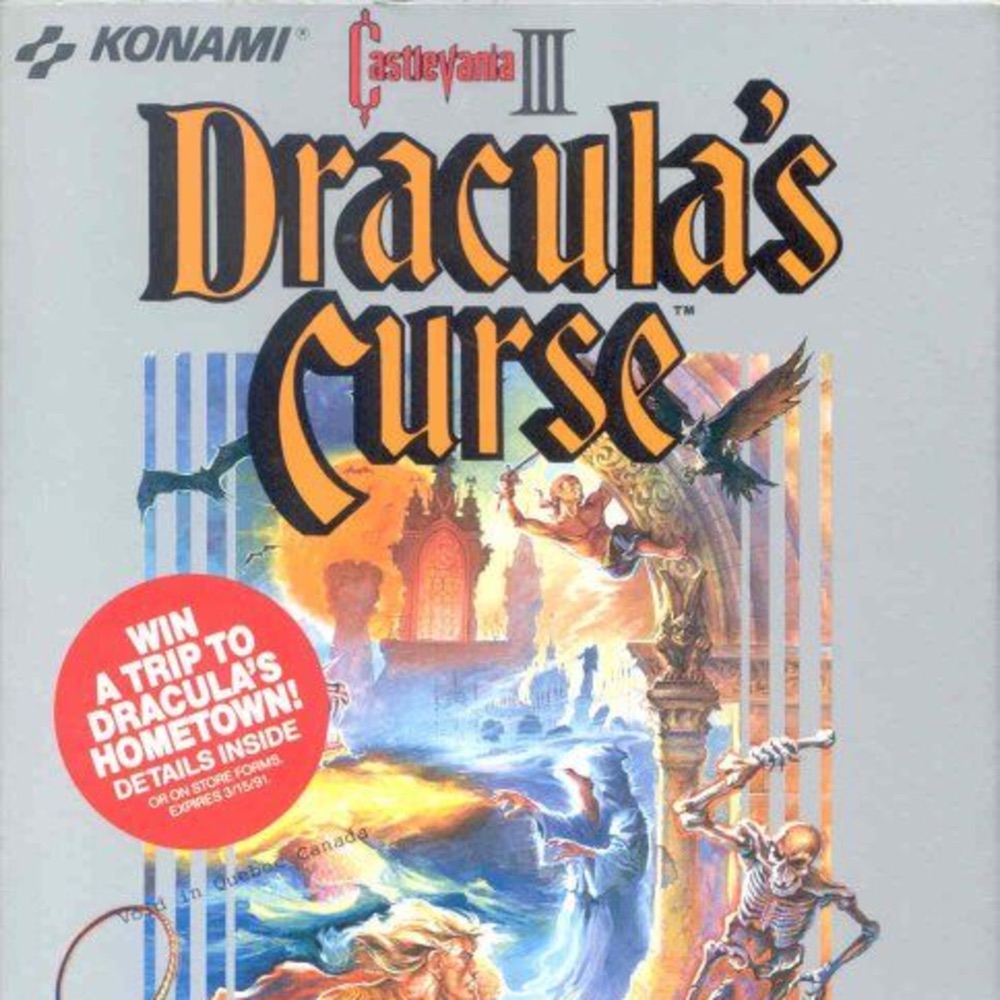
357 · Castlevania III: Dracula's Curse
Taking place 100 years before the events of Castlevania 1 and Castlevania 2, Dracula the Vampire has risen up to threaten the small village of Warakiya. Citizens who had banished the Belmont family now beg for Trevor Belmont's help in slaying Dracula. In his strange castle, Dracula has been assembling a massive army of undead creatures to sweep the Earth clean of life and bring everlasting darkness. Trevor agrees to help and equips his family's hereditary whip, the "Vampire Slayer", in order to destroy Dracula.
This was Castlevania's last day on the show, with Mike, Sean and Joe on hand. Dracula's Curse is a prequel set about 200 years before the first game, and a return to form after the detour of Castlevania II. It plays like the original, with more of everything. We spent much of the episode arguing over whether that is a strength or a flaw, and ended up in the same place.
What makes it essential
- Companions you choose. Grant, Sypha and Alucard each join you after a fight, but you can only carry one at a time, swapping with Trevor at will. Grant climbs walls and ceilings and moves fast. Sypha throws ranged magic, including ice that freezes water. Alucard turns into a bat and skips whole sections, though his shots are weak. Nothing is gated behind a character, so it is a style choice and never a key hunt.
- Branching paths. At the start you pick stairs up or down, and each route leads to different stages, not an easy and a hard version of the same ones. The art hints at where you are headed: a steampunk clock tower, a forest, catacombs. Taking the easy road can steer you away from the party members. We loved imagining a kid at a friend's house watching a totally different level with a different character.
- Real platforming. Platforms vanish and appear, a stage floods, another sinks, some scroll on their own. The swinging clocks and the set pieces won Joe over after a lukewarm start.
- Spooky, not scary. You are a Belmont kicking ass, with groovy tunes and monsters that are fun. The Beginning is a standout.
- Replay. Four endings (one per companion, or going solo), and finishing starts a harder second quest with armored zombies and unpredictable flying skulls where the Medusa heads were.
What we struggled with
- The same stiff Trevor. The jump is rigid, knockback drops you into pits, you cannot steer in mid-air, whip swings eat inputs, and you climb stairs when you wanted your special weapon. We were surprised it was still like this in 1990.
- Punishing in places. A late stage where blocks fall slowly while you wait for a tower to build is probably the least fun thing here. Dying sends you back further than you expect, and a stray candle can swap out the power-up you wanted.
Worth knowing
The Japanese script calls Dracula Vlad Tepes, and its intro reads differently from our localization. Enter HELP ME as your name for ten lives. Okuda, Fujimoto and Urata start you with Alucard, Grant or Sypha. Stage ten is labeled A-1.
The bottom line
Essential. All of us voted it onto the Essential Games List. It is the first game with more in it, and we agreed a game does not have to be easy or finishable to belong there. We were frustrated and liked it, the Dark Souls effect. Playing it also sent Joe back to rethink the first Castlevania.
Written from our conversation in this episode.
- Only you can stop dracula from drawing first blood
| In-game introduction (official localization) | Translation from Japanese (by Vice, 2003) |
| During 15th Century Europe, there lived a person named Dracula. He practiced sorcery in order to create a bad world filled with evil. | 15th Century Europe. In this dark age, an evil person named Vlad Tepes lived in Transylvania. Having reached the limits of his power, he revived dark gods, and used their power to terrorize the nation of Wallachia. |
| He began taking over the Continent of Europe, changing countries from good to bad. The good people of Europe tried to fight off Dracula, but none was able to survive. | Driven insane by his own greed, he planned to take over all of Europe. The Holy Church called out to arms and sent an army to stop Tepes, or as he called himself, Dracula, but none of them returned alive... |
| Finally, the Belmont family was summoned to battle Dracula's vile forces. The Belmont family has a long history of fighting evil. | Seeing that their efforts were futile, the Church decided to hand the task of slaying Dracula to the Belmond family,... ...known "vampire hunters" for many generations. |
| The townspeople became afraid of the Belmonts super-human power and asked them to leave the country. Fortunately the people found a mighty Belmont, called Trevor. | ...But they were feared because of their power. They vanished and have not been heard of since. The Pope never gave up, and at last found one young man: Ralph Belmond. |
| The curse of Dracula has begun. The fate of Europe lies with Trevor. | 100 years before Simon Belmond, Dracula and mankind's battle begins... |
- What is the Gameplay Loop?
- Castlevania III follows a structured, linear level progression where players must navigate through Dracula’s castle and surrounding regions.
- Each level presents a mix of platforming challenges, enemy encounters, and environmental hazards.
- At the end of most levels, there is a boss fight, which tests both pattern recognition and adaptability, with bosses becoming more difficult as the game progresses.
- The game rewards players who explore thoroughly by offering different paths and allowing them to recruit one of three companion characters, each with unique abilities.
- Throughout, players manage their health, sub-weapons, and resources (like hearts) while dealing with enemies, adding an element of resource management.
- What are Some Key Features of the Game?
- Multiple Playable Characters: Unlike earlier Castlevania games, Dracula’s Curse introduces three companions: Sypha Belnades (a spellcaster), Grant Danasty (an agile wall-climber), and Alucard (who can turn into a bat). These characters each offer different abilities that help players tackle levels in unique ways.
- Grant DaNasty: A nimble pirate with limited range but high mobility, able to cling to walls and ceilings.
- Sypha Belnades: A sorceress specializing in powerful spells like fire, ice, and thunder but less agile.
- Alucard: Dracula's son, capable of firing long-range projectiles and transforming into a bat, though slower and more vulnerable.
- Branching Paths: This installment lets players choose between different paths at various points in the game, allowing for a variety of experiences and adding replayability. Some paths are easier, while others present tougher challenges and more dangerous enemies.
- Huge emphasis on Platforming - Blocks being destroyed, blocks being added, levels being flooded, autoscrolling
- We’ve seen a lot of games where the sequel tries something completely different, but isn’t it odd that C3 plays just like C1? Not a huge engine improvement over C1
- What are Some of the More Frustrating Parts of the Game?
- High Difficulty Level: Known for its steep difficulty, especially in later levels, Castlevania III demands tight controls and quick reflexes. Even minor mistakes can be costly due to limited lives and sparse health pickups.
- Knockback: Like in other Castlevania games, taking damage often causes knockback, which can send the player flying into pits, leading to frustrating and instant deaths.
- Limited Checkpoints: Many sections have few checkpoints, meaning that if players lose a life, they have to redo large portions of a level, which can be frustrating, especially in longer stages.
- Endurance-Testing Final Stages: The final stretch leading to Dracula’s castle and the climactic fight against Dracula is a long, multi-phase battle that can drain resources quickly and feel punishing for even experienced players.
Found automatically from the transcript and checked, but it can miss things or pick the wrong page. Spot a mistake? Tell us.
Games
- Castlevania III: Dracula's Curse mentioned at
The episode's game: Konami's 1990 prequel with branching paths, three optional partners and a harder second quest.
- Castlevania mentioned at
The original 1986 game, compared constantly for its stiff jump, stairs and music.
- Castlevania II: Simon's Quest mentioned at
The adventure-style sequel that radically changed the formula, seen as the series' black sheep.
- Super Mario Bros. 3 mentioned at
Example of a third game that rebuilt its predecessor while improving it.
- Super Mario Bros. 2 mentioned at
Cited as a sequel that completely reinvented the first game, like Castlevania II.
- Super Mario Bros. mentioned at
The original Mario game, used to compare how sequels changed.
- Ninja Gaiden mentioned at
NES franchise mentioned as another series that ended at three games.
- Zelda II: The Adventure of Link mentioned at
The side-scrolling Zelda sequel, a radical departure from the original.
- The Legend of Zelda: A Link to the Past mentioned at
Wondered whether it was first planned for NES before moving to the Super Nintendo.
- Super Castlevania IV mentioned at
The 1991 Super Nintendo follow-up, noted for letting you whip in any direction.
- Castlevania: Symphony of the Night mentioned at
The PlayStation game that made Alucard iconic.
- Metroid mentioned at
Compared to the long-haired ending reveal, like Samus removing her helmet.
- Section Z mentioned at
An early NES shooter with branching up-or-down route choices.
- Mega Man 2 mentioned at
Suggested as a game to play before Castlevania III to feel how rigid its jump is.
- Red Dead Redemption 2 mentioned at
Example of a modern story game enjoyed without finishing.
- What Remains of Edith Finch mentioned at
Walking-simulator story game used as a game you would want to finish.
- Bloodstained: Ritual of the Night mentioned at
Igarashi's Castlevania-style game, the closest recent one a host has played.
- Castlevania: The Adventure mentioned at
The 1989 Game Boy Castlevania, a possible Patreon bonus episode.
- Castlevania: Belmont's Revenge mentioned at
The second Game Boy Castlevania, from 1991.
- Vampire Survivors mentioned at
Indie game that received a large Castlevania expansion.
- Dead Cells mentioned at
Roguelike that got a Castlevania crossover expansion.
- Castlevania Anniversary Collection mentioned at
Konami collection of classic Castlevania games, given away free on Epic.
- Castlevania Dominus Collection mentioned at
Konami collection of the three Nintendo DS Castlevania games.
Hardware
- Super Nintendo Entertainment System mentioned at
Nintendo's 16-bit console, arriving the next year and drawing sequels away from the NES.
- Famicom Disk System mentioned at
Add-on that gave Castlevania II its extra music, unlike this game's cartridge.
Companies
- Konami mentioned at
The developer and publisher of Castlevania, joked about for its secrecy.
- Netflix mentioned at
Streaming service that produces the Castlevania anime.
- Blockbuster mentioned at
Video rental chain joked about as the reason the North American version differed.
People
- Vlad Tepes mentioned at
The Japanese opening names Dracula's human identity as Vlad Tepes of Wallachia.
- Shigeru Miyamoto mentioned at
Nintendo designer joked about as never being allowed to tell his story.
Film, TV and music
- Castlevania: Nocturne mentioned at
Netflix's animated Castlevania spinoff, set in the French Revolution.
- Castlevania (TV series) mentioned at
The earlier Netflix animated Castlevania series.
Articles, videos and sites
- Nintendo Power mentioned at
The magazine whose issue laid out suggested routes by skill level.
- Epic Games Store mentioned at
PC storefront that gave away a Castlevania collection.
Other
- Alucard mentioned at
Dracula's half-vampire son, a playable partner who turns into a bat.
- Ghosts 'n Goblins mentioned at
A past episode's game that also requires beating it twice for the real ending.
- Dark Souls mentioned at
Used to describe the 'hurts so good' frustration of the difficulty.
- NEStalgia Essential Games List mentioned at
The show's running vote on which NES games are essential.
Auto-generated transcript. Each paragraph starts with its timestamp. Speakers are not identified.
Castlevania III, Dracula's Curse. Only you can stop Dracula from drawing first blood. Check. In it? Got it. Sorry. Fuck. Whoa! Is this how we're opening?
Castlevania III, Dracula's Curse. Only you can stop Dracula from drawing first blood. And welcome to NEStalgia, a chronological exploration of every NES game released in North America. I'm Mike. I'm Sean. And I'm Joe. We're gonna reach at some point in this podcast the conclusion of many great NES franchises, and today it is Castlevania's last day on the show.
Are we, you know, obviously we've all played the game and everything by now, but like just, we used to do this a long time ago with like first impressions and everything. I'm not asking for your first impression on the game, but just for this series, are you sad to see it go?
I am sad to see it go. And I feel like I've always been someone who's not as high on it as I think you two are both very high on like the original Castlevania, correct? Mm-hmm. That's very correct. Um, and I've never been as high on it, but it is and has been unlike most games that we play on this podcast. One of my first video games, I did play it on the NES as a child. It was like my short reprieves from playing Super Mario Bros. 3, I would pop in Castlevania. So like, yeah, I've got a little nostalgia for the old stuff.
Yeah, I mean, Castlevania 1 is probably, if not the, one of my favorite games on this system and kind of opened my eyes to Castlevania in general. Uh, and I knew that the second one, we knew going into it that it had a reputation, so I'm not holding that against it, like the series as much as I'm sure someone would have in real time in the original, uh, you know, time that it came out.
Um, and I, I had, I had heard that 3 was a return to form and to hear, cause I actually thought that there was gonna be more, uh, that, that this is the last one. Yeah, it gets, it's a, it's a little sad. But I think 3 is like the appropriate number for, uh, these NES games. Like, uh, it is, it is funny, like, uh, if one would have went, like, if we would have gotten Super Mario Bros. 4 on the NES, would we have also expected Castlevania 4, Ninja Gaiden 4? Like, most of them end at 3, but then you have Mega Man, which ends at 6. So, there's, there's not necessarily a formula. And Zelda ends at 2, right? Yes, Zelda ends at 2.
Um, and I do wonder, you know, like, were they ever, was, was linked to the past ever in NES game first? And then there was like, well, we gotta move everything over to the Super Nintendo. Cause you gotta remember, Super Nintendo's coming out, like, next year, 1991.
And we're in 1990 right now. So, we're playing Castlevania 3, and then either in 91 or maybe 92, I'm pretty sure it's 91 though, uh, Castlevania 4, Super Castlevania 4, is gonna come out on Super Nintendo. So, uh, this is really, like, we break them up by consoles, but they actually, these releases are all very close together. And so, Castlevania's always just kind of been around, even though we play such a large amount of video games to space them out.
You're really looking at, like, 1, 2, and 3 kind of just came at you. And 1 and 2 followed the same formula that a lot of NES sequel games did, where they just try to totally reinvent the entire game, but, like, keep the franchise around. So, you have that example with, obviously, Super Mario Bros. 2 completely changing what Super Mario Bros. was, but obviously still a platformer.
Castlevania 2. But creepier. Yeah, creepier, but also, like, better. Super Mario Bros. 2 is better than Super Mario Bros. 1, I'm not afraid to say that. But, um, Castlevania 2 going for, like, the, I don't know, like, adventure. Horrible curse nights and all that. Yeah, but also, like, the adventure aspect of, like, talking to people and figuring out clues and going to dungeons and stuff. Like, that was a radical departure. And, you know, we saw that even with Zelda 2 completely changing from top-down to side-scrolling.
So, it's not, you know, like, that was the norm, actually. If anything, the third game, you would expect, you know, to continue to evolve the formula. But as we've seen with Super Mario Bros. 3, you know, there's also a case to just say, well, maybe we should just go back to what made the first game so good. And revisit that. And Castlevania 3 not only does that, like you said, Sean, but it actually does it almost to a fault, in my opinion, where I can't believe how much they reverted back without changing all the things that we've learned in the meantime from the original Castlevania's release. Hold on, hold on. The jump in this game is unacceptable in some regards in 1990 history.
We're getting really, we're getting really into it now. Okay. I'm just, I'm just saying, I'm not saying the whole game is bad or anything. I'm saying, like, I think it's actually interesting that Super Mario Bros. 3 does not control, Mario does not control, like, Super Mario Bros. 1. The game is the same in the sense of, you know, it's more of a horizontal side-scrolling game instead of a vertical side-scrolling game, and Mario can't pick up objects and such like he could in Mario Bros. 2. But still, it's a different Mario than the original.
This, even though it's a different Belmont. It's not, it's not, it's not being as different as it is being more, which I think we've come to expect out of sequels nowadays, is keeping the vibe and feel, but giving you more. And I think that that's sort of what Castlevania 3 is going for here. You've got new characters you can play as, you've got branching paths, you've got, as a result of those branching paths, you've got more levels.
So I don't think it's trying to do that, like, be different thing, but it is trying to add value to it instead of just, oh, this is just a remix. Yeah, my, my opinion about this has evolved as I played it, because I kind of played this in bursts this week. And by this week, I mean, like, yesterday and today.
But, but I, like, maybe two days ago I started, but, so when I, like, when I first played it, I played, like, I played, like, maybe the first one or two levels. And I, and I immediately, it was like, yeah, this, I haven't played the original in a long time, but I'm like, this feels exactly like the original. And I know, I know exactly what you're saying, Mike, like, this is, whereas Super Mario Brothers 3 rebuilt a new game based on Super Mario Brothers, but made it better.
It feels like this used, like, reused all the assets of, um. Yeah, it feels like it's running on the Castlevania 1 engine. I don't, I'm not disputing anything Sean said in terms of bonus content. Like, we will talk about all those things because they're fantastic.
Yeah. And they're necessary upgrades to the system. I'm just surprised that, even though it's a different Belmont this time, he jumps and, and can't change directions. He can't do basic quality of life improvements that we've had in the other games. But one of those characters can. Yes, yes. Okay, so, so, yeah, when I, when I first, when I finished my first session of playing this game, I was like, wow, this is like, reminding me of Castlevania 1.
And to be honest, it made me think, you know, as much as I was like, this isn't bad by any means. It made me think, oh, maybe Castlevania 1 deserves another look on the essential games. I know that I'll never get through because you guys love it. But I was always just like, not, not as, not as into it. I'm like, maybe it, maybe it has aged out now.
Then I played for like, my second and third session. And I experienced all the other stuff, the stuff that Sean's talking about. We're like, okay, yeah, they added more to it. But also, like, it's evolved in like, concepts. And not necessarily in like, oh, how does it control and stuff. And that stuff kind of changed my opinion again. And then I found a lot more value in this game. When I, yeah, when we get to like, the other characters and like, kind of the party that you create. Well, sort of. And, and the boss battles and, and like, just the interesting ways that they took what they already had. And they, they found ways to elevate it. So, so yeah, I've kind of like, I kind of had both opinions at one time.
Well, I just want to make it clear. I'm not disputing that this game is, is adding content and re, you know, reimagining what a Castlevania game can be. Because I think even just the larger emphasis on platforming in general in this game goes way beyond anything Castlevania 1 did. Castlevania 1 was a very static game. In, in Castlevania 3, you're seeing levels where, uh, platforms are being destroyed in front of you. Platforms are being added right in front of you. There are, uh, levels that are. You can skip platforms. Yeah. Levels are flooded. And now you have to deal with that. Like, get out of the area before the water rises to your point. There are auto-scrolling levels.
There are, uh, multiple, like, uh, verticalities of these, of these different levels. So, like, there's obviously a huge emphasis put on the platforming, uh, which is a good thing, I think. Because it, you know, there's, there's so much more than just putting your whip onto the enemies and destroying them and moving forward. Uh, which was a lot of Castlevania 1, other than just some floating platforms with Medusa heads constantly trying to knock you off them. But the fact that the knockback and the, like, rigid jumping are still here was the only thing to me that was just confusing from, like, uh, what number entry are we on? Like, we're still on the third one? So I actually went back and played 1 and 2 again.
And 1 is still a masterpiece, Joe. It will never come off the Essential Games list. Well, let me ask you this. I mean, I'm sorry to interrupt your thought here. But, like, how do you feel about the movement and the jump in 1? The movement and jump in 1 are fair to me because of the way that the game is designed around it. So there are bad, there are bad knockback moments in that game, no doubt.
But actually, I think it is, and this is not a spoiler for the Essential Games list vote, I will, I have many good things to say about this game. But I think in 3, just the, because of the extra platforming elements and the, uh, enemies that they've introduced into this game and how many of them are on stages, it becomes more burdensome in the third one than it did in the first.
Really? Okay, that's interesting to say, because I, I was, I haven't played the first one in a long time. I was, I, I did get used to the, the, the jumps and the move and everything. And I was, I never felt like it was, like, poorly designed, level design for it. But it is a movement style, like, a movement speed and, like, a type of jump that I don't really like in a lot of games. So, like, that's, like, my biggest gripe with Castlevania 1 is that I feel like I'm trudging all the time. And I want to be able to, like, react to things, and I can't react fast enough because, like, he doesn't move fast enough. And I felt the same way here.
But I, but I did get used to it. It's just, like, it's just a preference thing. But do you think that these are things that they see as, like, oh, this is an issue, we should fix this? Or do we think that this is, like, oh, this is what a Castlevania game should feel like? Yeah, no, totally. Obviously, they feel that way. I think it's, I think it's a choice.
But also, I do think that, I don't know. I think that even with, like, a, you want, like, a stronger, heavier character or whatever, like, I think you can have a better jump than this. But, yes, you can have a better jump than this. But to Sean's point and Konami's point here, if, if Trevor was jumping, like, Mario, right, or even just had the speed of Mario, this game might be, like, way too easy or trivial in certain regards. And I'm not suggesting that it's, like, that it's, like, yeah, it's got that, like, momentum of Mario.
But, like, I mean, there are times where it's, like, I land and, like, there's, like, there's, like, a cool down before I can jump again. Or there's, like, I swing my whip. It does eat inputs, yes. Yeah, there's, like, a moment where I can't do anything. And sometimes, like, I jump and something appears on the screen and I land and it's too late for me to do anything at all because, like, there's that moment where it's, like, I can't do an input right now because I need to wait a second.
Yeah, or you're just too close to the stairs and you want to use your special weapon but instead you start going upstairs. Yes, it's things like that, that, like, that bothered me in the original and it bothers me in this. It doesn't feel fixed in this. So, like, but it also, like, is a flaw in this and also, in my opinion, is a flaw in Castlevania 1. I have a quick question for you guys.
What would you say is the most iconic element of a Castlevania game? Would it be whips? It's the music. Stairs? I was just going to say the music, too, honestly. I think the music is actually... I wasn't even going to give music as an option so you guys are just sort of, like, blowing right past me. I didn't know we were doing multiple choice. Yeah, yeah, no, no, no. It's stairs for me. When I think of Castlevania, I think of stairs and I don't think that anything's ever going to change that. Yeah, well, stairs are the actual final boss of this game, right? I suppose so. If you can master stairs... You will never see them. Yeah, you'll never see the end of the game because the stairs will kill you.
I truly don't understand their obsession with stairs as a mode of traversal and why there are so many rules around them. But again, it's just one of those quirks that makes a Castlevania game a Castlevania game. I don't want to scoop the whole, like, multiple characters and everything, but the stairs get even odder with the other side characters that can join your party. Like, Alucard, he can't use his projectiles on stairs for what reason? Oh, that's balance, Mike. No, I know, but is it? I don't know. Like, Simon, Trevor can use the whip. Why can't Alucard use his projectiles? It's a thing about half-vampires.
They just are afraid of stairs. He's nervous. They have to be invited onto the stairs. We should probably talk about these other characters, though. We should talk about the game. Okay, can I just give, like, a quick, like, rundown about, like, what we're stepping into right now? I would love to hear your rundown. Okay, so basically, during 15th century Europe, there was a man, there's a person named Dracula.
He practiced sorcery in order to create a bad world filled with evil, and he began taking over the continent of Europe, changing countries from good to bad. And the good people of Europe tried to fight off Dracula, but no one was able to survive. So, if you're following me so far. Yep. Finally, the Belmont family was summoned to battle Dracula's vile forces. And the Belmont family, if you haven't heard, they have a long history of fighting evil. And the townspeople kind of became afraid of Belmont's superhuman power and asked them to leave the country. Fortunately, the people found a mighty Belmont and called him Trevor after they asked his family to leave.
And the curse of Dracula has begun, and the fate of Europe lies of Trevor. Those are the slides that you see in the beginning of the game, yes? Yes. Okay. So, just one nitpick. The people of the town don't call him Trevor. His parents called him Trevor. Yeah, you made it sound like they then call him Trevor. Like, they label him Trevor. And then the other thing, Sean, since you bring that up, you know what's so interesting? In my notes, I have that entire script.
But then I also have the official Japanese translation rather than the English, like, hodgepodge that we got. It's not turning good countries into bad countries? Yes. Dracula is not politically motivated at all, as a matter of fact. And also, you know, since we're talking about turning good countries bad, it does mention in the localization that you have that none were able to survive.
The good people of Europe tried to fight off Dracula, but none was able to survive. So, where's the Belmont family coming from then? I thought all the good people were gone. Why they, like, recruit the Belmont family, then cast them out, and then find a good one. Well, maybe that's where the Belmont family's coming from. Well, the real story, though, too. Yeah, yeah. So, that, yeah. What's the order of events here? Is it more like they were cast out, and that's why they weren't killed off by Dracula to begin with? And that's, now they're being recruited back? Like, did that happen before Dracula?
And also, the biggest news in this whole thing is actually the first line during 15th century Europe. So, this is actually a prequel to Castlevania 1. This is, like, 200 years before the events of Castlevania 1. That's pretty wild.
Just in case you're interested at all, in Japanese, it translates to, it's still 15th century Europe, but instead of Dracula, it's Vlad Tepes. Vlad Tepes lives in Transylvania. Like, tapas? Like, the food? T-E-P-E-S. Tepes. Oh, okay. Having reached the limits of his power, he revived dark gods and used their power to terrorize the nations of Wallachia.
Driven insane by his own greed, he planned to take over all of Europe. Oh, so I guess he is politically motivated, because now he's going to get the church involved. The Holy Church called out to arms and sent an army to stop Tepes, or as he called himself, Dracula. But none of them returned alive. Okay, so we're getting it. So it wasn't that everybody who was good died. It was just the people that the church had sent. Their army was killed off. But you also just sort of proved the point real quick. He called himself Dracula.
Whereas... I guess he did, like, a name change, like, you know, Anakin Skywalker, Darth Vader. Yeah. Right? So Vladimir doesn't have the same ring as Dracula. So I'm just saying that it was the townspeople that called him Trevor. Sure, yeah, yeah. And he was actually Trevmonday. Okay. And... Okay, so the Belmonds are... And the Belmonds, by the way, not the Belmonts. Did you know that? No. It ends with a D. It's actually Trevor Belmond. It must have been an Ellis Island issue when they immigrated to get Belmont in there.
But they were feared because of their power, so they vanished and they have not been heard of since. However, the Pope never gave up and now you find out why it was changed in the localization because... Oh, you weren't making that as a joke. Okay. Yeah, the church, the Pope, everybody. The Pope never gave up and at last they found Ralph Belmond. Who? So his name is Ralph in this one. Yeah, right? Like, I mean, but Trevor's, like, accepted now universally as the name. I'd still say Trevor's kind of a bum name for a vampire hunter, but... What about Grant?
Grant is pretty cool. Yeah, Grant sounds great. Also, for the record, not to derail us here, but just so everybody's aware, for, like, the last, like, eight minutes, I've been in this, but you guys haven't been able to hear me, but it's all kind of worked out. Like, I've been responding to things you guys have been saying, and then I just realized you guys couldn't hear me. So if it's all been working out, why do you need to tell anybody? Because the audience will know. The audience will know. Like, believe me, the listeners will know, because by the end, I'm like, can you guys hear me? And they're like, okay, they can't hear me. And then I talk to them, you know? I don't know. I don't know.
You know what's funny, Sean? I thought you were going to talk about the actual fucking game, but instead you just gave us the plot of the game as if anybody gives a shit what happens story-wise. Okay, but here's the thing. If it's that ridiculous, no, we have a history of going over ridiculous storylines. In bad games. Yeah, but even good games can have it, and I think they should still be called out for poor localization.
Joe, your thoughts on the Holy Church, the Pope? Tell us. I mean... Dracula. First of all, I don't know if I, maybe I remember from my childhood, but I feel like I knew from the beginning this was a prequel. Maybe I just, just from cultural diffusion. That thing? Osmosis. Osmosis, yeah. But I like the story. I think it's cool. I took it immediately as, and I don't remember if I was, if you guys could hear me when I was saying this. No. I took it immediately as that they were sent away before Dracula took over, and that's why they're safe. I agree with you. So I felt like it, you know, it all worked out.
I'll be honest, I'm a little lost. Because I would spend a couple minutes trying to figure out how to get my mic working. Don't worry about it, because I'm going to bring us all back together for an actual gameplay moment instead of the plot. And I want to talk about the side characters that can join your party in Castlevania 3. And I say join your party like it's an RPG, but it is not. And once somebody joins your party, that's it. So choose your partner wisely, because you have three possible companions.
The way you find these companions is through the branching paths, which we'll talk about after this, because I feel like this is the most notable feature to talk about. This is the introduction of three new characters, Grant Dynasti, Saifa Belnades, and Alucard. I like how Alucard doesn't get a last name, just like how Dracula doesn't have a last name. But Dracula did have a last name at one point. See, that's what's disappointing. So he's actually Alucard Tepez. Was it like Dracula Smith? No, remember? It was Tepez. Oh, was Tepez his last name? Yeah, right? Oh, I thought he gave himself a last name. Okay, never mind. Yeah, yeah, yeah.
And everybody knows this, so I'm just going to say it out loud. Alucard is Dracula backwards. Everybody knows that. You didn't need to say it. Yes. I certainly knew that. Good. I'm glad you knew that, Joe, and thank you for proving my point. It is weird seeing him in this game. Yeah, right? To say that, like, I, you know. The star of Symphony of the Night? Yeah, and as not, like, a really slick, kind of effeminate, white-haired guy.
And just as, like, kind of a Dracula lookalike, where I thought I was fighting Dracula super early. I thought in the manual he had, like, a little bit, not, like, a feminine white-haired guy, but he had, like, more of, like, an anime look than a Dracula look. Or anime Dracula, I guess. Anime, animacula. That's what he is. He's anime Dracula. He's, like, the, you know, he's, like, the hot Dracula. Hot Dracula. Dracula's too old to be hot. I mean, he's not, like, that, you know, like, millionaire hitting on me at the club, sort of. So, never mind. Delete that. Go on.
Don't delete it. So, I'm actually not, I'm familiar with Alucard again through cultural osmosis. That's what it was. But I don't know anything about him. I didn't play. I've only played, like, the first and second Castlevania before this. So, like, he's iconic? Yeah. He's iconic now. He wasn't iconic. This was his introduction. Yeah, right, right. You shouldn't know who he is going into this game. Yeah. But, yeah, no, he's definitely, like, I don't think people think of Grant and Sypha the same way they, am I saying that right? Sypha? What do you think? Wouldn't go. I thought Sypha. Sypha sounds right. Sypha just sounds cool. Sypha. Bel Nadez. Sypha doesn't sound good. Anyway, yeah, it's like Tifa, Tifa. Right? Yeah. Yuffie. Yeah, exactly.
So, I don't know if there is actually, like, I ran into Grant first. Me too. You know, you have to fight these guys first. And then they're like, oh, I'm sorry, I was turned into a ghost or whatever. Pardon me. Yeah. I'm not feeling quite well in this castle, actually. And then they are like, you know, hey, I'll join you. And I actually turned Grant down for no good reason. You turned him down? Oh, Grant is, like, awesome. I know, I know. Did you play us at all? I played this game a lot, okay? So, I know what they're all like. And Grant is awesome because he climbs the freaking walls.
Yeah. And ceilings. Yes. He actually can, like, go above. He can go where the UI is. That's really cool. And so, that's also, I just want to throw this out there. Like, you can switch between your Belmont and your side character at will. You are never locked to a character. You could play the whole game as these side characters.
So, what you opened the show with, you could play a completely different game with these, like, wall riding controls that feel nothing like Castlevania, by the way. Just saying. Yeah. I mean, I agree. This is what started to sell me on, like, okay, the sequelness of it. I mean, all three of them, I love playing as. Granted, I didn't play too much as Alucard. Oh, you're not that fun. Well, he's awesome. I think he seems awesome. He turns into a bat. Yeah, I love that. I just didn't get too much further after I got Alucard.
But I love all the different gameplay styles. I do think that they still all, there's still this inherent, like, the physics engine, quote unquote, of this game still makes, like, their jumps all kind of weird and clunky. But you don't need to, you have, you think about it differently because the characters control differently. But, like, for Saifa, it's like, yeah, he's just Simon. Like, movement-wise, it's the same problem. But it's, you get all that magic, which is cool. Yeah, so it doesn't change anything about what I was saying in the beginning. No, it says, sorry, Grant is a completely different movement style. You can, your jump is completely different. You can change direction midair. You move faster.
He does move faster. You're right. But, like, I guess I just mean, like, it still feels like, it's, like, taking this kind of, what I feel is, like, a clunky control and making it faster, but still just as clunky. I'm not, I'm just, again, like, trying to play both, you know, like, both sides of what I was feeling. Both sides so you always come out on top, yeah. I love Grant's. What'd you say? Both sides so you always come out on top. Exactly, yes. Yeah, you gotta, you gotta just never pick a side. But, no, I love Grant's movement, but I did still have, I still did wish that, like, they just used, like, a totally different, I don't know, do you still call it an engine? Yeah, call it an engine.
Yeah. But, yeah, Grant was my favorite, like, to, to, to move around with. And, but Alucard, as the bat, can just skip entire sections that would otherwise be incredibly difficult. You know, there's those, like, swinging clocks and stuff, and you can just ignore that altogether and just fly over the whole section, so. I actually liked the spinning clock pendulums. I'm not saying they were a problem. You were saying that they were something you would skip. I didn't find them difficult. I'll say that.
But also. But on the other hand. What's the other side of that? Yeah. Okay, wait, so we've been talking a lot about Grant and Alucard. What do you have to say about Saifa? Saifa was maybe, like, maybe my main. Why is that? Because, well, the, I used fire the most, because it was just, like, the easiest to come by, but that was just such a safer way to attack. The, the, the kind of more ranged magic that, like, pretty much doesn't run out. I mean, it does if you run out of hearts, but, like, you don't run out of hearts. But, um. You can freeze the water. Yeah, yeah. Which is pretty cool. Yeah, and it is, is it the ice attack that, like, kind of, like, takes up, like, it's, like, three balls that go out across the screen?
Yes. I think so. Yeah, I think, I think that's that one. One of them. I don't know. But, like, that is also, like, a very, like, good, like, uh, crowd control option. Or just, like, just to play it safe, let's just throw a bunch of shit out there. Like, it is, I do like that. Yeah, and, and I do appreciate that it's, like, there's differences where, like, yeah, Grant is all about, like, movement, climbing, like, being versatile.
Uh, Saifa is, like, more, like, you might be a little more vulnerable if you're not gonna be able to dodge anything, but you're gonna be able to hit things further away. Like, I think. Isn't Saifa also going for that glass cannon thing, though, of being able to, like, obviously attack with projectiles from very far away? But, like, if, if Saifa gets damaged, it takes more damage than Grant or Alucard, I think.
Okay, so I read stuff like that. Oh, I didn't notice that. I thought that was just kind of. I read stuff like that. Sorry. Go ahead, Joe. I read stuff like that in the manual about, like, oh, like, but he's got, you know, weak skin or whatever, like, but then, like. No, it's a guy. It's a girl. It says in the manual it calls him a guy. I thought it was a guy. Oh, I thought it was a girl.
You have, like, are you shipping Saifa and Trevor? I'm shipping myself and Sheifa. Yeah. I'm shipping myself and Grant. He can climb the walls. Wait, how do you spell it again? I gotta confirm this. S-Y-P-H-A.
It sounds like a disease. It sounds like a STD. It's a girl. Just confirming that. That's funny because in the manual it's totally a man. Yeah, because I thought it was a girl, too, but it kept referring to him as he. I think there's, like, a Metroid moment in the end if you beat the game with Saifa. I beat the game with Alucard, so I only saw his ending. So then you hear, then you see, like, some long flowing locks.
Hmm. Girl locks. Girl locks, yes. But, uh, I forgot what I was saying. But, yeah, you get the point. I liked the, uh, the different, the way you can change up the characters. My favorite thing about the characters and side characters is that I think this is the best, maybe the only, handshake moment in the NES's catalog. There are some really good handshakes in this game. Every time you meet a new character, you will approach each other and then give a really firm handshake. You guys notice that? I think that's where a lot of their budget went to, was, like, the handshake engine. Everything's an engine to me now.
I just wanted to say that I'm seeing the, uh, ending with Saifa and it's very obviously, oh, oh, well, not obviously, but, like, that is some pretty long hair for a man. So, like, it looks like a woman now. But I just think that, I don't even think that they ever, it's not, it's not like a Metroid-style reveal where, like, you know, the hood comes off and it reveals to be a woman. I think this is just an error in the manga. An error. Oh, I see. Yeah, no, I, I'm saying me and Joe are still right. This is just an error in history. It was supposed to be a man.
Uh, but yeah, no, I agree with you and the handshakes, but also just, like, I, I feel like these are all, um, to the strengths of the game, all three of these characters obviously were designed to control differently, but it does say something that, like, Grant, Alucard, Enzyva, all are also useful with their different things. And it's not like, oh, with Grant, you have access to this, like, room that you otherwise wouldn't with Alucard, or, like, you needed to get Grant here to go to this place. Like, they don't wall anything off in the game based on who you choose. It's just a play-style thing.
Yeah. Uh, and I guess, like, that would make it more, like, Metroid-y if, if they did. Not, not even that. That's, that's, that's not true. But I appreciate that it is just a play-style thing instead of, uh, like, a... It would be, like, puzzly. Yeah, it would be more like, oh, this is just a, uh, this character is just a glorified key if there wasn't the same kind of... Right, yeah. Yeah. It would be a chore to be like, okay, I, I have to go back to this part of the castle to team up with Grant to unlock this thing, and then I have to go back down and find Alucard. Almost like a, uh, what, what was the, like, a sweet home situation?
Yeah. But, like, and I also like that it gives you, like, you have the choice then to, I mean, you, you, I did initially when I first ran into Grant, he was the first one I ran into,
um, think that, like, oh, I'm gonna be, like, building a party, and there's gonna be, like, a dozen characters, but I'm only gonna run into, like, five of them or something. Uh, I was a little disappointed when that wasn't what happened, but there still is an element of deciding who you want to bring with you, and then, like, that does, you're only, you can only get Simon and one other person at any given time, so it will change how you play these levels depending on who you bring.
And I, I thought that was cool. Like, I, I, I, there's replay value to it. If I had to add, give, like, a qualitative statement, though, I think you guys are higher on Alucard than I am, because it is cool to be a bat, but his entire thing is, oh, I, as this character, I get to skip more of the game.
And I think that that, that as, like, a power is less valuable than, than something like, oh, I get to maneuver differently, or, like, oh, I get to, uh, have this cool magic stuff. Like, because, uh, Alucard's attack sucks. It's like you're playing a really bad smoke. I thought it was a, I thought it was a good, I thought it was a good attack. And I think you're not valuing how, how hard this game is, that it's nice to skip sections.
Well, I, I, I, like I said, did not play it enough with Alucard to know this, but just from, like, watching him, it looks like a really overpowered attack, is it not? Like, I thought it was just like, oh, he just shoots three projectiles. Yeah, I felt it was good to have all, especially when you get all three, and you kind of just have this, like, barrier, you get the best of.
In special situations where you, there isn't something that's designed to hit you at, like, knee level. Sure. Um, and so you can just sort of spam, or, like, the enemy is really big, so you know that most of them are going to hit. Like, yeah. But I think individual hits are very weak with his attack. Yeah, I mean, that's true, yeah, it's not like you shoot a projectile and the enemy dies. Which is unlike the whip, in which case, a lot of the enemies are just gonna die.
And I think that's more of a balanced thing in general, to make sure that you go back to playing as Trevor, you know, and not, like, not just like, okay, cool, I got the other guy, I want to play as the other guy now the whole game. Uh, it's also interesting that they made it so that you, you know, there are four endings to this game. Uh, one with each character, and then one where you don't take any of them, and you just do it alone, which is, like, the bad ending. Uh, because it's like, someday, Trevor will get the respect he deserves, because nobody knew that you did this.
Um. You just needed, like, a witness. Oh, I thought it would have been more like, oh, one day Trevor will understand the power of friendship. Yeah. Yeah, right? I mean, that would have been nice, but no, instead it's, uh, in the shadows, a person watches the castle fall. Trevor must go for now, but he hopes someday he will get the respect that he deserves. Whereas, like, if you do it with Alucard, I'm pretty sure it mentions that, like, uh. He told everyone. Alucard's got a big mouth. Yeah. He's, like, really well-respected as the son of Dracula. No, it does mention that Alucard feels guilty because he killed his real father, though.
He's, like, really well-respected as the son of Dracula.
Uh. But there's no ending where you take, uh, uh, all three of them and see all four of them together at the end and have this, like, team moment because that doesn't exist in the game, obviously. The game makes it so that you can only take one of them. Um, uh, and would it be a better game if you could first collect Grant, then Saifa, then Alucard? Uh, I don't know. With this kind of difficulty? Maybe. Uh, but it would be kind of tedious to rotate around them by just constantly pressing the select button and watching the shift, the phase shifting thing happen until you got to the character you wanted. Yeah, it does take a while. Yeah. But I don't think, like, I don't know.
I think there's also something to be said about having a choice. And, and, uh, that leads me into my next topic here. The branching paths of the game. Something that is introduced right away into the game. You have to choose whether you want to go up the stairs or down the stairs. And you have the same Castlevania 1 style map, uh, of the entire, uh, castle and grounds,
uh, before you. And there are actual, like, it's not just like, oh, if you take the upstairs, uh, it's the hard route. And if you take the downstairs, it's the easier route. In, in a way that's true, but it's also entirely different levels. And it's entirely different number of levels that you might run into based on which set of stairs you take in these branching paths. And I think that that is another huge improvement in this game to kind of take the feel that Castlevania 2 was going for with, like, multiple castles and exploring a world, but simplifying it into the platforming genre.
Yeah, no, I, I was a huge fan of this, especially when I saw that, like, because one of the games that I think about when I think about branching paths, it was very, it was very early. What is that? Uh, section Z.
Yeah. You have to choose at the end of the stage to go up or down on the, uh, shmup stages. So. The whole game's a shmup, but yeah. The whole game's a shmup. But I thought of that, and I thought that looking back on it, it's like, oh, you're just kind of choosing to choose.
There isn't, there aren't crazy differences in the kind of place that you're going to in that game. Whereas, like, in this, like, you can look at the pixel art, or just, sorry, just the art, and see, like, oh, I'm either going to, like, this, like, steampunk clock area, gears and stuff, or I'm going to go into, like, a forest, or catacombs, or, like, it gives you a little hint about where you're going instead of, like, making an arbitrary choice. And I know that, like, there isn't too much to compare this to, but I appreciate that they did that. Because I could see a world in which it's just, like, go up or down. I don't know.
Something might be different. Yeah, right. And then it's like, well, you're not, you're not going to go check the other route right away. So it's like, yeah, you might not even ever know that it's, like, you're actually exactly the same thing down there.
You know, they actually made a different, and what I, what, what sparks my imagination the most is the idea that if I'm a kid in the 90s, I could play this game, and I could, I could get really far in it, and then I can go over to a friend's house and watch them playing it, and they could be in, like, a totally different area, using a character I wasn't using. Yeah. Playing a different game, you know, like, a different thing, and then it makes me want to go back and play it, and even if it's not really, it makes the game feel really big.
Like, there's, like, there's just all this stuff that, like, you don't, you, you might not even see. Yeah, it's, even if it is, even if it was, which is not, just, like, the illusion of choice between going up and down, but ultimately, you know, you're reaching the same ending.
The fact that they're completely different stages, and the ability to miss out on these important characters, right? Like, the characters that change the game and make it a little more player-friendly, the fact that taking the easier road might steer you away from them is something worth considering, and kind of says, like, well, you know, you have to challenge yourself a little bit if you want, you know, the necessary power-ups, and I think... To skip that, to skip those pendulums. Yeah, right, exactly.
But, you know, all that to say, like, the branching path thing, it's not like it's at the end of every single level. You have to then, like, choose another set of two stages, and so, like, there's endless combinations or whatever. It is kind of... And I think Nintendo Power laid this out in their issue that they cut when they covered
Dracula's Curse. There's, like, a certain, like, determined way to be like, okay, well, take these numbers if you're a beginner player. Take these numbers of stairs if you're, you know, like... That's interesting. If you're looking for, like, an intermediate playthrough, and if you think you're an expert,
take this challenge, and I thought that that's another fun way to think of it, too. Yeah. Of just kind of adjusting your difficulty based on how many stages and bosses and enemies you'll encounter throughout the game. That is really cool. It is surprising in this game, especially in, like, the first stage or maybe first three stages, how many enemies from Castlevania 1 you will run into again, but also, like, how many of them that you wouldn't have seen until, like, the end of Castlevania 1 you'll see at, like, the beginning of Castlevania 3. Oh, you mean Medusa heads? Not the Medusa heads, because I think you see them relatively... I think you see them in, like, the second stage or something like that, but, like, those
hunchbacks are present, the knights are present very early on, even the other colored skeletons show up. There's a lot of, like, kind of late-game Castlevania enemies showing up relatively early in Castlevania 3, but it's not like that's to show that, like, Trevor is stronger or that, you know, that you're a better player. They're just as hard as they were in Castlevania 1, so it's kind of like, whoa! This is, like, you know, I wasn't ready for this kind of challenge, and so I think that speaks to, again, this is a harder game than Castlevania 1. And whether it's a harder game than Castlevania 2, jury's out on that, because Castlevania 2 is just a hard game to navigate, let alone experience.
Yeah, I was trying to, like, go back and, like, think, because I haven't played the original in that, like, it's been a bit, but I was like, was it this hard? Like, I remember it being hard, and I remember praising the difficulty because it felt like the right kind of difficulty that we talked about once in a while, but I just don't remember being this kicked in the ass. Yeah, I do.
Maybe I was just, like, worse at video games at that time, and maybe I've gotten a little better now, because I felt, I still felt like this is, like, NES hard. Like, not the bad NES hard, but, like, a good NES hard. But I felt less frustrated than I remember being in Castlevania 1, which is crazy, because I, like I said, I grew up playing it, but I think I grew up playing, like, the first level of Castlevania 1, and, like, never getting much further. I will say that I do visit Castlevania 1 a lot, and I am pretty bad at NES games overall, like, just the challenging ones.
However, it's the same thing as, like, to the earth was to you, Joe, where, like, once you learn it, right, it's like, that's why these games are possible, right? They're not just, like, hard and impossible. They're hard because you have to really spend time with them. I've learned Castlevania 1 enough where, like, I can pretty consistently get to the Grim Reaper. I will not get past the Grim Reaper. That boss fight is way too challenging for me. I think the Grim Reaper is actually harder than Dracula is in Castlevania 1. But Castlevania 3, you know, it's only been a couple weeks with this game, but I mentioned earlier I beat it. Obviously, that was to experience everything in this game. I did not beat it without cheats. I don't think I ever will.
And I do think that, like, you know, everything they added makes this game, you know, really fun and different than Castlevania 1. But it is harder than Castlevania 1, in my honest opinion. I do think that this is offering specifically with the additional platforming elements. So I don't know if you guys probably didn't get this far, but might have seen it in a video, too. There is a late stage where blocks are slowly being removed from the stage. And that's kind of hard because, yeah, you have to, you know, you have to keep up with all that stuff. But then after all that's over with, there is a particular moment late in the game where blocks are falling from the sky and they drop at an insanely slow rate.
And you need to kind of just hang out and not get hit by these blocks and wait for them to build this very tall structure that you can then get to the next part of the stage at. But the whole time you have to wait for this to be built while also dodging all these falling blocks. So you must always be present in the gameplay, but you can't necessarily like cheese it by, oh, if you just stand in this area, like a block won't fall here. Or be a bat. Right. Yeah, you could be a bat. That's true. But I... But otherwise, yes, you have to... It's weird. And it's probably the least fun that this game really has to offer because you're just waiting
and sort of focusing on the top of the screen, making sure that you are also like, not only just making sure that you are in a spot where they're not going to hit, but not... But you're also like fully aligned in that spot because you could think that you're just about to get missed, but it's going to fall in like the square next to you and it's going to clip your hitbox and you're going to be like, I thought I was clear and you weren't. But... Sorry, go ahead, Mike.
No, no, that's... Because it's just another... It's another point about the platforming stuff is just that I watched a guy who sped that part up by 2,000% speed, okay? So 2,000% faster than regular gameplay. And it was still a 24-second video. That is how long this part takes. And if you die on the stage after that moment, you get sent back to before that happens. So you have to do that all again.
And that might just sound like, oh, well, that's just a really badly designed section of the game. The whole game's not like that. And that's true. There aren't many moments in this game where you're locked out in time and just have to wait for things to happen. But every time you die in this game, you do get sent back with a few exceptions. You do get sent back further than you expected to be. And that's also a really punishing thing in this game.
The game also didn't get rid of the whole like, oh, don't collect any other power up because if you accidentally hit a candle and it contains a new power up, now you lost your other power up. So if you wanted the axe, sorry, you now have the boomerang. If you wanted the boomerang, sorry, you now have the stopwatch. Yeah, the stopwatch. It's like, and we didn't even get any new power ups for that, right? I didn't notice anything new.
Aside from obviously the powers of the other characters. Yes, yes, that's true. But it is weird that you don't get anything different. Right. Anything different? Because that feels like a great way to improve, you know, the whip action too. But that is something that is going to be improved in Super Castlevania 4. In that game, you can whip in any direction. I am surprised that you still can only just whip forward in this game. Yeah. Just as I'm surprised that your jumps must still be perfect in this game.
Again, going back to the engine thing, it is really punishing at its worst. Like it's one thing to get hit by a Medusa and fall off the stage and die. And it's like, well, next time I just got to make sure I hit that Medusa or jump over it or just avoid contact at all costs. But it's another thing when you just are taking a jump that seems like, yeah, I'm going to make this. And you just don't by the smallest margin of pixels. And it's like, you couldn't really just give him like a ledge grab animation for this one? Well, no, that's for Grant. I know, I know. But like, you know what I mean? Like it's kind of punishing to play as Trevor in this game.
To me, the more punishing aspect of that was the fact that you have to be, you have to have momentum to move in the air. I know that that's literally how it works. That is physics, you're right. But like, that's not how video games work. Like not the ones that I play. And like a lot of times I'm standing still and something comes at me. I'm like, I got to get out of the way. And I jump, I just go straight up and land on it. And I'm like, well, yeah, I guess I needed to be running. But like, hey, in real life, I can jump and I can push off the ground in a direction. So I can at least move a little bit as I'm jumping from a standing position, you know. You're not wrong.
I watched another video that offered the idea of like, go play Mega Man 2 for like an hour. And then go play Castlevania 3 for another like 20 minutes or whatever after that, like immediately after.
And it'll like mess with your brain because you're used to Mega Man's jump. And now you have like just an incredibly rigid jump. And it's funny. It's like one of those things where like, you know, stare at this image for 30 seconds. And then you look at something else and you see Jesus or something. Yeah, it felt like when you're a kid and you're like, go in the hot tub and then you like go in there for 10 minutes and you're like, all right, now jump in the cold pool. Oh, did you guys ever like step into like a door jam and then press your arms up against it? Like the top of your arms up against like the inside of the door and then step outside of the door. And then it feels like your arms are being lifted up.
No, no, I'm not even sure what you mean by a door jam. Like within the doorway frame. Yeah, like within the door frame. And then you put your arms up against like the edges. You push it up for like the next like 15, 20 seconds. And then just do it now, Joe. Just do it now. I'm literally doing it right now. Yeah. And I don't know exactly what you mean. No, you'll get it. You'll get it. All right. I'll try later. One of the listeners knows what I mean. I don't know if it has any bearing on what you guys are talking about, but I still wanted to bring it up.
And then do you guys know that after you beat Castlevania 3, if you beat Castlevania 3, that you get transported back to the beginning with your partner still with you. So if you beat the game with Saifa, Saifa is still there at the beginning now with you again. And you can't get any. Are they praying with you? No. Just like straight back into the first level. Oh, interesting. Okay. Not like they didn't change the story or anything. Yeah. So it's not at that like altar. Yeah. Correct.
And then you would think like, oh, I'm just looping now. And it's about high score. Or it's actually a second quest. Oh. I did not know that. And it's... Different levels and everything after the first level? No, it's not that they're different levels. But they did swap out the enemies with significantly harder enemies. And in certain situations, enemies that you never saw in the first run through. Like the Medusa heads are changed.
That's cool. Where are they now? They're replaced by like flying skulls. But the worst part about them is that it's not a sprite swap. Okay. So it's not just like, oh, now it's skulls instead of Medusa heads. They don't fly in the same pattern. They're very like unpredictable in the way that they, you know, move across the screen. They don't move in like a wave format. So it's a true new game plus. I like that. The zombies are now armored zombies. They equip themselves.
But are they also just not sprite slops? Or do they behave differently? Or do they just take more hits? Yeah, now they have more health. So yeah, take more hits. I'm trying to think of anything else.
Well, it's also just like, so enemies in general, just like, there's more enemies on screen too. So it is a big change. But it's just mostly offering a harder experience, which is like, I go back to our Ghosts and Goblins episode where we found out that you have to beat the game twice to get the real ending. And it's like, somebody beat this game once? Like, it's not nearly as hard, obviously. Like, Castlevania 3 doesn't have that kind of reputation. But still, like, it needed an additional challenge? Yeah. But it's not changing the story, though, right? It doesn't change the story at all. You don't get a different ending. Okay. So it's not necessary.
It's crazy to think, though, that, like, in the 90s, they developed this game. And, like, back then, how many people do you think really got to, like, the final level the second time to even see what's there? You know what I mean? Like, they developed all this extra stuff that, like, a fraction, a fraction of the players. I mean, I think that's still the case in games today, to be honest. I mean, that's true. I mean, I'm not saying this is a problem. I think that's really cool. But it's just, it takes, I feel like it takes a lot for a developer to decide, like, let's make a thing that nobody's going to see. You know? And, like, I respect that. But that's tough to do.
Speaking from experience of game development. It's a good point, though, Joe, too. Because I was thinking about that with, like, PlayStation trophies. And there are just so many games where, like, obviously people have the game.
And you get the first trophy or whatever. And then you check it out. And it's, like, yeah, 76. 63%. Yeah, exactly. 60% of people got this trophy. And it's, like, what do you mean? That's the first thing you do. This is the first thing you do. Like, people opened this game but didn't play it? Like, that is nuts. And then you think about, like, how many people platinum certain games. And it's, like, it's a really impressive feat. But, yeah, it actually winds up being, like, 0.2% of the player base, like, platinum the game. That's really cool. Right. And so, you know, I know that there's a community out there for that kind of stuff with retro achievements.
Where you can say, like, you know, you can get a trophy for beating Castlevania III's second quest. But, yeah, like, do you need to, do you need to even get to the end of these games to enjoy them? Well, I, for one, speaking from experience, can tell you that I enjoyed it and did not get to the end of the game. That all that stuff, all that bluster that I had about Sifa or whatever the hell her name is being a girl. That's not because I found out firsthand. That's because I watched the video. But I did, with what I did play, enjoy it. And there's games, there's more modern games versus the same situation. I'm just not that good at them.
I don't know. I mean, for NES games, there's a different reason. But I'm definitely able to, like, really enjoy them without beating them. Because I haven't beaten most NES games that I've ever played by a long shot.
But, yeah, there's just, like, something about, it depends on the type of game. And I think most NES games fall into a category of, like, yeah, I can pick these up and play for a while and have a great time. More modern games, there's more, it's more 50-50. Like, I can play, I can play half of Red Dead Redemption 2 and be like, that was fun, but I'm tired of it, but I still had fun. But if it's, like, a storied game and I'm, like, burnt out halfway through, I'm like, this game's not worth it. You know, so, like, there's, I just think not a lot of NES games fall into that. Real quick, Red Dead's a story game.
Oh, no, I know. It's a story game, but it's also an open game. I can go do a bunch of things and, like, yeah, I loved the story while I was playing it, but I did just, not by fault of the game, just by fault of, like, time. I just never finished it. I do want to play it more.
I mean, like, story games, like, if I play, like, What Remains of Edith Finch and I don't finish it, whereas, like, this is just, like, a walking simulator story game. And I do love that game. But if I, like, stopped halfway through, I would have felt dissatisfied and been like, yeah, I don't want to play this game again. Yeah, as someone with a PlayStation Plus and Game Pass subscription, you know, I've learned that you don't have to really play much of a game to have an opinion on it and like it and move on. I don't have enough time to play all the video games in the world to completion.
And I think that's not only just a conversation point for modern video games or Castlevania 3 or NES games. There's just, like, a thing in general to keep in mind is, like, we have limited time to do this podcast, play all these games, and then talk about them for what is now going on almost an hour for Castlevania 3.
You know, you can still have an opinion one way or the other on these kinds of games, but I don't think I'm ever going to be able to, like, definitively say about Castlevania 3, it's difficulty. Like, I'm going to say it's a difficult game because of the time I was able to spend with it. It might wind up being a Castlevania 1 situation where I kind of say, like, oh, it's not that difficult, but that's because I've been playing it for, like, five, six years now, you know? Like, I've been hammering away at it for so long.
I don't know if, like, that's going to happen here with these kinds of games, and I think that's something you have to keep in mind when you talk about the difficulty and what you'll be able to experience in Castlevania 3. Because it is hard just to even, you know, by modern standards, it is hard just to even make forward progress in these kinds of games. Obviously not for our audience who grew up with them. Like, you know, you guys know these games very well and everything. But if you're just joining, you know, NES games and you want to experience these and you're not willing to kind of put in the time, you might just experience Castlevania 1, 2, and 3, 10 minutes each in an emulator and be like, oh, these games suck. Why does anybody like them?
Yeah, you need to have, like, that, you get that investment as you're getting that, like, skill in the game also. So it's like, I'm an eye and eye. And a good game would reward you for your investment, right? Good point, Joe. Yeah, yeah. And I'm, like, super guilty of just, like, picking up a game, an NES game, especially before this podcast, picking it up in an emulator, playing it for, like, one second and being like, no, I'm not going to like this. And then, like, we've come to some of these games in the show and I'm like, okay, I definitely didn't give this, like, a fair shake because I had the ability to play one of 800 other games. You know, so it's just like, I don't know, it's all contextual.
Bats suck. They always come at you right at your ankles. And it's always, like, it's on purpose. Like, they put it there on purpose so that, like, you're not, you're going to have, like, just finished up beating another enemy that you're standing up straight for. And then it comes in right at your ankles. Well, the hunchback guys also, yeah, I was going to say, like, every enemy kind of knows where you're going, right? Like, they have that information. It's in the script. It is in the script.
Just wanted to say that. Yeah. No, there were a lot of enemies that just felt like they hated Trevor in particular. I just hate saying Trevor. You want it to be Simon. I want it to be Simon. He looks just like Simon. His last name is Belmont. Can we just call him Simon? He looks just like Simon is right, right? Like, it's kind of, it's kind of like no one cared either. Like, it wasn't that controversial that, like, you're playing, you know, like, imagine if you were playing. Yeah, fuck it. His name is, his name is Ralph. Yeah, but just say, like, you know, oh, you're playing a Sonic prequel and it's his dad and his name is Quickster. You know, it's like, you can't do that. Quickster the hedgehog. It's like, you know what I mean?
It's not the same thing. Whereas, like, here it's like, this is not, like, Simon barely had an identity at this point. Trevor barely has an identity because he looks like Simon. And he's just his, like, great, great, great, great grandfather. So, like, does any of it matter? Like, and, you know, that's another thing, too. It's like, so this is a prequel. This is the earliest entry in the Castlevania saga that we have so far. But, like, I'm sure the Castlevania timeline by 2024 is an absolute mess.
Yeah, I mean, even now, like, what did it matter that it was a prequel? Like, if you'd have removed the, like, the entry crawl and just sort of had people guess. Like, like, the original Castlevania, well, I wouldn't say it's, like, like, plot and story. Like, it was still, like, telling a story based on, like, where you were, what you were doing. It at least had, like, the suggestion of a story. Whereas, it's only because they're telling us that it's 200 years early.
At least in my opinion. I mean, don't you, I mean, again, by this time in, you know, I'm sure it's all, like, if this is true, I'm sure it's all been retconned since. But don't you kill Dracula at the end of Castlevania 1? Yeah, but we kill people all the time that show up again in video games. Well, that's what I'm saying. But I'm saying, but maybe at that time, like, well, we already killed that guy. Let's do a prequel.
And by now, yeah, he comes back. He comes back. But, like, I don't know. I don't remember how, like, what kind of story there was in the first one. But I kind of thought it was cool. It's like, oh, this is, like, the story of, like, how the Belmonts became these famous vampire hunters. I like that it's a prequel. I like the concept of the canon. I just don't think that there is any canon.
So at the time of release, you wouldn't have expected necessarily that this would be the last Castlevania entry. Like, you didn't know for certain. Konami wasn't branding it that way.
But now that we know that Castlevania 3 is the last NES entry, this is not, don't tie this into your essential game list vote or anything. But, like, does the series overall, like, 1, 2, and 3 feel like something that has, like, an arc to it or a narrative behind it that, like, you could explain here on the podcast? Is there something of an evolution in these three games? Is there a streamlined thing? Or is it just, like, you know, Castlevania 1 and 3 are their thing and Castlevania 2 is just an attempt at something different?
I mean, are you talking plot? No, not plot. Yeah, just, like, a story that we could construct here with hindsight, you know, of just, like, looking at the development. It's hard to put these all together because of Castlevania 2, you know? When you, when you, I'm sure it can be done. I'm sure you can kind of get to that story. But, like, I would have trouble with it right now because Castlevania 2, which I don't even really remember too much. I just remember it being a completely different game. And then this being, like, so similar to 1. I'd say that while, if I couldn't put an arc to it, like, how Joe was saying, because there was such a huge discrepancy there. But I'd still say that 2 had the vibe down. There was still a vibe that was very Castlevania.
So I don't, I wouldn't say that there was a moment of, like, oh, I can see where they're going with this. It just, each felt like a Castlevania game in at least a, at least a cosmetic sense. Maybe not so much in a mechanical sense with 2, but they still, like, it was like, oh, this is, this is Castlevania Gaiden. Yeah, that's a good point, actually, because I was, as I was playing through Castlevania 2 again, 1 is just, just insane. Like, the start of Castlevania 2 compared to 1 and 3 is just, like, unhinged almost. You need to, you need to have the manual right next to you.
Because the game, the game is so funny because it just puts you right in the town and deliberately places a guy who, like, walks, like, paces back and forth right next to you. And you're coming off of Castlevania 1. So, of course, you're just going to whip that guy right away. Yeah. Because you think that's an enemy. But it's just somebody you talk to, and they don't react to your whip anyway. It's not like you can hurt them. And then you actually just, like, leave the town, go to the very next screen, and there are two enemies on the screen that are, like, right next to where you spawn into. And it's just like, what is going on in this game? Like, who's placing enemies? Why would you start a game like this?
And then, finally, after several screens, you get to the dungeon, and it's like, oh, yeah, this is, this is what Castlevania 1 was like, right? Like, there's, there's stairs to climb, there's enemies to take down, I still, there's still branching paths, it's not linear. Like, I have to look for the thing I'm looking for, and I can just enter rooms that don't mean anything like a real dungeon would.
But still, that felt more like Castlevania. And I feel like maybe that's the story here of just, like, what we're seeing in general with the NES games is just that the difference between 1 and 2 was maybe just too extreme. And so they did kind of go back to basics with 3. And again, with 4, 4 is going to play basically like 1 as well, but with Super Nintendo capabilities.
So there really is a, just a, a black sheep in the family with 2. Yeah. And, and yet, the core essence, like, like Sean was saying, like, we, we touched upon me and Joe saying, like, yeah, I think of the music. And, like, yeah, the music, the enemies, just, like, the way that they make scary stuff fun. Like, you don't see too many games like that. It's spooky, not scary. Yes, that's true. Sorry. Spooky. No, you're right. Spooky is the better word. You don't see a lot of games like that, that, that take something like, you know, Frankenstein, Dracula, mummies, skeletons. Handshakes. Yeah.
And you don't see games like that, that, like, make it, like, a fun, exciting environment with, like, groovy tunes and, you know, that you feel like you're in charge. Like, I'm just thinking about, like, every horror game usually tries to make you feel really underpowered and scared, right? But, like, you're not scared as a Belmont. You're fucking kicking ass. And I think that's what makes these games so cool, even if they're just 8-bit. Like, it still manages to get that idea across.
Yeah. And you know what? I'm, I'm watching, um, Castlevania 2 footage now. I switched from 3 to 2 just to remind myself a little bit. And that's kind of sparked, like, I think if I had to come up with the, the, the connecting thread is that they're taking this formula and they're trying to find ways to evolve it. And there's some trial and error.
So, like, Castlevania 2 does still, I'm, I'm not, I didn't remember how much the, like, dungeons did kind of have similar feel to the Castlevania 1. Like, there, there are some of those through lines in there. So, so I think it's like they tried really hard to evolve and they realized they did too much. And then they walked it back so much in this third game, but still did a great job evolving. So, like, it, they, they feel more like a series than I remember, you know? It just, 2 has, like, some, some really crazy changes.
Yeah, definitely. But, like, if you compare this to the Super Mario Brothers trilogy on, uh, the NES. Yes, I think that's more disconnected. Like, Super Mario Brothers 2 is more disconnected from its prequel and sequel than Castlevania 2 is. I also just wonder if it's, like, a marketing thing, though, where, like, they just thought you can't cannibalize the sales of the first game by releasing, uh, like, the second game can't be, like, the same thing. Like, you know, like, nobody's gonna buy the first game anymore. I, I, I don't know if that's true or not, but, like, that's a thought. But, uh, ultimately, we can speculate all day.
It is interesting that, like, there's not an entry in the Wikipedia for, like, an interview from Konami about why they did this. It's just so strange, right? Like, we'll never find out. These, these Japanese video game companies are so secretive about their development. Like, also, Konami is just evil. Yeah, no, but, like, Nintendo won't let anyone talk. Like, we're never gonna get the Shigeru Miyamoto story. He's gonna die working for Nintendo. And they're never gonna, there's never gonna be, like, a cool, like, here's what I wanted to do with Mario, but they wouldn't let me do. Like, he wouldn't say that shit.
The unauthorized biography. Yeah. Uh, all that to say, you know, Castlevania's 1, 2, 3, and 4 on Super Nintendo, like, that's my main exposure to Castlevania outside of Symphony of the Night. I have not played, like, the, the DS games or the, you know, like, really, like, the Metroidvania-style games. I really don't get into that stuff. I, I want to, though. Yeah, no, I do, too, now. It's really just because, like, even, even Symphony of the Night, like, I had so little exposure.
It was basically my exposure, I may have explained this in the original Castlevania, when we're like, oh, what, what, what experience do you have? Like, I was just over at a friend's house watching a friend play Symphony of the Night. And I haven't had a working PlayStation in my living quarters in, like, 15 years. So, and there hasn't been any remaster, re-release, and I don't feel like emulating it. So, I just have not played Symphony of the Night in 15 years. I just want to play it.
And even, like, stuff like the, the more modern, like, like, like, like, PS2 generation and further stuff, like, I just have not seen. Like, the closest I've got is playing Bloodstained. So, no, I need to get more into Castlevania than I have previously. And there are two Castlevania Game Boy games. One that already came out in 1989, Castlevania, the Castlevania Adventure. Or is it, no, Castlevania, the Adventure. It's just weird. The box art makes it look like it's the Castlevania Adventure. But it's Castlevania, the Adventure. And then Castlevania Belmont's Revenge. Castlevania Belmont Steaks. Yeah. It's a great horse racing Dracula game.
What do you think? Maybe, you know, plug the Patreon here for a second. But maybe on the, you know, Nostalgia Bites, our Patreon-only podcast. Maybe we hit up these two. Check them out. I feel like we're going to get disappointed by them. But I'm not against it. Game Boy games being bad, I've never heard of it.
And I think that's it. Because I don't want to do, like, sequels and spinoffs. You guys know there's, like, a thousand sequels to this shit. So I will say, just since we're talking about Castlevania in media in general, there was that Vampire Survivors game pretty recently. Oh, yeah. Got a huge Castlevania expansion. I think, didn't Dead Cells do something recently, too? Yeah, I think so. With Castlevania, right? Not with Devil Survivor. No. With Vampire Survivors. With Castlevania. Yes, they did something as well.
And there's also still Castlevania anime being produced. I know that there, like, a long time ago, Netflix was starting that. And it seems like it's still doing well. And they're still making more of it. So it's called Nocturne. And I think it started last year. But there's still more of it coming. And it's still on Netflix. So it's doing well. So Castlevania is alive and well. Which is funny, because Konami, you know, certainly doesn't, you know, there are months at a time where Konami doesn't say a word. So it's funny that they could do this whenever they want. They could just put Castlevania in the right hands and we would all be happy. But they are releasing Castlevania collections as well.
I don't know the name of those off the top of my head. But there's... There was the one that was free on Epic recently. Yeah, I feel like that one's probably just called the Castlevania collection, too. But, like, there's also, like, a collection of the DS games, a collection of the Game Boy Advance games. Like, there's no shortage of ways to play all these Castlevania games. So I'm definitely going to give it a shot. And we need to give Castlevania 3 a shot in the Essential Games list.
I won't deny that Castlevania as a franchise is something that I am very into and have a chance to be biased about. Because of how much I liked the first game. I also won't deny that Castlevania 3 is a difficult game. The kind of difficult game that could be frustrating. The kind of difficult game that you will see YouTube videos on where people just keep trying to walk up stairs. And Medusa heads or spiders or skeletons throwing bones constantly keep hitting them. And then they fall into a pit that they have no way to move out of because your knockback is uncontrollable. And then you just watch them, like, throw a controller.
Like, there are plenty of videos on that. However, I think Castlevania 3 is offering a larger experience than Castlevania 1 while retaining the controls and gameplay of Castlevania 1. And so if I consider all that, if I consider, hey, you're basically getting Castlevania with additional features and, you know, more levels and new enemies and a bigger, like, not even just story, but just a bigger scope in general. And all of those things are positive introductions. As we've mentioned, the additional three characters, the branching paths, like, none of those things were steps in the wrong directions.
So when you kind of talk about that you're complaining about features that mostly revolve around Castlevania 1, then I start to go back to the difficulty conversation that we were having in the middle of this podcast. And there was a reason I was talking about it for so long is I don't really think the essential games list is built around, like, which games are easy to complete or fair to complete or, you know, they should be left off because they're hard.
I don't think that's the experience. I think you can play the first six stages of Castlevania 3, call it a day, and say you had a good, like, Friday night, you know? I think that's totally possible.
And maybe that's the kind of experience that we're all having with video games nowadays where you don't have to necessarily beat a video game to say you enjoyed it. And so I have no problem saying that I really enjoyed my time with Castlevania 3, you know, lackluster.
I think that's the only thing that I've ever had to do with Castlevania 3, you know, and I think that's the only thing that I've ever had to do with Castlevania 3. Castlevania 3 should be on because it's only improvements. It shouldn't be penalized because we're just in the year 1990 now as opposed to 1987. I don't think that's how the essential games list works for me. So I'm going to put it on. What about you, Joe? When I first started playing this, I played, like I said, I played those first two levels and I walked away from that, planning to play more, but kind of with this, like, okay, there's no way I'm putting this on there. I'm already lukewarm on the first game. This is just more of the same.
I did say that my opinion evolves as I played more. And first of all, finding these other characters that you can play on made a huge difference to me, which does add this variety. It did give me, like, more reason to want to keep playing and, you know, there was more fun. But then, having continued playing, I kind of saw these game design things, like there's a level where, like, the whole stage is sinking as you're moving.
Or even those clocks, the swinging clocks that you move on, which aren't, like, crazy game design, but, like, it's cool aesthetic design, coupled with the music, coupled with the bosses, which we didn't talk too much about, but, like, are all pretty, you know, they're well done boss battles. I did have a pretty good time with this. I still had my frustrations, but I think that I largely agree with you, Mike. I mean, I think that they did, it's a lot of great improvements on here, and there's just clearly a lot of love in this game, even if I'm not very good at it.
So, I think that if I'm, like, looking at the frustrations I have from the Castlevania series, I think that I'm going to revisit the first one. And, like, I feel like that is on my short list to, like, think, to rethink, should it be on the Essential Games list before this. I think that this one won me over throughout my time playing it. Maybe I'll go back and maybe the first one will re-win me over.
But this one right now, where I am, I think that I've come full circle, and I do also want to vote this Essential. Okay, Sean, you can't stop it, but I don't think you were going to anyway. What's your vote? Yeah. It's funny how, I guess I kind of tipped my hand, and Mike kind of said exactly what I said at the beginning of the episode, to put this on the Essential Games list.
But it's funny. We didn't talk about this during the episode. We usually talk about, oh, what was the game like on the Famicom? And it seemed like a lot more friendly of a game. Like, you know, Grant had, like, a totally overpowered attack. And there were some changes that just made the game easier. And in some ways, I kind of wish we got that game instead of the version that we were dealt because of Blockbuster or whatever you want to say.
But I still think that the game that we got, as difficult as it is, and as frustrating as it may be, was just as frustrating as in the first one. And we were all frustrated, but we all really liked being frustrated. It's like, you know, I've said it in many episodes, it's very much the Dark Souls effect. Like, this hurts so good, in a way.
But yeah, I'm also going to vote this on the Essential Games list for the same reasons that were stated. This is the first game, but more. The fact they leaned into, like, those set pieces in their level design, like Joe was saying, was really cool. Like, the way that they were kind of defying expectations on what a level, a Castlevania level could be. I really appreciated, and I thought it was an expansion on what we had previously experienced. I will not forgive its elementary school level opening crawl, but I think that's endearing. But yeah, I'm putting this on the Essential Games list as well. I'm helping.
You're doing your part. I'm doing my part. I voted. Yes. I will say, Sean got me, you said a couple things there that just got me thinking, oh, I could do another 30 minutes on this show now, because you've given me a bunch of new topics to talk about.
I'll start with, first off, just weird take here, but, like, I'll still take the first one over this right now. Like, if I'm being honest with myself, like, I still think the first game. And maybe that's because I played it on Nostalgia, and now I have Nostalgia. But, like, right now, one over three for me, in terms of, like, what I would pick up if I had to, you know, like, I'm by myself. I think it's just more classic now. Like, those levels, those moments are like, oh, yeah, that clock tower level, not this clock tower level.
Yeah. So they're both essential. I'm just saying, like, for me, it's like, I'm just putting a, for anybody who was interested, for me, it goes one, three, two right now. And if I had to include four in there, I won't do that. Because, yeah, I won't do that, because we might get there someday. Ugh. Yeah. Pat and pending 2070. We'll get to that.
And then the other thing I was going to say is you mentioned the Famicom version of the game. And, yes, that has some actual gameplay differences, but it also has a special, like, audio chip. Yeah. So it can play, it has two extra waveforms on it or something like that. I don't know how those, wave channels.
And I listened to those tracks after I played through the NES version, and they're not good. Wow. I don't, it's the same, but it happened with Simon's Quest as well. Like, I feel like it's like, maybe if I heard them first, I'd be like, yeah, those are my songs. But, like, now, okay, so there are, there are, like, three amazing tracks in Castlevania 3, which is funny, because there's, like, seven in Castlevania 1. And there's two. That's neither here nor there. Yeah, there's two of the greatest of all time tracks in Castlevania 2.
But in Castlevania 3, the track called The Beginning, which is the music for the first stage, that is, that is just like, wow, they did it again. For the third game in a row, we have just an absolute classic track that's just gonna stick with you. And it just doesn't sound like that in the Famicom version, like, because of these two extra channels. Yeah, I'm not expressing any opinion on those. I have, because, again, I only heard them very briefly, so I don't have that attachment. But it seems that the prevailing opinion outside of Mike is that they are better. I'm not saying I agree with that, but that is outside of the norm.
Yeah, because it's just, like, really interesting that they put an additional chip onto there to, like, they didn't do that here for anything, as far as I know. Like, we didn't, the Famicom disk system was the reason for the second game having the extra music. But they didn't add this coprosser chip here, so that's interesting. And then the third thing I was gonna say that Sean had me thinking about was that there are, like, there's still some funny charm things, funny charming things about this game as well, like in the first one. If you guys remember in the first one, there was, like, you could pose in certain places to, like, have bags of money appear.
Yeah. Or, like, hit the walls and there would be, like, a fully cooked turkey in there. Yeah, uh-huh. You know, like, that stuff is still present in this game, too. But also, you can enter as your name on the screen, HELP ME, in all capitals, and you will start the game with ten lives. Really? Yeah, it just, like, it really leans into that shit. That's cool. So, I think there's a lot of fun being had here, too, which was kind of what I was getting into about the whole, like, you know, doing spooky but fun. No, I think, but does the name you enter do anything? No. Is it even listed anywhere? It does do something else. Sorry, it does. I'm trying to think of... If you... Yeah, your name is at the end of the game, I'm pretty sure.
They say your name, which is weird. And then, um, there are... If you do different names, you can also start the game with those characters. So, if you do... Oh, okay. Oh, cool. Okuda, these must be developers of the game, but if you do Okuda, you get to start with Alucard. If you do Fujimoto, you get to start with Grant. And if you do Urata, you get to start with Sifa. Um, and then if you do Akama, uh, A-K-A-M-A, not Akama, uh, then you will... I heard the first one. Yeah. You will, um, play the second... You'll start from the second quest.
So, that's pretty cool. It's kind of interesting that there's no, like, um, name yourself... It's just a hidden password system. It is. It is, in a way, because then you can even do, like, um, you know, use this name and, um, and use this password, and you can be like, okay, so start with Alucard and be on level 6-A, you know? Like, you can do it that way, too. Which is another funny thing about the game. Sorry, we're gonna keep going.
Um, the game has its levels, uh, you know, from 1-1, uh, but there are 10 stages. So, when it gets to the 10th stage, instead of it being 10-1, it's A-1. Whoa. Couldn't handle the number 10. Yeah, they're too many digits. Yep, so it went to A, um, for Alucard, of course. Um, shoulda went to D for, like, uh, Dracula, right? Eh. Yeah. I mean, or, but, I mean, Alucard is the one you play it. Maybe V for Vampire. Hmm. Mm-hmm. V for Vendetta. Oh. And you know what else V is for? The Essential Games List.