224 · Who Framed Roger Rabbit?
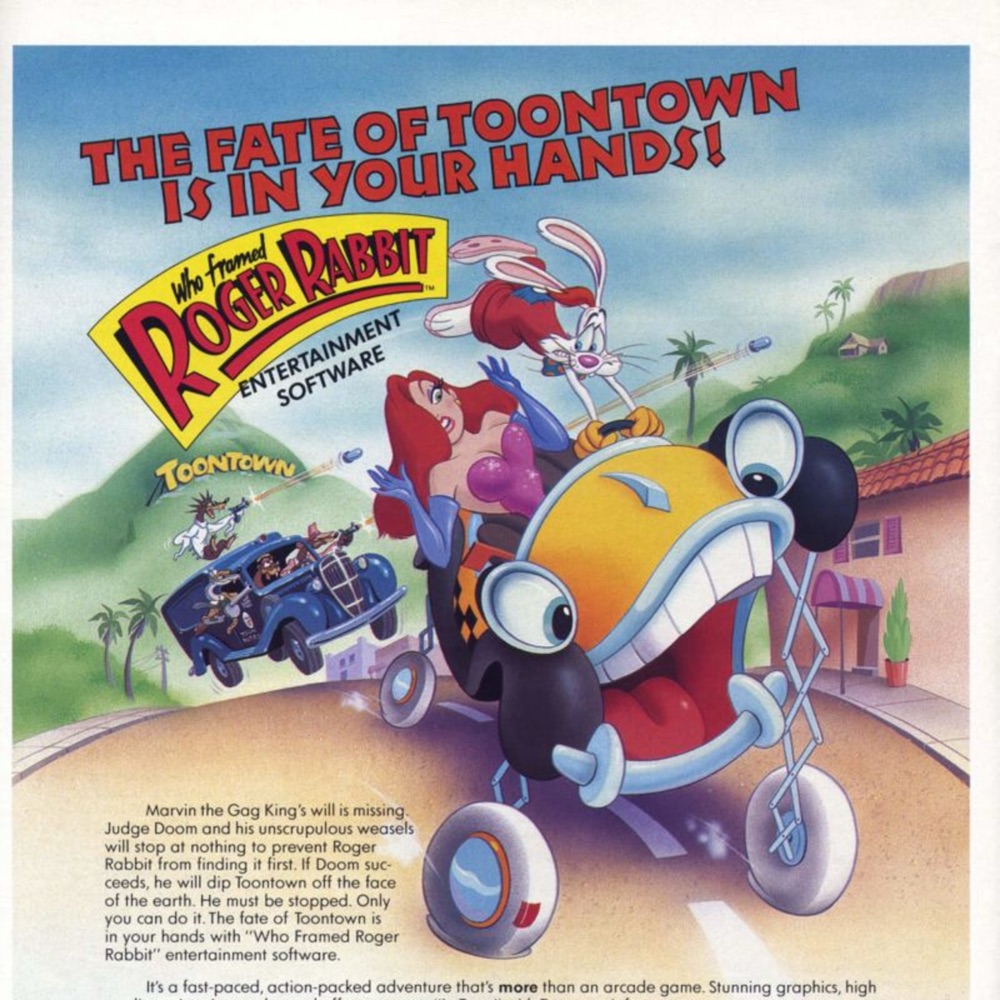
Roger Rabbit's, a living breathing cartoon, has been framed for the murder of Marvin Acme. The motive is that his wife, Jessica Rabbit had been photographed playing patty-cake with him. Obviously this kind of affair is enough to drive a man, or rabbit, into killing. But he didn't do it and now there seems to be some kind of mystery surrounding Marvin Acme's last will and testament... and with it, ownership of Toontown. In order to clear his name, Roger has enlisted the help of Eddie Valliant, no-nonsense detective. Together they'll need to search through Hollywood, Toontown, the Wilderness and Toontown in an effort to find the pieces to Marvin's original will and stop the evil Judge Doom and his henchmen, the Weasels.
SHOW NOTES
Who Framed the Longplay?
Who Played as Roger Rabbit?
Who Played the Opening Movie Sequence?
Who Read Roger Rabbit?
Who Promoted Roger Rabbit?
- You’ve Seen the Movie. You Know the Story.
- NES Longplay
- Introductions
- The back of the box assumes we’ve all seen the movie. So have we?
- Bugs Bunny and Mickey Mouse together
- One of the masters Robert Zemeckis
- Overview
- Based on the movie, this Action-Adventure game has the player control private detective Eddie Valiant. Accompanied by Roger Rabbit, you must find clues and items that help progress the story and find out…WHO framed Roger Rabbit.
- Gameplay
- Did you wanna play as Roger Rabbit?
- As a detective how do you find these clues? This aint Rockstar’s LA NOIRE
- The items are random every time
- When talking to people, be sure to press the A BUTTON only once. If you press it while talking to them, it will cancel out the conversation.
- If you hit a person then talk to them, you can sometimes get funny responses like "Go away you horrid man!"
- While walking along the streets, stay on the sidewalk as not to get hit. If Roger gets hit, he will be fine. Remember, he is a 'toon.
- While on the map screen, beware of birds. If they pick Roger up and carry him off, it causes you to die.
- The Weasels and their jokes
- The strange UI and inputs.
- SELECT and buttons just to put in commands?
- The choice of text, lives, power, strength meter.
- So the points of progression
- Find the password and the rose to get to the ink and paint club
- Talk to Jessica Rabbit to get clues where the will is
- Locate the pieces of the will
- Take will to Judge Doom for the final fight
- Cheat
- Final battle with the Judge, At the code entry screen, simply enter all Z's
- Sequels and Spinoffs
- Who Censored Roger Rabbit is the novel written in 1981 and the basis for the film
- Who P-P-P-PLUGGED ROGER RABBIT in 1991
- Soft reboot about Roger Rabbit starring in the cartoon adaptation of Gone With the Wind
- Who Wacked Roger Rabbit? In 2013
- Who P-P-P-PLUGGED ROGER RABBIT in 1991
- Who Framed Roger Rabbit for Computers
- Released in 88
- You actually play as Roger Rabbit
- Mostly driving levels with the Cab
- Who Framed Roger Rabbit on GameBoy
- This is an action game with puzzle solving elements. Roger Rabbit can move freely within Toontown (and some of its buildings) and the main gameplay consists of talking to people who give Roger clues about where to go next. He also has to collect and use a variety of items in order to progress. However, when walking around town he is attacked by enemies who reduce Roger's life bar if they hit him; there are also a few boss battles. A few (sparse) items can be used to dispatch enemies.
- Hare Raising Havoc (1991) for DOS and Amiga
- You need to help Roger Rabbit get out of each room he is stuck in so he can capture Baby Herman before Mommy returns home.
- Who Censored Roger Rabbit is the novel written in 1981 and the basis for the film
- EGL
- Next week - Casino Kid
- NEStalgia Byte - Tower of Druaga
Auto-generated transcript. Each paragraph starts with its timestamp. Speakers are not identified.
Who Framed Roger Rabbit? You've seen the movie, you know the story.
And welcome to NEStalgia, a chronological exploration of every NES game released in North America. I'm Mike. I'm Sean. And I'm Joe. Who Framed Roger Rabbit? You know, the back of the box assumes we've all seen the movie. So, have we?
I've seen it like once when I was a kid. I remember almost nothing about it. I haven't seen it at all. I mean, I've seen clips, I don't know, when people talk about it with pictures. So, like, you know, I know, I know what he looks like. And I know who Jessica Rabbit is. Of course you do. But, yeah, yeah. But other than that, like, I don't, I don't really know too much. All right. Well, I do, I love this movie. I also love Robert Zemeckis. This is another Robert Zemeckis joint. And also, Robert Zemeckis also made Back to the Future. So, I mean, we have two LJN produced movie video games that were both Robert Zemeckis style movies. This is interesting. This is, there's a lot of crossover here.
Didn't, wasn't, like, one of the bits of trivia from Back to the Future that Robert Zemeckis hated it? Like, hated the video game version? Of Back to the Future? Yeah, active, yeah, like, actively hated Back to the Future movie. I'm sorry, game, game. Yeah, Back to the Future, the movie, the game. Oh, well, he probably played it. Maybe, maybe I'm just misremembering.
Yeah, I don't remember that piece of trivia. So, I will try to find a source for that and put it in the show notes if I can. But, that's interesting. I doubt Robert Zemeckis was playing video games. He was pumped. This was his, like, you know, legendary run of movies from, like, 1985 all the way to, uh. Well, I mean, he was, it doesn't, that's not to say that he was playing them, but I'm sure, like, he was aware that a game was being made. Well, maybe he was just mad that so many of his, the games of his movies had nothing to do with the movies themselves. He's like, no, you don't understand, like, I'm telling a different story. You're telling the story of my characters doing other things that they don't do in my movies.
Yeah, I mean, it also could be that Back to the Future game was just, like, definitively a bad game. Well, the one thing I remember from Who Framed Roger Rabbit, the movie, not the video game that we'll get into in a minute, is that there is a scene in that movie where Bugs Bunny and Mickey Mouse are together in the same shot. And, like, for me, I just had to call that out here on the show because that was, like, a huge, I didn't think that could be done.
I didn't understand that that was possible, but that's when I learned to love our corporate overlords for giving us the much-needed crossover that now we just get all the time. Any, uh, any two pop culture characters that we want, put them together. It's a multiverse. I'm still waiting for a live-action Batman and Iron Man movie, so I think that'd be fun. Soon enough. You know, Marvel vs. DC is only, like, 30 years away.
Who Framed Roger Rabbit? The Game is based on the movie, but maybe not if you ask Robert Zemeckis, but it's a action-adventure game where the player controls private detective Eddie Valiant. Accompanied by Roger Rabbit, who you do not get to play out of at all, you must find clues and items that help you progress the story and find out, you guessed it,
who framed Roger Rabbit. Sounds like an okay game to me, but didn't you guys want to play as Roger Rabbit? Didn't you think you were going to play as Roger Rabbit? I mean, I don't know.
Like I said, I haven't seen the movie in a long time, but isn't, isn't, uh, this other guy, the detective, isn't he, like, the actual main character? Yes. Okay, but yeah, sure, he's the main character, but this is a children's game now, and, like, you know, you think it... Yeah, no, I don't think so. No? I beg to differ there. Okay. No, I'm just thinking, like, the NES is, like, a children's console, you know, like... Well, here's the question that I have.
Would you rather be Roger Rabbit or hang out with Roger Rabbit? Like, it's not, I don't think that, like, Roger Rabbit is, uh, is like, oh, men want to be him. Um, but he might be fun to hang out with, and that's exactly what this is simulating here. He just sort of, like, follows you around, and what?
I'll tell you why, because think about it like this. Would you rather be Sonic the Hedgehog or hang out with Sonic the Hedgehog? Sonic the Hedgehog does not translate to Roger Rabbit. No, no, no, listen. It does not translate. Listen, one fan made a game where you just hang out with Sonic the Hedgehog in your apartment. That's true. And he progressively does creepier and creepier things to you. And that's what you just made me think of with Roger Rabbit.
I'd rather play as him in some wacky platformer that is inspired by, like, the, um, the opening short with him and the baby who turns out to be, like, a 40-year-old man. Um, I don't know if you guys, you guys haven't seen the movie, so it doesn't matter. But that's, like, the opening sketch is, like, oh, Roger Rabbit is actually, like, a famous cartoon character in this universe, and he makes the movies in the cartoons in this toon world. And I thought, like, you know, you could do that as, like, a platformer or, like, a Bugs Bunny's Crazy Castle-style game. But instead, they decided to take the route that the movie totally takes, so it's fair.
I just don't know how much fun it is to be the private detective and then just have Roger Rabbit follow you around, but not even, like, closely follow you. He just kind of has his own mind and doesn't really interact with much of anything. Well, here's where I want to just kind of, uh, argue my point here. Um, the difference between Roger Rabbit and Sonic is that Sonic has, like, you know, he's fast. He has powers. He does things.
Whereas Roger Rabbit, as far as I can tell, as somebody that has mostly just absorbed knowledge of Who Framed Roger Rabbit through, like, I don't know, pop culture retrospectives. Um, it seems like he's just, like, a dude, like a dude cartoon and, like, more like an actor. Is that the case? Uh, yes to the actor, but I wouldn't say he's just, like, a guy living in that universe. He just takes on, like, the trope of, uh, you know, a Bugs Bunny, a Mickey Mouse, a Woody Woodpecker, just, like, the lead person who can do it all.
Okay. I, yeah, I don't know. I guess if we're going for a mystery and solving it, I would probably go with, like, the actual detective. Unless it was called Detective Roger Rabbit, which might be another thing in an alternate universe. Well, so I'm thinking of, like, what I would have, how I would have reacted as a kid in 1989 when this came out. And I feel like, yes, if we were talking, like, a platformer or something, I'd want to be, like, the colorful, you know, crazy, cartoony Roger Rabbit.
But, like, my, you know, my, like, eight-year-old brain would be, like, oh, like, I want to be the, I want to be the detective. Like, I want to be this cool guy and, like, have to protect the, like, goofy cartoon character because I'm too cool for cartoons. Like, you know, I feel like I would be, you know, for that age, you might, you might actually benefit from not being the cartoon character.
So they tried to make it true to the story of the movie, like, finding clues to figure out who framed Roger Rabbit. As a detective in this game, how do you find these clues? Because, remember, this isn't Rockstar's L.A. Noire. You're not going around and interrogating people and doing, like, you know, custom speech dialogue to get proper answers and stuff like that. Mike? This is a game where, ultimately, the detective part of it, like, the mystery-solving part, to me, I don't even know where to start because it's so, it's just so bizarre for a child's video game based on a hit movie to take the most, you know, the hardest route to getting around to the answers. Mike? Can you help me? No. There is nothing in this building.
I didn't know what you were doing for a second there. I was like, is Sean okay? It's so, like, humiliating, being a detective in this game. You're just like, oh, can you help me? And that's all you ask. That's all you can ask. And there's, like, there's nothing in this building. I was like, check the drawers, please. Like, that's what being a detective is like in this game. And then you find stuff just by sheer brute force, pretty much.
That's what my experience was, at least. Yeah, but at least you only have to wait, like, 11 seconds while you search each. Well, if you want to search the desk, yeah, you'll search for 11 seconds. You gotta just sit there. Well, it's very realistic, yes.
So, for those who don't know, what you do is you, as the detective, are on the streets of Toontown, and you go into a building, and you immediately, like, find a person or a stray cat that wants to kill you. But say you find the person first.
You press the A button only once. Don't you dare press it twice, or you will cancel the dialogue option between you and the other NPC. However, if you do manage to have the conversation, it is just what Sean asked me earlier, and there are only three possible answers. There's either the building is empty, the building has something, or search the drawers.
And that might prove to be, like, okay, great. Like, that's how you find out. That's a valid strategy for finding out if there's anything worth your time in these buildings. But every single time the game resets which buildings have which items and where they are, the only way to ever play this game from, you know, from start to finish is that you must go into every building, and at least you could just, I guess, not ask anybody and just explore everything. But you have to ask at least one person in each building, hey, is there anything in here?
And they just say no. It's like, what is the point of that? Why randomize everything if it just comes down to a simple, like, speech test against the NPCs? Look, I'll say that, you know, on the surface, well, first of all, yes, I agree. None of this is executed well at all.
It's very, it's very, the gameplay loop when it comes to this part is not fun. Just, there's no other way to put it. But I'll say that on the surface, or on paper, rather, I get, like, I can see a world where this is okay, because it's just a means to get you around town. It's like a little bit of a MacGuffin or whatever you want to call it. Like, that's just like, yeah, this is how, this is what gets you into building a building where, like, other crap happens that's, like, exciting or whatever. Like, things will attack you or you gotta answer these dumb jokes or whatever. But it's like, I get that as being like, well, this gameplay loop could work.
It needs to be contextualized. Everything else worked perfectly with it. And it wasn't quite so, like, it wasn't quite so tedious. Like, maybe have, like, one or two things to search in each building if you're gonna do it this way. Just let you search it. You don't have to wait for realism's sake. Like, and then you have to definitely have, like, enough exciting things going on between that that makes, like, the search feel exciting. Yeah, I mean, right now, what we're playing in this game is the template. Like, there's no reason why anything is in any building.
There's no context. There's no dramatic force. Like, we're playing the how-to. It's like, hi, my name is Love Interest. And I'm going to guide you to plot point two. And that's exactly like, if this game were the story, that's how it would be written out. And that means that it's all, like, I felt like what I was doing was completely useless. Because there was nothing mysterious about this detective story. It was just, oh, it's just, I have to click on everything, pretty much. And that's how you solve things.
Right, yeah. I mean, to follow up on what Joe was saying, if they said that there was something in the building, so that you knew, like, okay, yeah, this is why they randomized it. Because sometimes the build, and every building is completely different, right? Not the case in this game. But let's pretend in a different game, every building will be different. So you never know which challenging thing you're going to have to get X item in Y building. Because you don't want to deal with that challenge this time. Time for a reset of your game.
Instead, once you find out that there's something in the building, it's just on the freaking floor. And you pick it up and you leave. It's not even like there's some kind of challenge or things specific to only that building or a location or something like that. Or a puzzle. Even when they tell you, yeah, exactly. When they tell you, search the drawers or search around or whatever, I was thinking, like, oh, there's this little mouse hole.
Like, maybe there's something in there. And I was thinking, like, oh, I'm thinking ahead of the game. Like, they designed that really well. It's noticeable. I'm going to search in the mouse hole and something funny is going to happen. And it's just, there's nothing here. Well, then don't even make it an option then.
Each interactable object in this game is, like, a less interesting equivalent of flushable toilets in, like, first-person shooters. It's just, like, there's there. And it's there to, like, make you feel like the world is interactive. But it's really just a cookie cutter, like, button press. I don't know. I mean, it's very sad. But to be clear, things can. It's possible. Things are sometimes hidden in those mouse holes or in the drawers. It's just way more often than just sitting on the floor. And there's way too many mouse holes and drawers and desks that have nothing in it that just make it all so pointless.
And, yeah, I think, I mean, I feel like I want to make this suggestion. But I feel like it's one of those things where it's like, well, yeah, you're just talking about making a whole different game now. But, like, my thought is, like, if these rooms were a little more puzzly or a little more, like, contextual. It's like, yeah, the baseball is in, like, a sporting goods store or something. You know, whatever. But, like, I'm thinking of it like you can make these, like, tiny little mini escape rooms where there's, like, a little puzzle or a little something you've got to figure out.
Rather than just being totally random. You know, it's like Spy vs. Spy without the element of, like, the two-player, like, I wonder where he hid the trap thing. It's just things are just randomly placed. And that takes away what I think makes Spy vs. Spy cool. Yeah. And that's, like, when this game describes itself as an adventure game, that's what, like, that's what comes to mind is are these really ridiculous ways to interact with the world in very specific ways that, while it may not make sense, you may need to buy, like, a fake mustache to get something out of a drain pipe or something. But at least there's something going on instead of, like, oh, let's just check all the drawers. Like, let's just brute force this.
Yeah. And for a place like Toontown, the apartment buildings are, like, all exactly the same and really boring just consisting of desks and drawers that you can search through and everybody's rooms are just, like, their bedroom. There's no, like, wacky, zany things. And yet the actual gameplay parts of it do include some cartoony-like elements. I noticed that if you hit a person and then talk to them, not all the times, but sometimes they will respond, go away, you horrid man, because they're reacting to the fact that you just beat them up for no reason.
Reactivity. Yeah, exactly. It's like, that's a nice touch for a game to have like this that otherwise has zero personality. Think about when you're walking along the streets to get from building to building. If you get run over by one of the cars, you get, like, you know, laid out like one of those bear rugs, you know, you or Roger. Now, Roger, if he gets hit, he's fine because he's just a cartoon. So he just, like, unflattens himself and everything's back to normal.
If you get hit by a car, you're a human being with, you know, vital organs that are no longer intact. You know, like, I assume that just they've got a lot of little, like, just slapstick moments for Roger Rabbit. They're like, that's what he's there for. And also, like, you're there to, like, maybe I'm misremembering the movie, but, like, maybe, or, like, does this make sense that you're kind of there to protect Roger?
Yes. Yeah. You hate cartoons. Okay. That's the whole idea. Like, the detective hates cartoons. He, I think his, I think the story, which I'm now slightly misremembering too, but I believe his, like, buddy cop was killed by a toon or something like that. And that's why he doesn't trust cartoon characters anymore.
Wait, so he begrudgingly, we're just talking about the movie now. So he just begrudgingly accepts Roger Rabbit's request for help? Well, because now he's a private detective. So, you know, it's like before he used to be on The Force and everything. It's all the noir tropes, you know? Yeah, yeah. But I don't think he is, I don't think Roger Rabbit, like, comes to him. I don't recall exactly who comes to him. It might have been Jessica Rabbit. Oh, I see. Okay. Yeah.
Anyway, speaking of just cartoon-y things that happen in this game, occasionally as you're wandering around town, a group of Judge Doom's weasel henchmen will come up and potentially grab Roger and hold him hostage. And the only way to free him is to successfully tell the punchline to their jokes. And I can't help but feel like this is one of the best moments in the game, no matter how painful the punchlines actually are. Yeah, it's definitely a different form of combat, if you want to call it that. This game does have combat, too, but I like to think of it more as a creative solution to fights.
Yeah, it's a nice, it's a nice interrupter. That's one thing I will say, this game is going, but it's got a lot of variety. And it's kind of, it is funny to see all these really bad jokes come up. But, and I know we keep bringing it back to the movie, but does something like that happen in the movie, where, like, they laugh so hard that everyone gets away or something? Or is this just random?
I'm pretty sure that happens in the movie, yes. The weasels are, yeah, like, known for laughing. But I would even just argue that, like, that kind of, you know, very on-the-nose silliness is what the movie is known for, too. And I feel like here it's executed really well, because it's also, it's not just, you know, here's an A, B, C, D thing, and you just pick one of the options. You have to, like, cycle through potential answers and then select the one that you think matches their joke. And it just feels like it's an actual interactive moment rather than just, like, a forced cutscene that only happens, like, one time. And, you know, the joke is obvious. You gotta use your allotted tune seconds very thoughtfully.
They call them tune seconds. Yeah, what was that? I thought, when I read that in the manual, it says nine tune seconds. I thought they were trying to make a really bad play on 19. Oh, my God. But it's not 19. It's nine seconds. I don't know. I just, I laughed at that. And I'm not sure it was different. Well, you see, movies are filmed in frames per second. But because this was an animated movie, it was filmed in tunes per second. So that was a reference to the movie as well.
That sounds contrived, but I can't tell if you're messing with me. I can't tell if it's made up or not either. So I'm just not reacting. I want to talk about the strange selection of both user interface and inputs to do things in this game, though. Because we were just talking about the weasel punchline thing, which I thought was done very well.
Except for I didn't know how to even see any punchlines until I realized you have to hold down select and then cycle with the D-pad through the options. It's like, why wouldn't the D-pad just work by itself? Like, why would you have to hold select? The choice of text on the menu screens at all time of like, you know, like your lives are represented by these clapboards. And your power is these little P buttons, P icons.
And then your strength meter is just always on the screen, even if there's like no combat necessary. But it's something that winds up like a meter for, you know, for like a golf swing. It's very just a strange choice of of menu design elements that are just constantly around you. Yeah, and a ton of a ton of real estate on that on that menu at the top is given to like just the words Roger Rabbit.
And the fact that like some of them have have multiple uses and like because the power meter is also where it tells you what you're doing. And while I think it makes sense and it's a it's a good like workaround to have like your usable items be cycled through with like the select button. I have no idea why in a screen where you have no other like anything to input for, you still have to do that in the joke phase. I that was that was odd, but I don't think that an expert in UI UX was on staff. Yeah, well, I also I feel like the select thing.
Because that was really just baffling to me, too. I had to look it up like how to how to change the punchlines as well. And it feels like, well, you know, the the D pad is the is the most is the best way to use this. But like this button's called select, so we have to use that somehow or else people are going to take everything literally.
Yeah, like I feel like it's like you just because it's called select doesn't mean it has to be the button. You have to somehow incorporate it into selecting things. And I just want to throw it out there. You know, we didn't mention it. We did throw LJN under the bus, but they actually hired rare to develop this game. So this is kind of unusual that we're, you know, we're complaining so much about normal gameplay design elements from a company that usually we enjoy the way they think outside of the box.
I think that's a thing with LJN, too, though. Like what I associate them with are like this this really weird dude that just like, oh, we're going to make it so that you can drive a car and you have full 360 control steering. But we're not going to let you off the train tracks and we're going to have Roger Rabbit follow you around. But like not really close. And it's not going to make a lot of sense.
He's just going to kind of walk like that's sort of what they've been doing with whether it's whether it's Jaws or like all the line of bullies that you have to throw. You have to throw like beer bottles at and in in back to the future. Like they're just wild and crazy ideas. They just throw stuff at the wall and it's kind of endearing that they that they have these unique ideas. It's just they never really think too much about them. So that's what I think of LJN.
And this is still like we've talked about before, like Rare doesn't really have they haven't really proven that they have the kind of pedigree that we associate with Rare yet. So I this this is sort of like par for the course, but them, too. Right. Well, I guess I would just say that every time they've given us a game that wasn't just like a Jeopardy Wheel of Fortune thing, it's a completely different game. And this this one follows that rule as well. You know, who framed Roger Rabbit for me personally is so hard to talk about because it's unlike any of the other 222 NES games we played before it.
However, I would just say that, like, while I'm not a huge fan of something like Wizards and Warriors or Slalom and stuff like that, those games are good. You know, like they're technically impressive for the time. And I had very little to complain about this game. It feels like it's more like you were saying an LJN pitch them like you're going to make this game for us. And here's how it's going to work. And, you know, Rare was forced to make it the way LJN wanted it. That's the only sense I could make of it. Yeah, make it follows.
This definitely feels more LJN than Rare. Yeah. And you mentioned, like, their, their, like, ambition being kind of endearing. And I, like, really agree with that because, like, I, I enjoyed playing this game just purely out of, like, oh, they tried to do this and they tried to do that. You know, like, even when a lot of it doesn't work, even when, like, if I take away my, like, just my, like, the intrigue that I have about, like, what they were attempting to do, then, like, if I take away that, a lot of these things, yeah, are not fun. But, like, I just, I just appreciate seeing all of these, like, all of these, like, things that they try to do in the systems that they use to try to make it work. Like, it's kind of cool.
If you're, if you're, if you're interested in, like, in old games and stuff, I feel like this is just, it's just fun to kind of, like, break this game down. Yeah, and understand what's going on, going on under the hood.
And also just, like, the, the fact that bad is so much better than bland. So, um, a lot of the games that, uh, Mike mentioned, uh, that Rare had done previously, like, yeah, they're definitely competent games, but I don't really, they don't really occupy too much space in my head. Um, whereas I feel like I'm not going to forget playing Who Framed Roger Rabbit because it's so weird. So, yeah. Yeah.
Let's go over the points of progression throughout this game. Because you're a detective trying to get to the bottom of this, the whole game is just about finding series of clues to unlock the next gated part of the game to then allow you to move forward. So, the first thing you have to do is, and you will find many other things along the way, of which I can't tell you what you might specifically find because it'll be, uh, unique to your, uh, playthrough. But the first thing you need to do is find the password and the rose to get into the ink and paint club. Now, you can just find just the password to get in. However, Jessica Rabbit won't talk to you unless you give her a rose because that's how she knows that you love her or something, I suppose.
So, you give her the rose. Now you can talk to Jessica Rabbit. She'll give you clues to where the will is. And now the game becomes no longer about finding items, but finding pieces of the will. So, you locate the pieces of the will based on the obscure hints she gives you about where the will might be. And this is a little bit where the game opens up. But ultimately, it's just another batch of, okay, now instead of going into buildings and asking, is there anything in here? Now you're asking Jessica Rabbit, uh, do you have any idea where the next piece of your will is?
And so, I don't know if you guys want to talk about, like, you know, that part of the game. But, like, for me, it just, it didn't actually feel like anything opened up. You know, they try to make it so, like, now you can go into the woods and go into the caves and do this and that to find the will. And it's like, I don't know, it didn't really actually seem any more exciting.
I bet for them it was, like, that moment at the end of Final Fantasy VII, at the beginning of the end of Final Fantasy VII, where you leave Midgard. And it's like, now you've got the whole world. And it's like, maybe that's what they thought Roger Rabbit was going to be like. Now you can explore outside the buildings. No, because it doesn't change the fact that we're still just playing the bones of, like, a story.
Like, they're referring to these things as pieces of the will. But it's just, you need to collect three key items. And, like, you have to go back and ask her, like, where's the next key item, please? And she'll tell you. And then, like, that's sort of what's going on. It doesn't feel like you're opening up because, again, there's no context to anything. Yeah. And, like, you leave the city and you go into caves. And that's a little different because, like you said, instead of asking people what's here, you have to, like, fight a snake or something in the cave. And then you'll need, like, items, like you might have to get, like, the spring shoes that you would have had to find somewhere else to jump over, like, a chasm or something.
But then that's the new gameplay loop. Like, that one change happens. And then you do that 40 times, like, looking for things. And you go and talk to Jessica Rabbit and she gives you the clue and everything. But it's, like, yeah, there's, like, a minor tweak to the gameplay loop that just, like, incorporates into the gameplay loop a little bit. But still becomes very repetitive along with everything else.
In a very, like, basic way, a lot of these early games attempt to be nonlinear. Like, I think there is a very obvious points of progression thing that I just laid out. But if you're a kid exploring this game, those things aren't incredibly obvious to you. I'm looking on game FAQs to figure out, like, what to do next. There was this whole, like, nonlinear gameplay for a lot of these action-adventure NES games.
And then we just kind of said, like, that's not working. And the Super Nintendo, the N64, like, for a while it was just, like, linear games that were very, like, follow-the-hallway style stuff. And now we're getting back to the whole, like, open world, do-whatever-you-want style things that, like, yeah, these games aren't open world. I'm not making an argument for who framed Roger Rabbit there.
But I'm saying it is funny that games tried to do something very early on that they just didn't have the technology ready for yet. And I think that's the problem here is that Rare should have found a better way to communicate, like, what the new gameplay flow was rather than have it be just checking in with the same person over and over again to figure out what's the next place I have to go to. You know, think about, like, Ninja Gaiden does it through, like, cutscenes, right, of giving you the next bits of the story and then you just play the exciting moments.
I think Hoover and Roger Rabbit didn't need to be level-based, but it certainly needed to maybe have a moment of locked, you know, cutscene footage where you see, like, the next moment of the story unfold and understand, like, oh, okay, so now I gotta go here, you know? It would have been a little more exciting, I feel like, but they chose to make a game where you can find anything in any particular order because every time it's different. Yeah, I think that the... It's more open-ended than it is open world, so yeah, you're right on that count.
But I think that this game could have made a lot more sense and they would have the ability to flesh things out a bit more if they just did away with the whole randomization. Like, you could have finding the baseball in the sporting goods store even, like, yeah, just because it would be a hand-placed item that you can put, like, little environmental details in instead of everything being, like, a hotel hallway that people are walking around with desks and tables. Like, there would be more of an opportunity to flesh this world out because you didn't have to worry about everything being interchangeable.
And I guess that's a lesson that they're learning here, or hopefully they learned it, the industry is learning here, that unless you have unlimited resources that this game definitely didn't have,
the wider you make something, the shallower it becomes, and this is a prime example of that. Yeah, and, like, to me it's kind of the equivalent to what we always say about enemy placement.
Where it's like, they're doing the same problem that we have with a lot of games where, like, enemies just randomly appear anywhere, and it doesn't always end up being fun because it wasn't designed specifically to be fun. Whereas, like, this is the same thing. Like, in this case, if the developers took a little more control over where things were, it could feel a little more intentional. It could feel a little more like you solved a puzzle rather than, like, you just looked everywhere because you knew the game was just, like, randomly generating these items.
So, like, it's weird because I feel like we've not really – maybe we have seen things that have the same problem, but we've not really talked about that problem outside of, like, enemy placement. But it's kind of giving me the same vibe. And that's why I'll say that, like, I don't even necessarily think that this type of game doesn't work because the technology is not there. But I think that it's because the – yeah, the gaming industry's experience isn't there yet. Like, there's not enough gaming history to draw on and, like, learn from the mistakes of older games.
Whereas, like, you know, maybe a decade down the line or whatever when, like, other games are coming out, like GTA and stuff's coming out and things like that. It's like, oh, we've kind of – we have a good idea of what works and what doesn't and how to kind of make this kind of thing work. We keep mentioning that inside these buildings or just locations you go to that there are items you pick up. There are a lot of different items to pick up. There are wallets. There's whistles. There's custard pies.
You know, there's a lot of stuff. So I don't want to, like, break down the power-ups, if you want to call them that, you know, at a time. Was there anything you guys specifically thought was pretty unique?
I'll take the obvious one here with the whistle being able to use to hail Benny the Cab so that you could travel the map faster. That felt like an actual – a little bit ahead of its time but only because we haven't had all those Japanese RPGs come over yet. You know, they clearly took it from, like, those kinds of overall games. But that feels like you're getting the airship moment where you can now explore the map a lot faster and see sections you didn't think you could see before. Or I like stuff like that.
I'm less jazzed about, like, using a wallet to purchase items at a store. It's like, I have to give the whole wallet away just to buy things at the store. I mean, I like that there's different classes of things. Like, yeah, there's currency, which is just wallets. Like, there's no money in them, but this version of Los Angeles trades exclusively in wallets.
And you've got, like you said, the whistle. But then a lot of them are just glorified keys. Like, you can't see in the caves unless you get the torch and you can't jump over holes until you got the spring boots. Even though the man has legs, you can obviously jump, but not until you get those. So I just see them more as keys.
So a lot of it's just, like, little tricks like that and not so much, like, really interesting, interactable tools. Yeah. And then the other things are weapons, which, like, you get, like, the bricks. You throw the bricks and you think they would do, like, a lot of damage, but they don't. And then there's, like, there's, like, a couple of things that you, like, lay down on the ground and you need someone to, like, fall into a trap.
And then there are also, like, a few things that you use to, like, lure. Like, there's the cheese that you can use to, like, lure the mice away. And there's something else, I think, for, like, cats or something. I can't remember. Oh, the fish bones. Oh, yes. Yeah. So it's, like, it's cool how many items there are, but it does lose its luster a little bit when you realize, like, oh, there's actually just, like, five items. And then it's, like, because half of them all do the same thing. The flavors of them, yeah. Yeah, yeah. Joe, you were talking about the combat-based items, though, and I realized, you know, we haven't really given the combat its due here.
It's not terribly exciting, but do you want to break it down for us? Yeah, I mean, so your main attack, so when you're confronted by one of the, what do you call them, the weasels before you go into a building, with no weapon, your main attack is this punch. And you have to charge up your punch to get, like, a more powerful attack. It's a little clunky at first, but you have to, you know, repeatedly hit the A button to charge up your attack and punch. And to be honest, I feel like that, you know, right there at the very beginning is kind of, like, the most practical type of combat.
But, you know, you also just have, like, yeah, you could throw a brick in, like, an arcing motion and try and hit him or whatever. But usually you'll get attacked and you get kind of, like, locked into the area until you finish the fight.
Yeah, there are other little combat things if you want to consider, like, the cat and the dog and stuff. But actually, I'm not even sure. Can you hit them? Yeah, I feel like you can't hit them. So, yeah, it's just the weasels. You can only lure them away with the, you know, the various items, fish bones, meat, stuff like that. But you were talking about the punch and I think you kind of undersold the wackiness of the punch with the wind up, you know?
Yeah, it's a very cartoony, ironically, since you're not playing as the cartoon character, it's that very cartoony wind up. And if you want to be moving, like, towards your enemy, you have to start that momentum before you start the wind up. And you, like, continue that momentum through your wind up. So, it's actually kind of an interesting little bit of, like, mechanic because it's not just as easy as winding up and then, like, going up to your enemy and punching.
You have to kind of have a little bit of finesse to it. But I do think that it is wacky, but it's also, like, I could have used that, like, power build bar to be, like, maybe, like, 75% the length that it is. Because, like, sometimes you've got to wind up for a really long time to get that, like, max hit. But, I mean, that makes it even more cartoony than, like, just how over the top it is. That's true. Yeah, he's winding up like he's throwing a softball pitch.
And what he winds up doing is it's a release thing. So, you just hold down the button and you watch him swing his arm and around and around and around. And then, finally, the weasel approaches you completely, like, oblivious to the fact that you've been building up strength. And then you just wallop him right in the nose.
And if it is the kill shot, it's funny, too, because then he goes, like, flying up in the air. And, like, I appreciate that. I just wish either there were more animations for that kind of thing, like, just more zany things that could happen with it. Or that there was more to the fights than just, like, these are the enemy targets and just release the button when they get close enough to you. Right. It's not that hard to time it. Yeah. And it feels like they added more by some of these weapons. But, like, the weapons really don't, at least in my experience, don't do a ton of damage. So, usually, like, I feel like I run out of weapons and then have to start punching anyways. Yeah. In Toontown, a pie should kill a man.
Well, we could talk about the final battle with Judge Doom, but I didn't get there. And my general understanding is that it's fine because that is an incredibly tough boss battle. Yeah. Watching, like, a Let's Play, I also didn't get there. But, like, watching, like, a, you know, Let's Play to kind of just top off my knowledge for the end of the game, which I didn't finish.
That final battle that this guy who's, you know, would assume is, like, pretty good at this game took, like, it took, like, 14 minutes. Like, just to keep punching this guy and avoiding getting hit three times. I also want to point out that this fight is another example of just really bizarre, like, user interface. Like, you've kind of got that whole, like, strength slash description box being used simultaneously as your and the boss's health bar with these weird, like, these weird indicators moving at weird intervals. I just wanted to bring that out there. It keeps with the theme. It's very on brand.
No, you're right, because it's one bar where they can possibly display all the text because, God forbid, they get rid of the score bar because I know everybody's keeping track of their score. Need to know my score at all times. In a story-based game. Right, yeah. So, instead, the only other bar where they can display information, they just continue to trade off between that kind of stuff. I also noticed, though, that when you do this fight, the first time you, like, kill Judge Doom, he is, like, incapacitated on the ground. You have to go pick up whatever's in, like, I guess that's a cement truck or something.
You have to go pick that up. And then he, like, comes to life and you have to be ready with that particular item and then start hitting him with that because that's the only way to kill him. If you're, like, don't know that the first time around, it would suck to die there and then have to fight him all over. Yeah, it feels like that's why that's there. To be, like, the, like, gotcha. That thing that just pisses someone off. Yeah, that gets you at the end where it's, like, uh... And, like, it's the dip cannon.
Oh, the dip cannon. I'm not really sure what dip is, but it's referenced a lot. Um, I just have to imagine it's from the movie. Is it, like, tobacco? Of course. Like everything else. That's what I was thinking. The tobacco dip cannon. There you go. Um, and Judge Doom does not look nearly as scary as he does in the, uh, movie. I know that gave a lot of children nightmares because he winds up, like, turning into a very scary-looking cartoon skeleton-like thing and blowing up in size. But they spared us that animation probably because they just couldn't do it.
So one last thing that I wanted to, uh, to talk about is, we're going back a little bit, but when you meet Jessica Rabbit and you give her the rose, there's a way you can get her phone number. Oh, yeah, I read about this. Yeah, this phone number is a number that you are meant to call in real life. And then Jessica Rabbit's voice, or whatever voice that sounds like Jessica Rabbit's voice, gives you more hints about the game. I think that's fun. I think that's awesome. Yeah, I remember some stuff like this in the past with other, like, you know, uh, sort of ARG-like.
Um, I, I, it sucks that it's no longer active. I think they should have kept it up for posterity, but. Yeah, for this podcast. Exactly. Is there a recording anywhere? Yeah, I was gonna say, at one time, the number, when it went down, it was taken over by, like, a sex hotline.
So when you called that number, you got, I guess, you know, you didn't get any kind of, like, Jessica Rabbit impersonator or whatever. But just, like, you might have thought you were talking to Jessica Rabbit, depending on who you picked up the phone. But I think that's funny that, like, it's a kids game from 1989. And probably as early as, like, I mean, like, how long do you think they kept that number active?
Two years? Three years? Like, in the, by the 90s, it's like, now it's just kids are calling that number and getting access to points. Well, this is a total sidebar of this episode here, but a little fun fact, there are actually a lot of 800 numbers that went down and became sex hotlines. And there's an interesting, like, reason behind it. Not to plug another random podcast on our podcast, but whenever it listens to Reply All, they have a good episode that explains, that, like, delves into the mystery of why all of these 800 numbers became sex hotlines. Huh. Joe, you're allowed to plug another podcast. Okay, good, good. I didn't know that that was a recent development in our world. Yep, yep.
On the sequels and spinoff side, you know, obviously there's the movie, but I feel like it's also worth mentioning that the whole Roger Rabbit series began as a series of crime novels. The first novel written in 1981, who censored Roger Rabbit? And it is the basis for the film. But then 10 years later, in 1991, we get who p-p-p-plugged Roger Rabbit. P-p-p-plugged? Yeah, P-P-P-plugged. Okay. I'm not sure what- Yeah. That's what I was wondering, right. I'm thinking the same thing, too, but maybe, like, back then, plug was, like, a slang for, like, you know, giving him, like, exposure.
Yeah, I mean, I guess it still is. Like fiddling. Yeah. Like, Joe just diddled reply all. Right, yeah. Yeah, exactly. Totally interchangeable at all times. You can, it means the same thing. But that book, who p-p-p-plugged Roger Rabbit, is a soft reboot about Roger Rabbit, starring, it's like the same, it's basically Roger Rabbit is going to be in a cartoon adaptation of Gone with the Wind, and this is going to be the big thing for his career. But Clark Gable now has his eyes on Jessica Rabbit, and that's not going to go over well with him. So he's trying to figure out how to stay the leading man and win Jessica Rabbit's heart over. Doesn't sound nearly as fun as the movie or the video game, for that matter.
And then in 2013, the author was like, oh, I can still make money off of this if I just feel like writing more books. Like, now these people who watch who grew up with the movie are, like, older and they'll buy my book. So in 2013, he wrote, who whacked Roger Rabbit? And it's basically the same premise, but instead now Roger Rabbit's gone missing, presumably dead, and they have to try and find him, figure out who did it. But otherwise, it's the same thing. The correct pronunciation is whodunit. Whodunit instead of who did it. But maybe in that universe, they say who did it. Sure. Maybe they say who did it. Who did it? Oh, there you go. Or you could also then say who plugged it.
There you go. It's interchangeable. Yes, I forgot about that. Who Framed Roger Rabbit is not the only video game with that same exact title. Along the same time as Rare was developing the NES game, there was a game made for the computers called Who Framed Roger Rabbit. It was released a year earlier. You actually play as Roger Rabbit, and it's mostly driving levels with Benny the Cab.
That makes sense. That's fine. Oh, so now you're okay with a Roger Rabbit game where you play as Roger Rabbit. I'm okay with a Roger Rabbit game where you play as Roger Rabbit if you're not trying to solve a crime. Okay, that makes sense. I would agree with you 100% there. Yes. Who Framed Roger Rabbit also came to the Game Boy, but not the same game, because I would imagine that'd be a very hard type of game to port over. However, this is an action game with puzzle-solving elements. Roger Rabbit is still the person you play as, so once again, screw the detective.
And in this one, you're in Toontown, and the main gameplay loop is going up to people that give Roger clues about where to go next. Hmm, this sounds familiar. And he has to collect a variety of items in order to progress. Starting to sound like the NES game. However, when walking around the town, he is attacked by enemies and has a chance to die this time. So no car can just run him over and he gets freely back to life or whatever.
This time you actually have to deal with fights and boss battles for that matter, but only as Roger. So this one doesn't pass the Sean test, because it sounds like Roger is fulfilling both the Roger Rabbit and the detective role in this one. Yeah, it sounds like bullshit to me. Finally, in 1991, for, um, you say DOS, right? I say DOS. Yeah, I wouldn't say D-O-S. That sounds weird. No, it's DOS. So for DOS and Amiga, we got Hair Raising Havoc, in which, uh, you play as Roger Rabbit and you need to help him get out of each room, um, that he is, like, stuck in. So, Joe, here's your escape the room style game with Roger Rabbit.
And, um, similar to what I was saying the game should be, this one is all about that first short with, um, apparently his name is Baby Herman. But that's the 40-year-old man who just acts as a baby, uh, in the, in the movie. And in this game, you have to try to escape each room so that you can capture Baby Herman before Mommy returns home. And, you know, stupid question, but it is called Roger Rabbit, Hair Raising, whatever, Hair Raising Havoc, right? Is Roger Rabbit in the title?
I don't know if Roger Rabbit's in the title, but we're gonna find out in real time. Let's see. Hair Raising Havoc? No. That's crazy. Why would you not, why would you not brand your game with the character that people recognize, which is, I assume, a point. Well, they were able to license the likeness, but not the name. But not the name. Yeah. Yeah, I mean, he's on the front covers. I guess you know that it's Roger Rabbit. And they, actually, they put, they took the time to put Jessica Rabbit on the front cover, too, because they were, like, sex sells, baby.
Um, so here we are with, um, all three characters on there. And I guess, like, they made it, like, a movie poster, so Roger Rabbit and Baby Herman are both billed, but they're not, like, in the title. Darn. We've talked about a lot of different games, a lot of different books, a lot of different movies, but the only thing we care about is this NES game that we have been talking in depth now for a little over 50 minutes. So let's get to the bottom of this. Let's solve the mystery of whether Who Framed Roger Rabbit is an Essential Games list.
Is it on the list? There are no Essential Games in this building. Joe, is it on the list? Oh, short and sweet. Um, no, it's not on the list, but I'll say that, uh, it's interesting. It's not good.
You know, it's one of those games where it's just, like, maybe in 1989 it would have been, like, somewhat enjoyable because it was so unique and interesting. Now it's just interesting to, like, see what they were going for. You know, there's a lot of ambition in this game. It was kind of misplaced, I think, at times. But, um, but yeah, not Essential, but kind of a cool piece of history, of video game history. We're going to play over 600 NES games. And I will tell every listener that there has not been a single week, this one included, where I dread playing the game. Where I'm like, oh, another week. Got to learn another game.
Got to slog through this. I love doing this podcast and playing these games. But this one genuinely confused me. There was a lot of, like, just trying to wrap my head about, like, why did they choose to do it this way? Like, was this, was there anything else made like this at the time? It's such a weird game where, like, sure, Back to the Future was also, like, a weird movie adaptation game.
But this one made me realize, like, I might not even be, like, equipped or ready to talk about something like this because it just requires, like, 30 plus years of playing this game to truly understand it. You guys probably know Who Framed Roger Rabbit a lot better than the three of us just did on this episode. However, it also made me think about just how thankful I am that we don't get just every movie gets an adaptation for a video game now. That was happening for so long. I remember at one point I heard that Batman Begins got, like, a PlayStation 2, Xbox video game adaptation.
And I've never sought out video game footage for it. I've never, like, looked at a preview of it. I just wonder, what is that game like? Like, that's a Christopher Nolan film that now has a video game. And that's the same thing here. Like, this is a Robert Zemeckis movie that now has, like, a video game that is just a very obtuse way of exploring the same kinds of thing that, like, the movie does so well. So, in some ways, yeah, this isn't a...
It's not, like, the worst game I've ever played on the NES. Yes, it is a confusing game. No, I wouldn't recommend it. But it's almost worse because the movie is so good. Like, if that makes any sense, Back to the Future had, like, the same thing going for it where you're, like, that's a timeless movie now. Like, it's one of the classics.
And the game sucks so much that it, like, hurts to play it. And it hurt me to play Who Framed Roger Rabbit, a game where I am not Roger Rabbit, a game where I am solving a mystery that just involves finding things that just happen to be on the floor for whatever reason. Like, it's not... They're not hard to find. I'm sure if we just, you know, called the police force, they'd be able to, you know, send the whole crew out and find these things in an hour.
But here I am, wasting my freaking time, trying to do it over the course of several hours on an NES game I barely understand. And so, for that reason, no. Not on the Essential Games list. I just want to state real quick that, for the record, I never played it, but apparently the Batman Begins PS2 slash Xbox game or PS3 whatever wasn't that terrible.
Hmm. Or so ever. But isn't that just crazy? Like, the fact that they even made one? Imagine if they went even further and made a Dark Knight video game. Like, what would that be? I'm actually surprised they didn't. I don't know. It's an action movie. You can do stuff. Yeah, there's... As far as movies, video game adaptations of movies go, any Batman movie makes more sense than, like, more than half of them that exist. I'm hoping, like, I kind of wish that in Ultimate Universe we got, like, a You've Got Mail PS1 game. Yeah, where's the social network video game?
Where's my Zodiac video game? Well, there's a mystery. That was also two Fincher films. See, we had two Zemeckis films, two Nolan films, two Fincher films. All things are good with doubles. Doubles are good. Triples are best. Mr. Libertadores are good with toys. Mr. Libertadores are good with toys. Mr. Libertadores are good with toys. Mr. Libertadores are good with toys. Mr. Libertadores are good with toys. Mr Libertadores are good with toys. Mr Libertadores are good with toys. Mr Libertadores are good with toys. Thank you.