071 · STINGER
New to SHMUPs? Read our guide: How To Enjoy SHMUPs →
Ranked #6 in our Top 10 NES Games of 1987 →
From the noxious planet Attackon a billion light years beyond the Milky Way, hungry aliens invade Earth. Their mission: capture the genius creator of a bio-nuclear sweetener, the amazing Professor Cinnamon. FOR MORE NESTALGIA as well as show notes and links check out www.NEStalgiacast.com
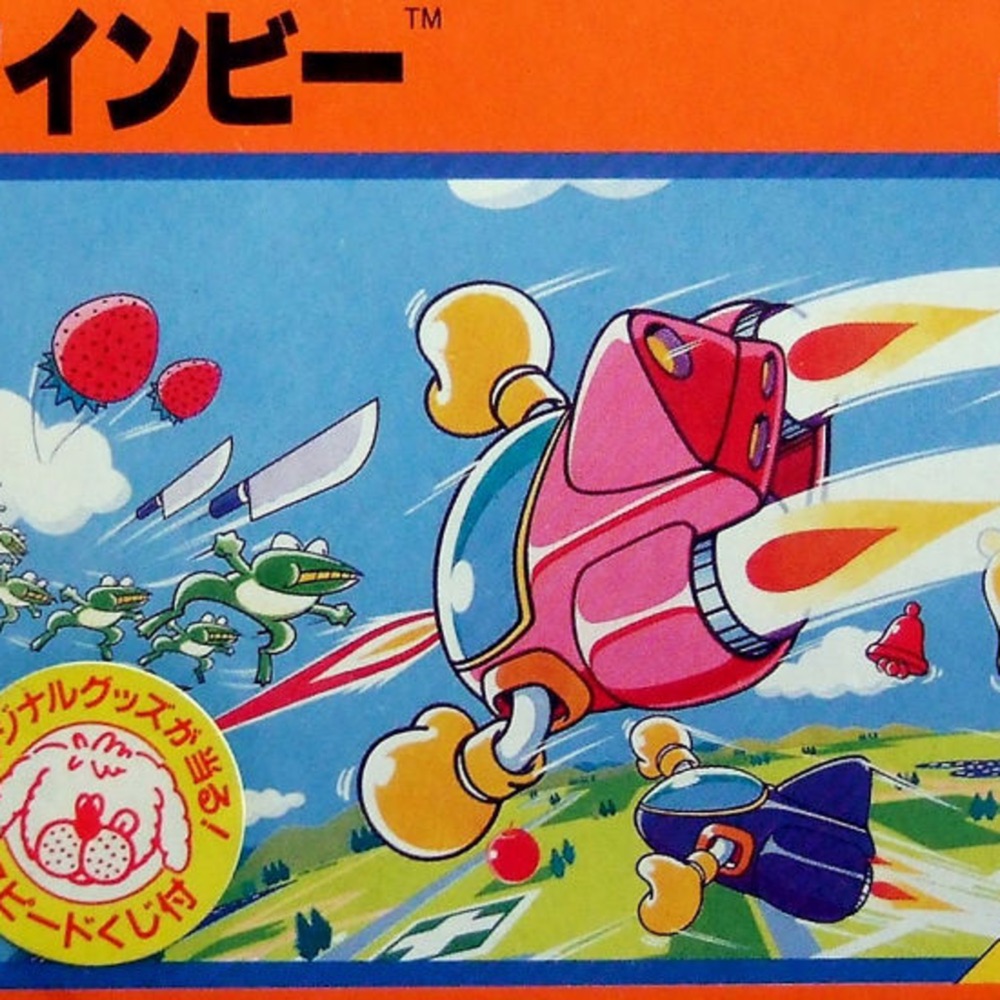
Stinger is Konami's second shmup on the NES after Gradius, and the only game in the Twin Bee series that ever reached North America. We didn't know it was a sequel, and we went in expecting shovelware. Sean put in several hours without stopping, and Joe, who isn't a shmup fan, had a lot of fun too. It's cartoonish, a little sloppy next to Gradius, and a lot more fun than we expected.
What makes it good
- Juggling the bells. Power-ups come from shooting bells out of clouds and keeping them bouncing until they change color. On the vertical stages the color changes every five hits. Hit it once too often and it reverts to a bell worth only 500 points. We kept losing track of the bell and getting hit, and that risk and reward is the heart of the game. A heart shot that only helps with the bells makes multitasking easier.
- Horizontal and vertical stages. Switching between them, sometimes two horizontal stages in a row, keeps it from going stale. The vertical stages have the ground targets and the lock-on bomb, and we agreed they felt better balanced than the horizontal ones.
- A ghost you can recover. When you die, you can fly back and grab your ghost ship to get your power-ups back, which Gradius never offered. It works once per ghost, so it can't be abused, and we called it Dark Souls before Dark Souls.
- Bosses that behave differently. Willie the Watermelon Head, Sigmund Squidmund, Fang the faucet (or saxophone, we argued about it) and the rest each make you play differently. They're easy once you have the laser and the ghost ships, but we liked them all.
- Continues and a rest before each boss. Continues made the difficulty easier to swallow, and the breather before each boss gave us a chance to loosen up.
- Household chaos. Hangers, scissors, a chomping shoe, a shower head, TVs and telephones. The localized story has aliens turning Earth into cotton candy and kidnapping Konami's Dr. Cinnamon for his bio-nuclear sweetener formula. We loved it.
- Two players. Combining ships in the same spot triggers a big attack. The Japanese version supports three players.
Where it's rough
- A strange difficulty curve. With a full set of power-ups the bosses fall quickly, but losing them in the middle of the game is a brutal drop. Joe found it unbalanced enough that he lost interest around level five.
- Less polish than Gradius. Joe's first impression was that the art looks like a kids' game, and it feels sketched more than finished. The horizontal stages felt like an afterthought, with the bell mechanic loosely applied and the color changes seeming random.
- An easy start. Stage one is so relaxed that we played a long time without understanding the bells. Sean reached the fifth level before learning what they did.
- No difficulty select. You begin on normal, and hard mode only unlocks after you beat the game.
- Slowdown and flashing. When the slowdown kicks in, the flicker was bad enough that Sean turned away from the screen.
Beyond the game
Twin Bee began in the arcade and Stinger is the second game, released in Japan in 1986. The cutscene with three pilots was removed in America, and the localized version opens with the aliens attacking a Konami building. Twin Bee 3 came out in 1989 on the Famicom, and the series continued on later consoles, all in Japan only. There was also a radio drama that ran for 96 episodes from 1993 to 1997, plus an anime and a manga. Not one of those reached North America.
The bottom line
Play it. We recommend it, but it isn't Essential. Joe voted Play it, calling it about as close to essential as a Play it can get, but he can't see himself replaying it. Mike and Sean voted it Essential, so two of three put it on the Essential Games List at the time. Sean had more fun with it than with Gradius, and Mike pointed to its consistent gameplay and fair difficulty. The sheet now shows Play it, since it was removed in the 1988 Best-of.
Written from our conversation in this episode.
- Introductions - Espo (Mike, Sean, Joe, Sam)
- Development History - Espo
- the second game in a long running quirky shooter series by Konami named TwinBee
- Twinbee came out in 1985 for Arcade
- This game did get the TwinBee name in Japan
- the second game in a long running quirky shooter series by Konami named TwinBee
- Konami back at it with another SHMUP (remember GRADIUS)
- First Impressions - Everyone
- How to Play
- Horizontal and Vertical SHMUP
- A and B buttons
- Tales from the Manual
- The Story
- You see a UFO attack Konami headquarters
- Why does it look so weird? - ESPO
- The game begins Stinger has to save the scientist.
- You see a UFO attack Konami headquarters
- The Story
- Gameplay
- Horizontal stages
- First level is easy - Espo
- Vertical stages
- The true Twinbee way - Espo
- Bells only change purposefully on Vertical levels
- The game feels like the Horizontal stages were added because of Gradius but without thought
- Game gets way harder on the back end, feels like you shouldn’t be there.
- The true Twinbee way - Espo
- Powerups
- That power up song that just plays over and over again
- SOULS of Ship
- Collect the soul to get back your powers
- Can only do it once per soul collection
- Collect the soul to get back your powers
- Colorful and unique bosses
- Final boss too easy? - Espo
- Ending says YOU ARE THE GREATEST STINGER OF ALL TIME
- Then you unlock the hard mode
- Final boss too easy? - Espo
- Difficulty difference from Gradius
- Horizontal stages
- Additional Thoughts
- The Japanese version of the game allows up to three players to play simultaneously (with the third controller plugged using the Famicom Four-way Adaptor, the Famicom variant of the NES Four Score). In the American version this option was reduced to just two, with Winbee omitted.
- In the NES version, Difficulty options are disabled, and the default difficult is Normal (though Hard can be accessed by finishing the game once). The Famicom cartridge version adds an Easy difficulty.
- Sequels and Spinoffs
- TwinBee 3: Poko Poko Daimao releases on the Famicom in 1989
- TwinBee continues on the SNES, Game Boy, Playstation but all JAPAN only
- Ends with TwinBee RPG ON PS1
- A spin-off of the TwinBee shoot-'em-up series featuring a storyline based on the TwinBee Paradise audio drama serial.
- RADIO DRAMA
- Began airing on the radio station NCB on October 10, 1993. The series lasted three seasons, with the third and final series concluding on March 30, 1997, comprising a total of 96 episodes, which were later released in drama CD collections.
- ANIME
- 2 Films
- One ties into the Super Famicom and the other with the OVA series
- OVA
- TwinBee Paradise and is based on the radio drama of the same name. The OVA comprises three episodes, which were released individually on VHS and Laserdisc in 1999
- And there’s MANGA too
- 2 Films
- EGL (Mike, Sean, Joe, Sam)
Auto-generated transcript. Each paragraph starts with its timestamp. Speakers are not identified.
Stinger, save the earth from an alien snack attack.
And welcome to NEStalgia, a chronological exploration of every NES game released in North America. I'm Mike. I'm Joe. And I'm Sean. Guys, we got a fun one today. Stinger on the NES, because that's all we ever do. I never really say the console. I usually just say the game. On the PS2. Right. I've been playing so much Kingdom Hearts 3 on PS4. You always have to say the game and then the console going forward. Right. You're really late to the game with that one, aren't you Mike? Well, you know, it's no secret to a lot of people that we publish the episodes. That game came out three years ago.
Honestly, probably, right? What are we like? Can we say how many episodes ahead we are? We're many episodes ahead. Like 20? 20, yeah. For sure. 50? 100? Yeah. But also, these are old games. They're not going to change their relevancy. No, I think it's like the window is closing for Stinger. In 2019, it wasn't an essential game, but it might be in 2020. You know? People are going to want to re-review on Mighty Bomb Jack. They're like, that wasn't fair. They recorded that episode in 2018.
Anyway, guys, we're talking about Stinger, which is the second game in the long-running, quirky shooter series, Twin B. Now, did you guys know that this was a sequel? No. I had no idea. Yeah. Well, it's good that you didn't know that because that sequel, I would have accused you of looking at Wikipedia had you have known that information. Don't we all, though? Like, shouldn't we?
I know. Well, that's the joke. But, yeah, Twin B is a series from Konami that started in the arcade, got a Famicom-only release for the first game, and then went under the Twin B name in Japan as well for this game in Japan for 1986 before coming to America. This is the only game in the entire Twin B series that comes to America, and it doesn't even get the name Twin B in it. Well, I think it's a cooler name. Like, it's more awesome. Stinger. And I think they picked the right game to port or to localize. Okay. I'd love to hear more about that later. Joe, any thoughts on this whole, like, Twin B thing?
I mean, not so much. I didn't play the original Twin B, but I'm interested to see what is different from it in this. But otherwise, going into it without knowing it's a sequel, it doesn't feel like a sequel. Yeah, this is the first time we're playing a sequel of any kind on the NES, and we don't even know that it's a sequel.
Well, yeah, this game, they weren't going to throw us into the middle of some concluded, like, Hideo Kojima sort of thing. So I think we're okay. Konami Kojima. So it could happen. And also, you know, we have to talk about the fact that Konami made this game, and they're back at it with another shmup because we had Gradius from them, which we all unanimously loved. I still love Gradius. I haven't changed my feelings for that one at all. But maybe we could just talk a little bit, for those who didn't hear the Gradius episode at length, just maybe a little recap of why we liked Gradius so much. It had a lot of polish.
It felt faster than, like, the console seemed to allow. It felt like not quite a next-gen game, but it felt like something more, not futuristic, but you know what I mean. Yeah, no, there was a lot more mechanics than we had been used to in a game. It was deeper. It had, like, a consistent tone throughout the whole game. It was just a fun game.
Joe, anything to add? Yeah, I mean, I think just on top of it, like, looking polished, like, actually visually looking polished, it was also just, like, the gameplay mechanics were, I think, just deeper than anything we've played so far. I mean, I think I'm just kind of repeating what Sean said. No, and I think it also comes down to just player choice. Yeah. I think that, like, there was the first time ever where you could be like, oh, no, I'm going to do this instead. I'm going to save up for this power-up instead of this power-up.
And, you know, I think that, you know, we all voted Gradius as an essential game, and I'm sure everybody's anxious to see how we're going to vote for Stinger. But before we talk about voting at all, we need to talk about the game at all. So let's get into our first impressions for Stinger. Who wants to go first?
I'll go first. All right. Joe, what do you got? Well, my very initial impression was that the art looked really clean and neat, but something about this art style, I think I've mentioned this before, makes me feel like it's a children's game, like a little kid's game. And I think it's just association with, I think we talked about, like, Leapfrog or one of those, like, one of those, like, handheld, like, preschool games that, like, you know what I'm talking about? I remember that. Yeah, and it's got, like, that style or, like, some kind of browser game. But it doesn't feel like one of those games.
But I think for somebody like myself that doesn't really, isn't a big fan of these kind of, like, shmups, I had a lot of fun with this. I thought this was, like, you know, jumping right into it. I was like, oh, this is more than what I thought it was going to be as just, like, a regular shoot-em-up. Yeah, and the childish thing, it doesn't help when, like, you're fighting, like, hangers. Right, yeah. Well, definitely it's, like, yeah. And the boss is a watermelon, you know? It definitely kind of comes to, like, that childish thing is, like, sort of a quirky little style that they're deliberately doing.
Oh, absolutely. And that kind of makes it fun. I think that's a twin bee thing in general, guys, just so that everybody knows. They were always going for a cartoon-like approach with that one as opposed to Gradius because they do have to be, like, two separate things, right? You can't have, like, twin bee is just the horizontal version of Gradius. Like, or the vertical version of Gradius because that doesn't, you know, that's not enough.
Sean, first impressions? When I looked ahead to see what we'd be playing this month, I saw Stinger and I, you know, I looked at the Wikipedia page and I looked at some screenshots. I'm like, great, another piece of shovelware that I'm just not going to care about and I'm going to play it for a half hour so I can, like, at least get a feel for how I'm going to shit on this game. And then I played it and I didn't stop playing it for several hours. And I, again, like, we talked about this with Gradius, but I'm also not a fan of Shmups in general, but I think that there's just so much going on.
Like, there are just, the mechanics are used in such a creative way that, like, you can just have fun with this for a long time. And I think that with Gradius, like, the reputation sort of preceded it, whereas with Stinger, it just caught me completely by surprise.
I'm going to echo those thoughts completely. I didn't know until I started up the game that this was a Konami thing, and I didn't know about the Twinbee thing either. I had heard Twinbee referenced a lot because I think it is big in Japan. We'll go into the whole franchise later in the show. We always cover that stuff. But I think, for me, what caught my eye was actually that cartoon stuff. Like, I started noticing, like, the enemies are actually, like, household objects or donuts or, like, you know, like, really weird things.
And I think I was, like, enjoying myself. And then once I got to the first boss, I was like, oh, this is actually, like. It's like a bullet hell. Yeah, and also, like, it's a creative style for, like, a boss. It doesn't feel like. I don't feel as, you know, remember in Gradius, we always said that the death felt earned. But I definitely felt it was a challenging game. I think Stinger, right off the bat, felt too easy for me and then, like, was good about teaching me, like, how to get better at the game as each level got harder. Yeah, because it does get harder. It does get harder, absolutely.
Okay, cool. So let's just talk real fast how to play. And I don't mean, like, actually, like, don't read me the manual or anything like that. But just a little bit about Stinger as a horizontal and vertical shmup because it does both styles. You know, we've had 1942, which was vertical, and we've had Gradius, which was horizontal. So this one kind of has a little bit of both. Yeah. I think that anybody that's played one or the other kind of shmup, vertical or horizontal, will immediately pick up on the controls of this game. It's not advanced or expert. Yeah. You just move and you shoot. Yeah. But your goal, as well as just, you know, shooting the enemies of whatever household object or, you know, or CDs or maybe there are records, I don't know.
So your goal is also to get your power-ups through bells, which is an interesting mechanic where you sort of have to use this risk-reward decision-making of whether you want to keep that bell up in the air for a while or if you need to focus more about not getting shot.
And, yeah, every level has, like, a very unique boss at the end, which sort of works differently depending on who you're fighting. It's not just some guy with more hit points or something along those lines.
So, yeah, the whole difficulty curve and fun curve, it goes up. Yeah. And just to expand on the bell thing, which I thought was just, like, one of the most unique mechanics about this game, is that in order to get a power-up, you have to either shoot at these bells that fall out of clouds and every time you shoot at it, it bounces it up. And you basically just have to juggle it until it turns a certain color.
And then it will give you a power-up based on the color it turns, which I thought was really interesting because, like you said, Sean, it's, like, a lot of times I found myself focusing too much on the bell and, like, oh, no, like, now there's, like, enemies that I'm not even paying attention to. Because I'm trying to juggle these bells and, like, get them to the right color. So it really adds, like, another layer of, like, if you want the power-ups, which if you get enough of these power-ups, like, you become a powerhouse in this game. It feels good. Yes.
So I thought that was, like, a really interesting way of doing it. And even there's, like, even other, like, mechanics to help you juggle the, you know, other than just shooting it. Like, in the side scrolling, there's other ways to do it. Yeah. I actually used a lot.
I don't know. You guys gave me a look like maybe you didn't use it so much. No, I used it. I used it quite a bit, too. You know, because there is two forms of attack here. One to attack. I think it's the B button lets you actually attack enemies that are on the screen. But then there's also, like, each world, each stage is, like, a different location. I know there's, like, everybody loves to reference the pyramids in NES games for some reason.
It's, like, Egypt is just the most amazing. I was surprised there were no Moai heads. Yeah, where were the Moai – there was Easter Island as a whole thing. But we did go to, like, the universe. So at the end of the day. We went to the universe. Where were we before? It's described as the universe. I think that's very strange that it's, like, we weren't there before, but now we're there.
But, yeah, you go to all these incredible places and, like, you know, the sphinxes are shooting at you from the ground. And so you have to use your secondary weapon, which is kind of like a lock-on material thing. It's like a bomb kind of thing, right? Yeah, like a bomb that has a very specific – like, it tells you where it's going to shoot as you shoot it. Yeah, specifically in the vertical portions. Right. Yes. Because in the horizontal, that button – Is a heart that shoots upwards.
Which really – I think it only helps you juggle the bells, right? It's only for bells, yeah. But I use that a lot because then you could switch between – you could be shooting things in front of you and keeping a bell right above you. It makes it a little easier to multitask. Juggling is, I think, one of the key words in this game. Yes. But, you know, yeah, it's very obvious, like both Sean and Joe have said. If you know shmups, you know that this is essentially just clearing waves of enemies as you scroll through the stage and then finally being greeted by a boss before going to the next stage. That's not to say that it's too simple or too repetitive. We'll get into that. But I just – I think that that's a general gist of how to play Stinger.
There you go. All right, guys. So let's do a little bit of the manual here. And I really just want to focus in on the story because I think that the story in this one – funny enough, it was changed. Okay? This is all American only. If you play the Japanese version, it's not really – it's a much more advanced story. There's actually a cut scene where three fighter pilots, like, talk to each other and explain – In the Japanese one. And that was removed from this one. Because the American version is basically just a simplified aerial version of scoon where they just want to eat us. But instead of eating man meat, they eat – they just turn us into tasty treats.
Yeah. Cotton candy, right? Yeah, cotton candy. But, you know, in the opening cut scene for the game – I don't know what's happening. The aliens go to the Konami headquarters. Is that Konami? It says Konami at the sign. In the image there's a sign that's like – that says Konami. That's actually like a part of the picture. And the craziest part is that – okay, so they're attacking the Konami headquarters, which is new for this American version, right? But then also, why does the Konami headquarters look so alien? Yeah, it looks like a flying saucer itself, and then a flying saucer comes down and attacks them. Yeah, I didn't know what I was looking at. I just know that, like, a weird-looking dude got kidnapped.
Konami's top scientist. Konami's top scientist, which I talked to Joe about this before the show. I think it's so funny that, like, a scientist works at a video game headquarters, like, as if they make the games with test tubes. You know, they're like, hmm, let's find the right amount of gameplay balance. The fun chemical. But they do steal – his name is Dr. Cinnamon, according to the manual. So I think that that's pretty sexy.
You've got to rescue Dr. Cinnamon from a watermelon and a saxophone. Yeah. Yeah, it's so great. People are looking this up right now to make sure we're not just making it up. Like, if this posts on April 1st or something, I know it says something else, but it's a saxophone. I would highly recommend, like, the YouTube version of this one because you would get to see all the crazy stuff we're talking about as we talk about it.
And then also, one more thing about, like, the whole, like, the plot and everything like that is, you know, that's it. Like, a scientist has been kidnapped, and now we have to travel throughout the entire universe just to get him back? What did he have? It is nice, though, that it's not, like, a princess or your girlfriend, which has been done, like, a trillion times since, like, these games. The beginning of time. Since we started playing. Yeah, but since we started playing even these NES games, like, every game is, like, the same thing. If I recall. So it's so different now.
If I recall correctly, I believe that they were trying to zap a recipe out of his head. Okay, that would make sense. He's Dr. Cinnamon. Yeah. To, you know, to turn the earth into cotton candy. Why does he have that recipe? I don't know. But it's in his head, and they need to zap it out. Right, of course. That's the word they used. Yeah, I think I have here just a little, they're called the attack-ons, or the aliens.
And they're scheming to zap the professor's brain, retrieving his secret bio-nuclear sweetener formula. There it is. So it's a little, it's a little Gradius meets Burger Time. I think a lot of the localization teams in these early NES games just had to be, you know, having, just having the time of their lives. Just like, I'm gonna, I'm gonna call them the attack-ons. Yeah. And the bio-nuclear something shit, man. Yeah, yeah. Oh my gosh. Yeah, it's true. I think it's funny that the Japanese ones had a totally different story, and they were like, screw it. Yeah. Let them do what they need to do. There's gotta be a reason hangers are in this game. Okay. That's the story. We're not gonna do any more on that.
They come to, okay, they come to listen to this for deep lore. Yeah. We always deliver on the deep lore, don't we? I always wanna know what's happening. And speaking of happening, you know, they don't waste any time. The gameplay goes right into the horizontal shmup is the first one. And what's interesting about that, and this is where we get into the whole Twinbee thing, is that the first game, Twinbee had no horizontal stages whatsoever. Twinbee was a vertical shmup through and through. That's what made the difference between Gradius. Now you have, you know, this horizontal stage where you have to juggle the bells in front of you while also, you know, attacking the enemies. But it doesn't feel as polished to me as the vertical stages.
Oh, I like the horizontal stages more. Oh, you like the horizontal stages more? Yeah. Okay. We'll talk about that a little later. Let's just talk about the horizontal stages in general. Since you like them, maybe you tell me a little bit about, you know, what was it? What was pleasing about going through the horizontal stages? Well, I think that the horizontal stages have a...
One thing I will say about this game in general is it doesn't have as much polish as Gradius. And this is gonna come up at any time. You might as well say it now. So I may as well say it now. Like, this is a more... It's not more jank. It just looks more sketched, more like a sketch instead of like a finished piece than Gradius. But one thing I'll say is that I did like the art more in the side-scrolling portions where there's like a horizon. And, you know, it just was more pleasing to the eye for me. You said in Gradius? I'm comparing the sort of art style within Stinger of the side-scrolling portions to the vertical-scrolling portions.
But yeah, the fact that you get to see like the pyramids and the side-scrolling ones. And again, for some reason, every city in these NES games is just littered with gigantic crosses in the cityscape. But yeah, I just like that more than the weird blobs on the ground in the vertical-scrolling portions. Got it. And in terms of like fighting enemies, did you find it easier on the horizontal stages than the vertical stages? Was it more fun? I think that since just by virtue of the fact that you're on a 4x3 television, you have more space to see where the enemies are coming from.
When you're scrolling horizontally than in the vertical-scrolling ones. They sort of, it seems to travel faster when you're going up as opposed to going right. See, I liked attacking the enemies on the horizontal one for sure. You had more time to kind of like, you know, in these games you're always anticipating where your enemy is going to be, not where it currently is. And I felt like I had more time to kind of think about that in the horizontal one because they were always coming pretty much, with the exception of the final stage, they're always coming from the right. So you always have a chance to kind of like think about your attack.
Whereas in the vertical stages, you have like sometimes they come from like the bottom of the, you know, they always come from the left and right. But they come from the bottom or they come from top down. It's like there was a lot more ambush going on. Yeah. But I would say that if the main idea of this game is that you're trying to get through waves of enemies while also balancing this power-up mechanic, I thought that that was a lot more fleshed out and done better in the vertical stages than the horizontal stages.
It just didn't feel like, especially knowing that Twinbee originated as a vertical thing, it felt like the horizontal stages were just kind of added as an afterthought. Like, this will surely work using the exact same mechanics and rules as the vertical stages without any changes. Interesting. I can see why you think that, like why you feel that way, because it does feel like there's, and I don't know if I necessarily say it felt like to me there was more to the vertical stages.
But it just, to me, it felt like it was a good difference between the two of them. Like I kind of liked, I don't know if I have a preference. I just liked that it switched up to like, oh, now you've got to think about the things on the ground, or now you have to think about using those hearts to your advantage. Like it was just like enough of a difference between it, regardless of whether you're going vertically or horizontally.
It keeps it from getting stale. Exactly. Yeah. I'm not a Twinbee purist. I'm not saying that like, oh, they should have only had vertical stages. I too enjoyed like going back between them. And it's not like it's ABAB. Like sometimes it's like two horizontal stages and then a vertical stage. So I, you know, I didn't mind it. I think personally that the layout of the game and the rules of the game worked better in the vertical stages than the horizontal one. That's my only, I guess, like note on that. Okay. And then, you know, let's talk about the bells because that's pretty much like how you get the power-ups.
That change of like, the change in colors, it is set on the vertical stages. But on the horizontal stages, it's not set to a number. So on the, at least with me, I might be going crazy here, but I felt like I should bring this up on the show. In the vertical stages, every five, it'll change color. So hit it five times, it changes to blue. Hit it five more times, it changes to white. Hit it five more times, it changes to red, so on and so forth.
When you go to the horizontal stages, it seemed random. It seemed like. Yeah, I think it was. And it also doesn't determine, like, you don't know which color is going to show up next. I think because that you're always, I feel like just because you're always going to be shooting under a bell, if you've hit a cloud, they had to make it a little more difficult for you to get something good. Because I was, when I first started the game, I didn't read the manual before I started, so I didn't know what the bells were doing. I was like, oh, I guess that just popped up. That gives you points. Easy 500 points. That's what I thought, too. Because you're just going to keep incidentally shooting these bells, maybe that was, like, a balance thing.
And I think another thing that makes it a little more difficult is that we haven't really mentioned that when you hit it however many times and it turns blue, it's only blue for that. If you hit it again, it'll turn back to whatever, yellow. It's the original color where it gives you nothing. So, like, you can't just spam it. You have to, like, notice, like, it turns blue, stop shooting it immediately because your next one is going to go away. And if this doesn't, like, sound like anything right now, basically, if you, there are these bells that will fall out of, like, you know, the scenery. And then if you shoot them, they sort of do that hop slash pop that the cans do in Duck Hunt. I feel like it's a very similar.
No, I'm not Duck Hunt. It was Hogan's Alley. Hogan's Alley. That's right. Yeah, that's what I meant. But it felt very similar to that. I love a good Duck Hunt reference.
Even if it's wrong. Yeah. So that's what we mean by, like, trying to juggle these things. Yeah. And I think that's a unique mechanic, especially the color changing thing because there's the risk reward that you guys were talking about between, like, it's blue now and that really doesn't do too much for me. I'd rather have the white bell. But if I hit the blue bell again, I have to wait for the cycle to change again. So I might just be stuck with 500 points because it's not like you can just easily juggle those things.
Anybody who's played this game knows that you're going to drop a lot of them. Yeah. And then sometimes more come on screen, which you think would be good because you could drop one. But then you lose track of, like, wait, which one did I hit 10 times? It's like when you get the multi-ball and break out. Yes, exactly. Yeah. You think it's a good thing that now you have three balls. But you don't.
You just don't watch any of them. Exactly. And I just wanted to talk about the enemies for a hot minute here because they start off, like, we talked about there's some donuts and, like, some fruit and stuff at the beginning. The second stage has, like, normal stuff like turtles and jellyfish. That's normal, I guess. Yeah. And then, like, no. But then the third stage, it just gets out of control.
There's a shoe that chomps on you and there's a pair of scissors. But, like, those, like, scissors that you use outside. Scissors are in. The hedge clippers. Scissors or hedge clippers are inherently intimidating. So. And then my favorites, hanger, which is just a hanger. And then also, like, what I have to imagine is a shower head with water actually coming out of it.
Yeah. You know? Like, these things are just getting ridiculous. It kind of reminded me a little bit of the feeling I had for Kung Fu. The first level was, like, people. The second level were, like, dragons and snakes. Plants. Yeah, plants. Yeah, pots. Yeah. Yep. And it doesn't even end there, too, because then you get into, like, stage four has, like, TVs. Yeah. And telephones and iron. This game is all about the developer's fear of technology and just domestic living.
I think that's what he was trying to say. Yeah. That's obvious. And how we're being controlled by our products. Exactly. And, you know, just a shout-out to the name of all of these stages, because nobody would ever know them, but since I'm looking at the manual here. We have the Donbury Island, which is the first stage. Then the Lama Yadora Kingdom for the stage two. And then what you think is Egypt is actually the Aldorado Province.
Aldorado? The Aldorado Province. Like a Chevy Aldorado? Yeah, I guess so. Because then from there, it just starts to get nonsensical. It's the Erururu Fusuhuku country. Just country. Country, yes. Which is also just an ice country. But this is, like, the whole idea of, like, you're not on Earth. Like, you're traveling to all these crazy planets to retrieve Dr. Cinnamon. No, it's all on the same planet. You're on the same planet. Oh, yeah, that's true. And you leave the space to the universe. Yeah. And then the Zamabi Kingdom. And then the last one is literally just LPU equals and then an upside down L.
Otherwise known as the Gamma Empire. But I kid you not, they actually, like, do that. Yeah. It's in parentheses, Gamma. Like, it must be their language. Empire. And I love it. I think that that's so funny. And then stage seven, of course, the universe. Yes. But we got ahead of ourselves. You know, we were talking about the power-ups there for a minute. I'd love to just kind of get back to that. Because you guys were talking about being a powerhouse in this game.
And I couldn't agree more. Once you get that triple shot. Yeah. It spreads out between the three different ways. Triple shot, then following with ghosts. Yeah. And if you have the long shot and the triple shot. The long shot, which just shoots through everything. Oh, the laser. Yeah. I just call it whatever. What's funny about the laser, too, is, like, I'd prefer the triple shot throughout most of the, you know, because of that spread. It attacks everything above, in the center, and below you. And I'd prefer that for, like, the normal, like, wave of enemies.
But then, like, the laser is so good for the bosses. Yeah. Well, I didn't. I like to laser when you have, because you can have two, yeah, ghost ships, I guess. Two other ships following you. Yep. When you have the laser for that, then it's, like, yeah, it's not as much as if you had three spread shots. But there's just three lasers. Yeah. And it just. I do want to mention, like, a shout-out, I guess, for getting those ghosts, because that takes a lot of hits on a bell. Oh, I didn't get the ghosts. I watched somebody get the ghosts.
Oh, okay. I was going to say. I got the ghosts on the first level and carried it a ways, but then I never was able to get it again. That's probably the best way to do it, because the first level is so relaxed. Right. I would say too easy. It actually took me several playthroughs just to realize how the bells worked, because I didn't have any power-ups for a while. Yeah, I made it to the fifth level without knowing what the bells did. And then I learned what the bells did, and I was like, I got to go back to the beginning. I've been playing on hard mode. Yeah, it was pretty hard.
And then when I had the power-ups, I was like, well, this is a lot easier than what I was doing. And I still only made it to the fifth level, so it didn't really give me better results. Yeah, yeah, yeah. But I blew through the bosses that took me a long time without the power-ups, almost to a point where I was a little bit like, some of these bosses are a little too easy now with these power-ups. But I would say, just as someone who played the game a lot, that if you don't have power-ups later on in the game, it's really tough to get through the waves of enemies. Yeah. The bosses are still relatively easy. They're fun, but they are all definitely doable with just your main ship.
You don't necessarily need any power-ups. I was able to beat... I still had trouble with them. I was able to beat every boss. I would say that the one I called the saxophone is actually a faucet. It's a saxophone. Yeah, I thought it was a faucet, too. Yeah, it's a faucet thing. But anyway, I think it's a saxophone. I think that's better. And it makes sense, right? I mean, we got all this other crazy stuff, right? I kind of like faucet just because I feel like it's even weirder than saxophone. It's so weird. Just a running faucet. What if I told you that the faucet's name was also Fang?
What? Because that's his name. It makes even more sense. The manual felt the need to name them all. So you have Willie the Watermelon Head, and he's the first boss. And I love his thing because, like you said earlier, it was like a bullet hell thing. But the spread out is enough that you can weave through it. And I love that that was fair and not like, oh, you just hang out on the top left and wait for him to stop shooting that stuff. Fucking volcanoes. Yeah, those volcanoes from Gradius definitely reminded me of that. And then the upside-down volcanoes.
And then you have Sigmund Squidmund, who was like the octopus guy. Yeah, but I thought he was like a meatball. Well, I mean, do meatballs shoot out? Actually, either are octopuses. It was like a meatball with fries. That was the one that I particularly found. I thought it had a decent challenge when I didn't know about the power-ups. But then when I went back with the power-ups, it was like three hits. It was almost like two months. Yeah, the laser will take him out easily. And you can also shoot down his tentacles, I guess that's what those are. You can shoot those down. So you can essentially just block his attacks and then shoot him when he's open.
Yeah. So I thought that was weird. Easy peasy. Fang is really tough because he only has an opening on his mouth. Yeah, and the bubbles can become a bit of a headache. Is that the one where there's like the rotating line of bubbles? Or no, is that the next one? It's the pink bubbles. That's an easier one for me. Yeah, the pink bubbles. And then who do we have next? Oh, Luther. That's the guy with the rotating thing. So did you guys, for that one, did you guys hide in the corner? No. I just went around in a circle. That's what I did. I was going around in a circle. But then when I was watching a playthrough later, the guy just went in the corner and we were untouchable, which I didn't think was possible.
I didn't think so either. You don't need to do that. It was fun to kind of, you shoot while you can and then the sword or whatever the heck it is comes around and you have to kind of race it around again and have time to shoot. I feel like that would have been better. You just take the inside track. Yeah. Easy peasy. Exactly.
But it's like you have some time to shoot. The thing comes around, you got to race it around. I did test my luck a bit trying to outrun that guy. I like how I said, and then we have Luther and everybody was like, yeah, Luther. Luther, the robot head. Yeah. I don't know what he's supposed to be. I'm going to say he's supposed to be a computer. But he also looks like he's measuring amplitude on stuff. So like, who knows? Because then you have Master Blaster, who's actually just a boombox. Yeah. And I didn't hate or like that one. I thought that was actually like the least creative one out of the batch.
You have to hit him in the speakers. Yeah. You have to hit him in the speakers. Where it hurts, of course. Exactly. And then Solar B Three Eyes, which was that sun. And I thought that was so random. It's like we had so many cool bosses and now we have the sun. But he's completely avoidable. Yeah. He just goes up and down. You can always get his little projectiles if we just move over to the left while he's farther away. And then you come back and shoot him in the face. I thought he should have done something a little more dangerous. Like move around in a circle like the other guy did. Or Luther.
I thought something should have happened there. It was disappointing that that stage is so hard and he's just a pretty easy boss at the end of it. And I think it's just a theme in general for this game is that the bosses are pretty easy, but I like them all. Yeah. They're all very well designed. They're unique. They make you play the game differently.
And last but not least, we have the attack on Emperor who is like a dragon. A disguised dragon. Yeah. He's like a – yeah. He's a dragon who's essentially like his power is homing attack. He just reaches out for you. He tries to eat the ship alive. I honestly – I beat him after a very long time. I couldn't get through this guy for a very long time because I couldn't – I didn't know like at what point do I turn. Or like I kept making this S shape and kept getting eaten. Like how did you guys fare with him? I think what was interesting was I didn't realize that he was homing at me at first. I think that took like a death and a half to realize.
And then I also after finding that out, all of a sudden I was like, but I'm never going to be able to shoot him unless he comes back to the right side. For those who have a hard time imagining it, you have this snake-like creature who comes in from the right side. You have to aim for his head. You get maybe a few shots. And then he's like on the screen just kind of chasing you. 80% of the time he's going to be behind the direction that you're shooting.
So the only way to really get about him is to kind of start in the right and then drift over to the left, trick him so that he goes to the left side of the screen and then comes out the other end, the right end. Yeah. And so I think that it's not an incredibly hard final boss by any means. That's hard for me. No, no, no. Meaning like it just takes a lot of patience, a lot of strategy. Something that like I don't think that we have necessarily.
No strategy. A lot of times I like to just rush in on things. I'm a big fan of press X to win. I love to just like just beat things to a pulp and not really think about like, oh, and my defensive strategy is this and I'm going to equip these things because I need this. It's like, no, I'm just going to attack him until he dies. You must be really bad at smash. Smash. Excuse you.
I don't have strategy, Mr. Mike. Yeah, I don't know. I think I'm pretty good at Smash Brothers. Anyway, I think that that was like for me, that was the thing. But I was able to beat him. So I'm pretty proud of myself. Yeah. Joe? Well, like I said, I only got to level five. Okay. But when after when I watched some like footage of it, I kind of realized like, oh, I was actually I was pretty close to the end. I just figured there was a lot more to it, which is why I stopped.
But so I didn't face him. So I don't know what it's like to face him. But I do want to say that even though I didn't move on, you get continues in this game. So you you can take your time and you can die and keep going. And whatever. I feel like a lot of games haven't done that for us yet.
So remember when that used to be a big thing for us? I mean, like, we're you know, we're like finally continues. Yeah. We're so many and we're in so many episodes now. But early on, that was like a make or break feature for a game was like, where does it let you continue from? Does it start you over from the very beginning? And now it's like we're barely like we're how many minutes are we into this episode? And we're just finally talking about it. Right. But I still think I still think we're going to be playing a lot that don't have continues. Absolutely. It's going to be frustrating. Yeah. But I thought this was yeah, that was great because, you know, I'm not going to pretend like I did it all in one shot. I abused continues like crazy.
And I also, you know, if I'm being honest, I abused the juggling system, too. I really I really made sure that I was getting the best power ups as soon as I could. And I didn't mind dying because I knew that I would just be able to continue right from where I left off.
You need the best power ups to continue moving on. Because it is devastating, especially if you kind of do what I did where in level one you get all the power ups. And it's it's not too hard to keep those power ups for the first couple of levels. But then once you first lose those power ups, if you're in like level three or four and suddenly you're back to for the first time, you're back to your base level. It's it's devastating to be like one thing I'd like to mention, though, about death.
Oh, this was going to be the next thing that we were going to talk about. So I'm glad you're bringing it up. Yeah. One thing that we gave Gradius flack for was that as soon as you die and you're with all of your powers like you better just reset the game. Because you're not going to be able to get past like level four with your little pea shooter.
But with this game, you do have a recovery mechanic that when you die, you can go and pick up your ghost and get your stuff back. Yeah, it's it's actually like the soul. It is dark souls. It's dark souls like but also way before dark souls came up with the idea. It's like, no, I just I love this. It's a little ghost ship.
You know, if you die at the very top of the screen, it's gone. Oh, yeah. But if you die at the bottom of the screen, you have a good chance to like re catch it. And then you can basically like dodge the enemies, dodge everything else, collect your soul, and then you get all your power ups back. And then what's really neat is if you did collect it, the next time you die, you won't be able to get the soul again. It's like a one catch thing. It's not in a system you can abuse.
But I do like that if you die and you don't catch it and then you die again, you have a chance at the new soul if it has any power ups. Yeah. It's just a really neat thing in a game that I, you know, that now that's like a feature that I was like, oh, why didn't Gradius have that?
Exactly. You know? Like, yeah, it's very like to that universe, that cartoon style like silliness of like a soul to your ship. But I just I was really blown away by that. And I'm kind of surprised it took us this long to talk about it. But I'm glad we got it in there. A lot of things about this game, this might be a little going on a tangent, but a lot of things about this game oddly remind me of Cuphead.
I mean, the weird bosses, both in design and in like the way you fight them. And this I didn't even think of that. But, yeah, the soul thing when you're playing two player Cuphead, same thing happens where your partner has to grab your soul to like bring you back down. Absolutely. There's a lot of that's just like as we're going, I'm like finding more and more things that like make that remind me of it. And it is it is a cartoony. Yeah, the art style in general. Yeah. Thank you.
They had a word for it in the manual for when you shoot from the same spot on the screen. It's like, oh, a ripple gun. You know, we did see that. What was it? Because we had a broken controller, so we didn't know how to get very far in it. Well, but are you talking about it's like a special attack only for two players? Yeah, I think if you combine your strength and go into the same spot on the screen. It was a big explosion. Is that the ripple attack? Yeah, I guess that's what it was. And it cleared out a whole wave of enemies. That's really cool to see.
Remember I said, what was that? Yeah. Because we played for like 10 seconds and then the controller wasn't working. But I do remember I was just more focused on the fact that I couldn't move. Yeah. And also that was a very stylized attack, too. It was like this yellow, like long rectangle thing that showed up on the screen. And I was like, oh. So yeah, the longer we talk, the more little goodies come out of this very simple system. Yep. And I would be, I think it now would be a great time to also just mention that in the Japanese version, this was a three player game.
I did read about that. That is awesome. Come on. What do you do with the third? The third player is also a ship. Just a third ship. All three of them on the screen at the same time. And now that's crazy because the Famicom just got the like accessory that you add on to the add four. Yeah, the multi-tab to add four controllers. And they managed to program three ships into, and that's why that cut scene has three fighters talking to each other because you can have up to three. You can be those people. But obviously the levels don't get any harder, right? The levels don't get any harder.
One thing that they took out of the American version of the game was a difficulty select. You start on normal in the American version, and then once you beat the game, you unlock the hard mode. It's immediately like the stage eight because there's seven stages, and then it just goes right to the next stage, which is the first one again. But it's now on hard mode. The Japanese one did let you choose between normal and hard. And I mean, that's pretty much Stinger in a nutshell.
So I kind of, you know, we've been talking so much about Gradius throughout this game. Maybe we could just talk about like the differences and difficulty between this and Gradius because, you know, we love Gradius, but we didn't beat that one. But we were able to kind of get our way through Stinger one way or another, no matter how many continues it took. So what does that say, guys, about these two games? I don't know. I mean, Gradius was definitely more difficult, but I think that it was, for the most part, welcome difficulty. Like I thought some of Stinger was maybe a little too easy, at least with all the power-ups at the beginning. I can't remember. In Gradius, you don't get continues, right?
No, you get continues. Okay, then I think that most of the difficulty in Gradius was not frustrating, if I remember correctly. I think this could have benefited from a little more difficulty. I think that the fact that both these games have continues makes both of their inherent difficulty easier to swallow. Because even this game, we keep saying that it's easy, but that's only in comparison to Gradius. Right, yeah, definitely. It definitely would be a lot harder if you couldn't continue. Yeah, these games would be maddening if you couldn't continue.
But I think that, you know, I think that they're not equal, but they both have enough difficulty for it to be a challenge and fun at the same time. Yeah, and I don't really have much to add there. I definitely think that these two games are held together because it's both Konami. It's both around that same time. It's kind of like, for the NES at least, it's our standard for Shmup.
You know, Capcom came out with 1942, but we didn't necessarily love that one. And I think maybe that's because it had something to do with being like trying to ground itself more in reality while these had like fun with the idea. I hated 1942. Okay, that's totally fine to hate on 1942. But I think if you're asking me to choose between the two, I think thankfully there's enough difference between them.
And that's impressive from a developer standpoint too, that it's not like Konami made Gradius and then Data East comes out with Stinger. You know, like it's interesting that the same company is able to make two games that are pretty different from each other in the respect that I would say like, well, some people are going to like Gradius more and some people are going to like Stinger more.
You know, you're definitely going to need to be a fan on some level of like the idea of like a shooter that gets like punishingly hard. Yeah. Towards the end of it, because that puts off a lot of people, those bullet hell games. And I don't think that either one of these becomes like the level of like Ikaruga does today. No, those are parodies of themselves. Yeah, exactly. But I definitely think like later stages will kind of make you yearn for stage one. The one that we've been talking about, like why is stage one so easy? It's like just chill, man.
Isn't it nice that you get a nice break? Yeah. And that's all I have to say about the difficulty. One thing I will also say about the difficulty, not in comparison to Gradius, but something that I think was a good quality of life feature was once the level's over, you get a rest period before you go into the boss. Like you can put the controller down for a second, loosen up your joints.
And then have a seizure. I was just going to say that because we've had some seizure inducing things in some of these games, but this was like, I kid you not, when it gets to the point where that slowdown happens, I turn around. I look away. I'm not even kidding because I can't handle how quickly these flashing lights come at you. I turn around and watch the shadows on my wall flash until the rocks. And then you imagine it happening on like a CRT, you know? Yeah, right. A big one back in the day and the kids like writing up on the screen. And it's very similar, not very similar.
It's similar to me only because I've been playing it recently. But the game Thumper, which is just this like, not theory inducing. It puts you in a sort of manic zen state, I guess like a state of flow. It's kind of a rhythm game, right? It's a rhythm game, but it's also, it tests your endurance in terms of like how hard you can grip a controller. But every few segments of a level, they will just give you like a 30 second rest period. And I think that with games with this sort of twitch needed in them, it's good to have that just built in.
But that's, that's all I had to say on that. Oh, okay. That was nice. I like that. And we got a chance to talk about seizures. Yeah, I love seizing. Seizing. I don't think anybody ever had a seizure playing this game, but I can't say that with certainty. People probably can. Yeah. So if you guys will humor me, I'm going to go into the whole like. Deep lore. Yeah, the sequels and spinoffs and other franchise related things. I'm just going to unplug my mic. Great. Well, I'd love to hear your reactions, if you don't mind.
Gasp. You know, because I think this stuff is interesting. So obviously Stinger, as we mentioned, is part of the Twin Bee line. And we'll never get another one. We will never get another one in the United States.
Mostly just because of how Konami is. And also because it never happened. Twin Bee 3. Twin Bee 3 Poco Poco Daimau released. Daimau. I don't know why I said that weird, but I was expecting some extra vowels. That released on the Famicom in 1989.
So maybe one day we'll like explore that as a bonus episode or something. See how they see the formula got better. I didn't check that one out before the show, so that didn't happen. But Twin Bee 3 is the last one for the Famicom. And then the Twin Bee series continues on the Game Boy, the Super Nintendo, the PlayStation, the Sega Saturn. Wow. But all Japan only. Never any of these games came to North America again. So it makes me wonder. Are there sales figures for Stinger? There are no sales figures for Stinger that I could get access to.
But I have to imagine that in a library with only two other shmups, it must have sold okay. Yeah. Especially when one of them is its own company's game. How bad could it have done? But everything ends for Twin Bee with Twin Bee RPG on PlayStation 1.
A spinoff of the Twin Bee shoot-'em-up series featuring a storyline based on the Twin Bee Paradise audio drama serial. It was a radio play. Yes. That brings me right into the radio drama. Began airing on the radio station NCB on October 10, 1993. Again, this is Japanese only, Kurt. Yes. Okay. We'll never understand what they said. We'll never be able to know the plot. But the series lasted three seasons. How long is a season? Right. That's what I wanted to know, too. How much plot could there be? The third and final season concluded on March 30, 1997.
So it comprised of a total of 96 episodes, which were later released in CD collections. Wow. So if you're a Twin Bee fan, you can get in on that. But you're like, Mike, I don't know Japanese. Clearly nobody is going to reread all 96 episodes in English.
But I heard there's an anime. Oh. Yeah, there's a Twin Bee anime. You heard that, right? And that makes sense, right? It's so cartoony. That makes a lot more sense than a radio drama. Than a radio drama, right? Because what's the decision making there where you're like, oh, there's probably a lot of crossover between our shoot-em-up game and people who want to listen to radio drama. You don't know Japan in the 90s. I know. That's got to be something that we just don't have a handle on because I'm struggling to understand the concept of a 90s radio play. Was that a thing? I mean. The masked. What was that? No, no. That's from the 30s. But, you know, like the. The masked avenger. The lone ranger.
The masked avenger. Is that what you said? The anime was interesting because we got two films. Okay. One that ties into the Super Famicom game. One that crossover. Yep. With Dragon Ball Z. No, the other one is it ties in with the OVA series.
And the OVA series is Twin Bee Paradise. It's based on the radio drama of the same name. So if you can understand where I'm going with all this. Because basically we have a radio drama that had 96 episodes that then got an anime which had only three episodes. And then that radio drama which then became an anime also got a film.
So there's all that going on. And then, oh, there's a manga as well. So if you want to read the Twin Bee manga, you can also get in on that. They pushed hard with this thing. Yeah. It's – I watched an episode. It was all in Japanese. There wasn't even an English sub.
But I watched an episode. And I'll tell you it was bizarre and didn't resemble anything I could understand. Were they fighting household objects? They were barely fighting. There was just a lot – like there was a lot of talking. There was a lot of like hanging out at a cafe. Cafe. Yeah. And the ships that they get in – oh, and how could we forget that the OVA, which was based on the radio drama, which was then turned into the Twin Bee RPG on PS1. So it's like everything comes full circle with this.
Guys, are you sad that you're never going to be able to experience half this stuff? I could barely – I could barely understand half of that. It was just a flood of information. Yeah. I feel like just knowing all that stuff exists is entertainment enough for me. I live for this stuff. It was like when we had a 20-minute talk about Athena and then a 40-minute talk about everything she's been in. Yeah. Okay. Let's go right into the Essential Games List.
I have a feeling that this is going to be a tough one for some of you people. I have – people know my stance on the Essential Games List now if they visit the website. I kind of cleared that up in the Metroid talk where I was kind of like, look, the Essential Games List is going through a change right now. Let's make sure we don't screw it up with Stinger. So, Joe, take me through it. So, you mentioned that the Essential Games List is going through a change. And I think that's kind of alluding to the fact that – I talked to Mike earlier and mentioned that I've been rethinking at least the way that I look at the Essential Games List. Because we always say it's about what's worth playing today, but we don't necessarily always represent it that way.
Sometimes that can be really tough, but I do think that when we get to the Best of 87 episode, I'm going to have at least some suggestions for kind of a spring cleaning. I don't think it'll actually be spring, but I'll have some suggestions for a cleaning of the Essential Games List.
So, with that in mind, this game was great, and we obviously are all very high on it, and we compared it to Gradius a lot. But I think the major difference between this and Gradius for me, which I talked about a little bit already, was the weird difficulty curve.
Because as fun as I thought the power-ups were, and interesting as they were, I found that if I had a bunch of power-ups, the game was really easy. I mean, specifically some of the boss battles that we talked about, what was it, Sigmund, Squidman. And so some of those boss battles were just a little too straightforward and too easy with the power-ups. And then on the flip side, when you die and lose the power-ups, the difficulty spike was so crazy that it almost made me want to start the game over just to get the power-ups back. So that created a little bit of an unbalance that is ultimately why I kind of lost interest in the game and didn't even finish.
And that's kind of what sets it apart from Gradius for me. And to be totally honest, I obviously really enjoyed this game, but when I stopped to think about it, I can't really see myself ever playing it again. I loved playing it once, and I'm very high on it right now, so I definitely think it's a play it. Probably as close as a play it can come to being essential without exactly making it. So I think it just sort of misses the mark for me. All right, Sean? Okay, I would like to preface this with a statement that, once again, I do not appreciate being bullied into voting the way that you want, Mike.
I dislike this. Like, you know, we want this, so vote accordingly. Like, I get it. I get how it's supposed to be. And I try my best to get it that way. Just so you know, this is actually what I wanted. The drama. Okay? I can't wait for this to be on every subreddit. You're just a manipulator, Mike. Every game in the subreddit. Because that's the thing. It's like, everything I just said was written down, but now it sounds like my opinion was covered. This whole thing is scripted. And the funny thing, I said a lot of that stuff to you earlier, Mike. It's true. Sean saying this whole thing is scripted was part of the script. It's actually line 83.
It's only 83. How wide is the paper? You don't get many lines, Sean. Whatever. All right. So, again, if we're going to talk about the Essential Games list as a concept, in all honesty, I play more modern games than I play retro games. If the Essential Games list was just for, to me, games that I would just pop on at any moment and not have an asterisk that said it's only retro games, there'd be like five that I would add total, probably. Exactly. So, no, I'm giving these games a bit more leeway.
Because if I'm going to have my NES, I'm going to be playing Stinger. And I think that, going back into what I sort of had prepared in my head before we started talking about the Essential Games list in the macro level, I think that Stinger, while it is sort of the less polished, goofy cousin of Gradius, I had a significantly more amount. I had a significantly bigger amount of fun with Stinger than I did with Gradius. I still really liked Gradius, and I still think it deserves to be an Essential Game.
And the idea that the Essential Games list at this point would have two shmups on it is weird to me that I voted for. But I am voting for Stinger to be an Essential Game. I had a blast at this game. I played it longer than I played a lot of these games.
So, yeah, that's my vote. I love it. It's very interesting. And I think everything that you said, I think the biggest takeaway for me is that, and this is important, the Essential Games list is different to each person, and it should be. That's what makes it such a fun and interesting thing. If we all come in and just say, vote how Mike wants it, right, that's weird. But we might as well just ask me my opinion.
So I like that, like, your idea of the Essential Games list is different than Joe's idea, which is different than mine. And, like, I'm sure the listeners at home, I've had people tell me, I can't believe Wrecking Crew isn't on the Essential Games list. You know, it's like everybody's going to have an opinion. And at the end of the day, we're just trying to come up with, like, some kind of, you know, NES canon, right, that works in modern times. Not like, oh, these were the best games at that time. These are the games that are still fun. That's how I view the Essential Games list. It's still fun. These are the games that are still fun.
And I said this in a post on the Metroid on NostalgiaCast.com. What I said was an Essential Game is a game that, even though it's limited to the scope and constraints of the system it was designed for, it still brings great gameplay, tight controls, and pushes the medium forward. And if we're considering the medium here, NES, like, you know, not like even just video games, but just, like, pushes the whole conversation of, like, what this home console experience is with the NES, I'm going to vote yes. I'm going to put this thing on the Essential Games list absolutely because I think that it fits all three of those things.
And I think that, you know, an argument keeps coming back to Metroid because I didn't vote for that on the list. And that's because I didn't think it had great gameplay and tight controls. I thought it had good gameplay and fun controls, but I don't think it still held up as well in, you know, in modern times as the later Metroid games do. This, on the other hand, I think is, like, it's the right amount of, like, fun and cartoonish. And, like, the gameplay is consistent throughout.
And even though the difficulty ramps, it ramps accordingly. Stage 1 is easy. Stage 2 is just a little tougher. It's not like all of a sudden you're just met with this wall. There's continues. The bosses are fun. They're beatable without, like, you know, a wide range of power-ups. There's so much that this game is offering that I like it just as much, if not more than Gradius. But I'm going to say just as much.
And I don't care, like, what genres get fulfilled. I don't think at the end of, like, this nostalgia we have to look at, like, okay, so 716 games and we never put a puzzle game on it. It's like, who cares? We're never going to put a puzzle. It's game yet. Tetris is going to show up. Anyway, I think, like, that's why I'm putting this on the essential games list. And 2 out of 3 does put it on our essential games list. So it is up there.
But I think, again, this is a fluid conversation. I'm not saying that Stinger will still be on my mind 2, 3 years from now. This could be something that because I'm experiencing it for the very first time right now, I'm really hot on it. And a game that I would have given a great review back in 1987 and I'm giving it a great review right now. Who knows if I'm going to still love it in 2 years after we've played a lot more. I think that's the interesting thing about anybody's list of favorite games. It's like, when I was a kid, nothing was taking Kingdom Hearts 2 off my number 1 game of all time.
Now, it's still a great game to me, but I don't think it's, like, the most polished, defined game ever. I was a kid. Yeah. You know, I like different things. And you're going to continue to like different things. And, you know, Joe, I feel like you want to say something. No, I feel like in general with a lot of games, like, especially in the past, like, I feel like I'm a lot of times more likely to give games a pass on things.
And that's one thing that I've been kind of looking back on. Like, some games that are essential, I'm like, am I ever going to play that again? Like, do I even care about some of these games? So I'm kind of thinking about this. Like, I did have a lot of fun playing it, but, like, I mean, I'm probably never going to play this game again. Like, unless it's, like, unless I'm sitting there with only, like, NES games. But, like, if I have options to play other things, this is probably not on my list. I just struggle to think of, and maybe this is who I am as a gamer, I very rarely replay any games.
Like, there are very few games. Like, I love Metroid Prime. I love The Witcher 3. I love Star Wars Knights of the Old Republic. Like, those are three games that are just, like, I don't, I played them each once, and I doubt I'm going back to them. Well, I've actually played KOTOR a few times. I mean, I can be that way with games, too, but this is a game that I haven't even finished. I can go back and finish it. But I'm not, it was fun as something that I was doing that I would, like, I needed to do for the podcast, and I had a great time. But I'm never going to be like, what am I going to do with my free time right now?
Play. Oh, finish Digger, yeah. I think what you're trying to say right now is hashtag impeach slalom 2019. Well, I'm saying that there will be some thoughts. There will be some thoughts in the future.
But, you know, I already had an Excitebike. Can we get that trending, Mike? I already had an Excitebike debacle. And that was, looking back on that, that was, can we just delete that episode? We were just blind. I think those first five episodes, guys, if you guys want to, if listeners want to revisit them, they're a joy.
The first episode, Ten Yard Fight, was recorded on one microphone with all of us shouting into it. Was it really? I forgot about that. It was one microphone. That's right. Because our audio producer, Chris, who's here, he showed up a little late that day, so we couldn't wait for him. And we recorded the first two episodes on the Blue Yeti microphone. I don't know if you sound bad because I was missing my mic stand. No, I'm saying, like, think about how silly we were being.
We were just like, oh, we need to record right now. Chris doesn't have a mic to defend himself. We can just say whatever and they can't hear him. Yeah. Okay. This was great. Guys, where can we find out more about Nostalgia? Burped into the microphone. You can find more information about Nostalgia at NESTalgiaCast.com or email Mike. Just email me. Just email him.
NostalgiaCast at gmail.com. Yes. N-E-S-T-A-L-G-I-A-Cast.com. I like saying, I like spelling it out. But, like, spelling's nice. But it's there on the podcast. Yeah. You're reading it right now if you're looking at your phone. Yeah. But I will spell it for you every time. In fact, call me. That's N as in Nancy. At 555 NostalgiaCast. That's N-E-S-T-L-A-T-A-L-G-I-A-Cast. We're getting off topic here. Did you guys know that NostalgiaCast currently does not have any food products available for sale?
We're working on a proof of concept of a candy bar, I think we wanted to tell the listeners. It's going to be very exciting. Yeah. We were thinking maybe of Nostalgia Soup. Yeah. The Legend of Candy.
It's a little bar that we're making. No food on the actual inside. We're just working on the wrapper. The candy bar right now is chocolate. But once you bite into the chocolate, it's got, what's the alphabet soup? You know that alphabet soup stuff? Yeah. But, you know, just the uncooked noodle portion. Right. You know, that sounds like a lot of content. Yeah, it is. You know where else you can get a lot of content?
Wikipedia. Our Twitter page, and that is at NostalgiaCast. I post a lot of weird content there. We've done blowouts for a lot of games recently, especially the bigger games, Castlevania, Metroid, Legend of Zelda. Those games got bigger blowouts, but all the time I'm just trying to post weird stuff that you wouldn't find on your own. Also, don't forget to check out my SoundCloud. Which is?
Okay. Great, Sean. Let's try not to plug things that don't exist, okay? It's hard enough getting a candy bar into production. Now we've got to make a SoundCloud. Why aren't we on SoundCloud? I don't know. How hard is it to get a candy bar? We're too busy trying to figure out how to get the ghosts out of NES baseball.
What were you saying, Joe? I said, how hard is it to get a candy bar into production? Do we know? I will have to do some more due diligence. I'm not sure. This feels very post-show-y. Yeah. I think we're bordering that topic right now. But I'll tell you right now, you don't need to... We could start a candy bar production tomorrow. You need an oven and a tray.
It sounds like it's a very easy thing to do. We're taking the alphabet noodle soup, we're crushing it together, and then we're pouring chocolate over it and heating it to 400 degrees. But alphabet soup's already cooked in the can, so we'd have to find somewhere where we get the uncooked noodles. Or we can flash freeze the noodles.
Yes. Because they need to be uncooked. I like that. It's flash freeze the noodles. By the time you get it, it's going to be warm and moist. This is just a hot NES tip. If you are having trouble with the Metroids in Metroid, you can use your ice beam to flash freeze them. And that's probably the only thing that'll take them down. Good one. You can call the hotline 555 NostalgiaCast.com. That's too many buttons. Yeah, it's too many buttons for a phone number. But call it. See who you reach. I'm Michael Esposito. You can find me on at Esposito Film on Twitter. I rarely post. But I will be talking to you soon.
I'll see you soon.