032 · 1942
New to SHMUPs? Read our guide: How To Enjoy SHMUPs →
Will it be victory? Or defeat? It's in your skillfull hands to master the SUPER ACE and make your way to Tokyo! For more NEStalgia as well as show notes and articles head over to www.NEStalgiacast.com
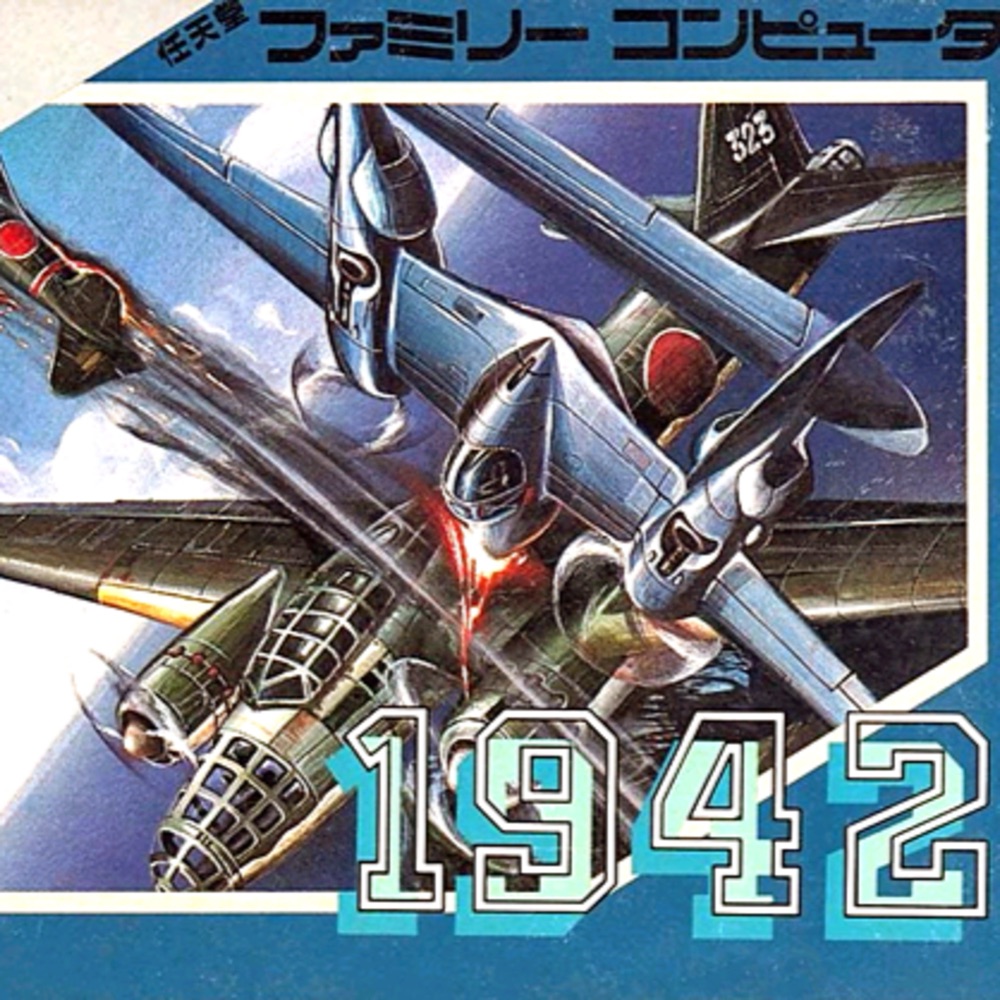
1942 gave us the first vertical shooter on the NES and the first Capcom game on the show, published here by Williams, the pinball company. Capcom made it themselves, and it was a big arcade hit that launched the 19xx series. As a new genre arriving on the system it was welcome. As something to sit down with in 2018, it left us shrugging.
What it gets right
- Something new. After a long run of platformers, a shmup felt like a change, and flying over islands and taking off from a carrier is a nicer backdrop than black space. A World War II setting is more tangible than space, which probably helped the arcade original land with people.
- Real planes. You fly a P-38 Lightning called the Super Ace, and the manual names the enemies too: a Kawasaki Ki-61, a Mitsubishi A6M-0, a Kawasaki Ki-48 and a Nakajima G8N boss. We liked that detail even if it was probably wasted on most kids.
- The loop-de-loop. The roll has a good sound and lets you dodge by vanishing from everyone's 2D plane for a second. The power-ups are better, especially the two wingmen who fly beside you and have their own hitboxes, so you survive losing one. Shooting four blasts at once feels good, and we agreed the game does make you feel more powerful.
- A fun bit of lore. The box art calls it part of the "Captain Commando Challenge Series," which sent us on a tangent about whether Capcom stands for that. Sam looked it up: Capcom is short for capsule computers.
Where it falls apart
- Stuttery. On original hardware it is a laggy mess, with flicker and an imprecise feel that sometimes got us clipped when it looked like a clean escape. Turning on frame skipping in an emulator made it far smoother, and the arcade original is clearly sharper.
- Four enemy types for 32 stages. The line of planes that swoops in for a power-up reminded us of Centipede, other planes fly up and just turn away without shooting, and the big boss plane is the only break in the monotony. Each stage starts easy and ramps up, then resets, so there is no overall rise in difficulty.
- Busy screen. Green planes disappear against the land, and the medium planes that come from behind punish anyone who sits at the bottom, which is a habit we all had to break.
- The sound. We played the music on the show and agreed it is awful. The drum track only shows up when you stop firing, and the noise sounded like an enemy plane locking on. We heard another home port got better music.
- Length. 32 stages and one hit kills it. Nobody got to Tokyo.
The bottom line
Skip it. Nobody voted it Essential. Sean's point was that a whole genre has the same controls and tricks, so you don't need to start here, even if it was one of the first on a console. Joe called it simple and fine, and said it was not essential for most people. Sam said to play it if you love the genre, and that it handles about how you would expect an NES shmup to. Our rule for the list is tight, simple controls that feel good to master, and this one does not have them. If you have two quarters at an arcade, take a round of the real thing.
Written from our conversation in this episode.
- Captain Commando
- Williams Electronic
- Micronics
- Capsule Computers
- Shmupulations
- Spy Fox and the case of the dry cereal
- 0.5A Presses
Auto-generated transcript. Each paragraph starts with its timestamp. Speakers are not identified.
1942. Will it be victory or defeat? It's in your skillful hands.
And welcome to NEStalgia, chronological exploration of every NES game released in North America. I'm Mike. I'm Sean. I'm Joe. And I'm Sam. And today we're playing the Captain Commando Challenge Series game 1942.
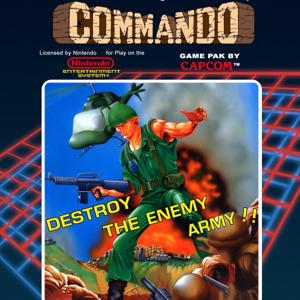
It has so much prestige behind it. Just the number. No one knew that it was the Captain Commando Challenge Series. But this is how Capcom branded the game when they brought it over because they had a bigger game, Commando, coming down the way. And they were like, oh, let's umbrella all this stuff under the same thing. Wait. It was Captain Commando what now? Captain Commando Challenge Series. Is that what Capcom stands for?
No. I never. Well, I never thought that. Wow. You might be blowing my mind. I had the same thought. I didn't know that either. They have a game coming out called Commando. It's our next game that we're playing. Well, I understand that Commando is a game, but Captain Commando or whatever. I assumed that Captain Commando was the player in Commando. No. I haven't played Commando yet. It must be. Like, this is crazy that you guys are actually revealing the origins of... That's like if Nintendo. That's like if Super Mario Brothers, but it was Super Nin and Ten. Like, you know, Nin Ten.
I wonder how many people are listening that are like, are these guys serious? Are these guys serious? Of course that's what it is. Yeah. So Captain Commando is Capcom. And we're talking about Capcom because they made this game. Welcome Capcom to the gigantic library of third-party NES filled with Bandai and Data East. Wow. It's quite the League of Extraordinary. It's quite the shelf. One thing to mention though, of course, is that Capcom actually developed this game. Not like how Bandai outsourced theirs.
So that's kind of cool, but it wasn't published by them here in the States. They probably couldn't afford to publish it or needed someone to take on those risks so this way they could develop it. So it was actually published by Williams, who I'm more familiar for like pinball. Is that them? Is that the same Williams? Yes, it's the same Williams that made the pinball cabinets. I always said I knew my pinball. You do. That's a claim I've made since like episode eight. Oh, you know, when you first said that, I thought you meant NES pinball. And I got really confused. Yeah, I really am a master of NES pinball. Isn't that in a water game? Yeah. Joe was actually the master of NES pinball. He bragged a lot during that episode. Hmm. Yeah, yeah, you know me.
Pinball cabinets. However, it was ported to the Famicom by a company called Micronics. Okay, we can only assume that they also got the, it was the same port job for the NES as well. I would assume so. Yeah. Because I don't know what else they've made. But that's kind of weird, right? That it got ported to the Famicom first before like ever seeing the NES. Because this is a very American heavy game. Yeah. You play as an American, I believe. Yeah. I mean, your goal is to get to Tokyo. You're shooting down the Japanese planes. Yeah. It's pretty clear. My only thought, which I guess isn't true, but I was wondering if like, oh, maybe, maybe they changed it up. Maybe like you're just, you were, it wasn't 1942 in Japan. Right, it was 1941.
Or maybe it's just like, oh, you're just playing as like, you're just fighting aliens or something just unrelated to history or something like that. But I guess, no. Yeah, no, I just, I think it's just weird. But I mean, if they didn't question it, I shouldn't be questioning it. Like, you know, this was a huge hit in the arcades. So I can only, you know, this was like Capcom's first big hit into, you know, Street Fighter will come soon. But for right now, it's 1942 that's dominating it and launches a whole line of the 19xx series.
Is that what they call itself? They do. Yeah. It's the 19xx series. And you never know. I think there actually might be some just games that are called 19xx, but I'm doing that on my own memory. I mean, they get an immediate sequel, 1943, that also came to any. Oh, like the year.
What's that? Like the year. Yeah. The year. Well, that's what this one is, too. It's just your score. I didn't get that. Yeah. It's the number in the in the series. 1942. Do you have to play one through 1941 and understand 1942?
I was also going to say it's the number of characters in the game. Oh, wow. That's like a reference to a donkey video on Smash. Anyway, Sam, I think you have some breaking news on the Capcom story. So I looked up the origin of the name Capcom and it is from capsule computers. Oh. So I think the Captain Commander is just them being cheeky. With the whole Capcom thing. It's still Capcom, but we're. That's disappointing. Yeah. But I'm okay with it. Yeah. Imagine if your name was Captain Commander.
That'd be sick. I think I think I'm going to go with the fact that I'm right here and that they were promoting the Commando game under this umbrella of games because they were all part of the Captain Commando series. Mike was always right. Yeah. Definitely check if I was right on our next episode. So definitely tune in next week again. Who's dragging along on this episode?
No, I don't think I'm going to be right. I think I just want like, I think by now the audience has a good sense of who they're dealing with when they talk to me. You know, they're going to get a lot of weird sounding words. They're just going to get a lot of what I like to call shmorgle. You know, it's like a mix of two words coming together. And phrases, yeah. You know, and phrases that like they, whatever they should have been, I've somehow flipped two of the words and still. But you get the gist. I've made the sentence make sense, you know, somehow still.
So the poster here is 1942. It's time for a change. And I don't know what change that is. But this is definitely a change. This is a change for the NES though. We haven't had a vertical shooter yet. That's true. We haven't had any kind of really like shooter. Any kind of like infinite scrolling shooter. What the insiders call shmups. Yes. Which is funny because this is the kind of game where I associate this with like really early stuff. I would think that like the launch titles would have something like this where it's like very arcadey, very, you know, you're just flying around shooting at things and like that's it. That's the game.
Well, I think that's also just coming from like how heavy the early arcades were on like space, you know, like with space invaders, but we also had asteroids and what was it? Galaga. You know, like those, those games are like kind of the predecessor to games like this, even though this one is grounded in reality and on earth, you know, it's like, it still is
kind of like, you know, it takes its notes and cues from those games. So I know that a lot of us have played this before, probably on the internet, right? Like, I mean, I mean, I've played many games like it. Oh, you don't think you've touched 1942 before this? I don't think I've ever played 1942 before this. What about you two? I think I've played, I may have played 1942 once when I was little before this.
Again, I've played tons of games that are like this. Right. I have definitely played this. This is one of the few games I remember from when I was a kid. I had the cartridge and this is one that, you know, my brother and I used to play. Um, I remember not being very good at it and always being, always being like, I just want to play Mario, but, you know, but, uh, but it is one that sticks out in my memory.
There's just something about shmups that like, I'm not a, I'm not a master at those games. I don't know those like really deep cut games that like, I'll just say this, the shmup fan base is, they have like tons of guides and like how to get into these games and how to play these games. But it just comes off as like, there's just too much. Like I just like, 90.2 is the right level of entry, but they probably hate a game like this cause it's incredibly basic. Yeah. I, I'm not really a shoot them up kind of guy. Um, I, I like a lot of them that have, that have a better art style or at least a more complex art style or, um, more effects.
This game for me, uh, seem it's, it looks like the most basic version of that kind of game that you can come up with. Yeah. One of my favorite shoot them ups is the mini game in the humongous entertainment point and click game, Spy Fox and the case of the dry cereal. All right. Where you can play a kind of Galaga copy with like all these different weapons upgrades and shields and stuff. And it's actually a pretty solid game in this old kids game. Was it, was it in a cereal box?
No. Okay. It just sounded like it was a cereal box thing, but okay, no, that's cool. Uh, so since, since we haven't really, uh, you guys haven't have too much experience in this game, maybe we do some first impressions. Yeah. Sean? Um, this game didn't leave too much of an impression on me. I, I found it incredibly basic, kind of boring, a little slow, somehow not challenging, but also too hard. Yeah. Um, I have very little good to say about this game other than like, it's cool that you get to fly over islands.
Like, wow, that's nice. I like that. That's a very, that's a very nice thing of you to say to compliment the game. Yeah. So booting up this game, I saw it and immediately I knew exactly what kind of game it was, you know, because I'm just so familiar with what this looks like. I haven't played a lot of shmups, but I just kind of know what I'm going to do. Like what I'm going in, what I'm getting into. Mm hmm. And it met my expectations pretty much exactly. Yeah. I think like, you know, this is such an early example of a shoot them up, but at the same time, since you've seen it now done so many different ways and usually they're like completely over the top. Yeah. I can understand the, uh, the boring complaint that I'm hearing from you too.
Joe? Having played it a lot as a kid, I was excited to see what, you know, how it held up to my memory. While I was playing it, I kind of thought like, maybe this kind of game is just not for me. Cause I knew that it was like a very popular game. And I don't know. I thought everyone, I thought you guys were all going to love it.
And I was going to be like the odd man out where it was like, eh, maybe it's just not my type of thing because it is a little just like, okay, you're shooting things like that's it. And now that I'm hearing what you guys are saying, I think that maybe just is what the general impression people get is like, well, I get the game. You're shooting things. There's some power ups and stuff, but overall it feels pretty straightforward.
So I'm, I'm similar to you, Joe. I wanted to see how this held up. Cause I liked it as a kid. I think it's still fun blowing stuff up. I don't think that there's a ton of variety there, but the, the basic concept of dodging enemy planes and shooting down stuff and like, you know, going from stage to stage and trying to like last as long as you can. There's just something about that. That's fun to me.
Maybe it's that genre that I like, you know, but playing the arcade version of this and playing the NES version of this is like night and day that this, this NES version, I'll, I'll say it now. It's really only salvageable if you play it on an emulator because you can register like frame skips and you can play it this way. It actually looks. Frame skips. Yeah. So you can do like, um, like every 10, like skip every 10 frames or something like that, you know, something dramatic. Right. And so it won't render out those frames and it will look a lot smoother when you're playing the game. And the funny thing is, is that like, it really doesn't do that much to the gameplay.
There might come like a time or two in your entire game where you might have like thought you were about to be hit by a laser, but then a laser, a bullet, but then, you know, it turns out you dodged it. It, but really it just makes the game so much smoother because for whatever reason I found this game to be like a laggy mess is laggy. The word here is just like a stuttery mess.
It doesn't feel smooth, right? It doesn't feel smooth at all. And the arcade port drags almost like the controls drag a little bit, right? The arcade, not the arcade port, the arcade version, the original version was like 60 FPS smooth, like, like really clearly defined and you could maneuver your way inside and outside of enemies. Sometimes on this one, I felt like I was about to, you know, get away from a close clip or something like that. And then I got crushed.
So I did go into my emulator and I turned on, um, frame skips and I had no problem whatsoever after that. And I actually thought it was a good time, but since we're talking about the original hardware here and I first played it on that, I have to say that, you know, playing it on the original hardware, it's, it's rough and it's, it's aged.
Yeah. Um, I, maybe it was just a performance thing, uh, in terms of how slow and, and imprecise it felt. Um, maybe I would have liked it cause I haven't played the actual arcade cabinet either. Right. I mean, I'll, I'll go and try and find a 1942 arcade cabinet. Yeah. I mean, graphics are nicer too. Yeah. So there's that. I have seen video of that. Yeah. So I don't think we have to talk about objective or anything. I think it's pretty clear. You're a American pilot with no help whatsoever.
You've just like been thrown into the Pacific theater of world war two. And now you have to go and find your way to Tokyo from who knows how far out because you have to do 32 stages to get to the end. That's weird. And it's weird the way they phrase it. Did anyone notice that? It always says like, last of 32 stage. Like, it's like, okay. And then it's like last of 31 stage. I was like, so I'm really on stage two from on the 31st stage. Yeah. So I thought, I thought that was weird.
And another thing that I wasn't like crazy about the difficulty spike isn't really there. It's kind of like every single level starts off kind of easy. And then they just like pour on the enemies. You know, it's like, it's not, it's not really a complaint, but it seems weird that the end of like, let's say level 29 is like really intense. And then I'm starting up level 28 and it's like, nothing's really happy. You know, it's like, Oh, back to the beginning again. And I also just wanted to mention how busy the screen gets. Like when you, when there are a lot of planes on there and you're especially like when you're over land.
Yeah. Well, I was going to say when you said you liked islands so much, you like islands, but some of the planes that you're facing are green. Yeah, I know. And they blend into the, I only said that as like a. No, I get it. It's nice to see changing backgrounds. Yeah, I guess. Yeah. Instead of it just being black, like a space. Yeah. Even, even taking off of the air carriers, you know?
And is this one of the, like, I don't know much about like the arcade games before this time, but like it's one of the first, you know, shoot them up games like this that has like an aesthetic that's on earth. And that has these great, these colors and that, and I feel like most of them were just like as simple as possible because they made it space. So it was very easy to like. Yeah. I mean, I want to say yes.
I don't think it would be the very first, but this is definitely the one that like launches the whole idea of like World War II is cool in video games. You know, like I want to play more war games and Capcom will deliver that. But I feel like that could have been a big part of the draw for people was like, it's something a little more tangible to them. It's like, it's a little less sci-fi. And it's like, oh, this feels more like realistic just because of the setting. Like, so I feel like that might be like some, have some credit in like how popular this game was. Right. So how did we feel about like the enemies and dodging them and dealing with them?
Like some of them have different patterns, but for the most part, there's only like four different types of enemies, I want to say, or like maybe five. Yeah, the one thing I can say about that is whenever they had those patterns of like, it'll be a line of four or five planes that just do like a little swoop. Oh, the ones that will give you the power up if you knock them all out. Yeah. That felt a lot like I was playing like Centipede or something. Yeah. But I guess that's really the only notable thing I can say about the different kinds of enemies. It's also just weird to think that they would do that. Yeah. Like they're not attacking you. They're never attacking you. So what are they doing? You've flown into an air show.
There are some enemies, just singular planes that will actually, a lot of them that just fly up to you and then turn around and fly away. They don't shoot. They don't even try and hit you. They just fly up to you and they flip over and they fly away. They're just like an obstacle. I have no idea if this is insensitive, but maybe they're like, they were about to go kamikaze and then they just said like, no, I gotta back out. I did not think of that. My thought was that like, are they like scouting you out? That thought crossed my mind.
You know, it's kind of crazy that this game has 32 stages and only, I just looked it up, four enemies and one of them is just that big boss plane. Oh, yeah. You know, like that big plane that just shows up. I mean, that's cool. I think like more bigger sprites would have been nice, you know, to have like. Yeah, just to break up the monotony of it. I mean, just because there are different patterns happening at the same time doesn't, it's just different patterns of chaos.
And just that feeling too of, you know, something, something that can truly like, you know, you're bigger than a lot of the other enemy planes. So to see something big like that, all of a sudden you're like, oh man, that's going to take a ton to get down, you know, and it does. I like that. It'd be cool if it was, you know, maybe a spot where there were less little planes and just a couple of those big guys on the screen. But that never happens. There's only ever one or two. Does that guy even shoot at you?
Yeah. Okay. The big ones shoot. I can't remember just because at that point there's also a lot of other enemies on the screen. So who knows? Because there are those, those aren't the same. I think there are some like medium sized planes that come up behind you. Yeah. And that, that throws you, because I, I'm a big like hang out at the back of the screen kind of guy and like, and, and, you know, get a good, a good view on what's coming.
They were designed for you. But yeah, it was designed to tell me to stop doing that and pay attention to what's coming up behind me. Yeah. I still, I'm just going to, you know, because I don't want to rag on the game too much. I still did enjoy it. I just think one interesting perspective I have is that I've also played the sequel, 1943, and I don't think any of you guys have, correct?
No. So it's kind of weird. It's almost like thinking about playing Super Mario Brothers when you know Super Mario Brothers 3. Yeah. You know, where it's like, I mean, that's an extreme example. I don't want anybody telling me 1943 is not that good. It's like, I didn't mean it like that. I just meant like, it's weird knowing what's coming up and how much more polished that game is than this one. And it almost makes you think like, oh, well, this is just garbage. But you have to think about it in this time, you know, like we're talking about it chronologically.
And so right now I think it's just really cool that we're getting a new genre. Yeah. You know? It's always good when I can get, when it's not just another puzzle platformer or something like that. Right. Like, when are we next going to see another genre, like an RPG? I think it'll be RPGs. That's like 1989. Yeah. That's so far away. Yeah, we'll be, we'll be in our 50s by then. I'm looking forward to the RPGs. Yep. Does anybody know the plane that you pilot in the game? Like the specific plane? Well, it has a nickname in the game, but. The Bazinga? The, yeah. How did you know? It's a Big Bang prequel.
No, it's the Super Ace is what it is, what it's named in the game. And it is a Lockheed P-38 Lightning. I'm sure that means something to the one person who knows planes in our audience. It's very exciting now that they know that. So I also just wanted to list that there's also the enemy planes, the Kawasaki Ki-61, the Mitsubishi A6M-0, and the Kawasaki Ki-48. I mean, it's cool that they, that they based them all off of actual planes. Yeah, that is cool. I think it was wasted on a lot of people. Yeah, right, right.
No, that's, that's pretty cool. I dig that. Is that in the, in the manual? That's in the manual as well as the, the boss plane is a Nakajima G8, not, G8N. So I mean, potentially this could have triggered some people's interests in planes. Maybe, you know. Maybe. Yeah. It was the, you know, I think at this time, that's a good point, Joe, because I think at this, at this time, video games are getting like a really bad rap as like, you know, oh,
I got to take away the Nintendo. Like you can watch these news specials all the time. If you look up like Nintendo 1986 news, you know, on YouTube and you'll see the, the, the parent be like, yeah, we had to take it away for two months, but then their grades got better. So we gave it back. You know, it's like, it's like, that's just weird. Like this, that got me thinking, I was thinking about this for this podcast, that this seems like one of those games that if you played too much of it, your parents would get mad,
you know? Because you're just taking down, you're just constantly killing things. You're just constantly killing things, but you're also just staring at the same screen the whole time. Oh, we didn't even talk about the sound. Oh, we didn't even talk about it. Oh, this game sounds horrible. I hopefully have not included any music in this episode. I usually play music all the time in the episodes. I think you should play it right now.
Did you play it? I did. Okay. That was terrible. Wow. Yeah. It's bad. And then there's not a lot of anything else. I think like one port that was not in the Nintendo ports, but like maybe it was like Commodore 64 or something like that. Like they got music and that's like, damn, why couldn't we get music? Like it doesn't even sound like, it does not sound like a soundtrack. Like I didn't even, I thought that there was a plane on my screen making that noise and I was getting targeted or something, but no, apparently that's like a melody. Yeah. I have no idea.
Uh, I, maybe that's even like code for something. Like maybe you're getting SOS. It's more as code. If you're not firing, which I know doesn't happen a lot in this game. If you stop firing, you can hear the, uh, the, like the drum track, drum track. Cause I guess they use the same track for firing and for, um, for drums, which is, yeah. I guess I, I mean, maybe I didn't pay too close attention to the sound, but I thought that there was just like a propeller sound the whole time. Like it was like, no, that was like a mark sound. I don't remember. But it did remind me of 10 yard fight.
Anything in that register just makes a flashback. CNES can only produce so many sounds anyway. But how about that, um, how about that sound that you make when you do the, like the turn, the flip? Oh, I like that. I like that sound. Yeah. That's kind of cool. It's like, boom. It also lets you know how long it's lasting and how long you're kind of invulnerable for it. Right, right, right. And that flip was one cool little like variation on playing the game where it's like, oh, you can dodge things with this, what is it? A loop-de-loop? Yeah, it's like a loop-de-loop.
It's weird to think that everybody's on the same exact axis though until the minute you do that. Like, and then all of a sudden you, they're like, wait, they're all playing on like a 2D plane and you just vanish for a second. And they're like, rats, we lost it. Are we just coming right back in? Come on. Yeah, why don't I just stay down there? Uh, what'd you guys think of the power-ups?
I thought they were fun. I think, I mean, it was cool. I really liked that one with the two planes that join you on the side. Yeah, and then. That was neat. And they're their own hitboxes too, so you could just lose one. Yeah, like if you could move one and the other one could stay with you, that was cool. Yeah, because I was afraid it made me, it was like a trade-off. Like, oh, you get more firepower, but also you're a bigger target. But like, no, if it hits one plane, like you're still alive as long as your center plane stays intact. Right. Yeah, there is just like a sort of primal, like good feeling to getting like more gunfire.
More, like just a bigger gun or more gun. Shooting four blasts. Yeah, shooting four felt pretty good. Four feels good. Yeah. You actually feel, I think that's one thing that the game gets right. You feel more powerful with the power-ups and that's always like important to communicate. Yeah, what do they say? It's like more DACA. Is that what they call it? What? More like D-A-K-K-A, I think. Isn't that mean like more guns?
Maybe, yeah. I don't know. One thing I also want to add is that this is like the first game that I can think of that really gets help from like turbo options. So if you add like an NES Advantage or another like similar NES Max, like one of those controllers. Like a machine gun. Yeah, yeah, no, no. Those are like two different controllers that came out around, I think in 86 or 87. And they had turbo options for A and B.
This one would really help you because- Oh, just every time you press? It's just, no, it's just holding down that button and now it'll fire off like, you know, shots every second. It's, so it does it on the press, on the B press, not on the- No, not, yeah. So you would hold it down and it would continue to do it at a consistent rate. No, right. I get that. But I'm saying without the turbo, you would, if you press it like crazy, you shoot more? No. So how would a turbo help?
Because you wouldn't have to continue to press the button. Well, that's what I'm saying. You don't have to do that in the game, right? No, you don't. You're not able to do that in the game. If you hold down B, I don't think you continue shooting. I think you just shoot once, don't you? Yeah, that's what I'm asking. I can't remember. And if you do shoot more than once, I don't think it shoots as fast as turbo. Because turbo on a controller is registering like the input over and over and over again. So it's the equivalent of like fast tapping. Right, but you can fast tap in this game.
Yeah, yeah, yeah. You can. Yeah, yeah, yeah. Totally. Sorry, I get your question. Yeah, yeah, yeah. Sorry. I thought you were talking about a press versus a long press. A whole. That gets into a whole thing about, you know, there are no such thing as half A presses. Oh, damn. I was going to make that joke.
You know, that opens up portals to other dimensions. I'm sure there are plenty of people that are like, what are they talking about? I'll link it in the show notes. It's about Super Mario 64, a game that we'll get to on episode 4 million of Nostalgia. Eh, not 4 million. You think there's 4 million video games at all? No, I don't think there's 4 million. That'll be just 4 million. There's probably 4 million movies, though. I don't think that's true either. Our sound engineer is shaking his head. He says, like, vehemently, no. He knows. There's at least 100 movies. There's at least 100. There's at least 4 million videos on YouTube, right? Yeah. That's gotta be true. Probably 4 billion. No. Really?
But now for the Essential Games list. I know, I know. We are going to get to the Essential Games list, but I did like our little thing there of Over Under. Like, it's just like, I think that should become a new thing where... But it's just not related to the game. Not related to Nostalgia. It's just like, how many pens do I have in my bag? Like, 5? Alright, let's do the Essential Games list.
Alright, guys. It's the Essential Games list. And the first thing I want to ask is, nobody got to Tokyo, right? No. Sorry, not like in life. In the game, that's the final objective. And it's like, I didn't even watch what happens when you get to Tokyo. We talked about in Ninja Kid, how it just says, the end, and they take you immediately right back to the main menu. I'd kind of like to know what happens, but maybe I'll just link that in the show notes show everybody. I doubt it's anything cool. Maybe it's like, you know, like, what would it be? You drop a bomb? It's kind of scary.
I don't... Whoa, watch yourself. One other thing that I think you told me was that there are like, there's like 100 levels or something? You, you as in Mike. Yeah. For the people who are listening that can't see me point or even know what Mike looks like.
Send me an email at contact at nostalgicast.com with what you think I look like. Send drawings of all of us. I would love a drawing. You don't have to send it though. You can just email it. But Mike, I think you told me that there were a lot of levels. I can't remember how many you said. 32. It was more than I was willing to.
Yeah, yeah, yeah. 32 is tough, especially on another game where one hit and you're out. Right. So now we're in the essential games list. Everybody knows what this is by now. We're talking about if these games are essential. Not in 1986, which is when this game came to the NES. We're talking about if they're essential for, you know, all time. Like, are they still relevant in 2018?
Sean? All right, you have an entire genre of this shmup game that has pretty much the same control schemes and the same gameplay techniques and all that. You don't need to play 1942 if you have access to almost any of them. So, I mean, maybe it's got the whole this was one of the first or at least the first on console going for it. But there are much better games than this one. Joe? 1942 is pretty simple. It's got a simple objective. It works. Everything's fine.
Not really for me. There's probably people who are going to like it more than I did. But I don't think it's going to be essential for too many people. I think not essential. Sam? So this is what you do. You build a time machine. You go back to 2005. You go into addictinggames.com. And one of the first games is called A-Blast. Which is like this. You know, it's a shmup. But with bosses and all this other kinds of crazy stuff. That game is, you know, it's probably better than this game. Not that this isn't a bad game. It handles just about as well as you'd think it would handle. You know, you guys were talking about a little bit of lag before. But for NES, it handles kind of how I expect it would handle.
But it's nothing special. If you're interested in this genre, I would say play it. But it's not bad. It's just not really. There's not a lot there. It's kind of fun. I like this game. And I won't even tell you to play it. I don't think you should.
If you're in an arcade, you got a quarter or two to blow. I don't know what they charge at arcades anymore. But hopefully it's no more than 50 cents for this. If you got two quarters and you want to play like a quick round of 1942, you'll enjoy yourself. But if you're looking for shmup experiences, especially vertical instead of horizontal, because we do have a horizontal shmup coming up later in December of 86 with Galaga. Holy shoot. Wow. Holy shoot. Yeah. Holy shoot, game. My point was this as a vertical shooter on the NES just really isn't cutting it. Maybe wait till 1943. Hear our verdict on that one. Or just go play it today and then wait for our episode on it, however dedicated you are as a fan.
You know, I think for something like this to be an essential game, I don't even know what it would need. I don't think that it would need so many performance enhancements too. I know Sam was saying that this is how he expects the game to perform, but that's not how I would want the game to perform. I do understand where you're coming from with that criticism.
I just think like, you know, for me, an essential game always has to have really tight controls that are just simple to play and feel good to master. Not like difficult to master, feel good to master. Yeah. So, you know, we're occasionally on these essential games, we're just kind of defining what an essential game is. You know, it's like we kind of did that with Ninja Kid last week and now we're doing it again. So in case you wanted any insight, this is like BTS footage for you. With no footage.
So you still don't know what Mike looks like. Well, no, it's footage, it's just not video footage. Yeah, yeah, yeah. I guess I don't know. Nice. I don't know the difference. Anyway, that is all the time we have for this episode of Nostalgia. Join us next time for Commando. Not Captain Commando. It's still Capcom, but it is. No, it is Capcom, but it's just regular Commando. And play it yourself if you can. Thank you for that, Mike2.
You know, when I want more Nostalgia, I usually just go on to Google Chrome, the optimal web browser, and I go into the URL and I type in www.nostalgiacast.com. Sean, how do you spell that? Well, you would, let me spell it for you. Yeah. First you go into Firefox, and you go into the URL box, and you type N-E-S-T-A-L-G-I-A-C-A-ST.com. I noticed that he didn't say Firefox was the optimal browser, but the optimal podcast is definitely the one you're listening to. And if you want to hear more, all you have to do is hit that big subscribe button. Smash that subscribe button.
You know, wherever you're listening, I don't want to make you go to iTunes if you hate Apple. I don't want to make you go to Google Play if you don't own an Android device. You can just open up, you know, Opera. Whatever you're doing. I think Opera was bought by a Chinese company that, like, has, like, a false VPN in it. Okay, you say you got a Netscape.
Yeah, you got a Netscape. I was thinking, like, AOL 6.0. You go to Microsoft Edge and you download Google Chrome EXE. And then you install that package and you go into Google Chrome. Firefox. And you hit the subscribe button because you love nostalgia and you want more. And if you want more, you're like, hey, you know what? These guys seem pretty cool and they're pretty laid back and they don't run ads on their show and they're not charging any money for me to listen to this thing.
Maybe you just write us an email. Don't say thank you. I don't need that. I don't need your praise. I feel it every day when we record. Ask us questions. We only got one question from that guy in Milwaukee. Yeah, we want more questions, you know, and actually, who knows? Maybe we are getting questions because we do record these episodes a little early. Someone's like, I've been sending you my email. It's like, trust me, I'm getting them. Just, you know, continue to send them.
Contact at NostalgiaCast.com. Remember, that's Nostalgia, not Nostalgia. But I have Nostalgia for, you know, websites like YouTube, Twitter, Facebook. By the time this goes up, those are gone. I have Nostalgia for those websites and we have links to those websites on our show. Not just links to the homepages of those websites. That was a seamless segue.
Thank you so much for your support of Nostalgia. Remember, next week is Commando. Play along. Send me an email with your thoughts. Maybe I'll read it on the show. So, we thank you for spending time with us. I'm Michael Esposito. You can find me on at Esposito Film on Twitter. I never post anything. I'll talk to you soon. Ha ha ha ha. Uh, nice arms. Have you been working out a lot? No. Really? Yeah.