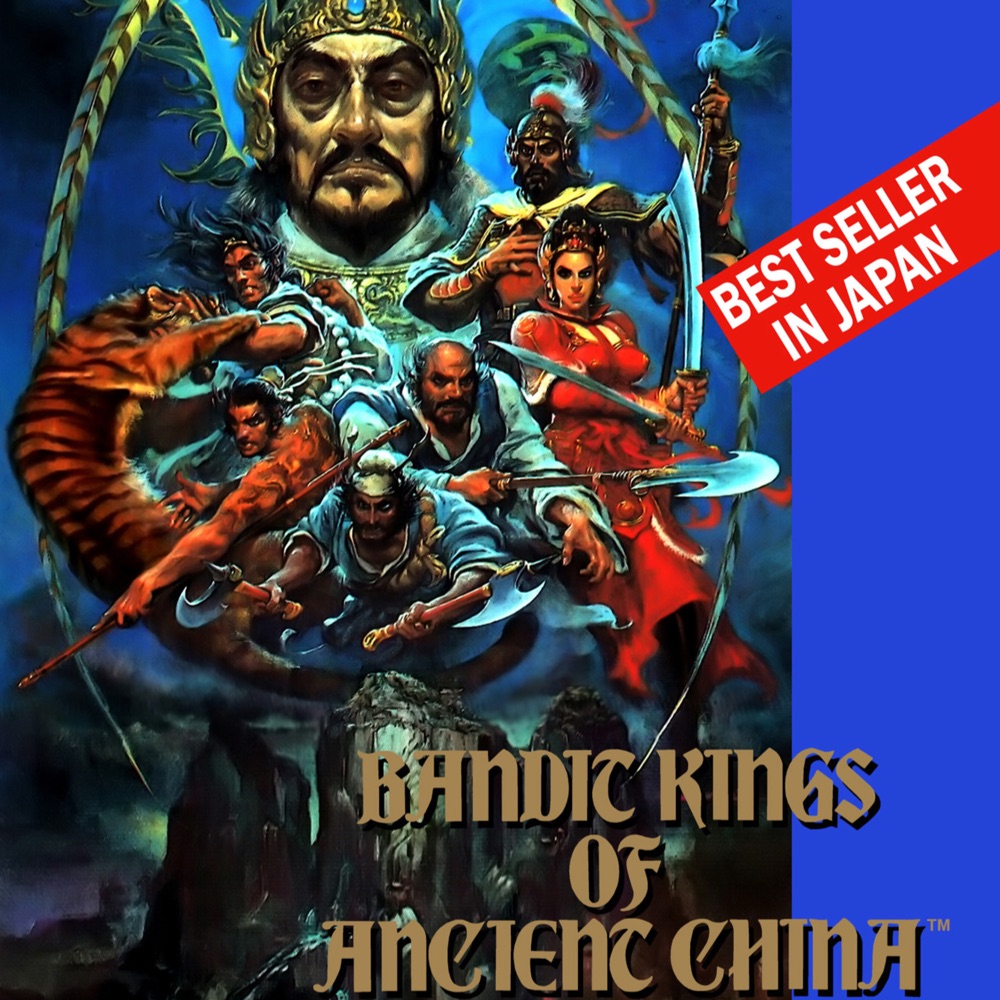
404 · Bandit Kings of Ancient China
A wall of menus hides an epic saga of warlords, droughts, and desperate rice shortages as you slowly stitch a battered China back together. One season you are recruiting wandering heroes in smoky taverns, the next you are marching armies across the map while praying the harvest does not fail. It feels less like an NES game and more like running a tiny, pixelated kingdom where every decision can doom or redeem your legend.
Bandit Kings of Ancient China is Koei's strategy game about the Water Margin outlaws, set in the 12th-century Song Dynasty and based on a book, the same way Romance of the Three Kingdoms was. It was our fourth or fifth grand strategy game. Mike, Sean and Joe were on this one (Joe admitted he'd missed a few of the earlier ones), and the ideas are better than the evening you spend learning them.
What's different here
- Popularity is the game. You are not painting the map. The goal is to build enough strength and reputation to take down the corrupt minister Gao Gui, and each prefecture tracks support that affects taxes, riots and prices. We joked that it makes you America's most popular mayor. Battles end up feeling like a means to an end.
- Outlaws to recruit. You can swear brotherhood with named bandits, who then lead troops or govern a prefecture for you. We liked a 1990 game modeling internal structure like that, even if we had no idea who the famous names were.
- Seasons and rice. Stock only jumps in autumn, but you have to work all four seasons to feed troops through the next year. Winter wars are the hardest, so you either have the supply for one or lie low. Rice and gold prices swing month to month, and we decided it teaches more about markets than Wall Street Kid ever did.
- A 30-day battle clock. Every command in a fight counts as a day. We never agreed on why it exists.
What gets in the way
- The manual tells you what, not how. It is a 40-page glossary that reads like a tax form. Nothing says to pay your officers first: skip it and loyalty slides from 70 to 65 to 64, then they walk out right before a war and take their men along. We read the manual, watched streamers and read a full FAQ, and still weren't sure we were doing it right.
- Tunnel vision. Every action sends you to a page that exists only for that action. Sean wanted some outliner to see the state of things at a glance, and there isn't one.
- It needs a week. One to two hours gets you nowhere. Joe said Sid Meier's Pirates is as far as management on the NES can go, and past that it starts to feel like Excel.
The bottom line
Skip it. We all voted no on the Essential Games List, so it was three no's and never close. We called it neat, and not the worst review we have given. If you love Koei's other titles it has enough new in it to keep the series going. But a game that takes hours before you can really start playing does not belong on the list, and Sean said none of these will get there without real quality-of-life improvements. A "make one prefecture like you first" tip, the way a Mega Man manual would hand you one, would have helped.
Written from our conversation in this episode.
- We keep getting these games, but its like a ton of text to translate. Usually in the SNES->PS3 days that would mean the games would just stay locked in the region. But the fact we keep getting these means it must have sold well.
- Introduction
- What it is: Koei’s historical strategy/RPG hybrid about the Water Margin outlaws (c. 12th‑century Song dynasty) leading bands against the tyrant Gao Qiu. NES port of the 1989 console/PC classic. (Wikipedia, StrategyWiki overview)
- Why it matters: A dense, menu‑driven Koei sim that predates Suikoden by years—famous for its huge cast, loyalty politics, and seasonal warfare loop on 8‑bit hardware. (HardcoreGaming101 – Koei Sims)
- Discuss now: When you think “NES,” is there room in your mental shelf for a grand strategy game next to platformers and action titles?
- Release, Credits, & Context
- Release: Famicom/NES 1989–1990 (JP/NA). Also on MSX2, PC‑88, DOS, and later platforms. (Wikipedia)
- Developer/Publisher: Koei (Shibusawa Kou). NES cart uses password saves vs. battery in some regions. (Manual scan – NES)
- Source material: Based on the Chinese classic Water Margin (a.k.a. Outlaws of the Marsh), with officers modeled on novel characters. (Wikipedia – novel)
- Discuss now: What do you value in a historical sim on console—accuracy, role‑play, or board‑game feel?
- WHAT’S DIFFERENT
- Different win conditions (story goal, not total conquest). Instead of unifying the map, your campaign’s purpose is to build enough strength and reputation to topple the corrupt minister Gao Qiu. The manual explicitly calls this out as “unlike past KOEI games.” Abandonware DOS
- Outlaw-reputation loop (Support/Popularity) that gates progress. Each prefecture tracks Support (local popularity) that affects taxes, riots, prices and annual January events. You also build Popularity through actions like hunting wild beasts; specific Popularity thresholds are checked in January to unlock late-game progress. This “do good deeds to win hearts” loop is far more central than in the other titles. GameFAQs+3digitpress.com+3digitpress.com+3
- Sworn brotherhood & “Good Fellows.” You recruit named outlaws and can swear an oath of brotherhood with trusted followers; sworn allies lock loyalty at 100, and some recruits only join if your reputation is high. That loyalty mechanic (and the Good Fellow/Chieftain cast) is unique to Bandit Kings’ Water Margin setting. koei.fandom.com+1
- Virtue stats matter (Mercy & Integrity). Ruler “Mercy” influences January income from Support; hero “Integrity” affects how effective training is. Moral attributes directly shaping economics and growth aren’t a focus in the earlier NES entries. digitpress.com
- Seasonal world events with civilian consequences. January brings taxes/aging/unrest; seasons bring typhoons, snowstorms, epidemics, festivals, and roaming wild beasts that terrorize citizens until you deal with them—blending public order with your strategy. digitpress.com
- Month-by-month turns, day-by-day battles. Strategic turns are monthly, but once a war starts the battle lasts that month and is divided into 30 days, with each hero issuing one command per day. That “calendar inside a battle” pacing is a distinct wrinkle versus the older titles. digitpress.com
- Civics tools tuned for bandits. Commands like Feast (boosts Body Points and loyalty across the crew) and Give to Citizens (directly raise Support, quell riots) tie your internal management to your outlaw image more tightly than in GK/ROTK/NA. digitpress.com+1
- Local infrastructure & markets that swing with Support. Prefectures can have smithies and shipyards; market Rate swings monthly and prices/outputs scale with Support and wealth—making “be good to the people” an economic strategy, not just flavor.
- Core Gameplay Loop (one season at a time)
- Domestic phase (per fief): Appoint leaders → Recruit officers → Farm/Develop to raise rice/gold → Trade for supplies → Search for new outlaws → Diplomacy with neighbors. (Manual)
- Military phase: March to neighboring fiefs, choose tactics (archers/cavalry/infantry), set formations, and fight on hex maps; seize cities or retreat. (StrategyWiki – Battle)
- Upkeep & seasons: Rice consumption each season; disasters and events fire; loyalty drifts if unpaid or mistreated. (Manual)
- Discuss now: Does this feel closer to a board game cadence or a proto‑4X on NES?
- Scenario & Win Conditions
- Scenarios: Multiple start dates covering the rise of the Liangshan bandits; choose a leader (e.g., Song Jiang, Wu Yong, etc.), each with different neighbors and officer pools. (StrategyWiki – Scenarios)
- Goal: Unite the outlaw hosts and ultimately defeat Gao Qiu (and his puppet emperor) before the time limit. Fail states include starvation, bankruptcy, or capture. (Manual)
- Discuss now: Which matters more to your run—map position or officer lineup at start?
- Officers, Stats & Loyalty
- Key stats: LEA (leadership), WAR, INT, CHR, Loyalty; some have Archery/Cavalry proficiencies and unique events. (StrategyWiki – Attributes)
- Loyalty economy: Pay stipends, gift items, share loot; captured foes can be recruited or ransomed—disloyal officers may defect. (Manual)
- 2) “If you forget pay, loyalty drops next season”
- What you see:
- Each officer has a Loyalty number (0–100).
- In the Domestic menu there’s a command to Pay (stipends/salaries).
- What happens if you skip it:
- When the game ticks to the next season, several officers’ Loyalty will drop (often 5–15 points).
- On NES you will not get a big warning. You’ll just open Domestic next season and notice Loyalty numbers are lower. Some officers may defect if they get too low.
- What to do:
- During every Domestic phase, open Pay in each fief and pay all officers before you do anything else.
- Concrete example:
- Officer has Loyalty 78 in Summer. You don’t Pay. In Autumn you open Domestic and he’s at 64. Do that twice and he may leave you, right before a war.
- Role‑play hook: Assemble your own “108 Stars” vibe; the cast is sprawling for an NES cart. (Wikipedia – 108 Stars)
- Discuss now: Best gift economy in a retro sim—this, Romance of the Three Kingdoms, or Nobunaga’s Ambition?
- Domestic Management (rice, gold, disasters)
- Rice is life: Plant in spring, harvest in autumn; price swings let you speculate or stabilize. (Manual)
- 1) “Rice cycle” — what that actually means on NES
- What you see:
- The game runs on four seasonal turns: Spring → Summer → Autumn (Harvest) → Winter.
- Your rice stock only jumps up during Autumn. On NES, when you advance past Autumn you’ll hear a short chime and the rice number for each fief increases all at once.
- Why it matters:
- Rice feeds troops every season. If you don’t have enough by Winter, your army starves and loyalty drops.
- What to do (every year):
- Spring (Domestic menu): Use Farm/Develop (wording depends on translation) in each fief to raise the agriculture value.
- Summer: Keep developing or trading for rice if you’re short.
- Autumn: After your domestic actions, end the season; you’ll get the harvest automatically (audio chime + rice number jumps).
- Winter: Don’t launch big wars unless you have rice to cover the extra consumption.
- Concrete example:
- Start Spring with 800 rice in Fief A. You choose Farm twice. In Autumn, after ending the turn, Fief A jumps to ~1,400 rice (exact amount varies). That jump is the “rice cycle.”
- Infrastructure: Develop (public order), Fortify (city walls), Smith (weapons/armor), Train (troops). (StrategyWiki – Domestic)
- Random events: Flood, fire, plague, bandit uprisings—mitigated by high INT officers and development. (Manual)
- Discuss now: The autumn harvest crunch: hoard rice for winter wars or sell high and risk famine?
- 9) “High-rice fiefs are your safety net”
- What you see:
- Some fiefs reliably produce more rice at harvest.
- What to do:
- Target one of these as your first conquest. It makes Winter upkeep painless and lets you train/develop instead of constantly trading for food.
- Concrete example:
- Without a rice-rich fief, you spend Summer trading gold→rice. With one, you focus Summer on Train/Develop and enter Autumn strong.
- “Do fief chores left-to-right” — why and how
- Why people say this:
- The NES port has nested menus and no big reminders. It’s easy to miss a step (like Pay) if you hop around.
- A simple left-to-right routine keeps you from forgetting something.
- A safe seasonal routine (repeat for each fief, in order on the map/list):
- Pay (stipends)
- Train (raise troop training)
- Develop/Farm (raise public order/agriculture)
- Fortify/Smith (walls/weapons) — optional, when needed
- Recruit/Search (only if you have time and officers available)
- Concrete example script:
- Select Fief 1 → Pay → Train → Develop.
- Move to Fief 2 → Pay → Train → Develop.
- After all fiefs are “clean,” then go to March and plan wars.
- Warfare Mechanics (hex battles on NES!)
- Army makeup: Troops + morale + weapons (bows, spears, horses); terrain affects movement/attack—forests slow cavalry, rivers choke lines. (StrategyWiki – Battle)
- 6) “Morale drop sound = pull back or Rally”
- What you see/hear:
- After a bad exchange, you’ll hear a short low tone and see your unit’s morale bar dip.
- What to do:
- Don’t press that unit forward. Either Rally (if you have the order), rotate it behind another unit, or retreat a hex to stabilize.
- Concrete example:
- Your frontline cavalry trades twice, you hear the low tone twice, morale is now orange/red. If you keep charging, they’re likely to break and get captured.
- 10) “Winter wars feel bad (by design)”
- What you see:
- In Winter, movement is a little slower overall and rice consumption keeps ticking.
- What to do:
- Unless you have a clear advantage, avoid launching big offensives in Winter. Use it to heal, train, and pay instead.
- Concrete example:
- You start a siege in Winter with minimal rice. By the time you breach, your stores are empty and loyalty took a hit. If you’d waited for Spring, you’d have moved and fed cheaper.
- Tactics: Ambush, Fire attack, Charge, Rally; success often checks LEA/INT and terrain. (Manual)
- Sieges & retreats: Breach gates or starve defenders; retreat costs morale and may trigger captures. (Manual)
- Discuss now: Favorite NES hex‑battle—this or Gemfire/Nobunaga—and why?
- Unique Systems & Little Quirks
- Amnesty & recruitment: High‑CHR leaders flip enemies after battles—classic “join me or rot” scenes right on 8‑bit. (StrategyWiki – Diplomacy)
- Ransom & prisoners: Monetize captures or trade officers—adds a criminal‑enterprise flavor missing from feudal sims. (Manual)
- 7) “Captured officers pile up unless you act”
- What you see:
- After battles, you may capture enemy officers. They sit in your roster as prisoners.
- Why it’s a problem:
- They still show up in your officer list and can clutter decision-making.
- If you never act, you miss chances to recruit them (good officers!) or ransom them (get gold).
- What to do:
- After each war, go to Diplomacy/Prisoner actions and either Recruit (if their Loyalty will take), Ransom, or Release.
- Concrete example:
- You win two sieges and snag four prisoners. Next season you forget them. During Pay, you scroll past a longer list and miss paying a real officer—now two problems.
- Outlaw culture: Periodic events name‑drop novel set‑pieces, giving the campaign a folk‑hero tone instead of dynasty formalism. (Wikipedia – Water Margin)
- Discuss now: Is this secretly the most role‑playable of the 8‑bit Koei slate because you aren’t a king yet—you’re a bandit coalition?
- Difficulty & Mastery (NES tips)
- Pick starts wisely: Avoid early multi‑front wars; prioritize fiefs with high rice yields and recruitable talent. (StrategyWiki – Walkthrough)
- 5) “Terrain really changes how units feel” (rivers/forests on hex maps)
- What you see:
- Battles are on hex grids.
- Forests slow cavalry. Rivers block or slow movement and favor archers on the far bank.
- What to do:
- If you expect rivers, buy/bring bows; park archers behind the river and let enemies wade in.
- If you expect open plains, bring horses and use cavalry for flanking.
- Concrete example:
- You attack across a river with horses and no bows → your cavalry crawls, gets shot on the bridge, and morale drops.
- Same map with two archer units on your side of the river → enemy melts trying to cross.
- 4) “Search fails a lot unless you use a smart officer”
- What you see:
- Search tries to find hidden officers or items in a fief.
- If you send a random or low-INT officer, you’ll often get “nothing found” several seasons in a row.
- What to do:
- Assign an officer with high INT to Search (the stat is visible on the officer screen).
- You’ll notice a clear uptick in “found” results versus sending anyone.
- Concrete example:
- Sending a WAR-heavy 40 INT officer might whiff three seasons. Switching to an 80 INT officer usually finds someone within a season or two.
- Comparisons & Legacy
- Sister series: Shares DNA with Romance of the Three Kingdoms (officer sim) and Nobunaga’s Ambition (territory/economy), but the outlaw theme changes incentives. (Wikipedia – Koei sims)
- Echoes in later games: Suikoden (1995) channels 108 Stars into a JRPG base‑building framework—spiritual resonance if not a direct adaptation. (Wikipedia – Suikoden)
- Discuss now: Which modern series scratches the Bandit Kings itch best: Mount & Blade, Total War: Three Kingdoms bandit factions, or indie kingdom‑builders?
- Version Notes (NES specifics)
- Interface concessions: NES uses more condensed menus and slower cursoring than PC; passwords instead of save slots in some versions. (Manual)
- Content: Core officer lists and scenarios intact, with minor portrait/translation differences vs. microcomputer releases. (StrategyWiki)
- Fun Facts
- Box copy flex: Koei marketed this as part of its “Historical Simulation Series,” which sat beside Nobunaga and Romance on NES shelves—a bold niche for 8‑bit. (Wikipedia – Koei sims)
- Name game: The villain Gao Qiu is a real historical official vilified in the novel—Koei leans hard into the literature. (Wikipedia – Gao Qiu)
- Host Notes
- For on‑air clarity, keep a season tracker (Spring→Winter) and a rice ledger handy. Use StrategyWiki’s battle pages for a quick terrain refresher during recording. Links above are placed inline where each topic appears.
Auto-generated transcript. Each paragraph starts with its timestamp. Speakers are not identified.
Bandit Kings of Ancient China, 100 years before Robin Hood. Bandit Kings of Ancient China, 100 years before Robin Hood.
And welcome to NEStalgia, a chronological exploration of every NES game released in North America. I'm Mike. I'm Sean. And I'm Joe, and fine, I'll show up to one of these episodes. Thank you for coming back. We appreciate it. You came back for like, you don't usually come back for these episodes.
No, that's what I'm saying. It's been a long time since I've played like one of these Nobunaga's Ambition likes. Yes. Are you even here for that? It's a Nobunaga like. I was here for Nobunaga, I believe. But the reason I don't really remember is it didn't tell me when relative to Robin Hood it take place.
Hmm. I see. Well, they should always tell you how many years. Like that's how we track things, right? Yeah. It's either A-R-H or B-R-H. Right. Bandit Kings of Ancient China, also a great title for like a heavy rock song or a hard rock song. There was a Paul McCartney and Wings song called Spirits of Ancient Egypt. And he was always like, spirits of ancient Egypt. Like he would really string that out. And so I've been doing lately, Bandit Kings of Ancient China.
Good job, Mike. I just feel like it works. That sounds great. Well, it sounds great. But also like I think you could see the connection if you knew the song, Sean. I think that should be like the menu screen music.
Right, right. But not me doing it like an NES synthesizer doing it. Yeah. We keep getting these games as Joe mentioned, but it's like a ton of text to translate these games. And in like the SNES to PS3 days, that would mean that these games just would stay locked in that region. Like whatever this audience, too much text. Like we're not going to. There's so many games on the Super Nintendo RPG specifically where it's like we never found out about it. And now all of a sudden they're getting either like translated or remastered and we're playing them. But the fact that we keep getting these on the NES either means that it's like before this whole thing started happening or that somehow these sold well.
It sounds like there's a sort of built in audience for these kinds of games. I'm still trying to figure out how they work. But yeah, it sounds like there's a pretty big strategy community that's buying some of them.
Yeah, I imagine it fulfills some some niche that that's out there. And and I do think that like maybe the more of these you play, the less of this like intimidating learning curve there is at the beginning of playing each one of these, because it really feels like especially for this one. But, you know, for others, too, that like this one, I think you got to be playing this for hours before you can even really like start playing it. You know? Well, isn't that true of like every board game we tried to play a board game night?
You have to like explain the rules for hours? Well, that's because that's because, Mike, you just wanted to play European board games that are all just math problems. You know? Yeah, the math board games. You got to do that. But not not to this extent. I don't. Yeah, that's true. That's true. Yeah, it does take a long time in the time that you are listening to this episode.
You could also try and play the game. And I still think between this episode and playing the game, you won't have a fully fleshed out idea of how to play Band of Kings of Ancient China. And it's well documented on YouTube because while there isn't some great Crusader Kings or Europa Universalis style like walkthrough, there are people who like play this game and stream themselves playing it. And it's just as like painful to watch them play it as it is to play it yourself in the sense of like the learning curve of it all. Right? Like explaining this stuff is kind of dry. And so don't think we're going to like get into that side of it.
I'd rather just like talk about what separates this one from the previous entries and like a few little neat things. But just to ground ourselves, this is another one of Koei's historical strategy games, this time about the water margin outlaws. I guess they could also be known as the wet bandits.
And they were leading these bandits against the tyrant Gao Gui in what is this? Or Macaulay Culkin, I think was his other culture. Right, right. Yeah. In the 12th century Song Dynasty, which again, like I kind of would understand if it was a Koei historical strategy game about the American Revolution or World War II. But like we sure people were snapping up for like, I want to play as 12th century Song Dynasty. Well, it seems like a lot of these, this one is based on a book.
Yeah, and so was Romance of the Three Kingdoms. Right. So it seems like there's like, yeah, they're like targeting a specific audience, like fans of this specific genre, this, you know, like that. I mean, there are, you know, there is a, you know, an appetite for like historical Chinese and Japanese like culture and warfare. So it's particularly, you know, in this case, China.
But like, yeah, I do think it is like maybe not as, you know, especially in the 80s in the US and not as popular in the West. But, but like it is something that like there's, there's a, there's definitely like a subculture that is like very into like that side, like that type of warfare and that, that kind of ancient, you know, like, like this wasn't made for Americans. Right. Originally. Originally. Originally. Sure. So, so like, you know, the American Revolution, whereas like, I find that interesting because I learned about it in school, you know, but like, you know, the rest of the world maybe is like, you know, whatever.
But this is something that's like, I feel like old enough and ancient enough that it's just like, it's just like world history, you know. And when you think NES, is there room in your mental shelf for the grand strategy genre next to the platformers and action games and arcade games that this console is littered with? I mean, I guess so. Now that we've got, what is this, our fourth or fifth one? I think it's our fourth. Yeah.
And I, when we started this podcast, I wouldn't have expected that in the slightest, but I guess if we're just talking about how accessible these games are, or I guess how inaccessible they are, but how like, if, if somebody that wants, has an itch for war gaming or grand strategy or whatever you want to call it. Um, and they, maybe they, maybe they don't have a PC to, to play the, you know, more souped up versions of these, which I think isn't really that souped up and they're mostly still spreadsheets, but, um, then it, it makes sense.
I mean, the, the NES has had, uh, it's, there's so many more genres on the NES that just seem like they wouldn't have gotten there, but it's just like, it's everywhere. It's in almost everyone's living room. So if you want the widest audience, especially for something so niche like this, then I guess you got to put it on the NES.
You bring up a good point, Sean, because this also came out on, uh, you know, those computers of the day, like the MSX2, the PC-88, DOS. But, uh, the NES is like the only console version. There was no, uh, like Sega Master System version of this game, uh, to compete in, in areas where like that console was the dominant, uh, console. So it, it feels like a computer game.
It feels dense enough to be that kind of thing that you would sit at a desk and plan out. But the NES version is here. And when you're playing these historical simulators, whether it's on the NES or, uh, you know, the more modern ones that we mentioned, usually with Paradox and such, what do you value most in those games? Is it the historical accuracy, the role-play nature, or the political resource management, uh, element?
Well, for me, it's definitely not the historical accuracy just because I, you, I would have no idea. Like, I just didn't, I have no clue if this is historically accurate. I mean, supposedly it is, but I wouldn't be able to fact check it. But I think those other two things kind of go hand in hand. Like, I, I do like the, the role-playing element and, and the, like, the management system. I think that, like, those two things are appealing to me on paper.
You know, the, the idea of them are appealing to me. The execution is where, uh, you know, a little more in-depth thought might come in. But, but yeah, those are like, that would be what draws me to this kind of game. The historical accuracy, if it was maybe a period that I was more familiar with. But yeah, not, not for this one as much.
Yeah, I mean, I, in terms of these games, especially Paradox, like, I guess historical accuracy can only really apply to the, uh, the starting conditions. Because as soon as you start interacting, things go off the rails. But yeah, it's, it's a mix between role-play and the actual strategy. I think that when it comes to the historical conditions, uh, I just don't have enough context in ancient Chinese history to even distinguish between Romance of the Three Kingdoms and Bandit Kings of Ancient China. I would have thought that these would have, like, overlapped maybe? But I guess they're probably hundreds, they're probably hundreds of years apart, as far as I know.
Um, but if, it comes more down to, in terms of, like, the historical framing of it, like, is this an interesting, uh, this is an interesting setup? Like, there are certain leaders in, like, a Crusader Kings that are like, oh wow, this is like a Norse, a landed Norseman on the coast of France. And, like, all of the weird, like, uh, all the weird, like, balance things that Norse people get. It's an interesting experience playing in that situation. Whereas, in these games, I don't, I once again don't have the context to know what any of their, like, their, these, like, groups mean. But they also seem a lot more symmetrical. Like, everyone's sort of starting almost, like, in a Civ-like situation.
Where you, you have no resources and you have to build from zero. Where it's not like that in a lot of Grand Strategy games. Because they're trying to give you that asymmetric, unique point of view. When you decide to play as any of the countries or leaders. Um, this game is a little different. Because you have, like, a big bad that you're all kind of going against. Maybe not together.
But there's that, like, wrench thrown in the, in the machine. I don't know. I'm rambling right now. No, I think, I think you bring up a good point, though. Because it is a different win condition than what we've seen in Romance of the Three Kingdoms and, and Nobunaga's Ambition. Where those were, like, total conquest. You don't win until you take over everything on the map and own all the territories. This is more of a story-driven goal. Where, instead of unifying the map, the purpose of the campaign is to build enough strength and reputation. It's really like a politics game in order to take down the corrupt minister, Gao Gui.
Exactly. And so there is, like, this whole reputation gameplay loop that you're really, you know, you're trying to, like, gain support and popularity in your own territories, but then also the territories you conquer.
And that's kind of what, like, gates your progress. Each of these prefectures track support that affects the kinds of things that we see in these games all the time of taxes, riots, prices.
You want, you know, essentially you want to be popular, but it's a balance. You have, just like anything else, there's a certain, like, you can't just make taxes zero because you won't be able to sustain yourself. So it's all about, like, sustainability and popularity. And so this game kind of becomes less about just building up an army, which, of course, you need. But, like, it's also a game of just being America's most popular mayor.
Yeah, I mean, the whole, like, sort of people management frame of this game was really interesting. And I really wanted to engage with it, but it wasn't until I had to watch those, like, streamers that you talked about to even really wrap my head around how to even get to that point.
But it adds another wrinkle for which the genre that we've seen so far hasn't really had too many wrinkles. It's more so, like, I think in previous episodes I've called them, like, calculators with extra steps. So actually having other characters beyond your opponents was an interesting, like, aspect of this. Yeah, it's also, well, it's just so, it's so different that it feels to me like the, it's not even, like, 50-50 that, like, oh, you're doing, like, half combat, half battles, and the other half is, like, managing your popularity and the political aspect of it. It feels like the battles are kind of just, like, a means to an end to get to that political element. Like, this really feels like your popularity is the game.
And, like, fighting is just, like, one small element of, like, many others. Which is funny because we've talked about that in the past of, like, the combat element of this whole thing could be its own game, but in this gigantic space feels like just another system you have to learn. Mm-hmm. Right. Yeah, I think the, like, when you were talking about, like, sort of gating progress, the popularity mechanic sort of just serves as that if you really zoom out. And the nuts and bolts are still this sort of, like, resource, positive feedback loop,
and to an extent map painting that kind of sidesteps, whereas you just have to beat the one guy. But all of that popularity has to come from somewhere, and that kind of just comes from how you would play any of these other games. And then there are, like, specific named outlaws that you can, like, swear an oath of brotherhood with and have them join your, I guess we're going to call them empires, whatever they would be, but, like, to have them join your... Warlords? Yeah, join your party.
And that's kind of cool because that's something that, like, Siv wouldn't even do right away. Eventually Siv would add the great artists and great, just that mechanic of different famous people that have specific stats that they can do specific things if you can court them. But it's also kind of like Star Wars Battlefront, where it's, like, all of a sudden, it's like... And you can play as Darth Vader in Star Wars Battlefront 2, like, when you play good enough. It's like, yeah, he goes in there now. It's like, yeah, this guy who was probably important in the year 1100,
he's part of your party now. And it's, like, sick. Wish I knew who he was. Yeah, it's a game more about, like... It's not really about delegation, but a game mechanic is gathering bandits. And they may not all be good fellows, but you have to gather your bandits, and they kind of serve as your lieutenants. You can give them men to order in battle, or they can just sort of be your magistrates, and they can govern a prefecture.
I do like when games try and model internal structures, which a lot of 4X games just don't do, like Civilization. Governors might be, like, little pieces on a board, and that's sort of what they are here. But for a game that came out in 1990,
it's still... I still like that little addition. I still like that little bit of a game. Battle starts. That battle is divided into 30 days, where, like, each command you give counts as a day. That calendar inside of battle pacing is also different than what we saw in the previous games. Doesn't, like, the calendar thing... I guess I'm not... It's not, like, a timer to me. I'm not, like, particularly stressed. It's just turns. It's like a way of saying, like, you're on turn 20 in Mario Party. Yeah, but there's still a, like... There's a condition. Like, the battle ends at 30 days. Right, but so does Mario Party's turn 20, right? Like... Oh, I didn't know that. Yeah, well, you can set it. You can say you either want, like, 10, 20, or 50 turns.
Got it. And, yeah, I think that in a game that is so slow, maybe there's some, like, lore reason to have it be a 30-day cutoff. Maybe after that it just turns into huge sieges that it doesn't want to model. But, I mean, there has to be something to push this game forward, right? Well, and what is the, like, what is the in-game reasoning for why 30 days battle's over? I don't think there is. The game, yeah, because the game has a reason for the whole game to end at, what, 11, 27?
Like, if you get to 11, 27, like, the game's over. But, like, there's a reason for that. It's a historical reason. It's an actual date. If it's just, like, a battle, and, like, you're controlling it, what's happening at the end of that 30 days? It's like, all right, battle. Everyone go home. Battle's off. I think it's more so just, like, in terms of the mechanics of the game, so you can't just have a stalemate where somebody just keeps running around the map. I don't know if that would be a thing, if that's possible,
but it's probably just to keep it relatively, the rhythm relatively going forward. And just thinking the way that each turn is a month, it needs the other players to do their turn when that month begins, you know? So, like, if you were fighting in January and now it's February, everybody else needs to go. You can't, like, have your war from January through March. Yeah, but they're enforcing the whole, like, day thing themselves. Like, they didn't have to have it be... Right, right, that's true. Each internal turn was a day. But my simulator...
Does this feel closer to, like, a board game? I know I said at the top, my Euro games and stuff, but, like, even if you forget that, like, is this closer to board game than some of the board game adaptations we've gotten on this podcast? I think this is closer to board game, like, closer to, like, a very... Much more complicated board game than the type of board games that we've had adaptations of on the podcast. Like, this isn't, you know, this isn't, whatever, Pictionary or whatever, but this is, like, one of those games that we used to... One of those, like, more math games that we used to play, or, like, you know, just a complicated, like, systems-based, like, point... What is it? Like, victory point type game, you know?
But I think particularly in the battles where there's just this assault on your eyeballs that is, like, the battlefield of all these little icons and everything, where it's, like... It's a very complicated board game, yes. Yeah, I'm sort of hobbling back and forth, whether it's more like a Warhammer sort of situation, or if it's more like one of your Puerto Ricos or something.
It's sort of in the middle there. It's way too complex to be pen and paper or tabletop, just with all of the calculations happening for, like, a dozen variables. So, it can really only work on a computer or game system, but at the base level, it could be either of those, yeah. Yeah, it gives you that vibe. It scratches that itch, even though, even if, like, you couldn't maybe physically translate it to a board game. And while we had games like Wall Street Kid attempt to teach us about the market,
you could say that Band of Kings of Ancient China will teach you more about real-world markets than any video game you'll play otherwise, because there's such an in-depth thing to just even, like, we were talking about the taxes and stuff, sure, but just, like, the prices of rice and gold fluctuating on a month-to-month basis and, like, planning accordingly. Like, sometimes it's huge in your favor to hoard rice because of a bad season, and then you'll be able to feed people, and then other times it's like, well, you focus too much on rice, and people need to be paid now, and you can't pay them in rice. So there's a lot more here than any other kind of, you know,
Wall Street-style game we were getting, and obviously that was a joke about Wall Street Kid, but just about stock markets in general, this really does do a good job of just simulating supply and demand because you can't anticipate it. You need to go with it. Yeah, I guess, like, it can be very educational on a very macro level of just, like, all right, you start this game thinking that you're just going to go out and conquer things, but at least if you're in the first scenario, and I didn't play any of the other ones that apparently, like, give you different starting conditions, but in the first scenario that I played, like, you play as an unlanded character, and you have to go and find land to say, like, all right, this is my,
this is my, like, polity now, and then you have to start from the very beginning of just, like, well, you have zero loyalty, so you're going to have to start, like, building things, or, like, improving the land, and then maybe the, the common folk that live there might support you, and then maybe the actual, like, skilled people in town might want to follow you, and there's a, like,
it's going to take in-game years for you to get to the point where you even have troops, so I think it gives you an idea of, like, nation building is a big word for this, but that war games or grand strategy in general is more than just, like,
more than just, like, battle strategy, it's also supply lines and yada, yada, yada, and all these games that we played kind of do that, but the, this one has gotten, has gotten closest, and maybe there's just some sort of internal iteration going on at Koei that makes it a bit more, like, just the slightest bit more approachable,
but, yeah, again, I guess, I just keep rambling. Well, no, no, I know that we've played a few of these, and by we, I mean you guys, because I, I think I did play Nobunaga's Ambition, I definitely played it, I think it was on the episode, but we've had a few since that I've missed, I might have played one more, but we had a few since I missed, so I want to ask you guys,
are, is this one vastly, more complicated and, and in-depth than the other ones we've played, or have they all been like this? Because this one, I think jumping from Nobunaga's Ambition, which I don't really remember, but like, I don't remember it being like, the learning curve, being, I really feel like, I can play this for hours, still learn more and more about it, and then like, at the end of five hours, be like, all right, I gotta start over, because like, now I kind of know what I'm doing. Yeah, somehow Nobunaga wound up being the, most entry level, of the four that we've played.
We also played Romance, and Genghis Khan, and I feel like, The English one, I can't remember the name of it. Oh, okay, and Romance was like, the hardest, of the bunch for me, because it was just such a big jump, between that and Nobunaga, but, I think like, in general, these games have figured out, like, even though we talked about, like, what's different, it's still mostly the same, in terms of like, from a gameplay perspective, there's just so much, menuing, and so much not told, to the player, that you probably need to like, read about in a fanzine, or, buy a strategy guide, if those were a thing, back then, for these kinds of games, like you need that, because, think about it, even if you,
you can forget, or not know, to pay, your officers, and there's no like, there's no reason, to think that you have to pay them, or that like, you specifically, as the ruler, have to pay them, but, let's say, you know, you have an officer, who has a loyalty of, 70, if you don't pay, and by that means like, going into the menu, and, for each of your fiefs, paying all the officers, before you do anything else, before you make any other kind of move, because that would count as a turn, if you don't pay them all, then in the next season, in autumn, they were at 70, now they'll be at like,
65, 64, you know, and, do it enough, like, the game doesn't warn you, do it enough, they just leave, right before a war. And they'll take, they'll take their men with them, yeah, and, you're right, like I, I combed them, the, the instruction booklet, and it does give you, it outlines what everything does, but, this is a complaint that I've had, with all of these, is that, it does not do enough, in the, in the instruction booklet, to actually tell you, how these interact with systems, like, the systems,
and, knowing that you need to, lay a foundation, to even start thinking about, recruiting men, or, uh, laying the foundation, for loyalty, so that you can actually get taxes, coming in every year, like, none of these, higher level things, are really that,
that, like, laid out for you, so, the only way you're gonna learn, is just by, playing over and over, and kind of saying like, oh that, I lasted longer this time, and I guess the thing, that I did differently was, I, I just kept improving the land, for like two years, and then, things started to work out, uh, I still have a problem with,
not really, being good at, tutorializing, and even when they have a full, 40 page booklet, to do it. I mean no, I felt the same way, because I, I read that whole manual, and it's like this giant,
document, like my girlfriend thought, I was like reading like a tax form, or something, this giant like, fine print document, and then, I, you know, I still felt like, I didn't have a good grasp on it, then I, I watched like a video, of someone playing it, and I was still like, this is hard, because now like, they're not really explaining, what they're doing, then I read an entire, uh, like FAQ walkthrough, like I just read the entire thing, from start to finish, and then still as I'm playing it, I'm like, am I, I think I'm doing this right, I think this is like, the way I should be playing, so I really think it is just like, this game just,
like it comes from experience, you have to, you have to play it a lot, before, you have to play it, and fail a lot, before you can really be like, okay now I really know, what I'm doing, I have a solid handle on it, and I think that's like, it, it is a tough thing, you know, peeking behind the curtain here, a tough thing, uh, for me, and I'm assuming all three of us, but for me particularly,
to be like, alright, this week is this game, and it's like, you can't just do the one to two hours, yeah, it's hard for me to just sit down, and play this game, it's like, you gotta be doing this like, all week, and like, by the end of this week, I'm still like, I think now I'm like, okay now I feel like, I can start playing this game, so like, as much as I played, like I don't feel like, I really played this game, you know, like I didn't get any, anywhere near, uh, victory, I didn't get anywhere near, even like, becoming a big,
player on the board, that isn't just gonna get bullied around, by whatever his evil name is, um, but I could, not just crumble, in on myself, I got to that point, um, and I think that, when I mentioned earlier, that like, oh maybe this is, maybe I think this is the most accessible one, maybe that's not even the case, and it's just because, I've played enough of these, before, that the very, the very like, basic mechanics, I've seen enough to, like, think, okay, I guess I get it,
and this game specifically, doesn't do anything, all that much better, in terms of teaching you how to play it, just thinking about, like how rice works in the game, something, that we could probably break down here, the game runs on, well it's like pork chops, in this one, yeah, but it, sure, but it runs on four seasons, okay, you have, spring, summer, autumn, and winter, and, your stock only jumps up, on, in autumn, like that's the harvest, so,
you know, until then, you don't see any, like real progress, but you have to be, putting in the work, for all four seasons, to make sure, that you have enough stock, for the following year, because, that stock is what feeds your troops, for every single season, they don't like, just eat in the winter, so, in spring, you're farming, and developing the land, in the summer, summer, you have to, you know, continue to do that, or, if you don't think you're, going to have enough, start trading resources, to have enough of the stock, or you can hunt, you can hunt, yeah, that's true, in autumn,
that's when, the harvest is, and you get your number, and hopefully, it was, as much as you were anticipating, if not more, because if it's less, you're going to have to, really start trading, and then in the winter, it's, you know, you, that's kind of, it depends on the player, I guess, if you're a really strong army, that's when you would, want to go to war, because winter wars are,
the most challenging, but, if you have the supply, and stock to take it on, if you don't, you're kind of like, laying low for the winter, and you can't even, farm develop the land, so, every single, every single month, every single season, like matters, and that's, that's true of like, all these, like chores, in the game, is like, everything wants you to like, go to each fief, pay, train, develop, each one of them, before you like, move on to like, your actual, uh, turn, you know, they get to take care of, all of these things, in addition, to running the, empire, you have to like, sustain the empire, and I guess that's like, what makes this such a,
complex game, it would probably help, if there was, some automation, behind some of this stuff, yeah, I think my, my main complaint, is still, from the other ones, where, you just, you're so, tunnel visioned, on every, single decision, that you make, like, in modern games, like you can go, like there's like, you can go check out, some other, like maybe, bigger picture,
visualization, of, the map, or just your, uh, your, your resources, but every time, you do something, you like, go to a, like a page, that is literally, just for doing that, and you, you can't really, you, you might have to have notes, and I know that, like, there's a lot of games, not just strategy games, where, uh, you guys like to, make your own notes, and maps, but I don't like to do that,
so, it's, it's tough, I, I would just have liked, some other, like, maybe outliner, just to see, like at a glance, certain things, um, that just doesn't exist, in these games. Yeah, I guess it really can't be, overstated, just how, detailed this manual is, though, like, they, they really did lay out, almost like a glossary, of terms, for, for the player, and I, it's certainly asking a lot, and they could have, tutorialized it in the game, but even still, it's just a glossary, of terms, it's not necessarily,
like, it needed, it needed actually, more of like a, first time playing, like, try this, kind of, play style, you know, and like, do these specific things. Yeah, this is what you want to do, not this is what you can, I mean, as well as, this is what you can do. This is how you do these things, and this is your goal, like, this is what you should be trying to do, a little bit, you know? Yeah. And it's funny that, in a lot of, in a lot of manuals, for much more basic, like, action games, you'll see, like,
I don't know, like, for example, this isn't true, but, like, let's say Mega Man, had in its manual, like, you can jump and shoot, and hit enemies above you, and, like, just these very goofball, like, tips, this manual needed something like that, of just like, hey, are you having trouble, like, starting out? Like, don't even think about, uh, finding new generals for a while, just sort of, just sort of make sure that your one prefecture really likes you, and, like, something like that. Well, the only question left to answer is whether this dynasty rules the essential games list.
It's more of what we've already played, uh, if you enjoyed those, I think that there is actually enough, like, newness in this to, like, continue checking out the series, um, but, like, let's be honest, like, if you were, if you were knee deep in one of these, like, just stay there, because you still probably have a long way to go, so just, like, whatever one of these you vibe with, like, just hang out there, right? I, I think it's like, it's kind of like the modern equivalent with Paradox again, of the idea of playing through, like, all of those different eras with all those different games of whether it's Crusader Kings, or, uh, Europa, or, uh, what's the other one, Sean? Victoria? Yeah.
Like, the idea of, of, like, playing all of those and mastering them all is great, but we have a limited time on earth, and we should be doing other things than playing all of them, you know? Like, it's, it's kind of like Europe truck simulator. You don't also play American truck simulator. It's like, you're a Europe truck simulator guy, you know? You're not going to, also, Euro, sorry. You're not going to do all those things. So, while I won't call this game,
Blandet Kings of Ancient China, I do think it's kind of neat. Uh, I, I don't think that there's anything here to convince me that this one, like, I guess if we're being honest, the only way one of these is going to get on the essential games list is if it does do the, uh, the streamlining and tutorializing of the, of this game in a way that would be friendly to all players, because this really is a game that otherwise takes hours and hours to learn. And I'm not sure that any game like that can be on the essential games list. Because there are plenty of games where you get,
uh, you know, like, as you continue to play, you get better and better where, like, you could walk all over a novice. Sure. But you can also feel like you know how to play the game from the beginning. And that's really important and reinforces Sean's like Mega Man note. It's like, you're never not like, ah, I don't know how to control Mega Man yet, you know, it'd be stupid. Uh, so I'm glad that that's not the case. What about you, Joe? I really, really want to love games like this. I, I think it's a very cool idea. And I think it's, I, I think that it's, it's fascinating to me how, how much you can make these systems work and, and, and how much you can command in your game. You know, you can be in control of, I just don't think,
I just think it takes too long. I think it's, I, like you said, my, I just don't want to put the time into this. And maybe part of that is because this kind of the systems in this game being on the NES, like maybe it's just not aged very well. And, and me coming from the future, going back to a game like this, it's just, it's just really, really hard for me to get into it.
I, I like, I, I wish I could get into it more. And I, and I like games where you're managing resources, where you're trying, you know, I, I think that there's like a balance where that, like, I, like, I love pirates, Sid Meier's pirates. I love that. I think that's like about as far as a game can go on the NES is like this management simulation thing that still captures my interest. Once it gets like any more complicated than that, I think I start to get, it starts to feel like I'm on, you know, Excel.
Yeah, exactly. Like, it feels like I'm in a math class or I'm just like doing, you know, I'm just plugging numbers into, into the machine. And like, I don't know. I think another part of it is that like the, the interfaces, I, maybe again, like I just need more stimulation. I need to have like,
not just a grid with a bunch of numbers on it and a bunch of like red eights that I can place my person in, you know, like I want like, um, I guess I, you know, in this rare case, just it being like eight bit graphics is like quite a detriment for me. Where normally I can get past that. But in this case, just as there's a lot of things working against it for me. So I, I love the idea, but I just really did not, did not enjoy the game. So I'm going to say no. Sean. Yeah. None of these are going to get under the essential games list until there's some amount of quality of life improvements. Um, like at any level it right now,
this is really just, you're given the basic tools to interact with the system, but you aren't given any tools to really analyze the system that you're interacting with. So, uh, and until, until that, and I don't know if we'll get there on the NES. I, I can't put any of these. I can't even put my one lone vote for it. Even though I love, I love games like this. I just don't love these games. All right. So three no's, um, but also not the worst reviews we've ever given.
Um, if you want more nostalgia, if you can't wait till next Friday, know that, uh, we do have a bonus show called nostalgia bites. Uh, it's on patrion.com slash nostalgia for just $5 a month. You'll get more of those episodes. Uh, if you can wait till next Friday, that's fine too. Uh, we're recording. Well, I, I thought we already did this episode, but, uh, so next Friday will be deja vu. Oh.