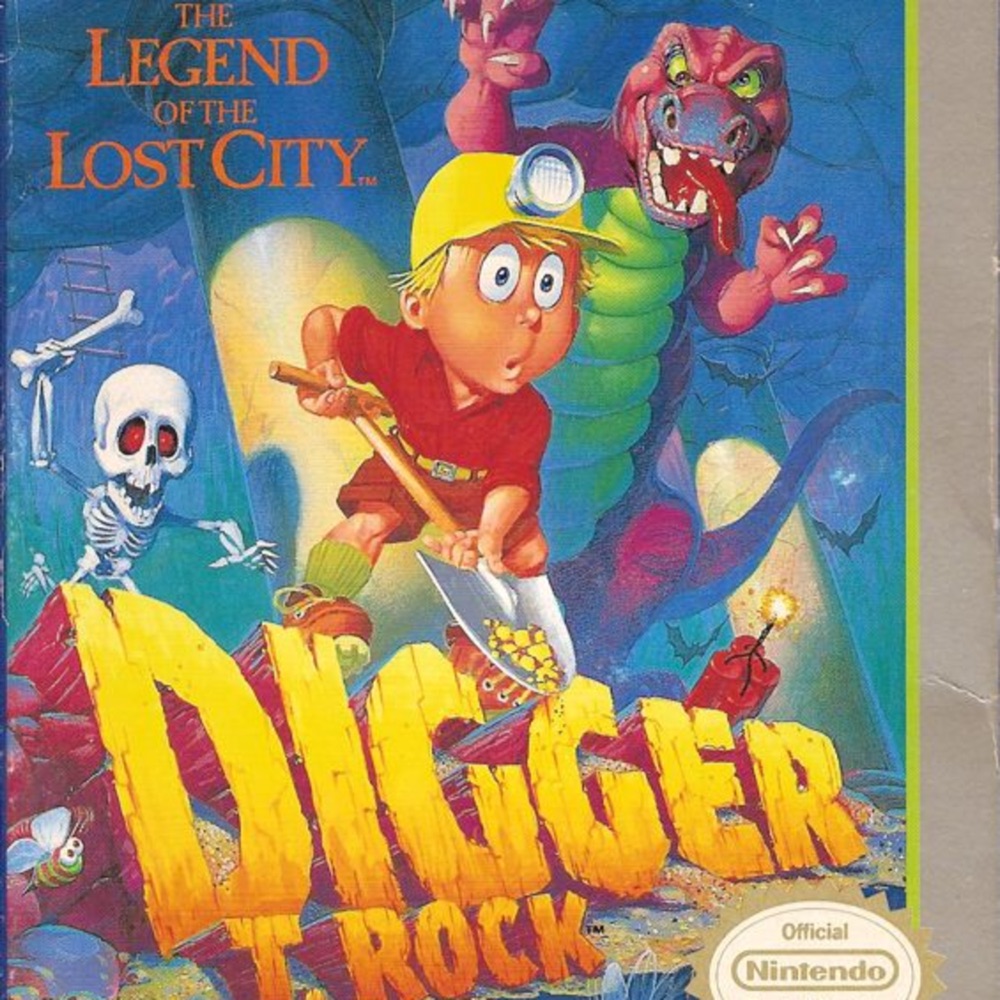
406 · Digger T. Rock
Digger T. Rock, a brave little miner who dares to dig where no shovel has gone before! He just loves to uncover underground wonders. And he dreams of discovering a buried city bursting with golden treasures and ancient relics. Support NEStalgia directly by becoming a member of our Patreon at https://www.patreon.com/Nestalgia Members at the $5 and above level get access to our brand new show NEStalgia Bytes. A look at the famicom games you can play without any Japanese knowledge! For More NEStalgia, visit www.NEStalgiacast.com
Digger T. Rock is a Rare game, and we spent the first few minutes on the name, the baby-faced hero and his garden-trowel shovel. You drop into a cave, find the pillar switch, then have 60 seconds to reach the exit door before it closes. Mike, Sean and Joe were on this one. It is pleasant and flawed, and nothing in it made us want to push it.
What it does
- Scout, then sprint. The clock only starts when you hit the switch, so you walk the level first, build a map in your head, and collect what you can before the run. That planning is the best part. It felt like a puzzle platformer with no exact puzzles, closer to a few fluid solutions than to Adventures of Lolo.
- Ladders and dynamite. You lay rope ladders, can chain two together, and fall to your death if you skip them. It felt like discovering the physics instead of following a script, and it reminded us of Spelunky.
- Digging that mostly isn't. Every action is some version of the shovel, but sand only matters when it drops a boulder. Once cleared, you walk through it as if it were still solid. Mosquitoes follow the paths you dig, so narrow, winding tunnels keep you safer.
- Charming characters. Digger and the enemies are clean, colorful little sprites, and the shimmy into a crawl space is smooth. Death is a puddle that leaves your clothes behind.
What wears us down
- A cave you can't read. Climbable walls, solid ones and hidden items all look the same, and some secrets are a single tile with no clue.
- The rocks choose for you. Throwing rocks and swinging the shovel share one button, and the game decides by distance. Stand far enough from an enemy and you waste a precious rock, and you can never deselect them.
- Extra work. The optional gems, ladders and dynamite turn out to be necessary later, so each level starts with a long look around. The shovel reaches about three pixels, so fights never went well.
- Too much game feel. A turnaround animation makes you press the button again before you move. The Mario-style slide suits big jumps, not this, and the later ice level adds little since you slide all game.
Beyond the game
The final boss is a dinosaur (or dragon, or in our ruling a platypus). You blow back the first ones with dynamite, but the last only gives way to a diamond, so running out of gems means you're done. The ending says "To be continued" while Digger falls and looks upset, with no friends anywhere in the cave, which we read as a sad kid story. Sean thinks it influenced Spelunky, though Spelunker from September 1987 already had the ghosts. It is on Rare Replay.
The bottom line
Skip it. We all voted no on the Essential Games List. The complaints were boring level starts, collecting that feels optional but isn't, and a game that is fine but forgettable. Joe had the most fun, calling it very flawed but very charming and close to a play it, though not essential.
Written from our conversation in this episode.
- Burrow through mysterious caverns, each one a "mine-boggling" maze of unknown dangers.
- Introduction
- What it is: A Rare-developed, Milton Bradley–published platformer about a caveman miner spelunking eight caverns to reach the Lost City. Single-player, tool-driven exploration with time-pressure exits. (Wikipedia, Manual PDF)
- Why it matters: Early Rare NES design that blends tile-digging, tool placement (ladders/bridges/bombs), and race-to-the-door timers—a different flavor from straight left-to-right platformers. Later resurfaced in Rare Replay. (Wikipedia, Rare Replay)
- “Update to The Pit”: Multiple retrospectives note Tim Stamper conceived Digger T. Rock as a modernized take on the early-’80s arcade game The Pit (digging, boulders, timed exits). (The dev-history notes are summarized on Wikipedia and point back to a Retro Gamer interview.)
- Release, Credits, & Context
- Release: North America (Dec 1990); Europe (1991). NES only. (Wikipedia)
- Developer/Publisher: Rare / Milton Bradley Company. Design by Tim & Chris Stamper; music by David Wise. (Wikipedia)
- Where it shows up later: Included in Rare Replay (Xbox One, 2015). (Wikipedia – Rare Replay)
- Discuss now: Rare’s late-NES output had range (from Battletoads to puzzle-platformers). Where does Digger T. Rock sit in that spectrum?
- Core Gameplay Loop
- Loop: Explore a cavern → Find the exit door and a pillar switch → Step on the pillar to open the door and start a countdown → Reach the door before it recloses. Eight caverns, three lives. (Wikipedia, SDA overview)
- Timers & exits
- You can’t “open the door and think.” Stepping on the pillar starts the countdown immediately. If you arrive after it shuts, you must go all the way back to the pillar and re-trigger. The game doesn’t freeze enemies or hazards during the sprint; everything still moves.
- Scouting first is mandatory. Efficient runs come from finding the door first, then the pillar, and planning the route (which ladders/bridges you’ll place) before you ever touch the pillar.
- Movement & digging: Walk, jump, and dig through certain tiles; digging changes routes and can cause hazards to drop. (StrategyWiki)
- Digging out certain tiles releases rocks above you. If you tunnel straight up or carve the support of a little “ceiling,” a rock drops instantly and can chain other drops. The safest rhythm is dig → half-step back → check above.
- Some vertical shafts are one-way. Once you drop, you can’t climb back without having pre-placed a ladder; this matters a lot during the exit timer.
- Between-stage interludes: Short bonus games to earn treasure; later, villages act as shops for tools using treasure as currency. (Wikipedia)
- Discuss now: Is the tension best when you’re planning paths before hitting the pillar—or when you improvise during the countdown?
- Level Structure & Win Conditions
- Caverns: Eight multi-route stages with vertical shafts, drop-through pipes, and one-way falls; each has one door and one pillar that unlocks it for a short timer. (Wikipedia, GameFAQs guide)
- Timer behavior: Stepping on the pillar starts the clock; if the door re-closes before you arrive, you must retrigger the pillar. (SDA overview)
- Scoring / treasure: Gems and bonus rooms feed your tool budget in later caverns (shops in caveman villages). (Wikipedia)
- Discuss now: Which creates the bigger “aha”: discovering a fast ladder line to the door, or a bomb shortcut through a wall?
- Tools, Items & Resource Use
- Core tools:
- Ladders – placeable to climb; limited stock.
- place on a single tile and are consumed even if you misplace one. You can’t reclaim it; a common newbie mistake is “ladder spam” that traps you beneath ceilings.
- Bridges/Stone slabs – span gaps or create safe footing.
- extend one tile at a time. You often need two to make a safe gap. Placing one on the wrong height wastes it and can block your jump arc.
- Bombs/Dynamite – open passages, clear enemies/rocks; unsafe up close.
- have knockback. If you bomb too close, the blast pops you backward into pits or falling rocks. Bombs also alter the tile map, so a careless blast can destroy the only safe foothold to a ledge.
- Armor/helm – reduce damage (rarer pickups).
- Shovel – default weapon/dig tool. You also collect rocks which are used depending based on distance to the enemy
(Tool set and usage described across manual and guides.) (Manual PDF, StrategyWiki)
- Ladders – placeable to climb; limited stock.
- Economy: Treasure → shops (later levels) → buy more tools to stabilize routes. (Wikipedia)
- Shops appear later. Early caverns rely on what you find; only from mid-game do villages let you convert treasure into a stack of ladders/bridges/bombs.
- Enemies & Environmental Hazards
- Creatures: Moles, mosquitoes, dragons, and other cave pests; all can be swatted with the shovel or avoided with placement tools. (Wikipedia)
- Cave-ins & falls: Digging can drop rocks; careless mining creates new hazards or blocks your own path. Fatal falls are common if you over-dig. He’s got the jumpman death where you can’t uncommit your death (Wikipedia)
- One-way slides & pipes: Some shafts commit you to lower areas; know the route before hitting the pillar. (GameFAQs guide)
- Discuss now: Do the enemies matter, or is self-inflicted danger (bad digs, missed placements) the true boss?
- Difficulty & Mastery (NES tips)
- Pre-plan routes: Find the door first, then the pillar, and mentally mark a ladder/bridge line back to the door before starting the timer. (SDA overview)
- Tool discipline: Don’t “ladder spam.” Many jumps are tuned to single-tile placements; over-placing traps you later. (StrategyWiki)
- Bomb safety: Place, step away, then dig; close detonations knock you into pits or cave-ins. (Manual PDF)
- DINOSAUR Boss ending. You blow up the first few with dynamite to get them to move back. The last one, you need to suddenly give a diamond too.
- After that CONGRATS YOU FOUND THE LOST CITY. What the hell is Digger T supposed to do now? Live down there? It was a perilous journey down, hes gotta do it all again? TO BE CONTINUED ending? Were they planning a mirror mode where you go in the other direction?
- Discuss now: What single habit moved you from “timed-door panic” to consistent clears—map-first scouting or tool rationing?
- Comparisons & Legacy
- Peers: Sits between puzzle-platformers (route planning, consumable tools) and arcade platformers (timers, enemy pressure).
- Rare lineage: Early example of Rare experimenting with mechanical mash-ups on NES. Included later in Rare Replay, preserving its original quirks. (Wikipedia, Rare Replay)
- Discuss now: If you pitched a modern indie remake, do you lean puzzle (longer timers, puzzles) or lean arcade (short timers, leaderboards)?
- Version Notes (NES specifics)
- Single-player only; three lives default; passwords not standard—designed for session play. (General NES spec per manual). (Manual PDF)
- Shops/villages appear only in later caverns; early stages rely on found tools. (Wikipedia)
- Fun Facts
- Title gag: The hero’s name is literally “Digger T. Rock”—on-brand for a digging/platform hybrid. (Wikipedia)
- Reception snapshot: Contemporary reviews were mixed—mechanics praised, presentation dinged. Cult following grew later via collectors and Rare Replay exposure.
- In June 2018, a youth soccer team and their assistant coach became trapped in the Tham Luang cave system in northern Thailand after heavy rains flooded the passages.
- The 12 boys, aged 11 to 16, and their 25-year-old coach had gone into the cave on 23 June after practice, not realizing the monsoon rain was coming.
- Rising water and strong currents cut them off from the entrance and left them with no contact with the outside world for more than a week.
- A huge international rescue effort formed, drawing in specialized divers, rescue workers, and officials from many countries as global attention focused on the cave.
- On 2 July, British divers John Vol-anthen and Rick Stanton finally reached the group, finding them alive on a small ledge about four kilometres from the cave mouth.
- Rescuers debated several options, including teaching the boys to dive out, drilling a new entrance, or waiting months for the floodwaters to recede.
- After days of pumping water and a short break in the rain, teams launched a high-risk operation between July 8-10th to guide each boy and the coach out through the flooded tunnels, and all of them were successfully rescued.
- The mission involved up to 10,000 people and enormous resources, but it also cost the lives of former Thai Navy SEAL Sah-mahn Koo-nahn, who died of asphyxiation on July 6th, and SEAL Beirut Pack-bara, who later died from a blood infection linked to the operation.
- YOU HAVE TO IMAGINE THAT’S WHAT HAPPENED IN THE SEARCH FOR DIGGER T ROCK AS WELL
- Time to see if Digger T Rock can excavate a place in the ESSENTIAL GAMES LIST.
- Digger T. Rock: Legend of the Lost Fun
Auto-generated transcript. Each paragraph starts with its timestamp. Speakers are not identified.
Digger T. Rock, Legend of the Lost City. Burrow through mysterious caverns, each one a mind-boggling maze of unknown dangers.
And welcome to NEStalgia, a chronological exploration of every NES game released in North America. I'm Mike. I'm Sean. And I'm Joe. And what we have here is a game that is going to have to have the title said more than once because it's also the kid's name, the main character's name in the game. Is that okay, Mike? Is something wrong? It's gonna be fine. Oh, okay. Yeah, yeah, yeah.
So Digger T. Rock, is the T like supposed to be... is the T like a play on something? Like, could there be a middle name where the T would mean something funny? It feels like the whole name is kind of like laid out to say that, but I don't really get it. It's like it's gonna be a pun in a different language. Yeah. But like, I'm like T-Rock. It's supposed to like, if you put it together, it's gonna say something, but like it doesn't. T-Rock. Or it's just Digger the Rock Johnson. Yeah, I mean, that's sort of what I was going for, yeah.
But of course he predates, or he's not, he hasn't been revealed yet, so we have... He's not born yet. No, he's born for sure. I mean, he's barely born though. I mean, like on the, on the, not the Rock, but the... Oh, yeah, yeah. We're talking about the Rock. Yeah, yeah. No, this character is barely born, because on the, on the cover he looks maybe like Elmer Fudd-ish, or on the, the title screen, but when you start the game, I didn't know it was gonna be like a newborn baby with a shovel. A baby? Yeah.
Yeah, and also, what's up with the size of the shovel he's using? I mean, it's cartoon-sized. Cartoon-sized, but no, it's like, also like, way too small of a weapon. Like, it has like, a few frames. You notice, but like, that's like a, that's like a dig up like flowers in the garden shovel. That's not like dig a hole in holes. Right, not like go in a cave and fight enemies.
Also, who goes, who uses a shovel when they go into a cave? Like, it... Well, you have to ask yourself, did he know that it was gonna be this big? Like, did he, did he have any idea what he was getting into? Because maybe he thought this was like a dig dug situation, and he was just kind of going like, digging through sand. Yeah. It seems like he just kind of fell into this giant cavern. I don't think he would be... I'm starting to question how realistic this game is overall.
There's no way that he would outfit himself with the helmet, with the light, if he didn't anticipate actual, like, spelunking and, like, bringing dynamite and explosives and stuff. No, he definitely knew he was going into a cave system. No. He did, because in the manual, it spells out that he also found a sign that pointed to the lost city with an arrow pointing down straight to the ground. And he's like, maybe I should start digging. Like, why would a sign be there? How could it be lost?
You are asking the real questions. Right. But this is a rare game, not in the sense of it doing anything interesting, just that it's developed by the company Rare. Rare. And as we mentioned, it's a caveman miner, who's also a miner, if that works for that player. He's a caveman? Yeah. Do we know he's a cave? I mean, he's in a cave. He's a man in a cave. But there are distinct cavemen later, and he doesn't look anything like them. The miner miner thing went over well, but the caveman joke didn't. Okay. No, I know. It wasn't... It was just the fact that you said the word.
Right, right. Didn't land. He's not a literal caveman like the ones you would see in caveman games that we played on the NES. This one just meant that he dwells in caves in this game, and so you will... You're helping him reach the lost city, question mark, if it's actually lost.
In terms of the gameplay loop, you are in stages of the cavern, and your goal is to find the exit door, you have to find the pillar switch for it, step on the pillar to open the door, and then you have a certain amount of time before the door closes. If you don't reach the door in time, it will close.
That's just the objective, but there are a lot of things that happen in this cave in addition. But just going over that core concept there, how does that hold up? It's definitely... You're correct. You didn't actually put any false information out into the airwaves describing that. That is an accurate description of the game. And yet, the game is maybe a little more tedious than that. It's not just like, find the door, find the switch. Okay. Yeah. So, the game, it's kind of like a maze where it's all just rocks, and climbable rocks, and
scoopable rocks that you can move out of the way to make a path with your shovel, trowel, whatever you want to call it. But there's teleporting rocks that, if you know anyone that's worked in mining, they'll tell you that every time they run into some teleportation rocks, it always ruins their day. Yeah. Or helps sometimes. Sometimes it helps, I would imagine. But yeah, I think the actual... The part of all these mechanics that actually sort of... It can... It's actually like standing on its own here, is sort of the whole like, get out of there as fast as you can. There's a time limit. You trigger the door, and open the door.
So, that's interesting. Yeah. And you find out pretty quickly... Well, I guess I found out pretty quickly, I think more from like reading about this online. But like, the beginning of the game, it's like, okay, this isn't so hard. Like, you find the switch, you find the door... You might even notice that you have a time limit. Yeah. Well, the time limit is only there once you open the door. Yeah. Right? So, you find the switch, okay, now you got 60 seconds to get to the door. Like, that's kind of cool, and it's not too hard. But I think I learned this more from reading online, that there's a lot to collect, and
you apparently really need to collect a lot of this stuff by the end of the game. So, really, you shouldn't just go straight for the door. Or you should collect your items, you know, which I'm sure we'll get into later, what each one does, and collect some currency so you can buy stuff later. Which of that, I think, adds to like a little bit of the exploration of like this cave digging
experience that you're having. Like, where you have to find things in the cave where it feels a little bit more like, okay, now I'm a cave explorer and not just looking for the exit. And it's not like Dig Dug, where everything is just, there's the surface, and then everything you dig into, and you kind of create these routes. The cave is a little strange in that there are very open areas, there are platforms, and then there's also these diggable areas where you kind of can, you can create different ways to reach the top or whatever, or you can just dig it all out. And you can climb over these things again. It becomes a little difficult to read sometimes, like what's climbable and what's not.
The rules of the game are clear, but it's just from a, from like an art perspective, it wasn't, it wasn't great for me. But you're doing all that, you're kind of like scouting out the level first. Like you have to do like one look through of everything. If you want to collect everything in this stage, you go do one look through of like where everything is. And then once you've built the map in your head, then it's like, it's time to press the pillar and, and go for the exit.
Yeah. Like the whole planning aspect of that, um, that makes you be a bit more thoughtful in how you're sort of navigating the space. I do agree that it is that, that everything kind of looks samey enough aside from like some of the enemies and rocks that are just going to be some different color to make it pop. Um, but in terms of climbable walls and the actual like boundaries of the game and like walls and floors and stuff, there is some like textural differences, but it's all the same color. So you kind of, you really do have to be on the lookout for a lot of things.
Yeah. And on top of that, there are parts of the texture that you can't dig through that does have hidden items or, or even times where you suddenly just for one little tile can dig through or, or, or walk through. So it's, it does suffer a little bit from that thing. We've had issues from, uh, about in the past where like, okay, there's a hidden thing that you just couldn't possibly see. There's no clue, no hint as to where it would be. It just like is hidden here.
And I think it might even be randomized where some of this stuff is hidden. So like, I guess once you know that you can kind of walk around and, and, and poke the ceiling with your shovel as much as, as much as you can, but that kind of gets tedious also. So like, it's, it's not the best designed way to hide secrets in a game.
And there are a lot of items that you'll need not only to beat the game. That is true, Joe, that, uh, you can't, can't just go to the end level empty handed and expect to win, but you also just need these things in general throughout, uh, your playthrough to get through these stages. There are, um, ladders, I guess they're like rope ladders that you like lay down or whatever from platforms. Uh, these are, these are all things you find. You don't have like in your inventory, but there are these ladders, uh, there's the, uh, stone slabs, there's dynamite.
Um, and, uh, there's the like rock, I guess they're like rocks. They act as your projectile. Yeah. You can just throw rocks. And that is the most confusing one of all the tools because it's the only one that you can't deliberately choose. The rocks are treated as your main, uh, attack when you have them in your, uh, in your possession and they're based on your proximity to the other enemy. So if you are far enough away from an enemy and you press the attack button, it will assume that you meant to throw one of your precious rocks away at it.
And use it. But if you're close enough, it will default to the shovel, but there's never an opportunity to deselect the rocks and say, I just want to use the shovel. Yeah. I found that pretty annoying. Um, it was funny the way that I discovered that it was like context sensitive like that. Um, because I just realized that I couldn't just select what I wanted to use, but I think that there, there are worse things to, that, that it could have done like that. This is much more like, I guess, user friendly than having to press select to change between those two things. When you're kind of, you're moving around, you, you, maybe you're, maybe you're trying to beat the timer. You got enemies in front of you. I guess I'm okay with that.
Yeah. Well, I was just going to say it's, um, I think if, if, if you're a perfect player, this is fine. This is a great way to do it. Like if like me, you will accidentally waste a bunch of rocks while playing. It does, it does get kind of annoying. And I think, yeah, if you had to hit select and go into a menu to switch to the rocks that would bother me or not bother me, but that would interrupt the action a little bit. Like maybe if it was just hit select once and it just shifts, it just toggles on and
off or whatever might be a little better, but yeah, I mean, there's no perfect way, just like so many things, there's no perfect way to do it with a controller that only has two buttons on it. But, but yeah, it was, it was definitely a pretty unique way that they went about it. Whereas like the ladders and the bombs dynamite, um, you know, they have like purposeful environment
interactions, but do they act really like puzzles? Like it's, it's not, it's not like a, oh, I got to place the ladder in a specific spot to solve this puzzle. It's more like I had to place the ladder here or else I'll fall to my depth.
It's funny that the way that I was looking at this game, it reminds me so much of Spelunky, which was, you know, uh, most people that were into indie games circuit 10, 15 years ago or whatever, uh, have probably played Spelunky and it kind of has a similar, uh,
like vibe and a similar, uh, even like just the items that you'd use, uh, where I think these levels are a bit more handcrafted, obviously, because I think it's Spelunky, it's all like procedural generation, but there's just going to be points where you need to use a ladder just so that you can get further down. And I, I think that that was a pretty, it felt like you were making your own way down the cavern. Uh, maybe you weren't, and maybe this is the only way to actually get through it correctly, but it at least felt that way.
So I kind of liked it. It's just that if you don't place the ladder there and you fall to the ground, uh, depending on the height, you'll fall to your death. But there's also, there's also just like the, it has like, there's multiple places that you could put the ladder, you know? Yeah. But it also has like that jump man from Donkey Kong mechanic where like, once you fall, you can't like out, you can't maneuver your fall. You're just falling. And then that's it. You have to wait to find out the punishment.
Um, but yeah, I get what you're saying, Sean, with the ladder. Like it feels a little more, even if it's not, it feels a little more like free form the way that you place the ladders and where you place them. And even the fact that you can like connect two ladders to each other, like a longer ladder. Like it just feels like, Oh, like I, I discovered this, this, uh, quirk in the, the physics and game mechanics of this game rather than this was what was intended for me to do, which I'm sure it was intended, but it feels more like, uh, I'm, I'm discovering it. And so the digging aspect is mostly to like dislodge boulders or, you know, uh, find new
passageways. Could they have done more with a game that's mostly about digging with a main character whose name is digger? Should it have been like, should there have been a larger focus on digging? I don't know. I thought that like they did it like, you know, I'm thinking of like dig duck or dig duck where it's like one, it's all about digging, but it's just, there's like one version of the mechanic for digging if I'm remembering dig duck correctly.
But like this has like a few different ways that like, it feels like that's this guy's main mechanic where like, yeah, you can dig through the, like, I don't know, I guess it's like the, the, the sandy texture of dirt and like, and like open up new pathways. You can, there's also the like kind of brickish texture where you can, it, I guess it reads to me like digging, but like you, you can walk on all, on all like the whole vertical plane. Like, you know, you can, you can walk up and down if this, if this is your background, which kind of gave me the vibe of like, oh, you're kind of swimming through loose dirt sort of feel, you know, where you can move up and down. Oh, that's not how I read it.
Yeah. I read it as like, oh, like I'm digging through this. I just don't need my shovel right now. You know, like this is me like tunneling or burrowing, you know, kind of. And then, and then there's also the rocks where you can, you can dig to dislodge the rocks or you can dig to discover secrets in there. It was like everything. And then even attacking the enemies, you're using your shovel.
Like it's like every action you can do is some variation of digging, but they're different. So I felt like, I don't know. It felt to me like a very fully baked quirk or fully baked gimmick where it wasn't just like a one move. It was like this whole moveset based around digging. I think like it's more so just like cave exploration. Maybe if they called it like Nick Cave and the Bad Seeds or something like that, it would be a lot more descriptive.
Because other than that, it's just like, as most of the sand that we've been describing, the kind of stuff that reminds us most of Dig Dug is it exists for one thing. And that is the few rocks, like the few boulders that it can dislodge. Otherwise, it's completely superfluous. You move through at the same rate as you move generally.
And it really just sort of maps your progress otherwise. It doesn't really feel otherwise that you're, that you're really doing much digging. You're right. But I do, there is one more thing that I, maybe it just happened to me more often that like, I had to, I noticed myself being careful at how much of that sand I dislodged because there were, you know, enemies, especially those mosquitoes will follow you based on the paths you create. That's true. So I was trying to create like as small and narrow and windy pathways as possible and keep myself separated from them as I'm going through. But like, yeah, it's not like a huge extra thing, but it was like another layer that that mechanic added to the game.
That's true, Joe. But a different game would have made those sand things that you are digging out. They would have made those pits more like platforms that like you can, once you dig them, you can't go back through them. You know, it's like you're creating, you're creating new ways to reach these areas. It's a little strange that like after you dig, you can still reach every area that you previously dug out, you know, as if it, as if it was a platform.
Um, could you just reword that? I'm not sure I'm following exactly what you mean. So like, um, try, there isn't, there isn't a lot of aside again, aside from the boulders, there, there's no real effect on the game that the sand. Once you clear it out, you can still stand on that same platform where it was as if like, there's now like you're as if it was load bearing. Yes. Then it would like, and maybe other stuff fell and maybe it would block your path. This game doesn't have enough. I feel like redundant paths to make that feasible. And it's more so a maze with context.
Um, that I don't think that would actually work, but it makes it feel less like digging. Yeah. Cause a game like steam world dig will have it where, you know, once you've dug out that area, like you will fall through that. You can't climb back up the same way that you just dug out. Now you have to make new platforms. You have to basically build your own platforming stations to climb back up rather than just crawl, like rock climb the wall.
Yeah. I guess that. Yeah. I see what you mean. Cause he is more of like, I, yeah, I was taking it again. Like he's burrowing this whole time, but yeah, I don't know how my burrowing analogy with the brick texture, how that actually fits with the heat. But then what are you digging out with the other texture? If you're then burrowing through something anyways. So, uh, yeah, I see what you're saying.
I see what you're saying.
The game kind of sits between puzzle platformer and arcade platformers. You know, there's the arcade timers and enemy pressure, but then the puzzle of like planning out your route before you commit to it. But if you had to push it one way or the other, which way would you have leaned the game more? Would you prefer it as a puzzle platformer or would you prefer it to be more arcadey, quick bursts of gameplay?
Well, I think this is more of a puzzle platformer than arcade platformer. I think even just what you might consider the more arcadey moments of the game, the whole like get to the exit quickly is still a puzzle in itself. Because, you know, you're sort of mapping out your route back and it's really just about execution. And the combat isn't really that complex to say that this is an action game. So, I think this is a puzzle platformer through and through. And I think there's a version of puzzle platformer cave dig stuff that is good than any action version that I can think of. So, to answer your question, they're like, yeah, I prefer the puzzle, the puzzliness of it. Yeah, I do too.
It's like puzzly. It's like one of those games where it's like there's it's like a puzzle game without like an without exact distinct puzzles. You know what I mean? The whole thing feels like you have to be a little cerebral about it. But like it never feels like, oh, my God, I finally solved that. But, you know, it's not the adventures of Lolo where like, oh, I got to figure out the solution to this part. It feels like there's like a few solutions and it's a little more fluid.
And I enjoy that about it. I think that makes it feel like kind of relaxed experience. But, yeah, I would I would also say it feels more puzzly than it feels like an arcade game. It seems like an arcade game, but it does feel like it's not like, you know, yeah, like a Donkey Kong or something like that where it's just like constant action. Yeah. So I guess like the question being if you could push it in one way, like I do agree this definitely feels like a puzzle platformer.
The arcade version of this would be like more more caves, but much shorter stages where you can probably see the whole stage in one screen or whatever. And you have to just trigger the pillar at the start and figure out how to get to the exit as quick as possible, like 60 seconds or something. And then you're still having these collectible power ups of the ladder or whatever that you use. But you have to collect them within the stage and then place them appropriately. So it's more like twitch reflexes than the current game we have. I would want to push it more towards puzzle, like personally, because it just feels like these mechanics are like ripe for some really cool puzzles.
It sounds like, Mike, you want this to be more like that pizza game, that indie pizza game. Do you know? I'm trying to remember. There's not too many indie pizza games, but I pizza tower or come on. You got help me out here. Pizza tower. Indie pizza game.
Yeah, pizza tower. Looks pretty good, yeah. It sounds like you want an immediate, like, it's all about just escaping a place fast. This doesn't have, this game, I've just basically seen like video of this game. I've never played it myself. But I think the whole concept of it is getting to a place and then very quickly getting out of it in a much more action packed way. It sounds like you want that game. Damn. It's not that I want that game. I guess I was just saying if you had, if you had both, I would have preferred to push it to the arcade. I don't like how drawn out and open these levels are. It doesn't quite feel like I'm exploring anything because a lot of it isn't digging.
And then a lot of the like, okay, look at everything to then just go back to the beginning to start the actual level. Isn't that fun? Yeah, I think a lot of like, a lot of the levels are optional. Like a lot of it's like, oh yeah, this is great because I got some more dynamite. I got some other rope ladder. I got more gems. But it's like, if you actually just do the level, just find the lever and find the exit. These levels are really short. Like a lot of the cool stuff is just like, if you're doing the extracurricular. Which turns out to be necessary anyways, but. I ran into enough like things that killed me that it wasn't too short for me.
I don't particularly like the mosquitoes. They killed me. They themselves didn't kill me, but they got me into a position to be killed. Well, your shovel can only attack like three pixels in front of you. So that's not helping. And then there's enough of a delay between your swing and when enemies can attack. That it doesn't really help ever. So yeah, I died enough times that I never really felt like, oh, this is quick.
Yeah. Well, I mean, the enemies only get harder too. You have the cavemen later on who have like those, the red sticks that they hit you with. You have dinosaurs. Yeah. Dinosaurs. You can bribe the dinosaurs. The dinosaurs are the whole ending of the game. It's just like, they're the boss at the end. Who would have thought dinosaurs were guarding the lost city? That's where they went. Right. That's where they wound up. Isn't this the Godzilla plot line? Yes. The creepypasta. You have to. No.
You have to blow up. You have to blow up the first few dinosaurs in this final level to get them to move back. A mechanic that is like. Did I not know? Sorry. I just need to like clarify. I put a gem in front of them and then jumped past them and did not get hit. Was I just lucky and I wasn't supposed to do that? So I know the gem is how you're supposed to get past the last one. Yes. I only know that because I watched a video of it. I didn't get to the last one. Oh. But the dynamite was how, at least how I got past one of them before that. Or like just pushed him back a little bit. Right. Did the dynamite make way this will work?
The dynamite makes sense because it's an explosive and like I get like you can never kill them. But like they're guarding the path forward. So you use the dynamite. They blow back and then you jump over them and you're in the next part. The last one of these dinosaurs, the one that guards the end of the game, the dynamite won't work on it. It's very strange. But you have to use the diamond. So it's good to confirm that at least the diamond works elsewhere, too.
But it's kind of funny to think that like if you didn't have enough diamonds and you and you only have the dynamite left, you're out of the game. Wow. That is that is really weird. But also the diamond thing makes me wonder, are these dinosaurs or are they dragons? Because dragons are like notoriously known for wanting treasure. I see dragons in this game and I see dinosaurs.
And I don't think there's definitely T-Rex adjacent designs in here. The arms are too short. All from the same genus and class and everything. Yeah. We all know about the genus and the class and the order. Yeah. Everyone that's seventh grade stuff. But they do have like really small arms.
Dinosaurs, notorious like T-Rex, short arms. I don't know about dragons. Do dragons or dragons notorious for the little arms, too? Well, is it a wyvern or is it a worm? It doesn't have any wings at all. All right. So then it's a platypus. The final boss of the game is a platypus.
Confirmed here. That's exactly it. Okay. And then as soon as you get to the end, it's just congrats. You found the lost city. Now, what the hell is Digger T supposed to do now? Live down there? He's down there. Well, there's water. But it was like a fountain. It was a perilous journey down. Yeah. He's got to like go do it all again in reverse. There's a to be continued sign at the end of the game. Were they planning on like a mirror mode where you now go in the other direction for the sequel? The weird thing about the to be continued sign is like he's jumping up and down. He's all excited. He's happy. Then he falls down and like gets upset. Like the look on his face is upset. And then it says to be continued. Like did the fall?
Was that supposed to like signify something or like give us a cliffhanger? He got a CT. Made him fall. He got a concussion. Like why did he fall and why is he all upset? And what's he looking at? I am actually kind of. Now I'm realizing I'm kind of sucked in by this cliffhanger. Here's why I'd be upset.
I've made my way down to this ancient city. There is water. Yes. But I don't see food anywhere. I don't see other people. I know that I'm probably going to die in the next couple of weeks down here. So maybe the to be continued is like you kind of play a game about him starving to death over the course of however many days or weeks. You have to dig your own grave. Yeah. That's probably part of it. Yeah. So that's how I see it. Oh. Speaking of like graves and deaths. I don't want to gloss over the disturbing death animation in this. Oh where you just sort of melt? Yeah. You like melt into like a thin puddle of yourself. But like your clothes are still there. Yeah. Like very weird.
I'm a fan. I think just to move more just into the animations in general. I would say that this game may be over animated. And my only reason why is I don't know how many games we've played recently.
Maybe maybe like three four years ago in the timeline this might have been more of like a thing that we're just like oh well they didn't realize how bad that felt yet. But does it need a turnaround animation that you then need to press the button again to start moving forward again? Do we need that? Yes. Wasn't a fan. Yeah. No. It is a little like it's like too many frames that you know that are not like going fast enough. You can tell I'm technically savvy. Yeah. I do like the animation of sort of shimmying into a crawl space because that's very smooth and the game just kind of knows when you want to do that. But yeah. Don't think it needed the turnaround animation.
All of the characters including Digger like are pretty well designed and have clear clean reads and animations and everything. It's just kind of like the world around them. Granted it's in a cave like I think it's supposed to read this way but it's just all kind of like blah otherwise. Like the enemies and you are like the colorful part of the game. Yeah.
And the way that you move too is it almost kind of reminds me of Mario where you've got a little bit of slidiness to you. There's a little weight. There's a little momentum. Which we always praise about Mario but I don't know if it's what was needed here.
Because like you're digging. You're kind of like taking it a little slower than Mario. You're not doing these big giant platform jumps where you get running starts and you know jumping on enemies or anything like that. Like I feel like you want to feel a little more like in control here. And there's an ice level later that lets you slide and like that's an interesting like shake up. But like we've already been kind of sliding throughout this whole game. So it feels like a little I don't know. It just feels like unnecessary levels of physics there.
Yeah. I want to say that the physics and just the game feel, the controls are well designed but is it well designed for this game specifically? Right. Maybe not. It does. They are smooth though. It just doesn't actually, doesn't actually mesh. In June 2018, a youth soccer team and their assistant coach became trapped in the Tam Luang cave system in northern Thailand after heavy rains flooded the passages. The 12 boys aged 11 to 16 and their 25 year old coach had gone into the cave on June 23rd after practice, not realizing that the monsoon rain was coming.
Rising water and strong currents cut them off from the entrance and left them with no contact with the outside world for more than a week. A huge international rescue effort formed, drawing in specialized divers, rescue workers, and officials from many countries as global attention focused on the cave. And Elon Musk.
And Elon Musk. And all of them were successfully rescued. The mission involved up to 10,000 people and enormous resources, but it also cost the lives of two Thai Navy SEALs. Hmm. You have to imagine that's what happened in the search for little Digger T Rock as well in this universe. I was wondering where that was going. I thought this was the sequels and spinoff section.
Right? They just, the Thailand cave thing all over again, but in this universe with Digger T Rock. I don't think anyone's looking for this kid. I think that really the reason that he does this to himself is because there's no one that would look for him.
Yeah, that's why he goes down there. Exactly. Like, you don't, there are no side characters. There's no, the only people that you meet want to kill you. I think that this kid has a lot that he's not, like, he's probably pretty sad all the time. Yeah, there's a lot to read between the lines in this. This is, like, a very well-written story. Yeah. It doesn't just, like, spoon-feed it to you either. You really have to, like, you really have to see, like, you make your own interpretations off of it. Yes. So, like, I think the story is one of the better stories we've had on the NES. All right. Well, then I guess it's just time to see if Digger T Rock can excavate a place on the Essential Games list.
I did not have a great time with this game. I think my biggest problem was just how, not tedious, but how boring everything felt to get started in each level and, like, the necessary collecting of what feels like optional items in order to complete both these stages and later stages.
It just didn't feel as cleverly designed as some other rare games that we're used to. And so I'm going to put it as a no. I don't dismiss that somebody could have fun with it. I'm not saying it's a badly designed game. It's just not something I had fun with. Sean? Yeah, I wasn't huge on it. I do think this had to have been a pretty big influence on Spelunky, though.
Just with, like, there's even ghosts that float around in a similar way. And, like, Spelunky feels a lot more, feels much better and is a lot more fun. But there's just so many borrowed, like, aspects that... So that means nothing to do with this game. This game is fine. It's pretty fine. It looks and feels fun. Your mileage may vary on how fun it actually is to play in terms of, like, that whole, like, execution thing.
But, yeah, it's otherwise pretty forgettable and not essential. Joe? I think I did have a little more fun with this. I think it's a very flawed but very charming game. I think that's where I've landed on it. Like, I thought that... I was enjoying the different mechanics. I was enjoying the movement. And even, like, the design. I know that the cave itself is kind of lackluster. But the enemies and you yourself are, like, pretty charming little chibi characters and stuff.
And I think it's maybe teeters on the edge of a play it for me. But also definitely not essential. Nothing to write home about. I think it's just another situation of, like, you know, we start one of these each week. I'm more often than not, we play a game that, like, eh, it's not very good. So, like, when there is one like this, I'm like, oh, yeah, I enjoyed this. You know, it's just not some, like, crazy essential game to me. So, definitely not.
Sean, you're forgiven for not remembering. But we did play a game on this podcast called Spelunker back in September of 1987. And I feel like that was probably the major influence on Spelunky. Because it also has those ghosts that you're talking about. But it has a lot more of the elements as well. Well, all right. All right. I retract everything that I ever said. And this game is essential. I can't get. No, I was trying to give you less points towards Digger T. You were helping it give a great franchise its birth. And I was like, hey, don't be so quick.
Rare did put this on their Rare Replay collection, though. Well, they'll put anything on Rare Replay. Rare Replay. It's probably true. Just like how we'll put every NES game on this podcast, whether they deserve an episode or not. Rare Replay.
Rare Replay.
night night night.! Thank you.