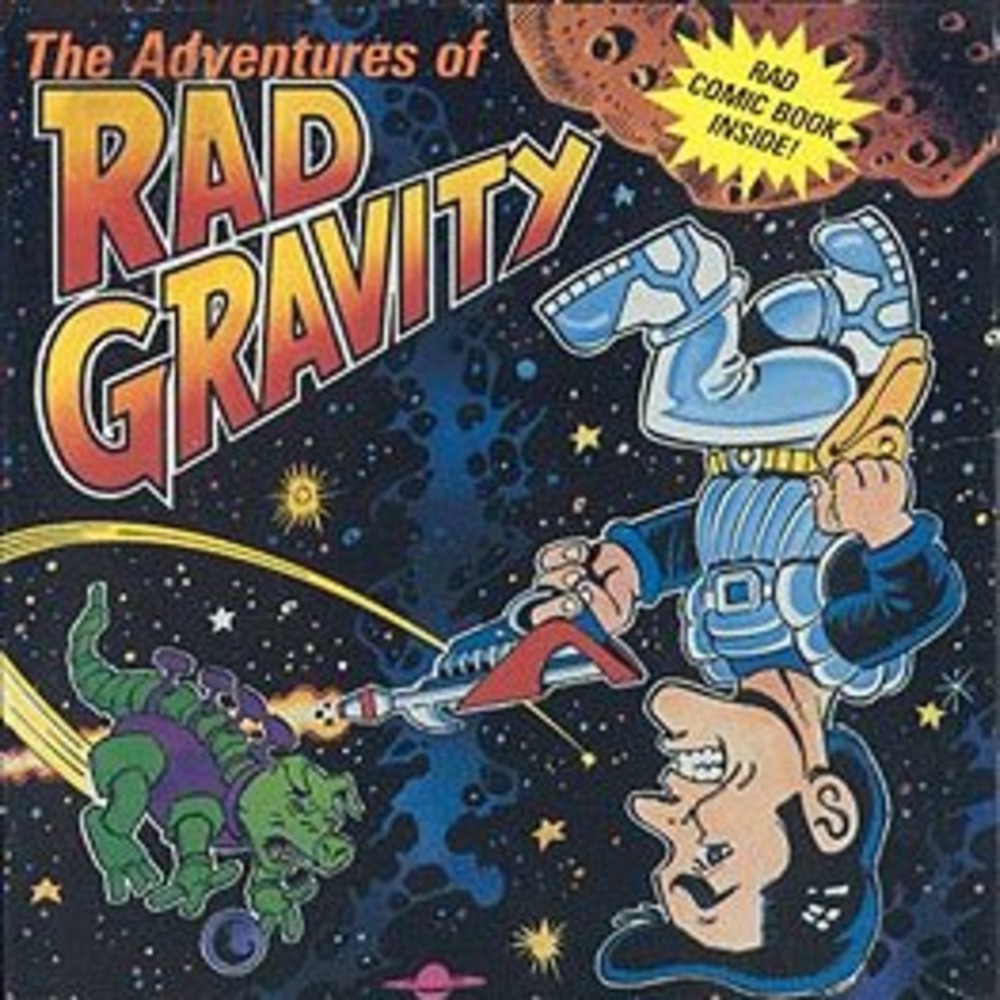
403 · The Adventures of Rad Gravity
In this game you are Rad Gravity, a futuristic heroic spaceman. A mad scientist disrupts the peaceful universe and it is your job to visit various planets to re-establish contact between all the worlds. Sights vary between verdant planets, lava pits and hazardous jumps, with gravity variations and craters. For more episodes like this become a member of our Patreon at https://www.patreon.com/Nestalgia Members at the $5 and above level get access to our brand new show NEStalgia Bytes. For More NEStalgia, visit www.NEStalgiacast.com
Mike and Sean played this one, and it is the first game from Sean's birth month: it came out in December 1990, so Sean is now born. It opens with the most unhinged music we've heard on an NES game, less a song than a glitchy cartridge. The game barely uses gravity.
What's interesting
- Big ideas from the West. Rad Gravity and his computer buddy Kakos hop planets from a hub ship, reactivating the galaxy's "compu minds," which are living beings merged with robots. The designer is the same one behind Wasteland, which explains why it ignores NES norms: sub-objectives, pop-up text boxes, story moments mid-play.
- Planets that change the game. A jungle, an underground maze, a cloud city, a trash planet. One planet is drawn upside down, and one stretch is open space where you push yourself along by firing your weapon the other way. We liked the space one more than flipping the whole screen.
- Friendly fire. Enemies shoot each other. Duck as a projectile comes at you and it hits the robot behind you, and the giant five-hit robots can die this way. It was the most welcome surprise in a glitchy game.
- Set pieces. A big green blob that turns out to be a stomping dinosaur is the kind of idea that shows up from nowhere.
What doesn't
- Enemies respawn forever. That kills the friendly fire payoff, and it hurts in the narrow corridors near a compu mind.
- Can't read what's solid. Blocks look alike, walls act like platforms, and one tunnel is half the size of the sprite. We got stuck and wondered about soft locks.
- A janky jump. It would have gone in Sam's jank folder, and the wind in the cloud city stacks on top.
- The loop. Land far from the compu mind, wander a big maze, grab the coordinates, repeat. Planet order doesn't matter beyond the first and the last, so there's no Metroid-style unlocking.
- One music track. It's less awful than the title screen but it's the only one, and we reached for mute quickly.
- That head. The close-up portraits on the ship screens give him a head the size of his body. We called it unnerving and just wrong.
Beyond the game
The manual has a 13-page comic that is arguably the best part, and it quietly slips in the trick for the open-space stage. The game never came to Japan, and it felt to us like an Atari 800 or Commodore 64 game that landed on the NES.
The bottom line
Skip it. We both voted it off the Essential Games List. Mike found it competent but offering nothing new. Sean liked it more, since every level has a different idea, but said it isn't well executed. If you're curious about a game that ignores every NES design rule, give it a try.
Written from our conversation in this episode.
- Introduction
- What it is: A sci‑fi platform‑adventure game where space hero Rad Gravity and the lone active Compumind (Kakos) try to re-activate the galaxy’s other Compuminds. Developed by Interplay and published by Activision on NES. (Manual, Wikipedia)
- Why it matters: A Western‑made NES oddball with big ideas—planet hopping, an infamous reverse‑gravity world (Turvia), and a hub ship for free routing as you find coordinates. (Wikipedia, Take On The NES Library)
- “This doesn’t look like an NES game” (Art & Presentation)
- Western palette & shapes: Big, chunky sprites; loud neons on Cyberia; grime greens on Effluvia—reads more like Western computer art than Famicom house styles. (Take On The NES Library)
- Discuss now: Use this opener to kick off a quick riff on Western‑developed NES titles that felt tonally different—e.g., A Boy and His Blob, Maniac Mansion.
- What kind of media (movies/TV) is similar to Rad Gravity
- Saturday-morning space opera: Scrappy hero + chatty computer buddy feels like Flash Gordon and Galaxy Rangers
- Comic Book Manual Story
- Premise: In the far future, galactic civilization ran on AI brains called Compuminds. Agathos, once a human, now a giant brain, rules over the galaxy. He turned the AI brains offline; only Kakos remains to guide Rad to re-activate the rest.
- Release, Credits, & Context
- Release: US Dec 1990; EU/AU 1991 (Mattel in AU). (Take On The NES Library)
- Developer/Publisher: Interplay Productions / Activision. (Wikipedia)
- Key creative / OST: Credits include Brian Fargo (design/program), Bruce Schlickbernd (art), and composers David Warhol & George Sanger. (Wikipedia)
- Banter weave‑in: Cue a chiptune craft sidebar—play 15–20 seconds and compare Western NES sound to Capcom/Konami schools. Does Warhol/Sanger read “space opera” or “Saturday‑morning sci‑fi”? (Credits on Wikipedia)
- Structure
- Loop: Pick a world from the ship monitor, grab codes/parts, reactivate that world’s Compumind, beam out, unlock the next coordinates. (Manual)
- Agency: You can discover multiple coordinates and route your own order (within reason) before the Telos finale. (Take On The NES Library)
- Kit growth: Start with short-range saber, then blaster, crystal bombs, armor—small expansions that change how you tackle chokepoints. (GameFAQs – FAQs)
- Discuss now: Is this closer to Metroid’s authored route or The Guardian Legend’s hub freedom? Where’s the sweet spot? (Refs: Metroid manual, Guardian Legend)
- Planet‑by‑Planet Flavor (set pieces, quick tips, and built‑in segment ideas)
- Planet identity via tilesets: Every world re-skins the rules with bold, readable motifs (cloud catwalks on Vernia, lava ledges on Volcania). (VGMaps – NES)
- Cyberia — Neon corridors, turret lines, beginner secrets. (Manual, GameFAQs)
- Effluvia — Toxic trash world; falling‑junk cadence; use vertical shafts to funnel enemies. (Take On The NES Library)
- Banter tie‑in: “Trash‑punk 1990” — pollution chic across late‑’80s media and how NES palettes sell “gross” with a few tiles.
- Turvia — Entire planet drawn upside‑down; gravity reversed. Inputs are normal but collision is mirrored—practice “ceiling” ledge checks. (Wikipedia)
- Segment idea: Inverted Level Hall of Fame — compare to Strider’s ceiling boots and Mega Man 5 – Gravity Man’s flip where art stays upright. Which is kinder, and why? (Refs: Strider, Mega Man 5)
- Sauria — Jungle with aggressive hatchlings; bombs trivialize nests. (Take On The NES Library)
- Vernia — Cloud city; wind‑feel scroll and thin catwalks—tap jumps. (VGMaps, Take On The NES Library)
- Segment idea: Wind levels we love/hate — bring in Ninja Gaiden II’s gust rooms for readability talk. (Ref: Ninja Gaiden II)
- Asteroid Belt — Derelict ship interlude; pockets of low‑ceiling platforming. (VGMaps)
- Odar — Underground maze; mark ladders mentally—lots of loopbacks. (Take On The NES Library)
- Segment idea: Mapping on paper — compare to Metroid notebook maps from childhood. (Ref: Metroid manual)
- Utopia — Two‑sided planet (surface/underside) with factory below; dead‑ends teach route logic. (Take On The NES Library)
- Volcania — Lava timing + projectile spam; learn safe ledge stutter‑steps. (VGMaps, Take On The NES Library)
- Banter tie‑in: Risk budget talk—compare to lava/attrition set‑pieces in other NES action (e.g., Castlevania’s clock‑tower‑style stress math).
- Telos — Final planet; Agathos showdown after Compuminds are online. (General plot: Wikipedia)
- Passwords & Progression
- Passwords: Necessary. Whole game only has 1 life (GameFAQs passwords)
- Soft order suggestion: Cyberia / Effluvia → Sauria / Turvia → Vernia / Odar → Utopia / Volcania → Telos. (Routing notes: Take On The NES Library, GameFAQs)
- Difficulty & Mastery
- Friendly Fire - Enemies can kill each other
- Is there enough gravity manipulation to warrant the title?
- Short answer: Mostly no—except Turvia.
- Is there enough Radness to warrant the title?
- Name & era tone: “Rad” is pure 1990 energy—quippy manual blurbs, neon cityscapes, and a hero with a saber
- In practice: The attitude reads more goofy pulp
- Segment angle: Define “radness” with a checklist (stunt, style, soundtrack sting). Does Rad hit 2/3?
- “The music is terrible”
- Fun Facts & Trivia
- No Japan release: NES‑exclusive in the West (later EU/AU distribution). (Take On The NES Library)
- Composer duo: David Warhol & George Sanger share credit—title track has a cult following. (Wikipedia)
- Strider vibes: Press often compared Rad’s sword + upside‑down stage to Strider’s ceiling walk. (Wikipedia – Strider)
- We’ve orbited every oddball planet. Do we land this one on the ESSENTIAL GAMES LIST?
- The misadventures of Sad Gravity
Auto-generated transcript. Each paragraph starts with its timestamp. Speakers are not identified.
The Adventures of Rad Gravity get upside down in the greatest space adventure ever!
And welcome to NEStalgia, a chronological exploration of every NES game released in North America. I'm Mike. And I'm Sean.
Sean, Adventures of Rad Gravity starts off with probably the most unhinged music I've ever heard on an NES game. But before we get into that, I'm seeing on my notes that you have a note. I do. I just thought it was important to note, just to put into perspective, just the time difference. When we're recording this and when these games came out, as of the release of this game in December of 1990, I am now born.
Hey! Which I think is, you know, it's worth noting because, you know, we've done 400 and something episodes. And for all those games, I hadn't been born yet. So that's fun. Right? I'm still chilling in the womb. Yeah, you are still chilling, aren't you? Yeah. But let me ask you, don't count this like an essential games list vote, but like these December 1990 games are like your birth month games. Are you pleased with the results? Like looking at the list? I guess I haven't looked too deep into it. Yeah. But I guess it's going to be sort of like, this is like a, like an astrology thing. Like what was your birth game? Right. You always struck me as a digger T-Rock guy. Whoa, whoa, whoa. Whoa, you're not supposed to say that on the air.
I guess I've never tried it out. Well, so we'll see. Yeah. And as for the adventure of red gravity, it's a sci fi platform adventure game where our space here who his name is actually red gravity. He's not just like on a gravity odyssey. He is, he's, I mean, like, I guess I do the story here a little bit, but he's, he's got one of these like AI computer things that's like left or compu minds, they call them in the game. And I, again, I'm just going to butcher this name here, but it's Kakos, K-A-K-O-S. Did you get that read?
Kakos sounds about right. Yeah. I like Kakos better. It's like he's Greek. Yes. Um, so Kakos and red gravity have to reactivate the galaxy's other compu minds, uh, or just AI robots, right? So this is like the reverse of the usual like sci fi story where like AI bad and, uh, we have to turn them off. I was gathering from like how they describe the deep lore of this game is that these are sort of like actual living beings that are also kind of mind melded into robots. And we just sort of take advantage of them to be like, like, like walkie talkies. Um, so it's very, it's very exploitative. Um, it's very strange, but, uh, yeah. So chat GPT. Oh yeah. Yeah. I mean, but like if, if chat GPT was also half made of meat. Right. Got it.
Uh, there's, there's quite a bit of lore here too. Not even just in the game, but there is a like several, I mean, we saw this in silver surfer too, but there are like 13 pages of a comic book story.
Like that's basically the best part of the manual is like this comic book story. But I think what's funny is like, and when you do it as a comic book, it's your chance to like have a different art style than the game. And they totally went there. Yeah, the unhinged shit. Right. They totally went there with like some of this stuff. And then rad gravity looks exactly the same as he does in the game. Like they needed to make it clear. Like, yeah, that's the guy from the video game you're playing. Like everything else doesn't look like that, but he looks, you know, like one, one with his sprite.
I think that part of the, like, just how, you know, we talked about the music, the crazy, the crazy music. Well, I want to talk about the music for even a second longer because it's crazy. Sure. It's crazy, but I think it needs to be understood that like, it's not even that it's like, oh, it's just a song I don't like or something. Or like, it's like, they're not even using the right sounds. Like it sounds, it sounds like something is broken. It sounds like, is the, is the TV working guys? Like, is the cartridge like a little glitchy? It doesn't sound like it's composed. It's if I slammed my hand on the keyboard over and over.
It's pretty, it's pretty intense. Yeah. But that's also sort of, you know, you're mixing that with the, the, the closeup version. Like you, Rad Gravity doesn't just have like the sprites that you play the, like the normal game in. There's also like the high fidelity version that you see when he's in his ship and it's actually unnerving. Uh, the, the weird like profile view that you get of him with the giant chin. And it, like it, it's kind of how I, I, this sounds weird, but it's how, how, how I used to draw.
I felt very strange. The problem with Rad Gravity as a, as an individual, uh, or as a character, as a character design here is that they drew, uh, the body and the body, uh, makes sense to me. Uh, it's all like rightly proportioned. And then they drew the head the same size as the rest of his body and placed it on top of that. And so he, I get it. Like he's supposed to be this, like, you know, uh, Flash Gordon, uh, you know, Saturday morning space opera. It was giving me Thunderbirds vibes. Okay.
Thunderbirds too. But like, you know, some kind of like Saturday morning cartoon, but like from like a different time period, you know, not from the nineties, from the fifties. And, uh, and I get that, but it's, it's, you said unnerving. I agree with that, but it also just feels wrong. It feels like he has too much head.
Very much is too much head. I think that's where the unnerving characteristics came from. In the, uh, in the, in the comic book manual, we also learned that, um, there was a, a guy named Agathos who was once a human, now a giant brain. And he rules over the galaxy. He turned all those other compu mines off except for Keiko's. And that's where like the game picks up is like all that shit's already happened. And now it's your job to go to these planets, find these compu mines, turn them back on and take down Agathos. And it's like, geez, that's a lot. How are we going to do it? Yeah. And, but before we get into the gameplay and the loop and everything, I wanted to talk about beyond the character model of rad gravity.
This is a, this is a Western made NES game, uh, with big ideas, you know, the planet hopping, um, the, uh, like the, the concept of playing with gravity, the hub ship where you put in the coordinates. But this doesn't look like an NES game. And we've seen this with other, you know, like Western developed NES games, a boy in his blob, maniac mansion. I think those ones kind of adhered more to the NES look, but definitely like the idea of feeling a little different than how normal NES games play.
Rad gravity is doing both. It doesn't quite feel like how we're used to NES games playing. And then at the same time, it doesn't quite look like other NES games. No. Are you tracking? I do track this. And, and one thing that it's a little, it's a little tangential, but I just wanted to point out that the designer of this game is the same designer as wasteland, like from like interplays very early days. That's insane. Yeah.
And, and I think like, once you sort of square that circle, it makes a bit more sense. Like this game doesn't really pay, pay attention to a lot of the, the rules and norms that we've seen. Um, there's a lot of like sub objectives happening while you're playing the game. Uh, you, there's so much text, like there's text boxes that just pop up. There's actual like set piece, like story driven moments that are happening in gameplay. Like they're trying to make a much more, at least in my opinion, like modern design here with pretty like primitive tech, like technical work.
I don't know if that's sort of how you're seeing it. Yeah. I think that is how I'm seeing it. And I think you kind of are blown away at first by being in that spaceship and even just like the higher fidelity of the graphics there than eventually like the, the, the bare bones game you get put into. But the, uh, like what's possible at first seems limitless. Like you're in this ship and there's other planets and like, you can, you can, you can like select from them on the map. It's not like, Oh, maybe when they'll be like, you could kind of see them, but you can't go there yet. Cause you don't know the coordinates.
Um, it feels like the game is very open. And then you kind of figure out like, Oh, I'm, I'm locked into this. Actually, this is pretty small. Actually, this is just like kind of a stage by stage platforming game, but they figured out like a, a new way to get me between the levels rather than just like reach the end of the stage. I, I feel like the first, the biggest problem with the game right away is, is again, a design thing because it doesn't happen always. And especially not like once you get into like, as you go further into the game. But when I first got to the first planet and landed, and then I'm like dropped in on their world and everything, the enemies are completely inconsequential.
You, there's no reason to attack them. You're better off like going around them and being like, sorry, I'm here. I know you don't like me, but I don't like you. And let's just leave each other alone. And then you're like trying to get around them. And it's like, huh, I didn't land on anything. I could have sworn those were all platforms or, huh, this isn't a wall. Like I thought this was a wall. And then all of a sudden, wait, this is a platform. Like this block looks the same as the other block.
It's funny because I feel like I know what they were going for, at least with like the enemy, like the philosophy behind these enemies. Like they don't act like a lot of the other side scrolling platformer enemies that we're used to where they just have a loop. They don't really care that you're there until you actually like, like if it were like Castlevania, they would actually have like attack patterns.
But in like, you know, Mario, they just sort of, they just happen in front of you. And whereas in this game, it's kind of like a mix between the two, like they're, they're just sort of there until you get close to them. And then they actually go after you. So you, you, you sort of want to just avoid them because you don't want them to seek you out, which is what they will do.
And then, yeah, there's that whole thing about just not knowing what is traversable or not, because like it ends up feeling that moments that you're just walking through walls. And you have to be really, it's kind of tricky. You have to really pay attention to like when you're going to be holding down when you jump so you can get, because otherwise you're just going to get stuck near the top of the screen sometimes.
And so, yeah, a lot of this traversal is, it feels off, but that, that's sort of, that's sort of where I was feeling. The loop is you pick from a world on the, on your ship, you grab the coordinates or parts or what have you, go reactivate that world's CompuMind and then go back and to the ship and go to the next place. What's the actual player agency like? Can you discover, can you route this yourself? Like, can you go to different planets?
Can you do, like, is everything just mandatory and linear or is there actually some kind of like, and I have to go back to this planet now because I have to go do this thing? Now I didn't beat the game, so I don't know for certain whether there's like a prescribed order of things, but like the way I was playing is because the game has like, sort of like each, each planet has some kind of mini puzzle in there.
Uh, you can just sort of go back and forth because you do have a device that if you go to the pause screen, you can just sort of teleport back to your ship and go somewhere else if you want. Um, you just sort of prod and poke and see like, oh, do I get this one yet? Uh, because there are moments that I would just get stuck because I'm like, I am I soft locked? Do I not have like a key item? Uh, do I, do I not have a weapon that'll like, like for, for example, like break this like power barrier? Um, and it turns out like, no, I just didn't do like, like a mini puzzle beforehand or like, oh, how do I get past this? Uh, how do I get through this tunnel that is half the size of my sprite? Right. And I just didn't know how to do that either.
Um, so from what I could see, it's more so it's kind of, you can take it at whatever rhythm you want and, and it's just, you're going to get it or not get it. And the whole changing of, uh, like which level you go to first, like maybe that's more so whichever one you feel like doing.
What were your thoughts on this? Yeah. It's not Metroid like where, um, you unlock something and now, you know, you can go back and, and go to other planets and do things that you previously couldn't do or, um, or like sequence break. Right. Like, oh, you know, if you, if you take it this order, you can skip this whole section entirely. Like doesn't exist, but you don't have to follow a prescribed order other than, uh, starting on Siberia and Siberia. Like not. Yeah. It's so close to the actual country, but it's cyber. And then go to a fluvia. Yeah.
Right. Um, so you have to start there and you do have to end on Telos, but everything else in the middle is kind of like, you know, there's no, like no set order. I'm sure there's a speed run order and what have you. Uh, but those things also like as exciting as that could be right. Like, oh man, NES, no man's sky, like find coordinates for new planets and go to them. And that's really funny.
Right. It's not, it's not that because the order that you go them in doesn't, uh, doesn't change anything about the game. Uh, it just changes about like the order that you see them, uh, uh, in your gameplay file. So there's, uh, there's a bunch of different planets to go to. And what they essentially did was they made the feel of all of them. Uh, and maybe even like the puzzle mechanic, if there, if there is such a thing on all of these, uh, different. So it's not like you're just going to a re-skinned planet with like just a slightly different map. Like they actually do feel different. There's, there's a jungle planet.
Uh, there's a whole like underground maze section. There's a cloud city planet. There's, uh, there's like a trash planet. Yes. Uh, all these, all these things to say that like, well, wait a minute. It's the adventures of rad gravity. Where's the, where's the, where's the rad gravity? And there's like one level, one planet, uh, Tervia, where the entire planet is just drawn upside down. So gravity is reversed. Uh, okay. So that's one of two.
The other one being there is the planet where you're kind of, well, it's not so much a planet as it is like an area of space where you just sort of float around and you have to, you have to push yourself forward or backwards with your weapons. Which is also, I think gravity. I think it's a better version of the gravity than just making the whole screen upside down. Uh, because that's not how gravity works. Your vision would then just be right side up. Right. But it, that, that's, that's not what we're here for. We're not, we're not here for that.
Uh, so yeah, they, they definitely over promised on the gravity. I would agree. Yeah. So, um, there's not enough gravity manipulation to warrant the gravity in the title, but I, that was before I put that in the notes before I learned that his name was rad gravity, which like, what's up with everybody having rad in their names? That was also a silver surfer thing. Remember? I do. Yeah. That's, that's, that's the nineties, man. Yeah. Uh, but now here's the question.
Is there enough rad to warrant the title? I mean, that chin is pretty rad. Right. Rad is, is like, like you said, a 1990s word. Right. But like in, in practice, I feel like this whole game is more like pulpy, like maybe goofy pulp. I agree. Um, yeah. Yeah. I don't think that, I think that they were still just trying to make it like, this isn't your dad's fifties pulp sci-fi. This is rad pulp sci-fi. Oh, cool. I like that. So before cyberpunk, there was rad punk.
Yes. Uh, and then like, that's the gameplay loop and we could go into like the stage by stage of it all. I don't think that there's enough there that I would really want to talk about. I just want to talk about the moment in this game that surprised me the most. And I'm sure I'm stealing this from you. Like you're going to say, oh yeah, I clocked that as well. But like the fact that the enemies have friendly fire and can kill each other was like the most welcome surprise in this otherwise kind of glitchy game where I was like, wow, I didn't, I didn't think they would program that. Like that was really funny. And, and the fact that like they, they affect the other enemies more than they affect you.
Um, it's pretty funny too. Like you just end up having these giant robots that you're like trying to like, you're going to, it takes like five or six hits to kill these giant robots in the first level. And then if you just keep walking and let their projectile hit another one, they just explode. And it's pretty funny. Um, and so, and pretty satisfying actually.
So that's fun. Yeah. Especially in those more like narrow sections, uh, of like when you're getting closer to the compu mines in the planets, uh, the friendly fire helps a lot because you don't want to be like, like I was using, cause he has a great duck, uh, and not the animal, like he himself can duck. Uh, and so when a projectile is coming straight at you and there's an enemy on the other side, you just duck and the projectile winds up hitting the other enemy, clears the path for you and you move on. But then the game immediately disappointed me because the enemies all respawn infinitely. Yeah. So there's once again, no incentive to take care of anybody if they're just going to come back instantly. So just move on with your life.
But that became, uh, difficult in those more narrow sections where, uh, you just really wish that they would have, I don't know. When I see enemies respawn and it's not part of some puzzle that makes me just feel like it's lazy game design. Now I definitely agree with that, but there are just too many examples of neat ideas in the game design that, that I can fully like just toss that at the feet of the designers here. Like there's a moment in this game where you sort of approach this large green thing that looks very poorly drawn.
Um, and as you get closer, you start to realize that it's a giant dinosaur. And then you've got like this sort of mini, again, like set piece where the design, the giant dinosaur tries and stomps on you and you got to get around it. And, and I think that while, yeah, where the regular enemies might be placed and the fact that they just respawn, like that it's kind of, we're, we're kind of over that. And hope that that doesn't continue to happen. But then like, you've got these cool ideas that just happen. So I just think that their priorities were a little different and I think maybe they were ahead of their time in some ways.
I mentioned, uh, that cloud city too. That's on the planet Vernia. Uh, and that has, uh, another like NES trope, uh, that we don't see too often, but we've seen it now in both Ninja Gaiden 2. And, uh, in our bites episode, we covered it on the lost levels, uh, for Super Mario Brothers. The like wind levels, like where like all of a sudden, like there's a gust of wind that, uh, forces, especially in platformers, like makes it harder to traverse.
Where do you feel on those? Like what's your read on those? Is that the kind of difficulty edit in platforming that you don't like to see? Or is that like, well, you know, I, I guess both of them are compromises, but do you personally enjoy when the game changes the, uh, I guess we'll keep it with the tone of the game, the gravity of a platformer? Uh, I, I think that it, like all these questions, it really depends on the execution. And I think at the base level of this game, the platforming just is not tight enough to really make it work. Like, again, all the ideas that I, I'm talking about all are, are clever and, and funny in some instances, but we never really got to how rad gravity feels on a baseline to play.
And his jump is a little, is pretty weird. Um, the, it just feels kind of jank. Like if, if, if this is one of Sam's jank folder games, or, or if we were still keeping track of them, this would be one of them. Um, so once you have that as a baseline and then you add in the whole, uh, wind dynamic, like, I think that you're, it's just going to feel wrong.
And we mentioned how the music, uh, at the start of the game on the title screen is terrible. The, the track inside the game isn't as bad, but it's like the only track, like you just keep, you just keep getting fed that over and over again. And, and so this is one of those rare instances where I bring up the music. I don't usually do that, but I'm bringing it up specifically because I don't like it. Like not to, not to applaud it. Usually that's why we bring up the music here. I, I really felt like it was, it was time to mute very quickly. Yeah. I agree. Um, the, the, I think just that, just the novelty of, of how unlistenable a lot of it is, is, uh, kept me from, uh, kept me from muting it. Um, because it is, it really is just that bad.
Outside of Rad's, um, platforming, uh, his jump, if you will. Uh, he does have a, uh, like a kit that expands as, uh, as the game goes on. You start with a, um, I guess I would call it a sword, but I guess it's, it's cool. It's like a saber. Uh, and then it, you get a blaster and then, uh, you get some bombs and get a blaster that shoots up. Yeah, yeah, exactly. So like, do these small expansions, like, do they change the feel of Rad or is it just like now he has a new way to attack? Well, I, I think not only does he have a new way of way to attack, but like they also, uh, place enemies in ways that you, like you need them to, to attack them.
So it's not just, oh, I can use these, uh, the, these bombs to lob somebody that could just as easily shoot or stab, but, um, the new enemy that they're, uh, or at least like the placement of the enemy that they're introducing in that level requires you to use it if you want to be any effective in any way. So I, I don't think like, it's not like a cool, it's, it's not like a ratchet and clank thing where it's like, oh, this is just fun to play around with. It's, it's more so like, oh, they're making you engage more with the, uh, combat by, uh,
making it necessary to use that weapon. Uh, but so I, I guess it's not the worst, it's not the worst version of this, but it's also not the best. Say it wasn't a video game and instead it was like, uh, you know, uh, uh, a sci-fi novella, you know, can't be too long, but like 150 pages of this same story. You in, you reading this?
Uh, I, I, you know what? Why the hell not? Right, right. Why not? I actually think like, I think there is something here. I just worry that like the book would get caught up in the same stuff that the game's getting caught up in, which is like these large labyrinth levels of trying to find, uh, the, the compu minds and coordinates in each planet. So do you, do you think that the actual pros of the story would be, and then I turned left and then I turned right? And then I turned left. Not like that, but just in the sense of like overstaying your welcome on each of these planets
as an attempt to like, how do you explain this otherwise? It's like you land the ship and then you land so far away from like where the compu mind is. Like surely you're not just like guessing where it is, right? You know? Well, I mean, that's where the parking spot was. Got it. Okay.
Yeah. You can't just land willy nilly. Like these are, these are giant ships, Mike. I don't want these levels to just be like, go to the right and take on enemies. Cause I, I just don't think that's how this game was designed, but I don't love that. Like each of these planets as they go on, just gets bigger and more like, and if you know the route, you could be out of here in no time. But if you don't know the route, uh, you're screwed. Like have fun going through like hallways that don't matter and backtracking through things. Cause now you found out that not that it's like a dead end, but like it wasn't where you needed to be. And it, I, this is, this is why every time we played one of those like first person maze,
like that sections of a game, uh, I just immediately would slump my shoulders and be like, Oh, here, here we fucking go. So because it, I don't particularly like mazes for mazes sake. So I agree. At least in this, uh, you're engaging with some gameplay instead of just navigating a, uh,
really low fidelity, like 3d ish room. So I, but I, I, I get where you're coming from. Uh, second week in a row where we've had a game that has a idle animation. If you don't do anything. Oh, what's he do? He kind of, um, I was almost doing like the Mr. Burns, like, you know, putting his fingers together, like, but it's not that he kind of just like puts them together and kind of like twiddles his thumbs, you know, like, Oh, what am I doing here? Like, you know, like waiting for you to pick back up the controller.
So that he's preceding, um, the sort of catty Sonic, the hedgehog tap the foot. Like what are you doing player? Okay. What do you think is better? Sonic tapping the foot or Mario falling asleep in super Mario 64? I think Mario falling asleep is less insulting. Yeah. Right. The Sonic is like, and Sonic's impatient. Mario takes a while for him to fall asleep. At first I think he like sits down. Right. Yeah, exactly. It's been a long journey. Yeah. We don't know how old Mario is. Like he's probably, do we know how old he is? We don't know how old he is. And we also don't know what kind of toll it takes on the body to go through paintings. Paintings and pipes. Well, I guess they both. Yeah.
No Japanese release for this game. So I mentioned this was a Western made game, but they didn't even try to like bring it to the Famicom. They were like, nah, they're going to hate this. I don't, um, I don't doubt their decision there. All right. Well, now that we've orbited every planet, we're going to find out if this one lands on the essential games list.
This is sad gravity. It's not rad. It's not rad at all. Actually. I think rad, uh, could have been interesting. Could have been fun to see a tubular, uh, take on the, uh, you know, the, the, I mentioned Flash Gordon. Uh, I also wanted to mention, uh, I also wanted to mention Galaxy Rangers cause it feels very influenced by that. Um, but like, I don't know if there's enough personality here outside of a guy with a giant head and the comic book that they gave us in the manual. And I'm not even sure that should count.
The, the game itself gives me just like a, gives me a weird vibe on the NES. It really does feel like it was made for the, like the, the microcomputers of the day, the, the Atari 800s and the Commodore 64s and the like, uh, and maybe that's just me having a bias against it here. But then when I think about like the actual game, uh, not terrible controls, but kind of a miserable gameplay loop.
Uh, uh, it's not particularly rewarding to get to the end of these stages because your prompt is basically like, great, you got the coordinates. Now go do this again at the next stage. There are some things that break it up and I do like the planets that really change things. Not just like, and this one's in a jungle, like, okay, fine. It's not a jungle. Great. Um, I like when they actually change up the gameplay overall, though, I think this whole game while competent isn't offering anything I haven't seen before. And so I'm going to give it a no.
Sean. Yeah. I think I had a more positive view of this game than you. Um, more so just because it had like, uh, I think there, there are so many weird ideas going on here that every level does feel super different, whether it's something super obvious, like now it's upside down, which is also not a fun experience. Um, or just the more like hunting down keys and moving around and like sort of, uh, the environment being used as a weapon in some cases, including other enemies. And like every episode, not episode, every level kind of had a different theme.
Um, I liked that. I don't, I don't think it really worked out that well, but I appreciated that they had ideas and it wasn't just a move to the right. And maybe sometimes moved to the left with like, Oh, maybe this one's made of ice. Like the episode that I'm like, why don't I keep saying episodes?
The levels had more personality to them and more unique elements to them. Uh, but yeah, not particularly well executed. Uh, but still kind of a, if you're very curious, uh, about the idea of ignoring every piece of, uh, game design rules that it seems to have to have established on the NES up to now, um, then play it. But yeah, definitely not essential. One thing I really enjoy in the manual, uh, for the comic book story is that they get into all the different planets you'll go to and they're mostly like describing like the types of enemies you'll see in the, um, like the, the environment.
And then they just kind of like, I don't know, they'd like break the fourth wall for a minute on the like one section where you're going to be outside, you know, like in the asteroid field. And they're just like to move in one direction, a space cadet must fire his weapon the other direction to push him along. Like they had to make sure that like they gave that tip somewhere in the manual and they just included it in his, in his story, comic book thing here. The concept of promote propulsion. Right, right, right. Like, like kids are not going to know what to do and we need to figure out a way to like enter it into the, get into the manual because otherwise like, you know, what do you do instead? Call the Toys R Us helpline? Who's going to answer? I will. Cue the Ghostbusters theme song.
Are you talking about talking about talking about talking about talking about talking about talking about talking about talking about talking about talking about talking about talking about talking about talking about talking about talking about talking about talking about Thank you.
Thank you.
Thank you.
Thank you.
Thank you.
Thank you.
Thank you.
Thank you.