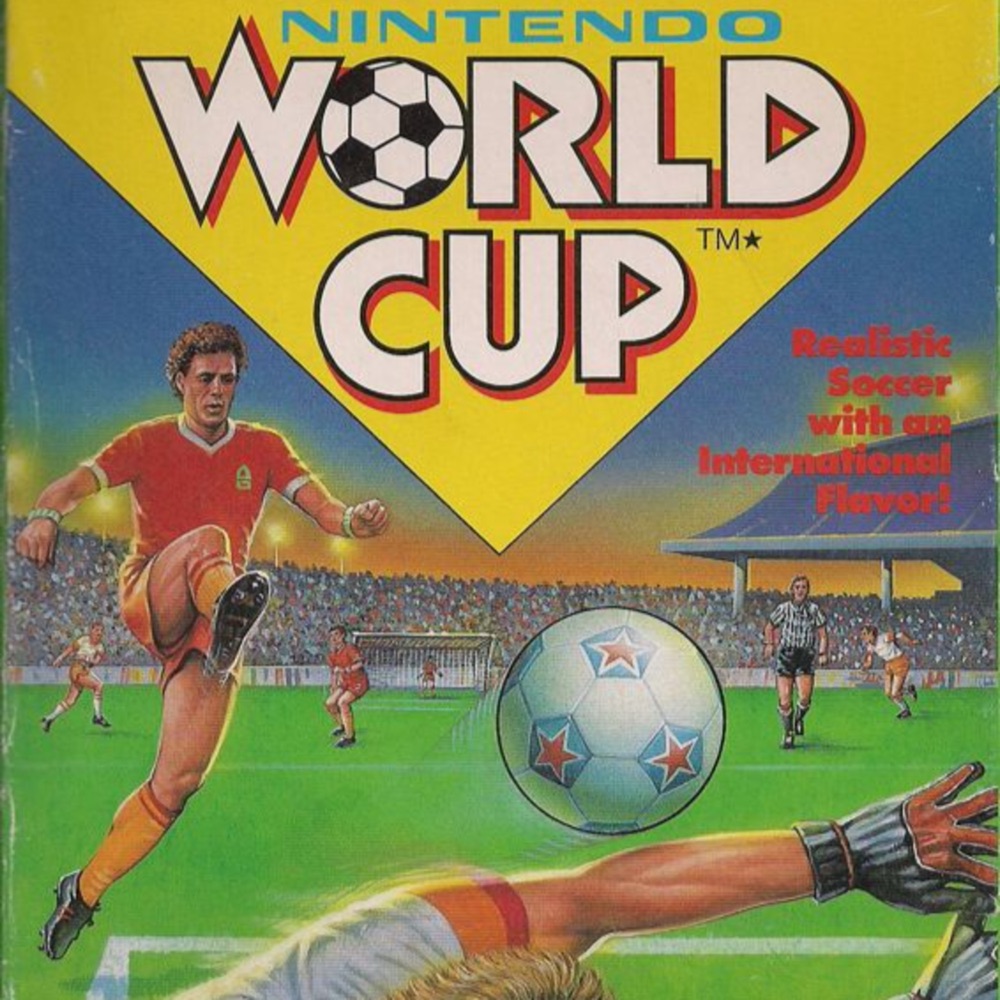
412 · Nintendo World Cup
Nintendo World Cup, released in Japan as Nekketsu High School Dodgeball Club: Soccer Story, is a 1990 soccer video game developed by Technōs Japan for the Nintendo Entertainment System. It was localized and released outside Japan by Nintendo, with a Game Boy port also being released. It is the fourth installment of the Kunio-kun series. Ports for the PC Engine and Mega Drive were also released in Japan.
The real 1990 World Cup averaged 2.2 goals a game and was famously defensive. Nintendo World Cup is five-on-five soccer with no fouls, no offsides and players who get knocked out and lie on the field. It is a Kunio-kun game from Technos Japan, the people behind the dodgeball game and River City Ransom, with the Famicom's high school story stripped out and 13 national teams swapped in. Sam and Joe were out, so this was just Mike and Sean.
The fun parts
- Violence as strategy. A knocked-out player stays down until the half ends, and nobody substitutes. That turns a match into a power play: six on five, six on two if you are ruthless enough. With no referees, nobody can dive. Scores climb well past anything real soccer produces, and every game we played was a blowout.
- Super shots. Press A and B together while shooting and each team has its own: backflips, headers, a spinning disc for the USA. They animate like the special throws in Dodgeball. You get five per half.
- Pre-match choices. Offensive or defensive, how aggressively teammates tackle, and which six players start. It is a gentle way of handing strategy to the computer. Roster stats are hidden even though the manual says players differ, so you learn by playing.
- Turf. In versus mode you can pick grass, sand, dirt or ice. Play a sand match, then go straight into tournament mode without resetting, and the sand carries over, which was almost certainly not intended.
- Four-player soccer. The box and manual push the NES Four Score and the wireless NES Satellite. We read it as Nintendo of America localizing the game to sell Four Scores while America was back in the World Cup for the first time since 1950.
The less fun parts
- One player only. You control one guy, with no switch button. We worked out why (A and B are taken) and that it is a choice, since four people can play at once.
- Cheese beats finesse. Twirling in front of the goalie nearly guarantees a goal, and a direct shot gets saved. Sean's biggest complaint is the feel: passes get intercepted, a one-timer sends the ball backward, and you end up playing the janky version to win.
- A hollow shell. We would have liked the high school tournament and its story.
Beyond the game
Versions came to the Game Boy, PC Engine and Mega Drive, and a Kunio hockey game never left Japan. Nobody ever added rules or referees, and no North American sequel followed.
The bottom line
Play it. Neither of us voted it Essential: Mike can see people remembering it fondly, but soccer is not what he wants from an 8-bit game, and Sean called it fun and not essential at all. It is better with friends, where the jank becomes part of the fun.
Written from our conversation in this episode.
- Pass. Shoot. Score! It’s world class fun
- 8. 1990 Soccer Headlines – The World Cup Behind Nintendo World Cup
- To give listeners context: what was actually happening in real-world soccer when this cart hit?
- Italia ’90 – the real World Cup
- Held in Italy, June 8 – July 8, 1990. Wikipedia
- West Germany beat defending champions Argentina 1–0 in the final on a late penalty. Wikipedia+1
- Style of play & legacy
- Widely remembered as a defensive, low-scoring World Cup (record-low 2.21 goals per game and a then-record 16 red cards). Wikipedia+1
- The tedious back-passes and negative tactics helped push rule changes like the back-pass ban (1992)
- More Important for the NES
- The USA appeared in their first World Cup since 1950, starting what’s often framed as the modern era of U.S. soccer. The Guardian+1
- 1. General Overview – NES Version
- Elevator pitch
5-a-side arcade soccer where you’re encouraged to absolutely destroy the opposition: no fouls, no offsides, players get knocked unconscious, and every team has ridiculous super shots. Developed by Technōs Japan (Renegade, Super Dodgeball, Double Dragon, River City Ransom. Localized by Nintendo from the Famicom Kunio game Nekketsu High School Dodgeball Club: Soccer Story. Wikipedia+2Kunio-Kun Wiki+2 - How funny is it that the real 1990 World Cup was ultra-defensive and low scoring, while Nintendo World Cup basically rewards you for transforming matches into demolition derbies?
- Structure & modes
- Tournament Mode: 1–2 players take a national team through a World Cup-style bracket.
- VS Match: Exhibition matches, with support for up to 4 players via Four Score / Satellite on NES. Wikipedia+2UKNESBoy+2
- Why it stands out
- Chibi Kunio-style characters, but re-skinned as national teams.
- Simplified soccer rules that prioritize chaos and accessibility.
- Couch-multiplayer focus with 2–4 player support at a time when NES sports games were often 1–2 players only. Wikipedia+2Aaltomies+2
- 2. Story & Framing – From Kunio High School to World Cup
- Original Famicom story (Nekketsu)
You’re actually playing a high school soccer story: Kunio and seven classmates in a school tournament against thirteen other schools. Full intros and story scenes exist in the Japanese version. Wikipedia+2Kunio-Kun Wiki+2 - NES localization framing
- All the school stuff is stripped.
- You now pick from 13 national teams: Argentina, Brazil, Cameroon, England, France, West Germany, Italy, Japan, Mexico, Netherlands, Soviet Union, Spain, USA. Wikipedia+1
- The “story” is simply: national teams compete in a World Cup to be number one.
- Did we need a story like Punch Out or NEStalgia Bytes Episode 15: Captain Tsubasa II: Super Striker
- Historical oddity NES roster still lists West Germany as a separate team, but real-world German reunification happened later in 1990 after the game’s release. Wikipedia+1
- Offbeat questions
- Does knowing it started as a Kunio high school tournament change how you read the aggression of the game?
- Any other West Germany equivalents in games? I remember Ukraine being a massive chunk of land in the board game Risk (from north to Greece)
- 3. Core Gameplay Loop & House Rules of Nintendo World Cup
- Basic structure
- Two halves of about 4 minutes each. GameFAQs+1
- You directly control the central midfielder; your AI teammates can be told to Pass or Shoot on command. When you’re not on screen you have to refer to the minimap field in the corner
- Major rule tweaks
- 5 outfield players + 1 keeper (6 per side), not 11. Wikipedia+1
- No offsides.
- No fouls. You can repeatedly slide, shoulder-check, or blast players until they drop.
- Knocked-out players stay down for the rest of the half, creating 6-on-3, 6-on-2 situations if you’re ruthless.
- Super shots
- Each team can perform up to five “super shots” per half.
- Each nation’s super shot behaves differently (curving, zig-zagging, bowling-ball-ing through defenders). Wikipedia+1
- High Power Kicks
- Even after all your Super Kicks have been used, you can still execute a powerful shot called the High Power Kick. To activate this kick, you must take a specific number of steps before shooting the ball with the B Button. Note that some players are naturally stronger and require fewer steps to perform a High Power Kick.
- Fields & physics
- Pitch surfaces include grass, sand, dirt, and ice, each changing player traction and ball behavior in VS Mode. Wikipedia+1
- The field-surface trick that feels like a schoolyard secret
- There’s a well-known trick/cheat: if you play a VS Match on a special surface (ice, sand, etc.) and then start Tournament Mode, the tournament can inherit that field type. It’s documented in GameFAQs cheat listings and guides. GameFAQs+1
- Offbeat questions
- Is the real “meta” here about scoring goals… or about systematically erasing the other team from the pitch?
- 4. Teams, Super Shots & Strategy
- Team identity
- While everyone shares the same chibi template, each national team has different hidden stats and a distinct super shot pattern. Wikipedia+2YouTube+2
- Japan’s team literally uses Kunio sprites from River City Ransom in NES version. Wikipedia+1
- Picking your six
- Before matches you choose which six players from a roster get fielded, even though their stats are only indirectly hinted at (you mostly learn by feel or by consulting guides). American Lucha Libre+1
- Why wouldn’t they include the stats somewhere? The manual mentions that all the players have their own characteristics.
- Formations & AI style
- You can set team strategies like offensive/defensive balance, how aggressively teammates go for tackles or shots, etc., even though this is presented in a very simple on/off menu
- Offbeat questions
- Does team choice actually matter to casual players, or is this one of those games where you just pick your country and mash shoot?
- Is hiding player stats part of the charm (learn by feel) or an unnecessary barrier to playing strategically?
- 5. Modes & Multiplayer – The Couch-Soccer Sweet Spot
- Tournament Mode
- 1 or 2 players on the same team, trying to run the bracket and win the cup.
- VS Match
- Up to 4 players simultaneously on NES with Four Score / Satellite, which was a huge hook in retrospectives and reviews. Wikipedia+2UKNESBoy+2
- Clearly Nintendo of America chose to rebrand the Kunio game for the NES so they could sell Four Scores
- Other versions
- Game Boy: portable version (Nekketsu High School Soccer Club: World Cup in Japan) based on NES rules but with some trimmed features. Wikipedia+1
- PC Engine (Super CD-ROM² & HuCard): expanded features, extra teams, CD version with arranged soundtrack and voice acting. Wikipedia+2The Cutting Room Floor+2
- Mega Drive: released in Japan as a Kunio-branded soccer game, with all teams selectable in Vs mode. Wikipedia+1
- Nekketsu High School Dodgeball Club - Soccer Story was released by Arc System Works as part of the compilation title DOUBLE DRAGON & Kunio-kun Retro Brawler Bundle for the Nintendo Switch and PlayStation 4 on February 20, 2020
- 9. The State of Soccer Games in 1990
- Where did Nintendo World Cup sit among its peers?
- Kick Off 2 (home computers, 1990)
- Top-down, fast, brutally responsive ball-control sim from Anco on Amiga, ST, DOS, etc.
- Emphasized realism and skill: no chibi sprites, no super shots, heavy focus on tactics and ball physics. MobyGames+2Wikipedia+2
- Tecmo World Cup ’90 (arcade / Mega Drive)
- Coin-op and Mega Drive football game tied to Italia ’90.
- More traditional 11-a-side approach: eight national teams, realistic top-down view, no fouls gimmicks. Wikipedia+2Codex Gamicus+2
- World Cup Soccer: Italia ‘90 / World Cup Italia ‘90 (home computers & Sega)
- Officially licensed World Cup games by Virgin Mastertronic (home computers) and Sega (Mega Drive / Master System). Wikipedia+2Wikipedia+2
- Featured real groups, fixtures, and (mostly) real player names for participating teams – a “simulation” pitch compared to Technōs’ cartoon chaos. Wikipedia+2Sega-16+2
- Offbeat question
- Does Nintendo World Cup age better because it never tried to be realistic in the first place?
- 10. Podcast Hooks & Essential Games List Segue
- “In 1990, the real World Cup was low-scoring, tactical, and often ugly to watch. On the NES, it was six-on-six chaos, flying bodies, and thunderbolt super shots.
- Glitches and “wait, that counts?” moments
- There’s a reported “own goal counts for you” trick documented as a GameFAQs cheat: positioning on your own goal line and passing can result in an own goal that is counted to your score. (This is presented as a glitch/cheat, not normal intended play.) GameFAQs
- Teams
- USA
The weird one: each USA player has a different super shot, so the team feels like a variety pack rather than one identity. GameFAQs - Argentina
Fastest (Speed 12) and built around the Boomerang shot. Also has a special bumpy-field quirk where they jump over rocks instead of tripping, which can change how that surface plays. GameFAQs - West Germany
High Speed (10), highest listed HP (70), and one of the best listed goalies (60% super-shot defense). Their ZigZag shot fits the “reliable powerhouse” vibe. GameFAQs - Italy
Speed 10 with Levitator super shot and solid goalie defense (47%). Shot-steps are high (9), so their running super feels more “planned” than spammy. GameFAQs - Brazil
Speed 6 with the Psycho super shot. Middle-of-the-road in stats but the shot personality is aggressive, making them feel like the “pick up and score” team. GameFAQs - England
Speed 5 and Stinger super shot. A nice middle pick in VS: not a stat monster, but not a liability either. GameFAQs - Holland
Speed 4 with the Waffle shot, and higher shot-steps (8) so you tend to lean on bicycles/headers or deliberate run-ups. Feels “technical” mostly because the super isn’t instant. GameFAQs - Mexico
Speed 4 with Boomerang and high shot-steps (8). It often plays like “set up the one big special” rather than constant pressure. GameFAQs - Spain
Speed 3 with Pulse. A smaller edge in speed means you feel the value of positioning and tackles more than pure outrunning people. GameFAQs - France
Slower (Speed 2), but has the lowest listed shot-steps (3) and the worst listed goalie defense (20%), so it’s a glass-cannon feel: offense is easy to trigger, defense is shaky. GameFAQs - Japan
Very slow (Speed 1) but extremely low shot-steps (3) and a Blaster-type super shot. This team tends to feel like “win via specials and brawling,” not footraces. GameFAQs - Cameroon
Also slow (Speed 1) with Pulse. In VS they can feel like an uphill climb unless you’re leaning hard into knockouts and set plays. GameFAQs - Russia
Speed 1 with the Spinner super shot. Like Cameroon/Japan, it’s more about forcing chaos than playing fast, clean soccer.
Auto-generated transcript. Each paragraph starts with its timestamp. Speakers are not identified.
Nintendo World Cup. Pass. Shoot. Score! It's world class fun! Nintendo World Cup.
And welcome to NEStalgia, a chronological exploration of every NES game released in North America. I'm Mike. And I'm Sean. And this is our first time we're recording in 2026, which is kind of timely because, Sean, there is a World Cup happening this year and in America, no less. I guess it was like a 25% chance that that was going to happen. Well, I guess not the American one. Yeah. Yeah, that's like the crazy one. Yeah. But it's also like messy. It's not really just the United States. It's technically America because it's all North America, but there's some games in Canada, some games in Mexico. Shouldn't all the games just be at MetLife Stadium and just call it a day?
Oh, I was. Actually, that's what I thought it was going to be. So you actually made me feel better in terms of traffic and amount of people. So. Yeah. No. Well, don't worry. You can still consider Airbnb-ing your apartment for this summer. For $4,000 a night? Yeah. $4,000 a night sounds about right. Okay. Now, in 1990, when this game came out, there was also a World Cup. And the real World Cup in 1990 was held in Italy. West Germany defeated the defending champions Argentina, won nothing in a final that ended on a late penalty in West Germany's favor.
And that's kind of like the story of the whole World Cup is that it was a defensive, low-scoring World Cup. There were only an average of 2.2 goals per game. And I'm like, well, 2.2 actually sounds pretty high. A lot of these games end in 1-0, right? It kind of reminds me of like the dead puck era. Yes. In hockey where, you know, everything was just 1-0, 1-1, you know. So there's the dead puck. There was also dead ball in baseball. So this was its own dead ball. Right, right. What is football's deflate gate?
There is a word that's used for like the low-scoring era. I forgot what it's called though, but it has one. I think it was in the 50s or 60s. Maybe more importantly for the 1990 World Cup though is that the United States is back in the 1990 World Cup for the first time since 1950.
So that's probably why this game is also like being licensed for the NES as like a Nintendo World Cup. Get this to North America because it's not this game on the Famicom.
No. And so there's like a push there probably to be like, well, we got to capitalize on this moment because soccer is kind of back in. And people always say that by the way, soccer is on the rise and everything. Is it really? No, I don't think it's ever truly going to be on the rise here. It's fine. Here, right. Here specifically. Yes. I mean, I think more people care about like Premier League and that stuff than they ever are going to care about like MLS. And I do think that like, you know, there is more interest in MLS these days. But if you look at the like if we're looking at as a horse race between MLS and even not even just not even NFL because that's not even a fair comparison.
But but even baseball, then I think that it's losing. It's losing track there, too. You know? Yeah. Funny you mentioned that, too, because baseball was just soccer beat out baseball in a recent poll of my favorite sports. And it was 10 percent of people's favorite sport.
So it's it's ahead of baseball now. Well, you just countered my claim. No, no. But think about this for a second. OK, so the question is, what's your favorite sport? Right. So obviously, a lot of people are saying football. Some people are saying basketball. And then it kind of gets divvied out between the rest. But I would argue that a lot of people who say football or basketball would probably say baseball is like their number two. Right. So it's like no one's saying the people who are saying soccer is their favorite are insane. And then and then like they wouldn't those same people like nobody who watches the NFL is putting soccer as their number two. They're putting it at like I forgot that this sport existed.
You know, there's got to be some word for the statistical analysis of these kinds of preferential rankings. But I think you got a speed on that one. Yeah. So let's see. Where was I going with this, though? Because oh, yeah. So the the low scoring defensive World Cup of 1990 is juxtaposed by this Nintendo World Cup video game where it is five on five arcade soccer where you're encouraged to absolutely destroy your opponents. There are no fouls. There are no offsides. Players get knocked unconscious and they just lie dead on the field. Yeah. Yes. Every team has like super shots to do like really crazy trick shots.
And it's actually in Japan. It's a Kunio Kun game. One of those the same ones who did the dodgeball and River City Ransom. This was a soccer game. I'm sorry if I say I have to say soccer going forward because if I say football, I think I'm going to confuse our primary audience. Yeah. But yeah, I apologize to the two percent of you in Brazil. You are appreciated.
So how funny is it that the real 1990 World Cup was ultra defensive and low scoring while Nintendo World Cup basically rewards you for transforming matches into, you know, demolition derbies? It's it's it's it's fun.
I'm sort of sort of thinking like, oh, if there ever was an MLS hits or an MLS blitz, then this would be it. It's just, you know, it's basically how I play FIFA. I don't really know anything about formations or how to do or how to make an approach around a defense.
So I will just spam the slide tackle button and I end up getting yellow cards left and right. This is me playing soccer with like freedom. And I think when you consider that this was part of the Cuneo series, I don't think that that's surprising to us anymore because of how we've covered it so frequently on this show with the ports and everything.
But also by now, I think in general, you know, people who bought a lot of NES games might catch on to this because the graphics are now a giveaway. They continue to use the same sprite look across all of these games. And so you do recognize that like, hey, like those are the same people from the dodgeball game or, you know, it's it's like the fact that they keep this consistent look and that they don't change even the look of the characters when they localize it. I think helps make that connection even more obvious now than just some like, you know, chubby cherub situation where it was like it was based on a manga in Japan and they changed the whole thing to Cupid. Like that was a total redesign.
For me, the thing that actually threw me off wasn't so much the style, which I think is iconic. It's just that the game itself is it's just Nintendo World Cup. Like it's not it's not saying that it's of dodgeball fame or of River City Ransom fame. It's just this generic name for a game that otherwise is a very unique look. It's very strange. Yeah, because the Famicom game had a whole like high school component to it where it was like Cuneo and his classmates are rivaling against like a bunch of other schools in a tournament. And there's like there's like a story there. The story scenes are stripped out completely.
And instead that the high school teams are replaced with, you know, 13 national teams, Argentina, Brazil, Cameroon. Yeah, I was going to ask, is Cameroon in the new World Cup? Yeah, I don't know, actually. And I did. I do have because I just wanted to see who the U.S. was playing first. And it's Paraguay. So we hate Paraguay right now. All my homies hate Paraguay. Yeah, they're next on the list.
Cameroon, though, I don't see on here. So no, probably. Well, you know who else you don't see on this list? West Germany. I don't see West Germany competing in 2026 either. Damn. You know what's funny about that is West Germany, you know, the German reunification happened later in the same year. So it's like, I think even by the time we're in December now of 1990, it's probably already happened. So the game like releases and West Germany is not even really a country anymore.
It happens, you know, like I could see, like I think we've had some Soviet stuff in the last kind of months of the NES library. So maybe, well, that's all right. It hasn't happened yet. So we'll get there. Not the same thing. But I think about like the board game Risk 2 always had like a non-realistic map where like certain countries were just like entire regions instead. And it's like, well, hold on. There's a couple of other countries, you know, like they simplify the game a little bit. But I remember like Ukraine just being a massive chunk of land going like all the way down to Greece. And it's like, I didn't know it was that big. But I guess, yeah, right.
Alt universe, Ukraine's taken over. I'm sure there's no New Zealand on the map either. Yeah, no New Zealand to even capture. That's true. I think now modern day Risk actually does do it with all the countries. But who knows? Maybe it's like, I remember also that there was times where they just didn't even label countries. It was like Northern Europe, Eastern Europe, Western Europe. That one is how I think I've played it.
Yeah. So there is no Western Europe team on here too. Anyway, the teams, it's the kind of thing where for me, when I see the team selection, I think it doesn't matter until I find out that it does. Because each of these teams has a different special shot. The one thing in this game to change the play style is that when you press the A and the B button together while taking a shot, you have the opportunity to do the super shot. And that changes depending on what team you pick. So I guess there is some strategy there. Yeah, and it also is another, like it looks exactly like the special shots in Dodgeball, like the way that they animate.
Whether it turns into like a hyper anime disc, like again, like as like a super shot in Dodgeball or as I think the United States has just like that kind of stylized spinning disc shot.
So it's another connection there. Yeah, there are people doing like backflips and hitting the ball in the air. There's the headbutts. All great stuff. The story being removed from the Famicom version of the game and just now having it be like this loose story that you have in your head of just it's the World Cup national teams competing to see who's going to win.
Does this kind of game ever need a story like how Punch Out kind of had like between rounds or between not rounds, but between different circuits, you would see the training and everything. Does it does it need a little flavor like that? It doesn't have to go like if you recall in one of our Nostalgia Bites episodes, we did Captain Tsubasa, which was like an anime soccer game with crazy cut scenes and everything. It doesn't have to go that far, but does it need a little something to drive the player?
I feel kind of like I'm missing out on this. I like when sports games go. Don't try and man in no world is this game trying to be a simulation, but it is trying to be a sports. And I really like it when sports games try to be something else.
Like that's why I've mentioned it before on the podcast. But like Blitz the League is a game in which a story, not a great story, but like it's not just a franchise mode in a football game. It is a story in which your stupid team ends up playing in a very corrupt league and all that kind of stuff. I would have liked to see the high school tournament mode in this game instead of what ends up being a kind of goofy version of soccer and having the audacity to call it World Cup when it doesn't even have offsides. I prefer the more fun cartoony version where it makes sense to play with the rules and stuff.
So, yeah, I like that kind of stuff. Yeah, for sure. And I mean, it's leaning into it in gameplay, so it might as well have it. But the core gameplay loop, we're not going to explain the rules of soccer here, but just explain how they translate soccer. We mentioned all the there are no rules thing, but there's still time. So there's about time still exists. There's two halves, four minutes each. There are five players on the field on each side. It's five V five. That is not how real soccer is. I believe real soccer is 11 on each side.
I don't think the game needed to go to that level, especially because one, it's not trying to be a sim. It is arcadey. It is fun. It is silly. I think the five on five is the appropriate way because of the sizing of the screen. They made it so that you don't have this vertical scroll in addition to a horizontal scroll because the field is so big. They kept it so that it's all just kind of, you know, it does. It does vertically scroll, obviously, but not like in a way where you can't see the immediate action in front of you.
Yeah. The other thing you only control one player on the team. So the whole time it's there's no button to like switch over. That's very strange over one of the computer. Yes, I agree. But I think they did that because they wanted to make one button a pass and one button a shoot. And because of the super shot taking A and B together, I just can't think of another button combination for them to do to give you control of another player. So all you do is, I mean, we've already solved this problem. You just sort of, oh, I see what you mean. It would also be used to pass to you.
Yes. But you could say, you could say what I thought you were going to say is when you, whoever, as soon as the computer gains control of the ball, then you become that person. Yeah. Then the pass button becomes changed person. Right. So we've done it before. I think it makes a lot more sense if you're going to have some kind of story and you're only playing as one person like canonically.
And I'm not sure how the original game plays or if that is the case. But it seems like a holdover of that. In which case, I think it would make sense if like your character is one guy. However, this is a national team and there's no main character on the national team. So I think it's weird. Right. And we know it's possible to control other characters on the field at the same time because the game actually allows up to four players at once. So it's not like there is some coding rule for why it's like you can only be this one character.
Sean, you mentioned that the knocked out players, for lack of a better word, the incapacitated players, they stay incapacitated on the field. Nobody comes to retrieve them. Pretty metal. Nobody swaps out, right, either. There's not like, okay, he's injured, so get somebody from the bench.
Now that's just where they lay until the end of the half. So that creates the, to make another hockey term here, like a power play. Basically, you could have a six on five, a six on four, a six on two situation if you're ruthless enough to take everybody else out. Yeah, I think it stops.
I think you, like, there needs to be two people on the opposing team or it wouldn't be, not that it even think, they're even thinking about fairness here. But I think it's a limit to losing three players. But still, like, they don't get back up. Like, there's no stoppage in play. So you don't get them back. I think you get them back at the half, maybe. But otherwise, it's way too, it's way too punishing if you're gonna, especially if we're playing against each other. And we just keep losing guys. I think that's just a frustration engine.
Yeah. Do you think that any of these guys are faking it? Like, they're hoping to draw a card? Hey, that's how you fix diving. You just get rid of any kind of referees. Right, right. So no, they're actually in dire pain.
And, you know, the power play component of it, I think, is actually the interesting part of it. It's one thing to incapacitate a player, but to actually change the balance of the two teams, knocking the player out and having it be like, yes, I could see it being frustrating if, you know, you're playing against somebody else and you are literally handicapped down to two people. However, I've got to think that, like, that's part of everyone's strategy is also just, like, how fast can I knock out the other guy's players? Like, maybe I don't even give a shit about the ball for a little bit and I'm just tackling everybody I can.
Spot me five goals while you try and break all their legs and then make it up on the back end. Well, that's another thing, Sean. You said spot me five goals. These games get out of hand. Yeah. They are unrealistic scoring for soccer. I know that much. I don't think I've ever seen anybody score more than seven goals in a game. I think it was that Brazil. Was it Germany? It was Germany-Brazil, that World Cup game. Do you remember that? I have never watched the World Cup.
I'm pretty sure Germany scored, like, seven goals against Brazil in, like, the first ten minutes of the game. And it was like, everybody was worried about the Brazilian team. Like, are they going to be able to come home? I don't think they would. Yeah. They're still there, right? I think it was 2016, that World Cup. Okay. Maybe 2014. Maybe 2018. Yeah. Yeah, definitely an even number.
But I haven't seen a game that high scoring. But every game of this that I played was this high scoring. Because, also, you don't even need to do special shots. You can kind of juke the goalie pretty easily just by doing little twirls in that little crease area.
And guaranteed goal. Yeah. Juking the goalie is kind of the only way, too. Because if you don't do that, the goalie will almost certainly block your shot. You know? Even a super shot? No, no. I guess I just mean, like, if you just take a shot directly at the net, like, the goalie's going to block it. Like, you need to do something with your shot in order to make it so that it doesn't just, like, there's not enough. There is no limit to how close to the net you can be, which I know is also a rule in soccer. Like, you do have to be outside of that box. Do you? Yeah, you do. I didn't think so. But okay. I think to take the shot, you do. I've seen, but I've seen, like, highlights of soccer matches where the guy's just, like, there.
That's true. Maybe there's, like, a rule of, like, because, you know, like, it's like an offsides thing. Like, you can't be parked in there. You can't be parked. You have to take the ball with you into that zone. That makes more sense. That does make more sense. It's a little important that I learn these rules before World Cup 2026. Is it? It is. Because I'm, no, I'm definitely not going to go. Have you seen those ticket prices?
But it's funny because it's, like, in our backyard and we can't, like, I can't even see it with binoculars. But meanwhile, I don't, I just feel like this is the one time to get excited about soccer for somebody who's not. I think you're right. I would say if you really want to get into soccer, you got to watch, like, the, like, didn't we just do? Conca Calf or however you say it? Like, when all the American countries kind of yell at each other? Excuse me? Look that up on your own time. I think. Conca Calf. Okay. Yeah. It's, you know, all the European people, like, are out of the way. They've got their own way to play soccer. It's when Brazil and all those teams get to, like, get to kick the shit out of the Americans and Canadians.
That's when all the fun stuff happens. The fun stuff might just be limited to beating the shit out of players and the super shots. But the super shots also have a limit. Just like you can't knock out an entire team and cause a forfeit. You can only use five super shots per half. And that's probably necessary as well, right?
Sounds pretty arbitrary considering everything else they let you get away with. But, sure, it's probably for the best. Yeah. But there are some play elements in the versus mode. If you leave the tournament, you do get the ability to play on other types of turf, not just grass. You can select between grass, sand, dirt, and ice. Each one obviously changing the traction and ball behavior. I don't think the players are more slippery on ice, but I didn't play on the ice either, so I can't confirm that.
But one neat little trick here, if you do a verse match on, let's say, the sand, and then you finish that match and go into tournament mode while the game, without ever resetting or turning it off, you will inherit that field type in the tournament mode. Wow, that sounds like a huge mistake. Yeah. I don't think it was intended, but it definitely happens. They just don't have a way to reset the field type unless you choose grass again in verse mode. I think that should sort of be a thing. If you're hosting the World Cup, you should be able to make all of the fields ice.
That should be within your right. Kind of how in the Olympics you get to pick whatever not real sports you're going to make sports just so you can get some medals. You should be able to force all of these world-class athletes to play soccer on ice. Right, right. Now, before each game, there's a couple boxes you have to tick. They basically work as on-off switches or yes-nos. Strategy. Yeah. And those strategy things of how you want to play offensive or defensive, how aggressively your teammates go for tackles versus shots.
It's a smart way, I think, of, especially to an audience that might not be too familiar with soccer, of communicating strategy to these, you know, especially for assigning to your computer, rather than having to control all of the players and executing that play style all on your own. Yeah, I mean, again, I would prefer to just be able to play as whoever, but if you're going to force me to stay locked to one guy, this is a good way to at least customize how you want to play. Instead of just saying pass to me over and over just so that you can finally take control of the game.
See you next time. And then the other thing you get to do besides setting up the strategies is you get to choose which six players from each team's roster get fielded, but there's no stats. Like, there are stats. The manual mentions that all players have their own characteristics. So why wouldn't you include the stats somewhere? Why does that have to be a mystery? You got to fill it out. You got to play it over and over.
Yeah. How many games do you how many matches do you think it would take you to figure out like specific characters to like who is who? Yeah. You know, I understand the idea of like figuring out all the different super shots across the team so that you don't just play as the USA every game. But to figure out like who that guy specifically was and where he is on the field when he's behaving that way. And if he actually moves faster or shoots harder, I don't buy that. Yeah. I mean, at least they all have specific like faces, which is nice.
I mean, I think they get like that. They're kind of duplicated between teams, but I think per team, they all have unique, unique faces so that you are right on both accounts. Yeah. So you would figure it out eventually. Like, oh, the guy that just has a huge circly eyes is probably Frank.
But I don't think that I'm paying attention enough or ever to be able to say I'm going to sub in Lucas. Right. The versus match, as I mentioned, can go up to four players. It's also one of those interesting games where you can play three player. You don't have to have either two or four. It does allow you to do 2v1 as well with the rest being computer.
But the four players simultaneously with the NES four score was a big sell of this game in all promotional material, but also in the manual. It straight up tells you to buy the NES four square four score or the NES satellite, which is basically the wireless version of the four score. I can't imagine buying a wireless controller product in, you know, back in 1990 and hoping for like a an input lag free experience. I'm sure there's no lag at all. I'm sure that it gets interfered with by a hairdryer.
But OK. Yeah. But all that to say, like, this makes a little more sense for why Nintendo of America or and Nintendo as a whole is like getting involved here and rebranding this game that they didn't even really make. You know, they're they're borrowing Technos Japan's game and saying like, hey, let's localize this and get a reason to sell the four score in America. Right. Like to do during World Cup fever. For USA is finally back. Four player soccer is where it's at.
And you just for the cozy price of buying a four score, which was probably like 50 bucks and this game, which was probably like 40 bucks or 50 bucks. You could do that. Would you? I wouldn't. But that's going to leave me to my next topic. So thank you, Sean. Is that when you don't care about the sport, right?
How how hard is it for you to get into the video game version of it? Like, obviously, you are communicating that you are barely even interested in the World Cup that's happening in your backyard, let alone, let alone like past soccer results. Like you're not about to start watching this sport. But is it as hard for you to get into the video game side of it, too? Or are you like, well, because now it's in video game form, it's a little more accessible? No, I mean, OK, I don't hate soccer. I guess like it's just low priority for me. But that's how I got into football. That's how I got into. I mean, I do like playing FIFA.
It's how I started to finally understand baseball. Like, I just like sports video games. Like, it's sort of my shtick at this point. So, no, I mean, this is fun. I liked it. Yeah. And I think in general, I'm weirdly like with soccer, I need it to not be like a sim game. Yeah. When it gets to like a full scale giant field, like you said, knowing the formations and the strategy stuff, it's like I love hockey and I can barely play the NHL games, the modern ones correctly because of just like, you know, I'm not I'm no coach.
I have no I'm just like running around, skating around on the ice, hoping that I don't, you know, that I can get over without doing an icing or something. So all that to say is like, I think for me, I can be interested in any sports game, too. But the ones that I don't the ones I'm not super familiar with, I feel like I need the the more arcadey like light on the rules version of the game. So this is way more approachable to me than the FIFA games are.
Absolutely. On the if I call it sequels and spinoffs, there was a Game Boy version of this game with just some trimmed features. But the the Cuneo version of this game also came out on PC Engine and Mega Drive, which is the Genesis in other countries. And all those things are just like expanded teams, better graphics. The CD version has an arranged soundtrack.
Nothing like nothing that changes the core experience. Nobody ever added rules. Nobody ever added referees. No one made the you know, if anything, they just made the the soccer longer, like the time and the ability to like play soccer and all that. But the the game did not like get a follow up, though, for for North America. So like while it got the PC Engine and the Mega Drive, it never got like a Nintendo World Cup, too. This didn't become like a series that Nintendo would revisit. So it maybe didn't sell that many four scores. I did see some footage of the Genesis or the Mega Drive version. It looks really good.
And maybe it's not like a true sequel slash spinoff, I guess more so spinoff. But did you like I saw footage that there's like a hockey version of this? Oh, I didn't see that. There's like a whole Cuneo hockey game and it never came to the States. So I want to play that game. Yeah. Thinking about that, it's like he got to play dodgeball. He got to play soccer. It's like, is there a baseball game, too? Like, let's get everything. That would be funny if they somehow found a way to like punkify baseball rules.
There were a lot of other World Cup games, though, that didn't, you know, for other systems, home computers, arcades, Mega Drive, that I'm not going to go like too in depth on. But just to throw out their names, there's Tecmo World Cup 1990, World Cup Soccer Italia 90, Kickoff 2. The one thing that all three of these games that I mentioned have in common is that they all go for the sim aspect where it's like, obviously, the graphics are still either 8 or 16 bit. But they have like a top-down realistic view with the 11 on 11 approach.
And they try to best give those, you know, some will have still no fouls. Others will have like, you know, different, not all the players on the field. But the idea is that Nintendo is the only one who's leaning into like this fun, chibi style of soccer that's like a little more carefree and probably better suited for video games in 1990. Like, it's great that these other ones exist for the purists. But I feel like out of all of them, from a video game fun standpoint, Nintendo gets that best. And that's why they chose what they went with for the localization.
Still feel like, again, just feel like we're missing out. Well, we might be missing out, Sean, but we won't let our listeners miss out on this final section, the essential games list.
I think Nintendo World Cup is a smart move by Nintendo. If I'm putting on like my marketing hat and everything, like, sure, soccer isn't the biggest thing. But I can totally see this from the four-player standpoint, the arcade-y nature, the quick gameplay, too. It does not take long to do one of these matches. So even playing with a friend or having multiple friends around, even if you don't have the four-score, you can kind of like quickly get in a bunch of games. I could see all that working and this being fondly remembered by the people who grew up with it. But I think that's where it stays.
I don't know if it's like – it's not even anything about the controls or anything like that. But I think it's just what I want from like a soccer game isn't going to happen on like 8-bit because I haven't even seen it happen on the modern games like I was talking about with the FIFA games. Like, I'm not sure I've found the kind of thing I'm looking for in a soccer game to like recommend it. The closest thing I can think of is maybe like, you know, Football Manager where it's like, damn, they really went all in on owning a club and building it out year over year over year.
And like that's the kind of thing that's a totally different kind of sports game but still falls into that same like scratching the itch as the simulation games of today do. So that's going to be like my recommendation having only spent minutes in those games that are supposed to be hundreds of hours is maybe start there. Sean? Yeah. I mean, I didn't dislike the game but we didn't even really get into any of the nitty gritty about like how the game feels to play. We talked a bit about the sort of like no rules.
But one thing that's really important about a sports game that this one didn't really quite hit the mark on is just how it kind of feels to play. Like, it feels kind of it feels kind of jank. Like, I feel like passing is always going to get intercepted or it's going to be some kind of it never feels like you're setting up a smooth play.
But when I try to do like a crosser or whatever like the equivalent of a one timer is it just kind of like they end up like passing it backwards and I'm and you just kind of have to go in. You have to basically play the jank version. You have to cheese the game in order to play it correctly, which I'm not a big fan of. But it's okay. It's still fun to play, but not essential at all. Yeah, I think that's a good shout out though to Sean about the gameplay feel because it again is another thing that like is probably more rewarding when you're playing with other humans as opposed to the computer because any kind of jankiness becomes more fun when playing with friends than it does against something that you can't like you can't shove.
And we're just going to keep shoving these episodes down your ears if you'll listen to us every Friday. We're still doing that somehow. I'm not quite sure, but we're nearing the end of 1990. Are you feeling it, Sean? I'm really feeling it. Good, because that was episode 162 of 1990. So we have been doing this for a few years. But you know what the end of 1990 calls for? That I have to go back and somehow remember every game we played so I can make some kind of grand judgment on the entire year as a whole?
Yes! Oh, I can't wait! Yep, it's coming up soon. But we have a few other big ones to come out first. Notably, Star Tropics and Ultima 4 and the second TMNT game. But neither of those are next week. Next week we are going to be talking about North and South. So East and West, stay out of it. We'll be right back.